

Western Europe’s unique political development remains a subject of perennial interest. Why did realm-encompassing participatory institutions arise there but not elsewhere? What factors drove European monarchs to construct administrative states? Ongoing debates within the divergence genre (e.g., “Great Divergence,” “Reversal of Fortune,” and “Political Divergence”) involve comparisons between Europe’s—typically Western Europe’s—historical trajectory and those of contemporaneous societies in East Asia, the Middle East, and beyond. Accounts for Europe’s institutional development focus on the emergence of executive constraints (Acemoglu, Johnson, and Robinson Reference Acemoglu, Johnson and Robinson2005; North and Weingast Reference North and Weingast1989), persistent geopolitical fragmentation (Mokyr Reference Mokyr2016; Scheidel Reference Scheidel2019), urban self-governance (Blockmans Reference Blockmans1994; Cox Reference Cox2017; Weber Reference Weber1968), royal power (Boucoyannis Reference Boucoyannis2021), and autonomous religious organizations (Grzymała-Busse Reference Grzymała-Busse2020; Reference Grzymała-Busse2023; Møller and Doucette Reference Møller and Doucette2022).
Recent scholarship highlights another advantageous characteristic: European rulers enjoyed longer reigns and faced lower likelihoods of deposal compared to their counterparts in the Islamic World by the early modern period (Blaydes and Chaney Reference Blaydes and Chaney2013; Kokkonen, Møller, and Sundell Reference Kokkonen, Møller and Sundell2022).Footnote 1 Long and secure reigns at the apex levels of government, in turn, facilitated institution-building, reduced the probability of civil war, and promoted economic growth (Acharya and Lee Reference Acharya and Lee2019; Blaydes and Chaney Reference Blaydes and Chaney2013; Kokkonen and Sundell Reference Kokkonen and Sundell2020). A growing body of research attributes this trend toward longer reigns among European monarchs to the emergence of primogeniture succession systems (Gorski and Sharma Reference Gorski, Sharma, Strandsbjerg and Kaspersen2017; Kokkonen and Sundell Reference Kokkonen and Sundell2014; Kokkonen, Møller, and Sundell Reference Kokkonen, Møller and Sundell2022; Sharma Reference Sharma2015; Tullock Reference Tullock1987).Footnote 2 Primogeniture, and father-to-son (FS) succession, generally, facilitated smooth power transfers and, thus, reduced the frequency of internal conflicts associated with uncertain successions. In doing so, it lengthened the tenures of rulers, even beyond the straightforward longevity advantage of a youthful accession. Primogeniture was already the dominant succession practice in most large European states by 1300 CE, after which it became even more common among great houses (Kokkonen and Sundell Reference Kokkonen and Sundell2020, 440).
Outside of Europe, primogeniture-like practices yielded longer, more secure reigns for the ethnic Han regimes of dynastic China (Wang Reference Wang2018; Zhou Reference Zhou2023), while the absence of comparable succession systems was associated with internal discord in contemporaneous Middle Eastern and Indian empires (Sharma Reference Sharma2015, 171). Stark inter-regional differences emerged over the medieval and early modern periods, along with dramatic changes in the spatial distribution of FS dynasties. That system simultaneously emerged in new areas (Western Europe, Korea, and Japan) while declining throughout the Indian Subcontinent, where it was once ubiquitous. This divergence was especially consequential, insofar as political entities that suffered from perennial succession crises and rapid leader turnover were at a disadvantage in the era of European imperialism and contemporaneous political transformations.
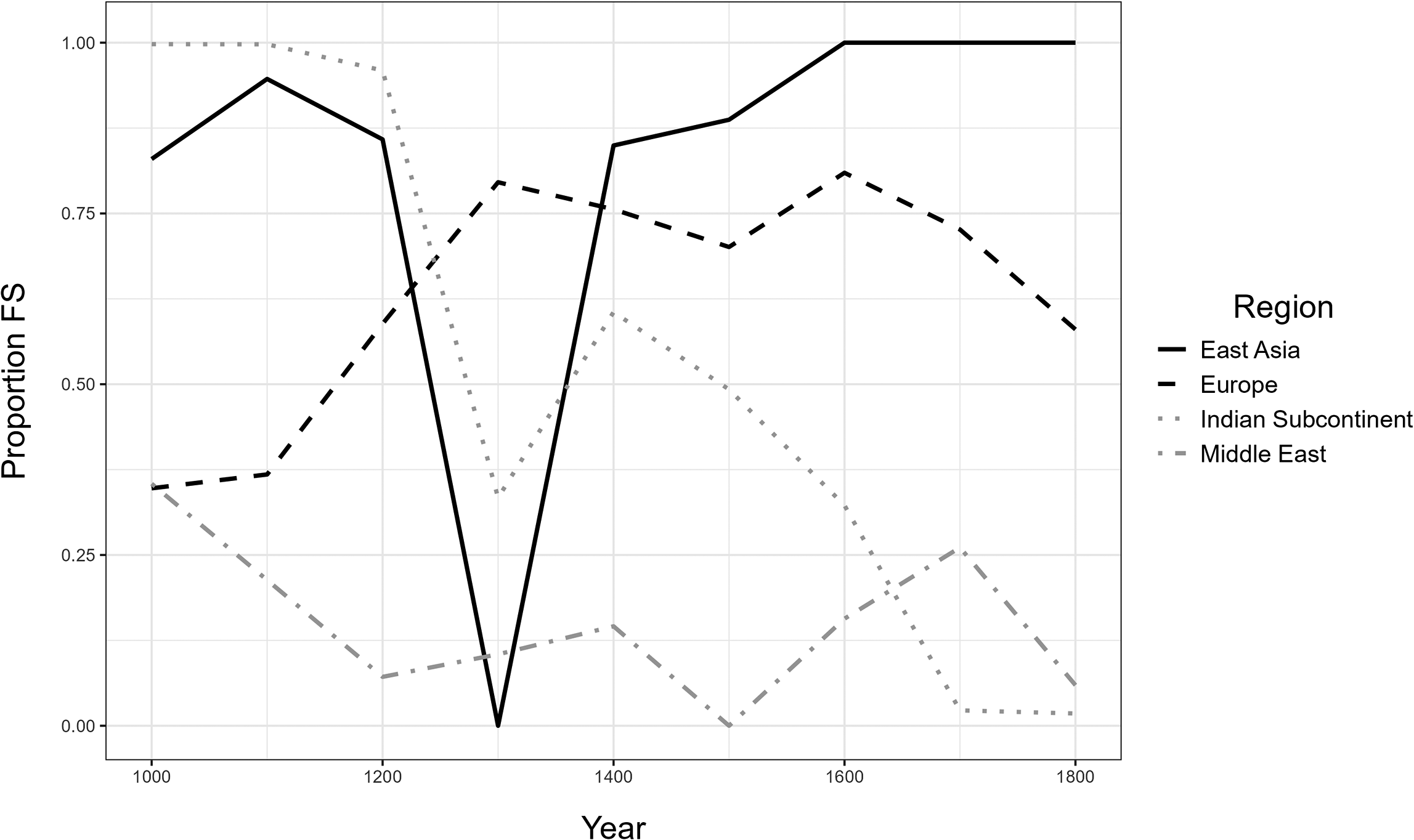
Figure 1 reports changes in the estimated population of polities relying on FS succession as a proportion of the cumulative population of all polities, by region.Footnote 3 This serves as a rough proxy for the (consequential) ubiquity of FS systems in each region—East Asia, Europe, the Indian Subcontinent, and the Middle East—at one century intervals. As is evident, the trajectories of FS succession systems varied dramatically between Eurasian regions. Most of East Asia and the Indian Subcontinent entered the second millennium under rulers benefiting from FS succession norms, while these were lacking in Europe and the Middle East. This salutary institution became dominant in Europe (prior to the French Revolution) while losing ground permanently on the Indian Subcontinent, rebounding in East Asia, and maintaining a low profile in the Middle East. These facts present a puzzle: on the one hand, FS succession conferred advantages to dynasties and their polities in terms of both internal cohesion and external competitiveness (Cecil Reference Cecil1895; Gorski and Sharma Reference Gorski, Sharma, Strandsbjerg and Kaspersen2017; Kokkonen, Møller, and Sundell Reference Kokkonen, Møller and Sundell2022; Sharma Reference Sharma2015). Yet the fortunes of that system were highly variable across time and space. What accounts for its failure, or faltering?
Prevalence of Father-to-Son Succession Systems, 1000–1800 CE

I argue that FS systems linked with long, secure reigns—favoring desirable political and economic outcomes—emerged in a variety of times and places throughout Europe and Asia, but only endured in areas insulated from conquest by Inner Asian armies.Footnote 4 Apart from Eurasia’s extremities, pursuit of military effectiveness, especially for conquest, was more closely linked to a leader’s personal qualities than to state capacity in the typical sense (i.e., effective taxation and administration). Elite mobility and conquest-oriented extraction characterized this milieu and favored succession systems that prioritized a prospective ruler’s strength, charisma, and battlefield prowess over long, secure reigns. Moreover, this military complex, which I refer to as Inner Asian cavalry warfare (IACW), expanded into domains previously characterized by “sedentary” conflict dynamics, in which FS succession conferred clear advantages. Political traditions associated with long, secure reigns fell before Inner Asian conquest elites with customs that encouraged violent struggles for high office. Geopolitical success was, in large part, a function of the ruler’s martial skills and coalition-building aptitude, even if purchased at the cost of cumulative internal capacity gains fostered by lengthy reigns and “smooth” power transfers.
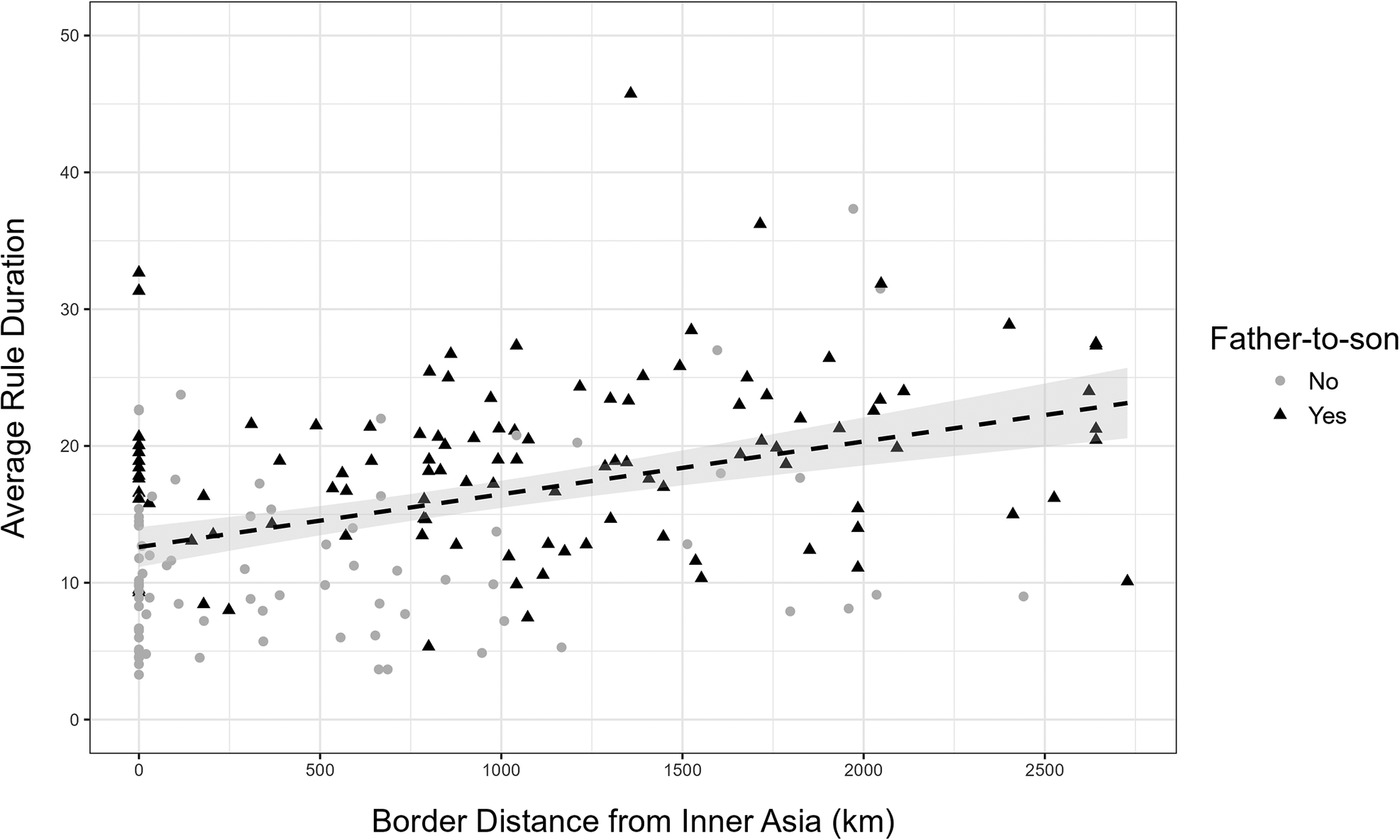
Figure 2 visualizes the basic relationships between distance from Inner Asia, succession systems, and reign duration. I obtain spatial boundaries data for most of the dynasties represented in my dataset and calculate the distance from Inner Asia using GIS software. The X-axis indicates dynasties’ shortest border distance from Inner Asia (in kilometers), whereas the Y-axis captures the average reign duration within a given dynasty.Footnote 5 Furthermore, I distinguish dynasties that, at any point, featured FS succession institutions from those that did not. This serves to highlight both the tenure-lengthening effects of FS succession and the higher proportion of FS dynasties further from Inner Asia. A pattern is apparent—rulers in a dynasty approximately 2,000 kilometers from Inner Asia could expect to reign ~50% longer than their Inner Asian counterparts. This includes European dynasties in Spain, Scotland, and England, along with Asian dynasties in modern-day Vietnam and Southern India. Rulers in dynasties 1,000 kilometers from Inner Asia (e.g., Japan, Germany, Iraq, and Northern India) still enjoyed average reigns ~25% longer than those of the Eurasian interior.
Dynastic Average Rule Duration by Border Distance to Inner Asia, 1000–1799 CE
Note: This figure reports the average ruler tenure length for Eurasian dynasties with three or more rulers plotted by shortest border distance to Inner Asia. The outlier around 1,300 kilometers is France’s Bourbon Dynasty, with Louis XIV as the longest-reigning monarch in (verifiable) recorded history.

This article advances ongoing political science debates in three ways. First, I unpack a novel theory that explains the differential survival of FS systems throughout medieval and early modern Eurasia. Hereditary succession practices associated with longer, more secure reigns emerged and endured in geopolitical contexts characterized by (relatively) immobile military elites with “stationary bandit” priorities. However, while FS practices were, ceteris paribus, beneficial to internal capacity-building and military performance, they were significantly less advantageous in areas where Inner Asian warfare was dominant. Proximity to Inner Asia increased the likelihood that a dynasty relied on coalitions of mobile, offense-oriented military elites. Maintaining these conquest juggernauts required competent adult leaders, encouraging succession practices associated with short reigns and ruler insecurity. Military success, and thus the realm’s survival, hinged on political institutions that undermined domestic capacity-building.
Beyond my specific theoretical argument, this account illustrates the explanatory power of institutional disruptions, per se—in addition to emergence and mechanisms of persistence—when engaging with macro-historical comparisons between broad cultural and geographic regions. The cadence of institutional development is a function of both generative and disruptive (even destructive) factors, some of which have a discernible systematic component.Footnote 6 In this case, the diffusion of a particular military-institutional complex disrupted previous trends in rule duration throughout Eurasia. Finally, my argument draws attention to the interactive role of geographic and political factors in shaping the distinctive institutional characters of individual regions. Europe’s unique trajectory is, itself, partially explicable in terms of pan-Eurasian dynamics in that it was spared (relatively speaking) recurrent exposure to a potent disruptive vector: Inner Asian conquerors and their armies.
I organize the manuscript as follows: first, I review prior literature on autocratic survival and its consequences, with an emphasis on succession arrangements. Succession systems that mitigate elite coordination problems and the crown-prince problem consistently yield longer, safer, and more stable tenures for autocrats. Polities with less internal strife are, in turn, more likely to prosper than those afflicted by perennial succession crises. In the second section, I develop a theory linking prevailing modes of warfare to the prospects of various succession practices. FS succession systems yielded longer reigns, conducive to internal capacity-building, economic prosperity, and geopolitical resilience, but only thrived in areas insulated from the widespread use of Inner Asian cavalry armies. In exposed domains, military capability and geopolitical survival hinged on the ruler competence, which encouraged practices that undermined internal capacity-building over the long run. The third section consists of empirical analyses that offer evidence for my macro-historical account of differential exposure to IACW, concomitant variation in prevailing succession systems, and average reign length. Finally, I discuss a few broad implications of my findings and potential avenues for future research.
SUCCESSION SYSTEMS, AUTOCRATIC SURVIVAL, AND CAPACITY-BUILDING
My argument builds on a growing body of scholarship that examines the relationship between succession systems and leader survival in autocracies. Messy power transfers—or pervasive uncertainty about an impending transfer—compel elites to engage in risky, potentially costly behaviors to secure their interests. For example, entire regimes might rely on ties of loyalty to a charismatic leader. Under such circumstances, even otherwise loyal subordinates have reason to preemptively launch a coup given uncertainty about the leader’s health, ensuring that they retain a favorable share of spoils in the future (LaPorte Reference LaPorte1969). It is no surprise that succession issues are a persistent source of instability in autocratic regimes, be they contemporary or antique (Brownlee Reference Brownlee2007; Meng Reference Meng2021). One strategy for preventing succession turbulence is to codify rules that minimize uncertainty about who is next in line and the conditions under which a power transfer will take place (Kurrild-Klitgaard Reference Kurrild-Klitgaard2000). Accordingly, autocrats often formalize succession systems in party constitutions or other statements of regime policy (Frantz and Kendall-Taylor Reference Frantz and Kendall-Taylor2014; Meng Reference Meng2021).
One consistent finding is that hereditary succession systems promote long reigns (Brownlee Reference Brownlee2007; Kokkonen and Sundell Reference Kokkonen and Sundell2014; Reference Kokkonen and Sundell2020; Sharma Reference Sharma2015; Tullock Reference Tullock1987; Wang Reference Wang2018) even if such practices often result in less competent leaders (Gray and Smith Reference Gray and Smith2023). Specifically, primogeniture and similar practices were uniquely conducive to peaceful power transfers. The theoretical logic is straightforward: primogeniture (a) facilitates elite coordination by identifying a clear successor and (b) restricts eligibility to a relatively young candidate who will likely “wait their turn” to enjoy the fruits of rule. Kokkonen and Sundell (Reference Kokkonen and Sundell2014) find support for the stabilizing effects of primogeniture succession in medieval and early modern European states. Other contemporaneous succession practices (i.e., lateral succession and election) fell short, insofar as they failed to mitigate the elite coordination problem, the crown-prince problem, or both. For example, early Polish and Russian principalities practiced agnatic seniority, in which the dynasty’s eldest male stood next in the line of succession. Identifying a clear successor in that system resolved the problem of elite coordination but not the crown-prince problem—an ambitious brother might not live long enough to lawfully take the throne given trivial age differences between siblings (Herz Reference Herz1952). Of course, a youthful heir was better positioned for a lengthy reign simply owing to their greater likelihood of acceding to office while young. Figure 3 visualizes the mechanisms linking FS succession and long tenures.
Father-to-Son Succession Systems Increase Rule Duration

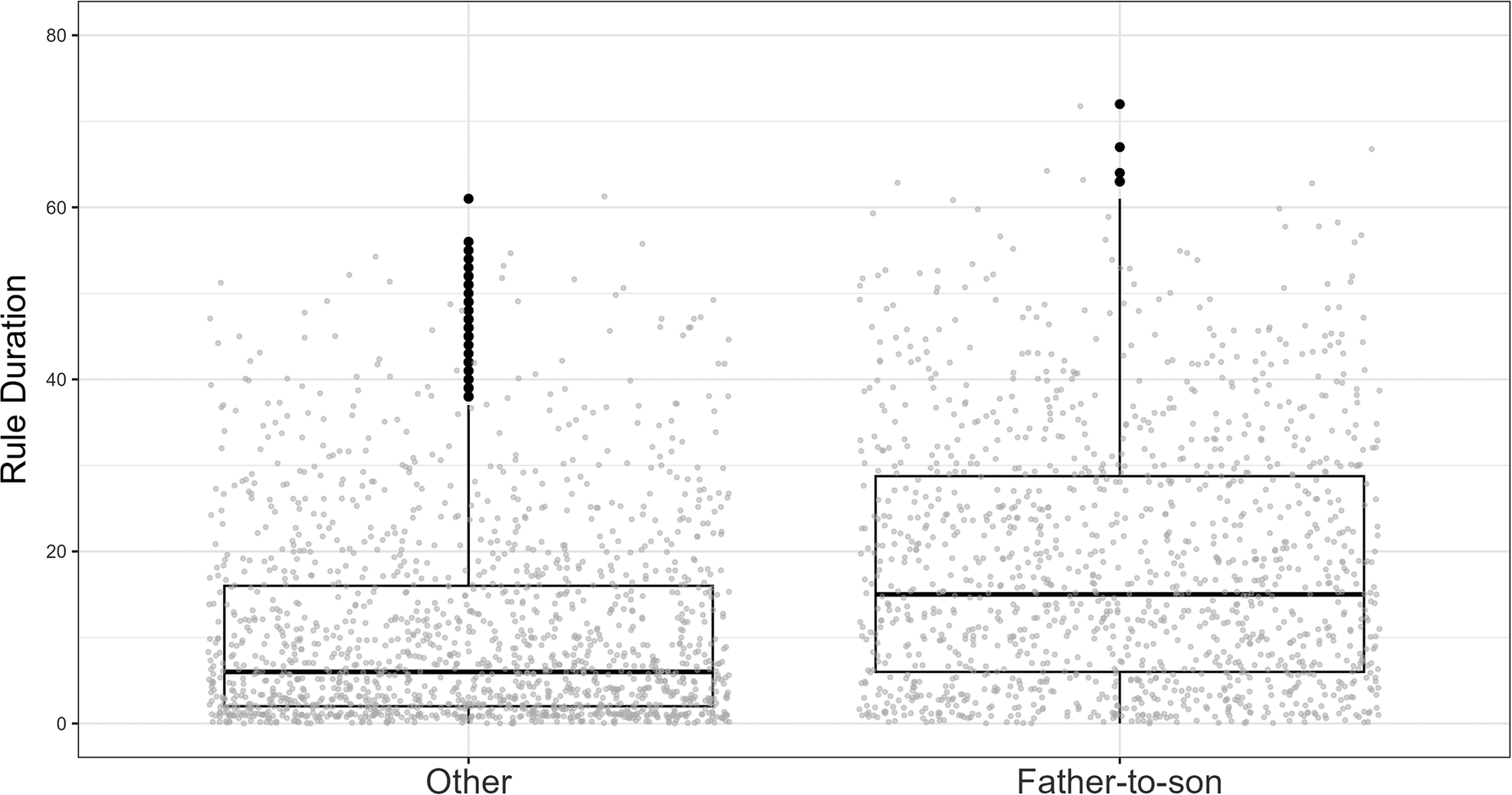
Moving beyond the European context, Nong (Reference Nong2023), Wang (Reference Wang2018), and Zhou (Reference Zhou2023) explore the consequences of succession practices in China’s Warring States and dynastic periods. Wang even finds that Chinese emperors enjoyed longer, safer reigns than medieval and early modern European rulers by virtue of their larger pool of eligible sons. While some definitional discrepancies problematize the term “primogeniture” per se, the scholarly consensus indicates that customarily identifying a (single) son as successor fosters longer tenures and greater security for rulers.Footnote 7 Kokkonen, Møller, and Sundell (Reference Kokkonen, Møller and Sundell2022) note that a variety of succession practices coexisted within medieval and early modern Islamic societies. On the one hand, the hereditary principle held sway during the early Caliphate period (c. 632–944 CE), and sons tended to succeed fathers (Kokkonen, Møller, and Sundell Reference Kokkonen, Møller and Sundell2022, 189). However, ambiguity in the successor identification process yielded chaotic power transfers that, in some cases, led to civil war. The Mamluk Sultanate of Egypt lacked a hereditary component altogether and was afflicted by frequent coups. At first glance, the available data clearly indicate a reign length advantage for rulers in Eurasian dynasties that adhered to an FS succession system. Figure 4 shows that the average reign duration for such rulers was just over 15 years. In contrast, rulers in dynasties with some other succession system only averaged about 6 years in office.
Eurasian Rulers Practicing Father-to-Son Succession Enjoyed Longer Reigns

Crucially, if unsurprisingly, longer and more secure reigns were associated with positive realm-level outcomes in the medium and long run. Acharya and Lee (Reference Acharya and Lee2019) find evidence that long reigns facilitated the development of state administrative capacity. A strong state with centralized administrative institutions was, in turn, a bedrock for future economic growth. Specifically, they contend that the availability of male heirs—suitable successors within that cultural context—corresponded with fewer succession disputes, greater opportunities for state-building, and enhanced levels of economic prosperity that persist up to the present day. This argument is consistent with an influential literature that identifies growing royal power as a key component of state formation during the Middle Ages (Boucoyannis Reference Boucoyannis2021; Spruyt Reference Spruyt1994; Strayer Reference Strayer1970). Kokkonen and Sundell (Reference Kokkonen and Sundell2014) make a similar claim: autocrats had more of an incentive to pursue costly investments with few near-term rewards—for example, enhanced administrative capacity—if they expected to still hold office when their initial investment yielded dividends.Footnote 8 The authors also identify an association between primogeniture succession systems and diminished risk of deposal by foreign actors.Footnote 9 More generally, states with primogeniture tended to outlive those using alternative succession systems. Stasavage (Reference Stasavage2020) points to succession disputes and associated short reigns as one factor responsible for weak economic performance in pre-modern autocracies, citing the Abbasid Caliphate (750–1258) as an instructive case. Perpetual conflict within the Abbasid political system led rulers to heavily invest in military force to the detriment of agricultural production in core economic regions (Stasavage Reference Stasavage2020, 188–9).
PRE-MODERN WARFARE AND INSTITUTIONAL OUTCOMES
I also engage with an influential literature addressing warfare and institution-building in medieval and early modern Europe. Charles Tilly’s (Reference Tilly1975) pithy statement, “war made the state, and the state made war,” highlights the impact of military conflict on political development according to bellicist theories. One proposition within the broader bellicist paradigm holds that persistent external threats encouraged rulers to construct institutions capable of mobilizing resources and maintaining internal cohesion (Downing Reference Downing1992; Ertman Reference Ertman1997; Feinstein and Wimmer Reference Feinstein and Wimmer2023; Mann Reference Mann1986; Tilly Reference Tilly1990). The basic logic is parsimonious: as monarchs sought to maintain control over their territories and subjugate neighboring domains, they frequently fought wars that required the support of landed nobility and extraction of resources from local populations (Ertman Reference Ertman1997; Glete Reference Glete2002; Parker Reference Parker1996). The pressures of war incentivized rulers to create more centralized and efficient administrative systems to manage these resources (Downing Reference Downing1992; Tilly Reference Tilly1990). Centralization measures included the reduction of feudal privileges and the establishment of standing armies loyal to the crown rather than to individual nobles (Brewer Reference Brewer1990; Mann Reference Mann1986). Scholars also identify a lasting association between the intensity of pre-modern warfare and institutional innovations associated with the growth of public administration (Hoffman and Norberg Reference Hoffman and Norberg1994).
A related research agenda specifically highlights links between geopolitical competition and succession systems. Historian Evelyn Cecil (Reference Cecil1895) was among the first to theorize the origins of European primogeniture amidst kingdoms and empires riven with inter-dynastic (and intra-dynastic) conflict. According to Cecil, early medieval vassals entrusted their entire domains to a single son—usually the eldest—to secure their assets amidst declining (Carolingian) imperial authority (Cecil Reference Cecil1895, 24–5). The old norm of partible inheritance entailed fragmented estates, an invitation to predatory actors. Cecil’s interpretation of the historical evidence suggests that primogeniture arose where actors experienced omnipresent threats following state collapse. This hypothesis resonates with recent scholarly accounts that cite external threats, inter alia, as a factor. Kokkonen and Sundell (Reference Kokkonen and Sundell2014, 448–9) note that monarchs in European states with primogeniture succession practices were less likely to be deposed by foreign actors by the late medieval period, illustrating a pattern consistent with Cecil’s hypothesis, but at the realm level. Moreover, Gorski and Sharma (Reference Gorski, Sharma, Strandsbjerg and Kaspersen2017, 108, 111, 121) argue that primogeniture succession norms contributed to territorial agglomeration via (relatively pacific) dynastic, not military, avenues in Western Europe.Footnote 10 In their account, primogeniture conferred a geopolitical advantage beyond simple preservation of the patrimony and might have also contributed to bureaucratic innovations associated with military effectiveness (Gorski and Sharma Reference Gorski, Sharma, Strandsbjerg and Kaspersen2017, 112–9).
Outside of Europe, FS succession practices frequently arose in contexts akin to medieval and early modern Europe, that is, competitive and fragmented geopolitical environments. Historians attest to the prevalence of FS succession systems among polities of the Indian subcontinent (Kulkarni Reference Kulkarni1974, 95; Sherwani and Joshi Reference Sherwani and Joshi1973, vol. 2, 479, 480, 481; Subrahmaniam Reference Subrahmaniam1976, 66) and feudal Japan (Hall and McClain Reference Hall, McClain and Hall1991, 146, 155; Jansen Reference Jansen2002, 45) during periods of fragmentation. For example, Japan’s Tokugawa dynasty (1603–1867 CE) retained FS customs that emerged from the Warring States (Sengoku Jidai) period, an epoch characterized by the collapse of overarching authority (Jansen Reference Jansen2002, 45). Dynasties with FS succession were less likely to be replaced by non-FS competitors, at least, further from Inner Asia.Footnote 11
The emergence of FS succession—and even eldest-son succession—was not historically uncommon, and conferred clear advantages to rulers, their houses, and their kingdoms, yet the practice did not persist in most places where it emerged. What factors enabled that system to thrive in pre-modern Europe and, with interruption, parts of East Asia, but vanish elsewhere? In the following section, I present an explanation for the continuity of FS systems in some areas and their disappearance, or disruption, in others. In brief, FS succession was less likely to survive in domains where IACW dominated. Leadership of capricious, mobile, and internally fragmented Inner Asian armies required coalition-building savvy and military competence that precluded youthful successors and all but ensured competent adult rivals.
INNER ASIAN CAVALRY WARFARE, RULER COMPETENCE, AND SUCCESSION INSTITUTIONS
The signature feature of IACW was reliance on mobile cavalry forces that afforded significant strategic and tactical advantages over sedentary forces, shaping Eurasia’s military landscape throughout the medieval and early modern periods. Historians note the ability of Inner Asian cavalry to traverse vast distances swiftly, which facilitated surprise attacks and strategic retreats throughout prolonged campaigns (Chaliand Reference Chaliand2004, 23; Gommans Reference Gommans2007, 2–13; Manz Reference Manz and Amigues2015, 1; Neumann and Wigen Reference Neumann and Wigen2018, 79–80; Vryonis Reference Vryonis1969, 260). The exceptional horsemanship of Inner Asian warriors, who were skilled riders from a young age, and the endurance of their horses, bred for stamina and resilience, underpinned this mobility (Golden Reference Golden1992, 4, 12, 138; Sinor Reference Sinor1990, 8, 9, 336, 417). Consequently, these mobile units could outmaneuver and outpace their sedentary counterparts, forcing larger infantry (or mixed) armies into a defensive posture.
The mobility and strength of Inner Asian armies yielded a distinctive political environment in societies where they dominated warfare. Specifically, rulers maintained the loyalty of military elites through constant conquest-oriented warfare; their hold on supporters waxed and waned based on the vicissitudes of combat and attractiveness of rival patrons. To understand why offensive military exertion was critical to the survival of rulers and domains, we need to examine two aspects of Inner Asian warfare that stem from mobility: offensive advantage and military elites’ high exit capacity.
I use the term offensive advantage in reference to the “offense–defense balance,” which Glaser defines as “the ratio of the cost of the offensive forces the attacker requires to take territory to the cost of forces the defender has deployed” (Glaser Reference Glaser2010, 43). This ratio is, in turn, a function of the system’s underlying technological and geographic characteristics. A state system partitioned by imposing mountain ranges and numerous wide rivers will have a higher ratio than one characterized by flat terrain with few geophysical or land cover obstructions. Likewise, the ratio is lower in settings where offensive military technologies (e.g., siege artillery) render existing defensive technologies obsolete. In offense-dominant contexts, states accrue territorial gains more easily after early successes (Hopf Reference Hopf1991, 485; Van Evera Reference Van Evera1998, 14–5). Thus, an initial power advantage, even a marginal one, is more likely to result in a positive-feedback loop of accelerating resource accumulation and further conquests (i.e., a “snowballing” dynamic). In contrast, states in defense-dominant settings face higher marginal costs with successive territorial gains. The absolute resource advantage of an overextended state might not be sufficient to overcome a weaker neighbor’s defenses. Aspiring conquerors incurred territorial losses—or refrained from certain expansionary actions—because the costs of quelling local resistance exceeded gains from expansion.Footnote 12 They faced an insurmountable “loss-of-strength gradient” (Boulding Reference Boulding1962, 229–31).
Inner Asian warfare closely fits the theoretical ideal of offense advantage, whereas sedentary realms more closely approximate the defense advantage archetype. For one, the costs of offensive action were relatively low, owing simply to the strategic and tactical advantages of IACW. Large forces could strike at the hearts of sedentary domains—whether held by local elites or other Inner Asian elements—overwhelming scattered defensive forces. The promise of collectively attainable riches allowed aspiring conquerors to muster military elites into large confederations and carve out whole polities (Barfield Reference Barfield1989, 5; Reference Barfield2010, 10, 235; Kradin Reference Kradin, Nikolay, Dmitri and Thomas2003, 74, 84; Manz Reference Manz2021, 94–5). Coalitions grew further after early successes, as these signaled the endeavor’s viability (Wink Reference Wink2002, 50–1). Thus, we see the positive returns to scale associated with offensive advantage military environments, but further magnified by elite defections to capable conquerors. The “snowballing” accumulation of forces within Inner Asian coalitions was further enabled by the fact that military elites were able to change patrons with relative ease (Bosworth Reference Bosworth and John1968, 112, 200; Chaliand Reference Chaliand2004, 30; Kradin Reference Kradin, Nikolay, Dmitri and Thomas2003, 84; Manz Reference Manz and Amigues2015, 130, 145; Rossabi Reference Rossabi, Franke and Twitchett1994, 118), given the inherent mobility of Inner Asian pastoralists. The common project of exploiting sedentary domains held together alliances, confederations, and whole empires. On the other hand, extraction-oriented political alliances were liable to collapse when conquerors (or their successors) failed to deliver (Barfield Reference Barfield2010, 10, 85; Bosworth Reference Bosworth and John1968, 15; Kradin Reference Kradin, Nikolay, Dmitri and Thomas2003, 74, 84). Victories compounded, as did defeats. Conquest polities were liable to decline after exhausting extractable resources or encountering effective resistance, only to be replaced later by new coalitions with a critical mass of support.
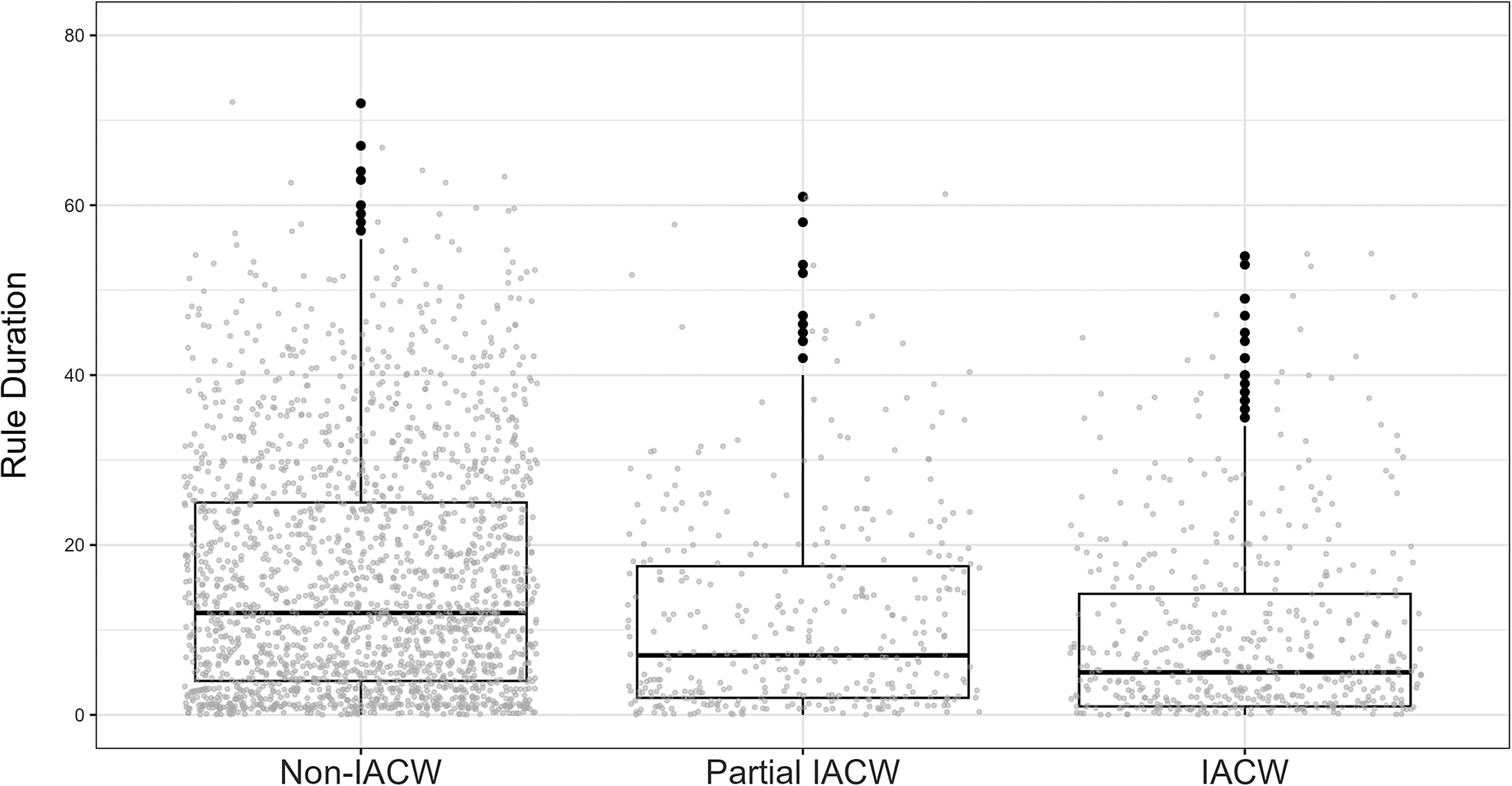
Military effectiveness and, hence, geopolitical survival, necessitated capable adult leaders with the personal charisma, proven martial talents, and political art needed to meld mobile fighting elites into a conquest polity. Accordingly, succession institutions tended to produce both competent military leaders and powerful adult rivals. On the one hand, ease of defection meant that allies—especially relatives—required placation with resources and autonomy. Inner Asian succession practices prioritized lineage in determining legitimate heirs to a leadership position, as was the norm in pre-modern societies (Barfield Reference Barfield1989, 24–6; Golden Reference Golden1992, 10, 293; Kradin Reference Kradin2002, 84). In many instances, succession followed the lateral principle, where power is transferred from brother to brother or to the deceased ruler’s eldest male relatives before passing to the next generation (Kafadar Reference Kafadar1995, 4–5; Khazanov Reference Khazanov, Khazanov and Wink2001, 4–5). The absence of more specific eligibility constraints exacerbated uncertainty and fostered intrigue among the ruling elite, while the practice of corporate dynastic rule fomented succession crises and even rebellions against precocious centralization efforts, especially following a ruler’s death (Barfield Reference Barfield1989, 5; Manz Reference Manz1999, 129; Petrushevsky Reference Petrushevsky and J.A.1968, 496; Rogers Reference Rogers2012, 241; Rossabi Reference Rossabi, Franke and Twitchett1994, 546; Subtelny Reference Subtelny1988; Turan Reference Turan, Holt, Lambton and Lewis1970, 254). Figure 5 indicates that rulers reliant on IACW forces saw shorter reigns than their counterparts in mixed or non-IACW systems.Footnote 13 Recent political science entries highlight this pattern in the case of dynastic China, where nomadic rulers enjoyed relatively brief reigns compared to their ethnic Han counterparts (Kokkonen, Møller, and Sundell Reference Kokkonen, Møller and Sundell2022; Wang Reference Wang2018).
Rule Duration by IACW Score
Note: The first category, “Non-IACW,” corresponds to rulers in dynasties not reliant on Inner Asian cavalry forces. Likewise, “Partial IACW” includes rulers in dynasties reliant on a mixture of IACW and non-IACW forces, while “IACW” indicates full reliance.

Dynasties reliant on semi-nomadic or non-nomadic IACW elites—for example, the early Ottoman Empire, the Ghaznavids, the Ghurids, and the Mamluk Sultanate—occupied an intermediate space between those characterized by reliance on purely pastoral and purely sedentary military elites. Yet they faced many of the same dynamics that encouraged non-FS succession. Inner Asian military elites’ limited, though substantial, mobility and raiding prowess allowed them to act as “free agents” even without a pastoral-nomadic economic base (Jackson Reference Jackson2003, 253). In fact, IACW took on a mercenary character throughout much of the Middle East and Indian Subcontinent, where institutionalized reliance on Inner Asian slave-administrators and hired swords (i.e., Mamluks/Ghulams) yielded a similar political climate to that of nomad-dominated realms. Non-nomadic regimes permeated with these IACW elites often fell to usurpers (e.g., Egypt’s eponymous Mamluk Sultanate) or fractured (e.g., the Ghaznavid and Delhi Sultanates) as conquest-oriented commanders sought independence from erstwhile masters (Blaydes and Chaney Reference Blaydes and Chaney2013, 91; Pipes Reference Pipes1981, 23).
On the one hand, IACW rulers survived about as long in office as those with neither IACW reliance nor FS succession practices. Yet, unlike the latter, polities that deployed Inner Asian cavalry could reshape the institutional makeup of whole regions by virtue of their exceptional military capabilities, even if they were no more prone to succession turmoil. This quality, martial prowess, enabled IACW conquerors to export violent, and often ruinous, succession practices into areas previously characterized by long reigns and stability.
INNER ASIAN WARFARE AND INSTITUTIONAL CHANGE IN MEDIEVAL AND EARLY MODERN EURASIA
Prior scholarship focuses on the emergence of FS systems in Europe between 1000 and 1800 CE. What accounts for the disappearance or interruption of that institution in the Middle East, Indian Subcontinent, and China (inter alia) over that period? I argue that FS dynasties were more likely to survive in areas far from the domains of IACW. Further from Inner Asia, the long and secure reigns cited in previous scholarship were more likely to confer a systematic advantage against rivals (Gorski and Sharma Reference Gorski, Sharma, Strandsbjerg and Kaspersen2017, 108, 111, 121; Kokkonen and Sundell Reference Kokkonen and Sundell2014, 448–9). At the very least, internal stability was consonant with political and military competitiveness. Yet any advantages associated with FS systems were outweighed by the demands of personalistic coalition-building where Inner Asian cavalry armies held sway.
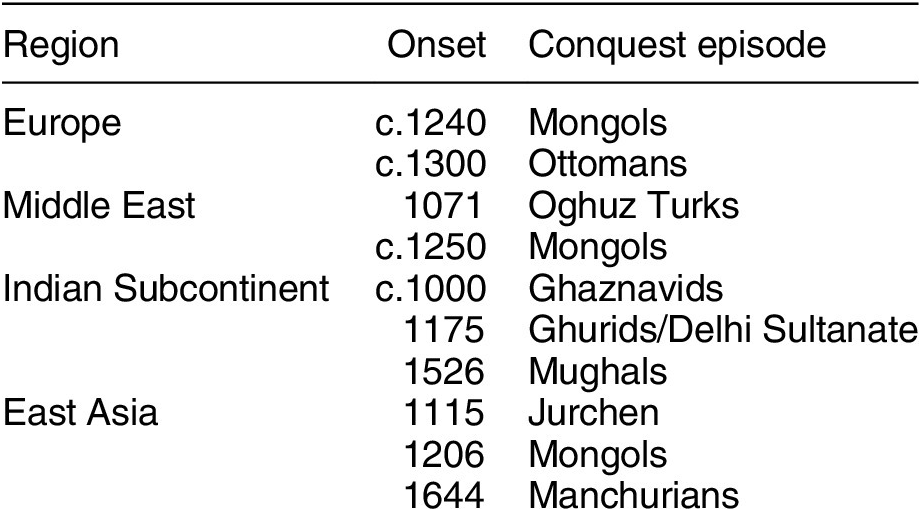
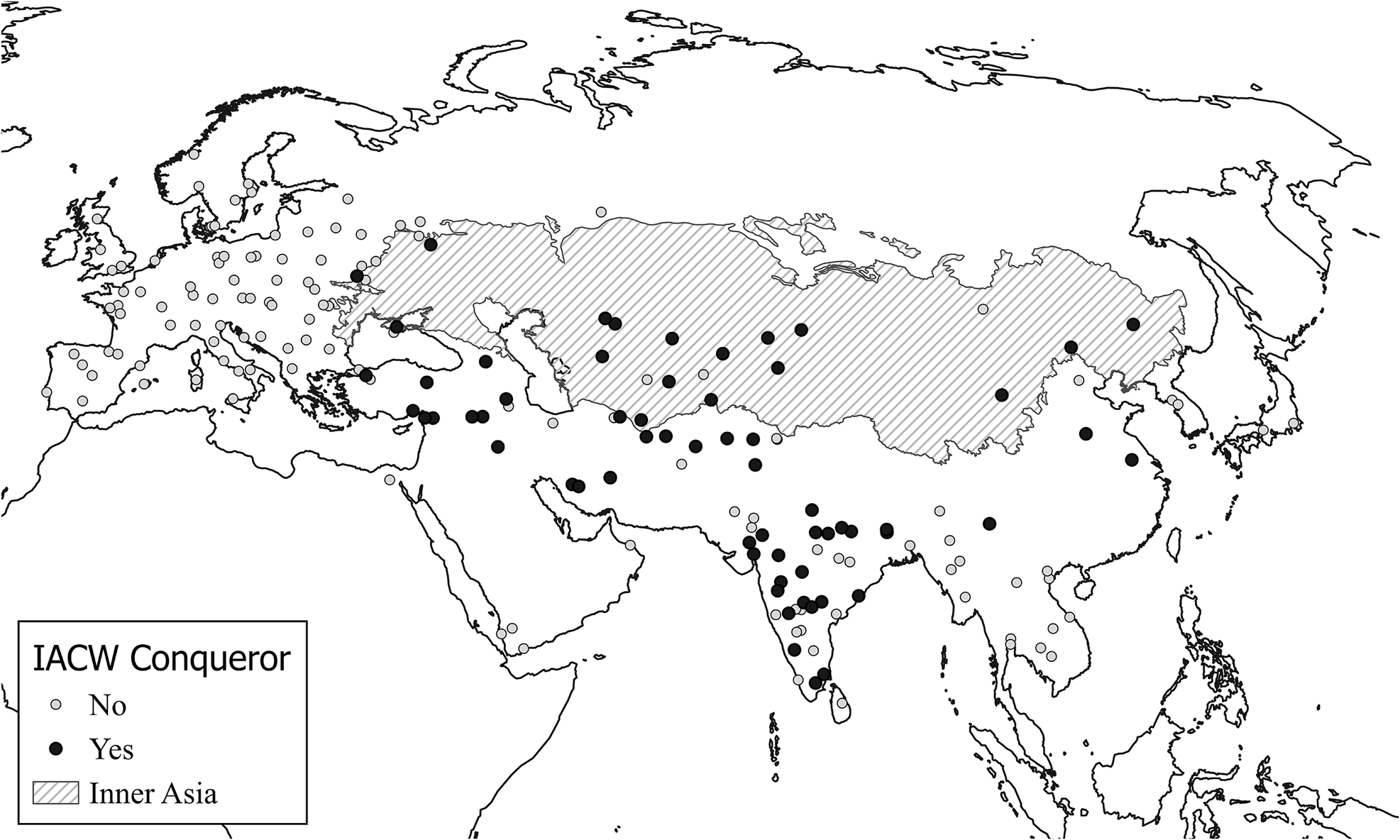
Inner Asian elites and their successors supplanted regimes and destroyed polities across Europe, the Middle East, the Indian Subcontinent, and East Asia throughout the second millennium. Each of these regions faced multiple conquest episodes (Table 1) that introduced IACW, along with fractious conquest dynasties. Invasion episodes inaugurated extended periods of domination by powerful successor states that also rested on the strength of Inner Asian armies. The Ottoman Turks, Egypt’s Mamluk regimes, and India’s Delhi Sultanate emerged following the dissolution of earlier conquest empires and extended the domain of Inner Asian warfare even further from Eurasia’s heartlands. Figure 6 shows the political cores (e.g., initial capital, founding location) of dynasties from my sample that were conquered by IACW entities. As we might expect, conquest events involving IACW aggressors were mostly clustered within and around Inner Asia.
IACW Conquest Episodes in the Middle East, Indian Subcontinent, and East Asia

Locations of Dynasties Conquered by IACW Entities, 1000–1799 CE
Note: Dynastic core locations are based on information derived from Truhart (Reference Truhart1996) and secondary historical sources.

DATA AND ANALYSES
I extract data on Eurasian dynasties and polities from Peter Truhart’s (Reference Truhart1996) Historical Dictionary of States. Footnote 14 Information on the tenure of European rulers is available in replication files for Kokkonen and Sundell (Reference Kokkonen and Sundell2014), which I combine with Asian ruler details recorded in Tapsell’s (Reference Tapsell1983) Monarchs, Rulers, Dynasties, and Kingdoms of the World. Together, these sources provide thorough coverage of dynasties and rulers in major sovereign or semi-sovereign polities across Eurasia between 1000 and 1799 CE.Footnote 15 Moreover, I code dominant succession systems based on secondary sources that describe dynasty and polity-level institutional characteristics. Supplementary Appendix A includes ruler-level empirical analyses that highlight reign-lengthening and security-enhancing effects of FS succession practices throughout Eurasia between 1000 and 1799 CE (Supplementary Appendix Tables A1 and A2). The basic format of the core dataset is dynasty-century, with each observation corresponding to a given dynasty during the first year of a given one-century time interval (1000, 1100, etc.). I compute spatial variable values for each observation based on borders in a dataset that combines boundary information from Euratlas Periodis (Nüssli Reference Nüssli2011), Geacron (2011), Droysen’s (Reference Droysen1886) Allgemeiner Historischer Hand-atlas, and other historical atlases.
I report results for several models that estimate the effects of IACW reliance on succession systems and IACW conflict exposure on dynasties’ likelihoods of conquest by external actors without FS succession practices. My first explanatory variable, IACW Score, takes a value of 2 if a dynasty relied overwhelmingly on Inner Asia modes of warfare at a given century outset, a value of 1 if its military forces were a mix of IACW and non-IACW elements, and a value of 0 if it was overwhelmingly non-IACW in composition.Footnote 16 Score values are based on a variety of secondary sources, many of which also provided details on succession institutions, which are listed in Supplementary Appendix D. Dynasty-century observations with higher IACW scores should be less likely to feature FS succession systems, all else equal, given the relative priority of a ruler’s leadership and martial capabilities. The second outcome variable, which I refer to as Non-FS Conquest, indicates whether a non-FS enemy conquered that dynasty at any point between times t and t + 1 (e.g., 1000 to 1099). I define conquest as a violent incursion resulting in the termination or eviction of the erstwhile ruling dynasty, coding observations based on dynastic summaries provided in Tapsell (Reference Tapsell1983) and additional sources.
My second explanatory variable, logged IACW Battles, equals the (logged) count of land conflict events in which one or more belligerents relied, at least partially, on Inner Asian cavalry forces. More specifically, I associate an eligible conflict event with a given dynasty-century observation if it occurred during the ensuing century interval and was located within 250 kilometers of the corresponding polity’s border.Footnote 17 I construct this variable using an augmented version of Miller and Bakar’s (Reference Miller and Bakar2023) Historical Conflict Event Dataset, which includes latitude and longitude coordinates for recorded battles since 1468 BCE based on an oft-used secondary source, along with siege incidents referenced in Chandler and Fox (Reference Chandler and Fox2013).Footnote 18 A greater number of IACW battles corresponds with an increased risk of dynastic conquest and replacement by a non-FS dynasty with succession institutions adapted to an IACW environment. My argument also holds that FS succession moderates the relationship between IACW conflict and non-FS conquest. Competitive advantages associated with tenure-lengthening FS succession systems were outweighed by the martial potency of IACW. That mode of warfare joined tumultuous power transfers and battlefield success. I include a Father-to-Son dummy that takes a value of 1 if FS succession was a dominant (if not exclusive) custom, and 0 otherwise.
I also include several covariates that plausibly modify the likelihood of conquest and, by extension, conquest by actors with non-FS succession practices. One possibility is that the intensity of inter-state strife, generally, poses a threat to all polities, regardless of the specific mode of warfare. In that case, a greater number of conflict events—greater intensity of conflict—should correspond to a higher probability of any conquest. I incorporate an Inter-State Battles measure that equals the (logged) count of all inter-state conflict events within 250 kilometers of a polity’s boundaries during a given century interval. Likewise, dynastic turnover via conquest was more likely given pre-existing tendencies toward domestic infighting. I include the frequency of Intra-State Battles, coded identically to inter-state battles, but for conflict events between factions within a single polity.
I also include covariates that capture demographic and geophysical properties of polities for corresponding dynasty-century observations. The first is Population Proportion, which equals the estimated population of a polity as a proportion of the total region population at the outset of a century. These estimates are based on spatial data generated by the HYDE project (Ellis et al. Reference Ellis, Nicolas, Kees, Rebecca, Nicole, Sandra and Dorian2021). The measure provides a dynamic estimate of (sedentary) relative material capabilities. I argue that the association between distance from Inner Asia and rule duration is a function of exposure to IACW. Yet other geographic, climatic, or cultural factors besides prevailing modes of warfare might explain the differential survival of dynasties. Historians observe that Inner Asian armies retained logistical advantages in arid zones connected to, but distant from, the Eurasian interior but faced difficulties operating in mountainous and forested terrain (Gommans Reference Gommans2007, 6; Lieberman Reference Lieberman2009, 93; Scheidel Reference Scheidel2019, 276). Accordingly, I include an Open Terrain variable that takes a value between 0 and 1 depending on the estimated proportion of a polity’s terrain composed of grasslands or open shrubland, along with a Terrain Elevation measure.Footnote 19 Furthermore, I control for Warm Water Coast access and a dynasty’s Core Latitude. Finally, institutions that promote internal harmony are, perhaps, more likely to emerge in areas with an extensive history of rule under state-level administration.Footnote 20 I include a (logged) State History variable with values equal to the number of centuries a dynasty’s core was controlled by “state-like” entities (i.e., not cultural spheres or tribal confederations).
First, I present quantitative evidence for my claim that IACW reliance tends to yield succession systems prioritizing political savvy and martial prowess in leaders. Customs that yield young, unseasoned rulers are less likely to emerge and endure in an IACW milieu. The initial analyses are linear probability (LP) models of the base specification with $ {y}_{ipjt} $
as the dichotomous FS succession dummy associated with a dynasty
$ {y}_{ipjt} $
as the dichotomous FS succession dummy associated with a dynasty $ i $
in polity
$ i $
in polity $ p $
, region
$ p $
, region $ j $
, and century
$ j $
, and century $ t. $
I include both region fixed effects (
$ t. $
I include both region fixed effects ( $ {a}_j\Big) $
and century fixed effects (
$ {a}_j\Big) $
and century fixed effects ( $ {\delta}_t $
) for all specification variants along with the IACW score and a normally distributed error term (
$ {\delta}_t $
) for all specification variants along with the IACW score and a normally distributed error term ( $ {\varepsilon}_{ipjt}\Big) $
:
$ {\varepsilon}_{ipjt}\Big) $
:
 $$ {y}_{ipjt}={a}_j+{\delta}_t+\beta \hskip0.35em \ast \hskip0.35em {IACW\ Score}_{ipjt}+{\varepsilon}_{ipjt}. $$
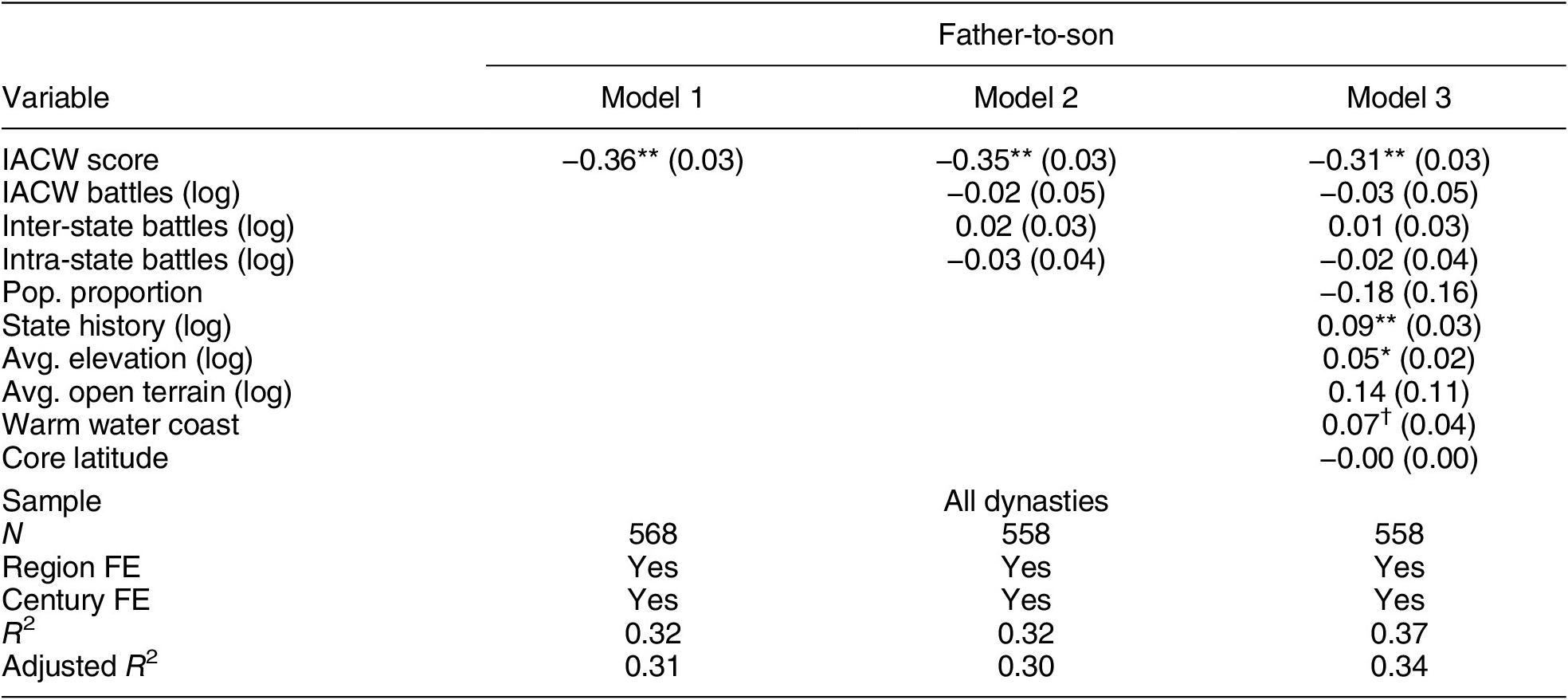
Table 2 reports the results of three model specifications. Model 1 tests for a bivariate relationship while controlling for region and century-interval fixed effects, whereas Model 2 introduces conflict indicators. Model 3 adds polity-level and geographic controls. As expected, there is a statistically significant negative relationship between IACW Score and FS succession systems. The IACW Score coefficients range between −0.31 and −0.36, indicating that an additional one-level increase in IACW Score is associated with an (approximately) 30% decrease in the likelihood of a dynasty using FS succession at the outset of a given century. Tables A3 and A4 in the Supplementary Material report consistent results using fixed effects and instrumental variable approaches. Specifically, I use border distance from Inner Asia as an instrument for the IACW score, finding support for a causal interpretation.
Linear Probability Models: Reliance on Inner Asian Cavalry Warfare Is Negatively Associated with Father-to-Son Succession Systems

Note: Numbers in cells are OLS coefficients with robust standard errors in parentheses. Standard errors are clustered by region and century interval. †p < 0.10; *p < 0.05; **p < 0.01.
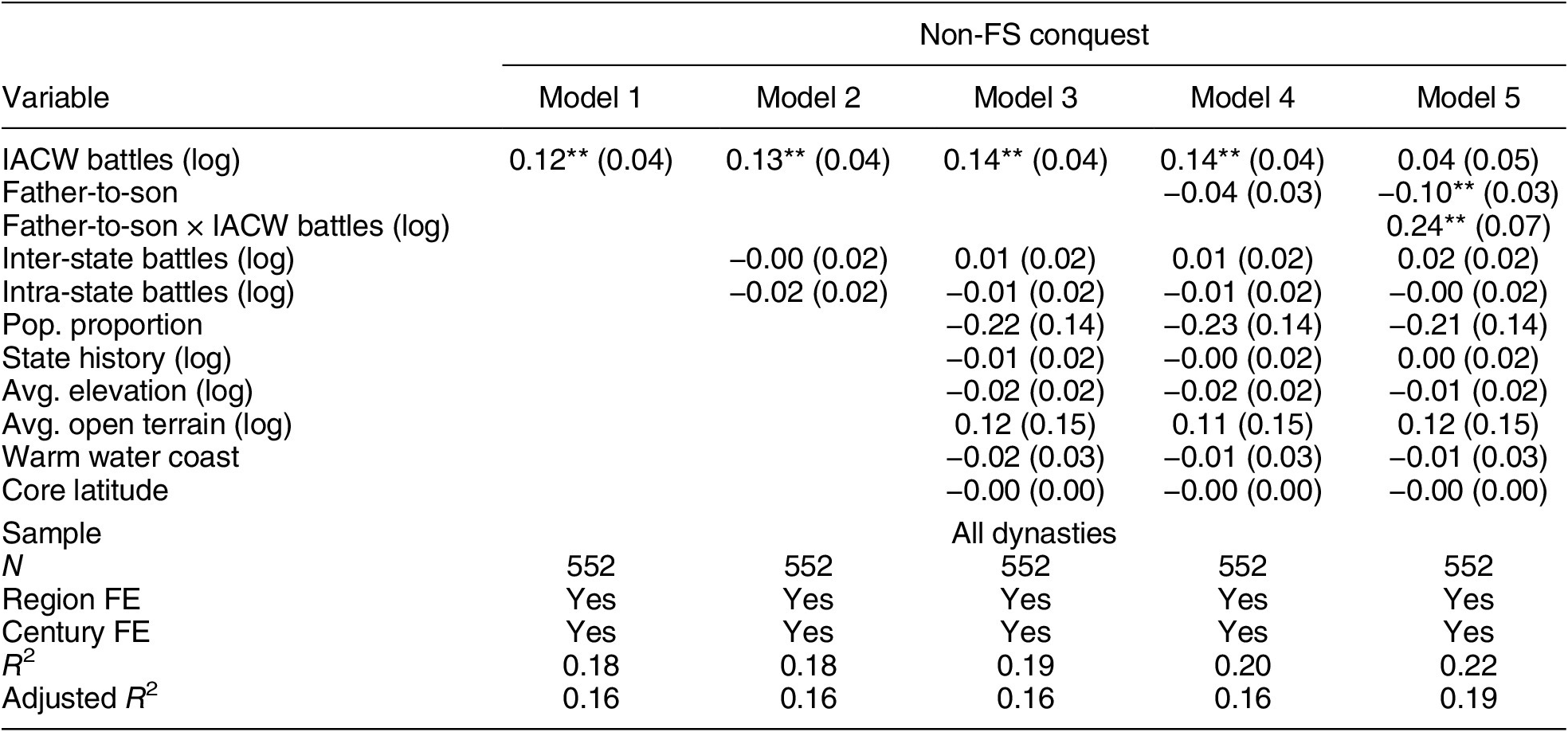
My argument also highlights a geopolitical mechanism for changes in the distribution of FS succession systems. IACW dynasties conquered and replaced their non-IACW rivals (or targets) practicing FS succession. The distinctive military capabilities of IACW dynasties overcame any advantages associated with long tenures and pacific power transfers. Table 3 reports the results of five LP model specifications. Model 1 tests for a bivariate relationship between IACW conflict and non-FS conquest, with region and century-interval fixed effects, whereas Model 2 introduces other conflict indicators. Model 3 adds polity-level and geographic covariates. Models 4 and 5 incorporate the FS succession dummy and a term for the interaction of FS succession and (logged) IACW Battles count, respectively.
Linear Probability Models: Inner Asian Cavalry Warfare Conditionally Predicts Non-FS Conquests

Note: Numbers in cells are OLS coefficients with robust standard errors in parentheses. Standard errors are clustered by region and century interval. †p < 0.10; *p < 0.05; **p < 0.01.
As expected, there is a statistically significant relationship between the (logged) count of IACW battles and non-FS conquest events. The IACW battles coefficients range between 0.12 and 0.14 in specifications without the interaction term, indicating that one additional log unit increase in IACW battles is associated with an (approximately) 12%–14% increase in the likelihood of conquest by a non-FS dynasty during the ensuing century interval. For reference, a one-log-unit increase from zero IACW battles corresponds to observations such as Middle Eastern dynasties subjected to the Mongol invasions.
Model 5 coefficients are consistent with my overarching account, insofar as the presence of an FS succession system was associated with diminished likelihood of conquest by a non-FS dynasty, conditional on the absence of IACW conflict. The interaction term itself indicates a substantively and statistically strong moderating effect in which IACW conflict increased the likelihood of non-FS conquest for FS dynasties. The IACW battles coefficient lacks statistical significance, perhaps indicating that sedentary non-FS dynasties were chronically vulnerable to non-FS conquest regardless of the prevailing warfare mode.
The Supplementary Material includes results for additional tests and robustness checks. First, I report supporting evidence for a relationship between IACW conflict and non-FS conquest, as conditioned by succession institutions, using a fixed-effects approach (Supplementary Table A5). Second, the baseline models rely on region delineations that are plausibly endogenous to Inner Asian conquest patterns. Moreover, aggregate statistics are partially a function of unit shape, size, and configuration—a “modifiable areal unit problem” (Manley Reference Manley, Manfred and Nijkamp2021). I address these threats to validity by constructing three Eurasian “pseudo-regions” that partition the landmass without reference to political or geographic features (Supplementary Tables B4 and B5). The results are essentially identical to those obtained using standard regional divisions of Eurasia. Likewise, the spatial distribution of outcomes might cluster in ways that standard confidence measures do not account for. I re-estimate the original model specifications using Conley standard errors that account for dependencies over time and space. The results, reported in Tables B6 and B7 in the Supplementary Material, are fully consistent with those of my baseline models.
Taken together, these results support my contention that the expansion, contraction, or absence of IACW helps explain changes in the distribution of FS succession systems between 1000 and 1799 CE via dynastic attrition and replacement. Exposure to more IACW conflict events predicts conquests in which non-FS dynasties replaced those with FS succession practices. FS systems tended to proliferate wherever they emerged in the absence of Inner Asian modes of warfare, a vector for political conditions that prioritized competent military leaders at the cost of long, secure reigns. The emergence and consolidation of European primogeniture is an exceptional case, as described by prior scholarship. Elsewhere, the geopolitical environment associated with IACW penalized FS systems while favoring “bloody tanistry” and other cutthroat norms that diminished autocratic longevity and security.
INNER ASIAN WARFARE, CONQUEST, AND AUTOCRATIC SURVIVAL: ILLUSTRATIVE CASES
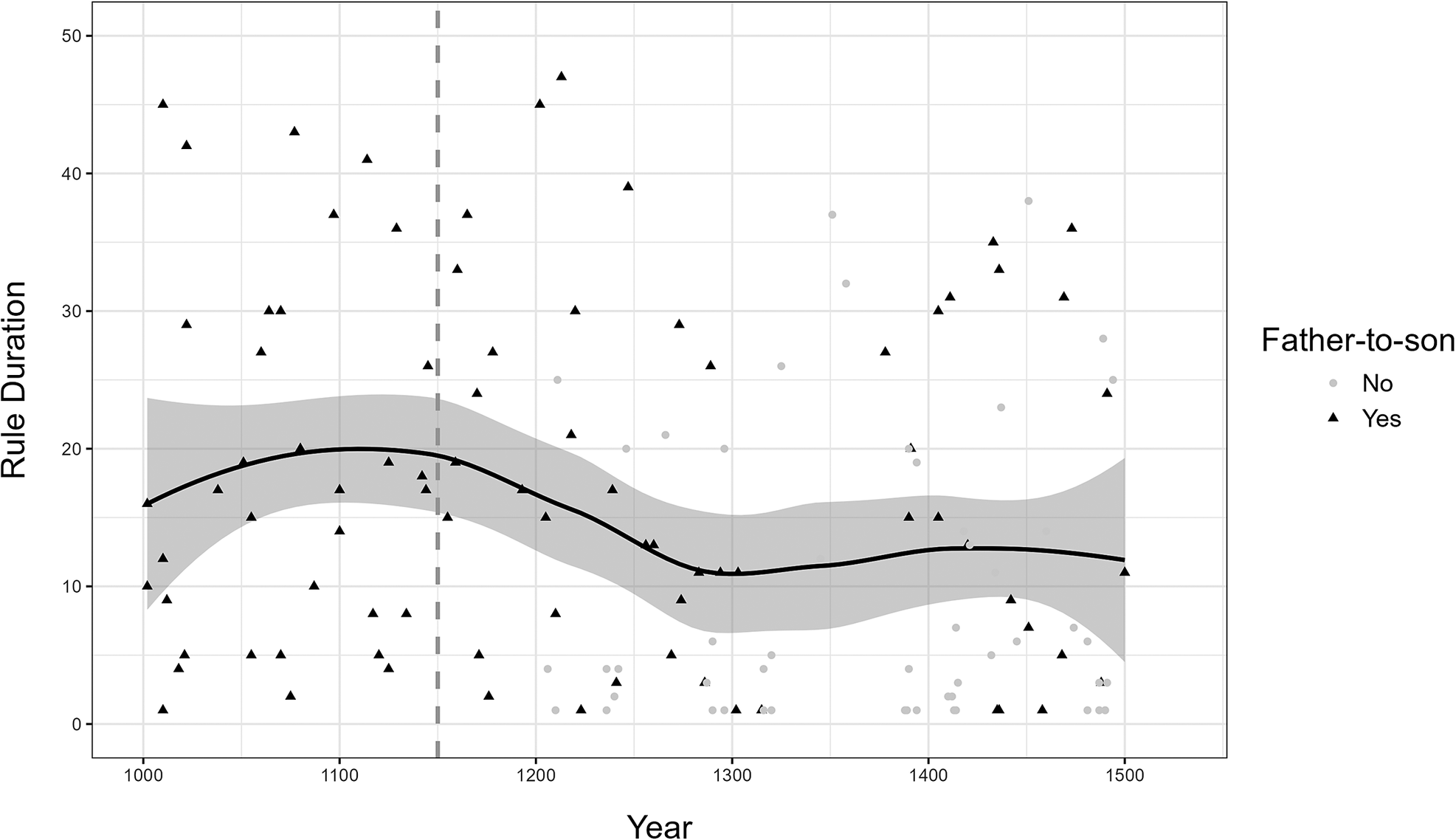
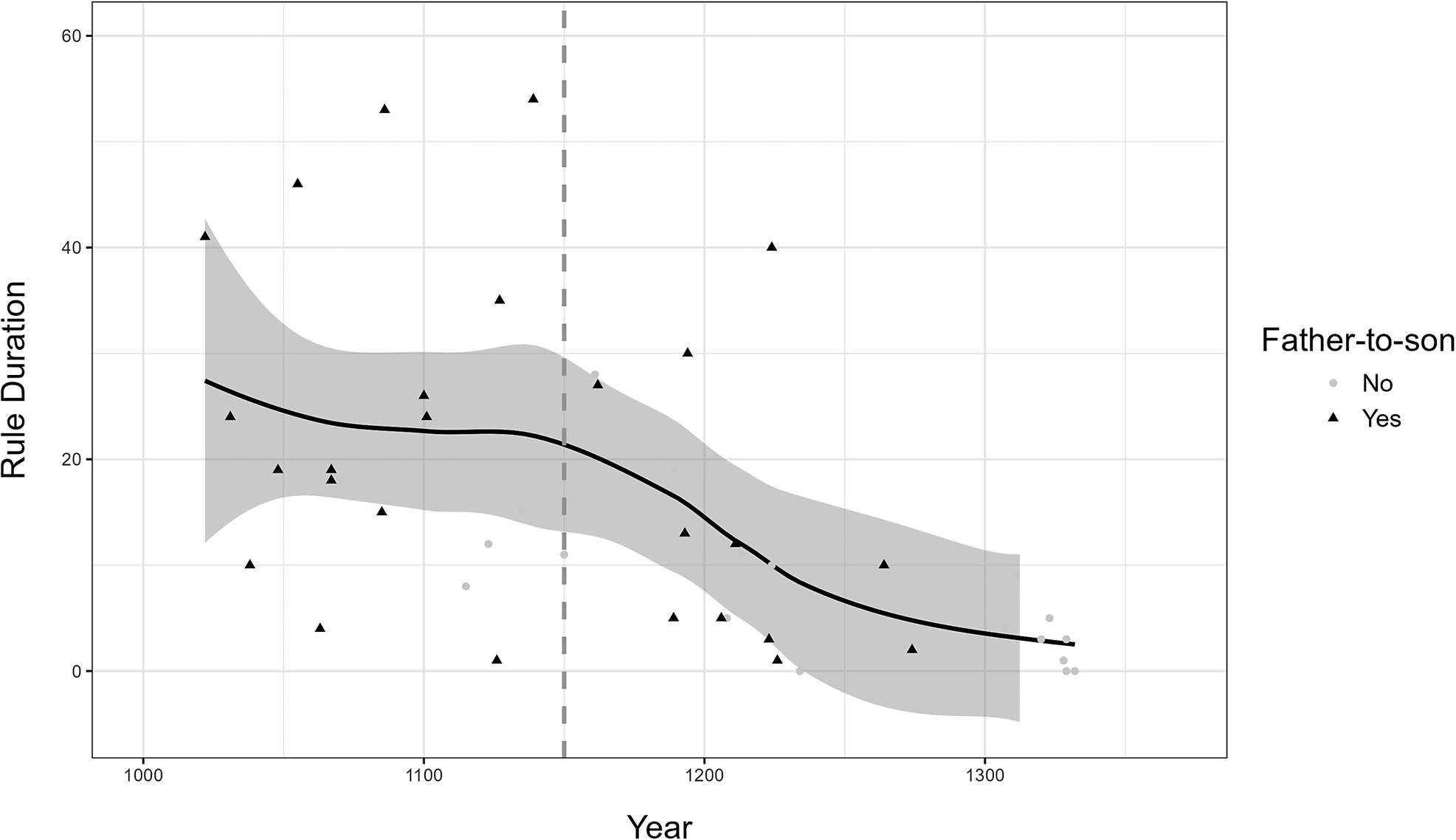
The relationship between exposure to Inner Asian warfare and long-run rule duration patterns is evident in the histories of areas subjected to recurring or sustained invasions. Figures 7 and 8 report the average ruler tenure during the 1000–1500 CE period for Northern India and the 1000–1368 CE period for China, respectively.Footnote 21 First, a negative association between expanding IACW dynasties and average rule duration is apparent in the case of Northern India. There, rulers of various Afghan and Turkic empires—each reliant on Inner Asian cavalry armies—gradually subdued Indigenous states in which FS succession was the norm. Power transfers at the apex were “managed” in the unordered fashion common among Inner Asian military elites (Day Reference Day1959, 49; Katouzian Reference Katouzian1997, 60; Pande Reference Pande1986, 248) in the hegemonic Delhi Sultanate. An increasing proportion of rulers in non-FS systems coincides with a gradual decrease in tenure duration between 1000 and 1500 CE, as visualized in Figure 7. The vertical dashed line indicates a break point identified using a structural break estimation approach.Footnote 22 The break points indicate a moment in time-series data associated with a significant shift in underlying patterns. I find such a break in Northern India’s average tenure duration associated with the year 1150, amidst conquests by the IACW-reliant Ghaznavid and Ghurid Sultanates. The trend in average tenure length transitions to gradual decline around the 1150 CE break point, consistent with my argument that IACW incursions explain macro-level changes in average ruler-level outcomes.
Inner Asian Conquests and Rule Duration in Northern India, 1000–1499 CE

Inner Asian Conquests and Rule Duration in China Proper, 1000–1368 CE

A visible bump in the average tenure length around 1400 CE corresponds to a short-lived resurgence of large FS dynasties after conquests by the Delhi Sultanate. That empire—largely reliant on Inner Asian cavalry armies—fragmented amidst succession contests, giving rise to (inter alia) the Bahmani Sultanate of Central India. Unlike its predecessor, the Bahmanis were unable to maintain stable access to Inner Asian cavalry forces and increasingly relied on local actors for military units and commanders (Ghauri Reference Ghauri1996, 147, 161, 164; Jones Reference Jones1925, 585). Moreover, a steady cadence of external threats from northern and southern neighbors enhanced the value of consolidating existing possessions relative to ever-more-costly expansionary campaigns. After a bout of dynastic infighting, the rulers—now armed with an increasingly non-IACW military apparatus (Sandhu Reference Sandhu2003, 346, 373)—managed to cultivate a norm of eldest-son succession (Kulkarni Reference Kulkarni1974, 95; Sherwani and Joshi Reference Sherwani and Joshi1973, vol. 2, 479, 480, 481). While a paucity of historical records limits the scope of defensible inferences, the rough coincidence of diminished reliance on Inner Asian cavalry forces and the limited re-emergence of FS succession in Northern and Central India is consistent with my theorized dynamic.
Inner Asian armies jeopardized dynasties with FS succession systems; however, domains were not equally liable to undergo an institutional transformation. Conquerors relied, to varying extents, on both Indigenous and imported systems to organize power within their families and military coalitions. Inner Asian armies did not necessarily spell a permanent end to FS succession practices, as they often reemerged under favorable circumstances. Two avenues relate directly to my theoretical argument. First, FS succession was more likely to emerge during spells of diminished reliance on mobile, offensive-oriented, military elites, as in the case of India’s Bahmani Sultanate. Northern China’s Jin dynasty is also illustrative: Jin military organization during early conquests typified the Inner Asian model of IACW cavalry forces with high mobility and striking capacity, although later incorporated sedentary bureaucratic and military elements with their own power resources (Mote Reference Mote1999, 59, 88, 223). Jin rulers even settled erstwhile semi-nomadic elites within China proper, pursuing a policy of (literal) demobilization and subsequently curtailed tribal political influence at the highest levels of government (Mote Reference Mote1999, 224, 229, 231). This episode coincided with abortive efforts by Jin rulers to adopt Han FS practices (Chan Reference Chan1999, 131, 133). Figure 8 reports changes in the institutional situation and tenure length in China between 1000 CE and the reestablishment of Han rule throughout China proper in 1368 CE. The dashed gray line indicates a structural break in the time series, although the firm imposition of Inner Asian succession principles is most associated with the Mongol rule of unified China from 1279 CE. I provide further evidence for the impact of IACW on average tenure length in Table A6 in the Supplementary Material.
The fate of China’s Mongol Yuan regime highlights a second mechanism operating against Inner Asian conquest dynasties: political infighting—a natural consequence of a system that prioritized competition for high office. Internal jostling for power undermined Inner Asian dynasties’ holds on sedentary realms, opening a window of opportunity for locally based insurgents to seize control. The rise of China’s Ming Dynasty—practicing FS succession—was partially enabled by endemic fratricidal infighting among Kublai Khan’s line and their retainers, followed by the state’s de facto partition by local warlords (Mote Reference Mote, Frederick and Twitchett1988, 12, 13, 18–25). This process of collapse was furthered by the deterioration of Mongol military might after the initial conquests. Subsequent emperors relocated Inner Asian cavalry forces to the capital and other strategic settlements, while sedentary forces staffed poorly-administered provincial garrisons (Mote Reference Mote, Frederick and Twitchett1988, 13, 14). Under these conditions, provincial despots, local bandits, and sectarian groups contested diminished imperial authority and, in 1368, one such group gained sufficient momentum to end Mongol rule and establish a new dynasty of ethnic Han extraction. Dynastic infighting, deteriorating administrative capacity—such that it was—and eventual collapse were the typical outcomes following a storm from the steppes.
CONCLUDING REMARKS
In this article, I make several contributions to the studies of succession systems, warfare, and institutional change broadly. First, I highlight the importance of leader competence as a significant weakness of FS succession systems in milieux characterized by mobile military elites and conquest-oriented warfare. A ruler’s ability to organize and inspire was paramount when a few victories (or losses) might make (or break) the realm. There, the gradual accretion of state capacity under long-reigning monarchs remained a far-fetched possibility. My argument brings the literature on warfare and institution-building into dialogue with recent work on trade-offs between autocratic security, competence, and state capacity. On the one hand, prior scholarship identifies a trade-off between the competence and loyalty of subordinates. The merits of useful underlings are offset by their potential threat to the autocrat as rivals (Egorov and Sonin Reference Egorov and Sonin2011; Zakharov Reference Zakharov2016). I invert this model—elites, not rulers, choose—and focus on the meta-level game of rule selection, highlighting conditions favorable to succession systems that yield competent leaders. More recently, and resonant with my account, Wang (Reference Wang2022) identifies a trade-off between autocratic security and state strength in dynastic China (the “sovereign’s dilemma”) wherein autocrats that forged a collectively capable elite did so at their own peril, owing to an increased risk of deposal by empowered subordinates. I argue that state strength and autocratic security were complements within a broader package where youthful rulers and long tenures were propitious to overall capacity-building. The key difference is that IACW polities, unlike Han Chinese regimes, faced a trade-off between two forms of strength: long-run internal capacity and external competitiveness.
Second, I introduce a novel explanation for the differential persistence of a consequential political institution, FS succession systems, across medieval and early modern Eurasia. Prior scholarship that addresses inter-regional divergences in political institutions tends to focus on whether institutional forms emerged in a particular area or cultural milieu (Acemoglu and Robinson Reference Acemoglu and Robinson2019; Blaydes and Chaney Reference Blaydes and Chaney2013; Cox Reference Cox2017; Doucette and Møller Reference Doucette and Møller2021; Kokkonen, Møller, and Sundell Reference Kokkonen, Møller and Sundell2022; Stasavage Reference Stasavage2020). Emergence is an obvious precondition for the contemporaneous and persistent effects of a particular institutional form—it is not the only one. Institutions must also withstand a barrage of crises and disruptions, some more severe than others. External threats were among the most consequential source of crises—rulers and elites with rapacious neighbors either adopted institutions that facilitated military effectiveness or risked demise. FS succession emerged in various times and places under unique political environments, but it was less likely to endure near the steppe grasslands and arid valleys of Inner Asia. Those were areas exposed to a mode of warfare that favored martially adept leadership at the expense of long, secure reigns and cumulative capacity gains. Critically, the prowess of Inner Asia cavalry armies overcame any competitive advantages attributable to FS succession systems.
Finally, my argument draws attention to the interactive role of geography and institutions in shaping long-run political outcomes. Europe’s relatively smooth path toward reign-prolonging succession practices is, itself, partially explicable in terms of Eurasian geography.Footnote 23 The region was partially insulated from a potent disruptive vector: Inner Asian cavalry armies. Outside of Eurasia, similar patterns emerged where arid climates and flat topography enabled pastoral-nomadic modes of production. For instance, Bedouin dynasties of Arabia and the Maghreb relied on mobile military elites from late antiquity, encouraging succession institutions that prioritized rulers’ military aptitude, experience, and seniority (Hurewitz Reference Hurewitz1968, 103; Levtzion Reference Levtzion and Roland1977, 364, 365).
Future scholarship might build upon these findings in several ways. First, to what extent did the frequency and severity of succession disputes impact long-run economic outcomes? Intuitively, palace coups might not have the destructive potential of a full-fledged civil war, all else equal. Yet the cumulative gains from capacity-building and policy continuity might be such that brief tenures alone can account for differences in medium-term economic performance as measured by, for example, urban growth rates (Cox Reference Cox2017; Dincecco and Onorato Reference Dincecco and Onorato2016) or long-term effects discernible in current-day indicators. Second, the timing of disruptive episodes is consequential in and of itself. The Middle East and parts of the Indian Subcontinent received infusions of Inner Asian political institutions mere decades before, then into the era of European imperialism.Footnote 24 Political strife associated with insecure successions degraded existing institutions (or ruined economies) in a way that enabled or exacerbated colonial predation. Finally, I encourage future scholars who engage with debates concerning macro-historical divergences and broad inter-regional comparisons to draw on diverse samples of contemporaneous non-European societies.Footnote 25 Culturally and geographically inclusive datasets will shed new light on old questions while bringing new questions and perspectives to the fore.
SUPPLEMENTARY MATERIAL
To view supplementary material for this article, please visit http://doi.org/10.1017/S000305542510097X.
DATA AVAILABILITY STATEMENT
Research documentation and data that support the findings of this study are openly available at the American Political Science Review Dataverse: https://doi.org/10.7910/DVN/D1XSBR.
ACKNOWLEDGEMENTS
I would like to thank Thomas Barfield, Deborah Boucoyannis, Sarah Brooks, John Gerring, Marcus Kurtz, Jan Pierskalla, Walter Scheidel, Matthew Wilson, the anonymous reviewers, and the editor for their helpful comments. I am especially grateful to Thomas Gray for his feedback on this project since its inception.
FUNDING STATEMENT
This research was funded by Ohio State University’s Department of Political Science and Mershon Center for International Security Studies.
CONFLICT OF INTEREST
The author declares no ethical issues or conflicts of interest in this research.
ETHICAL STANDARDS
The author affirms this research did not involve human participants.



 Open access


Comments
No Comments have been published for this article.