

Implications
Artificial insemination (AI) has proven to be a reliable technology for cattle producers to improve genetic progress and control venereal diseases in their herds. However, when the AI program is not adequate to the farm conditions, it can diminish reproductive efficiency by increasing the calving to conception interval and, thus, increasing the calving interval compared with natural service (NS). Hormonal stimulation is already a consistent and well-proven strategy used to improve the reproductive performance in beef herds.
Introduction
High reproductive efficiency is a key requirement in order to ensure sustainable livestock production and satisfactory economic returns for the beef producer. The incorporation of reproductive programs into routine on-farm is one way of optimizing the reproductive outcomes and profitability of beef herds. Despite the widespread adoption of AI globally, NS is the most frequently used method of breeding on beef farms (Thibier and Wagner, Reference Thibier and Wagner2002; Lamb and Mercadante, Reference Lamb and Mercadante2016). In Brazil, for instance, only 12% of females of reproductive age are inseminated, the remaining 88% being mated to bulls by NS during the breeding season (BS) (Baruselli, Reference Baruselli2016).
Artificial insemination has many advantages compared with NS (Lima et al., Reference Lima, Vries, Risco, Santos and Thatcher2010; Lamb and Mercadante, Reference Lamb and Mercadante2016). It avoids the transmission of venereal diseases (Vishwanath, Reference Vishwanath2003), enables the use of bulls that are not present on the farm, allows the production of crossbred calves originating from breeds of bulls that are not well adapted to the local environmental conditions (i.e. Bos taurus breeds in hot and humid climate), increases calf uniformity, and accelerates genetic gain, resulting in calves that are more productive and profitable (Rodgers et al., Reference Rodgers, Bird, Larson, DiLorenzo, Dahlen, DiCostanzo and Lam2015; Baruselli et al., Reference Baruselli, Ferreira, Colli and Elliff2017). The genetic and economic gains are principally achieved through the use of superior genetic bulls. However, the implementation of AI programs based on estrus detection (ED) in beef herds is hampered by factors such as postpartum anestrus, ED failure and the practical challenges of ED (i.e. estrus observation at least twice a day in each lot, the large number of animals per lot, the large size of many farms and the labor costs; Bó et al., Reference Bó, Cutaia, Peres, Pincinato, Maraña and Baruselli2007), reducing the reproductive efficiency of the herd. Because of that, a common perception among cattle producers is that NS is cheaper and easier to implement, overcoming the challenges associated with ED needed for AI (Lima et al., Reference Lima, Vries, Risco, Santos and Thatcher2010). Thus, aiming to avoid the problems associated with ED and to enable the intensive use of AI programs in beef herds, a variety of strategies have been devised to allow insemination at a predetermined time (timed artificial insemination (TAI)), eliminating the need for ED and allowing insemination of beef cows regardless of cyclic status or season (Lamb et al., Reference Lamb, Stevenson, Kesler, Garverick, Brown and Salfen2001; Rhodes et al., Reference Rhodes, McDougall, Burke, Verkerk and Macmillan2003b; Baruselli et al., Reference Baruselli, Reis, Marques, Nasser and Bó2004b; Bó et al., Reference Bó, Cutaia, Peres, Pincinato, Maraña and Baruselli2007). Use of TAI also has the advantage of concentrating the period during which cows become pregnant, this facilitating the organization of the BS, optimizing cattle management and the labor requirements.
Reproductive programs (artificial insemination v. natural service)
As a result of concerns raised regarding the comparative efficiency of NS, insemination based on ED and TAI in getting cows pregnant early in the BS, our group performed two sequential studies to evaluate reproductive performance of postpartum beef cows subjected to different reproductive programs (Sá Filho et al., Reference Sá Filho, Penteado, Reis, Reis, Galvão and Baruselli2013). In the first study, TAI+NS (n=150), TAI+ED+NS (n=148), ED+NS (n=147) and NS (n=149) were evaluated during a 90-day BS. In the second experiment, the use of TAI at the onset of the BS, followed by NS (TAI+NS; n=252) was compared with only NS (n=255) throughout the entire 90-day BS. In brief, in Study 1, the interval to establishment of pregnancy was decreased (P<0.001) for TAI+NS and TAI+ED+NS compared with ED+NS and NS (Figure 1). Also, TAI+NS resulted in a greater (P=0.001) proportion of cows pregnant at 45 days of the BS (75.3%) than TAI+ED+NS (63.5%), which was greater than NS (44.3%) and ED+NS (23.3%). Indeed, ED followed by AI always resulted in a reduction in pregnancy rate compared with natural breeding with a bull, likely due to human failures in ED. At the end of the BS, a greater (P<0.01) proportion of cows were pregnant when TAI was performed (TAI+NS=92.7% and TAI+ED+NS=91.9%) compared with ED+NS (85.0%) and NS (83.2%). Thus, using TAI shortens the interval from calving to conception, improves pregnancy rates at 45 days and at the end of the BS, and additionally increases the genetic gain of the herd.
Survival curves for proportion of non-pregnant cows by days of breeding season for various breeding strategies during a 90-day breeding season. TAI+NS (n=150): cows received timed artificial insemination (TAI) on day 11 of the breeding season (BS), followed by natural service (NS) until the end of the BS; TAI+ED+NS (n=148) cows received TAI at day 11, then were observed for estrus twice daily, with AI 12 h after estrus detection (ED) until day 45 of the BS, followed by NS until the end of BS; ED+NS (n=147) cows were bred by AI 12 h after ED during the first 45 days of the BS, followed by NS until the end of BS; NS (n=149) cows were bred by NS throughout the BS. Adapted from Sá Filho et al. (Reference Sá Filho, Penteado, Reis, Reis, Galvão and Baruselli2013).

Regarding reproductive efficiency, we conclude that (1) bulls are more efficient than ED followed by AI, and (2) TAI is more efficient than NS. The problem of low ED has been previously reported by others working with suckled beef cows (Stevenson et al., Reference Stevenson, Thompson, Forbes, Lamb, Grieger and Corah2000; Baruselli et al., Reference Baruselli, Marques, Carvalho, Madureira and Campos Filho2002; Bó et al., Reference Bó, Baruselli and Martı́nez2003). Previous studies also demonstrated that TAI increased the number of mounts received, improved estrus synchronization and first service conception rate in suckled Brahman cows (Flores et al., Reference Flores, Looper, Kreider, Post and Rosenkrans2006). Also, a greater percentage of Bos taurus beef cows bred by TAI (84%) weaned a calf during the subsequent calving season compared with cows bred by NS (78%; Rodgers et al., Reference Rodgers, Bird, Larson, DiLorenzo, Dahlen, DiCostanzo and Lam2015).
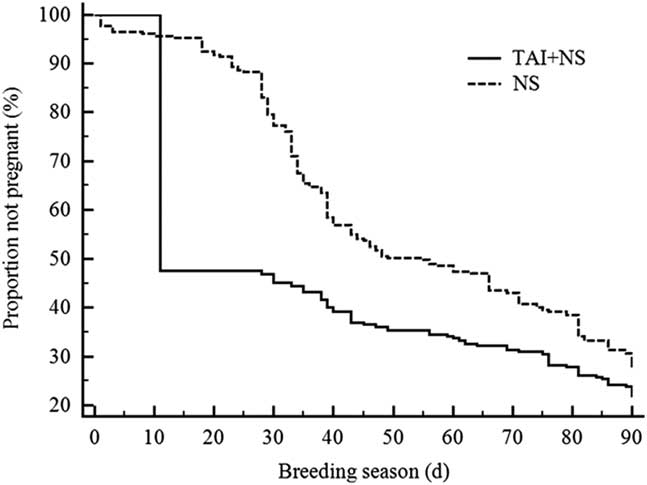
In Study 2 (Sá Filho et al., Reference Sá Filho, Penteado, Reis, Reis, Galvão and Baruselli2013), TAI+NS resulted in a greater (P=0.001) proportion of cows pregnant at 45 days of the BS than when cows were bred exclusively with NS (63.5% v. 46.3%); however, the proportion of cows pregnant at end of the BS was similar (77.0% v. 71.0%; P=0.31) between treatments. When the entire BS was evaluated, the likelihood of pregnancy was greater for TAI+NS than NS (adjusted hazard ratio, 1.64; 95% confidence interval, 1.34 to 2.01; P<0.0001; Figure 2), primarily because of pregnancies established by TAI at the beginning of the BS. Indeed, cows subjected to TAI+NS had fewer median days to conception (11 days) than cows exposed exclusively to NS (55 days). In this context, Rodgers et al. (Reference Rodgers, Bird, Larson, DiLorenzo, Dahlen, DiCostanzo and Lam2015) reported that a greater percentage of cows bred by TAI calved during the first and second 10-day intervals of the calving season than cows bred exclusively by NS.
Survival curves for proportion of non-pregnant cows by day 90 of the breeding season (BS) for postpartum beef cows bred by natural service (NS; dashed line; n=255) or by timed artificial insemination (TAI) at beginning of the breeding season (BS) followed by NS (TAI+NS; solid line; n=252) during 90-day BS. Median interval to pregnancy for NS and TAI groups was 55 and 11 days (adjusted hazard ratio, 1.64; 95% confidence interval, 1.34 to 2.01), respectively. Adapted from Sá Filho et al. (Reference Sá Filho, Penteado, Reis, Reis, Galvão and Baruselli2013).
These studies clearly demonstrate that using TAI early in the breeding period increases reproductive performance of postpartum beef cows maintained on pasture. Cows receiving TAI had greater pregnancy rates at 45 days and at the end of the BS, and reduced number of days from calving to conception. As a consequence, cows exposed to TAI at the beginning of the BS calved earlier, weaning heavier calves and had improved probability of re-conception in the subsequent BS.
Timed artificial insemination followed by natural service v. timed artificial insemination followed by resynchronization
Typically, the treatment most frequently adopted to achieve pregnancy in early postpartum cows which are not pregnant after TAI is the introduction of NS sires until the end of the BS. However, protocols to resynchronize those cows which are not pregnant after the first postpartum service are already well established. The main advantage of such protocols is the reduction in time required for subsequent inseminations, thus allowing a more compact BS. Initial studies involved the initiation of resynchronization at the time of pregnancy diagnosis, between 28 and 32 days after TAI (RE30; Stevenson et al., Reference Stevenson, Cartmill, Hensley and El-zarkouny2003; Marques et al., Reference Marques, Ribeiro Júnior, Silva, Sá Filho, Vieira and Baruselli2012 and Reference Marques, Morotti, da Silva, Ribeiro Júnior, da Silva, Baruselli and Seneda2015; Bó et al., Reference Bó, de la Mata, Baruselli and Menchaca2016). Cows diagnosed as non-pregnant on that day were immediately resynchronized for TAI. This Resynch procedure is flexible (it begins at the date chosen for pregnancy diagnosis) and only non-pregnant cows are treated. However, the interval between inseminations may exceeds 38 days which may be considered excessive compared with bull exposure, where mating occurs around 21 days after TAI as cows return to estrus naturally. Although natural mating reduces the interval between two consecutive services, the service rate is dependent on non-pregnant cows returning to estrus ~21 days after TAI (around 50%; Sá Filho et al., Reference Sá Filho, Penteado, Reis, Reis, Galvão and Baruselli2013). The advantage of Resynch programs lies in the reduction of the interval between inseminations, facilitating compaction of the BS, with the benefit of guaranteeing 100% service rate.
To optimize the compactness of the BS, Resynch protocols should start earlier than is typical for pregnancy diagnosis; this means that all cows must be treated. The Resynch22 (RE22) protocol begins 22 days after the previous AI, 8 days before ultrasound pregnancy diagnosis (Sá Filho et al., Reference Sá Filho, Marques, Girotto, Santos, Sala, Barbuio and Baruselli2014). At the time of pregnancy diagnosis, cows diagnosed as pregnant are excluded from the subsequent treatments while non-pregnant cows continue the resynchronization protocol. Use of RE22 reduces the interval between inseminations to 32 days; however, the first treatment (insertion of progesterone, P4, device and administration of estradiol) must be carried out in all cows and pregnancy diagnosis must be performed on a fixed schedule. In contrast, most farms that use Resynch30 (RE30) have a prescheduled date for pregnancy diagnosis to allow the Resynch protocol to start as soon as possible. This date is not fixed; a new protocol can be initiated in open cows anytime after pregnancy diagnosis). Conversely, for RE22, the date of pregnancy diagnosis is not flexible because the protocol has already been initiated 8 days before.
The reproductive efficiency of the different treatments associated with TAI and resynchronization programs was evaluated for postpartum beef cows (Rubin et al., Reference Rubin, Martini, Simões, Oliveira, Trentin, Sá Filho, Baruselli and Pessoa2015). In the first study, cows were subject to: (1) NS (n=266); (2) TAI+NS (n=200); (3) TAI+RE30+NS (n=245); (4) TAI+RE22+NS (n=249) during a 90-day BS (Figure 3). Within 30 days of the onset of the BS, only 3% of the females submitted to NS were pregnant compared with ~40% for the other groups (TAI+NS=40.0%, TAI+RE30+NS=40.0%, TAI+RE22+NS=39.8%; P<0.001). At 60 days of the BS, pregnancy rate was higher for cows that were resynchronized and received the second TAI (TAI+RE30+NS=69.4% and TAI+RE22+NS=66.3%) compared with cows subjected to the other treatments (TAI+NS=48.0% and NS=16.9%; P<0.001). In addition, cows receiving TAI+NS had greater pregnancy rate than those only exposed to NS (P<0.001). At the end of the BS, regardless of the resynchronization schedule, pregnancy rate was greater for cows subjected to TAI+RE30+NS (83.7%) and TAI+RE22+NS (81.5%) than for those subjected to TAI+NS (71.0%) or NS (45.1%).
Cumulative pregnancy rate of cows subjected to different reproductive procedures during a 90 day breeding season (BS). Cows under NS were only exposed to bulls’ natural service (NS) (n=266). Cows under TAI+NS (n=200) were subject to timed artificial insemination (TAI) followed by NS until the end of the BS. Cows under TAI+RE30+NS (n=245) received TAI and were resynchronized at the 30 days-pregnancy diagnosis. Cows under TAI+RE22+NS (n=249) received TAI and were resynchronized at unknown pregnancy status 22 days after TAI. Clean-up bulls were introduced 10 days after the last TAI, regardless of the experimental group. Adapted from Rubin et al. (Reference Rubin, Martini, Simões, Oliveira, Trentin, Sá Filho, Baruselli and Pessoa2015).

Use of Resynch programs lead to the adoption of management strategies exclusively involving TAI, thus eliminating the need for a clean-up bull(s) on the farm. The reproductive efficiency of using Resynch was evaluated recently by Crepaldi et al. (Reference Crepaldi, Freitas, Mingoti, Colli, Gonçales Junior, Ferreira and Baruselli2017). In that study, the use of three consecutive TAI using RE22 (3TAI) resulted in similar pregnancy rates to those achieved using two TAI using RE22 followed by bull exposure (2TAI+bull) and greater pregnancy rate than one TAI followed by bull exposure (1TAI+bull). A cumulative pregnancy rate of 87.4% was achieved at the end of a 64-day BS after three TAI using RE22 (Figure 4).
Pregnancy rate in Bos indicus beef cows after timed artificial insemination (TAI) with subsequent resynchronization or natural mating. Resynchronization was done using Resynch22 program starting 22 days after the previous TAI. Groups were: 3 TAI (TAI+Resynch22 and TAI+Resynch22 and TAI; n=450); 2 TAI (TAI+Resynch22 and TAI+clean-up bulls; n=300); 1 TAI (TAI+clean-up bulls; n=755). Pregnancy diagnosis of the 3rd TAI and bull mating were done at the end of the breeding season. Adapted from Crepaldi et al. (Reference Crepaldi, Freitas, Mingoti, Colli, Gonçales Junior, Ferreira and Baruselli2017). a: P=0.83, *: P=0.33, #: P=0.28, x, y: P=0.0001.

Use of color Doppler ultrasonography to characterize the vascularization of the corpus luteum (CL) and confirm the lack of an embryonic vesicle in the uterus can be used to diagnose non-pregnancy earlier than can normally be achieved with routine scanning (Siqueira et al., Reference Siqueira, Areas, Ghetti, Fonseca, Palhao, Fernandes and Viana2013; Baruselli et al., Reference Baruselli, Ferreira, Colli and Elliff2017; Pugliesi et al., Reference Pugliesi, Rezende, Silva, Lopes, Nishimura, Baruselli, Madureira and Binelli2017). This procedure is referred to as Resynch14, as the protocol is initiated 14 days after the previous TAI, followed by pregnancy diagnosis eight days later (i.e. 22 days after TAI) using Doppler ultrasonography (Vieira et al., Reference Vieira, Sá Filho, Pugliesi, Guerreiro, Cristaldo, Batista, Freitas, Carvalho, Guimaraes and Baruselli2014). As before, this protocol requires the initial treatment of all animals (due to unknown pregnancy status at the time of protocol initiation) and a fixed schedule for pregnancy diagnosis. In addition, it requires specific ultrasound equipment and expertise. However, it allows a significant reduction in the interval between AI to 24 days, which is close to what is achieved using clean-up bulls (around 21 days estrus return and rebreeding; Figure 5).
Service rate (SR) and duration of the breeding season after three artificial insemination (AI) for different Resynch programs (ideal model refers to a 21-day interval between AI and SR=100%): Resynch14 (starts 14 days after previous timed artificial insemination (TAI), with 24-day interval between AI and SR=87.5%), Resynch22 (starts 22 days after previous TAI, with 32 days interval between AI and SR=66%) and traditional Resynch (starts after pregnancy diagnosis 30 days after previous TAI, with 40 days interval between AI and SR=52.5%). Adapted from Baruselli et al. (Reference Baruselli, Ferreira, Colli and Elliff2017).
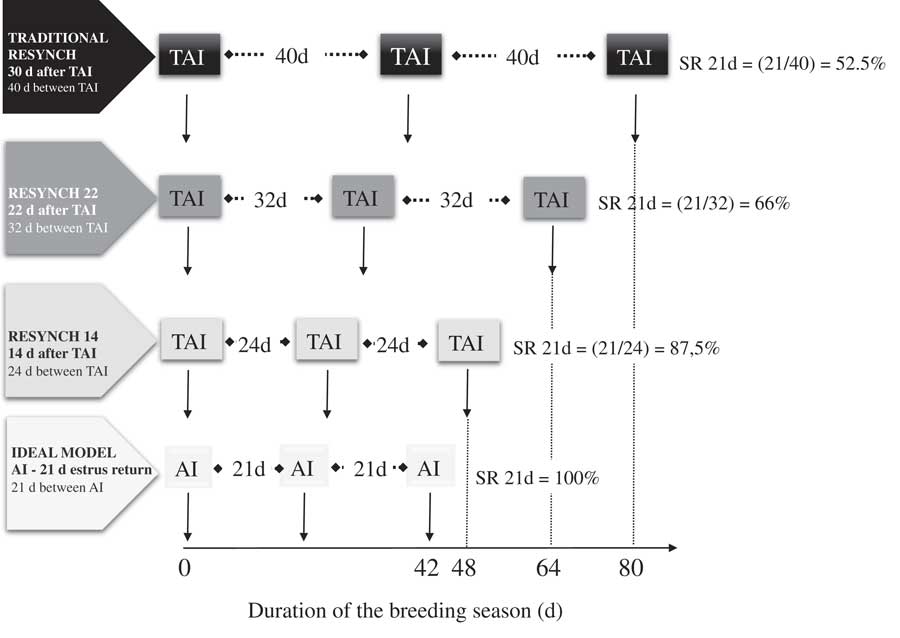
Pregnancy rates after Resynch22 and Resynch14 were recently compared in 244 postpartum beef cows (Penteado et al., Reference Penteado, Rezende, Mingoti, Colli, Sá Filho, Santos, Lemos Motta, Bayeux, Vieira and Baruselli2016). In that study, following TAI, cows were allocated to one of the two Resynch programs (Resynch22; n=126 or Resynch14; n=118). Resynch22 cows were treated with a P4 device plus 2 mg EB intramuscular (IM) 22 days after the previous AI (day 22). On day 30, the device was removed and pregnancy was diagnosed based on the presence or absence of an embryonic vesicle in the uterus (conventional ultrasonography). Cows diagnosed as non-pregnant were administered prostaglandin F2α (PGF), 1 mg estradiol cypionate and 300 IU equine chorionic gonadotropin (eCG) IM, followed by TAI 48 h later on day 32. Resynch14 cows were treated with a P4 device plus IM administration of 100 mg P4 14 days after the previous AI (day 14). On day 22, pregnancy diagnosis was carried out by the assessment of CL vascularization using color Doppler ultrasonography. Cows with low or absent vascularization were considered non-pregnant and continued the resynchronization treatment (device removal, PGF, estradiol cypionate and eCG IM), and were TAI 48 h later (day 24). Cows with moderate or strong CL vascularity were considered pregnant; in these cows the device was removed and no further treatment was applied. Similar pregnancy per artificial insemination were achieved for Resynch22 and Resynch14 cows following the first AI (48% v. 53%; P=0.57) and resynchronization (56% v. 51%; P=0.37), respectively. The cumulative pregnancy rates after 32 and 24 days of the BS were also similar (P=0.77) for Resynch22 (77%; 97/126) and Resynch14 cows (75%; 89/118), respectively. In addition, Resynch14 considerably improved the 21-day service rate from 66% to 87.5% compared with Resynch22 (Figure 5).
Collectively, these studies demonstrated that resynchronization programs are feasible and efficient to breed cows during early postpartum, reducing the length of the BS and allowing at least similar cumulative pregnancy outcomes as those achieved after bull exposure in a traditional 90-day BS. By increasing the number of cows pregnant by AI, resynchronization/TAI programs facilitate accelerated genetic progress. In addition, the consequent concentration of the calving period early in the season, results in more uniform and improved weaning weights and facilitates the use of young heifers in the subsequent BS.
Synchronization treatment previous to natural service
In Brazil, 88% of females of reproductive age are not exposed to an estrus synchronization protocol for TAI and are only exposed to natural breeding (Baruselli, Reference Baruselli2016). Similarly, many farms around the world cannot implement applied reproductive technology such as AI upon ED or TAI, because of the absence of adequate animal handling facilities or specialized personnel (Chenoweth, Reference Chenoweth2002) and the increased management demand (Chenoweth and Lennon, Reference Chenoweth and Lennon1984; Chenoweth, Reference Chenoweth2002). However, after parturition, cows may undergo a prolonged anestrous period, during which they do not show behavioral signs of estrus, which is crucial when reproduction is dependent on bull mating. Delays in the resumption of postpartum cyclicity may increase the interval from calving to conception and reduce reproductive efficiency (Diskin and Sreenan, Reference Diskin and Sreenan2000; Baruselli et al., Reference Baruselli, Reis, Marques, Nasser and Bó2004b; Crowe, Reference Crowe2008), which may lead to important economic losses.
Thus, the development of a strategy that allows the early conception of postpartum cows exposed to bull mating with satisfactory pregnancy rates is fundamental to enhance the reproductive efficiency. Based on previous experience showing the efficiency of the synchronization of follicular wave emergence and ovulation (as for TAI programs; Stevenson et al., Reference Stevenson, Thompson, Forbes, Lamb, Grieger and Corah2000; Baruselli et al., Reference Baruselli, Marques, Carvalho, Madureira and Campos Filho2002; Bó et al., Reference Bó, Baruselli and Martı́nez2003) and the addition of eCG to overcome postpartum anestrus (Baruselli et al., Reference Baruselli, Reis, Carvalho and Carvalho2004a and Reference Baruselli, Reis, Marques, Nasser and Bó2004b; Sá Filho et al., Reference Sá Filho, Ayres, Ferreira, Marques, Reis, Silva, Rodrigues, Madureira, Bó and Baruselli2010), our group recently conducted a study to evaluate whether different P4–E2 synchronization treatments (with and without eCG) used before NS, termed timed natural breeding (TNB), are efficient for hastening and improving the pregnancy rates of postpartum cows, thereby enhancing their reproductive efficiency during the BS (Ferreira et al., Reference Ferreira, Conti, Gonçalves, Souto, Sales, Sá Filho, Elliff and Baruselli2018). For that, a total of 350 primiparous Nelore (Bos indicus) cows between 35 and 60 days postpartum were randomly assigned to one of the three experimental groups: the Control group (n=123; no hormonal treatment); the TNB group (n=115; hormonal protocol with P4 and E2 for TNB without eCG); or the TNB+eCG group (n=112; hormonal protocol with P4 and E2 for TNB with eCG). The treatments are summarized in Figure 6. The bull : cow ratio was 1 : 10 within the first 7 days and 1 : 25 within the next 98 days of the BS. The bulls were removed on day 105.
Experimental design used to evaluate the effect of treating postpartum primiparous beef cows before exposure to bull natural breeding (NB) on time to conception and pregnancy outcomes during a 140-day breeding season. Control cows received no previous hormonal treatment, TNB (timed NB) cows received a protocol to synchronize follicular wave emergence and ovulation without equine chorionic gonadotropin (eCG), and TNB+eCG cows received a similar treatment as that given to the TNB group with the addition of 300 IU of eCG on day 0. US=transrectal ultrasonographic examination; *bull : cow ratio. Adapted from Ferreira et al. (Reference Ferreira, Conti, Gonçalves, Souto, Sales, Sá Filho, Elliff and Baruselli2018).

Pregnancy diagnosis was performed 40, 90, and 140 days after bull exposure. Gestational age was estimated based on an ultrasonographic assessment of the amniotic vesicle and embryo or fetus size (Youngquist and Threlfall, Reference Youngquist and Threlfall2007) to predict the date of conception and the number of new gestations every 21-day period (P21, P42, P63, P84 and P105), starting at bull exposure (P21). Pregnancy rate was cumulative and calculated as the number of pregnant cows after bull exposure divided by the total number of cows enrolled per period (P21, P42, P63, P84 and P105).
Control cows were less likely to be pregnant at P21 (5.7%, 7/123) than TNB (30.4%, 35/115) and TNB+eCG (51.8%, 58/112; P=0.001) cows. In the subsequent periods, the pregnancy rate increased for all groups, but differences remained between treatments (Table 1). The TNB+eCG cows achieved more than 50% conception rate within the first 21 days after bull exposure (i.e., the first estrus after treatment), whereas the TNB and Control cows, respectively, took more than 40 and 90 days to achieve a 50% conception rate (Figure 7). At the end of the BS, cows treated with eCG had 21% and 16% more pregnancies than the Control and the treatment without eCG, respectively (Figure 7). Also, the probability of conceiving increased 1.5 fold when cows were treated with the TNB protocol and increased 2.2 fold when eCG was added to the protocol (TNB+eCG). The average interval between the onset of the BS and conception was considerably reduced (P<0.0001) when cows were treated with TNB+eCG (26.5±3.8 days) compared to those treated with TNB without eCG (35.7±4.1 days) and those in the Control (64.7±3.9 days) group. Consequently, the calving to conception interval was also reduced from approximately 120 (Control) to 91 (TNB) and 82 (TNB+eCG) days when cows received the hormonal protocols (the cows started the BS at 55 days postpartum on average).
Survival curve illustrating the interval between the onset of the breeding season and conception for postpartum primiparous beef cows of the control and treated groups exposed to bull natural breeding (NB). Control cows received no previous hormonal treatment; TNB (timed NB) and TNB+equine chorionic gonadotropin (eCG) cows received a protocol to synchronize follicular wave emergence and ovulation without and with 300 IU of eCG on day 0, respectively. Adapted from Ferreira et al. (Reference Ferreira, Conti, Gonçalves, Souto, Sales, Sá Filho, Elliff and Baruselli2018).

Cumulative pregnancy rate every 21 days (P21, P42, P63, P84 and P105) of treated and non-treated (control) postpartum primiparous beef cows exposed to bull natural breeding (NB) during a 105-day breeding season

P21, P42, P63, P84 and P105=cumulative pregnancy rates at 21, 42, 63, 84 and 105 days of the breeding season.
Control cows received no prior hormonal treatment; timed NB (TNB) and TNB+equine chorionic gonadotropin (eCG) cows received a protocol to synchronize follicular wave emergence and ovulation without and with eCG, respectively. Adapted from Ferreira et al. (Reference Ferreira, Conti, Gonçalves, Souto, Sales, Sá Filho, Elliff and Baruselli2018).
a,b,cValues within a row with different superscript letters differ significantly at the P value presented.
In conclusion, the use of TNB, especially when associated with eCG, efficiently improved the early conception of postpartum beef cows that were exposed to natural breeding. The use of the treatment for TNB may have increased the LH pulse frequency, anticipating postpartum cyclicity and conception (Rhodes et al., Reference Rhodes, McDougall, Burke, Verkerk and Macmillan2003a). Also, the addition of eCG enhances follicular growth, ovulation and pregnancy after the synchronization protocol (Baruselli et al., Reference Baruselli, Reis, Carvalho and Carvalho2004a and Reference Baruselli, Reis, Marques, Nasser and Bó2004b; Sá Filho et al., Reference Sá Filho, Ayres, Ferreira, Marques, Reis, Silva, Rodrigues, Madureira, Bó and Baruselli2010). The increased number of cows conceiving early in the BS is crucial to improve reproductive efficiency (by reducing the interval between parturitions and increasing the number of pregnant cows at the end of the BS) and farm income.
Economic impact of using reproductive technologies
The use of reproductive technologies such as TAI and TNB can significantly enhance productivity of the herd, culminating in a significant positive economic impact on the entire chain of production. For example, in 2015, it is estimated that TAI generated ~US$ 175 million in Brazil, involving the participation of an estimated 3500 veterinarians (Baruselli, Reference Baruselli2016). Timed artificial insemination is currently used on 8.2 million beef cows, generating an 8% increase in calf production, which represents ~656 000 more calves per year or an additional income of ~US$ 253 million/year. Timed artificial insemination also increases the genetic merit of herds, generating an average increase of 20 kg in weaning weight, which represents 3.3 million weaned calves with extra 20 kg or an extra US$ 123 million. Also, from weaning to slaughter the TAI calves gain an additional 15 kg of carcass, generating an extra US$ 149 million. Thus, TAI adds more than a half billion dollars per year to the bovine beef chain (Baruselli, Reference Baruselli2016).
However, despite the great economic impact of the usage of TAI, many farms do not have adequate animal handling facilities or specialized personnel to implement it, thus, reproductive management of most herds may be flawed. The use of a TNB protocol associated with eCG can accelerate resumption of postpartum cyclicity and is a potential tool to improve pregnancy of primiparous cows exposed to bulls, with impact until the end of the BS (Ferreira et al., Reference Ferreira, Conti, Gonçalves, Souto, Sales, Sá Filho, Elliff and Baruselli2018). As only 12% of the Brazilian herd is actually inseminated (Baruselli, Reference Baruselli2016), TNB could be applied (depending on farm and animal conditions) to the remaining 88% of the beef national herd (~60.1 million cows and heifers), representing an estimated gain of an extra 4.8 million calves/year or ~US$ 1.9 billion (considering 8% more calves and no genetic gain). This additional income is still underestimated because the anticipation of parturition resulting from the use of TNB was not considered for the calculation.
It is important to note that the technique of TNB should not be used as a substitute for TAI, especially because it does not bring with it the genetic gain that TAI facilitates. However, TNB can organize the BS and improve the reproductive efficiency of herds exposed to bull natural mating. Thus, TNB can be a step forward for farms that, as for now, cannot implement TAI, so that one day they can reach this level of reproductive management.
Summary and conclusions
The high incidence of postpartum anestrus and the low efficiency, the prolonged time and great effort required to accomplish ED have limited reproductive efficiency, the widespread application and the success of AI on beef farms. This condition has to be taken into consideration when deciding to begin an AI program. However, the dissemination of efficient reproductive procedures, such as TNB, TAI and Resynch programs described herein, either alone or in combination, enables the production of a greater quantity (getting high pregnancy rate early in the BS) and quality (maximization of the use of AI with superior genetic sires) of beef calves. These technologies can contribute to improve the production efficiency, and consequently, improve livestock profitability.
Acknowledgments
The authors thank Fapesp, CNPq and Fumvet for supporting the researches.
Declaration of interest
None.
Ethics statement
None.
Software and data repository resources
None.



