

Advancing a Perspective of Market Transformation through Ecolabels
To achieve carbon reductions necessary to stabilize the climate, it is essential to move emergent technologies to market and gain widespread adoption. When emergent energy and environmental technologies gain widespread adoption in the marketplace, we term this Green Market Transformation. This phenomenon has been studied through the lens of technology adoption for decades and has received much attention in the academic literature. More recently, a perspective of sustainable energy transitions has emerged in the academic literature. We view our perspective as complementary to an emergent body of research of sustainable energy transitions.
Three characteristics separate this book from previous research on technology adoption and green market transformation or sustainable energy transitions. First, and perhaps most importantly, we contribute to a theory of technology adoption and market transformation that explains the mechanisms by which technology adoption occurs. In past research, technology adoption is observed, but rarely are the mechanisms by which it happens understood. Rather, vague pronouncements of “peer effects” or “communication” are thought to drive market transformation. In this research we articulate a number of mechanisms by which technology adoption is accelerated. These mechanisms include supply-side effects, such as building supply chains, disseminating information and knowledge across the supply chain, and lowering the costs of new technologies through market development. On the demand side, we observe multiple types of learning associated with new technologies that might exhibit as peer effects, improved information about the appropriateness of new technologies, or improved knowledge about the operation of new technologies. Together we speculate that these factors lead to a reduction in information costs and other transaction costs, generating positive spillovers and leading to an uptake in new technologies. These positive spillovers create a virtuous cycle where the adoption of new technologies leads to even more market uptake. This self-reinforcing pattern defines market transformation.
Second, we explore specific mechanisms to seed this market transformation, answering a question that has long eluded academics. In the technology and innovation literature, the so-called Valley of Death explains the failure of promising technologies to achieve widespread adoption in the marketplace. While the reasons for this are complex, in general, it is thought that high upfront costs of promising technologies prevent broad market uptake. While broad market uptake is thought to lower costs, innovative technologies are caught in a chicken and the egg paradox. If they were cheaper, they would gain broad market uptake. But because they are not cheaper, they do not. Expensive but promising technologies lay scattered in the Valley of Death, never to gain traction commercially or to deliver widespread benefits.
The typical response of policy-makers is to deliver subsidies for the adoption of new technologies through the tax code. There are a number of reasons that the use of subsidies may be less effective or efficient than intended, though these tools certainly remain very popular. While market subsidies have been used in solar photovoltaic, electric vehicles, and other domains, there may be other tools available to help seed market transformation.
In this book, we build upon mechanisms that do not require federal government intervention that can be used to help bridge the Valley of Death. Primarily, we link market transformation in the built environment to ecolabels, a policy tool that relies on private sector action to spur market transformation. To date, ecolabels have not received much attention in the literature and this effort to identify their mechanisms and impact is unique. Ecolabels can come in many forms. They can be sponsored by NGOs, governments, or industry associations. These labels exist in response to hard-to-observe sustainability attributes of a product (and in this case, buildings). This is worth repeating for the many readers who believe that government action is the primary or only way to induce change. While some ecolabels are government-sponsored, many ecolabels are private-sector or NGO-led efforts to differentiate and certify higher-quality products. As a result, we demonstrate that they change investments in sustainable technologies that have cascading effects upon an entire industry. Ecolabels work by providing a market premium (Rivera Reference Rivera2002) that induces early adoption of new technologies, thus lowering their costs for future potential adopters. Further, the initial seeding of these new technologies can be induced by demonstration projects, which reduce information costs and provide initial experience with new technologies that can spur market transformation.
Third, this book draws upon our experience in the built environment with a particular emphasis on the United States Green Building Council’s (USGBC) Leadership in Energy and Environmental Design (LEED) program, as well as other labels around the world such as the United Kingdom’s (UK) Building Research Establishment Environmental Assessment Method (BREEAM) program, the International Living Future Institute’s (ILFI) Living Building program, and others. Given that LEED is the world’s most popular green building program with 100,000 registered projectsFootnote 1 worldwide, and broad penetration of the standards into building codes, public policies, and standard building practices around the globe, we argue that the built environment serves as an example of successful market transformation, spurred by these ecolabels. Figure 1.1 shows the global distribution of green certified buildings.
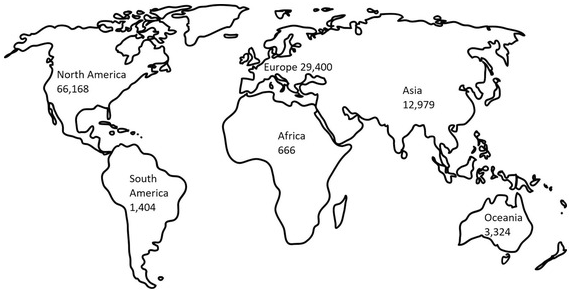
Figure 1.1 Green certified buildings around the world
Note: Data taken from project databases of the 14 most-popular ecolabels with public project data
The built environment is responsible for roughly 40 percent of total carbon emissions. Given the challenges that we face to rapidly decarbonize our economy, it is essential to understand how to do this in the built environment. Recently much attention has been paid to the electricity sector, where rapid advances in wind and solar have begun to transform the electricity market. In the concluding chapter, we compare the built environment with other sectors and technologies to draw out how these lessons may extend to other sectors.
While Chapters 2 and 4 of this book provide more information on ecolabeling and green building, it is helpful here to provide a brief overview of ecolabels and the built environment to explain a theory of market transformation.
Understanding the World of Ecolabels
Ecolabels are a type of third-party certification program that verify hard-to-observe characteristics of a good or service. Most ecolabels operate through a checklist approach. That is, labels offer a menu of product and process upgrades that relate to the sustainability of the production process or sustainability characteristics of a good.
There is significant variation across labels. Some are sponsored by governments. For example, at least 70 governing bodies around the world provide guidance on organic labels that can be placed on food products. Popular examples include the United States Department of Agriculture (USDA) label, the European Union (EU) Organic label, and the China Organic Food Certification.
Others are sponsored by nongovernmental organizations. For example, the Forest Stewardship Council (FSC) offers a timber and paper products ecolabel certifying forest management practices. The Sustainable Agriculture Network/Rainforest Alliance (SANRA) offers a Rainforest Alliance label that certifies economic, social, and environmental practices of farms producing a range of agricultural products such as coffee and sugar. The Marine Stewardship Council certifies sustainable fishing practices for seafood.
Still others are sponsored by for-profit entities, industry associations – or nonprofits that have close ties to industry. The Green Good Housekeeping Seal is awarded for a range of product quality, safety, sustainability, and warranty characteristics by the Good Housekeeping Research Institute, a part of the Hearst Corporation. Greenguard, a label for low volatile organic compound emissions that impact indoor air quality, is offered by Underwriters Laboratories (UL). The Sustainable Forestry Initiative, which provides an alternative forestry certification to the FSC, while technically a nonprofit organization, has been accused by environmental groups of being fully funded by industry and a vehicle for greenwashing.
Not much is known about the broader impacts of ecolabels. One pressing and relevant question – perhaps unanswered by the research cited in this book – regards the design of and governance of ecolabels and how that translates to their effectiveness. Some research has assessed a broad range of ecolabels to conclude that third-party certification is an important feature of ecolabels that improves their rigor and ecolabels sponsored by nongovernmental organizations (NGOs) have the most stringent rules while labels sponsored by industry have the least stringent rules (Darnall et al. Reference Darnall, Ji and Potoski2017, Reference Darnall, Ji and Vázquez-Brust2018; Rivera and de Leon Reference Rivera and de Leon2004). But many questions remain about the wider landscape of ecolabels. Researchers have also pointed out a number of problems with ecolabels such as greenwashing, a lack of enforcement (Aragón-Correa et al. Reference Aragón-Correa, Marcus and Vogel2020), or even fraudulent ecolabels that lack any sort of legal meaning (e.g., antibiotic free chicken; GMO-free foods; and “all-natural ingredients”) (Hamilton and Zilberman Reference Hamilton and Zilberman2006). Others have been criticized for providing confusing or misleading claims, which can be compounded by having multiple competing labels in a particular product area (Roheim et al. Reference Roheim, Bush, Asche, Sanchirico and Uchida2018). Individual labels have received more attention on impacts. In particular, the LEED label from the USGBC has received significant attention. While we dig into these results in more detail in Chapter 2, these results highlight market premiums to green building, increased employee productivity, increased investment in energy and environmental technologies, and improved energy and environmental performance.
While the case of green building provides perspectives of success in green market transformation, we would be remiss to explore some of the risks associated with ecolabels and the promises of green market transformation. These include, but are not limited to: ecolabels that do not produce environmental benefits; greenwashing or providing misleading environmental information about a firm’s behavior; or producing – instead of a virtuous cycle, produce a “race to the bottom” where organizations strive only for minimum levels of environmental performance or attempt to evade efforts aimed at producing improved environmental performance. In addition, it is important to recognize the conditions that enable the successes that we observe in the green building case and their applicability (or not) to other cases. We explore these risks in Chapter 3 (greenwashing), Chapter 8 (race to the bottom), and Chapters 10 and 11 (boundary conditions and limitations of our perspective).
The Green Building Movement and Ecolabels
Beginning in the early 1990s, there was a growing recognition of the need to think about energy efficiency and the environmental footprint of the built environment. The Building Research Establishment (BRE), which was a UK national lab (later privatized in 1997), launched its first certification in 1990, called the Building Research Establishment Environmental Assessment Method (BREEAM), aimed at benchmarking the performance of office buildings. In 1993, the USGBC formed and began to assemble a broad-based consensus-based process of stakeholders in the building and construction sector, seeking to launch a program aimed at improving the environmental performance of buildings. This consensus-based approach, which assembled diverse participants from environmental NGOs, government agencies, architects, engineers, developers, builders, product manufacturers, and other industry leaders, ultimately became the basis for a broad movement aimed at greening the built environment. The LEED program launched in 1998, though, as we discuss later, did not gain significant market traction until a couple of years later.
Originally, LEED worked as a checklist and what we like to call a “Choose Your Own Adventure” approach to ecolabeling (see Chapter 3). There were 69 different credits available divided across eight categories including energy and atmosphere, water efficiency, materials and resources, indoor environmental quality, sustainable sites, location and linkages, innovation and design, and awareness and education. Buildings could achieve certification levels based on points: 26–32 points achieved basic certification; 33–38 points achieved Silver certification; 39–51 points achieved Gold certification; and more than 52 points achieved Platinum certification. The technical committee aimed to make points roughly equivalent in terms of environmental impact, though certainly comparing water efficiency to innovation and design is like comparing apples and oranges. According to discussions with USGBC executives who were part of this early process, they just chose these cutoffs arbitrarily, intending for them to be like grades in school. Forty percent received a pass, 50 percent received Silver, and 60 percent received Gold. They wanted an extra step to get Platinum, so they required 80 percent of the total points to get Platinum.
At the time these systems were innovative for several reasons. First, while programs like Energy Star or product-labeling requirements in the EU labeled the energy-performance characteristics of a product (including buildings) or even labeled multiple performance characteristics, the BREEAM system and LEED system engaged in a more holistic rating of a building. LEED was not certifying just the energy performance of a building (and in fact, LEED attracted a fair bit of criticism for certification not being tightly tied to energy performance). Rather, LEED’s multidimensional label and multiple-tier structure allowed it to provide an overall sustainability rating with a differentiated structure that encouraged competition to achieve greener buildings. This innovation has proven popular. Most building certification programs and many other ecolabels or rating systems have since adopted a similar structure.Footnote 2
Over time, these systems have evolved. Both BRE and USGBC’s systems have grown internationally and become popular around the world. Figures 1.2(a)–(c) demonstrate the number of buildings in the United States, Europe, and the rest of the world, with the total buildings listed as state and country labels, and the shading indicating the number of buildings per capita. These figures highlight a few unexpected leaders in the Green Building Movement. New Mexico, for example, with 1,942 certified buildings, leads all states in certified buildings per capita, just behind Washington DC, which has a mandate that requires all large buildings to be certified or equivalent and has a significant number of federal buildings that are also certified under the federal procurement policy.


Figure 1.2 Total ecolabeled buildings and buildings per 100,000 people in (a) the United States, (b) Europe, and (c) the rest of the world
The United Kingdom leads the way in Europe, with 14,440 buildings, just behind Luxembourg in per-capita buildings despite its much larger size. This is likely due to the popularity of the BREEAM label, which is very popular in the UK. Not surprisingly, Sweden, Finland, and the Netherlands also have prominent ecolabeled buildings. These countries tend to certify under the LEED label. It is somewhat surprising that Germany, with its DGNB Sustainable Building Council certification and just over 1,500 certifications, does not have more popularity, although conversations with experts suggest that LEED has recently begun to gain uptake momentum in Germany. Other labels have also not gained significant traction in Germany.
Australia and Singapore are significant green building leaders in the rest of the world. Australia’s Green Star ecolabel and Singapore’s Green Mark ecolabel have become quite popular, with Singapore’s Green Mark covering 20 percent of gross floor area in the country.Footnote 3
These systems have developed multiple labels and certify a growing array of products. In LEED v2009, the point totals were expanded to move to a 100-point scale and incorporate additional opportunities for credits. Version 4 expanded the point total to 110 and incorporated a large shift from a checklist-based approach toward an approach focused increasingly on performance. Over the past 10 years or so, the concept of ecolabels for buildings has grown increasingly popular, demonstrating the growing importance of the Green Building Movement. Our previous research shows that firms participate in these programs for a variety of reasons and achieving a higher tier corresponds to receiving additional marketing benefits. As will be discussed throughout this book, this movement has had an enormous impact on the built environment and on the trajectory of building improvements that are now commonplace.
Our theory of Green Market Transformation lays out a model in which these ecolabels and associated marketing benefits of certification drive early movers to adopt advanced technologies. This early adoption is strategic. Firms may be experimenting internally to earn a competitive advantage, to gain experience with cutting edge technological systems, to showcase their firm’s identity, or to hire and retain employees. Other cases are oriented toward a broader public mission. The Kendeda Building for Innovative Sustainable Design at the Georgia Institute of Technology was initiated by the gift of a philanthropist as a mechanism to facilitate the transformation of the building and construction industries in the Southeastern United States. This building – and others built by foundations and universities, like the Bullitt Center in Portland and the Brock Commons tower at the University of British Columbia in Vancouver – highlights the role that foundations and universities can play in demonstrate innovative technologies to the private sector. Government-owned buildings such as the Vancouver Convention Center, Chicago’s City Hall, and the ACROS Fukuoka Prefectural International Hall in Japan might be built to appeal to a wide range of stakeholder interests. And private sector investments like the Pixel Building in Melbourne, Australia, Bosco Verticale in Milan, One Bryant Park in New York City, the Edge in Amsterdam, Netherlands, DPR Construction’s offices in Phoenix, Arizona, and Shanghai Tower in China highlight the role of the private sector strategically catering to niche markets or leveraging branding. The adoption of advanced technologies by early movers facilitates the broader uptake of these technologies. Here, we highlight several cases where firms or organizations that were early adopters of emergent technologies have paved the way for their widespread adoption.
Examples of Prominent Ecolabeled Buildings
Johnson Controls
Johnson Controls highlight a case where gaining experience with new technologies is key to the strategic practice of the firm. Johnson Controls, which builds and operates building automation technologies, is an obvious candidate to be an early adopter of leading energy technologies. Johnson Controls certified one of the very first LEED New Construction buildings in the world, the Brengel Technology Center in Milwaukee, in 2000. In 2010, the firm built a Corporate Campus in Glendale, WI, with four LEED Platinum buildings. These investments were seen through the lens of gaining experience with innovative technologies so that Johnson Controls could highlight to potential clients “what technologies provide the best financial investment while having the least impact on the environment, and at the same time create a productive workplace for employees,” notes facilities and building services director Ward Komorowski.Footnote 4 The Johnson Controls case shows how corporations adopt these new technologies to communicate with employees, customers, and the public. Komorowski insists “It’s important that our employees, customers and the public understand every aspect of our commitment to the triple bottom line, and the new corporate campus helps that happen.”Footnote 5 Not only does this case highlight some of the strategic reasons that firms are likely to pursue ecolabeling and adopt new technologies, but also the dissemination of these new technologies across borders. In 2018, Johnson Controls completed a second headquarters in Shanghai, China, certified LEED Platinum. They also certified with the Chinese label Three Star and the International Finance Corporation (IFC) - World Bank label Excellence in Design for Greater Efficiencies (EDGE). As we will discuss in more depth throughout the book, this repetitive and iterative certification represents evidence of learning and the transfer of knowledge across borders that is important to the market transformation process.
Genzyme
Other firms have less obvious strategic relationships with energy and environmental technologies. In 2001, biotechnology company Genzyme pursued one of the first LEED Platinum buildings in the United States at a time when Green Building certification was a new idea (Toffel and Sesia Reference Toffel and Sesia2010). While Genzyme did not have a strategic relationship with energy and the environment, they saw the pursuit of a sustainably certified building as part of their global citizenship efforts and corporate social responsibility initiatives (Toffel and Sesia Reference Toffel and Sesia2010). Henri Termeer, Genzyme’s Chief Executive Officer (CEO), discussed that Genzyme wanted to do something different and to make a statement with their new headquarters. “I wanted the building to explain what we stood for – innovation, doing the right thing, sustainability, transparency, life sciences” (Toffel and Sesia Reference Toffel and Sesia2010).
This case highlights many of the challenges, barriers, and costs associated with being an early adopter, as well as some of the motivations to pursue something truly innovative. When high costs associated with initial designs deterred the design team from pursuing a LEED Platinum certification, Termeer asked the Green Building Team to explore alternative green features to achieve Platinum certification. Back in 2001, senior Project Manager Gordon Brailsford explained the risks, costs, and uncertainties associated with being an early adopter of green building technologies: “This is a big challenge because it is not so easy to map a green feature to a LEED credit … there are so few ‘green’ products and materials in the marketplace that costs are ballpark estimates … making [design] changes could jeopardize LEED credits that we have in the bank.” Still, Termeer argued that “The difference between meeting the highest standard and a good standard such as Silver or Gold is very large for a company of this kind. Setting a good standard simply falls short and sends the wrong signal to potential partners, regulators, our employees, and our patients.” Early adopters of environmental technologies are subject to increased risk, uncertainty, and costs but are able to use these investments to signal to stakeholders that they are high quality, innovative, and sustainable.
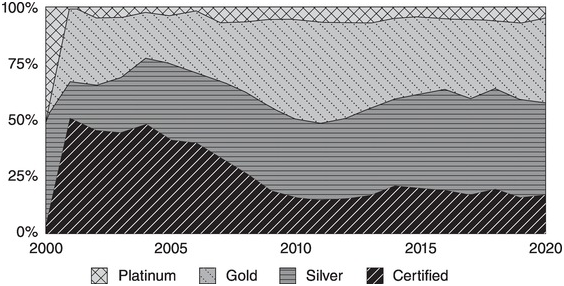
As we will highlight throughout the book, individual choices like Genzyme’s decision to invest additional resources to pursue a higher level of ecolabel can produce positive spillover effects that ultimately lead to the widespread uptake of these new technologies. Indeed, by 2020, roughly 1,200 projects worldwide had been certified Platinum under the LEED standard.Footnote 6 Figure 1.3 shows the growth of Gold and Silver new construction certifications in the United States relative to the lowest certification level throughout LEED’s 20-year history. The stringency of standards for achieving LEED Platinum ecolabel have only increased over time, demonstrating that firms consider the benefits of high certification to be worthwhile even under conditions of increasing costs. In spite of cost, high levels of ecolabeling have become achievable for many, and market transformation has occurred.
The Kendeda Building for Innovative Sustainable Design
This Living Building was built as a collaboration between the Kendeda Fund foundation and the Georgia Institute of Technology (Georgia Tech or GT). The developers aimed to build one of the largest Living Building projects constructed as a demonstration of sustainable engineering and design, with an overarching goal to transform the built environment in the Southeastern United States. Demonstration projects serve to disseminate state-of-the-art practices by reducing uncertainty associated with the performance of untested technologies. As one of the first Living Buildings in the Southeast, it faced incumbent climatic difficulties as well as a challenging lab and classroom environment. In addition to the adoption of a number of the advanced technologies highlighted in Chapter 5, the sponsoring partners and building team have actively undertaken a number of steps aimed at increasing the broader impact of the building and disseminating the new building practices across the Southeast. In its first year of operation, thousands of people were expected to tour the building.Footnote 7 They represent colleges and universities around the world considering similar building projects. Other folks come from corporations in the building and construction industry, sustainability professionals, and a diverse array of businesses and organizations hoping to learn about the leading edge of building technologies.
The building itself represents a transfer of technology and learning within the construction industry. When Georgia Tech initiated the design competition, all competing entries were made public. To the participants in the program, this represented a departure from the typical close-to-the-chest approach that design teams had observed in this cutting-edge technology space. Alissa Kingsley from the winning team at Lord Aeck Sargent explained that showcasing all of the designs, including those that did not win, allowed the design teams to build an understanding of varying approaches to meet ambitious performance targets. The winning team was a collaboration between Lord Aeck Sargent, Skanska, and Newcomb & Boyd. They partnered with Miller Hull and PAE Engineering, a design and engineering team from Seattle and Portland that had worked together on the Bullitt Center in Seattle, a Living Building that had been completed six years earlier. Together, these firms adapted many of the technologies that were employed in the Bullitt Center to use in the Kendeda Building for Innovative Sustainable Design (KBISD). This transfer of technologies and expertise from the Northwest-based design team to the Southeast-based design team allowed these technologies to be calibrated and adapted for a different climate zone and operating conditions. This transfer of knowledge as a result of collaboration on an innovative project is a unique example of learning by doing that we will explore further throughout the book.
Although the building has only been open since August 2019, a number of lessons have already emerged that have allowed this building to spur the diffusion of improved managerial practices. First, this building uses only off-the-shelf technologies that make broader uptake more likely. It highlights that innovation can look like the combination of various technologies together to build a cohesive sustainable system. Second, it engages a wide range of stakeholders through frequent tours, meetings, and large events that increase the number of people who interact with the building. Third, by placing the project within a large organization and frequent builder like a major state university, the visibility of the project is increased. This allows for the external transfer of technologies. Finally, engaging in a demonstration project like this requires enhanced coordination by the design and construction team as well as the development of new forms of communication and engagement. By engaging committed contractors and subcontractors in the project to build their own expertise, the project has an increased chance of success.
Soldier Field
Soldier Field, home of the National Football League’s (NFL) Chicago Bears and one of Chicago’s largest and most recognizable event facilities, was renovated and reopened in 2003. The project incorporated a number of energy conservation and recycling programs, use of green cleaning materials, and reuse of waste material such as old soil from sod. Like many stadiums, Soldier Field is publicly owned (in this case by the Chicago Park District) and managed by SMG, a large private venue management and consulting firm that operates stadiums, convention centers, and other large facilities across the United States. The building, first constructed in 1924, became the first stadium to receive LEED for Existing Buildings certification in 2012. To achieve this certification, the Chicago Park District made a conscious effort to lessen its environmental impact by reducing water usage, increasing energy efficiency, and creating waste management programs.
Compared with other advanced buildings, Soldier Field does not incorporate high end technologies or systems. Its scorecard, available on the USGBC website, shows that it barely achieved certification (with 37 out of 85 possible points for Existing Buildings) and earned few points in water efficiency and energy and atmosphere. The project was unique, however, in its leverage of a government-owned building to help spur a worldwide competition for green construction and operation of large event spaces and stadia around the United States. This highlighted a connection between cities’ sustainable development strategies and opportunities to involve private-sector construction.
Chicago has had a sustainable development policy to improve sustainable performance of projects receiving City assistance in place since 2004. As a result of this policy, Chicago has become an international leader in green building technologies such as green roofs. In 2018, it was one of seven entire cities worldwide to be certified LEED Platinum.Footnote 8 Chicago also operates its own building certification program. New construction projects and renovations for existing buildings are required to either certify through LEED or another existing certification program, or they need to select amongst a series of strategies to earn points through the city’s certification program.
Research suggests that public procurement programs like Chicago’s can help drive the market for green buildings (Simcoe and Toffel Reference Simcoe and Toffel2014). This research suggests that government agencies that adopt green buildings play a role in highlighting the performance of these buildings, making them less risky and more attractive to the private sector. In addition, they build supply chains and expertise in the private sector, which lowers their costs and makes them more widely available in the market. These market driving forces, which are similar to those for pilot and demonstration projects, help facilitate market transformation and highlight a mechanism that cities and governments can utilize to transform the private-sector market.
Diffusing Technologies through Competition
While National Basketball Association (NBA), National Hockey League (NHL), Major League Baseball (MLB), and NFL teams compete on the court, ice, or field, their ownership and management groups have been competing in sustainability management. There are over 30 LEED ecolabeled sports venues in the United States.Footnote 9 The Miami Heat’s American Airlines Arena was the first NBA facility to earn the LEED for Existing Buildings certification in 2009, as well as the first sports and entertainment facility in the world to earn a LEED Gold recertification. This spurred a long list of stadiums and arenas around the world employing green building techniques and certifications. Here, we describe some of the most recognized green sporting facilities that demonstrate a competitive dynamic relationship and have pushed the bar for green building and inspired additional uptake of green building practices – both in the sporting world and in the communities they reside in.
In 2010, Target Field in downtown Minneapolis became the first MLB stadium to earn the LEED Silver ecolabel, and then earned LEED Silver for Existing Buildings – Operations and Maintenance the following year. By switching to compostable packaging and making improvements in recycling and composting management, the facility diverted 5,419 tons of waste in its first several years of operation. The facility was one of the first to adopt light-emitting diode (LED) systems for stadium lighting and to collect rainwater for purification and re-use. It inspired a number of additional adoptions both nearby and around the world. Demonstrating some of the local effects of greening stadiums, the Xcel Energy Center in Minnesota was the first NHL facility to earn LEED for Existing Buildings in 2014,Footnote 10 drawing upon the management firm’s experience managing the Saint Paul RiverCentre, a convention center next door. The building boasts a solar photovoltaic (PV) and a solar thermal array and supports wind-power offsets. In addition, the facility is achieving recycling rates of 60 percent and has successfully encouraged 40 percent of employees to use public transportation. The success of this initiative has also inspired the nearby Edmonton Oilers to build Rogers Place, a LEED-Silver certified facility, in 2017.Footnote 11 In 2019, this building upped its certification level to Platinum during a recertification process.
A number of other stadiums around the world have demonstrated leadership in energy and environmental design. The Levi’s Stadium, home of the San Francisco 49ers, earned the first LEED Gold certification for a stadium hosting a professional team, and in 2016 received a second Gold certification for Existing Buildings – Operations and Maintenance. The building includes state-of-the-art solar arrays and solar-covered pedestrian bridges, as well as a green roof. The building employs a sustainable purchasing program for cleaning materials and local food sourcing. The Golden 1 Center in Sacramento became the first LEED Platinum building hosting a professional sports team in 2016 and is in the top 3 percent of high performance buildings in the world.Footnote 12 It achieves 100 percent solar energy and uses 45 percent less water than required by California’s (already strict) code. Lincoln Financial Field in Philadelphia, certified LEED Gold in 2018, has 11,000 solar panels and 14 wind turbines, producing 3 megawatts (MW) of peak power.
The Atlanta Falcons and Atlanta United FC’s Mercedes-Benz Stadium, completed in 2018, is the first LEED Platinum professional sports stadium in the United States. Arthur Blank, the founder of Home Depot and the owner of the Falcons and Atlanta United, built the first LEED building in Georgia in 2004. He notes,
We set out to build a venue that would not only exceed expectations, but also push the limits of what was possible in terms of stadium design, fan experience, and sustainability … We set a goal of achieving the highest LEED rating because it was the right thing to do for our city and the environment and with this achievement. We have a powerful new platform to showcase to the industry and to our fans that building sustainably and responsibly is possible for a venue of any type, size and scale.Footnote 13
“In many ways, this project is influencing the future of LEED for sports facilities,” says Carlie Bullock-Jones, founder and principal of Ecoworks Studio.Footnote 14 The stadium hosted the Super Bowl, the College Football championship games, and the Major League Soccer championship and all-star games, exposing hundreds of thousands of attendees, personnel, and fans watching the broadcasts to this innovative approach to construction. It is also slated to host a number of additional high-profile sporting events and conventions. This international exposure is expected to help boost awareness of the opportunities associated with a LEED Platinum certification.
Many of the advanced technologies employed in the Mercedes-Benz Stadium are unlikely to be cost-effective solutions on their own. In the context of a large public project that requires public assistance and has complex politics, however, many of these technologies may have major public benefits that help smooth the contentious politics of a major development project such as a stadium. Scott Jenkins, the general manager for Mercedes-Benz Stadium, notes that a 680,000-gallon cistern used to collect rainwater and irrigate vegetation around the building also serves as flood control for the flood-susceptible West End neighborhood nearby the stadium that has a median family income of just a fraction of Atlanta’s wealthier neighborhoods.Footnote 15 Jenkins states, “It’s a community play as much as an environmental play, to do our part around issues in the neighborhood … If you looked at the return on investment for the water, it will take a long time to pay off. But some of this is good for business and some is good for community.”
It has arguably become commonplace for large stadiums to pursue an ecolabel as a matter of standard operating procedure. The Banc of California Stadium for the Los Angeles Football Club certified LEED Gold in 2019. The new SoFi Stadium for the LA Rams and LA Chargers, which opened in 2020, certified Gold as well. Indeed, all six stadiums used for the 2014 World Cup in Brazil had some form of LEED certification. Mane Garrincha Stadium in Brasilia, Brazil can generate up to 2.5 MW of energy. BREEAM has been involved with stadium certification as well – with Moscow’s Luzhniki Stadium, Kaliningrad Stadium, and Rostov Arena featured in the 2018 FIFA World Cup achieving the BREEAM label. The Austrian and German sustainable building councils, ÖGNI and DGNB, respectively, have created their own label specifically for sports stadiums in central Europe.
It is worth noting, however, that stadiums have been used to demonstrate innovative energy technologies even before ecolabeling was popular. For example, the Amsterdam ArenA – built in 1996 as a climate neutral facility – hosts solar panels, a wind turbine, and an energy storage system with used car batteries. This storage system for the local grid also works as backup generation for the stadium. It also boasts the use of renewable sugarcane materials for seating, various natural heating and cooling mechanisms, and the re-use of rainwater. In the United States, the MetLife Stadium, built in 2010, was an early adopter of solar panels and LED lighting, and consumed 30 percent less energy than its predecessor.
With green building becoming standard within the stadium market and in other high-profile buildings, it is apparent that market transformation has occurred. No longer is it acceptable to build a large building without paying attention to the sustainability features. The focus on sustainability features and the certification of those features has created an enormous industry around ecolabeling and sustainable building. This development has truly transformed the building and construction market. In the following section we explore the drivers of this market transformation.
How Market Transformation Works
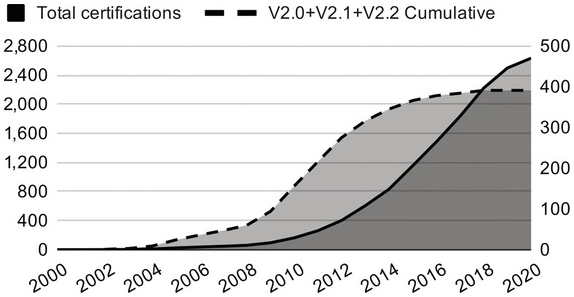
Early adopters pave the way for broader market uptake by reducing a number of uncertainties and search and transaction costs that typically inhibit the adoption of new technologies. Viewed from a traditional economic lens, these might affect the supply curve or the demand curve for these technologies. In the green building market, uptake of technologies has followed a traditional S curve for technological adoption, which is well known in the technological adoption literature. This S curve suggests that at first adoptions are slow but, eventually, the pace of adoption speeds up, facilitating market penetration and ultimately market transformation.
Figure 1.4 demonstrates this S-curve trend in the international market, highlighting a very gradual uptake of new technology followed by a period of more rapid uptake. The leveling off of the version 2 vintage is also typical of an S adoption curve, as the new technology becomes the market standard. In this particular graph, we see total adoptions continuing upward as new varieties of LEED are offered.
We next explore the supply-side and demand-side drivers of market transformation that brought the LEED program into the mainstream and may (or may not) provide a similar trajectory for Living Building technologies. Other trends where nascent technologies eventually achieve rapid uptake include solar and wind electricity and hybrid vehicles. Other technologies such as fully electric vehicles are currently in the nascent stage but show widespread market potential. Still others, such as various nuclear energy technologies, hydrogen fuel cell technologies, and others, appear to have failed to gain widespread market uptake. We turn next to exploring some of the drivers that may have facilitated successful market transformation in the built environment, as well as some parallels and contrasts with other technologies.
Supply-Side Drivers of Market Transformation
On the supply side, one major barrier to the adoption of new technologies is the lack of knowledge or expertise across the supply chain, which increases costs. If there are few or no suppliers of a product, it can be difficult to find potential product suppliers to bid into a project. Public buildings such as Georgia Tech’s KBISD are subject to public procurement and bidding requirements that might require three competing bidders. Even if these suppliers are found, they may demand a market premium because they do not have much experience with the product and perceive high risk in engaging with a new product space. Consider Genzyme’s comment that green features added uncertain costs to the project because there was little market experience available. Or consider comments from other contractors on innovative projects that note “nobody wants to be the first to try something.” Building systems are large, costly investments, and few want to gamble with new technologies.
In addition, a lack of competition in this space drives up prices. The initial products in a market pave the way for additional adoption, in part by building supply chains. Once suppliers gain experience with a product, it will be more readily available in the marketplace and prices will decrease. In the extreme case, for example, in 2001 the Genzyme LEED Platinum headquarters building had to import no-flush toilets from Europe at a cost of $117,000, with a payback rate of just $6,600 per year (Toffel and Sesia Reference Toffel and Sesia2010). Today, no-flush toilets are widely available with only a minimal market premium that has quick payback times. This principle also explains the importance of successive pilot and demonstration projects, and why it appears from the data that there is a critical mass of projects required before widespread adoption of new technologies can take place.
One factor that seems to have driven the success of market transformation in LEED and in solar manufacturing is the presence of a critical mass of projects in a particular geographic location. Building markets are extremely local, with prime and sub-contractors working regionally or locally due to regional expertise and conditions and high transportation costs. The co-location of projects establishes supply chains and brings down costs.
Several pieces of evidence from the LEED building dataset support these claims. When LEED starts a new label or vintage (e.g., New Construction 4.0, Retail Interiors, Core and Shell, Existing Buildings) they run a set of pilot projects to develop the label. These pilot projects are the earliest adopters of a new standard, and USGBC works with potential adopters to seed these projects into geographically dispersed building markets. In exchange for participating in the pilot project and agreeing to disseminate results, early adopters get technical assistance from the USGBC, a head start on experience with new technologies, and the right to advertise their status as innovative early adopters.
Examining these pilot projects can inform us about how the experiences of the earliest adopters impacts the eventual uptake of new technologies. Research described in this book (Chapter 7) highlights the role of pilot and demonstration projects in driving the adoption of new LEED projects. Further, once a market is established, building additional LEED ecolabeled projects leads to ever-lower costs as eco-practices are routinized, are incorporated into building codes, and ultimately become standard practice.
Demand-Side Drivers of Market Transformation
The earliest adopters of LEED Pilot projects take on the riskiest projects that have the most additional costs. By iterating projects and lowering costs, uncertainty associated with new technologies decreases, the recognition of the ecolabel and opportunities to build green increase, and demand for these new buildings increases. As this demand increases and green buildings become more commonplace, the dissemination of projects across the building industry represents market transformation. A similar story follows in the solar industry and demand for a range of green products, where people adopt green technologies to reduce their environmental impact or communicate their green values to others. These early adopters help drive down prices allowing the industry to expand. Further in solar and manufacturing, we see economies of agglomeration where the co-location of many suppliers has driven down costs. Policies and incentives that have been plentiful in the solar industry have furthered the demand for solar panels. Additionally, significant research points to the role of peer effects in boosting demand for hybrid and electric automobiles, solar panels, and even energy-efficient heating, ventilation, and air conditioning (HVAC) systems. This “keeping up with the Joneses” effect suggests competition and – even at the individual level – pressures people into green investments.
This phenomenon might also underpin the failure of promising technologies to gain widespread traction in the market. The federal government has invested massive amounts of resources in new designs of nuclear power plants since 1950. One estimate suggests that from 1950–2016, the government spent over $85 billion on civilian nuclear energy R&D (Management Information Services 2017). Yet few nuclear plants have come online since the 1970s, and none have used advanced reactor designs. While part of the failure of nuclear can be attributed to cost, political opposition, and other factors, it is also plausible that high costs have been driven by the low volume of plants constructed. An alternative strategy of iterating a small number of designs and increasing focus on the commercialization of these technologies could have produced a different outcome.
Early adopters of technologies also provide positive spillovers to other market participants on the demand side. First, new technologies have uncertain costs and benefits, as well as performance and reliability characteristics, meaning uncertain costs and benefits. Kotchen and Costello (Reference Kotchen and Costello2018) argue that both pilot projects and full-scale demonstration projects may warrant significant government subsidies because of the value generated by the learning that results from their construction. Adopters of new technologies supply other potential adopters with information about these factors of new technologies. Demand might also be influenced by peer effects, marketing benefits, and suppliers pushing a new product that they believe is a cost-effective solution.
As individual firms gain experience with new technologies, they may seek more widespread adoption. For example, large firms may choose to apply specific technological standards or adopt new technologies across an entire product line or in multiple locations. Visual cues like seeing a new technology being used by a rival firm might signal a firm that a new technology is market-ready, or spur the demand by those who are exposed to this new technology. Research on electric vehicles, rooftop solar, and even zoned HVAC suggests that these peer effects can be powerful tools for disseminating new technologies.
As new practices become standard practices, costs continue to come down and the marketing advantages of adopting these practices eventually diminish. When new technologies become standard practices, market transformation is complete. In the built environment, we have seen energy efficiency, LED lighting, and a number of other technologies that were once costly and premium products become standard practice in new constructions and in retrofits.
Conclusion
In conclusion, ecolabels help enable early adopters to invest in innovative technologies and practices. These early adopters see strategic benefits to adopting ecolabels and signaling leadership. These benefits might be market premiums, growing market share, preempting or steering regulation, etc. Even more simply, this may be about bragging rights, similar to early adopters of Tesla vehicles or solar panels on a house.
But early adoption is about more than bragging rights. These early adopters play an important role in the innovation cycle and bringing new technologies to market. By ponying up the extra costs of new technologies, they play an important role in bringing about market transformation. Early adopters provide valuable information to the market. This information can come in the form of performance data for new technologies, or it may come in the form of training up a supply chain. The reduction in costs of new technologies, combined with improved understanding of benefits, leads to widespread adoption of these technologies. As the (previously new) technologies become standard in the market, ecolabels can change the standards to push the bar further and introduce more advanced, greener technologies to the market. This sets the stage for the next wave of innovation. Ecolabels can ratchet up requirements and require a new round of innovation and technological adoption, again rewarded by a marketing benefit and premium associated with being an early adopter. We explore this virtuous cycle in more depth throughout the book.


