

Television is central to modern political campaigns and arguably the most politically influential medium in Latin America. As a result of historically low levels of literacy and limited newspaper circulation, Latin Americans learn about politics principally by watching television (Reference Lozano, Kaid and Holtz-BachaLozano 2006; Reference Pérez-LiñánPérez-Liñán 2002; Reference Straubhaar and ColeStraubhaar 1996). Television programming can raise the salience of issues, shape public opinions, and most importantly, influence political behavior (Reference Atkin and HealdAtkin and Heald 1976; Reference Franz and RidoutFranz and Ridout 2007; Reference Kahn and GeerKahn and Geer 1994; Reference LeighleyLeighley 2003; Reference Valentino, Hutchings and WilliamsValentino, Hutchings, and Williams 2004). As a result, political elites in the region seek to control the airwaves (Reference HorvathHorvath 1988; Reference Leon-DermotaLeon-Dermota 2003; Reference StraubhaarStraubhaar 1989, Reference Straubhaar, Morris and Waisbord2001; Reference WeylandWeyland 2013).
Conscious of the political influence of television, the democratic regimes that emerged in Latin America during the 1970s and 1980s promoted media pluralism. The authors of Brazil’s 1988 constitution went so far as to establish the Horário Gratuito de Propaganda Eleitoral (HGPE), a publicly financed electoral program, to ensure that voters receive information about the qualifications and policy views of candidates from across the political spectrum (Reference Porto, Kaid and Holtz-BachaPorto 2006). This program, which grants political parties the opportunity to broadcast campaign ads on television and radio in the forty-five days leading up to elections, but otherwise bars the purchase of airtime for political purposes, is widely regarded as a democratizing force. Although the HGPE diminishes resource asymmetries between political parties, party gatekeepers can limit which types of candidates appear on television.
Scholars largely attribute Afro-Brazilian political underrepresentation to racial disparities in campaign resources (Reference Bueno and DunningBueno and Dunning 2017; Reference CamposCampos 2015; Reference Campos and MachadoCampos and Machado 2017; Reference JanuszJanusz 2018; Reference Strijbis and VölkerStrijbis and Völker 2020). The extent to which gatekeeping by party officials underlies resource differentials between Afro-Brazilian and white candidates, however, is unclear. In their study of race and representation, Bueno and Dunning (Reference Bueno and Dunning2017) find that party officials do not discriminate against Afro-Brazilian candidates when distributing ballot numbers, some of which are more memorable than others. Nevertheless, this is only one of the mechanisms through which party elites can influence the attractiveness of candidates. Brazilian party elites distribute resources that are arguably much more consequential than ballot numbers: they control access to the airwaves.
In Brazilian elections, broadcast airtime is a valuable campaign resource. Survey research indicates that most voters regularly watch the HGPE and shows that advertising has important effects on voter behavior (Reference Porto, Kaid and Holtz-BachaPorto 2006). Qualitative interviews suggest that Brazilian politicians are aware of the electoral benefits of broadcast advertising. When asked about the importance of different types of campaign resources, politicians routinely mentioned television advertising (Reference JanuszJanusz 2019). Despite its electoral significance, relatively little is known about the relationship between candidate race and broadcast advertising in Brazil.
In this article, we seek to answer two important questions about television advertisements in Brazilian elections. First, do political parties provide Afro-Brazilian and white candidates similar amounts of HGPE airtime? And second, do Afro-Brazilian and white candidates use the HGPE airtime they receive similarly? To answer these questions, we use data on the universe of campaign ads broadcast on television during Rio de Janeiro’s 2012 municipal elections.
Our quantitative analysis reveals evidence of racialized gatekeeping. We find that party officials provide white candidates significantly more HGPE airtime than their Afro-Brazilian counterparts. While this behavior violates norms of equality, it may be strategic if Afro-Brazilian candidates are less qualified than their white counterparts. Using regression techniques, though, we do not find evidence that racial disparities in HGPE airtime are explained by differences in candidate quality. This finding points to the possibility that political party officials discriminate against Afro-Brazilian candidates.
In addition, our work sheds light on racial differences in campaign advertising. We show that whites and Afro-Brazilians highlight similar policy issues with one notable exception, racial inequality. We find that Afro-Brazilian candidates are more than ten times more likely than whites to highlight racial inequality in their televised campaign ads. This suggests that when they are elected, Afro-Brazilian politicians may be more likely than whites to work on racial equality issues, a topic of particularly significance to Brazil’s majority nonwhite population.
This article contributes to the literature on political parties and political representation. Political parties strategically nominate candidates from different ethnic and racial groups to broaden their base of support (Reference Fraga and HassellFraga and Hassell 2018; Reference MadridMadrid 2008, Reference Madrid2012). Nevertheless, the nomination of diverse candidates is at times purely symbolic (Reference DancygierDancygier 2017). Studies show that party elites routinely nominate minorities to run in noncompetitive electoral districts and place them in unelectable positions on party lists (Reference Dancygier, Lindgren, Oskarsson and VernbyDancygier et al. 2015; Reference Norris and LovenduskiNorris and Lovenduski 1995; Reference NorrisNorris 2004). In open-list electoral systems, party gatekeepers do not control the order of party lists, but they can use their discretion over resources to increase the likelihood that their preferred candidates are elected. Our research shows party elites perpetuate racial disparities in political representation by selectively distributing media resources. As such, our research provides new insight into why diverse candidate fields may fail to produce diverse elected assemblies.
Our work also contributes to the study of racial politics in Brazil. To our knowledge, this is the first article to empirically examine the relationship between candidate race and televised campaign advertisements in Brazil. Moreover, it is the first to present evidence that party officials discriminate against Afro-Brazilian candidates. As such, this study not only addresses a lacuna in the literature but also has critical policy implications. In the wake of a vast corruption scandal, Brazil adopted public campaign financing. While this reform will restrict corporate contributions, which primarily go to white candidates, our research suggests that party elites utilize their discretion over public funds to promote the candidacies of whites. If this occurs, Brazilian democracy may be undermined rather than strengthened.
Race in Brazilian Elections
Brazil’s entrenched racial hierarchy is reflected in its electoral politics. Afro-Brazilians, an umbrella category that includes mixed-race and Black individuals, account for more than 50 percent of the Brazilian population but are descriptively underrepresented at the local, state, and national levels (Reference Bueno and DunningBueno and Dunning 2017; Reference Johnson, Heringer and JohnsonJohnson 2015). A growing body of scholarship explores the causes of racial disparities in electoral outcomes. Afro-Brazilian candidates’ limited campaign resources are broadly recognized as the principal impediment to their electoral success.
Brazilian elections are recognized as among the most expensive in the world. The use of open-list proportional representation rules incentivizes candidates to distinguish themselves from copartisans as well as candidates from other parties (Reference Carey and ShugartCarey and Shugart 1995). To this end, candidates spend substantial sums of money (Reference SamuelsSamuels 2001). As a result of race-based, class hierarchies, though, white candidates have significantly more financial resources than Afro-Brazilians (Reference Bueno and DunningBueno and Dunning 2017; Reference CamposCampos 2015; Reference Campos and MachadoCampos and Machado 2017). While disparities in monetary resources provide white candidates an advantage over their Afro-Brazilian competitors in drumming up voter support through distribution of particularistic goods, money cannot purchase television airtime. The only way political candidates can solicit voter support via television is by appearing during the HGPE.
Brazil’s election coordinating body, the Tribunal Superior Eleitoral (TSE), distributes blocks of HGPE airtime to political parties. According to present regulations, one-third of HGPE airtime is distributed in equal shares among all official political parties, and two-thirds is divided according to the number of seats that each party holds in the Chamber of Deputies (Câmara dos Deputados), Brazil’s lower house of Congress. While all political parties thus receive airtime, not all candidates affiliated with those parties do. Party leaders have discretion over the distribution of HGPE resources.
Relatively little is known about how party leaders distribute HGPE airtime. While party officials may distribute it equally, it is also possible that they discriminate among candidates. We advance the literature on racial politics in Brazil by examining how political parties distribute HGPE airtime to white and Afro-Brazilian candidates, as well as by assessing whether there are racial differences in the content of televised campaign ads.
Race and Televised Campaign Advertisements
Televised campaign ads provide voters critical information about candidates’ qualifications and their political priorities. Survey research indicates that a substantial portion of the Brazilian electorate watches the HGPE and shows that HGPE ads influence vote choice (Reference Da Silveira and MelloDa Silveira and De Mello 2011; Reference Porto, Kaid and Holtz-BachaPorto 2006; Reference Speck and CerviSpeck and Cervi 2016). It is therefore unsurprising that scholars find a high correlation between candidate HGPE airtime and electoral success (Reference Carneiro and SchmittCarneiro and Schmitt 1995; Reference Kuschnir, Piquet Carneiro and SchmittKuschnir, Carneiro, and Schmitt 1998). Because of its electoral benefits, candidates covet the opportunity to appeal to voters on television (Reference Quadros and CostaQuadros and Costa 2017). Only a fraction of political candidates, however, get the chance to broadcast campaign ads during the HGPE.
Extant research indicates that party officials distribute HGPE airtime selectively. By effectively establishing “informal party lists,” party leaders increase the likelihood that their preferred candidates are elected (Reference Albuquerque, Boaz Steibel and CarneiroAlbuquerque, Steibel, and Carneiro 2008; Reference Schmitt, Piquet Carneiro and KuschnirSchmitt, Carneiro, and Kuschnir 1999). While withholding HGPE airtime from candidates directly diminishes their individual chances of winning public office, parties can maximize the number of seats they win if they provide resources to the candidates with greatest electoral potential. In contrast, party officials may choose not to support candidates for reasons unrelated to their electoral potential.
Brazilian political parties are known to discriminate against candidates from certain social groups. For example, party officials routinely fail to provide female candidates campaign resources necessary to contest public office (Reference Wylie and SantosWylie and Dos Santos 2016; Reference WylieWylie 2018). Women, however, may not be the only type of candidates to be systematically disadvantaged by party officials. Party officials may also discriminate against Afro-Brazilians.
Brazil’s predominately white political elite historically promoted the myth that Brazil is a color-blind, racial democracy (Reference TellesTelles 2004). In reality, blackness in Brazil is stigmatized and nonwhites suffer racial discrimination (Reference Da Silva, Paixão and TellesDa Silva and Paixão 2014; Reference Layton and SmithLayton and Smith 2017; Reference TellesTelles 2004). Given the pervasive discrimination that exists in Brazilian society, it is possible that party officials discriminate against Afro-Brazilian candidates in the distribution of HGPE resources.
Despite norms against racial prejudice, a portion of the Brazilian population is known to hold prejudicial views of Afro-Brazilians. In the nationally representative 2002 Brazilian Social Survey (Pesquisa Social Brasileira), Brazilian respondents were more likely to attribute positive characteristics like intelligence, honesty, and respectfulness to photos of whites than to photos of Afro-Brazilians (Reference Almeida, Kingstone and PowerAlmeida 2008). These opinions, however, are not restricted to just the electorate. Brazil’s president Jair Bolsonaro, as well as his vice president General Hamilton Mourão, were criticized for making racist remarks during their 2018 electoral campaign.Footnote 1 It is possible that party officials hold similar views, and that prejudicial attitudes influence how they distribute HGPE airtime.
Even if party leaders do not hold prejudicial attitudes, the expectation that voters have racial biases may lead them to provide Afro-Brazilian candidates less HGPE airtime than their white counterparts. In a survey conducted in Rio de Janeiro, 60 percent of respondents indicated that being Afro-Brazilian would present “a lot” or “some difficulty” for a person who wishes to be elected to political office (Reference BaileyBailey 2009). Moreover, respondents in that study made it clear that the reason being Afro-Brazilian would present difficulty is because of the discrimination they face. While experimental research indicates that Brazilian voters do not discriminate against nonwhite candidates (Reference Aguilar, Cunow, Desposato and BaroneAguilar et al. 2015; Reference Bueno and DunningBueno and Dunning 2017), this belief is not widely held. Party officials may choose to withhold HGPE airtime from Afro-Brazilian candidates because of the expectation that voters are inclined to vote for white candidates.
Prior research provides limited insight into how party officials’ personal preferences and electoral assessments impact the distribution of HGPE airtime. However, available evidence points to a single outcome: Afro-Brazilian candidates are likely to receive significantly less HGPE airtime than their white competitors.
H1: Afro-Brazilian candidates receive significantly less HGPE airtime than their white counterparts.
In addition to differences in how much HGPE airtime white and Afro-Brazilian candidates receive, there may also be racial differences in the content of campaign ads. In the United States, candidates from different racial groups are known to emphasize different attributes and highlight different issues (Reference McIlwain and CaliendoMcIlwain and Caliendo 2011; Reference MendelbergMendelberg 2001; Reference Valentino, Hutchings and WhiteValentino, Hutchings, and White 2002). The extent to which white and Afro-Brazilian political candidates convey different information in their televised political ads, though, is unclear.
The small body of research on race and campaign advertisements in Brazil focuses principally on the strategies used by Afro-Brazilian candidates. It demonstrates that Afro-Brazilian political candidates use racial cues in their campaign ads (Reference Mitchell-WalthourMitchell-Walthour 2009; Reference OliveiraOliveira 2016). For example, racial group membership was central to the campaign advertisements used by Benedita da Silva in her 1992 campaign for mayor in Rio de Janeiro. In the weeks preceding the first round of the mayoral elections, 30 percent of da Silva’s televised campaign ads utilized racial cues and messages (Reference OliveiraOliveira 2016). Not all Afro-Brazilian candidates, however, make race the focus of their campaign.
Afro-Brazilian candidates are known to also employ deracialized campaign strategies (Reference Mitchell-WalthourMitchell-Walthour 2009; Reference OliveiraOliveira 2016). In Celso Pitta’s 1996 mayoral campaign, Pitta, who has dark skin and Afrocentric facial features, rarely mentioned his race or justified his proposals on racial grounds. Oliveira (Reference Oliveira2016) finds that only 13 percent of the HGPE ads Pitta used prior to the first round of voting had racial content. After advancing to the second-round, runoff election, the percentage of ads with racial cues and content dropped to just 7 percent.
Extant scholarship points to two distinct reasons that candidates may choose to employ deracialization campaign strategies. First, candidates know that some voters believe that Brazil does not have racial issues and recognize that highlighting racial divisions may alienate them (Reference Hasenbalg and HuntingtonHasenbalg and Huntington 1982; Reference Mitchell-WalthourMitchell-Walthour 2009; Reference SouzaSouza 1971; Reference TellesTelles 2004; Reference TwineTwine 1998). And second, politicians may refrain from using racial cues in ads because they regard racial identities to be weak and therefore insufficient to mobilize voter support (Reference AndrewsAndrews 1991; Reference BaileyBailey 2009; Reference GuimarãesGuimarães 2001; Reference SansoneSansone 1998, Reference Sansone2004). For these reasons, it is not entirely surprising that when asked during a personal interview in May 2016 about racial cues in campaigns, Magno Ferreira, an Afro-Brazilian city council member in Pinheiro, a suburb of Rio de Janeiro, replied, “Candidates do not mention racial issues and those that do lose.”
Because Brazilian political candidates perceive highlighting racial issues or utilizing racial appeals to be ineffective, they are expected to rarely use them. Instead, Afro-Brazilian candidates and whites are likely to highlight similar policy issues. This leads to our second hypothesis:
H2: Afro-Brazilian and white candidates are likely to highlight similar policy issues in their HGPE campaign ads.
To test these hypotheses, we draw on original data from Rio de Janeiro’s 2012 city council elections. Rio de Janeiro is Brazil’s second largest city as well as one of its most racially diverse. Nearly half of Rio de Janeiro’s population is nonwhite and Afro-Brazilian candidates regularly compete in its highly competitive elections. As in other cities, though, Afro-Brazilian candidates in Rio de Janeiro are not elected in proportion to the rates at which they run (Reference CamposCampos 2015). As a result, Rio de Janeiro is an ideal case to examine how political parties distribute HGPE airtime and explore how candidates use the HGPE program airtime that they receive.
HGPE Campaign Data
In Rio de Janeiro’s 2012 municipal elections, 1,598 candidates from twenty-eight different political parties competed for fifty-one positions on the City Council (Câmara dos Vereadores). We collected data on all city council candidate advertisements that appeared during the HGPE in the weeks preceding elections. In total, 306 minutes of ads were televised during the six weeks prior to election day. On average, those ads were 8.5 seconds in length, although some ads were over a minute in length. While televised ads were overwhelmingly short, in Brazil’s low information electoral environment, the opportunity to appear on television for even seconds is highly prized by candidates.
In addition to collecting data on the length of the campaign ads aired during the HGPE, we also systematically coded the content of each ad. The data set we assemble includes variables that reflect whether an ad mentioned their personal qualifications, the policy content of each ad, and references to racial groups or explicitly racial issues. Accuracy and reliability in coding were attained via an iterative process. First, we discussed and developed a framework for coding ads. We then independently coded a random sample of ads, assessed intercoder reliability, discussed discrepancies, and formulated a revised classification scheme.Footnote 2 The classification scheme we employ reduces latitude for interpretation, and the need to make judgment calls.
The second author trained two graduate student research assistants and coded a stratified sample of ads with them.Footnote 3 After training, those research assistants coded all ads.Footnote 4 Due to resource constraints, each campaign ad was coded by only one research assistant. Our classification scheme was designed to limit ad subjectivity, yet it is possible that coders evaluated campaign ads differently. Importantly, robustness checks suggest this is not the case.Footnote 5 We use this original data to compare ads among candidates from different racial groups.
Importantly, only 53 percent of the 1,598 candidates who ran for city council broadcast campaign ads during the HGPE. To determine whether candidates’ personal characteristics affect the likelihood of appearing during the HGPE, we supplement our original campaign-ad data set with information from the Brazilian Regional Electoral Court (Tribunal Regional Eleitoral, TRE). Among the data we obtained from the TRE is information on each candidates’ level of educational attainment, occupation, gender, and prior political experience. One critical component of personal information unavailable during the period analyzed, though, is information on candidate race.Footnote 6
Racial group membership in Brazil is distinct from other multiracial societies. Unlike the United States and South Africa, racial group membership in Brazil is determined by physical appearance as opposed to ancestry (Reference NogueiraNogueira 2007). Phenotypic characteristics, such as skin tone, facial features, and hair type, affect how individuals identify themselves and how they are categorized by others (Reference Da Silva, Paixão and TellesDa Silva and Paixão 2014; Reference SansoneSansone 2004; Reference TellesTelles 2004; Reference Mitchell-WalthourMitchell-Walthour 2017). Because physical appearance is a strong determinant of racial group membership in Brazil, research on racial politics commonly utilize measures of ascribed race (Reference Bueno and DunningBueno and Dunning 2017; Reference Campos and MachadoCampos and Machado 2015; Reference JanuszJanusz 2018). Consistent with prior studies, we also rely on measures of candidate ascribed race.
To attain a measure of candidate ascribed race, photographs of each candidate were racially categorized by Brazilian coders.Footnote 7 Coders were recruited through a public posting for research assistants at the State University of Rio de Janeiro. Recruited coders include both white and Afro-Brazilian male and female college students living in Rio de Janeiro. Coders are thus not representative of the population in Rio de Janeiro; however, they do reflect its racial diversity.
Five Brazilian coders independently classified each candidate as white or Afro-Brazilian. The dichotomous categorization scheme is used widely by Brazilian race politics scholars and is employed in this study for two principal reasons. First, the distinction between white and Afro-Brazilian is clear in the minds of Brazilians (Reference BaileyBailey 2009). And second, members of the brown and Black racial categories have similar life experiences, including experiences with racial discrimination (Reference TellesTelles 2004). Because we are principally interested in how phenotypic differences affect treatment by others, we use a dichotomous measure of race.
To ensure coders’ assessments reflect social perceptions, they were simply instructed to view each picture and classify the individual as white or Afro-Brazilian. The fact that coders did not ask for additional detail on how to determine whether an individual is white or Afro-Brazilian suggests that they had a social understanding of racial group membership. In each photo, candidates appear in professional attire in front of a neutral background. As a result, coders’ assessments are likely to reflect candidate phenotypic rather than socioeconomic status.Footnote 8 Table 1 shows the extent to which coders’ independent racial assessments of candidates overlap.
Racial classification of candidates.

Note: Table 1 shows the extent to which coders agree about the race of political candidates.
Table 1 indicates that coders generally agree on the race of each candidate. In 57.4 percent of cases, coders unanimously agreed on the race of the candidate. In 21.8 percent of cases, four out of five coders agreed on the race of the candidate, and in the final 20.8 percent of cases, three of the five coders classified candidates into the same racial category. Given the ambiguity of Brazil’s racial boundaries, this variation is expected. Other studies have similarly found that Brazilian elected officials are routinely classified inconsistently by members of the public (Reference Bueno and DunningBueno and Dunning 2017; Reference Campos and MachadoCampos and Machado 2015; Reference JanuszJanusz 2018; Reference Mitchell-Walthour, Ickes and ReiterMitchell-Walthour 2018). For empirical purposes, in the subsequent analysis, we treat candidates as members of the racial category that a majority of coders ascribed them membership in.Footnote 9 Using this approach, we identify 45 percent of the candidates who ran for city council in Rio de Janeiro in 2012 as Afro-Brazilian and 55 percent as white.
When paired with our original measure of candidate race, broadcast airtime data provides an unprecedented opportunity to explore whether political party officials discriminate against Afro-Brazilian candidates. While extant research indicates that Brazilian political parties play an important gatekeeping role and may funnel financial resources toward preferred white candidates, it is unknown whether this occurs with respect to broadcast airtime.
Afro-Brazilian Presence in HGPE Airtime
All political parties receive airtime during the HGPE; however, many candidates do not. In 2012, only 53 percent of city council candidates in Rio de Janeiro received HGPE airtime at all. To investigate if the distribution of HGPE broadcast airtime is associated with candidate race, we initially present the results from a set of two-tailed t-tests. In the first t-test, we simply measure whether white candidates are more likely than Afro-Brazilian candidates to receive any HGPE airtime at all.
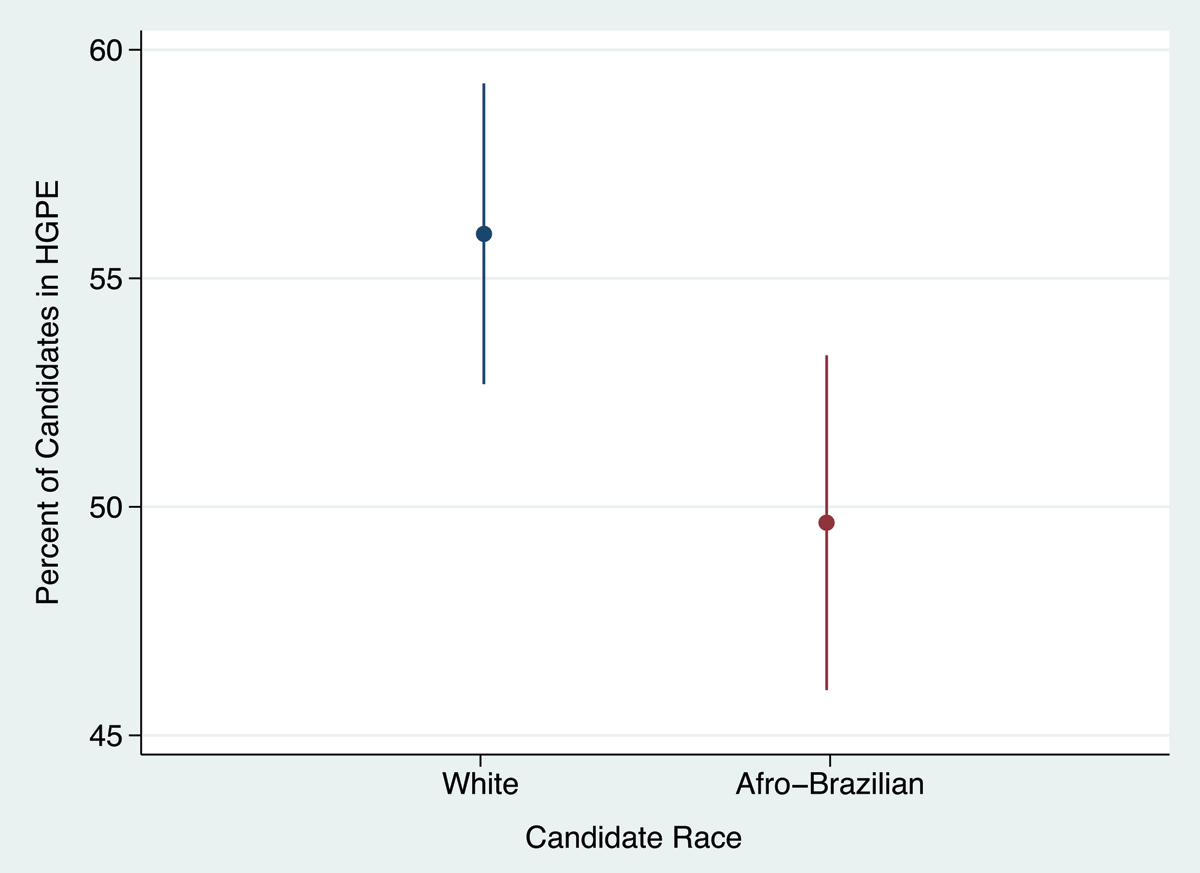
Figure 1 reveals that Afro-Brazilian candidates are significantly less likely than white candidates to receive any airtime during the HGPE. While 56 percent of white candidates received HGPE airtime, only 50 percent of Afro-Brazilian candidates did so. This 6 percent difference is significant at p < .05 according to a two-tailed t-test.
Appearance on HGPE by racial group (results of a two-tailed t-test comparing the percentage of white and Afro-Brazilian candidates who appeared in at least one political ad during the HGPE).
While appearing at all during the HGPE is likely to boost a candidate’s chances of winning elected office, candidates who appear for a longer amount of time are likely to have better electoral prospects than those who appear for shorter lengths of time. If our first hypothesis is correct, Afro-Brazilians can be expected to receive significantly less airtime on television than their white counterparts. Figure 2 shows the results of a two-tailed t-test comparing the average number of seconds white and Afro-Brazilian candidates received, conditional on them receiving any airtime at all.
Average HGPE airtime by racial group (results of a two-tailed t-test comparing the average number of seconds that white and Afro-Brazilian candidates appeared in political ads during the HGPE). The test excludes candidates that never appeared during the HGPE.

Figure 2 reveals that conditional on receiving any airtime at all, Afro-Brazilian candidates receive significantly less airtime than their white counterparts. While Afro-Brazilian candidates who received airtime had on average eleven seconds to speak directly to voters, white candidates had nearly thirty seconds. This difference, according to a two-tailed t-test, is significant at p < .0001. Nevertheless, the large standard errors suggest that this difference is at least partially driven by a few candidates.
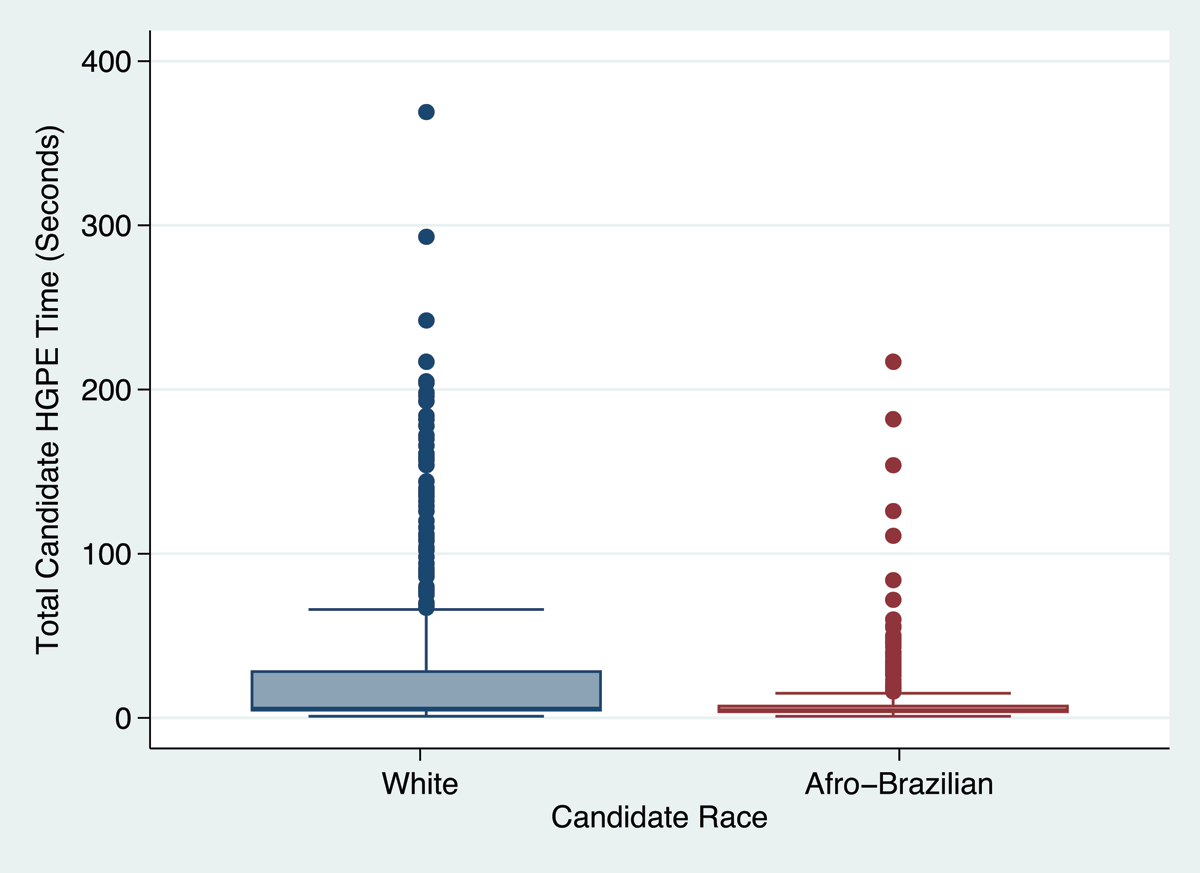
Figure 3 shows box plots of candidate HGPE airtime by racial group. Again, we restrict our sample to include only candidates who received any HGPE airtime. Figure 3 demonstrates that there is considerable variation in how much airtime candidates received. The candidate who received the most HGPE airtime in the 2012 Rio de Janeiro city council elections was Cesar Maia. Maia, who received nearly thirteen minutes on television, had previously served as mayor of Rio de Janeiro. This example illustrates that nonracial candidate attributes may also drive variation between whites and Afro-Brazilians with respect to television airtime.
Individual candidate HGPE airtime by racial group (how many seconds individual white and Afro-Brazilian candidates received). Includes only candidates who received one or more seconds of HGPE airtime. For display purposes, Cesar Maia, who appeared for 767 seconds, is not shown.
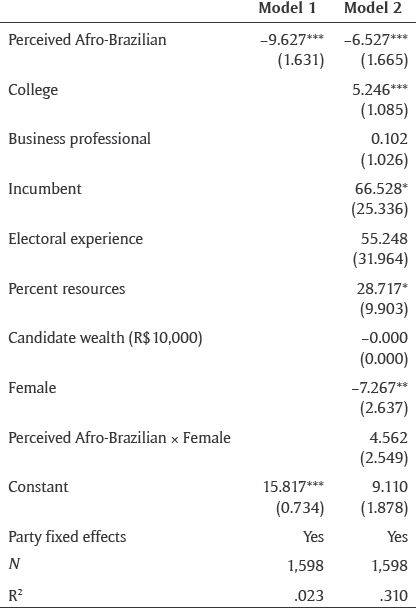
Although racial disparities in HGPE airtime suggest that Afro-Brazilians suffer discrimination, variation may be attributable to ostensibly nonracial differences between white and Afro-Brazilian candidates. To determine the effect of candidate race on HGPE airtime while controlling for theoretically important nonracial factors, we utilize regression techniques. In our regression, the results of which are presented in Table 2, our principal dependent variable is the number of seconds of HGPE airtime a candidate received. The principal independent variable in our analysis is our original measure of candidate ascribed race. The dichotomous variable of perceived Afro-Brazilian takes the value of 1 if a candidate is classified by a majority of coders as Afro-Brazilian and 0 otherwise.Footnote 10 Moreover, in our regression, we include control variables for candidate educational attainment, occupational prestige, political experience, financial resources, and gender. Inclusion of additional candidate characteristics raises the likelihood of posttreatment bias, but failure to include them would likely result in omitted variable bias. We therefore present models in Table 2 with and without control variables.
Regression results seconds during HGPE.
Note: Standard errors in parentheses.
* p < 0.05; ** p < 0.01; *** p < 0.001.
Brazilian political parties commonly recruit highly educated, business professionals to run for office. Candidates with that profile are presumed to possess the skills necessary to run a successful electoral campaign (Reference Lamounier and CardosoLamounier and Cardoso 1975; Reference RodriguesRodrigues 2009). For similar reasons, party officials may favor highly educated candidates and those with high-status occupations when allocating HGPE airtime. To assess this possibility, we include the college variable, which is coded 1 if a candidate attended or completed college and 0 otherwise. Moreover, we include the dichotomous variable of business professional. This variable is coded 1 if a candidate holds a white-collar, prestigious occupation and 0 otherwise. We code this variable according to the Carnes and Lupu (Reference Carnes and Lupu2015) coding schema. We expect both variables to produce positive coefficients.
Electoral experience can also be expected to influence the distribution of campaign resources. Party officials may expect politicians that have previously won elected office to succeed in future electoral contests and therefore provide them greater HGPE airtime than candidates who have not held elected office (Reference CerviCervi 2011). For this reason, we include the incumbent variable, which is coded 1 if a candidate was elected to the Rio de Janeiro City Council in 2008 and 0 otherwise. Moreover, we include the electoral experience variable, which is coded 1 if a candidate was not an incumbent member of the city council but was elected to any political office in the previous ten years. The electoral experience variable is coded 0 otherwise. We expect the incumbent and the electoral experience variables to produce positive coefficients.
In addition to human capital, financial capital is regarded as critical to electoral success. Politicians routinely spend large sums of money to drum-up electoral support (Reference SamuelsSamuels 2001). In recognition of the importance of money to winning public office, party officials can be expected to provide greater HGPE airtime to candidates with financial sources of support. We therefore include the percent resources variable, which reflects the percentage of all municipal campaign contributions each candidate possesses. This variable is coded according to campaign finance disclosures. Moreover, we include the candidate wealth variable, which reflects the value of each candidate’s assets as declared on financial disclosure forms. When candidates do not declare personal assets, the candidate wealth variable is coded as 0.Footnote 11 We expect the percent resources and the candidate wealth variables to yield positive coefficients.
In our analysis, we also control for candidate gender. Women are descriptively underrepresented at all levels of elective office in Brazil (Reference Miguel, Franceschet, Krook and PiscopoMiguel 2012). The limited number of women in office is partially attributed to discrimination (Reference MiguelMiguel 2008). Party officials historically did not recruit female candidates and withheld campaign resources from those they did recruit (Reference AraújoAraujo 1999; Reference Araújo and BorgesAraujo and Borges 2013; Reference Romero, Figueiredo, Araújo, Alves, Pinto and JordãoRomero, Figueiredo, and Araujo 2012). As a result, we expect the included female variable, which is coded 1 if the candidate identifies herself as female and 0 if the candidate identifies himself as male, to produce a negative and significant coefficient. To determine whether Afro-Brazilian women are even more penalized than white women, we interact the perceived Afro-Brazilian and female variables. We expect the interaction to produce a negative coefficient.
Finally, because political parties vary in both observable and unobservable ways, we utilize party fixed effects and cluster errors at the party level. This allows us to control for party-specific attributes, such as the amount of HGPE airtime officials from each party have at their disposal.Footnote 12
Both Model 1 and Model 2 indicate that candidate race has a significant impact on the provision of broadcast airtime. In Model 1, the negative and statistically significant coefficient of the perceived Afro-Brazilian variable indicates that Afro-Brazilian candidates receive significantly less HGPE airtime than their white copartisans. This model, however, does not take into account theoretically important, nonracial candidate attributes that may affect how party officials distribute HGPE airtime.
In Model 2, which includes control variables, we again find that Afro-Brazilian candidates receive significantly less HGPE airtime than their white counterparts. The coefficient on the perceived Afro-Brazilian variable indicates that male Afro-Brazilian candidates receive on average 6.5 seconds less than otherwise equal white male candidates. In Brazil’s open-list proportional representation elections, the ability to appear during the HGPE for an additional 6.5 seconds is likely to provide white candidates a considerable electoral advantage over their Afro-Brazilian competitors.
The results of Model 2 reveal that ostensibly nonracial candidate attributes also affect the allocation of HGPE airtime. Consistent with expectations, the coefficient on the college variable is significant and positive. This indicates that candidates with at least some college education receive 5.2 seconds more HGPE airtime than those with lower levels of education. However, the business professional variable proves to not be a significant determinant of HGPE airtime. One potential explanation for this finding is that party officials direct their HGPE resources to individuals with influence over large social networks. While this may be candidates with prestigious occupations, this is not always the case. For example, union officials, community leaders, and social movement activists are likely to possess a high social standing that makes them strong candidates, and thus warrant support from party officials.
We also find that party officials provide experienced politicians significantly more HGPE airtime than political novices. The coefficient on the incumbent variable and the coefficient on the electoral experience variable are positive as expected, although only the former reaches conventional levels of statistical significance. We find that Rio de Janeiro city council members who were running for reelection in 2012 received 66.5 more seconds of HGPE airtime than nonincumbents. While only 2.3 percent of the candidates running for city council in 2012 were incumbents, they received 23.4 percent of all HGPE airtime. Moreover, the positive sign on the electoral experience coefficient indicates that candidates who have won elected office receive more HGPE airtime than others.
Money is important in Brazilian elections and may also influence the distribution of HGPE airtime. Nevertheless, Model 2 shows that not all financial resources affect how party officials distribute coveted HGPE airtime. While the coefficient on the percent resources variable is positive and statistically significant, the candidate wealth variable is not significant. One potential explanation for these seemingly contradictory findings is that the size of a candidate’s war chest is a stronger signal of electoral potential than is the value of their personal assets.
Model 2 shows that a candidate’s gender has an important impact on how much HGPE airtime they receive. The negative and significant coefficient on the female variable reveals that white females receive significantly less airtime than white males. This finding is consistent with our expectations and demonstrates that Afro-Brazilian candidates are not the only group systematically disadvantaged in their pursuit of electoral office. In contrast to Afro-Brazilians, though, discrimination against female candidates has received substantially more attention. To combat gender inequality, Brazilian electoral regulations now mandate that at least 30 percent of the candidates who political parties nominate must be women. Moreover, parties are required to provide female candidates a minimum of 30 percent of their campaign funds. Some researchers and politicians have advocated that similar regulations be introduced to improve representation of Afro-Brazilians (Reference BragaBraga 2013; Reference DelgadoDelgado 2017).
Last, we do not find that female Afro-Brazilian candidates are doubly “penalized” because of their race and gender. In contrast to expectations, the interaction of perceived Afro-Brazilian and female is positive, albeit not at conventional levels of statistical significance. While Afro-Brazilian female candidates thus receive significantly less HGPE airtime than white male candidates, we do not find that they receive significantly less time than white females or Afro-Brazilian males.Footnote 13
The presented results broadly support the conclusion that party officials provide Afro-Brazilian candidates significantly less HGPE airtime than whites. Moreover, the results of a sensitivity analysis, which quantifies the degree of omitted variable bias needed to nullify our conclusions, points to the robustness of our findings.Footnote 14 A natural follow-up question to this analysis is: How do candidates use the HGPE airtime that they receive? Do Afro-Brazilian and white candidates use different types of campaign ads?
Campaign Propaganda Content
The use of open-list proportional rules encourages candidates to cultivate a personal vote (Reference Carey and ShugartCarey and Shugart 1995). In pursuit of this goal, candidates highlight in HGPE ads their qualifications and policy preferences, and appeal to specific social groups for support (Reference CerviCervi 2011; Reference Porto, Kaid and Holtz-BachaPorto 2006). The extent to which Afro-Brazilian and white candidates utilize their HGPE airtime differently, though, has heretofore not been studied.
Most city council candidates receive only a few seconds of broadcast airtime. As a result, candidates’ opportunities to relay information to voters via television ads is typically constrained. Our analysis shows that 60 percent of televised campaign ads provide little information beyond the name of the candidate running for office and that candidate’s five-digit identification number. Because voters in Brazilian elections must enter a candidate’s five-digit identification number on election day to cast their ballot for them, all campaign ads, regardless of length, communicate it visually to viewers. Moreover, in most campaign ads, candidates communicate their respective identification number orally. In short ads, the candidate or an announcer typically states the identification number, whereas in longer ads, candidates frequently convey the number through jingles.
In addition to telling viewers how to vote for them, candidates often use HGPE airtime to inform viewers why they should. One reason voters may choose to support a candidate is because of the candidates’ personal qualifications. When a campaign ad mentioned a candidate’s education, occupation, professional achievement, or some set of these factors, it was coded as a personal qualification ad. Of the ads televised in the run up to the 2012 city council elections, 17.4 percent focused on candidates’ personal qualifications.
Candidates who previously served as elected officials often mentioned their prior positions and political accomplishments. For example, in her fourteen-second ad, Laura Carneiro stated that she had served in a variety of elected and appointed offices for twenty-four years. Similarly, Nereide Pedregal, a city council member seeking reelection, mentions in her ten-second ad that she authored forty-one laws and 225 legislative proposals while holding public office.
Like their more experienced counterparts, the HGPE ads of political novices also highlight their occupational experience. Candidates with respected professions, such as doctors, teachers, and lawyers commonly relay this information through their chosen ballot name, dress, and speech.Footnote 15 For example, city council candidate Carlos Eduardo introduced himself as “Dr. Carlos Eduardo” in his sixteen-second ad. To further signal his medical training, he appeared in the ad with a stethoscope around his neck and indicated his commitment to improving health care. From his speech and dress, viewers are likely to presume that Carlos Eduardo has the expertise and ability to improve health services in Rio de Janeiro.
All candidates may benefit from highlighting their professional qualifications in the campaign ads, yet it may be especially important for Afro-Brazilian candidates to do so. Given the strong overlap between socioeconomic status and race in Brazil, voters may assume that Afro-Brazilian candidates are not qualified to hold public office (Reference BaileyBailey 2009). To counter negative stereotypes, Afro-Brazilian candidates may be more likely than whites to emphasize their professional qualifications in their HGPE ads.
Nevertheless, we find that white candidates are nearly three times as likely as Afro-Brazilians to provide information about their personal qualifications in their HGPE ads. While 21.6 percent of ads for white candidates highlight their personal qualifications, only 7.5 percent of ads for Afro-Brazilian candidates include this type of information. This difference is significant at p < .001. One potential explanation for this finding is that Afro-Brazilian candidates have insufficient airtime to communicate this information. However, when we limit our sample to ads that are at least eight and a half seconds long, the average length of an HGPE ad, we find that whites are still more than twice as likely as Afro-Brazilians to focus on their personal qualifications (37.3 percent to 15.7 percent). Future work should explore what effect, if any, this presentational difference has on voter perceptions and vote choice.
In addition to communicating their qualifications, candidates routinely identify a policy domain they would focus on if elected. Survey research suggests that this is a good strategy. Voters commonly indicate that candidates’ policy positions are among the most important factors influencing whom to vote for (Reference Almeida, Kingstone and PowerAlmeida 2008). Coders were provided a list of twenty-five policy domains and instructed to mark every domain referenced in an ad. The four policy domains that are most often mentioned in HGPE ads are education, health, culture, and transportation. It makes sense that city council candidates discuss these areas, considering that they are under the purview of municipal government in Brazil’s federal system.
The literature on political communication suggests that white and Afro-Brazilian candidates focus on similar policy domains in their HGPE campaign ads. To determine whether white and Afro-Brazilian candidates addressed the education, health, culture, and transportation policy areas at distinguishable rates, we conduct a series of two-tailed t-tests.Footnote 16
Table 3 shows the percentage of HGPE campaign ads that focus on education, health, culture, and transportation by candidate race. We find that white and Afro-Brazilian candidates’ HGPE ads are equally likely to focus on education, health, and culture. However, Afro-Brazilians are significantly less likely than whites to express a commitment to addressing transportation issues in their respective HGPE ads. These findings are largely consistent with our second hypothesis.
Differences in campaign policy focus between white and Afro-Brazilian candidates.

Note: In parentheses are 95 percent confidence intervals. N = 2,170.
* p < 0.10; ** p < 0.05; *** p < 0.01.
While our results broadly show that Afro-Brazilian candidates and whites highlight similar issues in their HGPE campaign ads, there is reason to suspect that Afro-Brazilian candidates will be more likely to mention racial issues in their ads (Reference Mitchell-WalthourMitchell-Walthour 2009). Racial inequality is pervasive in Brazil and Rio de Janeiro in particular. Because Afro-Brazilians are disproportionately disadvantaged by Brazil’s entrenched racial inequality, Afro-Brazilian candidates may be especially likely to highlight it.
Less than 0.5 percent of all ads broadcast during the HGPE specifically mention racial inequality, racial discrimination, or racism. One of those ads was for Jurema Batista, a candidate affiliated with the Workers Party (Partido dos Trabalhadores, PT). Batista’s six-second ad begins with her declaring that “racism is a crime” (racismo e crime), before providing her name and candidate number. In another ad, Cida Sousa implores voters to cast their ballot for her because of her commitment to equality. She claims in her fourteen-second ad that, as a teacher for nearly thirty years, she fought for gender as well as racial equality. Finally, some candidates present a starker picture of Brazilian race relations. Julio Anselmo indicates in his thirty-one-second ad that youth in Rio de Janeiro are victimized by drug traffickers, militia groups, and Rio’s municipal police. He claims that poor Afro-Brazilian youth are not just mistreated by police but also murdered by them. These examples demonstrate that candidates can and do raise important racial issues in their HGPE campaign ads.
Not all types of candidates, though, highlight racial inequality in their ads. We find that campaign ads sponsored by Afro-Brazilian candidates are nearly ten times more likely to mention racial issues than ads sponsored by whites. This difference according to a two-tailed t-test is significant at p < .001.Footnote 17
The significantly different rates at which Afro-Brazilian and white candidates highlight racial issues in their HGPE ads suggest that Afro-Brazilian may be more likely to address racial issues when elected. This finding is consistent with the growing body of research on the behavior of Afro-Brazilian elected officials (Reference Boas and SmithBoas and Smith 2019; Reference JohnsonJohnson 1998, Reference Johnson, Kingstone and Power2008, Reference Johnson, Heringer and Johnson2015). Future studies should examine whether politicians who mention racial issues in their campaign ads focus on racial issues when elected. Because only six of the fifty-one candidates elected to the Rio de Janeiro city council in 2012 were Afro-Brazilian and none of those candidates’ ads focused on racial issues, our data does not enable us to explore this possibility.
Discussion
Afro-Brazilians make up a majority of the Brazilian population but are rarely elected to public office. Scholars largely attribute the political underrepresentation of Afro-Brazilians to racial differences in campaign resources. Using original data on HGPE television ads, this article is the first to demonstrate that Afro-Brazilian and white candidates have differential access to the airwaves. We show that political party officials, who control the distribution of broadcast airtime, provide Afro-Brazilians significantly less airtime than their white competitors. This finding suggests that party leaders discriminate against Afro-Brazilians.
Brazilians rely heavily on television for political information. To ensure that voters receive information about candidates from across the political spectrum and make informed decisions, all political parties have free access to television programming in the forty-five days preceding elections. Although the HGPE is popularly regarded as a democratizing force, our analysis reveals that it perpetuates the political marginalization of Afro-Brazilians. Electoral reforms, though, could ameliorate racial disparities in television advertising. In 2018, Brazilian electoral authorities decided that party resources, including HGPE airtime, should be distributed proportionately to white and Afro-Brazilian candidates. This requirement will go into effect in 2022.
Although televised campaign ads are overwhelmingly short, they provide voters critical information about candidates’ qualifications and policy priorities. We find campaign ads for white and Afro-Brazilian candidates routinely focus on local issues, like education and health policy. Importantly, though, we do find some racial differences in the issue-content of ads. Our analysis shows that Afro-Brazilian candidates are ten times more likely to mention racial discrimination and racial inequality in their campaign ads than whites. To the extent that political ads sincerely reflect politicians’ issue priorities, Afro-Brazilian lawmakers may be more likely than white lawmakers to address racial issues that are particularly important to Afro-Brazilian citizens.
This article provides new insight on racial differences in campaign advertising. It advances our understanding about who gets the opportunity to speak directly to voters via television and what they say. Importantly, though, it raises new questions about how voters perceive and react to campaign ads. Are certain types of ads more effective than others in shaping preferences? Does a campaign ad’s length and content attenuate its influence? And finally, do racial cues in campaign ads affect white and nonwhite viewers similarly? It is important that future studies explore not just whether racial differences in campaign advertising affect voters but why.
Party gatekeepers are critical actors in the electoral politics. Extant research shows they shape the composition of electoral bodies by determining which candidates run for public office. Our research shows that gatekeeping does not end though at the nomination stage. Party leaders in Brazil have substantial control over which candidates get valuable media resources. Because other Latin American counties, as well as several Western European nations, subsidize campaigns with free access to the media, this finding is of considerable importance. If party leaders nominate members of racial and ethnic minorities but diminish their chances of winning by withholding critical media resources, the quality of democratic governance is likely to suffer.
Additional File
The additional file for this article can be found as follows:
Online Appendix DOI: https://doi.org/10.25222/larr.888.s1
Acknowledgements
We thank Felipe Borba and Argelina Figueiredo for providing access to the ad database maintained by DOXA, the Laboratory for Electoral Studies at IESP-UERJ, and the group of recruited coders: Kevin Schumacher, Ingrid Gomes, Isadora Harvey, Bruno Viggiano, Victor Ramos, Leandro Guedes, and Josca Santos. Moreover, we also thank Thyago Simas de Oliveira, who assisted in the development of the classification platform. For comments on previous versions, we are grateful to Davi Moreira, Brain Tsay, and two anonymous LARR reviewers.


 Open access

