

Melting ice patches are revealing an incredibly unique array of ancient plant and animal remains as well as archaeological materials that are shedding new light on past climate variability in high-elevation environments and Native American use of these landscapes. These discoveries—the ice patch record—are nothing short of astonishing, scientifically important, and at risk of loss as glaciers and perennial ice patches melt across western North America (Fountain Reference Fountain2009). The archaeological record associated with ice patches is not impacted by the same formation processes that affect most sites, and, consequently, they can contain the usually invisible organic component of hunting systems.
Rocky Mountain and Northern Plains hunting technologies are primarily known from—or at least academically discussed using—lithic projectile points because of their prevalence in the archaeological record. Far less is known about the wooden elements comprising the dart and arrow foreshafts and shafts that accompanied the lithic technology. Ice patches preserve these elements in the systemic context in which they functioned as hunting implements. They can preserve complete examples of tools (Lee Reference Lee2010) and complement the recovery of similar materials in cave and rock shelter sites that are often broken and discarded shafts or shafts undergoing manufacture, modification, or refurbishment (e.g., Gruhn Reference Gruhn1961; Husted and Edgar Reference Husted and Edgar2002; Weathermon Reference Weathermon2011).
Complete dart and arrow foreshafts and shafts recovered at melting ice patches in Alaska, the Yukon Territory, and the Northwest Territories illustrate the care that went into the delivery of a projectile to its target (e.g., Alix et al. Reference Alix, Hare, Andrews and MacKay2012; Andrews et al. Reference Andrews, MacKay and Andrew2012; Dixon et al. Reference Dixon, Manley and Lee2005; Hare et al. Reference Hare, Thomas, Topper and Gotthardt2012). Elements affixed to these tools include carefully applied coloring (Dixon et al. Reference Dixon, Manley and Lee2005; Dixon et al. Reference Dixon, Lee, Manley, Ann Warden and Harrison2007), adhesive resin (e.g., spruce [Picea spp.]) mixed with ochre (Helwig et al. Reference Helwig, Monahan and Poulin2008; Helwig et al. Reference Helwig, Monahan, Poulin and Andrews2014), and non-game bird fletching from raptors such as eagles (Dove et al. Reference Dove, Hare and Heacker2005). The organic elements illustrate the entwined concepts of reliability and maintainability (e.g., Bamforth and Bleed Reference Bamforth, Bleed, Barton and Clark1997; Bleed Reference Bleed1986). From a mechanical perspective, while any feather with the requisite stiffness could function as fletching, the selection of raptor feathers augurs for reliability as a criterion, whereas the occurrence of foreshafts reflects toolkit maintainability as a hedge against loss.
Over the last decade, research has identified wooden shafts and faunal remains at melting ice patches in the Greater Yellowstone Area (GYA) (northern Rocky Mountains) of Wyoming and Montana. The GYA is comprised of contiguous high-elevation lands and intervening valleys managed by the Custer-Gallatin National Forest, Shoshone National Forest, Bridger-Teton National Forest, Caribou-Targhee National Forest, and the Beaverhead-Deerlodge National Forest, as well as by Yellowstone National Park and Grand Teton National Park. AMS 14C dates obtained directly on the wooden shafts provide temporal resolution for ice patch hunting and, in concert with temporally diagnostic chipped stone projectile points, suggest persistent use of the alpine writ large. More specifically, in concert with the remains of hunted animals, we now have a firm picture of bighorn sheep (Ovis canadensis) predation in the GYA spanning the last 4,300 calendar years. Some ice patches also contain the remains of bison (Bison bison), which have not yet been definitively associated with human hunting.
Background
In North America, ice patch archaeology refers to the study of anthropogenic materials recovered in association with small, relatively stable areas of retreating snow and ice (e.g., Dixon et al. Reference Dixon, Manley and Lee2005; Hare et al. Reference Hare, Hare, Greer, Gotthardt, Farnell, Bowyer, Schweger and Strand2004; Lee et al. Reference Lee, Kelly, Reckin, Matt and Yu2014). Researchers in Europe frequently refer to this field as “glacial archaeology” (e.g., Equinox 2013; Hafner Reference Hafner2012). As in other parts of the world, global warming is causing perennial ice patches in the Rocky Mountains to melt, which is resulting in the release of ancient archaeological materials that, until recently, were in frozen stasis. Reckin (Reference Reckin2013) collates and compares much of the worldwide ice patch data acquired up to 2011. Recently, the Glacier National Park Ice Patch Project (GCRMG 2015), a collaborative effort involving the National Park Service; Universities of Wyoming, Colorado, and Arizona; the Blackfeet Nation; and the Confederated Salish and Kootenai Tribes, began hosting map-based links to ice patch projects and news stories worldwide.
Ice patches are areas of permanent snow and ice that survive the summer months as a result of drifted, wind-blown snow (Figure 1). They are not massive enough to become glaciers, although snow in these locations can turn into névé or firn ice through freeze-thaw cycles and compaction. Unlike ice patches, glacial ice flows and any material deposited in the glacier's accumulation zone is conveyed to the ablation zone over a period of decades to centuries, where it will again be exposed to the elements.
One of two ice patches associated with archaeological site 48PA3147.

Following VanderHoek et al. (Reference VanderHoek, Dixon, Jarman and Tedor2012), GYA ice patches can be classified using the morphological classes defined by Lewis (Reference Lewis1939) that reflect underlying topography and snow depositional processes. In general, archaeologically productive ice patches in the GYA are “transverse,” as in Figure 1, in that they lie horizontally on a slope below the crest of a ridge. Exceptions to this morphology are infrequent, and only one archaeological site in our sample (24CB2247) is located at a “longitudinal” ice patch that appears as more of a vertical or downward-trending gully. Archaeologically productive ice patches tend to experience minimal runoff from above/upslope sources and are not associated with moving landforms, e.g., rock glaciers. They also tend to have an east-facing or northeast-facing aspect on a rolling landform that serves as a source of windblown snow and provides solar shielding. The landform must provide sufficient topographic shielding from the sun so that the seasonal input of windblown snow on the ice patch persists all year but does not thicken enough to become a glacier. In some instances, the late afternoon shadow cast by the summer sun matches the downslope outline of the permanent ice core (Lee and Benedict Reference Lee and Benedict2011). Additional descriptions regarding the nature of ice patch sites in the GYA are available in Lee (Reference Lee2012), Lee et al. (Reference Lee, Kelly, Reckin, Matt and Yu2014) and Lee and LaPoint (Reference Lee and LaPoint2015).
In the GYA, ice patches are generally found in remote, alpine areas. Most archaeologically productive ice patches occur below 3,200 m; however, sites have been identified as high as 3,414 m (Lee Reference Lee2012; Rachel Reckin, personal communication 2015). To date, nine unique shafts and/or foreshafts have been recovered at five sites in the GYA (Table 1). An additional nine ice patches contain other types of artifacts, including temporally diagnostic chipped stone projectile points that will be addressed below (Lee Reference Lee2009, Reference Lee, Kelly, Reckin, Matt and Yu2014a). As of the end of 2014, a total of 14 ice patch sites with firm evidence of human use were known in the GYA. Three of the five sites containing organic dart or arrow shafts/fragments (48PA3147, 48PA3375 and 24CB2246) have a transverse (horizontal or cross-slope) morphology (sensu Lewis Reference Lewis1939) and similar elevation (average of 3,177 m), while a fourth site, 24CB2247, lies at roughly the same elevation, but has a longitudinal (vertical or uphill-downhill) morphology. The fifth site, 24CB2175, has a transverse morphology and is notably higher at 3,414 m.
Chronologically Ordered Shaft Samples from Ice Patch Sites in the GYA.
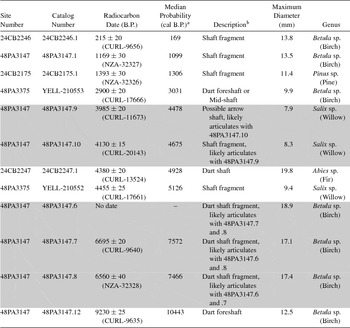
a Single point calibrated median ages were obtained from the online executable version of Calib 7.1 (http://calib.qub.ac.uk/calib/).
b Artifacts in gray shading are presumed to refit as described in the text and are considered as a unit/single artifact in our analysis.
Today, ice patches tend to exist at or above treeline; however, throughout the GYA, numerous ice patches contain in situ rooted stumps and tree trunks. These large-timber trees are distinct from the stunted and deformed krumholtz that typify treeline today, indicating that treeline was significantly higher at times during the past (Bunn et al. Reference Bunn, Peters, Littell and Graumlich2004; Carrara Reference Carrara2011: Appendix A; Carrara and McGeehin Reference Carrara and McGeehin2015; Lee Reference Lee2013, Reference Lee, Kelly, Reckin, Matt and Yu2014a; Morgan et al. Reference Morgan, Losey and Trout2014). Ice bound trees also occur outside the GYA, including along the Colorado Front Range (Benedict et al. Reference Benedict, Benedict, Lee and Staley2008; Brunswig Reference Brunswig2014; Lee and Benedict Reference Lee and Benedict2012 Footnote 1 ). This in situ rooted wood is invariably of alpine species, e.g., whitebark pine (Pinus albicaulis), which helps to differentiate it from the wood types generally restricted to lower elevations, e.g., birch (Betula sp.), primarily used to make hunting weapons.
Ice patch sites are invariably on public land administered by the federal government, and their contents are afforded legal protections by federal and state laws ranging from the Archaeological Resources Protection Act (ARPA) to Statutes 641 (Theft of Government Property) and 1163 (Theft from Indian Tribal Organizations). Sadly, ice patch archaeological sites are subject to unregulated collecting, with instances of significant theft and the attendant loss of contextual data known from Alaska to California (e.g., Sahagun Reference Sahagun2015). The ice patch phenomenon transcends the jurisdictional boundaries that divide the GYA. In 2012, the Greater Yellowstone Coordinating Committee (GYCC), which emphasizes research on cross-boundary issues, initiated a GYA-wide study to: (1) identify the highest potential snow and ice patches on GYA partner lands, (2) organize an aerial survey to photo-document as many of these locations as possible during their point of maximum annual melt in late summer/early fall, and (3) to generate a report for resource managers identifying the most promising ice patch resources so that they can be monitored in subsequent years (Lee Reference Lee2014b). Out of the thousands of ice patches located within the 62,000 km2 comprising the GYA, the project identified 456 prospective ice patches with archaeological and/or paleobiological potential (Lee Reference Lee2014b). Copies of the report and associated GIS and ArcGIS shapefiles, as well as Google Earth kml files, were shared with all cultural resources staff managing lands in the GYA. Following initial contacts with the Crow Tribe in 2006 and 2007 (and regular updates by project partner Halcyon LaPoint, archaeologist for the Custer-Gallatin National Forest), Craig Lee and Shane Doyle (Crow) shared details of the project with representatives from the Northern Cheyenne, Shoshone-Bannock, and Eastern Shoshone tribes. These visits revealed that changes in the alpine plant communities—as demonstrated through the analysis of lag deposits in ice cores (Lee et al. Reference Lee, Kelly, Puseman, Reckin, Matt and Yu2015)—were a topic of interest. As of 2015, at least five independent groups of archaeologists are now working on ice patch–related research in the GYA, including archaeologists from the Jackson History Museum (Anderson Reference Anderson2014; Sgouros and Stirn Reference Sgouros and Stirn2015), Office of the Wyoming State Archeologist (Peterson Reference Peterson2015), the University of Wyoming and the Greybull River Sustainable Landscape Ecology Project/Park County Historical Society (e.g., Baker Reference Baker2016; Kolb Reference Kolb2015) and more (e.g., Vlcek Reference Vlcek2015). The level of interest and the contributions generated by these teams bode well for ice patch research in the GYA; however, with the exception of the Colorado Front Range, Olympic National Park, and Glacier National Park, ice in the rest of the conterminous United States remains terra incognita with respect to ice patch archaeology.
GYA Ice Patch Hunting Implements and Wood Analysis
Hunting implements recovered directly on melting ice or in the forefield (downslope) or lateral margins of GYA ice patches include dart and arrow shaft fragments and foreshafts. Many of the wooden implements are represented only by broken specimens, which limits their technical description; however, one attribute that can be distinguished across the entire assemblage is wood type (genus). All of the wooden dart, arrow, and foreshaft artifacts found in the GYA ice patches through 2014 have been analyzed by paleobotanists, including Jeffery Lukas and Kathryn Puseman.Footnote 2 Puseman made taxonomic identifications using the standard procedure of splitting or cutting small fragments of the artifacts to expose three distinct views of the wood: transverse or cross-section, tangential, and radial (Figure 2). She then examined fragments using transmitted light microscopes at magnifications ranging from 70–600x. An AmScope 10MP microscope digital camera recorded images. Establishment of genus occurred by comparing anatomical features to those found in standard wood identification manuals (Carlquist Reference Carlquist1988; Hoadley Reference Hoadley1990; Panshin and de Zeeuw Reference Panshin and de Zeeuw1980), on Internet websites (InsideWood 2004), and in modern comparative specimens. We chose to make identifications to the genus level because it is not possible to reliably distinguish one species from another based on wood anatomy for many of the taxa.
Wood anatomy discussed in text.

Shaft Descriptions
Two wood shafts were recovered at site 48PA3375 (Lee Reference Lee, Kelly, Reckin, Matt and Yu2014a). Shaft fragment 1 (YELL-210552) dates to 4455 ± 25 B.P. and is made from willow (Salix sp.) (Figure 3a). Willow is a woody, dicot angiosperm with vessels exhibiting large, alternate intervessel pitting, simple perforation plates, and heterocellular rays that contain both procumbent and upright cells exhibiting large ray-vessel pits (Figure 3b). The rays are also unicellular, meaning that they are only one cell in width. Shaft 2 (YELL-210553) is a complete foreshaft (or possibly a midshaft) with a conical base dating to 2900 ± 20 B.P. It measures 39.4 cm in total length. It was made from birch (Betula sp.), which is also a woody, dicot angiosperm with vessels (Figure 3c). It is distinguishable from willow in that the vessel walls have extremely small intervessel pits that are much smaller than those of willow, sclariform perforation plates, and multiseriate rays, up to five cells in width (Figure 3d). Two parallel oblique lines near the conical base of the foreshaft likely represent ownership or property marks. Similar marks have been found on two other GYA shafts (Lee Reference Lee2010, Reference Lee2012). Ethnographic observations indicate that ownership marks can be found on hunting weapons, including the portion designed to remain in the bodies of large game, e.g., foreshafts, and that they typically consist of simple lines that can be specific to either an individual or a community (Boas Reference Boas1899). In her study of Late Prehistoric ownership marks in northwestern Alaska, Reynolds (Reference Reynolds1989:89) notes that, in addition to hunting equipment, they can occur on a variety of other tools ranging from pots to stored meat. Future studies of ownership marks could inform on aspects of social structure, inheritance, and ethnicity (e.g., Reynolds Reference Reynolds1989:103). In the GYA, one of the shaft fragments with ownership marks might be a main shaft or a fragment of a single-piece weapon shaft, e.g., a dart shaft with no foreshaft, ergo it is not necessarily foreshafts alone that bear ownership marks. Since we do not have enough data to make a firm statement on this, we simply call attention to the existence of the marks.
Sample YELL-210552, Salix sp. (willow): (a) cross-section view, 70x; (b) heterocellular ray showing both procumbent cells and upright cells with large pits, radial view, 600x. Sample YELL-210553, Betula sp. (birch): (c) cross-section view, 70x; (d) minute intervessel pitting, tangential view, 600x. Sample 24CB2247.1, Abies sp. (fir): (e) cross-section view, 70x; (f) taxodioid cross-field pitting, 600x.

Sites 24CB2246 and 24CB2247 are within 1.3 km of each other. Site 24CB2246 is associated with the largest ice patch recorded in the GYA. It contained a conically shaped shaft fragment made from a birch (Betula sp.) stave (24CB2246.1) that dates to 215 ± 20 B.P. (Lee Reference Lee2012). As of 2014, this ice patch still holds a significant volume of snow and ice. The artifact was recovered in an area of organic-rich lag along the lateral margin of the ice patch. Site 24CB2247 contained a deteriorated shaft fragment (24CB2247.1) that dates to 4380 ± 20 B.P. (Lee Reference Lee2012). It was made from a fir (Abies sp.) sapling, as evidenced by the fact that it is a conifer with tracheids but no resin canals (Figure 3e). It also has taxodioid cross-field pitting, which can be seen at a magnification of 600x in the radial view (Figure 3f). The sapling was trimmed of its branches and appears to have a purposefully beveled end, which may have functioned as a scarf joint allowing it to be mated to a correspondingly beveled piece. Scarf joints can be used to connect main shafts to foreshafts, as well as to link two pieces of wood together to make a longer shaft.
Site 24CB2175 contained a shaft fragment (24CB2175.1) that dates to 1393 ± 30 B.P. (Lee Reference Lee2012). It is unique in that it was recovered at 3,414 m, which is more than 250 m above modern treeline as measured using Google Earth imagery. This argues strongly for its presence in the ice patch being anthropogenic in origin. It is consistent in overall morphology with other shafts, and it appears to have been trampled by an ungulate when it was saturated based on the presence of a bend consistent with an animal hoof. Many GYA ice patch artifacts bear evidence of trampling damage, including deeply impressed hoof marks that must have been made when the artifacts were saturated. In some situations, saturation likely helped to preserve the artifacts, which may have simply snapped to pieces had they not been waterlogged. The artifact is made from a pine (Pinus sp.) sapling, a conifer with resin canals that can be seen in both the cross and tangential section views, as well as pinoid cross-field pitting. The somewhat deteriorated nature of the wood precluded a clear view of the ray tracheids in this particular fragment; therefore, we cannot identify it as a soft or hard pine.
The remaining four shafts and fragments presented in Table 1 were recovered from site 48PA3147. One of the shafts is represented by three distinct pieces (48PA3147.6, .7, and .8) that appear to be similar in age, diameter, and weathering but cannot be refitted due to weathering and warping at the broken ends. The three pieces are treated as one artifact in the present analysis. Two of the three fragments were radiocarbon dated and produced similar dates. One dates to 6695 ± 20 B.P. and exhibits five parallel oblique lines that likely represent ownership marks (Figure 4). The other dated fragment has a tapered/beveled end returned an age of 6560 ± 40 B.P.
Detail of sapling shaft fragment (48PA3147.7) with five parallel oblique ownership marks. (Photo by Tara L. Hornung)

The youngest shaft recovered at the site, 48PA3147.1, dates to 1169 ± 30 B.P. It is made of a birch (Betula sp.) sapling trimmed of its branches. The oldest artifact from the site, 48PA3147.12, dates to 9230 ± 25 B.P. and is a complete dart foreshaft made on a birch sapling. It is 1.07 m in total length. Two groups of three evenly spaced lines on opposing sides of the artifact are interpreted as ownership marks (for photos and additional description, see Lee [Reference Lee2010, Reference Lee2012] and for discussion of its replication and use, see McConnell and Lee [Reference McConnell and Lee2013]).
The remaining two shafts from the site, 48PA3147.9 and 48PA3147.10, are both made on willow (Salix sp.) and date to 3985 ± 20 B.P. and 4130 ± 15 B.P., respectively. The shafts are similar in age, diameter, and weathering, but cannot be refitted due to weathering and warping at the broken ends. The two pieces are treated as one artifact in the present analysis. Fragment 48PA3147.9 appears to have a V-shaped nock suggestive of bow and arrow technology (Figure 5). A variety of nock styles are known from Native American archery, including U-shaped, V-shaped, and an “Open U” in which the bottom of the cut is round, but the sides are flared (Alix et al. Reference Alix, Hare, Andrews and MacKay2012:107). U-shaped nocks dominate the Canadian ice patch assemblage (Alix et al. Reference Alix, Hare, Andrews and MacKay2012), whereas U-shaped and V-shaped nocks occur with similar frequency in Alaskan ice patches (e.g., Dixon et al. Reference Dixon, Manley and Lee2005). If this fragment is an arrow, it is far older than the widely accepted date range for the introduction/adoption of bow and arrow technology in the region, which most investigators place around 1500 B.P. based on the appearance of new types of projectile points and the occurrence of more diminutive forms (Kornfeld et al. Reference Kornfeld, Frison and Lou Larson2010:130). Arrow shafts of similar age have been reported in the north, including one with a U-shaped nock from the southern Yukon Territory that has two assays of 3510 ± 70 B.P. and 3600 ± 40 B.P., respectively (Hare et al. Reference Hare, Hare, Greer, Gotthardt, Farnell, Bowyer, Schweger and Strand2004; Hare et al. Reference Hare, Thomas, Topper and Gotthardt2012), and a ca. 4000-radiocarbon-year-old arrow shaft from the Wrangell Mountains of Alaska, some 400 km to the west of the Yukon artifact (E. James Dixon, personal communication 2016).
Two views of Salix sp. (willow) shaft fragment (48PA3147.9) showing possible nock at left (photos by Tara Hornung).

Hare et al. (Reference Hare, Thomas, Topper and Gotthardt2012) posit that the presence of arrow technology in the Yukon during this time period may represent the influence of the bow and arrow technology of Arctic Small Tool tradition people from the western Arctic (Anderson Reference Anderson and David1984). Although the GYA specimen is nearly 2,600 km to the south, the two areas are geographically linked by the arc of the Rocky Mountain Front, and it is possible that a cultural or technological connection, albeit brief, may have existed. Other evidence for a connection between the far north and mid-latitudes has come to light in recent years. Work by Wilson et al. (Reference Wilson, Visser and Magne2011) suggests that the microblade technology originally described by Wormington and Forbis (Reference Wormington and Forbis1965) in the High River area of southernmost Alberta, Canada, likely represents a derivative of an Arctic/SubArctic microblade tradition that was coeval with the late Paleoindian Cody complex based on associated diagnostic projectile points. Lee et al. (Reference Lee, Neeley, Mitchell, Kornfeld and O'Connor2016) describe further occurrences of microblade technology even further south during the late Paleoindian period in Montana at the Mammoth Meadows and Myers-Hindman sites. If 48PA3147.9/48PA3147.10 represents the presence of bow and arrow technology, its subsequent disappearance is no less intriguing. A possible interpretation might be that the technology was not significantly more suited to the hunting demands or group dynamics of the time and, thus, after a trial, was abandoned.
Materials Analysis
Most of the shafts recovered from sites in the GYA represent dart shafts that would have been propelled by an atlatl. VanderHoek (Reference VanderHoek1998:83) notes that “between the atlatl and the dart, the dart has been found to be the most critical part of the throwing equation.” There are many variables that affect the performance of a dart; however, experiments have shown that the dart's “spine” (ability to flex or degree of stiffness), has generally been seen as the most important (Cundy Reference Cundy1989:64; Hayes Reference Hayes1994; Perkins Reference Perkins1992; Schuh et al. Reference Schuh, Asbell, Holt and James1997:32–33; Tolley and Barnes Reference Tolley and Barnes1979:70–71; Whittaker Reference Whittaker and Ferguson2010). In bow and arrow technology, an arrow must be properly spined in order to compress upon release, oscillate, and then rapidly dampen to fly straight. So too a dart must also be able to flex, then rapidly abate its oscillations (Hayes Reference Hayes1994; VanderHoek Reference VanderHoek1998:83). One factor that affects how the dart will flex is the type of wood used in its construction. We can measure how well an arrow or dart might perform using indices (δ' and δ) of wood suitability based on Beckhoff (Reference Beckhoff1965:54–56; see also Alix et al. Reference Alix, Hare, Andrews and MacKay2012), for species known to have been used for making arrows in western North America. These numerical indices provide a way to compare different species of wood for their suitability as arrow shafts. Table 2 provides adaptability indices for several wood species found in western North America, some of which may have been used as shafts in the GYA. Although Beckhoff's formula was intended to measure arrow shafts, it is notable that woods with a good to excellent adaptability index were also used in construction of the dart shafts and shaft fragments recovered from ice patch sites in the GYA.
Wood Adaptability Coefficients (δ′) and Ratings.

a δ' = E/r15*ar/at*10−5.
b Rated as 1 = regular; .8 = medium;.5 = irregular.
c Rated as 1 = good; .9 = medium; .8 = poor.
d Beckhoff's final index (δ) is the product of δ′ and values given for fiber straightness and cleavability.
e Data originally presented in Alix et al. Reference Alix, Hare, Andrews and MacKay2012:Table 3.
f Species not found in GYA but are included to show values for more than one species of Betula.
g Although Salix alba is an introduced species and Salix nigra is found only in eastern North America, these species are included as the only species of Salix for which values are available.
Of the nine shaft samples examined from the GYA, five are made of birch, two from willow, one from fir, and one from pine (Table 1). Woods that are good for making arrows also appear to be good for making darts and foreshafts. Many of the variables used in Beckhoff's formula have been determined only for commercially graded lumber, and, as a consequence, not all of the wood types that might have been selected for use as shafts (such as species of willow) can be assessed to the same degree. Based on the long duration of birch shaft usage, it appears that Native American groups in the GYA preferentially selected this material through time, although other materials were used.
Temporally Diagnostic Projectile Points
In addition to organic materials, extensive lithic assemblages including projectile points and point fragments have been found in ice patch forefields. For example, temporally diagnostic chipped stone projectile points identified at the 48PA3376 ice patch and others include variants of Oxbow and Pelican Lake types (e.g., Lee Reference Lee, Kelly, Reckin, Matt and Yu2014a; Vivian and Mitchell Reference Vivian and Mitchell2005: Plate A-1E). Both point styles were likely used with atlatl darts (Peck Reference Peck2011; Wettlaufer Reference Wettlaufer1955). Oxbow projectile points have shallow side-notches with incurved bases and rounded ears. In the GYA they date to the Middle Plains Archaic with a core temporal span from ca. 5700 to 3500 years B.P. (Aaberg et al. Reference Aaberg, Eckerle and Cannon1999; Greiser et al. Reference Greiser, Greiser and Vetter1985; Kornfeld et al. Reference Kornfeld, Frison and Lou Larson2010). Pelican Lake projectile points date to the Late Plains Archaic and are corner-notched and date from ca. 3000 to 1500 B.P. (Frison Reference Frison1991:101–103). These chronological markers augment the date range obtained on direct 14C measurements made on shafts and potentially expand the temporal window for use of these features.
In some instances, upslope plateaus near transverse ice patches, such as at 48PA3375, are covered with thousands of chipped stone artifacts made on brightly colored cherts, silicified woods, and obsidians (Lee Reference Lee, Kelly, Reckin, Matt and Yu2014a). Many of the artifacts are fragments of formal tools and utilized flakes—the type of detritus associated with repeated occupations of seasonal campsites. Vertical exposures in the 20- to 30-cm-thick sediment cap at 48PA3375 suggest that some of these sediments may be stratified and offer an interpretable sequence (Lee Reference Lee, Kelly, Reckin, Matt and Yu2014a). In other alpine locations, researchers have reported buried soils in these contexts (Mitchell Reference Mitchell2012). Benches downslope from ice patches can also hold lithic scatters (Lee Reference Lee2009).
Prey
Based on the ice patch record, the seasonally rich forage of the 3,000 m or more elevation plateaus of the GYA have attracted large ungulates such as bighorn sheep (Ovis canadensis), bison (Bison bison), elk (Cervus elaphus), and mule deer (Odocoileus hemionus) for millennia. The remains of bighorn sheep and bison are the most commonly encountered species in the lateral and forefield margins of GYA ice patches (Lee Reference Lee2009, Reference Lee2013, Reference Lee, Kelly, Reckin, Matt and Yu2014a). This is true in other parts of the Rocky Mountains as well, including the Colorado Front Range (Lee and Benedict Reference Lee and Benedict2012 1; Lee et al. Reference Lee, Benedict and Lee2006). Why ice patches at these latitudes attract animals remains an open question, with possibilities including thermal regulation (cooling), hydration, the need to escape pests such as black flies (Simuliidae) and mosquitoes (Culicidae) (Greg Johnson, personal communication 2015), or a cyclical return to areas where scat from previous visits acts as fertilizer creating a positive feedback of enriched forage. Many GYA ice patches, such as the one depicted in Figure 6, do not contain material of a definitively cultural origin; however, as described below, the presence/preservation of bighorn sheep skulls (Figure 6c) without postcranial elements could reveal the presence of humans.
Main image: representative GYA ice patch showing a lush, well-watered forefield; Insets are paleobiological material observed at the ice patch: (a) trunk of a large timber fir (Abies sp.), (b) associated bison (Bison bison) rib (not collected), (c) base and horn cores of a bighorn sheep (Ovis canadensis) skull (not collected).

The best evidence for prey selection at GYA ice patches comes from archaeological site 48PA3147 (Figure 1), which contains the remains of numerous bighorn sheep represented primarily by crania and horn sheaths. In 2007, two pieces of spirally fractured and cut-marked long bone consistent with bighorn sheep were also recovered at the site; one of the pieces was exceptionally greasy and was radiocarbon dated to 2210 ± 25 B.P. (Lee Reference Lee2012). Lee observed skulls and horn cores at the location in 2007 and 2009 but did not collect them because their association with the archaeological materials was unclear. At that time, it was reasoned that some might relate to cultural activity but others could be the result of non-human events. (The volume of scientifically interesting material encountered during the course of a field survey can be staggering and would pose a significant curation issue if it were all collected.) Lee (Reference Lee2012) described the purported existence of 13 bighorn sheep skull caps and horn cores and two bison skulls collected by Dr. Don Pattie at the location in 1962. Lee attempted to locate the material for several years, but it was not until 2013 that project collaborator Weber Greiser found the errant sheep skulls and horn cores in their original field packaging at the Philip Wright Zoological Museum at the University of Montana. The two bison skulls have not been relocated. All of the sheep skulls were assigned the same catalog number by the museum: 13253. Lee photographed the skulls and fragments and collected six samples (three bone and three horn) for radiocarbon dating. The samples were also assigned a unique identifier based on the ice patch project archive curated at the Billings Curation Center in Billings, Montana. The GNS Rafter Radiocarbon Laboratory in New Zealand processed the three bone samples, and the keratin (horn) samples were prepared at INSTAAR and dated at the Keck AMS lab. Four of the dates on the Pattie sheep skulls cluster around 4000 B.P. and one is approximately 800 B.P. (Table 3). In Figure 7, the most complete skull (second from the top at left) dated in the 3400 B.P. range, while the more deteriorated skull fragment (third from the top at right) dated at ca. 880 B.P. The differences in preservation and age of these skulls is emblematic of the nature of ice patch materials: ice patches can contain specimens of vastly different ages exposed on the same melt surface with preservation not serving as a reliable indicator of age. We estimate the total number of skulls present at this site to be in excess of 20.
Radiocarbon Ages on Bighorn Sheep (Ovis canadensis) from Archaeological Site 48PA3147.

a Calibrated means were obtained from the online executable version of Calib 7.1 (http://calib.qub.ac.uk/calib/).
The eight bighorn ram sheep skulls/horn cores collected by Don Pattie in 1962; the remaining five samples collected by Pattie are horn sheathes (not pictured).

In concert with observations made at other known bighorn sheep hunting locales in the GYA, it seems clear that bighorn sheep skulls were frequently left at kill sites. Eakin (Reference Eakin2005:77) reports that ram skulls have been found by artifact collectors in tree branches at several sheep traps in the GYA and that a cluster of eight burned skulls were observed at a campsite/bighorn sheep processing area within ca. 300 m of a sheep trap (Eakin Reference Eakin2005:78). Frison (Reference Frison2004:160) describes a concentration of 25 sheep skulls associated with the remains of a badly deteriorated log fence in the GYA. This same location is mentioned in Kornfeld et al. (Reference Kornfeld, Frison and Lou Larson2010:312) with a note that very few postcranial elements were present. Nearly a dozen sheep traps, which frequently consist of drive lines made of logs that funnel the animals toward a cribbed log catch-pen, are known from the eastern flank of the Rocky Mountains alone (Frison et al. Reference Frison, Reher, Walker, Davis and Reeves1990; Kornfeld et al. Reference Kornfeld, Frison and Lou Larson2010). Given the effort involved in their construction, these features were likely maintained and reused for years (Kornfeld et al. Reference Kornfeld, Frison and Lou Larson2010:304). Tree ring dates derived from intact portions, as well as archaeological data from other mass sheep kills, indicate that these types of sites tend to date no earlier than the Late Prehistoric period, ca. 500 B.P. (Kornfeld et al. Reference Kornfeld, Frison and Lou Larson2010). Data from the region as a whole strongly suggest that the bighorn skulls found at 48PA3147 fit into a regional pattern of sheep hunting that includes the intentional accumulation of bighorn sheep skulls at certain sites. At the site, some of the skulls date to far earlier than the Late Prehistoric skulls that others have found affiliated with wooden sheep traps, suggesting a deeper temporal depth to this pattern than has previously been observed.
In contrast to bighorn sheep, the remains of other possible prey species, such as bison, that have been found at ice patches are represented by both skulls and postcranial remains. While bison remains have been observed at more than a dozen ice patches in the GYA, thus far, only three sets have been radiocarbon dated, and all are younger than 1000 radiocarbon years B.P. They include a partial bison skeleton (BCC-0727-PZ-010) recovered at 3,400 m that was radiocarbon dated to 775 ± 25 B.P. (CURL-17669; horn sheath; δ13C = −24.1‰); a portion of a bison hind limb (BCC-0727-PZ-006) recovered at an ice patch in another location that radiocarbon dated to 698 ± 23 B.P. (NZA 55631; astragalus, collagen; δ13C = −19.2‰); and a bison thoracic spine with soft tissue (BCC-0727-PZ-009) recovered in a third area ca. 48 km north of the northern border of Yellowstone National Park that returned a radiocarbon-modern date (CURL-10424; soft tissue) (Lee Reference Lee2013). The latter specimen is of interest because it is indicative of bison ranging well to the north of the modern “Tolerance Area” for bison in the North Management zone of the GYA; the movement of bison outside of the confines of Yellowstone National Park is severely restricted due to concerns over the transmission of brucellosis, a disease that can cause abortion in domestic cattle (IBMP 2014).
Discussion
The wood analysis of the shaft fragments collected from ice patches in the GYA suggests that birch (Betula spp.) was a consistent choice for ice patch hunting equipment throughout the Holocene but that other woods were also used, including willow (Salix spp.), fir (Abies spp.), and pine (Pinus spp.). Of the ranked woods (Table 2), birch is an excellent choice for making shafts and there appears to be broad continuity in its use across space and through time. In addition to those from the GYA, five of the seven dart and arrow shafts presented by Andrews et al. (Reference Andrews, MacKay and Andrew2012:Table 1) from ice patches in the Northwest Territories are made of birch (Betula sp.). The remaining shafts include one made of spruce (Picea sp.) and one of Saskatoon berry (Amelanchier sp.). Hare et al. (Reference Hare, Thomas, Topper and Gotthardt2012) report that dart shafts in the Yukon Territory are made from birch, willow, spruce, and, in a single instance, maple (Acer sp.), with birch being the most commonly used wood. They also note that all of the birch dart shafts and foreshafts are made from split staves, while the shafts and foreshafts made from willow and spruce are natural saplings. This pattern is not replicated in the GYA collection, where some birch shafts are made from saplings and others from staves. In a study of five Neolithic arrow shafts from the Oppdal area of Norway (Callanan Reference Callanan2013), two are made of birch, two of pine, and one of willow. Ryd (Reference Ryd2014) notes that birch was the preferred wood for arrows used by the Saami of Scandinavia due to its hardness.
With regard to prey selection, bighorn sheep appear to be the primary prey species at ice patches in the GYA based on the record at 48PA3147. In concert with the relative scarcity of post-cranial elements (n = 2), there is an obvious bias toward skulls at the site. Coupled with the presence of the organic hunting weapons, it seems parsimonious to conclude that the presence of the skulls at the site is a result of human activity. The dated bone and horn sheaths (Table 3) suggest at least three broad periods of use that can be combined with the dates on artifacts in the preceding sections. It is unclear whether these observations can be extended to instances where a single skull is observed, such as at the ice patch depicted in Figure 6, when no other obvious cultural material is present; however, such instances may warrant consideration in the future.
Although there are too few dates to make inferences about population size, as Kelly et al. (Reference Kelly, Surovell, Shuman and Smith2013) have done for the nearby Bighorn Basin in Wyoming, the dates on organic tools and hunted animals nevertheless provide an absolute indication of human presence at high altitudes in the GYA at certain points in time. Figure 8 overlays a temperature curve for the GYA on the summed probability distribution of the 15 discrete dates on shafts and hunted sheep from GYA ice patches. The sample of dates is small and the absolute value of the summed probabilities is not meaningful, but the discrete intercepts are illustrative of the persistent use of alpine ice patches beginning at the onset of the neoglacial advance at ca. 5400 cal BP. The breaks in the distribution may relate to taphonomic processes that affect ice patches, or equally may indicate periods of less intense use. Efforts are underway to study the growth and persistence of ice patches through the analysis of ice cores (GCRMG 2015; Lee et al. Reference Lee, Kelly, Puseman, Reckin, Matt and Yu2015). The result of those analyses will help to characterize the growth and melt patterns of GYA ice patches, which in turn will be informative regarding the differential effects of preservation in the ice patch record. Continued research on the part of the many groups now working in the GYA will help to build the artifact and radiocarbon date set and, perhaps more importantly, serve as a model for research throughout the Rocky Mountain West.
Summed probability distribution for dates on unique shafts and sheep created with OxCal v4.2.3 relative to temperature date from Shuman (Reference Shuman2012) and Kelly et al. (Reference Kelly, Surovell, Shuman and Smith2013) using the IntCal 13 data set (Reimer et al. Reference Reimer, Baillie, Bard, Bayliss, Beck, Blackwell, Bronk Ramsey, Buck, Burr, Edwards, Friedrich, Grootes, Guilderson, Hajdas, Heaton, Hogg, Hughen, Felix Kaiser, Kromer, McCormac, Manning, Reimer, Richards, Southon, Talamo, Turney, van der Plicht and Weyhenmeyer2009). The vertical gray bars reflect typologically derived date ranges for the Oxbow (left) and Pelican Lake (right) style projectile points discussed in text.

Recovery of hunting-related artifacts and bone from GYA ice patches suggests that the presence of prey animals attracted Native American groups to these areas. While the unique plant and animal communities of the alpine are of clear ethnohistorical and modern significance to indigenous communities, no histories specific to the use of ice patches have been identified. Ice patch hunting histories, such as those reported for the Saami in Scandinavia, provide a potential analogy (Ryd Reference Ryd2014). At a minimum, the GYA ice patch record allows for the conceptualization of the alpine—in ancient times, at least—as an ecosystem in balance where humans and animals alike took advantage of a seasonally enriched biome (Lee and LaPoint Reference Lee and LaPoint2015). Regular use of the alpine along the Rocky Mountain Front is consistent with the oral traditions of many tribal groups, including the Salish, Kootenai, and Blackfeet.
Conclusion
High-elevation environments are among the settings most vulnerable to climate changes. If our climate continues to warm as predicted, the ancient ice in these features will continue to retreat and some may melt out completely. The ice-buried archaeological and biotic remains are highly fragile once exposed, and the need for rapid assessment and salvage of these culturally and scientifically valuable artifacts and materials has been recognized by all of the land management agencies in the GYA.
Ice patch research is a unique way to introduce people to climate change or to maintain their awareness of the issue. It brings interdisciplinary scientists, government agencies, policy-makers, indigenous groups, and the general public together around a topic that cuts across ecology, economy, and cultural traditions. It is a fundable nexus for interdisciplinary, natural, and cultural research. Archaeological data, in conjunction with the involvement of descendant communities and the analysis of collocated paleobotanical and paleontological materials, can further our insight into questions of critical archaeological interest, such as population shifts and even demography across broad regions. Organic artifacts provide context for the inorganic elements that comprise most assemblages, and key elements, such as ownership marks, make the individual recognizable in the archaeological record. The recovery of organic artifacts such as wooden weapons is particularly informative, because organic artifacts reveal more about how weapons systems operated than projectile points alone, and small fragments of organic tools can be transformed via AMS 14C into a precise estimate of their age.
The use of the ice patch record to understand alpine ecosystems is of international significance because they occur across large swaths of Europe, Asia, and South America. Well-dated chronologies of botanical material contained in ice patches allow for the investigation of interactions between human and wildlife activity, ecological diversity, and climate. While the present study allows for some insight, such as the role of bighorn sheep as a driver for the human use of ice patches, the ice patch record—and in some respects, the archaeology of the Alpine writ large—represents a data gap, because, relative to the surrounding areas, comparatively little has been done in this environment. This view is consistent with the perception of many traditional stakeholders. The integration of the ice patch record with alpine data sets, such as the landscape-scale lithic analysis being pursued by Todd (Reference Todd2015) and the recognition of landscape engineering in mountain environments (e.g., Scheiber and Zedeño Reference Scheiber and Nieves Zedeño2015) bring us closer to answering Nabokov and Loendorf's (Reference Nabokov and Loendorf2004:299) charge to integrate humans into the biome and to see the GYA “as a multicultural habitat that has been visited, inhabited, shaped and instilled with meaning by American Indians for millennia.”
The inter-annual variability in precipitation (snowfall) and in degree of melting, coupled with seasonal constraints and the sometimes difficult access to locations in modern-day “wilderness” areas, limits the number of survey targets that can be reached by archaeologists in a season. The field of ice patch archaeology desperately needs more researchers; within the GYA alone we have identified hundreds of prospective sites in need of survey, and there are countless other areas with permanent snow and ice in many western states. We look forward to others tackling the field of North American ice patch research.
Acknowledgments
We thank representatives from the Native American community, including Ira Matt (Salish), Francis Auld (Kootenai), John Murry (Blackfeet), Conrad Fisher and Teanna Limpy (Northern Cheyenne), Shane Doyle and Emerson Bull Chief (Crow), Darrell Shay and Leo Ariwite, (Shoshone-Bannock), and Lynette St. Clair and Orville St. Clair (Eastern Shoshone) (and many more) for their interest in the research and sincerely hope that it is of use to the tribes. We thank colleagues at the USDA Forest Service, including Halcyon LaPoint, Mike Bergstrom, Kyle Wright, Molly Westby, Jamie Schoen, J.P. Schubert, Virginia Kelly, Carl Davis, Mike Beckes, Walt Allen, Jeff Dibenedetto, and Jeremy Karchut (and many more), as well as the National Park Service, including Staffan Peterson, Tobin Roop, Ann Johnson (retired), Stacey Gunther, Sarah Hass, Christie Hendrix, and Ivan Kowski (and many more) for their vision regarding this work. We thank countless volunteers who have trekked in difficult conditions up mountainsides where there are often no contemporary human trails. We thank an anonymous board member at American Antiquity for orchestrating the review and Thomas Andrews, Robert Kelly, and two anonymous reviewers for their thoughtful comments. Colleagues Rachel Reckin and Erick Robinson provided comments on an early draft. The work was funded in part by cost shares with the U.S. Forest Service and via grants from the National Park Service administered by the Rocky Mountain Cooperative Ecosystem Studies Unit. Important funding also came from Weber Greiser and the Cody Institute of Western American Studies at the Buffalo Bill Historical Center. Last, but not least, we thank Carla Villafuerte-Griessler for translating the abstract into Spanish and María Fernanda Boza Cuadros for checking it. Ice patch research will continue in the GYA through at least 2018 supported in part by the Camp Monaco Prize, a joint award to Lee at INSTAAR and colleagues at the U.S. Geological Service and Montana State University from the Buffalo Bill Historical Center's Draper Natural History Museum, the University of Wyoming's Biodiversity Institute, and the Prince Albert II of Monaco Foundation, Monaco and USA.
Data Availability Statement
All physical collections are housed at Billings Curation Center in Billings, Montana, or at the Yellowstone National Park Repository in Gardiner, Montana. Copies of all ice patch–related reports referenced by the authors are on file with the Billings Curation Center.



