The Cape Horn Archipelago has been identified as one of the 24 most pristine ecoregions of the world (Mittermeier et al., Reference Mittermeier, Mittermeier, Brooks, Pilgrim, Konstant, da Fonseca and Kormos2003), and was recently declared a Biosphere Reserve (Rozzi et al., Reference Rozzi, Massardo, Berghofer, Anderson, Mansilla and Mansilla2006). Although the archipelago is isolated and located in the sub-Antarctic region it has not been spared the blight of biological invasions (Vitousek et al., Reference Vitousek, D'Antonio, Loope and Westbrooks1996). One of these was by the American mink Mustela vison, imported to fur farms in southern Chile and Argentina during 1930–1950 (Jaksic et al., Reference Jaksic, Iriarte, Jiménez and Martínez2002). Accidental escapes and intentional releases led to the establishment of feral populations in many areas of both southern Argentina (Chehébar, Reference Chehébar1985) and Chile (Medina, Reference Medina1997; Jaksic et al., Reference Jaksic, Iriarte, Jiménez and Martínez2002). The c. 2,528 km2 Navarino Island, part of the Cape Horn Biosphere Reserve, is located south of Tierra del Fuego. Although mink were found in the wild in Tierra del Fuego as early as the 1960s, the first mink on Navarino Island was only recorded in 2001 (Rozzi & Sherriffs, Reference Rozzi and Sherriffs2003). As birds constitute the most diverse vertebrate group in the Reserve, with several ground-nesting species (Rozzi & Sherriffs, Reference Rozzi and Sherriffs2003), there is concern over which species are part of the diet of the alien American mink. Here we quantify the diet of mink and its seasonal variation to examine the potential impact of this alien species on ground-nesting birds in the wetlands of Navarino Island.
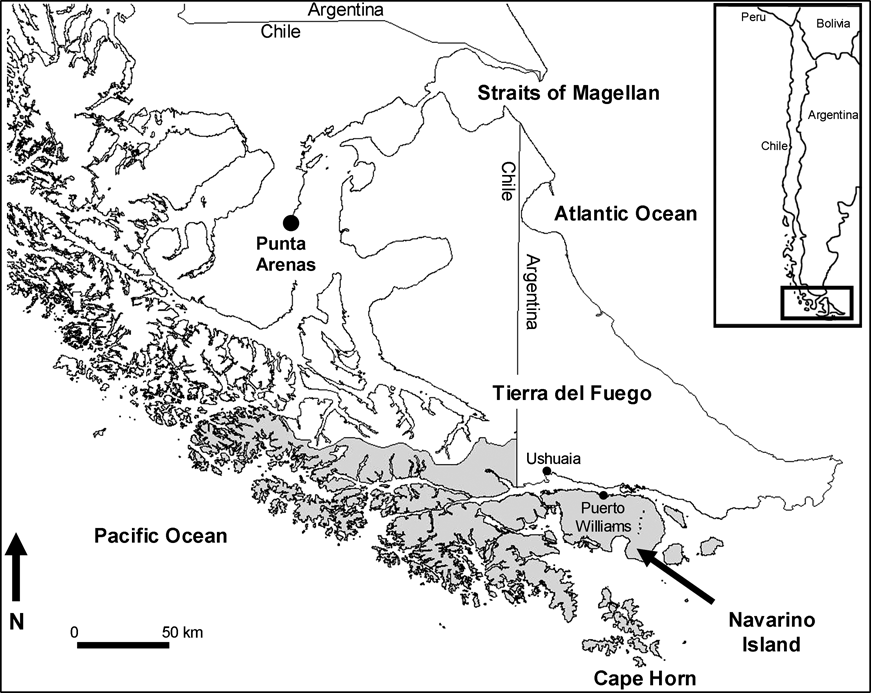
Navarino Island, which contains one settlement, Puerto Williams, with 2,262 inhabitants (Fig. 1), consists of thousands of water bodies (lakes, ponds, streams and bogs) and forest areas. The ecoregion corresponds to the Sub-Antarctic Magellanic Forest, dominated by the genus Nothofagus within a mosaic of Sphagnum spp. bogs. Most of the aquatic bird species inhabiting the wetlands are non-residents and arrive in summer to breed (J.T. Ibarra, R. Rozzi, H. Gilabert, C.B. Anderson, S.M. McGehee & C. Bonacic, unpubl. data). There are 56 species of birds in 25 families in the wetlands and adjacent habitats of Navarino Island. Potential mammalian prey of mink on the island include both native (yellow nosed grass mouse Abrothrix xanthorhinus and long-tailed pygmy rice rat Oligoryzomys longicaudatus) and exotic rodents (beaver Castor canadensis, mouse Mus musculus, muskrat Ondatra zibethica and Norway rat Rattus norvegicus). Aquatic prey include native fish (Aplochiton taeniatus, Aplochiton zebra, Galaxias maculatus and Galaxias platei) and introduced trout species (Onchorynchus mykiss and Salvelinus fontinalis), which are known to be eaten by mink in other regions of Chile and Argentina (Medina, Reference Medina1997).
Southern South America, showing the Cape Horn Biosphere Reserve (shaded in grey) and Navarino Island, Chile.

A total of 414 mink scats were collected over January–November 2006 along the shoreline of 27 ponds. Faeces were sorted into seven categories according to their contents: (1) bird, including feathers, bone fragments and egg shells; (2) mammal, including hair, teeth, and bone fragments; (3) fish, including vertebrae, scales and otoliths; (4) insects, including appendages and exoskeleton fragments; (5) crustaceans, incuding appendages and exoskeletal fragments; (6) molluscs, including valve parts; (7) plant matter, including seeds and leaves. Mammals and birds were identified to species, if possible, using taxonomic keys and references. In the case of mammals, teeth and the medullar and cuticle scale patterns of hairs were compared to patterns described in guides (Reise, Reference Reise1973; Chehébar & Martín, Reference Chehébar and Martín1989; Pearson, Reference Pearson1995). For the few bird species, feather colour patterns were used for identification. We computed frequency of occurrence expressed as a percentage (number of scats with a prey category divided by the total number of scats, by season), and percentage of bulk of a prey category (proportion of volume of a scat with a prey category multiplied by dry weight of the scat, divided by total dry weight of scats, by season).
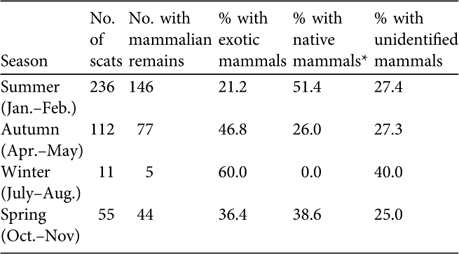
The diet of mink in Navarino Island's wetlands consisted mainly of mammal, birds, insects and plant matter. Whereas the occurrence of mammals and birds in scats was similar during summer and winter, the representation of mammals in the scats in autumn and spring was almost double that of birds (Fig. 2). Of 272 scats with mammal remains, 235 comprised fragments amenable to further identification, including native, exotic and unidentified mammals (Table 1). Exotic mammals (identified in 86 scats) were most abundant in the scats during autumn and winter, whereas native mammal species dominated during the summer (Table 1). Hair identification showed that muskrat (n = 78) was the most important exotic mammal prey followed by beaver (n = 4) and murid rodents (n = 4). Bird consumption was higher during the summer when 58.5% of scats contained bird remains (Fig. 2). Bird remains were identified in 202 scats, but only 11.4% contained remains that could be identified to species level. Remains of three species were identified: the ground-nesting upland goose Chloephaga picta, and tree-cavity nesting thorn tailed rayadito Aphrastura spinicauda and southern house wren Troglodytes musculus. Egg shells were found in only 0.03% of the scats collected during spring and summer (n = 9) but mink eat the contents of eggs without necessarily eating the shell (Ferreras & Macdonald, Reference Ferreras and Macdonald1999). Plant matter was more frequent in winter scats and seemed to compensate for the decrease in mammal consumption recorded for this season (Fig. 2). For details of the importance of other prey items see Fig. 2.

Mammalian remains found in mink scats, by season, with % of scats containing exotic, native and unidentified mammal species, on Navarino Island (Fig. 1).

* Representation of native mammals differed significantly from that of exotic mammals between seasons (χ2 = 18.97, df = 2, P < 0.0001; analysis excluding winter data). Differences were driven by summer peak in consumption of native mammals (significant differences disappeared when summer was excluded; χ2 = 2.13, df = 1, P = 0.144).
American mink have only recently invaded Navarino Island and this is the first report of their diet in the early years of their establishment, with a significant representation of native wetland and terrestrial birds. The consumption of birds was highest during the warmer months. Of mammalian prey, introduced species were mainly consumed during autumn and winter. This demonstrates that introduced prey species are available for mink when wild rodents and birds are probably less abundant. The three bird species identified in scats have their southernmost breeding distribution in the Cape Horn Biosphere Reserve.
The consumption of birds by mink in the Reserve appeared to be higher than reported in other parts of Patagonia (Medina, Reference Medina1997; Previtali et al., Reference Previtali, Cassini and Macdonald1998) and elsewhere (Erlinge, Reference Erlinge1969; Melquist et al., Reference Melquist, Whitman, Hornocker, Chapman and Pursley1981; Ferreras & Macdonald, Reference Ferreras and Macdonald1999) but comparable to that on Scottish islands in the UK (Clode & Macdonald, Reference Clode and Macdonald1995). Unsurprisingly, birds mostly featured in the diet of mink during the nesting season.
Because there are no terrestrial mammalian predators native to Navarino Island (Anderson et al., Reference Anderson, Rozzi, Torres-Mura, McGehee, Sherriffs, Schüttler and Rosemond2006), many bird species have evolved ground-nesting strategies (Moore et al., Reference Moore, Roy and Helyar2003). Under these circumstances invasive mammalian predators are particularly damaging (Amarasekare, Reference Amarasekare1993; Macdonald et al., Reference Macdonald, King, Strachan, Macdonald and Service2007). The high proportion of birds in the diet of mink on Navarino Island is only comparable to that recorded for islands sharing the same characteristics (Clode & Macdonald, Reference Clode and Macdonald1995) and where negative effects of mink on native birds were corroborated. Our findings indicate unambiguously that mink on Navarino Island are feeding on native vertebrates. We emphasize the need for further research to reveal whether predation by invasive American mink is affecting the populations of native mammals and birds in the Cape Horn Biosphere Reserve. We are designing studies that will allow us to answer this question.
Acknowledgements
This study was funded by the Chilean Environmental National Commission (CONAMA; Project 12-001-06), the Institute of Ecology and Biodiversity (ICM P05-002), University of Magallanes and Wildlife Trust Alliance. We received support from the UK Darwin Initiative (Refs 15006 and 13016). We sincerely thank Antonia Barreau, Tomás Altamirano, Steven McGehee and Germán González for help in the field and laboratory. This article is part of the ongoing research and conservation programmes conducted at the Omora Ethnobotanical Park (http://www.omora.org) on the Cape Horn Biosphere Reserve.
Biographical sketches
José Tomás Ibarra studies bird assemblages and the impact of American mink on island ecosystems in the Cape Horn Biosphere Reserve. Laura Fasola studies other aspects of American mink and southern river otter ecology in Argentinean Patagonia. David Macdonald is head of the Wildlife Conservation Research Unit at the University of Oxford, which focuses on aspects of fundamental biology relevant to solving problems of wildlife conservation and environmental management. Ricardo Rozzi is a philosopher and ecologist and his research combines both disciplines through the study of the relationships between the ways of knowing and inhabiting the natural world. Cristián Bonacic is head of Fauna Australis, a Chilean wildlife conservation research organization, teaching and outreach group for biodiversity conservation and wildlife management.