

Introduction
Dans une excellente synthèse que nous devons à M. Le Glay, dans son Saturne Africain, nous retenons le rôle important que jouent les parfums dans le rituel punique comme dans tous les rituels orientaux (Le Glay Reference Le Glay1966a, 357). Le matériel archéologique livré par de nombreux sanctuaires africains d’époque romaine, des ex-voto, des brûle-parfums et un nombre considérable d’unguentaria essentiellement, montre « l'importance que conserva ce genre d'offrande à l’époque romaine » (Le Glay Reference Le Glay1966a, 357). M. Le Glay termine cette remarquable réflexion par expliquer la permanence sans rupture de cette pratique rituelle de l'Orient sémitique à la Carthage punique, puis à l'Afrique romaine par « l'existence d'un corps sacerdotal, gardien intransigeant de la liturgie » (Le Glay Reference Le Glay1966a, 358).
Et voilà qu'un linteau comportant une inscription latine récemment découvert dans la médina de SousseFootnote 1, l'antique Hadrumetum, et mentionnant les membres d'une importante sodalité africo-romaineFootnote 2, les Florenti, qui vient confirmer ce constat.
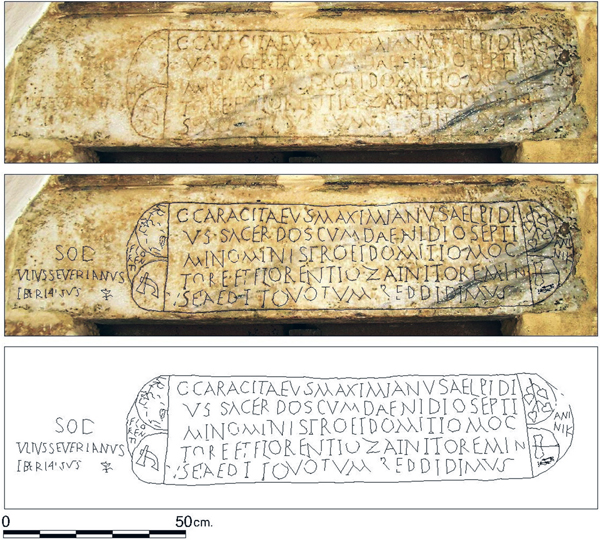
Le linteau épigraphe en question, en marbre blanc, de 160 cm de longueur, de 37 cm de largeur et de 17 cm d’épaisseur, est remployé au-dessus de l'entrée d'une demeure aujourd'hui abandonnée. Il offre l'association de registres épigraphiques et iconographiques répartis selon une expression schématique très peu soignée (Figure 1)Footnote 3.
Le linteau épigraphe de la médina de Sousse.
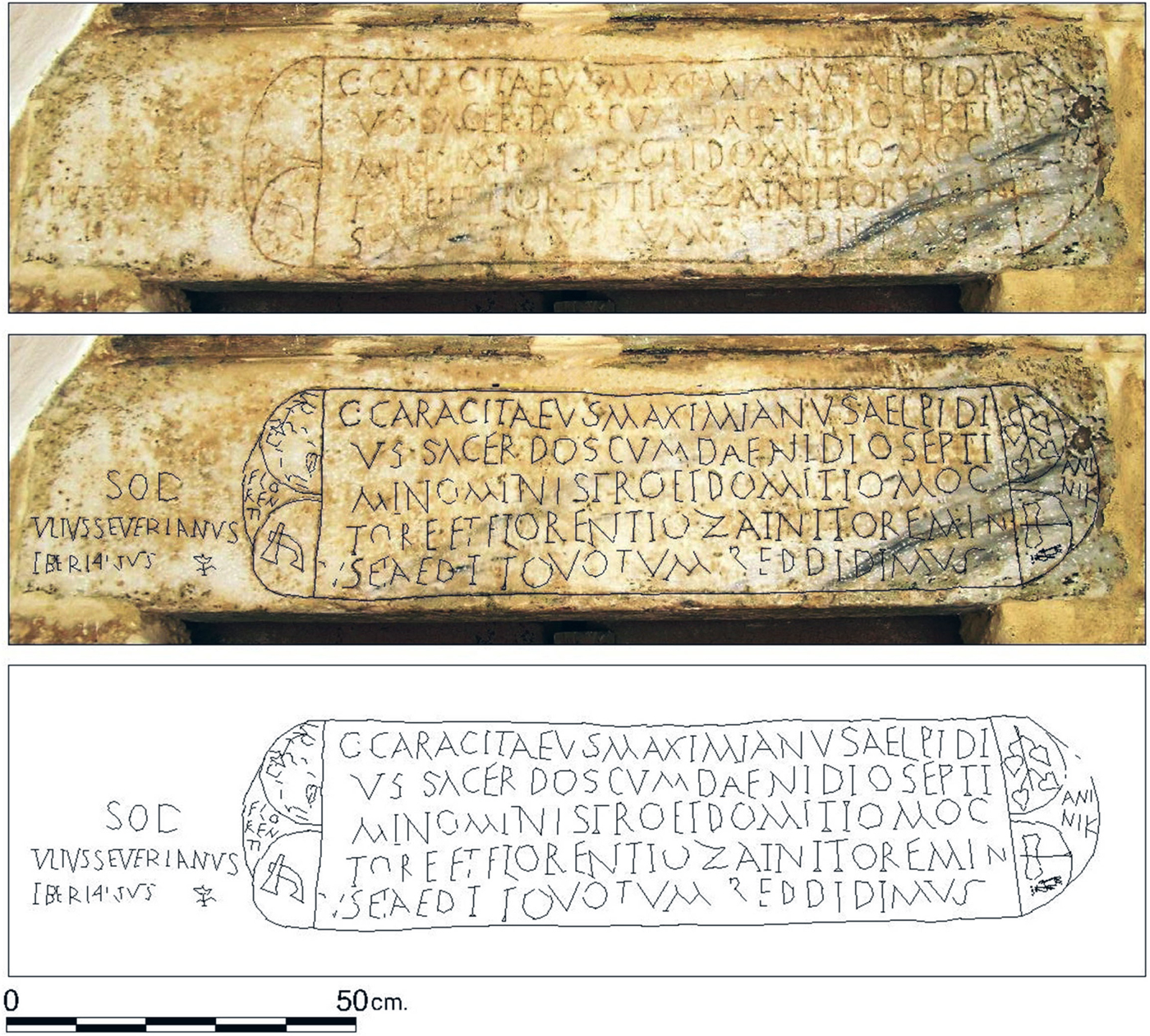
Le registre central, un cartouche de forme rectangulaire, comportant un texte épigraphique en capitales allongées peu élégantes (h. l. : 4–5 cm), est flanqué de part et d'autre de deux registres semi-circulaires, divisés chacun en trois petites cases. On y distingue une panoplie de motifs figurés et de brefs textes épigraphiques. Dans les trois petites cases du registre semi-circulaire de gauche, on distingue de haut en bas une composition florale de lecture difficile (deux tiges de roses vraisemblablement), le mot Florenti et une hache doloire (dolabra).
Dans les trois petits compartiments du registre semi-circulaire de droite, on distingue un rinceau de quatre feuilles de lierre, l'inscription [..]ANI/NIK[.] au milieuFootnote 4, et une hache à double tranchants en bas. De même, un deuxième registre se trouve à l'extrémité gauche du linteau comportant un texte de trois lignes partiellement conservées affichant la séquence onomastique d'un polyonyme suivie d'une rose éclose qui révèle peut-être sa notoriété.
Les textes épigraphiques
Registre gauche:
Transcription : SOD/ [..]VLIVS SEVERIANVS/ [.]IBERIA[… ---]
Développement et restitution : Sod(alis)/ [. I]ulius Seuerianus/ [T]iberia[nus —]
Traduction : Le confrère [. I]ulius Severianus Tiberianus [—]
Champ semi-circulaire à gauche du registre central:
Transcription : FLO/REN/TI
Développement et restitution : Flo-/ren-/ti
Traduction : Les Florenti.
Registre central:
Transcription : G. CARACITAEVS MAXIMIANVS AELPIDI/VS SACERDOS CVM DAENIDIO SEPTI/MINO MINISTRO ET DOMITIO MOC/TORE ET FLORENTIO ZAINITORE MIN/[.]S (sic) ET AEDITO V[.]TVM RED[.]IDIMVS.
Développement et restitution : G(aius) Caracitaeus Maximianus Aelpidi-/us, sacerdos, cum Daenidio Septi-/mino, ministro, et Domitio, moc-/tore, et Florentio, zainitore min-/[u]s (sic) (= minore) et aedit(u)o, uotum reddidimus.
Traduction : (Moi) Gaius Caracitaeus Maximianus Aelpidius, prêtre, avec Daenidius Septiminus, ministre, et Domitius, proposé aux encens, et Florentius, portier en second et gardien, nous nous sommes acquittés de (notre) vœu.
Champ semi-circulaire à droite du registre central:
Transcription : [.]/ ANI/ NIK[.]
Développement et restitution : [.]ani nik[a]
Traduction : Vive les [..]ani
Essai de datation:
Le texte ne comporte aucun élément fiable de datation précise. Toutefois, les cognomina Septiminus et Severianus de la liste onomastique des membres de la sodalité des Florenti renvoient peut-être à un contexte sévérien : première moitié du IIIe siècle apr. J.-C.
C'est l'accomplissement d'un vœu par les membres de la sodalité des Florenti qui constitue l'occasion de la mise en place de ce linteau qui aurait surmonté une entrée monumentale.
Le caractère « sodalicien » de ce groupement ainsi que son nom sont identifiables grâce au nom distinctif (Florenti) qui occupe la case médiane du champ semi-circulaire gauche et au nom d'un sodalis gravé plus à gauche. Ce groupement est loin d’être inconnu ; il fait partie de la liste des sodalités africo-romaines établie par A. Beschaouch, et que fait connaître une panoplie de documents africains, épigraphiques et iconographiques. La feuille de lierre (hedera) et le chiffre III leur servaient d'emblèmes (Beschaouch Reference Beschaouch1985, 469 n. 35).
Le collège religieux, dont les membres sont énumérés d'une façon hiérarchique, constitue la pierre angulaire de cette sodalité d'Hadrumetum. Une place d'honneur semble avoir été réservée au sacerdoce polyonyme qui occupe le premier rang et peut-être même pour le sodalis mentionné en dehors du registre épigraphique principal.
De même, par leurs nomenclatures onomastiques, les membres d'un personnel subalterne (minister, moctor, janitor minor et aedituus) sont vraisemblablement « recrutés » dans les classes sociales de condition modeste, peut-être même parmi les esclaves. Ainsi, ce collège religieux apparaît sous la forme d'un ministère collectif et hiérarchisé à la manière des corps des prêtres orientaux, notamment ceux chargés du culte de Baal Hammon/Saturne (Le Glay Reference Le Glay1966a, 376). En fait, c'est là un fait original de voir un collège religieux mentionné ainsi. D'autres listes sacerdotales révélées par l’épigraphique africaine, contrairement à la notre, ne sont pas aussi précises quant aux fonctions de leurs membres. Il s'agit par exemple des listes sacerdotales des temples de Saturne révélées par des inscriptions de CarthageFootnote 5, de Jebel Bou KourneinFootnote 6 et de ThevesteFootnote 7. De même, par la présentation d'un collège religieux, notre inscription trouve place dans le répertoire épigraphique mentionnant des corps sacerdotaux : les sacrati de MadaureFootnote 8 groupés autour d'un ordo, les thiases de Thamugadi Footnote 9 et de Sitifis Footnote 10 et les sacerdotes du dieu Mercure de Vazi Sarra Footnote 11 ou des contubernales Magarensium identifiés par une inscription découverte aux environs de Tituli (Mahjouba, en Tunisie) (Kallala Reference Kallala2006, 31–38). Mais, malheureusement notre texte ne rapporte rien à propos de la divinité protectrice et au culte de laquelle les membres de ce collège sont rattachés.
Les membres du collège religieux sont les suivants :
• G. Caracitaeus Maximianus Aelpidius, sacerdos
• Daenidius Septiminus, minister
• Domitius, moctor
• Florentius, zainitor (= janitor) minor et aedituus
Parce que cette inscription fait l'objet d'une étude à part, une monographie détaillée que nous réservons à la sodalité des Florenti, nous nous limitons ici à la présentation de l'un des membres de ce collège et à sa fonction : Domitius, moctor, celui qui occupe l'avant-dernier rang parmi ses collègues. C'est un cas de figure révélateur de l'idée de la résurgence du vocabulaire religieux d'origine sémitique parmi le langage religieux des provinces romaines d'Afrique. Mais procédons d'abord à une présentation brève de tous ses collègues.
G. Caracitaeus Maximianus Aelpidius, sacerdos:
Il s'agit d'un citoyen romain polyonyme. Placé incipit de l'inscription et pour la fonction qu'il assure au sein de ce collège religieux, un sacerdos, prêtre et chef, il doit être le supérieur hiérarchique de l'ensemble du clergé mentionné.
Daenidius Septiminus, minister:
C'est le deuxième personnage de ce collège. Sa fonction de minister figure parmi les responsabilités inférieures dans les collèges religieux. Il doit servir d'adjoint ou de serviteur au sacerdos : « c'est-à-dire le personnel subalterne attaché au culte »Footnote 12.
Florentius, zainitor (= janitor) minor et aedituus:
Il occupe le dernier rang parmi les membres de ce collège religieux. Il porte un nom unique (Florentius), tout comme son devancier, Domitius moctor, celui qui nous intéresse dans le cadre de cette étude. Il cumule deux fonctions: il fut janitor minor et aedituus, portier en second et gardien du temple.
Domitius, moctor:
C'est ce porteur de nom unique et de fonction absente dans les dictionnaires latins qui nous intéresse le plus. Comme nous venons de souligner plus haut, il occupe le troisième rang parmi ses collègues. Son nom Domitius, est un nomen gentilicium fréquent dans tout l'empire romain (Lassère Reference Lassère1977, 91 et 177). L'usage du nom unique pour le désigner suggère qu'il était peut-être d'origine servile. Quant à la fonction qu'il assure, moctor, est jusque là inédite parmi le clergé du panthéon romain. Ce terme paraît être forgé à partir du squelette consonantique sémitique KTR ou QTR, que nous trouvons dans les mots KTRT (encens) et QTRT (parfum) (Jean et Hoftijzer Reference Jean and Hoftijzer1962, 130 et 257)Footnote 13. De même, en arabe le substantif « al-quter », signifie l'odeur de l'encensFootnote 14, alors qu'en hébreu, la racine KTR veut dire « brûler de l'encens en l'honneur d'une divinité » (Sander et Trenel Reference Sander and Trenel1982, 639). En effet, QTRT avec le sens de parfum est attestée dans une inscription punique de CarthageFootnote 15. Aussi, une inscription bilingue (latine et néo-punique) fait état d'une corporation de l'encens à Althiburos (Février Reference Février1951–52, 19–24). Toutefois, cette charge fait malheureusement défaut dans l'inscription punique de Kition qui mentionne une série de fonctions attachées au temple (coiffeur, constructeurs, maître de l'eau, gardien) (Yon Reference Yon2004).
De ce qui précède, il est tout à fait possible que moctor soit une forme nominale d'un agent ou d'un métier à préfixe M (= mim fonctionnel) forgé à partir de la racine sémitique KTR / QTR. Ainsi, le terme moctor désignerait dans l’étymologie phénico-punique le « proposé à l'encens », lors des sacrifices d'offrandes particulièrementFootnote 16. De même, par la terminaison –or, fréquente dans les noms des métiers latins (sutor = cordonnier ; doctor = enseignant), nous avons affaire à une solution linguistique originale d'intégration d'une racine sémitique dans le système linguistique latin.
Toutefois, sachant que la fonction de « proposé à l'encens » ou de « parfumeur » n'est pas inconnue dans le monde gréco-romain, il est tout à fait légitime de s'interroger sur l'emploi d'un mot d'origine sémitique latinisé au lieu d'un terme latin parallèlement à toutes les autres fonctions mentionnées par notre inscription (sacerdos, minister, janitor minus et aedituus). En effet, une inscription de Rome fait connaître un collège des thurarii et des ungunentarii, commanditaires d'un hommage rendu à une famille impérialeFootnote 17. Ils sont à identifier avec des parfumeurs ou des marchands de parfums et d'encens qui faisaient partie des corporations municipales (Waltzing Reference Waltzing1895–1900, I, 170 ; II, 156). De même, l’épigraphie de Rome fait connaître des préposés à la parfumerie dans les grandes maisons, ad unguenta ou ab unguentis Footnote 18, chargés peut-être d'une chambre spéciale, unguentaria cella Footnote 19. Toutefois, d'après la littérature examinée, il semble que la fonction de parfumeurs, unguentarii ou thurarii, soit inconnue dans les milieux religieux romains. C'est ceci qui justifie peut-être l'emploi d'un terme sémitique latinisé (moctor), qui n'a pas peut-être de correspondant ou d’équivalent direct dans la liturgie gréco-romaine. On peut le rapprocher du camillus romain : un jeune garçon employé comme servant et aide de culteFootnote 20, qui, dans des scènes de sacrifices, portait un plateau avec des gâteaux et des couteaux ou des patères et des vases qui contiennent les vins des libations ou des boîtes à encensFootnote 21.
Cette attestation d'une fonction d'origine sémitique dans une inscription latine d'Hadrumetum n'a rien d'insolite lorsqu'on sait la place privilégiée qu'occupait l'encens dans le rituel des cultes puniques et orientaux (Le Glay Reference Le Glay1966a, 357–58). De même, la présence de cette fonction n'a rien d’étonnant dans une ville à héritage phénico-punique très important. Le nombre aussi important des unguentaria et des brûle-parfums découverts dans son sanctuaire du culte de Baal-Hammon/Saturne confirme la place particulière qu'occupèrent l'encens, le parfum, les parfumeurs et les proposés à l'encens dans le déroulement des cultes (Le Glay Reference Le Glay1966a, 357). C'est peut-être cette image que reproduisent deux stèles du milieu du Ier siècle apr. J.-C., ou au plus tard de la fin de ce siècle faisant apparaître des scènes de sacrifice découvertes dans ce même sanctuaire (Cintas Reference Cintas1947, 71–75 ; Le Glay Reference Le Glay1961, 256–57, n. 5 et 6, 276). Il s'agit de deux stèles avec deux scènes en bas-relief qui se déroulent autour d'un autel. Chacune rapporte en images un enfant portant un plateau et une sorte de seau, assistant les prêtres qui présidaient aux cérémonies sacrificielles et à la mise en place de l'encens dans le brasier de l'autel. Allure et attitude semblent se rapporter à un adjoint d'un prêtre qui s'approche des flammes pour bruler de l'encens (Cintas Reference Cintas1947, 71–74). Il est possible de les identifier avec des proposés à l'encens et les rapprocher de notre moctor, lui-même d'origine servile probablement secondant le prêtre, non seulement en ce qui concerne l'imprégnation et l'encensement quotidien de l'ambiance intérieure du temple ou du sanctuaire, mais aussi lors des cérémonies et des engagements religieux, en particulier ceux relatifs aux offrandes et aux cérémonials des vœux.
Par leur datation, les deux stèles du sanctuaire de Sousse viennent témoigner de la survivance des pratiques religieuses puniques sous les dynasties julio-claudienne et flavienne. Notre nouveau document d’époque sévérienne, semble-t-il, mentionnant la fonction de moctor, en est ainsi la suite logique et non une résurgence tardive de pratiques d'origine sémitique.
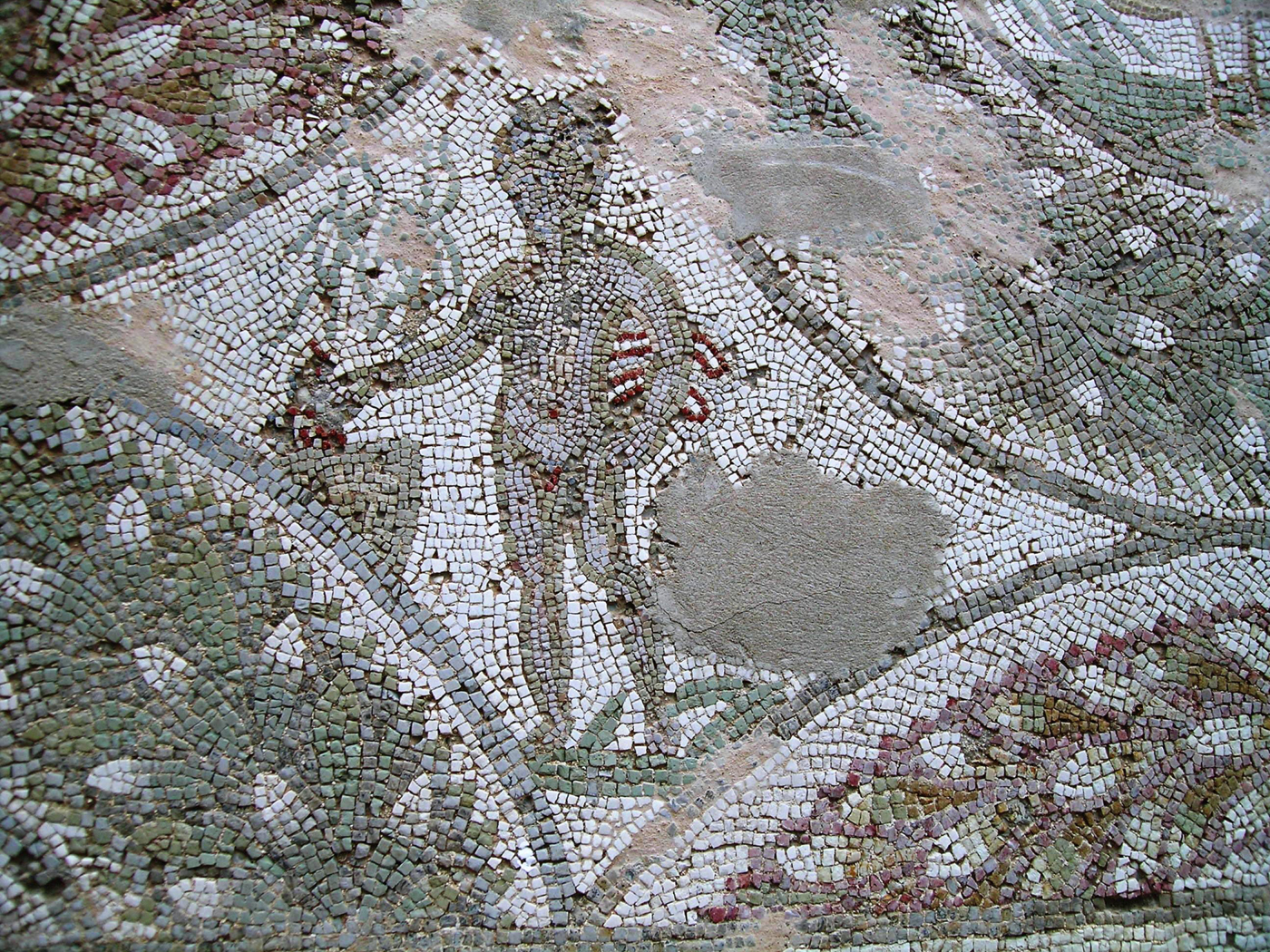
La persistance de cette fonction religieuse impliquant la relation avec l'encens, confiée à un personnage de statut servile probablement, doit être cherchée aussi, selon toute vraisemblance, dans un autre document iconographique chargée de signes appropriés aux sodalités africo-romaines. Il s'agit d'une mosaïque découverte dans le triclinium d'un édifice romain de Carthage datable du IVe siècle (Figure 2)Footnote 22. En effet, parmi les trois petites scènes occupant l'intervalle entre les médaillons des saisons, un « esclave » noir dénudé (Picard Reference Picard1965, 73–75 : « un sorcier nègre ») étendant la main droite au-dessus d'un brasier surmonté de deux tiges de millet. A sa gauche une coquille remplie d'encens.
Détail de la mosaïque de Carthage avec scène d'un « esclave » noir brulant de l'encens sur un brasier. (Photo des auteurs)
Conclusion
Si le rapprochement que nous proposons est possible entre le terme moctor de ce linteau d'Hadrumetum et la fonction du proposé à l'encens, nous aurons ici une attestation de la résurgence du vocabulaire religieux d'origine sémitique parmi le langage religieux des provinces romaines d'Afrique. Il s'ajoute au terme iudirio (enceinte sacrée) que nous trouvons dans deux inscriptions latines de Mactar et de Mustis (Beschaouch Reference Beschaouch1990, 639–46) et du mot mibil (association religieuse ou sanctuaire) révélé par trois inscriptions de la Proconsulaire (Benzina Ben Abdallah et Peyras Reference Benzina Ben Abdallah and Peyras1997, 129–41).