


Introduction
Plant-based diets offer significant benefits for both climate and health,(Reference Blomhoff, Andersen and Arnesen1,Reference Willett, Rockstrom and Loken2) while diets rich in animal-based foods have negative impacts on both.(Reference Willett, Rockstrom and Loken2–Reference Yip, Lam and Fielding4) The concept of plant-based diets varies from veganism to diets containing also animal-based foods,(Reference Storz5) but generally the common factor is the attempt to somehow restrict the consumption of animal-based products. Despite red meat consumption in Europe has slightly declined, the average consumption remains relatively high.(6) In Finland, for instance, the majority of men exceed recommended weekly consumption of red and processed meat; 79% of men exceeded the previous recommendation of maximum of 500 g of red and processed meat per week,(Reference Valsta, Kaartinen and Tapanainen7) while 93% of men exceed the new recommendation of max 350 g per week.(8)
Food production and consumption contribute to climate change, but climate change also affects people, for example, psychologically. The European Social Survey (ESS) showed that in 2020–2022, at least two-thirds of people in European countries expressed some degree of concern about climate change.(Reference Fitzgerald9) This concern may motivate actions like decreasing car use or meat consumption. Changing beliefs, attitudes, and habits is a challenging and time-consuming process.(Reference Carden and Wood10) To enable dietary changes at population level, external circumstances and supportive systems are needed to facilitate the changes and make them accessible for individuals.(Reference O’Brien and Sygna11) A European consumer survey conducted in 2023, including 7500 participants from 10 countries, showed that 51% of them reported to have reduced meat consumption.(12) However, the share of the participants frequently consuming meat remained unchanged between 2021 and 2023.
Various perceived barriers may hinder dietary changes. Dietary habits are often learned in childhood and deeply rooted into cultural norms. A recent systematic review grouped several individual barriers under themes: financial, lack of knowledge, emotional, health, convenience, social, enjoyment of meat, environmental, accessibility, personal ability, and media.(Reference Rickerby and Green13)
A Finnish study identified meat enjoyment, eating routines, health conceptions, and difficulties in preparing vegetarian food as key barriers to following a plant-based diet,(Reference Pohjolainen, Vinnari and Jokinen14) while a Danish study identified concerns about protein content, satiety, and taste as barriers and found that individuals with high consumption of animal-based foods disagreed with statements about positive environmental and health effects of plant-based diets.(Reference Reipurth, Hørby and Gregersen15) Other studies found unfamiliarity, price, and taste,(Reference Kuosmanen, Niva and Pajari16) as well as practical and cooking concerns along with incompatibility with current diet(Reference Whittall, Warwick and Jackson17) as barriers to pulse consumption. The lack of knowledge about the climate benefits of reducing meat consumption, identifying sustainable foods, and preparing tasty plant-based food are considerable barriers to adopting plant-based diets.(Reference Lea, Worsley and Crawford18–Reference Tobler, Visschers and green20) A qualitative study found uncertainty in British adults about what changes to make, despite willingness to adopt more sustainable diets.(Reference Whittall, Warwick and Guy21) In a study including ten European countries, only half of consumers were aware of the health and environmental benefits of plant-based foods, indicating a knowledge gap.(12) This suggests that more comprehensive information on diet–health–environment associations and practical guidance on plant-based diets are needed.
Previous literature has demonstrated a clear sociodemographic gradient in dietary choices, with women, urban residents, and those with higher education or income to be more likely to adopt healthier and more sustainable diets.(Reference Clonan, Roberts and Holdsworth22–Reference Valsta, Tapanainen and Kortetmäki24) It is likely that also barriers to adopting more plant-based diets differ across population groups. Men, younger adults, rural residents, those living in households with children, with low education, or low income tend to be generally less interested in reducing meat consumption or adopting plant-based diets than others.(Reference Pohjolainen, Vinnari and Jokinen14,Reference Tobler, Visschers and green20,Reference Waldman, Giroux and Blekking25) However, in Finland, women perceived more barriers to pulse consumption than men.(Reference Kuosmanen, Niva and Pajari16) Although previous studies have identified various barriers that hinder the dietary changes in the whole study populations or in a few population groups, as well as various population groups that generally perceive more barriers, a nuanced understanding of how different barriers differ by various population groups and how they may change over time across countries is inadequate. As barriers may differ depending on individuals’ background, actions of various types may be needed. A recent review concluded that tailored approaches, such as price incentives, normative messaging, and increased accessibility of plant-based foods, that also take into account the specific needs and backgrounds of the individuals, could be effective strategies to decrease meat consumption.(Reference Wiesli26) To be able to target the measures effectively according to different backgrounds, it is essential to understand which barriers hinder the dietary shift in which population groups. More nuanced knowledge of these group-specific differences can be utilised to help different groups to overcome the barriers and to tailor health promotion and food education strategies that are effective in various sociodemographic groups with different motivations, needs, and situations.
The aims of this study were to examine the proportion of the Finnish adult population that have shifted towards more plant-based diets to combat climate change. Furthermore, we identified perceived barriers to adopting more plant-based diets in different sociodemographic groups, including sex, age, urbanisation level, household structure, education, and household income.
Methods
Study participants
This study utilised data from the Healthy Finland Survey 2022–2023.(Reference Koskela, Ikonen and Parikka27,Reference Sääksjärvi, Elonheimo and Ikonen28) The sampling for the survey was conducted with a stratified random sample design to enhance representativeness of the results (for further information, see(Reference Koskela, Ikonen and Parikka27,Reference Sääksjärvi, Elonheimo and Ikonen28) ). The aims of the survey were to produce comprehensive information on health, well-being, and service use. The information was collected through questionnaires and health examinations. The nationally representative sample comprised 60,861 individuals aged 20 and older permanently living in Finland. A total of 46% (n = 28,153) of the sample participated in the survey. A representative sub-sample of 16,080 individuals was invited to participate in a sub-module on climate change. This study analysed 5390 participants aged 20–74 years, who responded to this sub-module and had answered to at least one of the questions related to the dietary changes (variables used as outcomes in this study, described in detail later). Participants who had not answered to any of these questions of interest were excluded from the analyses. Further, depending on the variable, 0-761 individuals had missing information in some of the exposure or outcome variables used.
The Healthy Finland Survey was performed in accordance with the Declaration of Helsinki and approved by the ethics committee of Helsinki and Uusimaa hospital district. All participants gave their written informed consent.
Measures
The questions concerning dietary changes towards more plant-based diets and potential perceived barriers to these changes were selected and formulated by a group of researchers at the Finnish Institute for Health and Welfare based on a literature search and on questions used in the previous studies. Dietary changes towards more plant-based diets were collected with the question ‘What are you doing or planning to do over the following year to combat climate change?’. One of the 11 pre-defined actions was ‘Change my diet to more plant-based’. The response options included ‘I am doing this or have already done it / I plan to do this / I do not yet plan to do this / does not apply to me’. Uncertainty about environmentally friendly foods was asked with the statement ‘I am unsure about what food is environmentally friendly’, and perceived social pressure to increase vegetarian food consumption was asked with the statement ‘People close to me think I should increase my vegetarian food intake’ representing normative influences of the close ones. Response options for these questions were ‘strongly disagree / somewhat disagree / neither agree nor disagree / somewhat agree / completely agree’. For this study, categories ‘somewhat agree’ and ‘completely agree’ were combined and reported together.
Perceived barriers to adopting plant-based diets were asked with the question ‘Do you feel that any of the following prevents you from making your diet more plant-based?’. Participants could select multiple options. Those who already follow a vegetarian/vegan diet were instructed to skip this question. The pre-defined barriers were:
-
I am unsure about whether a plant-based diet is nutritious enough
-
I do not know how to prepare tasty vegetarian food
-
I cannot afford to have a more plant-based diet
-
Plant-based products are not easily available
-
I do not have time to change my eating habits
-
I do not like vegetarian foods
-
The preferences of those close to me prevent me from making vegetarian food
-
I am not interested in the topic
-
Some other reason.
In this study, barriers were reported both separately and as combined.
Sex, age, urbanisation level of residential area, household structure, education, and household income were used to represent sociodemographic and socio-economic status. Information on sex, age, and urbanisation level were obtained from the survey’s sampling frame and originally from the Digital and population data services agency of Finland. As information on sex was based on official registered sex, categories used in this study (women, men) do not necessarily match perceived gender identity of the participants. Age was categorised into four categories (20–39/40–54/55–64/65–74 years). The age group cut-offs were selected roughly to represent younger adulthood (20–39), lower middle-age (40–54), higher middle-age (55–64), and retirement age (65–74), that are usually characterised by different life events. Additionally, age was used as a 10-year category variable when serving as a confounding factor. Information on residential area was based on coordinates of the participants’ residence locations, which had been categorised according to their level of urbanisation as follows: urban areas/areas near urban areas, rural centres/remote rural areas. For the household structure, education, and household income variables, information was collected with questionnaires. Household structure was categorised as follows: households with only one adult living alone/households with at least two adults and no underage children/households with at least one adult and at least one underage child. Education was based on self-reported number of years of full-time studying including primary school. The number of years was categorised into three tertiles separately in men and in women and in 10-year age groups: low (the lowest tertile)/ intermediate (middle tertile)/high (the highest tertile). The income quartile variable was based on questions about total household income during the last year before tax deductions, and on number of adult and underage household members. The original household income question comprised five pre-defined categories: less than 15,000 €/15,001–35,000 €/35,001–55,000 €/55,001–75,000 €/more than 75,000 €. In this study, upper limits of the categories (and in the highest category, lower limit multiplied by two) were divided by weighted sum of household members, given a value of 1.0 to the first adult, value of 0.7 to additional adults, and value of 0.5 to the underage household members using the OECD equivalence scale.(29,Reference Bellù and Liberati30) The result was further categorised into sex-specific quartiles.
Statistical methods
All analyses were conducted separately for women and for men due to significant sex differences in most of the studied factors and due to sex differences in diets found in previous studies.(Reference Valsta, Tapanainen and Kortetmäki24,Reference Sares-Jäske, Valsta and Haario31) Results were presented as prevalences and 95% CIs of factors related to adopting a more plant-based diet (outcome variables one at a time) in categories of selected sociodemographic and -economic factors (exposure variables one at a time) (Tables 1–2, Supplementary tables 1–5). The analyses were adjusted for age in 10-year categories (except for the analyses where age was used as an exposure variable (Table 2)) by using Surveyreg procedure in SAS. The prevalences were produced with least squares means which present predicted population margins – that is, they estimate the marginal means over a balanced population. Significant differences in prevalences between sociodemographic groups were evaluated by non-overlapping 95% CIs and by pair-wise tests. In pair-wise tests, multiple comparisons were taken into account using the Studentized Maximum Modulus (SMM) adjustment for multiple comparisons with row-wise denominator degrees of freedom. Survey weights (inverse probability weights), based on register data, were used to mitigate bias caused by non-participation and selection probability and to improve the representativeness of the results to the Finnish adult population.(Reference Sääksjärvi, Elonheimo and Ikonen28,Reference Härkänen, Karvanen and Tolonen32) All analyses were conducted with SAS Enterprise Guide, version 7.15 HF7 (SAS Institute Inc., Cary, NC, USA).
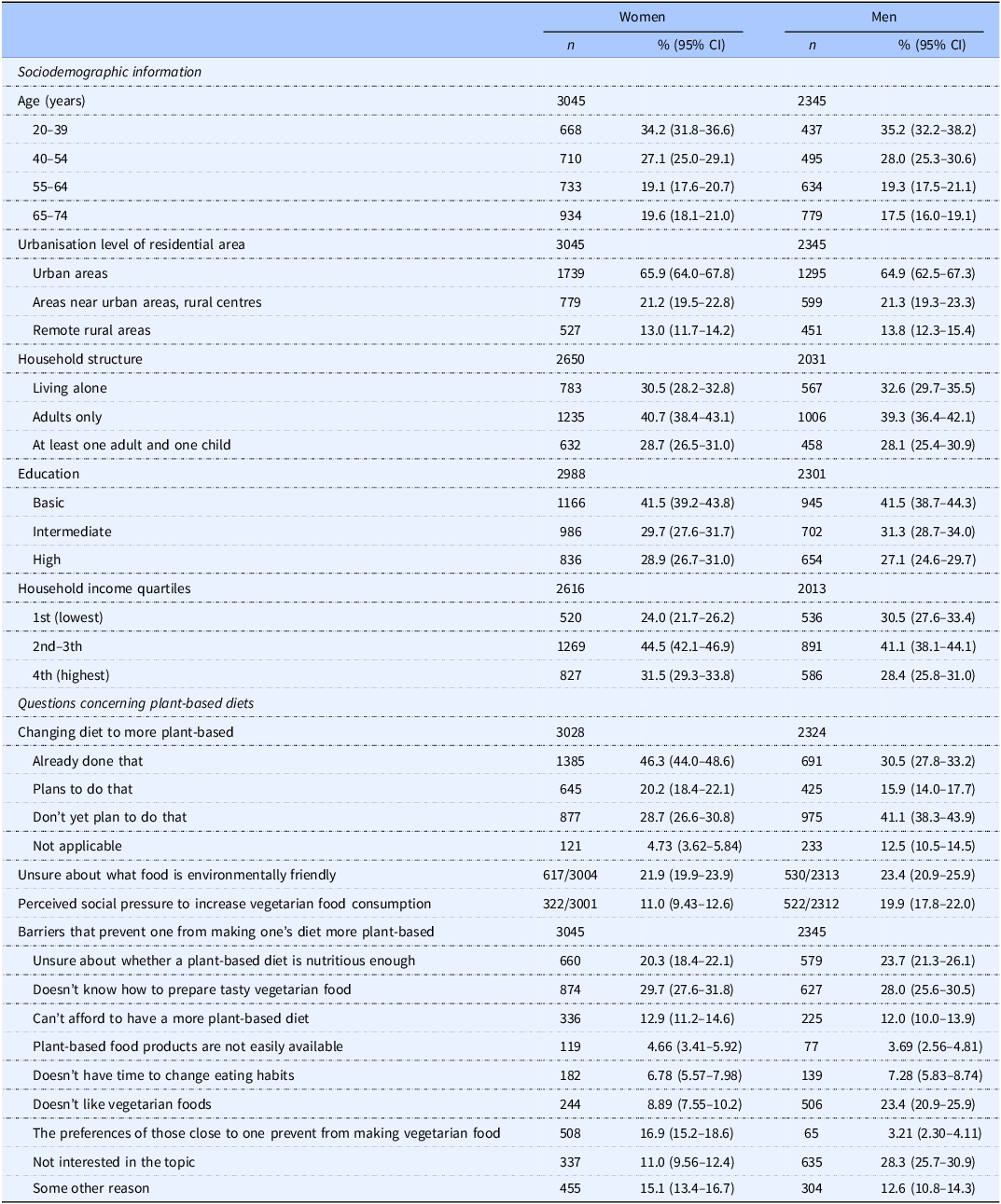
Characteristics (population-weighted prevalence and 95% CI) of study population (Healthy Finland survey, n = 5,390)

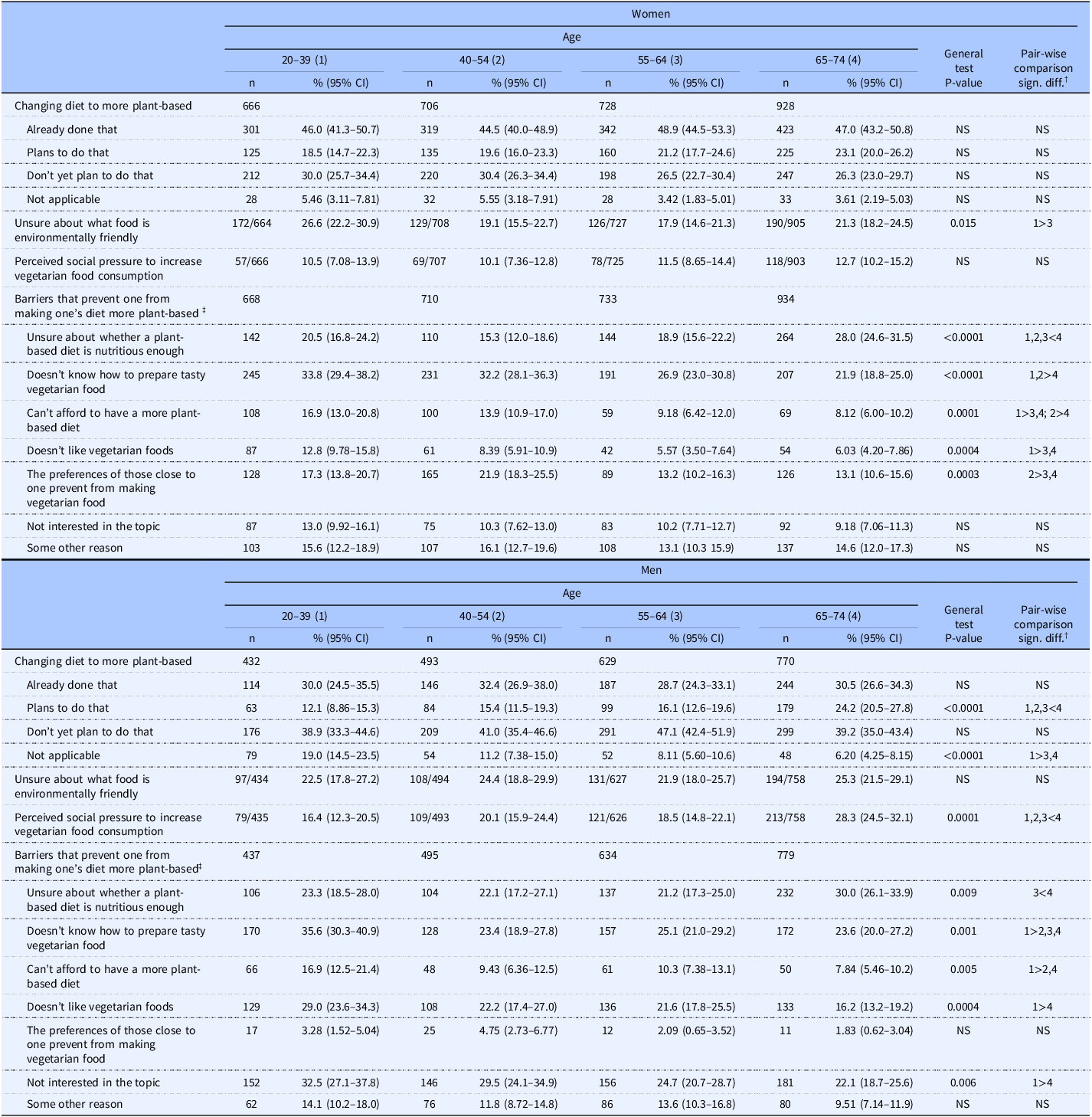
Prevalences and 95% CIs of studied factors related to adopting a more plant-based diet across age groups in women and in men (n = 5,390)Footnote *

NS, not statistically significant; sign. diff., significant difference.
* Population-weighted prevalences and 95% CIs.
† Considered significantly different with group rankings as indicated, if for the general test P < 0.05 and for pair-wise comparison P < 0.05.
‡ Due to small n and no statistically significant differences between the categories, the results concerning barriers ‘Plant-based food products are not easily available’ and ‘Doesn’t have time to change eating habits’ not presented.
Results
Characteristics of the study population
In all, 65% of the study population lived in urban areas, 40% lived in households with adults only, and 42% were categorised as having basic education (Table 1). In the following chapters, only statistically significant (general test P < 0.05, and pair-wise test P < 0.05, and 95% CIs not overlapping) differences between the groups are reported.
Prevalences and differences between women and men
Nearly half of the women and one-third of the men reported to have already changed their diet to more plant-based (Table 1). Women were also more often planning to change their diet, whereas greater proportion of men reported that they do not plan to do that (men 41% vs. women 29%) or that changing diet is not applicable to them (men 13% vs. women 5%). One fifth of women and men felt uncertainty about what food is environmentally friendly. Men (20%) reported more often than women (11%) that they perceived social pressure to increase vegetarian food consumption.
Of women 78% and of men 86% reported at least one perceived barrier in changing their diet to more plant-based (Supplementary table 1). Roughly half of women and men reported one barrier and almost one-fifth reported two barriers, whereas reporting three or more barriers was less common. The most common barriers both in women and in men were ‘Do not know how to prepare tasty vegetarian food‘ and ’Unsure about whether a plant-based diet is nutritious enough’ (Table 1, Figure 1). In men, also ‘Do not like vegetarian foods’ and ‘Not interested in the topic’ were frequent barriers. While 17% of women reported barrier ‘The preferences of people close to me prevent me from making vegetarian food’, only 3% of men perceived this as a barrier. Barriers related to limited availability of plant-based products or lack of time to change eating habits were the least commonly perceived barriers.
Perceived barriers to adopting more plant-based diets in women and in men.

Sociodemographic group differences
Within all studied sociodemographic groups, women had changed their diet to more plant-based more often than men had (Table 2, Supplementary tables 2–5, Figure 2). Such changes were most frequent in women and men living in urban areas (women 51%, men 35%), having high education (women 56%, men 43%), or belonging to the highest household income quartile (women 58%, men 36%).
Proportions of women and men who have already changed their diet to more plant-based in different sociodemographic groups (%).

Regarding intentions to change diet, men in the oldest age group (24%) reported planning to change their diet more often than men in the youngest age group (12%) (Table 2). In both women and men, those with basic education reported more often than those with high education that they do not plan to change their diet to more plant-based (women 34% vs. 24%; men 46% vs. 35%) (Supplementary table 4). In addition, women living in remote rural areas and women in the lowest household income quartile reported that more often than women in other corresponding groups (Supplementary tables 2 and 5).
Uncertainty about what food is environmentally friendly was more common in women (27%) and men (31%) in the lowest household income quartile, as well as in women in the youngest age group (27%), and men living in urban areas (26%), compared to other corresponding groups (Table 2, Supplementary tables 2 and 5). Men in the oldest age group (28%) and women with basic education (13%) reported more often than those in other groups that they perceived social pressure to increase vegetarian food consumption (Table 2, Supplementary table 4).
Several differences appeared between age groups in the barriers that prevent making diet more plant-based (Table 2). In both women and men, uncertainty about whether a plant-based diet is nutritious enough was most frequent in the oldest age group (women 28%, men 30 %). By contrast, in the youngest age group, both women and men reported most frequently the barrier ‘Do not know how to prepare tasty vegetarian food’ (women 34 %, men 36%). People in the youngest age group also reported more frequently than those in older age groups that they cannot afford to have a more plant-based diet or that they do not like vegetarian foods. While women aged 40–54 years reported most frequently (22%) that the preferences of people close to them prevent them from making vegetarian food, this was not an issue amongst the men with same age (5%). Barrier of disinterest in the topic was most common in men in the youngest age group (33%).
Urbanisation level of residential area showed statistically significant differences in the barrier of disinterest in the topic (Supplementary table 2). Men living in remote rural areas (34%) and women living in areas near urban areas or in rural centres (16%) reported more frequently disinterest in the topic compared to the other urbanisation level groups. A few differences in perceived barriers occurred between household structure groups (Supplementary table 3). Lack of knowledge of how to prepare tasty vegetarian food was most common in women living with children in the household (35%). Women living alone reported most frequently that they cannot afford to have a more plant-based diet. Even though the perceived barrier of ‘The preferences of those close to one prevent from making vegetarian food’ was notably more frequent in women than in men, those living in households with at least one under-age child reported this more frequently than those in other kind of households both in women (29%) and in men (6%). Education showed differences in three perceived barriers (Supplementary table 4). Women with basic education reported more often that they cannot afford to have a more plant-based diet (18%), or that they do not like vegetarian foods (11%) than women with higher education. Men with basic education (31%) reported more often than men with higher education that they are not interested in the topic. Differences by income appeared only in the perceived barrier ‘Cannot afford to have a more plant-based diet’; over one-fifth of women and men in the lowest income quartile reported this barrier (Supplementary table 5).
Discussion
This large population-based study of Finnish adults provided up-to-date information on the proportions of individuals in different sociodemographic groups, who had changed their diet to more plant-based, or perceived different barriers to making such changes. While the basic findings were mostly compatible with the existing literature, this study also provided new detailed insights into the adoption of plant-based diets and into the specific barriers faced in several different sociodemographic groups, which have not been studied earlier in this extent.
Adopting more plant-based diets
In this study, two-thirds of women and almost half of men had already changed or were planning to change their diet to more plant-based to combat climate change. According to a recent European consumer survey, half of the participants reported to have reduced their meat intake.(12) In line with this, also some other studies have shown an increase in vegetarianism or a decrease in meat consumption during the last decades.(Reference Lehto, Kaartinen and Sääksjärvi33–Reference Wozniak, Larpin, de Mestral, Guessous, Reny and Stringhini35)
Women had changed or were planning to change their diet to more plant-based more frequently than men had. Also earlier studies have concluded that women eat less meat and more vegetables, fruit, and other plant-based foods than men(Reference Valsta, Tapanainen and Kortetmäki24,Reference Lehto, Kaartinen and Sääksjärvi33,Reference Heuer, Krems and Moon36) and have less barriers to following more plant-based diets or reducing meat consumption.(Reference Pohjolainen, Vinnari and Jokinen14,Reference Tobler, Visschers and green20) Although some studies show women face more barriers in certain contexts (e.g. pulse consumption),(Reference Kuosmanen, Niva and Pajari16) they are generally more likely to adopt plant-based diets. Eating meat has traditionally been associated with masculinity, power, and wealth,(Reference Kildal and Syse37–Reference Marinova and Bogueva39) which may be one explanation behind sex differences found in most of the studies. In agreement with our findings between higher socio-economic groups and more frequent adoption of more plant-based diets, a direct association between indicators of socio-economic status and plant-based food consumption,(Reference Valsta, Tapanainen and Kortetmäki24,Reference Lehto, Kaartinen and Sääksjärvi33,Reference Boylan, Lallukka and Lahelma40) and an inverse association between socio-economic status and meat consumption(Reference Maguire and Monsivais23,Reference Valsta, Tapanainen and Kortetmäki24,Reference Heuer, Krems and Moon36,Reference Pfeiler and Egloff41,Reference Sych, Kaelin and Gerlach42) have been shown also in previous studies. Other studies have also linked less sustainable attitudes or behaviour to younger age, lower education, lower income, or rural residence.(Reference Waldman, Giroux and Blekking25,Reference Sares-Jäske, Valsta and Haario31,Reference Klink, Mata and Frank43,Reference Vainio, Niva and Jallinoja44) This has been suggested to stem from, for instance, different values, attitudes or traditions, food literacy, lack of information on healthy lifestyle habits, or not perceiving that one would benefit from healthy lifestyle choices.(Reference Pampel, Krueger and Denney45,Reference Svendsen, Bak and Sørensen46) In this study, differences between urban–rural axis categories may be accounted for, for example, by differences in education, traditions, attitudes, or social norms.
Barriers to adopting more plant-based diets
In this study, most women and men reported at least one barrier to change their diet to more plant-based. Generally, barriers to following a plant-based diet have been shown to be common in men, younger age groups, rural residents, those living in households with children, and those with low education.(Reference Pohjolainen, Vinnari and Jokinen14) Furthermore, different kinds of barriers may prevent people from changing their diets. In this study, most common barriers for women and for men were not knowing how to prepare tasty vegetarian food, and doubts about the nutritional value of a plant-based diet.
In agreement with previous findings,(Reference Rickerby and Green13) over one-fifth of the participants in this study felt uncertainty about what food is environmentally friendly or felt that uncertainty about the nutritional value of a plant-based diet prevented them from adopting it. Despite growing awareness of the health benefits of decreasing meat consumption and increasing the consumption of plant-based foods over the last decades, many studies have shown that decreasing meat consumption has not been widely seen as an important climate action.(Reference Tobler, Visschers and green20,Reference Marinova and Bogueva39,Reference Hoek, Pearson and James47,Reference Lea and Worsley48) It seems that animal or plant origin of foods is not perceived as an important environmental factor, and the concept of healthy and environmentally friendly food remains unclear for many. In this study, younger women were more uncertain about environmental friendliness of food, while older participants had more doubts about the nutritional value of plant-based food. Feeling uncertainty is subjective and does not necessarily depend on the actual level of knowledge. Uncertainty about environmentally friendly food was also common in participants with the lowest income, possibly due to socio-economic differences in health literacy.(Reference Svendsen, Bak and Sørensen46)
In addition to lack of knowledge of environmentally friendly foods, also the lack of knowledge on how to prepare tasty vegetarian food, not liking vegetarian foods and the preferences of the close ones were three commonly identified barriers to adopting plant-based diets. In accordance, 30% of the participants of a recent European survey reported that taste was a barrier when choosing plant-based alternatives.(12) In the present study, not knowing how to prepare tasty vegetarian food was frequently perceived as a barrier in both women and men. The lack of practical knowledge and skills to prepare such food may hinder dietary changes, but also adaptation to unfamiliar flavours and textures may require gradual exposure and time. Not knowing how to prepare tasty vegetarian food was frequent especially in younger women and in women living in households with children. Women with children may perceive that the vegetarian food they make may not meet the preferences of their children or spouses. Indeed, women – and especially women with children – perceived notably more often than men that the preferences of their close ones are a barrier to change their diet to more plant-based, while men reported notably more often than women that not liking vegetarian foods is a barrier for them. It appears that the barriers among women partly derive from preferences of their children and spouses instead of their own preferences.
In this study, affordability was not commonly perceived as a barrier to have a more plant-based diet. In previous studies, however, price and affordability factors have emerged as important drivers behind food selection.(12,Reference Mann, Thornton and Crawford19,Reference Waldman, Giroux and Blekking25,Reference Konttinen, Halmesvaara and Fogelholm49) Despite the affordability not being an important barrier for all population groups in this study, this barrier was more frequent in younger adults, in women living alone, in women with low education, and in women and men with the lowest income compared to the other groups. In agreement, previous studies have emphasised the relevance of socio-economic status in the association between price and affordability and dietary choices.(Reference Konttinen, Halmesvaara and Fogelholm49–Reference Green, Cornelsen and Dangour51) Especially for those with low income, price may pose a serious barrier to choose more sustainable foods.(Reference Green, Cornelsen and Dangour51) However, a recent optimisation study concluded that it is possible to compose a nutritionally adequate and culturally acceptable more plant-based diet while reducing the price of diet,(Reference Irz, Sares-Jäske and Tapanainen52) which implies that with adequate know-how, barriers related to affordability could be diminished.
While approximately 10% of women reported that disinterest in the topic was a barrier to adopt a more plant-based diet, the corresponding share in men was over one quarter. Among men, approximately one-third in the youngest age group, living in remote rural areas, or with the lowest education reported lack of interest. Generally, lack of interest represents a slightly different aspect than other more pragmatic or taste-related barriers. A Dutch study concluded that consumers could be divided into four groups according to their thoughts and actions concerning meat consumption: struggling consumers, coping consumers, indifferent consumers, and strategically ignorant consumers.(Reference Onwezen and van der Weele53) In the present study, those not interested in adopting a more plant-based diet may comprise both indifferent and strategically ignorant consumers. Either way, this group may need different kind of attention in dietary transition than those who perceive more pragmatic or taste-related barriers. Indeed, a Swedish study that explored motivations for active avoidance of carbon emission information stated that those, who are indifferent to the information offered, are not affected by it.(Reference Edenbrandt, Lagerkvist and Nordström54) Thus, providing information on sustainable dietary choices is presumably not effective among those feeling indifference, but other motivators, such as lower prices, convenience or trendiness, could help guide their food choices.
Methodological considerations
The strengths of this study were a nationally representative study sample with a large set of questions related to barriers to adopting plant-based diets and versatile information on sociodemographic factors. This study also includes certain limitations. Firstly, despite a large population survey sample, non-participation bias may have affected the representativeness of the sub-study population. This possible bias was strived to be mitigated by using inverse probability weights that are commonly used in population surveys.(Reference Sääksjärvi, Elonheimo and Ikonen28,Reference Härkänen, Karvanen and Tolonen32,Reference Härkänen, Kaikkonen and Virtala55) Secondly, the term ‘plant-based diets’ was not specified in the survey questionnaire, and the participants may have understood it in various ways. However, as this study examined changes towards more plant-based diets and not any specific plant-based diet, the usage of the wide definition may be less problematic here. Thirdly, the list of barriers to adopting a more plant-based diet was pre-defined in this study and, thus, other potential barriers could not be explored. In future, qualitative studies could investigate the barriers of different groups in more depth. Fourthly, this study used categorised sociodemographic exposure variables in each case instead of continuous variables even though previous literature has indicated that categorisation into, for example, tertiles or quartiles may cause loss of power and inaccurate estimation in epidemiological studies; cause false positive findings as it leads to multiple comparisons; or hinder the comparison between studies as the cut-off points are different.(Reference Bennette and Vickers56) However, in this extensive descriptive study, which aimed to identify sociodemographic groups in which dietary changes and perceived barriers to these changes are more common, categorisation was opted for as an appropriate method to enable similar comparisons of prevalences across all variables. Despite the critique, categorisation of independent variables remains to be a common procedure to treat exposure variables in epidemiological studies. In this study, the possibility of false positive findings was taken into account by using the SMM adjustment for multiple comparisons with row-wise denominator degrees of freedom in pair-wise tests. As our next step in future studies, we aim at examining these associations using continuous exposure variables. Fifthly, social desirability bias may have affected how some of the participants responded to the self-reported questions concerning sustainable dietary changes – possibly leading to slight overestimations of such socially more acceptable behaviours.(Reference Callegaro and JL57) Sixthly, this study was conducted in a cross-sectional setting, which prevented the examination of changes over time. Seventhly, this study was conducted in a Finnish context, and the results may be applicable to some other Nordic or Western countries, yet country or culture specific differences may exist.
Conclusions
This study showed that the readiness to adopt more plant-based diets varies between sociodemographic groups, each of them facing different perceived barriers. Even though two-thirds of women and almost half of men either had changed or were planning to change their diet to more plant-based to combat climate change, a significant share, especially in certain sociodemographic groups, had no such plans. Common perceived barriers included lack of knowledge about nutritional adequacy of plant-based diets, limited cooking skills to prepare tasty vegetarian food, own or close ones’ taste preferences, affordability, and lack of interest.
Previous research has mostly concentrated to study general perceived barriers to adopt more plant-based diets in different population groups, or to study different barriers in whole study populations or in only a few population groups. This study, however, simultaneously examined the prevalence of several different barriers in several different population groups providing a more comprehensive understanding on the complex issue. The novel group-specific information, provided by this study, can be utilised to support different groups in overcoming the barriers and to tailor campaigns, nudging or other measures accordingly to increase their effectiveness within different groups. Clear and accessible information on preparing nutritionally adequate, tasty, and culturally acceptable plant-based food is central to facilitating dietary changes. To encourage this shift, it is crucial to address uncertainties about sustainable diets and make the shift easy and enjoyable. In addition to information, actions like nudging (e.g. modifying default menu options in cafeterias or placing more sustainable foods in more accessible positions in supermarkets) and fiscal policies are needed to improve the accessibility and affordability of sustainable foods. Differences between population groups in adoption and barriers may reflect justice issues, as dietary transition may not be equally accessible to all, or it may disadvantage certain groups.
Addressing the barriers requires tailored public actions, as a one-size-fits-all approach may not be effective. For instance, men who are not interested in adopting more plant-based diets, or women who perceive that the preferences of their close ones prevent them from preparing plant-based foods may require different strategies. Campaigns targeted specifically to men with the most resistance could underline taste and protein content, while campaigns to whole families could underline taste, convenience and joy of eating together.
Small, gradual, and manageable changes in diet along with clear information on sustainable diets and personal benefits related to them, as well as enhanced availability of plant-based foods, are essential to dietary transition. Food industry, retail, catering services, media, and education have a significant role in promoting healthy and sustainable diets. Addressing the characteristics and perceived barriers of the groups, whose diets are far from meeting dietary guidelines, is vital for reducing sociodemographic differences in diets. Ensuring that dietary transition is accessible to all sociodemographic groups is crucial for planetary health and future well-being.
Supplementary material
The supplementary material for this article can be found at https://doi.org/10.1017/jns.2026.10101.
Data availability statement
The data that support the findings of this study are available from the Finnish Social and Health Data Permit Authority Findata. Restrictions apply to the availability of these data, which were used under licence for this study. Data are available at https://findata.fi/en/ with the permission of Findata.
Acknowledgements
The authors thank the Healthy Finland Survey personnel, who were involved in collection and preparation of the data, and the participants of the study.
Author contributions
Laura Sares-Jäske: Conceptualisation, Data curation, Formal analysis, Investigation, Methodology, Visualisation, Writing – original draft, Writing – review and editing. Laura Paalanen: Conceptualisation, Funding acquisition, Investigation, Project administration, Writing – review and editing. Heli Tapanainen: Conceptualisation, Data curation, Investigation, Methodology, Writing – review and editing. Niina E. Kaartinen: Conceptualisation, Investigation, Writing – review and editing. Minna Kaljonen: Funding acquisition, Investigation, Project administration, Writing – review and editing. Hanna Konttinen: Investigation, Writing – review and editing. Satu Männistö: Conceptualisation, Funding acquisition, Investigation, Project administration, Writing – review and editing.
Financial support
This work was funded by the Strategic Research Council (SRC) established within the Research Council of Finland (Just food project grant numbers: 352641 and 352638; Leg4Life project grant number: 352483). The funding source had no role in the design, analysis, or writing of the article.
Competing interests
None.


 Open access

