


Introduction
The plight of the African lion Panthera leo has attracted considerable attention. Estimates suggest that lion numbers have declined by at least 30% since the 1970s (Chardonnet, Reference Chardonnet2002; Bauer & van der Merwe, Reference Bauer and Van Der Merwe2004). The species’ range has contracted by > 82% compared to historic baselines, primarily because of conflicts with people resulting from livestock depredation but also because of habitat loss and depletion of prey (IUCN, 2006a,b). An additional, more controversial factor potentially contributing to lion declines is trophy hunting. Lions are one of the most sought after and economically valuable species in Africa's trophy hunting industry (Lindsey et al., Reference Lindsey, Balme, Booth and Midlane2012). Several recent studies have indicated that trophy hunting may be a significant contributor to lion declines in a number of key range states (Loveridge et al., Reference Loveridge, Searle, Murindagomo and Macdonald2007; Packer et al., Reference Packer, Kosmala, Cooley, Brink, Pintea and Garshelis2009, Reference Packer, Brink, Kissui, Maliti, Kushnir and Caro2011; Croes et al., 2011).
Partly in response to these findings and partly because of opposition in principle to trophy hunting, various animal welfare groups have lobbied for restrictions on international trade in lion trophies. The first such proposal was tabled by Kenya in 2004 at the 13th Conference of the Parties (CoP) of CITES, in Bangkok, Thailand, to list lions on Appendix I (Nowell, Reference Nowell2004). This proposal was subsequently withdrawn but since that time debate over the appropriate role of trophy hunting in lion conservation has continued. In March 2011 a consortium of animal welfare organizations filed a petition to list lions under the US Endangered Species Act (Platt, Reference Platt2011). The European Union is also under pressure to prohibit imports of lion trophies (Lindsey et al., Reference Lindsey, Balme, Booth and Midlane2012). If successful, such interventions could severely limit the movement of lion products or trophies across international borders and substantially curtail the commercial sport hunting of the species in Africa.
The ongoing debate about lion conservation policies and trophy hunting, under CITES and other unilateral statutes such as the US Endangered Species Act, hinges on whether trophy hunting supports or impedes lion conservation. This question is complex: trophy hunting generates > USD 200 million in annual revenue from lions and other wildlife in African countries, providing potentially important economic incentives to conserve species and their habitats (Lindsey et al., Reference Lindsey, Roulet and Romañach2007). A range of international policy statements affirms the importance of consumptive forms of sustainable use to effective conservation practice, including the Addis Ababa Principles and Guidance on Sustainable Use of Biodiversity of the Convention on Biological Diversity, and successive statements from IUCN World Conservation Congresses. For example, the IUCN Policy Statement on Sustainable Use of Wild Living Resources, issued at the 2000 World Conservation Congress at Amman, Jordan, states that the ‘use of wild living resources, if sustainable, is an important conservation tool because the social and economic benefits derived from such use provide incentives for people to conserve them’ (IUCN, 2000).
However, as these international conventions and accords widely recognize, hunting, if not managed in a sustainable manner with an appropriate suite of mechanisms that create incentives for sustainable use, may contribute to the declines of hunted species. To design appropriate policy measures at both national and international levels it is essential to understand the factors that enable hunting to support sustainable use and lion conservation in the long term while mitigating the negative impacts of hunting. This is particularly important as hunting occurs under a wide range of governance regimes, with consequently variable impacts and outcomes (Dickson et al., Reference Dickson, Hutton and Adams2009).
To inform policy debates over lion hunting and conservation strategies we compare the relationship between trophy hunting and lion conservation in a number of the key lion range states, all in East and Southern Africa where the majority of Africa's lions occur (IUCN, 2006a). We examine the conditions and factors that influence how trophy hunting threatens or supports lion conservation objectives under various management frameworks, paying particular attention to policy and governance factors that shape the incentives created by trophy hunting.
Methods
Our review uses published, unpublished and web-based sources of information to construct overviews of the relationship between trophy hunting and lion conservation in a number of key lion range states and management contexts. We collected information on lion and wider wildlife population trends, trophy hunting revenues, hunting concession allocation and management systems, extent and location of hunting concessions, lion offtake levels and analyses of their sustainability, and general wildlife policy and governance issues in Namibia, Mozambique, South Africa, Tanzania and Zimbabwe. Kenya, where no trophy hunting of lions or other species takes place, is included as a control case study. This review complements other studies that have assessed the significance of African lions for the financial viability of trophy hunting and the maintenance of wild land (Lindsey et al., Reference Lindsey, Balme, Booth and Midlane2012) and evaluated the scale and impact of lion hunting across the species' range (P.A. Lindsey et al., unpubl. data). Selection of country cases was determined primarily by the availability of data, particularly on hunting revenues, species offtakes, quotas and lion populations (e.g. Zambia is an important lion range state but there are limited data available on population trends and hunting offtakes regarding lions and other species).
Tanzania
Tanzania holds four of the six remaining wild lion populations that exceed 1,000 breeding adults and are considered viable in the long term (IUCN, 2006a). Despite the presence of sizeable lion populations in some of the region's largest protected areas (e.g. Selous Game Reserve, Ruaha–Rungwa–Kizigo complex, Greater Serengeti ecosystem), lions are declining outside state protected areas and in and around smaller protected areas (Kiffner et al., Reference Kiffner, Meyer, Mühlenberg and Waltert2009; Kissui, Reference Kissui2009; Chardonnet, Reference Chardonnet2010; Packer et al., Reference Packer, Brink, Kissui, Maliti, Kushnir and Caro2011).
Tanzania hosts the second largest trophy hunting industry in Africa, generating c. USD 77 million annually (Booth, Reference Booth2010). Lions are particularly important to Tanzania's hunting industry because, unlike most countries in the region, lions are included in the quotas allocated for the majority of hunting concessions, revenues generated by lion hunting are particularly lucrative (valued at c. USD 70,000 per animal excluding government fees), and Tanzania allows hunting of relatively few elephants Loxodonta africana, another highly valued species (Lindsey et al., Reference Lindsey, Balme, Booth and Midlane2012). Between 1996 and 2009 an average of 171 lion trophies were exported annually from Tanzania, more than the next two highest-exporting countries (Zambia and Zimbabwe) combined (Packer et al., Reference Packer, Kosmala, Cooley, Brink, Pintea and Garshelis2009). This excludes South Africa, which exported > 800 trophies from captive-bred lions in 2009, a facet of lion hunting unique to South Africa and that has little relevance to wild lion conservation (UNEP WCMC, 2011).
Tanzania's Game Reserves, which cover c. 13% of the country's land area, are used primarily for trophy hunting. This is in contrast to National Parks, which cover c. 4.4% of the country and do not allow consumptive utilization of wildlife (URT, 2007). Trophy hunting also occurs outside state protected areas; c. 56% of the 300,000 km2 used for such hunting is outside protected areas, on or around community lands, particularly in the north and west (Baldus & Cauldwell, Reference Baldus and Cauldwell2004). Land used for trophy hunting comprises 34–50% of the range of lions in Tanzania (P.A. Lindsey et al., unpubl. data). Consequently, trophy hunting has potential to have substantial impact on lion conservation, depending on how it is managed (Packer et al., Reference Packer, Brink, Kissui, Maliti, Kushnir and Caro2011). However, trophy hunting in Tanzania has long been characterized by weaknesses in how wildlife utilization is governed and how revenues are distributed, leading to long-running debates over reform of the industry. These governance factors serve to undermine the development of a positive relationship between wildlife conservation and hunting revenues (Baldus & Cauldwell, Reference Baldus and Cauldwell2004; Nelson et al., Reference Nelson, Nshala and Rodgers2007).
Firstly, revenues from trophy hunting accrue to hunting operators and central government, largely bypassing the communities and landholders who live with and bear costs from wildlife (Leader-Williams et al., Reference Leader-Williams, Baldus, Smith, Dickson, Hutton and Adams2009). Local communities are not directly involved in negotiations or authorization of hunting concession allocations on their village lands and no revenue is paid directly by hunting operators to communities except through mandatory, but poorly defined and inconsistently applied, contributions to local development projects. Recent changes to regulations governing Wildlife Management Areas give communities greater authority over trophy hunting in these areas; however, these changes have yet to be fully implemented and their impacts remain unclear. Such distribution of costs and benefits is particularly significant for the lion, which is a key conflict species because of its impacts on livestock and the threat to human life. Lions attacked at least 1,000 people in Tanzania during 1990–2007 (Kushnir et al., Reference Kushnir, Leitner, Ikanda and Packer2010). Where the people living with lions do not benefit financially from their presence the species is unlikely to be tolerated (Kissui, Reference Kissui2008).
Secondly, Tanzania employs a closed tender system for allocating hunting areas, resulting in lower earnings than could be generated via public auction systems. This system allows discretionary allocation of valuable hunting concessions by government officials, creating conditions conducive to corruption and the use of hunting blocks for political patronage (Nelson & Agrawal, Reference Nelson and Agrawal2008; Leader-Williams et al., Reference Leader-Williams, Baldus, Smith, Dickson, Hutton and Adams2009). Thirdly, the majority of government income from Tanzanian hunting blocks comes from trophy and licence fees, which has encouraged the establishment of unsustainably high quotas (Booth, Reference Booth2010). Furthermore, there has been a tendency for hunting blocks to be subdivided, resulting in substantially increased overall quotas over time (Hurt & Ravn, Reference Hurt, Ravn, Prins, Grootenhuis and Dolan2000). Operators are required to pay for 40% of quotas in advance, regardless of whether animals on the quota are actually hunted, further encouraging excessive and unselective harvests (P. A. Lindsey et al., unpubl. data). As a result of these factors lion quotas and offtakes are higher than the recommended maximum of 0.5–1.0 per 1,000 km2 in most Tanzanian hunting areas (Packer et al., Reference Packer, Brink, Kissui, Maliti, Kushnir and Caro2011). Lastly, Tanzanian hunting blocks are leased for periods of 5 years, which is shorter than lease lengths in most other countries, discouraging management for long-term sustainability (Hurt & Ravn, Reference Hurt, Ravn, Prins, Grootenhuis and Dolan2000).
In the mid 1990s the government approved policy reforms to introduce a competitive bidding system for hunting concessions, which would have reduced corruption and devolved rights over wildlife management and benefits, including hunting revenues, to local communities (with respect to wildlife living on community lands outside core protected areas). However, these reforms were blocked by government officials following lobbying by national and international trophy hunting organizations (Baldus & Cauldwell, Reference Baldus and Cauldwell2004). Groups and individuals within government and industry have long benefited from the non-transparent and non-competitive system of hunting concession allocation that has kept down concession prices and allows concessions to be distributed via personal or political means (Nelson & Agrawal, Reference Nelson and Agrawal2008). The World Bank (2008) estimates that the market value of Tanzanian hunting concessions is USD 7 million greater than their actual administratively determined price. These excess rents become available to those companies that are allocated blocks and then sub-lease them at market rates, and to government officials who control the process (Nelson, Reference Nelson2009). Tanzanian investigative journalists have described a range of elected officials and other political elites who, through various proxies and relatives, have ownership stakes in numerous hunting companies and thus vested interests in concession allocation (This Day, 2008; cited in Nelson, Reference Nelson2009).
The result is that long-entrenched wildlife governance issues in Tanzania have not been effectively addressed despite 20 years of policy debate, including multiple reviews highlighting the problems (Baldus & Cauldwell, Reference Baldus and Cauldwell2004; Barnett & Patterson, Reference Barnett and Patterson2006; TNRF, 2008). Although trophy hunting does provide aggregate macro-economic incentives for the retention of land under wildlife at the national scale in Tanzania (Lindsey et al., Reference Lindsey, Roulet and Romañach2007, Reference Lindsey, Balme, Booth and Midlane2012), and in protected areas where there are no resident people, incentives for conservation in areas occupied by or adjacent to rural communities are weak.
As an example of how hunting revenues, local community incentives and conservation outcomes for lions interact, Tanzania's Maasai Steppe holds the country's fourth largest population of lions (Kissui, Reference Kissui2008). More than 80% of the Maasai Steppe lies within the boundaries of village lands managed by local pastoralist communities (Sachedina & Nelson, Reference Sachedina and Nelson2010). Human–lion conflict because of livestock predation is widespread, with Kissui (Reference Kissui2008) recording 85 lions killed in 12 villages during a 19-month period. The Maasai Steppe is the most important trophy hunting area in northern Tanzania, with more than a dozen concession areas. However, because hunting revenues flow to central government and private hunting companies, with limited benefit-sharing with resident communities living alongside wildlife, hunting does not provide incentives for local communities to protect wildlife habitat or tolerate species such as lions (Sachedina & Nelson, Reference Sachedina and Nelson2010). The Maasai Steppe is thus emblematic of the broader paradox of wildlife conservation in Tanzania: wildlife is highly valued and productive but the distribution of costs and benefits engendered by existing policy and governance arrangements results in local incentives that discourage conservation, particularly for a high-conflict species such as the lion. Wildlife in the Maasai Steppe, as in the majority of Tanzania's main wildlife areas, has declined significantly since the 1990s (Stoner et al., Reference Stoner, Caro, Mduma, Mlingwa, Sabuni, Borner and Schelten2007). Lions in particular have suffered; Kissui (Reference Kissui2009) reports that the Tarangire National Park lion population, a key stronghold for the species in the region, declined by 15–20% between 2003 and 2008.
Southern Africa
Southern Africa has a unique shared regional experience of adopting a number of important wildlife management and policy reforms that have led to wildlife recoveries across large areas of private and communal land (Child, Reference Bond, Child, de la Harpe, Jones, Barnes, Anderson and Child2004). Namibia, South Africa and Zimbabwe (which have large commercial farming sectors on private land) all devolved user rights over wildlife to landholders in the 1960s and 1970s (Bond et al., Reference Bond, Child, de la Harpe, Jones, Barnes, Anderson and Child2004). Most countries in the region have also experimented with reforms that facilitate community-based natural resource management, with the aim to devolve significant control over wildlife use and benefits to people living alongside wildlife on communal lands, although only in Namibia has this devolutionary aspiration come close to being fully realized and implemented (Roe et al., Reference Roe, Nelson and Sandbrook2009; Nelson, Reference Nelson2010). These different long-term management strategies and wildlife governance experiments provide key insights into the relationship between trophy hunting and lion conservation.
Southern Africa dominates Africa's trophy hunting industry in economic terms, accounting for 84% of total annual revenues (Lindsey et al., Reference Lindsey, Roulet and Romañach2007). This was not always the case. In the 1960s Kenya accrued the highest national revenue from hunting but when the industry was banned in 1977 much of Kenya's business shifted to Southern Africa. In addition, while West, Central and East Africa have all witnessed long-term declines in large mammal populations, Southern Africa has generally experienced substantial recoveries in wildlife populations across large areas of private and, in some cases, communal lands (Bond et al., Reference Bond, Child, de la Harpe, Jones, Barnes, Anderson and Child2004; Craigie et al., Reference Craigie, Baillie, Balmford, Carbone, Collen, Green and Hutton2010).
There are three scenarios under which trophy hunting is carried out, which reflect the region's three main land tenure categories: private ranches and conservancies, communal conservancies, and state protected areas.
Private ranches and conservancies
Large areas of privately owned rangelands, including former cattle farms where large predators such as lions were historically persecuted, have been converted to wildlife ranches (and mixed wildlife/cattle ranches in many cases) across Southern Africa: 205,000 km2 in South Africa, 27,000 km2 in Zimbabwe (prior to the land seizures initiated in 2000) and 288,000 km2 in Namibia (Lindsey et al., 2013). Earnings from trophy hunting have been a key driver of these restorative conservation efforts (Lindsey et al., Reference Lindsey, Roulet and Romañach2007). Such land conversion has driven a steep increase in some wildlife populations; for example, 1.8–2.8 million wild ungulates occur on freehold land in Namibia, which is 10–20 times the number occurring in the protected area network (Lindsey et al., 2013). The impacts on predator conservation are less clear (Lindsey et al., Reference Lindsey, Romañach, Davies-Mostert, Hayward and Somers2009a). Many commercial game ranchers perceive large carnivores as competitors and some persecute them accordingly (Lindsey et al., Reference Lindsey, du Toit and Mills2005). However, in cases where landowners have pooled land to create collaboratively managed conservancies, land uses tend to shift to high-value trophy hunting and ecotourism where lions and other predators are considered valuable (Lindsey et al., Reference Lindsey, Romañach and Davies-Mostert2009b). In several such circumstances lion populations have been reintroduced or allowed to recover. For example, lions naturally recolonized and were also reintroduced to the Bubye Valley and Savé Valley Conservancies in Zimbabwe and now occur in significant numbers in both (Lindsey et al., Reference Lindsey, du Toit, Pole, Romañach, Child, Suich and Spenceley2008). Similarly, > 500 wild lions have been reintroduced into private conservancies in South Africa for ecotourism and hunting purposes, adding considerably to the country's two naturally occurring lion populations (Slotow & Hunter, Reference Slotow, Hunter, Hayward and Somers2009).
On private lands in Southern Africa the growth of wildlife-based land uses during the past 30–40 years stems from policy and legislative reforms that devolve user rights over wildlife to landowners, enabling them to benefit financially from recreational hunting (Bond et al., Reference Bond, Child, de la Harpe, Jones, Barnes, Anderson and Child2004). However, successful lion conservation appears to require an additional step, namely collaborative management agreements among neighbouring landowners that facilitate development of sufficiently large land units (Lindsey et al., Reference Lindsey, Romañach and Davies-Mostert2009b).
Communal conservancies
Wildlife-based land uses have also developed on communally owned lands in parts of Southern Africa, most notably in Namibia. Namibia has put in place policy and legal measures, starting in the mid 1990s, which devolve user rights over wildlife to local landholders. Communities in Namibia are able to establish ‘communal conservancies’ where local residents can legally hunt wildlife for their own consumption or sell a quota to a hunting operator, keeping 100% of the revenue (Jones & Weaver, Reference Jones, Weaver, Suich, Child and Spenceley2009).
Trophy hunting has played a key role in the development of Namibian conservancies by providing an entry point for communities into wildlife-based land uses and acting as a catalyst for changing attitudes towards wildlife (Weaver & Petersen, Reference Weaver, Petersen, Baldus, Damm and Wollscheid2008). The number of conservancies in Namibia has increased rapidly, and there are now 71 covering 149,829 km2, or 18.2% of Namibia's land area (NACSO, 2010). Wildlife, including lions, in the conservancies has recovered dramatically (Jones & Weaver, Reference Jones, Weaver, Suich, Child and Spenceley2009). For example, the lion population in the Kunene region in north-west Namibia, where many communal conservancies are located, grew from only a few in 1999 to > 120 by 2009 (Stander, Reference Stander2010). Lions hunted on conservancies may generate > USD 60,000, much of which accrues to the conservancy members, who are rural, economically marginalized people with limited economic alternatives to wildlife and livestock. In 2008 trophy hunting generated a total of USD 1.3 million for Namibia's communal conservancies (Weaver & Petersen, Reference Weaver, Petersen, Baldus, Damm and Wollscheid2008).
Key to the success of the Namibian communal land conservancies has been the allocation of clearly defined user-rights over wildlife, the integral involvement of communities in wildlife management decisions, and the fact that all earnings from wildlife on communal lands accrue to the communities rather than local or national governments (Jones & Weaver, Reference Jones, Weaver, Suich, Child and Spenceley2009). In cases where wildlife has been promoted as a land use on communal lands in Southern Africa without full devolution of user-rights over wildlife and where greater proportions of earnings accrue to local or national governments, conservation success has been less clear (Child, Reference Child, Suich, Child and Spenceley2009). In Zambia, for example, the Zambia Wildlife Authority retains 50% of daily rates and 80% of concession fees from trophy hunting in Game Management Areas situated on customary community lands, resulting in weak local incentives for conservation and the decline of wildlife populations (Simasiku et al., Reference Simasiku, Simwanza, Tembo, Bandyopadhyay and Pavy2008).
State protected areas
Most Mozambican wildlife areas were severely depleted during and after the many years of civil war and many were partially settled by communities. Because of their remoteness and low wildlife densities, many wildlife areas in Mozambique are currently unsuitable for ecotourism and trophy hunting represents the only commercial form of wildlife use that can generate significant revenue from wildlife.
Many Mozambican trophy hunting operators are investing in their hunting blocks and running at a loss, on the assumption that profits will be forthcoming following recovery of wildlife populations (Lindsey et al., Reference Lindsey, Balme, Booth and Midlane2012). Central to the prospect of success is investment in anti-poaching to protect wildlife resources. In one hunting concession area, for example, hunting operators removed 5,000 gin traps during 2002–2010 and have reintroduced lions (Lindsey & Bento, Reference Lindsey and Bento2010).
Trophy hunting is the primary land use in the Niassa Reserve, one of Southern Africa's largest state protected areas (42,000 km2), and represents the core portion of the distribution of lions in Mozambique (Chardonnet et al., Reference Chardonnet, Mesochina, Renaud, Bento, Conjo and Fusari2009). Trophy hunting in Niassa generates USD 400,000 in annual income, some of which is retained for running of the reserve (Mozambique Ministry of Tourism, 2006). Hunting operators are granted exceptionally lengthy leases for their blocks (20–25 years), providing incentives for conservative long-term management and investment in their concessions. The Niassa lion population, estimated at c. 700–1,000, is one of the few in Africa believed to be growing (IUCN, 2006a). In Niassa lion conservation has additionally benefited from the development and implementation of a programme to restrict hunting to that of male lions of 6 years and older (Begg & Begg, Reference Begg and Begg2009).
Kenya
Kenya provides an illuminating contrast as all hunting has been banned there since 1977, making it the only country in Africa with a population of > 1,000 lions that does not allow any licensed trophy hunting. Despite the ban on trophy hunting, wildlife conservation efforts in Kenya have been notably unsuccessful. Numbers have declined by 60–70% since the 1970s in state protected areas and on communal lands (Norton-Griffiths, Reference Norton-Griffiths2007; Western et al., Reference Western, Russell and Cuthill2009).
The underlying drivers of wildlife declines in Kenya are rapid human population growth, changes in land use, and disincentives to invest in wildlife as a form of land use (Norton-Griffiths, Reference Norton-Griffiths2007). Although ecotourism generates large amounts of revenue (tourism as a whole is worth > USD 1 billion annually) the vast majority of wildlife tourism occurs on only 5% of the land, limiting the distribution of revenues generated by wildlife (Norton-Griffiths, Reference Norton-Griffiths2007). Elsewhere, generating income from wildlife is largely precluded because ownership is retained by the state and all forms of consumptive utilization are prohibited. As a result, incentives for conservation are weak and wildlife-based land uses are generally unable to compete with alternative, less conservation-compatible alternatives (Norton-Griffiths, Reference Norton-Griffiths2007). Since the 1990s there have been recurrent attempts to reform current wildlife law and reintroduce hunting (Kabiri, Reference Kabiri and Nelson2010). However, at least in part because of the notable influence of western animal welfare organizations in Kenya, these reform efforts have been unsuccessful (Norton-Griffiths, Reference Norton-Griffiths2007).
Lions in Kenya, although not subjected to any legal hunting, are rapidly declining because of conflicts with people and resultant killing through poisoning or other means, loss of habitat, and depletion of prey (Frank, Reference Frank2010). Kenya Wildlife Service officials have estimated that the country is losing 100 lions annually and that at this rates of offtake the lion could be extirpated from Kenya within 20 years (Barley, Reference Barley2009).
Discussion
Our review demonstrates that the relationship between the trophy hunting of lions and their conservation is complex and varies considerably amongst the countries in East and Southern Africa. Table 1 provides a summary of the role of trophy hunting in relation to lion population trends in the countries and different management contexts discussed.
Summary of comparative regional examples of the interaction between trophy hunting and lion population trends and their drivers across key lion range states in East and Southern Africa.

Tanzania's trophy hunting industry is notable in that most revenue, whether on state or communal lands, accrues to the state and private operators, and the state remains responsible for concession allocation, with limited authority devolved to local landholders. These factors, combined with the lack of transparency and public oversight in hunting concession allocation, undermine the ability of trophy hunting to generate long-term incentives for local people to tolerate lions and the sustainable use of Tanzania's wildlife more generally (Baldus & Cauldwell, Reference Baldus and Cauldwell2004; Nelson & Agrawal, Reference Nelson and Agrawal2008; Leader-Williams et al., Reference Leader-Williams, Baldus, Smith, Dickson, Hutton and Adams2009).
From the perspective of lion conservation the priority in Tanzania is to develop measures that provide stronger linkages between trophy hunting and local communities living alongside lions. This requires reform of the governance of trophy hunting and wildlife use more generally, a need that is widely acknowledged (Baldus & Cauldwell, Reference Baldus and Cauldwell2004; Barnett & Patterson, Reference Barnett and Patterson2006) but that has been undermined by the constellation of private and public interests that benefit from existing arrangements (Nelson & Agrawal, Reference Nelson and Agrawal2008). Any efforts to promote lion conservation through international trade regulations, directed at trophy hunting or otherwise, should be logically oriented towards encouraging domestic wildlife governance reforms in Tanzania.
Southern Africa, by contrast, provides broad evidence of positive interactions between lion conservation and trophy hunting, with the economic value of hunting having helped drive the recovery of wildlife, including lions, across large areas. During the last 20–30 years there have been significant recoveries in wildlife populations and ranges because of the development of wildlife-based land uses. Changes in legislation occurring in the 1960s and 1970s granted user rights over wildlife to private landowners, enabling them to generate income from this resource through trophy hunting and other forms of consumptive wildlife use (Bond et al., Reference Bond, Child, de la Harpe, Jones, Barnes, Anderson and Child2004). Similarly, devolved user rights and control over wildlife's economic value underpin the recovery of wildlife, including lions, in Namibia's communal conservancies. The ability of trophy hunting to create incentives for wildlife conservation has thus been a function of governance institutions that grant landholders authority over wildlife use.
The experience of Kenya serves to illustrate that prohibiting trophy hunting does not assure effective conservation of lions or other large mammals. Kenya is experiencing some of the steepest declines in wildlife numbers of any country in the region.
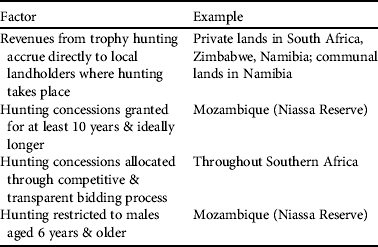
Our review suggests that trophy hunting can provide conservation benefits for lions where well managed, or alternatively constitute a significant threat where governance of the industry is poor. Key criteria for effectively governed trophy hunting systems include clear, transparent and competitive systems for hunting concession allocation, long-term leases (> 10 years) for concessions to encourage long-term investments by operators, and the empowerment of local landholders to capture the bulk of revenues generated from hunting on private or communal lands (Table 2). The challenge for international conservation efforts is to encourage the forms of trophy hunting that benefit conservation, while promoting reforms to hunting and wildlife management in Tanzania and other key range states where hunting revenues do not provide effective or sufficient incentives for conservation measures.
Key governance factors that promote sustainable use and foster positive linkages between trophy hunting and lion conservation.
Sweeping measures that simply curtail trophy hunting without reference to specific national situations will probably have a negative impact on lion conservation in countries such as Namibia and parts of Mozambique and Zimbabwe, while failing to target some of the key causes of lion population declines elsewhere (e.g. exclusion of the people from economic benefits derived from wildlife; Lindsey et al., Reference Lindsey, Balme, Booth and Midlane2012). For international regulatory mechanisms such as CITES to play an effective role in promoting the conservation of species affected by trade, polarized ideological positions need to give way to a more scientific and context-specific approach to problem-solving. Using international trade regulatory regimes to promote the necessary domestic governance reforms to trophy hunting should be explored as a strategy to address current lion declines and range contractions and encourage more effective conservation policies and practices.
Acknowledgements
We are grateful for helpful comments made by Bill Adams and two anonymous reviewers on an earlier version of this article.
Biographical sketches
Fred Nelson is Executive Director of Maliasili Initiatives, which supports natural resource conservation, sustainable development, and social justice in Africa by working with leading local organizations to build their capacity to foster collaborative and innovative incentive-based solutions to conservation challenges. His research interests focus on community-based natural resource management, political economy and governance issues. Peter Lindsey works throughout Southern Africa on wildlife-based land uses, the bushmeat trade and predator conservation. He is Policy Initiative Coordinator for Panthera's Lion Program. Guy Balme is the Director of Panthera's Lion Program and also heads the organization's efforts to address poorly regulated trophy hunting and legal control of leopards in Africa. In addition, he is an Honorary Research Associate at the University of Cape Town.



