

Introduction
Transparent nudging has been proposed as a means of alleviating autonomy concerns that have persisted since the nudge’s inception (Bovens, Reference Bovens, Grüne-Yanoff and Hansson2009). Nudges primarily influence people’s decisions without them being aware of it, potentially undermining individual autonomy and creating a sense of manipulation (Hansen and Jespersen, Reference Hansen and Jespersen2013; Thaler and Sunstein, Reference Thaler and Sunstein2008). Awareness of the nudge would then offset the possible loss of autonomy, typically achieved through disclosure messages or ‘disclosures’ (Bruns et al., Reference Bruns, Fillon, Maniadis and Paunov2025). Disclosed nudges could even be more effective than their covert counterparts, as disclosure allows for more conscious and reflective decision-making. Recent innovations in behavioural techniques focus on the possibility of making people aware of their own behaviour and biases, such as nudge+, boosts or self-nudges. Through self-reflection, they aim to increase the effect of behavioural measures (Grüne-Yanoff and Hertwig, Reference Grüne-Yanoff and Hertwig2016; Banerjee and John, Reference Banerjee and John2021; Tontrup and Sprigman, Reference Tontrup and Sprigman2022). While disclosures can have a positive effect on nudges, the prevalence of null effects in studies examining disclosures (Bruns et al., Reference Bruns, Fillon, Maniadis and Paunov2025) and the ongoing doubts surrounding their autonomy-enhancing effect (Bruns et al., Reference Bruns, Kantorowicz-Reznichenko, Klement, Luistro Jonsson and Rahali2018; Wachner et al., Reference Wachner, Adriaanse and De Ridder2021a) suggests that several moderators influencing the effects of disclosures have yet to be discovered.
Previous work has explored the effect of disclosures on nudging, but key aspects remain underexplored (Michaelsen, Reference Michaelsen2024; Bruns et al., Reference Bruns, Fillon, Maniadis and Paunov2025): the mechanisms or source of nudges are rarely discussed, studies have focused almost exclusively on default nudges, and we know little about how different disclosure elements affect perceived autonomy.
To address these gaps, we measure the effect of four types of disclosures on nudge effectiveness and perceived autonomy of the person being nudged. For this purpose, we simulate a salience nudge in an online vignette experiment, focusing on sustainable food options on a menu. The first three disclosures address the presence, mechanism and purpose of the nudge (de Ridder et al., Reference de Ridder, Kroese and van Gestel2022), while the fourth combines aspects of all three disclosures.
In doing so, we provide three contributions to the literature. First, we study a salience nudge rather than a default nudge, responding to the predominance of defaults in transparency research. Defaults are covert, can often influence behaviour outside people’s awareness, and are frequently seen as autonomy-threatening (Jung and Mellers, Reference Jung and Mellers2016; Bruns and Perino, Reference Bruns and Perino2023). However, the underlying mechanisms of different nudge types vary substantially and might interact differently with disclosures, just as they impact nudge acceptance (e.g. Bang et al., Reference Bang, Shu and Weber2020) or a person’s cognitive load (Weijers et al., Reference Weijers, de Koning and Paas2021) differently. Salience nudges work by increasing the noticeability of options, making them theoretically more overt than defaults (Noggle, Reference Noggle2018). A disclosure may reinforce their visibility, contributing to its effectiveness in ways that are less likely for defaults. Investigating salience nudges therefore answers calls for greater heterogeneity in nudge research and focuses on a nudge type for which disclosures have a large potential of making an impact (Bryan et al., Reference Bryan, Tipton and Yeager2021). Second, we draw on theory that identifies fundamental disclosure elements and test three that have not yet been directly compared to our knowledge. Our experiment offers the best opportunity to detect differences by isolating and comparing the most different core components. Third, autonomy is inconsistently defined in the nudging literature, with studies variously measuring decision freedom, agency or self-determination, leaving findings fragmented (e.g. Bruns et al., Reference Bruns, Kantorowicz-Reznichenko, Klement, Luistro Jonsson and Rahali2018; Wachner et al., Reference Wachner, Adriaanse and De Ridder2020). By integrating multiple operationalisations into a unified measure, our study offers an initial test of whether autonomy forms a coherent construct across manipulations and whether disclosures can not only avoid reducing autonomy but also enhance it.
In the following, we structure our Theory section around how two key outcomes, nudge effectiveness and perceived autonomy, are influenced by disclosure elements. In the case selection, we clarify the choice for a salience nudge. The Methods section outlines our survey design and analytic approach. In the Results section, we present the effect of the disclosures on the nudge’s effectiveness and perceived autonomy. Finally, we discuss these results and their implications for future public policy nudging research and practice.
Theory
Disclosures
Hansen and Jespersen (Reference Hansen and Jespersen2013, p. 17) define a transparent nudge as ‘a nudge provided in such a way that the intention behind it, as well as the means by which behavioural change is pursued, could reasonably be expected to be transparent to the agent being nudged as a result of the intervention’. Transparency does not necessarily require a disclosure providing additional information. According to Hansen and Jespersen’s (Reference Hansen and Jespersen2013) definition, a nudge can be inherently transparent if its purpose and underlying mechanism are evident. The degree of transparency is often dependent on the type of nudge. For example, sending a reminder message is inherently more transparent than changing the default option, as it is more easily noticed.
When used, disclosures are often part of nudges targeting both automatic and conscious decision-making by introducing reflection and providing information on potential biases and the nudging intervention during the decision-making process. By engaging both decision-making processes, these nudges aim to generate larger and longer-lasting effects (Banerjee and John, Reference Banerjee and John2021; Winterstein, Reference Winterstein, Ogunyemi and Burgal2022; Dold, Reference Dold2023). Following this logic, adding disclosures would have a positive effect on the desired behaviour if it prompts decision reflection rather than merely informing. A meta-analysis by Bruns et al. (Reference Bruns, Fillon, Maniadis and Paunov2025) supports that disclosed nudges are more effective than covert nudges, although they warn of a potential risk of publication bias. Even so, many disclosures produce null effects and occasionally even backfire by reducing nudge effectiveness (Bruns and Paunov, Reference Bruns and Paunov2021; Bruns et al., Reference Bruns, Fillon, Maniadis and Paunov2025).
There are many types and combinations of disclosures, which may explain the inconsistency of prior findings. Bruns and Paunov (Reference Bruns and Paunov2021) identify nine distinct content elements, ranging from information about expected behaviour to statements about the unawareness principle, i.e. that nudges often work because people are unaware of them. de Ridder et al. (Reference de Ridder, Kroese and van Gestel2022), by contrast, consolidate these into four key content elements of disclosures which align with the fundamental elements of communication (Lasswell, Reference Lasswell and Bryson1948): the presence (or what, where and when), purpose (or why), mechanism (or how) and source (or who) of a nudge. Whereas Bruns and Paunov (Reference Bruns and Paunov2021) derive their classification from a literature review, de Ridder et al. (Reference de Ridder, Kroese and van Gestel2022) present a more theoretically aggregated typology. This helps explain why they include the source element, even though Bruns and Paunov (Reference Bruns and Paunov2021) find no examples of it in the nudge disclosure literature, and why Bruns and Paunov’s (Reference Bruns and Paunov2021) more fine-grained categories can be meaningfully aggregated into the four fundamental content elements. For instance, disclosures on the unawareness principle fall under the mechanism category because they explain how the nudge works. In this study, we follow de Ridder et al. (Reference de Ridder, Kroese and van Gestel2022) and use three disclosure content elements: the presence, purpose and mechanism of the nudge, as they represent the most fundamental disclosure elements and thus allow us to most clearly observe potential differences. We exclude the source element because its effects could depend heavily on the identity of the source rather than on the disclosure itself (e.g. Evers et al., Reference Evers, Marchiori, Junghans, Cremers and De Ridder2018), making it conceptually distinct and better suited for separate analysis.
The first disclosure content element is the presence of the nudge, which can be communicated in two ways. Type interference transparency only informs respondents of the general use of behavioural techniques without specifying elements in the choice environment (Bovens, Reference Bovens, Grüne-Yanoff and Hansson2009). Token interference transparency at least refers to the specific nudge elements used, such as sustainability labels on a menu. The latter is far more commonplace in previous experimentation (e.g. Loewenstein et al., Reference Loewenstein, Bryce, Hagmann and Rajpal2015; Dranseika and Piasecki, Reference Dranseika and Piasecki2020; Michaelsen et al., Reference Michaelsen, Johansson and Hedesström2024). Many experiments also include the desired influence of behaviour in the disclosure (e.g. Kantorowicz-Reznichenko and Kantorowicz, Reference Kantorowicz-Reznichenko and Kantorowicz2021; Michaelsen et al., Reference Michaelsen, Johansson and Hedesström2024), though this is not always necessary (Gråd et al., Reference Gråd, Erlandsson and Tinghög2021). This distinction matters, as merely noting that decisions might be influenced, without properly explaining how or why, could increase confusion about the nudge (Diepeveen et al., Reference Diepeveen, Ling, Suhrcke, Roland and Marteau2013; Osman et al., Reference Osman, Fenton, Pilditch, Lagnado and Neil2018). Moreover, disclosing only the presence can lead people to make inferences about other elements of the intervention, such as its purpose (Sher et al., Reference Sher, McKenzie, Müller-Trede and Leong2022; Van Dessel et al., Reference Van Dessel, Boddez and Hughes2022).
The second disclosure content element is the purpose of the nudge, which communicates the ultimate policy goal of the nudge and desired outcomes. Purpose disclosures often mention the nudge, thereby also revealing its presence, though this is not required. Kroese et al. (Reference Kroese, Marchiori and de Ridder2016) and Cheung et al. (Reference Cheung, Gillebaart, Kroese, Marchiori, Fennis and De Ridder2019) for instance only disclose that they ‘helped people make healthier choices’.
Third, the mechanism of the nudge explains how it is intended to work. The disclosure’s content depends on the underlying mechanics of the nudge type and the level of detail provided. For instance, a disclosure might simply describe how healthy food labels make healthy choices easier or also discuss the biases towards salient and simplified information in labels (Samuelson and Zeckhauser, Reference Samuelson and Zeckhauser1988; Codagnone et al., Reference Codagnone, Veltri, Bogliacino, Lupiáñez-Villanueva, Gaskell, Ivchenko, Ortoleva and Mureddu2016). Furthermore, some mechanism disclosures explicitly mention that the nudge operates because people are unaware of it (Bruns and Paunov, Reference Bruns and Paunov2021).
Disclosures and perceived autonomy during nudging
According to Vugts et al. (Reference Vugts, van den Hoven, de Vet and Verweij2020), the nudging literature utilises three distinct conceptualisations of autonomy: (1) freedom of choice, whereby all options remain accessible in the choice environment; (2) agency, which involves the extent to which people are able to choose based on their reasons and intentions – conscious or subconscious; and (3) self-constitution, where people can shape, develop and reaffirm their identity in the choices they make, free from indoctrination. While these insights inform theoretical discussions on nudging, little is known about how people themselves conceptualise and experience autonomy. Such perceptions are nevertheless paramount for a person’s well-being (Deci and Ryan, Reference Deci and Ryan2008; Chen, Reference Chen2025), influencing feelings of authenticity (Kernis and Goldman, Reference Kernis and Goldman2006) and ownership of decisions (Chan, Reference Chan2024).
Although people tend to accept nudging as a policy intervention (Sunstein et al., Reference Sunstein, Reisch and Rauber2018; Bang et al., Reference Bang, Shu and Weber2020; Treger, Reference Treger2023), their perceptions of autonomy during nudging are not as consistent (Arvanitis et al., 2022; van Roekel et al., Reference van Roekel, Giurge, Schott and Tummers2023; Michaelsen et al., Reference Michaelsen, Johansson and Hedesström2024). For instance, default nudges (Yan and Yates, Reference Yan and Yates2019; Bruns and Perino, Reference Bruns and Perino2023) and nudges targeting unconscious and automatic decisions rather than conscious decisions (Felsen et al., Reference Felsen, Castelo and Reiner2013; Sunstein, Reference Sunstein2016a, Reference Sunstein2016b) are deemed more intrusive and a larger threat to freedom of choice or autonomy.
One theory suggests that decreased perceived autonomy influences behaviour through psychological reactance. According to Brehm (Reference Brehm1966), people are motivated to restore their behavioural autonomy when they perceive it is threatened. A perceived threat might lead them to feel uncomfortable, angry or aggressive, prompting them to deliberately choose alternatives to the nudged option as an act of retaliation (Brehm, Reference Brehm1966; Heilman and Toffler, Reference Heilman and Toffler1976; Dillard and Shen, Reference Dillard and Shen2005; Steindl et al., Reference Steindl, Jonas, Sittenthaler, Traut-Mattausch and Greenberg2015). Reactance can thus severely impact a nudge’s effectiveness or potentially even cause backfiring. Nevertheless, psychological reactance as a response to being nudged has not been widely discussed (Rosenberg and Siegel, Reference Rosenberg and Siegel2018) and evidence of its occurrence as a response to nudging is largely inferred. Some studies interpret a lack of nudge effectiveness as a confirmation of reactance theory (e.g. Hedlin and Sunstein, Reference Hedlin and Sunstein2016; Dewies et al., Reference Dewies, Schop-Etman, Rohde and Denktaş2021; Michaelsen et al., Reference Michaelsen, Johansson and Hedesström2024), while others measure it directly and report mixed results (Arad and Rubinstein, Reference Arad and Rubinstein2018; Bruns et al., Reference Bruns, Kantorowicz-Reznichenko, Klement, Luistro Jonsson and Rahali2018).
Whether disclosures affect perceived autonomy or trigger reactance in the context of nudging remains relatively underexplored. Studies generally find no significant impact on perceived autonomy (Goswami and Urminsky, Reference Goswami and Urminsky2016; Bruns et al., Reference Bruns, Kantorowicz-Reznichenko, Klement, Luistro Jonsson and Rahali2018; Michaelsen et al., Reference Michaelsen, Johansson and Hedesström2024), although disclosures can sometimes be seen as threatening freedom of choice (Liu et al., Reference Liu, Zhao, Li and Zheng2022; Michaelsen et al., Reference Michaelsen, Johansson and Hedesström2024), a key aspect of autonomy. However, they can also lead to people feeling less deceived by a nudge (Paunov et al., Reference Paunov, Wänke and Vogel2019b). Therefore, disclosures can be theorised to offset potential autonomy losses caused by nudges and may even enhance the perception of autonomy by clarifying the decision context and the nudge’s intended influence. In short, the relationship between perceived autonomy, nudge effectiveness and transparent disclosures can vary and might be dependent on factors that remain insufficiently understood.
How disclosures can influence nudge effectiveness and perceived autonomy
Theoretically, disclosures can influence both behaviour and perceived autonomy of nudges in numerous ways, yet a recent meta-analysis reveals that the majority of studies find no significant effects, with only a small positive overall impact (Bruns et al., Reference Bruns, Fillon, Maniadis and Paunov2025). In what follows, we discuss the theoretical possibilities associated with this study’s disclosures, although we acknowledge that null effects are likely given prior evidence.
Disclosing a nudge’s presence previously left a nudge unaffected in most instances (Bruns et al., Reference Bruns, Kantorowicz-Reznichenko, Klement, Luistro Jonsson and Rahali2018; Dranseika and Piasecki, Reference Dranseika and Piasecki2020; Michaelsen et al., Reference Michaelsen, Nyström, Luke and Hedesström2021, Reference Michaelsen, Johansson and Hedesström2024), though some exceptions report an increased (Paunov et al., Reference Paunov, Wänke and Vogel2019a, labelled 'target behaviour') or decreased effectiveness (Casal et al., Reference Casal, Guala and Mittone2025; Gråd et al., Reference Gråd, Erlandsson and Tinghög2021; Kantorowicz-Reznichenko and Kantorowicz, Reference Kantorowicz-Reznichenko and Kantorowicz2021). Notably, in rare instances where disclosures only mention the general use of behavioural insights or the influencing of behaviour without additional context (type interference transparency), they seem more likely to have a negative effect compared to when they provide additional context (token interference transparency) (e.g. Casal et al., Reference Casal, Guala and Mittone2025).
A decrease in nudge effectiveness is theoretically plausible when applying reactance theory. Feelings of manipulation decrease perceived autonomy, which in turn trigger reactant behaviour. Prior work shows that even subtle cues signalling an influence attempt can be sufficient to activate reactance (Dillard and Shen, Reference Dillard and Shen2005; Steindl et al., Reference Steindl, Jonas, Sittenthaler, Traut-Mattausch and Greenberg2015).
The central question, then, is whether presence disclosures evoke such feelings of manipulation. Here, the persuasion knowledge model offers useful insights (Friestad and Wright, Reference Friestad and Wright1994). It posits that once individuals recognise an attempt to influence them, they activate persuasion knowledge to evaluate the persuader’s motives and tactics. Crucially, research shows that when information is incomplete, people tend to rely more heavily on sceptical assumptions about the agent’s intentions (Campbell and Kirmani, Reference Campbell and Kirmani2000). Because type interference presence disclosures provide the least contextual information of all disclosure types, they should be especially susceptible to triggering persuasion knowledge in ways that lead to suspicion and perceived manipulation. This mechanism increases the likelihood of reduced autonomy perceptions.
Our design implements such a general presence disclosure, leading to the following hypotheses:
H1a: Disclosing the presence of the nudge decreases nudge effectiveness.
H2a: Disclosing the presence of the nudge decreases perceived autonomy.
Many purpose disclosures do not affect nudge effectiveness (Kroese et al., Reference Kroese, Marchiori and de Ridder2016; Steffel et al., Reference Steffel, Williams and Pogacar2016; Bruns et al., Reference Bruns, Kantorowicz-Reznichenko, Klement, Luistro Jonsson and Rahali2018; Gråd et al., Reference Gråd, Erlandsson and Tinghög2021; Wachner et al., Reference Wachner, Adriaanse and De Ridder2021a; Hokamp and Weimann, Reference Hokamp and Weimann2022; van Rookhuijzen et al., Reference van Rookhuijzen, de Vet and Adriaanse2023; Zhuo et al., Reference Zhuo, Ratajczak, Thornton, Jones, Jarchlo and Gold2023), and two studies even found decreased effectiveness (Gråd et al., Reference Gråd, Erlandsson and Tinghög2021; Kantorowicz-Reznichenko and Kantorowicz, Reference Kantorowicz-Reznichenko and Kantorowicz2021). However, purpose disclosures can also enhance nudges (Paunov et al., Reference Paunov, Wänke and Vogel2019a). Casal et al. (Reference Casal, Guala and Mittone2025) found that a negative effect of a presence disclosure disappeared when the purpose of the nudge was also disclosed, Paunov et al. (Reference Paunov, Wänke and Vogel2020) observed increased effectiveness from a purpose disclosure by itself without actually using a nudge, and Buratto and Lotti (Reference Buratto and Lotti2024) found that an ineffective nudge became effective when its purpose was disclosed in a food choice setting. This demonstrates that disclosures not only have the potential to enhance nudges but also to act as a nudge themselves (Maheswaran and Chaiken, Reference Maheswaran and Chaiken1991; Bohner et al., Reference Bohner, Frank and Erb1998; Paunov et al., Reference Paunov, Wänke and Vogel2020).
Contrary to the presence disclosure, revealing the nudge’s purpose might provide sufficient contextual information for people to retain or even increase their perceived autonomy. The persuasion knowledge model suggests that unclear motivations prompt inferences of manipulation (Friestad and Wright, Reference Friestad and Wright1994). Disclosing the purpose (and mechanism) of a nudge clarifies its intent, reducing the need for inferences (Campbell and Kirmani, Reference Campbell and Kirmani2000). Furthermore, self-determination theory predicts that understanding the intervention’s rationale allows individuals to internalise behaviour, experiencing it as self-endorsed rather than externally imposed (Deci and Ryan, Reference Deci and Ryan2000). Supporting results have been found in related fields such as AI interactions or health care (Kors et al., Reference Kors, Paternotte, Martin, Verhoeven, Schoonmade, Peerdeman and Kusurkar2020; Sankaran et al., Reference Sankaran, Zhang, Aarts and Markopoulos2021; Fink et al., Reference Fink, Newman and Haran2024). Therefore, disclosing a nudge’s purpose could offer clearer insights into why people’s choices are being influenced, making them feel more informed and empowered, and potentially increasing or offsetting a loss of perceived autonomy.
Nevertheless, disclosures that reference the purpose of the nudge generally do not affect autonomy in limited prior research (e.g. Bruns et al., Reference Bruns, Kantorowicz-Reznichenko, Klement, Luistro Jonsson and Rahali2018; Wachner et al., Reference Wachner, Adriaanse and De Ridder2021a) or do so only in a hypothetical scenario (Wachner et al., Reference Wachner, Adriaanse and Ridder2021b). Potentially, a conflict between the nudge’s goal and individual ideology could trigger resistance. Indeed, nudges can both backfire (Fors et al., Reference Fors, Cakanlar, Rosengren and Dewitte2024) and be less accepted (van Gestel et al., Reference van Gestel, Adriaanse and de Ridder2021) if their goals are incongruent with those of the decision-maker.
We acknowledge the majority of prior studies report disclosures with null effects. Building on self-determination theory and the persuasion knowledge model, we nevertheless hypothesise that disclosing the purpose of a nudge can still increase effectiveness when enhancing perceived autonomy by reducing uncertainty about the nudge’s intent, highlighting potential goal alignment and enabling informed decision-making. Therefore, we formulate the following hypotheses:
H1b: Disclosing the purpose of the nudge increases the effectiveness of the nudge.
H2b: Disclosing the purpose of the nudge increases perceived autonomy.
Bruns and Paunov (Reference Bruns and Paunov2021) found a general positive effect of mechanism disclosures on nudge effectiveness through a meta-analysis, though many studies on mechanism messages still report null effects (Steffel et al., Reference Steffel, Williams and Pogacar2016; Paunov et al., Reference Paunov, Wänke and Vogel2019a; Michels et al., Reference Michels, Ochmann, Schmitt, Laumer and Tiefenbeck2023; Wachner et al., Reference Wachner, Adriaanse and De Ridder2021a; Hokamp and Weimann, Reference Hokamp and Weimann2022; van Rookhuijzen et al., Reference van Rookhuijzen, de Vet and Adriaanse2023) and Liu et al. (Reference Liu, Zhao, Li and Zheng2022) observed a negative effect. While direct empirical evidence for increased perceived autonomy is limited, mechanism disclosures – like purpose disclosures – can provide comprehensive information about the nudge and reduce the need for inference. In addition, they aim to enhance people’s understanding of a nudge’s influence and, by extension, their own decision-making. By improving comprehension, they may confer similar benefits to those observed in nudge+ or boost interventions, which deliberately increase individuals’ knowledge or decision-making competence to support more reflective and self-endorsed choices (Grüne-Yanoff and Hertwig, Reference Grüne-Yanoff and Hertwig2016; Banerjee and John, Reference Banerjee and John2021).
Based on this, and the previous meta-analysis (Bruns and Paunov, Reference Bruns and Paunov2021), we formulate the following hypotheses:
H1c: Disclosing the mechanism of the nudge increases the effectiveness of the nudge.
H2c: Disclosing the mechanism of the nudge increases perceived autonomy.
Finally, disclosures can combine multiple fundamental content elements. In fact, most existing disclosure studies combine several elements into a single disclosure (Bruns and Paunov, Reference Bruns and Paunov2021). While Bruns et al.’s (Reference Bruns, Kantorowicz-Reznichenko, Klement, Luistro Jonsson and Rahali2018) combined disclosure did not strengthen the effect of the nudge, Felsen et al. (Reference Felsen, Castelo and Reiner2013) theorise that a combined message could be beneficial. In principle, a combined disclosure has the greatest potential to increase comprehension by providing the most comprehensive account of how and why the nudge operates. At the same time, overly long or complex disclosures may impose higher cognitive load on the decision-maker, causing them to ignore or disregard the message entirely (Jackson and Farzaneh, Reference Jackson and Farzaneh2012; Michaelsen, Reference Michaelsen2024). To our knowledge, little empirical work has examined interaction effects between different disclosure content elements.
Accordingly, we formulate the following hypotheses:
H1d: Disclosing a combination of the presence, purpose and mechanism of the nudge increases the effectiveness of the nudge.
H2d: Disclosing a combination of the presence, purpose and mechanism of the nudge increases perceived autonomy.
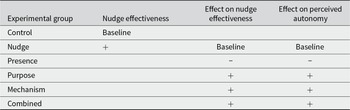
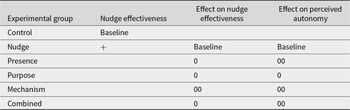
Table 1 presents a summary of all hypotheses.
Hypotheses
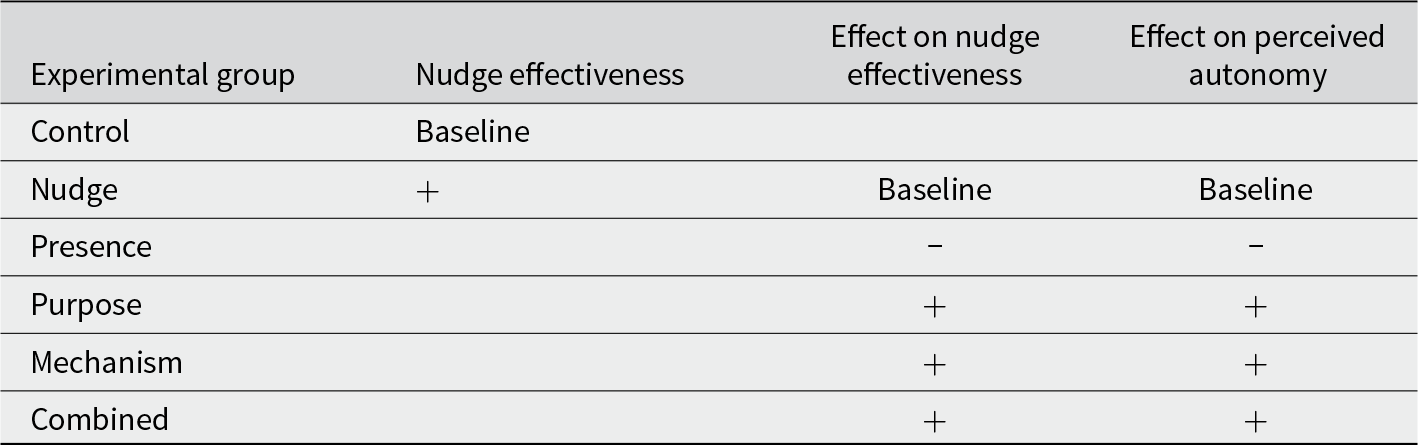
Note: +: Increase; −: Decrease.
Case selection
This study examines transparency effects in the context of a salience nudge. A salience nudge influences behaviour by guiding attention and increasing the attractiveness of certain choices, thus exploiting attention and choice availability biases (Noggle, Reference Noggle2018). Most prior research focuses on default nudges (Bruns et al., Reference Bruns, Fillon, Maniadis and Paunov2025), which conversely rely on inertia and people’s tendency to stick to the status quo. Nudge types operate through different underlying mechanisms, thus warranting separate attention (Michaelsen, Reference Michaelsen2024; Bruns et al., Reference Bruns, Fillon, Maniadis and Paunov2025). For instance, Michaelsen (Reference Michaelsen2024) suggests the literature’s focus on defaults is attributable to the comparatively non-transparent nature of the default intervention. Salience nudges, in contrast, hinge on certain choices being made more noticeable in the choice environment. Whilst this does not guarantee the transparency of a nudge itself, it is reasonable to assume that salience nudges are more likely to be recognised. They may therefore elicit different responses because their relative transparency could either make the ‘manipulation’ more noticeable or lead people to make inferences about the nudge’s intentions (Friestad and Wright, Reference Friestad and Wright1994), while they also have the potential to increase understanding of a nudge’s intent and reduce the need for additional disclosures. Kawa et al. (Reference Kawa, Gijselaers, Nijhuis and Ianiro-Dahm2022) found greater acceptance for a default than a salience nudge in a setting similar to this study, though general evidence points to people preferring overt over covert nudges (Felsen et al., Reference Felsen, Castelo and Reiner2013). More research is needed to determine how salience nudges interact with disclosures.
Earlier experiments suggest that disclosures for salience nudges do not impact nudge effectiveness (Kroese et al., Reference Kroese, Marchiori and de Ridder2016; Cheung et al., Reference Cheung, Gillebaart, Kroese, Marchiori, Fennis and De Ridder2019; Michels et al., Reference Michels, Ochmann, Schmitt, Laumer and Tiefenbeck2023; Zhuo et al., Reference Zhuo, Ratajczak, Thornton, Jones, Jarchlo and Gold2023; Banerjee et al., Reference Banerjee, Galizzi, John and Mourato2023b;) or may even enhance it (Banerjee et al., Reference Banerjee, Galizzi, John and Mourato2023b). However, these studies have not tested the effects of using different disclosure types on perceived autonomy.
In this study, we implement a nudge to promote sustainable food choices. Many food choice interventions succeed in influencing food decisions, which are often guided by cognitive biases (Vecchio and Cavallo, Reference Vecchio and Cavallo2019; Ensaff, Reference Ensaff2021). Salience nudges guide attention and make specific options, like sustainable meals, more noticeable and attractive (Bordalo et al., Reference Bordalo, Gennaioli and Shleifer2012; Bucher et al., Reference Bucher, Collins, Rollo, McCaffrey, Vlieger, Bend, Truby and Perez-Cueto2016; Münscher et al., Reference Münscher, Vetter and Scheuerle2016). A popular technique of implementing a salience nudge is through changing menu design (Bucher et al., Reference Bucher, Collins, Rollo, McCaffrey, Vlieger, Bend, Truby and Perez-Cueto2016; Bacon and Krpan, Reference Bacon and Krpan2018). Shifting attention towards specific meals can be achieved by changing their location on the menu to the top or bottom (Dayan and Bar-Hillel, Reference Dayan and Bar-Hillel2011; Feldman et al., Reference Feldman, Mahadevan, Su, Brusca and Ruzsilla2011; Reinholdsson et al., Reference Reinholdsson, Hedesström, Ejelöv, Hansla, Bergquist, Svenfelt and Nilsson2023), by using salient logos, colours or boxes (Feldman et al., Reference Feldman, Mahadevan, Su, Brusca and Ruzsilla2011, Reference Feldman, Su, Mahadevan, Brusca and Hartwell2014; Bacon and Krpan, Reference Bacon and Krpan2018) or by describing them in different ways – like including a chef’s recommendation – to increase visibility, perceived value and taste expectations (Dayan and Bar-Hillel, Reference Dayan and Bar-Hillel2011; Wagner et al., Reference Wagner, Howland and Mann2015; Bacon and Krpan, Reference Bacon and Krpan2018).
Methods
We conducted a survey experiment with six different groups: one control group, one covert nudge group and four experimental groups each containing a different disclosure. The study is preregistered at https://osf.io/yr7sw including data analysis code using R software and received ethical approval from the authors’ institution (KU Leuven SMEC G-2023-7072-R2).
Experimental design
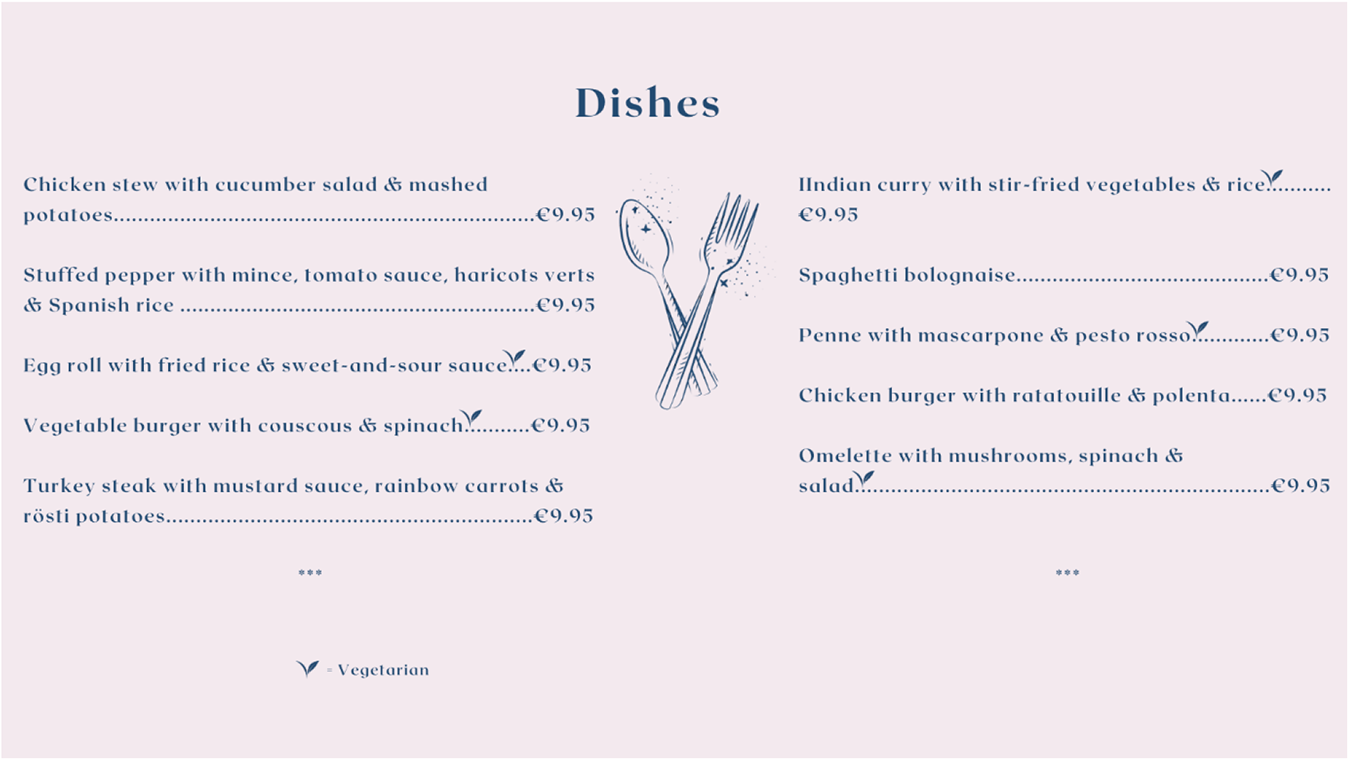
We use vignettes to measure the nudge’s effectiveness. Respondents are presented with a food menu vignette and asked to decide which main dish they would prefer for their lunch break. After 10 seconds, they could move to a subsequent page containing a neutral, randomised list of all dishes to indicate their choice. All prices are kept equal to avoid confounding effects. Vegetarian dishes are marked with a symbol, which is explained at the bottom of the menu.
We utilise vignettes because they offer high experimental control (Rettinger et al., Reference Rettinger, Jordan and Peschiera2004) and allow comparisons of different disclosures in a semi-controlled environment (Aguinis and Bradley, Reference Aguinis and Bradley2014; Jilke and Van Ryzin, Reference Jilke, Van Ryzin, Van Ryzin, James and Jilke2017). Vignettes therefore exhibit relatively greater external validity than lab experiments and relatively greater internal validity than traditional surveys for the purpose of this study (Aguinis and Bradley, Reference Aguinis and Bradley2014; Migchelbrink and Van de Walle, Reference Migchelbrink and Van de Walle2020). We acknowledge, however, that vignettes may not fully simulate the complexity and situational pressures of a cafeteria setting (Aguinis and Bradley, Reference Aguinis and Bradley2014), and that participants could respond differently in a hypothetical scenario, potentially inferring the study’s purpose and which choices are socially desirable (Stolte, Reference Stolte2021). To reduce such demand effects, we introduced a random-lottery element informing respondents they could win the meal they chose. Food vouchers were awarded using a tie-breaker question.
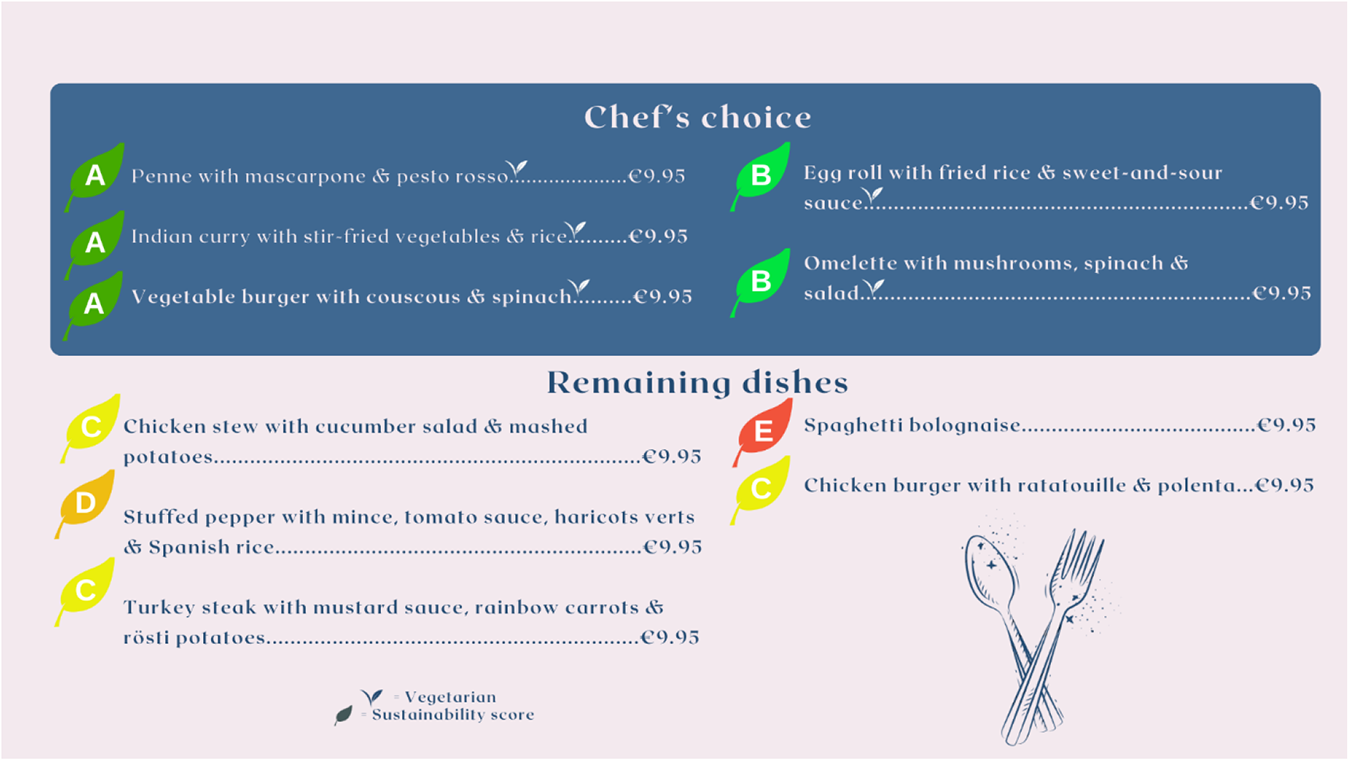
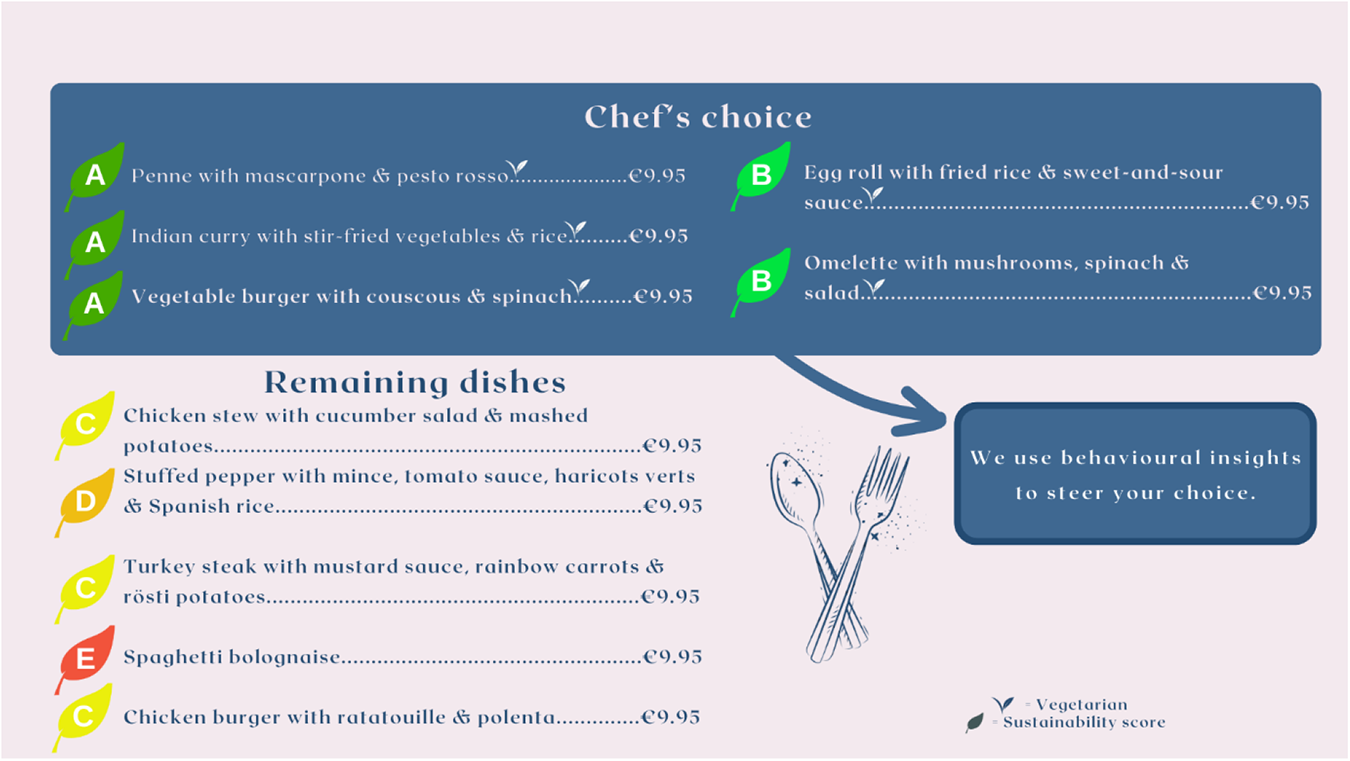
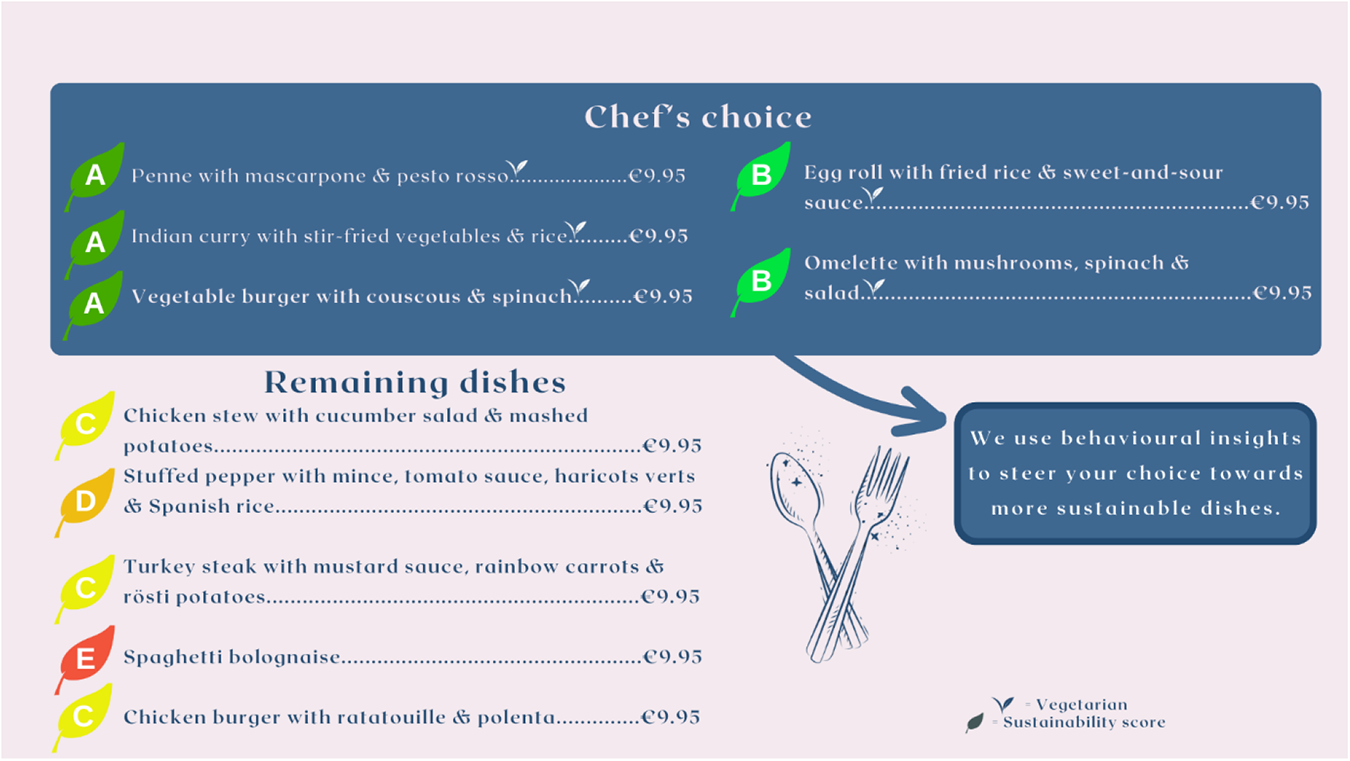
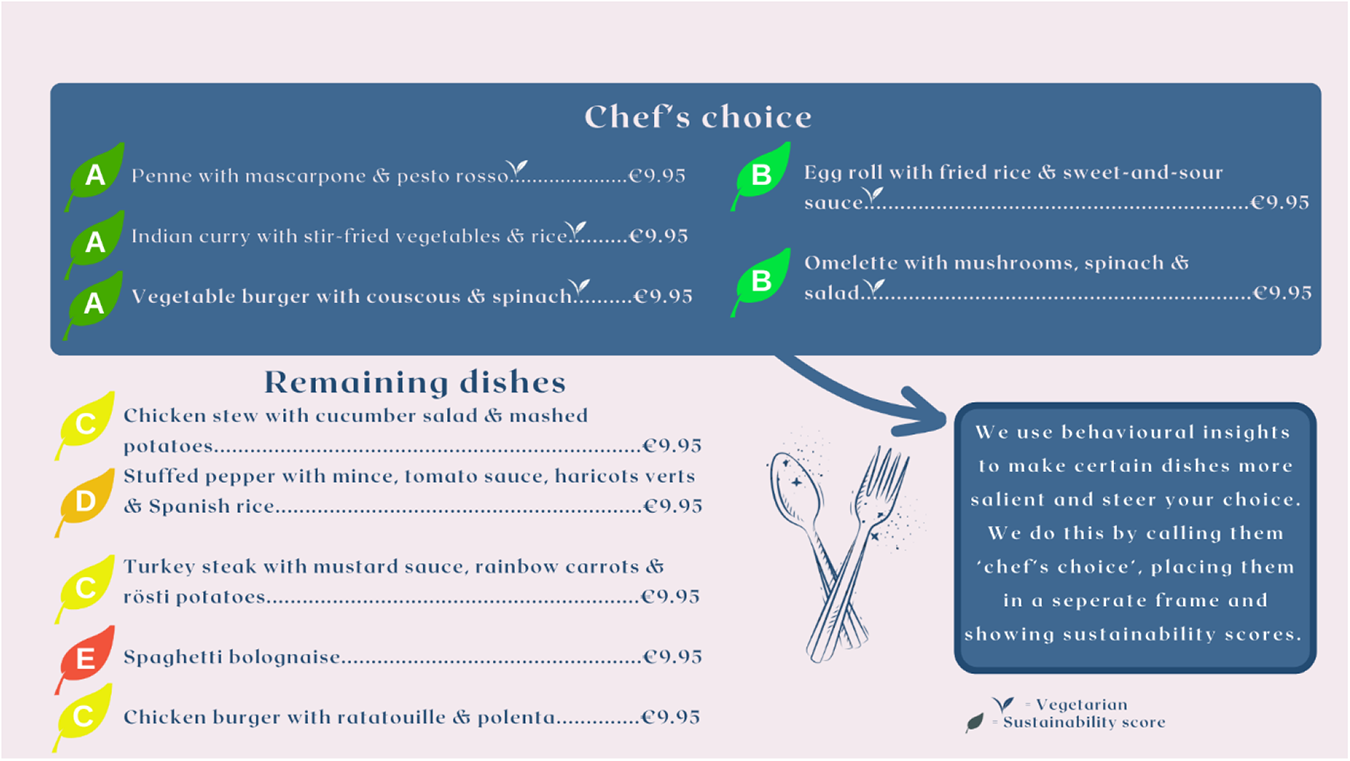
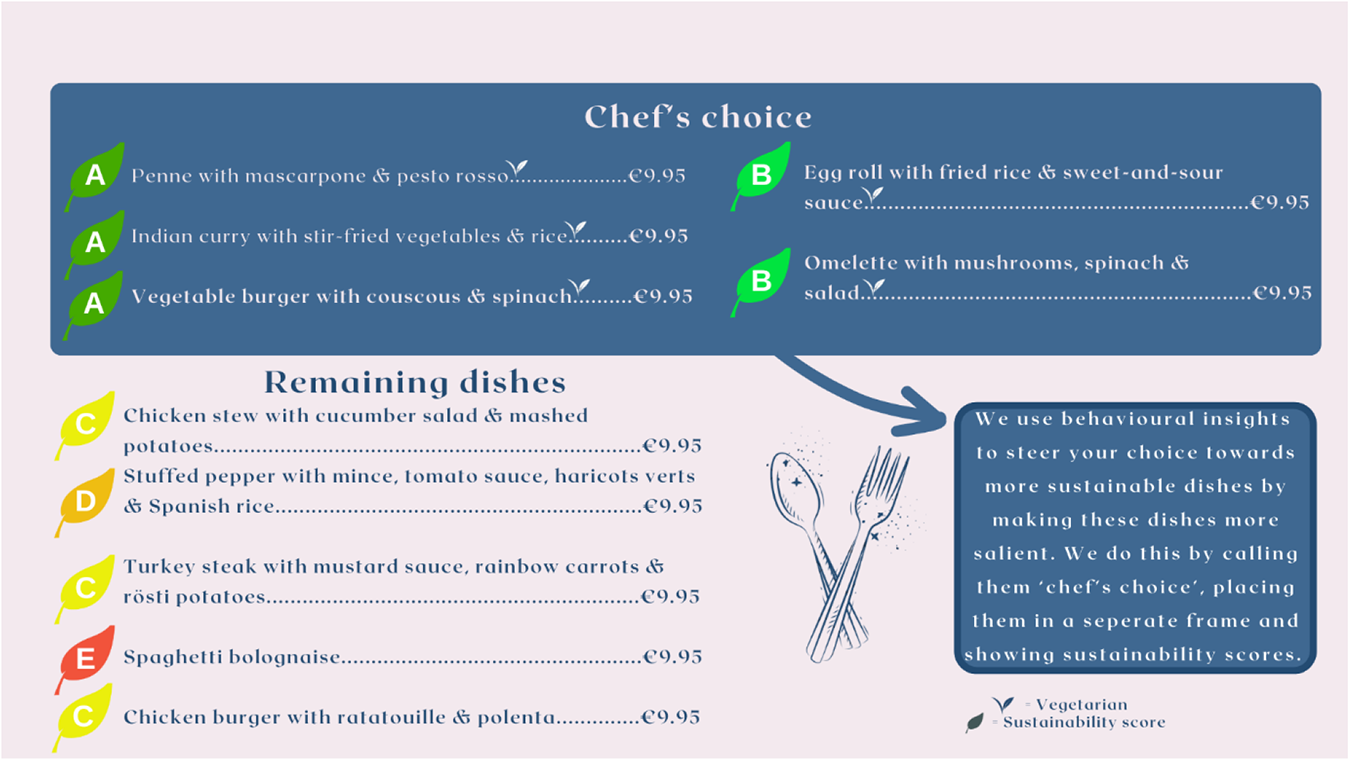
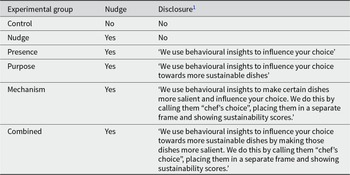
Using variations of the menu vignette, we measure the effects of the nudge and disclosures. For five groups, the menu is modified to increase the salience of the most sustainable dishes by placing them on top and using a differently coloured font, a ‘chef’s choice’ heading, a separate background and eco-labels ranking dishes from A–E by carbon score of the dish’s primary food type and ingredient (Composition of foods integrated dataset (CoFID), 2021; Scarborough et al., Reference Scarborough, Appleby, Mizdrak, Briggs, Travis, Bradbury and Key2014) similar to Banerjee et al. (Reference Banerjee, Galizzi, John and Mourato2023a). For the four groups receiving a disclosure, a large arrow points from the ‘chef’s choice’ section to the disclosure at the bottom of the menu. We incorporate the disclosures directly into the menu, similar to Buratto and Lotti (Reference Buratto and Lotti2024), rather than as a separate notification within the survey, as done by Banerjee et al. (Reference Banerjee, Galizzi, John and Mourato2023a, Reference Banerjee, Galizzi, John and Mourato2023b). This approach allows us to better simulate a real-life menu. The exact messages are listed in Table 2 and the menus in Appendix B.
Experimental design
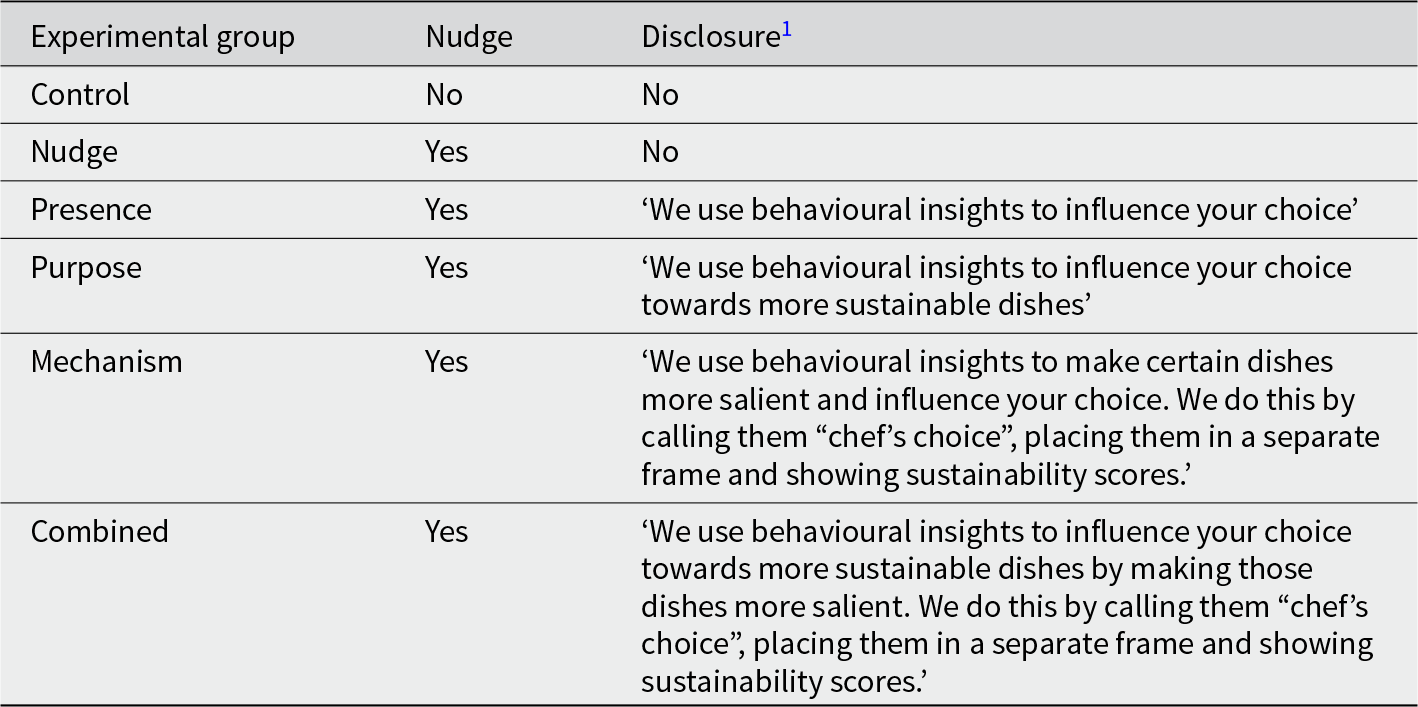
The (type interference) presence disclosure refers to the general use of behavioural insights but gives no further indications about the nudge in the choice environment. An arrow does link the location of the nudged dishes with the disclosure. The purpose disclosure outlines the nudge’s goal to improve sustainability. The mechanism disclosure briefly explains how the nudge works, highlighting the visual elements that increase salience and attractiveness. This explanation is kept brief to simulate real-life conditions, where the information environment is crowded and a longer message would be harder to implement. This also applies to the Combined disclosure which includes all information of the previous disclosures. Note that all of the disclosures indicate the presence of behavioural insights.
Measures
The outcome variable for nudge effectiveness is the percentage of participants choosing a sustainable dish. Four dishes are considered sustainable and nudged by the menus, while five other dishes are considered non-sustainable. This creates a dichotomous variable that captures whether participants select a sustainable or non-sustainable dish.
We operationalise perceived autonomy by measuring all three autonomy interpretations by Vugts et al. (Reference Vugts, van den Hoven, de Vet and Verweij2020): freedom of choice, agency and self-constitution. Previous research on nudges and perceived autonomy is mostly limited to a narrow interpretation (e.g. Wachner et al., Reference Wachner, Adriaanse and De Ridder2020; van Roekel et al., Reference van Roekel, Giurge, Schott and Tummers2023). We adapt two validated scales and add two items, resulting in thirteen items on a 5-point Likert scale presented after the vignette. To measure freedom of choice, we employ the State Reactance Scale used by Bruns et al. (Reference Bruns, Kantorowicz-Reznichenko, Klement, Luistro Jonsson and Rahali2018) and originally developed by Dillard and Shen (Reference Dillard and Shen2005). It assesses both perceived threat to freedom and experienced anger. Agency and self-constitution are measured via the adjusted autonomy subscale of the Basic Psychological Needs in Exercise Scale (BPNES), previously used in nudging research (Vlachopoulos and Michailidou, Reference Vlachopoulos and Michailidou2006; Paunov et al., Reference Paunov, Wänke and Vogel2020; Wachner et al., Reference Wachner, Adriaanse and De Ridder2021a). Finally, we add two items capturing potential autonomy-enhancing effects of the nudge by assessing whether the menu’s design supports autonomous choice, as the other items only regard negative influences on autonomy.
All items are weighted equally except for three measuring anger towards the food menu, which are weighted at 1/3 of the value of other items.Footnote 2 This way, we combine them into one item, as anger is solely a related concept of autonomy and should not disproportionally influence the scale. The autonomy scale shows acceptable inter-reliability (Cronbach’s α = 0.72). Items from the State Reactance Scale are, however, more interrelated (Cronbach’s α = 0.84) than the BPNES subscale (Cronbach’s α = 0.62). This is surprising, as previous BPNES subscale uses reported higher scores ranging from 0.76 to 0.89 (Paunov et al., Reference Paunov, Wänke and Vogel2020; Wachner et al., Reference Wachner, Adriaanse and De Ridder2021a). The difference may reflect that perceived autonomy could be a more heterogeneous construct in the context of a salience food choice nudge, leading to less consistent responses. This warrants caution in interpreting results based on this subscale, as measurement error could attenuate observed effects. By presenting the general autonomy scale with acceptable reliability, we partially mitigate this issue.
We included several control variables that could affect nudge effectiveness and perceived autonomy: gender, age, education, perceived financial situation, political alignment, vegetarian eating habits, hunger and food preferences (Bacon and Krpan, Reference Bacon and Krpan2018; Onwezen et al., Reference Onwezen, Reinders, Verain and Snoek2019; Michels et al., Reference Michels, Ochmann, Schmitt, Laumer and Tiefenbeck2023). We measure food preferences by asking how important it is that people’s food is sustainable, healthy and delicious.
Sample
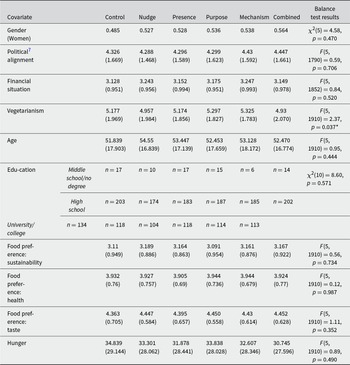
We used a sample of n = 1916 online survey responses, collected through Bilendi based on a Flemish representative sample. This sample size is sufficient based on an a priori power analysis (power = 0.8, α = 0.05, f 2 = 0.007,Footnote 3 assuming 6 out of 16 predictors) of the most demanding test, namely the test of differences in nudge effectiveness. The sample consists of 47.1% men, with a mean age of 52.94 years (SD = 17.43), closely matching the 2024 Flemish population (49.5% male, 50.77 years of age average) (STATBEL, n.d.). An ANOVA balance check revealed a significant difference in vegetarianism between groups, though a post hoc Tukey HSD test found no between-group differences. Appendix C provides an overview of these tests.
We performed three checks to measure respondents’ attention and the manipulation of the nudge and disclosures. First, an attention check in the perceived autonomy section asked participants to indicate ‘do not agree’ for one item. Second, a nudge awareness check measures whether respondents noticed the nudge by asking them to identify at least one ‘chef’s choice’ meal. Third, a disclosure awareness check assesses whether the disclosure was apparent by asking respondents which menu elements were present in a multiple-choice question, one of which being the disclosure. The latter two checks were only presented to respondents in the relevant nudge or disclosure groups. To reduce survey design effects, the order of the answers to meal choice, manipulation checks and the attention check was randomised.
The initial sample pre-exclusion included 2037 respondents. We removed 95 respondents who failed the attention check and 26 respondents due to a survey issue, where one of the sustainable dishes was unselectable in the actual meal choice question. We took steps to remove respondents intending to choose this dish from the final sample. This led to a total sample of n = 1916. The nudge and disclosure awareness checks showed failure rates of 40.8% and 40.0% respectively, totalling 857 failed respondents. We conduct separate analyses for the total sample (n = 1916) and restricted sample excluding failed respondents (n = 1059). Results focus on the full sample, with significant differences in the restricted sample related to the hypotheses reported as robustness checks. High failure rates are common in transparent nudging research, and the restricted sample provides additional nuance (Michaelsen, Reference Michaelsen2024). The full analysis of the restricted sample is available in the Supplementary Materials.
Method of analysis
We use logistic regression analysis for nudge effectiveness and linear regression for perceived autonomy. A Wald test evaluates whether the Nudge group coefficient differs significantly from zero, allowing us to isolate the nudge’s effect from the entire model and measure its baseline effectiveness compared to the control group. Stepwise regression models explore covariate effects, with likelihood ratio tests determining the best model fit. As many studies on nudge disclosures find null effects, we additionally perform statistical equivalence tests using the R TOSTER package (Lakens and Caldwell, Reference Lakens and Caldwelln.d.) which assesses whether data from groups are so closely related they can be regarded as statistically equivalent (Lakens et al., Reference Lakens, Scheel and Isager2018). A two one-sided t-test procedure (TOST) measures equivalence if results fall within certain bounds.Footnote 4 Using Cohen’s h and Cohen’s d respectively we calculated equivalence bounds of ±0.076 for nudge effectiveness and equivalence bounds of ±0.108 for perceived autonomy. TOST was applied to all non-significant results. When both lower and upper margins are significant, it indicates group differences fall within the margins and groups are deemed statistically equivalent.
Results
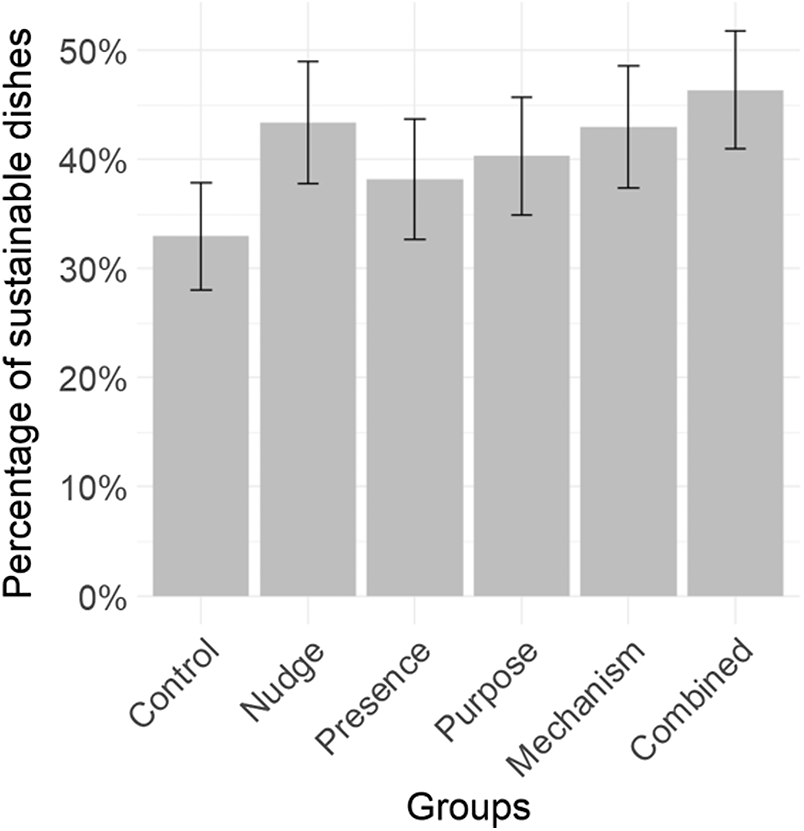
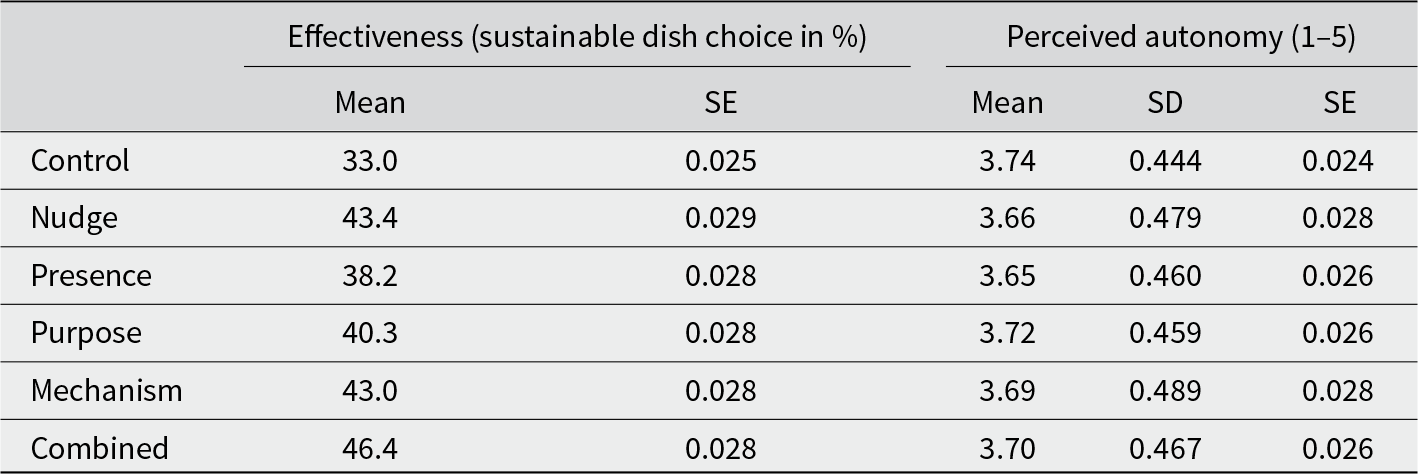
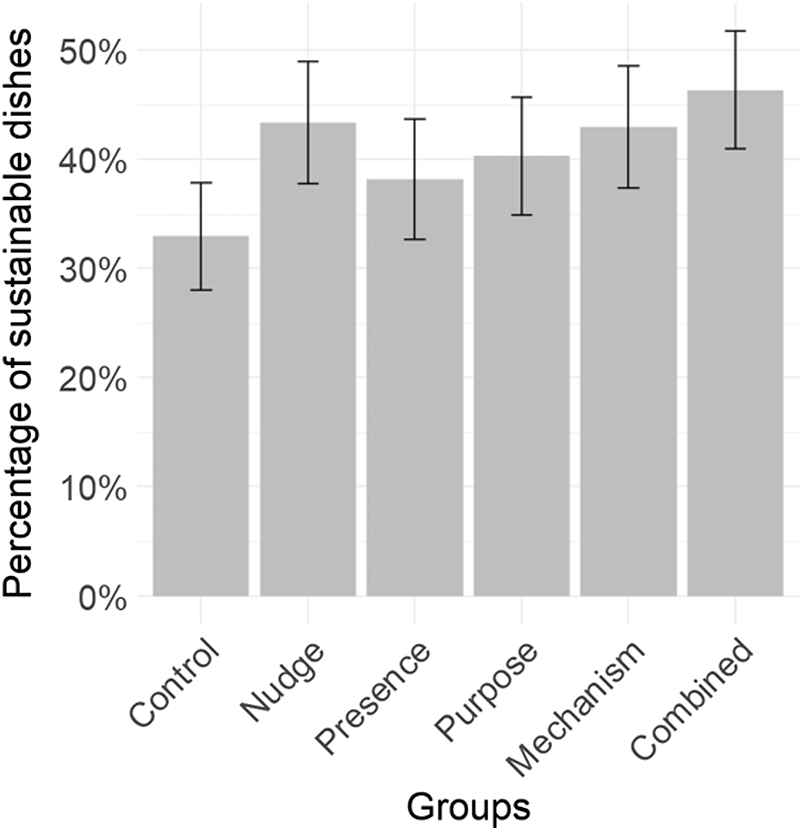
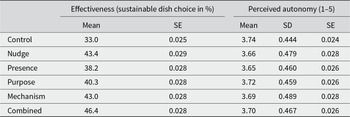
Table 3 presents descriptive statistics for both outcome variables. Sustainable choices were most frequent in the Combined disclosure group (46.4%), followed by the Nudge group (no disclosure) (43.4%) and lowest in the Control group (33.0%) (Figure 1). Perceived autonomy, however, decreased for all Nudge and disclosure groups relative to the Control group (M = 3.74), with the lowest scores in the Nudge (M = 3.66) and Presence disclosure (M = 3.65) groups.
Percentage of sustainable dishes per experimental group, with 95% confidence intervals.
Descriptive statistics of both outcome variables
Nudge effectiveness
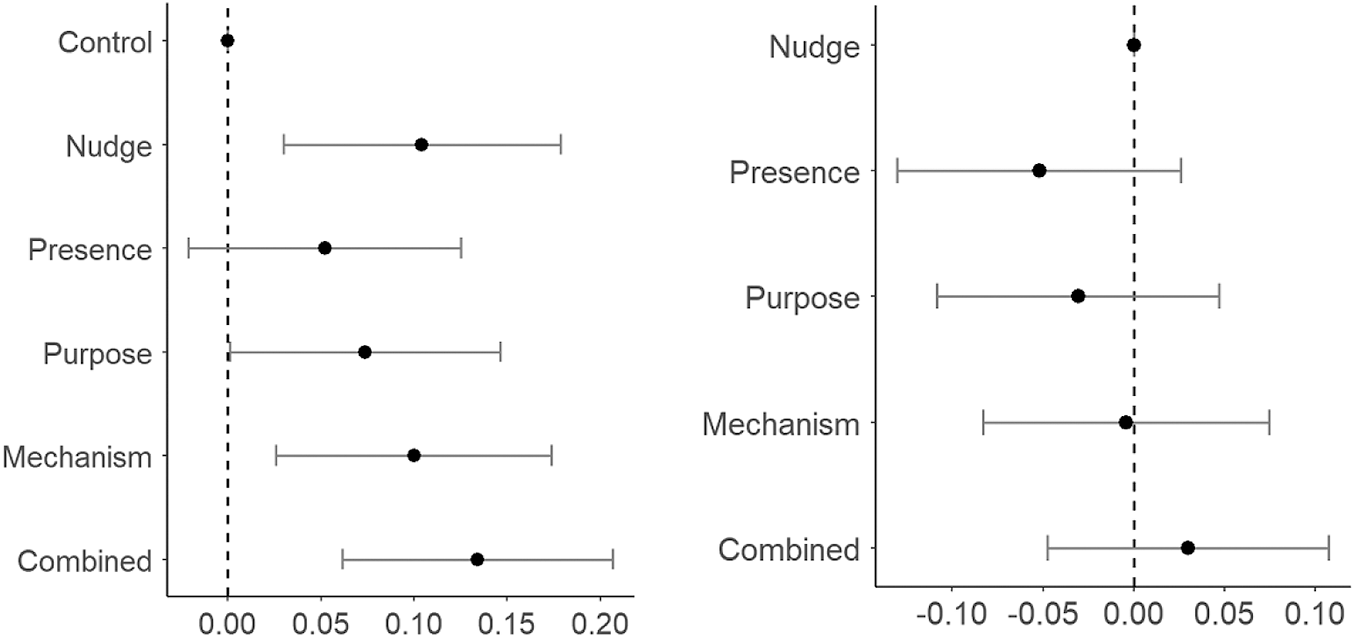
We performed a logistic regression analysis using the non-nudged Control group as reference to measure the nudge’s baseline effectiveness. The model confirms that the salience nudge successfully increases sustainable choices. Average marginal effects (Figure 2) show a 10.4 per cent point increase in selecting a sustainable dish, Wald(1) = 7.50, p = 0.006.Footnote 5 The Combined disclosure group showed the largest increase in sustainable choices of 13.4 per cent point.
Average marginal effects of sustainable dish per experimental group with Control or Nudge group as reference.
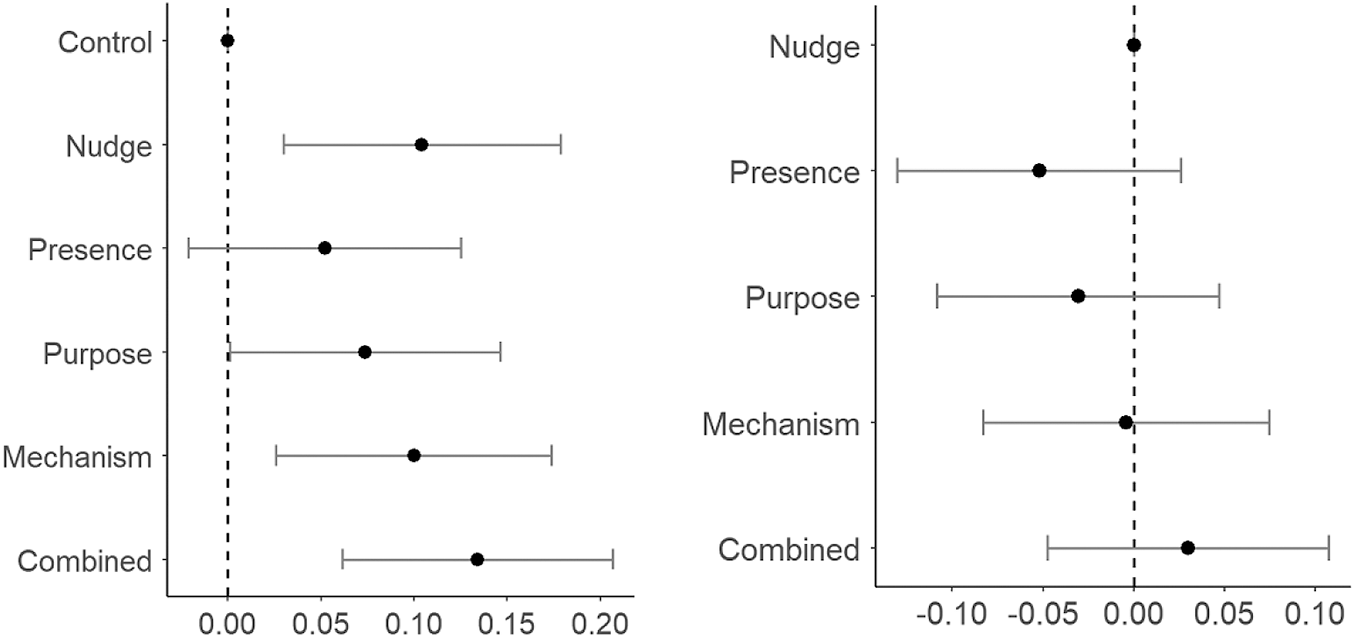
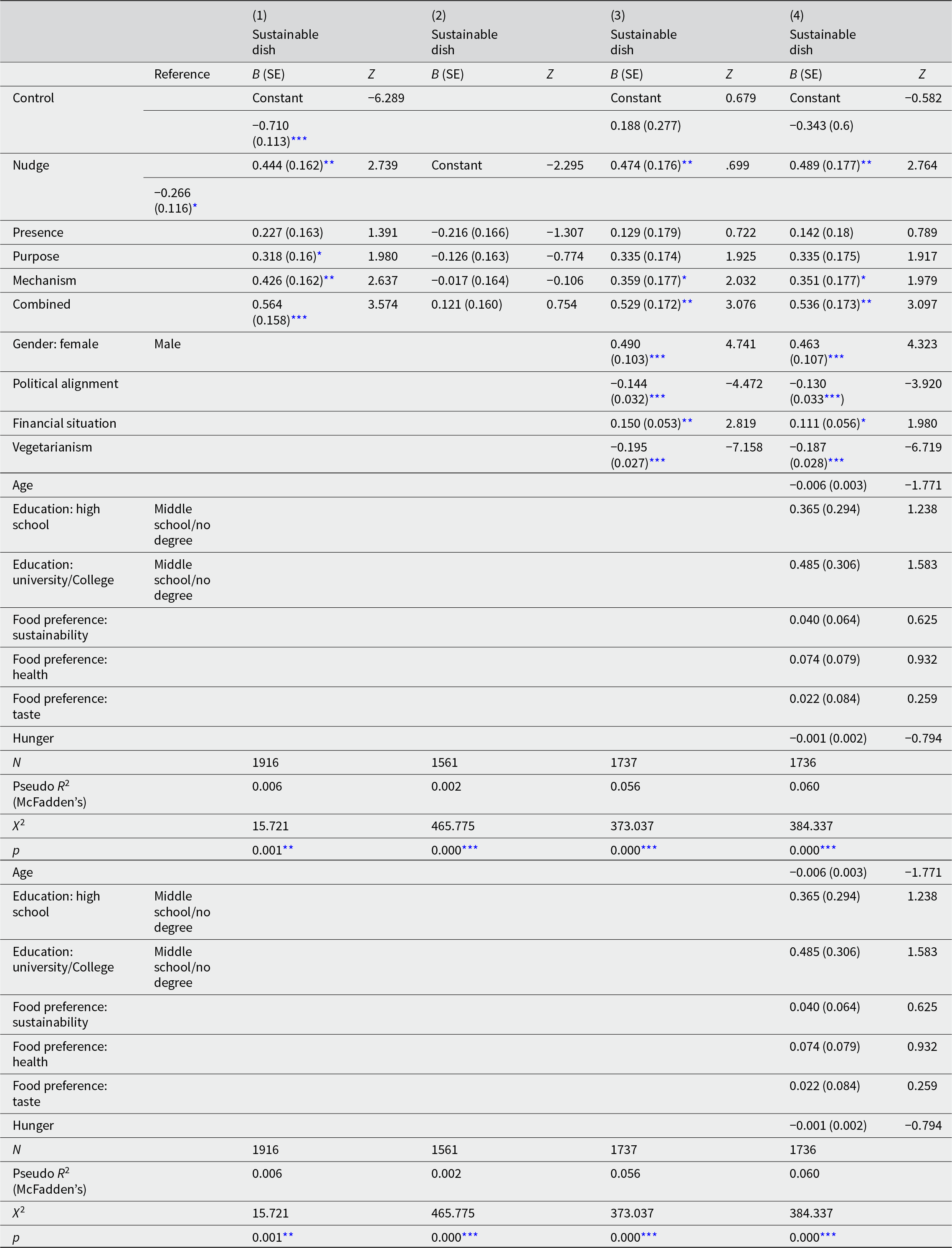
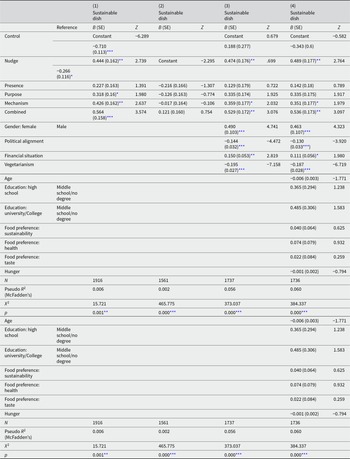
Table 4 presents stepwise logistic regression models, with Model (1) comparing all groups to the Control group and Model (2) comparing the disclosure groups to the Nudge group. Models (3) and (4) add different amounts of covariates. Model (3) provides a significantly better fit than Model (1), χ 2(4) = 115, p < 0.001, whereas Model (4) does not improve on Model (3) when all covariates are included, χ 2(7) = 9.751, p = 0.203.
Stepwise logistic regression of nudge effectiveness
Note: Significance using p-values refers to whether the estimated coefficient differs from zero:
* p < 0.05, **p < 0.01, ***p < 0.001 (two-tailed test).
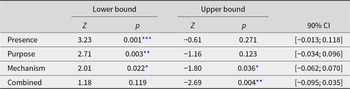
Model (1) show us that all groups except the Presence disclosure group significantly increase sustainable choices relative to the Control group. However Model (2) indicates that none of the disclosure groups differ significantly from the Nudge group, contradicting H1. Therefore, we applied TOST equivalence tests for all nudge-disclosure comparisons. This indicates that only the Mechanism disclosure and Nudge group were statistically equivalent, Z low = 2.01, p = 0.022; Z high = −1.80, p = 0.036 (see Appendix C). For the other groups, one or both margins were not significant, meaning we cannot conclude that their differences with the Nudge group fall within the equivalence margins.
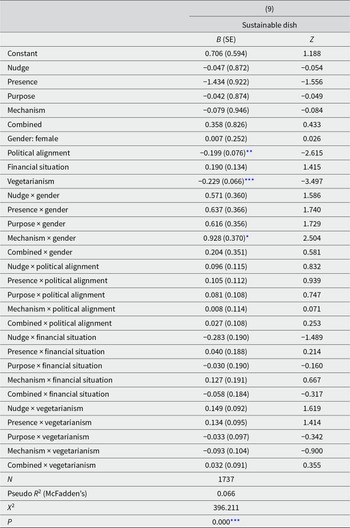
We explore the covariates using Model (3) and find that people are more likely to choose a sustainable dish if they are female, have a more left-leaning political ideology and feel more financially secure. Surprisingly, people who had recently eaten more vegetarian meals were less likely to choose a sustainable dish. No notable interactions emerged between experimental groups and covariates (see Appendix C). Some group differences lose significance once covariates are added, but generalised variance inflation factors remain well below the common threshold of five, indicating no multicollinearity (see Supplementary Materials). The reduced significance likely reflects that certain covariates explain additional outcome variance that partially overlaps with treatment effects, making treatment coefficients smaller or less precise when adjusting for relevant individual differences (Andrade, Reference Andrade2024). Importantly, these shifts do not change our interpretation of the hypotheses, which remains robust (Montgomery et al., Reference Montgomery, Nyhan and Torres2018).
As an additional robustness check, we repeated the analysis for the restricted sample excluding participants who failed the manipulation check. Model (2b) showed no significance differences, χ 2(1216) = 1619.485, p < 0.001, pseudo R 2 = 0.005, compared to the full sample when answering H1 (see Supplementary Materials).
Perceived autonomy
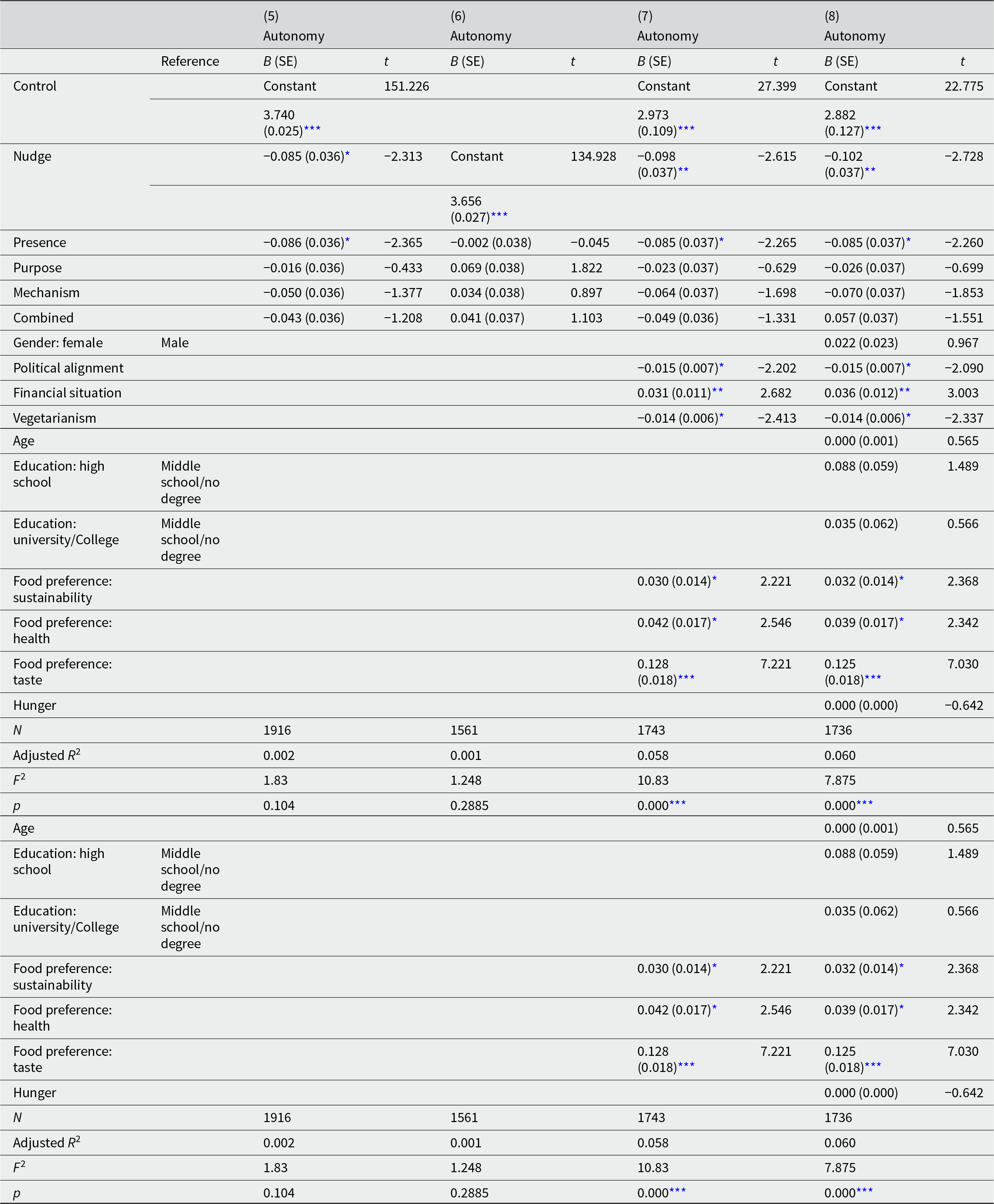
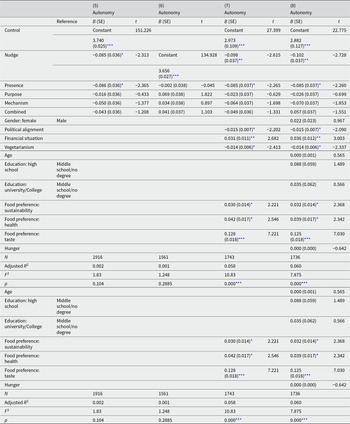
Table 5 reports the stepwise linear regression models. Model (5) compares all experimental groups to the Control group, while Model (6) compares the Nudge group to the disclosure groups. Models (7) and (8) add covariates. Model (7), which includes only significant covariates, is a better fit than Model (5), F(6) = 18.242, p < 0.001, whereas Model (8) includes all covariates but does not improve on Model (7), F(5) = 1.1838, p = 0.102.
Stepwise linear regression of perceived autonomy
Note: Significance using p-values refers to whether the estimated coefficient differs from zero:
* p < 0.05, **p < 0.01, ***p < 0.001 (two-tailed test).
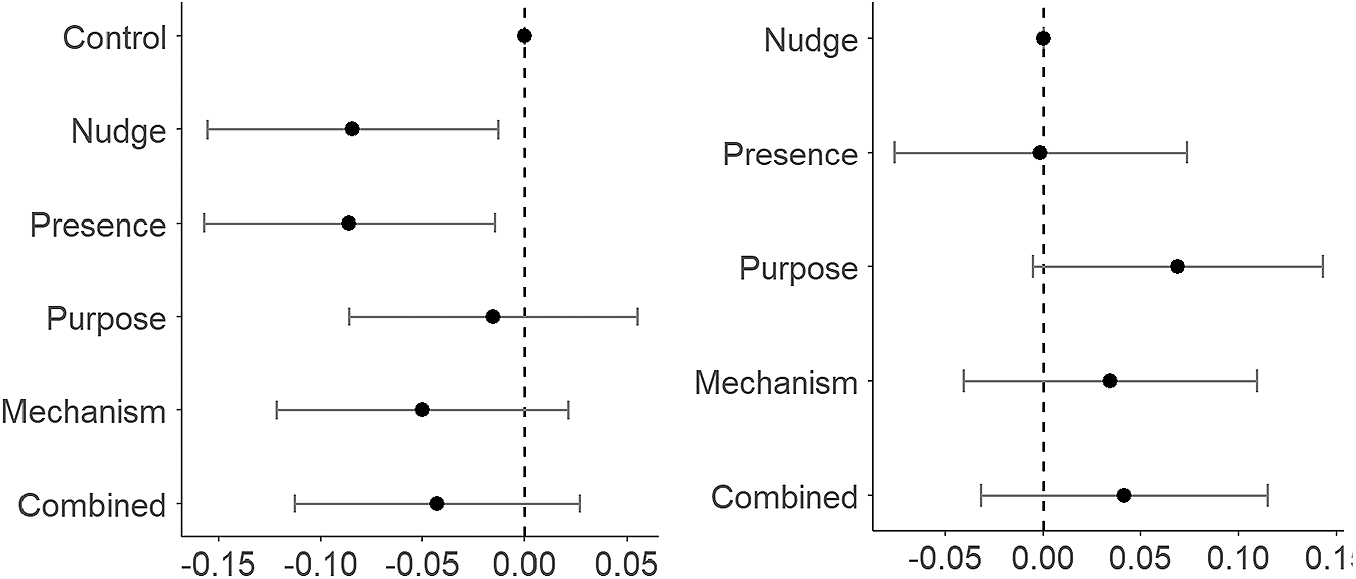
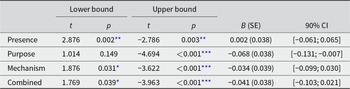
Respondents in the Nudge and Presence groups reported significantly lower autonomy than the control group, while the differences between the Control and Purpose, Mechanism or Combined group were insignificant. Average marginal effects indicate that the nudge reduces perceived autonomy by 2.4 per cent point (Figure 3). However, none of the disclosure groups differ significantly from the Nudge group (Model 6), meaning H2 is not supported. In fact, the Presence, t low = 2.876, p = 0.002; t high = −2.786, p = 0.003, Mechanism, t low = 1.876, p = 0.032; t high = − 3.622, p = < 0.001 and Combined group, t low = 1.769, p = 0.039; t high = −3.963, p = <0.001, are statistically equivalent to the Nudge group according to TOST procedures.
Average marginal effects of autonomy per experimental group with Control or Nudge group as reference.
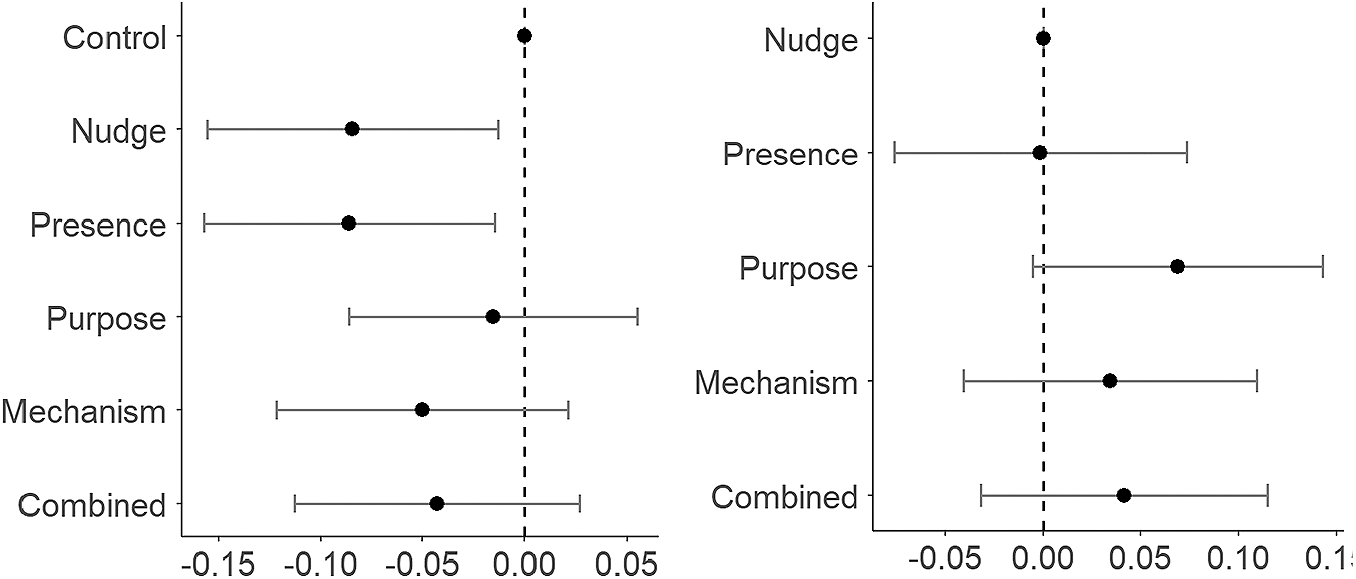
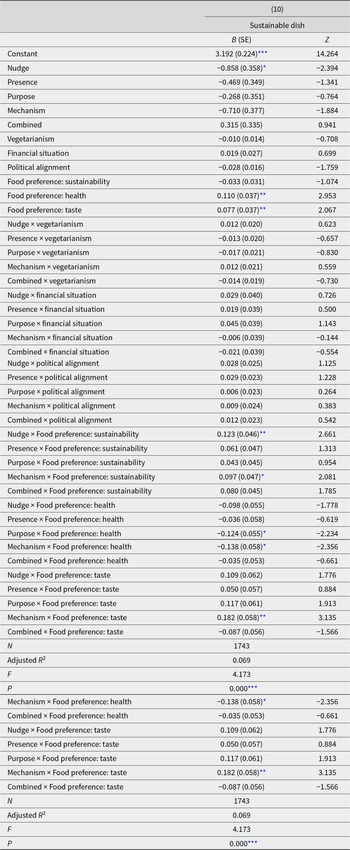
Regarding covariates, we find financial situation, political alignment, vegetarian eating habits and food preferences are significantly associated with perceived autonomy. More right-leaning participants report lower autonomy, as do those who more frequently eat vegetarian. People who consider the sustainability, taste or nutrition of their food, or have more financial stability experience higher degrees of autonomy. Interaction effects revealed inconsistent interactions between experimental groups and food preferences (see Appendix C).
Analysis of the restricted sample contradicts these findings: only the Mechanism group differs significantly from both the Control (Model 5b), F(5, 1053) = 2.588, p = 0.024, R 2 = 0.007 and Nudge group (Model 6b), F(4, 699) = 3.139, p = 0.014, R 2 = 0.012. No other significant findings related to H2 were observed (see Supplementary materials).
Table 6 summarises the results, highlighting which null effects were statistically equivalent.
Summary of the results
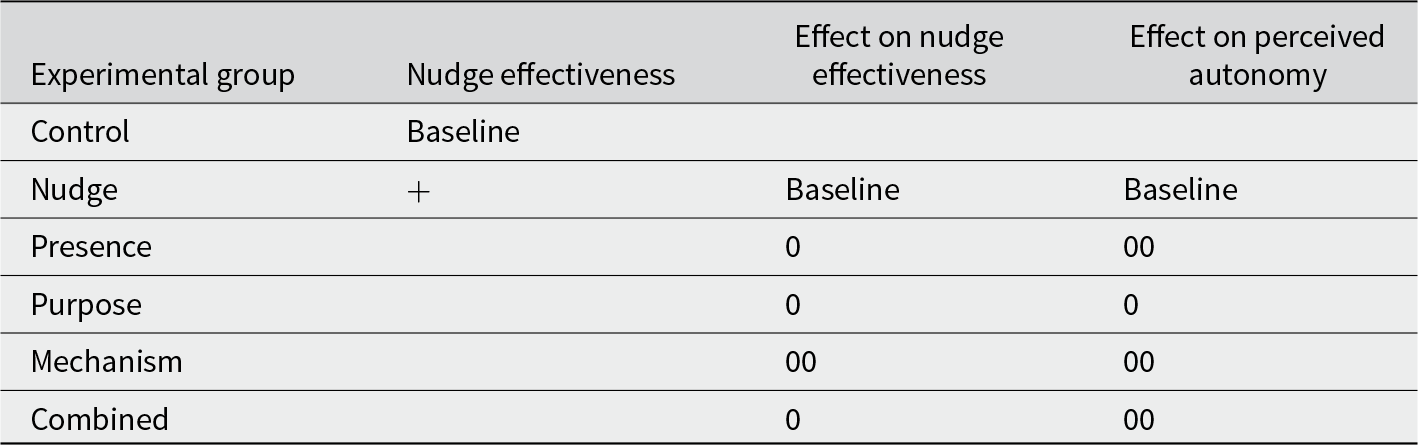
Note: +: Increase; −: Decrease; 0: No significant effect; 00: Statistical equivalence.
Discussion
Our experiment supports the idea that disclosures can be implemented without reducing nudge effectiveness. Using an effective salience food choice nudge, we found no significant differences between disclosures types, with some even being statistically equivalent to the covert nudge. The combined disclosure produced the highest number of sustainable food choices. Even though the nudge itself led to a small but significant decrease of perceived autonomy, no disclosure could mitigate this effect, with three out of four disclosures being equivalent to the Nudge group without disclosure. However, as the autonomy results were not perpetuated in all robustness checks, we are cautious in interpreting these results.
Our findings align with prior research suggesting that disclosures do not significantly affect nudging in terms of effectiveness or perceived autonomy, even when some impact was theoretically anticipated. First, disclosing the presence of the nudge did not appear to trigger psychological reactance (Brehm, Reference Brehm1966), even when it only broadly referenced behavioural influence. This does not reinforce the idea that minimal disclosures would lead to people making inferences about the nudge or feeling manipulated. It mirrors previous studies where presence disclosures referring to specific nudge elements were used (Goswami and Urminsky, Reference Goswami and Urminsky2016; Bruns et al., Reference Bruns, Kantorowicz-Reznichenko, Klement, Luistro Jonsson and Rahali2018) and supports the view that transparent information, even when very limited, does not undermine autonomy or nudge effectiveness. Second, disclosing the nudge’s purpose (Wachner et al., Reference Wachner, Adriaanse and De Ridder2021a) did not offset the loss of perceived autonomy due to the nudge in this instance. While this finding is consistent with prior experiments (Bruns et al., Reference Bruns, Kantorowicz-Reznichenko, Klement, Luistro Jonsson and Rahali2018) it contrasts with Paunov et al. (Reference Paunov, Wänke and Vogel2019a), where the disclosed purpose of the nudge increased effectiveness. Following self-determination theory, this suggests that understanding the intervention’s goals alone may be insufficient to enhance autonomy, even when this goal aligned with the person’s preferences. Possibly, the salience nudge’s purpose was already obvious, particularly due to the presence of eco-labels, leaving little added value for disclosures. Alternatively, the disclosure may not have sufficiently communicated the broader societal objective of reducing climate impact, but instead only indicated that sustainable options were being highlighted. Third, the mechanism disclosure likewise had no impact. Previous research shows that providing additional information can prompt reflection on one’s own behaviour, increasing nudge effectiveness (e.g. Banerjee et al., Reference Banerjee, Galizzi, John and Mourato2023a) and empowering people by increasing knowledge on how their decisions are influenced while reducing the need for inference on the nudge’s mechanics. Here, the disclosure seems unlikely to prompt additional reflection or facilitate more autonomous decisions. Finally, combining the disclosures had no effect on perceived autonomy, suggesting that even the most comprehensive disclosure does not empower people to make more autonomous decisions in this context.
These null findings align with the broader literature, which has mainly examined default nudges, but our study extends this work to salience nudges regarding food choice (Bruns et al., Reference Bruns, Fillon, Maniadis and Paunov2025). While prompting reflection can sometimes increase sustainable food choices (Banerjee et al., Reference Banerjee, Galizzi, John and Mourato2023a, Reference Banerjee, Galizzi, John and Mourato2023b), our findings show no evidence that the disclosures trigger such reflection in this context. Given that salience nudges are more easily identifiable than defaults, we would expect people to form inferences about the presence, purpose and mechanism of the nudge on their own before reading the disclosure. In theory, disclosures could then interact with these pre-existing conceptions, but we found no evidence of such effects. Thus, our findings support prior suggestions that disclosures can be applied across nudging techniques and indicate that this principle extends to salience nudges.
Notably, the nudge itself caused a small decrease in perceived autonomy. This study is not the first to find concerns about autonomy in the context of nudging, although such concerns are typically associated with more intrusive nudges, such as defaults (Felsen et al., Reference Felsen, Castelo and Reiner2013; Sunstein, Reference Sunstein2016a, Reference Sunstein2016b). Some scholars argue that nudges can be autonomy-enhancing by increasing agency and empowering individuals to align choices with their goals (De ridder et al., Reference De ridder, Feitsma, van den Hoven, Kroese, Schillemans, Verweij, Venema, Vugts and de Vet2020; Vugts et al., Reference Vugts, van den Hoven, de Vet and Verweij2020). Following this logic, salience nudges could enhance perceived autonomy by openly guiding attention, for instance when a nudge helps individuals make quicker decisions or support alignment with pre-existing goals (Vugts et al., Reference Vugts, van den Hoven, de Vet and Verweij2020; Ensaff, Reference Ensaff2021). Research on decision signposts (Ungemach et al., Reference Ungemach, Camilleri, Johnson, Larrick and Weber2017; Mertens et al., Reference Mertens, Hahnel and Brosch2023) supports this perspective by suggesting that overt, attention-guiding interventions can help individuals align their choices with their own goals by making certain attributes of information more salient. However, our results show that even less intrusive salience nudges can reduce perceived autonomy. Given that the effect is, at most, 0.09 on a 5-point Likert scale, it can hardly be considered a serious threat to autonomy. Still, participants clearly did not perceive the nudge as autonomy-enhancing.
We should note attention to the nudge and disclosures was low, as almost half of all respondents failed the manipulation checks. This is consistent with similar experiments who report high check failure rates (e.g. Wachner et al., Reference Wachner, Adriaanse and De Ridder2021a; Michaelsen et al., Reference Michaelsen, Johansson and Hedesström2024) and highlights a broader issue of attention (or lack thereof) towards nudging and disclosures. While nudges can remain effective without explicit attention, this does not hold true for disclosures. If disclosures go unnoticed by a subset of people affected by the nudge, they fail to increase its transparency. We therefore encourage researchers to pay attention to the noticeability of disclosures and whether their content is actually perceived by decision-makers.
This experiment provides new insights into transparent nudging using disclosures. To our knowledge, the presence, purpose and mechanism message of a disclosed nudge have not been directly compared before in this context. Despite comparing fundamentally different disclosure content elements, we observed no differences between disclosure types. This suggests that disclosure content elements either have limited theoretical impact on nudges or are unable to effectively reach their audience and bring about meaningful changes. By moving beyond the theoretical expectations from self-determination theory or inference-based reasoning that might predict increased autonomy from certain disclosures, we provide a more neutral assessment of autonomy effects. The use of a salience nudge adds some necessary diversification to the transparency literature and aligns with similar findings across other types of nudges. In addition, the instability between previously utilised autonomy subscales within our operationalisation of autonomy indicates that perceived autonomy may not be a uniformly interpreted construct. The addition of two new positively framed items to the scale allows us to examine whether nudges can also be perceived as autonomy-enhancing, rather than solely focusing on their potential harm to autonomy. Finally, this study is among the few to empirically test whether adding disclosures can offset reduced perceived autonomy. In doing so, our results add to prior evidence suggesting that disclosures have rather minimal effects on autonomy.
Nevertheless, at least three limitations of the experiment can be identified. First, as we treat a specific combination of techniques as a single nudge, it is unclear whether the findings are generalisable to all salience nudges. Future research could include different salience nudges and other nudge types to provide a more heterogeneous assessment of disclosure effects. Second, this study reflects the broader tendency in the literature to measure disclosures in a controlled online or lab environment rather than in the field (Bruns et al., Reference Bruns, Fillon, Maniadis and Paunov2025). We do attempt to increase ecological validity and reduce demand effects by introducing real consequences into the hypothetical scenario, as individuals have the possibility of receiving the dish they selected. Even so, demand effects cannot be fully ruled out, as participants (1) only had a chance to receive a dish instead of a guaranteed dish in a real-world scenario, (2) were aware they were participating in a research study and (3) could infer which dishes were preferred through the nudge and disclosures. Future research should therefore place greater emphasis on real-life nudging scenarios through field experiments. Third, we did not directly measure whether participants perceived an increase in transparency due to the disclosures. While the disclosures objectively provided more information about the nudges and awareness checks confirmed that participants noticed this information, we cannot determine whether participants actually experienced the disclosure as transparency-enhancing. Future research should incorporate direct measures of perceived transparency to assess how disclosures are interpreted and evaluated.
In conclusion, the present research reaffirms that nudges can be transparent without losing effectiveness or substantially harming perceived autonomy. Although attention to the disclosures was limited and the disclosures did not mitigate a reduction in perceived autonomy, this does not contradict the broader finding in the literature that transparency itself does not undermine a nudge’s effectiveness. Disclosures might not be the go-to tools when autonomy perceptions are a concern, but they might still serve to increase the transparency of a nudge. For policymakers, this underscores the need to carefully operationalise disclosures in behavioural interventions that are both noticeable and comprehensible if they are to increase their chances of effectively informing and empowering individuals in their decision-making.
Supplementary material
The supplementary material for this article can be found at https://doi.org/10.1017/bpp.2026.10037.
Acknowledgements
This project is part of a PhD Fellowship Fundamental Research and is funded by the Research Foundation Flanders (FWO). Many thanks go out to Malte Dewies, Patrik Michaelsen and Yagor Paunov for their invaluable comments, and to Sara Coghe for their help in designing the survey materials.
Funding statement
This project is part of a PhD Fellowship Fundamental Research and is funded by the Research Foundation Flanders (FWO).
Statement of competing interests
There are no competing interests to declare.
Data availability statement
Date will be made available at https://osf.io/yr7sw 1 month after publication of the article at the latest.
Declaration on AI usage
The researchers used AI for troubleshooting during the R data analysis coding process. Any code provided by AI was manually reviewed by the reviewers before being used. No AI was used for the writing process.
Ethics approval statement
This project was ethically approved by the first author’s institution (KU Leuven SMEC nr. G-2023-7072-R2).
Appendix A. Survey
Vignette and manipulation checks
On the next page you will see a menu of a cafeteria. Imagine that it is lunch break and you have one main course. Which dish do you choose? Please note! You have a chance to win a gift voucher for the dish you choose, so be sure to choose the dish you would like the most. You will receive more information about this at the end of the questionnaire.
I order … (nudge effectiveness)
o Vol-au-vent with cucumber salad and mashed potatoes
o Stuffed bell pepper with minced meat, tomato sauce, green beans and Spanish rice
o Spring roll with fried rice and sweet and sour sauce
o Vegetable burger with couscous and spinach
o Turkey steak with mustard sauce, rainbow carrots and rösti potatoes
o Indian curry with wok vegetables and rice
o Spaghetti bolognaise
o Penne with mascarpone and pesto rosso
o Chicken burger with ratatouille and polenta
Which of the following dishes were called ‘chef’s choice’? You only have to choose one dish, even if several dishes would be correct. (Nudge awareness check)
o Vol-au-vent with cucumber salad and mashed potatoes
o Stuffed bell pepper with minced meat, tomato sauce, green beans and Spanish rice
o Spring roll with fried rice and sweet and sour sauce
o Vegetable burger with couscous and spinach
o Turkey steak with mustard sauce, rainbow carrots and rösti potatoes
o Indian curry with wok vegetables and rice
o Spaghetti bolognaise
o Penne with mascarpone and pesto rosso
o Chicken burger with ratatouille and polenta
o I don’t know
What information was displayed on the menu? (Disclosure awareness check)
o A sale is in progress
o Behavioural insights are used to make certain dishes more visible
o Some dishes are gluten-free
o Free fruit is available due to subsidisation from the Flemish government
o I don’t know
Perceived autonomy
You have just chosen a dish based on a menu. We would like to find out what you think about this menu. Below you will see some questions related to this. These questions may use heavy language, but are of great academic importance. Fill them in as best you can in your opinion. (5-point response scale ranging from ‘strongly disagree’ to ‘strongly agree’) (Perceived autonomy)
• The design of the menu manipulated me
• The design of the menu is an infringement of my freedom of choice
• The design of the menu has taken away my choice
• The design of the menu has put pressure on me
• My choice is in line with my goals and interests
• I am convinced that my choice fits my taste perfectly
• I feel that my choice is a clear expression of who I am
• I feel like I had the opportunity to influence my choice
To what extent do you agree with the following statements (5-point response scale ranging from ‘strongly disagree’ to ‘strongly agree’) (Perceived autonomy)
• The design of the menu irritates me
• The design of the menu makes me angry
• I am annoyed by the design of the menu
• The design of the menu helps me to make a choice
• The design of the menu allows me to make a choice according to my personal preference
Covariates
What is your gender?
o Male
o Female
o Not listed:
o I’d rather not say
What is your year of birth?
What is your highest completed degree?
o Middle school/no degree
o High school
o College/university education
o Other:
How would you describe your financial situation?
o I have a lot of trouble making ends meet
o I sometimes struggle to make ends meet
o I earn enough to make ends meet
o I earn enough to live comfortably
o I earn enough to live very comfortably
o I’d rather not say
In the past seven days, how many days did you eat meat or fish? (0–7 scale)
In politics, people sometimes talk about ‘left’ and ‘right’. Where would you place yourself on this scale, where 1 means ‘left’ and 7 means ‘right’? (1–7 scale, with separate ‘No answer’ option)
I think it is important that my meals on a typical day: (5-point response scale ranging from ‘strongly disagree’ to ‘strongly agree’)
• Are environmentally friendly
• Are healthy
• Are tasty
How hungry are you right now, where 0 is not hungry at all and 100 is extremely hungry? (0–100 scale)
Appendix B. Vignette graphicsFootnote 6
Control group
Nudge group
Presence group
Purpose group
Mechanism group
Combined group
Appendix C. Additional analyses
Results balance tests
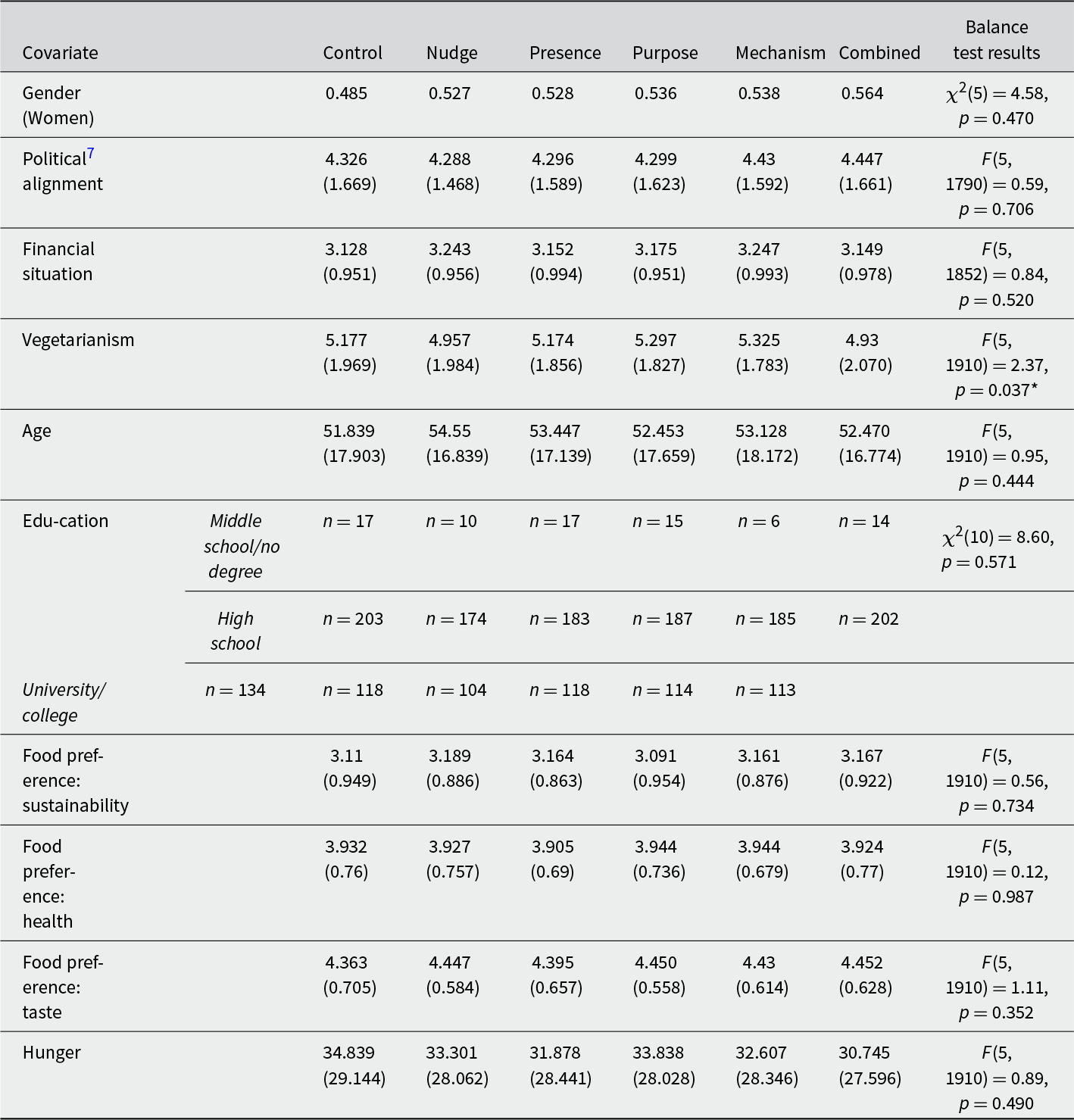
Notes: Mean and standard deviation per experimental group provided. Count of each instance provided for education.
*p < 0.05, **p < 0.01, ***p < 0.001.
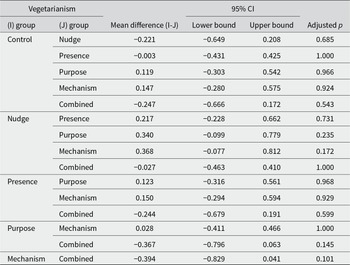
Post hoc Tukey HSD test for vegetarianism
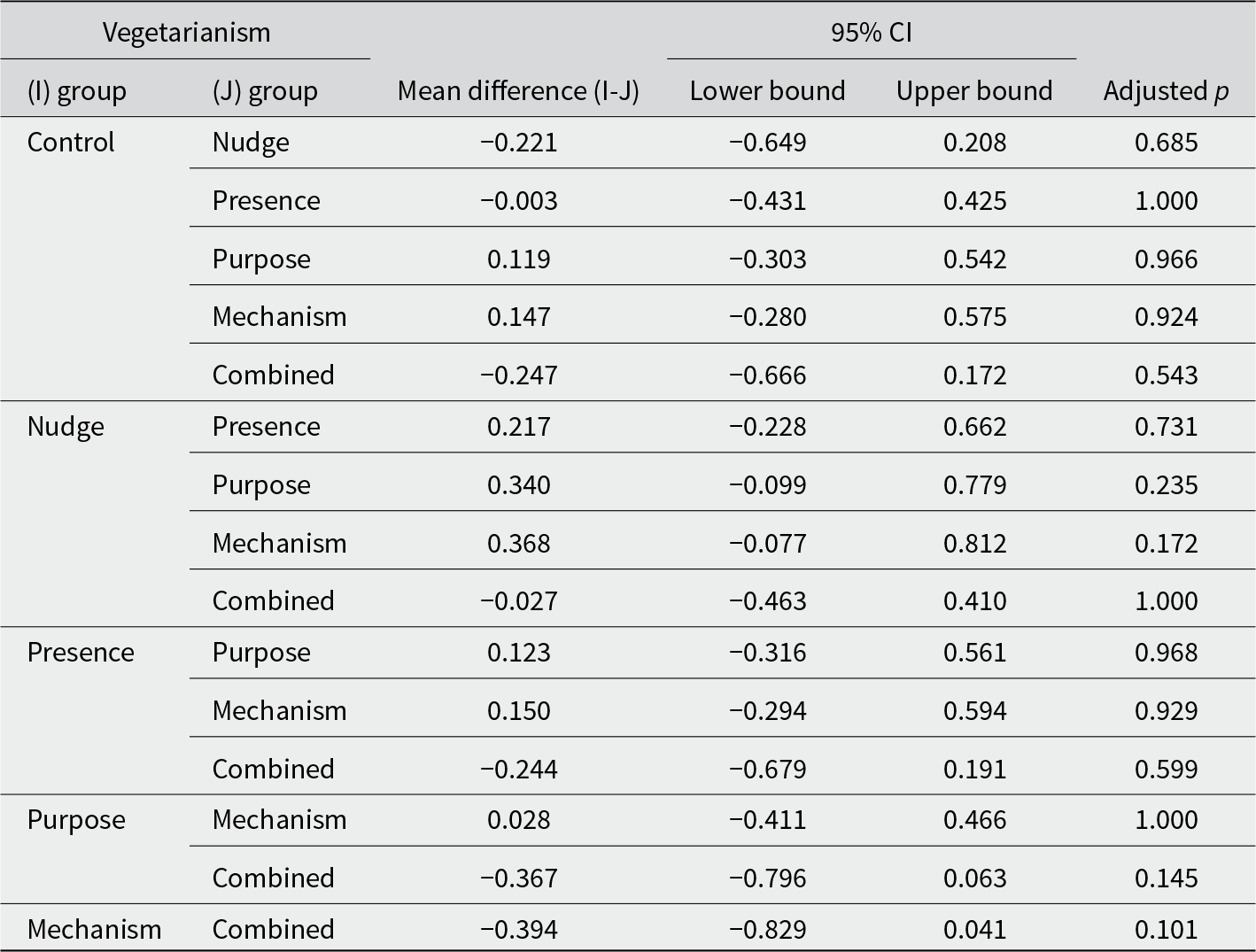
Note: *p < 0.05, **p < 0.01, ***p < 0.001.
TOST equivalence testing for nudge effectiveness
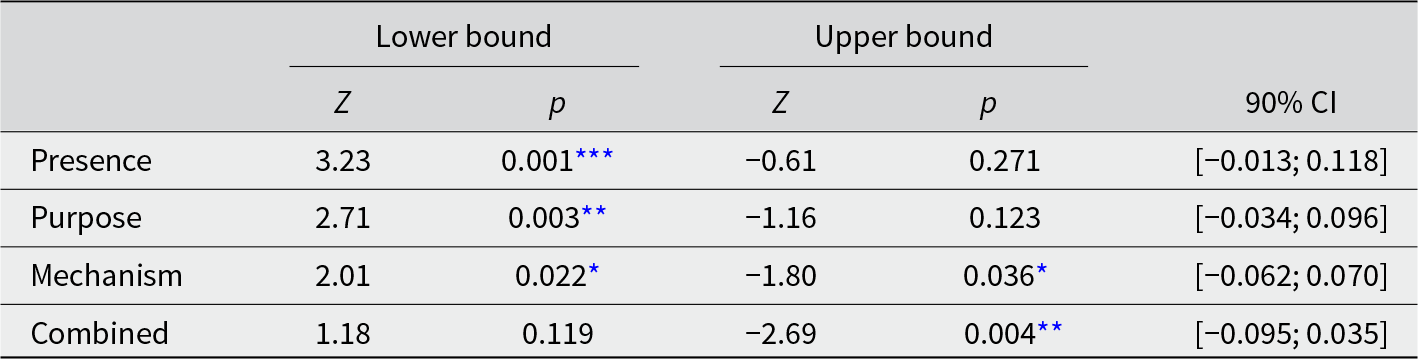
Notes: Bounds set at ±0.076, based on Cohen’s h power analysis (power = 0.08, α = 0.05).
Reference group: Nudge group.
* p < 0.05, **p < 0.01, ***p < 0.001.
TOST equivalence testing for perceived autonomy
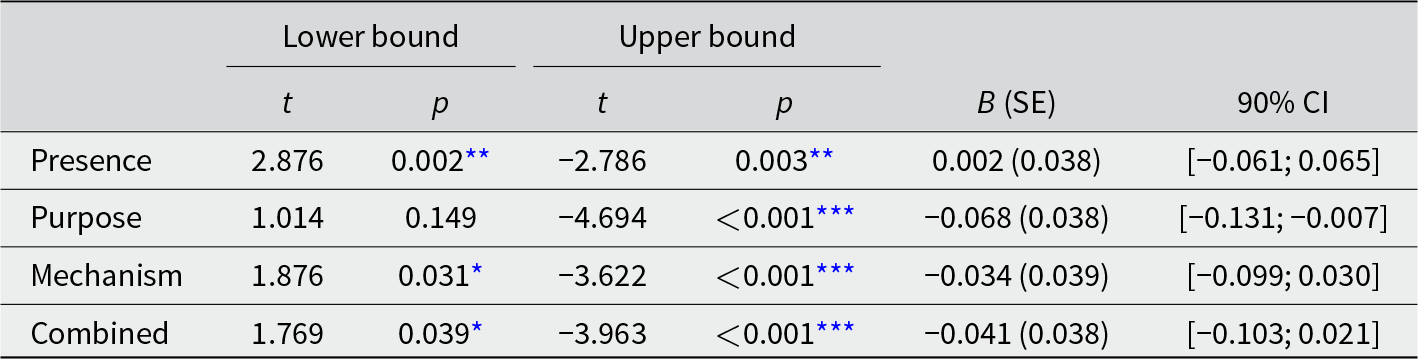
Notes: Bounds set at ±0.108 based on Cohen’s d power analysis (power = 0.08, α = 0.05).
Reference group: Nudge group.
* p < 0.05, **p < 0.01, ***p < 0.001.
Logistic regression analysis of nudge effectiveness including interaction effects
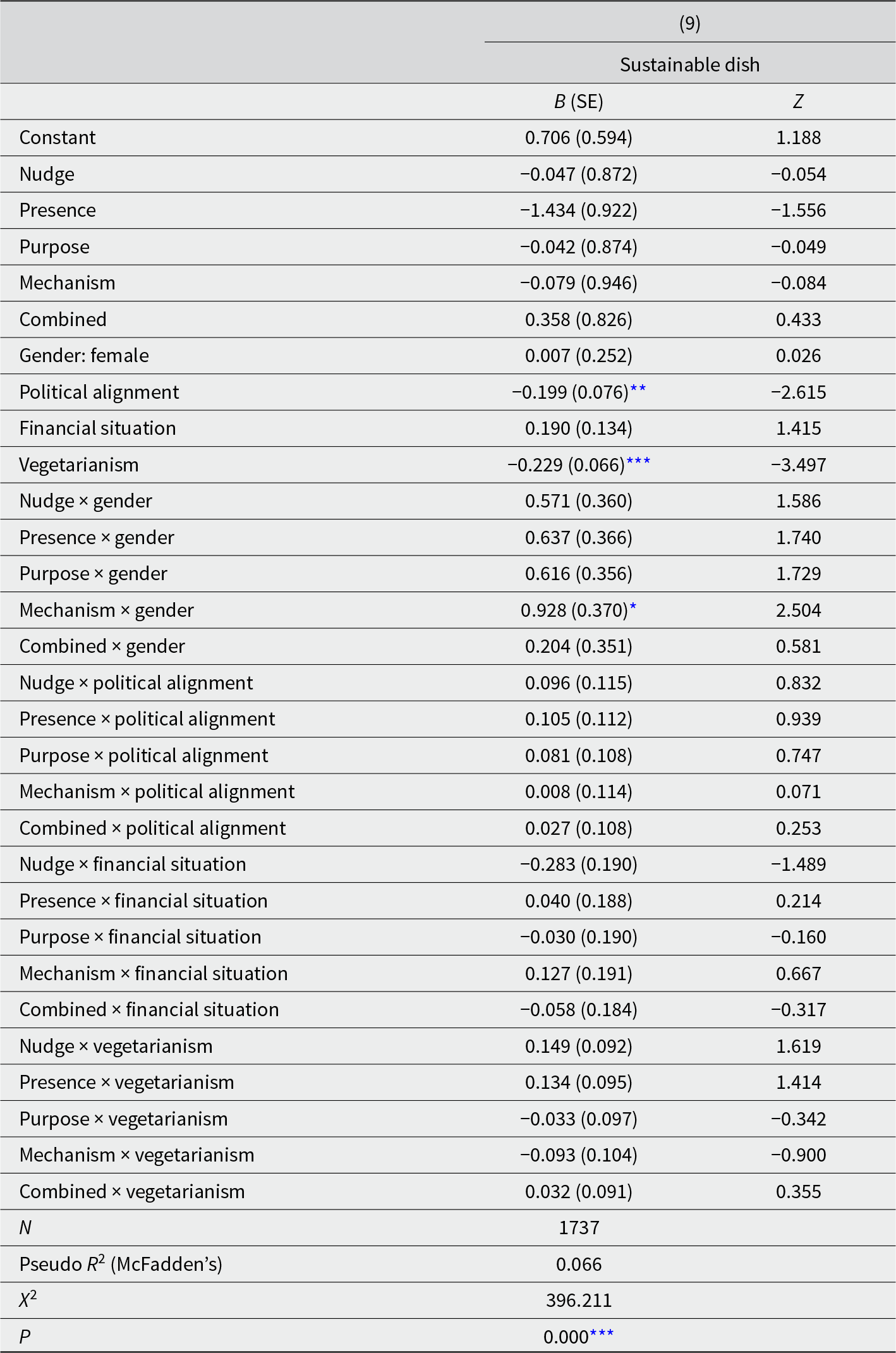
Notes: Coefficients are log-odd estimates and should not be interpreted as predicted probabilities.
Significance using p-values refers to whether the estimated coefficient differs from zero:
* p < 0.05, **p < 0.01, ***p < 0.001 (two-tailed test).
Linear regression analysis of perceived autonomy including interaction effects
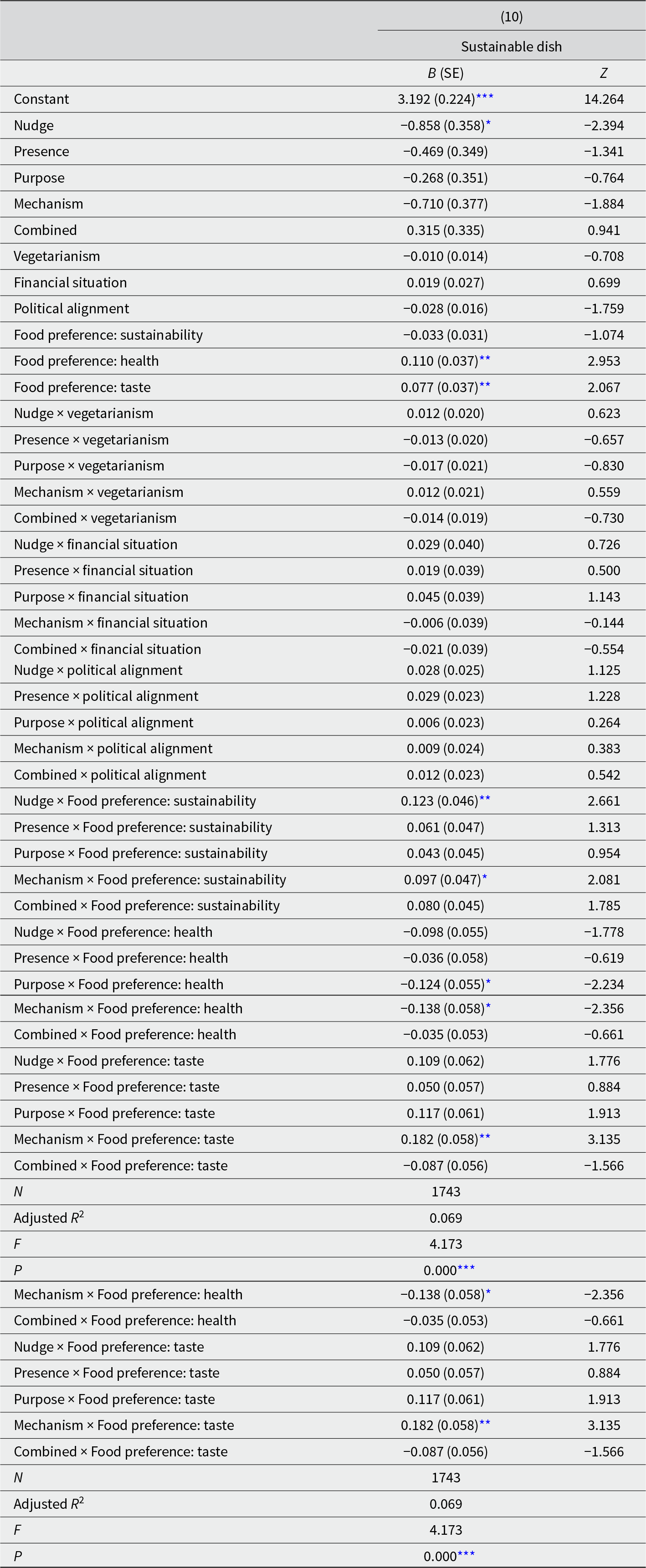
Note: Significance using p-values refers to whether the estimated coefficient differs from zero:
* p < 0.05, **p < 0.01, ***p < 0.001 (two-tailed test).


 Open access

