




Introduction
Southern Scandinavia was never part of the Roman Empire, but Roman influence is evident in the archaeological record of present-day Denmark and southern Sweden. The middle Iron Age (c. AD 200–600) in this region is characterised by hierarchical societies in which religious, social and economic power was confined to the hands of a ruling elite, with social networks reaching far into the Roman Empire to the south (Näsman Reference Näsman1984a; Lund Hansen Reference Lund Hansen1987; Jørgensen Reference Jørgensen, Jørgensen, Storgaard and Gebauer Thomsen2003; Fischer Reference Fischer2005). Long-distance travel was a means to gather wealth and obtain status in a hierarchical and unstable political power structure, not least by winning control of metal imports by the means of networks established through such contacts (Herschend Reference Herschend, Fabech and Ringtved1991; Jørgensen Reference Jørgensen, Jørgensen, Storgaard and Gebauer Thomsen2003, Reference Jørgensen, Grimm and Pesch2011; Fischer Reference Fischer2005; Hedeager Reference Hedeager2011; Andrén Reference Andrén2014).
The Migration Period was a turbulent time in both Scandinavia and the rest of Europe (Table 1). The decline of the Western Roman Empire, the invasion of the Huns, war, famine and shifting alliances within the Barbaricum (Germanic populations beyond the Roman Border in the northern parts of Europe) all had impacts on societies (Lund Hansen Reference Lund Hansen1987; Fischer Reference Fischer2005; Heather Reference Heather2006; Fischer & Victor Reference Fischer, Victor, Arrhenius and O'Meadhra2011; Hedeager Reference Hedeager2011). A social and economic crisis can be identified in various areas of Scandinavia during this time, as indicated by an abrupt decline in settlement activities, with numerous examples of farms being deserted or even destroyed during this time (Stenberger Reference Stenberger1933; Näsman Reference Näsman, Näsman and Lund1988).
Basic chronology of the Swedish Iron Age (the period of the Sandby borg massacre is indicated).

Excavations at Sandby borg ringfort, on the island of Öland in south-east Sweden, have revealed unique traces of a Migration Period (c. 400–550 AD) massacre. Our conclusions are based on the discovery of human remains from at least 26 individuals, several of whom display lethal traumatic injuries, the skeletal remains of animals abandoned following the assault and artefacts recovered from the site.
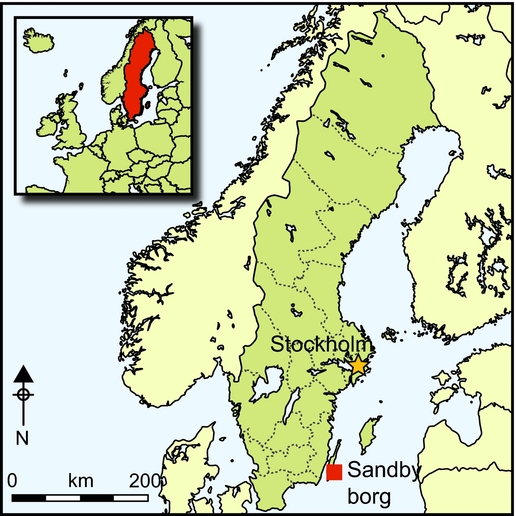
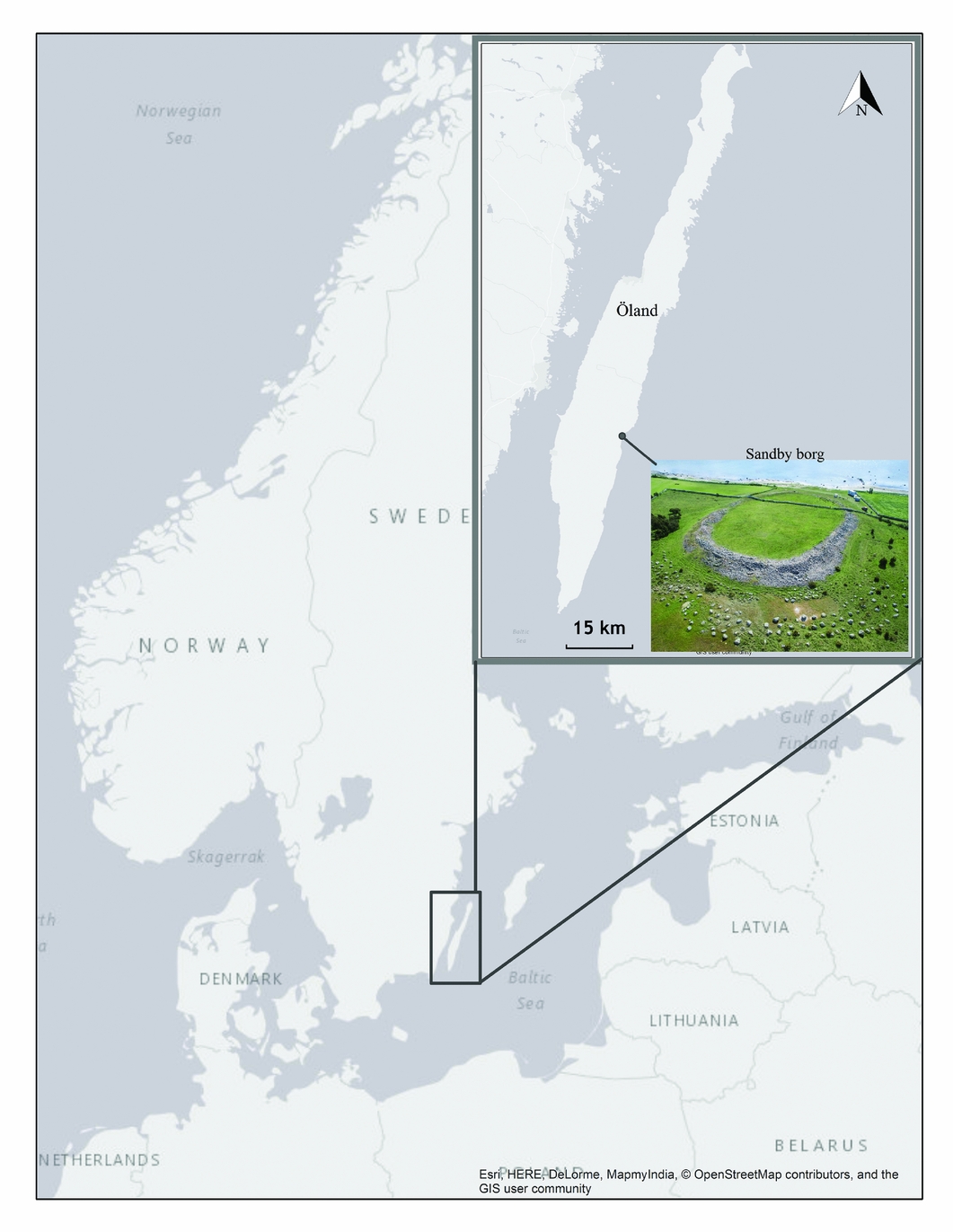
Öland is located off the south-east Swedish coast in the Baltic Sea (Figure 1). Here, the archaeological record from the Roman Iron Age and Migration Period is exceptionally rich, including more than 1000 visible stone house foundations, innumerable accompanying stone fences, thousands of cemeteries and graves, and at least 15 ringforts (Stenberger Reference Stenberger1933; Fallgren Reference Fallgren2006, Reference Fallgren and Tegnér2008). To this should be added numerous prestigious and exclusive items, including bronze statuettes, glass beakers and gold coins of Roman origin. At least 360 solidi are known from the island—more than from any other region in Scandinavia (Fagerlie Reference Fagerlie1967; Herschend Reference Herschend1980; Fischer et al. Reference Fischer, Lopez Sanchez and Victor2011). The main influx of gold coins seems to have occurred in the early to mid fifth century; this decreased dramatically after AD 476 (Fischer et al. Reference Fischer, Lopez Sanchez and Victor2011).
Map of Scandinavia with the island of Öland indicated. Inset is a map of Öland with the location of Sandby borg. Photograph: Sebastian Jakobsson.
The Sandby borg ringfort
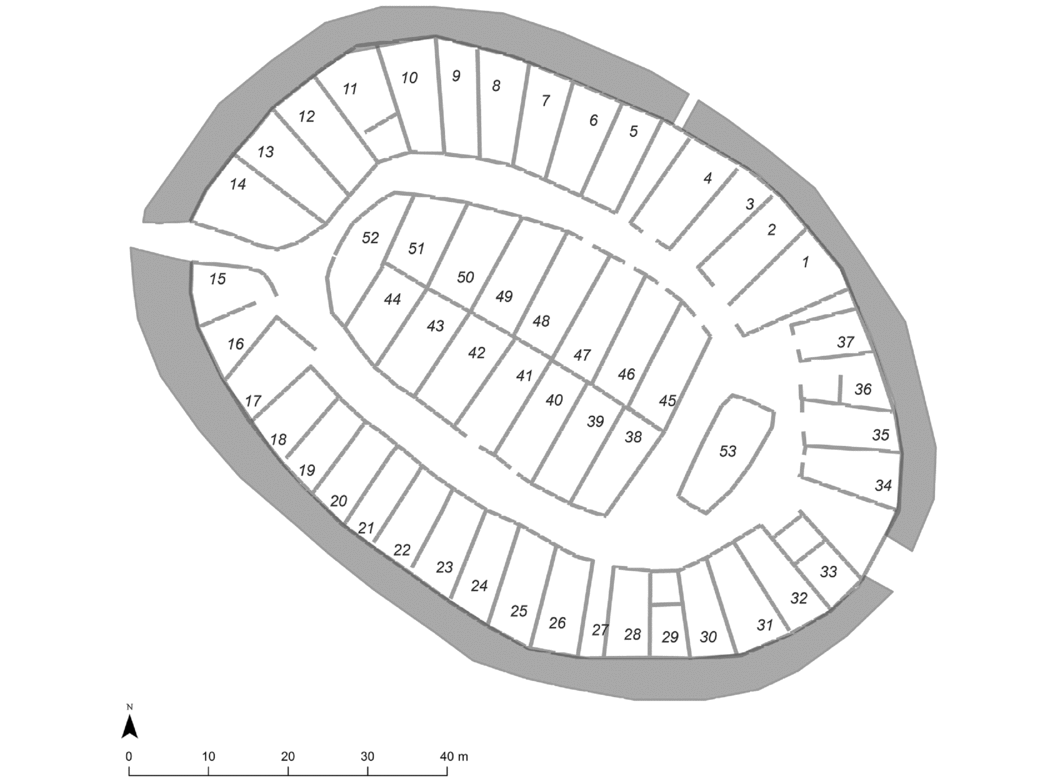
The ringfort of Sandby borg is located adjacent to the shoreline on south-east Öland. Today, the structure consists of an eroded oval stone wall enclosing an area of approximately 5000m2. Three gates are visible as shallow depressions in the wall. The walls would originally have been approximately 4–5m high. Aerial photographs and geophysical surveys of the ringfort interior revealed buried stone structures, interpreted as stone house walls (Borg et al. Reference Borg, Näsman and Wegraneus1976; Viberg Reference Viberg2012; Viberg et al. Reference Viberg, Victor, Fischer, Lidèn and Andreèn2014). The layout is similar to that of several other Öland ringforts, with houses radially placed inside the ring wall and a central block surrounded by a street (Stenberger Reference Stenberger1933; Borg et al. Reference Borg, Näsman and Wegraneus1976) (Figures 2 & 3).
Plan of Sandby borg with the identified houses numbered. The overview is based on geophysical surveys (Viberg Reference Viberg2012), excavations and aerial photographs.
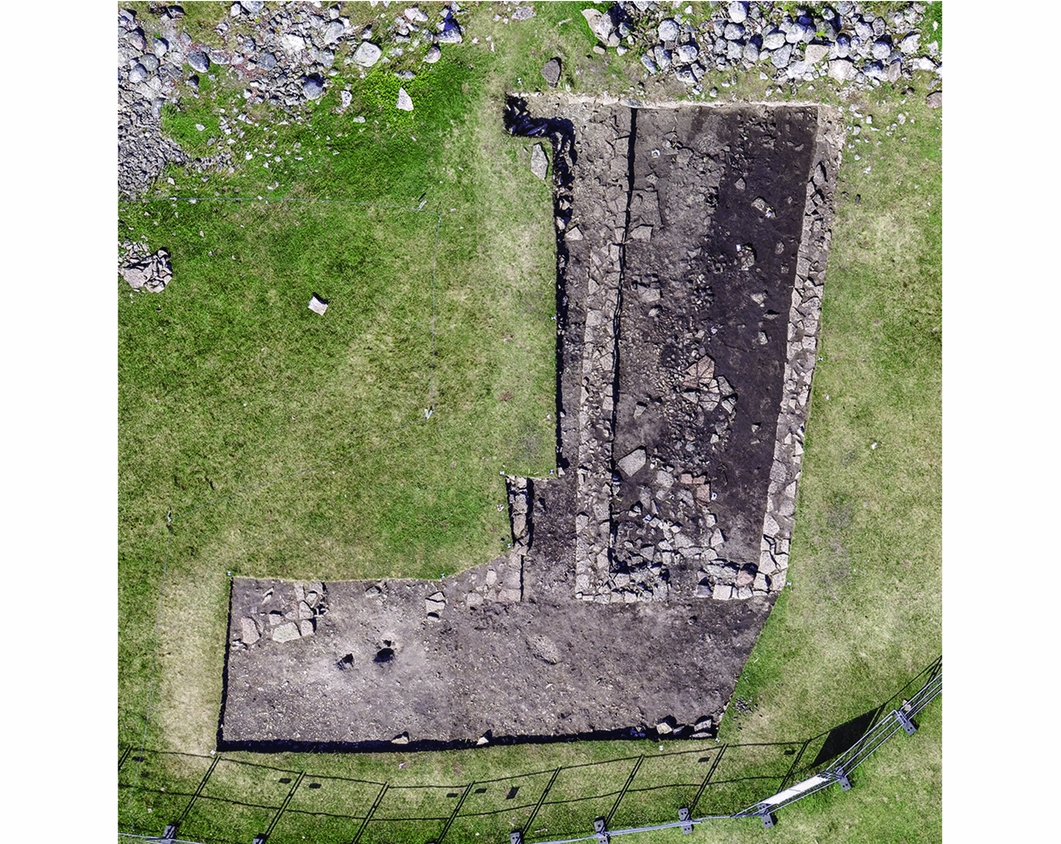
Aerial photograph of house 4 being excavated in 2016. The rectangular house foundation measures approximately 14 × 6m. The eroded fort wall also constitutes the north-east wall of the house, as seen in the top of the photograph. Photograph: Sebastian Jakobsson.
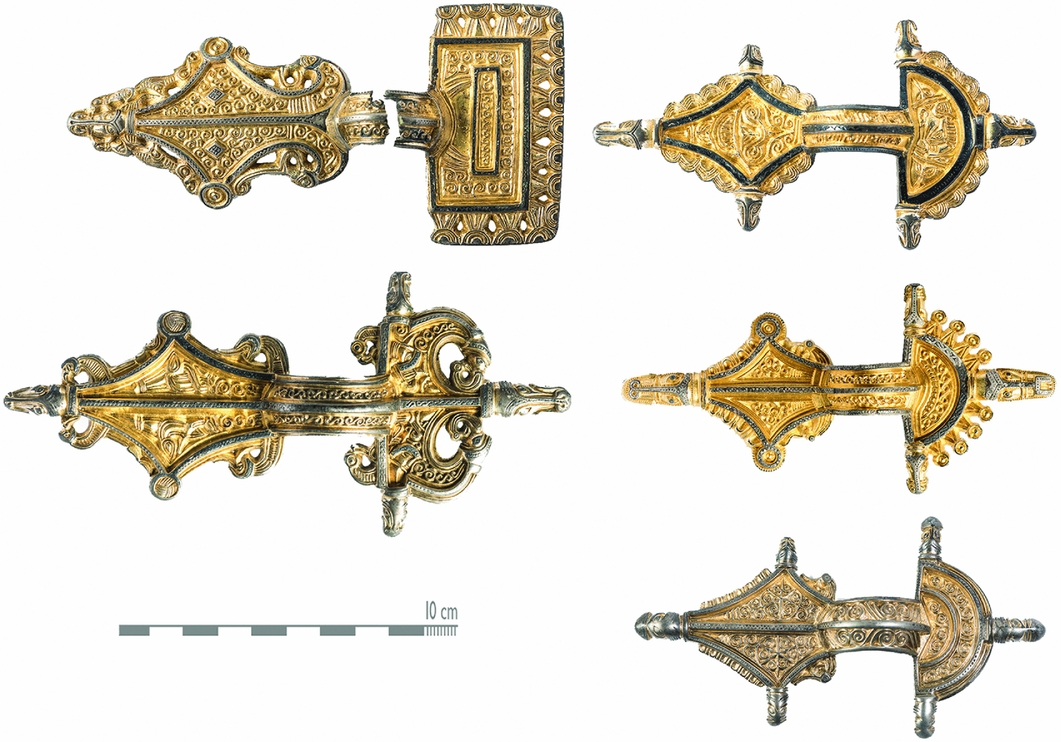
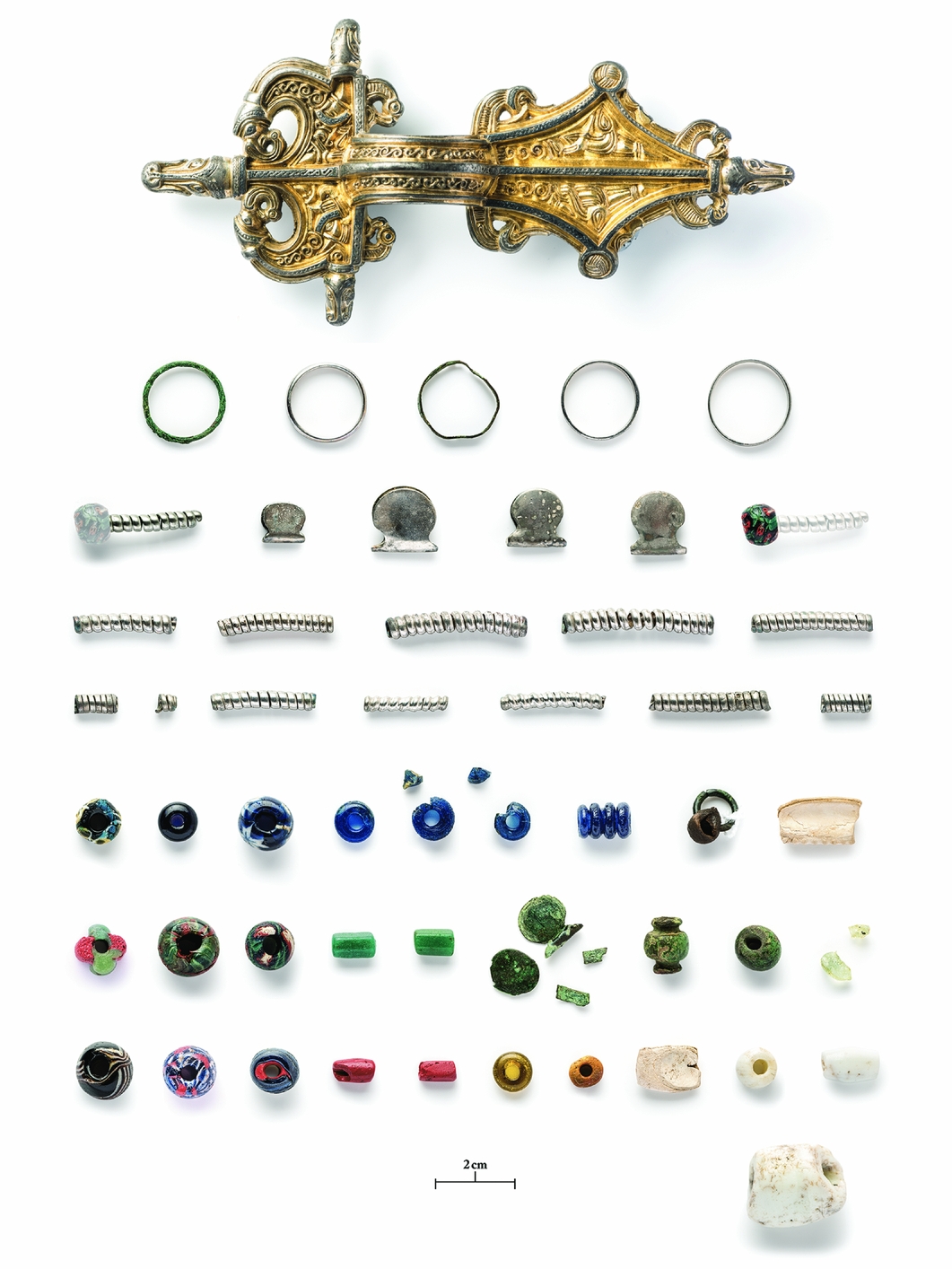
Suspected looting pits were discovered during initial geophysical work in 2010. This led the local authorities to commission a metal-detector survey of the whole site. Five deposits of exquisite Migration Period jewellery were discovered hidden in different houses within the central block of the fort. Each deposit contained a gilded silver relief brooch (Figure 4) along with various items, such as glass beads, finger rings and silver pendants (Figure 5) (Blohmé et al. Reference Blohmé, Fallgren and Bäckström2011; Victor Reference Victor, Arnell and Papmehl-Dufay2015a; Fallgren & Ljungkvist Reference Fallgren and Ljungkvist2016). The relief brooches are large, prestigious items of a very high quality, typically made of gilded silver and covered with decorative animal art designs. The brooches, which were probably part of aristocratic women's jewellery sets, are decorated in Salins Style I and spiral ornamentations. Typologically, they can be dated to the period AD 450–510 (e.g. Haseloff Reference Haseloff1981; Näsman Reference Näsman1984b; Magnus Reference Magnus, Webster and Brown1997, Reference Magnus2002; Kristoffersen Reference Kristoffersen, Hines, Højlund Nielsen and Siegmund1999; Fischer & Victor Reference Fischer, Victor, Arrhenius and O'Meadhra2011). While the brooches were probably locally made, other artefacts in the deposits, such as millefiori glass beads, silver bell pendants and cowrie shell ornaments, are of non-local origin (Grabarczyk Reference Grabarczyk1983; Näsman Reference Näsman1984b; Tempelmann-Mączyńska Reference Tempelmann-Mączyńska1985; Sjøvold Reference Sjøvold1993; Volkmann & Theune Reference Volkmann and Theune2001; Tvauri Reference Tvauri2012; Victor Reference Victor, Arnell and Papmehl-Dufay2015a). The artefacts indicate contacts to the south-east, through present-day Poland, the Baltic states and into areas of the Roman Empire (see Victor Reference Victor, Arnell and Papmehl-Dufay2015a). Artefact typology suggests that the fort was in use during the Migration Period, with a focus on the later part of the fifth century AD.
The five gilded relief brooches in silver found in five different deposits in 2010. Photograph: Daniel Lindskog.
Objects found in deposit 2 (house 40), one of the five jewellery deposits encountered at Sandby borg during a metal detector survey in 2010. Photograph: Daniel Lindskog.
The excavations
Small-scale annual excavations at Sandby borg have been undertaken by Kalmar County Museum since 2011. Initially, the aim was to establish the contexts of the deposits first discovered in 2010. During the first year of excavation, the discovery of human remains inside houses alerted the archaeologists that a violent event had occurred at the site in the late fifth century AD.
By the end of the 2016 field season, approximately 300m2 had been excavated—equivalent to six per cent of the total ringfort surface area (Dutra Leivas & Victor Reference Dutra Leivas and Victor2011; Victor Reference Victor2012, Reference Victor, Arnell and Papmehl-Dufay2015b; Victor et al. Reference Victor, Emilsson and Frisk2013; Gunnarsson et al. Reference Gunnarsson, Victor and Alfsdotter2016; Papmehl-Dufay & Alfsdotter Reference Papmehl-Dufay and Alfsdotter2016). This includes the complete excavation of 2 of the 53 houses, approximately 50 per cent of a third house, and 6 houses subjected to limited investigation. Articulated human remains have been found in four of the houses, and scattered and commingled human remains found in the street surrounding the central block.
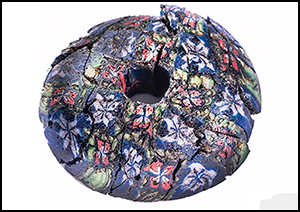
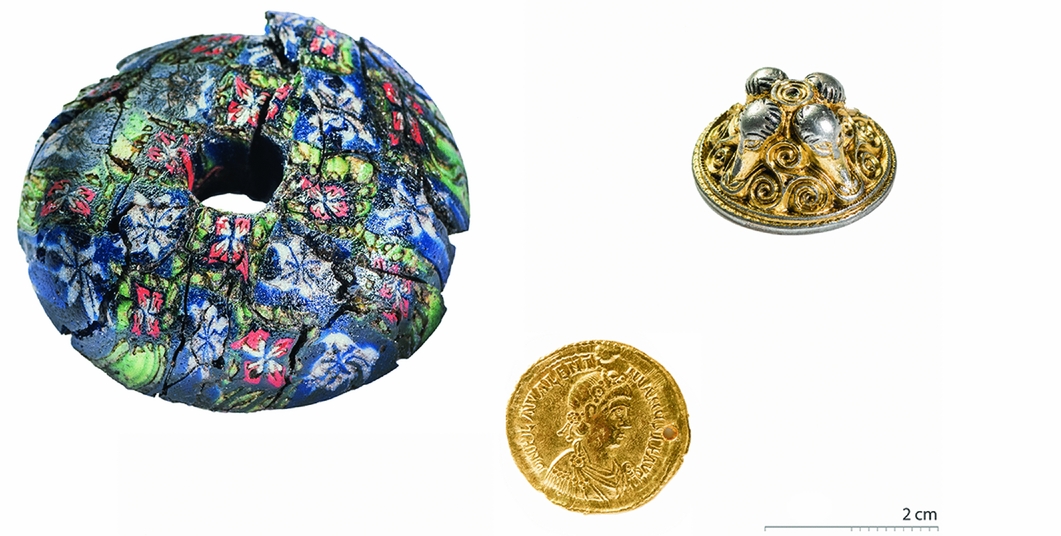
Ceramics were recovered in all of the excavated houses, in many cases in the form of fragmented but complete vessels. The entire site has been surveyed with metal detectors on several occasions, resulting in the recovery of bronze, silver, gold and some iron objects. Artefacts from the excavations include glass and silver beads, a gilded silver sword pendant, a large millefiori glass bead, a Valentinian III solidus (AD 425–455), yet another fragmented relief brooch and several other outstanding finds (Figure 6). Military equipment is limited to a handful of arrowheads, one lance-head and two or three unique sword details (Victor et al. Reference Victor, Emilsson and Frisk2013; Victor Reference Victor2015b). Dating of the massacre to the late fifth century is based mainly on typological evidence (Victor Reference Victor, Arnell and Papmehl-Dufay2015a). A current aim for the project is a major programme of 14C-dating, in which human and animal remains, as well as archaeobotanical material, will be dated. This will provide a solid base for understanding the chronology of the site.
A large millefiori glass sword bead, a Valentinian III solidus and a gilded silver sword pendant found on the floor of house 40. Photograph: Daniel Lindskog.
Defining a massacre
The term ‘massacre’ has several definitions, some with well-defined social or quantitative implications, and others more general in character. In modern times, massacres are typically connected to contexts of war, and the killing is often preceded by cruel acts of violence and abuse (Dutton et al. Reference Dutton, Boyanowsky and Harris Bond2005). In a study of the 1994 Rwanda genocide, massacre was defined as an event involving the killing of at least 100 people in a specific location in less than 3 days (Verwimp Reference Verwimp2006: 12). In a study focusing on the rationality of mass killing in civil war contexts in Algeria, massacre was defined as involving large-scale, face-to-face violence against civilians targeted in groups. Massacres were systematically used as a strategy for punishing and deterring civilian resistance (Kalyvas Reference Kalyvas1999: 246). Here, we use the word ‘massacre’ as referring to an act of intentional murder upon a mass of people who were not prepared for battle, with the killing being conducted by a group.
Body positions, spatial context and trauma
To date, the remains of a minimum of 26 human individuals have been found at Sandby borg (bioarchaeological interpretations provided by Alfsdotter, unless otherwise specified). The context of the skeletal remains is unusual. Animal and human skeletons were found articulated and disarticulated on the floors of houses and on the streets. At least nine human individuals were found in house 40 (Figure 7), which has been fully excavated. Three of these have been sexed as males, and another two display secondary masculine morphological traits. Six of the skeletons were articulated, and skeletal elements of at least another three individuals were found in a disarticulated state. There are no indications that the disarticulated skeletons were deliberately dismembered. Rather, the disarticulation of the remains is interpreted as resulting from post-mortem taphonomic processes (for a taphonomic interpretation of the human remains in Sandby borg, see Alfsdotter & Kjellström forthcoming). Among the disarticulated elements are three vertebrae of a young child aged approximately 2–5 years, and the femur of a 1.5–3-month-old infant.
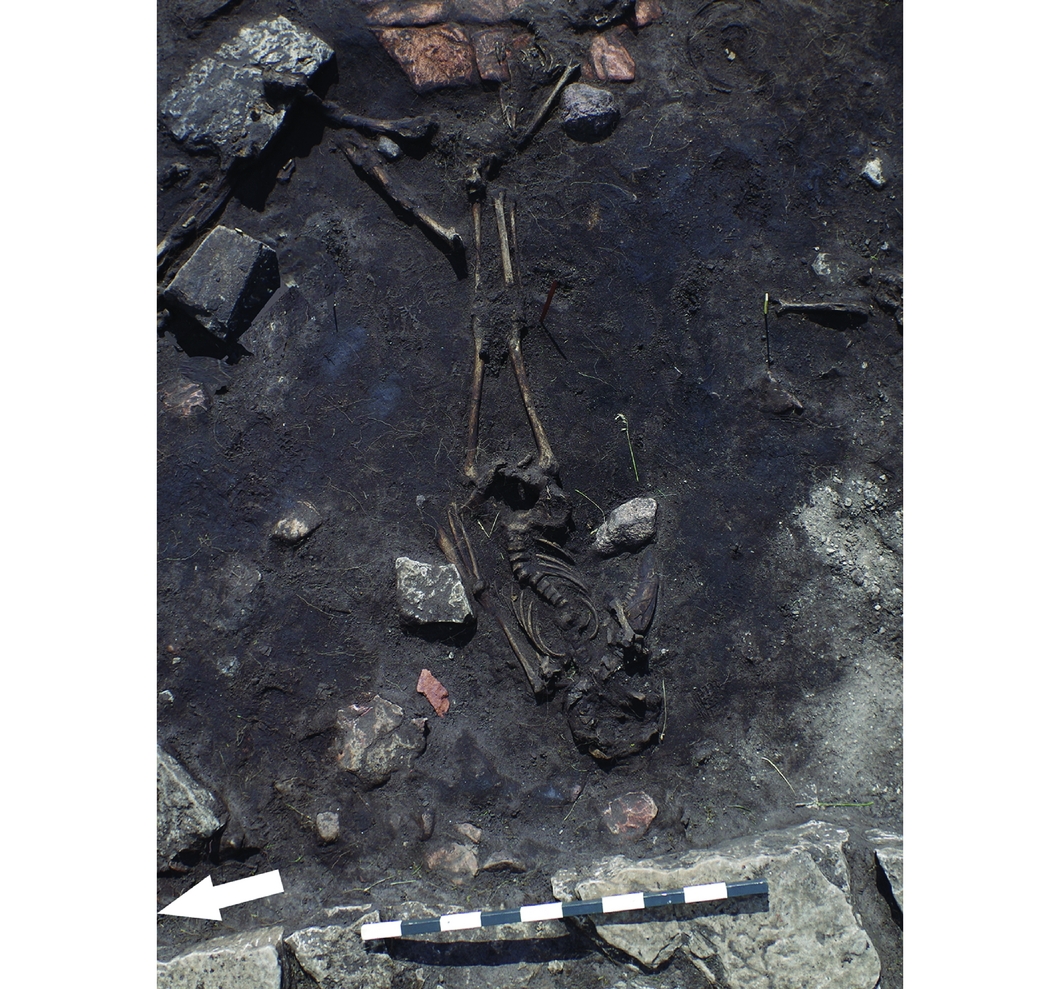
One of the nine human skeletons found on the floor level of house 40. This adolescent was found lying on their side. The white arrow points north. Photograph: Kalmar County Museum.
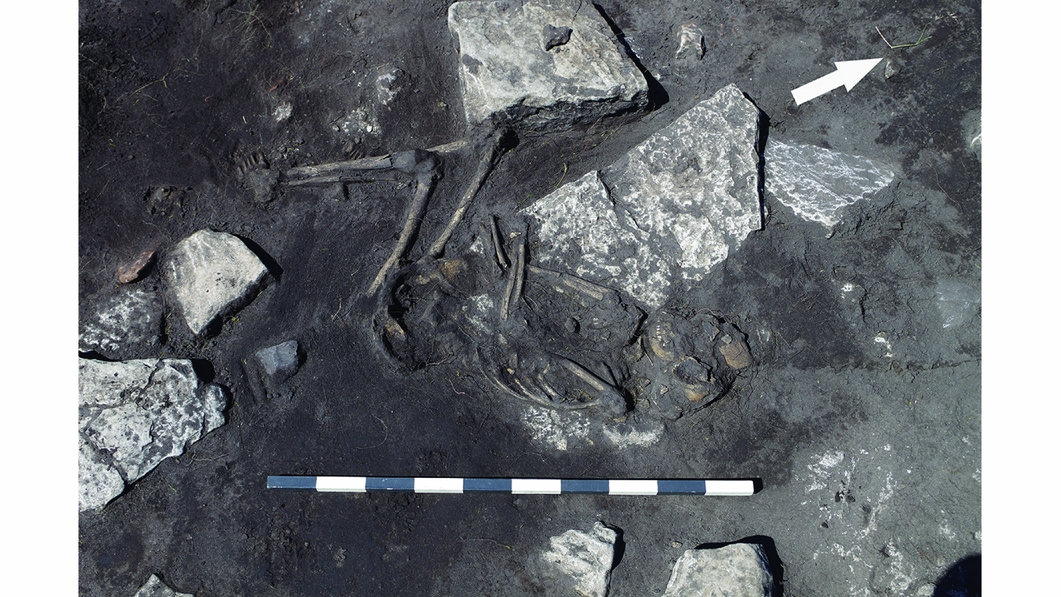
Perimortal interpersonal trauma has been identified on the skulls of at least four adults from house 40. The skull of one young adolescent displays signs of blunt-force perimortem trauma. Of the six articulated individuals, three were in extended positions (both prone and supine), indicating sudden death or unconsciousness before death. Two individuals had extended upper bodies with slightly flexed legs, and one adolescent was found lying on their side (Figure 8). The adolescent may have experienced a slower death, allowing him or her to flex. There is no evidence suggesting that the individuals were placed or moved after death (Alfsdotter & Kjellström forthcoming). One of the adolescents lay flat on their back, with their feet over the pelvis of an adult, suggesting that the adult was already lying motionless on the floor when the adolescent fell backwards over him.
The skeletal remains of two individuals inside house 40. The remains of the young teenager are stretched out, with the feet on top of the pelvis of an adult man, suggesting that the teenager fell backwards over the dead or dying adult. The adolescent (12–15 years old) displays perimortem blunt force on the skull (Gunnarsson et al. Reference Gunnarsson, Victor and Alfsdotter2016). The western house wall is at the bottom of the picture. The white arrow points north. Photograph: Kalmar County Museum.
Two of the human skeletons in house 40 were partially charred and disarticulated. The character of the thermal trauma suggests that fire consumed the bodies before the soft tissue had decomposed (Alfsdotter & Kjellström forthcoming). This suggests that raiders attempted to set some houses on fire, or that a fire broke out by accident. That the fire eventually extinguished itself before any bodies were completely charred is supported by the presence of charred logs inside the houses, and archaeobotanical samples containing charred roots and herb stems—presumably the remains of turf roofs (Gunnarsson et al. Reference Gunnarsson, Victor and Alfsdotter2016; Heimdahl Reference Heimdahl, Papmehl-Dufay and Alfsdotter2016). The majority of the excavated houses and their contents, however, were untouched by fire.
Disarticulated human and animal remains have been found in other houses and on the street surrounding the central block. In front of one of the houses, the partially articulated remains of a horse were discovered (Victor Reference Victor2015b). Several articulated dog and sheep skeletons were found inside the houses, suggesting that animals were left to starve or, in some cases, may have been killed during the attack (animal scavenging is discussed in Alfsdotter & Kjellström forthcoming). There are also remains stored in houses from animals that had been slaughtered and dismembered prior to the attack but not yet consumed. Archaeozoological analysis of the faunal assemblage is ongoing.
In house 52, which has only been partially excavated, the skeleton of an elderly man was found lying face down across the central hearth (Papmehl-Dufay & Alfsdotter Reference Papmehl-Dufay and Alfsdotter2016). Parts of the pelvis area were burnt, the extent of charring indicating that soft tissue was present when his body fell across the hearth. He was lying stretched out, with legs crossed and arms straight. His head was mostly absent due to taphonomic disturbance, apart from the lower jaw and some skull fragments. The body position and charring suggests that he fell face down over the still burning hearth, and that he was dead or unconscious when he fell.
The trauma evident on several skulls, on one man's shoulder and one man's hip resulted from blows aimed at the back or the side of the bodies. Perimortem damage resembling common battle injuries, such as parry fractures or facial trauma (Roberts & Manchester Reference Roberts and Manchester2007: 108–109), both typically produced when facing an opponent—has so far not been identified. This pattern leads us to conclude that the perpetrators comprised a large number of people, striking simultaneously in several houses, and that several of the victims were not in a position to defend themselves.
Demography of the massacred
Demographic observations can be made concerning the recovered individuals (at least 26 in number). All age groups are represented, from infants and young children to older adults. So far, none of the osteologically sexed skeletons display female morphological traits. Several of the skeletons, however, are those of sub-adults that cannot be sexed osteologically, and the poor preservation of some of the skeletons precluded sex determination.
The season of the massacre
The skeletons of eight lambs were found piled adjacent to a wall inside house 40. Osteological analysis reveals that the lambs were recently slaughtered and partially dismembered. The assemblage was probably stored in a now decomposed container. The lambs were all of similar age at the time of death, approximately 3–6 months old. As lambs are traditionally born during spring, the presence of newly slaughtered but uneaten lambs suggests that the assault was conducted sometime between late spring and early autumn (Gunnarsson et al. Reference Gunnarsson, Victor and Alfsdotter2016).
A moment frozen in time
The fact that articulated human and animal skeletons were found at the site shows that the ringfort was abandoned after the massacre. We encountered skeletons on the floors of the houses and on the surface of the streets, indicating the original ground surface (in the cases where the bodies had not originally fallen on top of furniture or similar). The articulated condition of several skeletons inside the houses—in some cases just inside the entrance—bears witness to the cessation of human activity after the assault. In houses where the roof turf did not collapse as a result of fire, the bodies would have been left to decompose unburied where they lay, until the houses eventually caved in (Alfsdotter & Kjellström forthcoming).
The extent of skeletal articulation as an indicator that the ringfort was left undisturbed is illustrated by a particular find in house 40. Adjacent to the fireplace, the articulated skeleton of half a herring was found (Victor Reference Victor2015b). The fact that the fragile and edible fish was left intact strongly suggests that human activity inside the house ceased immediately following the massacre. The large quantity of artefacts encountered on the original floor-level inside the houses strengthens the theory that the fort was not reused. In the southern part of house 40, for example, numerous glass and silver beads and half a relief brooch were found scattered over the floor.
Discussion
The archaeological context of Sandby borg is unusual in several respects. The human remains provide a snapshot of Migration Period violence with a level of detail rarely seen. The site also offers a rare opportunity to study aspects of everyday life of a Migration Period ringfort. Several observations strongly indicate that the entire site was abandoned suddenly, resulting in a detailed set of data concerning domestic life.
In many ways, the archaeology of Sandby borg relates to the archaeology and bioarchaeology of battlefields, mass graves and violence (e.g. Martin & Frayer Reference Martin and Frayer1997; Scott et al. Reference Scott, Willey and Connor1998; Knüsel & Smith Reference Knüsel and Smith2014; Loe et al. Reference Loe, Boyle, Webb and Score2014). The contextual circumstances at Sandby borg, however, still make it unique in the archaeological record. In most cases where human remains have been found in connection with battlefields or scenes of brutal violence, the bodies have been buried in mass graves (e.g. Ingelmark Reference Ingelmark and Thordeman1939; Biers Reference Biers1992; Fiorato et al. Reference Fiorato, Boylston and Knüsel2000; Kjellström Reference Kjellström2005; Štefan et al. Reference Štefan, Stránská and Vondrová2016). This is not the case at Sandby borg, where victims were instead left where they had been killed.
A lack of osteological evidence for females among the dead suggests that the massacre at Sandby borg may have been gender-biased towards the male inhabitants. This theory is weakened, however, by the relatively small area of the site excavated to date, and may be refuted through further excavation and analysis. The discovery of infant bones reveals that women were present at the site, although not necessarily at the time of the attack. The demographic composition of the victims at Sandby borg includes people of all ages, which is peculiar; the victims of battlefield violence usually represent particular segments of a population—people who have actively participated in acts of warfare (e.g. Štefan et al. Reference Štefan, Stránská and Vondrová2016).
The fact that many of the individuals were left unburied inside the ringfort indicates that nobody came back to tend the dead. Several scenarios are possible: all the inhabitants may have been killed; some may have been killed and others abducted; or some may have fled but were unable or unwilling to return. The evidence suggests that no survivors or neighbours could, or wanted to, enter the site after the massacre. The event most probably had a major long-term impact on surrounding settlements and inhabitants. Unlike many of the ringforts on the island of Öland (cf. Borg et al. Reference Borg, Näsman and Wegraneus1976; Näsman & Wegraeus Reference Näsman and Wegraeus1979), Sandby borg shows no signs of reuse after the Migration Period. In that respect it appears to be unique, although due to limited excavation, we cannot rule out the possibility that similar attacks were conducted at other ringforts.
The bioarchaeological material offers large quantities of data rarely encountered from this period and area. Besides details regarding the violent attack, the deaths of the victims and clues about spatial and architectural details, the human remains also provide vital knowledge concerning the victims' lives and general health. Inhumations from the Scandinavian Migration Period are rare, as cremation was the dominant burial custom (Bennett Reference Bennett1987; Hagberg & Beskow-Sjöberg Reference Hagberg and Beskow-Sjöberg1996). In this context, the Sandby borg human remains constitute an important source of data for analysis of stable isotopes, ancient DNA and bioarchaeology.
The evidence for interpersonal violence at Sandby borg contrasts with the almost total lack of weapons and military equipment. Finds of this type are limited to a couple of sword fittings, a small chape, a sword pendant, a lance head and a few arrowheads. Weapons such as swords, spears and shields were probably kept and used in large quantities at a site such as Sandby borg. This assumption is based mainly on the widespread occurrence of weapons in contemporaneous graves, the undisputed position of warrior ideology in Migration Period Scandinavia and the presumed military character of the site in general (Fabech Reference Fabech, Fabech and Ringtved1991; Rasch Reference Rasch, Fabech and Ringtved1991; Näsman Reference Näsman, Nørgård Jørgensen and Clausen1997; Olausson Reference Olausson and Olausson2000; Fischer Reference Fischer2005; Hedeager Reference Hedeager2011). The sparseness of evidence for weapons in the excavated and metal-detector-surveyed material could mean that they were removed from the scene following the massacre. While the motives for such an act can only be speculated upon, the widespread custom of depositing military equipment in lakes or marshes during the preceding Roman Iron Age (e.g. at Nydam and Illerup in Denmark, and at least two such deposits on Öland) could offer an explanation (Fabech Reference Fabech, Fabech and Ringtved1991). At the sacrificial bog of Skedemosse on Öland, six different deposits of weapons and military equipment have been identified, two of them dated to the Migration Period (Hagberg Reference Hagberg1967; Rau Reference Rau2005; Monikander Reference Monikander2010). These deposits include numerous swords, shield bosses, sword chapes, sword beads (decorative attachments on swords and scabbards, often made of glass; see Figure 6) and other sword details, and combs. While it is not possible to connect the bog directly to Sandby borg, the Skedemosse site does show that the custom of depositing military equipment in sacrificial bogs was practised on Öland at the time of the massacre.
The suggested date of the Sandby borg massacre corresponds to the period after the fall of the Western Roman Empire in AD 476, an event that had a significant impact on large parts of Europe, including southern Scandinavia (Lund Hansen Reference Lund Hansen1987; Fischer Reference Fischer2005; Heather Reference Heather2006; Hedeager Reference Hedeager2011). The assault on Sandby borg may have been the result of subsequent power struggles on the island, at a time when the political map and power structures were being rewritten across the European continent. Considerable quantities of important trade goods (e.g. wealth items and live animals) were destroyed or abandoned at the site. The massacre at Sandby borg cannot, therefore, be explained simply as an act of outright plunder. One possible scenario is that the perpetrators at Sandby borg established themselves as the new local ruling elite.
Conclusions
Combining osteological evidence of trauma with the archaeological context and the taphonomy of the skeletons has been crucial to our interpretations. We argue that a massacre was carried out at Sandby borg—probably at the end of the fifth century AD—and that the ringfort was abandoned immediately following this event. The dead individuals span all age groups but are gender-biased towards males. The site provides a snapshot of the moment of both the massacre and everyday life that was halted brutally. We do not interpret the massacre as an act of outright plunder, but rather as one that was connected to political instability during the turbulent Migration Period.


 Open access

