

5.1 Introduction
The idea of fossil fuel subsidy reform can be considered an ‘international norm’, usually defined as a ‘standard of appropriate behaviour’ (Finnemore and Sikkink Reference Finnemore and Sikkink1998: 891). Norms define what actors ought and ought not to do – respect human rights, for example, or ban chemical weapons. Contrary to binding laws and rules, norms are obeyed not (necessarily) because they are enforced but because they are seen as legitimate and contain a sense of ‘oughtness’ (Florini Reference Florini1996). This description captures fossil fuel subsidy reform quite well, as state support for fossil fuels is increasingly portrayed as deviant from ‘proper’ or ‘appropriate’ behaviour. Lord Nicholas Stern (2015), for example, called low taxes on coal consumption ‘unethical’ because they result in large-scale deaths and damage to others. Similarly, Fatih Birol, now the head of the International Energy Agency (IEA), declared that fossil fuel subsidies ‘do not make sense’ and are ‘public enemy number one’ (cited in Casey Reference Casey2013).
Looking at fossil fuel subsidy reform through the lens of international norms raises two questions. First, international norms are typically the products of advocacy by transnational networks and social movements (Keck and Sikkink Reference Keck and Sikkink1998). The fossil fuel subsidy reform norm, however, did not follow this traditional pattern. Instead, it more or less trickled down from above in 2009, when the leaders of the Group of 20 (G20) pledged to ‘phase out over the medium term inefficient fossil fuel subsidies’ (G20 2009). The very few non-governmental organisations (NGOs) that had worked on the issue were completely taken by surprise by this G20 commitment. How can we account for the top-down emergence of the fossil fuel subsidy reform norm in the absence of a networked international ‘movement’ led by transnational norm entrepreneurs? And why did the norm emerge in the late 2000s, even though the first calls for reform of fossil fuel subsidies can be traced back to the 1980s?
Second, the weak diffusion of the norm of fossil fuel subsidy reform is also puzzling. In spite of the commitment to phase out fossil fuels at the highest possible political level (the leaders of the G20), many states inside and outside the G20 continue to provide lavish support to fossil fuel consumers and, to a lesser extent, producers. Moreover, the issue has been generally overlooked in the international climate change regime (van Asselt and Kulovesi Reference van Asselt and Kulovesi2017; see Chapter 8). The absence of real action within the United Nations Framework Convention on Climate Change (UNFCCC) regime on fossil fuel subsidies is surprising given that fossil fuel subsidies can be regarded as a form of ‘negative climate finance’ (Brende Reference Brende2015) or even an ‘anti-climate policy’ (Compston and Bailey Reference Compston and Bailey2013). An efficient climate policy would first seek to eliminate fossil fuel subsidies and then explore ways to price carbon, yet international efforts have focused primarily on ways to price carbon, arguably putting the cart before the horse.
This chapter seeks to explain the top-down emergence and incomplete diffusion of fossil fuel subsidy reform as an international norm. Our focus lies on the international level. We first trace the long history of multilateral efforts to address fossil fuel subsidies, before interpreting the role of norm entrepreneurs, political opportunity structures and discursive contestation. A key conclusion that emerges from this is that the norm of fossil fuel subsidy reform remains essentially contested. In contrast to the established international consensus over how to define agriculture and fisheries subsidies, no common definition of energy subsidies has emerged, which hinders implementation of the norm. The norm of fossil fuel subsidy reform thus follows a broader pattern, recently identified by constructivist norm scholars, whereby very general norms have weak normative power because they permit a very wide range of interpretations. This often leads to their decay or irrelevance (e.g. Bailey Reference Bailey2008; Hadden and Seybert Reference Hadden and Seybert2016).
5.2 Genesis of the Fossil Fuel Subsidy Reform Norm
How did the norm of fossil fuel subsidy reform emerge? Here we describe the process of how international norms emerge along three stages. In the first stage, a norm is articulated by a set of norm entrepreneurs. In this process of norm building, norm entrepreneurs call attention to issues and set new standards of appropriate behaviour. In the second stage, the norm gets institutionalised in specific sets of international rules and organisations. This happens when norm entrepreneurs convince a critical mass of states (norm leaders) to embrace the new norm. The third stage involves the diffusion of the international norm as the norm leaders attempt to socialise other states to become norm followers.
Our three-staged model is inspired by the seminal work of Finnemore and Sikkink (Reference Finnemore and Sikkink1998), but it also differs from their model because we do not assume that these stages unfold in a strictly sequential manner. Some norms may indeed ‘cascade’ through the international system and eventually reach the stage of internalisation. This is the point where the norm gets a taken-for-granted character and is no longer a matter of broad public debate. For example, few people today would dispute the abolishment of slavery or the immunity for medical personnel during war (Finnemore and Sikkink Reference Finnemore and Sikkink1998). Other norms fare less well and may be subject to backsliding, reinterpretation, replacement and even complete disappearance.
Therefore, rather than seeing the norm of fossil fuel subsidy reform as a concept with a fixed meaning that evolves linearly, we subscribe to the more constructivist position of norms as ‘processes’ or as works in progress that have contested and shifting meanings. Norms are often agreed to in international treaties and organisations precisely because they mean different things to different actors (Wiener Reference Wiener2008; Krook and True Reference Krook and True2010; Bucher Reference Bucher2014). The articulation of the fossil fuel subsidy reform norm (e.g. determining which fossil fuel subsidies are ‘inefficient’) may continue well after the norm has been embraced in an international forum (e.g. the G20). The three stages laid out in the remainder of this section thus should be seen as overlapping and not as strictly separate or sequential.
5.2.1 Norm Articulation
There is a long history of international efforts to reform fossil fuel subsidies, but attention to the issue has waxed and waned over time, and the policy goals and justifications have shifted considerably. The first major multilateral effort to address energy subsidies was the 1951 Treaty Establishing the European Coal and Steel Community, the precursor to the European Union. This treaty expressly abolished and prohibited all ‘subsidies or aids granted by States’ to the coal sector, which were deemed ‘incompatible with the common market for coal’ (ECSC Treaty 1951: Article 4). However, since 1965, given the severe problems in this industry, exemptions from that rule became routine (Steenblik Reference Steenblik1999).
The 1980s was the first decade during which energy subsidies began to be scrutinised by NGOs and international organisations (World Bank 1982, 1983; Kosmo Reference Kosmo1987; IEA 1988). The global context was characterised by the rise of neoliberal ideology, with its emphasis on liberalisation, fiscal discipline and redirection of public expenditures. Against this backdrop, initial studies on energy subsidies emphasised their macroeconomic, fiscal and public revenue effects, rather than their environmental effects. A 1987 World Resources Institute study only briefly touched on the environmental consequences of energy subsidies while covering the macroeconomic and microeconomic effects to a much larger extent (Kosmo Reference Kosmo1987). The so-called Washington Consensus spread to developing countries through the Structural Adjustment Programmes of the International Monetary Fund (IMF) and the World Bank. As a result, energy consumption subsidies were reduced in most of the newly emerging countries of Central and Eastern Europe, and several African and Asian countries partially or completely deregulated their fuel prices in the 1980s and 1990s (Steenblik Reference Steenblik and Pauwelyn2009: 188).
As environmental issues were increasingly capturing global attention, a World Bank study for the first time calculated the potential carbon dioxide emission reduction gains from subsidy removals (Larsen and Shah Reference Larsen and Shah1992). The report caught the attention of the Group of 7 (G7) environment ministers in 1994, who recommended reducing ‘the currently high volume of environmentally damaging subsidies in the industrialised and in the developing countries’ (G7 1994a). This statement was noteworthy because fossil fuel subsidy reform was no longer solely justified on fiscal (economic) grounds but also on climate change (environmental) grounds. More importantly, industrialised states acknowledged that they had environmentally damaging subsidies in place. Yet, at the subsequent G7 leaders’ meeting in Naples, this issue was not raised in the final communiqué (G7 1994b).
Attention to the issue of energy subsidies waned until the IEA decided to make it a key focus of its 1999 World Energy Outlook (IEA 1999). The IEA noted that ‘very few detailed quantitative estimates exist of the true costs of energy subsidies’ and that ‘information is particularly poor for developing countries, which are projected to contribute two-thirds of the world’s incremental energy demand in the next twenty years’ (IEA 1999: 9). In other words, pricing distortions were emerging as a key uncertainty in the outlook for energy demand growth and were hence complicating the IEA’s mission to develop global energy scenarios. The IEA framed the issue of energy subsidies in terms of both public spending and environmental stewardship. The report received a lot of press, and the IEA decided to continue working on this issue.Footnote 1
It is remarkable to see how, from the very beginning, there have been different articulations of the norm. In fact, the norm has never been consistently defined or measured. In its 1988 study of coal subsidies, the IEA applied the Organisation for Economic Co-operation and Development’s (OECD) producer-support estimate approach (IEA 1988). Larsen and Shah (Reference Larsen and Shah1992) of the World Bank combined the price-gap approach with elasticities to estimate the welfare and environmental costs of energy subsidies. More recent work by the IMF (Coady et al. 2015a) even frames the absence of Pigouvian taxes on negative externalities as a subsidy.Footnote 2 The lack of a common definition of energy subsidies meant that the ongoing work in the 1980s and 1990s was piecemeal and largely non-cumulative. Most studies were done in the form of case studies, but since each started from a different definition and followed a different format, the findings were not comparable across the cases. The upshot is that, today, ‘nobody refers back to that work’.Footnote 3 The lack of consensus over what fossil fuel subsidies are, and how they should be measured, continues to fuel norm contestation to this very day (see Chapter 2).
5.2.2 Norm Institutionalisation
Bernstein (Reference Bernstein2001: 30) defines ‘norm institutionalisation’ as the ‘perceived legitimacy of the norm as embodied in law, institutions, or public discourse even if all relevant actors do not accept or follow it’. It can be inferred primarily from ‘the norm’s frequency or “density” in social structure, that is, the amount and range of instruments, statements, and so on, that invoke the norm’ (Bernstein Reference Bernstein2001: 30).
The institutionalisation of the norm of fossil fuel subsidy reform received a shot in the arm in 2009 when the G20 leaders pledged to rationalise and phase out fossil fuel subsidies at their Pittsburgh summit (G20 2009). A few months later, the Asia-Pacific Economic Cooperation (APEC) countries adopted a similar voluntary commitment (APEC 2009), which added 11 new countries to the group committing to the phase-out. While a number of NGOs and international organisations had raised the issue before, many of them were surprised that the G20 took up the issue. Leadership by the Obama administration and the wider context of the global financial crisis were instrumental in getting the issue onto the G20’s agenda (see Section 5.3). The G20 and APEC endorsements of fossil fuel subsidy reform arguably represented what Finnemore and Sikkink (Reference Finnemore and Sikkink1998: 901) call the ‘tipping point’: the moment ‘at which a critical mass of relevant state actors adopt the norm’.
By committing in 2009 to phase out ‘inefficient’ fossil fuel subsidies over ‘the medium term’ and by reiterating the commitment every year until 2016, the G20 set in motion a process whereby the fossil fuel subsidy reform campaigners gained a larger supporting constituency. To implement its strategy, the G20 asked four relevant institutions – the IEA, the Organization of the Petroleum Exporting Countries, the OECD and the World Bank – to ‘provide an analysis of the scope of energy subsidies and suggestions for the implementation of this initiative’ (G20 2009). Several follow-up reports were commissioned, ensuring that the issue of fossil fuel subsidies gained primary attention in those organisations as well. Not only international organisations but also national finance and energy ministries started addressing the issue of fossil fuel subsidy reform when the G20 countries were asked to prepare national reports on fossil fuel subsidies.
The fossil fuel subsidy reform norm gradually made its way into the United Nations (UN) sphere and was included in the final reports of the Advisory Group on Climate Change Financing (2010), the High-Level Panel on Global Sustainability (2012), and the Third Financing for Development Conference (2015). Prior to the UN Rio+20 Conference (2012), there was a huge push from NGOs to make fossil fuel subsidy reform the lead issue within the energy goal of the new Sustainable Development Goals, but the issue was too contentious. In the end, fossil fuel subsidy reform was moved from Goal 7 (on Secure, Sustainable Energy) to Goal 12 (on Sustainable Production and Consumption), where it was mentioned as a possible means of implementation. For NGOs like the Global Subsidies Initiative, this represented a step backwards, since ‘the wording is no longer a goal, no longer linked to energy, does not include an end date, and is no longer about a phase out’ (Merrill Reference Merrill2014).
Efforts to graft the issue of fossil fuel subsidy reform onto the agenda of global climate negotiations also largely failed. The UNFCCC does not mention fossil fuel subsidies even once, whereas the Kyoto Protocol only includes a vague reference to ‘subsidies in all greenhouse gas emitting sectors’ in an illustrative list of policies and measures, leaving it up to the parties to decide which policies to implement (van Asselt and Skovgaard Reference van Asselt, Skovgaard, Van de Graaf, Sovacool, Ghosh, Kern and Klare2016; see Chapter 8). During the December 2015 climate negotiations in Paris, a proposal urging countries to ‘reduce international support for high-emission investments’ appeared in the penultimate draft text but was cut from the final version (UNFCCC 2015: 6). Countries could refer to fossil fuel subsidy reform as part of their nationally determined contributions, but only 14 countries did so in the run-up to the climate summit in Paris (Terton et al. Reference Terton, Gass, Merrill, Wagner and Meyer2015).
Despite these setbacks at the United Nations, a few months later the leaders of the G7 pledged to ‘remain committed to the elimination of inefficient fossil fuel subsidies and encourage all countries to do so by 2025’ (G7 2016). This was the first commitment related to fossil fuel subsidy reform that included an implementation date. At the subsequent G20 Hangzhou summit in September 2016, the first voluntary peer reviews were presented of the reform efforts of China and the United States (G20 2016). Two other members, Germany and Mexico, volunteered to be next subjected to peer review. Their reviews were presented in November 2017.
5.2.3 Norm Diffusion
Over the past few years, numerous countries have initiated fossil fuel subsidy reform to some degree, as documented in various chapters in this book. In 2014 alone, almost 30 countries implemented fossil fuel subsidy reform (Merrill et al. Reference Merrill, Harris, Casier and Bassi2015), including countries such as Ukraine and Saudi Arabia that had no (recent) history of attempted reforms. Whether these reforms will stick if crude oil prices rise again remains to be seen, as there are many historical examples of countries reversing reforms. Yet the impact of the implemented reforms in the wake of the G20 commitment is real and tangible. The IEA has calculated that without the national reforms undertaken since 2009, the value of fossil fuel consumption subsidies would have been 24 per cent higher in 2014, putting the level of these subsidies at USD 610 billion instead of USD 493 billion (IEA 2015: 96–97).
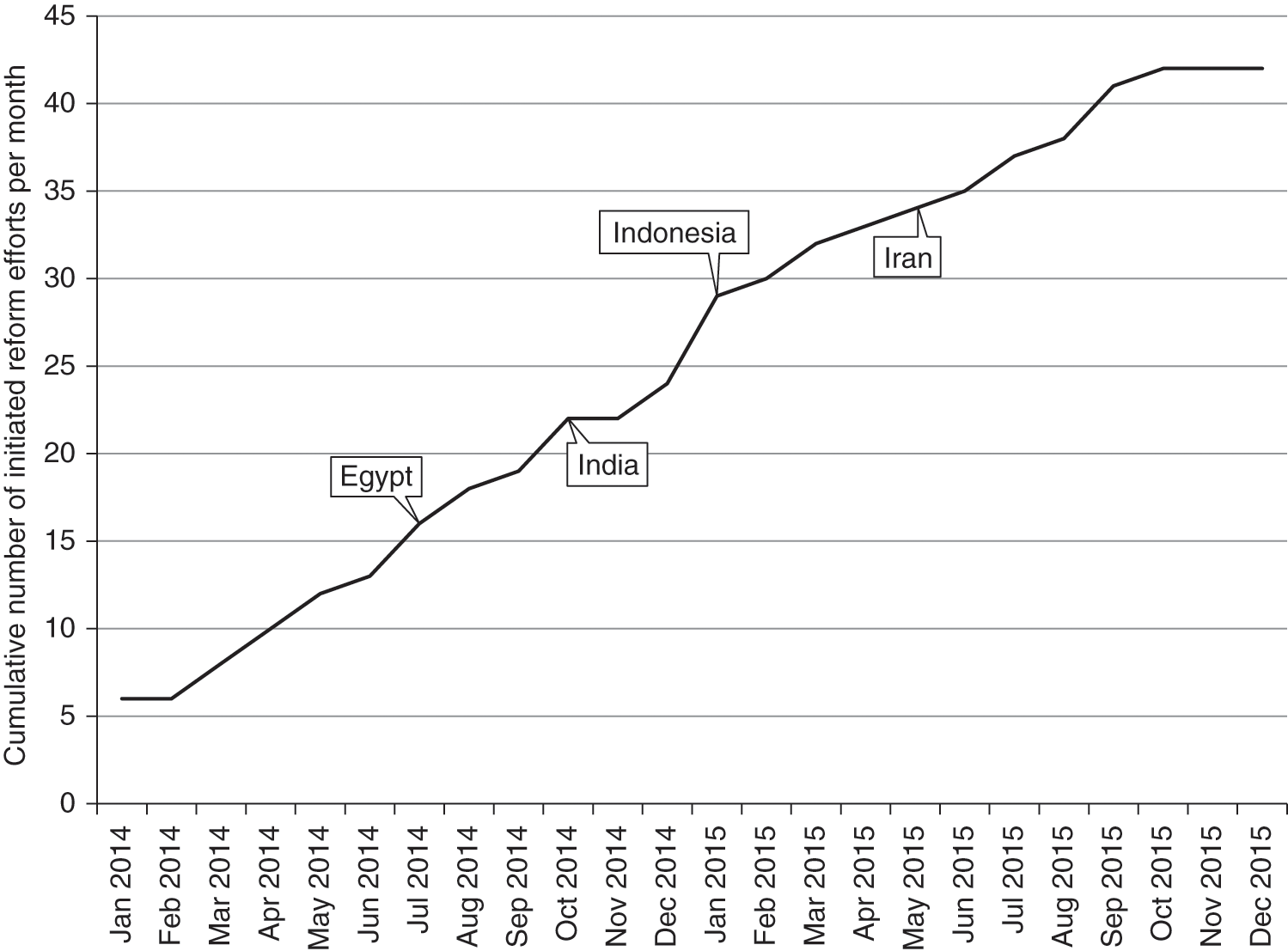
Figure 5.1 shows the cumulative monthly number of initiated reform efforts in the period 2014–15. This figure was compiled using data from the IEA (2015) and the Global Subsidies Initiative. There are four important considerations to keep in mind. First, since the figure counts reform efforts, countries can appear more than once. Iran, for example, raised gasoline prices by 75 per cent in April 2014 and then by another 25 per cent in May 2015. These reforms are counted separately. Second, the figure only counts initiated reform efforts and does not trace whether or not the reforms have been sustained. Third, the figure shows that there is a wave of countries initiating reforms, including large countries such as India, Indonesia, Nigeria and Egypt, which are highlighted on the chart. However, it is hard to tell whether the global pace of fossil fuel subsidy reform has accelerated after 2009 due to the lack of adequate and comparable historical data. International organisations have only recently started to compile databases of fossil fuel subsidies. The IEA’s fossil fuel subsidy database, for example, only goes back to 2012. Fourth, measuring energy subsidies is also hampered by the varying definitions of what constitutes a subsidy and different ways of measuring them. The bulk of subsidy reforms reported here was calculated with the price-gap method (see Chapter 2).
It is clear that fossil fuel subsidies are still widespread, even in many G20 countries. The institutionalisation of the norm of fossil fuel subsidy reform in global forums thus should not be conflated with genuine norm adoption and internalisation (Finnemore and Sikkink Reference Finnemore and Sikkink1998).
5.3 Key Drivers Behind the Fossil Fuel Subsidy Reform Norm
The concept of fossil fuel subsidy reform rarely came up until 2005, but in recent years more than 40 efforts to reform fossil fuel subsidies have been initiated. What explains the emergence of fossil fuel subsidy reform as an international norm? Drawing on recent scholarship on international norms (Wunderlich Reference Wunderlich, Wunderlich and Müller2013), we highlight the role of norm entrepreneurs, political opportunity structures and discursive contestation in shaping the emergence and uneven diffusion of the fossil fuel subsidy reform norm.
5.3.1 Norm Entrepreneurs
There is a large consensus in the literature that ‘norm entrepreneurs’ play a key role in both the emergence and further development of norms (Finnemore and Sikkink Reference Finnemore and Sikkink1998; Bucher Reference Bucher2014). Norm entrepreneurs may operate from organisational platforms such as NGOs, transnational advocacy networks or standing international organisations that have their own distinct purposes and agendas. Norm entrepreneurs can therefore be non-state as well as state actors (Wunderlich Reference Wunderlich, Wunderlich and Müller2013: 33).
The fight against energy subsidies was spearheaded in the 1980s by NGOs (most notably the World Resources Institute) and international organisations (particularly the IEA and the World Bank). These actors and institutions all contributed to placing fossil fuel subsidy reform on the global agenda. Between 2005 and 2009, the issue had been addressed by several NGOs, including Oil Change International and Earth Track, mostly from a climate change perspective. In 2005, the Global Subsidies Initiative was established within the International Institute for Sustainable Development, the first NGO to focus squarely on the issue of subsidy reform (see Chapter 10). Fossil fuel subsidy reform was a central part of the Global Subsidies Initiative’s long-term strategy, set out at a meeting in the margins of the December 2005 World Trade Organization (WTO) Ministerial Meeting in Hong Kong. Yet, in its early days, the Global Subsidies Initiative focused mostly on biofuel and irrigation subsidies. The newly created NGO wanted to ‘cut its teeth first on subsidies that few were addressing before taking on the much larger and challenging subject of fossil fuel subsidies’ (Steenblik Reference Steenblik2016).
It is hard to overstate the role of the Obama administration in promoting the fossil fuel subsidy reform norm on the international stage. The September 2009 G20 Pittsburgh Summit was the first chance for the newly elected US President Barack Obama to host and chair a summit and thus make history at home on a central world stage. The idea to act on fossil fuel subsidies was pushed by Lawrence Summers, then director of the National Economic Council, who had long opposed such subsidies. It was presented at the Sherpa meeting only two weeks before the actual summit. The idea was to ‘creatively link climate change to the financial and fiscal issues at the G20 agenda’s core’ (Kirton and Kokotsis Reference Kirton and Kokotsis2015: 229). When the G20 partners did not oppose to the general idea, ‘the Americans seemed pleased and surprised that they had gotten so far with the fossil fuel subsidies initiative’ (Kirton Reference Kirton2013: 302).
Many of the above-mentioned NGOs, including the Global Subsidies Initiative, were caught completely off guard when the G20 made the pledge to phase out fossil fuel subsidies at their Pittsburgh Summit (Chapter 10). Ronald Steenblik, a long-time expert on energy subsidies at the OECD and former research director of the Global Subsidies Initiative, only heard about the G20 pledge one week before the summit.Footnote 4 In other words, NGOs and international organisations did not influence the G20 agenda through direct lobby efforts but may have influenced the G20 agenda indirectly by exerting ideational power – that is, by conveying information, providing advice and identifying new policy options.
The Friends of Fossil Fuel Subsidy Reform (FFFSR), an informal coalition of non-G20 countries led by New Zealand, is helping to sustain momentum on fossil fuel subsidy reform (see Chapter 9).Footnote 5 Established in June 2010, the group advocates for reform through three interrelated principles: increased transparency around fossil fuel subsidies, greater ambition in the scope of reform and the provision of targeted support for the poorest (FFFSR 2015). The FFFSR has organised meetings and summits, published statements and hosted side events at the annual Conferences of the Parties to the UNFCCC, often in cooperation with the Global Subsidies Initiative. The FFFSR group was created in analogy to existing groups of like-minded WTO members – such as the Friends of Fish, Friends of Special Products and Friends of Anti-Dumping Negotiations – that act as informal negotiation coalitions within the WTO or other international trade, development or environment contexts. The FFFSR group appears to be largely focusing on the reform of consumption subsidies (a problem largely for developing countries) rather than on production subsidies (recurrent in both developing and industrialised countries).
5.3.2 Political Opportunity Structures
Agents do not exist in a vacuum but instead operate in shifting contexts. The importance of these settings is captured by the term ‘political opportunity structures’, generally referring to the nature of resources and constraints that are external to norm entrepreneurs. Particularly important exogenous factors are crises and so-called focusing events. A crisis situation usually leads policymakers to question conventional policy wisdom and thus opens a window of opportunity for new policy ideas. Norm entrepreneurs can capitalise on the opportunity by framing the policy issue at hand in a new way (Baumgartner and Jones Reference Baumgartner and Jones1993).
The G20 Pittsburgh Summit, organised in the midst of a global financial and economic meltdown, primarily addressed the critical transition from global crisis to recovery. It focused on turning the page on an era of ‘irresponsibility’ by adopting a set of reforms through the G20 Framework for Strong, Sustainable and Balanced Growth (G20 2009). The financial crisis led global leaders to rethink embedded wisdoms on economic growth, thus creating a political window of opportunity for fossil fuel subsidy reform to be grafted onto the global sustainable-development agenda. The G20, under the auspices of President Obama, pushed for ‘sustained and systematic international cooperation’ and a ‘credible process for withdrawing extraordinary fiscal, monetary and financial sector support’ (G20 2009). The crisis proved to be a useful window of opportunity in political terms to advocate for fossil fuel subsidy reform based on a convergence of fiscal, macroeconomic, distributive and environmental arguments.
Another important contextual factor is the international price of oil. Albeit economically inefficient, energy subsidies provide economic benefits to actors who consume fossil fuels and producers who extract them. Interest groups that demand subsidies are mostly well organised, while simultaneously the beneficial effects of these subsidies strengthen these interest groups’ awareness of their need to sustain policy subsidies (Victor Reference Victor2009: 7). Here it is important to differentiate between consumer and producer subsidies: consumer subsidy reform is easier when oil prices are low. Under low oil prices, such as in the period between 2014 and 2016, the economic and political costs of consumption subsidy cancellation or reform are less severe than under high oil prices. As a result, ‘a rational interest group that benefits from fuel subsidies lobbies less aggressively for their continuation when oil prices decrease’ (Benes et al. Reference Benes, Cheon, Urpelainen and Yang2015: 10). Reform of producer subsidies, by contrast, should in theory be easiest when prices are high, as they were between 2010 and 2014.Footnote 6 When fossil fuel prices are low, we would expect producers to lobby harder for their subsidies because they account for a higher relative share of their net profits due to the lower prices for their products.
5.3.3 Discursive Contestation
The third driving force of the dynamic evolution of norms is ‘discursive contestation’. In constructing their cognitive frames, norm entrepreneurs face opposition from firmly embedded norms and frames that create alternative perceptions of both appropriateness and interest (‘external contestation’). For example, fossil fuel subsidies are still often represented as social policy, helping to bring energy services to the poor, particularly in rural areas. They have also been justified on the grounds of redistributing national wealth, fostering energy security or promoting economic development by supporting energy-intensive industries (Commander Reference Commander2012; Strand Reference Strand2013). Supporters of fossil fuel subsidy reform counter these arguments by pointing to the fiscal, economic, environmental and distributional costs of fossil fuel subsidies (Coady et al. Reference Coady, Flamini and Sears2015b; Rentschler and Bazilian Reference Rentschler and Bazilian2017). They argue that governments may reap political benefits from offering a salient and visible bonus to their citizens (Victor Reference Victor2009).
There can also be contestation among the supporters of the norm themselves (‘internal contestation’), often on matters of definition (Krook and True Reference Krook and True2010; see also Chapter 2). Such controversy usually plays out in the form of ‘frame contests’, whereby actors promote competing discourses that differ in how they make sense of different situations and events, attribute blame or causality and suggest lines of action (Schön and Rein Reference Schön and Rein1994). Critical constructivist scholars argue that such norm contestation is a permanent feature of any normative system (Wiener Reference Wiener2008).
The vague description of fossil fuel subsidies at the G20 Pittsburgh Summit demonstrates that framing an international norm is a highly strategic process. The concept of fossil fuel subsidy reform was not defined in the summit’s outcome document, and no specification was given to the terms ‘rationalise’, ‘medium term’ and ‘inefficient’. If a detailed definition had been given, many countries would have probably not accepted the Pittsburgh pledge to phase out fossil fuel subsidies. The BRICs group (Brazil, Russia, India and China), with India as their agent, succeeded in including the word ‘rationalise’ in the commitment (Kirton and Kokotsis Reference Kirton and Kokotsis2015: 230). Saudi Arabia was less successful when it tried to replace the term ‘fossil fuel subsidies’ with the more generic ‘energy subsidies’, thus targeting, among other things, subsidies for biofuels. After the summit, Saudi Arabian authorities were quick to claim that the country’s subsidies were not ‘inefficient’ and therefore should not be subject to reform (Lahn and Stevens Reference Lahn and Stevens2011: 12–13).
Many G20 countries made a similar argument in their reports submitted after Pittsburgh. Of the 20 member countries, eight stated that they had no ‘inefficient’ fossil fuel subsidies that needed to be phased out, including two (the United Kingdom and Japan) that provided no information at all.Footnote 7 The number of countries opting out of reporting entirely tripled from two in 2010 to six in 2011 (Van de Graaf and Westphal Reference Van de Graaf and Westphal2011). The emerging norm of fossil fuel subsidy reform is thus a perfect illustration of the argument that the institutionalisation of norms in international forums and treaties should not be conflated with the genuine adoption of the norm. The success of international agreements or conventions often depends on the impreciseness of their content, or as Wiener (Reference Wiener2004: 198) puts it, ‘detail is not necessarily conducive to agreement.’ A broad and often imprecise formulation fosters a broader adoption of the norm precisely because the norm means different things to different people. Therefore, it maximises the potential for consensus but complicates the task of determining what types of behaviour constitute a violation of the norm (Krook and True Reference Krook and True2010: 110).
There is not just disagreement over what constitutes a fossil fuel subsidy but also over how to best measure its different elements (IISD 2014). The IEA follows the above-mentioned ‘price-gap approach’ in defining energy subsidies as ‘any government action that concerns primarily the energy sector that lowers the cost of energy production, raises the price received by energy producers or lowers the price paid by energy consumers’ (IEA 2006: 1). The OECD, by contrast, follows the ‘inventory approach’ and defines ‘energy subsidies’ (or ‘support’ as it prefers to call them) as ‘[a] result of a government action that confers an advantage on consumers or producers [of energy], in order to supplement their income or lower their costs’ (OECD 2010: 191). This definition is based on the WTO’s Agreement on Subsidies and Countervailing Measures, according to which a subsidy only exists when it confers a benefit to a specific party, and is meant to be consistent with the OECD’s treatment of government support to agriculture and fisheries. The OECD recognises the fossil fuel consumption subsidies measured by the IEA as an important component of total support to fossil fuels, but it does not measure such subsidies itself because to do so would constitute a duplication of effort. Thus, the OECD views its estimates as complements to those of the IEA, its sister organisation.
The lack of a consensus over the definition and measurement of energy subsidies is not merely a technical matter but a deeply political one. It translates into hugely varying estimates of the size of energy subsidies, ranging from USD 325 billion (IEA 2016) to USD 5.3 trillion in 2015 (Coady et al. Reference Coady, Parry, Sears and Shang2015). These diverging estimates obviously convey different messages about the magnitude and urgency of the policy issue at hand and what kinds of reform (if any) are recommended. The disagreement over what should be counted and how is thus an inherently value-laden exercise (Van de Graaf and Zelli Reference Van de Graaf, Zelli, Van de Graaf, Sovacool, Ghosh, Kern and Klare2016). The IEA’s estimate of USD 325 billion covers most consumer subsidies, which are especially rampant in non-OECD countries, but it leaves out production subsidies, which might actually contribute to the energy security of the IEA’s member governments, still the agency’s primary objective. Economists at the IMF typically frame energy subsidies in terms of fiscal stability, which is related to the organisation’s core tasks, but their estimates also factor in various externalities, such as climate change, air pollution, and traffic congestion. In WTO terms, subsidies are only relevant insofar as they are trade distorting because that could make them legally actionable. In sum, when actors define energy subsidies differently, they construct different policy problems according to their value stance.
5.4 Conclusion
This chapter has examined the drivers behind the development of fossil fuel subsidy reform as an emerging international norm. Our analysis reveals that the initial articulation of the fossil fuel subsidy reform norm can be clearly linked to specific norm entrepreneurs. The anti-subsidies campaign has been backed by an informal coalition of NGOs (most notably the Global Subsidies Initiative, Oil Change International and the World Resources Institute), policymakers (notably the Obama administration) and international organisations and their staff (the IEA, IMF, OECD and World Bank). The Obama administration was probably the most important norm entrepreneur; without its leadership, the norm would have not reached the same level of institutionalisation. The global financial crisis also played a key role in turning the attention of the G20 to fossil fuel subsidy reform.
The norm is also characterised by internal and external contestation and discursive cleavages. Neither the definition of ‘fossil fuel subsidies’, nor the precise meanings of ‘inefficient’ or ‘reform’, have been settled. It has become clear that different alternative framings of the norm coexist, targeting different audiences. Efforts to forge a common definition of fossil fuel subsidies, or a common methodology, among international organisations are likely to falter. However, a division of labour among international organisations may be emerging, such as between the IEA and the OECD, who view their estimates of fossil fuel subsidies as complementary. Such acts of coordination could bring more coherence to the fragmented landscape of international organisations that govern energy subsidies (Van de Graaf and van Asselt Reference Van de Graaf and van Asselt2017).
The availability of more data on fossil fuel subsidies and on how reform strategies can be successfully implemented might in itself spur more countries to enact reforms. To the extent that this happens, the diffusion of the norm of fossil fuel subsidy reform may come to rely less on the mechanism of moral persuasion (a communicative process through which actors convince each other that subsidy reform is ‘the right thing to do’) and more on learning (the experience of others provides new information on the effectiveness of policies, leading to an update of causal beliefs) and emulation (the desire of actors to conform to widespread social practices).
Clearly, the fossil fuel subsidy reform norm has not yet reached the stage of being ‘taken for granted’. While this chapter has described the emergence and uneven diffusion of the norm, it did not assess the causal influence of the international norm on actual domestic policy reforms. If countries reformed fossil fuel subsidies in the 1980s and 1990s without referring to it as such and before the norm emerged in the G20, to which degree are the recent domestic reforms the result of the norm being diffused? Future studies could attempt to parse out the effects of the 2009 pledge on the global level of subsidies. In addition, they could look more closely into the causal mechanisms through which fossil fuel subsidy reform as a (contested) norm influences domestic policy processes; for example, it may empower certain constituencies or shift the framing and content of specific reforms.
These questions show that analysing fossil fuel subsidy reform from an international norm perspective opens up a promising area for governance and policy scholars, one that we believe can yield both valuable theoretical and empirical insights.
Acknowledgements
We are grateful to Laura Merrill, Ron Steenblik and the anonymous reviewers for valuable comments on earlier drafts of this chapter.

 Open access