

Understanding the nature and evolution of ideological orientation has been the focus of many studies (Hibbing et al., Reference Hibbing, Smith and Alford2014; Johnston et al., Reference Johnston, Lavine and Federico2017). Recent research has recognized that, in addition to social environment, biological factors impact political cognition and behavior (Fournier et al., Reference Fournier, Soroka and Nir2020; Fowler & Schreiber, Reference Fowler and Schreiber2008; Gruszczynski et al., Reference Gruszczynski, Balzer, Jacobs, Smith and Hibbing2013; Kim et al., Reference Kim, Hur, Kwak, Jang, Lee and Kwon2020; Tsakiris et al., Reference Tsakiris, Vehar and Tucciarelli2021). An emerging line of research reveals that people’s motivational reactivity, an indicator of how strongly people react to negative and positive stimuli in the environment, also correlates with political ideology (Dodd et al., Reference Dodd, Balzer, Jacobs, Gruszczynski, Smith and Hibbing2012; Hibbing et al., Reference Hibbing, Smith and Alford2014; Oxley et al., Reference Oxley, Smith, Alford, Hibbing, Miller, Scalora and Hibbing2008). However, explanations of the exact relationship between motivational reactivity and ideology are contested.
The classic view of the relationship between motivational reactivity and political ideology is that a certain motivational reactivity pattern causes the adoption of a particular political ideology; for example, sensitivity to negativity—defensive system activation (DSA)—leads to conservative ideology (Hibbing et al., Reference Hibbing, Smith and Alford2014; Janoff-Bulman & Carnes, Reference Janoff-Bulman and Carnes2013b). However, empirical support for the classic view is mixed (e.g., Bakker et al., Reference Bakker, Schumacher, Gothreau and Arceneaux2020; Oxley et al., Reference Oxley, Smith, Alford, Hibbing, Miller, Scalora and Hibbing2008; Tritt et al., Reference Tritt, Page-Gould, Peterson and Inzlicht2014). In contrast with the classic view, a more recent account argues that the relationship between motivational reactivity and ideology is subject to social-environmental modulations (Hatemi & McDermott, Reference Hatemi and McDermott2012; Pliskin et al., Reference Pliskin, Ruhrman and Halperin2020). The dynamic coordination account (see DeScioli & Kurzban, Reference DeScioli and Kurzban2013), in particular, argues that motivational reactivity modulates people’s political ideology in response to their proximal social context. Specifically, reactivity to positivity—that is, appetitive system activation (ASA)—should relate to the adoption of minority political ideology and moral stances on social principles (i.e., social morality), whereas reactivity to negativity should correlate with adoption of majority political and social moral stances. This study tested these two competing hypotheses in a liberal-leaning context, where the classic hypothesis predicts that DSA will be positively associated with a conservative stance and the dynamic coordination account predicts that DSA will be positively associated with a liberal stance.
The classic view
The classic view argues that differences in people’s morality and political ideology are derived from underlying differences in their motivational reactivity. The first approach theorizes that conservatives demonstrate greater sensitivity to negative stimuli than liberals (e.g., Inbar et al., Reference Inbar, Pizarro and Bloom2009; Oxley et al., Reference Oxley, Smith, Alford, Hibbing, Miller, Scalora and Hibbing2008). Hibbing et al. (Reference Hibbing, Smith and Alford2014) synthesized existing research and proposed that heightened response to negativity (which they referred to as negativity bias) is a causal mechanism of conservatism (Hibbing et al., Reference Hibbing, Smith and Alford2014, p. 304).
The second approach under the classic view argues that political ideologies reflect distinct social moral principles that arise from different motivational reactivity patterns. The model of moral motives (MMM; Janoff-Bulman & Carnes, Reference Janoff-Bulman and Carnes2013b, Reference Janoff-Bulman and Carnes2016) argues that conservatism is broadly based on DSA, and liberalism is based on ASA. MMM is thought to provide a more comprehensive typology of group-binding moralities for liberals and conservatives compared with the moral foundation theory. While the moral foundation theory argues that liberals rely less on group-binding moralities such as loyalty and authority than conservatives, MMM argues that liberals and conservatives just endorse different group-binding moralities (Haidt, Reference Haidt2013; Janoff-Bulman & Carnes, Reference Janoff-Bulman and Carnes2013a). Specifically, conservatives tend to be higher in social order morality, which emphasizes group conformity and behavioral norms, while liberals are higher in social justice morality, which emphasizes communal responsibility and mobilizes collective efforts to enhance group welfare (Janoff-Bulman & Carnes, Reference Janoff-Bulman and Carnes2016).
The classic account suggests that certain motivational reactivity patterns have a somewhat stable relationship with certain social moralities and political ideologies. Three hypotheses can be derived from these two approaches to the classic view:
H1: Defensive system reactivity should be positively correlated with conservatism.
H2a: Defensive system reactivity should be positively correlated with social order morality.
H2b: Appetitive system reactivity should be positively correlated with social justice morality.
The classic view on the relationship between motivational reactivity and political ideology has received mixed support. For example, Tritt et al. (Reference Tritt, Page-Gould, Peterson and Inzlicht2014) showed that conservatives in their sample had enhanced reward-processing EEG signals when receiving positive feedback, which is indicative of enhanced sensitivity to positivity. We acknowledge that a great deal of research relating negativity bias (i.e., heightened defensive system reactivity) to conservatism has found the relationship to be more robust in the association between threat/disgust and conservatism (Inbar et al., Reference Inbar, Pizarro and Bloom2009). A recent review, however, found the relationship between physiological responses to disgust/threat stimuli and political attitudes to be mixed (Smith & Warren, Reference Smith and Warren2020; see also Brandt et al., Reference Brandt, Turner-Zwinkels, Karapirinler, Van Leeuwen, Bender, van Osch and Adams2021; Osmundsen, et al., Reference Osmundsen, Hendry, Laustsen, Smith and Petersen2019). Similarly, a recent replication adopting the same stimuli and measurements as Oxley et al. (Reference Oxley, Smith, Alford, Hibbing, Miller, Scalora and Hibbing2008) did not find the expected higher defensive reactivity in conservatives (Bakker et al., Reference Bakker, Schumacher, Gothreau and Arceneaux2020).
On balance, current evidence does not show a clear tendency for conservatives or liberals to have a specific motivational reactivity pattern. The problem may be tackled by examining whether context modulates the relationship between motivational reactivity and ideology (Federico & Malka, Reference Federico and Malka2018). One explanation for the different findings in these studies may relate to the different social contexts from which scholars drew their participant samples. For instance, Oxley et al. (Reference Oxley, Smith, Alford, Hibbing, Miller, Scalora and Hibbing2008) recruited their participants from Lincoln, Nebraska. The city had conservative majorities when the studies were conducted. On the other hand, Tritt et al. (Reference Tritt, Page-Gould, Peterson and Inzlicht2014) recruited their subjects from the University of Toronto, a social context that may be less likely to be dominated by conservative political opinions and is not American. If social context modulates the relationship between defensive system reactivity and political ideology to the extent that it can actually change the direction of the association, then the findings reported here (in predominantly conservative and liberal social contexts) are in line with the predictions of the dynamic coordination account (reviewed in the next section).
The dynamic coordination account
The dynamic coordination theory (DCT) of morality (DeScioli & Kurzban, Reference DeScioli and Kurzban2013) offers a more context-dependent explanation for the relationship between motivational reactivity, social morality, and political ideology. DCT argues that the question of why people judge other people’s actions to be wrong is at the core of human morality. Human moral cognition is designed to solve the problem of choosing sides in conflicts.
Political and social moral codes are especially subject to dynamic coordination because all of them possess the characteristics of strategic morality. According to DCT, strategic morality is different from Rawlsian morality. Whereas Rawlsian morality refers to moral rules that are in the majority’s interest, such as not killing and not deceiving, strategic morality refers to moral rules upon which people do not easily form agreements, such as abortion and gun control (DeScioli & Kurzban, Reference DeScioli and Kurzban2013, p. 488). Political ideologies and politically related moral codes are rife with disagreements and disputes (Graham et al., Reference Graham, Haidt, Koleva, Motyl, Iyer, Wojcik, Ditto, Devine and Plant2013). It is this characteristic of political and social morality that renders DCT an appropriate framework from which to analyze the relationship between motivational reactivity, social morality, and political ideology.
How does the proximate social context influence the adoption of political ideologies and social moralities? People can use interpersonal communication and other communication devices to negotiate which side they will take on strategic moral decisions in a given social environment (Crockett, Reference Crockett2017; Hofmann et al., Reference Hofmann, Wisneski, Brandt and Skitka2014; Tamborini et al., Reference Tamborini, Eden, Bowman, Grizzard, Weber and Lewis2013). Dynamic coordination is accomplished when third parties agree on which rule applies. How does motivational reactivity, including appetitive system and defensive system reactivity, influence the adoption of political ideology and social morality? DCT contends that moral condemnation sits at the center of moral cognition, guiding people to choose sides in conflicts. To the extent that moral condemnation involves judgments of harmful actions (Gray et al. Reference Gray, Young and Waytz2012; Gray et al., Reference Gray, Schein and Ward2014; Schein & Gray, Reference Schein and Gray2015), moral condemnation should be broadly based on the regulative function of the defensive motivational system (see Cacioppo et al., Reference Cacioppo, Berntson, Norris, Gollan, Van Lange, Kruglanski and Higgins2011). Thus, the extent to which individuals adopt the social moral rules held by the majority should also be positively correlated with their defensive system reactivity.
The next question concerns the function of the appetitive system in shaping social moral motives and political ideology. A great deal of research has shown that higher appetitive system reactivity is related to risky behaviors (Christiansen et al., Reference Christiansen, Cole, Goudie and Field2012; Kambouropoulos & Staiger, Reference Kambouropoulos and Staiger2004; Koh et al., Reference Koh, Jia and Hirt2017; Rubenking & Lang, Reference Rubenking and Lang2015). Adopting minority social moral rules is risky (Janoff-Bulman & Carnes, Reference Janoff-Bulman and Carnes2013b; Matthes et al., Reference Matthes, Knoll and von Sikorski2018). On balance, we expect a positive relationship between ASA and the adoption of minority social moral rules. Finally, there is some evidence that DSA is more predictive of political ideology among people with higher ideological extremity (Keene et al., Reference Keene, Shoenberger, Berke and Bolls2017). Thus, it may be that motivational reactivity exerts a bigger effect on political ideology among people with more extreme stances. Taken together, we derive the following hypotheses from the dynamic coordination account:
H3: Defensive system reactivity should be positively correlated with the dominant political ideology in the proximal social context among people with more extreme ideology.
H4a: Defensive system reactivity should be positively correlated with the dominant social morality in the social context.
H4b: Appetitive system reactivity should correlate positively with the minority social morality in the social context.
The MMM proposes that social morality mediates the link between motivational reactivity and political ideology (Janoff-Bulman & Carnes, Reference Janoff-Bulman and Carnes2013b, Reference Janoff-Bulman and Carnes2016). However, the specific pathways of the relationship are currently unclear. Thus, we propose the following research question:
RQ1: What are the pathways through which motivational reactivity influences social moral motives and political ideology?
Method
Participants
Self-reported data were obtained from 300 subjects recruited from an American public university for course credit. Some participants were excluded from the analyses for failing the attention check or not meeting the criteria for inclusion (i.e., being American, because many previous studies and the content of social moralities focused more on the American political context, N = 20). This left a final sample of 280 participants with an average age of 20 (SD = 1.08); 66% were female (N = 185).
Variables
Motivational reactivity. Motivational reactivity was measured using the mini Motivational Activation Measure (Lang et al., Reference Lang, Kurita, Rubenking and Potter2011). Participants were presented with 43 images selected from the International Affective Picture System (IAPS; Lang et al., Reference Lang, Bradley and Cuthbert1997). Participants viewed each image for as long as they wanted and then rated their level of arousal, positive or negative, using a 9-point scale ranging from “not at all” to “extremely.” The pictures were presented randomly.
ASA quantifies the range of a person’s appetitive system reactivity. Specifically, ASA (M = 2.16, SD =1.56) was calculated by subtracting the mean of the positivity rating for both positive and negative images with the lowest level of arousal from the mean positivity rating of the positive pictures with the highest level of arousal. DSA measures the range of aversive system reactivity from low to moderate activation. DSA (M = 4.24, SD = 1.36) was calculated by subtracting the mean negativity for both positive and negative images with the lowest level of arousal from the mean negativity rating for the negative images with moderate arousal. All variable calculation procedures and IAPS image selections followed Lang et al. (Reference Lang, Bradley, Sparks and Lee2007) and Lang et al. (Reference Lang, Kurita, Rubenking and Potter2011).
Social moral motives. Social justice (Cronbach’s alpha = 0.77, M = 4.72, SD = 1.19, range = 1–7) and social order (Cronbach’s alpha = 0.62, M = 3.63, SD = 0.97, range = 1–7) were measured using scales developed by Janoff-Bulman and Carnes (Reference Janoff-Bulman and Carnes2016). Each scale consists of a five-item questionnaire using 7-point scales ranging from “strongly disagree” to “strongly agree.” The social justice scale has five items: (1) “It is our responsibility, not just a matter of personal preference, to provide for groups worse off in society”; (2) “Giving to groups worse off in society does not make those groups too dependent on help”; (3) “It is important for those who are better off to help provide resources for the most vulnerable members of society”; (4) “Increased economic equality is ultimately beneficial to everyone in society”; (5) “In the healthiest societies, those at the top should feel responsible for improving the well-being of those at the bottom.” The social order scale has five items: (1) “In a good society, there must be very little deviation from behaviors viewed as appropriate”; (2) “It is harmful to society when people choose radically new lifestyles and ways of living”; (3) “There are good reasons why traditional ways of living have lasted for so long, even if people don’t fully understand those reasons”; (4) “In a decent society, people should strictly attend to the values and practices of the larger community”; (5) “The best societies are usually the least permissive societies.” The two social moralities reflect a pair of conflicting rules held by liberals and conservatives (Janoff-Bulman & Carnes, Reference Janoff-Bulman and Carnes2013b, Reference Janoff-Bulman and Carnes2016).
Political ideology was measured using a single 11-point conservatism-liberalism scale, where 1 was conservative and 11 was liberal (M = 6.99, SD = 2.31; Kroh, Reference Kroh2007).
Control variables in our study included age (M = 19.60, SD = 1.08), gender (66.10% female), race (86.07% white), household income (M = 9.29, SD = 3.51, range = 1 [less than $10,000] to 12 [150,000 or more]).
Results
The correlations between the study variables can be found in Table 1.Footnote 1 H1 predicted that defensive system reactivity would be positively correlated with conservatism. However, there was no correlation between DSA and self-reported political ideology, r = 0.09, p = .10. H2 predicted that participants who have higher DSA would have higher social order morality (SO) and participants who have higher ASA would have higher social justice morality (SJ). Contrary to the predictions, there were no significant correlations between DSA and SO (r = –0.08, p = .20) or between ASA and SJ (r = –0.04, p = .54). The two hypotheses based on the classic view were not supported.
Bivariate correlations between key variables (inverse of Bayes factors and the corresponding hypothesis in paratheses).
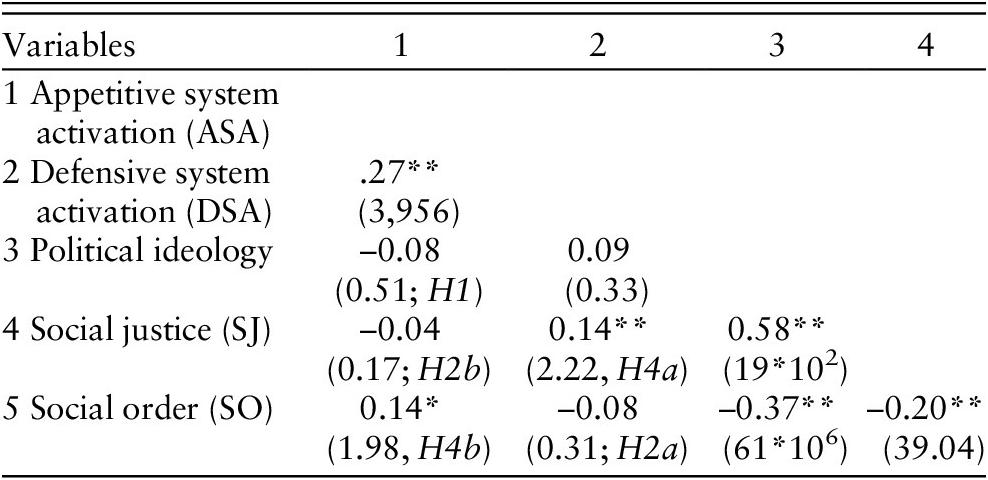
**p < .01, * p <.05, two-tailed.
We also tested two hypotheses from the dynamic coordination perspective. We define the majority ideology and morality as that adopted by most people in a specific social context; this conceptualization is similar to collective norm, the objective prevalence of a certain behavior or intention in a certain context (Rimal & Yilma, Reference Rimal and Yilma2021). Previous studies operationalized the objective prevalence of behavior or intention (i.e., collective norm) as the mean derived from the sample at hand (Rimal & Yilma, Reference Rimal and Yilma2021; Sedlander & Rimal, Reference Sedlander and Rimal2019). We used a similar procedure to determine the majority social morality and political ideology. First, a paired t-test was performed to compare the mean SJ and SO. The difference between the scores for SJ (M = 4.72, SD = 1.19) and SO (M = 3.64, SD = 0.97) was significant (t (279) = –10.85, p < .001), with SJ being in the majority. Additionally, a new variable indicating social justice dominance within each subject was created by subtracting subjects’ SO scores from their SJ scores. In our sample, 73.2% (N = 205) of subjects reported higher SJ than SO, which implies that SJ was the majority social morality in the context.
To determine the majority political ideology, we compared the number of liberal-leaning subjects and conservative-leaning subjects using their self-reported political ideology score. In total, there were 156 liberal-leaning, 69 moderate, and 55 conservative-leaning subjects in the original sample. Furthermore, during the time of this study (September 2017 to November 2018), the larger proximate social context (i.e., Monroe County, Indiana) where we ran the study was liberal leaning according to the 2016 presidential election data and 2018 midterm elections results. On balance, liberalism was the majority political ideology in our subjects’ proximate social context.
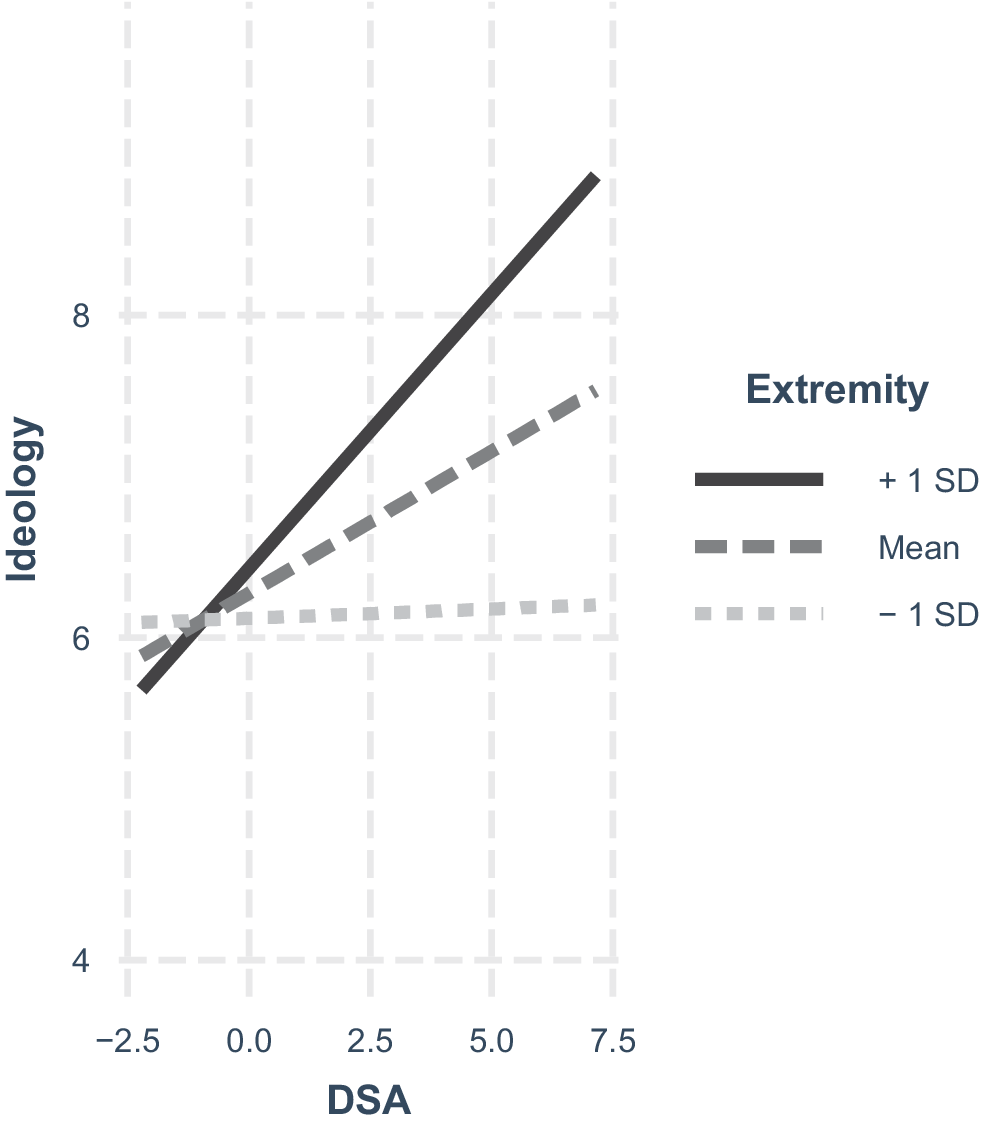
H3 predicted that DSA would correlate with the dominant ideology in our sample location (liberalism) for those with more extreme ideology. To examine this possibility, a new variable indicating ideology extremity was created by subtracting 6 from participants’ political ideology value, producing a scale ranging from –5 to 5, and then taking the absolute value as an indicator of ideological extremity (M = 2.01, SD = 1.51, range = 0–5). A linear regression was conducted with political ideology as the dependent variable and DSA, ASA, political extremity, and interactions between ASA and political extremity and between DSA and ideology extremity as predictor variables (Table 2). The interaction between DSA and ideology extremity was marginally significant (b = 0.11, t = 1.74, p = .082, 95% CI [–.01, .23], Figure 1). As shown in Table 2, DSA was associated with higher liberalism among people with more extreme ideology, providing partial support for H3.
OLS regression model of political ideology.
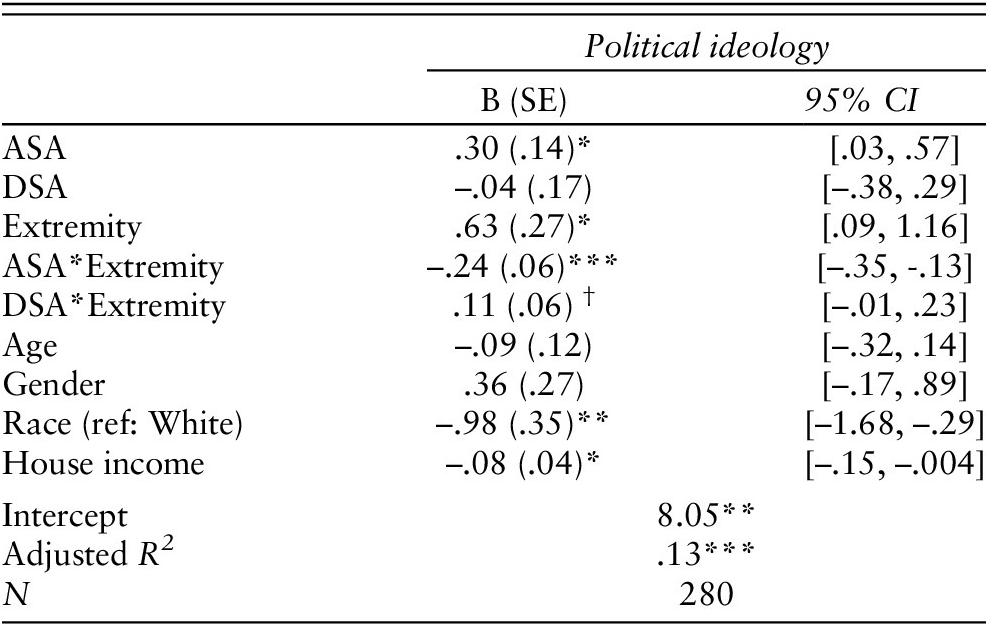
†p < .10; * p < .05; ** p < .01; *** p < .001, two-tailed.
Interaction between DSA and ideology extremity in predicting political ideology.
The last hypothesis predicted that participants with higher DSA would have a stronger relationship with the majority morality (i.e., SJ) and those with higher ASA would have a stronger relationship with the minority morality (i.e., SO). The results supported this hypothesis. The correlations between DSA and SJ (r = 0.14, p = .017, inverse Bayes factor = 2.22) and between ASA and SO (r = 0.14, p = .020, inverse Bayes factor = 1.98) were both positive and significant. However, the Bayes factor analysis shows that the evidence favoring our hypothesis is very weak (Jarosz & Wiley, Reference Jarosz and Wiley2014). To further examine the effect of ASA and DSA on political ideology and social morality, a series of linear regressions with demographic control variables were conducted. As shown in Table 3, DSA (b = 0.16, t = 2.99, p = 0.003, 95% CI [0.05, 0.26]) was associated with SO. In addition, ASA was a positive predictor (b = 0.10, t = 2.66, p = .008, 95% CI [0.03, 0.18]) and DSA was a negative predictor (b = –0.10, t = –2.21, p < .027, CI [–0.19, –0.01]) of SO. H3 was supported.
OLS Regression models of social morality and political ideology.
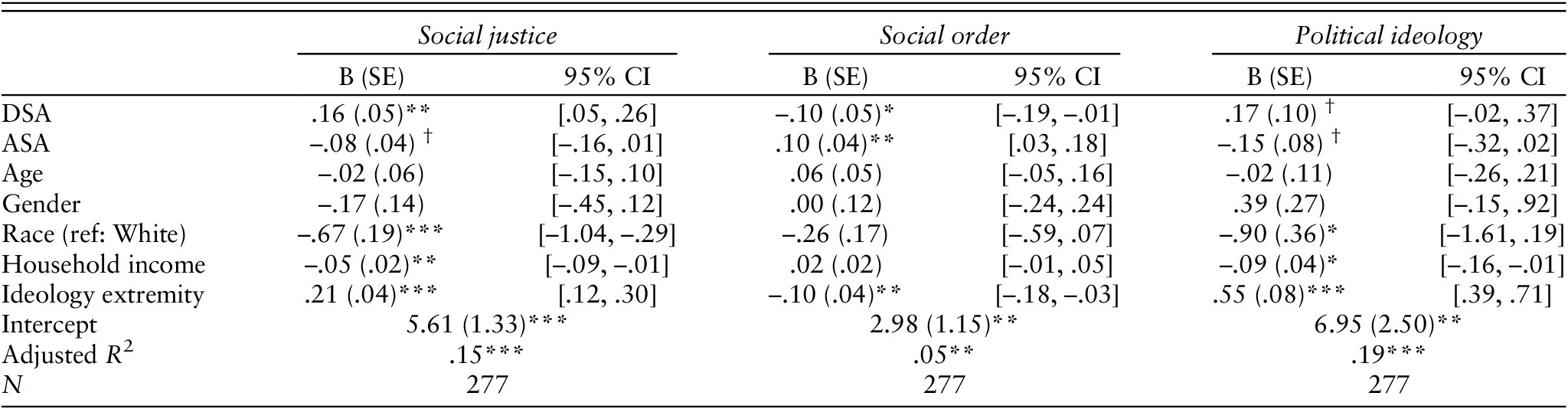
†p < .10; * p < .05; ** p < .01; *** p < .001, two-tailed.
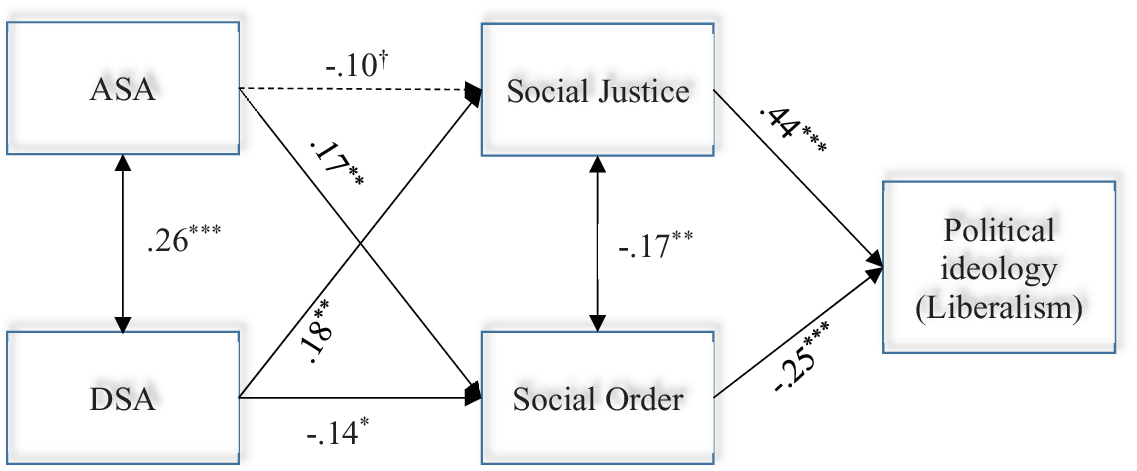
To answer our research question—what are the pathways through which motivational reactivity influences moral motives and political ideology?—we proposed a path model, as seen in Figure 2. Specifically, we incorporated four possible associations between appetitive system reactivity and defensive system reactivity to both SJ and SO (H2 and H4), as well as two possible covariances, one between the two motivational systems activity measures and the other between the two social moralities. Because of the nonsignificant association between DSA and political ideology, we did not consider any direct effects between motivation activation and political ideology. The details of the model are shown in Figure 2 (see also Table A1 in the Appendix). Our proposed path model showed a good model fit. The model revealed indirect association between motivational reactivity and self-report political ideology via social morality. The indirect effects of DSA (b = 0.19, t = 3.35, p = 0.001, 95% CI [0.08, 0.30]) and ASA (b = –0.12, t = –2.56, p = .01, 95% CI [–0.22, –0.03]) on political ideology are all significant. Taken together, these data lent no support to the classical view but were generally supportive of the dynamic coordination account.
Conceptual model examines the relationship between DSA, ASA, and political ideology through social moralities. † p < .10; * p < .05; ** p <. 01; *** p < .001. All coefficients standardized.
Control variables include age, gender, race, household income, and ideological extremity.
N = 280; df = 2; p( $ {\chi}^2 $
) = .74; RSMEA = .00 [.00, .083], SRMR = .005; CFI = 1.00, TLI = 1.09.
$ {\chi}^2 $
) = .74; RSMEA = .00 [.00, .083], SRMR = .005; CFI = 1.00, TLI = 1.09.
Discussion
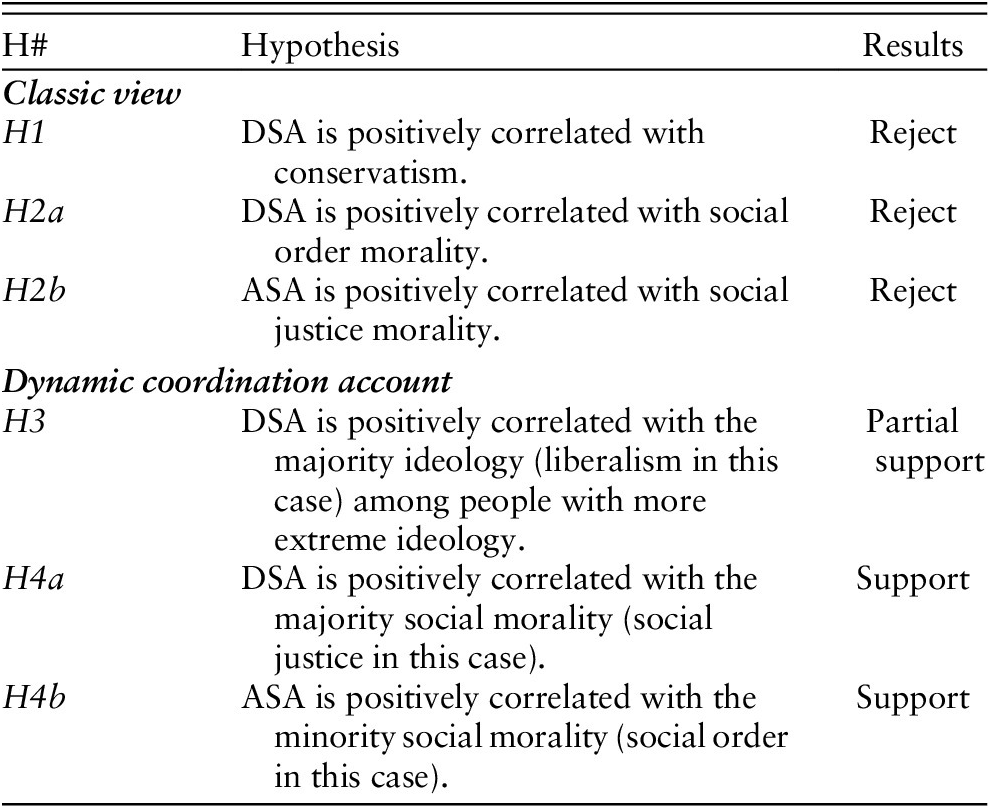
In this study, we tested two competing theoretical hypotheses about the relationship between motivational reactivity, social morality, and political ideology. Table 4 summarizes the results by hypothesis. The results are more in line with the dynamic coordination account. DSA was positively correlated with the dominant social moral motive (i.e., social justice morality) in the subjects’ social context, whereas ASA was positively correlated with the adoption of the minority social moral motive (i.e., social order morality) in the subjects’ social context. Also, DSA was found to be a negative factor in predicting social order morality, a minority social morality in this context. These results support the idea that moral condemnation, which is presumably modulated by the defensive motivational system, is central in informing human moral cognition, as put forward by the dynamic coordination theory of morality (DeScioli & Kurzban, Reference DeScioli and Kurzban2013). The dynamic coordination account may provide a theoretical explanation for the variations in the existing literature regarding negativity bias and conservatives by treating social context as a critical moderating factor.
Summary of results by hypothesis.
The results showed that motivational reactivity did not demonstrate a clear correlation with self-reported political ideology. It may be that ideological self-labeling is also heavily influenced by other factors (e.g., Ojeda & Hatemi, Reference Ojeda and Hatemi2015; Proch et al., Reference Proch, Elad‐Strenger and Kessler2019), and as a result, ideology is less influenced by motivational reactivity. However, path analysis revealed that social morality mediated the link between motivational reactivity and self-reported political ideology. The results correspond with the notion that chronic dispositional preferences for bedrock issues within social organizations are central to the connection between biological factors and the manifestation of political attitudes (Smith et al., Reference Smith, Oxley, Hibbing, Alford and Hibbing2011).
We also found that among subjects with more extreme political ideology, DSA was predictive of the adoption of the dominant political ideology, whereas ASA was predictive of the adoption of a relatively minor political ideology, replicating a previous study by Keene et al. (Reference Keene, Shoenberger, Berke and Bolls2017). One possibility is that more politically inclined people may have a higher sensitivity to and a clearer categorization of political ideology along the conservatism-liberalism continuum (e.g., Jost et al., Reference Jost, Federico and Napier2009).
There are several limitations to our study. First, the university sample used in the study limited the generalizability of the results. Our study relied on a sample from only one liberal-leaning context. Moving forward, studies may compare participants from different social contexts and incorporate a multilevel design to better account for the heterogeneity of social context. Second, the cross-sectional data could not determine the causal relationship between motivational reactivity and ideology. The path model proposed in the study did not mean to suggest causality but to empirically examine the indirect effects that motivational reactivity has on political ideology using the data at hand. Furthermore, the direction of influence between morality and political ideology is contested (e.g., Hatemi et al., Reference Hatemi, Crabtree and Smith2019). Future studies can use a longitudinal design to move this scholarship forward. Third, although adopted from previous literature, the procedure of determining majority ideology and morality could be strengthened by using more external measures. Future studies may consider using a probabilistic survey to gauge people’s political and moral attitudes in a certain social context. Studies could also add “perceived norm” to check whether people’s estimation of the dominant social moral and political attitude is a stronger predictor of their dynamic coordination behaviors. Lastly, this study did not measure subdimensions of political ideology. Although single-dimensional measures were used in many previous studies, future studies may benefit from adopting more fine-grained measures of ideology (Claessens et al., Reference Claessens, Fischer, Chaudhuri, Sibley and Atkinson2020; Jost et al., Reference Jost, Federico and Napier2009).
Emerging research has highlighted the importance of context in studying how lower-level neurocognitive factors influence political cognitions and behaviors. For example, Brandt et al. (Reference Brandt, Turner-Zwinkels, Karapirinler, Van Leeuwen, Bender, van Osch and Adams2021) found that the link between political belief and threat perception varied across countries. Pliskin et al. (Reference Pliskin, Ruhrman and Halperin2020) argued for the necessity of studying emotion and political differences with a context-sensitive approach. Social context is also a core element in the predictive coding account in politics put forward by Tsakiris and colleagues (Reference Tsakiris, Vehar and Tucciarelli2021). Similarly, our study highlights the contextual nature of the relationship between motivational reactivity, social moral motives, and political ideology. Based on the dynamic coordination theory, we argue that social context is a critical variable in understanding the link between defensive system reactivity, appetitive system reactivity, social morality, and political ideology. This context-based view may provide a more complete picture of the role that motivational reactivity plays in moral and political attitudes.
Acknowledgments
We thank Minchul Kim, Yanqin Lu, Mike Gruszczynski, and Andrew Weaver, who read and made valuable comments on an earlier draft of this article. We also thank the reviewers and editors of PLS for their constructive comments and kind help.
Appendix
Indirect relationship between DSA, ASA and political ideology through social justice (SJ) and social order (SO) moralities using structural equation modeling.
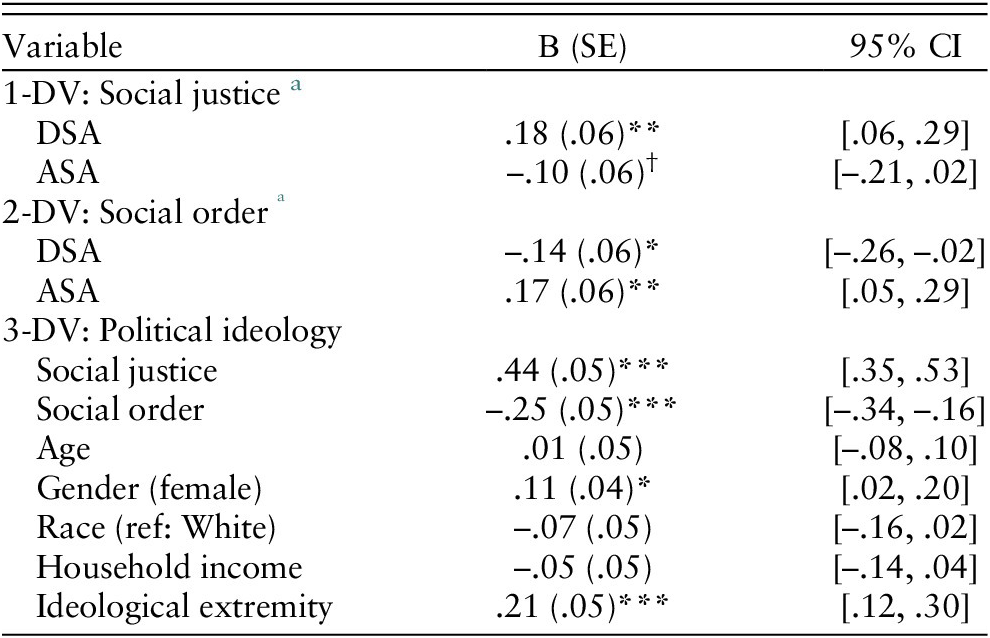
†p < .10; * p < .05; ** p < .01; *** p < .001, all coefficients standardized.
CI = confidence interval.


 Open access

