

Introduction
Many decisions made by individuals are curated, incentivised or nudged by a third party (Thaler and Sunstein, Reference Thaler and Sunstein2008). As a recent example, travellers could enter certain destinations only when getting vaccinated against Covid-19 or with a negative test result. Understanding why, when and how third parties decide to intervene in others’ choices – known as paternalism – is critical to understanding the behavioural and wellbeing-related consequences of such interventions for others’ outcomes. This is especially the case if third parties have different motivations for intervening, if there exist various points in time at which they might intervene and if third parties have different means at their disposal. For example, third parties who are motivated by projecting some sort of ideal or their own preferences onto others may intervene at a different point in time (say, earlier as a precaution) or may use different means and intensities of intervention (say, coercion rather than nudge-style interventions), compared to paternalists who are motivated by helping others achieve what these others would choose for themselves, if they had complete information and were able to act on their well-informed preferences. This may generate a wide range of outcomes for others, some of which may be more beneficial, some of which may be less, and which is important to understand from a social welfare perspective.
Paternalism is defined as a policy or attitude in which those having authority over others extend this authority into areas usually left to individual choice or conscience (e.g. smoking or sexual behaviour), usually on the grounds that this is necessary for the welfare or protection of the individuals concerned (APA, 2018).Footnote 1 That is, under paternalism, an agent, such as a policymaker, employer or service provider, influences other individuals’ choices, usually to achieve ‘better’ outcomes for these individuals. They can do this in various ways, for example through exploiting others’ cognitive boundaries or biases (e.g. via nudges or choice architecture), via educative nudges or boosts, coercion (e.g. laws or fines) or through various other forms of incentivisation, regulation or information and education. Importantly, paternalism – unlike authoritarianism or manipulation – usually assumes that these agents act on the grounds of improving others’ welfare (Thaler & Sunstein, Reference Thaler and Sunstein2003; APA, 2018).
Besides an established literature on paternalism in political philosophy (going back as early as John Stuart Mill's On Liberty in 1859), legal theory (cf. Feinberg, Reference Feinberg1986a; Arneson, Reference Arneson1989), ethics (cf. Groll, Reference Groll2012) and public policy (cf. Le Grand and New, Reference Le Grand and New2015), the literature on paternalism in behavioural public policy is newer yet has been steadily growing over the past years (Thaler and Sunstein, Reference Thaler and Sunstein2003, Reference Thaler and Sunstein2008; Conly, Reference Conly2012, Reference Conly2017; Sunstein, Reference Sunstein2014; Hertwig and Grüne-Yanoff, Reference Hertwig and Grüne-Yanoff2017; Loewenstein and Chater, Reference Loewenstein and Chater2017; Schwartz and Cheek, Reference Schwartz and Cheek2017; Hausman, Reference Hausman2019; Le Grand, Reference Le Grand2020; Dreyer Lassen and Mahler, Reference Dreyer Lassen and Mahler2022; Hausman, Reference Hausman2022; Hertwig, Reference Hertwig2023; Oliver, Reference Oliver2023), motivated by an increasing interest in behavioural public policy and paternalistic interventions in the choice architecture for others, in particular nudges and related intervention strategies (see Johnson and Goldstein (Reference Johnson and Goldstein2003), Thaler and Benartzi (Reference Thaler and Benartzi2004) or Madrian anf Shea (Reference Madrian and Shea2001) for early examples and Hagman et al. (Reference Hagman, Erlandsson, Dickert, Tinghög and Västfjäll2019) or van Roekel et al. (Reference van Roekel, Giurge, Schott and Tummers2023) for more recent ones). While this literature has focused mostly on the effectiveness of such paternalistic interventions on improving others’ outcomes (see Benartzi et al. (Reference Benartzi, Beshears, Milkman, Sunstein, Thaler, Shankar, Tucker-Ray, Congdon and Galing2017), Hummel & Maedche (Reference Hummel and Maedche2019), Mertens et al. (Reference Mertens, Herberz, Hahnel and Brosch2021) and DellaVigna and Linos (Reference DellaVigna and Linos2022) for reviews), much less attention has been paid at paternalistic decision-makers and the psychological processes by which they arrive at their decisions.
In fact, only very few studies focus on paternalistic decision-makers and their psychological processes (Uhl, Reference Uhl2011; Krawczyk and Wozny, Reference Krawczyk and Wozny2017; Daniels and Zlatev, Reference Daniels and Zlatev2019; Ambuehl et al., Reference Ambuehl, Bernheim and Ockenfels2021; Bartling et al., Reference Bartling, Cappelen, Henning, Skivness and Tungodden2023; Bushong and Gagnon-Bartsch, Reference Bushong and Gagnon-Bartsch2024), and most of them look at the context of the decision (like availability of information) or on stable attributes of the decision-maker (like preferences or personality traits). The role of affect, however, has been ignored so far. This could be an important omission because, by nature, paternalism involves restricting agency on a potentially large group of individuals (including the decision-maker themself) who might be psychologically close – a potential burden that is both consequential and might be perceived as highly unpleasant by the decision-maker, or even pleasant if related to power and efficacy. At the same time, the context of many paternalistic decisions can be characterised as complex, risky or uncertain, and hence prone to provoking affective states in decision-makers (Bar-Anan et al., Reference Bar-Anan, Wilson and Gilbert2009; Faraji-Rad and Pham, Reference Faraji-Rad and Pham2016; Anderson et al., Reference Anderson, Carleton, Diefenbach and Han2019; Morris et al., Reference Morris, Tupitsa, Dodd and Hirsch2022). In part, this under-appreciation of affect so far may come about because we find it comforting to think of those who make decisions for us as sophisticated, rational beings, much like the technocratic social planner in economics. There is little room here for affect. At the same time, decades of research on affect, mood and emotion (e.g. Damasio, Reference Damasio1994; Lerner and Keltner, Reference Lerner and Keltner2001; Loewenstein et al., Reference Loewenstein, Weber, Hsee and Welch2001; Slovic et al., Reference Slovic, Finucane, Peters and MacGregor2007) document that our affective states significantly and predictably influence our judgements and decisions. This has culminated in what some have referred to as the era of affectivism (Dukes et al., Reference Dukes, Abrams and Sander2021). If affect influences judgments and decisions on behalf of others as those for the self, potentially leading to systematically different outcomes than would otherwise prevail if affective states were absent, then this requires theoretical and empirical study, especially if there could be consequences for efficiency, welfare and equity in a large group of individuals.
To fill this gap, we develop a conceptual framework of paternalistic decision-making that builds upon and extends the established Emotion-Imbued Choice (EIC) Model (Lerner et al., Reference Lerner, Li, Valdesolo and Kassam2015). The EIC Model joins rational choice with affect and is a comprehensive account of the role of affect in decision-making for the self. Apart from familiarity to readers, we build on this model for another reason: paternalistic decision-making does not occur in a vacuum and the choices of paternalistic decision-makers often do not only involve individuals under their care but also the decision-makers themselves. It is thus important to first take stock of and understand the potential entry points through which affective states can influence how individuals make decisions for themselves, before thinking about the role of affect in decision-making for others. We then extend the EIC Model to the case of paternalistic decision-making and identify additional entry points – integral to the paternalistic decision at hand – through which affect may create systematic deviations in paternalistic decision outcomes. We term such systematic deviations created by the influence of affective states affective paternalism. From these additional entry points, we can then learn where and possibly how to intervene in the paternalistic decision-making process if we wish to minimise affective paternalism.
After developing our framework, we provide initial evidence on affective paternalism from a novel survey experiment using the recent example of the Covid-19 public health crisis in the UK as an application. We chose Covid-19 for three reasons. First, it is quoted as a recent, prominent, high-stakes case of paternalistic decision-making in the literature (cf. Konrad and Simon, Reference Konrad and Simon2023). Second, respondents of our UK-based survey (which was fielded on Tuesday, 15 December 2020, i.e. shortly after the second lockdown and shortly before the heavy Tier 4 restrictions across the UK), should be readily able to identify the trade-offs involved in the chosen scenario, adding to its external validity.Footnote 2 Third, we attempt to illustrate the maximum influence that affective states may have. The pandemic as a case of high-stakes and fast paternalistic decision-making is uniquely suited to do so.
Our survey experiment has two objectives: first, to provide initial evidence on the extent to which affect (rather than cognitive reasons) may play a role in paternalistic decision-making; and second, to show that participants who cite affect as their main motivation may make systematically different decisions (than those who cite cognitive reasons).
In particular, we let participants make paternalistic decisions (i.e. prescribing a pill at various risk levels so that they and their community can live without restrictions, or not prescribing it and have guaranteed restrictions) whilst also asking them about their main motivations behind their decisions, including cognitive reasons and affect. We find that a non-trivial share of respondents (the second largest) cite affect rather than cognitive reasons (i.e. what they think others under their care would or should choose, or what they would choose for themselves) as the main motivation behind their decisions. We also find that respondents citing affect make significantly different decisions, and in particular, are much less likely to prescribe the pill and have no restrictions. We take this as first initial evidence that affect may play a significant role in paternalistic decision-making and on the extent of affective paternalism.
Finally, we discuss implications for policy, including emotion regulation in paternalistic decision-making processes as well as questions regarding ecological rationality and social welfare optimality (i.e. whether affect in paternalism is necessarily undesirable), and outline avenues for future research. In doing so, we are joining two hitherto separate strands of literature – the established literature on the role of affect in judgements and decisions (e.g. Damasio, Reference Damasio1994; Lerner and Keltner, Reference Lerner and Keltner2001; Loewenstein et al., Reference Loewenstein, Weber, Hsee and Welch2001; Lerner et al., Reference Lerner, Han and Keltner2007; Slovic et al., Reference Slovic, Finucane, Peters and MacGregor2007, etc.) and the sparse literature on paternalistic decision-makers and their psychological processes (Uhl, Reference Uhl2011; Krawczyk and Wozny, Reference Krawczyk and Wozny2017; Daniels and Zlatev, Reference Daniels and Zlatev2019; Ambuehl et al., Reference Ambuehl, Bernheim and Ockenfels2021; Bushong and Gagnon-Bartsch, Reference Bushong and Gagnon-Bartsch2024; Bartling et al., Reference Bartling, Cappelen, Henning, Skivness and Tungodden2023) – to obtain a more complete picture of how paternalistic decisions come about.
Setting the scene: the role of affect in decisions for the self
Affect is a broad concept that encompasses constructs such as mood, emotions and emotional traits. Within affect, emotions are defined as behavioural, cognitive, experiential or expressive reactions regarding survival-level events (Lerner et al., Reference Lerner, Li, Valdesolo and Kassam2015). In this paper, we will use the term affect to encompass a wide range of constructs which could impact judgements and decisions. As emotions are a cornerstone of affect, however, we give them special attention in our conceptual framework.
Emotions are considered one of the primary drivers of individual decision-making (cf. Ekman, Reference Ekman, Scherer and Ekman1984; Frijda, Reference Frijda1988; Ekman, Reference Ekman, Coan and Allen2007; Lazarus, Reference Lazarus1991; Loewenstein et al., Reference Loewenstein, Weber, Hsee and Welch2001; Keltner and Lerner, Reference Keltner, Lerner, Fiske, Gilbert and Lindzey2010; Keltner et al., Reference Keltner, Oatley and Jenkins2013). They have been shown to significantly and predictably influence judgements and decisions for the self in various domains, including risk-taking (cf. Lerner and Keltner, Reference Lerner and Keltner2001), intertemporal choice (cf. Ifcher and Zarghamee, Reference Ifcher and Zarghamee2011) or pro-social behaviour (cf. Drouvelis and Grosskopf, Reference Drouvelis and Grosskopf2016). Interestingly, evidence has shown that the recipients of paternalism themselves respond with various emotions (Fehr et al., Reference Fehr, Herz and Wilkening2013; Bartling et al., Reference Bartling, Fehr and Herz2014; Kataria et al., Reference Kataria, Levati and Uhl2014; Lübbecke and Schnedler, Reference Lübbecke and Schnedler2020; Ackfeld and Ockenfels, Reference Ackfeld and Ockenfels2021), though so far no attention has been paid at the emotional states of paternalistic decision-makers, and in particular, whether and how emotions may influence their judgements and decisions on behalf of others.
Emotions can be broken down further into either incidental or integral, each of which has been shown to influence decision-making in distinct but interrelated ways (Hillebrandt and Barclay, Reference Hillebrandt and Barclay2017). Incidental emotions are carried over from unrelated events but nevertheless influence the decision at hand. Integral emotions arise during the process of making the decision, such as excitement over a new option or fear of regret once a choice is made (cf. Loomes and Sugden, Reference Loomes and Sugden1982).Footnote 3 Both incidental and integral emotions have been shown to influence judgements and decisions for the self, and it is likely that they may also influence decision-making on behalf of others, though integral emotions are arguably more relevant in paternalistic decision-making processes, as we will discuss later.
The established Emotion-Imbued Choice (EIC) Model, summarised in Lerner et al. (Reference Lerner, Li, Valdesolo and Kassam2015), joins rational choice with affect and is a comprehensive account of the role of affect in decision-making for the self, capturing the complex relationships between incidental and integral emotions and their joint influences on judgments and decisions. Apart from being well-known, we build upon this model as the choices of paternalistic decision-makers often do not only involve individuals under their care but also the decision-makers themselves. Hence, we first take stock of the potential entry points through which affective states can influence how individuals make decisions for themselves, before extending this model to the case of paternalistic decision-making (i.e. decision-making for others).
The original model assumes, for simplicity and illustration, a one-time choice between given options, without the possibility of seeking additional information or options. It ends at the moment of decision and does not include actual outcomes nor feelings that occur as a consequence of the decision. The original model is shown in Figure 1.
Emotion-imbued choice model (EIC model). Note: cognitive elements are in black, affective elements are in green. Source: Lerner et al. (Reference Lerner, Li, Valdesolo and Kassam2015).

Figure 1 Long description
The flowchart illustrates the Emotion-imbued choice model with various components and connections. The main components are: • Characteristics of Decision-Maker: Includes preferences, personality traits and socio-emotional skills. Connected to Evaluation via B2. • Characteristics of Options: Includes time delay, interpersonal comparisons and ambiguity. Connected to Evaluation via B1. • Affect (Felt at Time of Decision): Connected to Evaluation via F1 and F2 and to Incidental Influences via E. • Evaluation (Conscious, Unconscious): Connected to Decision via G. • Decision: Connected to Actual Outcomes via H and to Option Set via A. • Option Set: Includes Expected Outcomes 1, 2 and 3, with Expected Outcomes 1 including expected emotions of self. Connected to Affect via C and C'. • Incidental Influences: Includes feelings, mood, weather and carry-over effects. Connected to Affect via E. The flowchart shows how these elements interact in the decision-making process, highlighting both cognitive and affective influences.
In short, the model assumes that, for every decision, there is a conscious (or unconscious) evaluation of expected outcomes by the decision-maker (Figure 1), which takes into consideration the characteristics of options (e.g. subjective probabilities or values) (B1) and depends, to a certain extent, on the characteristics of the decision-maker themself (e.g. preferences) (B2). In addition to these cognitive components rooted in rational choice theory (shown by black elements), the model also incorporates affective components (shown by green elements), allowing these inputs to influence the current emotions of the decision-maker while making the decision and, thereby, the evaluation of expected outcomes (F1). Anticipatory influences (C) based on regret theory – the impact of how one anticipates feeling after making a decision on how one feels right now – can include anticipated feelings of happiness or regret, depending on the decision at hand (cf. Loomes and Sugden, Reference Loomes and Sugden1982).Footnote 4 Option characteristics (D1) that may induce emotional reactions include time delays, interpersonal comparisons or ambiguity of choices (cf. Wang et al., Reference Wang, Sivanathan, Narayanan, Ganegoda, Bauer, Bodenhausen and Murnighan2011; see also George and Dane, Reference George and Dane2016), whereas examples of decision-maker characteristics (D2) include personality traits such as neuroticism, socio-emotional skills such as self-regulation or social anxiety (cf. Izard et al., Reference Izard, Libero, Putnam and Haynes1993, Tong, Reference Tong2010). Moreover, incidental factors may also influence the decision-maker's current emotional state (E). Such factors can range from feeling happier on a warm, sunny day (Keller et al., Reference Keller, Fredrickson, Ybarra, Côté, Johnson, Mikels, Conway and Wager2005; Lucas and Lawless, Reference Lucas and Lawless2013) to being angry or violent due to traffic congestion (Beland and Brent, Reference Beland and Brent2018). Often, the decision-maker may not even be consciously aware of the affective state they are in when making the decision. Of course, making a decision itself may evoke an emotional reaction (F2), which may, in turn, influence the evaluation of expected outcomes (Loewenstein et al., Reference Loewenstein, Weber, Hsee and Welch2001).
Jointly, these factors influence evaluations (e.g. current sadness may make outcomes seem less rewarding, cf. Lerner et al., Reference Lerner, Li, Valdesolo and Kassam2015) and, thereby, decisions (G) and, ultimately, outcomes (H). The model argues that both cognitive and affective tracks must be understood to accurately predict an individual's decision. While this is an accepted view when it comes to decisions for the self, this role of affect has, so far, not been considered in the context of paternalism, maybe because we find it comforting to think of those who make decisions for us as sophisticated, rational beings or because it is empirically more difficult to examine decision-making on behalf of others. Yet, although the EIC Model has only been applied in the context of decisions for the self, it can also be applied – with some alterations and additions – to decisions on behalf of others. Considering these modifications, we may then more accurately predict a paternalist's decision as well as where and possibly how to intervene in the paternalistic decision-making process if we were to minimise the extent of affective paternalism.
Paternalistic decision-making and affective paternalism
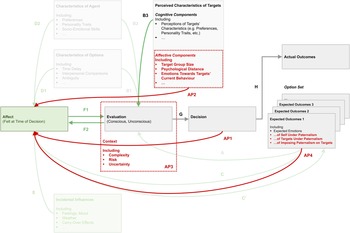
Given the large, robust evidence base behind the familiar EIC Model and the influence of emotions on judgements and decisions more generally, we take these core principles as the fundament to model the role of affect in paternalistic decision-making. Figure 2 adapts the EIC Model to the specific case of paternalism, and we refer to it as EIC-P Model from here on to make it distinct. We highlight our additions to the EIC Model in red while de-emphasising its well-known, original elements for readability. A notable addition is the characteristics of those subjected to paternalism (which we refer to as paternalistic targets) (B3). Some characteristics are similar to those of the decision-maker (which we now refer to as paternalistic agent), such as demographics or preferences. Others are unique to paternalism, including the size and heterogeneity of the target group and its psychological distance from the agent. Unique is also the context of paternalistic decisions, which is often characterised by complexity, risk or uncertainty.
Emotion-imbued choice model for paternalism (EIC-P Model). Note: affective elements unique to paternalism are in red, for others, see Figure 1 notes. Source: adapted from Lerner et al. (Reference Lerner, Li, Valdesolo and Kassam2015), own illustration.
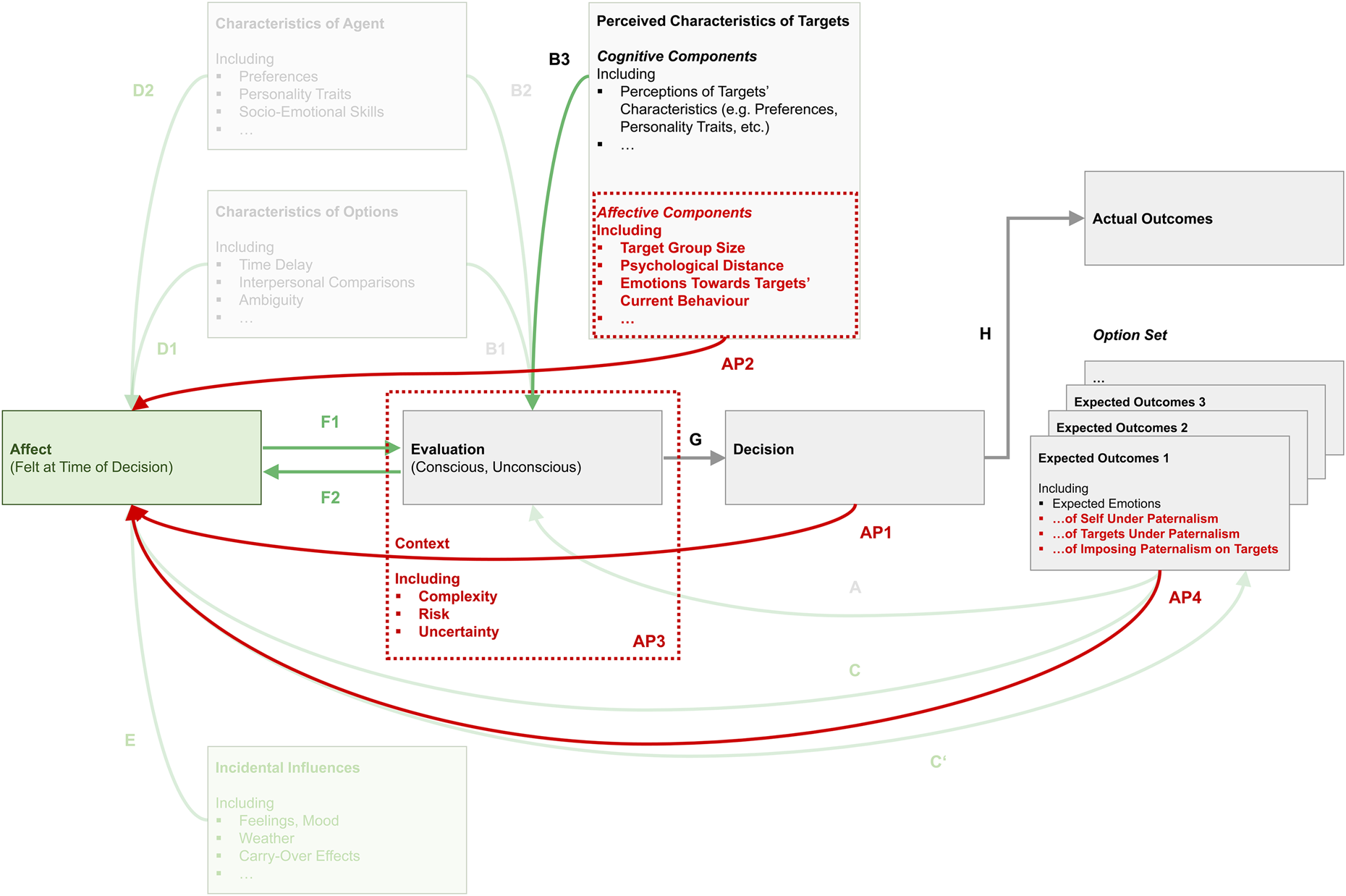
Figure 2 Long description
A flowchart infographic titled Emotion-imbued choice model for paternalism (EIC-P Model). The main sequence shows: Affect (Felt at Time of Decision) connects to Evaluation (Conscious, Unconscious). Evaluation connects to Decision. Decision connects to Actual Outcomes. Decision also connects to an Option Set. The Option Set contains stacked boxes labeled Expected Outcomes 1, Expected Outcomes 2 and Expected Outcomes 3. Expected Outcomes 1 includes the text: Including. Expected Emotions. ...of Self Under Paternalism. ...of Targets Under Paternalism. ...of Imposing Paternalism on Targets. A box titled Perceived Characteristics of Targets contains the heading Cognitive Components with the text: Including. Perceptions of Targets’ Characteristics (e.g. Preferences, Personality Traits, etc.). ... It also contains the heading Affective Components with the text: Including. Target Group Size. Psychological Distance. Emotions Towards Targets’ Current Behaviour. ... A dashed callout labeled Context lists: Including. Complexity. Risk. Uncertainty. A box titled Incidental Influences lists: Including. Feelings, Mood. Weather. Carry-Over Effects. ... Two additional boxes list: Characteristics of Agent, Including. Preferences. Personality Traits. Socio-Emotional Skills. ... and Characteristics of Options, Including. Time Delay. Interpersonal Comparisons. Ambiguity. ... Connector labels shown in the diagram include D1, D2, B1, B2, B3, F1, F2, G, H, AP1, AP2, AP3, AP4, A, C, C’ and E.
Though necessarily a simplification of the real world, the EIC-P Model is flexible and can be applied to different strands of paternalism, including forms of weak paternalism (Dworkin, Reference Dworkin and Zalta2014, also referred to as loose, soft or means paternalism, cf. Feinberg, Reference Feinberg1986b; Scoccia, Reference Scoccia, Coons and Weber2013; Le Grand and New, Reference Le Grand and New2015), where agents interfere to help targets achieve their stated goals, or strong paternalism (ibid, also referred to as strict, hard or ends paternalism), where agents interfere because they think that targets’ choices are mistaken, which can result in the same observed paternalistic decision taken.Footnote 5 Note that paternalistic decision-making may occur over a wide range of time horizons (with some legislation taking years to fully craft and enact) and can involve multiple agents. The strength of the influence of affective states in paternalistic decision-making is likely a function of the time a paternalistic decision-maker has at their disposal to make a decision. If there is enough time for deliberation (and perhaps even conscious regulation of affect), we expect affective states – both integral and (especially) incidental – to have much less influence. On the contrary, there may be policy processes such as the quick passing of an emergency act during crisis times (such as the Covid-19 public health crisis), where decisions must be made much faster or even ad-hoc. Here, we expect affective states – both integral and incidental – to have much stronger influence.
Yet, even in cases of lengthy public policy processes (such as the passing of a law during normal times, where decisions are made in a systematic way with many steps from conception to implementation), affective states at each step – especially those integral to the paternalistic decision at hand – may cause systematically different outcomes when accumulated over all steps than would prevail if such affective states were absent. Similarly, affective states at the initial step may initiate a different path of action than would be taken if such affective states were absent, which may again cause systematically different outcomes.Footnote 6 Hence, even in lengthier processes, we expect affect to play a role. Our proposed extension to the established EIC model is flexible enough to apply to paternalistic decisions of any length. For lengthier paternalistic decision-making processes, the model needs to be re-applied at each step of the process.
Just like the original model, the EIC-P Model has both cognitive and affective tracks, and both must be understood to accurately predict a paternalistic agent's decision. We look at each of them in turn.
Similar to before, in the cognitive track of paternalistic decision-making, the agent first calculates the expected outcome of each option in the option set so that it can enter evaluation (Figure 2). Each expected outcome is obtained by weighting the anticipated gains or losses from pursuing the option to all targets or target groups in society (which often includes the agent themself) by their subjective probabilities, and then summing them up. Anticipated gains or losses can include emotions, of both paternalistic agents and targets, but these enter the calculus simply as benefits or costs, in line with regret theory (cf. Loomes and Sugden, Reference Loomes and Sugden1982). The agent then evaluates the expected outcome of each option by computing its expected utility, which involves the characteristics of options (B1), agent (B2) and targets (B3). Finally, the agent chooses the option with the highest expected utility (G), which then may or may not lead to the desired outcome and the realisation of that utility (H).
Though sparse, the current literature on paternalistic decision-makers and their psychological processes aligns well with this established, cognitive track. For instance, studies have found that characteristics of options (B1) such as the degree of certainty or availability of information (Lusk et al., Reference Lusk, Marette and Norwood Bailey2013; Martin et al., Reference Martin, Lin and Olson2016; Daniels and Zlatev, Reference Daniels and Zlatev2019) influence paternalistic decisions, and so do characteristics of agents (B2) such as confirmation (Banuri et al., Reference Banuri, Dercon and Gauri2019) or self-projection bias (Jacobsson et al., Reference Jacobsson, Johannesson and Borgquist2007; Gangadharan et al., Reference Gangadharan, Grossman and Jones2015; Foerster et al., Reference Foerster, Linnainmaa, Melzer and Previtero2017; Lupoli et al., Reference Lupoli, Levine and Greenberg2018, Reference Lupoli, Zhang, Yin and Oveis2020; Ifcher and Zarghamee, Reference Ifcher and Zarghamee2020; Ambuehl et al., Reference Ambuehl, Bernheim and Ockenfels2021). Likewise, characteristics of targets (B3) such as self-control or cognitive ability have been shown to significantly influence a paternalistic agent's decision-making (Uhl, Reference Uhl2011; Krawczyk aand Wozny, Reference Krawczyk and Wozny2017; Sheffer et al., Reference Sheffer, Loewen, Soroka, Walgrave and Sheafer2017; Bushong and Gagnon-Bartsch, Reference Bushong and Gagnon-Bartsch2024).
So far, affect – in form of anticipated emotions of the paternalistic agent and targets – has entered the paternalistic decision-making process merely as benefit or cost (A). However, there are four additional entry points of affect that are unique to paternalism and through which the agent's affective state may influence paternalistic decision-making.
In what follows, we outline these entry points, and discuss how these may cause systematic deviations from decision outcomes that would have otherwise prevailed had affect not been present (affective paternalism). In our empirical section later on, we will present the results from a novel survey experiment in which we let participants make paternalistic decisions whilst asking them about their main motivations behind their decisions, differentiating affect from cognitive reasons. Our objectives will be, first, to provide initial evidence on the extent to which affect (rather than cognitive reasons) can play a role in paternalistic decision-making, and second, to show that participants who cite affect as their main motivation make systematically different decisions (than those who cite cognitive reasons).Footnote 7 Both are novel contributions to the literature on paternalistic decision-makers and their psychological processes.
The red elements in Figure 2 are our additions and represent those factors that are unique to paternalism. These are (i) the requirement to make a decision on behalf of others, typically to improve their welfare; (ii) the context surrounding paternalistic decision-making; (iii) the agent's affective association with the targets; and (iv) the anticipatory influence of the paternalistic decision's outcome on affect.
First, unique to paternalism is the requirement to intervene on behalf of others, typically to improve their welfare. This itself may provoke an affective reaction (Figure 2, AP1), because taking the responsibility for interfering with others’ choices – especially in situations that are risky and may even risk the lives of the targets, may be perceived as a burden and as highly unpleasant, or even pleasant if related to power and efficacy. Though they may vary based on context, the emotions that arise when being confronted with the requirement to intervene are integral to the agent's decision. Because each agent may have different emotional reactions to the requirement to intervene, their evaluations of options will vary as well. For example, certain emotions may distort subjective probabilities (Rottenstreich and Hsee, Reference Rottenstreich and Hsee2001) or increase or decrease individual discount rates (Lerner et al., Reference Lerner, Li and Weber2013; DeStano et al., Reference DeStano, Li, Dickens and Lerner2014). Happiness, for instance, has been shown to make individuals more risk averse, in line with the mood-maintenance hypothesis (Isen and Patrick, Reference Isen and Patrick1983; Johnston and Tversky, Reference Johnston and Tversky1983; Krekel et al., Reference Krekel, Swanke, De Neve and Fancourt2023).
Second, and similarly unique to paternalism, the characteristics of paternalistic targets (AP2) may have an impact on affective evaluations. Depending on context and the specific paternalistic decision at hand, reviewing targets’ current state can evoke positive feelings such as empathy and warmth or negative feelings such as pity, amity and disgust. These feelings integrally influence the current emotional state of the agent whilst making the paternalistic decision, potentially altering evaluations and thereby subsequent decisions. In the literature on dehumanisation, for example, the relationship between target characteristics and affective evaluations shows that emotions – particularly disgust – are an integral part of prejudice and dehumanisation (Hodson and Costello, Reference Hodson and Costello2007; Tapias et al., Reference Tapias, Glaser, Keltner, Vasquez and Wickens2007; Buckels and Trapnell, Reference Buckels and Trapnell2013; Hodson et al., Reference Hodson, Choma, Boisvert, Hafer, MacInnis and Costello2013; Dalskev and Kunst, Reference Dalskev and Kunst2015), which may lead to policies supporting for deportation or discrimination (Dalskev and Kunst, Reference Dalskev and Kunst2015; Bruneau et al., Reference Bruneau, Hameiri, Moore-Berg and Kteily2020). While these examples are obviously not in the best interest of the individual, they do provide suggestive evidence that characteristics of the target group can influence affective states of the agent.
A third factor unique to paternalism is the context in which paternalistic decisions typically take place (AP3): it is often characterised by complexity, risk or uncertainty, which are, for instance, brought about by scientific advisers from different disciplines stressing different costs and benefits of options, competing special interest groups or timely political pressures in the political arena. In such situations, which are often the case in actual policy-making, the ‘right’ course of action may not be ex-ante clear or even ex-post verifiable (because the counterfactual is not known or ever observable). Complexity and uncertainty influence affective states and reliance on affect in decision-making (Bar-Anan et al., Reference Bar-Anan, Wilson and Gilbert2009; Faraji-Rad and Pham, Reference Faraji-Rad and Pham2016; Anderson et al., Reference Anderson, Carleton, Diefenbach and Han2019; Morris et al., Reference Morris, Tupitsa, Dodd and Hirsch2022). Certain emotions may, for example, reduce the number of options considered (Tiedens and Linton Reference Tiedens and Linton2001), increase the weight of particular options relative to others (Lerner & Keltner, Reference Lerner and Keltner2000, Reference Lerner and Keltner2001) or lead to mispredictions of the usefulness of some decision outcomes (Loewenstein et al. Reference Loewenstein, O'Donoghue and Rabin2003). Thus, the paternalistic context can reasonably be proposed to impact an agent's affective state during conscious or non-conscious evaluations and subsequent decisions.
As for anticipation of affect once some outcome is chosen (AP4), paternalistic agents (as opposed to individual decision-makers) now forecast three sets of emotions, all of which may impact their current emotional state. First, agents anticipate their own emotions as being targets themselves under the intervention (which is often the case). Second, they anticipate the emotions of (other) targets under the intervention, which may include targets’ emotional reactions toward the decision-maker, their emotional reactions toward the decision (e.g. targets being upset about the decision but acknowledging the good intention of the agent, or outright happy that decisive action was taken), or both. Third, they anticipate their own emotions should targets follow the intervention, which may include feelings of satisfaction that targets are now on the ‘right’ path, or a loss of identity now that their ‘help’ is no longer needed.
Take choosing whether to ban indoor-smoking as an example of paternalistic decision-making, which has been a known public health issue for decades but has only recently been banned in many countries. First, agents would anticipate the emotions they would feel if they themselves were not allowed to smoke indoors anymore (if applicable). Second, they would anticipate the emotions (other) targets would feel if they were not allowed to smoke indoors, which may include frustration or relief at the ban. Third, they would anticipate the emotions they – as the agent – would feel if other targets were not allowed to smoke indoors, which may include satisfaction at not having to smell smoke in a bar or relief that children are not susceptible to asthma or lung cancer through second-hand exposure. Anticipated emotions in this third category may also include broader aspects related to the warm-glow from helping others (cf. Andreoni, Reference Andreoni1990) or aspects related to ego, i.e. the desire for a positive and consistent self-image that makes agents feel better about themselves (Tajfel and Turner, Reference Tajfel, Turner, Austin and Worchel1979). In our smoking example, this could be the positive self-image generated from standing up for public health and against big tobacco, possibly to maintain consistency with prior decisions taken in the health domain or other domains (Festinger, Reference Festinger1957). Note that, in this example, the characteristics of the targets such as heterogeneity and psychological distance could also influence evaluations and subsequent decisions, as an agent's ability to effectively anticipate other targets’ emotions has been shown to be influenced by these characteristics (Schroeder et al., Reference Schroeder, Waytz and Epley2017).
We have identified four entry points that are unique to paternalism and through which the agent's affective state may influence decision-making: (i) the requirement to make a decision on behalf of others, typically to improve their welfare; (ii) the agent's affective association with the targets; (iii) the context surrounding paternalistic decision-making; and (iv) the anticipatory influence of the paternalistic decision's outcome on affect.
We now ask: what is the extent – overall, across these four entry points – to which affect (as opposed to cognitive reasons) may play a role in paternalistic decision-making? Moreover, do paternalistic decision-makers for whom affect plays a role make decisions that lead to systematically different decision outcomes? Can we observe affective paternalism? We turn to initial evidence next.
Initial evidence
To provide initial evidence on the extent to which affect (as opposed to cognitive reasons) may play a role in paternalistic decision-making and on whether it may lead to systematically different decision outcomes (affective paternalism), we exploited the recent example of the Covid-19 public health crisis in the UK in a survey experiment. Covid-19 is quoted as a prominent, high-stakes case of paternalistic decision-making in the literature (cf. Konrad and Simon, Reference Konrad and Simon2023) and policy-making during Covid-19 naturally required many paternalistic decisions. Respondents of our UK-based survey should also be readily able to identify the trade-offs involved in the scenario outlined below, adding to its external validity. Moreover, Covid-19 is a case of fast paternalistic decision-making, and therefore allows us to illustrate the maximum influence that affective states may have. It is also a collective action problem that requires carefully balancing benefits and costs to different groups. This reflects the reality in many contexts surrounding paternalistic decision-making. Finally, using Covid-19 limits potential confounding variables: it allows us to focus on a novel, immediate, one-off crisis in which the welfare-maximising choice was (and is) not ex-ante clear.
We conducted a novel survey experiment in which we let UK participants make decisions on behalf of others to improve their welfare and that of their community as a whole, creating a scenario that mimics the Covid-19 public health crisis as closely as possible.Footnote 8
Participants
A total of 172 participants were recruited using the online platform Prolific and invited to complete an online survey on Qualtrics. They were paid an hourly rate of GBP 8 for their time. The survey took about 15 min to complete. The recruitment pool was restricted to participants living in the UK. Besides that, there were no other inclusion or exclusion criteria. Supplementary Appendix Table A.1 shows the summary statistics of our estimation sample, which excludes eight participants who did not pass a sense check.
Procedure
Participants were first shown a consent form that gave a broad outline of the study without describing any details to avoid selection or framing. The study was described as: ‘We are interested in understanding public preferences related to health trade-offs.’ After answering basic demographic and attitudinal questions, including age, gender, education, overall life evaluation and perceived burden of Covid-19 restrictions and motivation to comply with them, participants were given a brief description of a future pandemic very similar to Covid-19, including different risks of death to different age groups (i.e. the young, the middle-aged and the elderly). The description was as follows:Footnote 9
Think about how you would feel, both physically and emotionally, if another global pandemic, similar to Covid-19, were to occur, with a similar risk profile (higher risk for people above 60 years, low to medium risk for people between 35 and 59 years, and low risk for people below 35 years). This new pandemic would include similar restrictions for two years while a vaccine was being developed.
These restrictions would mean periods with less access to restaurants, shops, meeting indoors with family and friends, travel, and no large gatherings such as weddings, funerals, or baby showers. This would also include economic fluctuations and uncertainty. Finally, it would mean mandatory mask-wearing and steep fines for rules-breaking.
We then let participants take the role of paternalistic agents, and in particular, decide whether to prescribe a (risky) pill to different population groups in order to avoid restrictions.Footnote 10 The instructions were as follows:
Now, imagine that you were given the possibility to prescribe a pill for the people living in your community.
If you choose not to prescribe the pill, you and your community will have these restrictions guaranteed for two years during this next pandemic.
If you choose to prescribe the pill, you and your community are guaranteed to live without these restrictions in these two years, but the pill comes with a risk that either you or others in your community might die as a consequence of the side effects of the pill.
Note that we deliberately framed the paternalistic decisions in our experiments holistically by explaining each trade-off including its potential gains and losses (rather than relying on a single gain or loss frame only) to avoid framing effects (cf. Tversky and Kahneman, Reference Tversky and Kahneman1981). We took not prescribing the pill as the status quo, as a pill would not readily exist at first and this status quo resembles more closely and realistically the choice a paternalistic decision-maker would be confronted with.
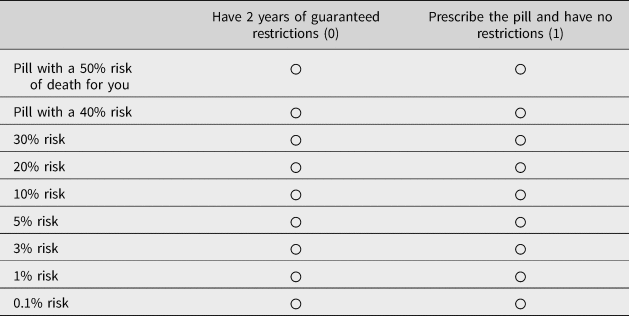
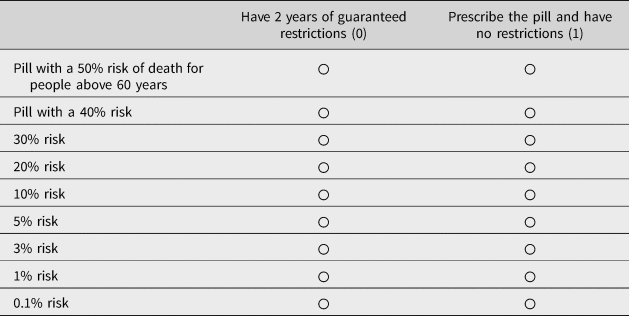
After a short sense check whether participants understood the scenario and a short behavioural measure (i.e. click-able links to ‘expert opinions’, which, however, did not work, on purpose to create uncertainty), the participants then played standard gambles, which is a common method in health economics (cf. Drummond et al., Reference Drummond, Stoddard and Torrance1987; Dolan et al., Reference Dolan, Gudex, Kind and Williams1996) to elicit the utility of health interventions (here: a pill).Footnote 11 In particular, they had to decide, for different risk levels of side effects ranging from 50% to 0.1%, whether (or not) to prescribe the pill, for themselves (one gamble) and for three other age groups (three separate gambles), which mimicked the risk profile of Covid-19, namely: the young (less than 35 years of age), the middle-aged (between 35 and 59) and the elderly (above 60). For example, Tables 1 and 2 show the prompt of the standard gamble for the self and for people above 60 years, respectively:
Standard gamble for the self. For each of the choices below, please choose whether you would (a) have 2 years of guaranteed restrictions or (b) prescribe the pill if it were guaranteed to avoid restrictions for you and everyone in your community but had the following risks that you might die as a consequence of the side effects of the pill

Table 1 Long description
The table is intended to report responses to a standard gamble question about choosing between two years of guaranteed restrictions and taking a pill that avoids restrictions but carries varying risks of death from side effects. No rows, columns, labels, or numeric values were included in the provided table data. Because the data are missing, it is not possible to describe the risk levels presented, the number of choices, or how often respondents selected the pill versus guaranteed restrictions. It is also not possible to compare preferences across different risk levels or identify any trends. Provide the table entries to generate accurate, WCAG-compliant.
Standard gamble for people above 60 years. Now, instead of yourself, please choose when to prescribe the pill for people above 60 years
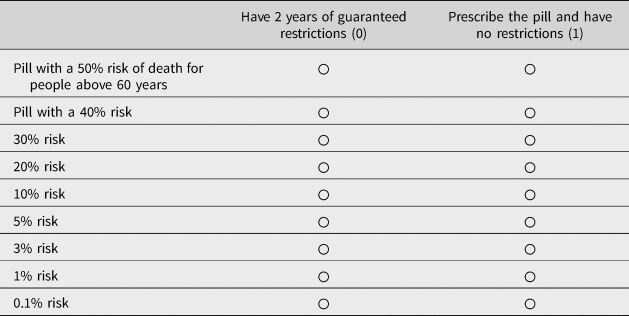
Table 2 Long description
The table is intended to report standard-gamble responses about when to prescribe a pill for people older than 60. However, no table entries, headings, or numeric values are included in the provided data. Because the underlying values are missing, it is not possible to describe key results, compare groups, identify trends, or interpret preferences. Please provide the table rows and column labels to generate accurate, WCAG-compliant.
The standard gambles for the young (less than 35 years of age) and the middle-aged (between 35 and 59) had exactly the same appearance as that for the elderly (above 60 years of age). Our outcome was the risk level prescribed for the self and for the others by age group, respectively, i.e. 9 categories including 50%, 40%, 30%, 20%, 10%, 5%, 3%, 1% and 0.1%, at which the participant switched from (A) not prescribing the pill and having two years of guaranteed restrictions to (B) prescribing the pill and having no restrictions for themselves and for everyone in their community.
Although hypothetical, these choices closely resemble the real-life trade-offs that policymakers had to make during Covid-19: whether to restrict personal freedoms by imposing lockdowns (or restricting life in other ways, for example by shutting down parts of the economy such as culture or tourism, or letting travellers enter certain destinations only when getting vaccinated against Covid-19) or to avoid restrictions at the risk of potentially serious health consequences, which are heterogeneously distributed amongst the population. Participants were told to imagine and immersive themselves in the scenario (by appealing to them that their ‘responses will be a part of an important research into public preferences, which could inform future public policy in the UK’), and were given a lot of descriptive information about the situation to make it appear realistic and complex. There was no obvious optimal course of action, as in reality.
Finally, after playing these standard gambles, participants were asked about their main motivation behind each choice, and they could only choose one (i.e. motivations were mutually exclusive). For example, for people above 60 years, they could select, besides an ‘other’ and a free text option, one of the following:
1. ‘I think those above 60 would choose this’ (weak paternalism motivation, i.e. the agent satisfies the preferences of targets, hereafter labelled ‘Would’)
2. ‘I think those over 60 should choose this’ (strong paternalism motivation, i.e. the agent projects ideal preferences onto targets, hereafter labelled ‘Should’)
3. ‘It is what I would choose for myself‘ (strong paternalism motivation, i.e. the agent projects own preferences onto targets, hereafter labelled ‘Myself’)
4. ‘I feel the least uneasy by choosing this’ (affective paternalism motivation, i.e. the agent's choice for targets is motivated by integral emotions elicited by the prompt to make a choice, hereafter labelled ‘Feel’)
While the first three motivations are more established in the literature on paternalism (cf. Ambuehl et al., Reference Ambuehl, Bernheim and Ockenfels2021), pertaining to cognitive reasons behind paternalistic decisions, the fourth motivation pertaining to the affective state of the paternalistic decision-maker has, so far, not been looked at.
Note that it is likely that respondents (and, by extension, paternalistic decision-makers) have several motivations (which may vary depending on context and the specific paternalistic decision at hand). We decided to go with a ‘main motivation’ (i.e. mutually exclusive options) because respondents might otherwise tick all, which would not provide sufficient variation. Importantly, it is likely that, although several motivations may be present at the same time, there is some implicit ranking of importance, which is ultimately what we want to get at.
The survey experiment was conducted on Tuesday, 15 December 2020, i.e. shortly after the second lockdown (which ended on December 2) and shortly before the (heavy) Tier 4 restrictions (which were similar to a lockdown and which started on December 26) across the UK. We therefore expect that our participants were thoroughly familiar with lockdowns and associated trade-offs, yielding a high degree of external validity. The survey ended with a seriousness check and a debriefing, including the possibility to withdraw from the study ex-post. The Supplementary Materials include the full survey.
Analysis
We did two analyses. First, we looked at the shares of the main motivations stated behind the choices made to study the extent to which affect overall (relative to cognitive reasons) played a role in the paternalistic decision-making, whereby we did not differentiate by age group (the young, the middle-aged or the elderly).Footnote 12 Then, we conducted a multiple regression analysis to study whether those participants who stated affect as their main motivation made significantly different decisions (for the self and for each age group) than those who stated cognitive reasons. In particular, for each decision (for the self and for each age group), we used a linear regression model and regressed the prescribed risk level of the pill on participants’ stated main motivation, controlling for age, gender, education and general life satisfaction, amongst others.Footnote 13 The mean prescribed risk level for the self is 3.0 (SD of 2.5), for the young is 2.5 (SD of 2.3), for the middle-aged is 2.6 (SD of 2.2) and for the elderly is 2.8 (SD of 2.2). Supplementary Appendix Table A.1 shows summary statistics for all outcomes.
Results
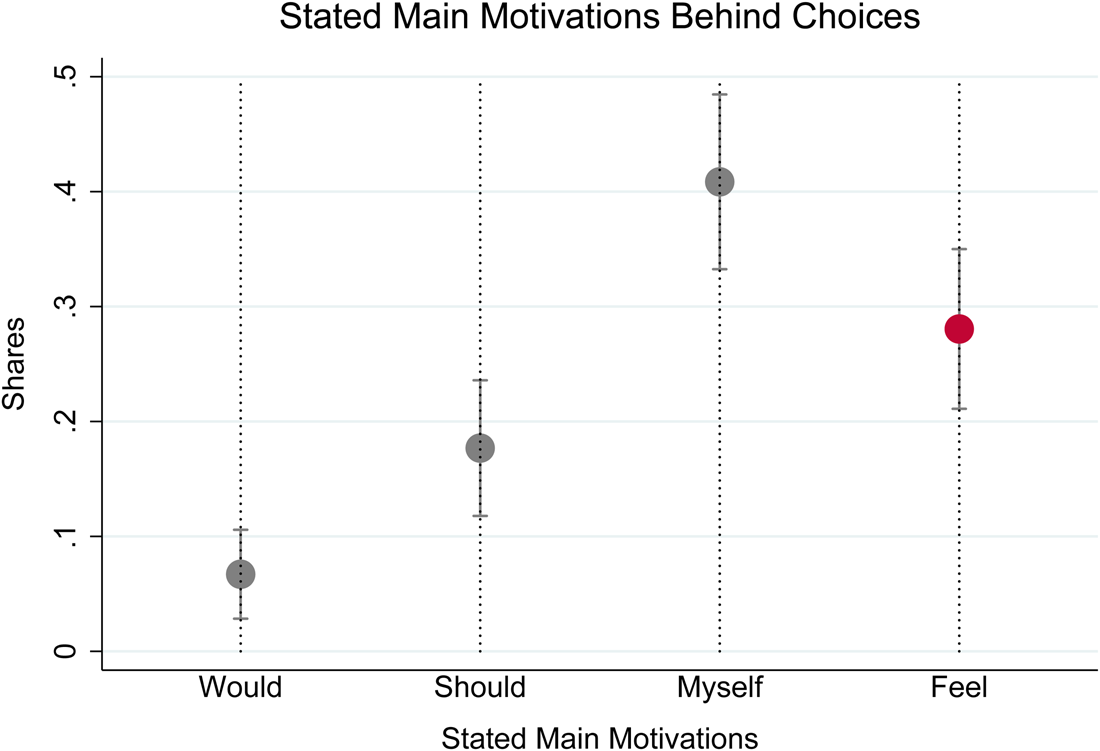
Figure 3 shows the shares of the main motivations stated behind the choices made. We found that a non-trivial share of participants stated to have made their choice mainly because he or she ‘feels the least uneasy’ with it. In fact, about 28% of participants stated to be mainly motivated by affect (‘Feel’) rather than cognitive reasons, the second highest share after own preferences projection (the first strand of strong paternalism, i.e. ‘Myself’, about 41%) and significantly higher (p < 0.05) than ideal-preferences projection (the second strand, i.e. ‘Should’, about 18%) or weak paternalism (target-preferences satisfaction, i.e. ‘Would’, about 7%). Recall, however, that motivations are mutually exclusive, so that these shares are only approximations of underlying motivations.
Extent of affect in paternalistic decision-making. Notes: Shares of stated main motivations behind choices made overall. See Supplementary Appendix Table A.1 for shares of stated main motivation by age group. Confidence bands are 95%. Source: N = 164, own data, own calculations.

Figure 3 Long description
NA
Although we cannot pinpoint the relative importance of each entry point of affect into paternalistic decision-making – whether it is the requirement to make a decision on behalf of others to improve their welfare (Figure 3 AP1); the agent's affective association with the targets (AP2); the context surrounding most paternalistic decision-making (AP3); or the anticipatory influence of the paternalistic decision's outcome on affect (AP4) – we take our findings as initial evidence that affect (as opposed to cognitive reasons) may play a significant role in paternalistic decision-making. In fact, a non-trivial share of respondents state that they mainly made at their choices not because how they or those under their care would or should choose (i.e. cognitive reasons), but because they felt least uneasy about their decision. Note that if respondents were randomly making their decisions (e.g. due to lack of interest or engagement), we would expect a more equal distribution of around 25% across motivations, which is not the case.
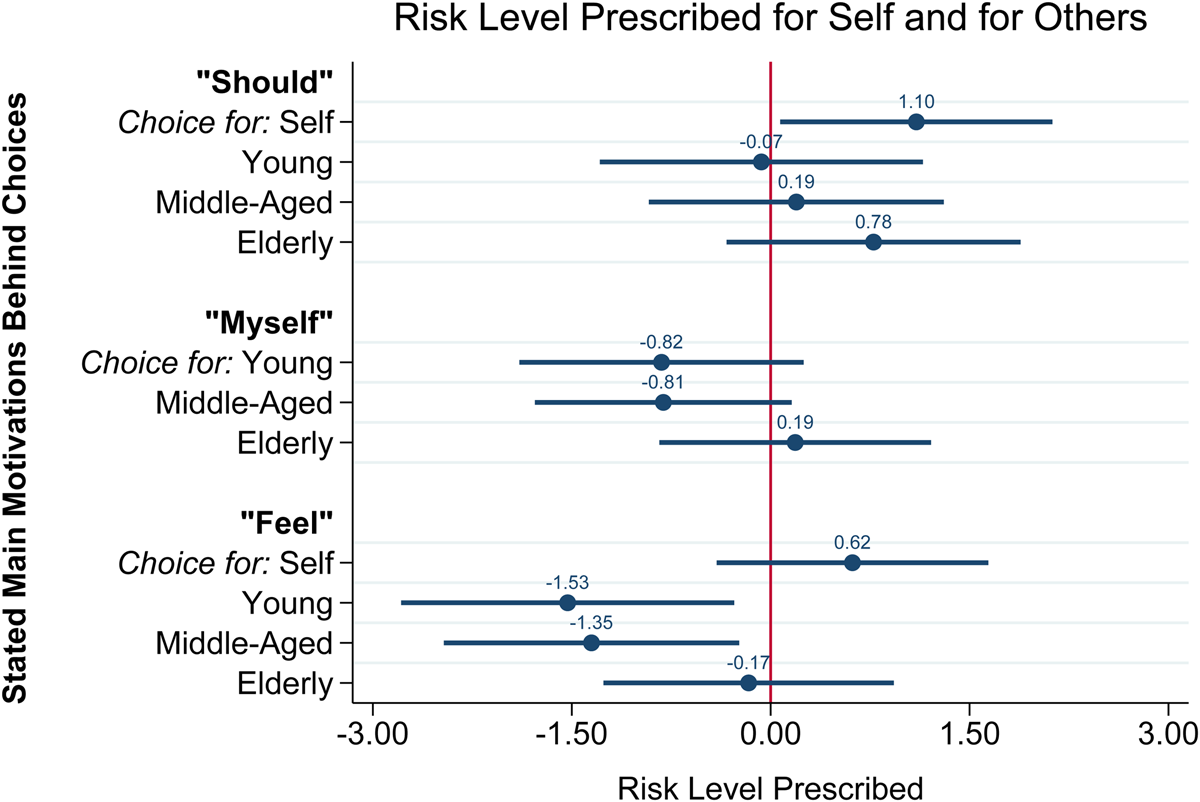
Next, Figure 4 plots the coefficients from our linear regression models, one for the self and one for each age group (the young, the middle-aged and the elderly). These models regressed participants’ prescribed risk levels on their stated main motivations for their choices while controlling for potential confounders. The reference category is ‘Would’. We chose this reference category because one intuitively thinks that paternalistic decision-makers make decisions on behalf of others that these others would choose for themselves if they had complete information and were able to act on their well-informed preferences.Footnote 14 Note that logically there is no motivation ‘It is what I would choose for myself’ (i.e. ‘Myself’) when making choices for the self. Supplementary Appendix Table A.2 shows the full regression behind this figure (and ordered logit models with odds ratios as a robustness check, which confirm our findings).
Affective paternalism – paternalistic decision-makers who cite affect as main motivation make systematically different choices. Notes: Outcome is risk level (9 categories including 50%, 40%, 30%, 20%, 10%, 5%, 3%, 1% and 0.1%) at which participant switched from (A) not prescribing pill and having two years of guaranteed restrictions to (B) prescribing pill and having no restrictions. Reference category is ‘Would’. Motivation ‘Myself’ is not available in choice for ‘Self’. Coefficients from linear models regressing prescribed risk levels for the self and for the young, middle-aged and elderly on stated main motivations for choice controlling for age, gender, level of education, current life evaluation, the Death Anxiety Scale and thoughts about own death as well as a dummy for a mortality-salience prime, see Footnote Footnote 9. Supplementary Appendix Table A.2 shows the full regression results behind this figure (and ordered logit models with odds ratios as a robustness check). Confidence bands are 95%. Source: N = 164, own data, own calculations.

Figure 4 Long description
Risk Level Prescribed for Self and for Others A dot and whisker plot with horizontal confidence intervals and a vertical reference line at 0. The y-axis is labeled Stated Main Motivations Behind Choices. Groups are labeled Should, Myself and Feel, each followed by rows labeled Choice for: Self, Young, Middle-Aged and Elderly (with no Self row shown under Myself). The x-axis is labeled Risk Level Prescribed. Tick labels shown are minus 3.00, minus 1.50, 0.00, 1.50 and 3.00. Should group: Choice for: Self has a point labeled 1.10. Young has a point labeled minus 0.07. Middle-Aged has a point labeled 0.19. Elderly has a point labeled 0.78. Myself group: Young has a point labeled minus 0.82. Middle-Aged has a point labeled minus 0.81. Elderly has a point labeled 0.19. Feel group: Choice for: Self has a point labeled 0.62. Young has a point labeled minus 1.53. Middle-Aged has a point labeled minus 1.35. Elderly has a point labeled minus 0.17. Each point has a horizontal line extending left and right from the point, indicating an interval around the labeled value.
We found that participants who cited affect as their main motivation behind their choice made choices that were systematically different than those made by participants who stated to be mainly motivated by weak paternalism and, to some extent, strong paternalism. In particular, participants motivated mainly by affect (‘Feel’) prescribed significantly (p < 0.05) less risk for the young and for the middle-aged (about 1.5 and 1.4 categories lower, respectively) compared to participants motivated by weak paternalism (‘Would’). For these age groups, the coefficients between affective paternalism (‘Feel’) and strong paternalism (ideal-preferences projection, i.e. ‘Should’) are likewise significantly different (p < 0.05). Of course, relationships are only associations, and there may be unobserved third factors driving both prescribed risk levels and main motivations, so results should be taken with caution.
We take this as initial evidence on affective paternalism: participants who cite affect as their main motivation behind their choice make significantly different decisions for others, and in particular, these participants appear to take a more cautious approach when it comes to prescribing risk for the young and for the middle-aged.
The way forward
This paper provided a conceptual framework and initial evidence on affective paternalism. Our findings from a novel survey experiment in the UK showed that a non-trivial share of participants reported to be primarily motivated by affect as opposed to cognitive reasons when making decisions on behalf of others. Moreover, these participants made significantly different decisions than those primarily motivated by cognitive reasons, namely imposing significantly lower risk levels to those under their care. Although this is only initial evidence, it nevertheless suggests that affect may play a significant role in paternalistic decision-making and that it may cause systematic deviations in interventions implemented.
Although these differences in paternalistic decision-making brought about by the affective states of the decision-maker say nothing about social welfare optimality, their size warrants further investigation. In particular, to the extent that affective paternalism may result in inefficient, undesirable or unfair consequences, which need to be re-evaluated from context to context, our framework suggests entry points on where to intervene, for example via emotion regulation techniques (e.g. process modification, cf. Gross, Reference Gross2015; or affect labelling, cf. Torre and Lieberman, Reference Torre and Lieberman2018) or choice architecture (e.g. mandated delay between deliberation and decision, cf. Gneezy et al., Reference Gneezy, Imas and Madarász2014). Future work should study the impact of such interventions on the ability to standardise an agent's paternalistic decisions. This would allow equality and consistency for targets influenced by these interventions.
There are several limitations to our paper. While our findings hinted at the role that affect and affective paternalism may play, our survey experiment did not allow us to disentangle the different entry points through which affect may enter the paternalistic decision-making process (i.e. Figure 3 AP1 to AP4). Instead, we only saw an overall effect, in that a non-trivial share of participants reported to be primarily motivated by what they feel as opposed to what they think and that this difference in motivations was associated with different decision outcomes. A more complex experiment would be needed to causally identify and differentiate all four entry points. To truly evoke affective states, the experiment would need to be incentivized, multi-staged and high-stakes, including the possibility for paternalistic agents to make a ‘wrong’ decision, with potential negative welfare consequences for paternalistic targets under their care (while still being ethical). Future research should aim at disentangling these entry points – both what information they are based on (i.e. some characteristics of the agent, options or targets, or predictions of outcomes) and what emotions are triggered (e.g. fear, anger, happiness, etc.), to unpack their relative importance. We hope that this paper sparks interest amongst scholars in developing such an elaborate experimental paradigm.
Of course, there may be issues of reporting bias, but none of the options given to participants to choose from was clearly more socially desirable than the other. Future research should seek to replicate our initial findings, preferably in experiments across different domains of paternalistic decision-making, replacing self-reports with behavioural outcomes or other, more objective outcome data. Such experimental paradigms would be a real addition to the literature.
A final important limitation is our sample, which is based on a ‘normal’ UK population (without any inclusion or exclusion criteria). Individuals who choose to be in power and make decision on behalf of others are clearly self-selected and different from average citizens, and hence may show differences in their affective states (and other psychological processes) when making their decisions. It would be highly desirable to conduct an experiment with ‘real’ paternalists. This limitation, however, does not only pertain to our study but is a complication that affects the entire literature on paternalistic decision-makers and their psychological processes.
While conducting our experiments at the time of Covid-19 yields a high degree of external validity, mood and emotions surrounding lockdowns and restrictions at the time of our experiments may be incidental factors influencing our findings. In particular, we expect that already heightened affective states amongst our participants may be factors that could contribute to a lower-bound estimate, and that our effect sizes could be even larger during ‘normal’ times.
What is less clear is whether affective paternalism necessarily leads to suboptimal welfare consequences. In our survey experiment, the optimal course of action was neither ex-ante clear nor ex-post verifiable (as is often the case in reality). For example, there may be good reasons to be cautious when making choices for others that can be very consequential for them, e.g. expose them to a higher risk of death. In contrast, in situations that are less consequential, the welfare-maximising outcome may be more straightforward. In such situations, the role of affect may also be smaller, because the context of paternalistic decision-making may be less complex or because the difference between affective states of agents in different outcomes may be lower.
A promising yet difficult avenue for future research would be to study the impacts of affect in paternalistic decision-making on the long-term wellbeing of those affected by the decisions. We hope that our paper provides sufficient motivation and appetite for a better understanding of the causes and consequences that affect can play in paternalism.
Supplementary material
To view supplementary material for this article, please visit https://doi.org/10.1017/bpp.2024.24.


 Open access

