

Hasidism, arguably the most significant socio-religious movement in modern Eastern Europe and contemporary Judaism, possesses a distinctive character. Among its notable features, the leadership structure has long captured the attention of numerous scholars. The Hasidic religious leader, known as a tsadik (pl. tsadikim), has been described by scholars (following Mircea Eliade) as the axis mundi of the Hasidic community. This designation signifies not only Hasidic leaders’ central role in institutional matters but also their profound spiritual significance. By the late eighteenth century, Hasidism emerged as a collection of various groups of followers, each devoted to a different tsadik, with each group having its unique ethos, ideologies, and modus operandi. It is no wonder that there are countless studies on virtually every aspect of the doctrines and social lives of Hasidic leadership.Footnote 1
One facet that has enjoyed special scholarly attention in recent years is Hasidic dynasties.Footnote 2 Toward the end of the eighteenth century, some Hasidic leaders began to employ a mechanism of inheritance of their posts through a son, sons, or sons-in-law. In this way, the deceased tsadik left one or more heirs who “inherited” some of his followers, sometimes his residence, or “court” (which could be anything from a simple hut to an aristocratic mansion), and his area of influence. This mechanism gave rise to multi-generational dynasties, which in the nineteenth century became the dominant model for organizing Hasidism. The names of such dynasties were commonly derived not from the family name but the dynasty’s original town of residence, for example Chernobil (the town renowned today for its nuclear power plant) not Twersky, Sadgora not Friedman. Often, these names traveled with successors of the dynasties even after they had relocated to other towns or regions or emigrated abroad. A dynasty’s title became its brand name, a representation of its East European historical legacy and a demarcation of the group’s identity, and carried economic and legal significance.Footnote 3 When a dynasty was subdivided by multiple heirs, each branch generated a sub-dynasty named after the town of residence of its founding leader, but maintained affinity and a sense of continuity with its original dynasty.Footnote 4 In this article we analyze the “top level” dynasties and include sub-branches under their original larger dynasties so long as they maintained collective identity as one dynastic family.Footnote 5 We will focus on biological rather than spiritual dynasties; that is, on succession by family members rather than by disciples.
We intend here to analyze how the dynasties developed and how they built their social and spatial positions, not through specific activities of talented individuals, but rather as dynasties with collective dynasty-building efforts and long-term strategies.Footnote 6 We will focus on one, possibly the most important, aspect of dynastic strategies: kinship practices and marriage alliances. Most tsadikim were married and, in fact, it seems that a young candidate had to marry to fully realize his leadership. His position was determined by his own inherited status as much as that of his wife. What is more, due to a historically dominant model of family-arranged matrimonies and the importance of inter-dynastic marriages, Hasidic leadership tended to set matches for their children at a young age, even when they were infants. Hasidic parents, and sometimes larger groups of political players, played a crucial role in matchmaking for their children, even in periods when modern patterns of matchmaking were proliferating within traditional Jewish society. Therefore, these marriages illustrate not individual, but dynastic choices, and marriage strategies of entire families. In this sense, they are like all premodern matrimonies, and especially like all marriages in premodern power groups, which opens our case for a wide comparison with those other elite groups.Footnote 7 The story of marital choices and families’ alliances is thus not a collection of individual commitments, but rather an expression of a long-term dynastic strategy and a general kinship model. The marriage strategies and practices of the Hasidic leadership families offer valuable insights into how they established themselves as dynasties, which in turn illuminates the broader social history of Hasidism.
A central question for the history of Hasidic leadership is, then, how these marriages were selected. Which social, spatial, economic, or perhaps ideological factors played a role in the selection of a candidate for a mate? In another study, we explored what dynasties meant to achieve with their marriage strategies.Footnote 8 This was not primarily for the gain of positions, localities, political power, or even clout of seniority, even if all these were important for the functioning of the movement. The most important gain was symbolic capital, which can be understood as the charisma of office, the sole fuel of the voluntary, non-territorial, non-political, even non-economic religious leadership in Hasidism. To be sure, Hasidic leaders did pursue political and economic power, as can be seen in various examples of relationships between the leaders and their followers. Our argument is that in Hasidic marriage policies the pursuit of those forms of power was not as central as in most other elite groups, or indeed as we might expect. In this study we shall approach this topic from a different angle. Namely, how, socially and spatially, did the dynasties choose marriage matches, and how did that contribute to their ultimate goal of building their religious position?
Source, Method, Data
For our project, we will start with the quantitative and follow with the qualitative, including through comparative analysis. We have constructed as extensive as possible a database of the marriages of all the known tsadikim. Footnote 9 Chronologically, the database covers the period from the first marriage of the putative founder of Hasidism, Israel ben Eliezer (1700–1760), known as the Besht, up to the last recorded matrimonies in the early 2000s. Geographically, the database extends globally throughout all territories of Hasidic expansion, from eighteenth-century Eastern Europe to contemporary Israel and North America. Although it covers a period of almost three centuries and extensive geographical areas, here we are more focused on particular historical contexts. The long history of Hasidism may be divided into several successive periods that correspond with phases of development of the movement and its dynasties, but also with major geo-political changes in Eastern European contexts. Throughout these periods the significance of dynasties varied, as did the position of Hasidism in the different geographical regions. Following earlier attempts by two of us to periodize Hasidism, in this study we employ the following chronological divisions:Footnote 10
-
(1) Before 1772: From the beginning of the Besht’s activity until the death of his major disciple Dov Ber of Mezrich, whose disciples initiated many of the prominent Hasidic dynasties. This period, which coincidentally ends when the partitions of Poland-Lithuania began, can be described as the “pre-dynastic” period of Hasidism.
-
(2) 1772–1815: This is when institutionalization of the movement and the inception of the first dynasties occurred, mainly in today’s Ukraine and Belarus. By the end of this period, marked by the termination of the Napoleonic Wars, the political borders of Eastern Europe stabilized for the rest of the nineteenth century.
-
(3) 1815–1867: In this period the dynasties became a major social structure of Hasidic leadership and significantly expanded into Galicia and central Poland. We understand this period to be the “golden age” of Hasidism, in terms of social impact.
-
(4) 1867–1914: This period of the ultimate consolidation saw also significant signs of crisis, one of which was the declining power of numerous dynasties in Russia; the center of gravity moved to Galicia and central Poland; Hungarian dynasties became more prominent too.
-
(5) 1914–1944: In this period, which included the two world wars, renewed Poland became the territory of most dynasties.
-
(6) After 1944: Eastern Europe ceased to exist as the center of the Hasidic movement and its dynasties. The two major Hasidic centers became and remain North America and Palestine/Israel.
While we have genealogical documentation of marriages from all periods, the majority of Hasidic sources relate primarily to the periods from the early nineteenth century until 1939. Therefore, the dynastic era of Hasidism (1815–1939), both in terms of its social fabric and its cultural legacy, is our major focus in this article. We will further explore this temporal perspective.
The data has been extracted mostly from Hasidic sources of varying origins. For the first-stage analysis, we gathered data from Hasidic lexicons and encyclopedias, both historical and contemporary.Footnote 11 Admittedly, the books are by no means free of deficiencies: important details are missing, and legendary tales are accepted uncritically as historical evidence. Nevertheless, they provide a valuable source base best suited for our purpose, since we intend to create a comprehensive registry of all known Hasidic leaders, regardless of their importance, which will capture the movement’s full chronological and geographical span. This is precisely what qualifies these publications to serve as our primary source. In addition, we have used a wide spectrum of other materials that include an extensive corpus of Hasidic wedding books, archival materials, primary and secondary literature, wedding invitations, and press clippings. Importantly, we have confronted the internal Hasidic data with the extensive scholarly literature on individual dynasties and leaders as well as biographical data gathered by a number of genealogists and local historians.Footnote 12 Thanks to these other sources we were able to expand our data not only on men (grooms, fathers, fathers-in-law) but especially on women (brides, mothers, mothers-in-law) as equal participants in a Hasidic marriage. Our study thus achieves more gender balance than is usually found in studies of premodern religious life. This is fully manifested in the structure of our database and our analysis below.
All in all, the database collects information on 3,510 Hasidic leaders or their immediate male relatives (fathers, sons, sons-in-law) who played a role in the Hasidic movement.Footnote 13 It is important to remember that the database does not record all heirs of Hasidic leaders, but only male descendants who held some significance in Hasidism (or whose children became tsadikim) and female descendants who married tsadikim or whose children became part of the Hasidic leadership. For these figures, we have recorded a total of 2,375 marriages, which include 2,088 first, 266 second, twenty third, and one fourth marriage. Of these, 1,629 marriages (69 percent) joined families of two dynastic leaders. Chronologically, we have marriage data for 18 percent of the tsadikim in the earliest, pre-dynastic period of Hasidism, 1700–1772; this total extends to 36 percent in 1772–1815; to 51 percent in 1815–1867; and to 81 percent after 1867. This suggests the data is rather porous for the early years of Hasidism, but rich and highly reliable for Hasidism in its full development, or the “golden age,” in the nineteenth and twentieth centuries, when dynasties became the dominant form of its religious leadership.
Based on those data, we propose an analysis of two essential aspects of Hasidic religious leadership: the network it created and the spatial parameters this network adopted. What do matrimonies tell us about geosocial patterns among Hasidic groups past and present? Upon what were they based? Can we find patterns of internal clustering?
We will start with social network analysis (SNA) of the material gathered for this study, including analysis of the centers, clusters, and alliances, and then investigate the spatial aspects of the marriage patterns. With this data at hand, we will attempt to confront these initial quantitative findings with a historical analysis of textual sources, mostly of Hasidic origin. Here we will focus mainly on Hasidic wedding books, a specific sub-genre of Hasidic publications that scholars have overlooked. These books were published in the twentieth and twenty-first centuries by particular dynasties on the occasion of important weddings within those dynasties.Footnote 14 Besides providing extensive descriptions of customs, beliefs, and practices associated with Hasidic weddings, they include narrative materials about how the Hasidim themselves have understood these marriage strategies. While the quantitative data provides the patterns of marriage, the Hasidic narratives are irreplaceable qualitative sources that complement and often substantiate the quantitative conclusions, bringing to life the intentions or motivations of the actors who influenced the patterns the quantitative analysis reveals.
In a seminal study of network analysis of elite families in fifteenth-century Florence, John F. Padgett and Christopher K. Ansell presented the following methodological note: “One needs to penetrate beneath the veneer of formal institutions and apparently clear goals, down to the relational substratum of people’s actual lives. Studying ‘social embeddedness,’ we claim, means not the denial of agency, or even groups, but rather an appreciation for the localized, ambiguous, and contradictory character of these lives.”Footnote 15 The presupposition of our study is inspired (with necessary adaptations) by that sort of approach, which has been followed by several other studies on kinship networks of elite families.Footnote 16 We assume that to understand the history of Hasidism it is insufficient to simply investigate its formal social institutions such as central Hasidic “courts” or local Hasidic prayer houses. Neither is it sufficient to just explore the explicit ideologies and worldviews of Hasidic leaders as manifested in their sermons or letters. It is equally important to investigate the social relationships between the dynasties, and inter-dynastic marriages are the epitome of those relationships.
Centers and Peripheries
First and foremost, the data unequivocally indicate the strong tendency of nearly all dynastic leaders in Hasidism to marry their children off to other Hasidic dynasties. This grew over time. While the first generation of dynastic founding fathers only rarely married dynastic heirs (17 percent), this grew to 59 percent in the second generation and 73–82 percent for further generations. Chronologically, the inter-dynastic matrimonies were still a minority at the start of the nineteenth century (36 percent of marriages in 1772–1815), but became the majority by mid-century (60 percent in 1815–1867), and reached a dominance of 74–80 percent in the period between the later nineteenth century and the Holocaust.Footnote 17 Of course, individual dynasties might have developed differently. Ger, which was the dominant Hasidic group in Poland, for example, preferred intra-dynastic endogamy and as few as 19 percent of their marriages were inter-dynastic. In a similar vein, some other dynasties, which were less central or perceived as misfits, never became popular as marriage partners (e.g., of Nadvorna marriages, 34 percent were endogamous, and in Izbits-Radzin two out of twelve marriages were inter-dynastic), so they had to develop alternative strategies. But even for these, which only rarely followed the dominant pattern, the inter-dynastic marriages constituted an important point of their self-identity and a pattern to follow.Footnote 18
By the mid-nineteenth century this created a relatively dense network in which most of the dynasties were interrelated: of 122, only twelve had no inter-dynastic marriages and these were all the smallest, least powerful, and late or long-discontinued dynasties. All the other 110 dynasties were interrelated, usually to more than one other dynasty and through more than one matrimony with every connected dynasty.Footnote 19 This pattern was consistent for the majority of dynasties for most of the classic period up to the Holocaust as well as with the marriage strategies of many other elite circles in the period, from the ruling families of early modern Europe to the aristocratic classes.Footnote 20 In a recent study on kinship networks among Dallas elite families of the first half of the twentieth century, Shannon O’Brien argued, “Through moderate levels of intermarriage and reproduction, and over the course of just fifty years, the white upper class of Dallas went from a collection of largely unrelated newcomers to a massive, interconnected family web.”Footnote 21 Our findings indicate a similar pattern among Hasidic elites. While Hasidic leaders emerged as unrelated figures and families in the eighteenth century, through intermarriages, particularly those that connected families of different regions, by mid-nineteenth century they had become one big web of Hasidic leadership.
Figure 1 presents the network of the matrimonial connections, their density, and multiplicity of interconnections.Footnote 22 The figure, which presents an amalgamated picture for the entire period studied here (which we will break into diachronic and spatial analyses presently) indicates a network of inter-dynastic relations with a high degree of cohesion. Yet, even if fairly coherent, the dynasties did not make up one big family of dynasties, but rather, as Daniel Schönpflug wrote about royal marriage circles, “several smaller networks of relatives that were shaped by frequent endogamy as much as by distinctions of rank … and by regional identity.”Footnote 23 Which families among the Hasidic families were more and which were less attractive as candidates for a match? How did the tsadikim choose candidates for their in-laws? Here varying levels of centrality and peripherality, essential categories in network analysis, come to hand.
Network of marriages between Hasidic dynasties, 1700s–2000 (UCINet, modified).
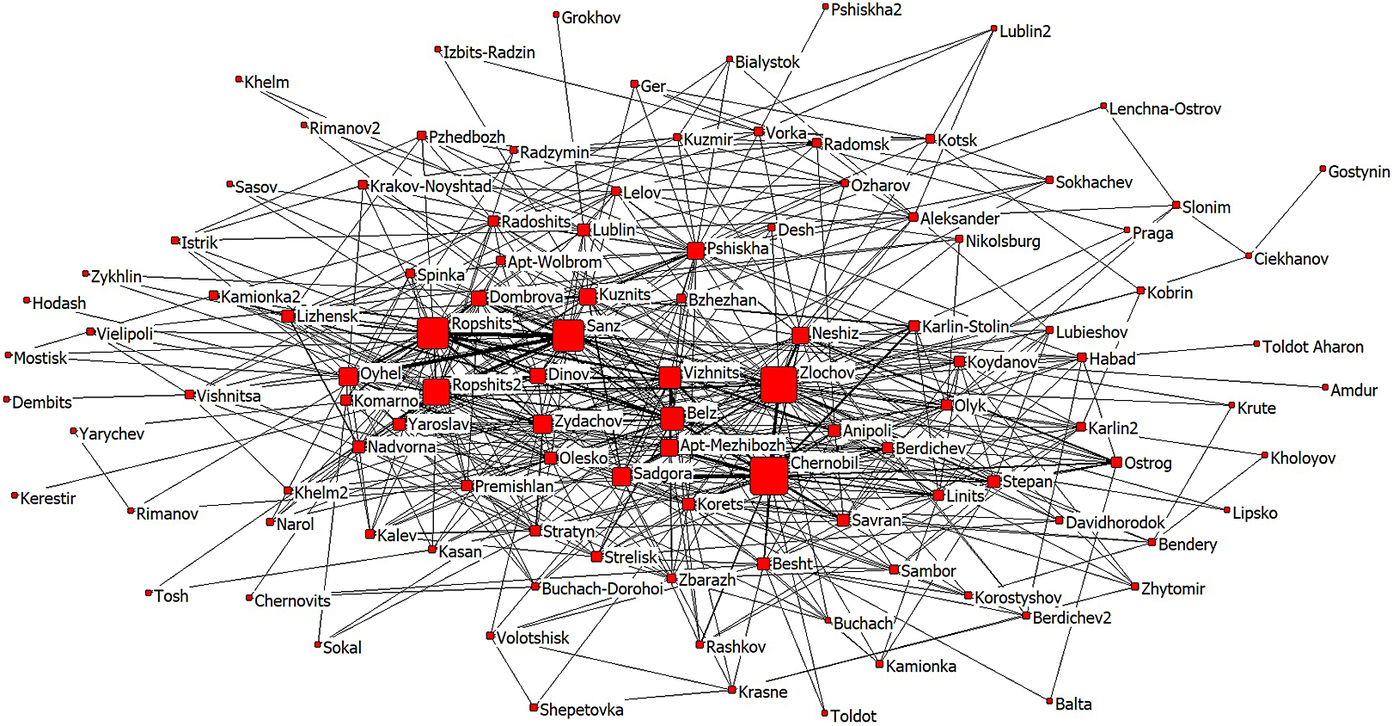
Eleven dynasties—Apt-Mezhibozh, Belz, Chernobil, Vizhnits, Kuznits, Ropshits, Ropshits2, Sadgora, Sanz, Oyhel, and Zlochov—were central to the network, totaling 21 percent of all the inter-dynastic marriages within it.Footnote 24 These eleven dynasties were densely connected among themselves, but had also a number of connections to other dynasties. Five others—Dombrova, Dinov, Neskhiz, Pshiskha, and Zydachov—were not as densely connected as those eleven, but still had at least one high measure of centrality, such as degree, closeness, and so forth (see table 1). Hence, these five dynasties could be perceived as semi-peripheral. All the other dynasties were more or less peripheral, which meant they were less attractive, or else more reluctant to establish and/or maintain inter-dynastic alliances, or less effective in doing so. Table 1 gives centrality measures and names of dynasties with the top scores (centrality measures for all 122 dynasties are in table 3 in our appendix).
Top centrality measures for the Hasidic dynasties
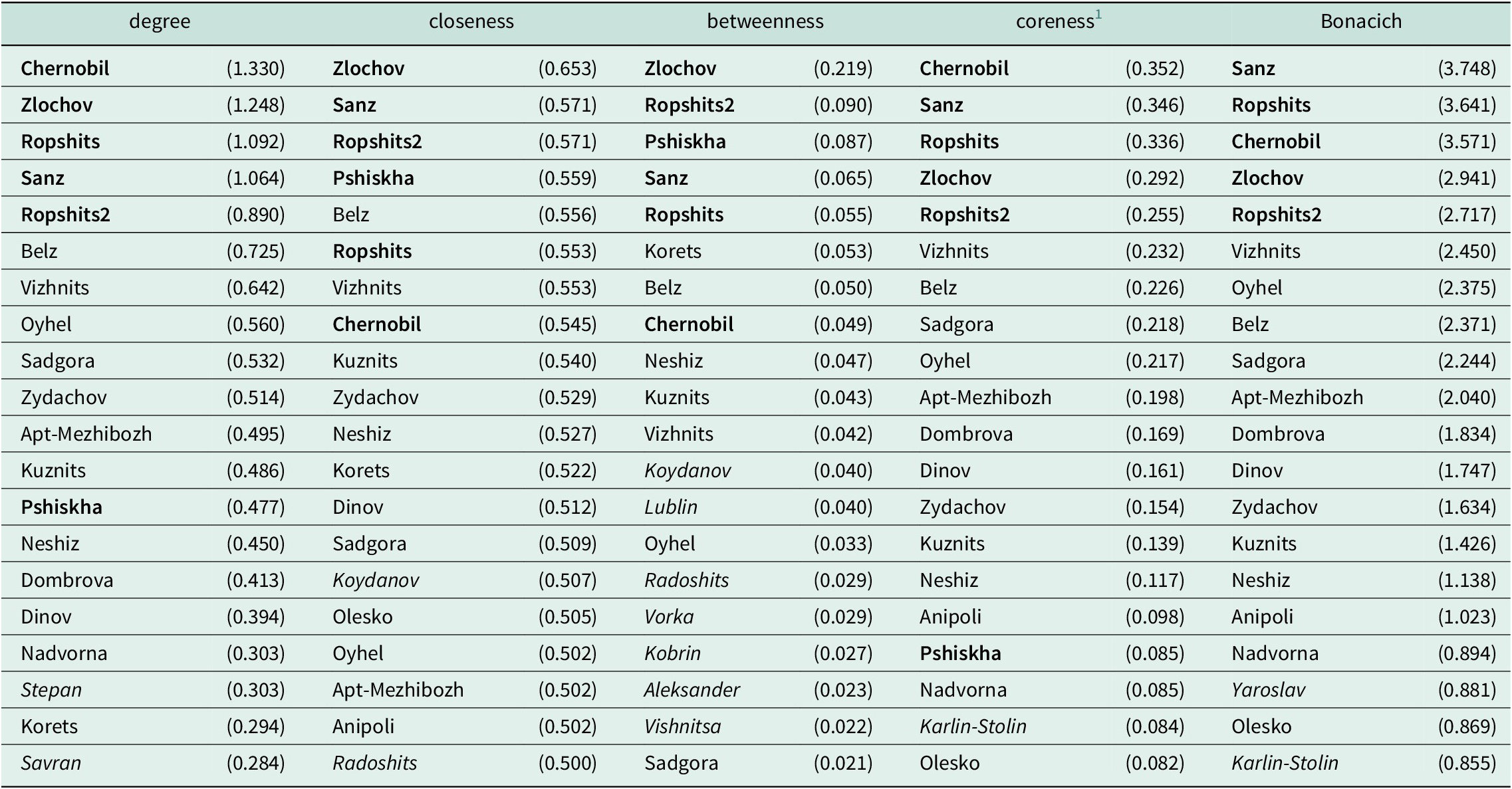
1 continuous coreness model (UCINet)
Bold script indicates dynasties being among top three for at least one centrality measure.
Cursive script indicates dynasties that appear in top 20 in less than 3 centrality categories.
These data fully confirm the core/periphery count. The most central dynasties according to the applied criteria were Chernobil, Ropshits, Ropshits2 (Rubin), Sanz, and Zlochov, closely followed by Belz, Vizhnits, Oyhel, Sadgora, and Zydachov. In other words, they were the most popular dynasties to seek matches with and served as marriage hubs for most of the other dynasties.
Some of these findings were predictable. Centrality is naturally correlated with the size of a dynasty (as measured by the number of tsadikim), which means that small dynasties cannot reach high centrality for the simple reason that they have fewer marriages (for the sixteen dynasties mentioned above as central or semi-peripheral, the median number of tsadikim per dynasty is sixty-three, while the median for all 122 dynasties is fourteen). The best expression of this correlation is Chernobil. Established by Menahem Nahum Twersky (1730–1797), a disciple of the Besht, this dynasty boasts a rich historical legacy and held a revered position within Hasidic tradition. Notably, it implemented simultaneous inheritance, where all sons of the tsadik would establish sub-branches in their respective locales. This solidified the dynasty’s influence, particularly in Ukraine, where it emerged as a prominent force. It is thus the “winner” in several centrality categories, most naturally by the number of marriages they established (or, in social network analysis language, their degree). Chernobil was also the most central group in both Ukraine and Lithuania, being the top marrying choice for many other dynasties there: Apt-Mezhibozh, Belz, Berdichev, Linits, Karlin-Stolin, Korets, Ostrog, Sadgora, Savran, and Zlochov. There was little change over time: Chernobil was the top choice from the early nineteenth century up to the Holocaust, when it lost its central position. Furthermore, Chernobil also had the most transregional reach of prestige, extending to Galicia, Bukovina, Central Poland, Belarus, and their native Ukraine. Much like Chernobil, the Sanz dynasty held sway in western Galicia, which embodied an extreme conservative stance in Hasidic culture. Founded by the esteemed scholar and halakhic authority Ḥayim Halberstam (1797/99–1876), this dynasty boasted numerous tsadikim and sub-dynasties, many of which remain active to this day. The Sanz dynasty was well known for its comparatively high level of social power (as measured by the number of shtiblekh—Hasidic prayer sites),Footnote 25 intense expansion strategies, and rapid proliferation of particularly numerous heirs of the dynasty, so it is no surprise that it appears on the list.Footnote 26 But none of this was true for Ropshits, Ropshits2, Pshiskha, or Zlochov. In fact, these dynasties were not the largest in terms of the number of tsadikim or number of marriages. Their cases indicate that centrality measures are dependent on marriage strategies no less than on the size of the dynasties. Thus, several of the largest dynasties are not included, most prominently Nadvorna, but also Kuznits, Lizhensk, et cetera. Likewise, to play a prominent role in dynastic alliances it is not enough to have only socioeconomic power. Some powerful dynasties were more peripheral in the matrimonial market, like Ger, which was the foremost Hasidic group in Poland during the interwar period and currently stands as the largest Hasidic community in Israel, and Habad, which originated in northern Belarus and rose to prominence, particularly in the twentieth century, and showcased distinctive organizational and theological features.
This is well illustrated by the social network analysis term “betweenness,” a measure of centrality that allows one to establish how many pairs of elements in a network have their shortest connection running through a given element. In our case, betweenness indicates how often a given dynasty would be the most natural connection in matchmaking between one dynasty and another, or which dynasties were most important for maintaining a high degree of cohesiveness for the network as a whole. Put differently, they might not be that strong in their power-building but be particularly widely connected and enjoy universally accepted authority, or at least not be perceived as a threat to other dynasties’ authority. The dynasties with a high degree of “betweenness” are especially interesting because they played a crucial role in transforming the network of unrelated dynasties or clusters of dynasties into one complex web. Dynasties that display by far the highest values of betweenness are Zlochov, Ropshits2, and Pshiskha, which were neither markedly populous nor influential by standards of seniority (meaning how old a given dynasty is) or the number of shtiblekh affiliated with them.Footnote 27
This suggests that we need to reflect on what it really meant to be central in the net of Hasidic dynasties. First, the data confirm the general observation that centrality does not equal power, which is not a novel discovery.Footnote 28 Several of the most powerful dynasties are low on the list regarding centrality, while some of the most central are not exceptionally strong as measured by the number of shtiblekh and followers, or indeed by any of the other criteria known to us. Second, Hasidic centrality might be a good measure, not of power or authority or prestige, as such, but of the ease in marrying off children due to fairly low enforcement of their own dynastic identity on the newlyweds. This might also indicate a tendency to establish wide inter-dynastic connections and an effective resignation from using marriages as a path to excessive upward mobility. And these intermarriages seem to have become the recipe for dynastic success. This, again, is not surprising, since it resembles the pattern among elite families in various other historical contexts, including the most celebrated case of the Medici clan in Renaissance Florence.Footnote 29
This argument requires some clarification regarding inter-dynastic sociocultural relationships. A superficial observer might categorize all Hasidic dynasties as uniform entities in structure and sociocultural character, but a more nuanced assessment reveals that each group exhibits its own distinct organizational framework, cultural identity, and spiritual orientation. The variances among dynasties and ideological currents within the diverse and decentralized movement have given rise to a multitude of perceptions and portrayals, both internally and externally. Some groups have cultivated an image of disparity and uniqueness, drawing on social or behavioral traits, distinctive theological discourse, fervent religiosity, or cultural inclinations toward conservatism and orthodoxy in response to modernity. Yet, there are other groups whose distinct characteristics are less defined, and Hasidim themselves have hesitated to attribute specific traits to them. Membership in these groups tends to rely less on explicit ideological or cultural elements and more on subtleties in material culture, appearance, ritual practices, musical styles, and the like.Footnote 30
These identities, shaped by historical contexts, have significantly influenced the structure of dynasties, family dynamics, and, notably, patterns of matchmaking. Generally, dynasties with well-defined identities sometimes present challenges in matchmaking because they seek to maintain their distinctiveness and may avoid unions with certain dynasties in order to preserve their uniqueness for future generations. Conversely, dynasties perceived as less distinct were unimposing and might forge familial bonds with a broader array of dynasties. This phenomenon is particularly evident in the adoption of ideological trends of traditionalism and religious radicalism among some Hasidic groups since the mid-nineteenth century, which has led to mutual perceptions between dynasties and created tangible or perceived barriers that influence patterns of inter-dynastic (dis)connections.Footnote 31
As our data show, dynasties that were the hubs of marriages (Zlochov, Chernobil, Ropshits) were typically less stringent in upholding their dynastic identity than were many more peripheral ones. Unlike dynasties that are commonly perceived as culturally unique, these did not emphasize their distinctive group identities. They were easy to match with because they were less of a challenge. In addition, they all practiced simultaneous hereditary patterns that enabled multiple marriages through sub-dynasties. This points to a negative correlation between the extent and durability of inter-dynastic bonds, on one hand, and the rigidity of dynastic identities, on the other, not only in Renaissance Florence but also in Hasidism and elsewhere. The most successful Hasidic dynasties, in terms of preference for intermarrying with them, were those that managed to combine classic measures of influence with unimposing dynastic identities.Footnote 32
At the same time, unlike in the cases of the Medici and other aristocratic powers, the strength and extent of Hasidic marital networks did not always translate into, nor correlate with, political or socioeconomic power.Footnote 33 While Chernobil is certainly one of the most powerful groups as measured by the standard parameters of shtiblekh and followers, this is far from true for Pshiskha, Zlochov, Ropshits, Ropshits2, and several other central dynasties. This shows that a dynasty’s centrality is dependent not just upon its size and socioeconomic power, but also on its matrimonial engagements. Therefore, some powerful dynasties, despite their socioeconomic influence, remained peripheral in the matrimonial market. We therefore propose that centrality in the realm of marriage is an additional indicator of significance in Hasidic culture, one which has played a vital role in shaping the dynamics of influence and authority within the Hasidic world.
Clusters
But can we still further differentiate the dynasties or groups of dynasties based on their marital preferences? Can we locate clusters of dynasties that are marked by the strongest interconnectedness? And if so, what other characteristics might they share?
One way to approach these queries is through cluster analysis. One of the models divides the 122 dynasties into three groups with strong internal connections and few outliers. Their distribution is presented in figure 2.Footnote 34 Each of the three clusters is grouped around several dynasties that are central, or central and semi-peripheral. The clusters are consistently territorial and seem to share other general characteristics.Footnote 35
Network of marriages between Hasidic dynasties, 1700s–2000 (UCINet; modified) with clusters by Clauset-Newman-Moore (NodeXL Basic).
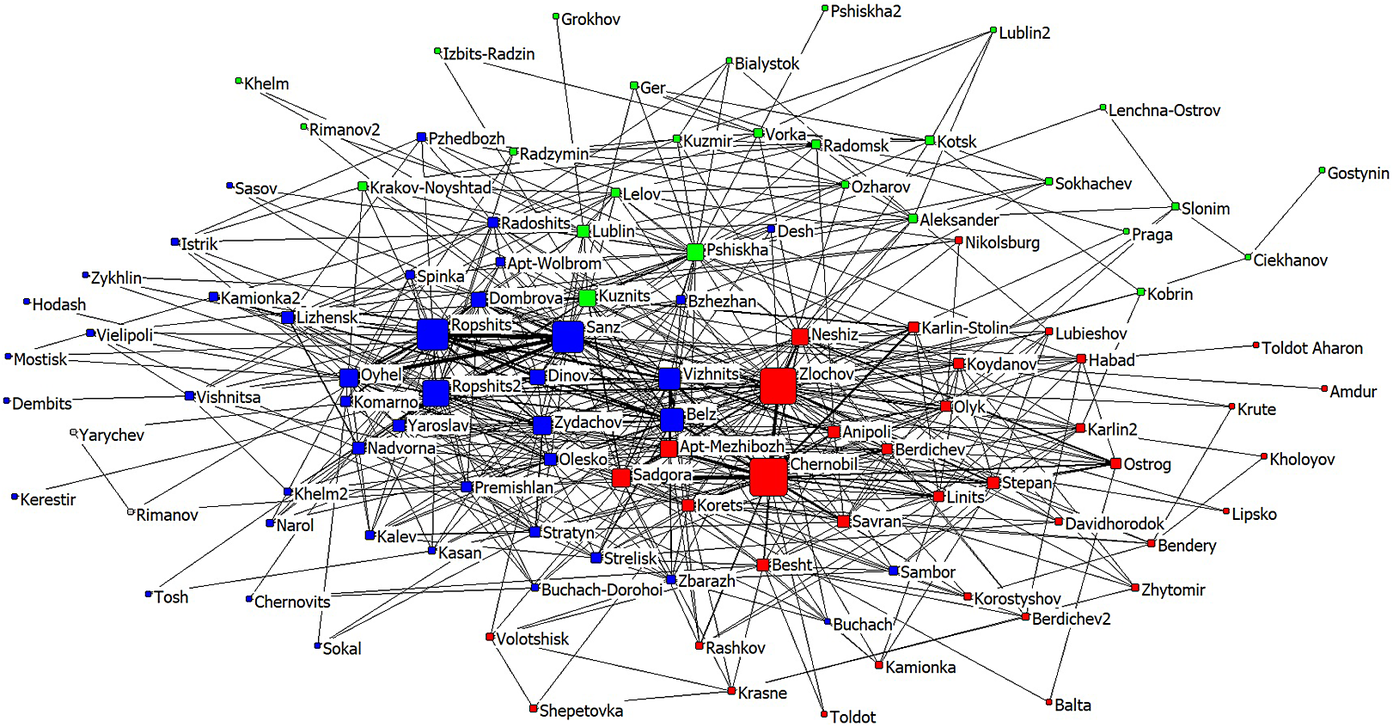
The “Russian” cluster (red in the diagram) is the oldest of the three and has a strong core of old dynasties: Apt-Mezhibozh, Chernobil, Sadgora, and Zlochov, in addition to relatively prestigious but powerless Besht, Toldot Ya’akov Yosef, Linits, and Korets, with their heydays long gone.Footnote 36 These dynasties were the first to connect simply because they were the earliest to appear in the history of Hasidism, which emerged in the Ukrainian territories of Podolia and Volhynia.Footnote 37 Several dozen of the oldest inter-dynastic marriages within this cluster had already appeared by the end of the eighteenth century among the first established groups of the consolidating movement (e.g., between Neskhiz and Korets ca. 1780). In relative numbers, these dynasties formed the strongest inter-dynastic pattern in the late eighteenth and early nineteenth centuries, with 98–100 percent of the inter-dynastic marriages being within the cluster, which fell to 88–83 percent later in the nineteenth century and to 72 percent in the interwar period. This was a result of the general crisis of Russian Hasidism after World War I, and the gradual disappearance of Hasidism within its historical regions. Yet, though they coexisted within the same geopolitical region, the core dynasties that made up this cluster were socioculturally diverse. Some wielded significant political influence or established lavish “courts” reminiscent of non-Jewish nobility, exemplified by the Sadgora dynasty, which originated in Ukraine and maintained these characteristics even after it migrated to Bukovina and Eastern Galicia in the mid-nineteenth century. Others followed a more modest spiritual ethos. The prevailing ethos among dynasties in the southern Pale of Settlement leaned toward less emphasis on scholarly pursuits and a more relaxed approach to traditionalism, as indicated by the lower frequency of marriages with rabbinical families: compared to the average in all clusters of every fifth tsadik being a rabbi and every tenth marrying a rabbinical daughter, in Chernobil and Habad (which maintained a self-perception of uniqueness, recognized by other Hasidic groups) it was as low as 2 and 3 percent, respectively, in Apt-Mezhibozh 5 and 6 percent, in Sadgora 3 and 0 percent, et cetera.
The biggest “Galician-Hungarian” cluster (blue in the diagram) is grouped around the dynasties of Belz, Ropshits, Ropshits2, Sanz, Oyhel, and Vizhnits, supplemented with semi-peripheral Dombrova and Dinov. The cluster emerged later than the “Russian” one, with the vast majority of marriages being in the second half of the nineteenth and early twentieth centuries. The short period of its formation and maturation, compared to other dynasties, might explain its high degree of coherence: in the later nineteenth century and the interwar period, between 82 and 85 percent of their inter-dynastic marriages were forged within the cluster. The core of the group had a clear preference for marriages with the rabbinic elite and rabbinic marriages both within dynasties and outside them to non-dynastic tsadikim-rabbis and even to rabbis outside the Hasidic elite. This tendency is noticeable especially in Galicia, where tsadikim and their descendants commonly accepted the roles of communal rabbis. This phenomenon can be attributed to cultural factors, since many Hasidic dynasties in Galicia espoused values of religious piety, cultural conservatism, and an emphasis on traditional scholarship. Further, the structure of communal rabbinate positions facilitated the perpetuation of familial inheritance, which allowed dynasties to exert a broader influence in the region.Footnote 38 Thus, the tradition of marrying into rabbinical families within this community has persisted across generations as a distinct sociocultural trait. While on average every fifth tsadik was a rabbi and every tenth married a rabbinical daughter, in Oyhel these parameters were as high as 55 and 22 percent, respectively, in Sanz 20 and 23, and in Ropshits 14 and 29. That is, these dynasties, besides having a geographical proximity that might have influenced their tendency for multiple marriages among them, shared also a clear inclination to marry into the rabbinical elite. They also shared a “genealogical” connection due to the fact that many Hungarian dynasties had originated in Galicia. Both centers shared many sociocultural characteristics.Footnote 39 As a result, the main dynasties in the group (as analyzed by k-cores) were interconnected through an exceptionally high number of marriages. Figure 3 illustrates the connections between dynasties that had seven or more marriages between them.
Network of Hasidic dynasties with seven or more marriages between them, 1700s–2000.

The “Polish” cluster (green in the diagram) is the smallest and weakest of the three in terms of number of inter-dynastic connections, with semi-peripheral Kuznits and Pshiskha at its center. There are few old dynasties here, and it has by far the weakest connections between individual groups, with the highest number being five marriages between Kuznits and Pshiskha (see figure 2). This is fully understandable given Polish Hasidism’s long resistance to the system of dynastic leadership and the strong tradition of schools rather than dynasties in central Poland as late as the mid-nineteenth century.Footnote 40 Dynasties came late there and thus produced fewer generations of leaders, and in some schools the followers often felt that the disciples of their masters surpassed the descendant of those masters. This led to the weakening of dynastic heritage and the proliferation of non-hereditary leadership succession. Maybe this was the reason why the “Polish” cluster never became as dominant here as “Galician-Hungarian” and “Russian” ones: the marriages within the cluster never exceeded 67 percent, and in the nineteenth century fell much below that.
We might also catch the “bridges” between the three clusters; that is, the dynasties that created the strongest connections between them. The connection between the “Galician-Hungarian” and the “Russian” groups was largely based on Vizhnits and Belz (the former connected to Anipoli, Apt-Mezhibozh, Berdichev, Chernobil, Korets, Ostrog, Rashkov, and Sadgora; the latter to Apt-Mezhibozh, Chernobil, Karlin-Stolin, Kobryn, Neskhiz, Stepan, and Volochisk), while the connection between “Polish” and “Galician-Hungarian” as well as “Russian” dynasties was based primarily on Kuznits, but partly also on Pshiskha. The role of the “bridge” might have invested these dynasties with relative importance, but more importantly it put them in a position of greater transregionality than other, more regional dynasties. In some cases, the geographic locations of a dynasty might have played a role in their bridging position. The Rokeah family of the Belz dynasty resided mostly in Belz and nearby towns in the northernmost corner of Galicia, near to the borders of central Poland and Russia, and was easily reachable from Poland, Volhynia, Podolia, and Ukraine—most of the central Hasidic territories. Similarly, the Vizhnits dynasty, with its seats located on the Galician-Bukovinian border, formed a natural passage between Galicia, Bukovina, Hungary, and Romania. These dynasties held the opposite of a central geographical location: a position that bridged central territories, which allowed them to gain importance by transcending regional limitations and acting as social and spatial brokers.
Alliances
The clusters also disclose firm alliances between individual dynasties. In the Hasidic context, an “alliance” does not mean any formal pact or agreement between two dynasties, but rather a recurring pattern of intermarriage and connection between two specific dynasties maintained for several generations. In the “Galician-Hungarian” cluster, the highest number of marriages, eighteen, joins Galician Sanz and Hungarian Oyhel, closely followed by tenacious bonds between Ropshits and Sanz (seventeen), Sanz and Ropshits2 (twelve), Dombrova and Ropshits (eleven), and Dinov and Ropshits (eleven)—all of which were characterized by a tendency toward conservatism and rabbinical positions. The “Russian” cluster has seventeen marriages between Chernobil and Sadgora, fourteen between Chernobil and Apt-Mezhibozh, and thirteen between Chernobil and Zlochov.
Of the forty top alliances (as measured by the number of matrimonies), only two emerged around the beginning of the nineteenth century (Zlochov-Stepan, and Chernobil-Karlin-Stolin), and none of those were particularly significant. The vast majority appeared in the later part of the century: the strongest in the Russian cluster (Chernobil-Sadgora) in the 1840s, Galician-Hungarian Sanz-Oyhel in the 1840s, and Sanz-Ropshits in the 1860s. This is fully consistent with the nineteenth-century pan-European trend, in both Christian and Jewish communities, of the rise in consanguineous marriages as part of a wider class-building process in which endogamic marriages served to cement alliances and extend them into succeeding generations.Footnote 41
These alliances, while they functioned, forged as many as two or three marriages per decade up until the Holocaust. But even for those who married their children to the alllied dynasties relatively rarely (average being three to five times over five to seven decades), previous unions were important reference points retained in the dynastic memory. A striking example of this can be found in the marriages between the Habad and Chernobil dynasties. While Chernobil was one of the most connected dynasties, Habad was not. Yet, Chernobil was the only dynasty with which Habad maintained inter-dynastic connections across several generations. Consequently, it is unsurprising that for the Habad memory the Habad-Chernobil marriages were more important than they were for Chernobil, where the marriages with Habad were just one of many inter-dynastic connections.Footnote 42
There is also a palpable tendency to maintain gender symmetry in marital alliances, especially among the most powerful groups. Power in Hasidic dynasties was patriarchal and patrilineal. With a few noticeable exceptions, it was ostensibly only men who held positions of power, with the role of the tsadik at the top of the hierarchy, and men inherited their power through men. Although in Hasidic discourse we did occasionally discover special attempts to marry the elder son to another prominent dynasty, since he was sometimes considered the major successor,Footnote 43 we found no explicit expressions of Hasidic discourse on the differences, or lack thereof, between marrying sons and daughters. The noteworthy effort and care invested into marrying off daughters to the heirs of Hasidic dynasties indicates that their role was perceived as important, even if they eventually became part of the other dynasty. This was a significant gesture in the building of dynastic alliances. Successful matches held cumulative importance for further alliances and granted significance to the prestige of future generations whose lineage would encompass ancestors from multiple dynasties. Hasidism was by no means exceptional in this regard. As O’Brien argues, women played a significant role in transforming the isolated families into a complex web.Footnote 44
Thus, while the tsadikim of Apt-Mezhibozh married off their sons mostly to the daughters of Chernobil (five) and Sadgora (four), they also chose the same dynasties for marrying off their daughters (nine and six, respectively).Footnote 45 Most of these “reciprocal” marriages occurred close to each other in time, within the living memories of those involved, usually no more than one generation apart. This may well have been a conscious decision to maintain the symmetrical relationship. Pairs and triangles of these symmetrical alliances form the cores of the “Galician-Hungarian” and “Russian” clusters. Only rarely do we find highly disproportionate gender relations, such as between Chernobil and Korets, where the former took from the latter six brides, but not a single groom. It is difficult to know why.
Generally, most of the alliances were established within clusters between the largest dynasties that, simply because of their size, had higher numbers of brides and grooms to marry off and a more-or-less developed dynastic strategy. Sometimes alliances were also established between different clusters, as in the case of the two very different dynasties of Belz and Chernobil. The initial marital union between them, one in Ukraine and one in Galicia, was motivated by the clearly stated desire of the tsadik from the younger Belz dynasty to marry off his son into the prestigious, old, and influential dynasty of Chernobil (even if not into its most powerful branch).Footnote 46 After the first wedlock was successfully arranged, several others followed. This might have been the more general pattern for such transregional alliances that depended on two essential factors: desire to find a comparably strong match (most acute for the top dynasties), and the success of the first marriage.
Hasidic literature retrospectively invested these preferences with meaning in order to elevate their own dynasty’s importance.Footnote 47 More importantly, despite pronounced tendencies to maintain and strengthen such individual alliances, there was a parallel tendency to limit their extent. In the vast majority of these alliances, the dynasties were careful not to establish too intense a relationship with one dynasty alone, so that if a power imbalance emerged they would not be left as fully dependent. This assessment emerges from the data, but it is difficult to confirm it via Hasidic texts, which rarely refer explicitly to takeover attempts or the dangers of surrendering in matchmaking considerations. Only in a few isolated cases do we find a strong reliance of one dynasty on marriages with one, stronger partner. The extreme case was the alliance between Karlin-Stolin and Chernobil, within which as many as 43 percent (nine of twenty-one) of all Karlin-Stolin marriages were forged with Chernobil. Their rather exceptional relationship was established in their first generation and continued in later stages without either being assimilated into the other or creating one-sided dependency. There were several reasons for this: Karlin-Stolin was an equally old dynasty and the geographical distance between Karlin-Stolin and Chernobil was large (but still within the same socio-political region), and Karlin-Stolin was a dominant group in Lithuania and Belarus. It is possible, however, that these multiple marriages were also intended to aid the stability of the Karlin-Stolin dynasty, which experienced several intergenerational leadership crises, inter alia due to its smaller number of descendants. Still, the relationship between these two dynasties illustrates the enduring nature of matchmaking practices, which persisted across various epochs and were rooted in family traditions and a commitment to continuity. Similar disproportions occurred in relations between the incapacitated Rashkov and Chernobil, or Kobrin and Zlochov. More often than not, though, even the greatest numbers of intermarriages within such alliances made up only a small fraction of all the matrimonial unions of these dynasties. In the above-mentioned top example of the eighteen marriages between Sanz and Oyhel, those made up only 10 and 22 percent, respectively, of the marriages the two dynasties forged.
Perhaps the best example of such a consistent policy of balancing between gaining prestige from well-selected marriages yet avoiding too-strong alliances was Zlochov.Footnote 48 This old and respectful dynasty was established by Yehiel Mikhl (1726–1781), a disciple of the Besht, thus forming a connection to the origins of Hasidism. It was socioeconomically feeble and apparently had little to offer. Yet Zlochov managed to establish a strikingly successful policy of maintaining strong ties with the most powerful dynasties in its cluster, while simultaneously cultivating a wide net of marriages with other dynasties both within and outside of the “Russian” cluster. Surprisingly, Zlochov developed this strategy only in its fourth generation during the nineteenth century, when it already had little power or significance. Despite this, in the nineteenth century it managed to build firm ties with Chernobil (thirteen marriages; 7 percent of Zlochov’s marriages),Footnote 49 Neskhiz (eleven), Premishlan and Stepan (six), Sadgora, Ropshits2, and Sanz (five), which allowed it to shine with the political clout as an ally of the strongest. Yet, at the same time, none of these alliances dominated Zlochov, simply because it had a wide and well-balanced net of marriages with fifty-five other dynasties in all areas of the Hasidic habitat, with almost 40 percent of their marriages in Ukraine, 40 percent in Galicia, 11 percent in central Poland, 6 percent in Hungary/Romania, and 4 percent in Lithuania/Belarus. Thanks to this success of their dynastic policy, Zlochov managed to survive and thrive despite having limited resources, fewer noteworthy tsadikim (except for the dynasty founder), and fewer shtiblekh and followers. This, again, confirms that marriage strategies were not a tool of political or socioeconomic expansion, but instead a prime instrument of building religious prestige, symbolic capital, or charisma of office, among the Hasidic leadership.
Another marked effect of such a wide and geographically diversified network of marriages was the significant dispersion of the residencies of the Zlochov tsadikim. By the early twentieth century, they had their residencies in Galicia (seven localities), Volhynia (four), and Podolia, Moldavia, and central Poland (three), as well as individual sub-branches in Bukovina, Transylvania, and Ukraine, so they crossed nearly all borders of nineteenth-century Eastern Europe. Their consistent strategy of wide marriage alliances made them into a trans-territorial, universally accepted, and almost indispensable element of the dynastic leadership in Hasidism (even if feeble by itself), and several sub-branches have remained active till today.
Intra-dynastic Endogamy
An intriguing form of consanguineal wedlock critical to understanding the very construction of the dynastic identity in Hasidism was arrangements between bride and groom from the same dynasty (see figure 4). These often involved first cousins or uncles and nieces, but also second and third cousins, who bore the same surname and belonged to the same dynasty.Footnote 50 Unlike inter-dynastic alliances, intra-dynastic endogamy was not universal, or even close to popular. Only forty-four dynasties, or 34 percent, practiced any intra-dynastic endogamy. But in the families where they did appear, the numbers of such marriages were relatively high. The top three dynasties with such marriages were also among the largest with regard to the number of tsadikim, so endogamy was reasonably simple to achieve: the pool of potential matches was large and blood relations within such a large dynasty did not have to be very close. However, the high level of intra-dynastic endogamy was equally popular in far smaller dynasties. The groups with the highest values were Nadvorna (34 percent), Sadgora (31 percent), and Chernobil (30 percent), closely followed by much smaller Habad (29 percent), Ger (28 percent), and Radomsk (27 percent).Footnote 51 Every third or fourth child in these dynasties married within the dynasty. This percentage was also strikingly high when compared to other dynasties with intra-dynastic endogamy: the median for all of these groups was 11 percent, and after the exclusion of the top three it fell to 7 percent.
Endogamy in Hasidic dynasties.

There could be different explanations for this endogamy: marginality, as in the case of Nadvorna; centrality, as in that of Sadgora; and seemingly voluntary separatism, as with Habad. Nadvorna was an old dynasty but marginal and socio-politically weak, with most of its tsadikim in Romania, and until the early twentieth century it was on the periphery of the Hasidic world. The tsadikim of Nadvorna were also among the first to emigrate to the New World and to establish dynastic branches there.Footnote 52 Many of the Nadvorna tsadikim had no other Hasidic leaders in their area and nothing to offer to potential in-laws from more central territories. The scarcity of their resources and the large distances separating them from others led to disproportionately high numbers of endogamous marriages. By contrast, for Sadgora, as for Ger and Habad, their particularly strong position as measured by their socioeconomic power and/or distinguished lineage resulted in a hesitance to share these with others. The dominant dynasties rarely managed to marry off their children to dynasties of equal power since it was difficult to find such matches. One way to counterbalance this shortage of qualified in-laws was to seek matches within their own dynasty. As Rhonda Berger-Sofer suggests in relation to Habad, which following its establishment in the 1780s had a singular central leader and only a limited period of fragmentation, the high level of endogamy might also have been a means to decrease pressure on non-inheriting brothers and sisters, since it opened to them, or their children, an alternative path for inheriting power.Footnote 53 Note, though, that high levels of intra-dynastic endogamy were not universal among those most influential dynasties (influential either in power or centrality). Aleksander (the second most powerful in central Poland), Karlin-Stolin (second in Lithuania/Belarus), and Spinka practiced no endogamy at all, and the numbers for Belz, Oyhel, and Zlochov were far below the median.
So, endogamy was just one of many possible ways to respond to the challenges of the dynastic strategies of the largest and dominant groups. As such, it might be a useful indicator of the dynastic policies they have adopted, especially since it correlated with other features. First, high endogamy was rare among small dynasties. Second, it coincided with high concentrations of inter-dynastic marriages with a limited number of families. The extreme case was, again, Sadgora, whose marriages were almost exclusively with five old or powerful dynasties: of their fifty-eight inter-dynastic matrimonies, forty-three (74 percent) were arranged with Chernobil, Apt-Mezhibozh, Vizhnits, Kuznits, or Zlochov.Footnote 54 In Habad, too, a preference for endogamic marriages might have resulted from many other dynasties avoiding marriage into Habad because of its cultural and theological distinctiveness or its sense that it was superior to others.Footnote 55
Another possible explanation for a high level of endogamy in Hasidic marriages is “endogamy of the faithful,” a strategy to preserve important societal bonds within a sectarian circle of the most ardent, or initiated members of a religious grouping.Footnote 56 Endogamy of the faithful is typical of religions and denominations with a high degree of church involvement (as in contemporary Hasidism), but can also characterize particularly zealous sub-groups of a religious community.Footnote 57 As such, it could have affected some of the dynasties with more prominent senses of religious self-identity. One can assume this sort of endogamy played no role for the less imposing dynasties of Ropshits, Zlochov, and Chernobil, but it seems a plausible explanation for the notably stringent group of Ger or the “aristocratic” Habad, which cultivated distinct forms of religious practice and senses of superiority.Footnote 58
Spatial patterns
As noted, the clusters of marriage alliances had a distinct territorial pattern. This is significant for establishing possible correlations between geography and marital preferences among the Hasidic elite, both clusters of dynasties (Polish, Galician, small, trans-territorial) and individual groups. We can further ask whether spatial features of marriage preferences in any way correlated with types of Hasidic leadership and characterized individual dynasties. Do marriage networks allow for the designation of regional clusters, and thus also regional borders of Hasidism and East European Jewry? Are there regional specifics of marital strategies among Hasidic leadership? Can we identify spatial patterns of marriage alliances? What role, if any, did state or provincial borders play in Hasidic marriage strategies? Did these borders overlap with Jewish cultural boundaries or were they easily traversed?
Most significantly, the data show a strong correlation between marriage preferences and political boundaries in nineteenth-century Eastern Europe. Even though figure 2 is not a geographical map, but an automated diagram of the Clauset-Newman-Moore network, it closely imitates the proper geographical distribution of the dynasties, with three dominant clusters for Galicia-Hungary, Ukraine-Belarus, and central Poland. With a few exceptions of minor groups, the seats of the dynasties determined where they would seek their marriage partners. This again confirms that the political boundaries of nineteenth-century Eastern Europe informed Hasidism not only politically but also in many forms of its cultural and even religious expression, here in the pattern of their marital preferences.Footnote 59 This meant that most dynasties preferred to marry off their children within the same political and, after 1914, historical province. Map 1 presents this correlation between geographic locations of the dynasties and the clusters to which they belonged.
Seats of the Hasidic dynasties and their matrimonial connections.
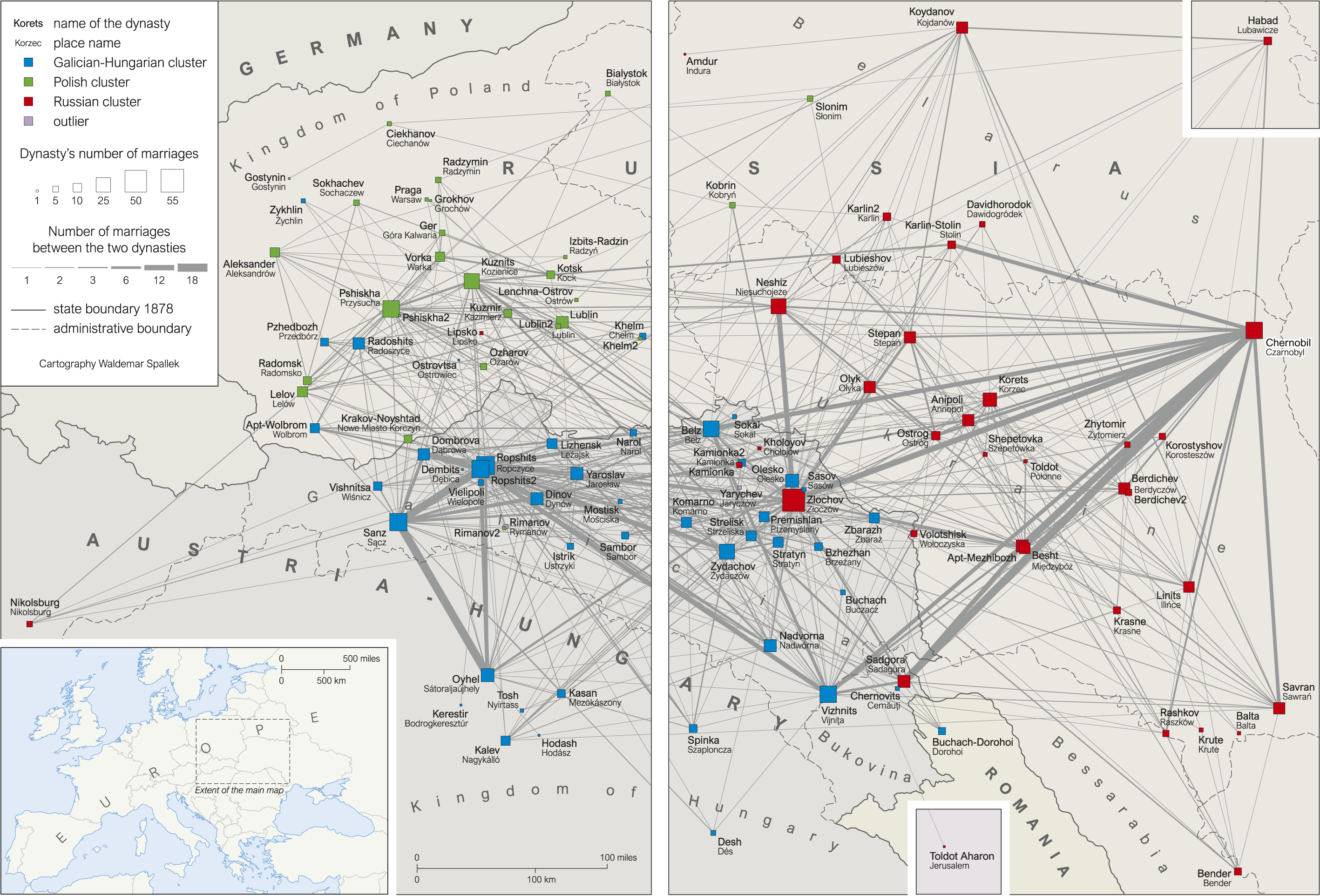
The tendency to seek matches in the same province is even more evident when studied at the level of individual dynasties. Table 3 in the appendix gives data on the dynasties’ territorial preferences in five main provinces of Hasidic expansion in Eastern Europe for the period prior to the Holocaust. Table 2 gives the same data but amalgamated for all of the dynasties in a given province.
Territorial distribution of marriages of the dynasties and median distances between bride and groom’s place of residence, 1700s–1944.
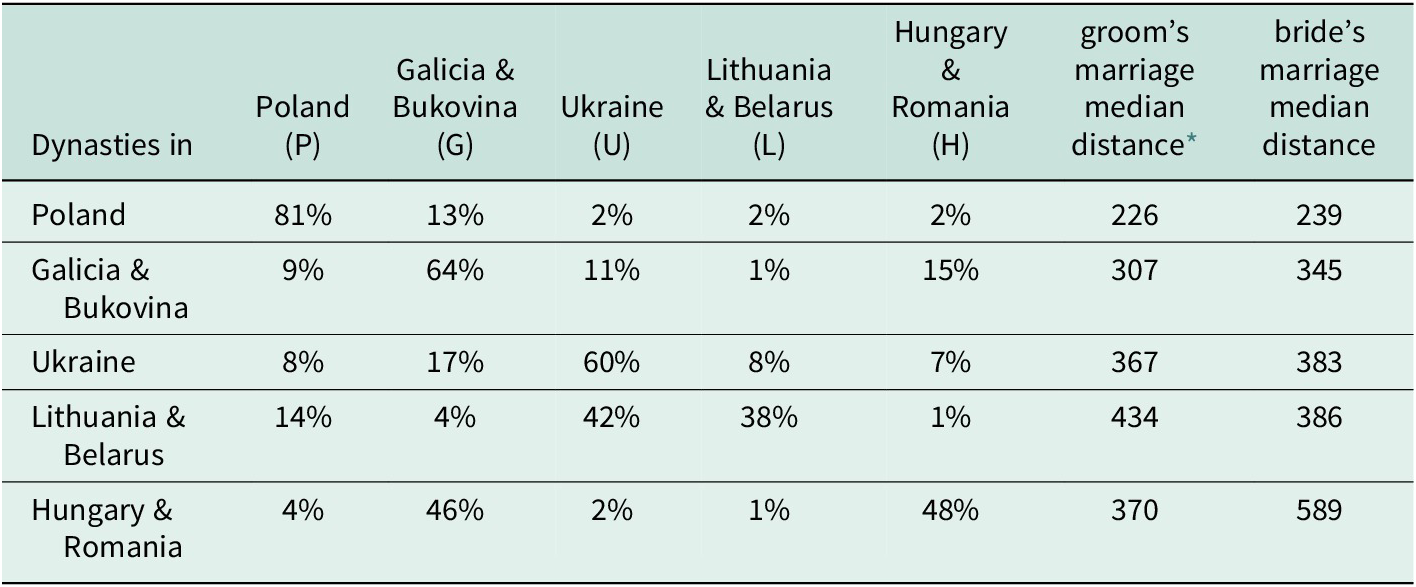
* The median distance between the place of residence of the groom/bride’s father and the residence of the groom/bride’s father-in-law.
The tendency to seek marriages between dynasties from the same territory was most pronounced in central Poland, where nearly all dynasties had between 90 and 100 percent of their matches, of both brides and grooms, within central Poland. On average, 81 percent of all marriages arranged by the Polish dynasties sought a spouse among Polish dynasties. Similarly, Galician dynasties usually married their children in Galicia, and Ukrainian dynasties in Ukraine. Galician dynasties Premishlan, Ropshits, Stratyn, and Zydachov had 80 percent or more of their mates in Galicia. This pattern was even more evident in marriages among smaller dynasties, with at or close to 100 percent being in the same region.
Only in the peripheral regions of Hungary, Romania, and Lithuania/Belarus did the dynasties seek matches principally outside of their home areas. This is understandable: in provinces with a low Hasidic presence there were few matching opportunities, few dynasties of status met the expectations of the other party, and there were few powerful groups. Consequently, as many as 48 percent of Hungarian and Romanian grooms and 44 percent of brides found their matches in Galicia, not in Hungary or Romania. Likewise, 45 percent of Lithuanian newlyweds married in Ukraine. This, too, is consistent with other spatial characteristics of the Hasidic movement. As demonstrated in another study, the vast majority of shtiblekh of a given group were located in the same nineteenth-century region as the tsadik or, more often, the line of the tsadikim (i.e., the dynasty), with which they were affiliated, and thus fully corresponded with the distribution of marriage preferences along the lines of political borders.Footnote 60 The most porous boundaries for shtiblekh were the same as for marriages: between Galicia and Hungary as well as between Lithuania/Belarus and Ukraine; that is, not state but provincial boundaries. Once more, this indicates directions of interregional affinities and, more generally, confirms the relevance of Eastern Europe’s political borders for internal cultural divisions within Hasidism, both in the nineteenth century and later, long after those boundaries had changed many times. With time, growing cultural differences in customs, religious practices, self-definitions, and dress or religious stringencies between regional clusters of Hasidism caused tensions between newlyweds and their families who came from two different traditions.Footnote 61 Whether they were a reason for creating the clusters or an outcome of them, sociocultural characteristics of Galician-Hungarian, Russian, and Polish clusters further likened the core groups within each cluster and distanced them from other clusters. It became ever more difficult to cross the political borders and form interregional marriage alliances. This is one more similarity they share with aristocratic elites of early modern Europe, for which, even in the most advantageous periods, the international marriages never exceeded 2.5 percent.Footnote 62 But at the same time, it sharply distances Hasidic strategies from Christian analogs, the closest of which were Polish magnates for whom transregional marriages were the most important tool of political ascendance.Footnote 63 It once more amplifies the essential difference between marital strategies in a political elite and those among the spiritual elite of a religious voluntary movement.
On the other hand, interregional marriages had two important advantages: First, they reduced potential competition for resources: localities, shtiblekh, followers, and their purses. Second, it helped dynasties to build an image of a major, transregional power. Several dynasties consistently expanded their marital alliances into more than one province, of which the best example was Zlochov, as discussed earlier. Another prominent example comes in Sadgora (which originated in Ukraine, but from the mid-nineteenth century located in Bukovina, eastern Galicia, and Romania) which had a strong preference for marriages in the Kiev gubernia of central Ukraine (Chernobil), followed by Podolia (Apt-Mezhibozh, Savrah), and Bukovina (Vizhnits), and only a small fraction of their marriages with Galicia and Hungary (Rimanov, Ropshits, Krasne, Sanz). These transregional dynasties had also the highest median distances from their in-laws (see table 3 in the appendix).
On the other end of the spectrum were the smallest dynasties that had not only all their marriages within the same province but, closely correlated, smaller median distances over which they married off their sons or daughters. The correlation, however, was not consistent (see table 3). Among dynasties with the highest median distances one can find both small and sizable groups, and likewise both minor and dominant dynasties among those with small or medium-small distances (e.g., Aleksander, Kamionka2). This inconsistency might result from a limited quality of the available data but might also indicate that distance was not a critically important category in establishing marital alliances. In the nineteenth and early twentieth centuries, information, including matchmaking offers of the Hasidic elite, traveled wide and fast. The correlation also lacked any temporal pattern: median distances between the late eighteenth and early twentieth centuries do not differ in any significant way, and grew slowly from 176 kilometers in the earliest period to 216 kilometers in the interbellum.Footnote 64 Until the Holocaust, it seems that the advent of modernity with its new means of transportation had only limited influence on the marital horizons of the Hasidic leadership.
If there were a pattern, it would not be distance-dependent, chronological, or power-based but rather territorial/provincial: dynasties in Ukraine and Lithuania/Belarus (Habad, Apt-Mezhibozh, Karlin-Stolin, Chernobil, Savran) as a rule had larger median distances for their marriages than those in Galicia or, especially, central Poland. This is understandable given the northwest shift of Hasidism’s center of gravity from Ukraine to Galicia and central Poland in the nineteenth century. In effect, there is a significant correlation between high distances for the matches and low numbers of Hasidic leaders per capita in a given province, or simply put, the tsadikim had to look for matches farther away in areas where there were few of them.Footnote 65 More generally, this parallels the demographical factor of the Jewish settlements’ densities, which were much higher in Galicia and Poland than in Russia.Footnote 66 In the nineteenth and early twentieth centuries there were more Jews, Hasidim, and tsadikim in central Poland and Galicia than in Ukraine or Lithuania/Belarus; one could thus more easily find a proper match there for a dynasty’s children.
There were no noticeable and consistent differences between median distances of marrying off sons and daughters among most of the dynasties. This might imply that the dynastic policies were gender-symmetrical, at least in this respect. This is significant because it seems to confirm the aforementioned similar importance attributed to the marriages of both sexes and their similar role in building dynastic alliances, though the matter requires further analysis. The trend of gender equality in marriage strategies is not always evident but is covertly persistent in Hasidic wedding books, an important source for our analysis. Naturally, their starting point is the marriage of sons as future tsadikim. But in practice equal significance is given to the lineage and dynastic affiliations of brides and grooms. What is more, some of the wedding books contain chapters dedicated to the marriages of dynastic daughters and are similar in style to those concerning sons, even if the chapter titles tend to represent the grooms.Footnote 67 We found that in most descriptions of marriages between dynasties, even in the inner-Hasidic historiographical literature, there is a clear tendency to glorify the bride’s lineage and to compare it to that of the groom.
After the Holocaust
The earliest dynasties did not emerge before the end of the eighteenth century, and it usually took them more than one generation to start to build consistent dynastic strategies. Therefore, the fully developed marriage strategies among the Hasidic dynasties, with their clusters, alliances, and territorial preferences, took their final form no sooner than around mid-nineteenth century. The process began in Ukraine, matured in Galicia, and eventually, hesitantly, expanded to central Poland. In this sense, the history of dynastic strategies is fully consistent with the general history of Hasidism and its “hegemonic centers.”Footnote 68
Massive dislocations of Hasidic leadership and changing economic conditions forced some dynasties to modify their marriage strategies in the wake of World War I.Footnote 69 But the dramatic turning point came with the Holocaust. As a result of decimation of the Hasidic community, many of the traditional marriage strategies became irrelevant. Several dynasties lost their position due to physical extinction, while some others became marginal because of their loss of social basis, dearth of followers, or dispersion. Once-central Apt-Mezhibozh and Kuznits almost ceased to exist, and semi-peripheral Neskhiz vanished. Once powerful Kobrin, Stepan, or Olik, too, disappeared entirely; influential Aleksander became marginal, and Sadgora lost much of its clout. That did not mean full abandonment of the old preferences, but the number of inter-dynastic marriages fell drastically. In the period immediately after the Holocaust there were simply few dynastic children to be married, they were dispersed, and many were unsure as to the continuation of their Hasidic leadership. The tendency for inter-dynastic marriages slowly reemerged later in the twentieth century, but the average for the entire post-Holocaust period is as low as 56 percent, compared to 80 percent in the interbellum.
This caused the collapse of the former clusters and alliances. None of the pre-Holocaust clusters survived, and none of the alliances continued to exist in their prior forms. Of the 40 strongest pre-Holocaust alliances, less than one-third preserved any continuity, and only one (Chernobil-Zlochov) maintained its earlier intensity. Some of the strongest, including Chernobil-Sadgora and Ropshits-Sanz (each with seventeen matrimonies), entirely abandoned their previous alliances. Until the end of the twentieth century, no new dynasties emerged as central in their matrimonial network. Just as for the general Hasidic community, the post-Holocaust realities exerted a significant standardizing and unifying influence on Hasidic elites and their marriage habits.Footnote 70
Due to the major spatial dislocation of Hasidism, the geography of marriage preferences also changed. “Polish” tsadikim are no longer in Poland, nor do “Hungarian” ones remain in Hungary. Today they often reside in the same neighborhood in Jerusalem, greater Tel Aviv, or New York, or thousands of kilometers away across the Atlantic. This shift made the old categories of space extraneous, but it did not annihilate the old “territorial” preferences entirely, since they were often rooted in both spatial proximity and, more importantly, similarities in their ethos. It remains unclear what will eventually emerge. Today, Polish leaders (that is, Hasidic leaders that were previously part of the Polish cluster) still prefer dynasties that originated in central Poland (and as many as 90 percent of them choose their in-laws among Polish dynasties), while Galician tsadikim increasingly prefer in-laws from Hungary and Romania, a clear expression of the shifting hierarchies and the rising importance of these latter groups.
Similarly, median distances between residencies of brides and grooms radically increased due to the greater distances between the two main centers of Hasidism, in Israel and North America, along with a greater ease of trans-Atlantic matches. While the median distance in the late nineteenth century and the interwar period was 216 kilometers, after the Holocaust it extended fourteen times, to 3,041 kilometers. Hasidic matchmaking became global, and older categories of regional versus trans-territorial marriage strategies lost all relevancy.
While it is certain that the post-Holocaust map of dynastic marriage strategies is nothing like the old one, it remains unclear what new map will emerge.
Conclusions
The data analyzed in this article, for 2,375 marriages of 3,510 tsadikim, provides a rich picture of dynastic strategies in Hasidism. It reveals a pronounced tendency to not only marry dynastic children off to other Hasidic dynasties but also follow discernible geosocial patterns and hierarchies of matchmaking. In another study we noted a visible preference for arranging marriages with dynasties of similar social status, in terms of seniority, as measured by their age, and socioeconomic influence, as measured by the numbers of their shtiblekh and followers.Footnote 71 However, against this general tendency, among Hasidic dynasties the most popular matching partners (Chernobil, Ropshits, Ropshits2, Sanz, and Zlochov) were not necessarily those with the greatest seniority or socio-economic capital, but rather those which could combine these features with less imposing dynastic strategies. Such flexible dynasties were popular for marriage because there were lower risks of inter-dynastic conflicts due to sharp differences in customs and lifestyles. For dynastic success, it was equally important to be dominant yet to avoid excessive deployment of that dominance. In other words, wide inter-dynastic connections both strengthened the position of a dynasty and required resignation from, or at least less stress on, using marriages as a means of acquiring power. If this negative correlation between dynastic success and stringencies of dynastic identities proves to be correct, it strongly indicates similarities with other networks of expanding elites. But, equally importantly, it amplifies differences between power-oriented political and/or economic networks and religious dynasties with their prime goal of enhancing their spiritual influence.Footnote 72
A significant category for differentiating the dynasties is their level of intra-dynastic endogamy. The majority of dynasties practiced no endogamy at all, while several others kept it at a relatively low level of 3–6 percent. Only a small group of dynasties practiced endogamy at a level that reached 20 percent, and the most extreme case was 34 percent. High endogamy could stem from both the centrality of a dynasty reluctant to share its prestige with others (as in the case of Sadgora) and the marginality of a dynasty that was an unattractive match for any other comparable family (as in the case of Nadvorna).
Finally, we can differentiate the dynasties as to their marital preferences according to territorial clustering. Three such clusters exist—Galician-Hungarian, Russian, and Polish—with several outliers. The political boundaries of nineteenth-century Eastern Europe proved to be viable cultural boundaries for Hasidism, at least in its marriage policies. These characteristics emerge from an analysis of our quantitative data, not from superimposed sociocultural stereotypes (even if some apparent stereotypes can now be substantiated by the quantitative data). The clusters are characterized not only by the territoriality their names indicate, but also by other distinguishing features: vigorous inclusion of rabbinical elites and scholarly ethos in the Galician-Hungarian cluster, a noticeable preference for the oldest dynasties in the Russian cluster, or the relative weakness of dynastic connections within the Polish one. This finding should be compared with other scholarly attempts to recognize and verify possible dominant features of these regional versions of Hasidism, and also with their popular images.Footnote 73
We were also able to locate core and peripheral dynasties for each of those clusters, “bridges” that maintain their interconnectivity, as well as alliances between individual dynasties and their durability. Individual inter-dynastic alliances could be established both within (Chernobil-Sadgora, Sanz-Oyhel) and between clusters (Chernobil-Belz). However, there was a simultaneous tendency to limit the extent of such alliances, possibly due to the danger that the stronger dynasty would subjugate the weaker. Historical cases of “converting” sons-in-laws from the weaker to the stronger dynasty confirm that this threat was real, or at least perceived as real, even if it was not widespread.Footnote 74
Spatial analysis of the marriage practices suggests there was a gender symmetry in the Hasidic leadership’s approach to marrying off sons and daughters. This is significant, because it might confirm our working hypothesis that marriages of sons (except for firstborns) and daughters had a similar role in building the dynastic alliances and dynastic positions of Hasidic groups. Substantiating this assumption will require further research, and that is true regarding all of the areas that we have discussed. We also know that we cannot back up all of our quantitative observations with qualitative sources. Still, with all of the limitations of the database, methods, and analyses applied in this study, we believe it brings us closer to understanding how Hasidic dynasties constructed their marriage strategies and how these played out in how they built their dynastic positions.
In her study on elite families in Dallas, Shay O’Brien wrote, “Dynasties are brittle, but webs are strong, and the upper class is a web,”Footnote 75 and argued that the web structure of the network of elite families contributed to the persistence of that elite in the face of crises. Our findings bring us to a similar conclusion. Rather than a set of unrelated dynasties, Hasidic leadership gradually became a web of interconnected families, with distinctive patterns of organization, clusters, alliances, and endogamic practices. Both Hasidism’s similarities to other elite societies and its idiosyncrasies, visible only through comparison, shed new light on historical processes within both Hasidism and those other elite networks. As such, we expect this research to prove relevant and innovative for the wider fields of religious studies and the historical study of dynasties.
Acknowledgments
We thank Jan Antoni Wodziński for his assistance in processing the database, Moses J. Rubin for providing data on the Ropshits2 (Rubin) dynasty, Avraham Frischman and David Singer for materials they shared with us, and the editors and anonymous readers of CSSH for their insightful comments. We are also grateful to the participants of the Oxford Summer Institute on Modern & Contemporary Judaism (2023), and the participants of three conferences at which we discussed sections of this project: Transregional Contacts and Connections, at the Charles University in Prague (2020); Hasidism in the Twentieth Century, at the University of Wrocław (2022); and Displacement, Networks, and Other Transnational Effects in Modern Jewish History, at the Hebrew University of Jerusalem (2023). Their comments and criticism helped us greatly to improve sections of this study.
Funding
Part of the research for this article was sponsored by the Polish Minister of Science within the National Program for the Development of the Humanities grant no. 11H 20 0154 88.
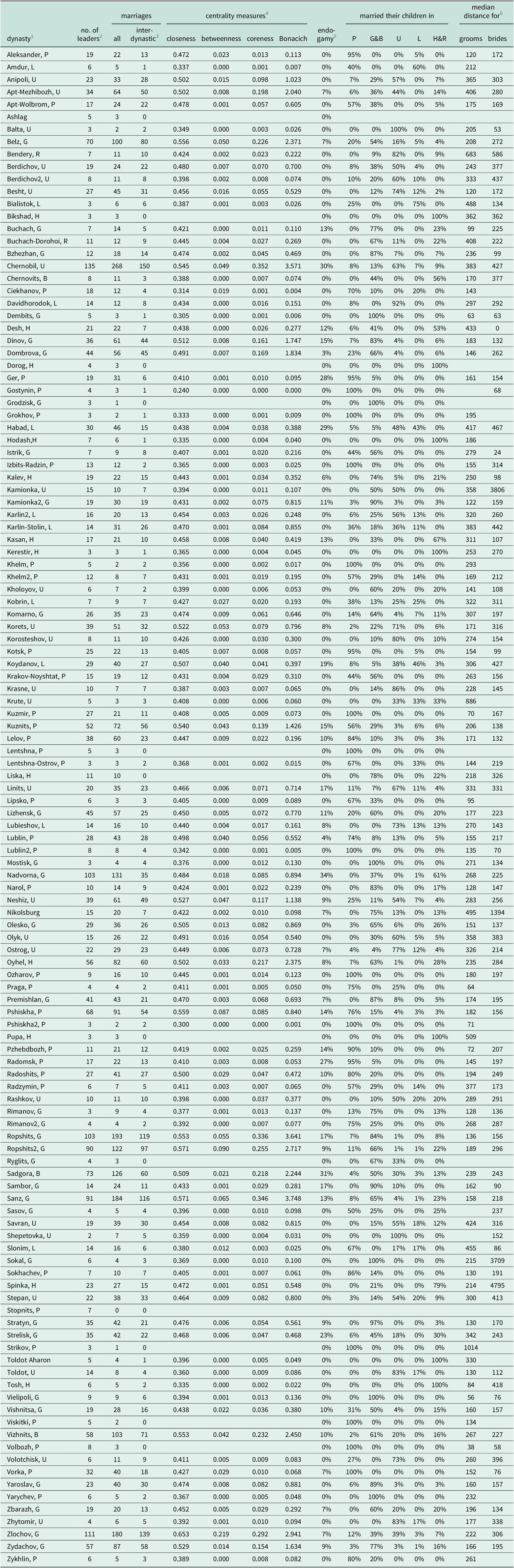
Appendix Table 3
All the SNA calculations for this study have been conducted through the UCINet (Borgatti, S. P., M. G. Everett, and L. C. Freeman, Ucinet 6 for Windows: Software for Social Network Analysis (Harvard, 2002)). The only exception has been made for cluster analysis, for which we have used the Clauset-Newman-Moore and Wakita Tsurumi algorithms offered in Node XL Basic, as both gave the most interesting result fully corresponding with further spatial analysis, while the most popular, Girvan-Newman (offered in both NodeXL and UCINet), provides a large number of outliers. The other community detection algorithms provided by the UCINet (Louvian, and Newman) give less significant results.
The database was calculated as a weighted and undirected network, where the value of each edge is the number of marriages (the only case when we analyzed the data as directed applies to gender relations where we differentiate between marrying off a groom and a bride). After removing 12 isolates, the network has 110 nodes for 110 dynasties, 1,164 ties valued from 1 to 18, with an average degree at 10.582, centralization at 4.15, the density of the network at 0.097, average distance at 2.353, small worldness at 3.152.
The table below presents the essential data on the 122 dynasties, as they are subject to analysis in the article, thus (1) centrality measures, (2) level of endogamy, and (3) territorial patterns of marrying off dynastic children.
All the raw data used in this study has been made available online at tsadikim.uwr.edu.pl. The website is in the process of development with built-in analytical tools for SNA, spatial, and statistical analyses as well as visualization and mapping tools.
Marriage patterns of the Hasidic dynasties


 Open access

