

The study of the labour history of pre-colonial India is still in its infancy. This is due partly to the fact that in many respects the evidence is scanty when compared with what is available for Europe and China in the same period. However, the information we do have, in Persian (then the official language), regional, or local languages, and in European languages (from missionaries, merchants, and travellers), enables us to explore the major forms of labour that prevailed in India during the late sixteenth century and the entire seventeenth century, and to trace the perceptions of the social status of the labourer that were held by the superior classes and by the labourers themselves.
Forms of labour
During the period we are dealing with, India was known all over the world for its manufactures, which it exported notably to western Asia and Europe. These included various kinds of cotton textiles (calico, dyed and printed), silk fabrics, indigo, and damascened steel. In other words, it possessed a large craft sector that also catered to its own considerable domestic market. It is estimated that India's urban population had grown to about 15 per cent of the total population,Footnote 1 put at 145 million, which would mean an urban population of nearly 22 million. This may provide us with some idea of the size of the internal market formed by the towns alone. For its internal money use India absorbed a significant proportion of the huge quantities of silver that were then flowing into Europe from the Spanish-controlled silver mines of Mexico and Peru. My estimates of Mughal currency output show the following peak annual averages in tons of silver: 246.29 tons (1586–1595); 290.70 tons (1596–1605); 213.12 tons (1626–1635); and 188.39 tons (1696–1705).Footnote 2 We should also consider the copper coinage, which in the seventeenth century served as fractional money.
With money use on such an extensive scale, it is not surprising to find that in the towns money wages were universally in vogue for both skilled and unskilled labour and in domestic service. In the A'in-i Akbari (c.1595), an official account of the Mughal Empire, Abu'l-Fazl provides detailed rates for wages for all such categories, stated invariably in copper coins when daily rates are quoted.Footnote 3 Wages were apparently generally paid on a daily basis, and only regular employees, whether craftsmen or domestic servants, received their pay monthly. It is true that some employers paid their servants partly in kind (old clothing), and delayed salary payments were common; but the basic rates seem always to have been fixed in money.Footnote 4 This is borne out by all the incidental references to wages paid, whether in Indian records or in the accounts of European travellers and documents of the “factories” of the European East India Companies in the seventeenth century.Footnote 5 Money wage payments can thus be regarded as largely the rule in seventeenth-century Indian towns and markets, and in imperial and aristocratic establishments. “Commodified labour” was thus practically universal.
The forms in which such wholly or partly “commodified labour” was found can be broadly categorized as follows.
Non-market institutions
Apart from domestic servants in the imperial household and in those of nobles (the latter to be included in the state apparatus for the present purpose), there were cavalrymen and clerks, employed in large numbers, usually on monthly salaries. Skilled artisans and labourers worked in imperial and aristocratic establishments, called karkhanas (workshops), which produced goods of various sorts for use in the employers’ households, as well as for use as gifts. These workshops are described in detail in the A'in-i Akbari and by Francois Bernier (in India, 1658–1668).Footnote 6 The A'in-i Akbari furnishes us with details of wage rates for different kinds of work, invariably in terms of money, and on a daily basis. But in construction work carried out under imperial aegis, piece rates are also specified.
Market-governed, private employment
(a) Self-employed:
The self-employed population consisted largely of peasants, who, with their families, cultivated the land with the aid of their own cattle and tools, and paid tax and rent to the state or the local potentate.Footnote 7 Since the tax/rent was paid generally in money and only rarely in kind, a large part of the peasant's produce was put on the market, though naturally a part too was kept by him for direct consumption. Peasant labour could therefore be deemed to be only semi-commodified.
The labour of such artisans as weavers, ironsmiths, carpenters, and oil pressers, who worked at home and sold their products either from their homes, which served as their shops, or at fairs or markets,Footnote 8 was, on the other hand, almost wholly commodified. Their position as free-market operators was, it is true, often modified when they accepted advances (dadani) from merchants and committed themselves either to work for them alone, or to supply them their products at fixed prices and on a preferential basis.Footnote 9
Employers: This category includes a class of peasants (described in Marxian literature as “rich peasants”) who in Mughal times cultivated large areas of land using their own ploughs and cattle, assisted by labourers. They were both self-employed and employers.Footnote 10 Among artisans, we learn of goldsmiths, who employed assistant workmen in their karkhanas,Footnote 11 but I have found no reference to other artisans employing paid assistants.
(b) Market wage earners:
One class of wage earners was formed by those who worked in merchants’ karkhanas or workshops. These were workshops run by “rich merchants and tradesmen, who pay the workmen rather high wages” (Bernier).Footnote 12 In 1620 the English East India Company's factors set up a temporary “Cor Conna” (karkhana) at Patna employing nearly 100 persons to wind silk for them.Footnote 13 It was considered unethical to take work from a labourer and not pay the agreed wage for it.Footnote 14 But the practice of holding back wages was apparently quite common.
In rural localities, agricultural labourers worked on the lands of peasants at different tasks. Fixed share-cropping arrangements with such labourers are not reported. Usually wages were paid in cash or kind on a daily basis,Footnote 15 or partly daily and partly on a seasonal basis. It is possible, however, that here the caste system in the shape of the general repression of the “untouchables” (see below) influenced the level of wage rates and depressed them in relation to what they would have been if the “outcastes” had also been landholders or been allowed full freedom of choice and movement.
(c) Piece-rate wage earners:
Clear evidence for piece-rate payments in certain categories of work is found in the A'in-i Akbari, especially for construction work, as has already been noted.Footnote 16 In such work as that of cloth washers (who used an indigo wash to prepare the final form of woven cloth), ordinary washermen, silk winders, and spinners, it is inconceivable that any remuneration other than on a piecework basis could have been paid.
(d) Indentured labour:
It is true that the Arthasastra, the famous text on government and law, datable to c.100 AD at the latest, provides for persons to work for a creditor for a certain period to pay off a debt. Such practice, however, seems to have been very rare in most parts of Mughal India. Debt slavery obliging debtors to work in the fields of the creditor is known to have prevailed only in certain areas of Bihar in early colonial times.
(e) Chattel slaves used in production for the market:
Although slave artisans were known in the period of the Delhi Sultanate (the thirteenth and fourteenth centuries), by the time of the Mughal period such slaves are no longer mentioned. Agrestic slavery, however, existed in Malabar (Kerala) and Bihar around 1800, and is described in Buchanan's detailed local surveys.Footnote 17 But outside of these areas Irfan Habib has been able to cite only one instance, from Gujarat for 1637, where a peasant claimed to possess a slave, presumably for work in the field.Footnote 18
(f) “Demiurgic” labour:
This is a category of semi-commodified productive labour which is, perhaps, largely confined to India: the particular term used here was given to it by Max Weber.Footnote 19 This was a system in which the occupational fixity of the caste system and a semi-hierarchical village organization (conventionally called “the village community”) created a system of set obligations and rights under which the so-called “rural servants” (balutas), for instance, worked and obtained their livelihood. In general, in return for their services they were allowed to hold small pieces of land tax free (the tax which was usually borne by the village as a whole), and/or to claim modest shares in the grain harvest, given to them by each peasant at harvest time. Individuals such as hereditary barbers, potters, carpenters, blacksmiths, watchmen, shoemakers, carcass removers, and sweepers rendered certain recognized services to all (or the leading) villagers, with extra payments for work rendered outside of these customary services. Such arrangements, with certain variations, existed practically all over Mughal India.Footnote 20 Here customary entitlements to land and wages in cash and kind were inextricably linked; and these kept the families of the artisans and labourers practically tied down to their villages, though there was seemingly no legal bar to their movement, so far as we can see.
(g) Domestic service:
The domestic service sector in Mughal India was exceedingly large. Not only did the aristocracy maintain a considerable number of servants, the employment of domestic servants by “middle-class” groups was also quite extensive. Pelsaert, writing around 1626 at Agra, noted that “Peons or servants are exceedingly numerous in this country, for everyone be he mounted soldier, merchant or king's officials – keeps as many as his position and circumstances permit”.Footnote 21 Bernier, the French traveller, tells us that personal servants in the Mughal army were “indeed numerous”,Footnote 22 and Fryer, writing of the period 1672–1681, remarked more specifically that “however badly off a [cavalry] soldier is, he must have three or four servants”.Footnote 23
In the aristocratic households servants were appointed for specific duties, so that, as Pelsaert tells us, “in the houses of the great lords each servant keeps himself strictly to his own duties”.Footnote 24 On the other hand, the servants working for lower officials and ordinary people had to perform varied functions. Khidmatgars (personal attendants) of an officer of moderate rank, Anand Ram Mukhlis (c.1745), also worked as cooks.Footnote 25 The treatment meted out to servants often depended on the temper of the master. Some, like Abu'l-Fazl, did not like to scold them directly;Footnote 26 another noble was such a hard taskmaster that he even made his torchbearers and musicians, normally working at night, work as building labourers so that they might not remain idle in daytime.Footnote 27 There was, however, some disapproval of physical ill-treatment. The historian Badauni tells us of the refusal of a mystic at Kalpi (UP) even to speak to a visiting commander who beat and abused his servants.Footnote 28
Non-market, non-free labour (slavery and forced labour)
By c.1600 slave labour formed a small component of the labour force, being restricted largely to domestic service (where free servants normally predominated) and concubinage. Akbar made notable attempts to forbid the trade in slaves and forcible enslavement. He freed all the imperial slaves, who “exceeded hundreds and thousands”.Footnote 29 But domestic slaves and concubines remained an essential feature not only of the aristocratic household but also of the homes of lower officials and even ordinary people. In his verses the satirist Jafar Zatalli (1710) suggested that a small household could still comprise the master, his wife, a male slave, and a slave girl.Footnote 30
The practice of forced labour (begar) was generally considered unethical, though it was widely prevalent in relation to certain occasional tasks, such as baggage conveyance, imposed on specific lowly rural castes or communities. Akbar in 1597 and Shahjahan in 1641 issued orders abolishing the practice of begar (forced labour) extracted for various tasks in Kashmir, such as picking and cleaning saffron flowers and carrying timber and firewood.Footnote 31 It is interesting that an inscription at the gate of Akbar's Fort at Nagar in Srinagar (Kashmir), built in 1598, explicitly proclaims that no unpaid labour was used there, and 11,000,000 dams (copper coins) from the imperial treasury were spent on wages for labour.Footnote 32
Women in the workforce
Even in fairly advanced market economies, women's labour is largely unremunerated in terms of money, and is often subsumed within family income, obtained by the men of the household. This was largely true of Mughal India as well. In agriculture women undertook weeding and transplanting, picked saffron flowers (in Kashmir), husked and ground grain, besides looking after cattle or working at textile crafts, ginning cotton, and spinning yarn. They assisted their artisanal menfolk in nearly all the work done at home. Clay was prepared by women while the men potters worked on the wheel. Here, as in corn milling, heavy work could be assigned to women without any qualms.
In some crafts women worked directly for wages too, and here again they could be given heavy work to do. In Mughal paintings depicting building construction, we see women pounding limestone to obtain lime mortar, sieving lime (Figure 1) and bearing (on their heads) bricks and lime to carry to bricklayers (as they still do). As far as we can judge, the division of labour by gender was practically all pervasive, even within the same occupation (women were spinners, men weavers; men were bricklayers, women brick carriers).Footnote 33 There appears to have been little competition between the two sexes for the same kind of job. In domestic service, where this could conceivably happen, the presence of male and female slaves introduced a complicating factor in the wage market that was not present in non-domestic lines of work.
Painting by Tulsi, with Akbar's figure by Madho the Younger (c.1595).
Abu'l-Fazl, Akbarnama (Calcutta, 1984). Reproduced from Moosvi, People, Taxation, and Trade in Mughal India. Used with permission.

The place of labouring classes in society: reality and perception
The foregoing survey of labour relationships discloses an advanced state of differentiation in society, based on factors that can be regarded as historically universal: forcible expropriation of one class by another; property inheritance; and the growth of money relationships. In India, however, there was an additional factor, namely the caste system. The caste system is not easy to define, since it has enormous complexities and has undergone variations across regions and over time. Broadly, however, it implies the presence of communities, or jatis, that are endogamous and have fixed occupations traditionally assigned to them. They are theoretically arranged in a hierarchical order, each jati being either assigned to one of the larger orders (varnas), namely Brahmans (priests; though theoretically there should be no jatis among Brahmans), Kshatriyas (rulers and warriors), Vaishyas (traders), and Shudras (manual workers), or, put among the outcastes, the so-called Untouchables or menial workers (Chandals).
The caste system thus limits not only vertical social mobility, but also horizontal mobility; it is the latter which makes it so unique, and which often explains the apparently innumerable social divisions among Indian labouring classes. In practice, of course, the caste system has had its own elements of flexibility. Certain communities move up (when economic circumstances improve) in the hierarchical ladder by adopting the customs and rituals of higher castes – a process now called “Sanskritization” by sociologists. New castes are spawned to take up new occupations. The presence of non-Hindu communities, notably Muslims, which are not incorporated into the caste system (though they themselves do not remain uninfluenced by its customs and prejudices), introduces another element allowing adjustment to economic change. Theoretically, Muslim communities are more open to horizontal mobility, and this, with certain limitations, has been observable in practice as well.Footnote 34
In his account of Hinduism in the A'in-i Akbari, Abu'l-Fazl reproduces the classical conceptions of the caste hierarchy.Footnote 35 We have here the four orders, Brahmans, Kshatriyas, Vaishyas, and Shudras, and the occupations assigned to them. Painters, goldsmiths, blacksmiths, and carpenters are explicitly classed among Shudras. Abu'l-Fazl also follows the classical law books, such as the Manusmriti (first century AD), in tracing the origins of the various outcaste communities to the offspring of particular breaches of the law of endogamy. Curiously enough, what he omits to stress here is the idea of purity and pollution (doubtless exaggerated out of all proportion by Louis Dumont and his followers), under whose influence certain kinds of manual work, such as sweeping or leather dressing, were regarded as impure and fit only for the outcaste or the lowly.
But Abu'l-Fazl also offers other perceptions of class ranking. Invoking traditional Iranian wisdom, Abu'l-Fazl states that mankind is divisible into four groups: first, warriors, who are like fire; second, artisans and merchants, who correspond to air; third, men of letters, such as philosophers, physicians, accountants, architects, and astronomers, who together resemble water; and fourth, peasants and cultivators, who are comparable to earth.Footnote 36 In this arrangement artisans and merchants are given precedence not only over peasants but even over men of letters. Quite striking surely is the fact that men of religion are not even considered.
Elsewhere, Abu'l-Fazl ranks all professions into just two classes, placing that of warriors again at the higher level, and that of peasants and other professionals next. He then goes on to state that the Greeks had classified professions into three types: noble, ignoble, and middling. The noble professions are: (1) those based on the use of reason, contributing to farsightedness and administrative competence; (2) those based on knowledge, such as those of persons engaged in writing or oral eloquence; and (3) those based on strength of heart, such as the military profession. The three types of ignoble profession are those that (1) are against the interest of the people, like hoarding; (2) are contrary to sobriety, such as buffoonery; and (3) are detestable, such as the professions of barber, tanner, and sweeper. (The latter might reflect a distinct influence of the Indian concept of “impure” work.) The middling professions are divided into (1) essential, such as agriculture; (2) those that one can live without, such as cloth dyeing; (3) basic (basit) crafts, such as carpentry and iron or metal work; and (4) secondary (murakkab) crafts, such as weighing and tailoring.Footnote 37
Such ranking systems were largely theoretical. There could be other official or quasi-official conventions. In censuses of certain towns of the region of Marwar (western Rajasthan) given in the singularly interesting statistical work, Munhta Nainsi's Marwar ra Parganan ri Vigat, compiled in 1664, the total number of houses is recorded. These are categorized according to the castes or professions of their occupants.Footnote 38 The lists of castes in five of the six towns are not given in any identifiable order, but bankers are mentioned first. In Merta, the sixth and largest town, there seems to be a hierarchical arrangement. We have, first, the Brahmans (priests), Kayasths (clerks), Rajputs and soldiers (sipahi), followed by a category designated pavan jati (“working castes”), where the houses of fifty other castes, artisanal, menial, and mercantile, are enumerated.Footnote 39 The peasants are not listed, presumably because they were not found among townsmen. In this list a clear preference is given to the intellectual classes (Brahmans and Kayasths), followed by soldiers, and only below them come the artisans, menial workers, and merchants, the last three groups being mixed up without any seeming care for hierarchy.
The attitude towards artisans, peasants, and labourers among those speaking for the state, such as Abu'l-Fazl and Nainsi, thus seems mixed, with a recognition of their necessity tempered with a sense of the authors’ own superiority and distance from them. In this context, the exaltation of manual labour by the famous Mughal Emperor Akbar (reigned 1556–1605), both in words and action, seems notably singular. One of his recorded statements is that “an artisan who rises to eminence in his profession has the grace of God with him. Holding him in honour amounts to worship of God.”Footnote 40
His own treatment of an expert dyer as revealed by the chance survival of three documents seems to be well in line with these sentiments. Three farmans (imperial orders) of his relate to a certain Ustad Ramdas rangrez (dyer), the prefix ustad indicating that he was a “master” dyer. The first farman, dated 7 April 1561, assigns Ramdas the revenues of a village near Agra in lieu of his salary. When he probably retired the next year, he was granted 21.73 hectares of land in the same locality as an in'am (pension grant). Though no longer in imperial service, he still retained direct access to the Emperor; and on his personal petition against a certain Darayya for not repaying a loan and instead accusing Ramdas of insanity, the third farman was issued in 1569. It directed the local revenue collector to make Darayya repay the loan and to take him to the local qazi (judge) to extract an undertaking not to harass Ramdas again.Footnote 41
Though there is no explicit rejection of the caste system or untouchability in any statement attributed to Akbar,Footnote 42 one finds him appointing the untouchable Chandals as members of his palace guard and giving to their leader the fairly high title of rai (literally “chief”, “prince”). The official chronicler tells us that the Chandals, who were considered outcastes, and described as thieves and highway robbers, began to be employed by many nobles as watchmen after such a display of imperial patronage for them.Footnote 43 Abu'l-Fazl also informs us that sweepers, who were called kannas or “menials”, were redesignated by Akbar as halalkhor (earners of legitimate wages),Footnote 44 clearly in order to eliminate a pejorative characterization.
Akbar's own habit of performing manual labour aroused the astonishment of Jesuit missionaries visiting his court. Father Monserrate, who saw him in 1581, tells us: “Zelaldinus [Akbar] is so devoted to building that he sometimes quarries stone himself, along with the other workmen. Nor does he shrink from watching and even himself practising, for the sake of amusement, the craft of an ordinary artisan.”Footnote 45 In his account based on Jesuit letters from the Mughal court, Father Pierre du Jarric has this description of Akbar: “At one time he would be deeply immersed in state affairs, or giving audience to his subjects, and the next moment he would be seen shearing camels, hewing stones, cutting wood, or hammering iron, and doing all with as much diligence as though engaged in his own particular vocation.”Footnote 46
In many ways, such as his attitude towards women's rights and slavery, not to speak of his hostility to religious bigotry, Akbar remained unique.Footnote 47 His successors as well as the aristocratic classes in general by no means shared this interest in and respect for artisanal labour. Yet Akbar's own conduct shows that it would be a mistake to assume that the attitude towards manual labour in Mughal India universally conformed to a particular stereotype.
Self-perception of artisans and labourers
It is not easy to set boundaries between the social ideas of the higher or elite classes and those of the lower orders. It is obvious that the caste system would not have established itself and functioned so successfully had the lower castes and the outcastes to a large extent not accepted it as representing a divinely ordained institution. It is therefore particularly noteworthy that from the late fifteenth century we begin to witness artisans and labourers who assumed the garb of religious preachers and asserted the dignity of their profession in the eyes of God.
A notable representative of Brahmanical orthodoxy, Tulsidas (fl.1570), author of a very popular version of the religious epic Ramcharitmanas, noted as an astonishing phenomenon of his day that “low-caste people such as oilmen, potters, untouchables (svapachas), fishermen, watchmen, and distillers simply shave their heads and turn into mendicants, at the loss of their wife or household goods”.Footnote 48 Their one act of defiance led to others. They tended to form part of a religious movement, now often called Popular Monotheism, which, rejecting both Hinduism and Islam, India's two major religions, preached an unalloyed faith in one God, abjuring all ritual and the constraints of the caste system. Apart from the cloth printer, Namdev (c.1400) of Maharashtra, a major figure in this movement was Kabir, a weaver from the city of Banaras (Varanasi) in Uttar Pradesh, who lived around 1500.
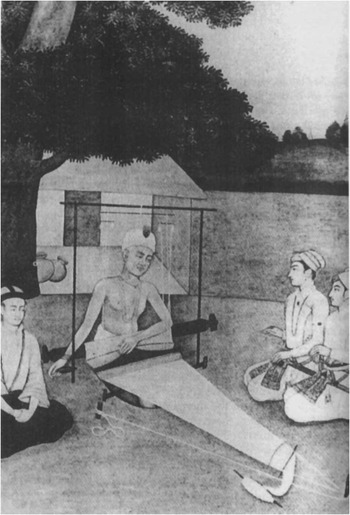
Mughal School, mid-seventeenth century.
Miniature in the Leningrad Branch of the Institute of the Peoples of Asia. Reproduced from Habib, Agrarian System. Used with permission.
Some time before 1603, the fifth Sikh Guru (Master) composed a set of verses in the name of the peasant saint Dhanna, which he included in the Guru Granth Sahib, the Sikh scripture, assembled by him in that year.Footnote 49 These verses bring out so well the defiant perception of the artisans’ own proximity to God that they deserve to be given in full.
In Gobind [God], Gobind, Gobind was Namdev's heart absorbed;
A calico-printer worth half a dam [petty copper coin] became worth a lakh [=100,000].
Abandoning weaving and stretching thread, Kabir devoted his love to God's feet;
Though a weaver of low family he obtained untold virtues.
Rav Das who used to remove dead cattle, abandoned worldly affairs,
Became distinguished, and in the company of the saints obtained a sight of God.
Sain, barber and village drudge, well known in every house,
In whose heart the Supreme God dwelt, is numbered among the saints.
Having heard all this, I, a Jat [peasant], applied myself to God's service;
I have [now] met God in person and great is the good fortune of Dhanna.Footnote 50
Of the four premier artisanal religious leaders mentioned in these verses, we have compositions included in two massive collections compiled in the late sixteenth and early seventeenth centuries, namely the Guru Granth Sahib, the Sikh scripture, and the Sarbangi of Rajabdas, of the Dadupanthi sect.Footnote 51 Owing to their early date, they enable us to capture the original compositions as they circulated in their earliest form among the common people in the various spoken languages, including Marathi, Awadhi, Braj, and Panjabi. One can see from a Mughal painting by the famous artist Bichitr (fl.1630) how they must have been sung out to the poorest of the poor (Figure 3).
Painting by Bichitr (c.1635).
Victoria and Albert Museum, I.M.27-1925. Reproduced from Habib, Agrarian System. Used with permission.

There, verses are addressed largely to persons of the same class as that of their authors. And while the message is strongly monotheistic, the pride in their hereditary mundane callings is frequently manifest – note for instance their bold presumption in seeing God as a skilled artisan. Thus Kabir: “None knows the secret of the Weaver. He hath woven the warp of the whole world.”Footnote 52 To the earlier Namdev, the cloth printer, God could be a carpenter: “My Carpenter pervadeth all things; My Carpenter is the support of the soul.”Footnote 53 He also sees Him as a potter who has fashioned the world.Footnote 54
God also appears to Kabir in the garb of persons who had influence on the artisan by way of trade. In one of his verses, God is the just merchant, while in another He is a strict moneylender. Elsewhere, by implication, man is the artisan who sells his wares to Him, or has borrowed money (his life) from Him.
There was no sense of shame felt for their own lowly professions. Ravidas owned that members of his family still went around Banaras removing dead cattle.Footnote 55 He is explicit in pronouncing his indifference to caste and claimed that “belonging to caste and being out-caste matters not for God's love, the path being open equally to all, Brahman, Bais (Vaishya), Sud (Shudra) and Khatri (Kshatriya), as well as Dom, Chandar (Chandal, outcaste), and Malechh (Muslims)”.Footnote 56
These preachers thus asserted that for the very reason of their lowly position as artisans and workers, they were the more favoured by God. They did not challenge the existing social restrictions, such as caste endogamy, or fixed hereditary occupations. What they did challenge was the status assigned to the artisans and workers on the basis of the pervading concept of caste and social hierarchy.
The popularity that the artisanal preachers’ compositions gained caused bitter hostility from a section of the educated classes. For Tulsidas (c.1570) such claims of the lowly (Shudras) were those of false pretenders and their appearance the sure sign of the Kali (Evil) Age.Footnote 57 This opinion was probably widely held, since Tulsidas's Ramcharitmanas is one of the most popular versions of India's sacred epic. But some of the educated nevertheless held a different view. The notable Muslim theologian, Abdu'l Haqq Muhaddis (fl.1600), records a conversation that took place between his father and grandfather as early as 1522, its message being that Kabir deserved respect as a “monotheist”, being neither a Muslim nor a Hindu.Footnote 58 Abu'l-Fazl (c.1595) finds in Kabir “a broadness of path and an elevatedness of vision”, and says: “[t]he door of spiritual truth became open to him somewhat and he abandoned the obsolete customs of the age. He has left behind many Hindi verses containing the truths he preached.”Footnote 59 Such praise of Kabir suggests a curious indifference in the higher circles of the Mughal elite to Kabir's lowly artisanal affiliations, and a willingness to exalt and share common truths with him, although he himself rejected their religion (indeed, all religions) in toto.
It is tempting to suppose that among both the labouring poor themselves and the elite, a breach in the faith in the old established order was being brought about largely owing to changes in the position of the artisans caused by the development of money relations and the broader market framework. This hypothesis can, however, be juxtaposed with another hypothesis, equally speculative. Islam, as understood in pre-modern times, was almost as sympathetic to concepts of hierarchy as traditional Hinduism. Yet the fact that the beliefs of these two religions were in constant contention, in circumstances of largely peaceable coexistence, opened the doors to ideas and assertions for which neither provided any room. And so, for the first time, the artisan had a choice in matters religious that he had never enjoyed before. With such choice available he could at least see both God and himself in a new light, his own.



