

Women’s political representation is a critical pathway to sustainable peace for postconflict societies, according to a growing body of gender and security scholarship. States with higher levels of women in legislature are linked with lower levels of conflict (Caprioli and Boyer Reference Caprioli and Boyer2001; Dahlum and Wig Reference Dahlum and Wig2020; Koch and Fulton Reference Koch and Fulton2011; Melander Reference Melander2005a; Shair-Rosenfield and Wood Reference Shair-Rosenfield and Wood2017), lower levels of human rights abuses (Melander Reference Melander2005b), and are more likely to invest in education, health care, and other areas critical to human security (Bratton Reference Bratton2005; Clayton and Zetterberg Reference Clayton and Zetterberg2018; Koch and Fulton Reference Koch and Fulton2011). However, it remains unclear why some postconflict states see substantial increases in women’s representation, while others experience no change or even decreases in women in legislature. Recent studies of women’s political empowerment suggest a link between the end of conflict itself and increases in women in government (Bakken and Buhaug Reference Bakken and Buhaug2021; Hughes Reference Hughes2009; Hughes and Tripp Reference Tripp2015; Tripp Reference Tripp2015; Webster, Chen, and Beardsley Reference Webster, Chen and Beardsley2019). However, there are many cases where women’s representation has backtracked after conflict, such as Congo-Brazzaville, Bangladesh, and Papua New Guinea, and the majority of women’s representation gains are minimal or short-lived. New research is needed to explain why and how some peace processes result in sustained increases in women’s political representation while others do not.
This article proposes a missing variable to address this puzzle: types of women’s participation in intrastate peace processes.Footnote 1 In addressing the political causes of intrastate conflict, peace processes often reshape the political system of the postconflict state and expand citizens’ access to politics. These processes have the potential to increase women’s political representation, but when and how they do so remain questions underexplored in the literature. Given the numerous positive consequences for durable peace that result from including women in peace processes (e.g., more gender clauses in peace agreements: Anderson Reference Anderson2015; increased propensity for compromise and cooperation: Brannon, Thomas, and DiBlasi Reference Brannon, Thomas and DiBlasi2024; Christien and Mukhtarova Reference Christien and Mukhtarova2020; Dayal and Christien Reference Dayal and Christien2020; more sustainable peace: Krause, Krause, and Bränfors Reference Krause, Krause and Bränfors2018; Stone Reference Stone2014), we might expect that women’s inclusion in peace processes would in part explain the variation in outcomes for women’s political empowerment in postconflict states. While prior studies have found that gender clauses in peace agreements do lead to increased women’s empowerment after conflict (Reid Reference Reid2021), no study yet empirically examines whether women’s participation in peace processes sparks this effect. This article, therefore, addresses this gap by answering the following question: How do different types of women’s participation in intrastate peace processes affect women’s political representation in postconflict states? Here, “political representation” refers to the proportion of women in the national legislature. I argue that local women’s active participation in influential roles in both the formal peace negotiations (i.e., Track I process) and associated informal peace activities feeding into them (i.e., Track II process) leads to the greatest increases in women’s political representation in postconflict states.
I find that local women’s participation in peace processes is critical to women’s political representation in the five years after conflict ends, and that a combination of this participation with autonomous women’s movements is the only predictor of sustained (10 years after conflict) growth in women’s representation. These findings have important theoretical implications for understanding the factors determining or inhibiting women’s representation and the extent of social movements’ influence on electoral outcomes. The findings can also help guide policy and practice in designing effective and sustainable peace processes. The article proceeds as follows: first, a review of the extant literature on women’s political representation in postconflict states; second, my theoretical argument for the importance of local women in peace processes in driving such representation after conflict; third, a description of the new Women in Peace and Empowerment (WPE) dataset and the statistical methods used in this study; fourth, the results, showing the clear effects of women in peace processes on representation; and finally, conclusions on the implications of these findings for both theory and practice, and opportunities for further research.
Women’s Political Representation in Postconflict States
In postconflict societies, the empirical reality of women’s political representation is particularly puzzling because — despite the above-cited literature pointing to the end of conflict as an opportunity ripe for rapid increases in such representation — the gains women achieve in the immediate aftermath of conflict frequently fail to stick. While some states experience long-lasting increases in women’s political representation after conflict (e.g., South Africa, Rwanda, and Nepal), recent findings indicate that the effect of conflict on women’s representation wanes over time, losing significance by around five years after the end of conflict and zeroing out by ten years following conflict (Hughes Reference Hughes2009; Webster, Chen, and Beardsley Reference Webster, Chen and Beardsley2019). These findings suggest that in the short-term (one to four years after conflict ends) postconflict states will be more likely to increase women’s representation, but from five years onward, there is some additional variable that influences the longevity of those gains in representation. Norm “stickiness” can be challenged by structural and institutional barriers, movement fragmentation, and contestation and backlash (Berry Reference Berry2017; Deitelhoff and Zimmermann Reference Deitelhoff and Zimmermann2020; Ranchod-Nilsson Reference Ranchod-Nilsson2008; Zulver Reference Zulver2021). In the face of these challenges, we do not yet understand the determinants of sustained women’s political representation from five years after the end of conflict onward.
Literature on gender and conflict tells us two primary reasons why we should expect to see increased women’s political representation in the aftermath of conflict: disruptions to gender norms and rapid structural changes to the political system (Berry Reference Berry2018; Hughes and Tripp Reference Hughes and Tripp2015; Tripp Reference Tripp2015). However, empirical findings do not consistently reflect these theoretical predictions. First, we should expect more women’s representation after conflict because conflict precipitates disruptions to existing gender norms and roles in societies. Women frequently become the primary breadwinners in their households, and gain access to new rights and responsibilities within their communities due to their economic status (Tripp Reference Tripp2015, 35). Women also take part in the conflict, as combatants, leaders of peace movements, or suppliers of resources and medical care in war-torn areas (Abdullah, Ibrahim, and King Reference Abdullah, Ibrahim and King2010; Anderson Reference Anderson2015; Ellerby Reference Ellerby2013; Hughes Reference Hughes2009, 178; Nakaya Reference Nakaya2003, 467; Tripp Reference Tripp2015, 36; Webster, Chen, and Beardsley Reference Webster, Chen and Beardsley2019). Both as a response to conflict and as a result of new roles women take on in conflict, women often begin to demand more voice and recognition in the political arena (Chingono Reference Chingono2015; Tripp Reference Tripp2015).
Empirically, however, we do not see postconflict states consistently experiencing sustained shifts in women’s roles in society and politics. In many cases, these disruptions are fleeting, and after conflict women are relegated back to traditional roles and restrictions. For example, Chingono (Reference Chingono2015) describes how women’s economic and political gains during the 1980s-90s conflict in Mozambique were not sufficiently entrenched to present a long-term challenge to the existing patriarchy. Similarly, Niner (Reference Niner2011) found that deep-seated gender prejudices soon eroded social changes brought on by the conflict in East Timor. In these and many other cases, after conflict ends women are once again marginalized and oppressed.
Second, we should expect to see more women’s political representation in postconflict states because conflict often results in an overhaul of the existing political system. These structural changes can open the door to new candidates, including women, and to new political systems and laws that facilitate women’s entry into politics. Many conflicts result in an overall regime change, which removes incumbency advantages that primarily benefit men (Hughes Reference Hughes2009, 178–79) and broadens the candidate pool for all political offices. New electoral rules might introduce procedures friendlier to women candidates, such as proportional representation (Hughes and Tripp Reference Hughes and Tripp2015, 1514–15; Krook Reference Krook2010). Rewriting constitutions opens the door for laws that explicitly promote women’s political representation, such as quotas, which face less opposition in the context of an entirely new political system than when men would be pushed out of existing seats (Hughes and Tripp Reference Hughes and Tripp2015, 1517). While many states do implement such changes after conflict, the studies above found that their impacts are not long-lasting. At times, short-term gains in women’s political empowerment result in backlash and a “revitalization of the patriarchy” (Berry Reference Berry2017, 844; Corredor Reference Corredor2021; Ranchod-Nilsson Reference Ranchod-Nilsson2008; Zulver Reference Zulver2021). Therefore, a new theory is needed to explain why some states emerge from peace processes with large and sustained increases in women’s political representation, while the majority experience no change or only temporary, short-lived boosts to representation.
Local Women in Peace Processes
Given the opportunities the postconflict environment creates, I argue that the type of women’s participation in peace processes is an omitted variable explaining women’s political representation in postconflict states. Specifically, I argue that when local women actively participate in both the Track I and II processes and in roles with higher influence on the text of the peace agreement, women’s political representation will see sustained growth in the postconflict state. I define local participants as those who are both citizens and permanent residents of the conflict state.Footnote 2 Conversely, I define international women as those who either reside outside the conflict state or are foreign nationals, or both. I further argue that local women in peace processes are a necessary partner for women’s movements, and that the partnership between women in peace processes and women’s movements will lead to the most sustainable increases in women’s political representation. This theoretical argument introduces a new variable, informed by literature on women in peace processes, to explain the puzzling variation in and impermanence of growth in women’s political representation in postconflict states.
Types of Women’s Participation in Peace Processes
Peace processes offer an opportunity for women to disrupt traditional gender roles and address long-standing structural inequalities (Ellerby Reference Ellerby2016; Kastner and Roy-Trudel Reference Kastner, Roy-Trudel, Shackel and Fiske2019; Tripp Reference Tripp2015). It is unsurprising then that the proportion of women in parliament increases more after negotiated settlements to conflict versus ending conflict by other means (Bakken and Buhaug Reference Bakken and Buhaug2021). However, there remains a large variation in the outcomes for women’s representation even among postconflict states with a peace agreement. I argue, therefore, that scholars must look more closely at the types of participants negotiating these agreements to fully understand how increases in women’s representation occur and when they last.
The literature on women in peace processes has proven that women make a difference in peacebuilding and peace processes. Women’s participation in Track I negotiations (Anderson Reference Anderson2015; Christien and Mukhtarova Reference Christien and Mukhtarova2020; True and Riveros-Morales Reference True and Riveros-Morales2019) and Track II processes (Dayal and Christien Reference Dayal and Christien2020) increases the likelihood of including clauses on gender or women’s issues in the peace agreements. Women signatories increase the durability of peace after agreements are reached (Krause, Krause, and Bränfors Reference Krause, Krause and Bränfors2018). However, women participants in peace processes continue to face significant obstacles to full, meaningful participation (Anderlini Reference Anderlini2007; Féron Reference Féron, Rosoux and Anstey2017; O’Reilly, Súilleabháin, and Paffenholz Reference O’Reilly, Súilleabháin and Paffenholz2015; Paffenholz Reference Paffenholz2015; Paffenholz et al. Reference Paffenholz, Ross, Dixon, Schluchter and True2016; Waylen Reference Waylen2014). Moreover, the reduction of women to “present” or “absent” evokes a “just add women and stir” mentality that elides the complexity of women’s varied identities, experiences, and beliefs (Harding Reference Harding1991, 212). I argue that it matters not just that women are present in peace processes, but also the type of women’s participation in peace processes. In other words, both women’s experience with local barriers to empowerment and how women participate in peace processes matter for postconflict women’s political representation.
First, I argue that it matters whether women participants are local or international. While international women who participate in peace processes in the post-Cold War era often operate from a shared liberal understanding of democracy, representation, and gender equality, they are less likely to understand the specific structural barriers to such goals in each local context (Mac Ginty and Richmond Reference Mac Ginty and Richmond2013; Paffenholz Reference Paffenholz2015). Local women often have first-hand experience facing the unique barriers to women’s representation in their communities. Local women are not divorced from international agendas on gender equality and women’s representation; often, the local women who participate in peace processes are connected with transnational women’s networks that rely on the same human rights perspective that international women would bring to the table (Anderson Reference Anderson2015).
Because of these diverse backgrounds and experiences, I argue that local women’s experiences are best placed to ensure the inclusion of concrete and specific gender clauses that increase women’s representation. Moreover, local women’s continued presence in the conflict state after the peace process ends ensures that the issues raised in the peace process will not be forgotten after it ends. International efforts to impose gender inclusivity on peace processes often result in vague, holistic references to women and little practical change or follow-up (Abdullah, Ibrahim, and King Reference Abdullah, Ibrahim and King2010; Anderson and Swiss Reference Anderson and Swiss2014; Christine Bell Reference Bell2015; Chingono Reference Chingono2015). Additionally, in many cultural contexts, international gender interventions can delegitimize local women’s movements by associating them with Western imperialism (Corredor Reference Corredor2021; Kandiyoti Reference Kandiyoti, Cornwall, Harrison and Whitehead2007; O’Rourke Reference O’Rourke2013). In some situations, then, international efforts to promote gender equality can be counterproductive and even generate local backlashes, especially when women’s rights movements can be tied to restrictions on national sovereignty (Goetz and Jenkins Reference Goetz, Jenkins, de Jonge Oudraat and Brown2020, 59). Local women, on the other hand, avoid these stigmas and can utilize their understanding of local symbolism to more effectively counter local backlash (Chopra Reference Chopra2021). Therefore, I expect that:
H1: Local women’s participation in peace processes will significantly increase women’s political representation.
H2: International women’s participation in peace processes will have no significant effect on women’s political representation.
Second, I argue that it matters which parts of the peace process women participate in. Women in the Track I process typically have greater influence on the text of the peace agreement and are more visible as elite actors. However, as noted above, even when women are included in Track I negotiations, their voices are often still silenced and their means of contributing to the final peace agreements are limited. The gendered power structures of the political and military elite continue to create barriers to women’s full participation in peace processes, despite efforts to increase women’s presence in peace negotiations (Aggestam and Svensson Reference Aggestam, Svensson, Aggestam and Towns2018; Aharoni Reference Aharoni, Aggestam and Towns2018; Anderlini and Tirman Reference Anderlini and Tirman2010; Christien and Mukhtarova Reference Christien and Mukhtarova2020; Ellerby Reference Ellerby2016; Féron Reference Féron, Rosoux and Anstey2017; Kastner and Roy-Trudel Reference Kastner, Roy-Trudel, Shackel and Fiske2019; Paffenholz et al. Reference Paffenholz, Ross, Dixon, Schluchter and True2016; Waylen Reference Waylen2014). Track I women may also be constrained by their party’s goals and even prohibited from raising gender issues at the table (FMLA women delegates in El Salvador reported this problem, for example; Ellerby Reference Ellerby2016).
Track II peace processes present two benefits unavailable to Track I peace negotiations. First, they open space for the participation of a variety of civil society groups, which are more likely to include women than the politico-military elites in Track I peace negotiations (Cárdenas Reference Cárdenas2019; Christien and Mukhtarova Reference Christien and Mukhtarova2020; Ellerby Reference Ellerby2013, Reference Ellerby2016; Hudson Reference Hudson2009; Paffenholz et al. Reference Paffenholz, Ross, Dixon, Schluchter and True2016). Moreover, within these organizations, the gender norms that restrict women’s participation in Track I peace negotiations hold less sway, giving women more leeway to participate and even lead (Anderson Reference Anderson2015; Dayal and Christien Reference Dayal and Christien2020; Ellerby Reference Ellerby2016). Second, Track II peace processes are not tied to the parties to the conflict and can focus exclusively on gender clauses and issues without subordinating those goals to the objectives of the party they represent (Aduda and Liesch Reference Aduda and Liesch2022; Anderson Reference Anderson2015; Féron Reference Féron, Rosoux and Anstey2017; Waylen Reference Waylen2014). Additionally, women can gain legitimacy through their explicit disassociation from the cause of and parties to the conflict (Tripp Reference Tripp2015, 19; Webster, Chen, and Beardsley Reference Webster, Chen and Beardsley2019, 263). However, there is often no guarantee that Track I negotiators must listen to Track II participants, or that their contributions will be institutionalized in the peace agreements.
Due to the different obstacles and opportunities of Track I and II processes, I argue that local women will have the greatest impact on representation when they participate in both components of peace processes. Local women’s participation in the Track II process can show public support for addressing gender issues in Track I negotiations, liaising between conflict parties in more informal dialogues, and interacting directly with the public at grassroots levels. Women in the Track I process can support and amplify the work of women in the Track II process by pushing for a more inclusive peace process that formally incorporates Track II activities, bringing the recommendations of the Track II processes to the negotiating table, and lending greater public visibility to Track II programs. Coordination between groups in Track I and II processes, via collaboration, communication, resource sharing, and synchronization, can put pressure on elites to reach peace agreements, address specific popular demands, and increase the legitimacy of actors (Nilsson et al. Reference Nilsson, Svensson, Teixeira, Lorenzo and Ruus2020). This coordination between tracks can create the foundation for long-lasting coalitions of women across sectors of society. Therefore, I expect that:
H3: Local women’s engaged participation in both Track I and II processes will increase women’s political representation to a greater extent than will participation in either track individually.
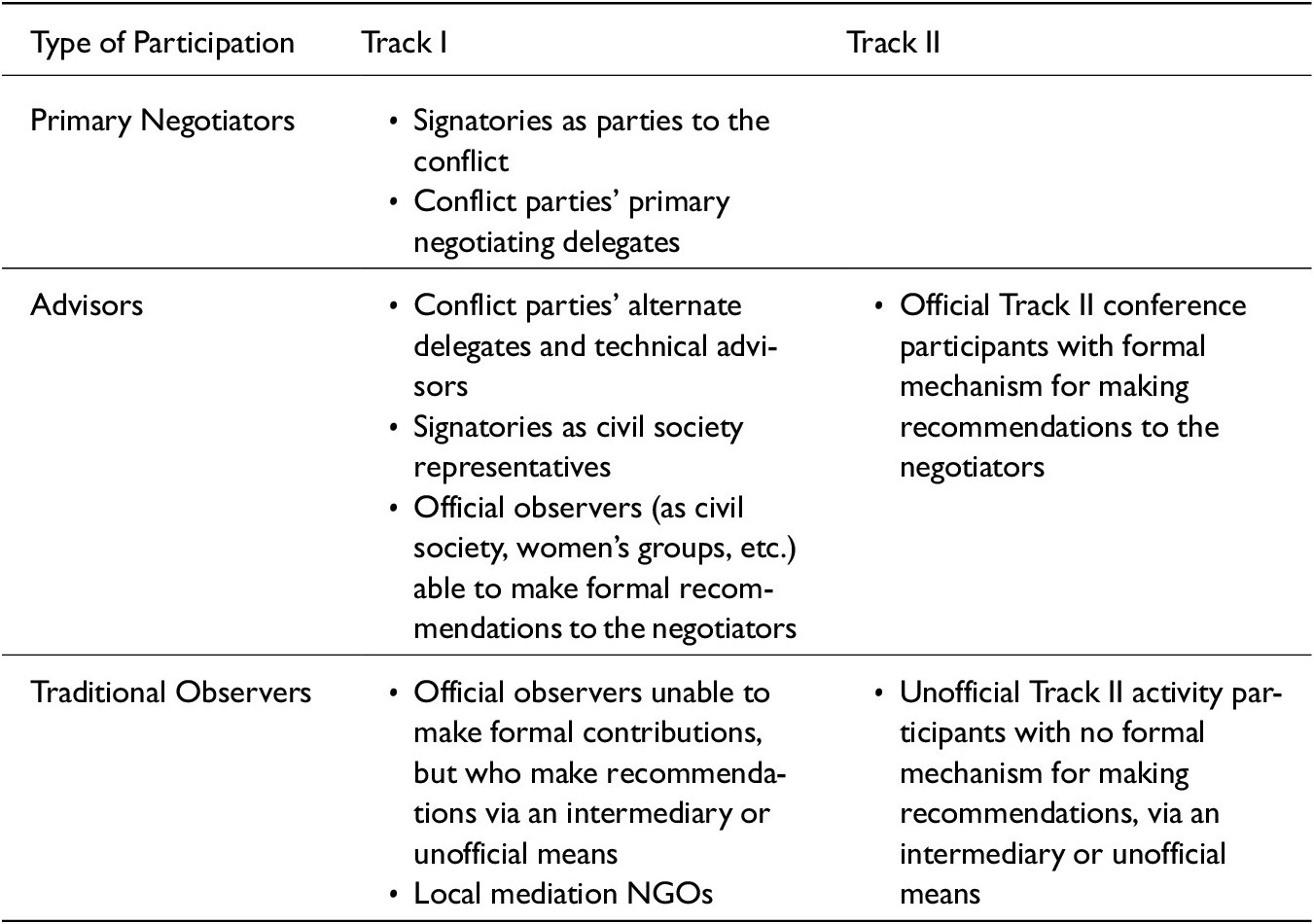
Third, I argue that it matters how much influence women’s roles in the peace process have on the final clauses of the peace agreement. As Good (Reference Good2024) found, actors’ power matters in peace processes, not just their presence. Expanding Good’s theory to include both tracks, I create a typology of five categories of peace process participants, based on their level of influence on the text of the peace agreements and the track in which they participate (Table 1).
Typology of local women’s roles in peace processes

First, primary negotiators are those who are regularly able to make concrete recommendations for inclusion in the peace agreements directly to the Track I negotiating table on all aspects of the agreement. The primary delegates and lead negotiators (signatories) for each conflict party are the only participants who meet this definition of sustained, direct, and broad influence on the peace agreement text. Second, advisors are those who have sustained ability to make recommendations to some portions of the agreement text, or intermittent ability to make recommendations to all aspects of the agreement. In the Track I process, advisors include technical advisors, alternate delegates, official observers who are allowed to submit formal recommendations or speak in negotiations, and signatories representing CSOs. In Track II processes that are officially incorporated in the overall peace process, there is typically some formal mechanism for transmitting recommendations from the Track II process directly to the primary negotiators as an official agenda item for discussion. With such mechanisms, these participants can provide intermittent contributions on all aspects of the agreement text.
Finally, traditional observers are those who are unable to submit recommendations directly for consideration in the peace agreement and instead must rely on indirect methods of contribution. In the Track I process, this includes observers who do not have speaking or voting rights and local mediators (often from a mediation-focused CSO). Mediators typically facilitate discussion rather than contributing ideas in their own rights, while observer groups without speaking rights must rely on indirect, ad hoc means for transmitting suggestions. In Sudan, for example, women observers resorted to shoving papers under doors or into the hands of passing negotiators (Castillo Diaz and Tordjman Reference Castillo Diaz and Tordjman2012, 8). In Track II processes without formal mechanisms for contributing to the final peace agreement, participants also must resort to submitting recommendations to the Track I process indirectly and rely on the offices and voice of a third party to reach the negotiating table. The ability of traditional observers to influence the final text of the peace agreement is therefore limited and unpredictable.
If women in positions with higher influence on the peace agreement are able to introduce more concrete gender clauses (Good Reference Good2024), they should, in turn, have greater impacts on women’s representation (Reid Reference Reid2021). Further, women in higher influence positions are more visible and more likely to convert their peace process participation into political careers. Thus, they should create sustained women’s representation after conflict. For example, three of the four women negotiators at the El Salvador Chapultepec Accords subsequently served as legislative representatives for decades. Therefore, I argue that:
H4: Primary negotiators and advisors will significantly increase women’s political representation after conflict.
H4.a: Traditional observers will have no significant effect on women’s political representation.
One important causal mechanism connecting women in peace processes to representation is the text of the peace agreements. There are certainly other ways that women’s participation in peace processes can contribute to increases in women’s representation — for example, by acting as role models for both voters and other women, by personally networking with political elites, and by changing the overall tone of discussions on women and gender. However, peace agreement clauses are a particularly powerful and visible means through which women’s advocacy in peace processes can be translated into national law. Existing studies found that: 1. Women in peace processes increase gender clauses in peace agreements (Anderson Reference Anderson2015; Good Reference Good2024); 2. Gender clauses in peace agreements increase women’s political rights after conflict (Reid Reference Reid2021); and 3. Certain political settlement clauses disrupt women’s mobilization and empowerment (Berry Reference Berry2017). Thus, peace agreement clauses clearly link women in peace processes to women’s political empowerment after conflict.Footnote 3
Alternate Explanation: Women’s Movements
Much of the literature on women’s empowerment, especially following conflict, focuses on the role of women’s movements — both local and transnational — in mobilizing for women’s issues and laws increasing women’s representation. For example, Tripp (Reference Tripp2003, Reference Tripp2015, Reference Tripp2016) and Kang and Tripp (Reference Kang and Tripp2018) showed how women’s movements in Africa play a critical role in increasing representation and introducing gender quotas in legislatures. Htun and Weldon (Reference Htun and Weldon2012) and Weldon (Reference Weldon2002) similarly found that women’s movements were key to the spread of violence against women legislation around the world. Moosa et al. (Reference Moosa, Rahmani and Webster2013) highlight the role grassroots women’s movements play in supporting women’s empowerment, specifically when women are excluded from formal peace processes. However, some studies have found that women’s movements’ impacts on empowerment are only effective when partnered with more formal institutions, like political parties (Geisler Reference Geisler2006). Similarly, Anderson (Reference Anderson2015) found that partnerships between transnational women’s movements and women in peace processes were most effective in introducing gender clauses to peace agreements. In fact, Hughes et al. (Reference Hughes, Krook and Paxton2015) found that women’s NGOs had a small impact on gender quota adoption alone, and interacted with global pressure on gender norms had a negative effect. This suggests that women’s movements need to partner with someone other than international organizations to succeed in expanding women’s political representation. Building on these findings, I predict that:
H5: Women’s movements in combination with local women in peace processes will have the greatest effect on women’s political representation, but no significant effect on their own.
Methods
I statistically test the correlations between types of women’s peace process participation and subsequent shifts in women’s political representation using multivariate ordinary least squares (OLS) linear regression analyses. In these analyses, I control for various country-level and conflict-specific effects. Where there is evidence of autocorrelation due to repeated countries, I cluster the standard errors by country. In some models, one case (2019 Central African Republic Khartoum Accords) exerted high levels of influence on the results and therefore was removed. The full results with outliers can be found in the Online Appendix (Tables A.7–9).
Women in Peace and Empowerment Dataset
I created a new dataset of Women in Peace and Empowerment (WPE). This dataset includes 77 different intrastate peace processes from 1991 to 2020 (full list in Online Appendix Table A.1), compiled from existing databases as well as novel contributions from my own research. I used the Uppsala Conflict Data Program’s Peace Agreement dataset (Pettersson, Högbladh, and Öberg Reference Pettersson, Högbladh and Öberg2019), the PA-X database (Bell and Badanjak Reference Bell and Badanjak2019), and the Peace Accords Matrix (Joshi, Quinn, and Regan Reference Joshi, Quinn and Regan2015) to identify peace processes following intrastate conflicts with at least one year reaching 10 battle-related deaths, one-sided violence, or deaths resulting from political violence.
I use a unit of analysis of one complete peace process, aggregating all agreements that belong to the same peace process into one observation. A peace process initiates with the first formal negotiations for ceasefire and concludes when the final comprehensive agreement is signed. Failed peace processes that dissolve before signing a final agreement are not included in the WPE dataset. I used the three above datasets and accounts of peace processes to determine which agreements were signed as part of each peace process. In some cases (for example, Somalia), completed comprehensive peace agreements repeatedly collapsed, and peace processes were reinitiated many years later. I separated these into individual peace processes each time there was a comprehensive agreement that was intended to end the peace processes. Based on this aggregation, I coded the date of the final peace agreement using the last substantial or comprehensive agreement, not any follow-on implementation agreements or reaffirmations.
All participants in any portion of a peace process (even if not present for all negotiations) count as participation in the whole peace process. This aggregation is necessary due to the impossibility of isolating individual participants’ (other than signatories) contributions to each separate peace agreement within a peace process. Track II processes in particular do not correlate neatly to a specific agreement or phase of negotiations.Footnote 4 There are only two cases where women are counted despite only participating in a small portion of the peace process — the 1994 Colombia Gaviria talks and the 2005 Indonesia Helsinki process. Colombia saw below-average increases in women in legislature, both after 5 years and 10 years, and Indonesia saw a slightly above average increase after 5 years, and a below average increase after 10. Therefore, this aggregation is unlikely to overestimate the effects of women.
The dataset ends in 2020 to allow sufficient time for the outcome variables to measure sustained change in women’s political representation for most cases.Footnote 5 These peace processes cover 49 different countries in East Asia Pacific (4), South Asia (4), Europe and Central Asia (7), sub-Saharan Africa (27), Latin America and the Caribbean (5), and the Middle East and North Africa (2). There is one case in Mexico, which is included in Latin America and the Caribbean, but no cases in the rest of North America. Sub-Saharan Africa, as might be expected, is overrepresented in the dataset. However, the country-level and conflict-level variables for the 27 sub-Saharan African countries vary widely and none of the outcome variables appear to cluster by region. Thus, I do not believe that the regional imbalance affects the results.
Dependent Variables
I operationalize my dependent variable of women’s political representation by measuring the change in proportion of women in the legislature (both houses, where there are two) from the year the final peace agreement was signed to five years and ten years later. Due to the dependence of the final proportion of women in legislature on the initial proportion, a change score is both the most accurate and comprehensible measure of my outcome of interest (Allison Reference Allison1990; Dalecki and Willits Reference Dalecki and Willits1991). This measure isolates the effect on legislative representation solely in the period following the peace process.
The dependent variables use a combination of data from (in order of preference): 1. the Inter-Parliamentary Union (IPU); 2. UN Statistics; and 3. individual parliaments when information was missing from IPU or UN data. I use a minimum of a five-year lag in order to allow time for implementation of peace agreement clauses (Joshi and Quinn Reference Joshi and Quinn2017) and at least one election cycle to pass (Flores and Nooruddin Reference Flores and Nooruddin2012). The five-year window also allows enough time for a peace process failure to materialize (Doyle and Sambanis Reference Doyle and Sambanis2000). Finally, it keeps the window standardized across all cases to minimize the influence of social shifts over time. In six cases there were no elections during the preliminary lag window, and in five of those cases this represented a failure of the peace process.Footnote 6 By 10 years following the final peace agreement, all but two cases (Angola 1994 and Somalia 1993) had at least one election. Once again, those two cases suffered breakdowns of the peace agreements. In cases where the legislature was dissolved entirely, the proportion of women is counted as 0.Footnote 7
The legislatures vary in composition. Fifty-eight percent are bicameral, while the rest are unicameral. All but six of the lower houses are directly elected; five of the six exceptions are transitional legislatures with appointed representatives (Gabon, Guinea, Mali, Niger, and South Sudan), while Somalia has indirectly elected representatives in both houses. The upper houses are a mix of directly elected, indirectly elected, mixed, and appointed.
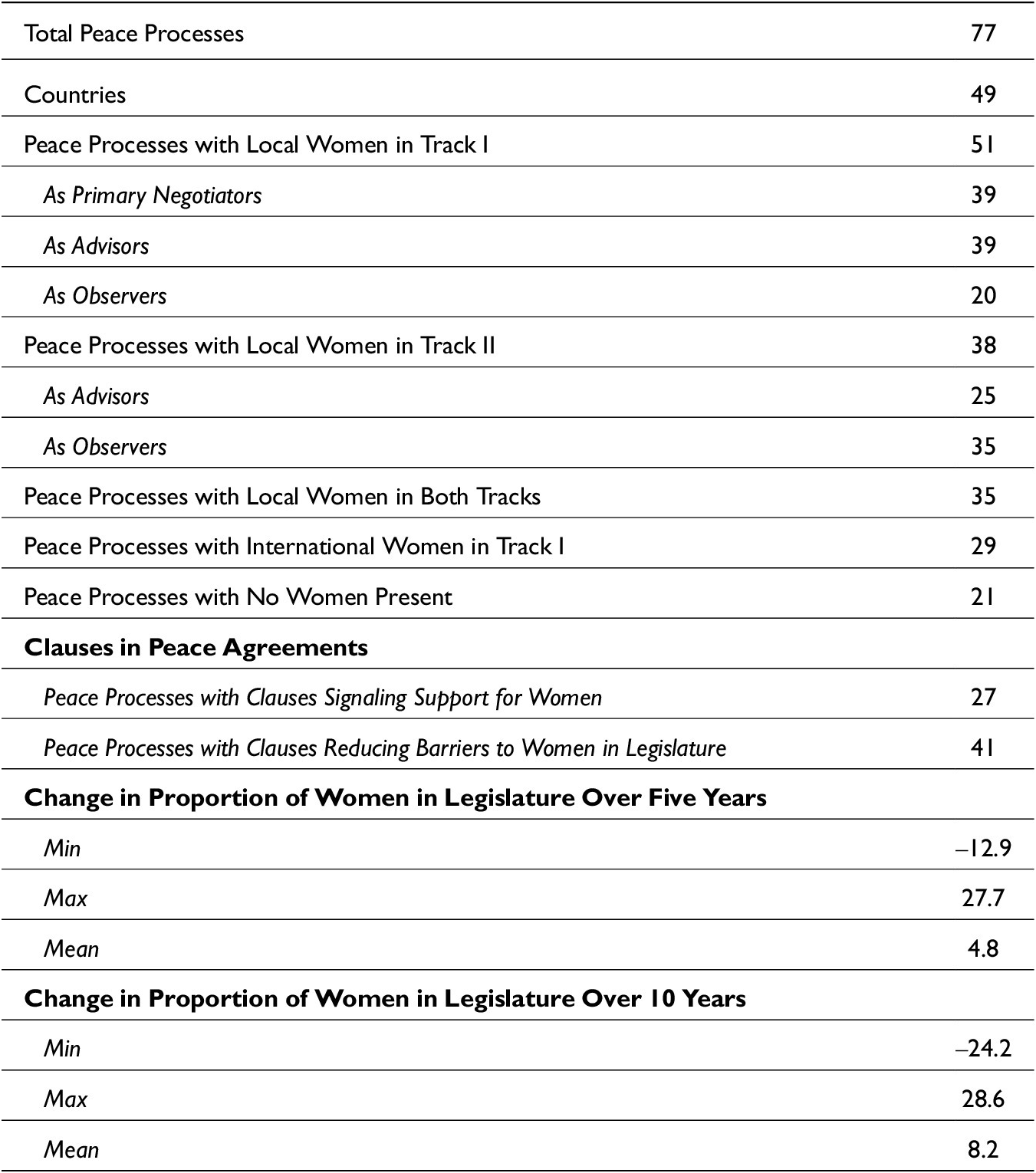
The change in proportion of women in the legislature over five years (Table 2) ranges from a decrease of 12.9 percentage points (Rwanda) to an increase of 27.7 percentage points (Angola, Cabinda), with a mean change of an increase of 4.9 percentage points. Over 10 years, the change in representation ranges from a decrease of 24.2 percentage points (Sudan, due to legislature dissolution) to an increase of 28.6 percentage points (Angola, Cabinda), with a mean increase of 8.2 percentage points. The outcome variables have relatively normal distributions.
Descriptive statistics

Explanatory Variables
The WPE dataset includes remarkably high women’s participation in peace processes. In 66 percent of the peace processes, local women participated in the Track I process, and just under half had Track II processes with local women participants (Table 2). Forty-five percent of peace processes had local women participating in both the Track I and II processes. Only 21 cases had no women present in any role. Due to the lack of sufficient, reliable records of exact numbers of women present at most peace processes in the WPE dataset,Footnote 8 I am only able to code whether there were any local women present in each category, not how many were present. Because I rely in part on existing coding of women’s participation, I duplicated those databases’ gender coding and use a binary variable indicating the individual’s gender identification at the time of the peace process.Footnote 9 In addition to pre-existing gender coding, I identified the gender of other participants in the following order of priority: 1. self-identification on the individual’s own website, social media, or autobiography; 2. gendered titles used in official peace process participant lists (e.g., title of a signatory on the peace agreement); 3. gendered pronoun usage in official biographies (e.g., on a government website); 4. cultural name conventions; and 5. photographs, only where no other information was available.
To distinguish women’s participation type and role, I used the three peace agreement datasets listed above, the Council on Foreign Relations’ dataset of women’s participation in peace processes (Council on Foreign Relations 2020), the original signed peace agreements, Dayal and Christien’s (Reference Dayal and Christien2020) data on Track II processes, Inclusive Peace and Transition Initiative’s case studies of women’s participation in various peace processes, existing case studies on the peace processes, and other published accounts of women’s participation in each peace process. I created variables for each individual role in the Track I process: 1) signatories as representatives of a conflict party; 2) signatories as representatives of a civil society organization (CSO) or sector of society (e.g., youth or women); 3) primary conflict party delegates; 4) alternate conflict party delegates; 5) technical advisors; 6) local mediators; 7) official observers with speaking rights; and 8) official observers without speaking rights. I also created variables for women in both 1) official and 2) unofficial Track II processes. Following Paffenholz et al.’s (Reference Paffenholz, Ross, Dixon, Schluchter and True2016) categorization, I coded as Track II processes the following activities: consultations; inclusive commissions; high-level problem-solving workshops; public decision making; public forums and town halls; local and community peacebuilding and reconciliation efforts; and mass action. I coded Track II processes as official if there was a record of a formal mechanism for transferring suggestions from that process to the Track I negotiation table, and unofficial if there was not. In each of these variables, I recorded a “1” if there are records of women in that role, and “0” if there are no records of women. Where datasets disagreed, I sought first-hand accounts and the sources cited by those datasets to determine which record was correct. Unfortunately, records of roles such as technical advisors are extremely limited, so 29 of these cases are coded as NA. To maintain sufficient cases for statistical analysis, these NAs were converted to 0s before conducting regression analysis.
Existing data on women in peace processes finds much lower participation rates than the WPE dataset, largely due to missing data and the regular invisibility of women in international accounts. To identify missing data, I read first-hand accounts, news stories, case studies, interviews, and other records of each peace process in the WPE dataset. I frequently found new records of women’s participation missing from earlier datasets and formal accounts. Sometimes women’s participation was only hinted at by a single image, a feminine pronoun, or feminine handwriting on a peace agreement. After thorough investigation, I identified who those unrecorded women were and what roles they played in the peace process. For example, many datasets list no women in any roles in the 1995 Dayton Accords for Bosnia-Herzegovina. However, upon examining the Dayton Accord signatures, I discovered that the UK mediator was Pauline Neville-Jones. That a woman had signed the agreement was not immediately obvious because she signed using only her initials (L.P. N-J). A search for UK mediators at the Dayton Accords swiftly identified her full name and gender. Further, I identified several additional women present in Dayton who have been ignored in most narratives about the peace process (McLeod Reference McLeod2019), including Tatjana Ljujić-Mijatović, the Serb member of the wartime presidency (Aganović, Miftari, and Veličković Reference Aganović, Miftari and Veličković2015). While there remain, inevitably, some gaps in the WPE dataset, I was able to fill in much of the previous missing data and therefore provide a more comprehensive dataset on women’s participation in peace processes than existed before.
In addition to women in peace processes, I coded a dummy variable for the presence of an autonomous women’s movement advocating for greater women’s political empowerment. The data for this variable comes from two existing datasets (Htun and Weldon Reference Htun and Weldon2012; Kang and Tripp Reference Kang and Tripp2018) as well as accounts of women’s movement history in each country. To differentiate women’s movements from women’s activity in peace processes, I only included women’s movements that were clearly autonomous from both state and conflict parties, and which organized around issues beyond peace advocacy. Additionally, I included only women’s movements that actively worked on women’s political empowerment — this does not include, for example, women’s movements that focus specifically on health issues or violence against women. For models testing effects on women’s representation, I counted all women’s movements that were active during and within five years after the peace process.
One concern in using the participation of women in peace processes as an explanatory variable is selection bias. To understand the variables impacting women’s inclusion in peace processes, I conducted logistic regressions on the probability of including local women in each of the Track I and II processes based on international women in the Track I process, autonomous women’s movements, the length of the peace process, the length of the conflict, women combatants in the conflict, and the control variables (results in Online Appendix Table A.2). I find that women’s movements, UN peacekeeping operations, peace processes after UNSCR-1325, women combatants, longer peace processes, and higher secondary education gender indices lead to peace processes including more women in Track I, while (strangely) a higher civil society gender index and a higher proportion of women in legislature lead to fewer women in Track I. For Track II, only women’s movements, post-1325, women combatants, and the peace process length are significant, and all positive. Using these variables and international women in Track I (which has a significant population difference for both Track I and II women), I constructed weights using a Generalized Boosted Model (GBM). All models in the results which include local women in either Track I or II are weighted by their respective GBM scores; models with both types of local women use the more robust Track I weights.
Control Variables
I employ eight control variables that could affect the clauses of the peace agreement and the change in women’s representation. First, I include the starting proportion of women in legislature as a control, following the above-cited recommended models for change scores. Second, to account for the lack of women’s education impeding access to political offices, I include a control for the secondary education completion rate adjusted gender parity index (from UIS; hereafter secondary education index). I expect that a higher secondary education index (i.e., more equal, or skewed in favor of women) will be correlated with larger gains in women’s representation.
Third, I include a variable for the change in the country’s female-to-male life expectancy ratio over the course of the conflict. This variable controls for conflicts where a large imbalance in the conflict-related deaths by gender leads to a sudden inclusion of women in politics, for lack of men (Hughes Reference Hughes2009).Footnote 10 I use the life expectancy ratio rather than battle-death statistics because battle-deaths are naturally skewed towards men, while the totality of conflict’s effects on life expectancy is more negative for women (Plümper and Neumayer Reference Plümper and Neumayer2006). I expect that there will be a positive correlation between the change in life expectancy ratio and the change in representation. For this variable, I used UN data on life expectancy for men and women (United Nations 2022) and UCDP data on conflict length to calculate the female-to-male life expectancy ratio in the first and last years of the conflict, then subtracted the first year’s data from the last year’s to get the percentage point change over the conflict.
Fourth, considering Hudson’s (Reference Hudson2009) findings on the role of ethnic strife in women’s political power, I include a control for ethnic fractionalization using Drazanova’s (Reference Drazanova2019) index. I expect that lower ethnic homogeneity will complicate women’s ability to attain political positions, and therefore, the ethnic fractionalization index (measured from 0 to 1, where 0 is completely homogenous) will have a negative effect on women’s representation.
Fifth, I include a dummy variable recording whether a peace process concluded before or after UNSCR-1325 on Women, Peace, and Security. I expect women’s representation to be positively correlated with the post-1325 era.
Sixth, to account for other unrelated conflicts that may inhibit implementation of the peace agreement under examination, I include a variable indicating a conflict with different actors during the year of or year prior to the second political representation measurements (according to the UCDP PRIO dataset). The use of only unrelated conflicts rather than all conflicts allows me to include the success or failure of the peace process under observation as part of the outcome of women’s participation in the peace process. Conflicts with a different party, however, are not generally attributable to the failure of another peace process and thus may impede implementation of clauses at no fault of the participants under observation. I expect unrelated conflicts, therefore, to have a negative relationship with women’s representation.
Seventh, I include the civil society gender index from V-Dem (Coppedge et al. Reference Coppedge, Gerrig, Knutsen, Lindberg, Teorell, Altman and Bernhard2023). I cannot include a broader index of gender equality because existing gender indices are duplicative of several of the controls I include (F:M life expectancy ratio, secondary education index) as well as my dependent variable. However, the extent to which women can participate in civil society is not well represented by these controls. I expect that greater gender parity in civil society will be correlated with greater gains in women’s representation.
Finally, following findings by Blanton et al. (Reference Blanton, Peksen and Blanton2023) that UN peacekeeping operations (PKOs) are correlated with growth in women’s representation, I include a dummy variable for the presence of a UN PKO within the first five years after the final peace agreement.
I do not include some systemic or national controls that have been traditionally linked to women’s representation — such as electoral system, GDP per capita, party ideology — because my outcome variable is the change in representation. These systemic controls can reasonably be expected to affect both the starting and ending representation in the same way. I also do not include the Polity V score (Marshall and Gurr Reference Marshall and Gurr2020) in the year the final peace agreement is signed. I note that this control has a nonlinear relationship (Online Appendix Figure A.1) with changes in women’s legislative representation, consistent with existing findings on the complex relationship of democracy and democratization with women’s representation (Fallon, Swiss, and Viterna Reference Fallon, Swiss and Viterna2012; Hughes and Paxton Reference Hughes, Paxton, Franceschet, Krook and Tan2019; Kenworthy and Malami Reference Kenworthy and Malami1999; Krook Reference Krook2010; Paxton Reference Paxton1997; Reynolds Reference Reynolds1999; Tripp and Kang Reference Tripp and Kang2008). As a result, when included in linear models it essentially has no effect, and makes the model fit significantly worse (Online Appendix Table A.3). Peace process length, sexual violence in conflict (Savun et al. Reference Savun, Stanton, Hartzell and Reid2024), and women combatants (Thomas Reference Thomas2024) were also insignificant and made the model fit worse (Online Appendix Table A.3), so are not included in final models to preserve degrees of freedom.
Limitations
There are a few limitations to this analysis due to missing data. First, due to the unreliability of data on the numbers of women participants, it is impossible to differentiate between peace processes with a certain threshold of women’s participation, or to examine the effects of various proportions of women participants. Second, while women’s participation in central roles such as primary delegates is usually noted in qualitative accounts of each peace process, women’s participation in supplementary roles such as technical advisors often goes unrecorded. In cases where it was clear there were no women delegates or signatories, but it was unclear whether there were any women technical advisors, I recorded the case as having no women participants. The dataset may, therefore, undercount women’s participation in such roles. Finally, due to a rapidly dwindling case number when lag times are increased, I only conduct analyses at the five- and ten-year marks. Future research after 15 and 20 years would greatly supplement these findings.
Additionally, due to the relatively small number of cases and the collinearity of some of the variables, I cannot include all explanatory variables together in one model. For example, there are only three cases with Track II women and no Track I women. Therefore, I test individual women’s roles in separate models and cannot isolate the influence of each independently, controlling for all others. I therefore can only test H3 for Track I women compared to women in both tracks but not Track II women. This limits to some extent the conclusions I can draw about the effects of different combinations of women’s roles.
Results
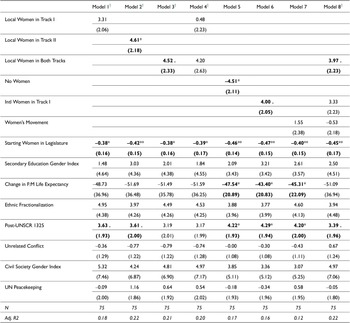
The results show strong support for H1, H4, and H5, and some support for H2 and H3. Table 3 shows that local women in Track II processes and local women in both Track I and II processes significantly increase the proportion of women in legislatures after five years by nearly five percentage points above peace processes without such participants. Even when controlling for international women and women’s movements, local women in both tracks significantly increase women’s representation by almost four percentage points. In their own model, international women significantly increase women’s representation by four percentage points; however, that significance disappears when local women and women’s movements are controlled for. Women’s movements on their own have no significant effect on representation. Figure 1 visualizes local women in both tracks’ definitive influence even when combined with other explanations. By contrast, when no women (local or international) participate in a peace process, women’s representation is significantly less likely to increase. Ten years after the peace process ends, however, nothing remains significant (Online Appendix Table A.14).
Effects of women in peace processes and women’s movements on representation after five years

† Standard errors are heteroskedasticity robust.
*** p < 0.001; ** p < 0.01; * p < 0.05; ․ p < 0.1.
Results significant at p < 0.1 are in bold.
Effects on Women’s Representation – 5 Years (90% Confidence Intervals).

Building on Good’s (Reference Good2024) findings about the importance of power within peace processes, Table 4 shows that within Track I and II processes it is only local women who are signatories, primary negotiators, and participants in official Track II processes that have significant, positive effects on representation. Although I cannot test the terms together (only three cases have Track II advisors and no primary negotiators), the combination of primary negotiators and Track II advisors does result in a larger coefficient effect on representation than each individually. Again, nothing attains significance in the 10-year models (Online Appendix Table A.15).
Effects of different roles on representation after five years

All standard errors are heteroskedasticity robust.
*** p < 0.001; ** p < 0.01; * p < 0.05; ․ p < 0.1.
Results significant at p < 0.1 are in bold.
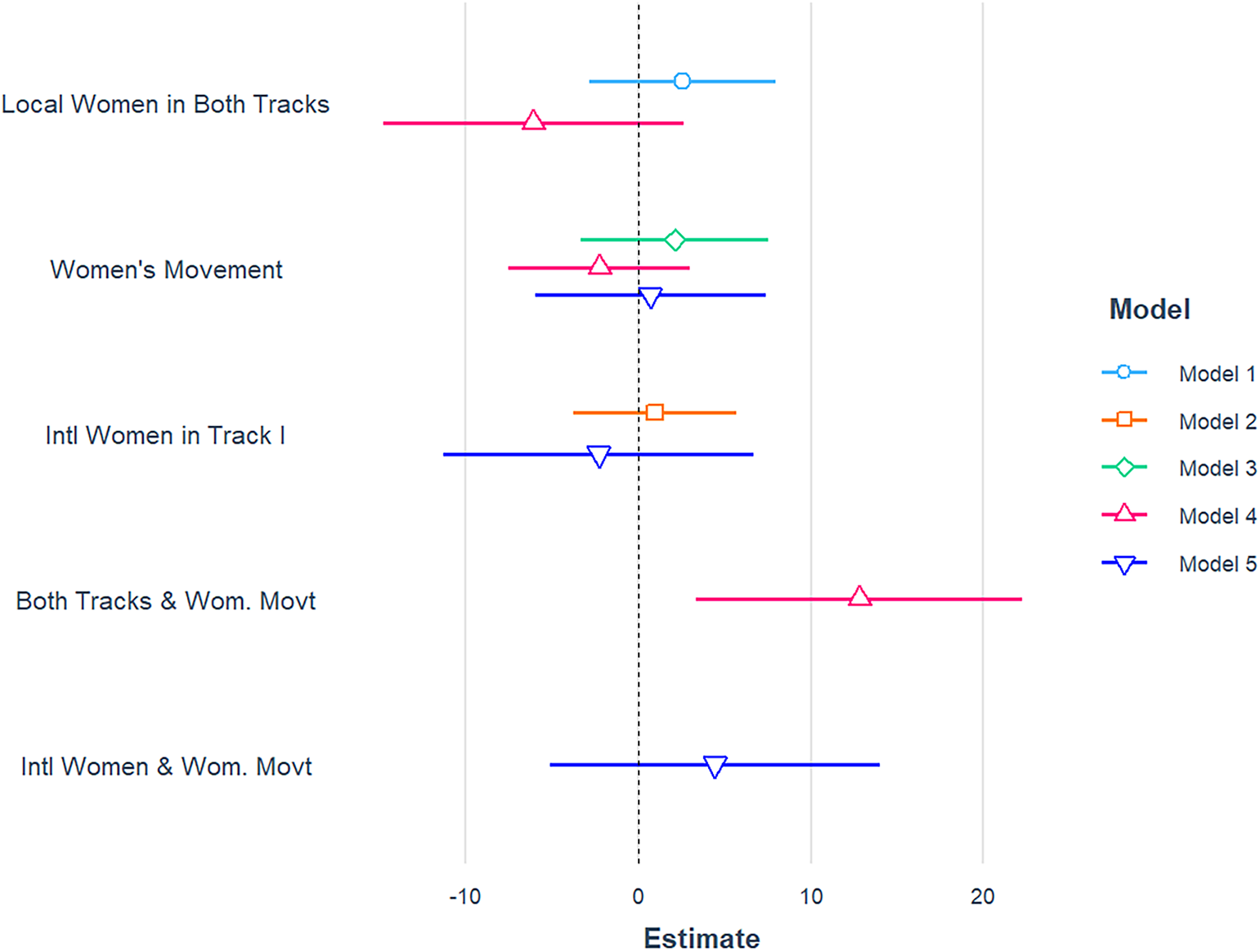
Finally, I test three combinations of women in peace processes and women’s movements to determine if coordination between these different women’s groups drives increases in women’s representation. Oddly, the results are reversed from the previous two tables — at 5 years after the peace process ends, nothing is significant (Online Appendix Table A.10). At 10 years, however, local women in both tracks combined with a women’s movement leads to substantially greater increases in women’s representation than any variable alone (Figure 2 and Table 5).
Effects on Women’s Representation – 10 Years (90% Confidence Intervals).

Effects of combinations of women in peace processes and women’s movements on representation after 10 years

All standard errors are heteroskedasticity robust.
*** p < 0.001; ** p < 0.01; * p < 0.05; ․ p < 0.1.
Results significant at p < 0.1 are in bold.
A few of the controls have results worth mentioning. First, the change in life expectancy ratio is, contrary to expectations, negative. This suggests that instead of women replacing a lack of men, women are spurred to seek greater empowerment when they themselves are more negatively affected by the conflict. The second control that behaves unexpectedly is ethnic fractionalization – although its effect is positive (but insignificant) in the five-year models, the sign flips in most of the 10-year models. One possible explanation is that during the peace process it is difficult for women to attract attention to their concerns when there are many ethnic groups, but in the longer term women partner with those ethnic groups to achieve greater representation.
As previous authors have found (Anderson Reference Anderson2015; Good Reference Good2024), women’s participation has a clear connection to the inclusion of gender clauses in the peace agreements. Local women in both tracks — especially in the highest influence roles — increase the likelihood that both clauses that reduce barriers to women in politics (Online Appendix A.16-21) and clauses that signal support for women (Online Appendix A.22–27) are included. International women, on the other hand, only increased the likelihood of the vaguer signaling clauses, confirming my theoretical expectations of the importance of local women in achieving specific, concrete clauses. Women’s movements had no effect on either type of clause on their own, but in combination with international women increased the likelihood of including clauses reducing barriers to women in politics (albeit not as much as local women in both tracks).
Clauses reducing barriers to women in politics, in turn, led to increases in women’s representation after five years, while signaling clauses had no significant effect (Figure 3; Online Appendix Table A.28). Combined with my main independent variables, clauses reducing barriers cancel out the significance of local women, international women, and women’s movements, suggesting that in the short-term women’s impact on representation is primarily through these clauses. However, after 10 years the significance of both types of clauses disappears, and once again only the combination of local women in both tracks and women’s movements is significant and positive (Online Appendix Table A.29).
Effects of Peace Agreement Clauses on Representation.

Conclusion
In the aftermath of conflict, peace processes have the potential to rewrite gendered political barriers and expand women’s representation in national legislatures. This article illustrates the importance of local women’s participation in both tracks of peace processes, as well as coordination with external women’s movements, for converting that potential into reality. When local women have a voice at both the formal and informal negotiating tables, women’s political representation in the postconflict state increases significantly. Moreover, in the face of challenges to “norm stickiness,” including rising backlashes against women around the world, it is more important than ever to understand what factors contribute to long-term growth in women’s political empowerment. This article shows that the only way to ensure gains in women’s representation stick in the long run is through combined women’s participation in both tracks of a peace process and women’s movements. No single participant or movement alone is enough – only broad-based women’s participation across all facets of peace processes and civil society can ensure sustained women’s empowerment.
These same effects do not appear when international women participate in peace processes, highlighting the importance of local ownership of peace processes. However, it is important to note that direct international presence in peace processes is not the only way international norms on women’s representation spread to postconflict states. Many local women who participate in peace processes belong to broader transnational women’s networks, participate in international women’s conferences, and take part in the development of National Action Plans on Women, Peace, and Security in their countries (Anderson Reference Anderson2015). Thus, the negative findings for international women do not discount the influence of international norms diffusion – rather, they suggest that the most effective spokespeople to introduce those norms to local communities are local women.
These findings have several implications for research both on Women, Peace, and Security and for political science as a whole. First, the results emphasize the importance of studying peace processes holistically and not merely looking at Track I activities. Only by examining the effects of Track II processes and the coordination across the two parts of peace processes can we get a complete picture of the outcomes of peace processes. Second, these findings contribute to studies on local ownership and the dangers of cookie-cutter international processes in peace and security (e.g., Mac Ginty and Richmond Reference Mac Ginty and Richmond2013; Paffenholz Reference Paffenholz2015). Local women are essential both for crafting the specific, concrete clauses that lead to increases in women’s representation, and for ensuring peace process interventions stick in the long term. International actors generally do not have the local knowledge, experience, and presence to create the same lasting effects. Third, these findings confirm and expand on findings on the difference that power makes in peace processes (Good Reference Good2024). By disaggregating the impacts of different types of roles and levels of influence, this study further chips away at the “add women and stir” mentality focusing merely on presence. Fourth, the findings draw into question the extent of the influence of women’s movements on their own, demonstrating instead the importance of linkages between such movements and women in official institutions like peace processes. Future research on social movements should consider including variables representing such partnerships to fully understand how and when women’s movements affect political outcomes.
The findings also suggest several recommendations for policymakers. First, and most obviously, women need to be included in all aspects of a peace process, and in the highest-influence roles. Adding women’s groups as observers without voting capabilities does not have the same effect as women who participate as primary negotiators. Second, the structure of the peace process matters for postconflict political outcomes — connections between the Track I and II processes ensure greater gains for women’s representation after conflict. Creating official forums for civil society consultations and recommendations, with formal mechanisms to connect those forums to the Track I negotiations, will offer local women the best opportunity to support the formal negotiations and advocate for women’s empowerment. Third, international organizations can best support women in postconflict states by ensuring their inclusion in peace processes, supporting autonomous women’s groups, and building connections between the two groups. International women on their own, no matter how feminist-oriented their goals may be, are not the most effective actors to promote gains in women’s empowerment in countries not their own.
Women’s representation in legislatures is by no means a complete picture of women’s political empowerment in postconflict states. Further research on other aspects of women’s political rights and voice will be crucial to gaining a full perspective on local women’s participation in peace processes effects on all areas of women’s political empowerment in postconflict states. Particularly in less-democratic states, high levels of women in legislature may not reflect much actual power over governance and political decision-making. The effects of women’s participation in peace processes on women in executive offices, as judges, and in civil society are important areas for future study.
Supplementary material
The supplementary material for this article can be found at http://doi.org/10.1017/S1743923X2510038X.
Acknowledgments
I am grateful to the Center for Citizen Peacebuilding for their continued financial support of this research. I thank Heidi Hardt for her invaluable support and feedback. I would also like to thank Catia Confortini, Christine Cheng, Danielle Thomsen, Erin Lockwood, Carrie Menkel-Meadow, Ines Levin, Melina Much, and the anonymous reviewers for their helpful comments and suggestions on earlier drafts of this paper. This research has been previously presented at the APSA and ISA annual conferences, and I thank all participants of those sessions for their questions and feedback on this research.
Data availability statement
The data that support the findings of this study will be openly available in Harvard Dataverse upon publication.
Competing interests
The author declares none.
Funding statement
This research has been partially funded by the Kugelman Citizen Peacebuilding Research Fellowship. The funder had no involvement in research design or execution.




 Open access

