

Hostname: page-component-6766d58669-6mz5d Total loading time: 0 Render date: 2026-05-16T16:28:56.001Z Has data issue: false hasContentIssue false

Low-frequency unsteadiness in laminar separation bubbles

Published online by Cambridge University Press:  22 November 2024

Fatemeh Malmir
Affiliation:
Laboratoire de dynamique des fluides, Polytechnique Montréal, Montréal, Québec H3C 3A7, Canada
Giuseppe Di Labbio
Affiliation:
Laboratoire de thermofluide pour le transport, École de technologie supérieure, Montréal, Québec H3C 1K3, Canada
Arnaud Le Floc'h
Affiliation:
Laboratoire de thermofluide pour le transport, École de technologie supérieure, Montréal, Québec H3C 1K3, Canada Institut für Aerodynamik und Strömungstechnik, Deutsches Zentrum für Luft- und Raumfahrt (DLR), 38108 Braunschweig, Germany
Louis Dufresne
Affiliation:
Laboratoire de thermofluide pour le transport, École de technologie supérieure, Montréal, Québec H3C 1K3, Canada
Julien Weiss
Affiliation:
Laboratoire de thermofluide pour le transport, École de technologie supérieure, Montréal, Québec H3C 1K3, Canada Institut für Luft- und Raumfahrt, Technische Universität Berlin, 10587 Berlin, Germany
Jérôme Vétel*
Affiliation:
Laboratoire de dynamique des fluides, Polytechnique Montréal, Montréal, Québec H3C 3A7, Canada
*
Email address for correspondence: jerome.vetel@polymtl.ca

Abstract

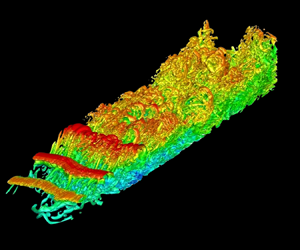
Low-frequency phenomena in an incompressible pressure-induced laminar separation bubble (LSB) on a flat plate is investigated using direct numerical simulation. The LSB configuration of Spalart and Strelets (J. Fluid Mech., vol. 403, 2000, pp. 329–349) is used. Wall pressure spectra indicate low-frequency-flapping $(St \sim 0.08)$ and high-frequency-shedding $(St \sim 1.52)$ regimes. Conditional velocity averages based on the fraction of reversed flow reveal the low frequency as an expansion/contraction of the LSB. While the high frequency only exhibits exponential growth within the LSB up to breakdown of the spanwise rollers, the low frequency and velocity fluctuations exhibit exponential growth upstream of separation. Instantaneous flow fields reveal large streamwise streaky structures forming within the LSB and extending past reattachment, much like high and low speed streaks in turbulent boundary layers. A predominance of sweep-like events ($Q4$) is observed during contraction and of ejection-like events ($Q2$) during expansion. These motions appear as dominant low-frequency modes in three-dimensional proper orthogonal and dynamic mode decompositions, exhibiting spatial amplification from separation to reattachment. The advection of a group of spanwise alternating streaky structures past the LSB results in an overall contraction after which the bubble expands to its ‘unforced’ state in the absence of the streaks. The low frequency then corresponds to the time it takes for streaks to form, amplify and advect past the LSB from separation to reattachment. This behaviour is linked to the mean flow deformation reported by Marxen and Rist (J. Fluid Mech., vol. 660, 2010, pp. 37–54), where the presence of streaks results in reduced mean bubble size. The formation of these streaky structures, in the absence of free stream turbulence, may be attributed to an absolute instability of the LSB due to the development of a secondary bubble within the primary.

Information

Type
JFM Papers
Copyright
© The Author(s), 2024. Published by Cambridge University Press

Access options

Get access to the full version of this content by using one of the access options below. (Log in options will check for institutional or personal access. Content may require purchase if you do not have access.)

Article purchase

Temporarily unavailable