





Introduction
Weed science is a relatively new discipline that largely evolved after the adoption of synthetic herbicides (Ahmad et al. Reference Ahmad, Jabran, Cheema, Bajwa and Farooq2023). Although herbicide use began in the late 1800s, the field grew substantially after World War II (Weis et al. Reference Weis, De Oliveira Alves, Assmann, da Silva Rosa Bonadiman and Costabeber2019). Since that time, weed science has become central to addressing major challenges in agricultural and managed ecosystems, including herbicide resistance, invasive species, and the need for integrated and sustainable weed management strategies. Weed science is largely taught through agricultural programs, whether out of stand-alone weed science departments or through units such as agronomy, crop science, or ecology (Ahmad et al. Reference Ahmad, Jabran, Cheema, Bajwa and Farooq2023). Comparatively few faculty focus on addressing weed issues in settings other than production agriculture, such as horticultural crops, turfgrass, forests, or pastures (Chauhan et al. Reference Chauhan, Matloob, Mahajan, Aslam, Florentine and Jha2017).
Because there are few departments devoted solely to weed science, training for a weed science career must come from a variety of places. However, to date, no one has investigated the academic background of individuals who train to become weed scientists. One place where the academic training of people working within a given career field is readily available is on the faculty webpages maintained by most universities (Brevik and Vaughan Reference Brevik and Vaughan2020). Furthermore, the academic backgrounds of those who both practice within a field and train others to do so can provide insights into why a field has evolved in certain directions as well as likely future directions. In weed science, faculty training backgrounds may directly influence research priorities, teaching emphases, and extension approaches, particularly as the discipline adapts to emerging weed management challenges.
Therefore, the objective of this study was to characterize the weed science faculty at universities around the United States of America. Specific aspects of this characterization were to include the fields in which these faculty obtained their academic credentials, their academic ranks, any leadership positions held at their universities, the countries from which their degrees were obtained, and their gender. Understanding the composition and training of weed science faculty provides insight into the intellectual structure of the discipline and the pipeline responsible for educating future weed scientists.
Materials and Methods
Data Sources and Faculty Identification
Data for this study were collected between April and September 2025 using a web-based approach similar to that described by Brevik et al. (Reference Brevik, Dolliver, Edinger-Marshall, Itkin, Johnson-Maynard, Liles, Mbila, Moorberg, Sanchez-de Leon, Steffan, Ulery and Vaughan2020), Brevik and Vaughan (Reference Brevik and Vaughan2020), and Diochon et al. (Reference Diochon, Basiliko, Krzic, Yates, Olson, Masse, Amiro and Kumaragamage2016). This approach allows large amounts of data to be gathered efficiently at low cost and avoids the problems of low response rates common in survey-based studies (Mwita Reference Mwita2022).
Data were compiled to document the academic backgrounds of individuals currently serving as weed science faculty in the United States. Universities that offer weed science were identified through systematic online searches of agronomy, crop science, plant science, and related departments at land-grant and major agricultural institutions in the United States, supplemented by recent Weed Science Society of America (WSSA) annual meeting proceedings (2023 and 2024) and professional networking platforms. Institutions employing at least one faculty member with primary research, teaching, or extension focus on weed science were included. Information was collected on each faculty member’s credentials, including their bachelor of science (BS), master of science (MS), and doctor of philosophy (PhD) degrees; the granting institutions; and the academic fields in which those degrees were earned (agriculture, agronomy, botany, crop science, horticulture, weed science, etc.).
Following the approach of Brevik and Vaughan (Reference Brevik and Vaughan2020) and Brevik et al. (Reference Brevik, Krzic, Elbasiouny, Dawson, Hannam, Mbila, Reyes-Sánchez and Coles2025), data were gathered from multiple sources, including:
-
1. university departmental websites (agronomy, crop science, weed science, plant and soil science programs);
-
2. professional networking platforms such as LinkedIn;
-
3. proceedings of the two most recent WSSA annual meetings (2023 and 2024); and
-
4. university press releases or other public online announcements (e.g., faculty hiring or award notices).
As many pieces of data as possible were collected from university faculty websites. When the desired data were not available, secondary Internet-based sources such as LinkedIn pages, WSSA conference biographies, or press releases were used to fill in gaps.
Definition of “Weed Science Faculty”
For this study, weed science faculty were defined as academic personnel whose research, teaching, or extension programs primarily focus on weed biology, ecology, management, herbicide resistance, or weed–crop interactions. Faculty were included if:
-
they hold an academic appointment (tenure-track, non-tenure track (teaching focused), or research) at a U.S. institution;
-
their publication record or course portfolio explicitly includes weed science or herbicide-related research; and
-
their highest degree (MS or PhD) is in weed science or a closely allied discipline such as agronomy, crop science, or plant and soil sciences.
Individuals with administrative or purely extension appointments were excluded unless their research or teaching output demonstrated active engagement in weed science.
In addition to degree information, data were also collected on the faculty members’ academic ranks, gender, and whether they held leadership roles at their universities, such as being a department chair or director of a research center. Gender was determined using photographs, pronouns (“he,” “she,” “his,” “hers”), and related references available on institutional websites. As in Brevik et al. (Reference Brevik, Krzic, Elbasiouny, Dawson, Hannam, Mbila, Reyes-Sánchez and Coles2025), a binary “men” and “women” classification was used, recognizing that most websites do not provide details on gender identity or self-identification.
Data Extraction and Classification
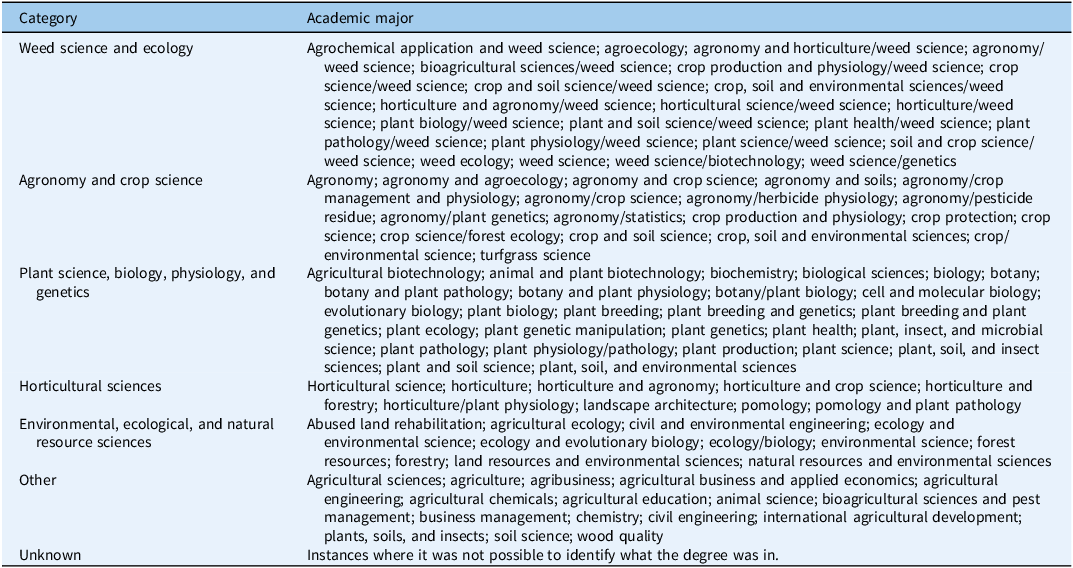
Degree fields were standardized using a classification scheme modified from Brevik and Vaughan (Reference Brevik and Vaughan2020), which groups academic disciplines into six broad categories (Table 1):
-
1. Weed science and ecology
-
2. Agronomy and crop science
-
3. Plant science, physiology, and genetics
-
4. Horticultural sciences
-
5. Environmental, ecological, and natural resource sciences
-
6. Others (known degrees outside core agricultural or life sciences fields)
Table 1. The academic majors included in each broad field category used in this study (majors may have occurred at the bachelor of science, master of science, or doctor of philosophy levels).

When the specific major or degree name clearly identified a weed science focus (e.g., weed science, crop science-weed management), it was classified within “weed science and ecology.” When the title indicated an agronomic or crop production focus (e.g., agronomy, crop and soil science), it was categorized under “agronomy and crop science.” Degrees outside the first five categories (e.g., business management, civil engineering) were grouped as “others.” If a degree was not reported or unverifiable it was classified as “unknown.”
In addition, the country or state where each degree was earned was recorded. For universities within the United States, state-level identification was included to support geographic visualization. It was not always possible to determine all desired information concerning academic training; in such cases, the data point was categorized as unknown. Therefore, the counts for any country or state (e.g., the number of weed science faculty who received their PhDs in Canada) should be interpreted as minimum estimates, because some unknowns may belong to those categories.
Data Processing and Verification
All data were compiled in Microsoft Excel and cross-checked independently by two members of the research team. Duplicate entries and inconsistencies between sources (e.g., department websites vs. LinkedIn) were resolved by referencing multiple public records such as university press releases or WSSA abstracts.
Institutions granting PhD degrees were further verified by checking official program listings on institutional websites. Each U.S. university granting one or more PhD degree(s) to current weed science faculty was tabulated, and frequencies were calculated to determine institutional representation in the discipline. Institutions contributing three or more faculty were considered “major contributors.” This threshold was selected because institutions meeting this criterion collectively accounted for approximately 75% of all weed science faculty in the dataset, indicating a concentration of training within a relatively small number of universities.
Data Visualization and Analysis
Quantitative summaries were generated for each degree level (BS, MS, PhD) by academic category. The percentage of faculty holding degrees in each field was calculated and visualized using bar charts. To illustrate the institutional and geographic distribution of PhD degrees, a choropleth map of the United States was prepared, with states shaded according to the number of PhDs granted. All figures were produced using Microsoft Excel 2025 (Redmond, WA, USA).
Limitations
The web-based approach is limited by the accuracy and currency of university websites. Degree information was not available for a small portion of faculty profiles, particularly for older entries or private institutions. Although multiple verification steps were used, some degree titles may have changed due to department mergers or rebranding (e.g., “Plant and Soil Sciences” vs. “Crop, Soil, and Environmental Sciences”). Therefore, while the dataset provides a comprehensive overview, minor classification uncertainty remains.
Results and Discussion
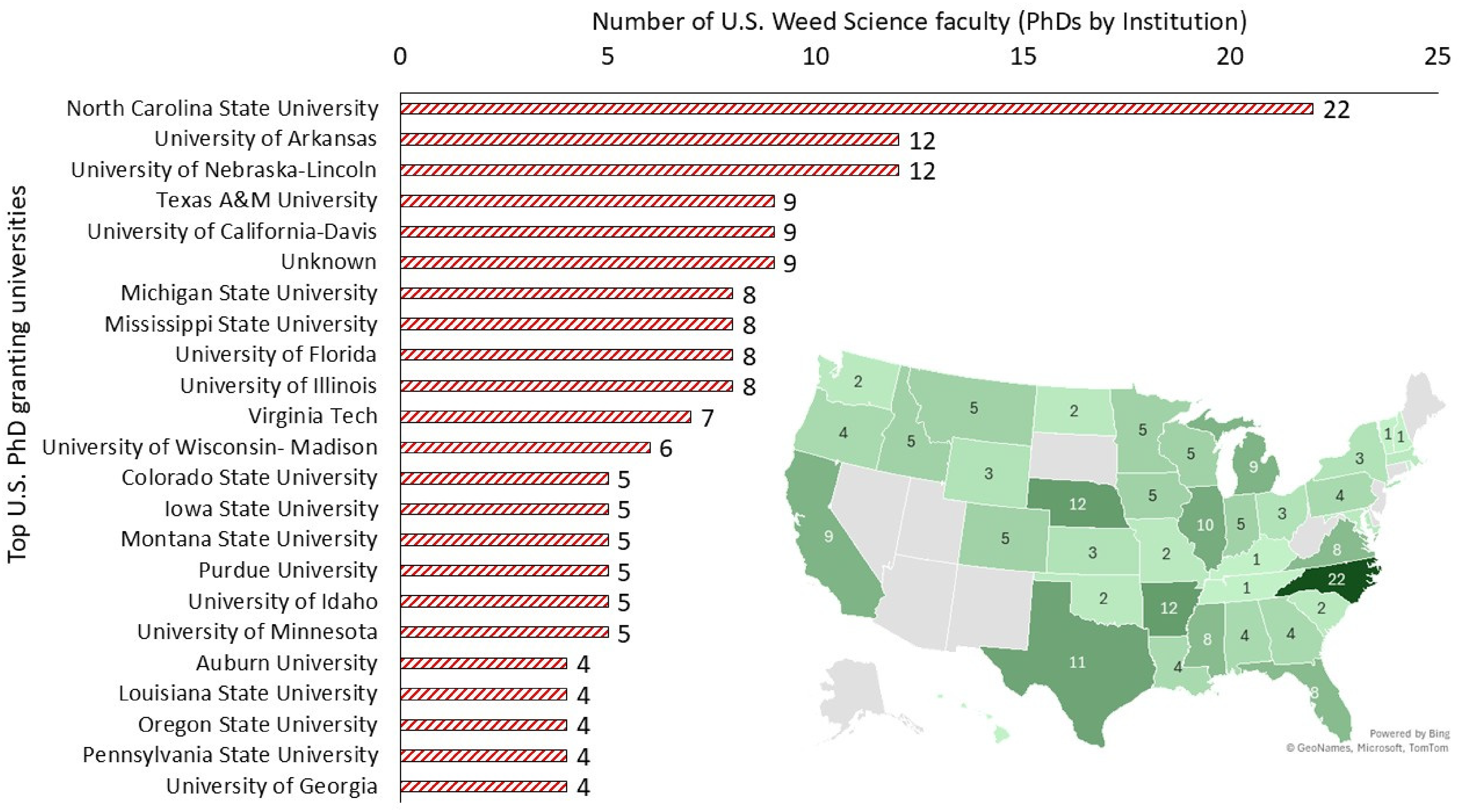
Weed science programs were identified at 50 universities (Table 2) with 223 faculty who work in weed science, an average of 4.46 weed scientists per program. This means the weed science faculty in the United States is about 40% the size of the soil science faculty (Brevik and Vaughan Reference Brevik and Vaughan2020), another relatively small specialized agriculturally focused university faculty. The weed science faculty received at least one of their degrees from institutions in 24 different countries. The majority of these degrees were earned in the United States, but other commonly occurring countries included India, Canada, and Brazil (Table 3). For those weed science faculty who earned their PhDs in the United States, the degrees came from 45 different universities in 39 states (Figure 1). We are not aware of another study of university agricultural faculty in the United States that looks at the states and countries from which the degrees were received.
Table 2. Universities with identified weed science faculty.

Table 3. Countries where the 223 weed science faculty identified in the United States obtained their degrees.


Figure 1. Institutions that issued the largest number of PhD degrees to current weed science faculty in the United States (left, institution-level totals) and the total number of PhD degrees granted by state (right, state-level totals).
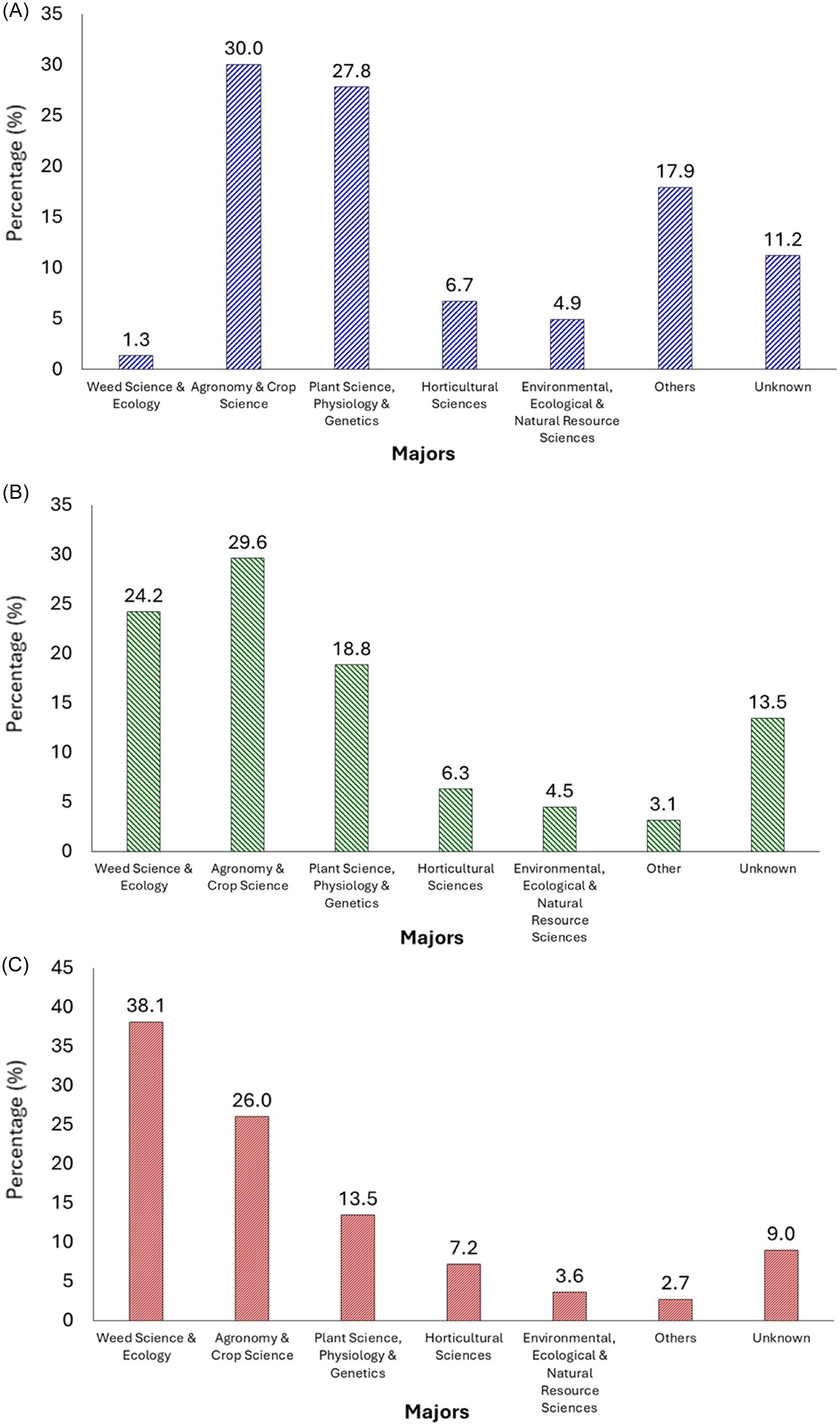
The majority of weed science faculty in the United States received their BS degrees in an agronomy and crop science or plant science, physiology, and genetics area. Very few of the BS degrees were in weed science (Figure 2A). Both of these results are similar to results for soil science faculty, who earned the plurality of their BS degrees in crop or plant science, with relatively few of their BS degrees in soil science (Brevik and Vaughan Reference Brevik and Vaughan2020). At the MS level, agronomy and crop science was still the most common area for weed science faculty to receive their degrees, but weed science and ecology became the second most common degree category, and plant science, physiology, and genetics was third (Figure 2B). At the PhD level, weed science and ecology became the most common area for weed science faculty degrees, with agronomy and crop science as the second most common area, and plant science, physiology, and genetics the third most common (Figure 2C). This trend of very few of the BS degrees being in the eventual professional field and growing degrees awarded within the field through the MS and PhD levels is consistent with the trend observed for soil science faculty in the United States (Brevik and Vaughan Reference Brevik and Vaughan2020). Both weed science and soil science are highly interdisciplinary fields with strong ties to agriculture, establishing a multitude of logical entry points into these careers.

Figure 2. Broad categories of degrees earned by weed science faculty in the United States when they completed their (A) bachelor of science, (B) master of science, and (C) doctor of philosophy degrees.
Of the 223 faculty identified, the plurality were professors (48.9%), followed by assistant professors (28.7%), associate professors (19.7%), lecturers (0.9%), and faculty of unidentified rank (1.8%). Overall, 82.5% of weed science faculty in the United States were men and 17.5% were women. This trails U.S. soil science faculty, which included about 30% women in 2023 (Brevik et al. Reference Brevik, Krzic, Elbasiouny, Dawson, Hannam, Mbila, Reyes-Sánchez and Coles2025). The percentage of women faculty was highest at the assistant professor level and declined with each succeeding academic rank; only two faculty were lecturers, so lecturers were not considered in the gender analysis (Figure 3). This is consistent with findings for soil science (Brevik et al. Reference Brevik, Krzic, Elbasiouny, Dawson, Hannam, Mbila, Reyes-Sánchez and Coles2025), earth science (O’Connell Reference O’Connell2014), and epidemiology (Schisterman et al. Reference Schisterman, Swanson, Lu and Mumford2017) faculty in the United States. Overall, men held 84.4% of leadership positions compared with 15.6% for women. This ranged from 100% men in associate/assistant director positions to 50% men and 50% women in assistant/associate department chair and dean or vice-presidential positions. In between, the man/woman split was 87.5%/12.5% for department chair and center director positions and 80.0%/20.0% for coordinator positions (undergraduate coordinator, graduate coordinator, etc.). This lack of women in leadership positions is also consistent with findings for soil science faculty. However, unlike soil science, where women were relatively underrepresented (18% of leadership positions compared with 30% of the overall faculty) (Brevik et al. Reference Brevik, Krzic, Elbasiouny, Dawson, Hannam, Mbila, Reyes-Sánchez and Coles2025), women faculty in weed science held leadership positions roughly in line with their percentage of the overall faculty (15.6% leadership to 17.5% of the overall faculty).

Figure 3. Gender distribution of weed science faculty in the United States by academic rank. Bars show the percentage of women and men at the assistant professor, associate professor, and professor levels.
The representation of women in the weed science faculty trails that of most other scientific fields as well, even though women are typically underrepresented across the board in science faculties. Women made up about 25% of both geoscience and life science faculties in the United States in 2010 (Ceci et al. Reference Ceci, Ginther, Kahn and Williams2014), although there is evidence these numbers have improved since then. For example, about 33% of tenure-track faculty jobs in geography were held by women in 2018 (Schurr et al. Reference Schurr, Müller and Imhof2020), while 41% of the faculty at medical schools in the United States in 2017 (Clark and Horton Reference Clark and Horton2019), 55% of epidemiology faculty in 2016 (Schisterman et al. Reference Schisterman, Swanson, Lu and Mumford2017), and 61% of veterinary medicine faculty in 2018 (Morello et al. Reference Morello, Nelson and Fubini2023) were women, with all these areas falling under the life sciences.
While this study did not investigate causal factors underlying gender representation, the observed patterns are consistent with broader trends reported across agricultural and STEM disciplines, including historical underrepresentation and attrition across academic ranks. Future research could explore recruitment pathways, retention patterns, and structural barriers specific to weed science.
Overall, our study provides the first comprehensive snapshot of the weed science faculty in the United States, one that is valid for 2025. It provides insights into the number of weed science faculty, where and how weed science faculty are educated (which influences the education of our non-academic weed scientists), and their academic rank. It also provides insights into gender distribution in weed science. Taken together, these patterns highlight both shared and discipline-specific challenges facing weed science as it seeks to train and retain a diverse future workforce. Furthermore, it provides a baseline against which future studies can be compared to evaluate trends in the weed science faculty.
Funding
We thank the Illinois Nutrient Research and Education Council for funding SB’s visiting faculty position and Illinois Soybean Association for funding MJ’s graduate stipend.
Competing interests
The authors declare no conflicts of interest.




 Open access

