

The British Empire’s delegation to the Paris Peace Conference represented a panoply of different political visions towards imperial policy, the Peace Conference, and the League of Nations. Alongside senior British politicians such as Lloyd George, Curzon, Balfour, and Robert Cecil were the Dominion Premiers: Smuts for South Africa, Borden for Canada, ‘Billy’ Hughes for Australia, and William Massey for New Zealand.Footnote 1 Representing India was Montagu, followed by the Maharaja of Bikaner and Satyendra Sinha, who had both represented India at the Imperial War Conference in 1917.Footnote 2 There was also a major Round Table presence at the Conference, headed by Milner and followed by Curtis and Philip Kerr.Footnote 3 The British delegation to Paris was thus replete with the imperial agents who had been the architects of India’s accession to the Imperial War Conference.
The question of Dominion and Indian representation was the first point raised by the British Empire delegation, at their meetings with the other Great Powers, in the room of French Foreign Minister Monsieur Pichon in the Quai d’Orsay. The Dominions and India were excluded from this closed-door meeting with American and French Presidents, Wilson and Clemenceau, and Italian Prime Minister Orlando, but Lloyd George made the case for the representation of the Dominions based on their participation in the conflict. Wilson was highly apprehensive of allowing separate membership for the Dominions, in that he believed it would delegitimise the Peace Conference and make other small states envious, as the Dominions would also have a voice at the meetings of the major powers. Morever, it would grant a disproportionate number of representatives to Britain.Footnote 4 Clemenceau, who was described as initially ‘friendly’ to the idea of separate Dominion representation, was ‘considerably astonished’ when he heard that Lloyd George was not trying to secure two representatives for all of the Dominions and India, but two each.Footnote 5
The Paris Peace Conference was marked by regular meetings of the British Empire delegation, a more informal meeting of the Imperial Conference in a Parisian hotel. Lloyd George returned from his meeting at the Quai d’Orsay to inform the Dominion Leaders that they were to have only one representative each, less than the two to three representatives that other small states would be granted. The Council’s decision infuriated the Dominion leaders, particularly Borden, who fumed that Canada should be given an equal number of representatives as the United States, as it had lost more men in the fighting than its southern neighbour.Footnote 6 Montagu and the Indian delegation were concerned, as they had hoped for an additional representative for India’s princely states, so as not to disenfranchise a third of British India.
Confronted by a fuming Empire delegation, Lloyd George returned to the meeting of the ‘Big Four’ as the Allied leaders of the Great Powers were named. Lloyd George stressed the heterogeneity of the Dominions by their size and contributions to the war effort, as opposed to their constitutional progression. On this basis, the Dominions and India would each receive two representatives, save that New Zealand would only have one, and Newfoundland would not have any. Moreover, representation would only occur when the topic of the discussion under consideration, concerned the Dominion. This form of conditional representation marked the inferior status of the Dominions, obtaining the same number of representatives as non-European states such as Siam and Hedjaz.Footnote 7 The conclusion of two representatives for India was peculiarly unique. Despite its inferior status in the British Empire, it had secured more representatives than other Dominions such as New Zealand and Newfoundland. Lloyd George’s advocacy of Indian representation due to its substantial manpower contribution to the war effort, overruled the norms of sovereignty and self-governance on representation at an international conference.
The separate representation of the Dominions and India would occur at the Peace Conference’s plenary sessions. These would feature larger gatherings of all the participating nations of the Conference, and marked a significant symbolic elevation for these British colonies to be seated in a hall usually restricted to sovereign states. However, Dominion and Indian access to the true corridors of power at the Conference, the closed-door meetings of the Great Powers, was more restricted.Footnote 8 Nonetheless, when a topic of concern, such as a meeting on 24 January on the topic of the Mandates was scheduled, Dominion representatives were allowed to attend.Footnote 9 On other occasions, Dominion and Indian representatives could be represented among Britain’s five delegates, seeing a return of the previously proposed panel system. The ambiguity of the status of the Dominions and India would thus see them staddle a position that both resembled statehood symbolically, but would require working within the British delegation to achieve political aims. Yet, despite the often-totemic nature of the Conference’s plenary sessions, the presence of the Dominions and India at them as separate entities to Britain, would be decisive in securing their membership at the League.
Separate representation at the Peace Conference did not initially guarantee representation at the League of Nations. Lionel Curtis had been put in charge of the ‘Dominions committee on the League of Nations’, a position that initially seemed to give the Dominions considerable scope and intervention in the drafting of the League of Nations Covenant. Curtis himself had tried to flavour the Committee with his own Imperial Federalist views. His draft proposed that, pending a conference on the Constitutional convention that would decide the creation of an Imperial Parliament, the Dominions would have the right to vote on delegates to the League within the British delegation. This position, which essentially denied separate representation was largely ignored by Dominion leaders, who failed to attend Curtis’s meeting.Footnote 10
The impetus for separate representation at the League of Nations arose primarily from the Dominions and Indian representatives themselves, rather than being a position manufactured by Britain. Wilson was keen to resolve the drafting of the Covenant and to establish the League of Nations even before finalising the terms of the peace treaties.Footnote 11 Britain’s initial position on the League of Nations had been drafted by Robert Cecil and presented on 1 January, but Cecil’s draft did not intend to fully separate representation for the Dominions or India at the League. This was a perpetuation of the panel system that the Dominions resented, in which they could be represented at the League Council, Assembly, and Conferences but only on points where they had an explicit interest and only as part of the British delegation.Footnote 12
Australia and New Zealand considered that the panel system was adequate representation at the League. Their and South Africa’s primary aim was to have sufficient political weight to annex former German colonies in their respective regions, but for Canada who had no such aims of annexation, the panel system was woefully inadequate.Footnote 13 Among Dominion leaders, Borden and Smuts were both the strongest agitators for separate representation at the League of Nations. For Borden, Canada’s participation at the Peace Conference was a moment of Canadian state-building, in which its international personality would be confirmed as being in the family of nations. Borden attacked Cecil’s draft as ‘clearly unacceptable’ claiming that it denied the Dominions ‘existence as national entities’, relegating them to ‘their former condition of Colonial tutelage’. Borden’s outrage at Cecil’s draft threatened the stability of the Imperial Conference system, as he accused Britain of reneging on the Dominions’ status decided on in the Imperial War Conference, threatening an angry backlash among the Canadian electorate.Footnote 14 Borden was highly conscious of political affairs back in Canada, and feared that his efforts were not gaining significant press coverage in Canada, compared to the American coverage that Wilson was enjoying.Footnote 15 On 30 January, Borden’s Minister for Justice, Charles Doherty, presented Cecil with a new draft that gave the Dominions the right to seek League membership, and required that this decision should be ratified by the Dominion Parliaments.Footnote 16
The Canadian draft clause also included India’s right to accede to the League. Yet fearing that India might get a separate status from the Dominions, Indian delegates such as Sinha were quick to ensure that India, too, could gain a separate membership. Though India was not a Dominion, from an international position, Sinha saw no difference between India and the Dominions internationally as neither were separate sovereign entities and neither had their own foreign policies.Footnote 17 The level of autonomy was not a qualifying factor for Sinha.Footnote 18 Montagu was swayed by Sinha’s memorandum, and writing to Cecil urged him to include India stating that, ‘In conclusion we are expressing our purpose to recognise India as a nation.’Footnote 19 Borden and Sinha’s protestations succeeded, and the Cecil draft was amended to include the separate representation of the Dominions and India.Footnote 20
The proposed omission of prerequisites of self-rule and sovereignty for League membership, was ridiculed by other League members when the finalised Cecil draft was presented on 25 January. The French Press, which had been secretly fed information throughout the conference, much to Lloyd George’s chagrin, lampooned Britain’s call for separate representation, stating that France had a similar right to include Algeria and its own colonies.Footnote 21 This is what prompted United States’ legal advisor, David Hunter Miller who was drafting his own version of the Covenant, to call the inclusion of India ‘an anomaly among anomalies’.Footnote 22 The initial American draft (known as the Hurst-Miller draft) also named ‘states’ as the only polities capable of being represented at the League, effectively excluding the Dominions and India.Footnote 23
The plenary session on 25 January would establish a Commission to establish the League of Nations that would be particularly weighted in terms of numbers of representatives towards the major powers, meaning that disagreements about separate membership for colonies would essentially fall to them to resolve.Footnote 24 Keeping minor powers out of the Commission meant that Wilson could stifle the voices of smaller states, who he feared would be disenchanted with Britain obtaining multiple votes at the future League of Nations. At the plenary session, however, Wilson did not oppose the admission of the Dominions on the basis that they were self-governing, and warded off French protests:
We ourselves were champions of giving vote to Panama and of giving vote to Cuba. I ask you in debating the affairs of mankind would it have been fair to give Panama a vote, as she will have, Cuba a vote, both of them under the influence of the United States and not to give a vote to the Dominion of Canada?Footnote 25
Wilson’s position seemed contradictory to his earlier aversion to colonial representation and seemed to be a significant step back from the American stance promulgated at the Hague Conferences. The United States had previously backed the de jure status of a state rather than the de facto reality, that Canada may have been more self-governing than several Latin American states. Cuba and Panama were nominally independent states, unlike the Dominions that had no separate legal status internationally, yet Cuba and Panama, along with a plethora of other Central and South American states, were heavily influenced by the United States, and would have supplied additional votes to it in the League Assembly. The United States had recently intervened militarily in Haiti (1914) and Cuba (1917), both of which would become founding members of the League with little controversy. Borden in particular accentuated that the United States had more effective control of the foreign policy of its Latin American protectorates than Britain had over its own Dominions.Footnote 26 One Canadian Minister complained about the American position at the League, as ‘the fetish of sovereignty’ that was used to ‘accomplish many absurd things’ and did not adequately reflect the power balance among the Allies.Footnote 27 However, it was clear that Wilson did not have the same proclivity to sovereignty as the British delegation had accused him of. Wilson, who had pursued an academic career before politics, claimed he had ‘spent twenty-years of my life lecturing on self-governing states and trying all the time to define one. Now whereas I haven’t been able to arrive at a definition, I have come to the point where I recognize one when I see it’.Footnote 28
The compromise between American notions of full sovereignty, and British ideas of divisible sovereignty on the basis of self-governance, removed the American roadblock to Dominion membership. By basing membership on self-governance, or domestic statehood, Wilson had eschewed a more undiluted version of sovereignty.Footnote 29 Despite the British championing the right to ‘divisible sovereignty’ in the nineteenth century, by 1919 most British officials had accepted that separate representation was no longer normatively acceptable for many other states participating in the Conference. Therefore, the push for Dominion representation at the League of Nations was initially carried out largely by the Dominions themselves.Footnote 30 However, these requirements for membership were still not sufficient for the entry of India into the League. Wilson’s legal advisor D. H. Miller wrote that ‘No one by any stretch of the imagination could say that India like Canada, was in all essentials a self-governing country.’Footnote 31 A different legal basis would have to be employed to secure Indian membership.
With its membership of the League secured, Canada launched a new diplomatic offensive to gain a seat in the League of Nations Commission responsible for the drafting of the Covenant. With the acceptance of four ‘minor nations’ to the Committee, Borden wrote to Lloyd George arguing that Canada, too, should sit at the Commission.Footnote 32 Phillip Kerr, Lloyd George’s secretary, responded, stating that if Canada were to join, it would create a precedent for other Dominions to join too, potentially flooding the Committee with British Empire representatives. This, the British Government feared, would ‘prejudice’ other states against them and, ultimately the League, that the British had too strong an influence on the Commission. Moreover, the conditions for entry were more likely to focus on other criteria such as economic power and population, as opposed to wartime contribution. Kerr also emphasised that Canada could perhaps gain more clout, if Borden worked through the British delegation, as Smuts did, where he was said to exercise a ‘predominant influence’.Footnote 33 However, unlike other Dominion members that were seeking annexation or mandatory control over Germany’s colonies, one of Canada’s main goals was to secure separate representation as a form of status symbol, without wishing to wield the same degree of influence over the formation of the League as Smuts sought. Borden bypassed Kerr, writing directly to Lloyd George warning him Kerr’s position was likely to anger Canadians, and asked for a meeting once he had returned from London.Footnote 34
Within the Commission, British policymakers continued to press the other members for the inclusion of the Dominions and India at the League. The impetus for India’s representation was not solely from the work of Montagu and other British officials of the India Office, but from Indian representatives too. For Sinha and Ganga Singh, the Maharaja of Bikaner, separate membership offered an opportunity for India to achieve an elevated status within the Empire. For Sinha, this membership was part of India’s natural progression in governance from its membership of the Imperial Conference in 1917 that set it on course for future Dominion status.Footnote 35 Indian delegates thus had similar aspirations as the Dominion Prime Ministers, in using their new international status to achieve greater statehood within the Empire, despite the growing inequality of devolution between India and the Dominions.
Montagu’s ongoing plan to reform the Government of India into a Dyarchy, proved to be an important political basis for lobbying for Indian membership of the League. Rather than a lack of self-governance precluding Indian membership, the British argued that League membership would be a form of exposure for India to effectively grow into the position of a self-governing state.Footnote 36 The logic of the colonial ‘civilising mission’ was apparent in much of the discourse over India’s membership, and was not dissimilar to the ongoing debates about the Mandates System. Like the Mandates’, India’s membership was sold as being akin to a form of suspended sovereignty in anticipation of its ultimate capacity for self-governance.Footnote 37
Whilst Montagu and British delegates appealed for the tutelage that League membership could offer India, Indian delegates made the case for India’s ancient and unique national past, rather than its connection to the British Empire as the basis for its admission. In his first call for Indian membership, Satyendra Sinha showed that Indians, too, were prepared to draw upon the civilisational discourses for their admission:
The League of Nations is intended to be a permanent institution from which it is not desirable to exclude a country with India’s past traditions and glorious Civilisation. I am confident that technical objections will not be allowed to prevail.Footnote 38
In doing so, Sinha turned the usual discourse of the ‘Standard of Civilization’ on its head, arguing that rather than requiring a Western-led civilising mission for India to ‘grow’ into its position at Geneva, it was more than ready:
We need hardly point out that India amply fulfils the condition of membership enunciated by President Wilson viz, that of being a civilised country which can be relied upon.Footnote 39
Yet the assurances by Indian delegates that India was ‘prepared’ for a voice at the international table, led to questions as to which of India’s many component polities were truly ready for such representation. Montagu’s draft Government of India Act would only extend to the British-administered regions within India, but over a third of British India was ruled by approximately 560 monarchs that made up the so called ‘Princely States’. Although they were technically different polities to British India, they were effectively under British control through the doctrine of British ‘Paramountcy’ and through British Residents who monitored their rule. Under Paramountcy, Princes could retain some autonomy and were not automatically subject to rules emanating from New Delhi, but conversely possessed little to no international personality either.Footnote 40 The Princes had secured a representative in the Indian delegation to the Paris Peace Conference through the Maharaja of Bikaner, but being separately represented at the League of Nations would have been in breach of British Paramountcy.
Even though the British could claim a move towards Indian self-governance and democratic institutions through the Government of India Act, the same could not be stated for the Princely States, which were under the dual autocratic rule of both the Prince and the British Raj. If the British were having a hard time justifying the presence of civilising self-governing institutions in their part of India, it was an even more difficult case to make for the Princely States. For the Western eyes that made up the Commission on the League of Nations, only British India could be the vehicle through which India would be transformed into a Westernised, democratic state. Miller claimed that many Princely States had more autonomy than a Canadian Province did in relation to the Canadian Government, but that they were nonetheless ‘despotic’ and only tempered by their British Residents.Footnote 41 In doing so however, it clearly contrasted the lack of national or cultural connection of British rule in India to the hereditary Princes of India. In a later pamphlet published in 1924, M. V. Kibe argued that the Princes were the original rulers of India and had a stronger claim to representing India than British India:
a misconception prevails that, perhaps, a particular form of Government is necessary in a State which would be entitled to a membership of the League. It is not so. The League although so named is not a League of Nations but of Governments of States. The principal conditions laid down are that (1) it must be a stable government, (2) it ought to be fully self-governing (3) its conduct, including both acts and assurances, with regard to it obligations ought to be above board, and lastly (4) it ought to have a respectable size and population.Footnote 42
Kibe’s pamphlet reveals the desire for India’s international representation to be delivered by those with a historical and cultural connection to India. Such arguments underpinned a more nation-centric basis for India’s international representation, challenging British notions that India’s representation would hinge on Britain’s civilisational push to bring ‘representative’ institutions to India. Ultimately, the Indian delegation would always include a Prince, but they would formally represent ‘India’ as a whole, rather than the patchwork of polities that constituted British South Asia.
The Indian delegation hoped that the constitutional changes being enacted in India would convince Wilson that India would soon be a self-governing entity on par with the Dominions. However, Wilson was still reluctant to include India, because of the precedent that including a non-self-governing colony would create for the organisation. He was aware that the inclusion of British India had transformed the Telegraph and Postal Unions half a century before, when empires had attempted to flood those organisations with additional members. Whilst Wilson had accepted the inclusion of sovereign entities within America’s sphere of influence, such as Panama and Cuba, he feared that the inclusion of India could put pressure on the United States to include the Philippines:
If we admit India, can we reject the Philippines? Whilst we propose to grant the Filipinos their political freedom at the earliest practicable date, at present they are satisfied with their status, and I think it would be unwise to admit them to the League, although I am frank to say that I consider them farther advanced in the art of self-government than are some other peoples who are applying for recognition. We must admit that not all the States here present are regarded by all the other States as of good character.Footnote 43
Whereas Wilson had seen the de facto difference between Canada and India in terms of the powers that had been devolved to them, Sinha stressed that India’s application was just as valid as that of the Dominions. Though the Dominions had more self-governing institutions, Sinha insisted that gradations of self-governance did not matter. Instead, he stressed a more binary position in that the Dominions were not sovereign states and were therefore not self-governing, meaning they had no greater right to membership than India:
It is true, of course, that India is neither an independent state nor a Power. But no more is Canada, Australia, New Zealand, South Africa or Newfoundland. If we look at the matter from the strict point of view of international law, the position of India is in no way different from that of the Dominions – not one of them is a sovereign state, no one of them has “foreign relations” independently of Great Britain and, accordingly to the existing constitution, each one of them is bound by declaration of war or peace by the parent-State … it may be said that internal autonomy or self-government should be the test to determine membership of the proposed League and judged by that test, the claim of the Dominions for admission might be considered to be stronger than that of India. … the British parliament has constitutionally the right to legislate for the whole British Empire, and from the strictly legal point of view, it makes no difference whether the measure of interference by Great Britain is more constant and continuous in India that in the Dominions … As regards the Native States of India, I would further point out that they are both in fact and in theory autonomous and vested with complete control within their territories. And, judged even by the test of autonomy or self-government, their position cannot be held to be different from that of the Dominions.Footnote 44
Despite Sinha’s memorandum for Indian membership, Wilson stood his ground on the principle of internal self-governance, although he admitted that self-governance was difficult to define. Besides the Philippines, there were other reasons that could have motivated Wilson’s decision to remain adamant on self-governance as the requirement for membership. Resistance to the United States’ own admission to the League of Nations was rapidly growing in America, and many saw Wilson as weak in the face of a British attempt to vote-stuff the future League of Nations.Footnote 45 This had been confirmed with the resumption of Senate debates its colonies in mid-February after the first draft of the League’s Covenant had been published.Footnote 46 Forgoing the principle of self-governance would have been seen as a total capitulation to British demands and would have discredited the League before it was even founded.
This contention between Britain and the United States revealed different normative visions through which imperial power could be wielded. Whilst Wilson had been reluctant to allow the British to include India or the Dominions on the basis of their formal position within the British Empire, he had not been questioning their ability to have a truly independent foreign policy. Wilson’s desire to include the United States’ Latin American protectorates, as well as his strong emphasis that the League Covenant must not tamper with the Monroe Doctrine, the policy of American ‘protection’ over South America, revealed his view that a state’s de facto independence did not impinge on its representation at the League.Footnote 47 The United States thus promulgated a framework in which national independence, however nominal it may be, would be the basis for international representation.
Initially, it seemed that the American notion of state sovereignty as the basis for membership, and Britain’s desire for India’s accession, were incompatible. A solution to this impasse was suggested by Smuts, where a loophole in the Covenant would be drafted in which original signatories of the peace treaty (Treaty of Versailles) would automatically gain entry to the League of Nations as founding members.Footnote 48 As India’s inclusion at the Peace Conference had already been confirmed, this ruse guaranteed India’s membership of the League, whilst closing the door to other colonies that may attempt to gain membership in the future. This would effectively allow India to participate, but avoid establishing a precedent for the inclusion of non-self-governing colonies once the League of Nations began to operate. Rather than change the League’s normative basis for membership, the amendment opened a brief window of exception in 1919 to allow India’s inclusion, which would then be shut again once the Treaty of Versailles had been signed. In a final meeting on the topic, Wilson once again resisted Indian admission. However, seeing that most parties were satisfied with India entering as a signatory, or as Miller wrote ‘no-one seemed to care’, he conceded, and stated that the definitions of who is self-governing could be defined later.Footnote 49
The acceptance of this amendment gave a deadline by which other empires could also push for the inclusion of their colonies before the window of opportunity closed indefinitely. However, the anticipated wave of applications to include colonies, that had occurred at the Postal Union in the 1870s, did not occur. France, with its own colonies and protectorates, stood to lose out from Britain’s multiple representations, but it made no bids of its own. Whilst France had also been initially opposed, in the nineteenth century, to the inclusion of British colonies in the Postal and Telegraph Unions, it had used Britain’s example to follow suit and include its own colonies. The French empire was the second largest in the world, and colonial representation offered France an opportunity to significantly multiply its vote share. This, the French Foreign Ministry chose to investigate relatively later on, only in July 1919. When the issue was raised, they concluded that the Covenant was drafted for the British Dominions, and that no French colony fitted the requirements to participate. Thus, the opportunity to follow the Indian example was dismissed when it came to French policy-setting.Footnote 50 After the signature of the Versailles Treaty, formal ‘self-governance’ would be the requirement for eligibility. The signatories of the Covenant therefore created a special state of exception at the League’s creation, to enable Britain alone to include parts of its empire, whilst preventing other states from obtaining the same privilege.
Colonial Representation and the ‘Wilsonian Moment’
The year 1919 was a veritable ‘Springtime of Nations’ in the former empires of the defeated central powers, as well as the colonies of the victors. Protests, uprisings, and riots against the imperial order broke out across the world from Seoul to Shanghai and Bombay to Cairo. Scholars such as Erez Manela have attributed the acceleration of anti-colonial resistance in 1918 and 1919 to the belief, albeit mistaken, that Woodrow Wilson would champion the principle of self-determination and would support nationalist claims to self-governance against the other colonial empires. Manela has called this the ‘Wilsonian Moment’ – a significant normative change in the tectonics of the international order, discrediting Empire and legitimising the basis for national self-determination.Footnote 51 This had been one of Wilson’s Fourteen Points, his speech for his intended post-war settlement in January 1918, but Wilson’s vision for self-determination in fact did not extend beyond the borders of Eastern Europe.Footnote 52
Despite the fact that Wilson did not universally apply his standard of national self-determination, the perception was widely held that he would support the positions of the plethora of national liberation movements that attempted to contact him in Paris. However, the Wilsonian Moment was a small, albeit important, part of a longer history of decolonisation for many independence movements. The Irish Volunteers had made a bid for independence with the Easter Rising in 1916, as had the aforementioned Punjabi Ghadar movement in 1915 with their botched mutiny.Footnote 53 These movements were already highly internationalised, but the promise of the Wilsonian Moment was to offer a path from the revolutionary to a seat at the table of nations. This offered a tantalising possibility of international recognition from perhaps the greatest of the Great Four, for many nationalist movements to pressure Britain to relinquish its rule.Footnote 54
However, this apparent conjunction of growing anti-colonial pressure and American support did not turn out to play a significant role in the decision to go down the path of separate representation at the Paris Peace Conference or the League. Wilson did not in fact offer the expected support for anti-colonial movements, failing to respond to much of the correspondence addressed to him. His secretary did respond to Tilak, but offered little support, and postponed the issue by suggesting that Tilak’s case for Indian self-government might be dealt with at the future League of Nations. By mid-1919, the British Foreign Office was considerably less anxious about the President’s communications with nationalist leaders, content in the knowledge that Wilson would not deliver on his ovations to national self-determination.Footnote 55
Wilson’s refusal to intervene in British imperial affairs did not halt many of these nationalist movements from growing in strength throughout 1919. However, amongst these movements, there was a negative correlation between the scale of resistance to British rule and their representation at the League of Nations. The three most significant regions of anti-colonial resistance that perturbed the British Empire, were in Egypt, Ireland, and India. Anti-colonial nationalist organisations in all three attempted to send a delegation to the Paris Peace Conference, all three would be rejected, yet only India would become a member of the League of Nations. Moreover, of the three movements, India would see the least active armed resistance to British rule compared to Ireland and Egypt. Secret French diplomatic cables also confirm that the British had been fully expectant of an ‘insurrection’ in Ireland in early 1919 but had not expected any significant resistance in India or Egypt.Footnote 56
Irish nationalism had been a major concern for the British, particularly since the Easter Rising in 1916, when the nationalist Irish Volunteers had attempted to occupy Dublin and declare a Republic. The rebellion was suppressed, brutally in the eyes of many in Ireland, as many of the ringleaders were executed. The general election in December in 1918, had returned a majority for the Irish nationalist party Sinn Fein across all of southern Ireland. Its leader, Eamon de Valera, who had fought in the Easter Rising in 1916 had received a death sentence, but had had his sentence commuted, and ran for his seat from prison.Footnote 57 Sinn Fein MPs refused to take their seats in Westminster, and instead declared an Irish Republic on 21 January 1919. The timing of the declaration had been synchronised with the Paris Peace Conference to seek international help.Footnote 58 The declaration was backed by a steadily intensifying guerrilla struggle against the British rule.
The Irish struggle for independence was seen as the nexus of anti-colonial resistance to British rule. Its combination of political republicanism and organised violence against British rule worried the British, who feared that Ireland would export its brand of resistance to other colonies. In India, the government considered censoring all news related to Ireland, so as to avoid similar political agitation.Footnote 59 Combined with a second node of revolutionary activity, Bolshevik Russia, the British feared these twin dangers to the Empire, nationalism and communism. British anxieties that Irish and Bolshevik ideology had already spread within the Empire struck when large-scale street protests erupted on the streets of Cairo and Alexandria in late 1918.Footnote 60 Egypt had seemed relatively calm during the war, and there was little expectation of the growing scale of resistance to British rule as the Peace Conference got underway.
To bypass both the British rejection and Wilson’s denial, many nationalist movements put together their own delegations to go to Paris. In Egypt, the ‘Wafd’ or Delegation Party was created for the purpose of representing the Egyptian national interest in Paris.Footnote 61 Other representatives such as a young Nguyen Ai Quoc, later to be given the title of ‘Ho-Chi-Minh’ (he who enlightens), also waited in Paris for a chance to petition Wilson for a Vietnamese seat at the table.Footnote 62 Even some of the inhabitants of the Dominions were not satisfied with their level of representation at the Peace Conference. Afrikaner nationalists in the South African Assembly also saw the Conference as a way to assert independence over Dominion status. Under General Hertzog of the South African Nationalist Party, a delegation was put together in February to set sail to Paris. Two members of the initial delegation were swapped, as the British refused to give them permits on account of their role in rebelling during the war.Footnote 63 On attempting to board their ship, the ‘Durham Castle’, the crew, who opposed the Nationalists, threatened to strike if Hertzog and his party boarded the ship. Though this delayed the delegation reaching Europe, the British Foreign Office feared that it would be interpreted by South African nationalists as interfering within the domestic politics of South Africa. Another ship, the Minerva, was offered to the delegation, but was refused.Footnote 64 Instead, they boarded a Dutch ship, the ‘Bawean’ to New York, where they came into contact with Irish Republicans.Footnote 65
This was an unexpected turn for British intelligence, which had expected Hertzog to proceed straight to Paris. The Consul General in New York reported that an agreement had been struck between Hertzog and Irish nationalists, to support each other’s deputations for a place at the Paris Peace Conference.Footnote 66 The delegation carried on to London where they sought to contact the British government. Meanwhile, the Irish were preparing their own delegation for Paris in April, with the declared President of the Irish Republic, Eamon de Valera, claiming that Ireland’s membership of the League of Nations was essential for its recognition and independence. A delegation was assembled, led by Sean T. O’ Kelly. They, like all the other non-official delegations, were refused entry.Footnote 67
When the United States allowed several Irish representatives of the Irish Republican Philadelphia Convention to set sail from the United States to Paris and ‘remain in France until Ireland’s case is fully determined’, there was fury within the British Foreign Office. One official peevishly wrote, ‘The Committee may expect to remain in France some time then!’.Footnote 68 With the anti-League debates in the US Senate getting more agitated, Wilson was reluctant to publicly intervene in favour of Britain, but the Foreign Office saw the American position as hypocrisy: ‘Whenever the USA mention self-determination for Ireland (if ever) we ought to enquire how they apply the principle in Haiti, San Domingo, Nicaragua and the Philippines.’Footnote 69 In spite of the mounting anti-colonial pressure from across the Empire, there was no discussion about the inclusion of other colonies. There was to be only one ‘anomaly among anomalies’ for now, and that would be India.
Within India, anti-colonial nationalist movements were growing rapidly, yet there had been no widely recognised declaration of Indian independence, nor had there been any mass civil unrest to date, as in Egypt. Montagu had been worried about the Indian National Congress’s deputation as well as the growing Muslim discontent over the dissolution of the Ottoman Empire. The moment the news came that India would participate in the Peace Conference, Tilak wrote to Lloyd George thanking him for securing India’s representation but requested that India be represented by ‘tribunes of the people’, nominating Hasan Imam, Mohandas Gandhi, and himself.Footnote 70 They represented the increasingly radical position of the Indian National Congress held in December 1918, that India should strive for self-determination.Footnote 71 For Congress, India could only be represented as an equal to the Dominions as a self-governing state, not as a colony. By devolving some international stature to India, the British inadvertently created an expectation of a subsequent devolution of political power. For Congress, the widely touted reforms towards Dyarchy led by Montagu, were not befitting of India’s new and unique status within the British Empire. However, before their aspirations could be carried to Paris, the India Office denied issuing the Congress delegates passports.Footnote 72
Although Indian representation at the Paris Peace Conference had become British Government policy, authorities aimed to discourage civil participation in activities concerning the League of Nations. The League of Nations Union, a lobby group for the promulgation of the League of Nations and international cooperation, that had been promoting the virtues of the League in China, approached the India Office relatively early, in late January 1919, before it was fully apparent whether India would gain League membership. The Union saw an opportunity in India to spread propaganda, owing to a ‘wave of patriotism’ that was being felt after the war, with hopes to contact Indian Princes and educational boards.Footnote 73 The India Office was unanimous in their displeasure at the proposed scheme, with one official calling it the ‘height of folly’, and that ‘the proposal is evidently made in ignorance of Indian conditions … there is no wave of patriotism’.Footnote 74 Sinha in the Indian delegation also suggested that if India were to be accepted, that would achieve the desired propaganda value, and that any third party’s involvement ‘would undoubtedly prove mischievous’.Footnote 75 Faced with the disapproval of the India Office, the Union tried to limit the distribution of tracts to only Europeans in India, but this was also rejected on the grounds that it would fuel ‘resentment’.Footnote 76 Though the India Office was keen for Indian League membership to appear as a symbol of constitutional development, they were still unsure as to whether India would finally be admitted to the League.
Yet, whilst civil unrest in India might have appeared to play a role in considering India’s accession to the League, the question of India’s inclusion had already been settled prior to the rise in violence in the Spring of 1919. Sinha, who had written the original memorandum in January 1919 for India to take a place at the League, had warned that any appearance of difference between the status of the Dominions and India would be considered ‘deplorable’ and would ‘undo much of the good effect recently produced’ by Montagu’s constitutional reforms.Footnote 77 Cecil, as a case for Indian admission, had warned of potential civil unrest in India by disappointing Indian aspirations, if India were not permitted to join, yet Wilson had confirmed India’s membership of the League of Nations at the third meeting of the League of Nations Commission on 5 February.Footnote 78 By the time anti-colonial discontent exploded onto the scene in March and April, the negotiations regarding India’s membership of the League had been largely settled. Riots in Delhi and Punjab culminated in the bloody backlash at Jallianwala Bagh in Amritsar on 13 April.
The Amritsar Massacre has reverberated throughout the history of the Raj as one of the lowest points of British rule in India, and had a significant role in radicalising the Indian independence movement.Footnote 79 Verma even shows how the American Senate debates raised the validity of India’s claims to self-governance when being ‘shot down in cold blood by British machine guns’. Yet these debates only occurred in 1920, almost a year after the massacre.Footnote 80 Local authorities in Punjab controlled the flow of information, to the extent that the news only reached the European media by December. For Montagu, leading the Indian delegation back in Europe, reports about the scale of the massacre had been concealed, as they had been to both the media and Congress.Footnote 81 Much of the political fallout from Amritsar would occur many months after the events of the massacre, by which time Indian membership at the League had already been secured.
Although the growing resistance to British rule in India was led by a range of actors from different religions (many of the victims of the Amritsar massacre had been Sikh), Montagu continued to be anxious over the sentiment of Indian Muslims and their reactions to the rending of the Ottoman Empire. He used his position at the Peace Conference to soften Lloyd George’s retribution against the Ottomans, but to no avail. After months of negotiations in Paris, Montagu was convinced that the Allies had an ‘anti-Muslim’ bias, but hoped that the rapidly growing disorder in Egypt and India would convince Lloyd George to reconsider his position towards the Ottoman Empire.Footnote 82 Montagu had been particularly concerned by plans to occupy Constantinople, stating that the Allies were not intending to take Berlin from the Germans, so why remove their capital from the Ottomans? Yet Montagu’s call for restraint ran counter to the attitudes of former Cabinet members, especially the former Viceroy of India, Lord Curzon who with crusading zeal saw the conquest of Constantinople as a means of destroying Ottoman power by dissolving the Caliphate, just as many Indian Muslims feared.Footnote 83
Lloyd George defended his position due to the ongoing conflict within Turkey, in spite of the Armistice.Footnote 84 Draft plans that would have seen parts of Turkey fall under an Italian Mandate, panicked Montagu who wrote to President Wilson, imploring the United States to take the Turkish Mandate instead; an idea that Wilson ignored.Footnote 85 Montagu had hoped that growing anti-colonialism in India could thus be placated, but he was singularly focussed on the Muslim community. The Khilafat movement, protesting the abolition and territorial vivisection of Ottoman Caliphate, had begun to emerge in India, which Montagu saw as the primary source of unrest against the Government of India, rather than from the Indian National Congress. His attempts to change British and Allied policy towards the Ottoman Empire were to no avail, revealing that even when the delegation was headed by a senior British politician, the Indian delegation could not secure its aims. After a year of negotiations in Paris, Montagu wrote bitterly that he felt that his efforts there had been a ‘complete waste of time’, and the Allied policy towards Constantinople had not shifted.Footnote 86 Even Montagu himself believed that India’s representation had become a ‘fraud’, if it could not gain concessions on Britain’s policy towards Turkey.Footnote 87
The British also kept informed of the reactions of other empires to their own proliferations of anti-colonial movements. Simultaneously with India gaining entry to the Peace Conference, the French Senate had begun devolving certain rights and powers to the Arab and Berber populations in Algeria. On 4 February 1919, a law was passed that extended French citizenship to a great number of Algerians and moved to abolish discriminatory taxes and punishments that Europeans were exempt from. The French representative, Monsieur Steeg, informed the British that ‘the Bill under discussion could not fail to bear excellent results from the point of view of the maintenance of public order and of the general tranquillity of Algeria’.Footnote 88 ‘La Loi Jonnart’ as it came to be known, worried the India Office, which feared that it would overshadow the Montagu-Chelmsford reforms towards Dyarchy in India. The law expanded suffrage to a larger proportion of the Algerian population than had been envisaged in the Montagu reforms in India. Montagu himself was concerned that France would pass similar legislation in its territories in India, upstaging his reform efforts.Footnote 89 Ultimately, and to the relief of the India Office, the French reassured them that the reforms were restricted to Algeria, and not to their colonies in India.Footnote 90
Curtis had seen the Paris Peace Conference as an opportune moment to discuss the question of migration and had suggested organising a separate conference in Paris, for members of the Empire, to discuss immigration. This idea was denied, as the Foreign Office did not want to air the dirty laundry of the immigration debate, that showed the growing divisions within the Empire, to foreign governments. Yet they feared that the topic would be brought up by Japan, in a bid to allow Japanese immigration to the Dominions.Footnote 91 The Anglo-Japanese Treaty of 1911 could provide a basis for Japan to make a claim that its citizens should not be discriminated against, prompting Indian delegates to claim the rights of Indians to migrate within the Empire too. Milner suggested that they fall back on the Imperial War Conference’s decision to enact the principle of reciprocity in immigration, and apply it to Japan too, hoping that would resolve the issue.Footnote 92
Many Indian politicians also wanted the Indian delegation at Paris, to resolve the question of Indian immigration and racial equality. This desire was not just relegated to Congress politicians, but extended to other members of the delegation. Sinha, in particular, had raised the issue at the 1918 Imperial War Conference, and even explained how the immigration question was undermining Montagu’s attempts to placate Indian nationalism: ‘The efforts of the British Government to create and foster a sense of citizenship in India have, within the last few years, undoubtedly been hampered by the feeling of soreness caused by the general attitude of the Dominions towards the people of India.’Footnote 93 Sinha had also raised the poor treatment of Sikhs in Canada in particular, as he claimed that discrimination against them risked angering India’s ‘martial race’, that had mobilised in the greatest numbers to fight in the war.Footnote 94 Despite Sinha’s stance, the Indian delegation would be barred from discussing immigration at Paris. The inability of the Indian delegation to effectively throw off the Dominion’s immigration controls at the Peace Conference meant that their views would have to be represented vicariously through Japan.Footnote 95
Japan’s bid for racial equality at the Peace Conference began in March 1919 and was preceded by lobbying from civil society groups and diplomats. On 10 March, Japanese residents in Honolulu Hawaii passed a resolution that stated that the Peace Conference should include a racial equality clause and sent their demands to Clemenceau.Footnote 96 Several days later, the Japanese ambassador to the United States, Viscount Ishii gave a speech to a Japanese society in New York, expressing the desire to introduce the principle of racial equality at Paris. The British delegation fumed at the speech, and declared that it was ‘some nefarious method of bringing forward the claim, which it was anticipated that the Japanese would raise in some form at the Paris Peace Conference, for securing admission for Japanese labour to the British Dominions and the USA’.Footnote 97
The Japanese, who themselves subscribed to similar notions of disparity between levels of civilisation, and still smarting from their treatment as inferior by Western powers since the nineteenth century, were simultaneously encouraged and embarrassed by the support from India and China. Japanese representatives were attempting to pass a clause built on the universal principles of racial equality, whilst concurrently trying to convince the Allies, of their own superiority over other peoples.Footnote 98 Although the Japanese proposal was resisted by the United States and Britain, it was the Dominions that opposed the prospect of racial equality the most vociferously. Japanese delegates were afforded a meeting arranged by Robert Borden, and a compromise reminiscent of Curtis’s bill on reciprocity was almost struck, in which the Dominions would endorse ‘the principle of equality between nations and just treatment of nationals’. This would essentially elevate the position of Japan and India vis-a-vis the Dominions (as well as the Dominions vis-a-vis sovereign states) but in reality would do little to improve the rights of migrants from these Asian states. For states such as Canada, whose immigration laws were less explicitly racist (despite their operation in practice) and which were coated with a veneer of legalism (‘indefinite transit’ rules and quotas), this compromise was acceptable. But for Hughes of Australia, even this weakly-worded compromise was too much, and infringed on his outright discriminatory immigration policy of a ‘White Australia’.Footnote 99
Montagu’s failure to convince the Allies, and even more the British delegation, to change their policy towards the Ottoman Empire and Japan’s racial equality bill, revealed that even when represented by a senior British politician, India was to be seen, but not heard. Yet this failure also revealed the lack of consistency and coherence within the policy of colonial representation. If India’s accession to the Peace Conference and to the League of Nations was supposed to be a rebranding effort for a new kind of Raj in India, it was one that by the end of 1919, had failed.
Montagu had entered into the Paris Peace Conference aware of the ‘irretractable changes that have been made in the constitution of the British Empire during the last few months’ and was not sure what the result of Indian representation would mean in reality. What he saw was a growing contradiction in the Empire, which he described as ‘riding two constitutional horses’, one that proclaimed the Empire’s unity whilst the other manifested itself in the attendance of Dominion and Indian delegates at the Peace Conference. He found India’s new position in ‘international affairs … wholly inconsistent with that of a subordinate country’ yet continued to actively promulgate its accession to the League of Nations.Footnote 100
These inconsistencies would also be played out within India. With events in Paris unfolding, Montagu was simultaneously attempting to pass his and Curtis’s reform bill for India through the British Parliament. Yet within India, much of the British administration, local governors, and British settlers detested the planned reforms. Curtis’s plan to include more Indians in the Indian Civil Service angered many British bureaucrats, local governors detested the local devolution of power, whilst British settlers feared that Dyarchy was a dangerous step towards Indian self-governance.Footnote 101 Montagu had few allies in British India, and became increasingly reliant on Curtis and the Round Table whom he described as ‘respectable’ but also ‘a little anaemic and theoretical’.Footnote 102 Even Curtis was apprehensive of Montagu’s reforms, seeing them as a watering-down of his own vision, and began establishing a campaign backed by the Labour Party, the Times, and Manchester Guardian for his version of ‘undiluted Diarchy’.Footnote 103
Montagu forged ahead with the reforms, presenting the new bill in the Parliament in May 1919, thanking Curtis and the Round Table in the process and stating that India and the Empire owed Curtis ‘a great debt of gratitude’. Although the Indian Reform Bill and India’s accession to the League had not initially been linked, Montagu made the connection explicit to Parliament. Here, Montagu compared India’s national aspirations as comparable to those of the ‘Arabs’ and ‘Czecho-Slovaks’, with its original membership of the League seen as an important instrument in becoming a nation. However, this was to be achieved under Britain’s ‘protecting care, imbued to a greater and greater degree with our political thought’.Footnote 104
Although Montagu and Curtis dangled the prospect of imminent reforms in front of Indian nationalists, the Government of India ramped up its repressive measures. On 21 March, the Imperial Legislative Council passed the ‘Anarchical and Revolutionary Crimes Act of 1919’, more popularly known after its drafter Sir Sydney Rowlatt. The Rowlatt Acts extended the government’s wartime emergency powers for detention without warrant and retained press censorship. Although the Act never actually came into force, these repressive measures reeked of betrayed expectations for many in India.Footnote 105 Every Indian member of the Legislative Council voted against the Rowlatt Acts, but the appointed British majority outvoted them.Footnote 106 Jinnah from the Muslim League resigned from the Imperial Legislative Council, whilst Gandhi began a series of hartals (strikes and shutdown of local businesses), culminating in the British backlash in Amritsar in April.
Montagu’s hopes that India’s accession to the Paris Peace Conference and the League, combined with his reforms towards increased devolution would win the hearts and minds of Indian politicians were dashed by internal events. Many Indian politicians were cynical of India’s position at the League from the outset. Montagu’s reforms forbade the new Legislative Assembly from even discussing foreign affairs or engaging in talks with a foreign power. Several Indian representatives would routinely break this rule and criticise their lack of representation in India’s main expression of international personality.Footnote 107 When martial law was finally lifted in June 1919, the Congress began an investigation into the events at Amritsar in April, that would only feed the flames of anti-colonial nationalism. They initially supported Montagu’s reforms, with Montagu winning back goodwill among Indian politicians by pursuing an indictment of the instigator of the massacre, Brigadier General Reginald Dyer, in the face of considerable opposition within Britain. However, by the summer of 1920, Gandhi and his ‘non-cooperation’ movement had dropped their support for the reforms.Footnote 108 Plans to win Indian acquiescence had backfired, and the political situation in India had become more confrontational to British rule, not less.
Long-term nationalist pressures and expectations for greater devolution thus played a significant driving factor in reforming the Government of India and admitting India to the League, but the springtime of discontent in India and further afield played less of a role and could be temporarily contained through military repression. Nonetheless, resistance to British rule and its subsequent bloody crackdown, invalidated attempts to legitimise reforms in India from the outset. The decision to include India and the Dominions at the League, had followed a constitutional progression down a road paved by the British and Dominion reformers seeking to further integrate them into imperial affairs. Attempts by nationalists to deviate from this path were ignored or supressed. Nonetheless, this constitutional approach marked out Britain’s imperial structure as different from other empires’. There had been considerable revolts and resistance to colonial rule in Japanese Korea, Spanish Morocco as well as in French North Africa. Not unlike in the British Empire, these movements were met on occasion with the carrot of reforms, but were more often treated to the stick of severe political repression. What differentiated the British Empire was its formal internationalisation of some of its colonies. No other empire copied this model of creating a form of nominal international personality for their colonies, but it was an international personality yoked to British imperial policy.
Signing of the Treaty of Versailles
A significant legal hurdle remained before India could be admitted as a founding member: the signing of the Treaty of Versailles. British India was not accustomed to signing treaties separately from Britain and doing so was seen by many within the British government as a constitutional overstretch for a colony, or indeed an anomaly.Footnote 109After some petitioning from Borden, treaty-signing rights had been devolved to the Dominions, but not to India. Montagu had to defend India’s right to sign the Treaty to the other members of the British Empire delegation. In a memorandum on 14 March, Montagu laid out the case for India’s right to sign the Treaty of Versailles. Though he acknowledged that India was not as constitutionally advanced as the Dominions, he argued that India’s role in the Imperial Conferences and the Peace Conference as well as the desire to fulfil Indian national aspirations, meant that India should have the right to be a separate signatory. Days after this memorandum, a meeting between Montagu, Sinha, and Borden took place, in which Dominion support was won, in exchange for dropping resistance to Resolution 21 of the Imperial War Conference on the reciprocity of migration. A further unrecorded meeting between Sinha, Bikaner, and Lloyd George seemed to have confirmed India’s right to a separate signature.Footnote 110
The signing of the Treaty laid the direction towards the complex and often contradictory policy of ‘inter se’, the belief in the simultaneous divisibility and indivisibility of the Empire. Britain needed to ensure that the Dominions and India did not sign as states completely autonomous from Britain, setting a precedent of individual treaty-signing that the British were not prepared to devolve. The formula for reconciling this contradiction was that the Dominions and India would sign separately, but underneath the heading of the ‘British Empire’. Moreover, instead of investing Dominion governments with the status of a plenipotentiary, this right was reserved for the King Emperor, as head of state and the Empire. Balfour sent letters investing full powers accompanied by the King’s seal, to the different Dominion and Indian delegates. Each letter had a reminder that ‘The possession of Full Power must not therefore be taken as necessarily a right to sign the Treaty’.Footnote 111 The legal form in which the Dominions and India thus signed the Treaty, signalled a form of separate international personality but one intrinsically inside the Empire, not outside it.
Though these terms were acceptable for the Dominions, they still wanted to exhibit the autonomy they had gained in Paris to their constituents. Borden wanted the Canadian signature to be ratified by the Canadian Parliament, connecting Canada’s international personality granted by the King to the Canadian electorate too.Footnote 112 Borden’s request was met with general silence from the British delegation, but generated discussion in the Foreign and Colonial Offices as they began to witness some of the effects of the paradoxical situation on imperial relations created at the Peace Conference. Milner, in particular, doubted whether the Canadian Parliament had the authority to ratify the King’s devolution of full powers to Canadian plenipotentiaries and hoped that Canada would drop the issue.Footnote 113 Milner, always predisposed to cast doubt on the notion of separate representation in favour of his notion of imperial federalism, believed that Dominion representatives should have full power but only to sign as a singular entity of the British Empire.Footnote 114 Milner’s doubts were invalidated, when a precedent was uncovered from a ‘Life at Sea’ Conference held between 1913 and 1914 (the conference had been held to regulate nautical safety procedures after the sinking of RMS Titanic in 1912), in which the Dominions had been granted the power to sign separately.Footnote 115
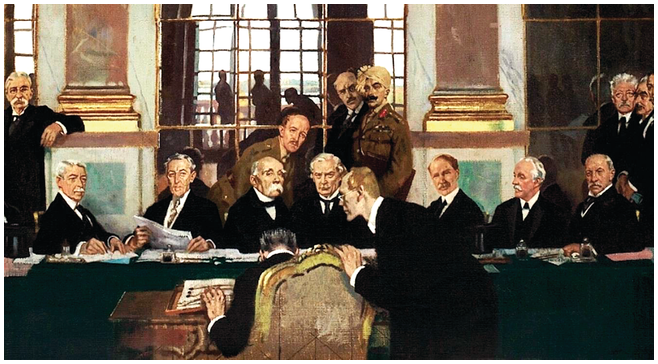
As membership of the League of Nations was predicated on signing the Treaty of Versailles, the separate signature of the Dominions was essential for their accession. However, the Paris Peace Conference would lead to four more peace treaties with the defeated Central Powers. The second treaty to be signed, the Treaty of Saint-Germaine-en-Laye, to conclude the war with Austria, did not have the same implications on the signatories, as the Versailles Treaty. Having signed the Treaty of Versailles, Jan Smuts, one of the architects of the League of Nations, decided to promptly return to South Africa, leaving no South African representative to sign the remaining treaties separately.Footnote 116 This perplexed the Colonial Office which believed that the same system that had been applied to the Versailles Treaty, would be replicated with the subsequent peace treaties. With Smuts’s departure causing a potential break with precedent, efforts were made to either find a replacement signatory, or a new means for the Dominions to sign. One proposal that hoped to appease Milner’s federalism was the idea of an imperial seal, instead of the typically-used ‘Great Seal of the United Kingdom’.Footnote 117 If adopted, this would have contradicted the emerging constitutional position, not to mention the method by which the Versailles Treaty had been signed. It was not followed through, but helped reveal the extent to which resistance remained in the Colonial Office to the notion of separate representation. With two weeks to go, the Governor General of South Africa finally wrote to Milner himself, as to whether he would sign for South Africa. Milner, who was preparing to leave on a mission to assess the escalation of resistance to British rule in Egypt, begrudgingly accepted.Footnote 118 In an ironic twist, the grand ‘proconsul’ of Imperial Federalism would execute an instrument of South Africa’s accession to the League, both furthering its devolution and confirming the political direction instigated by one of his greatest political rivals (Figure 2.1).
‘The Signing in the Hall of Mirrors’ by William Orpen, depicts the Maharaja of Bikaner in the background with Edwin Montagu standing behind him. Seated left to right are Robert Lansing (US Secretary of State), Woodrow Wilson, Clemenceau, Lloyd George, Bonar Law, Arthur Balfour, Alfred Milner.
Conclusion
With the Treaty of Versailles signed, the Dominion leaders began to trickle away from Paris, as talks moved towards peace with Austria and the Ottoman Empire. Many left the Conference sensing that an irrevocable change had occurred within the constitution of the Empire over those months in Paris. British reformers had hoped that greater devolution would tie Dominions more intimately into Imperial affairs, yet Smuts’s early departure from the Conference after securing his aims for South Africa suggested otherwise. Smuts left, stating that South Africa had ‘no particular interest in Austria’.Footnote 119 On Smuts’s arrival in South Africa, he declared to the South African National Assembly that he had achieved international recognition for South Africa. He proclaimed that, the idea that the Dominions were still under British ‘tutelage’ had been dispelled and that the British Empire now consisted of a ‘League of Free States’ as opposed to a strong central British government. However, Smuts hastened to add that the Dominions’ new status did not loosen the ties which bound together the British Empire.Footnote 120 The Peace Conference had been a resounding success for Smuts’s vision of the Empire, redefining Dominion status and devolving more powers and a nominal international personality to South Africa, all of which had been consented to by the British government.
These sentiments were reinforced by other Dominion leaders, such as Borden. Though he had had his disagreements with Lloyd George over the question of separate representation, Borden thanked the Prime Minister on his departure to Canada, expressing his ‘profound appreciation of the broad outlook and remarkable foresight which have always characterised your attitude in respect of the British Dominions’. The highly satisfactory resolution of the conference for Canada and most of the Dominions would foreshadow the growing divergence between them and India in terms of constitutional devolutions throughout the 1920s.Footnote 121
Although the Dominions’ new status may have satiated their representatives’ thirst for a new status in the British Empire, the same optimism was not shared uniformly among the British establishment. The Peace Conference had been a huge blow to the Round Table’s aspirations for an Imperial Parliament. Milner had tried to restrain the Empire’s constitutional direction towards confederation and had failed. During the negotiations, he sent around an apocalyptic memorandum penned by Richard Jebb, an academic whose work regularly engaged with the Round Table’s theories of imperial governance.Footnote 122 Jebb warned that the separate ratification of the Versailles Treaty would cause the Dominions and India to seek more natural geostrategic partners outside of the Empire. For the Dominions, this was most likely the United States, but he predicted that India would begin to ally itself with China and Japan, in a bid to support its citizens’ rights to emigrate to the Dominions. Jebb saw the principle of separate representation for the Dominions and India as poison for the Empire’s unity, declaring that ‘To me it had never occurred that in order to found the League of Nations the Britannic Commonwealth must be dissolved.’Footnote 123
Despite the simultaneous lauding and criticism of the seeming revolution in the Empire’s constitutional makeup through the Conference, the changes at Paris did little to satisfy nationalist ambitions across most of the Empire. Many did not identify with the British-appointed delegations and aspired to the representation of their issues by a delegation of their own choosing. For the Dominions, this was generally not problematic, as they had sent their elected representatives to Paris. The Minerva incident suggested that South Africa represented the only exception, where Afrikaner nationalists refused to recognise Jan Smuts as their legitimate interlocutor, revealing Smuts’s difficulty in reconciling Afrikaner and Imperial identity.
Although the Indian delegation wanted to engage in topics at Paris that were not dissimilar to the Congress-elected delegation’s objectives, their lack of real autonomy from the British Empire delegation prevented them from achieving their objectives. Indian aims to support Japan’s claim for racial equality were thwarted. Loyalist politicians such as Sinha and Bikaner were as concerned about the status of Indians within the Empire as were Congress politicians, yet their aims ran diametrically counter to those of the Dominions. In fact, the Indian delegation’s main goal of acceding to the League of Nations came at the price of a loss of equality of status for Indians within the Empire, with the acceptance of Curtis’s principle of reciprocity. This only furthered the narrative that India’s growing status was largely for show and that it entailed the loss of rights of Indians throughout the Empire.
By the end of 1919, the British objective of winning the support of Indian elites through the Montagu reforms and League membership had largely failed. The British and Indian delegations had argued at Paris that only British rule could lead India to self-governance, yet by December, the full exposure of the details of the carnage wrought at Amritsar had rocked the Empire. The revelations overshadowed Montagu’s reform bill, passed in December, and though the Montagu reforms initially received tacit support from Gandhi, he would rapidly denounce them as not ambitious enough and would resist the Government through mass ‘Non-cooperation’ the following year.Footnote 124 The inconsistency between Montagu’s reforms being drafted in London and the repression carried out in the streets of the Punjab, undermined Montagu’s plans to strike a new social contract in India. But some of these inconsistencies originated from Lionel Curtis, who had drafted both the notion of ‘Dyarchy’ as well as the Indian states’ rather flaccid ‘right to reciprocity’. His position was one that empowered the British Indian state and the participation of Indians within its machinery, whilst undermining Indians’ rights as subjects of the wider Empire.
Despite the cosmetic nature of India’s position at the League, it marked out Britain’s imperial governance structure as unique, compared to other colonial powers. By including some of its colonies, Britain had nevertheless not halted the normative shift towards state sovereignty as the basis for international recognition. Many states deplored Britain’s actions as a power-grab, and it was only Wilson’s tacit approval that allowed their accession to the League. Yet even within the United States, the prospect of joining an international organisation where Britain held more votes than them, added significant weight to the growing movement against the American accession to the League. Milner, who had been grumbling throughout 1919 at the prospect of separate representation, now feared that the inclusion of the Dominions would alienate the United States, providing: ‘fine material for party pugilism’.Footnote 125 Republican Senator Moses of New Hampshire exclaimed that ‘I do, however, strenuously object to the United States taking part in any organisation where the British Empire is superior to us by reason of the vote of her dependencies like India.’Footnote 126 The Senator for California, Hiram Johnson wrote that the League would be ‘undoubtedly the greatest victory for English diplomacy the world has even seen. With six votes in this League, against our one, it has our absolute guarantee of its territorial integrity’.Footnote 127 In November 1919, the Senate passed the Lenroot Reservation, stating that the United States would not be beholden to League resolutions which had involved more than one vote cast by the British Empire.Footnote 128 Moreover, the United States refused to acknowledge the votes of different states within the Empire in a dispute between the United States and another Empire member-state.Footnote 129
Feeding the flames of anti-Versailles isolationists in the United States was the Indian National Congress through affiliates in North America. Lala Lajpat Rai, who had tried to gain entry for a Congress representative at the Paris Peace Conference, had now resorted to a campaign of smearing India’s membership of the League as fraudulent, and claiming that the League of Nations itself was illegitimate for accepting colonies as members.Footnote 130 Though not the most significant reason behind the Senate’s ultimate rejection of the Treaty of Versailles and thus the United States’ membership of the League of Nations, the presence of British Dominions and colonies was enough to tarnish the embryonic League’s reputation among American isolationists. Lajpat Rai’s character assassination of the League, also revealed that the Indian National Congress was willing to forego and discredit a limited form of international personality for India, rather than accept colonial India as a legitimate international actor.
Whereas Indian nationalists attacked the admission of India to the League, Wilson was under increasing pressure by Irish nationals and Irish Americans who were angry at the League’s failure to include Irish representatives.Footnote 131 Moreover, with Britain taking such a predominant position in the League, there were fears that Article 10 of the Covenant that mandated the protection of members of the League, would be used to call on international support for putting down independence movements, such as the one in Ireland. Though this was a misreading of the obligations of Article 10, Wilson’s chief of propaganda George Creel responded that the League should rivet ‘no new shackles’ on the people of Ireland, the Philippines, Puerto Rico or Egypt.Footnote 132
The desire to retain American membership at the League was a higher priority to the British government than maintaining its multiple votes. The British Ambassador to Washington, Viscount Grey attempted to persuade the Dominions to accept the Lenroot Reservation and to surrender their rights to vote in the case of a dispute with the United States. Borden relented, privileging the United States’ presence at the League more than his vote, as did New Zealand. However, Hughes and Smuts did not. Despite being a strong Atlanticist, the latter vehemently refused to let go of the concessions he had fought for and gained at Paris. Grey failed to convince the Dominions, but by March 1920, the United States Senate had completely rejected the Treaty of Versailles and thus the League.Footnote 133 Grey’s intervention had revealed to the Dominions their expendability in British imperial policy to appease American isolationists. If the United States had joined the Senate under the Lenroot Reservation, as Britain was prepared to concede, the project of separate representation could have been largely overturned.
With the United States no longer willing to join the League, there was little effective resistance to the idea of separate representation. However, with India joining the League as a founding member, it could not set a precedent for future non-self-governing colonies to join. What the inclusion of India and the Dominions created was a political precedent rather than a legal one, and one that would be replicated, once the British government had attempted to resolve its now seemingly anomalous international relations.


 Open access