
Skip to main content Accessibility help
×
  • Cited by 1
    • Show more authors
    • Open Access
      You have digital access to this book
    • Select format
    • Publisher:
      Cambridge University Press
      Publication date:
      23 March 2025
      03 April 2025
      ISBN:
      9781009584432
      9781009584449
      Creative Commons:
      Creative Common License - CC Creative Common License - BY Creative Common License - NC
      This content is Open Access and distributed under the terms of the Creative Commons Attribution licence CC-BY-NC 4.0.
      https://creativecommons.org/creativelicenses
      Dimensions:
      (229 x 152 mm)
      Weight & Pages:
      0.628kg, 316 Pages
      Dimensions:
      Weight & Pages:
    Open Access
    You have digital access to this book
    Selected: Digital
    View content
    Add to cart View cart Buy from Cambridge.org

    Book description

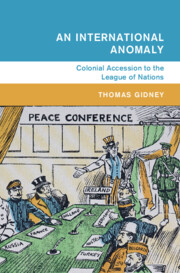
    It is often assumed that only sovereign states can join the United Nations. But this was not always the case. At the founding of the United Nations, a loophole drafted by British statesmen in its predecessor organisation, the League of Nations, was carried forward, allowing colonies to accede as member-states. Colonies such as India, Ireland, Egypt, and many more were afforded a tokenistic representation at the League in Geneva during the interwar years, decades before their independence. Thomas Gidney unites three geographically distinct case studies to demonstrate the evolution of Britain's policy from a range of different viewpoints, exploring how this policy came into being, and why it was only exploited by the British Empire. He argues that this membership shaped colonial norms around sovereignty and international recognition in the interwar period and to the present day. This title is also available as open access on Cambridge Core.

    Reviews

    ‘Gidney takes us beyond the Mandates question at the League of Nations to the thornier question of (post)colonial territories. Rich and fascinating studies of India, Ireland, and Egypt show liberal and imperial internationalism intersecting to court and discipline anticolonial desires to use the League as an exit route from Empire.’

    Stephen Legg - University of Nottingham

    Refine List

    Actions for selected content:

    Select all | Deselect all
    • View selected items
    • Export citations
    • Download PDF (zip)
    • Save to Kindle
    • Save to Dropbox
    • Save to Google Drive

    Save Search

    You can save your searches here and later view and run them again in "My saved searches".

    Please provide a title, maximum of 40 characters.
    ×

    Contents

    Full book PDF
    • An International Anomaly
      pp i-i
    • Global and International History - Series page
      pp ii-ii
    • An International Anomaly - Title page
      pp iii-iii
    • Colonial Accession to the League of Nations
    • Copyright page
      pp iv-iv
    • Dedication
      pp v-vi
    • Contents
      pp vii-viii
    • Figures
      pp ix-x
    • Acknowledgements
      pp xi-xii
    • A Note on Names
      pp xiii-xiv
    • Abbreviations
      pp xv-xvi
    • Introduction
      pp 1-24
    • 1 - India’s Accession to the Imperial Conference
      pp 25-68
    • 2 - The Formation of the League of Nations and Indian Membership ‘The Anomaly among Anomalies’
      pp 69-104
    • 3 - Inter Se and the League of Nations
      pp 105-124
    • 4 - Ireland’s Accession to the League of Nations
      pp 125-178
    • 5 - A Membership Obstructed
      pp 179-253
    • Egypt’s Delayed Accession to the League of Nations
    • Conclusion
      pp 269-276
    • Bibliography
      pp 277-288
    • Index
      pp 289-300

    Metrics

    Altmetric attention score

    Full text views

    Total number of HTML views: 0
    Total number of PDF views: 0 *
    Loading metrics...

    Book summary page views

    Total views: 0 *
    Loading metrics...

    * Views captured on Cambridge Core between #date#. This data will be updated every 24 hours.

    Usage data cannot currently be displayed.

    Accessibility standard: Unknown

    Why this information is here

    This section outlines the accessibility features of this content - including support for screen readers, full keyboard navigation and high-contrast display options. This may not be relevant for you.

    Accessibility Information

    Accessibility compliance for the PDF of this book is currently unknown and may be updated in the future.
