

Egypt was the last member state to accede to the League of Nations but it was not the last state within the greater British Empire to be considered for membership. Britain had contemplated Burma’s accession to the League of Nations, after it was separated from British India in 1937, a process that reveals much of the evolving strategy for maintaining the Empire through the twilight years of the League. The decision to partition Burma from India had been concluded in the Round Table Conferences in 1931 and had promised the Burmese that they would retain the same constitutional developments that they had when part of India.Footnote 1
Limited self-governance could be readily replicated in Burma on the Indian model. However, questions regarding Burma’s international expression proved to be the most difficult to resolve. The India Office began discussing whether Burma could become a member of the Imperial Conference, the stepping stone by which India became a member of the League of Nations. The admission of the Irish Free State was analysed as a basis for possible Burmese membership, but its constitutional status was insufficient, despite being nominally equal to that of India. Other states with greater self-governance such as Southern Rhodesia had also been denied entry to the Imperial Conference.Footnote 2 Some in the Dominion Office argued that Burma was considerably smaller than India, both geographically and in terms of population, with only 9 million people as opposed to the over 300 million people in India. Burma’s entry to the League of Nations would raise demands for membership from the other British colonies that Britain had denied membership.Footnote 3
On the international level, the inclusion of yet another British member into the League of Nations proved problematic. The presence of India in particular, had been a thorn in the side of Britain’s credibility with other League members from the outset and had been one of the reasons for the United States not to join the League. An application for Burmese membership would have to convince two-thirds of the League Assembly, which was unlikely and could raise ‘the very greatest hostility in Geneva’.Footnote 4 With the League increasingly unable to contain multiple crises throughout the 1930s, neither the League nor Britain needed to lose credibility for the sake of Burmese representation. The pragmatic use of having multiple votes had waned as the League of Nations decreased in significance.
Though Burma had the same level of constitutional development as India, ‘possessing a status inferior to that of a Dominion, but superior to that of a non-self-governing colony’, the League Covenant itself would make it unlikely for Burma to gain membership.Footnote 5 India had gained entry to the League through its signature of the Versailles Treaty, Ireland due to its Dominion status, and Egypt due to its nominal independence. Yet the League maintained a barrier to entry for the rest of the colonised world, including Burma, in spite of the constitutional reforms that Burma had undergone. One Foreign Office official doubted that if Burma had applied in 1936 it would have been accepted.Footnote 6 The British feared that these reforms, which fell short of self-governance, would be exposed for what they were through a rejected application for membership at Geneva, and that such a global refusal to recognise would underline to Burmese nationalists, Burma’s lack of sovereignty.Footnote 7
The Foreign Office did not think it possible for Burma to pass the League’s requirement for self-governance. This had not been an issue for India as a founding member, Ireland as a Dominion, nor for Egypt as a nominally independent state. Yet for a ‘dependency’ seeking to join after the Paris Peace Conference, there was a barrier to entry. In that sense, India had been an anomaly, and though its entry set a political precedent within the British Empire for other ‘self-governing’ states to join, it did not set an international legal precedent for colonies of a similar status to join after the League’s creation.Footnote 8
Perhaps the most telling point came around from Anthony Eden, the Foreign Secretary, who dismissed all the former arguments as irrelevant:
Mr. Eden has examined this question very closely … the question whether a territory has the right to vote, and to appear as a signatory of Conventions, does not depend on size or population, or even upon the degree of self-government which it possesses. It depends upon an international recognition of a separate status for international purposes. India achieved such international recognition under the Treaty of Versailles and by becoming a member of the League of Nations, although she was not self-governing. Newfoundland and Southern Rhodesia, although fully self-governing, have not enjoyed such separate representation because they have not obtained such international recognition.Footnote 9
For Eden, the right to represent Burma was at Britain’s discretion and did not rely on claims of self-governance, economic importance or population. These were simply arguments to justify that a colony fulfilled the normative expectations of a member state. Other British bureaucrats had looked at including Burma in other technical organisations, such as the Telegraph and Postal Unions, which posed less of an issue of reconciliation with Burma’s lack of self-governance. Yet Eden was reluctant to reignite the question of separate representation with the other empires with membership there, claiming the issue of colonies had already been a point of contention in these organisations, and to attempt to introduce Burma might limit Britain’s scope to include more ‘valuable’ colonies within their future membership.Footnote 10
Burma would either have to be represented by India or Great Britain. Eden found it inconceivable that India could represent Burma as a form of overseas territory within the Empire, and thus Burma would be ‘represented’ within the British delegation.Footnote 11 True to form, the British representative for Burma at the 1938 League Assembly was an Englishman, Mr Clague. His official role at the Assembly was to act purely as an ‘observer’ and to hold a ‘watching brief’.Footnote 12 Clague, like so many British representatives for colonies in Geneva, played a purely tokenistic role towards Burmese international representation. Devoid of any power to act on Burma’s behalf or in the interests of its people, Clague’s sole role was to be present, for apparently, having even a muted Englishman was better than having no representative for Burma at all.
Yet the 1938 Assembly attended by Clague, the last before the outbreak of the Second World War, was in some respects a very different forum than what had been envisioned at Paris in 1919. Despite Clague being emblematic of the old style of British officers representing colonies, other British Empire member states had transformed since the first Assembly in 1920. India’s delegation was still selected and commanded by the British Secretary of State, but its delegation had been headed by an Indian since 1929.Footnote 13 De Valera, who had in 1919 written the League off as a tool complicit in British imperial interests, was now President of the Assembly of the League. The Free State had dropped its epithet to become simply ‘Ireland’, and had ceased attending the Imperial Conference, effectively exiting the Empire. Ireland would remain neutral in the War, the only Dominion to do so. Egypt, shut out of the League for 15 years was now represented, though the War would prove that the autonomy it had gained in its new Treaty proved to be largely a façade. Even the building had changed as the League shifted from the Palais Wilson on the shores of Lake Geneva to the newly completed art deco Palais des Nations.
It would be easy to believe that the constitutional and international progress of British colonies made both domestically and at Geneva, was wiped away when the German invasion of Poland in 1939 hammered the final nail in the coffin built from the litany of recent failures for the League. Darwin argues that, ‘The worst nightmare for loyal exponents of the Dominion Idea was British involvement in a war whose purpose was unintelligible to Dominion (or Indian) opinion.’Footnote 14 The reaction by the Empire’s Dominions and India in intervening in another European conflict varied markedly. The original Dominions, Canada, Australia, and New Zealand all voluntarily joined the conflict on Britain’s side, whilst there was considerable reluctance from South Africa, whose Governor General called it a ‘tragedy’ that Britain should sacrifice its global interests for the sake of Poland. An aging Smuts led a new British loyalist government during the War, but after 1948 it would be the last time a unionist party would be in government in South Africa. The Irish Free State, that had largely abandoned any pretence of being in the Empire by 1939, declared its neutrality, and largely sat out the conflict. Rather than consult the Indian National Congress, the Government of India triggered a large-scale nationalist backlash in the form of the ‘Quit India Movement’, by declaring war on Germany without making any promises of devolution or Dominion status. The decision to do so severed the already strained relationship between Congress and the Government of India, ensuring Indian independence as the only acceptable outcome of Indian participation in the War.Footnote 15 Nonetheless, India played a pivotal role in the War, with around 2.5 million Indians fighting in the conflict.Footnote 16
But once again it was in Britain’s nominally independent client state, Egypt, that the limits of its nominal independence would be seen. Since the signing of the Anglo-Egyptian Treaty, the British Residency in Cairo had contingency plans for reoccupying Egypt if their influence was under threat. Lampson wrote to Eden, suggesting ways in which Britain could still have an important role in the administration of Egypt, and under what circumstances Britain could intervene if the Wafd and the Palace failed to govern.Footnote 17 The opportunity came much sooner than they had anticipated and despite Egypt’s formal neutrality in the conflict, its geostrategic significance would see the Empire deploy large numbers of British, Dominion, and Indian troops on Egyptian territory.
The large-scale deployment of imperial armies in Egypt undermined the notion of Egypt’s fledgling sovereignty, with the British were more than prepared to intervene in Egyptian politics. Faced with an impending German assault on the Nile Delta in 1942, the British needed to secure Egyptian support once again. In a strange reversal of the previous two decades, the British backed Nahas to form a government, against the will of King Farouk, who the British feared had pro-German sympathies. Lampson pushed Farouk to accept a Wafd government but was rebuffed. On the night of 4 February 1942, British troops surrounded the Abdeen Palace, to force Farouk to comply or abdicate. He submitted, but the orchestrated coup hurt both Britain’s and the Wafd’s perception among the Egyptian Parliament.Footnote 18 The Wafd, that had been a vanguard of the Egyptian revolution and resistance to the British would be seen increasingly as collaborators and would ultimately be banned in 1953 by Gamal Abdel Nasser after the officer’s coup. The Wafd’s fall from grace in Egyptian politics revealed the chasm between the party elites and Egyptian society. The Wafd remained popular so long as it resisted British rule and interference in Egypt. Any compromise or deviation from the goal of complete independence weakened support for the Wafd.
The War revealed the very limits of the ‘Third British Empire’, for the British, whose symbolic devolutions had failed, outside of its culturally British Dominions, to secure loyalty to the imperial project. But it also revealed the often-fictitious, or at least limited nature of the constitutional progression that many of these British colonies had seemingly achieved in the interwar period. The ostensibly consensual bonds that the ‘Third’ Empire attempted to build were dashed in the name of imperial defence.
The Perpetuation of Colonial Membership at the United Nations
The demise of the League of Nations did not signal the end of colonial membership at international organisations. Even before the League of Nations had been replaced by the United Nations, plans were afoot for the inclusion of quasi-sovereign entities into the new organisation. Yet this time, Britain was not the only empire looking to expand its vote share.
Prior to the Dumbarton Oaks conference in 1943, the Soviet Union had made a request that seven of its Soviet Republics (the internal Federal States of the USSR) should become members of the future United Nations Commission on the investigation for war crimes. The British rejected this by citing the Soviet Constitution back to the USSR’s delegates; only the Central Government could represent the Soviet Republics internationally. The Soviet Ambassador to London quipped back that the position was analogous to that of the British Dominions. The Soviet Union temporarily dropped the issue.Footnote 19 For the upcoming negotiations at the 1945 inter-Allied conference at Yalta, the Soviet Union was better prepared. Article 18 of the Soviet Constitution had now been amended so that internal Soviet Republics had the right to conduct their own foreign policy. However, Article 14a, which stated that such actions can only be conducted through the central government, remained unchanged.Footnote 20
The basis of the Soviet Foreign Minister Molotov’s demands at Yalta, had very similar parallels to the demands Britain had made for India in Paris in 1919. Instead of claiming seven seats at a UN Commission, Molotov and Stalin asked for only two seats, Ukraine and Belorussia, for full membership of the United Nations as founding members. This matched the intentions of the United States and Britain to include the American Philippines and India, both colonies, as member states. The basis for their admission was their contribution to the war effort, and that the German invasion during Operation Barbarossa had advanced primarily through these two Soviet Republics.Footnote 21 Citing sacrifice and contribution to the War as a basis for UN membership was not dissimilar to the arguments made by the Dominions and India twenty-six years earlier. Moreover, on account of their large population and industrial output, Molotov argued that Ukraine and Belorussia should be allowed membership, an argument that was used at the Paris Peace Conference for India’s admission too. This was conceded, as otherwise it was likely that Stalin would have blocked the application of India and the Philippines to the UN.Footnote 22
At the San Francisco Conference that founded the UN, the United States and Britain accepted the admission of Soviet Ukraine and Belorussia.Footnote 23 Molotov spoke in favour of their admission, but then proceeded to comment on the status of British India and the Philippines, both still colonies (on the verge of independence):
We share the view held by the British Government, which supported that representation and India should be granted a seat at the conference, imperfect though her status is … we all knew that the time will come when the voice of an independence India will be heard … we have at this conference an Indian delegation but India is not an independent state.Footnote 24
Similar comments were made about the American Philippines, which the Americans had intended to include, now that they were definite with engaging with the UN, in contrast to the position they had taken with the League.Footnote 25 The Philippines had been a sticking point for Woodrow Wilson when confronted with the British request for the inclusion of India at the League. No such qualms were made at the creation of the UN. All these quasi-sovereigns had their positions ratified unanimously at a steering committee of the UN on 27 April 1947, almost four months before Indian independence.Footnote 26 This had profound consequences in international law, demonstrating that when India became independent, it retained its membership of the UN as the continuation of the colonial state of British India, despite its regime change and significantly different borders.Footnote 27
The basis on which to allow these quasi-sovereign entities into the United Nations showed a resurrection of the article of exception crafted by Jan Smuts in 1919, who also symbolically drafted the preamble of the UN Charter.Footnote 28 India had been admitted to the League on the basis of being a signatory to the Treaty of Versailles. India would again be admitted, as would the Philippines, Ukraine, and Belorussia on the basis of Article 3 of the UN Charter. These were the founding members, who joined nominally for their contribution in the war, backed by support from a great power. Even the British doubted if any of these states, including India could have passed the conditions for membership through the normal admissions process laid out in Article 4.Footnote 29 Nonetheless, both India and the Philippines became independent by 1947.Footnote 30 This exception to the rules that the British opened at Paris in 1919 to allow colonial representation, had once again been deployed, but this time by a rival imperial state in a new organisation in the 1940s. For an apparent ‘anomaly among anomalies’, colonial representation was certainly showing its longevity.
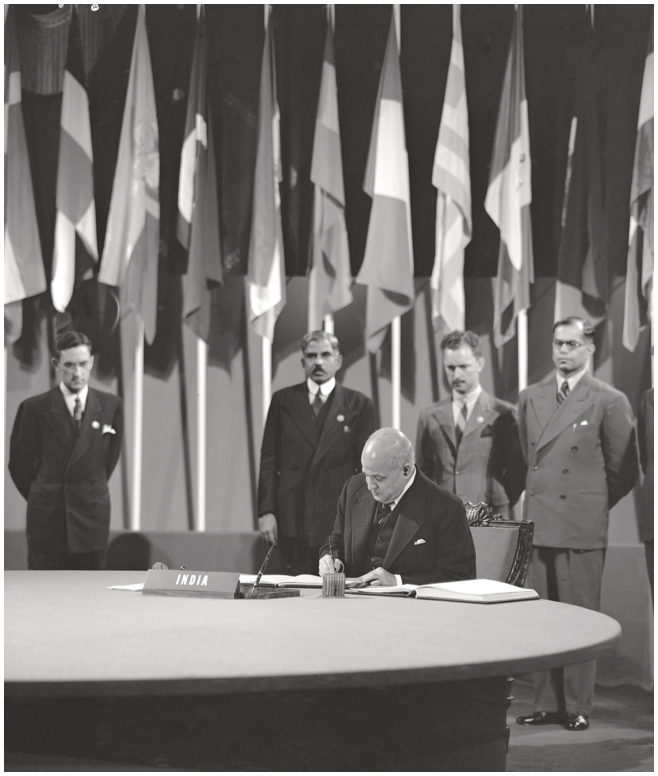
The most significant difference between India’s experience at the UN and its experience at the League was over who appointed the new delegation. At the San Francisco Conference, there were few differences in the composition of the delegation to the Paris Peace Conference. The Government of India appointed veteran Indian civil servants representing different populations, Sir Firoz Khan Noon for the Muslims, Sir Ramaswami Mudaliar for the Hindus, and Sir V. T. Krishnamachari for the Princely States. Perhaps the most significant difference was that only one European, John Bartley, travelled with the Indian Delegation, but as an advisor. The Indian delegation was particularly keen for the Charter to protect state sovereignty, but also to ensure the application of human rights, regardless of race, a concept of racial equality that had been shot down in 1919 at the Paris Peace Conference. The Indian Delegation also strongly supported the Philippines delegate, Carlos Romulo, who wanted to ensure that the UN’s new ‘trusteeship’ system guaranteed the ultimate independence of trust territories, rather than simply receiving ‘self-governance’. As has been shown many times throughout the interwar period, the two were by no means the same.Footnote 31
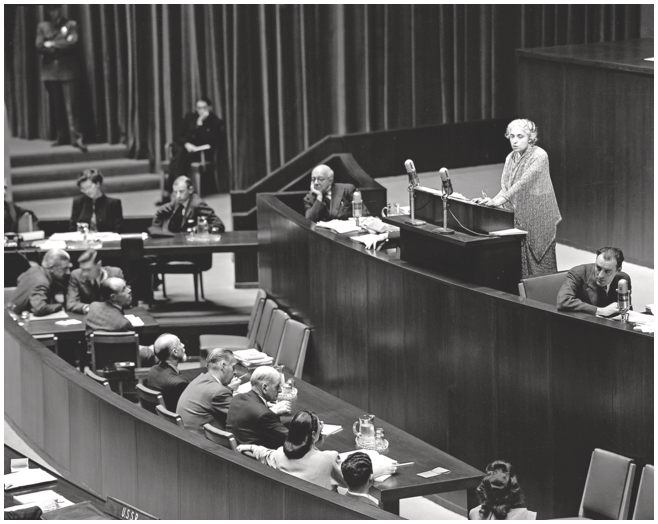
One of the biggest detractors of the British appointed Indian Delegation at San Francisco, Vijaya Lakshmi Pandit, Nehru’s younger sister, who called the Indian delegates ‘British stooges’ had similarly protested on the position of ‘Trust Territories’:
Great Britain, France and the Netherlands, all colonial powers, have proposed ‘self-government’ as a substitute for ‘independence.’ What is the difference? The word independence means what it says and is clean-cut. The British formula of ‘selfgovernment’ – an ancient weasel word – was deliberately designed and has long been used in India and elsewhere to offer the shadow but never the substance of independence to subject peoples.Footnote 32
Having gone through the lengthy process of devolutions of power, many of which were more symbolic than substantive, like League membership, the Indian National Congress was aiming to secure outright independence. Vijaya Lakshmi may have been protesting outside the San Francisco Conference in 1945, but merely a year later, she was appointed by the new interim Indian Government led by Nehru to head India’s delegation to the UN.Footnote 33 1946 was the first year in which the Government of India and the Secretary of State for India would not select India’s delegation.
Despite the illusory nature of India’s international personality prior to 1946, Nehru was a strong internationalist, and the Indian delegation left an imprint at the UN’s first General Assembly. It launched a bid for a seat as a non-permanent member of the UN Security Council, as well as on the Trusteeship Council, both of which were opposed by Britain.Footnote 34 But it was one of the original complaints, that had launched Gandhi’s career and India’s League membership in the 1910s, long supressed at the League by the doctrine of inter se, that the Indian delegation chose to revisit as a de facto independent delegation in 1946. This was the treatment of Indians living in South Africa. With South Africa running headlong into the system of apartheid, with the 1946 ‘Asiatic Land Tenure Act’ confining Asians from owning property except in areas attacked as ‘ghettoes’, the Indian delegation was tasked by Gandhi with attacking this infringement on the rights of Indians abroad. Moreover, South Africa had refused to release its former Mandate of South West Africa as a trustee or independent state.Footnote 35
A now-aged Smuts led South Africa’s delegation claiming that Indians in South Africa, a population group that he’d tried to marginalise for several decades, were South Africans, and that India could not interfere with its internal affairs. In contrast at the League where Britain had aimed to align its Dominions’ and dependencies’ voice, the British Government opposed India’s complaint against South Africa, which saw more support from China and the Soviet Union. Britain’s support for South Africa was more of a support for the Smuts regime, fearing his electoral defeat by Republican South African nationalists, but its refusal to support India revolted its delegation. Nonetheless, India’s successful galvanisation of a coalition of states against South Africa at the General Assembly, managed to pass two resolutions on improving the conditions of Indians in South Africa, as well as a resolution that South West Africa should be brought under trusteeship rather than annexed by South Africa. The first General Assembly of the United Nations thus heralded a very new form of Indian diplomacy, which showed that the UN would not mask India’s colonial status like the League had done. India’s dissent from the imperial line, as well as Australia’s abstention on the treatment of Indians in South Africa showed the dissolution of the practice inter se at the UN (Figures 6.1 and 6.2).Footnote 36
Sir V. T. Krishnamachari signing the UN Charter at San Francisco on 26 June 1945.
Vijaya Lakshmi Pandit at the UN General Assembly on 25 October 1946.
The British Government had thus used up considerable political capital in including India at the UN which had quickly deviated from inter se, and it was no in position to resist the Soviet Union’s demands for the admission of its Soviet Republics. Equipped with additional votes at the UN Assembly and a seat on the Security Council, the USSR began blocking admissions of perceived ‘Western’ states as members of the UN in 1949. The Soviet Union applied the veto to: Austria, Ceylon, Finland, Italy, Ireland, Nepal, Portugal, and Transjordan. The United States was simultaneously blocking the Soviet’s own satellite states Bulgaria, Hungary, and Romania from accession.Footnote 37 The UN thus found itself in the seemingly paradoxical situation of having non-independent polities among its members, whilst new sovereign states found the door barred. But it also put states like Britain, that had used its clout from its multiple Empire-votes at the League of Nations, on the receiving end of similar behaviour by the USSR.
The Soviet Union’s blocking of Ceylon in particular, aggravated the Foreign Office. Ceylon had recently become independent in 1948, though it remained officially a Dominion. The newly independent government was keen to assert itself on the international stage by applying for UN membership, yet was blocked by the Soviet Union which accused Britain of introducing more members of the Empire to produce ‘mechanical majorities’.Footnote 38 This infuriated the Foreign Office, with Dominion status by 1949 meaning virtual statehood, which the British contrasted with the position of Ukraine and Belorussia, which they branded ‘phony’ and as the ‘two stooges’.Footnote 39 The fact that Ukraine and Belorussia had never once deviated from the Soviet position at the UN, only served to heighten their indignation.Footnote 40 The Soviet Union’s veto on new members threatened the integrity of the Commonwealth, as Britain feared that its inability to gain UN membership for Ceylon would be proof of its powerlessness to its former colonies in managing global events.Footnote 41
A rebuttal to the Soviet’s vetoing of new members was planned by the British High Commissioner for Canada to ‘have some fun at the Russians’ expense’.Footnote 42 This ‘fun’ included challenging the admissibility of the two Soviet Republics as viable member states at the International Court of Justice.Footnote 43 The British Foreign Office wanted to call the Soviets out for hypocrisy, but decided it could not base their claim on a state’s political independence being a prerequisite for UN membership.Footnote 44 This gave the British little room for manoeuvre, so they promptly abandoned the policy, deeming that ‘cold war items such as this, which are primarily used to annoy the Russians rather than advance the business of the United Nations, should be selected with great discrimination’.Footnote 45 The Soviet Union had tried to shift the debate too, from one of challenging the veracity of independence of new member states to invoking procedural issues, in which itself and Poland tried to remove Ceylon’s admission from the agenda.Footnote 46 The Soviet strategy of blocking new member states would continue until 1955.
The admission of Ukraine and Belorussia reveals how the architect of the system of colonial membership, Britain, had been outplayed at a game that it had dominated for two decades at the League of Nations. The Soviet Union’s veto on UN membership for recently independent states from the British Empire, reveals how they utilised their own hegemony over the Soviet Republics and Eastern European satellite states to outmanoeuvre Britain in the early years of the UN. Their success in doing so was condemned by those that had initially created the system, and who now deemed the membership of many of the USSR’s clients to be fake. Yet even in 1949 Britain would not argue that full independence should be the basis for membership at the UN, fearing the repercussions it could cause within the Empire.
The UN has inherited many of the legacies of the League of Nations, including that of colonial membership. Rather than reject the principle of separate representation for empires once and for all, the UN perpetuated it. Yet this is not how the UN is perceived, or its history remembered today. The UN did change its official stance against empires, with Resolution 1514 otherwise known as the ‘Declaration on the Granting of Independence to Colonial Countries and Peoples’ (on which Britain, the US, and most ex-colonial powers abstained). These changes were effectuated by decolonised states, not by those that had designed the system of ‘representing’ their colonies at the League. Article 4 of the Charter made it impossible for colonies to join after the foundation of the UN. However, the effects of Article 3 lingered on until the 90s, where Belorussia and Ukraine only took real control of their representation at the UN after their independence from the collapsing of the Soviet Union. Like India and the Philippines, this regime change did not require readmission to the UN, as it did for other former Soviet Republics such as the Baltic, Caucus, and Central Asian states.
The end of the Soviet Union seemed to mark an end to the legacy of the policy of colonial membership that began in Paris in 1919. For many new post-Soviet states, UN membership has been an important demarcation of sovereignty from their former position as Soviet Republics. The United Nations’ inability to safeguard the sovereignty of its member states in recent conflict has not diminished the appetites for those seeking international recognition, however. Palestinians have long seen UN membership as a significant act of international recognition, moving Palestine beyond its quasi-sovereign status as an ‘observer state’ with the President of the Palestinian Authority, Mahmoud Abbas, calling for full membership at the 2022 UN Assembly.Footnote 47 Kosovo is a member of a number of international organisations but not the UN, where it has long sought a seat.Footnote 48 But perhaps one of the most striking calls for UN membership comes from an autonomous polity seeking a greater international role. Greenland, currently a Danish self-governing territory, is currently seeking its own seat at the UN, without declaring full independence from Denmark.Footnote 49
The League of Nations has often acted as a lingering and cautionary tale for the United Nations, of the fragility of international organisations in maintaining its core mission of upholding world peace. But it is the symbolic allure of membership, both at the League, and later at the UN, as institutions that impart accreditation, recognition, and sovereignty, that has continuously drawn those seeking to build statehood.


 Open access