

Sinn Fein and International Recognition, 1919–1921
The admission of Ireland or the Irish ‘Free State’, a British Dominion, to the League of Nations in 1923 was a culmination of the efforts of the preceding years to define the Empire’s separate representation. Ireland would be the first colonial entity to enter the League as a non-founding member, meaning that it could not rely on the loophole drafted by Smuts to include India; instead it would be subject to the League’s regular admission process.
India had gained its League membership in a process akin to an overspill of devolution due to its position in the Imperial Conference. Similar provisions, as mentioned in Chapter 2, had not been envisaged for Ireland in 1919. Administratively, Ireland was part of the United Kingdom, rather than a colony, although the debate for Irish ‘Home Rule’ had raged through British politics for half a century. Home Rule would have seen increased autonomy for Ireland within the United Kingdom, rather than Dominion status. After two failed attempts to pass a Home Rule bill in 1886 and 1893, one finally passed in September 1914.Footnote 1 This had passed in a context of tension between Catholic Southern Ireland, and the Protestant-majority Northern counties of Ulster, that opposed devolving powers to a parliament in Dublin. As the debates raged on in Westminster, Ulster Unionists formed the Ulster Volunteers in 1912, whilst Irish Nationalists formed the Irish Volunteers in 1913. Both paramilitary groups, particularly the Ulster Volunteers, were able to secure large shipments of rifles from Germany, whilst Ulster officers in the British Army based at Curragh, chafed at potential British plans to crush the Ulster Volunteers and was met with the threat of mass resignation.Footnote 2 The Home Rule Bill was thus amended to omit Ulster for a period of six years, a decision that was quickly superseded by the outbreak of the war which suspended the Government of Ireland Bill. The aforementioned Easter Rising of 1916 confirmed the risk of nationalist armed insurrection against British rule in Ireland.
Whilst Ireland had politically been more of a tinderbox than Egypt and India prior to 1919, there was no initial intention at the Paris Peace Conference for Ireland to be represented at the League. Although British politicians in 1919 resisted the calls for Ireland to participate in the Peace Conference at the League, the Wilsonian Moment’s global clarion call was most influential in Ireland. The Irish Republican political party Sinn Fein was buoyed by its success in the General Elections in December 1918, winning a landslide victory across Ireland except in the Northern counties. With popular support behind it, the Dail (the new but internationally unrecognised Irish government) declared Irish independence in January 1919, in the early weeks of the Paris Peace Conference.Footnote 3 Whereas reformers such as Montagu and the Round Table were keen to foster an image of a future Indian Dominion operating loyally within the British Empire, the same objectives had not been envisaged for Ireland.
The timing of the Irish declaration had been strategic, as it brought in an important prerequisite for the Irish statehood that Sinn Fein desired, international recognition, especially from the United States. Not only were nationalists buoyed by a perceived Wilsonian commitment to national self-determination, but the Dail aimed to wield significant political influence within the United States. The Irish diaspora in the United States was significant, and the Dail aimed to utilise their political weight to push Wilson towards Irish recognition. The Declaration of Irish independence was coupled with a ‘Message to the Free People of the world’, asserting Ireland as a new state on the international stage, seeking recognition. Supporting the Irish bid for a seat at the table was an ever-increasing stream of Irish-American support, such as the Irish Race Convention in Philadelphia, which aimed to pressure the President, but also the Congress and the Senate for American support for Irish independence.Footnote 4
The petitions were followed up by an Irish delegation led by George Gavan Duffy and Sean O’Kelly, who petitioned Wilson and other leaders, such as Clemenceau, for Irish representation at the Peace Conference.Footnote 5 This delegation paid close attention to the Peace Conference proceedings, especially the Conference’s Committee to establish the League of Nations that had begun to operate in February 1919. When the draft Covenant released in March, revealed the tolerance for the representation of colonies and Dominions, Kelly saw an opportunity to push for Irish membership of the League:
membership of the League – a membership available under Article 7 (later moved to Article 1) even to Colonies who have freely and legislatively subscribed to the supremacy of the English Imperial Parliament – shall not be denied to the Government of a free and independent Irish Republic.Footnote 6
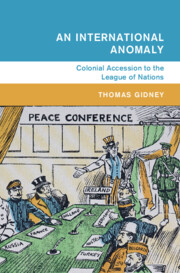
Consequently, O’Kelly led a small delegation to Paris, but was turned away at the door. Nonetheless, the trip to Paris provided an opportunity to distribute a pamphlet entitled ‘The Message of Dail Eireann to the Free Peoples of the World’, asking representatives at the Conference to recognise Ireland’s sovereignty (Figure 4.2).
An envisaged Irish Republican entry to the Paris Peace Conference. Uncle Sam welcomes Ireland to a seat at the head of the table, whilst John Bull frets.

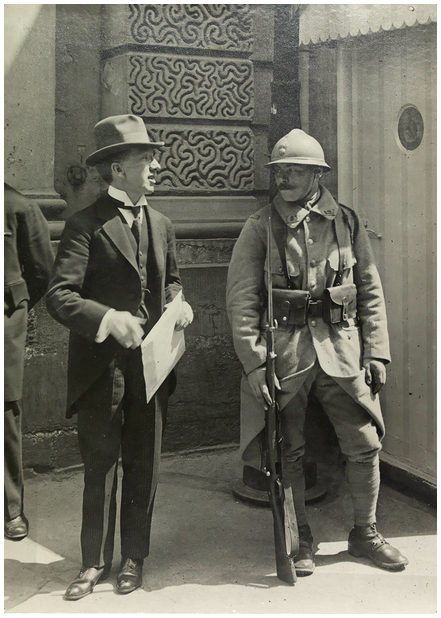
Sean T. O’ Kelly attempting to meet Clemenceau in Paris requesting the right to present the case of Irish independence at the Paris Peace Conference.
Declaring Ireland to be a sovereign state, the Irish delegation intended to utilise Article 10 of the draft League Covenant, the article that guaranteed the collective security of a member state’s territory as a basis for independence. This would essentially declare Ireland to be under an illegal occupation by British troops, causing a dispute that could be resolved in their favour at the League.Footnote 7 Yet, as no state had agreed to even recognise Irish statehood, the claim that Ireland had been invaded by Great Britain held no water at Paris. Irish nationalists, de Valera in particular, focussed their efforts for recognition on the United States. Having escaped from a British prison in Lincoln, allegedly with a counterfeit key smuggled within a fruitcake, de Valera arrived in the United States in June 1919, to raise support for the recognition of the Irish Republic and funds for its independence struggle (Figure 4.2).Footnote 8
For Wilson, the Irish Republican Delegation proved to be yet another fly in the ointment of the embryonic League. Wilson was already unpopular with Irish Republicans in the United States, having been accused of not interfering in the execution of Roger Casement for smuggling guns into Ireland, but Irish- Americans were a key base for the Democratic Party. Wilson had tried to delay attempts in Congress, to discuss whether the topic of Irish self-determination should be brought up at Paris. In March 1919, an Irish-American delegation had met Wilson, requesting that he push for Irish self-determination.Footnote 9 This angered the President, who, according to D. H. Miller’s memoirs, wanted to tell the delegation to ‘go to hell’. The ‘Irish Question’ was complicating negotiations over the future of the League, especially over a clause of non-interference into member states’ domestic affairs, which Wilson feared would be seen by Irish-Americans as a ‘shot at them’.Footnote 10 For Wilson, the status of Allied colonies and territories like Ireland was settled law, and not of relevance to the Conference.
The failure to secure Irish recognition through official means transformed prevailing opinions towards the League of Nations among Sinn Fein. Wilson was already struggling with isolationist American Republicans who opposed signing the Treaty of Versailles, and de Valera, who had once seen the Treaty and the League as vehicles towards independence, joined in the coalition against Wilson. In a series of interviews and speeches, de Valera attacked the League of Nations. He stated that no population could be more disappointed than the Irish, as he believed that Wilson’s Fourteen Points were best suited for Ireland, and that the League had become dominated by British imperial interests.Footnote 11 De Valera believed that the League had been created so as to guarantee the territorial integrity of the empire its most powerful members, especially Britain, and that in its current state, the ‘machinery’ of the League could never support an internal independence movement.Footnote 12 This belief was solidified when a British bureaucrat, Eric Drummond, was selected as the League’s Secretary General.Footnote 13 De Valera thus pleaded to Americans: ‘you would not in this great nation (the United States) have a right to do the Irish nation an injustice, and yet that is what you do if you decide to ratify the present covenant of the League of Nations’.Footnote 14
De Valera and other Irish republican organisations routinely cited atrocities committed by British armed forces in India and Egypt, and their meetings were often attended by members of Indian and Egyptian nationalist organisations. De Valera was in contact with the revolutionary Ghadar party, that had unsuccessfully attempted to instigate a mutiny in Punjab in 1915, but had successfully caused troops to revolt in Singapore the same year. In 1920, de Valera co-published a booklet called ‘India and Ireland’, that attacked the events of the April 1919 Jallianwala Bagh massacre at Amritsar, which had become public knowledge by December 1919. De Valera believed that Britain was in a sensitive position after the Peace Conference, by revealing it as a prime actor in attempting to perpetuate an imperialist status quo, and that a united struggle from India and Egypt could rid them of what he called ‘the vampire fattening on our blood’.Footnote 15
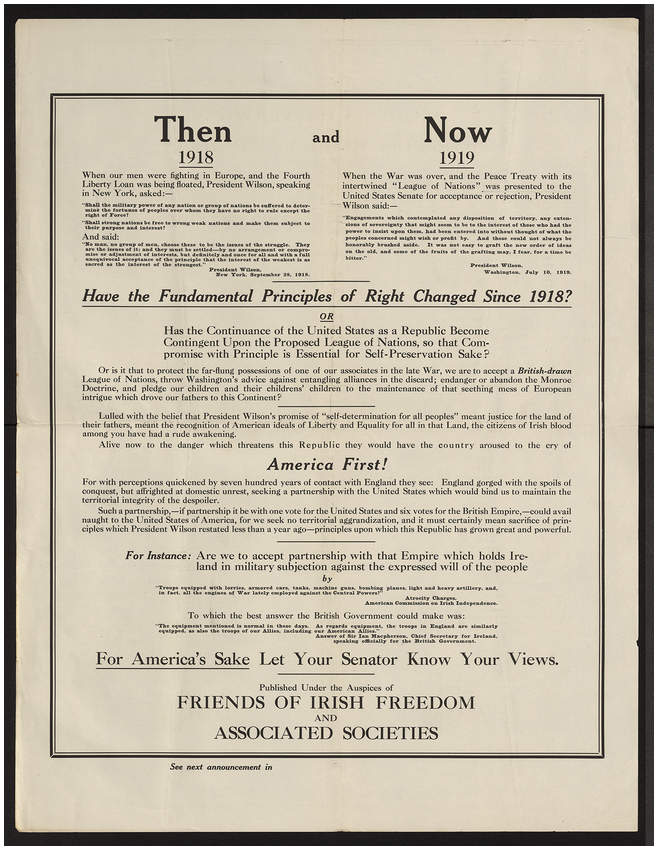
The League of Nations proved to be an easy target for this coalition of Irish and Indian activists. Britain’s multiple votes at the League made the organisation considerably less attractive to American adherence. Posters were disseminated stating: ‘If the League goes through, England will control six votes as against the one of the United States’ and that Americans should ‘Drop a line to your senator. Help send the League of Nations back to Paris.’Footnote 16 Another exclaimed: ‘alive now to the danger which threatens the Republic they would have the country arouse to the cry of America First! Such a partnership, – if partnership it be with one vote for the United States and six votes for the British Empire’.Footnote 17
At the inaugural meeting of the League of Nations in January 1920, Irish Delegates in Paris sent a letter to Eric Drummond and other League members, denouncing the League as a weapon of Britain’s secret diplomacy to guarantee its ‘hegemony in two hemispheres’. They demanded that the League reform itself into a democratic organisation that upheld the protection of peoples under foreign assault, as Sinn Fein perceived the situation in Ireland.Footnote 18 This discourse of reforming the League was present on numerous occasions, and showed how Republicans still saw the League as a potential tool for recognition, if only it were not dominated by Britain. One of the Paris delegates, Gavan Duffy, even wrote to de Valera suggesting the League Secretariat could one day move to Ireland as a possible shield against British aggression (Figures 4.3 and 4.4).Footnote 19
Anti-Versailles Treaty poster.
Irish anti-League poster. Smuts’s views on Ireland were used against him by anti-Versailles Treaty activists in the United States.
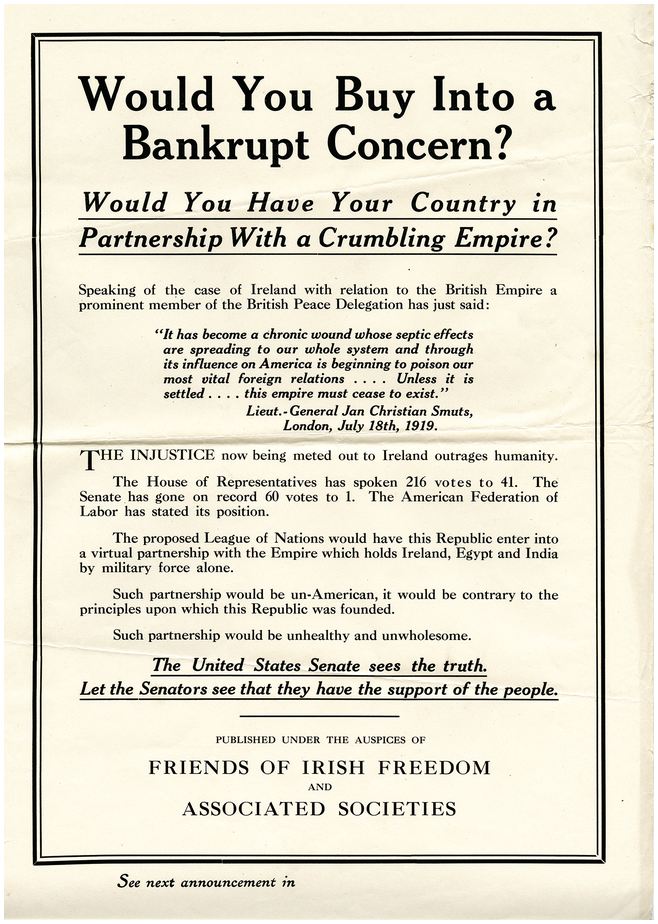
The deleterious effects that Irish nationalism posed to the rest of the Empire were not lost on British statesmen. By building networks with Egyptian and Indian nationalists, discrediting the League of Nations, both in the Empire and in the United States, and by seeking to sour transatlantic relations, the effects of Irish Republicanism resonated much wider than within the Emerald Isle. Smuts, in his leaving speech at the Paris Conference, warned that the Irish question had become a: ‘chronic wound whose septic effects are spreading to our whole system and through its influence on America is beginning to poison our most vital foreign relations … Unless it is settled … This empire must cease to exist’.Footnote 20 Smuts’s quotation would later be republished in propaganda by Irish nationalists in the United States, aiming to turn popular opinion away from the League of Nations.
Smuts saw in Ireland a country in need of his proverbial remedy of Dominion status. Despite Sinn Fein’s hard line for outright independence, other nationalist organisations such as the Irish Dominion League, formed by Horace Plunkett in June 1919, were calling for Dominion status.Footnote 21 Smuts had been cultivating this form of Irish Dominionism and had a large role in the 1917 Irish Convention, that aimed, and largely failed, to reconcile Irish republican aspirations and British imperial aims. Plunkett saw in Smuts an example of perceived reconciliation between Afrikaners and the British Empire, that could be emulated in Ireland. The Irish Dominion League’s efforts were not taken particularly seriously by Lloyd George, nor by de Valera.Footnote 22 De Valera’s uncompromising position could itself have been undermined by those willing to open negotiations with the British Government for Dominion status, but Plunkett and the Irish Dominion League lacked significant popular support. Writing to another member of the Irish Republican Cabinet, Arthur Griffith, de Valera wrote that ‘that there is no danger that the Irish people will start into a trot after the new Plunkett carrot. The carrot dodge is perhaps unknown to the American people but it will be explained to them’.Footnote 23 Nonetheless, in the United States, de Valera targeted Plunkett and Dominion status in his speeches, claiming that Ireland was different from other British Dominions, as an ancient civilisation.Footnote 24 Any talk of Dominion status would ‘wean’ support away from the Republican movement.Footnote 25 Yet despite the antagonisms between Valera and Plunkett, both agreed that Ireland should have an independent place in the League, and wrote to Clemenceau asking him to petition a League of Nations Commission for admission.Footnote 26 Irish representation at the League was thus a goal which united two rival sides of Irish nationalism.
The Irish Dominion League in 1920 did not hold sufficient political weight in Westminster, and the British Government pursued a strategy of devolving powers to two new parliaments, one in Northern and one in Southern Ireland, foreshadowing the partition of Ireland. Despite limited devolution, the Government of Ireland Act 1920 retained Ireland’s position within the United Kingdom. The devolution did nothing to stem the escalating violence, as the Irish Republican Army under the leadership of Michael Collins, intensified its campaign. The creation of two separate parliaments only increased Republican fears that Ireland would be divided into two. Weeks before the implementation of the Bill, Collins ordered the assassination of the ‘Cairo Gang’, twelve British intelligence agents operating in Dublin that had been monitoring the IRA’s (Irish Republican Army) activities. The same day, British paramilitary forces, known as the ‘Black and Tans’ (for the colour of their uniforms), opened fire at a rugby match at Croke Park in Dublin, killing fourteen civilians. This did a lot to discredit Britain internationally, where the memory of the Amritsar massacre in India from the year before was still fresh.Footnote 27
Smuts’s prediction of Irish nationalism as a ‘chronic wound’ to not just Britain but the Empire was becoming a reality when Irish troops based in India mutinied in June 1920. The Connaught Rangers revolted against the growing ubiquity of martial law in Ireland. An Irish tricolour was flown from the barracks, and the mutineers pinned Sinn Fein rosettes to their uniforms. Though primarily a protest against repression in Ireland, the mutiny inspired the rapidly growing Indian nationalist movement, as a symbol of anti-imperial solidarity. The Marathi newspaper Kesari that had been established by Tilak was keen to draw a contrast between Irish troops who had mutinied and Indian ones that had remained loyal in the face of a similar repressive policies in India. Though the mutiny was quickly quashed by British forces, it would be an important transnational moment in a time when the Indian National Congress began to divide itself between elements that aimed for constitutional reform, and radicals such as Gandhi, who would distance himself from the violence of Sinn Fein but would soon lead the ‘non-cooperation’ movement for Indian self-governance.Footnote 28
The perpetual violence in Ireland, and the instability to the Empire that emanated from the conflict, threatened the existence of Lloyd George’s coalition with the Conservative Party. However, the protracted war in Ireland proved to be fertile ground for British imperial reformists. Smuts, who had been unsuccessful in creating an Irish Dominion in 1919, raised the option once more at the Imperial Conference in June 1921. Even de Valera wanted to break the stalemate and use Smuts as a possible voice at the Imperial Conference. Working through a friend of Smuts, Thomas Casement (brother of executed Irish nationalist Roger Casement), de Valera approached Smuts vicariously through Casement, to push the British Government to relinquish Ireland.Footnote 29 However, Smuts was still aligned to work with Horace Plunkett for a Dominion solution to the conflict in Ireland, rather than relinquish it by negotiating with Sinn Fein.Footnote 30
Throughout the summer of 1921, Smuts became the focus of attention for competing visions of Irish nationhood. Perceiving a division within the Irish nationalist movement, Smuts planned a renewed bid to Sinn Fein for Irish Dominion status.Footnote 31 Utilising his close relationship with the King, Smuts sent a symbolic message to Irish nationalist groups through the King’s opening speech at the Northern Irish Parliament on 22 June 1921. The King’s speech sought a conciliatory note with Sinn Fein, and was followed up two days later by Lloyd George’s offer of a truce, and possible Dominion status for Southern Ireland.Footnote 32 The truce did not entice de Valera, as it threatened the unity of Ireland, but others such as Collins welcomed the opportunity, especially due to the fact that recent military attacks such as the one on the Customs House. had severely weakened the IRA’s military capabilities.Footnote 33
Smuts engaged in a series of letters with Sinn Fein leaders, most notably with de Valera, hoping that South Africa’s experience after the Boer war could serve as a model of Dominion status within the Empire. Smuts interviewed de Valera on 7 July, but the discussions were unfruitful. Smuts had tried to convince de Valera that maintaining a claim to be a Republic caused tensions, citing the examples of the Boer War against Britain, and how the Boers who had initially resisted the British had recently returned an imperialist such as himself to office. Smuts believed his contribution was valuable in providing a historical example to Ireland, as South Africa was the only Dominion whose White governing class was composed largely of Dutch-speaking Afrikaners rather than British settlers. The accession of Ireland to Dominion status would mean another state in the Commonwealth that based its self-governance on a distinctly different national identity to that of Great Britain. However, Smuts misjudged the significance of Ireland’s territorial integrity to the nationalist cause, suggesting that de Valera abandon the issue of Ireland being represented as a whole (including the Northern Counties) at the negotiations, and that only the South be represented. De Valera, adamant on keeping the Republic and the North, was dismissed by Smuts as an unpractical visionary who would not deviate from his position.Footnote 34
Despite Smuts’s initial failures to entice de Valera into accepting Dominion status, the truce was accepted and came into force on 11 July 1921.Footnote 35 This was followed up by four meetings in London with Lloyd George, where minutes were not taken. However, these talks came to no avail, as de Valera insisted on the Republic and unity between Northern and Southern Ireland. At this moment, Lloyd George threatened to break the agreement of the meeting by publishing the terms offered to de Valera, angering him. Lloyd George knew that publishing the terms which he deemed fair could undermine Sinn Fein, making de Valera seem uncompromising, but he never carried out his threat. De Valera returned to Ireland, and the Sinn Fein leadership maintained Irish territorial integrity and the republic as their price for peace.Footnote 36
Irritated by the breakdown of negotiations, Smuts left Ireland, sending de Valera a final letter on 4 August. He accused both de Valera and Craig, the North Irish Premier as immovable, and spoke of the merits of Dominion status claiming that if they accepted that status, their ‘sister Dominions’ would see a British ‘violation of your status, as if it was an invasion or violation of their own’.Footnote 37 This was to no avail, and the Dail again rejected Lloyd George’s offer in late August, prompting fears of a breaking of the truce.Footnote 38 In a letter to Lloyd George, de Valera welcomed the recognition Dominion status would bring, but attacked its illusionary nature, as it would not give true freedom to Ireland, such as the freedom to declare full independence if it so wished. In return, he conceded a form of looser association with the British Empire, alongside League membership but also declared that this had to be for the whole of Ireland, calling partition a ‘mutilation’.Footnote 39
Despite failures to bring Irish negotiators to the table, there was intense pressure from the British Labour and Conservative parties to achieve some sort of conclusion to the war in Ireland. The Labour Party, that was snapping at the Liberal Party’s heels in the polls, supported a highly favourable settlement in Ireland that could even extend as far as self-determination, whilst the Conservatives pushed for a military solution before any terms were offered.Footnote 40 Austen Chamberlain, leader of the Conservative opposition staked his position as ‘the fairest offer combined with the most drastic threat’, that being a return of full martial law throughout Ireland.Footnote 41 Another push was made to open negotiations with the Dail by the end of September, but de Valera had made discussions increasingly difficult by appointing himself the President and appointing plenipotentiaries for negotiations with the British, as a sign that any negotiations would be carried out between two sovereign states, which Britain was not prepared to concede, especially before the negotiations had even taken place.Footnote 42 De Valera’s demand for international recognition would have set precedents that Lloyd George deemed ‘fundamental to the existence of the British Empire’.Footnote 43 Each of the Dominions could have made similar requests to Ireland and if Ireland were not satisfied with the negotiations, it could seek recognition from a foreign power and possibly even the League of Nations.Footnote 44 Lloyd George made one last ‘fresh’ attempt at inviting de Valera’s ‘spokesman’ to a conference on 11 October 1921 to reconcile the British Empire with ‘Irish national aspirations’.Footnote 45 De Valera’s refusal to negotiate without conceding the de jure sovereignty of Ireland was dividing loyalties in Sinn Fein against him.Footnote 46 De Valera finally gave way and sent delegates to Britain, but would not go in person.
Negotiating the Anglo-Irish Treaty
The elevation of Ireland to Dominion status would have repercussions for the dynamic nature of Dominion status, and the relations of the Dominions with the League of Nations. Attracted to the constitutional questions that an Irish Dominion presented, Lionel Curtis became actively engaged with the status of Ireland and was hired as an adviser by the British Government during the treaty negotiations. By 1921, Curtis’s ambitions for an Imperial Parliament had somewhat dampened, and he set his sights on countering the growth of anti-colonial nationalism. Curtis was aggrieved by Lloyd George’s handling of Ireland, accusing him of marginalising ‘constitutional nationalists’ such as Plunkett, leaving the road open to ‘fanatical separatism’ from leaders such as Gandhi and Griffith who he saw as ‘particularists’ and supporters of ‘a tribal mythology’.Footnote 47
For Curtis, the reconciliation of the notion of Irish Dominion status and imperial unity hinged on the Empire’s common adhesive: the Monarchy. Though many saw it as a mere symbolic gesture, Curtis was insistent on the inclusion in the Treaty of an oath of loyalty to the British Monarchy:
The first question of imperial importance is allegiance to the Crown. The Crown is the symbol of all that keeps that nations of the Empire together … All the Governments of the Empire are His Majesty’s Governments; and there has never been a government recognised by Ireland as a whole which was not the King’s Government.Footnote 48
Despite the many incarnations of sovereignty that had emerged in the preceding years, for Curtis, imperial sovereignty derived quite literally from the medieval ideal of stemming from the sovereign. To counterbalance this, Curtis ambitiously wanted to reinforce this status with an Imperial Constitution, as had been proposed in 1917 at the Imperial War Conference, in which the British Parliament would lose the right to intervene in the Dominions’ domestic affairs. However, the notion of an Imperial Constitution would have profound implications for the other Dominions in which the British Government did not want to get entangled.Footnote 49
Despite the addition of the Royal Oath that ran contrary to Irish republicanism, Curtis – like Smuts – was aware of the issues of national identity at stake that distinguished Ireland from other Dominions such as Canada. Ireland could not be compared to as a ‘sister’ nation, but one of the mother nations of the British Isles that historically made up Britain’s national identity. Curtis argued that the Commonwealth’s desire for allegiance was not at odds with Ireland’s desire for nation-building, comparing the case with India: ‘The British Commonwealth is in any reasoned view by far the greatest agency in the world, for safeguarding great eastern communities while they are laying the foundations of their national freedom.’ Moreover, Curtis proposed calling the new Dominion a ‘Free-state’, plagiarising the term Irish republicans were using in Irish, ‘Saorstát Éireann’ (Irish Free-State). Curtis, knowledgeable of Sinn Fein’s historic desire for international recognition, stated that should they accept the agreement, Ireland would be recognised internationally as an equal, due to the Treaty of Versailles and that Britain would support Ireland’s application to the League of Nations. Moreover, Curtis described the position of a Dominion at the League as one of complete equality and that they could even vote against Britain, although Curtis omitted mentioning the harmonising influences of inter se.Footnote 50
Another symbolic gesture that would distinguish the Free State’s status was that the instrument of its statehood was being negotiated under the guise of a treaty. Valera in his communications with Lloyd George had carefully used the word ‘Treaty’ to signify Ireland’s nationhood as separate from that of Britain and the Dominions.Footnote 51 The Irish Delegation had in its preliminary discussions with the British Cabinet, outlined their plan as a ‘treaty of settlement, accommodation, and association’ in which Ireland would be treated as a partner and an independent sovereign state, and in which the British Dominions were cited as examples.Footnote 52 The status of the ‘Treaty’ as a form of international agreement rather than as an act of devolution was also contested in the British Parliament. Detractors of the agreement within the Conservative party derided the term ‘Treaty’, arguing that a treaty could be concluded with France and Germany, but not with Yorkshire.Footnote 53 Former Liberal Prime Minister Asquith defended the terminology, arguing that it was a treaty ‘between two peoples’, whilst detractors attacked the basis on which Britain and Ireland were signing this agreement as two separate entities.Footnote 54 The term ‘Treaty’ thus offered great symbolic value to the Irish negotiators, which the British Cabinet was willing to accept, but that would cause dilemmas about Ireland’s international status further down the line.
The notion of concluding an inter-state treaty to create a ‘Free-State’ rather than a Dominion had some appeal to the Irish delegation, in that it emblematically distinguished Ireland from other Dominions. Conversely, though Griffith and Collins may have enjoyed the unique status, they needed the guarantee that legally, the Free State was the same as a Dominion. Not only would Dominion status be a benchmark for gaining a high degree of autonomy, it would also mean that the Free State could utilise precedents set by other Dominions in the future to evolve its constitutional position. Creating a brand-new political entity would isolate Ireland, and atrophy its constitutional development, wrecking the notion held by Griffith and Collins that the Free State could be a stepping stone towards independence. Curtis’s initial memorandum on Ireland’s Dominion status went down poorly with the Irish delegation, as it curtailed Ireland’s ability to apply tariffs on British products, and on Churchill’s insistence, gave Britain the right to occupy Irish ports and airbases even during peacetime. The other Dominions maintained tariff autonomy and control of their own ports; thus Curtis’s draft seemed to contradict the earlier assurances by Smuts and other Dominion Premiers that Dominion status offered a form of sovereignty and equality. As if to taunt Curtis, the Irish Delegation’s response stated that the position of the Dominions was ‘one of absolute freedom for all Members of the Commonwealth coupled with the most intimate and friendly co-operation, the last whisper of any scheme of Imperial Federation having disappeared’.Footnote 55 The Free State’s position had to be clarified by Lloyd George, who stated that the Free State was no different in status to a Dominion, which entitled it to the same rights.Footnote 56
The injection of the Dominion perspective into the debates over the Treaty was instrumental to it being signed. The Round Table’s vision of the Commonwealth’s evolution to a League of Free States impressed Collins in particular. On 28 November, Collins delivered a memorandum to the British delegates entitled ‘On the wider international aspects of an Anglo Irish Settlement’, in which he argued that ‘A new era is dawning, not for Ireland only, but for the whole world … The problem of associating autonomous communities can only be solved by recognising the complete independence of the several countries associated … Into such a league might not America be ready to enter?’Footnote 57 The dynamic and changing nature of the Commonwealth such as the constitutional development of the Dominions since the Treaty of Versailles, assured the Irish delegates that the Free State was a legitimate stepping stone towards full self-determination.
Though Sinn Fein had grown to mistrust the League of Nations, neither did they trust the British to uphold the Treaty without international recognition of Ireland’s new statehood. In a memorandum to the British Government, they demanded that the agreement be guaranteed by the Commonwealth, by the League of Nations, but most importantly by the United States.Footnote 58 The request that the League act as a guarantor for the Free State’s recognition revealed how Sinn Fein saw the use of the League as a tool for international recognition. Nonetheless, the League was still an imperfect tool for achieving recognition, considering Britain’s powerful position within the League and America’s absence from the organisation. Conversely, Britain was not prepared to risk Ireland joining the League, gaining potential recognition, without first becoming a Dominion, officially subsuming the new Irish State within the British Empire.Footnote 59 The Free State’s membership of the League of Nations was virtually implicit, by virtue of its shared constitutional status with the Dominions. Lloyd George even offered to submit the Free State’s claim to the League of Nations once the Free State’s constitution was ratified.Footnote 60
Similar terms were also sought after by James Craig, the Premier of the newly formed ‘Northern Ireland’, of the Ulster Unionist Party, who had refused to join negotiations so long as the notion that Ireland remain united was still tabled. Craig’s alternative scheme to partition Southern Ireland, and Northern Ireland within the United Kingdom was to also demand Dominion status for Northern Ireland.Footnote 61 The British government found the idea of two Irish Dominions as ‘indefensible’ and that it would fundamentally change the system of imperial organisation. Dominions were for the ‘amalgamation’ of ‘scattered colonies’ as had been the case in the federalisation of Canada, South Africa, and Australia prior to Dominion status, not disintegration. Moreover, the idea that such a small territory such as Northern Ireland would gain equal status to the other Dominions, would put their relationships with the other Dominions at risk: ‘We could not reasonably claim place for two Irelands in the Assembly of the League of Nations or in the imperial conference.’Footnote 62
The negotiations for the creation of the Free State were sensitive to the new Irish Dominion’s relationship with the rest of the Commonwealth. Some of the Treaty’s more symbolic gestures such as the Oath of Allegiance, or the title of ‘Free State’, were tokenistic designs by Curtis but were important in reconciling Irish claims to a non-British identity, whilst securing the Free State’s loyalty to the Empire. Nor could the negotiations be allowed to threaten the pre-existing structure of the Empire, by creating Dominions as an automatic response to national self-determination. The rejection of a Northern Irish Dominion reveals that the British Government was more interested in securing the inter se relations of the Empire, than maximising its vote share at the League of Nations.
Lloyd George was impressed by Curtis’s proposals stating that ‘The Round Table combination is perhaps the most powerful in the country.’Footnote 63 Yet behind the carrot of Curtis’s proposals stood a very large stick. On the same day that Curtis distributed his memorandum to the Irish delegation, Lord Worthington-Evans, the British Secretary of State for war, circulated a plan marked ‘very secret’ for a military recourse if the negotiations failed. This would involve a seventy-two hour grace period before martial law would be proclaimed throughout all of Ireland, followed by ‘Speeches made by the Prime Minister calculated to stir the county … followed by intensive propaganda, for, unless a wave of enthusiasm is created, it may not be possible to raise the necessary troops’.Footnote 64 Lloyd George also made it clear to the Irish negotiators that breaking the Treaty would provoke an ‘immediate and terrible war’ between Ireland and Britain.Footnote 65
Behind the veneer of the negotiations, the threat of violence and imperial retribution was an omnipresent future for the Irish delegation, as it tried to justify its terms to the Dail. Collins and Griffith had tried to maintain secrecy in their negotiations, knowing that the terms as they stood, could discredit them back in Ireland. The leaking of some of the negotiations to the Daily Express had been enough for the negotiators to demand secrecy.Footnote 66 The abandoning of the north of Ireland to a ‘Boundary Commission’ and the acceptance of the Oath of Allegiance would have made the situation ‘impossible in Ireland’ if it had been leaked.Footnote 67 Yet the terms proved to be immediately controversial when brought back to Ireland, being instantaneously opposed by Valera, and hotly debated by the Dail throughout December 1921.
The debates at the Dail over the signing of the Treaty often raised the Free State’s future relationship with the League of Nations. The implicit right to League of Nations membership reassured those that supported the Treaty, that Britain would observe the agreement, and that Dominion status was a viable path to freedom: ‘You ask Lord Milner; he will tell you they are developing into full free nations in the world of free nations.’Footnote 68 Moreover the status of an equal voice in the League of Nations with its other member states outside of the Empire, was seen as a means to bolster Ireland’s international status: ‘On the ratification of this Treaty, Ireland passes from what was known all over the world as a domestic question to a position of sovereign status in the League of Nations.’Footnote 69 Anti-Treaty members were less enthusiastic, seeing that Dominion status would weaken the claim to independence, by accepting a status within the British Empire, meaning that disputes would not be inter-state but a domestic concern. The League of Nations would thus be impotent to protect Ireland in the case of a dispute with Britain. Moreover, there was still considerable resentment towards the League among Irish Republicans: ‘The League of Nations – what does it mean to this country? The League of Nations – the League of Robbers!’Footnote 70
The question of whether the League of Nations could impart international recognition to Ireland was the measurement of the League’s worth in the Treaty debates. Michael MacWhite, the Irish representative who had lobbied for Irish recognition in Paris, had begun operating in Geneva several months previously, and urged the signing of the Treaty. Rejecting the Treaty would be considered a ‘millstone on the neck of posterity’ that would alienate international support for the Irish independence movement. A pro-Irish society in Zurich had even disbanded, thinking its mission had been achieved by the signing of the Treaty. For MacWhite, the League offered an opportunity to register the Treaty, bringing the document that gave Irish statehood into international law.Footnote 71 Ultimately, the Dail passed the Treaty by only four votes, which prompted Valera and his deputies to leave the chamber.
Approaching the League of Nations
Despite the creation of the Free State, League membership was not a foregone conclusion, and it would not be until September 1923 before Ireland would find its seat in Geneva. Regardless of the considerable delay in applying for League membership, the nascent Irish Ministry for External Affairs would strategically use its application to the League, in a bid to expand the Free State’s international status, challenging the boundaries originally delineated by Britain. The debates at the Dail confirmed a renewed interest among some supporters of the Treaty, for the Free State’s right to claim membership of the League of Nations.
British concerns about Ireland’s lack of formal recognition due to its unratified constitution, were not shared at the League. The Dail had maintained an Irish presence in Geneva, from the point it accepted to enter into negotiations with the British government in September 1921. Their delegate, MacWhite, approached League Secretary-General Drummond in January 1922 about the necessary steps to be taken for League membership. Drummond claimed to be unconcerned by the lack of a constitution, which was a prerequisite to British recognition of the Free State, but spoke only of a form of early associate membership before full membership was to be obtained after adoption of the constitution.Footnote 72
Fearing that the Free State would backslide on the Treaty, a concern that was further reinforced by de Valera’s withdrawal from the Dail, Lloyd George made it clear that Britain would only support Irish membership once Ireland had ratified its constitution.Footnote 73 This was not optimal as the Free State sought confirmation of its equality with Britain, not a form of proto-state status. However, MacWhite wanted to acquire an international status for Ireland prior to membership and enquired whether Ireland could participate in any League conferences open to non-members.Footnote 74 MacWhite also sought the opinion of the League Legal Director Van Hamel who had stated that for membership to conferences, Britain’s assurances may be needed, and that Ireland could submit an application which would be scrutinised by the League Assembly. This would also require British support to gain sufficient votes, and with the Free State not in a position to defy Britain, MacWhite conceded that it was best to wait until ratification of the constitution.Footnote 75
MacWhite had been building relations with French officials for several years, aided by his reputation and service in the French Foreign Legion during World War One. French officials had been very positive about supporting Irish membership, and there had been considerable sympathy in France towards the Irish struggle.Footnote 76 It was important to the supporters of the Treaty for the Free State to gain recognition, in an international sphere that had been dominated for years by de Valera’s republicanism. Whilst in Paris, MacWhite attended the Irish Race Convention in January 1922. De Valera had booked the finest suite in the Grand Hotel for himself, to demarcate his role as the head of the republican movement, with the Convention dominated by de Valera’s supporters.Footnote 77 The dominance of Irish and American civil society groups that were hostile to the Free State, stressed the immediacy of finding international support for the Free State, and especially through foreign delegates in Geneva.
The task of leading the fledgling department of External Affairs fell to Gavan Duffy, who had previously lobbied for Irish recognition from Paris. With the failure of the Irish delegation to make its breakthrough at the Peace Conference, Duffy had been hostile to the League of Nations, perceiving it as a tool of British imperialism.Footnote 78 Despite his negotiation of the Treaty, and his new position within the Irish Free State, Duffy retained his republican views, and hoped to utilise Ireland’s new international personality, albeit one of a Dominion, to push for full independence:
We are going to keep the Republican machinery well-oiled with a view to that eventuality. I foresee a strong Republican minority sitting in the Free State Parliament, (for the oath is a mare’s nest) and within five years, after certain conferences with the Dominions in London and with other powers at Geneva, I see England begging us to clear out of the Empire and allow it a little peace.Footnote 79
By 1922, membership of the League of Nations became a primary goal of the new Irish Free State, planning to defy the League’s proposition that Ireland should apply for membership only after the Free State’s constitution had been ratified.Footnote 80
The study of the constitutional relations of other Dominions with Great Britain was a high priority among the Free State’s Department of External Affairs. Of particular interest was Canada’s unpractised right to appoint an ambassador to the United States, which the Free State not only wanted to emulate, but also to implement.Footnote 81 Duffy reached out to Quebecois leader Henri Bourassa, for input on the nature of Dominion status and the drafting of the Free State constitution. As the only Dominion whose existence was based on a treaty, there were still fears that the Free State was a different entity to the Dominions and could not draw on their precedents, for Ireland’s constitutional development. Bourassa advised that the Free State’s constitution must be highly distinct from the Treaty, if it were to evolve along politically similar lines.Footnote 82
Duffy contacted Michael Collins about joining the Postal and Telegraph Unions, who rejected making an application until the Free State had stabilised its position.Footnote 83 Collins was also against an immediate application to the League, but supported establishing a claim to membership, so as to show that the Free State was an eligible future member.Footnote 84 Collins was also wary of losing Irish-American support, that due to a combination of American isolationism and de Valera’s propaganda campaign, had made the League an object of revulsion. Duffy objected, and pressed him for an application to the League, stating that the Free State had to free itself from the influence of the diaspora in America.Footnote 85
Despite Duffy’s desire to defy anti-League Irish-Americans, his strategy for an immediate entry into the League was also based on the belief of an imminent American application for League membership. United States President Warren Harding, who had opposed then President Wilson’s attempt to enter the League of Nations, was himself considering a bid for membership. Duffy hoped that an Irish entry would provoke an excuse for President Harding to make an application, thereby achieving the American entry into the League that Irish nationalists had long sought.Footnote 86 Other small European states were also encouraging the Free State to make its application in order to encourage an American application. The Czechoslovakian Foreign Minister Dr Benes stated that ‘many circles wait ardently for Ireland’s admission in consideration of the United States’.Footnote 87
Before Duffy could submit an early application to the League, he resigned in protest over the lack of habeas corpus for the captured anti-Treaty fighters in the Free State.Footnote 88 His resignation happened at a critical juncture, with little time left to make an application before the second Assembly of the League of Nations began. His replacement, Desmond Fitzgerald, was also determined to gain admission to the League as soon as possible. However, it was the British that countered the Free State’s attempts to apply in 1922.Footnote 89 Lloyd George had promised to back Irish membership, but only once the constitution had been ratified, and the British Government maintained that position.Footnote 90 The British government feared that the Provisional Free State would renege on the Treaty prior to the constitution’s ratification, a process that had to be approved in London. They would not run the risk of elevating Ireland’s status until it had fulfilled the requirements of the Treaty.
The British attempts to dissuade Irish League membership in 1922 raises questions about Britain’s continuation of the policy of separate membership. As aforementioned, scholar Glen Lowry has criticised most of the academic accounts written on the Free State’s attempts to gain League membership as a form of romanticised account of ‘David versus Goliath’ proportions. He argues that the British in general did not oppose Irish membership, and in the case of Curtis, actively encouraged it, a position that corresponds more accurately with the admission of India and the Dominions in 1919.Footnote 91 Though Lowry is correct that the British Government was willing to see the Free State eventually accede to the League, it was only ready to do so once the Free State had accepted its Dominion status. In 1922, the British government wielded League membership as a compliance mechanism against the Free State. Until the Free State formally agreed to conform to the terms of the Treaty, it could not be a ‘fully self-governing state’, and would not be considered admissible by Article 1 of the League Covenant.Footnote 92 This meant that all along, the Free State’s Department of External Affairs had been acting within a limbo. It was not part of a state that had formally taken shape, but acted on behalf of a provisional government that already operated with many attributes of a state, including a limited form of representation. The British were making it clear, especially through the Free State’s claim to international recognition, that its existence was contingent on ratifying the Treaty through the constitution.
Curtis and Churchill, who had been observing the Free State’s attempts to implement the Treaty, feared that Free State politicians would change the constitution and negate core elements of the Treaty regarding their position in the Empire to appeal to anti-Treaty Republicans. The passing of the Irish Free State Agreement in the British Parliament had led to the beginning of devolved power to the provisional Irish government, which was to be ratified with an election on 16 June 1922.Footnote 93 The day before the elections, a draft of the Free State’s constitution was published that held little connection to the British Empire, and watered down key elements such as the Oath. The draft constitution angered Curtis, who did not feel that the document was in the spirit of the Treaty, and saw it as setting dangerous precedents for the Dominions of the Empire.Footnote 94 Moreover, Collins and de Valera had struck a pact so that de Valera and the anti-Treaty side could run in the elections, temporarily reunifying Sinn Fein. The possible representation of anti-Treaty Republicans in the Irish Parliament angered Churchill who gave a speech in Westminster, denouncing the pact, claiming that ‘twenty pistoleers could prevent the citizens of a whole country from exercising their constitutional rights’.Footnote 95
The publication of the now-more Republicanised draft constitution, and the participation of de Valera in the elections aimed to trap Britain into conceding a watered-down version of the Treaty. Despite Collins’s pro-Treaty faction winning the election, the threat of amendment by force to the draft Constitution was an embarrassment and Curtis insisted that the British government should not diverge from the Treaty.Footnote 96 The electoral pact revealed that Collins had been prepared to compromise with the anti-Treaty forces without British consent, and thus the Treaty as it stood was in existential crisis. A suitable wedge to re-divide Sinn Fein was found in the anti-Treaty IRA’s occupation of the Four Courts in Dublin since April 1922. Enraged by this and the assassination of British Field Marshal Henry Wilson outside his house in London, Churchill insisted that Collins reoccupy the Four Courts and loaned British artillery for this purpose. Faced with the threat of a British military reoccupation of Dublin, which would have caused a collapse of the Treaty, Collins complied, starting a week-long battle between Anti-Treaty forces and the Free State army in the streets of Dublin.Footnote 97
The looming threat of British intervention forced the Free State into a position of compliance with Britain, saving the Treaty but igniting a civil war in Ireland with the anti-Treaty faction. Collins’s attempt to weaken the Treaty had worried Curtis and Churchill, but Collins would also shortly perish in an IRA ambush. Despite attending Collins’s funeral, Curtis would later write to Churchill stating that ‘personally I am convinced that Collins’ early death alone saved the Treaty’.Footnote 98 Collins’s successor, William Cosgrave would be seen as considerably more compliant, and a follower of the ‘spirit of the Treaty’.Footnote 99 Unlike Collins, Cosgrave held more conviction in the creation of the Free State, pushing for the constitution to be finalised, as well as hounding the IRA and executing a substantial number of their fighters.Footnote 100
Cosgrave intended to use the constitutional methods delineated in the Treaty to create the Free State and was a keen advocate of an Irish application to the League of Nations. However, the civil war and lack of constitutional standing to make an application meant that the 1922 League Assembly deadline had been missed. Nevertheless, British imperial politics were yielding new opportunities for entering the League and advancing Ireland’s statehood. In the former Ottoman Empire, Turkish troops had entered into the ‘Neutral Zone’ around the port of Çanakkale (often referred to as Chanak) on the Dardanelles occupied by France and Britain. Kemal Mustafa’s army that had been fighting a Greek expeditionary force in Asia Minor had successfully repelled the Greeks and was retaking cities along the Mediterranean, notably at Smyrna (Izmir), and threatened to retake Allied-occupied Constantinople.
The British response would provide an important juncture in the Dominion relationship with the Empire, and Ireland’s accession to the League. Lloyd George and Churchill called for war against the Turkish forces for breaching the Treaty of Sèvres, calling on France and Italy, as well as the Dominions for military support. There was little appetite for conflict with the Turks from the allied states, and the Dominions, particularly Canada were enraged that Lloyd George had attempted to declare war without consultation. The Raj, gripped by the protests of the Khilafat movement and the outright rebellion of the Muslim Moplah community in the Malabar Princely states, was in no position to send troops to intervene in a conflict that could further inflame the Muslim community. Churchill’s request to the Dominions for troops against the Turks was seen as arrogant, and in Canada was rejected by the Prime Minister Makenzie King, on the basis that the Canadian Parliament had not been consulted before going to war.Footnote 101 The crisis would play a significant role in confirming the Dominions’ autonomy in foreign relations, and revealed that the Dominions would not automatically participate in a war if asked to by Britain.
There was a sort of irony that it was the Chanak crisis and Dominion resistance that would hammer the final nail into Lloyd George’s premiership, as well as the Liberal-Conservative coalition that had been in power since removing Asquith in 1916. From 1916 until 1922, it had been Lloyd George that had ultimately overseen the rapid devolution of imperial authority and state devolution, to the Dominions and to a more symbolic extent, India. From the decision to resuscitate the Imperial Conference during the War, arguing for the inclusion of the Dominions and India at the Paris Peace Conference, to negotiating the Anglo-Irish Treaty, Lloyd George had played a pivotal role in the creation of the ‘Third’ British Empire. Yet despite the hopes of building stronger ties through devolution, Chanak revealed that the Dominions would no longer be at Britain’s beck and call in military matters. The Conservative Party ‘die-hards’ that dissolved the coalition with Lloyd George’s Liberals, had often grumbled throughout his tenure that the Prime Minister, in negotiating with the nationalists, was keener on dismantling the Empire than saving it.Footnote 102 But the end of Lloyd George’s government would not mark an end of the imperial experimentation that had marked his premiership.
Free State representatives sought to use the instability in Westminster as a portal for their own admission to the League. Rather than confront Turkey, peace talks began in Lausanne in November 1922. In declaring peace and British recognition of the Turkish Republic, Turkey expected to be admitted to the League, in an extraordinary session of the League Assembly. With the new Free State Constitution coming into effect on 6 December 1922, the Free State had missed the League of Nations Assembly of 1922, where member states could have voted for Ireland’s entry into the League. Fearing that they would have to wait until late 1923, MacWhite and Fitzgerald anticipated latching onto the extraordinary session for Turkish membership as a vehicle for the Free State to enter the League.Footnote 103 However, an extraordinary session of the League Assembly in the case of Turkey was not forthcoming either, as talks at Lausanne continued into the summer of 1923, and the question of the control of Mosul kept Turkey out of the League until 1932. With no means to call for an extraordinary session of the Assembly until the routine annual meeting in Autumn, the representatives of the Free State were obliged to wait.Footnote 104
The Free State’s Application to the League of Nations
For the early Free State, League of Nations membership was more than about status and international recognition; it was about Irish reunification. The Treaty had partitioned the island, and the border was subject to a Boundary Commission, that had the task of delineating the border between North and South. In practice, the Commission awarded the Free State considerably less territory than it had anticipated, and the Free State believed that League membership could bring international opinion to bear on the issue. By 1923, the Free State’s ‘Boundary Bureau’, tasked with negotiating the border with the Boundary Commission, was unanimous in its desire for League membership.Footnote 105 Fear that Arthur Balfour would retire as head of the British League of Nations delegation, and be replaced by Robert McNeill, a ‘violent partisan’ of splitting Northern Ireland from the South spurred the Free State to make an application as soon as possible.Footnote 106 There was hope that by gaining an international status at the League, they could overshadow Northern Ireland, which had no international standing.Footnote 107
Curtis was highly aware of the risk that the Free State posed to imperial unity by bringing the boundary dispute to the League of Nations. Under inter se, Britain had always tried to resolve inter-imperial disputes at the Imperial Conference, rather than threaten the notion of the Empire’s indivisibility by having disputes raised in Geneva. Though Curtis had shown enthusiasm to the Free State joining, Curtis also didn’t trust the League to effectively comprehend the Commonwealth’s inter se relations, and was angered when the League opened an Irish subcommittee headed by a Latvian.Footnote 108 Attempting to preserve his conception of the Commonwealth, Curtis urged Cosgrave to join the Imperial Conference and take the matter to the next meeting rather than at the League.Footnote 109 Curtis even envisaged inviting the ex-Prime Minister of Canada, Robert Borden, to oversee the Boundary Commission, so as to increase Dominion participation in Imperial politics.Footnote 110 In an attempt to accelerate the Boundary Commission’s work, Curtis asked Robert Cecil and Edward Wood (later Viscount Halifax), to have resolved and ratified the borders of the two Irelands before the Free State joined the League.Footnote 111 The Free State’s legal adviser for the Boundary Bureau, Kevin O’Sheil recommended to the Free State Executive Council to apply to the League and the Imperial Conference simultaneously, so as to avoid any ‘disagreeableness’.Footnote 112 The Free State politicians were not operating to conform to Curtis’s vision of the Commonwealth, but would work through whichever institution would best achieve the transfer of land from Northern Ireland to the Free State.
On 17 April 1923, the Executive Council sent their application to the League of Nations Secretary.Footnote 113 The following day, a letter was sent to the Colonial Office by the Free State’s Governor General Tim Healy, informing them of the application.Footnote 114 Several days later, Curtis wrote to the Executive Council offering the British Government’s assistance in their application, but also asked that the Free State announce its application to other Dominion governments too, so as to preserve the inter-imperial relations of inter se.Footnote 115 Besides Curtis’s concern that the Irish application be done the British way, were dissenters within the Irish Seanad (upper house) who claimed that they had not been adequately consulted or afforded the right to vote on the Free State’s entry into the League. However, this impediment was more of a constitutional challenge than a disagreement over the Free State’s entry and was easily overcome.Footnote 116
As the Third League of Nations Assembly approached in September 1923, an increasing volume of anti-Free State admission mail was sent to the League. Irish-American organisations in Philadelphia telegrammed the League, attacking the Free State as ‘tools of the British Government’, and that only a Republic would represent Irish people.Footnote 117 Another newspaper, the ‘Gaelic-American’ published a headline entitled ‘Free state makes bad blunder in applying for league membership’ attacking membership as ‘transparently the result of an English intrigue, the shrewd Englishmen playing on Irish susceptibilities by dangling before their eyes the phantom of international recognition of Ireland as a nation’.Footnote 118
In Geneva, an intense propaganda campaign against Free State admission was carried out by an anti-Treaty delegation calling itself ‘la Délégation Diplomatique et Consulaire de la Republique Irlandaise’. Prominent members such as Hanna Sheehy-Skeffington, a suffragette and republican, wrote to the League Secretariat and foreign delegates alike, attacking the Free State’s legitimacy:
From the foregoing I hope it has been made clear that Ireland is not yet in a position to decide on its merits for herself as to whether or not she should apply for membership of the League of Nations. If she should ever so desire, it will be in the capacity of free nation, acting independently and not in that of a puppet-state. The inadvisability of considering the question now is apparent. Under pressure conditions to admit the ‘Free State’ to membership would be to be guilty of a slur upon your prestige, would justify those who maintain that your League is a one-sided Assembly and not truly representative.Footnote 119
Other members of the anti-Treaty delegation wrote to Drummond, seeking to invalidate the Free State’s accession claim based on the backlash in the Free State’s Oireachtas (legislature) at having not been consulted on League accession. Moreover, the anti-Treaty delegation used the Free State’s unresolved border claim, its limited international expression as a Dominion, and the expansion of British power at the League as arguments against the admission of the Free State.Footnote 120
Anti-Treaty groups had even tried to use the Turkish peace talks to try and gain recognition for an Irish Republic. De Valera had contacted the Turkish delegation in Lausanne, and had tried to send a delegate, Ms O’Brian, whose request, MacWhite claims, was rejected, due to the Turkish delegate’s ‘Oriental prejudices where women are concerned’.Footnote 121 There was also considerable confusion in foreign delegations about which delegation was the correct one to contact. Official documents were even accidentally sent to an Irish Republican ‘Consulate’ in Paris, which replied that they were willing to overlook that the documents were intended for an ‘illegal usurping government’ backed by ‘English guns, English ammunition and English credit’.Footnote 122
Similar Republican missions were also made to Paris, where anti-Treaty groups hoped to convince France to block the Free State’s entry into the League. Reports of the mistreatment of IRA detainees in Ireland were being sent to the French press, in a bid to embarrass and delegitimise the Free State.Footnote 123 Requests had been made by anti-Treaty activists to the Red Cross and International Women’s Organisation to launch an investigation into the treatment of prisoners. Dr Kathleen Lynn had provided reports that ‘irregulars’ were being executed by the Free State, in breach of the Geneva Convention, which had prompted the Red Cross to investigate the Free State’s actions in the civil war.Footnote 124
To prepare other League members for the Free State’s accession and to dispel what Curtis called Hannah Skeffington’s attempts to ‘poison the atmosphere’ the Free State began to distribute its own propaganda in Geneva.Footnote 125 MacWhite had already established a strong foothold in Geneva and had already entertained Swiss officials and other European representatives in a charm offensive that promoted Ireland’s culture and commercial opportunities.Footnote 126 MacWhite had also given a press conference where he stated that the Free State would follow its own direction at Geneva, and not follow British policy, which apparently pleased the French in particular.Footnote 127 Ultimately, the anti-Treaty propaganda was unsuccessful in blocking the Free State’s application and did not rally any other League member states to its cause. Nevertheless, Irish Republicans, who had loathed the League since their exclusion from the Paris Peace Conference, realised its potential in legitimising the Free State and weakening their independence movement.
Unlike the other Dominions and India, who were admitted as signatories of the Versailles Treaty, the Free State was the first and only British Dominion to be subjected to the investigative eyes of the League’s Sixth Committee, which oversaw admission to the League. An Irish subcommittee was established to assess the Free State’s viability as a member state. Membership rested on five main categories which were perceived as important elements of statehood:
(1) Is the request of the Irish Free State for admission into the League of Nations in order?
(2) Is the Irish Free State recognised de jure and de facto and by what states?
(3) Does the country possess a stable Government and well-defined frontiers?
(4) Is it fully self-governing?
(5) What have been the acts and declarations of the Irish Free State:
a. As regards its international engagements.
b. As regards the stipulations of the League with reference to armaments?Footnote 128
The committee was affirmative on all points, although as the Treaty was not registered with the League of Nations, the question of recognition was solely as a Dominion, as for the other Dominion members, only of recognition of its international personality within the Empire. Nor was point three as clear as the committee affirmed. The Irish boundary commission was still operating to define the borders between North and South, but the committee chose the provisional borders as laid out in the Treaty, recognising the split of the six northern counties from the south.Footnote 129 In terms of membership requirements, the committee found that the Free State had no barriers to entry, demonstrating that quasi-sovereign entities such as the Free State could enter the League through the usual procedures, rather than the temporary loopholes designed at Paris that saw India and other Dominions gain entry.
An Irish delegation headed by President Cosgrave left Dublin and took a steamer directly to Cherbourg in France, symbolically bypassing Britain. They were advised by a contact in Geneva to avoid using British passports which he described as ‘absolutely ruinous’ and would ‘destroy all the other great effects of the other strongs’.Footnote 130 Cosgrave and the delegation were met by French officials on their arrival in Cherbourg and travelled onwards to the League Assembly where the Free State was admitted on 10 September 1923 to ‘astonishing and universal welcome’ by the League members, including Britain.Footnote 131 Despite Britain’s acceptance of the Free State at Geneva, the Free State’s delegation was apprehensive about Britain’s next move. The delegation was aware that inter se at the League had largely been successful, and that the Dominions had generally harmonised their policies with Britain at Geneva. They intended to do the opposite but were aware of mounting warnings in the British Press, that ‘Britain would not concede another inch’ if the Free State chose to use its status as a bid for full independence. Moreover, there was anticipation that Britain would act pre-emptively to delegitimise the Free State’s bid to raise issues about the Boundary Commission.Footnote 132 Rather than having their loyalty to the Empire bought by League membership, as may have been intended by Curtis, the Free State’s delegation was prepared for a confrontation with Britain from the outset, in attempting to expand its international status.
Despite the collision that the Free State delegation expected with Britain, the admission of the Free State to the League had changed opinions on the League’s purpose:
The presence of the Delegation in Geneva during the whole of the proceedings of the Fourth Assembly gave it the opportunity of testing the accuracy of some of the charges levelled against the League. One of the commonest allegations is that the League is entirely controlled by the great Powers, of which Great Britain is the dominant influence. Whatever may have been the case in the early days of the League, the great Powers certainly cannot now be said to control the League, although they naturally possess a considerable degree of influence in its Councils, and Great Britain is most decidedly not the dominating factor that ill-informed people imagine her to be.Footnote 133
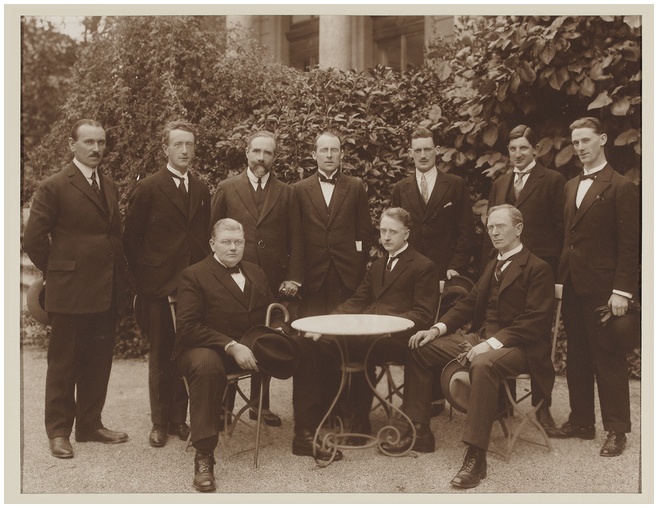
For the Free State delegation at Geneva, the League’s applicability as a means towards self-determination, had come from being portrayed as a tool of British domination, to becoming seen as a portal for international recognition. The Irish Free State’s admission to the League was an important milestone for supporters of the Treaty and represented one of the first cases of a new, albeit semi-postcolonial state’s accession to an international organisation after a struggle for self-rule. Conversely, the Anti-Treatyites saw this as a reassertion of British imperial power over Ireland, which had successfully divided the independence movement, and internationally legitimised a puppet state. Though this may have been Britain’s intention, and part of Curtis’s vision to bring Ireland into line as a participatory member of the Commonwealth, the Foreign Office in particular realised that the Free State was not like the other Dominions. The British Government expected the Free State to renege on or dilute the Treaty and were only prepared to concede the Free State’s statehood and consequent League membership when they were assured of its compliance with the Treaty (Figure 4.5).
Photograph of the Free State’s first delegation to the League of Nations, September 1923. Seated (left to right): Hugh Kennedy (Attorney General), William Cosgrave (President of the Executive Council) and Eoin MacNeill (Minister for Education). Standing (left to right): Michael MacWhite (Permanent Representative to the League of Nations), Desmond Fitzgerald (Minister for External Affairs), the Marquis MacSwiney of Mashongalas (Delegate), Kevin O’Sheil (Assistant Legal Adviser), Ormod Grattan Esmond TD (Delegate), Diarmaid O’Hegarty (Cabinet Secretary) and Gearoid McGann (Secretary to the President of the Executive Council).
France’s Response to Irish Admission to the League of Nations
The admission of Ireland almost caused a situation in which colonial membership at the League of Nations expanded beyond the British Empire. The French Ministre des affaires étrangères followed the process of Ireland’s admission attentively. Having decided not to follow India’s precedent and commit its own colonies and protectorates to the League of Nations through the signing of the Versailles Treaty, French Prime Minister and Président du Conseil des affaires étrangères Raymond Poincaré began to see France as increasingly isolated within the League Assembly.
Although the French were content with their influence in the Council, Poincaré worried that France with its single vote, had become a particularly weak voice compared to the now-seven British Empire votes at the Assembly. France’s declining influence at the Assembly was beginning to impact some of France’s key foreign political aims. France had to date successfully lobbied to exclude German membership of the League. However, popular opinion in the League Assembly was turning against Germany’s exclusion from the League. Though France had been happy to cultivate a strong relationship with the Irish Free State on the basis that it would take an independent line to British foreign policy, it was anxious that the Free State would support Britain on the admission of Germany to the League.Footnote 134 The French Consul in Dublin, Alfred Blanc reported in June 1923 that the inclusion of Ireland would lead to one more voice in the League Assembly in favour of Germany’s admission.Footnote 135 This fear was reinforced in August with word that Jan Smuts was to travel to Geneva to make a speech to the League Assembly in favour of German admission. Fearing an imminent vote on the matter, France realised they could count on few supporters, with the exception of Belgium, who they expected to come to their aid.Footnote 136
Smuts had been one of the leading advocates of German membership of the League from the outset, viewing its exclusion as a ‘gaping wound in western civilisation’ (a term he used five days after Hitler’s failed Beer Hall Putsch in November 1923), that could lead Germany into becoming a ‘militant monarchy’.Footnote 137 The advocacy of German rehabilitation was a flashpoint in Anglo-French relations, with France occupying the Ruhr region throughout 1923 when Germany failed to pay reparations imposed at Versailles. An inter-allied conference that aimed to settle the matter of German reparations that would become known as the Dawes plan, side-lined France. The French were infuriated by the representation of the Dominions, including the Free State at the negotiations, and challenged the notion of separate representation.Footnote 138
Realising that the British were about to potentially gain a seventh vote in the Assembly against France’s one, French foreign ministry officials began to debate the position it should take towards Irish admission. One French League official however, suggesting that it would be difficult to block Ireland’s admission due to the precedents set by Dominion and India’s membership, recommended following Britain’s example. Claiming that France had three possible Protectorats within the Empire namely Tunisia, Morocco, and Annam, that France could push for admission to the League. The idea rapidly gained traction with French Foreign Minister Raymond Poincaré, who sent copies of the proposal, off to the French minister for the colonies, as well as the French Resident-Generals in Tunis and Rabat.Footnote 139
Poincaré’s appeal to the Residents-General was on the grounds that the French protectorates were already in a legal and political position to satisfy Article 1 of the Covenant, in that they were ‘sovereign’, having retained some legislative autonomy. Moreover, he felt assured from the British example that despite several outbursts of independent opinion, notably over the rights of Indians within the Empire, the Dominions and India had generally followed Britain’s lead.Footnote 140 The responses to the proposal revealed a distinct rift in colonial policy among French officials regarding France’s North African protectorates. The first response from the French Minister of the Colonies Albert Sarraut, wholeheartedly supported the proposal and suggested that two additional memberships could be formed by Cambodia and Annam. If they were individually rejected, he believed that France’s Southeast Asian colonies could be represented through a united polity of ‘Indochine’. To keep a check on the Protectorates taking an independent position at the League, Sarraut recommended that the delegations be made up of two high-ranking officials from the colony, supervised by a French official, not dissimilar to the structure of the British Indian delegation.Footnote 141
The provisional Resident in Tunis, filling in for the Marshal Lyautey who was in Paris on medical leave, was considerably more apprehensive of the proposal. He found that the example of British Dominion membership was not analogous to that of France’s North African Protectorates. He argued that the Commonwealth was held together by a common English language, an Anglo-Saxon culture, and a common European race. In the case of India’s membership at the League of Nations, Lyautey argued that it was the British- administered Government of India, and not the Indian Princely States that were represented (although Indian Princes were included within the Indian delegation).Footnote 142 However, he had correctly identified that much of the British Empire was not represented at the League, and that a pre-existing chasm in the constitutional development between the White-settler Dominions and India had only widened after their League membership. This point was reinforced by the response from the French Resident in Tunis, Lucien Saint who stated that the Dominions had had over a century of association with Great Britain, whilst Morocco had only been a protectorate since 1913.Footnote 143
In a slightly indirect fashion, Marshal Lyautey received the letter from Rabat whilst in convalescence in Paris, instead of getting it from Poincaré in Paris. Lyautey angrily disagreed with his junior Resident in Rabat and exclaimed that if he had received the letter directly, he would have agreed with an application to the League without reservation. His main contention was over the future of the Protectorates within the French Empire. Urbain Blanc, the provisional Resident in Rabat, had worried that the inclusion of the Protectorates would cause a divergence in policy away from turning Morocco and Tunisia into extensions of France’s full integration of Algeria into Metropolitan France. Lyautey however, insisted that the Protectorate was not some transitory state, but the definitive form of French colonialism in North Africa, and that League membership would help assure everyone from the Sultan to the ‘lowest echelons’ that France would not annex them.Footnote 144
The debate was brought to a close after Lucien Saint in Tunis stated his firm opposition to the idea. He feared the growing Tunisian nationalist movement that had mobilised under the banner of Wilson’s Fourteen Points. Rather than satisfying nationalist demands, he believed Tunisian representation would only affirm the existence of Tunisia as a nation internationally, and that the nationalists had already been inspired by the events that had led to Egyptian independence in 1921, and the belief that it would imminently become a member of the League. Moreover, Saint offered a global analysis of France’s situation, fearing that after the failure to curb the rise of a Turkish nation through the Treaty of Lausanne, the rise of Pan-Islamic thought would create a dangerous bloc of nations at the League that would push for the inclusion of other Muslim states.Footnote 145
Ultimately, the plan to admit French protectorates fizzled out, and Tunisia and Morocco would only gain representation in 1956, at the United Nations. However, this short-lived policy proposal was conducted in full confidence that there would be no barriers to entry for France’s protectorates, and that France could match Britain’s vote-share in doing so. Moreover, much of Poincaré’s plan had been based on the British model, including the idea of a French lead delegate to monitor the two ‘indigenous’ delegates for each Protectorate. Ultimately the barrier to entry was French colonial policy itself. The proposal revealed a schism between the French Foreign Ministry that desired to maintain the exclusion of Germany internationally, and colonial officers who intended to retain centralised control over France’s Protectorates. Many of the Residents’ reservations had been quite natural, especially Lucien Saint’s position that membership would encourage nationalism and policy- divergence. Saint never believed that a French administrator would ever fully be able to control his colonial delegates unless he physically followed them around Geneva.Footnote 146
Despite the status quo being maintained, the Free State’s admission was a portent of revolution through the presence of colonies at the League of Nations. Based on the Free State’s admission, and the presence of India, France would have had a claim for making an application for its protectorates, that could have seen a repeat of what had occurred in the Postal Union half a century before. However, fundamental differences in French colonial policy meant that they would not seek to emulate the Commonwealth model of separate representation. Although French reformers did exist, France had no equivalent of the Round Table movement and reformers lacked the influence to push French policy towards multiplying its representation at the League through its protectorates. France’s decision not to pursue potential multiple votes at the League, reveals again how domestic and imperial considerations outweighed the perceived advantages of controlling a bloc of seats in Geneva.
The 1923 Imperial Conference: Two-Track Progression of Dominions and Colonies
Having achieved membership at the League of Nations, the Irish Free State contemplated accession to the Imperial Conference. The League offered an opportunity to exhibit Irish statehood, shedding the symbols of Dominion status. Conversely, the Imperial Conference, though it would mark the Free State’s position in the Empire, provided an opportunity to claim greater devolution of power using precedent set by other Dominions. The concept of the Free State being a stepping-stone towards full statehood could thus be advanced at the Imperial Conference, by seeking to redefine Dominion status itself.Footnote 147
Irish representatives were keen to maintain good relations with other Dominions and support them in matters in which their own internal autonomy was concerned. Conversely, Free State representatives were also prepared to contrast India’s inferior constitutional position vis-a-vis their new-found Dominion status. Fitzgerald, who had returned from Ireland’s inaugural General Assembly in Geneva, represented the Free State at the Imperial Conference and intervened in the perennial issue that had blighted Commonwealth relations: the position of Indians in other parts of the Empire. A very heated debate arose between the Indian representative, Sir Tej Bahadur Sapru, who threatened South Africa by seeking adjudication at the League of Nations, and South African Premier Jan Smuts.Footnote 148 Fitzgerald sided with South Africa:
Now the Indian representatives here are not on an equality with the rest of us, because they are not really here in a representative capacity; they are not really sent by an independent Indian Government, and they cannot really be regarded as equal with the rest of us. If I were an Indian, putting myself in their position, I would recognise that this hypersensitiveness about their treatment outside of India arises really from the fact that they have not, so far, reached the degree of self-government that the rest of us have reached.Footnote 149
Though the Irish were not directly affected, let alone interested in the question of Indian immigration, the dispute provided an opening through which Irish delegates could assert their growing sovereignty. Irish nationalists had sympathised with Indian demands for equality of migration within the Empire, however, the Free State argued that it was within South Africa’s right to govern its domestic matters as it saw fit.Footnote 150 For the Free State’s representatives, Dominion sovereignty overruled common British subjecthood, or the racist immigration policies experienced by Indians.
Since the signing of the Treaty, Free State politicians had carefully studied the developing constitutional relations of the Empire. Though the Department of External Affairs had contact with Quebecois leaders, and sympathised with their position as a national minority within the British Empire, it was the Canadian Government itself that provided ample material through which the Free State could expand its international personality.Footnote 151 The Canadian government exercised the right to send a separate diplomatic representative to the United States, a right that the Canadian Government had decided not to enact, to the relief of Britain that had been reluctant to start separating diplomatic representation beyond the League of Nations. With the accession of the Free State onto the international stage in Geneva and with the civil war over, Cosgrave wanted to expand the Free State’s direct foreign relations with the United States. Prior to 1924, all official communications to the United States government went through the British ambassador to Washington, which Cosgrave claimed, reinforced Irish republican views that the Free State was a British pawn. To allay British fears of Irish separation, the Free State’s envisioned representative was Timothy Smiddy, who was a strong advocate of the Treaty and had spent two years working as an unofficial envoy in the United States. However, he remained unrecognised by Britain and by extension the United States, hurting the Free State’s legitimacy, especially in the very country in which the Irish Republican movement received most of its support. This argument that an official representative could help solidify the Free State’s legitimacy as against anti-Treaty activists eventually won out.Footnote 152 Although Canadian precedents were used to appoint an Irish Minister to the United States, the Free State was the first Dominion to exercise this right, revealing the alacrity through which the Free State was bounding towards international ratification of its statehood.
The Free State also hoped to make use of another political precedent set by Canada with the United States, that came from a relatively unexpected aquatic source: halibut. Owing to a reduction of fish stocks of halibut in the northern Pacific and to replenish stocks, Canada wanted to conclude an agreement regulating fishing with the United States. Similar commercial treaties to the proposed ‘Halibut Treaty’ had been signed between Canada and the United State, but these treaties were all signed by the British ambassador to the United States.Footnote 153 Canada’s decision to sign the treaty itself was resisted by the British Foreign Office, but Canadian Prime Minister William King threatened to send a permanent Canadian representative to Washington if Britain did not relent. This right to a separate representative had been granted to Canada since 1920, but had never been actioned, yet was sufficient a threat for Canada to be able to proceed with its unilateral signing.Footnote 154
The somewhat-inconspicuous nature of a treaty over fish stocks combined with Canada’s geographic proximity to the United States caused the British to relent, hoping that the incident would go unnoticed. The US-based Chicago Tribune ran the story for two days, heralding ‘Canada signs pact with US as free nation, rejects British dominion’ and ‘Canada becomes practically independent’.Footnote 155 This constitutional development in Canada did not go unnoticed by the Irish representative in Washington, who reported back to Fitzgerald that the Halibut Treaty had ‘important implications for us’.Footnote 156 The Free State saw in the Halibut Treaty an example of a Dominion that had seemingly strayed from the inter se doctrine, and had brokered its own bilateral treaty. The Halibut Treaty provided the Free State with a clear precedent it could deploy as it sought to strike its own foreign policy, independent of the Commonwealth.
The British Government was perfectly aware of the implications of the Halibut Treaty and wanted to use the Imperial Conference as a means to define and clarify the new precedent it set. They intended to formalise Commonwealth treaty-signing, by having Dominions sign their own treaties through the Empire’s Head of State, (the King) or his plenipotentiaries. Moreover, separate treaties could not be seen to threaten or impinge on the rights of the Commonwealth or its members:
It is desirable that no treaty should be negotiated by any of the governments of the Empire without due consideration of its possible effect on other parts of the Empire, or, if circumstances so demand, on the Empire as a whole.Footnote 157
By maintaining a sole head of state as a treaty signatory, Britain hoped to retain discretion to sign only those treaties it agreed with and could deny a signature if the Dominion demands were deemed unacceptable. The Conference was thus a way of trying to maintain imperial unity in the face of Dominion demands for autonomy of foreign policy. Moreover, an alternative was also introduced to formalise the procedure of ‘agreements’ of a ‘technical of administrative character’ between states. These agreements would not need to be signed by the King or by a plenipotentiary, offering flexibility though agreements were less binding.Footnote 158
1923 had been a testing year for the maintenance of imperial unity through inter se, and the Imperial Conference hoped to find a settlement that could harmonise recent constitutional developments. The Conference revealed to the Free State the growing autonomy of many of the Dominions, and that the Round Table doctrine of federalism was becoming obsolete.Footnote 159 The desire to harmonise imperial foreign policy was quickly breaking down, with one Irish Minister praising the League and stating that ‘the Irish Free State has arrived at nothing nearer to a definition of foreign policy than is expressed in adhesion to the League of Nations’.Footnote 160 Despite the Free State’s unbounded enthusiasm for using the League as a space to pursue an independent line of action, Smuts continued to support the League, stating that it was not an organisation of ‘revolutionary agency’ that could ‘destroy the British Empire’ but rather a ‘conservative stabilising force working on the side of the British Empire and the ideals for which we stand’.Footnote 161 The Round Table journal published a piece on how the League would remind the Dominions of the benefits of their attachment to a global power like Britain on the world stage, if the Irish should push for the greater constitutional devolution of Dominions.Footnote 162 However, Ireland’s accession would quickly show how the League could be utilised to mark Ireland’s separation from Britain.
Registering the Treaty
One of the Free State’s key objectives that it aimed to derive from its membership at the League of Nations was the registration of the Anglo-Irish Treaty at Geneva. This had been considered a potential diplomatic manoeuvre since the creation of the Free State, and was even raised in a letter by MacWhite in the Dail-debates over the ratification of the Treaty.Footnote 163 Despite the name ‘Treaty’, there was considerable ambiguity in whether the agreement could be considered a treaty between two separate states, or a devolution of autonomy. As the Treaty gave Ireland a form of statehood, registering the Treaty, as expected to do so under Article 18 of the League Covenant, was seen as a means of giving the Free State true international legal personality. This would demonstrate the Free State’s international as opposed to its intra-imperial status. Moreover, registering the Treaty early protected the Free State legally in case of a failure of the Treaty and an attempted re-annexation of Ireland by Britain. Until the constitution had been signed, the provisional government was not a legal entity, and a British revocation of the Treaty could have reabsorbed the Free State back into the United Kingdom.Footnote 164 The other significant factor for the Free State was that by securing formal international recognition at Geneva, the Free State hoped to be able to press its claims over Northern Ireland. O’Rahilly, who like many former members of Sinn Fein was sceptical about the League, believed that an international status that distinguished Ireland from the United Kingdom could put pressure to resolve the boundary with the north.Footnote 165
Despite plans to register the Treaty early as a possible defence if Britain reneged on it, registration was not attempted until 1924. In the Department of External Affair’s study of Dominion precedents, few examples could be found of Dominions registering treaties at the League of Nations. They realised that registering the Treaty would be virtually unprecedented, besides some independent ratifications by India of ILO Labour Conventions, which were not treaties.Footnote 166 Even the Halibut Treaty, which the Free State had used as a means towards further international autonomy, had not been registered at the League of Nations by the Canadian Government.Footnote 167 Moreover, considering that Lloyd George had insisted on ratifying the Free State’s constitution before making a bid for League membership, a premature early attempt to register the Anglo-Irish Treaty could have seen Britain withdraw its support for Free State membership. Though the statesmen of the Free State knew that registering the Treaty was in defiance of the principle of inter se, they would shield themselves with the claim that it was an international obligation for members of the League to register all treaties.Footnote 168 This argument would pit the Free State’s international obligations against its obligations to the Empire.
Even as the Free State’s Executive Council discussed how to approach registering the Treaty surreptitiously, Free State MPs had begun raising the issue of registration. Darrel Figgis, a Free State politician who had worked on drafting the Free State’s constitution, raised the question, which the Department of External Affairs tried to avoid responding to directly. A level of subterfuge had to be employed, as the Executive Council feared that attempts to register the Treaty might lead to Britain using its position on the Council to define the Treaty as an internal agreement, rather than an inter-state treaty.Footnote 169 This secrecy was maintained until 1924, when Figgis’s counterpart in the drafting of the Free State’s constitution, Alfred O’Rahilly, also gave the greenlight, believing the League offered ‘great political and social possibilities’. The Free State needed weight in its negotiations with the Boundary Commission for Northern Ireland; registering the Treaty could offer this.Footnote 170
Rather than register the Treaty with great fanfare, Fitzgerald sent copies of the Treaty to MacWhite in Geneva, with instructions to submit them ‘quietly and unostentatiously’ telling no one of the matter.Footnote 171 In a handwritten note, MacWhite suggested that the Secretariat’s only question when submitting the Treaty, was whether the British were aware of the registration.Footnote 172 It was only the following day that the Free State’s Governor General informed the British Government of the registration.Footnote 173 Initially there was no British response. Van Hamill, the head of the Legal Section questioned whether the Treaty was actually a Treaty at all, and whether Ireland could be considered a state. Hamill’s understanding of inter se suggested that the Treaty was rather an agreement between two parts of the same entity. This was rather paradoxical as Irish delegates were hoping to gain international recognition of statehood via registration of the Treaty which had to be an agreement between two recognised states. However, the lack of a British response, coupled with the lack of precedents in this case meant that the Treaty was registered a week later on 11 July.Footnote 174
The weakness of the Treaty as an international agreement raises the question as to why Britain didn’t decide to reply, in which case it could have easily blocked the Treaty’s registration. Kennedy argues that the election of the Labour administration under the Premiership of Ramsey MacDonald in January 1924 was the reason of a lack of British response. MacDonald was an internationalist who did not want to cause a serious formal controversy in Geneva, especially as he had begun drafting the Geneva Protocol for international dispute settlement.Footnote 175 In a more recent study, Gibbons claims that the Labour Government initially informed the Irish that its registration had raised important constitutional questions regarding component parts of the Empire and that it would advise the League not to register the Treaty.Footnote 176 For Gibbons, this is proof that the first Labour administration did not mark a significant break with the status quo in terms of Dominion and colonial policy.Footnote 177 Following this response from the Labour Government, the Colonial Office had also written to the League Secretariat to ask for clarification as to whether the Treaty counted as a ‘treaty’ and was eligible under Article 18 of the League Covenant.Footnote 178
Both Kennedy and Gibbons agree that there was a noticeable change of policy however, when the short-lived Labour Government collapsed on 4 November 1924. The new Conservative Government was determined to curtail the Free State’s legalistic attempts for international recognition and took steps to invalidate the registration the day after they came into government.Footnote 179 Letters were sent to the Irish Executive Council and then to the League Secretary stating that Treaty with Ireland was an act of inter se and thus a domestic issue, rather than an international one, making registration needless.Footnote 180 Fitzgerald responded to the Colonial Office, stating that the Covenant bound its members to register all treaties, and that the registration of the Anglo-Irish Treaty had been an act of duty. The Free State’s response was to state that withdrawing the registration would have consequences for the position of Dominions in the League of Nations, formalising a two-tiered membership.Footnote 181
The Free State’s Ministry for External Affairs realised that they had potentially overreached by registering the Treaty, which could possibly compromise the unity of the British Empire:
The British obviously don’t want to sacrifice their pet principle of the oneness of the sovereignty of the Commonwealth. They cannot allow two portions of the Commonwealth to bring a dispute before the League, the International Court or any other external body. If a single member of the Commonwealth brings a dispute with an outside State before the League, the fiction of the whole acting for the part will save the situation. The effort to maintain this fiction at all costs is at the bottom of the present ridiculous position of the Dominions in the League.Footnote 182
The League’s reaction to the registration was a litmus test for the value of League membership to the cause of reaching full statehood. The Free State appealed to the League Covenant’s ‘universal application to all members without exception’. If the League annulled the registration of the Treaty simply on the behest of Britain, the Free State threatened to withdraw from the League altogether.Footnote 183
To other member states of the League, this dispute between Britain and her Dominion was particularly perplexing. A formal letter from the British Government was sent to the League Secretary informing them that the Treaty would not be registered as the decision to create the Irish Free State was one internal to the British Empire, and that Article 18 of the League Covenant, which demanded that all treaties be registered, was not applicable.Footnote 184 This would essentially render the Treaty as a form of internal devolution and not as a recognised inter-state treaty in international law, denying Irish international personality beyond its membership at the League. The French were bewildered by the bizarre constitutional drama that was being carried out between Ireland and Britain. The Irish had carried out the registration so secretly that the French were not aware of the fact. The episode was particularly embarrassing for both Britain and Ireland, with the French Consul in Dublin dismissing the Free State:
Mais ce que choque vraiment toutes les idées de logique et de justice, c’est que cet embryon ou plutôt cette parodie d’État puisse disposer les délibérations de la Société des Nations d’une voix égale à la notre.Footnote 185
Despite its ‘embryonic’ nature, the Irish Free State had successfully registered the treaty, and the League had not withdrawn the registration. The British Government made a final protest that they did not recognise the Treaty as an inter-state treaty, but decided that further correspondence over the matter was no longer fruitful.Footnote 186 Britain’s attempt to dispute the registration was an embarrassment and one that revealed the growing cracks Ireland had introduced into the principle of inter se. Despite the Free State being a member state, Van Hamill and the League’s legal office had been sceptical about whether the agreement that gave Ireland statehood was an agreement between two legal entities or a redistribution of power within a single polity.Footnote 187 In a more recent analysis, Lowry has downplayed the significance of the treaty registration, stating that though the Treaty was registered, it lacked effect as inter-state treaties have to be registered by both parties.Footnote 188 Yet the British reaction to the registration revealed a paranoia that the Free State’s actions threatened the fundamental bonds that held the Commonwealth together. Therefore, the registration had little legal effect on Ireland’s international standing, but instead was more of a political action that undermined inter se and the narrative of the Empire’s unity.
The registration now marked Ireland as unique among the Commonwealth states as both a member of the Empire, but one that had been arguably recognised via inter-state treaty, and as a legal equal to Britain, setting a precedent for other Dominions to follow suit. Moreover, the dispute over registration had revealed a lack of coherence in British foreign policy, with Labour choosing to passively resist the Free State’s decision whilst the Conservatives aggressively threatened to challenge it. Through the Treaty registration, the Irish delegation had effectively circumvented the anomalies of the system drafted at the Paris Peace Conference for the benefit of Britain’s imperial politics. This had been the most severe case since the League’s creation of a Dominion, not just failing to toe the line but making formal manoeuvres to distinguish itself as independent from Great Britain.
Conclusion
Despite the Free State’s high hopes, the registration of the Treaty, as well as membership of the League of Nations did very little to modify the territorial outcome of the Anglo-Irish Treaty. Nonetheless, the accession of the Free State after the Paris Peace Conference shows how precedents set in 1919 were utilised to further Irish statehood through constitutional means, and how British attempts to set bounds to these means were often circumvented.
Although the League of Nations membership was only a small part of a considerably larger set of reforms needed to create an Irish Dominion, it became one of considerable importance for the nascent Free State. From the outset, international recognition and support had been a key objective of the Irish independence movement, who had sought recognition from the Paris Peace Conference, and only turned against the League when they were not granted a seat at the Conference.
For British negotiators, Ireland was the first case of accepting part of the Empire’s accession to League status whilst under pressure from a nationalist insurgence. With Smuts’s loophole of admission of signatories to the Versailles Treaty having been closed, Ireland had to satisfy the requirement of state or Dominion status in order to gain membership of the League. Yet the process followed a similar pattern and was built on the precedents of previous claims for greater self-rule in the British Empire. Therefore, Irish membership of the League of Nations was not seen by Round Table advocates as a surrender of British rule, but as an act of constitutional evolution through inter se.
The offer of Dominion status effectively divided the Irish independence movement, turning former IRA members against their old comrades, often with as much vehemence as against the British, with President Cosgrave approving many executions of anti-Treaty fighters. Though the Free State was not able to destroy the IRA, with the civil war ongoing, Britain had effectively, albeit temporarily, supressed the IRA by creating a schism within it. However, in spite of the Free State’s creation of a schism in the Republican movement, few in the Free State bought into Smuts’s and Curtis’s vision of statehood within the British Empire. Rather, the statesmen of the Free State’s external affairs were willing to use Dominion status and its accompanying membership of the League of Nations to expand their status, using precedents set by other Dominions and creating new ones such as through registering the Treaty at the League. Rather than significantly curbing Irish demands, the introduction of southern Ireland as a Dominion risked significant turbulence to the constitutional structure of inter se.
With the Dominions being granted League of Nations membership in 1919, this had become part of the package of reforms an entity aspiring to that status might expect. Even though many Irish statesmen mistrusted the League of Nations at the time of creation of the Free State, a lack of participation in the League would have been interpreted as conferring an inferior status to that of the other Dominions. In fact, it transpired that the creation of the Free State rapidly changed Irish political opinion on the League being a space to enhance Ireland’s international personality, as well as finding a venue outside of the Imperial Conference to assert itself beyond the British Empire (Figure 4.6).
Eamon de Valera at the League of Nations.
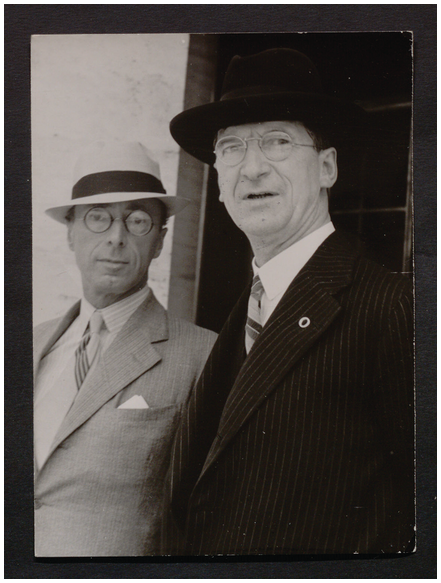
For anti-Treaty Republicans, the admission of the Free State to the League of Nations was a disaster. The international recognition that the Irish independence movement had sought was being offered to what many saw as a British proxy. Though many civil society groups, particularly in the United States, sided with the anti-Treaty forces, internationally, many states were happy to accept the Free State as a legitimate government for Ireland. The continuation of fighting after gaining statehood was seen by many as rash and extreme. Although the Anti-Treaty faction detested the League and saw the Free State’s membership as a means for Britain to have an additional vassal vote in Geneva, the accession of the Free State highlighted Geneva’s importance in conferring international recognition. Anti-Treaty activists had tried to question the legitimacy of the Free State and campaigned to have its accession blocked. Nonetheless, de Valera himself would become President of the League of Nations Council, after being elected President of the Free State’s Executive Council in 1932.Footnote 189
The fear that an Irish vote at the League would expand Britain’s vote share almost had far-reaching consequences for the presence of colonies at the League, which could have profoundly changed the organisation: France’s contemplation of following suit to gain enough supporters to maintain the exclusion of Germany. However, the decision not to pursue the policy of separate representation revealed significant and intentional differences in approaches to internationalising their colonial governance. France mistrusted how granting League membership to Morocco, Tunisia, and Cambodia might have been interpreted as a loss of control, rather than the attempt to buy into a new vision of empire.
French fears revolved around the concern that its protectorates were not aligned with the cultural and racial identity of the mother country, contrary to most of the British Dominions. However, concerns of a symbolic and identarian nature were rife in the Irish bid for independence and went beyond statehood. Symbolic gestures such as the Oath of Allegiance had split the Irish independence movement, and many in Sinn Fein wanted to hold out for a Republic, even if it were to be a Republican Dominion. Smuts’s hope on his visit to Ireland in 1921 was that, the South African formula where Afrikaners could reconcile their identity with a British imperial one, could be replicated in Ireland. However, despite wanting devolution, Smuts was committed to voluntary Dominion participation in the Empire which Free State politicians generally were not. However, the League again provided a platform for Ireland to behave more like an independent state and advertise its autonomy to the world.
Ultimately, the Free State’s Dominions status as a consequence of its independence struggle would only accelerate the constitutional evolution of Dominion status as foreshadowed at the 1923 Imperial Conference. At the next Conference in 1926, Balfour declared the equality of the states of the Commonwealth, and the Dominions began to adopt increasingly autonomous foreign policies. The status of full statehood was finally granted in the Statute of Westminster in 1931. The Irish Free State would be the last British Dominion to become a member of the League of Nations, but it would not be the last state within Britain’s larger empire to become a member.


 Open access