





Introduction
Nonsuicidal self-injury (NSSI) behaviors are defined as deliberate and direct self-harm to one’s own body without suicidal intent and for purposes not socially or culturally sanctioned (Nock, Reference Nock2010). NSSI is a significant predictor of future suicide attempts (Ribeiro et al., Reference Ribeiro, Franklin, Fox, Bentley, Kleiman, Chang and Nock2016). Adolescence is a critical period for the onset and development of NSSI; a recent meta-analysis revealed that the lifetime prevalence of NSSI among adolescents aged 10–19 years is 17.7% (Moloney et al., Reference Moloney, Amini, Sinyor, Schaffer, Lanctôt and Mitchell2024). NSSI is also highly prevalent among Chinese adolescents, particularly those living in rural areas. A national meta-analysis shows that the past-year prevalence of NSSI among rural Chinese adolescents is as high as 29% (Tang et al., Reference Tang, Li, Chen, Huang, Zhang, Chang, Wu, Ma, Wang and Yu2018). Given its prevalence and clinical significance, there is a pressing need to identify potential factors that contribute to the emergence of NSSI and to develop targeted prevention and intervention programs.
Childhood maltreatment is a well-established risk factor for adolescent NSSI (Liu et al., Reference Liu, Scopelliti, Pittman and Zamora2018). However, the physiological mechanisms underlying this association remain largely unknown. Moreover, despite the co-occurrence of childhood maltreatment types (Kim et al., Reference Kim, Mennen and Trickett2017), few studies have examined the effects of their co-occurring patterns on diurnal cortisol or NSSI. The stress-mediating model proposes that functional alterations in the hypothalamic–pituitary–adrenal (HPA) axis may serve as a plausible pathway linking early adversity (e.g., childhood maltreatment) to a broad range of psychopathological outcomes (Koss & Gunnar, Reference Koss and Gunnar2018). The recent temporal neurobiological framework of NSSI explicitly conceptualizes dysregulated HPA axis functioning as a proximal marker of vulnerability to NSSI (Kaess et al., Reference Kaess, Hooley, Klimes-Dougan, Koenig, Plener, Reichl, Robinson, Schmahl, Sicorello, Westlund Schreiner and Cullen2021). Guided by these two theoretical models, the present study examined whether differential patterns of childhood maltreatment influence subsequent NSSI behaviors directly or indirectly via diurnal cortisol in Chinese adolescents.
Patterns of childhood maltreatment and NSSI
Childhood maltreatment refers to acts of commission and/or omission by parents or other caregivers that cause or have the potential to cause harm to a child (Kaplan et al., Reference Kaplan, Pelcovitz and Labruna1999). It encompasses multiple types, including sexual, physical, and emotional abuse, as well as neglect (Kaplan et al., Reference Kaplan, Pelcovitz and Labruna1999). Several theoretical models of NSSI conceptualize childhood maltreatment as an independent, distal risk factor. For example, Nock’s integrated model posits that childhood maltreatment undermines an individual’s ability for emotion regulation and interpersonal communication, with NSSI functioning as a maladaptive yet compensatory means to manage unpleasant affective experiences and interpersonal stressors (Nock, Reference Nock2010). The overall association between childhood maltreatment and NSSI is well supported by empirical research (Ernst et al., Reference Ernst, Brähler, Kampling, Kruse, Fegert, Plener and Beutel2022; Paul & Ortin, Reference Paul and Ortin2019).
Researchers have increasingly recognized that the impact of childhood maltreatment on NSSI may vary depending on specific characteristics of maltreatment experiences, such as maltreatment type. A meta-analysis found that most types of maltreatment were significantly associated with NSSI, with emotional abuse showing the strongest effects; however, there was no consistent evidence linking emotional neglect to NSSI (Liu et al., Reference Liu, Scopelliti, Pittman and Zamora2018). Similarly, a recent study employing a dimensional approach revealed that threat-related maltreatment (i.e., physical, emotional, and sexual abuse) was more strongly associated with NSSI than deprivation-related exposures (i.e., neglect) (Xiao et al., Reference Xiao, Xu, Yu, Li, Li, Jin, Tao and Wan2023). Notably, predefined categorization schemes based on types or dimensions may limit the practical utility of findings, as different forms of maltreatment often co-occur (Kim et al., Reference Kim, Mennen and Trickett2017; Smith & Pollak, Reference Smith and Pollak2021). For instance, evidence from case record abstraction indicated that 65.3% of maltreated youth were exposed to multiple types of maltreatment (Kim et al., Reference Kim, Mennen and Trickett2017).
As such, person-centered approaches such as latent profile analysis (LPA), which empirically classify individuals into mutually exclusive groups based on shared patterns of maltreatment experiences (Peugh & Fan, Reference Peugh and Fan2013), have received increasing attention. Concrete efforts have been made to examine maltreatment patterns using LPA, with most studies identifying three to five distinct profiles (for a review, see Rivera et al., Reference Rivera, Fincham and Bray2018). To date, only preliminary evidence has linked specific maltreatment patterns to adolescent NSSI. Begin et al. (Reference Begin, Ensink, Chabot, Normandin and Fonagy2017) identified four profiles among maltreated youth, with the “sexual abuse” and “neglect plus abuse” groups exhibiting higher levels of NSSI compared to the non-maltreatment group. In contrast, a recent study of 544 Chinese children found no significant differences in NSSI across four profiles of childhood maltreatment and peer victimization (Liang et al., Reference Liang, Wang, Tian, Zheng and Liu2025). Notably, the latter study included only two maltreatment types (i.e., psychological aggression and corporal punishment), which may limit the generalizability of its findings. Thus, further investigation is needed to examine how distinct maltreatment patterns differentially contribute to NSSI and to elucidate their underlying mechanisms.
The mediating role of diurnal cortisol
The psychosocial factors of NSSI, as informed by existing theoretical models, have been relatively well explored. However, the underlying physiological mechanisms have just begun to come to light. From a functionalist perspective, the recent temporal neurobiological framework posits that biological systems centrally implicated in the stress response, including the HPA axis, may contribute to the development and persistence of NSSI (Kaess et al., Reference Kaess, Hooley, Klimes-Dougan, Koenig, Plener, Reichl, Robinson, Schmahl, Sicorello, Westlund Schreiner and Cullen2021). Evidence has shown that individuals often engage in NSSI to regulate aversive emotional states or to cope with interpersonal stressors (Edmondson et al., Reference Edmondson, Brennan and House2016; Kaess et al., Reference Kaess, Eppelmann, Brunner, Parzer, Resch, Carli, Wasserman, Sarchiapone, Hoven, Apter, Balazs, Barzilay, Bobes, Cosman, Horvath, Kahn, Keeley, McMahon, Podlogar and Wasserman2020). In other words, heightened stress states, triggered by internal cues or external events, typically precede acts of NSSI (Miller et al., Reference Miller, Eisenlohr-Moul, Glenn, Turner, Chapman, Nock and Prinstein2019). When stress-response systems are dysregulated, individuals may struggle to regulate internal states and restore physiological homeostasis following stress exposure (Gunnar & Quevedo, Reference Gunnar and Quevedo2007), and NSSI may emerge as a maladaptive coping strategy in such contexts.
The HPA axis is one of the primary stress-response systems, eliciting the production of cortisol, which increases arousal and mobilizes resources to navigate the stressor (Herman et al., Reference Herman, Ostrander, Mueller and Figueiredo2005). Diurnal cortisol rhythm represents a key indicator of HPA axis regulation. Specifically, cortisol follows a circadian pattern: levels are typically high upon waking, peak approximately 30 min after awakening (the cortisol awakening response, CAR), and then decline gradually throughout the day (Adam & Kumari, Reference Adam and Kumari2009). Alterations in this rhythm, such as a flattened diurnal slope (Adam et al., Reference Adam, Quinn, Tavernier, McQuillan, Dahlke and Gilbert2017) or atypically high or low levels of waking cortisol and CAR (Boggero et al., Reference Boggero, Hostinar, Haak, Murphy and Segerstrom2017; Gunnar & Vazquez, Reference Gunnar and Vazquez2001; Owens et al., Reference Owens, Herbert, Jones, Sahakian, Wilkinson, Dunn, Croudace and Goodyer2014), have been linked to a wide range of health problems. Waking cortisol, CAR, and diurnal slope are related but distinct indices (Adam et al., Reference Adam, Quinn, Tavernier, McQuillan, Dahlke and Gilbert2017; Stalder et al., Reference Stalder, Lupien, Kudielka, Adam, Pruessner, Wüst, Dockray, Smyth, Evans, Kirschbaum, Miller, Wetherell, Finke, Klucken and Clow2022), each providing unique and complementary information about diurnal cortisol activity.
To date, few studies in the NSSI literature have examined the role of diurnal cortisol among adolescents, and the findings remain inconsistent (Peng et al., Reference Peng, Li, Liu, Fang, Zhao, Chen, Xiu and Zhang2022; Reichl et al., Reference Reichl, Heyer, Brunner, Parzer, Völker, Resch and Kaess2016, Reference Reichl, Schär, Lerch, Hedinger, Brunner, Koenig and Kaess2024). For example, one case–control study found that adolescents with NSSI (n = 26) exhibited a greater CAR than healthy controls (n = 26), but showed no group differences in diurnal cortisol slope or baseline cortisol levels (Reichl et al., Reference Reichl, Heyer, Brunner, Parzer, Völker, Resch and Kaess2016). Another study of adolescent and young adult patients with major depressive disorder reported that those with NSSI (n = 46) had lower serum cortisol levels than those without NSSI (n = 80) (Peng et al., Reference Peng, Li, Liu, Fang, Zhao, Chen, Xiu and Zhang2022). By contrast, a recent study involving help-seeking adolescents with NSSI (n = 51) found no effects of diurnal cortisol rhythm (i.e., CAR or diurnal slope) on the longitudinal course of NSSI (Reichl et al., Reference Reichl, Schär, Lerch, Hedinger, Brunner, Koenig and Kaess2024). Taken together, small sample sizes and methodological heterogeneity in cortisol assessment across these studies may obscure the underlying associations, underscoring the need for further investigation.
There is a broad theoretical consensus that chronic stress, such as childhood maltreatment, can disrupt HPA axis functioning (Del Giudice et al., Reference Del Giudice, Ellis and Shirtcliff2011; McEwen, Reference McEwen1998). A key idea of these models is that individuals undergo biological adaptations to environmental stressors to achieve allostasis – the active process of maintaining physiological stability through change (Del Giudice et al., Reference Del Giudice, Ellis and Shirtcliff2011). In response to acute stress, cortisol levels increase to mobilize energy and support adaptive functioning. However, when stress is repeated or chronic, prolonged activation of the HPA axis can lead to dysregulation and “wear and tear” on the body, reflective of allostatic load (McEwen, Reference McEwen1998). Empirical research linking childhood maltreatment to adolescent diurnal cortisol patterns is steadily increasing, yet it has yielded mixed findings (for a meta-analysis, see Niu et al., Reference Niu, Gao, Xie, Yip, Gunnar, Wang, Xu, Zhang and Lin2025). With the emergence of the specificity model of adversity, including the dimensional approach, researchers have also drawn attention to the role of adversity types in explaining inconsistencies in these associations (Holochwost et al., Reference Holochwost, Wang, Kolacz, Mills-Koonce, Klika and Jaffee2021).
For instance, one study examined how various domains of early-life adversity were differentially associated with diurnal cortisol in late adolescence and found that major sexual and major physical abuse had opposite effects on waking cortisol levels (Kessler et al., Reference Kessler, Vrshek-Schallhorn, Mineka, Zinbarg, Craske and Adam2023). However, as noted earlier, the practical utility of such findings is limited, given that multiple types of maltreatment frequently co-occur (Kim et al., Reference Kim, Mennen and Trickett2017). A recent study examined the unique and interactive effects of threat and other co-occurring adversities on latent trait cortisol among emerging adults (Stroud et al., Reference Stroud, Chen, Navarro, Gim, Benjamin and Doane2024). It found that greater exposure to threat was associated with lower across-wave cortisol, but only among individuals experiencing lower levels of other adversities, suggesting that the impact of threat may be moderated by broader adversity exposure. To our knowledge, only one study has empirically derived distinct groups of adverse childhood experiences and investigated their associations with average daytime cortisol (Iob et al., Reference Iob, Baldwin, Plomin and Steptoe2021). This study reported that “emotional abuse” and “bullying” groups had significantly lower cortisol levels than the low-adversity group.
In sum, diurnal cortisol rhythm can be influenced by childhood maltreatment, with these effects varying by maltreatment type. Moreover, diurnal cortisol has been linked to adolescent NSSI. It is therefore plausible that dysregulated diurnal cortisol may serve as a mechanism linking childhood maltreatment to NSSI. Consistent with this view, the stress-mediating model suggests that alterations in the HPA axis represent a pathway through which childhood adversity contributes to psychopathology (Koss & Gunnar, Reference Koss and Gunnar2018). However, this mediation hypothesis has not yet been tested in relation to NSSI. The present study seeks to address this gap and further distinguishes co-occurring patterns of maltreatment to enhance our understanding of this potential mechanism. Such knowledge may afford more precise identification of maltreated youth at high risk for NSSI and inform early intervention and prevention strategies.
The current study
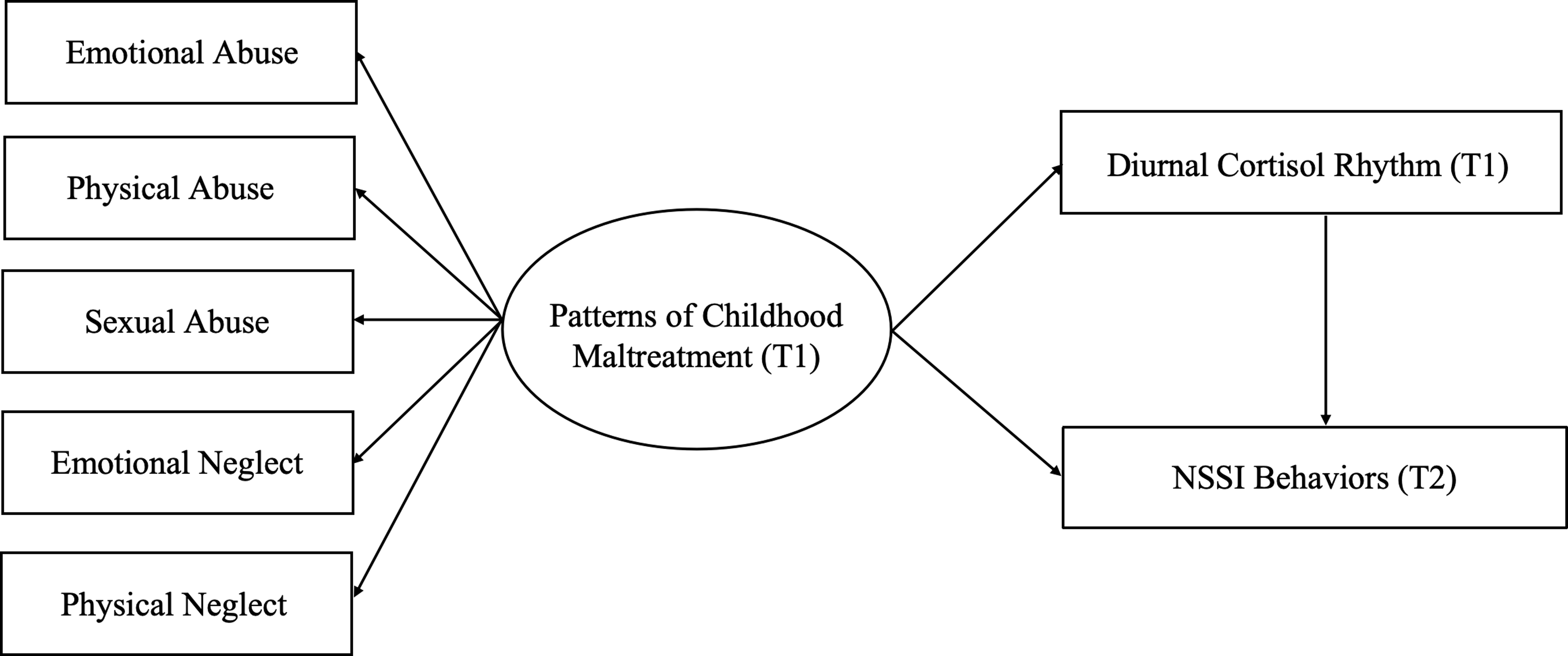
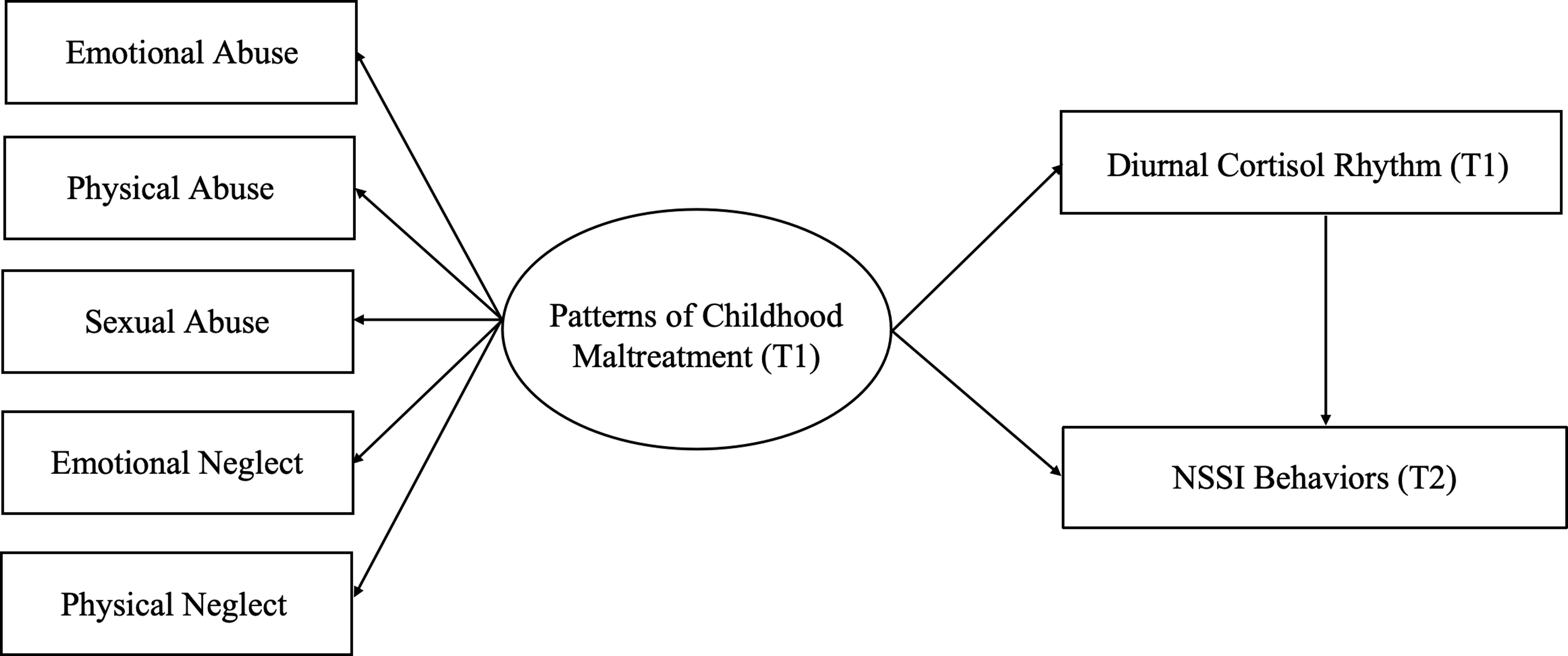
Drawing on data from a longitudinal study of Chinese rural adolescents, this study identifies maltreatment patterns and examines how different patterns predict subsequent NSSI behaviors through diurnal cortisol (see Figure 1 for the conceptual model). Given that rural adolescents are at higher risk for both maltreatment and NSSI compared to urban adolescents (Tang et al., Reference Tang, Li, Chen, Huang, Zhang, Chang, Wu, Ma, Wang and Yu2018; Wang et al., Reference Wang, Cheng, Qu, Zhang, Cui and Zou2020), there is a need to understand the implications for, and pathways leading to, NSSI in this understudied population. LPA provides a way to empirically identify different patterns of maltreatment in terms of type, frequency, and co-occurrence (Lanza & Rhoades, Reference Lanza and Rhoades2013). The two-wave longitudinal design allows for a preliminary examination of the temporal relations among childhood maltreatment, diurnal cortisol, and NSSI. Waking cortisol, CAR, and diurnal slope were assessed to provide a comprehensive picture of diurnal cortisol rhythm. We expected at least three maltreatment patterns: low maltreatment, high neglect, and poly-maltreatment (i.e., high levels across all types). Given the limited prior research, no specific hypotheses were formulated regarding how diurnal cortisol might mediate the effects of maltreatment patterns on NSSI behaviors. In general, it was hypothesized that adolescents exposed to co-occurring types of maltreatment would show distinct associations with diurnal cortisol compared to those with low maltreatment, and that these alterations in cortisol would in turn be linked to NSSI behaviors.
Conceptual model of the current study.
Methods
Participants
Participants were recruited from two primary schools in rural areas of Anhui Province, China. In the baseline year, the per capita gross regional product in this area was $2,526, which was substantially lower than the national per capita gross domestic product of $11,127 in the same year (National Bureau of Statistics of China, 2020). A total of 304 adolescents aged 9–13 years (M age = 10.82, SD = 0.82; 67.0% boys) completed the baseline assessment (December 2019, T1), and 290 of the original sample (95.4%) completed the follow-up survey approximately six months later (June 2020, T2). To maximize the use of data, adolescents who participated in the T1 assessment and had complete data on childhood maltreatment were included in the analyses, resulting in a final sample of 295 adolescents (M age = 10.79 years, SD = 0.84; 67.1% boys).
The majority of the participants (88.1%) came from two-parent families, while others came from single-parent families due to parental divorce (8.8%) or death (1.7%), and 1.4% did not provide responses. The mean value of subjective social status for the sample was 5.79 (SD = 1.74), with the median and mode coinciding on the fifth rung. None of the adolescents in the study reported having an endocrine medical condition or taking medications known to influence cortisol levels (e.g., steroid medications).
Procedure
After obtaining approval from the administrations of the participating schools, the research team distributed invitation letters and flyers to recruit adolescent participants. Informed parental consent and adolescent assent were obtained prior to participation. Since participants were recruited from boarding schools and resided in dormitories during the assessment period, all data were collected on school premises with the assistance of school teachers or research assistants. The timing and strategies for data collection were planned in collaboration with school personnel to minimize disruptions to participants’ routines while ensuring the validity of the data. During the baseline assessment, participants completed a self-report survey and provided salivary samples, which were later assayed for cortisol. Participants completed the self-report survey during regular class hours. Salivary samples were collected over three consecutive days, from Monday to Wednesday, under the guidance of research assistants. Given the relatively young age of participants, this supervision helped maximize compliance. On the days of sampling, participants completed daily checklists to report their wake-up time and any medication use. At the 6-month follow-up assessment, only the self-report survey was administered.
Measures
Childhood maltreatment (T1)
Childhood maltreatment was assessed using the Chinese version of Childhood Trauma Questionnaire-Short Form (CTQ-SF) (Bernstein et al., Reference Bernstein, Stein, Newcomb, Walker, Pogge, Ahluvalia, Stokes, Handelsman, Medrano, Desmond and Zule2003; Zhao et al., Reference Zhao, Zhang, Li and Zhou2005). This scale comprises five subscales, each with five items: emotional abuse, physical abuse, sexual abuse, emotional neglect, and physical neglect. Adolescents retrospectively reported their maltreatment experiences on a 5-point scale (1 = never, 5 = always). Subscale sum scores were used as indicators to determine maltreatment profiles. Cronbach’s alpha values for the emotional abuse, physical abuse, sexual abuse, emotional neglect, and physical neglect subscales were 0.77, 0.79, 0.82, 0.75, and 0.35, respectively. As some subtypes of maltreatment, such as physical neglect, are more approximately conceptualized as formative constructs, internal consistency was not used as a criterion for measure selection and is reported solely for descriptive purposes.
Salivary cortisol (T1)
Participants collected saliva samples using the Salivette sampling device (SARSTEDT, Germany) three times per day: upon waking (Sample 1), 30 min after awakening (Sample 2), and at bedtime (Sample 3). Before data collection, the research team visited each participating class to provide detailed instructions on saliva sample collection. To minimize contamination, participants were also asked to abstain from eating, drinking, or brushing their teeth within 30 min prior to saliva sampling. The first two samples were collected in the participants’ dormitories. Research assistants arrived before the scheduled wake-up time and assisted with collecting the first sample immediately following the school’s wake-up bell. Participants were then instructed to stay awake and rest in their dormitories until the second sample was collected. The third sample was collected in classrooms under the guidance of research assistants. The research team met with participants at the end of their final evening class, after which students returned directly to their dormitories to sleep. The sample collection times were recorded by research assistants. All salivary samples were stored at −25°C in refrigerators provided by the participating schools until the completion of sample collection. The samples were then shipped on ice to the Beijing Protein Innovation Co. Ltd., China, where cortisol concentrations were assayed using the DRG Salivary Cortisol Enzyme Immunoassay Kit (DRG International, Inc., Germany). The lowest detectable cortisol level that can be distinguished from the Zero Standard is 0.537 ng/mL at the 95% confidence limit. The intra-assay (0.66%–9.69%) and inter-assay coefficients of variation (10.34%) were acceptable.
A total of 2,585 samples were collected from 295 participants, of whom 87.8% (n = 259) provided all 9 samples. Fifteen waking samples (i.e., Sample 1) and six CAR samples (i.e., Sample 2) collected more than 10 min earlier or later than the requested sampling time were considered noncompliant and treated as missing values (Adam et al., Reference Adam, Hawkley, Kudielka and Cacioppo2006; Stalder et al., Reference Stalder, Lupien, Kudielka, Adam, Pruessner, Wüst, Dockray, Smyth, Evans, Kirschbaum, Miller, Wetherell, Finke, Klucken and Clow2022). Forty-three outliers were winsorized to the values at M ± 3SD. This study used three diurnal cortisol indicators: waking cortisol, CAR, and diurnal slope. CAR was calculated as the area under the curve with respect to increase (Pruessner et al., Reference Pruessner, Kirschbaum, Meinlschmid and Hellhammer2003; Sugaya et al., Reference Sugaya, Izawa, Ogawa, Shirotsuki and Nomura2020): $\displaystyle{\left(\rm Sample\ 2-\rm Sample\ 1\right){\rm *}(\rm Time\ 2-\rm Time\ 1) \over 2}$
. Diurnal cortisol slope was calculated using the equation (Adam & Kumari, Reference Adam and Kumari2009):
$\displaystyle{\left(\rm Sample\ 2-\rm Sample\ 1\right){\rm *}(\rm Time\ 2-\rm Time\ 1) \over 2}$
. Diurnal cortisol slope was calculated using the equation (Adam & Kumari, Reference Adam and Kumari2009):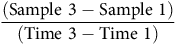 $\displaystyle{(\rm Sample\ 3-\rm Sample\ 1) \over (\rm Time\ 3-\rm Time\ 1)}$
. Each indicator was averaged across the three sampling days to reduce day-to-day variability. Natural logarithmically transformed values were used when calculating cortisol indicators.
$\displaystyle{(\rm Sample\ 3-\rm Sample\ 1) \over (\rm Time\ 3-\rm Time\ 1)}$
. Each indicator was averaged across the three sampling days to reduce day-to-day variability. Natural logarithmically transformed values were used when calculating cortisol indicators.
NSSI behaviors (T2)
NSSI behaviors were measured using an adapted version of the Inventory of Statements About Self-Injury (ISAS) (Hamza & Willoughby, Reference Hamza and Willoughby2019; Klonsky & Glenn, Reference Klonsky and Glenn2009). Adolescents reported how many times they had intentionally engaged in seven self-harm behaviors without suicidal intent over the past 6 months. These included cutting, burning, head banging, biting, severe scratching to the point of bleeding, preventing wounds from healing, and rubbing the skin against a rough surface. Responses were recorded on a 4-point scale ranging from 0 (never) to 3 (more than five incidents). This scale has demonstrated good reliability among Chinese adolescents (Gao et al., Reference Gao, Niu, Wang, Zhao, Xiao and Lin2024). The internal reliability was high for this scale in the present sample (α = 0.87).
Covariates
We included NSSI-related covariates: gender (0 = boys, 1 = girls), age at T1, parental marital status at T1 (1 = currently married, 0 = others), subjective socioeconomic status (SSS) at T1, current depressive symptoms, and T1 NSSI. SSS and parental marital status were included to account for their potential confounding effects in associations involving childhood maltreatment (Martin et al., Reference Martin, Bureau, Yurkowski, Fournier, Lafontaine and Cloutier2016; Page et al., Reference Page, Lewis, Kidger, Heron, Chittleborough, Evans and Gunnell2014). SSS was measured using the MacArthur Scale of Subjective Social Status (Goodman et al., Reference Goodman, Adler, Kawachi, Frazier, Huang and Colditz2001), which asks adolescents to rank their socioeconomic position relative to others they know on a ten-rung ladder (1 = the lowest, 10 = the highest). To account for the well-established risk and high comorbidity of depressive symptoms (Liu et al., Reference Liu, Walsh, Sheehan, Cheek and Sanzari2022; Tilton-Weaver et al., Reference Tilton-Weaver, Marshall and Svensson2019), we included depressive symptoms at T2, assessed using the Center for Epidemiological Studies Depression Scale (CES-D) (Radloff, Reference Radloff1977), as a covariate. T1 NSSI was assessed using the adapted ISAS (Hamza & Willoughby, Reference Hamza and Willoughby2019; Klonsky & Glenn, Reference Klonsky and Glenn2009), based on participants’ retrospective reports of NSSI engagement during the year preceding the baseline assessment. We also included two additional covariates known to be associated with diurnal cortisol: wake-up time (Adam & Kumari, Reference Adam and Kumari2009) and sleep quality (Ly et al., Reference Ly, McGrath and Gouin2015). Average subjective sleep quality (1 = very bad, 4 = very good) and average wake-up time were calculated across the three sampling days.
Statistical analysis
Means, standard deviations, and intercorrelations among variables were calculated using SPSS 29.0. The main analyses comprised two steps. The first step primarily involved the identification of maltreatment patterns using LPA. We estimated a series of LPA models with 2–7 profiles. The optimal solution was determined using the following criteria (Nylund et al., Reference Nylund, Asparouhov and Muthén2007): (a) lower Akaike information criterion (AIC), Bayesian information criterion (BIC), and sample-size adjusted BIC (aBIC); (b) significant Bootstrap Likelihood Ratio Test (BLRT) and Lo–Mendell–Rubin Likelihood Ratio Test (LMR-LRT); and (c) entropy values greater than 0.90. To better characterize each profile, we conducted Wald tests and logistic regression analyses to examine differences in indicators (maltreatment type scores) and sociodemographic characteristics (gender, age, subjective social status, and parental marital status) across profiles, respectively.
The second step tested mediation models in which maltreatment patterns (profiles) predicted NSSI behaviors through diurnal cortisol. The three cortisol indicators were tested separately. Using the BCH method – a robust approach for latent profile modeling with continuous outcomes (Bakk & Vermunt, Reference Bakk and Vermunt2016), we first examined differences between identified maltreatment profiles in levels of diurnal cortisol and NSSI behaviors. Hedges’ g was computed to quantify effect sizes of these differences. Next, we added paths from diurnal cortisol to NSSI behaviors in the model above, creating indirect effect terms. Individual membership probabilities in profiles were saved and used in mediation analysis, wherein membership was treated as an observed variable but adjusted for classification uncertainty (McLarnon & O’Neill, Reference McLarnon and O’Neill2018). This process resembles traditional structural equation modeling with a multi-categorical independent variable, where k profiles are dummy-coded as k-1 variables, with the low maltreatment profile set as the reference group (Hayes & Preacher, Reference Hayes and Preacher2014). We refer to these k-1 estimates as relative effects, as they quantify the effect of being in one group relative to the reference group. Bias-corrected bootstrapping with 5,000 resamples was utilized to estimate the significance of the relative indirect effects (95% confidence intervals [CIs] excluding zero). Standardized parameter estimates were obtained using z-scores of variables. Full information maximum likelihood was employed to handle missing data (less than 5% on all study variables) (Newman, Reference Newman2003). LPA and the mediation models were conducted using Mplus 8.2 (Muthén & Muthén, Reference Muthén and Muthén1998–2017). In the mediation models, the path predicting NSSI adjusted for age, gender, parental marital status, SSS, current depressive symptoms, and T1 NSSI, whereas the path predicting diurnal cortisol included age, gender, SSS, wake-up time, and sleep quality as covariates.
Transparency and openness
This study was approved by the Institutional Review Board of Beijing Normal University (#201912210084). Study and analysis materials are available upon request with the last author. The study design and analysis were not preregistered.
Results
Preliminary analyses
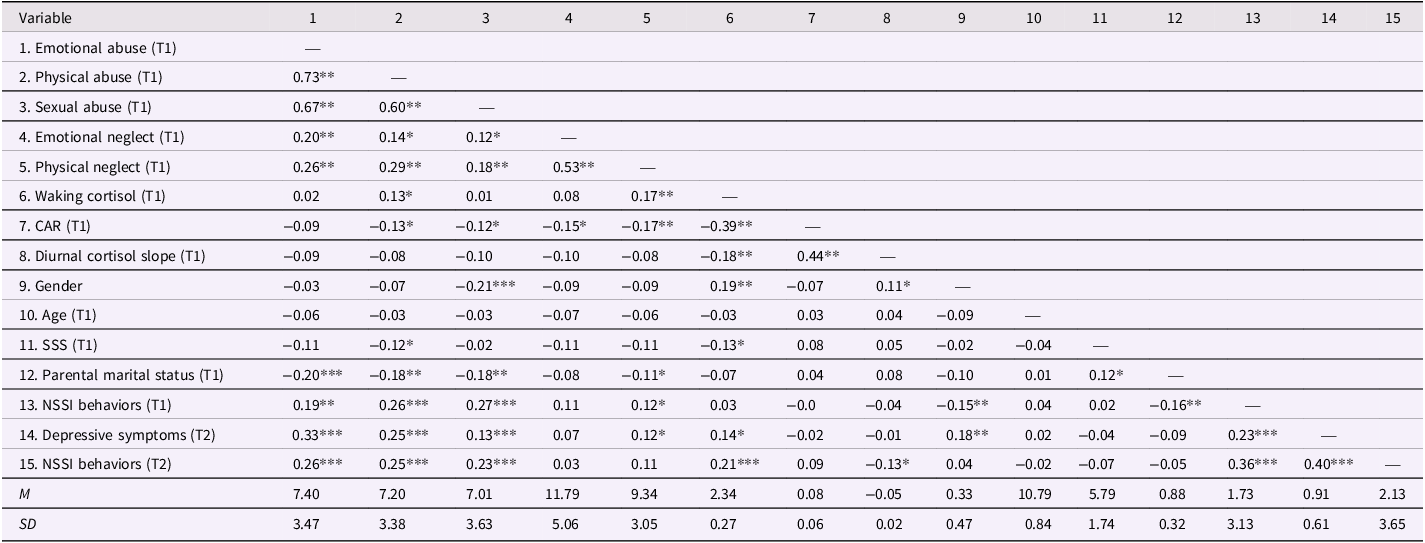
A total of 39.3% (n = 116) of adolescents reported engaging in T2 NSSI behaviors at least once during the past 6 months. Among them, the majority (n = 83; 71.6%) reported using more than one method. The three most common methods were biting (n = 73; 62.9%), cutting (n = 60; 51.7%), and severe scratching to the point of bleeding (n = 60; 51.7%). The prevalence of each NSSI method is presented in Table S1 of the supplementary material. Table 1 displays descriptive statistics and correlations among the study variables. All subtypes of maltreatment, with the exception of emotional neglect, were positively correlated with NSSI behaviors (ps < 0.05). Moreover, waking cortisol was positively associated with NSSI behaviors at T2 (r = 0.21, p < 0.001), whereas diurnal cortisol slope was negatively correlated with NSSI behaviors at T2 (r = −0.13, p < 0.05).
Descriptive statistics and correlation matrix among variables
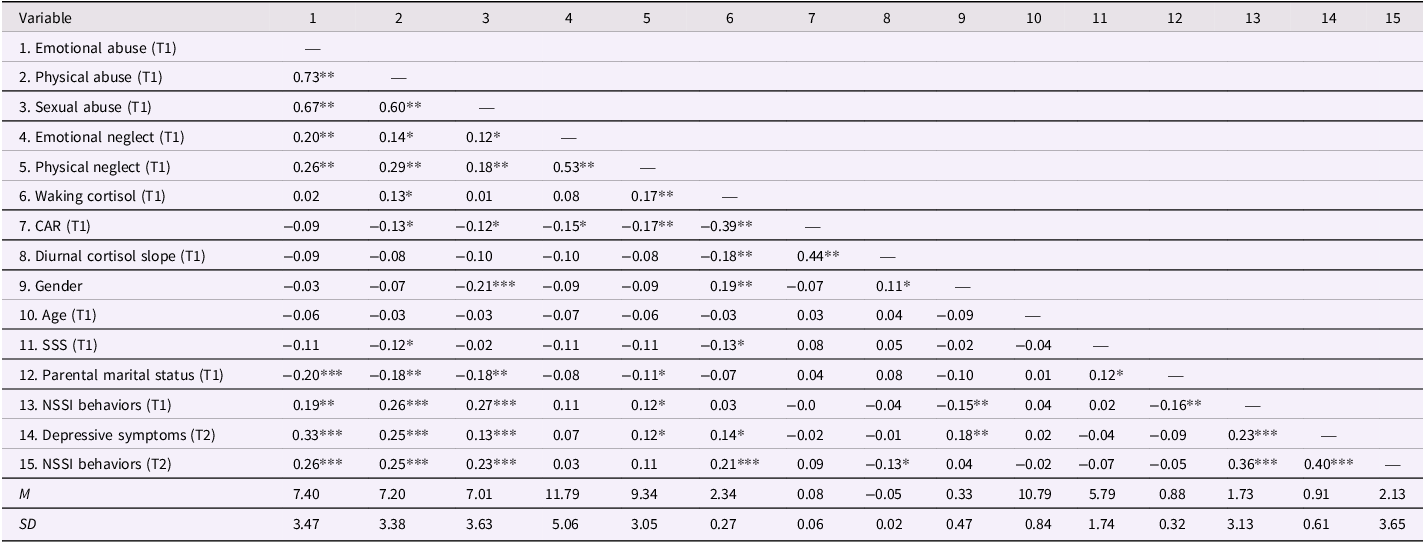
Note. CAR = cortisol awakening response; SSS = subjective socioeconomic status; NSSI = nonsuicidal self-injury. * p < 0.05, ** p < 0.01, *** p < 0.001. The coding scheme for each was as follows: gender (0 = boys, 1 = girls), parental marital status (0 = others, 1 = currently married).
Profiles of childhood maltreatment
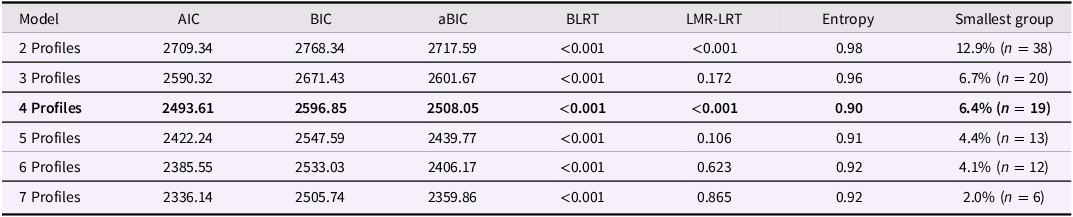
The values of AIC, BIC, and aBIC decreased as the number of profiles increased, leveling off after the four-profile solution (see Table 2). Although the BLRT remained statistically significant for all solutions, the LMR-LRT showed that the four-profile solution fit the data better than the three-profile solution. The four-profile solution also had a high entropy value of 0.90. Taken together, these results supported the four-profile solution as the optimal model.
Model fit indices from latent profile analyses of childhood maltreatment (N = 295)
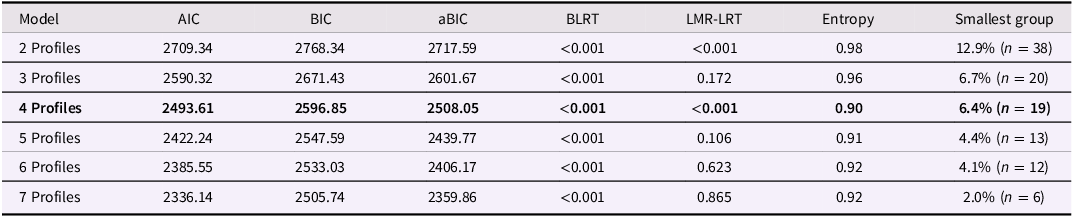
Note. AIC = Akaike information criteria; BIC = Bayesian information criteria; aBIC = sample size adjusted BIC; BLRT = Bootstrap Likelihood Ratio Test; LMR-LRT = Lo–Mendell–Rubin Likelihood Ratio Test. Bold indicates final profile solution.
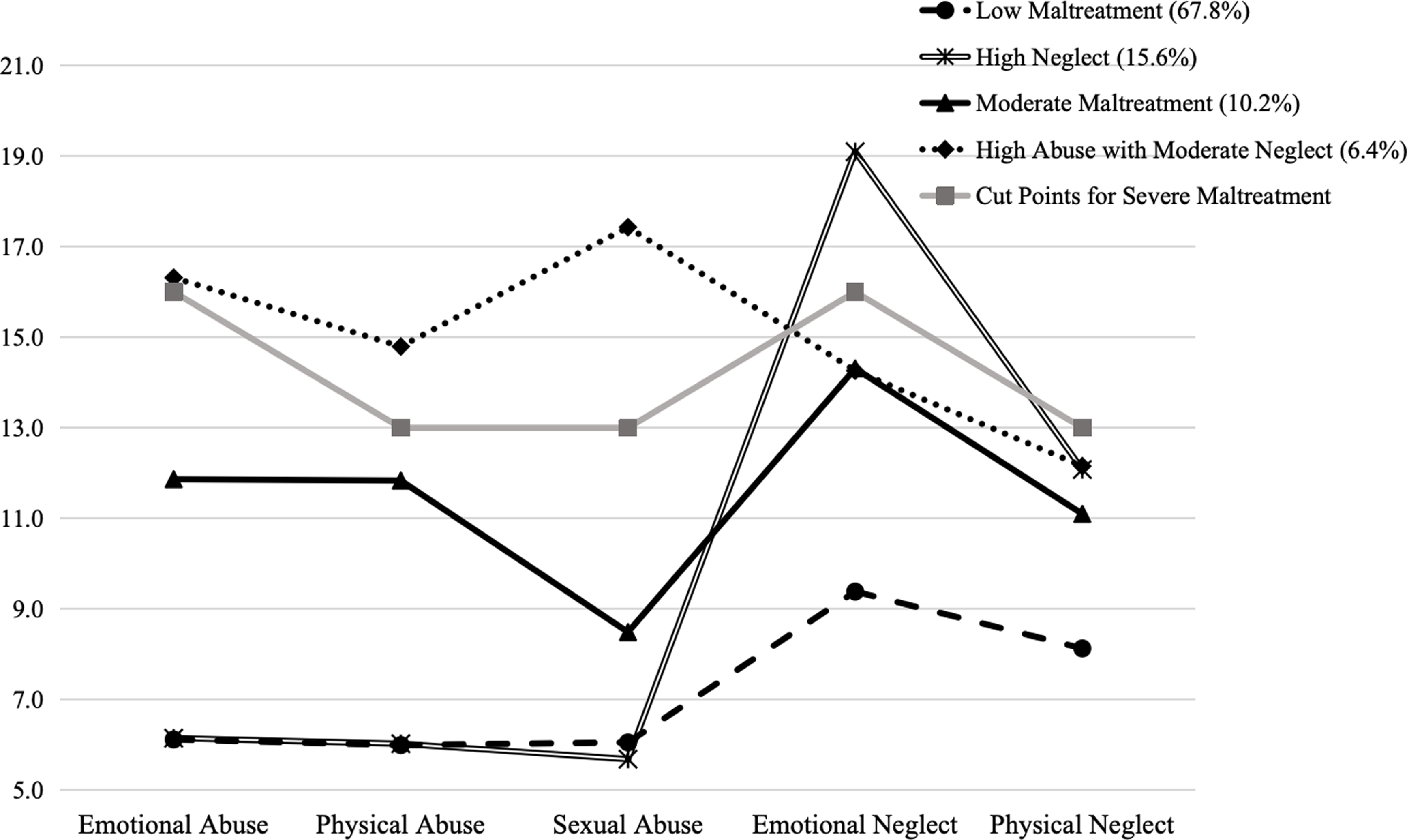
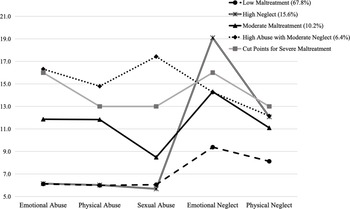
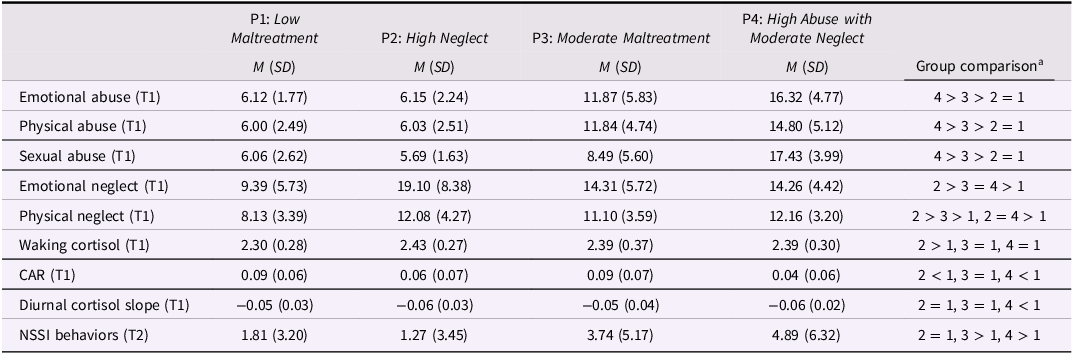
Figure 2 depicts the four maltreatment patterns, and Table 3 presents differences in maltreatment subtype scores across profiles. Profile 1 (67.8%; n = 200) was labeled Low Maltreatment, characterized by low scores on all maltreatment types. Profile 2 (15.6%; n = 46) was labeled High Neglect. This group exhibited the most severe emotional neglect and relatively severe physical neglect (albeit below the cutoff score), along with low abuse experiences. Profile 3 (10.2%; n = 30) was labeled Moderate Maltreatment, characterized by moderate scores on all maltreatment types, each falling below the respective cutoff score. Profile 4 (6.4%; n = 19) was labeled High Abuse with Moderate Neglect, characterized by severe abuse accompanied by moderate neglect. Gender differences were observed, such that boys were more likely to be in the High Abuse with Moderate Neglect profile compared to the Low Maltreatment profile (OR = 0.27, p < 0.001). No other differences in sociodemographic characteristics were found.
Patterns of childhood maltreatment. Note. Gray line indicates the cutoff points for severe maltreatment in each subtype to facilitate interpretation: emotional abuse ≥16, physical abuse ≥13, sexual abuse ≥13, emotional neglect ≥18, and physical neglect ≥13 (Bernstein et al., Reference Bernstein, Stein, Newcomb, Walker, Pogge, Ahluvalia, Stokes, Handelsman, Medrano, Desmond and Zule2003).
Differences in maltreatment types, diurnal cortisol, and NSSI behaviors across maltreatment profiles
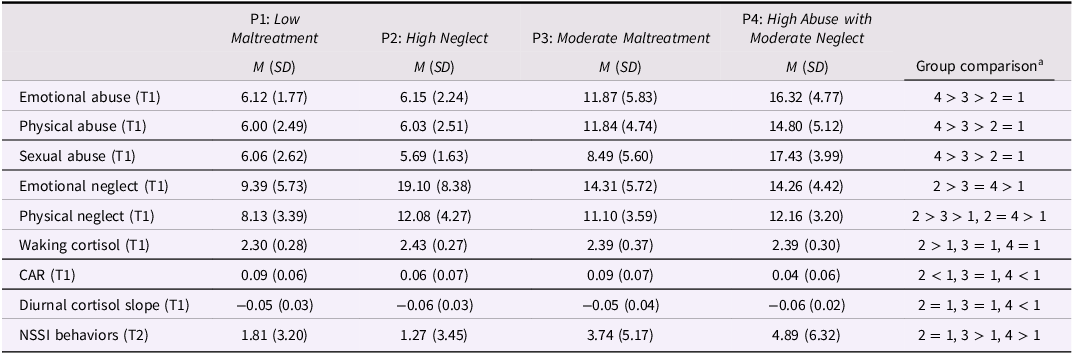
Note. CAR = cortisol awakening response; NSSI = nonsuicidal self-injury. aWe conducted pairwise comparisons to examine differences in maltreatment type scores across four profiles. When analyzing the associations of maltreatment profiles with diurnal cortisol and subsequent NSSI behaviors, the Low Maltreatment profile was used as the reference group.
Profile differences in diurnal cortisol and NSSI behaviors
Differences between identified maltreatment profiles in diurnal cortisol and subsequent NSSI behaviors were first examined (see Table 3). Compared to the Low Maltreatment profile, adolescents in the High Neglect profile showed higher waking cortisol levels (p < 0.01, Hedges’ g = 0.47) and a more blunted CAR (p < 0.05, Hedges’ g = 0.48); adolescents in the High Abuse with Moderate Neglect profile showed a more blunted CAR (p < 0.001, Hedges’ g = 0.83) and a steeper diurnal slope (p < 0.01, Hedges’ g = 0.34). No differences were observed between the Low Maltreatment and Moderate Maltreatment profiles in any diurnal cortisol indicators. Compared to the Low Maltreatment profile, adolescents in both the Moderate Maltreatment (p < 0.05, Hedges’ g = 0.55) and High Abuse with Moderate Neglect (p < 0.05, Hedges’ g = 0.86) profiles exhibited greater engagement in NSSI behaviors.
The mediating role of diurnal cortisol
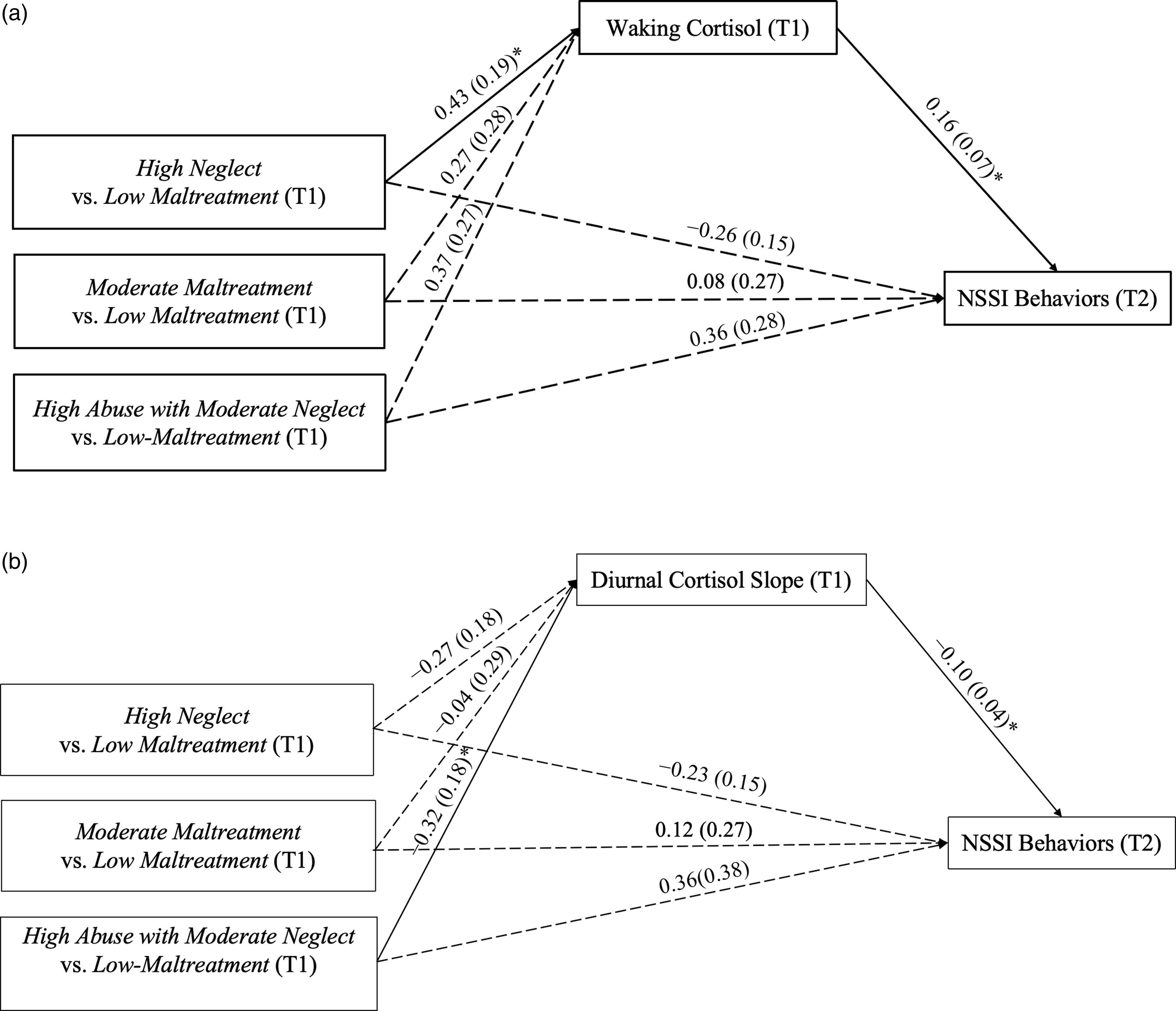
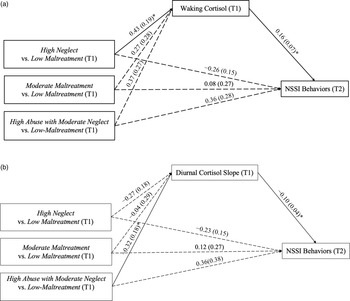
We examined the mediation model for each diurnal cortisol indicator separately (see Figure 3). As shown in Figure 3A, compared to the Low Maltreatment profile, adolescents in the High Neglect profile exhibited higher waking cortisol levels, which in turn predicted increases in subsequent NSSI behaviors (β = 0.16, SE = 0.07, p = 0.01, 95% CI = [0.04, 0.29]); the relative indirect effect was significant (β Indirect effect = 0.07, SE = 0.04, 95% CI = [0.01, 0.18]). As shown in Figure 3B, compared to the Low Maltreatment profile, adolescents in the High Abuse with Moderate Neglect profile exhibited a steeper diurnal slope, which led to greater engagement in subsequent NSSI behaviors (β = −0.10, SE = 0.04, p = 0.02, 95% CI = [−0.20, −0.03]); the relative indirect effect was significant (β Indirect effect = 0.03, SE = 0.02, 95% CI = [0.01, 0.11]). CAR did not play a mediating role in the relationship between maltreatment profiles and NSSI behaviors at T2 (see Figure S1 in the Supplemental Material).
Mediation model linking childhood maltreatment profiles to NSSI behaviors via waking cortisol (A) and diurnal cortisol slope (B). Note. Solid lines represent significant paths, and dashed lines represent non-significant paths. NSSI = nonsuicidal self-injury.
Sensitivity analyses
We repeated the mediation analyses excluding current depressive symptoms as a covariate to assess potential bias arising from the strong correlations among depressive symptoms, cortisol, and NSSI behaviors. The results of these sensitivity analyses were highly consistent with our main findings, supporting the robustness of our findings. Specifically, the longitudinal associations between the High Neglect profile and NSSI behaviors via waking cortisol, as well as between the High Abuse with Moderate Neglect profile and NSSI behaviors via diurnal cortisol slopes, remained significant, with effect sizes and confidence intervals comparable to those reported in the main analyses (see Tables S2 in the Supplemental Material).
Discussion
The present study addressed gaps in the NSSI literature by examining the longitudinal associations and physiological mechanisms between co-occurring patterns of childhood maltreatment and adolescent NSSI behaviors. In a sample of rural Chinese adolescents, we identified four maltreatment patterns: Low Maltreatment, High Neglect, Moderate Maltreatment, and High Abuse with Moderate Neglect. Compared to the Low Maltreatment profile, the High Neglect profile was associated with higher waking cortisol levels, while the High Abuse with Moderate Neglect profile was associated with a steeper diurnal slope, both of which were in turn linked to increased NSSI behaviors 6 months later.
Patterns of childhood maltreatment and NSSI behaviors
As expected, the majority of adolescents (67.8%) experienced no or low maltreatment. Consistent with prior findings that neglect is the most common form of childhood maltreatment in rural China (Wang et al., Reference Wang, Cheng, Qu, Zhang, Cui and Zou2020), 15.6% of the sample was classified into the High Neglect profile, the largest maltreated group. The identification of the Moderate Maltreatment (10.2%) and High Abuse with Moderate Neglect (6.4%) profiles reinforces previous studies showing that a substantial proportion of adolescents are exposed to multiple types of maltreatment (Kim et al., Reference Kim, Mennen and Trickett2017).
Results of gender differences in membership of maltreatment patterns showed that boys were more likely to be in the High Abuse with Moderate Neglect group than in the Low Maltreatment group. A possible explanation is that “gender-linked expectations” arise from patriarchal consciousness in China (Cui et al., Reference Cui, Xue, Connolly and Liu2016). Typically, Chinese males face higher expectations to shoulder more responsibilities for the prosperity of their families and society compared to females. Another explanation may stem from the gender stereotype that males have stronger character (Leung et al., Reference Leung, Wong, Chen and Tang2008). Together, these high expectations and societal perceptions of gender contribute to harsher discipline and more corporal punishment directed at boys in China, ultimately leading to a higher risk of experiencing childhood maltreatment (Wan et al., Reference Wan, Tang and Xu2020).
Maltreatment patterns were associated with varying levels of NSSI risk. Compared to the Low Maltreatment profile, the High Abuse with Moderate Neglect and Moderate Maltreatment profiles exhibited higher levels of NSSI behaviors, supporting the detrimental effects of childhood maltreatment on NSSI risk (Ernst et al., Reference Ernst, Brähler, Kampling, Kruse, Fegert, Plener and Beutel2022; Paul & Ortin, Reference Paul and Ortin2019). No significant differences in NSSI behaviors were observed between the High Neglect and Low Maltreatment profiles, echoing previous research demonstrating that neglect has a weaker relation with NSSI than abuse (Liu et al., Reference Liu, Scopelliti, Pittman and Zamora2018; Xiao et al., Reference Xiao, Xu, Yu, Li, Li, Jin, Tao and Wan2023). One possible explanation is that deprivation-related experiences (e.g., neglect) primarily affected cognitive development, while threat-related experiences (e.g., abuse) impacted emotional reactivity and automatic processes that are strongly associated with NSSI (Gao et al., Reference Gao, Liu, Liu, Wang and Qiu2024). Therefore, exposure to neglect alone did not significantly predict NSSI behaviors.
Diurnal cortisol as a pathway linking childhood maltreatment to NSSI behaviors
Our study supports the temporal neurobiological framework (Kaess et al., Reference Kaess, Hooley, Klimes-Dougan, Koenig, Plener, Reichl, Robinson, Schmahl, Sicorello, Westlund Schreiner and Cullen2021) and the stress-mediating model (Koss & Gunnar, Reference Koss and Gunnar2018), both of which propose the dysregulation of HPA functioning as a physiological pathway through which childhood maltreatment “gets under the skin” and increases adolescents’ risk for engagement in NSSI behaviors. Interestingly, various maltreatment patterns had distinct pathways in predicting NSSI. Adolescents in the High Neglect profile (compared to the Low Maltreatment profile) were at increased risk of engaging in NSSI behaviors via elevated waking cortisol levels, whereas those in the High Abuse with Moderate Neglect profile exhibited a greater risk through a steeper diurnal cortisol slope. These distinct pathways highlight the importance of understanding how specific indices of diurnal cortisol rhythm reflect underlying neurobiological mechanisms, thereby deepening our insight into the pathogenesis of stress-related psychopathology, such as NSSI.
Adolescents in the High Neglect profile exhibited elevated waking cortisol levels, consistent with previous research on children exposed to neglect (Sun et al., Reference Sun, Lunkenheimer and Lin2023) and early deprivation (Kertes et al., Reference Kertes, Gunnar, Madsen and Long2008). Given that neglect often manifests as a pervasive and constant absence of caregiver stimulation or support, elevated waking cortisol may reflect an adaptation to a chronically under-responsive environment, preparing neglected children to begin the day with limited external resources. Recent research suggests that cortisol secretion upon awakening is modulated by neural regulation of adrenal sensitivity to ACTH during the transition from sleep to wakefulness (Abelson et al., Reference Abelson, Sánchez, Mayer, Briggs, Liberzon and Rajaram2023). One implication of enhanced adrenal sensitivity is that it increases exposure to circulating glucocorticoids (Herman et al., Reference Herman, Ostrander, Mueller and Figueiredo2005). Chronic glucocorticoid excess has been linked to structural and functional alterations in the limbic system and cortex, impairing emotional processing and cognitive control (Dekkers et al., Reference Dekkers, Amaya, Van Der Meulen, Biermasz, Meijer and Pereira2022), which may indirectly increase the risk for NSSI (e.g., Fikke et al., Reference Fikke, Melinder and Landrø2011; Mayo et al., Reference Mayo, Perini, Gustafsson, Hamilton, Kämpe, Heilig and Zetterqvist2021). Additionally, chronic exposure to glucocorticoids can lead to glucocorticoid resistance within immune cells, which is associated with elevated inflammatory markers and may further contribute to pathophysiological processes underlying NSSI (Kindler et al., Reference Kindler, Koenig, Lerch, van der Venne, Resch and Kaess2022).
Adolescents in the High Abuse and Moderate Neglect profile showed steeper diurnal cortisol slopes, consistent with prior evidence linking abuse to increasingly steeper diurnal cortisol slopes over time among adolescent girls (Sun et al., Reference Sun, Lunkenheimer and Lin2023). The defining feature of this group is exposure to high levels of abuse, often occurring as intermittent and unpredictable events that accumulate across months and years. Although the diurnal cortisol slope is measured over several days, research suggests that it reflects longer-term adaptations of the HPA axis to repeated adversity across development (Perrone et al., Reference Perrone, Thorpe, Panahi, Kitagawa, Lindhiem and Bernard2024). Specifically, chronic exposure to maltreatment-related threat may sensitize the HPA axis to mobilize resources and heighten vigilance early in the day, followed by stronger negative feedback mechanisms later in the day to facilitate recovery and disengage from stress (Moyers & Hagger, Reference Moyers and Hagger2023; Wesarg-Menzel et al., Reference Wesarg-Menzel, Marheinecke, Staaks and Engert2024), producing a steeper diurnal decline. However, steeper slopes may also confer risk for NSSI through two possible pathways. First, abuse undermines functioning across multiple domains, including emotion regulation (Swannell et al., Reference Swannell, Martin, Page, Hasking, Hazell, Taylor and Protani2012) and cognitive processes (Gibb, Reference Gibb2002). When psychological and social regulatory resources are limited, heightened physiological arousal may intensify vulnerability to maladaptive coping, such as NSSI behaviors. Second, a physiological “trade-off” may compromise health outcomes. Although steeper slopes can enhance vigilance, they also impose costs such as attentional biases (Jopling et al., Reference Jopling, Tracy and LeMoult2025), which may accumulate over time into wear and tear on the body (McEwen, Reference McEwen1998). Supporting this notion, Chen et al. (Reference Chen, Kertes, Benner and Kim2024) found that steeper diurnal slopes in response to daily discrimination predicted poorer subsequent mental and sleep health in adolescence, indicating that short-term cortisol activation in the face of stress carries adaptation costs. Together, these two mechanisms help explain how steeper diurnal cortisol slopes contribute to NSSI behaviors among adolescents exposed to high abuse alongside moderate neglect.
Although adolescents in the High Neglect and High Abuse with Moderate Neglect profiles (compared to the Low Maltreatment profile) exhibited alterations in CAR, no significant association was found between CAR and subsequent NSSI behaviors, which is inconsistent with prior findings suggesting elevated CAR among adolescents engaging in NSSI (Reichl et al., Reference Reichl, Heyer, Brunner, Parzer, Völker, Resch and Kaess2016). This discrepancy may result from differences in sample characteristics between our study and Reichl’s (2016). The CAR is thought to capture a slightly distinct aspect of HPA axis functioning, providing a physiological “boost” to help the body prepare for the demands of the upcoming day (Abelson et al., Reference Abelson, Sánchez, Mayer, Briggs, Liberzon and Rajaram2023; Stalder et al., Reference Stalder, Lupien, Kudielka, Adam, Pruessner, Wüst, Dockray, Smyth, Evans, Kirschbaum, Miller, Wetherell, Finke, Klucken and Clow2022). In Reichl’s (2016) study, participants in the NSSI group were help-seeking adolescents who may have experienced heightened daily stress or strain, leading to an elevated CAR as an anticipatory response to perceived daily demands. It is also possible that the observed alterations in CAR among adolescents with NSSI in that study were driven by comorbid psychopathology, such as depression, rather than reflecting a specific marker of NSSI itself. Thus, future research should further clarify the association between CAR and adolescent NSSI by accounting for the potential effects of comorbid symptoms and perceived stress.
As a final note, the Moderate Maltreatment profile (compared to the Low Maltreatment profile) was not significantly associated with alterations in diurnal cortisol rhythm, suggesting that the severity of adversity may be a critical factor in the link between adverse experiences and biological dysregulation. One possible explanation is a threshold effect, wherein HPA axis dysregulation may emerge only when the accumulation or intensity of maltreatment surpasses a certain level. For instance, Kessler et al. (Reference Kessler, Vrshek-Schallhorn, Mineka, Zinbarg, Craske and Adam2023) found that more severe forms of adversity were broadly associated with disruptions across multiple aspects of the diurnal cortisol rhythm (i.e., waking cortisol levels, diurnal cortisol slope, and CAR), whereas less severe adversities were linked only to changes in mean daily cortisol levels. Future research employing more comprehensive assessments of adversity severity and analytic models capable of detecting nonlinear associations is warranted to further elucidate the biological stress-response pathways to NSSI shaped by maltreatment.
Limitations and future directions
Our findings should be interpreted with several limitations. First, childhood maltreatment was assessed using retrospective self-reports, which may be influenced by current symptomatology (e.g., depressive symptoms; Goltermann et al., Reference Goltermann, Meinert, Hülsmann, Dohm, Grotegerd, Redlich, Waltemate, Lemke, Thiel, Mehler, Enneking, Borgers, Repple, Gruber, Winter, Hahn, Brosch, Meller, Ringwald and Dannlowski2023), potentially introducing recall bias. Despite the well-established psychometric properties of the CTQ-SF (Georgieva et al., Reference Georgieva, Tomas and Navarro-Pérez2021; Spinhoven et al., Reference Spinhoven, Penninx, Hickendorff, van Hemert, Bernstein and Elzinga2014), future research may benefit from incorporating multiple data sources (e.g., official records, self- and parent-reported data) and using diverse measurement methods (e.g., diagnostic interview measures) to more accurately assess maltreatment experiences. Additionally, this study assessed adolescents’ engagement in NSSI behaviors using self-report checklists, which may not fully capture all aspects of the DSM-5 criteria for NSSI disorder. Therefore, our findings should be interpreted as reflecting NSSI behaviors rather than a formal clinical diagnosis. We encourage future research to incorporate structured assessments of the DSM-5 criteria for NSSI disorder and to differentiate between subclinical and clinically significant presentations.
Second, it is important to note that this study focused primarily on early adolescents, which may have implications for the frequency of observed NSSI behaviors. Biting was the most commonly reported method, consistent with previous findings that biting was one of the top three prevalent NSSI behaviors in early adolescence (for a review, see Qu et al., Reference Qu, Wen, Liu, Zhang, He, Chen, Duan, Yu, Liu, Zhang, Ou, Zhou, Cui, An, Wang, Zhou, Yuan, Tang, Yue and Chen2023). One possible explanation is that biting does not require external instruments and is considered less severe than cutting or deep scratching (Lloyd-Richardson et al., Reference Lloyd-Richardson, Perrine, Dierker and Kelley2007), making it more accessible and easier to perform for younger adolescents. Nonetheless, it should be noted that the younger age of our sample is also a strength, as this developmental period represents a critical window for early identification of at-risk youth and the implementation of preventive interventions (Townsend et al., Reference Townsend, Jain, Miller and Grenyer2022). Future studies including samples with a broader age range would help enhance confidence in and the generalizability of these findings.
Third, the study collected three cortisol samples per day. Although evidence suggests that collecting 3–6 samples per day is sufficient to detect associations between diurnal slope and health outcomes (Adam et al., Reference Adam, Quinn, Tavernier, McQuillan, Dahlke and Gilbert2017), denser cortisol sampling may offer more nuanced information about diurnal cortisol rhythm. Given that cortisol levels are relatively stable in the evening, our sampling strategy (i.e., at awakening, 30 min after awakening, and at bedtime) may strike a reasonable balance between data validity and participant burden. Additionally, this study calculated CAR using two time points, largely consistent with the initial guidelines (Stalder et al., Reference Stalder, Kirschbaum, Kudielka, Adam, Pruessner, Wüst, Dockray, Smyth, Evans, Hellhammer, Miller, Wetherell, Lupien and Clow2016). The decision to collect two post-awakening samples was made to minimize disruptions to participants’ daily routines, allowing them to have breakfast and attend classes on time. However, the updated recommendations suggest collecting at least three post-awakening samples to more accurately capture CAR (Stalder et al., Reference Stalder, Lupien, Kudielka, Adam, Pruessner, Wüst, Dockray, Smyth, Evans, Kirschbaum, Miller, Wetherell, Finke, Klucken and Clow2022). Furthermore, although all samples were collected under supervision and sampling times were recorded by research assistants, the use of objective methods (e.g., tracking caps) would further improve sampling accuracy. Future studies should consider adopting more intensive and objectively verified sampling protocols for assessing the diurnal cortisol rhythm.
Fourth, the current study employed a two-wave longitudinal design, with time passing only between the assessments of diurnal cortisol and NSSI behaviors. This limits the ability to draw accurate inferences about the causal mediation process (Maxwell & Cole, Reference Maxwell and Cole2007). Future research would benefit from adopting fully lagged longitudinal designs to more rigorously examine the mediating pathways and causal relationships among childhood maltreatment, diurnal cortisol rhythm, and NSSI behaviors.
Lastly, childhood maltreatment and proximal stressful experiences/perceived stress may work together in shaping adolescent HPA axis functioning and NSSI behaviors (Knight et al., Reference Knight, Jiang, Rodriguez-Stanley, Almeida, Engeland and Zilioli2021; Lecarie et al., Reference Lecarie, Doane, Stroud, Walter, Davis, Grimm and Lemery-Chalfant2022). However, testing a moderated mediation model, particularly one involving an interaction term with a four-category independent variable (i.e., maltreatment profiles), would substantially increase model complexity and require a larger sample size to ensure adequate statistical power and stable parameter estimates. Nonetheless, exploring the combined effects of childhood maltreatment and perceived/proximal stress on physiological and psychological health remains a valuable direction for future research.
Conclusions
To conclude, alterations in diurnal cortisol rhythm may be a potential mechanism through which childhood maltreatment leads to adolescent NSSI. This study intends to raise awareness of the biological and clinical repercussions of childhood maltreatment, encouraging school workers and clinicians to ask adolescents about their childhood maltreatment history and respond accordingly. The findings revealed distinct mediating pathways of diurnal cortisol linked to unique patterns of maltreatment experiences, affording greater precision in preventing adolescent NSSI behaviors. This study highlights the need for tailored prevention and intervention efforts to meet adolescents’ particular needs. For example, for adolescents experiencing severe neglect, kinship care practices may have the potential to normalize HPA axis function and prevent the emergence of stress-related psychopathologies (Abdullah et al., Reference Abdullah, Frederico, Cudjoe and Emery2020).
Supplementary material
The supplementary material for this article can be found at https://doi.org/10.1017/S0954579425100898.
Data availability statement
The data, code, and materials used in this study are available from the corresponding author upon reasonable request.
Acknowledgments
We thank all the participating students and schools for their time and support. Jianing Sun is supported by the National Institute of Child Health and Human Development (T32HD101390).
Funding statement
This work was supported by the National Natural Science Foundation of China (#32471116). The findings and conclusions of this report are solely the responsibility of the authors and do not necessarily represent the official views of the funder. The funder played no role in the study design, data collection, writing, or decision to submit the manuscript for publication.
Competing interests
All authors declared that they have no conflicts of interest.
Pre-registration statement
The study design and analysis were not preregistered. This study was conducted under the framework of a project funded by the National Natural Science Foundation of China and approved by the Institutional Review Board of Beijing Normal University.


 Open access

