





Introduction
Members of the genus Scaphanocephalus (Jägerskiöld, Reference Jägerskiöld1904) are opisthorchiid trematodes that mature almost exclusively in osprey, Pandion haliaetus. Metacercariae cause Black Spot Syndrome (BSS) in fishes (Kohl et al., Reference Kohl, Calhoun, Elmer, Peachey, Leslie, Tkach, Kinsella and Johnson2019; Malawauw et al., Reference Malawauw, Piaskowy, ter Horst, Calhoun and Johnson2024), which manifests as immunopathogenic pigmented spots on fish skin and fins (Dennis et al., Reference Dennis, Izquierdo, Conan, Johnson, Giardi, Frye and Freeman2019; Kohl et al., Reference Kohl, Calhoun, Elmer, Peachey, Leslie, Tkach, Kinsella and Johnson2019; Cohen-Sánchez et al., Reference Cohen-Sánchez, Sánchez-Mairata, Valencia, Box, Pinya, Tejada and Sureda2023a, Reference Cohen-Sánchez, Valencia, Box, Solomando, Tejada, Pinya, Catanese and Sureda2023b). Though little studied historically, Scaphanocephalus is receiving increased attention, likely because BSS appears to be increasing in prevalence (Elmer et al., Reference Elmer, Kohl, Johnson and Peachey2019; Cohen-Sánchez et al., Reference Cohen-Sánchez, Sánchez-Mairata, Valencia, Box, Pinya, Tejada and Sureda2023a) in keystone herbivorous fishes of importance to coral reef health (Mumby et al., Reference Mumby, Hastings and Edwards2007; Burkepile and Hay, Reference Burkepile and Hay2008; Kohl et al., Reference Kohl, Calhoun, Elmer, Peachey, Leslie, Tkach, Kinsella and Johnson2019), and has been linked to economic impacts in fisheries (Shimose et al., Reference Shimose, Kanaiwa and Nanami2019).
Jägerskiöld (Reference Jägerskiöld1904) named Scaphanocephalus for the wide forebody and narrow hindbody of adult worms that form a distinctive shape he likened to a spade. He erected the genus for a species Creplin (Reference Creplin1842) originally described as Monostomum expansum from adults in osprey, having examined both Creplin's (Reference Creplin1842) material as well as newly collected specimens from osprey in Egypt. Creplin (Reference Creplin1842) did not mention a locality, but presumably the type specimens originated near Greifswald, Germany, where he lived and worked (Häckermann, Reference Häckermann1876). Scaphanocephalus expansus has subsequently been reported from Europe, the Middle East, North America, the Gulf of Mexico, Caribbean, Japan and Malaysia (reviewed by Kohl et al., Reference Kohl, Calhoun, Elmer, Peachey, Leslie, Tkach, Kinsella and Johnson2019). Two other species have been described: Scaphanocephalus australis (Johnston, Reference Johnston1916), described from the sea eagle, Icthyophaga leucogaster, to date endemic to Australia; and Scaphanocephalus adamsi, described from metacercariae found within split-level hogfish, Bodianus mesothorax, in the Philippines (Tubangui, Reference Tubangui1933). Yamaguti (Reference Yamaguti1942) considered S. adamsi a synonym of S. expansus, but Kifune and Kugi (Reference Kifune and Kugi1979) disagreed, based on adults of S. adamsi in Buteo buteo burmanicus from Kyushu, Japan, that presented morphological differences from S. australis and S. expansus.
Six recent studies have employed 28S rDNA to study diversity within Scaphanocephalus (Dennis et al., Reference Dennis, Izquierdo, Conan, Johnson, Giardi, Frye and Freeman2019; Kohl et al., Reference Kohl, Calhoun, Elmer, Peachey, Leslie, Tkach, Kinsella and Johnson2019; Al-Salem et al., Reference Al-Salem, Baghdadi, Mahmoud, Ibrahim and Bayoumy2021; González-García et al., Reference González-García, Garcia-Varela, Lopez-Jimenez, Ortega Olivares, Pérez-Ponce de León and Andrade Gómez2023; Cohen-Sánchez et al., Reference Cohen-Sánchez, Sánchez-Mairata, Valencia, Box, Pinya, Tejada and Sureda2023a, Reference Cohen-Sánchez, Valencia, Box, Solomando, Tejada, Pinya, Catanese and Sureda2023b). Phylogenetic analysis reveals 3 28S lineages of Scaphanocephalus in the Gulf of Mexico, Caribbean Sea, Persian Gulf and Mediterranean (González-García et al., Reference González-García, Garcia-Varela, Lopez-Jimenez, Ortega Olivares, Pérez-Ponce de León and Andrade Gómez2023). One 28S lineage occurs in both the New World and in the Persian Gulf (Al-Salem et al., Reference Al-Salem, Baghdadi, Mahmoud, Ibrahim and Bayoumy2021) and another is in both the New World and the Mediterranean (González-García et al., Reference González-García, Garcia-Varela, Lopez-Jimenez, Ortega Olivares, Pérez-Ponce de León and Andrade Gómez2023; Cohen-Sánchez et al., Reference Cohen-Sánchez, Sánchez-Mairata, Valencia, Box, Pinya, Tejada and Sureda2023a, Reference Cohen-Sánchez, Valencia, Box, Solomando, Tejada, Pinya, Catanese and Sureda2023b). The third lineage, which to date has only been found in the Gulf of Mexico and Caribbean Sea, was identified as S. expansus after morphological study of metacercariae (Kohl et al., Reference Kohl, Calhoun, Elmer, Peachey, Leslie, Tkach, Kinsella and Johnson2019) and adults (González-García et al., Reference González-García, Garcia-Varela, Lopez-Jimenez, Ortega Olivares, Pérez-Ponce de León and Andrade Gómez2023). Collectively, these works leave several questions unresolved. Firstly, available 28S sequences indicate 3 species exist where only S. expansus has ever been reported (González-García et al., Reference González-García, Garcia-Varela, Lopez-Jimenez, Ortega Olivares, Pérez-Ponce de León and Andrade Gómez2023), indicating undescribed diversity. Second, except for 3 sequences from González-García et al. (Reference González-García, Garcia-Varela, Lopez-Jimenez, Ortega Olivares, Pérez-Ponce de León and Andrade Gómez2023), molecular data are from metacercariae, which impedes identification because, as in all digeneans, species of Scaphanocephalus are conventionally distinguished based on the adult, which differs morphologically from the metacercaria. Third, although the morphological taxonomy clearly underestimates species diversity in this genus, the additional diversity indicated by 28S may also represent an underestimate, given that ribosomal markers may be insufficiently variable to resolve recently diverged species (Vilas et al., Reference Vilas, Criscione and Blouin2005). Finally, the current molecular view of species distributions in Scaphanocephalus is perplexing in that the species recognized in recent studies as S. expansus (Kohl et al., Reference Kohl, Calhoun, Elmer, Peachey, Leslie, Tkach, Kinsella and Johnson2019; González-García et al., Reference González-García, Garcia-Varela, Lopez-Jimenez, Ortega Olivares, Pérez-Ponce de León and Andrade Gómez2023) has only been recovered in Mexico and the Caribbean, and lacks a molecular link to the Old World, from which S. expansus was described by Creplin (Reference Creplin1842).
The aim of this study was to describe species and provide a robust basis for phylogenetic conclusions within Scaphanocephalus. Adult worms collected from across North America and the Caribbean were studied morphologically with sequencing targeted on both 28S (for comparability with past studies) and mitochondrial markers. Results were interpreted in a biogeographic context that considers the distribution of hosts and geographic barriers. Whole mitochondrial genome and nuclear ribosomal operon data were also obtained to clarify the phylogenetic placement of the genus Scaphanocephalus and to provide resources for future molecular phylogenetic work.
Materials and methods
Sample collection and processing
Specimens of Scaphanocephalus were newly collected from salvaged osprey carcasses (provided by wildlife rehabilitation centres) and from ocean surgeonfish (Acanthurus tractus) collected in North America and the Caribbean (Table 1, Supplementary Table 1). Adult worms were removed from osprey gastrointestinal tracts while metacercariae were mechanically excysted from fins and stored in 95% ethanol until molecular or morphological analysis. In specimens or subsamples of worms intended for molecular work, DNA was extracted using commercial kits following manufacturer instructions (e.g. NucleoSpin Tissue XS, Macherey Nagel, Allentown, PA, USA). Vouchers for morphological study were gradually rehydrated, stained with acetocarmine, gradually dehydrated in pure alcohol, cleared in clove oil and mounted on slides using Permount. Voucher specimens were deposited in the Museum of Southwestern Biology (MSB:Para:49134–46). Line drawings of adults were made with a Nikon Alphaphot YS equipped with a camera lucida.
Specimens of Scaphanocephalus sequenced in the present and prior studies

CO1 BC = barcode region of cytochrome c oxidase I, CO1 JB3 = 3′ region of cytochrome c oxidase I, 28S = partial sequence of 28S nuclear rDNA; MT genome = whole mitochondrial genome; rDNA operon = nuclear rDNA array, with partial external transcribed spacer; MSB = Museum of Southwestern Biology. A more detailed version of the information in this table is in Supplementary Table 1.
a Identified as Scaphanocephalus expansus by study authors.
Extracted DNA from prior studies (Dennis et al., Reference Dennis, Izquierdo, Conan, Johnson, Giardi, Frye and Freeman2019; Cohen-Sánchez et al., Reference Cohen-Sánchez, Valencia, Box, Solomando, Tejada, Pinya, Catanese and Sureda2023b) was also re-analysed in the present study. These extracts were from (1) a metacercaria (specimen XN4P4M) from a pearly razorfish (Xyrichtys novacula) caught offshore from the Balearic Islands in the Mediterranean Sea, from which Cohen-Sánchez et al. (Reference Cohen-Sánchez, Valencia, Box, Solomando, Tejada, Pinya, Catanese and Sureda2023b) obtained 28S sequence OK045682, and (2) 2 specimens from a doctorfish (Acanthurus chirurgus) in St. Kitts, from which Dennis et al. (Reference Dennis, Izquierdo, Conan, Johnson, Giardi, Frye and Freeman2019) obtained 28S sequence MN160570.
Molecular analysis
Next generation sequencing
The DNA of an adult worm from a salvaged osprey from Florida was extracted and shotgun-sequenced on an Illumina HiSeq 4000 at Azenta (NJ, USA). Nuclear ribosomal DNA operon and whole mitochondrial genomes were assembled using Geneious Prime v2020.2.2 (Biomatters Ltd., Auckland NZ) from 150-bp paired-end reads built with Nextera adapters (Illumina, San Diego, CA, USA). The nuclear rDNA operons were iteratively assembled using custom settings with medium-low sensitivity read-mapping to a chimeric consensus of 2 28S sequences of Scaphanocephalus (MN160569, MN160570) and the entire rDNA operon of Diplostomum ardeae (MT259036) until even and deep coverage of the assembly was obtained. The boundaries of rDNA subunit genes and the transcribed spacers were determined by aligning the assembly with other sequences (MH521249–52, Locke et al., Reference Locke, Van Dam, Caffara, Pinto, Lopez-Hernandez and Blanar2018). Mitochondrial genomes were assembled by mapping Illumina reads to a consensus of 2 mitochondrial genomes from Heterophyidae: Haplorchis taichui (MG972809) and Metagonimus yokogawai (KC330755). The longest resulting fragment with good coverage was then extended in iterative assemblies until the molecule was circularized. Coding regions, transfer RNAs (tRNAs) and ribosomal RNAs (rRNAs) were annotated using MITOS (Bernt et al., Reference Bernt, Donath, Jühling, Externbrink, Florentz, Fritzsch, Pütz, Middendorf and Stadler2013) and through comparison with KC330755 (unpublished), EU921260 and FJ381664 (Shekhovtsov et al., Reference Shekhovtsov, Katokhin, Kolchanov and Mordvinov2010), KC330755 (unpublished), KT239342 (Na et al., Reference Na, Gao, Liu, Fu, Su, Yue, Gao, Zhang and Wang2016), MG972809 (Le et al., Reference Le, Nguyen, Dong and Le2021), MH536507–13 (Locke et al., Reference Locke, Van Dam, Caffara, Pinto, Lopez-Hernandez and Blanar2018) and NC_063968 (unpublished).
As described in the results, 2 specimens (1 from Montana, 1 from Florida) each yielded CO1 Sanger sequences that differed by a large and similar magnitude from all other sequences obtained. The specimens were suspected to belong to the same species, but their CO1 sequences could not be compared because different regions of this gene were amplified in each. After unsuccessful attempts to amplify and Sanger-sequence CO1 fragments allowing direct comparison, extracted DNA from the Florida specimen was subject to Minion sequencing with the goal of obtaining CO1 sequence comparable to the Montana specimen. The sequencing library was prepared using the Ligation Sequencing Kit v14 (SQK-LSK114, Oxford Nanopore Technologies, Oxford, UK) following the manufacturer's protocol. The library was sequenced on a whole Flongel Flow Cell (R10.4.1, Oxford Nanopore Technologies) with MinKnow v.21.05.12 software (Oxford Nanopore Technologies). Base-calling was performed in Guppy (v.5.0.12). NanoFilt v.2.8.0 (De Coster et al., Reference De Coster, D'Hert, Schultz, Cruts and Van Broeckhoven2018) was used to process and filter all resulting reads with quality scores ≥Q10. MiniMap2 v.2.22 (Li, Reference Li2018) was used to remove non-trematode contaminant reads (host, human, bacteria).
Sanger sequencing
Partial 28S was amplified using the primers LSU5 (Littlewood, Reference Littlewood1994) and 1500R (Snyder and Tkach, Reference Snyder and Tkach2001) with the following thermocycling conditions: 95°C for 30 s, followed by 30 cycles of 95°C for 30 s, 56°C for 45 s and 68°C for 60 s; and a final incubation at 68°C for 5 min. The 5′ or barcode region of the mitochondrial cytochrome c oxidase I (CO1) gene was amplified using the primers and protocols MplatF/R, MplatF/Dice11 and MplatF/Dice14 of Moszczynska et al. (Reference Moszczynska, Locke, McLaughlin, Marcogliese and Crease2009) and Van Steenkiste et al. (Reference Van Steenkiste, Locke, Castelin, Marcogliese and Abbott2015), using the touchdown protocol described by Van Steenkiste et al. (Reference Van Steenkiste, Locke, Castelin, Marcogliese and Abbott2015). The 3′ half of CO1 was amplified using primers JB3 (Morgan and Blair, Reference Morgan and Blair1998) and CO1-R (Miura et al., Reference Miura, Kuris, Torchin, Hechinger, Dunham and Chiba2005) using the cycling conditions of Miura et al. (Reference Miura, Kuris, Torchin, Hechinger, Dunham and Chiba2005).
Phylogenetic analysis
Sequences generated in the present study were aligned with data from the literature and discovered through BLAST searches (Altschul et al., Reference Altschul, Madden, Schäffer, Zhang, Zhang, Miller and Lipman1997) using MAFFT (Katoh and Standley, Reference Katoh and Standley2013; Supplementary Table 1). Uncorrected P-distances were calculated using all alignment sites in MEGA X v.10.1.8 (Kumar et al., Reference Kumar, Stecher, Li, Knyaz and Tamura2018). Phylogenetic trees based on alignments stripped of gaps were based on substitution models selected using the Bayesian Information Criterion in MEGA X v.10.1.8 (Kumar et al., Reference Kumar, Stecher, Li, Knyaz and Tamura2018), or the nearest approximation available in maximum likelihood (ML) (RAxML, Stamatakis, Reference Stamatakis2014) and Bayesian inference (BI, Huelsenbeck and Ronquist, Reference Huelsenbeck and Ronquist2001) implemented in Geneious. Phylogenetic accuracy in ML was estimated by bootstrapping the trees with 1000 replicates and in BI, with 2 runs of total chain length 1 100 000, subsampled every 200 generations, a burn-in length of 110 000, yielding 4951 trees.
Results
Molecular data were obtained from 27 newly collected adult Scaphanocephalus specimens found within osprey from Montana, Virginia, Florida and Curaçao, and 2 metacercariae from newly collected ocean surgeonfish (A. tractus) from Curaçao (Table 1). Mitochondrial data were also newly obtained from 3 specimens from which 28S was sequenced in prior studies, namely 2 metacercariae from St Kitts (specimens QSK29.1, QSK29.2, 28S sequence MN160570 from Dennis et al. [Reference Dennis, Izquierdo, Conan, Johnson, Giardi, Frye and Freeman2019]) and 1 from the Spanish Mediterranean (specimen XN4P4M, 28S sequence K045682 from Cohen-Sánchez et al. [Reference Cohen-Sánchez, Valencia, Box, Solomando, Tejada, Pinya, Catanese and Sureda2023b]). As presented further below and summarized in Table 2, molecular and morphological data supported description of a new species. As many as 4 other putative species were not described, identified or characterized morphologically due to a lack of vouchers of adult worms or of CO1 sequences: Scaphanocephalus sp. ne1, Scaphanocephalus sp. ne2, Scaphanocephalus sp. pa1, Scaphanocephalus sp. pa2 (where ‘ne’ refers to Nearctic and ‘pa’ to Palearctic). Sequence-based identifications revealed mixed infections in osprey. One osprey from Florida was infected with 6 S. robustus n. sp. and 1 Scaphanocephalus sp. ne2, and a second osprey from Florida was infected with 4 S. robustus n. sp. and 1 Scaphanocephalus sp. ne1.

Description
Scaphanocephalus robustus n. sp.
Type host: Pandion haliaetus; other hosts: Mugil curema
Type locality: Virginia, USA; other localities: Florida, USA; Curaçao; Celestún, Yucatán, Mexico
Voucher specimens: MSB:Para:49134–46
GenBank: 28S: PP436427–34, OR794154; CO1: PP456658–80
Description based on 15 hologenophores from P. haliaetus (Table 3, Fig. 1): Dorsoventrally flattened, with wide lateral expansions in forebody; hindbody subcylindrical. Oral sucker small, subterminal. Short pre-pharynx followed by small pharynx and lengthy oesophagus. Muscular genital complex (ventral sucker, gonotyl) in anterior third of body. Vitellaria in 2 lateral extracaecal fields, confluent posteriorly in most specimens, extending anteriorly to caecal bifurcation. Ovary multilobate, median, pretesticular; testes tandem, deeply lobed, in posterior third of body. Seminal receptacle submedian, elongate, extending laterally between ovary and anterior testis.
Morphometrics of Scaphanocephalus described in the present and prior studies, as mean (range), ±standard deviation, n measured, in μm

Line drawing of type specimen of Scaphanocephalus robustus n. sp. from Pandion halietus from Virginia, USA. Hologenophore for sequence PP456670 (cytochrome c oxidase I) and PP436435 (28S), deposited in the Museum of Southwestern Biology (MSB:Para:49138). Scale bar is 1 mm.

Remarks
Compared with descriptions of S. expansus originating in the Old World by Creplin (Reference Creplin1842), Jägerskiöld (Reference Jägerskiöld1904) and Dubois (Reference Dubois1960), S. robustus n. sp. is shorter in total length, with a relatively wide hindbody. In S. robustus n. sp., the width of the hindbody is mean 34% (range 26–46 ± 7%) of total length, while in descriptions of S. expansus from the Old World, this proportion is mean 25%, range 23–29% (Creplin, Reference Creplin1842), 20% (Jägerskiöld, Reference Jägerskiöld1904) and 28% (Foronda et al., Reference Foronda, Santana-Morales, Feliu and Valladares2009). The relative width of the hindbody in adults of S. adamsi described by Kifune and Kugi (Reference Kifune and Kugi1979), from 44 to 46% of total length, was greater than in S. robustus n. sp. Foronda et al. (Reference Foronda, Santana-Morales, Feliu and Valladares2009) described worms identified as S. expansus that were similar in length and proportion to S. robustus n. sp. but with smaller eggs.
Among New World species, S. robustus n. sp. can be distinguished from Scaphanocephalus sp. ne1, described by González-García et al. (Reference González-García, Garcia-Varela, Lopez-Jimenez, Ortega Olivares, Pérez-Ponce de León and Andrade Gómez2023) as S. expansus, by the longer eggs and, to a lesser extent, the wider anterior body of S. robustus n. sp. Morphometrically, S. robustus n. sp. most closely resembles S. australis, which Johnston (Reference Johnston1916) described from I. leucogaster in Australia, but in S. robustus n. sp. eggs are slightly longer and narrower, and testes are deeply lobed, rather than solid bodies.
Although S. robustus n. sp. is morphologically distinguished from S. expansus based largely on metrical variation, caution is needed in making metrical comparisons among descriptions because authors have reported the range, both mean and range, mean and standard deviation or unexplained figures, often without specifying the number of specimens in which a feature was measured. Notably, most measurements provided by Jägerskiöld (Reference Jägerskiöld1904), who examined the type specimens of Creplin (Reference Creplin1842), are inconsistent with or lack the variability of the original description. Foronda et al. (Reference Foronda, Santana-Morales, Feliu and Valladares2009) reported the seminal receptacle to be wider than the hindbody, with a large standard deviation suggesting this was not a typographical error. González-García et al. (Reference González-García, Garcia-Varela, Lopez-Jimenez, Ortega Olivares, Pérez-Ponce de León and Andrade Gómez2023) apparently summed the standard deviations to the means to obtain a range of measurements in Foronda et al. (Reference Foronda, Santana-Morales, Feliu and Valladares2009), thus underestimating morphometric variation in the latter study.
Phylogenetic results: Sanger sequencing
28S rDNA
The 19 new sequences of 28S generated in this study were aligned with 16 sequences collectively published by Kohl et al. (Reference Kohl, Calhoun, Elmer, Peachey, Leslie, Tkach, Kinsella and Johnson2019), Dennis et al. (Reference Dennis, Izquierdo, Conan, Johnson, Giardi, Frye and Freeman2019), Al-Salem et al. (Reference Al-Salem, Baghdadi, Mahmoud, Ibrahim and Bayoumy2021), Cohen-Sánchez et al. (Reference Cohen-Sánchez, Valencia, Box, Solomando, Tejada, Pinya, Catanese and Sureda2023b) and González-García et al. (Reference González-García, Garcia-Varela, Lopez-Jimenez, Ortega Olivares, Pérez-Ponce de León and Andrade Gómez2023). Phylogenetic analysis yielded 3 strongly supported clades (Fig. 2). The largest clade consisted of S. robustus n. sp. (from North America, the Caribbean and the Yucatán), with sequences from the Mediterranean nested within (including OK045682 from specimen XN4P4M, from which divergent CO1 was newly obtained in the present study, see below). Another 28S clade was formed by identical sequences from specimens from the Persian Gulf, and Montana and the Caribbean. A third clade, Scaphanocephalus sp. ne1, was formed by 28S from specimens collected in the Gulf of Mexico and Caribbean (Florida, St. Kitts, Curaçao, Bonaire, Campeche), including specimens identified as S. expansus by Kohl et al. (Reference Kohl, Calhoun, Elmer, Peachey, Leslie, Tkach, Kinsella and Johnson2019) and González-García et al. (Reference González-García, Garcia-Varela, Lopez-Jimenez, Ortega Olivares, Pérez-Ponce de León and Andrade Gómez2023).
Phylogenetic analysis of 28 partial 28S sequences of Scaphanocephalus in the present (16 sequences) and prior studies (12 sequences). The maximum likelihood topology is shown and nodes are annotated with posterior probability (Bayesian inference)/bootstrap support (1000 replicates in maximum likelihood). The trimmed alignment was 1048 nt in length. The ML tree was generated using nucleotide substitution model GTR + G; the BI tree using HKY + G. The same tree, with individual sequences labelled with GenBank accessions, is available in Supplementary Fig. 1.

Genetic distances among 28S sequences of the genus Scaphanocephalus were bimodally distributed, with a lack of P-distances greater than 0.57% and less than 1.01% (Fig. 3). This gap in 28S P distances corresponded to intra and inter-clade variation in 28S (Fig. 2), but not to comparisons within and between species, as recognized herein. For example, 28S distances between S. robustus n. sp. and Scaphanocephalus sp. pa1 averaged 0.27 (range 0–0.57%) and thus were similar in magnitude to intraspecific 28S distances in Scaphanocephalus (Table 4).
Histogram of uncorrected P distances in Scaphanocephalus among (a) 33 partial 28S sequences from the present and prior studies and (b) 28 partial cytochrome c oxidase 1 sequences from the present study.

Average genetic distances (range in parenthesis) within and among species of Scaphanocephalus in cytochrome c oxidase I (CO1) and 28S rDNA (uncorrected P expressed as per cent difference among all sites in alignments of 29 sequences of CO1, 33 of 28S)

Cytochrome c oxidase I
Phylogenetic analysis of partial CO1 revealed 4 lineages with variable node support (Fig. 4). The topology of the CO1 phylogeny was consistent with the 28S phylogeny (Fig. 2) in that Scaphanocephalus sp. ne2 was the earliest diverging lineage, its ancestor giving rise to other clades, including Scaphanocephalus sp. ne1, which emerged as reciprocally monophyletic in analyses of both markers. The CO1 phylogeny (Fig. 4) differed from the 28S phylogeny (Fig. 2), in that CO1 from the Mediterranean specimen of Scaphanocephalus sp. pa1 (XN4P4M) was separate from New World specimens of S. robustus n. sp., albeit with weak support. A concatenated alignment of 28S and CO1 generated to clarify the phylogenetic position and status of this Mediterranean specimen (XN4P4M) with respect to S. robustus n. sp. showed Scaphanocephalus sp. pa1 to be separate from the S. robustus n. sp. in both BI and ML (Fig. 5).
Phylogenetic analysis of 26 partial CO1 sequences of Scaphanocephalus generated in the present study. The Bayesian inference topology is shown with nodes annotated with posterior probability (Bayesian inference, BI)/bootstrap support (1000 replicates in ML) based on a 415-nt alignment. The ML tree was generated using substitution model GTR + I; the BI tree using HKY + I.

Phylogenetic analysis of concatenated partial 28S (1059 nt) and CO1 (374 nt) sequences of Scaphanocephalus. The maximum likelihood topology is shown and nodes are annotated with posterior probability (Bayesian inference)/bootstrap support (1000 replicates in maximum likelihood). The ML tree was generated using substitution model GTR + I; the BI tree using HKY + I with unlinked parameters in an alignment partitioned into 28S and CO1.

Among the 4 species (Scaphanocephalus spp. ne1, ne2, pa1 and S. robustus n. sp.) from which CO1 sequences were available, P-distances were as high as 2.54% within and at least 5.0% between species (Fig. 3, Table 4). Between the most closely related species (S. robustus n. sp., Scaphanocephalus sp. pa1), P distances averaged 5.5% (range 5.0–6.2%) and the 59th translated amino acid (glycine) from the single specimen of Scaphanocephalus sp. pa1 differed from the amino acid found in all specimens in the New World (alanine). Under the alternative interpretation that Scaphanocephalus sp. pa1 and S. robustus n. sp. represent a single, transatlantic species, CO1 variation within this species would average 1.27 (range 0–6.2%).
Phylogenetic results: next generation sequencing
Nuclear rDNA operon
Of 73 675 730 150-bp Illumina reads obtained from the DNA of an adult Scaphanocephalus from P. haliaetus in Fort Lauderdale, Florida, 52 581 were assembled to an rDNA operon contig 7571 bp long, with mean coverage of 1015 reads per site (range 477–1930) over subunit and internal transcribed spacer sites (GenBank accession: PP430581). The guanine + cytosine (G + C) content of the rDNA operon was slightly enriched (52.4%) and the 18S subunit was 1991 nt long, ITS1 798 nt, 5.8S 157 nt, ITS2 275 and 28S 4194 nt. Blast searches using the entire rDNA operon or portions thereof yielded top hits belonging to Cryptocotyle lingua, with overall operon similarity of 7194/7618 identities, or 94.4% similarity with C. lingua (MW361240), including 2 large gaps (20 and 162 nt) in the ITS1 portion of the alignment.
Mitochondrial genome
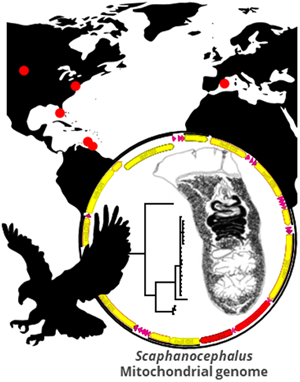
The mitochondrial genome assembly of Scaphanocephalus sp. ne1 (GenBank accession: PP577105) was a circular molecule 14 188 bp in length, with mean of 2279 (range 516–17 204) reads per site from the 5′ end of cox3 to the 3′ end of nad5 (i.e. excluding a difficult to assemble, non-coding, region repetitive that artefactually increases read depth). Annotations yielded 36 genes: 12 protein-coding genes (cox1-3, nad1-6, nad4L, atp6, cob), 22 tRNA genes and 2 rRNA genes (Table 5) transcribed in the same direction (5′–3′). Mitochondrial coding genes were separated by short intergenic sequences except for cox2 and nad6, which overlap by 17 bp. The start codon ATG was used in 7 protein-coding genes, followed by GTG codon in 4 genes, and TTG in 1, and all coding genes ended in the TAG stop codon except nad2, which terminated with TAA. The molecule was A + T enriched, like other opisthorchiid mt genomes (Table 6).
Position and characteristics of protein-coding and non-coding sequences from the mt genome of Scaphanocephalus sp. ne 1 (GenBank accession: PP577105)

Comparison of mitochondrial genomes from the Opisthorchiidae

In phylogenetic analysis of mitochondrial genomes, Scaphanocephalus and Cryptocotyle emerged as sisters while the families Opisthorchidae and Heterophyidae were not monophyletic (Fig. 6).
Phylogenetic analysis of complete mitochondrial genomes (1059 nt). The maximum likelihood topology is shown and nodes are annotated with posterior probability (Bayesian inference)/bootstrap support (1000 replicates in maximum likelihood). Maximum likelihood and Bayesian inference trees were both generated using substitution model GTR + G + I.

Minion sequencing was used to resolve the status of 2 adult specimens from 2 salvaged osprey that yielded Sanger sequences from different parts of the CO1 gene (Supplementary Fig. 3). The P distances of the barcode CO1 Sanger sequence (3′ region, PP456682) from a specimen of Scaphanocephalus sp. ne2 from Montana averaged 16.5% (range 16.3–16.6%) to CO1 from all other specimens, while the 3′ CO1 Sanger sequence (PP456683) of a worm from Florida averaged 17.2% (range 16.3–17.8%). However, these 2 Sanger sequences did not overlap and could not be compared, and repeated attempts to amplify and sequence CO1 fragments allowing direct comparison were unsuccessful. Minion sequencing of the Florida specimen yielded 27 411 reads (average length of 2618 nt) and 7457 contigs averaging 2751.1 (range 115–6963, s.d. ± 1200.7) nt in length, some assembled from hundreds of reads. Most (95%) were filtered out as contamination after mapping to bacterial, human or avian scaffolds. The remaining 356 contigs were mean 593.3, range 165–2370, s.d. ± 306.0 in length. Of the latter, a 198-nt contig mapped to the CO1 sequence obtained from Montana with 90.2% similarity. All variation between the Minion contig of the Florida specimen and the Montana specimen occurred in the first (5′) 47 and last (3′) 29 nt; the central 122 nt (PP456684) were identical in the Minion contig and the PCR-amplified, Sanger-sequenced CO1 of Scaphanocephalus sp. ne2 (PP456682) from Montana. Quality scores of the Minion contig were lower in these 5′ and 3′ marginal regions (mean quality 15.0, range 3–43, s.d. ± 8.8), and trimmed by default parameters in Geneious. In contrast, the central 122 bp of the Minion contig identical to the Sanger sequence of Scaphanocephalus sp. ne2 had mean quality 26.7, range 6–90, s.d. ± 13.1. We interpret these results as indicating the Florida specimen also belongs to Scaphanocephalus sp. ne2.
Discussion
Here we report a large-scale, molecular phylogenetic study of the trematode genus Scaphanocephalus. We describe a new species and find evidence for 4 others (2 in North America and 2 in Europe), ultimately concluding that none of these 4 can be reliably identified as S. expansus based on currently available data. We provide mitogenomic confirmation of the close relationship between this genus and Cryptocotyle, previously suspected based on morphology and phylogenetic analysis of a smaller number of nuclear characters. The genomic resources provided here will be useful in ongoing and future work that is needed in view of the association of Scaphanocephalus with BSS, an emerging pathogenesis in reef fishes.
The existence of multiple, genetically distinct species within the geographic distribution encompassed by descriptions of S. expansus casts morphometric variation in descriptions of this species in a new light. For example, measurements provided by Jägerskiöld (1904, in Egypt) are mostly smaller than those of Creplin (1842, likely in Germany). In France, Dubois (Reference Dubois1960) reported worms smaller than in both these prior accounts, yet oral suckers and internal organs were larger. Next, Foronda et al. (Reference Foronda, Santana-Morales, Feliu and Valladares2009) reported even shorter body lengths in worms from the Canary Islands than Dubois (Reference Dubois1960), along with eggs highly variable in size. Recently, González-García et al. (Reference González-García, Garcia-Varela, Lopez-Jimenez, Ortega Olivares, Pérez-Ponce de León and Andrade Gómez2023) reported worms from Mexico smaller than those described by Creplin (Reference Creplin1842), Jägerskiöld (Reference Jägerskiöld1904) and Dubois (Reference Dubois1960). All of these authors attributed such differences to morphological variability within S. expansus, but the inclusion of multiple species in these descriptions of geographically widespread specimens seems likely to have contributed to this morphometric variation.
Even without the species diversity revealed by recent molecular studies, the cosmopolitan range of S. expansus implied by records in the literature (reviewed by Kohl et al., Reference Kohl, Calhoun, Elmer, Peachey, Leslie, Tkach, Kinsella and Johnson2019) is questionable considering host distributions. While osprey definitive hosts conduct impressive latitudinal migrations, the American and European osprey constitute genetically distinct subspecies with flyways that do not overlap (Ferguson-Lees and Christie, Reference Ferguson-Lees and Christie2001; Monti et al., Reference Monti, Duriez, Arnal, Dominici, Sforzi, Fusani and Montgelard2015; Monti, Reference Monti, Panuccio, Mellone and Nicolantonio2021). Thus, transatlantic distribution of worms by osprey is unlikely. Mackrill (Reference Mackrill2023) emphasizes the unprecedentedness of a recent transatlantic journey from Scotland to Barbados by 1 osprey, speculating that the bird rested on oceangoing boats. Transatlantic transport of Scaphanocephalus in other migratory bird species is also unlikely, due to the high specificity for osprey. Another way that S. expansus could theoretically maintain population connectivity across the Atlantic is via transport of metacercariae in migrating fish hosts, but this also seems improbable. Metacercariae of Scaphanocephalus are recorded mainly in reef-associated fishes poorly adapted for long-distance migration across pelagic habitats. Transatlantic distributions are reported in just 116/2605 (4%) of reef fish species (Floeter et al., Reference Floeter, Rocha, Robertson, Joyeux, Smith-Vaniz, Wirtz and Bernardi2008; see also Evans et al., Reference Evans, Arndt and Schembri2020). Recent molecular studies (González-García et al., Reference González-García, Garcia-Varela, Lopez-Jimenez, Ortega Olivares, Pérez-Ponce de León and Andrade Gómez2023; Cohen-Sánchez et al., Reference Cohen-Sánchez, Valencia, Box, Solomando, Tejada, Pinya, Catanese and Sureda2023b) encountered metacercariae of Scaphanocephalus in fish species (X. novacula, M. curema) reported on both sides of the Atlantic in resources such as FishBase (Froese and Pauly, Reference Froese and Pauly2023). However, both these fishes consist of geographically disjunct, cryptic species (Durand and Borsa, Reference Durand and Borsa2015; Nirchio et al., Reference Nirchio, Gaviria, Siccha-Ramirez, Oliveira, Foresti, Milana and Rossi2019). Overall, given the distribution and mobility of known hosts, the parasites described from osprey in Germany by Creplin (Reference Creplin1842) are unlikely to be conspecific with specimens in North America and the western Atlantic; indeed, any individual species of Scaphanocephalus distributed on both sides of the Atlantic seems doubtful. This view is in keeping with the general tendency of molecular data to reveal multiple, geographically isolated species of digeneans within samples of allegedly cosmopolitan species (Locke et al., Reference Locke, Drago, López-Hernández, Chibwana, Núñez, Van Dam, Achinelly, Johnson, de Assis, de Melo and Pinto2021).
These 2 considerations – unclear morphological foundations in S. expansus, and disjunct host assemblages across the Atlantic – influence our interpretation of phylogenetic results in Scaphanocephalus. Essentially, while 28S data indicate 3 species, we argue that 5 species are more likely present among currently sequenced specimens, for 2 reasons. First, 28S may be identical in species of digeneans distinguishable through life history, morphology and other markers, and, secondly, 2 of the 28S lineages in Scaphanocephalus have implausible transoceanic distributions. Examples of digenean species that are poorly distinguishable with 28S and other commonly used nuclear ribosomal markers include members of Hysteromorpha (Locke et al., Reference Locke, Van Dam, Caffara, Pinto, Lopez-Hernandez and Blanar2018), Pseudoheterolebes (Martin et al., Reference Martin, Ribu, Cutmore and Cribb2018), Bivesicula (Cribb et al., Reference Cribb, Bray, Justine, Reimer, Sasal, Shirakashi and Cutmore2022), Posthodiplostomum (Achatz et al., Reference Achatz, Chermak, Martens, Pulis, Fecchio, Bell, Greiman, Cromwell, Brant, Kent and Tkach2021) and Transversotrema (Cutmore et al., Reference Cutmore, Corner and Cribb2023). In neither S. robustus n. sp. nor Scaphanocephalus sp. ne2 do the 28S data provide sufficiently strong support for conspecificity of specimens separated by oceanic barriers. In the case of S. robustus n. sp., American isolates can be distinguished from Palearctic species of Scaphanocephalus both morphologically and by 5–7% divergence in CO1, which is higher than usually observed within species of digeneans (e.g. Vilas et al., Reference Vilas, Criscione and Blouin2005).
Among the 3 lineages of 28S rDNA recovered in 33 specimens, Scaphanocephalus sp. ne1 has been recovered in the Gulf of Mexico, Caribbean and North America, but not the Old World, where Creplin (Reference Creplin1842) described S. expansus. González-García et al. (Reference González-García, Garcia-Varela, Lopez-Jimenez, Ortega Olivares, Pérez-Ponce de León and Andrade Gómez2023) identified adult specimens of this species as S. expansus, based on morphological similarity to prior descriptions. However, we doubt these specimens correspond to S. expansus because, as mentioned above, trans-Oceanic distributions are unlikely in species of Scaphanocephalus; no molecular evidence supports such a distribution in Scaphanocephalus sp. ne1; and the likely inclusion of multiple species in the morphological concept of S. expansus s.l. weakens identification on morphological grounds.
The mitochondrial genome phylogeny provides strong and independent support of both early and more recent systematic hypotheses. In creating Scaphanocephalus, Jägerskiöld (Reference Jägerskiöld1904) noted its close relationship to Cryptocotyle. Kohl et al. (Reference Kohl, Calhoun, Elmer, Peachey, Leslie, Tkach, Kinsella and Johnson2019) were the first to support this close relationship using molecular data, namely partial 28S. At the family level, the paraphyly newly observed here in the evolution of mitochondrial genomes, with the Opisthorchidae nested within Heterophyidae, was first reported by Olson et al. (Reference Olson, Cribb, Tkach, Bray and Littlewood2003) and has emerged repeatedly in increasingly taxon-dense analyses of rDNA subunits by Thaenkham et al. (Reference Thaenkham, Nawa, Blair and Pakdee2011), Kuzmina et al. (Reference Kuzmina, Tkach, Spraker, Lyons and Kudlai2018), Pérez-Ponce de León and Hernández-Mena (Reference Pérez-Ponce de León and Hernández-Mena2019), Tatonova and Besprozvannykh (Reference Tatonova and Besprozvannykh2019) and Sokolov et al. (Reference Sokolov, Kalmykov, Frolov and Atopkin2022).
The new molecular data provided herein will be useful for resolving the status of both the unidentified lineages already encountered, and of S. adamsi, considered a synonym of S. expansus by Yamaguti (Reference Yamaguti1942). The rDNA operon, mitochondrial genome and CO1 sequences will facilitate surveys and phylogenetic work based on commonly used markers heretofore unused in Scaphanocephalus (e.g. 18S, ITS, NAD1). For example, these data can help identify the first intermediate host of Scaphanocephalus. The use of littorinoid and truncatelloid snails by members of Cryptocotyle (Stunkard, Reference Stunkard1930; Rothschild, Reference Rothschild1938; Wootton, Reference Wootton1957; Tatonova and Besprozvannykh, Reference Tatonova and Besprozvannykh2019) suggests coastal-dwelling members of these clades may serve as hosts for Scaphanocephalus. Thus far, all known life cycles of opisthorchioid trematodes, which include the heterophyids, opisthorchids and cryptogonimids, involve snails in 1 of 3 superfamilies: Cerithioidea, Truncatelloidea, and Littorinoidea (with Cryptocotyle as the sole representative using this last superfamily) (Cribb et al., Reference Cribb, Bray and Littlewood2001).
Identification of a gastropod intermediate host of Scaphanocephalus may shed light on regional variation in BSS epidemiology, which is a research priority due to potential effects on algal grazers that contribute to coral reef health (Mumby et al., Reference Mumby, Hastings and Edwards2007; Burkepile and Hay, Reference Burkepile and Hay2008; Kohl et al., Reference Kohl, Calhoun, Elmer, Peachey, Leslie, Tkach, Kinsella and Johnson2019). BSS appears to have increased in prevalence in the Caribbean in recent decades (Elmer et al., Reference Elmer, Kohl, Johnson and Peachey2019), and Cohen-Sánchez et al. (Reference Cohen-Sánchez, Sánchez-Mairata, Valencia, Box, Pinya, Tejada and Sureda2023a, Reference Cohen-Sánchez, Valencia, Box, Solomando, Tejada, Pinya, Catanese and Sureda2023b) also note a recent increase in reports in the Mediterranean. In most of the world, the cause of BSS has been treated as a single, cosmopolitan species, S. expansus, but we argue that the global distribution of definitive (Monti et al., Reference Monti, Duriez, Arnal, Dominici, Sforzi, Fusani and Montgelard2015) and intermediate hosts (Costello et al., Reference Costello, Tsai, Wong, Cheung, Basher and Chaudhary2017) suggests S. expansus, described initially from Germany, is probably limited to Eurasia and Africa. This predicted continental separation of species in Scaphanocephalus is supported by newly obtained CO1 distinguishing a new American species, S. robustus, from a European species with matching 28S. To clarify the status of other species of Scaphanocephalus, mitochondrial sequences are needed from morphologically characterized adults of Scaphanocephalus in Europe. Such data would resolve the conflict between our conclusions and those of Al-Salem et al. (Reference Al-Salem, Baghdadi, Mahmoud, Ibrahim and Bayoumy2021), who maintained that identical 28S in the Persian Gulf and Caribbean indicated a cosmopolitan species; and of González-García et al. (Reference González-García, Garcia-Varela, Lopez-Jimenez, Ortega Olivares, Pérez-Ponce de León and Andrade Gómez2023), who concluded the distribution of Scaphanocephalus ‘expansus’ to be cosmopolitan, based on adult morphology.
Supplementary material
The supplementary material for this article can be found at https://doi.org/10.1017/S0031182024000647.
Data availability statement
Sequence data are available at GenBank accessions: PP436423-40 (partial 28S); PP456658–84 (partial CO1); PP577105 (mitochondrial genome); PP430581 (rDNA operon). Specimen vouchers are deposited in the Museum of Southwestern Biology (MSB:Para:49134–46).
Acknowledgements
The authors are grateful to Robin Bast, Becca Wehmeier, Kristie Schott (Clinic for the Rehabilitation of Wildlife), Samantha Little (Audubon Center for Bird of Prey), Karra Pierce and Jess Dyer (Wildlife Center of Virginia), Odette Doest (Veterinary Practice Doest of Curaçao) for providing osprey gastrointestinal tracts, and to Kara Cromwell, Matthew Yutrzenka, Sophia Bourdrel and Jasmine Groves for assistance with dissections, and to an anonymous reviewer for feedback that improved the paper.
Author contributions
S. A. L. and P. T. J. J. conceived and designed the study. All authors contributed to data gathering – obtaining samples or sequences. S. A. L. generated a draft manuscript that all authors revised and approved.
Financial support
This research was funded by a National Science Foundation award (1845021) to S. A. L. S. C. D. P. was supported by the COVID-19 Science Communication and Living Expenses Grant from the Puerto Rico Science Technology and Research Trust. Other support was from Undergraduate Research Opportunities (UROP), Biological Sciences Initiative (BSI), Eppley Foundation and the David and Lucile Packard Foundation to P. T. J. J.
Competing interests
None.
Ethical standards
Vertebrate hosts used in this research were salvaged osprey (permit MBPER0028773).


 Open access

