





Introduction
Rice is a staple crop and the primary source of dietary energy for more than half of the world’s population, making it critical for global food and nutritional security (CGIAR 2013; Kumar et al. Reference Kumar, Chhokar, Meena, Kharub, Gill, Tripathi, Gupta, Mangrauthia, Sundaram, Sawant, Gupta, Naorem, Kumar and Singh2022). India plays a pivotal role in this context, accounting for 25% of world’s rice growing area and 21% of global rice production (Singh et al. Reference Singh, Tripathi, Taloor, Kotlia, Singh, Attri, Taloor, Kotlia and Kumar2021). Therefore, the sustainability of India’s rice sector is crucial for food security at national, regional, and global levels. To achieve food security while minimizing environmental effects in a changing climate, rice must be cultivated sustainably and efficiently, using fewer resources of labor, water, energy, and agrochemicals while mitigating the adverse effects of climate change (Reddy et al. Reference Reddy, Parihar, Panneerselvam, Sarkar, Patra, Bharadwaj, Sena, Reddy, Sinha, Dhakar and Kumar2025). Achieving these goals will require a paradigm shift in rice cultivation, moving away from manual puddled transplanted rice (PTR), which is labor- and resource-intensive to alternative methods that are more resource-efficient and cost-effective, with reduced greenhouse gas emissions, and better adapted to climate variability (Chakraborty et al. Reference Chakraborty, Ladha, Rana, Jat, Gathala, Yadav, Rao, Ramesha and Raman2017; Kumar and Ladha Reference Kumar and Ladha2011; Reddy et al. Reference Reddy, Parihar, Panneerselvam, Sarkar, Patra, Bharadwaj, Sena, Reddy, Sinha, Dhakar and Kumar2025).
Manual PTR is the predominant method of rice cultivation in India, particularly in the northwestern region (Kumar et al. Reference Kumar, Chhokar, Meena, Kharub, Gill, Tripathi, Gupta, Mangrauthia, Sundaram, Sawant, Gupta, Naorem, Kumar and Singh2022). In this method, rice seedlings are first raised in a nursery, then uprooted and manually transplanted into puddled (wet-tilled) soil in the main field, which remains flooded for most of the growing season. This method offers several agronomic benefits, including good crop establishment, effective weed suppression, improved nutrient availability, and reduced water percolation losses (Johnson and Mortimer Reference Johnson and Mortimer2005; Sharma et al. Reference Sharma, Ladha, Bhushan, Ladha, Hill, Duxbury, Gupta and Buresh2003). However, the long-term sustainability of PTR is increasingly being questioned in recent years due to its intensive requirements in labor, water, and energy—resources that are becoming scarcer and more expensive (Chakraborty et al. Reference Chakraborty, Ladha, Rana, Jat, Gathala, Yadav, Rao, Ramesha and Raman2017; Gathala et al. Reference Gathala, Kumar, Sharma, Saharawat, Jat, Singh, Kumar, Jat, Humphreys, Sharma and Sharma2013; Kumar and Ladha Reference Kumar and Ladha2011). Moreover, PTR significantly contributes to greenhouse gas emissions, particularly methane (Reddy et al. Reference Reddy, Parihar, Panneerselvam, Sarkar, Patra, Bharadwaj, Sena, Reddy, Sinha, Dhakar and Kumar2025). All these factors are making PTR progressively less profitable and sustainable and underscore the urgent need for alternative rice establishment methods that are more efficient in labor, water, and energy use; and are cost-effective, youth-friendly, and capable of mitigating climate change (Kumar et al. Reference Kumar, Jat, Sharma, Gathala, Malik, Kamboj, Yadav, Ladha, Raman, Sharma and McDonald2018; Kumara et al. Reference Kumara, Birthal, Meena and Kumar2026; Panneerselvam et al. Reference Panneerselvam, Kumar, Banik, Kumar, Parida, Wasim, Das, Pattnaik, Roul, Sarangi and Sagwal2020; Reddy et al. Reference Reddy, Parihar, Panneerselvam, Sarkar, Patra, Bharadwaj, Sena, Reddy, Sinha, Dhakar and Kumar2025).
Drill-seeded rice (DSR), a non-puddled and non-flooded system in which rice seeds are directly sown in a field using seed drills, has emerged as an efficient and sustainable alternative to PTR (Bhullar et al. Reference Bhullar, Singh, Kumar and Gill2018; Dhillon et al. Reference Dhillon, Kumar, Sagwal, Kaur, Mangat and Singh2021; Jat et al. Reference Jat, Singh, Gupta, Gill, Chauhan and Pooniya2019; Kumar et al. Reference Kumar, Jat, Sharma, Gathala, Malik, Kamboj, Yadav, Ladha, Raman, Sharma and McDonald2018; Panneerselvam et al. Reference Panneerselvam, Kumar, Banik, Kumar, Parida, Wasim, Das, Pattnaik, Roul, Sarangi and Sagwal2020). Several studies in the region have reported multiple advantages of DSR over PTR. These include substantial labor saving by eliminating the process of first raising rice in a nursery and then transplanting it; water savings of 18% to 50% by avoiding puddling and maintaining non-flooded (aerobic) soil conditions for most of the growing season; lower production costs, with savings in the range of US$74 to US$149 ha−1 and reduction in methane emissions by 70% without any yield penalty (Bhuller et al. Reference Bhullar, Singh, Kumar and Gill2018; Chakrabarty et al. Reference Chakraborty, Ladha, Rana, Jat, Gathala, Yadav, Rao, Ramesha and Raman2017; Kumar and Ladha Reference Kumar and Ladha2011; Kumar et al. Reference Kumar, Jat, Sharma, Gathala, Malik, Kamboj, Yadav, Ladha, Raman, Sharma and McDonald2018; Reddy et al. Reference Reddy, Parihar, Panneerselvam, Sarkar, Patra, Bharadwaj, Sena, Reddy, Sinha, Dhakar and Kumar2025; Singh et al. Reference Singh, Kumar, Kumar, Solanki, McDonald, Kumar, Poonia, Kumar, Ajay, Kumar, Singh, Singh and Malik2020). Because of these benefits, there is an increased interest among public and private sector organizations to promote DSR, and farmers are slowly transitioning from PTR to DSR in various parts of India (Bhullar et al. Reference Bhullar, Singh, Kumar and Gill2018; CSISA 2017; Kakumanu et al. Reference Kakumanu, Kotapati, Nagothu, Kuppanan and Kallam2019).
Despite several advantages of DSR, its adoption in India has been low and slow. One of the biggest challenges hindering its widespread adoption and preventing farmers from realizing its full yield potential and economic benefits is severe weed infestation (Kumar and Ladha Reference Kumar and Ladha2011; Kumar et al. Reference Kumar, Singh, Chhokar, Malik, Brainard and Ladha2013; Rao et al. Reference Rao, Johnson, Sivaprasad, Ladha and Mortimer2007, Reference Rao, Wani, Ramesha, Ladha, Chauhan, Jabran and Mahajan2017; Xu et al. Reference Xu, Li, Wang, Xiong and Wang2019). Weed infestation tends to be higher in DSR fields compared to PTR fields due to two key factors: 1) the early flooding used in PTR to suppress the initial flush of weeds is not an option in DSR because rice is sensitive to early flooding at germination and early establishment stage; and 2) the seedling age advantage in PTR, which provides a head-start to rice and enhances weed suppression, is lost in DSR, where weeds emerge concurrently with the rice crop (Rao et al. Reference Rao, Wani, Ramesha, Ladha, Chauhan, Jabran and Mahajan2017). Yield losses due to weed competition in DSR is much higher than in PTR (Kumar and Ladha Reference Kumar and Ladha2011; Kumar et al. Reference Kumar, Bellinder, Gupta, Malik and Brainard2008; Rao et al. Reference Rao, Johnson, Sivaprasad, Ladha and Mortimer2007; Singh et al. Reference Singh, Singh, Singh, Yadav, Sinha, Johnson and Mortimer2011), with losses ranged from 50% to 90% if not effectively controlled (Chauhan and Johnson Reference Chauhan and Johnson2011; Prasad Reference Prasad2011).
Therefore, effective weed control is critical to reducing weed competition in DSR. A sequential application of preemergence herbicides (e.g., pendimethalin or oxadiargyl or pretilachlor with safener) followed by one of the postemergence herbicides based on the weed flora (e.g., bispyribac-sodium, fenoxaprop-ethyl, penoxsulam, a premix of florpyrauxifen-benzyl + cyhalofop-butyl, a premix of triafamone + ethoxysulfuron, a tank mix of bispyribac + pyrazosulfuron, and fenoxaprop-p-ethyl + ethoxysulfuron) and a need-based hand-weeding have been found to be effective in controlling weeds in DSR (CSISA 2023; Gill et al. Reference Gill, Bhullar, Yadav and Yadav2013; Panneerselvam et al. Reference Panneerselvam, Kumar, Banik, Kumar, Parida, Wasim, Das, Pattnaik, Roul, Sarangi and Sagwal2020; Saha et al. Reference Saha, Munda, Singh, Kumar, Jangde, Mahapatra and Chauhan2021). However, selecting postemergence herbicides is knowledge-intensive, and their narrow application window often hinders farmers from achieving optimal weed control in DSR. Additionally, preemergence efficacy is affected by soil moisture and may cause crop injury under too-wet conditions due to untimely rain. Therefore, herbicide programs with broad-spectrum weed control capability, a more flexible application window, and minimal risk of crop injury are required to achieve effective weed control under DSR conditions in the global South, where knowledge of herbicide selection and timing of application is lacking at the farmer level.
Herbicide-resistant rice (HR rice) can help overcome weed control challenges and hence can facilitate the adoption of more sustainable practice of DSR. Some of the key benefits of HR rice include 1) improved weed control with greater flexibility and reduced risk of crop phytotoxicity, especially for problematic weeds of DSR including weedy rice; 2) replacement of currently used herbicides with more effective herbicides in controlling broad-spectrum weeds with better environmental profiles; and 3) new options for controlling weeds that have evolved resistance to current herbicides (Kumar et al. Reference Kumar, Bellinder, Gupta, Malik and Brainard2008).
Non-genetically modified (non-GM) herbicide-tolerant rice, especially rice that is tolerant of imidazolinone (IMI) has been developed and successfully commercialized in several countries, including the Brazil, Colombia, Italy, Malaysia, Uruguay, and the United States to control weedy rice (Oryza spp.), one of the most difficult-to-control weeds in DSR (De Avila et al. Reference De Avila, Marchesan, Camargo, Merotto, da Rosa Ulguim, Noldin, Andres, Mariot, Agostinetto, Dornelles and Markus2021; Sudianto et al. Reference Sudianto, Beng-Kah, Ting-Xiang, Saldain, Scott and Burgos2013) and other key weed species such as barnyardgrass, broadleaf signalgrass (Brachiaria reptans (L.) C. A. Gardner & C.E. Hubb.), and rice flatsedge (Cyperus iria L.) (Levy et al. Reference Levy, Bond, Webster, Griffin and Linscombe2006; Ottis et al. Reference Ottis, Chandler and McCauley2003; Pellerin et al. Reference Pellerin, Webster, Zhang and Blouin2004; Tan et al. Reference Tan, Evans, Dahmer, Singh and Shaner2005). Additionally, imazethapyr is compatible with several other herbicides for a tank-mix application to enhance weed control efficacy, including control of weeds that are not controlled by imazethapyr alone (Masson and Webster Reference Masson and Webster2001).
In India, two IMI-resistant aromatic basmati rice varieties, Pusa Basmati 1979 and Pusa Basmati 1985, were released in 2024 to tackle the weed control challenge in DSR (Kar et al. Reference Kar, Chakraborti, Munda, Saha, Swain, Mukherjee, Behera, Majhi, Kumari, Mandal, Samantaray and Nayak2024). Similarly, Savannah Seed Pvt Ltd., a subsidiary of RiceTec, has also introduced the IMI-resistant technology in hybrid rice varieties under the FullPage Rice Cropping Solution (https://ricetec.com/news-press-releases). Currently, imazethapyr is the only herbicide registered for use in IMI-tolerant rice in India. Despite its success in other countries, limited research has been carried out in India to assess its effectiveness against diverse weed flora and to evaluate IMI-based weed control programs under DSR conditions.
While IMI-tolerant rice offers significant weed control benefits, the soil persistence of IMI herbicides may pose challenges for succeeding crops in rotation (Alister and Kogan Reference Alister and Kogan2005). Some degree of persistence in soil is advantageous for extended weed control; however, prolonged herbicide residues can negatively affect the growth and yield of succeeding crops in rotation (Santos et al. Reference Santos, Pinto, Piveta, Noldin, Galon and Concenço2014). To mitigate these risks, it is crucial to evaluate the carryover effect of IMI herbicides on succeeding crops grown in rice-based systems in India. This will help in developing crop rotation strategies for adopters of IMI-tolerant rice. Therefore, the main objectives of this research were to 1) determine the optimum timing and rate of IMI herbicides (imazethapyr and imazethapyr + imazamox) for weed control in IMI-tolerant rice under DSR conditions; and 2) assess the carryover effects of IMI herbicides on succeeding crops in northwest India’s rice-based systems.
Materials and Methods
Experimental Site and Climate
Field experiments were conducted over a 3-yr period from 2020 to 2023 at Chaudhary Charan Singh (CCS) Haryana Agricultural University, Regional Research Station, Uchani, Karnal, Haryana, India (29.7690 N, 76.9903 E). The soil type at the experimental field was a clay loam with low organic carbon (0.42), pH 8.1, and available N, P2O5, and K2O at 131 kg ha−1, 15 kg ha−1, and 290 kg ha−1, respectively. The climate at the experimental site is semiarid, with an average annual rain of 759 mm, about 80% of which falls during the monsoon period between June and September. The daily minimum and maximum temperatures range from 0 to 4 C in January and from 41 to 44 C in May/June, respectively. The relative humidity varied from 50% to 90% throughout the year.
Treatment Description, Experimental Details and Data Collection
Experiment 1: Imazethapyr-Based Herbicide Program for Weed Control in IMI-Tolerant Rice
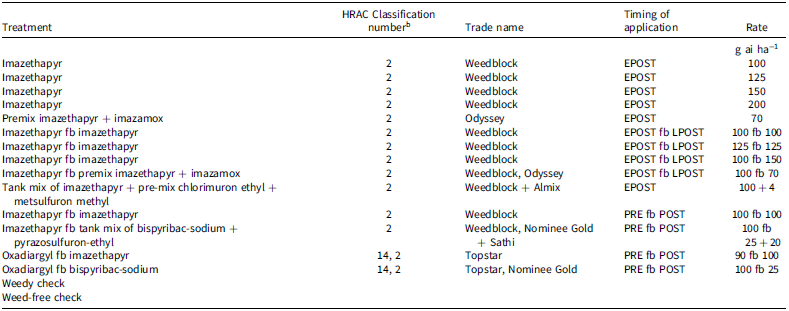
This experiment consisted of 16 herbicide combinations laid out in a randomized complete block design with three replications. The experiment was carried out from June to October in three consecutive years during the rainy/wet season (locally known as the kharif season) in 2020, 2021, and 2022 (Table 1). Treatments consisted of a single early postemergence application of imazethapyr and sequential early postemergence applications of imazethapyr followed by (fb) a late postemergence herbicide, varying across different rate combinations, as described in Table 1. All preemergence treatments were applied 2 to 3 d after sowing (DAS). Early postemergence treatments were applied around 14 to 17 DAS, while late postemergence treatments were applied 10 to 14 d after early postemergence treatments. Postemergence herbicides were applied around 20 to 25 DAS.
Herbicide information. a

a Abbreviations: DAS, days after sowing; fb, followed by; EPOST, early postemergence (applied at 14–17 DAS); HRAC, Herbicide Resistance Action Committee; LPOST, late postemergence (applied at 24–27 DAS); POST, postemergence (applied around 20–25 DAS); PRE, preemergence (2–3 DAS).
b Group 2 herbicides are inhibitors of amino synthase. Group 14 herbicides are inhibitors of protoporphyrinogen oxidase.
Seedbed preparation consisted of two passes, each with a tyne cultivator and disc harrow, followed by leveling with a wooden plank. The field was laser-leveled before sowing the crop. Rice hybrid SAVA 134 HT (Savannah Seeds Pvt. Ltd.) was drill-seeded using a tractor-mounted seed drill in dry conditions at a row spacing of 20 cm at a depth of 2 to 3 cm using a seed rate of 20 kg ha−1 on June 23, 2020, June 9, 2021, and June 16, 2022. Irrigation was applied on the same day of sowing to ensure uniform crop emergence. Plots consisted of 11 rows (with row-to-row spacing of 20 cm) and were 8 m long. The crop was irrigated frequently but not permanently flooded and kept as aerobic to saturate. Irrigation was applied when a hairline crack appeared on the soil surface. The recommended N-P₂O₅-K₂O rate (150-60-60 kg ha−1) was applied, with full dose of phosphorus and potassium at sowing, and nitrogen (urea) top-dressed in three equal splits at 20 to 22, 40 to 45, and 60 to 65 DAS (CCS 2020). Herbicides were applied using a knapsack sprayer calibrated to deliver 500 L ha−1 volume for preemergence applications and 375 L ha−1 for postemergence applications, fitted with a cut nozzle (XLP/WP/40/60/500; ASPEE, Mumbai, India) for preemergence applications and flat-fan nozzle (FFP/95/900; ASPEE) for early and late postemergence applications. Imazethapyr at early postemergence and late postemergence was applied with a tank mix of ammonium sulphate (2.0 g) and a surfactant with 1.5 mL per liter of water. All other agronomic and pest management practices were followed according to CCS Haryana Agricultural University’s recommendations (CCS 2020). Rice plots were manually harvested on October 16, 2020, October 17, 2021, and October 27, 2022. To estimate grain yield, eight rows each that were 7.5 m long (12 m2) were harvested from each plot, threshed and weighed, and the plot yield was converted to kilograms per hectare (kg ha−1) at 14% moisture content. To assess the effect of IMI herbicides on rice phytotoxicity, visual assessments of rice injury were recorded at 3, 7, 10, and 20 DAS based on a scale of 0% to 100%, where 0% represented no injury or no control, and 100% represented complete control or plant death. Species-wise weed density and dry weight were recorded at 60 DAS. For this purpose, two quadrats of 0.5 m by 0.5 m were placed randomly in each plot, weeds were manually harvested from the soil surface and collected from each quadrat. Weed dry weight in grams per square meter (g m−2) was determined after drying the samples in an oven at 70 C for 72 h.
Experiment 2: Assessing Carryover Effect of Imazethapyr and Premix Imazethapyr + Imazamox Applied During Rice on Succeeding Non-Rice Crops
The experiment was conducted to investigate the residual effect of imazethapyr and imazethapyr + imazamox used on IMI-tolerant rice during the kharif wet season on succeeding crops grown in the winter season (locally known as the rabi season) from November to April during 2020–21, 2021–22 and 2022–23. The carryover effect of IMI herbicides was assessed on dominant succeeding rabi/winter-season crops grown in the region, including spring wheat, mustard, chickpea, lentil, and maize. The experiment was laid out in a randomized complete block design with three replications. The succeeding crops, wheat (variety HD 3086 in rabi 2020–21 and HD 2967 in rabi 2021–22), mustard (variety RH 725), chickpea (variety HC 5), lentil (variety Sapna), and maize (variety HQPM 1) were directly seeded in rice stubbles in a perpendicular direction, with six rows of wheat and four rows of other crops in each plot of Experiment 1 carried out during the kharif seasons. These crops were sown during the last week of October in each study year. All crops were sown at recommended seeding rates with row-to-row spacing of 40 cm, except for wheat, for which spacing was 20 cm. All plots were kept free of weeds by need-based manual weeding. Weed-free and weedy check plots served as the no-herbicide checks. To assess the carryover effect of IMI herbicides on crop emergence and growth, plant population per meter row length and crop dry weight at 60 DAS were recorded for each crop.
Statistical Analysis
ANOVA in R software (v.3.6.1) was used to analyze the data. The fixed effects in ANOVA were herbicides, whereas the replications and all interactions involving replication were considered random effects. Due to significant year-by-treatment interaction (P < 0.05), the data were analyzed separately for each year. Treatment means were separated using a Tukey HSD test with a value of α = 0.05 to minimize the Type I errors.
Results and Discussion
Experiment 1: Imazethapyr-based herbicide programs for weed control in IMI-Tolerant rice
The field site was infested primarily with grassy weeds, including barnyardgrass, crowfootgrass, and Chinese sprangletop. Among the broadleaf weeds, blistering ammannia (Ammania bacifera L.) and jute mallow (Corchorus olitorius L.) were the dominant weed species. Under weedy check conditions, a higher total weed dry weight was recorded during the 2020 kharif season than in other seasons.
Results showed that oxadiargyl was comparatively more effective in controlling grassy weeds than imazethapyr when applied preemergence (Table 2). During 2022, when oxadiargyl was applied, the densities of barnyardgrass, crowfootgrass, and Chinese sprangletop were reduced by 75% to 81% at 15 DAS compared with weedy check plots, whereas imazethapyr suppressed the density of those weeds by 45% to 57%.
Weed density of barnyardgrass, crowfootgrass, and Chinese sprangletop at 15 d after sowing as influenced by imazethapyr and oxadiargyl herbicides applied preemergence during 2022. a – c

a Abbreviations: fb, followed by; POST, postemergence; PRE, preemergence.
b The treatment column shows the full treatment name (PRE followed by POST); however, the results presented here reflect only the effect of the first herbicide applied PRE.
c Means within a column with common letters are not significantly different based on the Tukey HSD test at 5% probability. Letters are missing against mean value for mean comparision.
Barnyardgrass
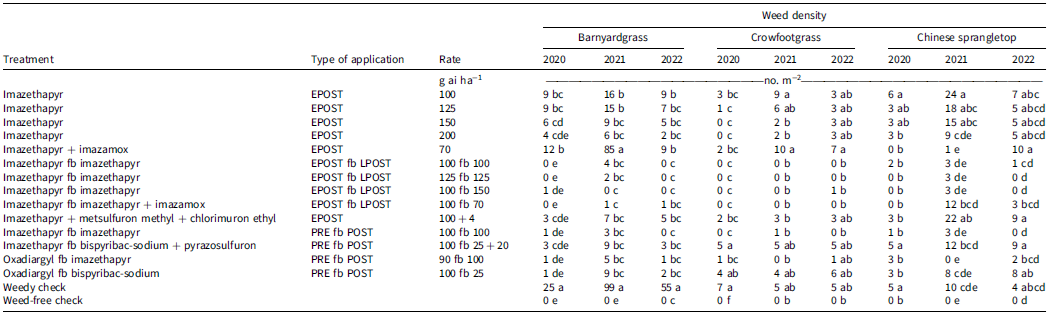
At 60 DAS, sequential early postemergence applications fb late postemergence applications of imazethapyr (100 fb 100 g ai ha−1, 100 fb 150 g ai ha−1, or 125 fb 125 g ai ha−1) as well as sequential preemergence applications fb postemergence applications (100 fb 100 g ai ha−1) consistently reduced barnyardgrass density by 96% to 100% in all 3 yr compared to the weedy check (Table 3). These results are consistent with those reported by Levy et al. (Reference Levy, Bond, Webster, Griffin and Linscombe2006) that preemergence fb postemergence applications of imazethapyr controlled barnyardgrass, rice flatsedge, and weedy/red rice by 98%. Similarly, Atwill et al. (Reference Atwill, Bond, Gore, Gholson, Walker, Spencer, Oakley, Reynolds and Krutz2023) also recorded 91% to 96% control of barnyardgrass with imazethapyr under both continuous and intermittent flood water management systems.
Effect of different imazethapyr-based herbicide programs on weed density of barnyardgrass, crowfootgrass, and Chinese sprangletop at 60 DAS in drill-seeded IMI-resistant rice. a , b

a Abbreviations: DAS, days after sowing; fb, followed by; EPOST, early postemergence (applied at 14–17 DAS); IMI, imidazolinone; LPOST, late postemergence (applied at 24–27 DAS); POST, postemergence (applied around 20–25 DAS); PRE, preemergence (2–3 DAS).
b Means within a column with common letters are not significantly different based on the Tukey HSD test at 5% probability.
Results also demonstrated that sequential postemergence application of imazethapyr fb a premix application of imazethapyr + imazamox reduced barnyardgrass density by 99% to 100%. A combination of preemergence oxadiargyl fb postemergence imazethapyr effectively suppressed the density of barnyardgrass by 95% to 98%. A conventional herbicide program of oxadiargyl fb bispyribac-sodium was found to be effective in suppressing barnyardgrass density by 91% to 96% compared with a weedy check. These findings agree with those reported by Jat et al. (Reference Jat, Singh, Gupta, Gill, Chauhan and Pooniya2019) and Saha et al. (Reference Saha, Munda, Singh, Kumar, Jangde, Mahapatra and Chauhan2021) that barnyardgrass was effectively controlled with bispyribac-sodium. Awan et al. (Reference Awan, StaCruz and Chauhan2015) reported 95% to 100% control of barnyardgrass with oxadiazon applied preemergence fb bispyribac-sodium applied postemergence.
In contrast, single postemergence applications of imazethapyr were relatively less effective in suppressing barnyardgrass density (Table 3). However, efficacy increased from 64% to 84% when imazethapyr was applied at 100 g ai ha−1 to 84% to 96% when the herbicide was applied at 200 g ai ha−1 in all years of the study. A single early postemergence application of premixed imazethapyr + imazamox was also less effective in reducing barnyardgrass density than sequential postemergence applications of imazethapyr (Table 3). Webster and Masson (Reference Webster and Masson2001) also reported poor control (53%) of barnyardgrass with a single application of imazethapyr at 70 to 140 g ai ha−1 when rice was at the 2- to 3-leaf stage, but control increased to 88% to 96% when imazethapyr was sequentially applied preemergence fb postemergence.
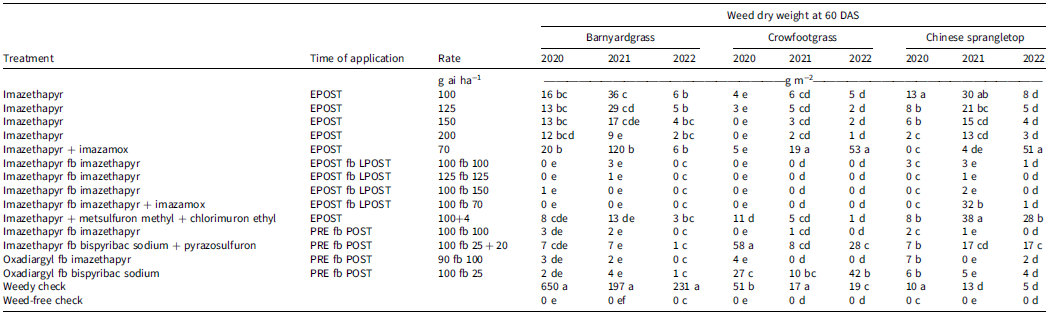
All treatments with sequential postemergence applications or preemergence fb postemergence applications effectively suppressed the dry biomass of barnyardgrass by 98% to 100% compared with the weedy checks in all 3 yr (Table 4). Imazethapyr applied alone early postemergence at 100 g ai ha−1 resulted in a decrease in barnyardgrass biomass by 82% to 97% compared with the weedy check plots, and suppression increased with an increase in imazethapyr rate resulting in 95% to 99% biomass reduction at 200 g ai ha−1. The premix of imazethapyr + imazamox applied early postemergence effectively reduced barnyardgrass biomass by 97% in two out of three years, but 2021 the reduction was only 39%, likely due to the emergence of a second cohort of barnyardgrass in Year 2 after herbicide application. Conventional herbicide applications of oxadiargyl fb bispyribac-sodium provided similar barnyardgrass control (97% to 99%) as sequential imazethapyr-based applications but better than a single postemergence application of imazethapyr.
Effect of different imazethapyr-based herbicide programs on weed dry weight of barnyardgrass, crowfootgrass, and Chinese sprangletop at 60 DAS in drill-seeded IMI-resistant rice. a , b

a Abbreviations: DAS, days after sowing; fb, followed by; EPOST, early postemergence (applied at 14–17 DAS); IMI, imidazolinone; LPOST, late postemergence (applied at 24–27 DAS); POST, postemergence (applied around 20–25 DAS); PRE, preemergence (2–3 DAS).
b Means within a column with common letters are not significantly different based on the Tukey HSD test at 5% probability.
Crowfootgrass
Similar to barnyardgrass, sequential early postemergence applications of imazethapyr fb late postemergence applications at various rates completely suppressed crowfootgrass density and biomass by 100% (Tables 3 and 4). Similarly, imazethapyr applied sequentially before emergence fb a postemergence application also achieved 100% control in Years 1 and 3. However, in Year 2, crowfootgrass density and biomass were reduced by 80% and 94%, respectively, relative to the weedy check. Kaur et al. (Reference Kaur, Kaur and Bhullar2016) in a study in Punjab, India, observed that imazethapyr (70 g ai ha−1) and a premix of imazethapyr + imazamox (70 g ai ha−1) provided effective control of crowfootgrass in green gram (Vigna radiata L.). Maji et al. (Reference Maji, Reja, Nath, Bandopadhyay and Dutta2020) also observed that imazethapyr and imazethapyr + imazamox provided effective control of grasses dominated by crowfootgrass in green gram.
Integrating a conventional preemergence herbicide (oxadiargyl) with imazethapyr as a postemergence herbicide resulted in a reduction in crowfootgrass density by 86%, 100%, and 80% in Years 1, 2, and 3, respectively, and the biomass reduction ranged from 92% to 100% compared with weedy check plots in all 3 yr (Tables 3 and 4). In contrast, the conventional herbicide treatment (preemergence oxadiargyl fb postemergence bispyribac-sodium) was ineffective in suppressing crowfootgrass density and biomass (<50%) in Years 1 and 2, and it had no effect in Year 3. Similarly, a preemergence application of imazethapyr fb a conventional late postemergence application of bispyribac sodium + pyrazosulfuron-ethyl was not effective in suppressing the density and biomass of crowfootgrass. Bhullar et al. (Reference Bhullar, Kumar, Kaur, Kaur, Singh, Yadav, Chauhan and Gill2016) also reported poor efficacy, with only 12% to 35% control of crowfootgrass after postemergence applications of bispyribac sodium. A single early postemergence application of premix imazethapyr + imazamox did not effectively suppress crowfootgrass density or biomass in Years 2 and 3, but density and biomass were suppressed by 71% and 90%, respectively, in Year 1. The efficacy of imazethapyr as a single early postemergence application increased with the herbicide rate (82% to 100% reduction in crowfootgrass biomass) at 150 to 200 g ai ha−1 across years compared with the weedy check plots. At lower rates of imazethapyr (100 to 125 g ai ha−1), the reduction was lower, ranging from 64% to 95% depending on the year. Overall, these findings highlight the superior efficacy of sequential applications of imazethapyr-based treatments, particularly those that target both early- and late-emerging cohorts for season-long control of crowfootgrass in the DSR system.
Chinese Sprangletop
Similar to results with barnyardgrass and crowfootgrass, sequential early postemergence applications of imazethapyr fb late postemergence applications at either 125 fb 125 g ai ha−1 or 100 fb 150 g ai ha−1, and sequential preemergence and postemergence applications of imazethapyr effectively reduced Chinese sprangletop density and biomass by 70% to 100% and by 80% to 100%, respectively, compared with weedy check plots in all 3 yr (Tables 3 and 4). Compared with weedy check plots, Chinese sprangletop density was reduced by 62% to 68% and biomass was reduced by 70% to 80% after sequential postemergence applications of imazethapyr at 100 g ai ha−1, but the reductions were statistically comparable to the higher rates of imazethapyr. Chinese sprangletop density was reduced by 87% to 100% and biomass was reduced by 71% to 100% during the first 2 yr after early postemergence applications of the imazethapyr + imazamox premix, but it was ineffective in suppressing both density and biomass in the third year, likely due to the late emergence of Chinese sprangletop after the herbicide was applied. These results are similar to those reported by Levy et al. (Reference Levy, Bond, Webster, Griffin and Linscombe2006) that imazethapyr applied both preemergence and postemergence controlled Amazon sprangletop [Leptochloa panicoides (J. Presl) Hitchc.] by 87% to 91%. Ruzmi et al. (Reference Ruzmi, Ahmad-Hamdani, Abidin and Roma-Burgos2021) found that other IMI herbicides such as premixed imazapic + imazapyr (OnDuty, BASF Crop Solutions Australia) provided effective control of Chinese sprangletop and other key weeds of rice including weedy rice, barnyardgrass, ricefield flatsedge, and globe fringe rush fimbristylis (Fimbristylis littoralis Gaudich.) in Malaysia. All other treatments did not provide effective control of Chinese sprangletop. For example, all postemergence applications of imazethapyr alone did not result in significant reductions in Chinese sprangletop density and biomass compared with weedy check plots. Sequential early postemergence applications of imazethapyr fb bispyribac sodium+ pyrazosulfuron or a sole application of the tank mix of imazethapyr + premixed metsulfuron-methyl + chlorimuron-ethyl also failed to achieve satisfactory control of sprangletop. Bhullar et al. (Reference Bhullar, Kumar, Kaur, Kaur, Singh, Yadav, Chauhan and Gill2016) also reported poor control (35%) of Chinese sprangletop with pendimethalin (preemergence) fb bispyribac-sodium (postemergence) in DSR. Several studies also reported poor control of Chinese sprangletop with bispyribac-sodium (Jacob et al. Reference Jacob, Menon and Abraham2017; Menon Reference Menon2015; Sekhar et al. Reference Sekhar, Ameena, Jose, Beena and Susha2024).
Blistering Ammannia
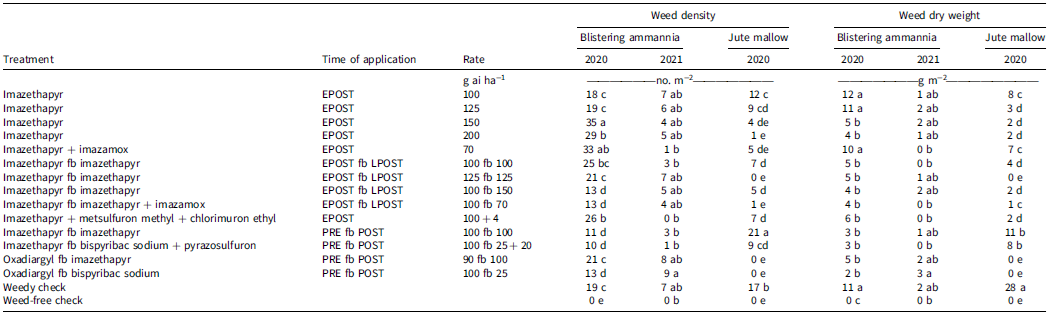
Among broadleaf weeds, blistering ammannia is a major weed in DSR (Chauhan Reference Chauhan2013). In Year 1, plots were considered to be moderately infested with blistering ammannia, whereas in Year 2, density was low and spatially inconsistent across experimental plots. In Year 1, early postemergence applications of imazethapyr at all tested rates (100 to 200 g ai ha−1) failed to significantly reduce blistering ammannia density compared to weedy check plots (Table 5). However, sequential early fb late postemergence applications of imazethapyr (100 fb 150 g ai ha−1) or preemergence fb postemergence applications, and imazethapyr fb premix imazethapyr + imazamox suppressed blistering ammannia by 29% to 40% and biomass by 60% to 75% relative to weedy check plots. Pellerin et al. (Reference Pellerin, Webster, Zhang and Blouin2004) reported poor efficacy (15% control) of weed hemp sesbania (Sesbania exaltata) when imazethapyr was applied both preemergence and postemergence. Masson and Webster (Reference Masson and Webster2001) also reported similar results with Indian jointvetch control, ranging from 44% to 74%, when imazethapyr applied to water-seeded IMI-tolerant rice. Sequential preemergence applications of imazethapyr fb postemergence applications of bispyribac-sodium + pyrazosulfuron resulted in a 47% reduction in blistering ammannia density in Year 1. Density was reduced by 31% with a conventional herbicide treatment of oxadiargyl applied preemergence fb bispyribac-sodium applied postemergence. In Year 1, higher early postemergence application rates of imazethapyr (150 and 200 g ai ha−1) resulted in a 54% to 60% reduction in blistering ammannia biomass (Table 5). Biomass was reduced by 53% to 63% with sequential early postemergence fb late postemergence applications of imazethapyr, and biomass was reduced by 72% to75% with sequential preemergence applications of imazethapyr fb postemergence applications of either imazethapyr or bispyribac-sodium + pyrazosulfuron. Similarly, biomass was reduced by 82% with sequential preemergence applications of oxadiargyl fb postemergence applications of bispyribac-sodium, whereas biomass reduced by 54% when oxadiargyl was applied preemergence fb imazethapyr applied postemergence. In Year 2, due to low and patchy infestations of blistering ammannia, treatment effects on density and biomass were inconsistent and not statistically significant. Overall, our results indicate that although imazethapyr applied alone at early postemergence was ineffective, sequential applications—especially when oxadiargyl was applied preemergence fb a postemergence application of imazethapyr, bispyribac-sodium, or bispyribac-sodium + pyrazosulfuron—provided moderate suppression, emphasizing the need to integrate conventional herbicides and sequential herbicide strategies to manage this species in DSR systems.
Effect of different imazethapyr-based herbicide programs on broad leaved weed density and dry weight at 60 DAS in drill-seeded IMI-resistant rice. a , b

a Abbreviations: DAS, days after sowing; fb, followed by; EPOST, early postemergence (applied at 14–17 DAS); IMI, imidazolinone; LPOST, late postemergence (applied at 24–27 DAS); POST, postemergence (applied around 20–25 DAS); PRE, preemergence (2–3 DAS).
b Means within a column with common letters are not significantly different based on the Tukey HSD test at 5% probability.
Jute Mallow
Jute mallow density was reduced with all herbicide treatments, except when imazethapyr was applied preemergence and postemergence, with the highest reduction (94% to 100%) occurring with sequential early and late postemergence applications of imazethapyr (125 g ai ha−1) or imazethapyr (100 g ai ha−1) applied early postemergence fb the premix of imazethapyr + imazamox (70 g ai ha−1) applied late postemergence, and with sequential preemergence applications of oxadiargyl fb a postemergence application of imazethapyr or bispyribac-sodium (Table 5).
All treatments resulted in jute mallow biomass reductions that ranged from 60% to 100% compared with biomass in weedy check plots (Table 5). Notably, the imazethapyr preemergence fb postemergence treatment, while ineffective in reducing density, still suppressed biomass by 60%. Sequential postemergence applications of imazethapyr (125 g ai ha−1) or a preemergence application of oxadiargyl fb a postemergence application of bispyribac-sodium or imazethapyr provided a 92% to 100% reduction in biomass. The efficacy of an early postemergence application of imazethapyr improved when the application rate increased; the density reduction increased from 29% at 100 g ai ha−1 to 94% at 200 g ai ha−1, while biomass increased from 71% to 93%.
Total Weed Biomass
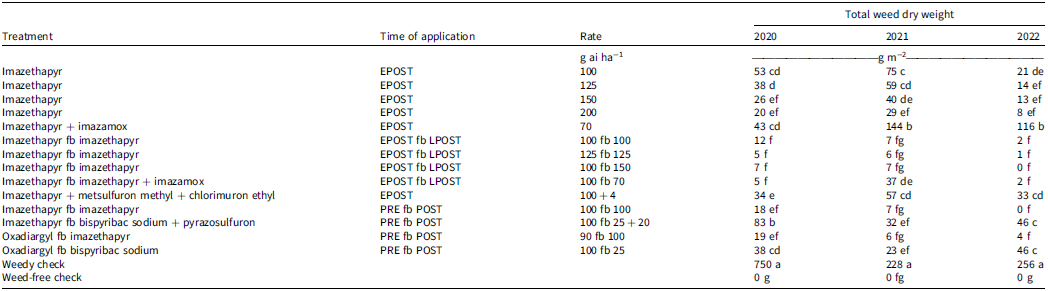
Compared with weedy check plots, total weed biomass was lower in all 3 yr with all herbicide treatments (Table 6). For instance, sequential early postemergence fb late postemergence applications of imazethapyr were most effective by consistently reducing total weed biomass by 97% to 100% compared with weedy check plots in all years. These sequential treatments outperformed the conventional herbicide treatment (preemergence oxadiargyl fb postemergence bispyribac-sodium) because total weed biomass was reduced by 82% to 94% across years compared with weedy check plots.
Effect of various imazethapyr-based herbicide programs on total weed dry weight at 60 DAS in drill-seeded IMI-resistant rice. a , b

a Abbreviations: DAS, days after sowing; fb, followed by; EPOST, early postemergence (applied at 14–17 DAS); IMI, imidazolinone; LPOST, late postemergence (applied at 24–27 DAS); POST, postemergence (applied around 20–25 DAS); PRE, preemergence (2–3 DAS).
b Means within a column with common letters are not significantly different based on the Tukey HSD test at 5% probability.
A sequential early postemergence application of imazethapyr fb a late postemergence application of premixed imazethapyr + imazamox also provided excellent control, with 99% biomass reductions in Years 1 and 3; however, efficacy was 84% in Year 2 (Table 6). Compared to single early postemergence applications of imazethapyr at 100, 125 or 150 g ai ha−1, the sequential postemergence applications of imazethapyr at 125 fb 125 g ai ha−1 or 100 fb 150 g ai ha−1 reduced total weed biomass by 72% to 90%, 82% to 92% and 93% to 96% in Years 1, 2, and 3, respectively. These findings clearly demonstrate that sequential applications, particularly with imazethapyr at two timings, is critical for achieving season-long weed suppression in fields of DSR.
Rice Yield
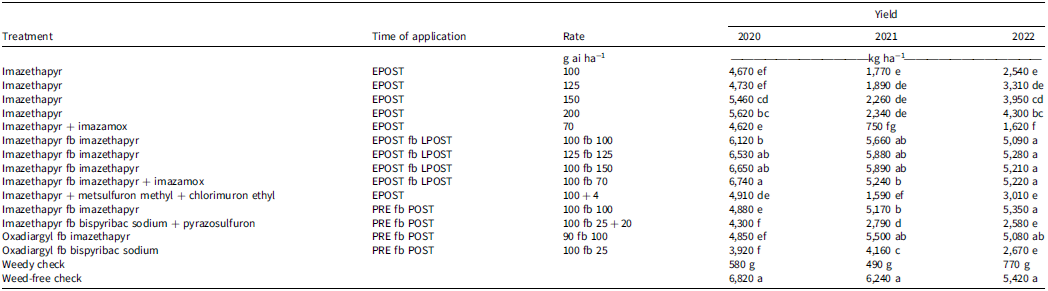
Significant differences in grain yield were observed among herbicide combinations in all 3 yr (2020 to 2022) (Table 7). Uncontrolled weeds in the weedy check plots resulted in severe grain yield losses that ranged from 86% to 92%, underscoring the importance of effective weed management in DSR.
Effect of various imazethapyr-based herbicide programs on grain yield of drill-seeded IMI-resistant rice. a , b

a Abbreviations: DAS, days after sowing; fb, followed by; EPOST, early postemergence (applied at 14–17 DAS); IMI, imidazolinone; LPOST, late postemergence (applied at 24–27 DAS); POST, postemergence (applied around 20–25 DAS); PRE, preemergence (2–3 DAS).
b Means within a column with common letters are not significantly different based on the Tukey HSD test at 5% probability.
Among all treatments, sequential early postemergence applications of imazethapyr fb late postemergence applications of either 125 fb 125 g ai ha−1 or 100 fb 150 g ai ha−1 consistently resulted in the highest rice yield (5,210 to 6,740 kg ha−1) in all years with yields comparable to that of weed-free treatments (5,420 to 6,820 kg ha−1). The next best performing treatment was the sequential postemergence application of imazethapyr at 100 g ai ha−1 fb 100 g ai ha−1, which produced yields that were comparable to the higher-rate sequential postemergence treatments in all years. However, yields under this treatment were 9% to 10% lower than that of the weed-free check in Years 1 and 2 but similar in Year 3.
Sequential early postemergence applications of imazethapyr fb a late postemergence application of the imazethapyr + imazamox premix also resulted in grain yields that were similar to those of the weed-free check in two out of three years, but in Year 2, the yield was 16% lower than the weed-free check. Sequential early postemergence treatments with imazethapyr fb a late postemergence application of 125 fb 125 g ai ha−1 or 100 fb 150 g ai ha−1 outperformed the conventional herbicide treatment with preemergence oxadiargyl fb postemergence bispyribac-sodium in both weed suppression and yield.
Sequential preemergence applications of imazethapyr fb postemergence applications (100 fb 100 g ai ha−1) or oxadiargyl applied preemergence fb imazethapyr applied postemergence (90 fb 100 g ai ha−1) also resulted in good yields (4,880 to 5,500 kg ha−1) that were comparable to those of weed-free plots in Year 3. However, in Years 1 and 2, yields after these treatments were 12% to 28% lower than yields from the weed-free control plots (Table 7). In contrast, single early postemergence applications of imazethapyr (100 to 125 g ai ha−1) resulted in substantial lower yields, ranging from 31% to 72% lower than the weed-free check plots. Yield improved when imazethapyr rates increased, with 18% to 64% lower yield than weed-free check when imazethapyr was applied at 150 to 200 g ai ha−1, depending on the year. Similarly, a single postemergence application of premixed imazethapyr + imazamox (750 to 4,620 kg−1) or a tank mix of imazethapyr + metsulfuron-methyl + chlorimuron-ethyl (2,580 to 4,300 kg ha−1) also did not result in good yield due to poor weed control with these treatments.
Experiment 2: Assessing the Carryover Effect of Imazethapyr and Premixed Imazethapyr + Imazamox Applied During Rice on Succeeding Non-Rice Crops
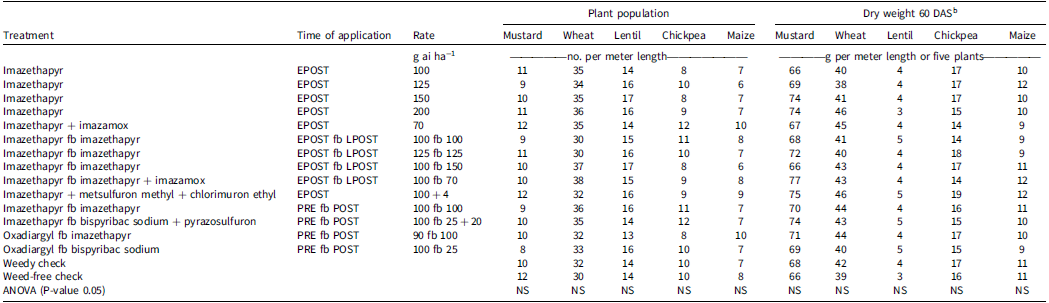
The results showed that imazethapyr-based herbicide programs applied during the rice phase had no adverse effects on the crop’s establishment or growth of succeeding crops planted after rice had been harvested in all 3 yr (Table 8). Punia et al. (Reference Punia, Punia, Sangwan and Thakral2017) reported no carryover effect of imazethapyr on succeeding wheat and chickpea crops when it was applied as pre-plant treatment, or when applied preemergence or postemergence to cluster beans [Cyamopsis tetragonoloba (L.) Taubert] grown prior to these crops in Hisar, Haryana, India. Earlier, Ulbrich et al. (Reference Ulbrich, Souza and Shaner2005) studied the carryover effect of imazapic and imazapyr in succeeding crops and found soybean to be the least sensitive, whereas edible bean, wheat, corn, and cucumber were most sensitive. But in this study, we recorded no phytotoxicity in mustard, which could be due to rain during the monsoon season and frequent irrigations of rice under DSR conditions. Punia et al. (Reference Punia, Punia, Sangwan and Thakral2017) reported that regardless of application and rates, there were no residual effect of imazethapyr or imazethapyr + imazamox on a succeeding mustard crop due to heavy rains (594 mm) during the crop growing season, which enhanced the microbial degradation of the herbicides that had been applied to a preceding crop of green gram. Sangwan and Singh (Reference Sangwan and Singh2016) also reported no carryover effect on a succeeding mustard crop of imazethapyr and imazethapyr + imazamox herbicides applied to a cluster bean crop in two different textured soils. This could be due to high temperatures and rain (500 to 594 mm) that drove microbial degradation and leaching at both the locations. However, further studies are needed on this aspect under different climatic and soil conditions because moisture availability, amount of rain, and establishment method (zero, minimum, and conventional tillage) for succeeding crops are likely to influence the toxicity to these crops, especially where continuous cultivation of herbicide-tolerant rice will rotate.
Effect of imazethapyr-based herbicide programs applied to herbicide-tolerant direct-seeded rice during crop establishment and dry biomass of succeeding crops at 60 DAS. a

a Abbreviations: DAS, days after sowing; EPOST, early postemergence (applied at 14–17 DAS); fb, followed by; LPOST, late postemergence (applied 24–27 DAS); POST, postemergence (applied around 20-25 DAS); PRE, preemergence (at 1–3 DAS).
b Dry biomass of wheat was measured in grams per meter length. Other crops are measured in grams per five plants.
Practical Implications
Infestations of weeds and their emergence in different cohorts in DSR cause significant yield losses and remain a major bottleneck in the wide scale adoption of DSR in India. Deployment of IMI-tolerant rice can address these weed control challenges and accelerate the shift from PTR to DSR. However, India-specific optimal herbicide programs for IMI-tolerant rice are needed. This study evaluated imazethapyr-based herbicide treatments that varied in rates and application timings to identify optimal combinations that would maximize weed suppressions and gran yield in IMI-tolerant rice, and to provide guidance on suitable rotational crops following rice harvest.
Results indicated that the sequential early postemergence application of imazethapyr fb a late postemergence application of 125 fb 125 g ai ha−1 or 100 fb 150 g ai ha−1 produced grain yields that were comparable to the weed-free check and provided superior control of diverse weed flora, particularly Chinese sprangletop and crowfootgrass, relative to the conventional treatment of oxadiargyl applied preemergence fb bispyribac-sodium applied postemergence. Imazethapyr was more effective when applied postemergence than preemergence. A single early postemergence application of imazethapyr + imazamox (70 g ai ha−1) performed poorly compared with a preemergence or postemergence application of imazethapyr (100 g ai ha−1). By contrast, imazethapyr was not effective against several broadleaf species, notably blistering ammannia and jute mallow; this aligns with reports of limited activity on difficult-to-control Fabaceae weeds such as Indian jointvetch and hemp sesbania. These findings underscore the need to integrate imazethapyr with complementary modes of action to manage species outside its control spectrum. Given the variability observed with early postemergence applications of imazethapyr in controlling Chinese sprangletop and crowfootgrass, further research on the emergence dynamics of aerobic weeds in relation to rain, sowing date, and application timing is needed to refine recommendations. No visual phytotoxicity was observed on succeeding wheat, mustard, chickpea, lentil, or maize crops following IMI-tolerant rice planted via drill seeding. Nevertheless, multi-environment assessments across soil textures, rain regimes, sowing/spray timing, and irrigation frequency in continuous IMI-tolerant rice systems are warranted. Finally, widescale implementation of IMI-tolerant rice for drill seeding will require long-term, coordinated stewardship among stakeholders to mitigate risks related to gene flow, rapid evolution of herbicide resistance, management of volunteer rice, and potential impacts on rotational crops.
Acknowledgments
We thank CCS Haryana Agricultural University for supporting this research study at their Regional Research Station in Uchani, Karnal, Haryana.
Funding
This research was funded by the International Rice Research Institute under the Direct Seeded Rice Consortium.
Competing Interests
The authors declare they have no competing interests.
Declaration of AI Contributions in the writing process
During the preparation of this work, the authors used ChatGPT to check for grammatical errors and improve sentence structure. After using this tool, the authors reviewed and edited the content as needed and take the full responsibility for the content of the publication.


 Open access

