


1 Introduction
The centenary of the Great War (1914–18) has attracted massive commemorative projects. However, one event which occurred in July 1917 and has passed relatively unmarked was Britain’s National Baby Week. Three years into the conflict, war rhetoric loomed large in the occasion, with slogans such as, ‘It is more dangerous to be an infant in England than to be a soldier in France’.Footnote 1 Or, as Lord Rhondda, President of the Local Government Board and Chair of the Council of National Baby Week, declared, ‘If they were to get the greatest virility and the greatest competence out of the people of the Empire they must see that they started with healthy babies, for “the race marches forward upon the little feet of the children”.’Footnote 2 A National Baby Week leaflet declared that in 1915 nine soldiers had died every hour at the front, while twelve babies died at home.Footnote 3 The refrain was widely repeated; for instance, in June 1917 The British Journal of Nursing explained that ‘Of 800 000 babies born England and Wales, 100 000 die before the year is out, so that a soldier at the Front has a better chance of life to-day than a baby under a year old in this country.’Footnote 4 A contributor to the Contemporary Review informed his readers: ‘In 1915 …death carried off more British babies than British soldiers…. The figures of infant mortality are terrifying. In the United Kingdom alone a baby dies every five minutes.’Footnote 5
Over the years National Baby Week has attracted little historical attention. The cover of Lara Marks’ 1996 history of metropolitan maternity features a poster from the 1917 National Baby Week,Footnote 6 and she began a chapter with a quote from Baby Week,Footnote 7 but she did not investigate the event itself. Deborah Dwork, whose writing remains arguably the most comprehensive account of British infant welfare in this period, described the event in her book War is Good for Babies and Other Young Children as ‘extraordinary’ but, despite this, did not extend her discussion beyond one paragraph, citing J.M. Winter’s 1977 article on the First World War.Footnote 8 In the introduction to her 2002 book, Women and the First World War, Susan Grayzel explained how ‘philanthropic, feminists and sometimes government objectives coalesced around the idea of supporting women as mothers’, pointing to National Baby Week.Footnote 9 However, she did not elaborate further, either there or in the body of the text. In her earlier book on motherhood in Britain in the First World War, Grayzel did not even mention Baby Week.Footnote 10
When National Baby Week has been discussed it has been in predominantly negative terms, drawing on that war rhetoric as evidence of pronatalism, an event reinforcing women’s place in the home as breeders for country and empire, orchestrated by a socially conservative and patriarchal society. In an early and influential article on the infant-welfare movement published in 1978, Anna Davin aptly summed up this approach in a section title: ‘World War I and Cannon Fodder’.Footnote 11 In an article published thirty-five years later, Trudi Tate argued that for those who believed that the improvement in infant health lay in housing, food, wages and medical care, Baby Week was not merely a waste of time but a ‘positive nuisance’ as it took attention and effort away from ‘real reforms’. Baby Week, she wrote, was all about educating mothers and insisting they required expert guidance and supervision to perform their role.Footnote 12 In her history of London’s working-class mothers, Ellen Ross referred to National Baby Week in passing, citing Dwork and Winter, as part of the imposition of ‘scientific motherhood’ on working-class women.Footnote 13
In this article, I look beyond the war rhetoric which can so easily be interpreted to support such a perspective, to conduct a more in-depth investigation of the nature of National Baby Week, its reception and influence. I will locate the event in the context of the early twentieth-century infant-welfare movement, outline the planned programme for the event and show how it was orchestrated by prominent and powerful members of society, especially women. It is misleading, however, to see these individuals imposing their will on society. The event was, as Dwork suggested, ‘extraordinary’, a result of the enormous enthusiasm with which the public embraced it. While the health messages conveyed through Baby Week afforded a broad scope for varying interest groups to publicise their ideas, those who led the campaign did not seek to blame and educate mothers but rather to garner support for political reform. They used the opportunity to lobby for increased state involvement in maternal and child welfare. This article draws on the work of British social policy historian Pat Thane, who has argued that middle- and upper-class women who engaged in philanthropy in the early twentieth century were not simply agents of the establishment but became politicised by the experience and urged state involvement in welfare.Footnote 14 However, I take issue with Thane’s second claim that early twentieth-century women reformers who urged housing reform and the expansion of maternal- and child-welfare services did not create these as a political issue; rather, she has maintained, the creation of the political issue had more to do with the international demographic panic, exacerbated by fears of the effects of the loss of young male life in the war.Footnote 15 I argue that these panics and fears did not exist independently but needed to be ventilated to be kept alive, and that it was the carefully orchestrated public-awareness campaigns like National Baby Week which achieved that outcome. In other words, the wartime situation was used to promote a pre-existing cause. As Fionnuala Walsh found in Ireland, ‘The high visibility of death during wartime provided an important catalyst for health campaigners to draw attention to an ongoing social problem.’Footnote 16 The leaders of Britain’s Baby Week also looked to other welfare systems, specifically New Zealand, to make their case for improving care of mothers and babies; I will show how, just as they drew on wartime mortality data, they employed New Zealand’s mortality data to support their case for reform.
This article intentionally focuses on the Central Council for National Baby Week and its work, which was concentrated on London. Baby weeks were staged elsewhere, but each must be seen as a discrete event, heavily influenced by the individuals who ran it. Those who chose to become involved in London had an active political reformist agenda, concentrated on London as the seat of political power and influence, and their efforts helped to inform the direction welfare took in Britain after the war. I will argue that National Baby Week was an important backdrop to post-war social reform in Britain.
2 Early Twentieth-Century Public Health and the Infant-Health Movement
Much has been written by historians about the rise of the infant-welfare movement in the early twentieth century.Footnote 17 Emphasis has been placed on the role of ‘national efficiency’ or the concern about both the quantity and the fitness of the population to fight for nation and empire and to build up the economy, following revelations of poor urban health and declining birth rates. For Britain, the 1904 Inter-departmental Committee on Physical Deterioration has been identified as pivotal. Focusing on improving infant and child health to prepare the next generation of fighters and workers, it marked the beginning of the infant-welfare movement in Britain. One contemporary declared that welfare measures were ‘first rate Imperialism …because I know that it is not out of the knitted gun or the smoothed rifle, but out of the mouths of babes and sucklings that the strength is ordained which shall still the Enemy and Avenger’.Footnote 18 He was not alone; as historian Alisa Klaus noted, in the early twentieth century fascists and Fabians alike advocated public programmes to protect maternal and child health and to encourage child-bearing for the sake of national strength.Footnote 19
At the same time, new understandings of the causes of major killer diseases changed the application of public health intervention. In the mid-nineteenth century, under the influence of the miasma theory of disease causation, the focus of public health had been the environment. The isolation of the bacterial cause of major infectious diseases (the ‘germ theory of disease’) in the late nineteenth century changed the approach to public health, with efforts now being directed at reforming personal behaviour. Health education became an important part of public health.
Historians have shown how the focus for infant health shifted to the domestic environment and hence to women. The reason for this new emphasis was that the major cause of infant death was infant diarrhoea, which, under the influence of the germ theory of disease, was linked to the environment and in particular to feeding practices. Keir Waddington has explained how some commentators suggested that 50 per cent of the infant mortality rate was due to disorders of the digestive system directly linked to dirty or diseased milk.Footnote 20 The solution was better feeding practices, and breastfeeding was widely advocated as a proven preventative of infant diarrhoea.Footnote 21
In Britain and elsewhere in the early twentieth century, middle- and upper-class women (commonly called ‘maternalists’)Footnote 22 actively campaigned along with public health physicians to establish clinics for the education and support of working-class mothers. In Britain, these clinics, called ‘Babies Welcome and School for Mothers’, were set up around the country. The first London clinic was founded by Dr Eric Pritchard in St Marylebone in 1906, and the second appeared the following year in the London borough of St Pancras, initiated by local Medical Officer of Health Dr John F.J. Sykes. The latter is said to have invented the word ‘mothercraft’,Footnote 23 and yet significantly his centre also provided meals for breastfeeding mothers.Footnote 24 By 1911, there were about one-hundred such centres in England and Wales, and in 1912 the National Association of Maternal and Child Welfare Centres was founded. These centres, originally voluntary but with increasing input from local authorities, employed health visitors to advise and educate mothers on infant care.
Health education also occurred through lectures and exhibitions. For instance, as part of the anti-tuberculosis campaign in early twentieth-century Britain, the National Association for the Prevention of Tuberculosis hosted exhibitions around the country, travelling in a caravan and viewed by over a million people.Footnote 25 For infant health, America took the lead with the US Children’s Bureau holding a ‘baby exhibition’ in 1911, which expanded in the following years into a major event. The first baby week there was staged in 1914, and in 1915 a report noted that ‘baby week is a celebration in American towns and cities as familiar nowadays as old home week’. That year the General Federation of Women’s Clubs and the Children’s Bureau announced that they were joining in a common effort to promote a national baby week. Held in March 1916, America’s National Baby Week involved millions of mothers and their infants around the country. Infant-welfare historian Richard Meckel has explained that baby week had several functions – educational, fundraising and introducing modern mothering to middle-class women who had missed out on the health education provided to the poor by philanthropic organisations. An important feature in America, he wrote, was ‘the almost complete absence of any reference to the socioeconomic determinants of infant mortality’. Motherhood there was framed as universal.Footnote 26
3 Organising Baby Week in Britain
The idea of holding a National Baby Week in Britain has been credited to Jeanette Halford, honorary secretary of the National Society for the Prevention of Infant Mortality, established in 1912. Halford organised an informal meeting of the Society in February 1917 to discuss plans for a National Baby Week, presided over by Adeline Duchess of Bedford, with representatives of fifty national societies. In early 1917, the National Society for the Prevention of Infant Mortality became the National League for Healthy Maternity and Child Welfare, and Halford remained honorary secretary; she was awarded an OBE for her contributions in 1928.Footnote 27 Halford explained to the February meeting that similar events had taken place elsewhere, including America, France and Denmark, and that it was envisaged it would include cinema films, sermons, speeches and exhibitions. Dr Eric Pritchard announced that £25 had been guaranteed to help form an executive for the proposed week’s ‘celebrations’.Footnote 28
By March 1917, the committee had elicited the involvement of sixty societies, and Sir Robert Morant, who would become the first Permanent Secretary of the new Ministry of Health in 1919, presided over the organising committee, and Prime Minister Lloyd George agreed to be president. By May, the committee had circulated 2000 local authorities, 600 infant-welfare centres, a hundred day nurseries and 200 central children’s and relatives’ societies. They now had ninety national societies involved.Footnote 29 In the end, 628 committees participated in Baby Week in England, Wales, Scotland and Ireland.Footnote 30 Some of these were more active than others. In its final report for the event, National Baby Week’s Central Council regretted that it had overlapped with Red Cross Week in Scotland, so that only six centres there took part in Baby Week.Footnote 31 The Central Council itself focused on organising events in London.
Middle- and upper-class women assumed leadership of Baby Week in London. A month prior to Baby Week, the Duchess of Marlborough invited mayoresses of the different boroughs of London to an at-home at Sunderland House to discuss arrangements.Footnote 32 While Lord Rhondda became Chairman of the Baby Week Council, this was a direct result of a deputation of women (along with Dr Pritchard) to persuade him; they understood the value in having prominent men attached to the cause.Footnote 33 Other committee members, as noted, included Sir Robert Morant and Lloyd George; significantly, their wives were also members. Vice-presidents of the Central Council for National Baby Week included ten ladies, six duchesses, three countesses, three marchionesses and three viscountesses.Footnote 34 Their number included Lady Plunket, who had been involved in founding New Zealand’s infant-welfare system while her husband was Governor of New Zealand a decade earlier. This organisation, named the Plunket Society in her honour, provided free and comprehensive health care and advice for all mothers of new-born infants in New Zealand. Also on the Central Council of Baby Week was Lady Plunket’s mother, Hariot Hamilton-Temple-Blackwood, Marchioness of Dufferin and Ava, who had introduced better medical care for women in late nineteenth-century British India.
These women were responsible for fundraising for the event. The Duchess of Marlborough organised a concert at Sunderland House.Footnote 35 Another initiative was a jumble sale hosted by Lady Chetwynd, at which she raised £250, with The Times reporting, ‘Lady Chetwynd’s auction of frocks, coats, hats, and lingerie at 32 Park-end…drew a very large crowd of women, who scrambled for the bargains exactly as if it were a West-end sale’.Footnote 36 However, it would be misleading to characterise the event as orchestrated by upper-class women simply for their own entertainment and amusement; these same leaders saw it as an opportunity for political reform, as will be discussed below, and, importantly, the event was not confined to this group but rather captured the imagination of the wider public.
4 Baby Week and Public Engagement
As Dr Pritchard had signalled at the first planning meeting, the event was intended as a celebration. Pageantry with a strong imperial flavour was important and possibly a welcome distraction from the trials and horrors of war. Queen Mary agreed to be patron, and a song, ‘The Children of our Empire’, was composed especially and presented to her.Footnote 37 The imperial theme carried over to planned processions around London, organised by committee member Dorothea Irving. Marching under a banner designed especially for the occasion, they were to include representatives from Australia, New Zealand, Canada, South Africa and India, with Britannia as the mother of them all in a triumphal car surrounded by children and babies drawn from the boroughs of London.Footnote 38 Sadly, the proposed processions were abandoned following air raids, a stark reminder that the country was after all in the midst of a war.Footnote 39 Yet, despite the ongoing hostilities, the declared goal of National Baby Week was to ‘make it impossible for a man to be in England during the first week in July and not to learn something about the needs of infancy and motherhood’.Footnote 40 It was intended to be a hugely visible public-awareness exercise.
The week began on Sunday 1 July, ‘Baby Sunday’, with clergy asked to give sermons on the needs of mothers and babies. There are no statistics on how many clerics obliged, but the sermon delivered by Henry Gamble, Canon of Westminster, at Westminster Abbey was widely reported.Footnote 41 Local areas took charge of events for their districts. A competitive spirit appears to have developed, at least in some localities. Walthamstow boasted that it had an unusual feature – the Town Crier ‘proclaim[ed] the propaganda of Baby Week Council at all railway exits and in crowded streets and districts’.Footnote 42 This probably contributed to Walthamstow winning the National Baby Week Challenge Shield for the best municipal programme in Baby Week.Footnote 43
Baby Week appealed to mothers across the social classes, something which can be seen by focusing on the centrepiece of Baby Week, the special mothercraft exhibition held at Central Hall Westminster. There was clearly an expectation among some mothers that there would be a baby competition at the Central Hall, and mothers were fiercely competitive. At the opening of the exhibit, The Times reported, ‘the management have been embarrassed by the arrival of many mothers carrying babies. It has taken considerable tact and persuasive force to disband the would-be exhibitors’.Footnote 44
While there was no baby show at Westminster, these proved to be popular elsewhere. At Islington there was a big gathering at Arsenal’s Highbury football stadium, including around 650 mothers and their babies, with no fewer than 200 prizes awarded.Footnote 45 While it did not stage baby shows, the Central Council reported on its National Mothercraft Competition, which attracted keen competitors from forty-six centres. It noted that, not surprisingly under war conditions, the ‘Fathers Class’ attracted few competitors. Nor was the ‘Mending Class’ popular; it had only six entries, with three second-class certificates awarded. By contrast, the competition on the value of welfare centres attracted keen interest, and the Shield Challenge for the National Mothercraft Competition was won by the Wimbledon Mothers and Babies Welfare Society.Footnote 46
Mothers also had the opportunity to participate on Monday 2 July, when the Queen opened the Central Exhibition.Footnote 47 The press reported that she was greeted by a large crowd, and that
the aisle through which the Queen passed was a ‘guard of honour’ of about a hundred London mothers from the different infant welfare centres. Instead of presenting arms they presented babies, the Queen as she passed took note of many of the healthy, well-cared-for, and beautifully dressed children.
It was also noted that most of the mothers were wives of fighting men. This was such a sought-after honour for the mothers that each centre had chosen its representatives by vote.Footnote 48
Equivalent to a modern-day expo with many exhibits and displays, the Westminster exhibition ran from 2 to 7 July, with more than 42 galleries and stalls, and attracted over 20 000 visitors.Footnote 49 The exhibition had an air of festivity. Throughout the week, ‘The Ladies Orchestra’ played, under the direction of Mabel Seeley, ‘by kind permission of the Indian Empire Club’. Teas were provided by Messrs Lipton Ltd, and there was a book stall and information bureau.Footnote 50 The Westminster Exhibition included stalls from other countries, such as America. The latter’s stall was manned by the wife of the American consul to Britain, Walter Hines Page, ‘where many well-known American women were to be seen explaining the exhibits’.Footnote 51 The New Zealand stall was manned by Lady Plunket, who reported that it attracted much interest.Footnote 52
The exhibition was so crowded that the Council’s summing-up report advised that ‘at any future exhibition, recipes and instructions should be printed, so that those interested could take copies away instead of standing and taking notes, and so blocking the way for others longer than is desirable’.Footnote 53 The Times reported on 4 July that the cost was one shilling admission before 5 pm, and that ‘some working-class mothers who were going away because they could not afford that price were paid for by ladies who happened to be going in at the same time’.Footnote 54 The organisers subsequently waived that fee.
Working-class women along with others participated in large numbers in Baby Week in London. Their very presence and active engagement belies any suggestion that the health propaganda and the celebration of motherhood were forced upon them. They sought new knowledge and science as a manifestation of modernity. This does not mean they passively absorbed all the messages conveyed or that they acted on all advice given. As Ellen Ross found among her working-class mothers in early twentieth-century London, their response was probably a mixture of acceptance, resistance and negotiation.Footnote 55 It would be disparaging to view them simply as victims of a patriarchal, socially conservative country, with the duty of mothering foisted upon them. Women of all classes found common ground as they participated in this event, just as infant-welfare historian Richard Meckel observed in America.Footnote 56
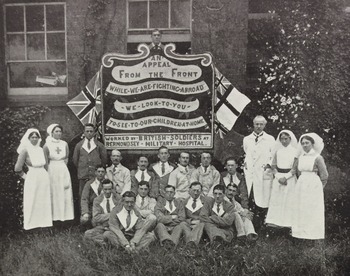
Banner made by soldiers at the Bermondsey Military Hospital and exhibited at the Central Hall, Westminster, during the 1917 National Baby Week: Report of the National Baby Week Council (London: National Baby Week Council, 1917), 29, SA/HVA/F.3/3. Wellcome Library, London, after page 34.
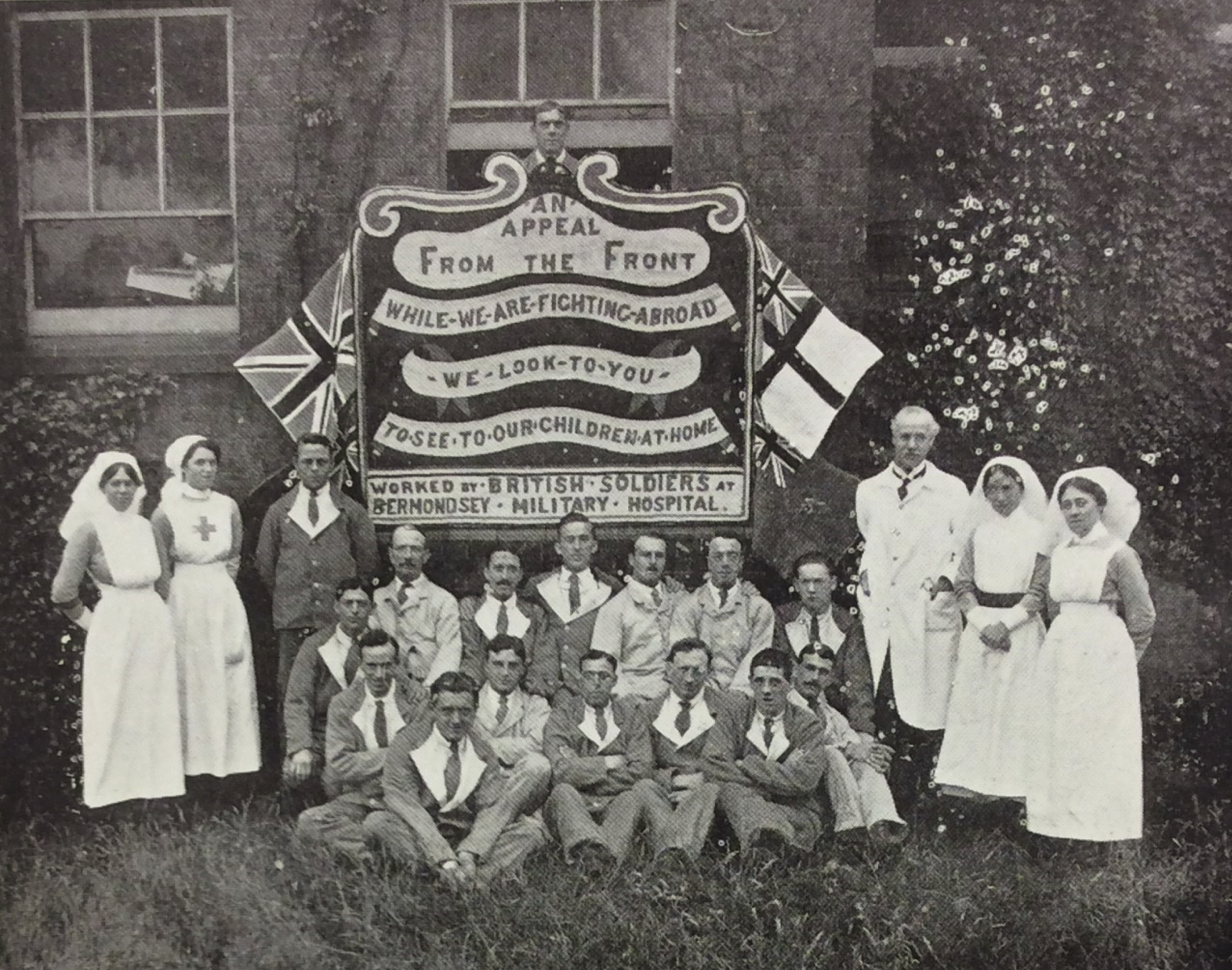
Men wounded in the war and resident in local hospitals also participated. In a variation of the theme of women making comfort items for soldiers, the Westminster Exhibition displayed a ‘fine banner embroidered in silk and wool by soldiers from the Bermondsey Military Hospital, bearing the words, ”while we are fighting abroad we look to you to see to our children at home.”’ Figure 1. All of the embroiderers were present in their hospital blues, and the Queen presented one of them, Lance-Corporal Godwin, who had already won a DCM, with a Military Medal.Footnote 57 There was no suggestion that embroidery was effeminate or emasculating, something also remarked upon by historian Joseph McBrinn in his research into veterans’ involvement in the Disabled Soldiers’ Embroidery Industry, established during the First World War.Footnote 58 In Baby Week, these soldiers’ efforts were simply viewed as yet another facet of public involvement and engagement with the event. Others also contributed; the wounded soldiers in the Royal Free Hospital had made a miniature model of the nursing section of its maternity and infant-welfare department, which was displayed at Westminster.Footnote 59 While entertainment was important to the event and it had considerable buy-in from the public, the organisers also perceived this as an opportunity for health education.
5 Health Propaganda
Taking a close look at the exhibits at the Central Hall Westminster Exhibition illustrates common themes in maternal and infant welfare in the early twentieth century. The exhibition was designed to be informative and educational. With 42 exhibits there was much scope for various interest groups. Displays varied from a focus on germ-causing diseases to lifestyle and personal hygiene. A room from a slum dwelling was reconstructed, with an instructively clean room positioned adjacently, or ‘The same room made habitable by the exercise of thrift and ingenuity’.Footnote 60 The Women’s Imperial Health Association showed films of various educational methods, such as Montessori and Dalcroze eurythmics.Footnote 61 The Eugenics Education Society, which had been founded a decade earlier in 1907 to promote improvement in the quality of the race,Footnote 62 also had a presence. It stressed ‘the importance of parents being strong and healthy if they are to have children endowed with sound physical and mental health’, and used charts to show family pedigrees. It also chose to highlight ‘the chief influences prejudicial to healthy parentage’, pointing to venereal diseases, consumption (tuberculosis), and alcoholism.Footnote 63
The Central Council listed and described all the exhibits in its final report, but only some received special mention in the section which followed, entitled ‘Recommendations to others organising Child Welfare Exhibitions’.Footnote 64 The Eugenics Education Society display was not one that attracted comment, although its concern about alcoholism, which had also been flagged by others, was highlighted. The Council drew attention to the National Temperance League’s exhibit, showing the ‘detrimental influence which parental alcoholism may have upon infant and racial health’.Footnote 65 Alcoholism was targeted as a serious concern at the time. The British Women’s Temperance Association had invoked science in promoting its cause, using ‘Photographs and transparencies showing the effects of alcohol on baby chicks, baby tadpoles, baby plants and child life’.Footnote 66
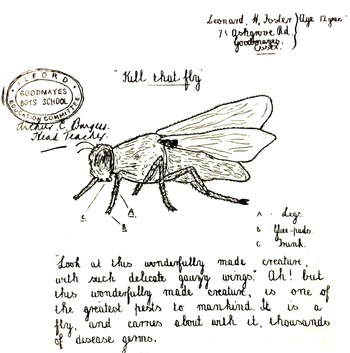
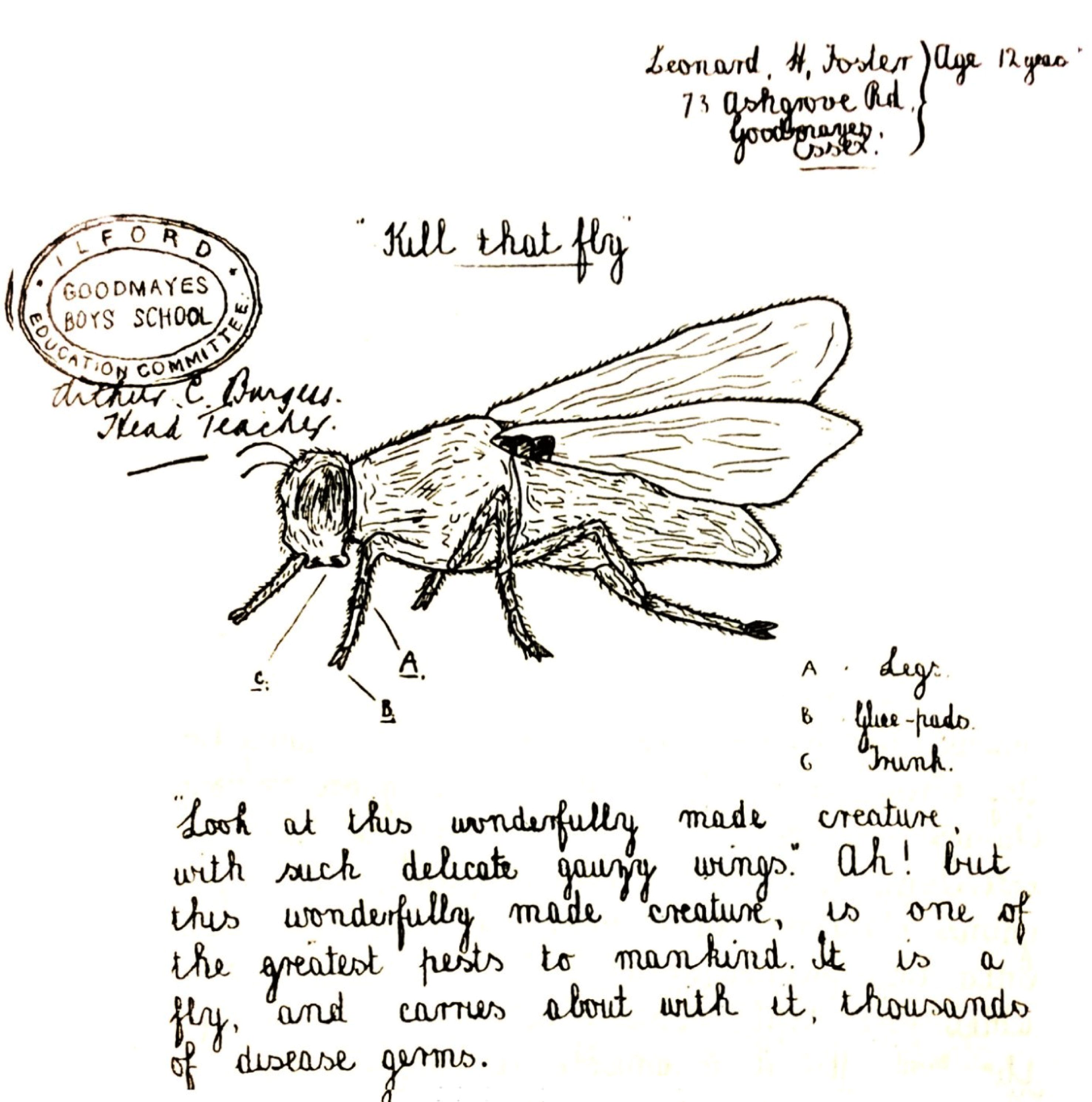
Winning entry for essay, ‘Kill that Fly’: Report of the National Baby Week Council (London: National Baby Week Council, 1917), 29, SA/HVA/F.3/3. Wellcome Library, London, 61.
In its recommendation for future child-welfare exhibitions, the Central Committee commented on the recognition of the mother’s need for recreation, which it believed should be promoted by the Schools for Mothers. It regarded the Baby’s Food section as ‘an especially important one’, which should include demonstrations of breastfeeding and mothers’ diets. It also drew attention to ‘The Fly Section’, which showed that ‘not only ways of protecting food from flies, but the extensive harm, by transmitting infectious disease, which flies do, constitutes a very important section in a baby life exhibition’.Footnote 67
A prominent feature of the exhibition was a giant fly, magnified 252 times, ‘15 feet across its wings and reproduc[ing] in every particular the poisonous and dangerous characteristics of this household pest’.Footnote 68 As the Council’s final report described it: ‘The hairs on the legs of the fly appear as coarse as bristles, and thus display the means by which the germs of infant diarrhoea and other life-wasting maladies are spread.’Footnote 69 Infant diarrhoea, particularly prevalent over summer months, was a real danger to infant survival in the early twentieth century, and flies were recognised as vectors of infection, drawing on the new understandings of the germ theory of disease.Footnote 70 The National League for Physical Education and Improvement also picked up on this theme and offered a prize for the best essay written by any boy attending an Elementary School on ‘Why I should kill that fly’ Figure 2.Footnote 71 The National Baby Week Executive Committee decided to match it with a similar prize for girls for the best essay on ‘How I mind our baby’, in accordance with early twentieth-century gender stereotyping. About 180 000 essays were submitted in total.Footnote 72 The winning essays were published in The Times.Footnote 73
Apart from the Central Exhibition, another feature of National Baby Week was a film made by Mrs H.B. (Dorothea) Irving, a member of the Baby Week Council’s Executive committee. This film, in which Irving herself featured as a health visitor, was ‘specifically intended to show the advantages of a greater number of health visitors and the extension of mothercraft teaching’.Footnote 74
Irving was not new to acting. She had formerly made her name as an actress, under her maiden name Dorothea (Dolly) Baird.Footnote 75 Born in 1875, she was the daughter of prominent barrister Sir John Forster Baird and had begun her acting career at the Oxford University Shakespearean company. As she commented in an interview in 1911, ‘It was not very customary for a gentlewoman to become an actress sixteen years ago’.Footnote 76 In 1896, she married fellow-actor Henry Irving, who studied law at Oxford and was himself the son of a famous actor, Sir Henry Irving, and they had two children, in 1897 and 1904.
Her film, Motherhood, made without charge by the Trans-Atlantic Film Company and with all profits going to the Baby Week Council, proved to be a highlight of Baby Week. It was screened around the country, with tickets costing from 1 shilling to 3 shillings but sometimes shown free-of-charge. For example, The Times reported that in Oxford 300 mothers with babies gathered in the garden quadrangle of Balliol College to see Motherhood, with free passes provided.Footnote 77
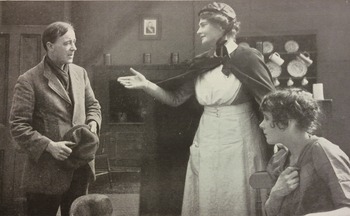
‘Scene from “Motherhood” film: THE HEALTH VISITOR [Irving] APPEARS ON THE SCENE: Published by kind permission of the Transatlantic Film Company’: Report of the National Baby Week Council (London: National Baby Week Council, 1917), 29, SA/HVA/F.3/3. Wellcome Library, London, after page 20.

The film described a young working-class couple, with the wife struggling in poor surroundings before the First World War. Unable to cope with terrible conditions and with a husband out of work, the young mother came under the influence of an alcoholic neighbour, who almost ruined their marriage but for the intervention of the health visitor (played by Irving) Figure 3. The husband served in the war, and the wife had a baby in his absence. The health visitor introduced her to the local School for Mothers. The description stated, ‘The young couple, when the war is over, are happy in a home built for them by a grateful country, where there is air and space for the children to grow and play, and labour-saving devices for the mother.’Footnote 78 In other words, this film was primarily about the external environment, not just teaching good mothercraft skills. The film also made clear that women were the rightful leaders of the new public health campaign. The National Baby Week Council featured in the film, with Margaret Lloyd George declaring, ‘What we want is the mobilisation of motherhood’.Footnote 79 Despite the fact that David Lloyd George had been asked and agreed to be president of the National Baby Week Council, Irving chose his wife Margaret, a vice-president, as its spokesperson.
6 Baby Week as a Platform for Social Reform
The Times medical correspondent described Baby Week as ‘a great rally of the motherhood of England and of all those who are ready to support that motherhood in its just demands’. Those ‘just demands’ included housing, health and food reform, and the enemies of the reform were categorised as ‘various interested people, slum landlords, sluggish and apathetic local councils, dairymen and others who possessed or could control organized political force’. Using a military metaphor, the writer declared, ‘In the battle which is coming motherhood must close its ranks to meet with and withstand vested interests.’Footnote 80
On the first day of Baby Week, a contributor to the Contemporary Review referred to a National Baby Week pamphlet. He compared the infant death rates in Hampstead to Shoreditch in London (74 and 148 per 1000 births) and noted how the pamphlet attributed this to ‘worse housing conditions, more ignorance, more dirt, inferior food, vitiated air’. He added to the list ‘the want of skilled assistance’.Footnote 81 Who was responsible for feeding such political statements to the press? In order to understand what Baby Week was all about, we need to take a look at the agendas and motivations of those who staged the event.
As noted in the introduction, Trudi Tate, in one of the few recent historical articles on Baby Week, assessed the event negatively, as an imposition on women, who were instructed by ‘experts’ to be good mothers. None of this, she argued, addressed the ‘underlying problems of housing and poor sanitation’.Footnote 82 In fact, an examination of the activities in London’s Baby Week calls this interpretation into question.
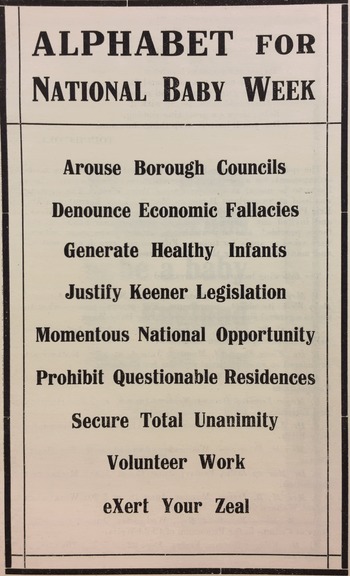
Irving’s film is one indication that Baby Week was not simply an exercise in educating mothers about their duties, responsibilities and inadequacies, ignoring the ‘real’ issues causing infant and maternal morbidity and mortality. Irving was reported in the Pall Mall Gazette in June 1917, just prior to Baby Week, on the subject of the Schools for Mothers. There she declared indignantly that teaching mothers did not improve housing conditions and that nobody had thought of starting a school for slum property-owners. ‘There is nothing easier,’ she declared, ‘than lecturing mothers on their duty. There is nothing harder than effecting real improvement in the environment, food and treatment of the mothers and children themselves.’Footnote 83 Irving and her colleagues on the Central Council aimed to mould Baby Week into something involving much more than the education of mothers (Figure 4).
‘Poster designed for the National Baby Week Council by Miss E. Walker Finlay’: Report of the National Baby Week Council (London: National Baby Week Council, 1917), 29, SA/HVA/F.3/3. Wellcome Library, London, after page 26.

The Central Council was at pains to avoid any suggestion of patronising working-class mothers. In his introduction to the final report of Baby Week, the Chairman of the Council, Lord Rhondda, attested
It was no part of the object of the campaign to judge and condemn poor mothers. To help them, an effort was made to show them their rights as mothers and the rights of their children, but those taking part in the ‘Week’ had too great an appreciation of the heroic struggle that many mothers make to desire to criticise them adversely.Footnote 84
Health propaganda could easily descend into blaming mothers, as noted by Ellen Ross in her history;Footnote 85 this was something that the Council consciously strove to avoid.
Irving in general appears to have had much influence over the direction of Baby Week in London. Not only did she produce the film described earlier, which was widely acclaimed in the press; she was also a member of the executive of the Baby Week Council and of the Exhibitions and Propaganda sub-committees. In summing up the week, Lady Rhondda paid tribute to Irving’s contributions, singling her out for special mention.Footnote 86
Irving had long been involved in infant welfare. She was honorary secretary of St Pancras School for Mothers from its foundation in 1907. She and her husband, who was Treasurer, fundraised for the School by staging theatrical performances. In 1913, Irving gave up her acting career and was elected to the St Pancras Board of Guardians. When Irving was interviewed in 1913, the reporter commented,
I knew before I met her, since I had come across evidences of her interest in some of the most uninviting slums of London, she has a passion for babies, and gives liberally of her time and money for those pitiable and not always very inviting-looking little objects – the children of London’s poor.
Referring to her social peers, Irving told the reporter, ‘I wonder what those people would have to say …if they’d come with me this winter, and gone to, I should think, as many as fifty houses where inmates were in dire need of, not only food, but clothing?’Footnote 87 Irving conforms to the women whom historian Pat Thane found had been politicised by their involvement in philanthropic work in the early twentieth century.
At an early meeting of the Baby Organising Committee in March 1917, Irving made her views clear. She spoke harshly about the housing situation and the ‘criminal neglect’ of borough councils. She advised that these councils should be ‘bombarded’ with pamphlets to clean up their act; her criticisms included housing conditions and the closing of baths and washhouses under the councils’ wartime economy.Footnote 88 Her agenda had little to do with educating mothers. Housing was in fact a long-standing concern for her. While on the committee for St Pancras School, she had run fathers’ educational evenings, displaying ‘magic lantern slides’, which she used to show the effects of bad housing conditions on infants.Footnote 89
Irving was not alone in holding these views. At the opening of Baby Week in London, presided over by the Lord Mayor of London at the Guildhall on 2 July, the Duchess of Marlborough, one of the Council’s vice-presidents, put forward a resolution that, owing to the high infant mortality, the assembled citizens ‘pledge themselves to inquire into the conditions which are responsible for this loss to the nation and undertake to use their influence to secure improved housing and sanitation, together with adequate provision for the care of maternity and infancy in their own districts’. The resolution was passed unanimously.Footnote 90
Adeline (Russell) Duchess of Bedford had presided over the initial informal meeting in February 1917 to discuss the staging of the event with representatives of 50 national societies,Footnote 91 and she also chaired a highlight of the Week, the Mothers’ Meeting at Westminster. This was held in the afternoon of 3 July and was attended by over 2000 mothers. Adeline had long been active in philanthropy and social work. Her contributions included supporting poor women and prostitutes around Victoria Station in London, prison visiting and working with wounded soldiers during the war. In her opening speech to the Mothers’ Meeting, she declared that preventative causes of infant mortality included ignorance, insanitary dwellings and the impurity of milk. She announced that a hostel for blind infants had already been set up as a result of Baby Week, but stressed the importance of putting measures in place to prevent blindness among infants in the first place (i.e. improving maternity services).Footnote 92
Her Mothers’ Meeting at Westminster included as speakers Maud Pember Reeves and Dr R.M. Wilson.Footnote 93 Glasgow-trained Dr Robert McNair Wilson had been rejected for military service owing to a heart murmur and was therefore able to continue the job he had started in 1914 as medical correspondent for The Times. He was the author of the article of 19 May 1917 which had called upon the ‘mobilisation’ of mothers as a political force. He was clearly attractive to the Baby Week organisers for this reason, and his talk at the Mothers’ Meeting was on ‘Mothers’ Rights’. In his speech, he stressed the importance of good medical and nursing attendance at childbirth and argued that the health of women and children should be the responsibility of the state. He also condemned food profiteers. He reiterated his point relating to the mobilisation of mothers and pointed out that ‘they would soon have a vote and let them use it’; it would, he said, be a powerful force.Footnote 94 He was right; in his history of the ‘struggle’ for the Ministry of Health set up in 1919, historian Frank Honigsbaum described the ‘pressure exerted by millions of new female voters who ardently desired a Ministry’.Footnote 95
The other speaker, Maud Pember Reeves, was the wife of former New Zealand Liberal MP William Pember Reeves, who was then New Zealand’s Agent-General in London. Maud had helped found the Fabian Women’s Group in London in 1908, and the following year she initiated a ‘Mother Allowance Scheme’. From 1909 to 1913 she recorded the daily budgets and lives of thirty-one working-class families in Lambeth through weekly visits to their homes, and in 1913 she published the results as Round about a Pound a Week, showing that incomes were not adequate to sustain health.Footnote 96 In her talk at the Mothers’ Meeting, Maud said that some of her friends who were mothers in the poorest parts of London had told her how they spent their days; one mother with ten children worked continuously from 6.30am to 10.30pm, washing and dressing children. What those mothers wanted, she said, was ‘cheery, jolly help’. It was the hardest work in the world to be a good mother, and mothers wanted holidays when they could forget they were mothers and just be women.Footnote 97 She stressed the need for rest and recreation for working-class mothers, which, she said, was available for better-off mothers. ‘At present,’ she said, ‘motherhood was the worst paid, the most sweated, and the most difficult profession in the nation.’Footnote 98
These views aligned closely with those of Irving. In 1915, Irving had spoken to a conference under the auspices of the Mothers’ Union and the League of Honour on the topic ‘Some Problems of the Working-class Housewife’. In this talk, she declared it was ‘not reasonable that women of the class to which she and her hearers belonged should go about teaching thrift of the money-saving kind to the working classes who were struggling to bring up their children under conditions which were frequently disheartening’. She explained,
From considerable experience and after much investigation among these women …she could not see how a mother and five children on 31s a week – the pay of a soldier’s family – could work out the weekly budget with a surplus of more than 5d. …the best and most self-sacrificing mothers found they could only just manage on the 31s a week.Footnote 99
Like Pember Reeves, she was concerned about the inadequacy of working-class incomes.
One of Irving’s subjects which she broadcast upon during Baby Week was the plight of unmarried mothers and illegitimate children, bringing these issues into public awareness. At the very first meeting of Baby Week Council she declared that ‘special attention should be paid to the care of illegitimate children, who should on no account be separated from their mothers’.Footnote 100 This foreshadowed the views of the National Council for the Unmarried Mother and Her Child set up in 1918.Footnote 101 Another member of the Central Council was Dr Mary Scharlieb.Footnote 102 Scharlieb was the first woman to gain an MD from London University, in 1888, and a specialist in obstetrics and gynaecology. She too supported campaigns for improved child and maternal health and welfare, along with humane treatment of unmarried mothers.Footnote 103 Lord Rhondda said in summing up the week, ‘The care of the illegitimate child and the right treatment of the unmarried mother have been emphatically laid before the public.’Footnote 104 The Baby Week conference discussed this topic and passed a resolution calling on the government to improve ‘the social and economic conditions’ of unmarried mothers and their children.Footnote 105 As Pat Thane and Tanya Evans found in their history of unmarried mothers, ‘An array of prominent people sympathized with unmarried mothers and their children and did not condemn them as ‘sinners’.’ Studying these individuals, they said, offered ‘an intriguing glimpse of the variety of ideas and ideals of social reformers and voluntary activists at this time, far from stereotypes of Lords and Ladies Bountiful, patronizing the poor’.Footnote 106 This can be seen most clearly in National Baby Week.
Dorothea Irving was also responsible for drawing attention to New Zealand’s infant-welfare system as a model for Britain. She had used her theatrical tour of Australia and New Zealand in 1911–12 to explore the latter’s infant-welfare scheme. A New Zealand reporter interviewed her in London before her departure and commented,
When I first met her, and she knew I was a colonial, she had a dozen questions to ask concerning our New Zealand legislation on matters affecting women and children, our methods of dealing with unemployment, etc., and there was not the least doubt that her knowledge of these subjects was absolutely genuine.Footnote 107
New Zealand’s Dominion newspaper reported,
She is looking forward to investigating for herself the result of the woman’s vote in this country [which had been granted in 1893], and is keenly enthusiastic over a pet scheme with which she is connected in London, namely, the Society for the Education of Mothers – a most practical and helpful institution somewhat on the same lines as the NZ Plunket Nurses Society.Footnote 108
Her visit to New Zealand clearly made an impression on her. One of her 1915 speeches was reported in the New Zealand press, under the title ‘Infant Welfare: High Praise for N.Z. System’.Footnote 109 The story ran, ‘Mrs Irving, discussing infant welfare at the National Union of Women Workers, said that New Zealand had a most perfect system, mother and infant were given skilled attendance and advice. The infant death rate had fallen in five years from 80 to 35 per 1000.’ The article added, this ‘compare[d] very favourably with the death-rate of 130 in England and Wales, 192 in the German Empire, and 321 in Moscow’.Footnote 110 Writing to a friend in New Zealand in December 1916, Irving explained how helpful the medical founder of Plunket, Dr Frederic Truby King, had been in explaining the Plunket Nurse system to her when she was in New Zealand and commented, ‘This has helped me tremendously since I have been back in England’.Footnote 111 In the process of planning for Baby Week, she looked to New Zealand as a model, publishing an article in the Pall Mall Gazette in June 1917, in which she referred to her tour of New Zealand and her investigation of the Plunket system. The Pall Mall Gazette article, reproduced in the New Zealand press, declared, ‘Mrs Irving was greatly impressed in all the details of the Plunket Society’s work’.Footnote 112
New Zealand’s infant-health system also featured in Britain’s Baby Week, owing to the efforts of Lady Plunket, who was a member of the original Baby Week Provisional Committee set up in early 1917 as well as the subsequent Executive Committee, as noted earlier. The significant interest in New Zealand was indicated at the very first meeting to discuss Baby Week. This was attended by 200 people, and there were just three speakers, one of whom was New Zealand’s Prime Minister, William Massey.Footnote 113 He was then appointed a vice-president to the Council. Bill Massey’s wife, Christina, was at that time President of the Wellington branch of the Plunket Society. The Masseys were in Britain from August 1916 to June 1917, and Christina’s daughter Marian Isabel kept a diary of the visit, listing their contacts, which included unsurprisingly Lord and Lady Plunket, and also Lord and Lady Rhondda.Footnote 114 During Baby Week, Lady Plunket reported back excitedly to her New Zealand friends,
At the National Baby Week, the New Zealand section attracted a most enormous amount of interest, and I was asked repeatedly why we do not try to induce Dr King to come over to London and start the work here. We feel we are asking a very big thing; but we anticipate big results.Footnote 115
Social reform was therefore high on the agenda of those women who ran National Baby Week in London. For them, the campaign did not revolve around educating women to be good mothers; they sought to promote maternal and child welfare. Two questions remain to be answered: how does this fit into the early twentieth-century eugenic movement, and to what extend did the campaign emerge out of the wartime crisis in manpower?
In light of the early twentieth-century eugenics movement, which sought race improvement, it is highly significant that the London committee chose not to host a baby show, an emblem of ‘good stock’. Investigating infant welfare in twentieth-century America, Janet Golden has written,
Far from fairground baby shows, social welfare advocates remained busy investigating the link between family income and mortality and morbidity rates. Eschewing simple eugenic explanations for poor health, they sought to understand the living conditions that helped to determine if babies lived or died.Footnote 116
This description fits exactly the women who led Baby Week in London and also accounts for why they chose not to comment on or highlight the Eugenics Education Society display at the Central Exhibition, while allowing it to be present. The one aspect they drew from it, as noted earlier, was concern about alcoholism’s effects on family welfare. They were more closely aligned with the early twentieth-century progressive reformers and environmentalists that Golden described in America than with eugenists who sought racial improvement. It was these environmentalists who were behind the creation of the US Children’s Bureau in 1912, which, significantly, also looked to New Zealand as its model.Footnote 117
The war context of Britain’s National Baby Week cannot be overlooked. War rhetoric loomed large in the event. Yet at the same time it is clear from profiling those who led the campaign and their organisational networks that the wartime demographic crisis did not create Baby Week. The extent to which they bought into the propaganda is of course unknown. It is possible they saw themselves as part of a crucial imperial endeavour and that ‘manpower’ mattered to them. However, it is also important to remember that the most vocal proponents of Baby Week did not commence their involvement in wartime but represented organisations that were campaigning for maternal- and infant-welfare reform prior to the war. In this sense, they seized the opportunity to gain wide support for a cause they were already committed to. They were long-standing champions of maternal and infant welfare who used the opportunity to good effect. As Dr Janet Lane-Claypon, Dean of the Household and Social Science Department of King’s College for Women, University of London, and the organiser of a three-day conference during Baby Week, declared in 1920, they had ‘to strike when the iron [was] hot’.Footnote 118
Jeanette Halford’s long-standing commitment to improving maternal and infant welfare, in peacetime and in wartime, has already been addressed. Dr Eric Pritchard was Chairman of the initial ‘Provisional Committee’ of National Baby Week set up to commence planning. This became the Executive Committee of Baby Week, and he was again elected Chair. As noted earlier, Pritchard had set up the first infant-health centre in Britain in 1906. In 1911, he became Chair of the new Association of Schools for Mothers and Infant Consultations, which became the National Association for the Prevention of Infant Mortality the following year, and he represented this body on the Baby Week Council. Later described as ‘world famous as a pioneer in maternal and child welfare’,Footnote 119 he was not motivated by the wartime losses but clearly saw this as an opportunity to promote a cause about which he felt passionate. Pritchard remained Chairman of the Executive Committee of the National Baby Week Council from 1917 to 1939.
While the war did not create Baby Week, those who led it were not averse to drawing on wartime losses to support their cause. For instance, Irving, as discussed, was motivated to insist on housing and welfare reform, but, significantly, she did not shy away from describing babies as ‘national assets’ who ought to be a ‘national responsibility’, or from declaring that ‘It is more dangerous to be a baby in England than a soldier of the line in France’.Footnote 120 This declaration was apparently first made by Sir Robert Morant, who chaired the initial meeting to set up a Baby Week, but it was Irving who converted it into a slogan for Baby Week.Footnote 121 Irving and her colleagues encouraged others to adopt this argument. Famously, the refrain that it was more dangerous to be a baby in England than a soldier in France was repeated in the sermon by Henry Gamble, Canon of Westminster, on 1 July at Westminster Abbey. Gamble also noted the differential death rates between professional and artisan classes in Britain (50 to 150 per thousand births) and attributed this to their surroundings. He cited a letter from a mother, who declared, ‘most of our children are being slowly starved at the hands of the profiteer …while our husbands are being murdered in France we are being starved here’.Footnote 122
These direct references to the war were also used in advocating for New Zealand’s system. An article in The Times declared, ‘Had our infant mortality been as low as that of New Zealand, we should have saved 100 000 babies during the first two years of war – a number nearly equal to our men killed at the front.’Footnote 123 Outlining Britain’s National Baby Week in the Contemporary Review on 1 July 1917, the author added, ‘It only remains to say that a British colony leads the way in Baby Reform’, referring to New Zealand having the lowest infant-death rate in the world.Footnote 124 Those urging reform marshalled wartime statistics to good effect.
7 Conclusion
This article has focused on those who orchestrated Baby Week in London. It clearly played out differently in different places despite all coming under the umbrella of Baby Week, which is why it is important to focus on the key individuals who drove the events, the current issues and the social and political contexts. The fact it became a political statement in London does not mean this was replicated elsewhere. For instance, in New Zealand, the event held later that same year turned out to be very low-key, consisting of just a few lectures and garden parties;Footnote 125 and in Ireland, as Walsh points out, the event became tied up with politics between the Republicans and Unionists, with the former using issues relating to infant welfare to press for independence from Britain.Footnote 126
Considering events in London, we need to look beyond the propaganda drawing on virility and war losses to consider the motivations of those who led and participated in the movement. Whether those who headed Baby Week believed the war rhetoric they were espousing is unknown, but what incentivised them is clear – the fact they were already involved in maternal- and infant-welfare promotion before the war and continued to be so after the war suggests this movement did not arise out of the war manpower crisis. War rhetoric was a useful ploy to attract public attention to the ‘needs’ and ‘rights’ of working-class mothers, and the points could be made in an apparently unthreatening environment of the celebration of motherhood and infant life. Susan Grayzel has argued that the concept of ‘mobilisation’ signified an association between society preparing for war and for childbirth; for her, women’s mobilisation meant ‘breeding for Empire’.Footnote 127 By contrast, while Meckel stressed the universality of the messages during Baby Week in America, he also concluded that ‘perhaps the major benefit of the maternal education campaign was that it mobilised American women as a potent force behind infant welfare’.Footnote 128 An in-depth analysis of National Baby Week in London too shows not the intent to mobilise women as breeders of empire but rather the mobilisation of women to demand social reform targeted at mothers and babies, in which they were remarkably successful.
Lord Rhondda acknowledged the importance of the lobbying around Baby Week in gaining support for his proposal to institute a Ministry of Health for England and Wales.Footnote 129 At the conclusion of Baby Week, the Council, with officers of 628 committees who had taken part in Baby Week, unanimously passed a resolution, ‘That this meeting ask the Government to take immediate steps to constitute a Ministry of Health’.Footnote 130 While Rhondda acknowledged the groundswell of support for the Ministry emerging from Baby Week, he himself did not live to see it come to fruition in 1919, as he died in 1918. Yet the lobbying during Baby Week undoubtedly contributed to the reform, with one department of the new Ministry devoted to Maternal and Child Health. In his analysis of the setting up of the Ministry of Health, Honigsbaum claimed that the ‘leaders of the infant mortality campaign deserved most of the credit’ for arousing public interest in the new Ministry.Footnote 131
The reforming zeal probably also contributed to the passing of the Maternity and Infant Welfare Act in 1918. This Act required local authorities to set up maternal- and child-welfare committees and enabled, though it did not compel, these local authorities to provide full maternal- and child-welfare services. They could apply for grants to cover up to 50 per cent of the expenditure on such services, including paying midwives, health visitors, infant-welfare centres, day nurseries and milk and food for necessitous mothers and infants.Footnote 132
The need for more qualified midwives was also stressed during Baby Week; a series of lectures ‘carefully laid out’ the ways in which midwives were ‘grossly under-paid, under-trained and under-valued’.Footnote 133 Lord Rhondda declared, ‘The better provision of, and for, midwives, has been shown to be a necessity.’Footnote 134 In 1918, a Midwives Act was passed, giving more responsibility to local councils for paying some of the midwives’ costs.
England and Wales were not alone in this reforming spirit. In Ireland, Walsh noted that the publicity given to infant and maternal welfare during Baby Week led to some positive reforms relating to environmental factors and social services, notably in relation to measures to improve milk supplies and maternity services.Footnote 135
Britain did not adopt the New Zealand model of free universal health care for new mothers and their babies but rather continued to target services to the poor. However, in order to boost awareness of infant welfare, the medical founder of New Zealand’s infant-welfare system, Dr Frederic Truby King, was invited to Britain to set up a Mothercraft centre in London at Earl’s Court, modelled on New Zealand’s Plunket system. New Zealand’s Prime Minister, Bill Massey, formally opened the centre in 1918. Dame Margaret Lloyd George was appointed one of the vice-presidents, and eventually the Duchess of York, later the Queen and then Queen Mother, became President. A major focus of this training centre, like the Plunket Society in New Zealand, was the promotion of breastfeeding, which had also been a goal of Baby Week.Footnote 136
The National Baby Week Council continued into the post-war years, fundraising and staging lectures and other forms of health education, affiliated to the National Council for Maternity and Child Welfare.Footnote 137 However, no event equalled the 1917 Baby Week in extent and scope, which possibly speaks to the importance of the war context in 1917 making that occasion so successful; as Lane-Clapton put it, they had indeed struck while the iron was hot. The war had provided ammunition to those wishing to promote maternal and child welfare, and women had been effectively mobilised to support for welfare reform.