

The scholarly and popular commonsense about corruption in the Philippines consists of two ideas. First, that the Philippines is a corrupt country. Corruption is perceived as being high (ranked 115 out of 180 countries by Transparency International in 2023), widespread (Social Weather Stations 2016), and costly.Footnote 1 Second, that the Philippines has always been corrupt. Scholars and pundits point to the sale of public offices in the Spanish colonial period, rampant graft in the American period, and, finally, a postcolonial politics characterized by corrupt practices, including graft, patronage, nepotism, and electoral fraud (e.g., Quah Reference Quah2011). It is in this sense that the Philippines’ seventy-eight years of corruption as an independent state (1946–2024) may as well have been a thousand.
Lay and scholarly accounts explain the continuity of corruption with respect to culture and structure. Cultural arguments fault bad or “traditional” values as justifying corrupt practices such as palakasan—using personal connections to gain a position or benefit (e.g., Constantino Reference Constantino1966). Structural arguments tend to emphasize the process of state formation during the early American period. Specifically, the introduction of elections led to the elite capture of government and institutionalized a logic of rent-seeking with regard to the state (e.g., Hutchcroft Reference Hutchcroft2000). In both accounts, corruption is all but genetic to Philippine culture or politics.
To be sure, continuity is self-evident if we are looking only at corruption scandals, but scandals have been accompanied by anti-corruption movements, broadly speaking.Footnote 2 The two have gone hand-in-hand historically, suggesting that we need to understand them together. Taking them together—that is, focusing on their dialectic—reveals a history of change. Specifically, how Filipinos relate to corruption has changed. They have become less tolerant of it in general and learned to embrace an anti-corruption model of politics. How scholars and policymakers conceive of corruption has changed as well, not just in the Philippines but everywhere. They have come to adopt a view of corruption as a generic social problem, effectively disembedding it from society. These developments have enabled a more intolerant approach such that, today, the greater danger lies in an anti-corruption “fundamentalism” leading to the rejection of politics altogether.
Viewed as a whole, the history of corruption/anti-corruption has been a popular struggle over what politics should look like. Historically, “corruption” has been a label used to highlight a set of political practices as unacceptable. “Anti-corruption” has been the effort to reform these practices according to a different standard of politics. Thus we might read their dialectic as driving the progress of political modernization from below. On the ground, however, this dialectic has been experienced as a struggle for the very soul of politics.
My argument touches on a set of ideas most fully developed in the anthropological literature on corruption.Footnote 3 These ideas concern four relationships. The first is that between corruption and anti-corruption. Muir and Gupta (Reference Muir and Gupta2018: S7) conceive these two movements as being related not just dynamically but dialectically insofar as the one “calls forth” the other. This dialectic is historically variable but also propulsive and history-making. It produces social histories of the kind featured by Schneider and Nugent. Schneider (Reference Schneider2018) traces the dialectic of corruption/anti-corruption with respect to the Italian government’s evolving approach to the Sicilian mafia, and Nugent (Reference Nugent2018) with respect to the very different “shadow worlds” threatening Peruvian politics over the course of the twentieth century. The point is not just that corruption and anti-corruption should be considered together, dialectically, but that the whole complex should be understood over time as a moving object.
The second relation concerns citizens and the state. As Gupta has illustrated, the discourse of corruption is productive (Reference Gupta1995; Reference Gupta2012). It helps shape how people relate to the state both practically and affectively. Hornberger (Reference Hornberger2018), for instance, shows how undergoing the crucible of getting a driver’s license and having to pay bribes along the way leads young middle class South Africans to develop a particular relation to the state marked by frustration and contempt. Notably, while this discourse concerns the nation state all the way down to its local embodiments, it takes shape within a larger transnational field (Gupta Reference Gupta1995: 393), meaning that, to some extent, certain attitudes toward corruption and relations to the state are held in common across a historically defined set of cases (e.g., “developing” countries).
The third relation concerns the different social groups within society and regards the perspectival nature of corruption/anti-corruption. For my purposes, the two key ideas here are that, one, perceptions of corruption—not just who is corrupt but what counts as corruption—are mediated by social location and modified by social distance/proximity (Lomnitz Reference Lomnitz and Dalton1971; Das Reference Das2015), and, two, the discourse of anti-corruption provides a kind of resource or tool. Social groups mobilize this discourse in service of their particular social and political agendas (Sampson Reference Sampson, Haller and Shore2005; Picci Reference Picci2024). In several cases, including the one I will discuss, middle-class groups use their cultural power to impose a particular vision of society upon the masses.
The fourth relation is between co-nationals and regards their collective experience of the nation. According to Smith (Reference Smith2007), Nigerians see corruption as a crisis of social morality afflicting the nation as a whole and respond with self-flagellation, with “what’s wrong with us?” being a common lament. According to Muir (Reference Muir2016), the crisis of legitimacy precipitated by Argentina’s financial crisis in 2001–2002 found expression in the idiom of corruption. The Argentine middle class described an experience of “total corruption”: the sense that “corruption is in our hearts” (ibid.: 131) and thus we deserve to be stuck in crisis and disqualified from historical progress. This experience of radical negativity, she writes, “played out as a felt complicity with the destruction of the very social institutions upon which one most depended” (ibid.: 150). In both cases, the “thickness” of the discourse on corruption/anti-corruption is oppressive. It promotes a dark and fatalistic view of the nation as culturally and thus irremediably corrupt.
This literature foregrounds the major themes of the present paper and provides us with a comparative framework. Situating the Philippine case within this framework both facilitates cross-cultural comparisons and allows elaboration of existing theory. For much of the rest of the paper I will trace the dialectic of corruption and anti-corruption in the Philippines historically, beginning with national independence in 1946. I will conclude this historical account by underscoring the paper’s central argument about the mutability of corruption and attitudes toward corruption and the inseparability of the dialectic of corruption/anti-corruption from the political process. In the final section, I will take issue with the current state of the dialectic, arguing that the disembedded, fundamentalist approach to corruption prevalent today threatens to negate the reality of Philippine culture and society and undermine popular sovereignty.
The Postwar Period, 1946–1965: Tolerance
The great observer of postwar society, Onofre D. Corpuz, found Philippine politics to be riddled with corruption, from the petty fixer skulking about government offices to the lowly bureaucrat submitting fake vouchers to elected officials peddling influence and political party leaders misusing funds (Reference Corpuz1965: 85–86). Corruption seemed baked into the way “traditional politics” or pulitika was conducted normally. Politicians unabashedly engaged in patronage and graft. They employed fraud and violence to sway elections. Even among their number, as much was freely admitted, that public office was a means of personal enrichment. Senate President Jose Avelino let the truth slip in a closed-door session of party members, chiding President Elipidio Quirino for allowing an investigation of colleagues to move forward: “Why did you have to order an investigation, Honorable Mr. President? If you cannot permit abuses you must at least tolerate them. What are we in power for? We are not hypocrites. Why should we pretend to be saints when in reality we are not?” (quoted in ibid.: 90).
A disposition toward corruption, Corpuz (Reference Corpuz, Abueva and de Guzman1969) argued, took shape in the course of Filipinos’ long colonial experience. Under the Spanish, they experienced government as an alien and oppressive entity, and thus came to conceive an instrumental relation toward it. Meanwhile, the Filipinization of the colonial civil service under American rule provided substantial opportunities for corruption in the forms of nepotism and graft. The first major opportunity for widespread graft came in the wake of liberation from Japanese occupation—the so-called surplus scandals. The United States had granted leftover military stocks in the country to the Philippine government as a form of aid. These stocks were appropriated by individuals with political influence and sold on the black market. Their illicit disposition, Corpuz (Reference Corpuz1965: 85) writes, created millionaires overnight. Reconstruction provided other opportunities for corruption. Politicians awarded contracts for projects to allies and associates and jobs to friends and followers. Ordinary people filed false claims for war reparations or claimed to have been guerillas in the hope of collecting backpay.
Corpuz attributed the postwar scramble to “demoralization” following a brutal occupation (ibid.). By the mid-1950s, an air of normalcy had returned, and yet corruption scandals were rife, from Quirino reputedly having a golden chamber pot to the Harry Stonehill affair. Stonehill was an American businessman accused of bribing several high-level government officials, including President Macapagal. When he was arrested, Macapagal had him summarily deported, purportedly so that he could not testify against him. Corruption stories preoccupied the public mind along with other “newsbreakers”: natural disasters; high-profile international events held in the country; massacres, assassinations, and heinous crimes; and periodic apparitions of the Virgin Mary (Syjuco Tan Reference Tan and Felisa2015a).
Somehow, rampant corruption coexisted alongside a popular anti-corruption sentiment. The play between the two, scandal and rebuke, fascinated Corpuz. Quirino’s election in 1949 was marred by massive fraud, and his administration proved to be terribly corrupt. In response, the National Citizens’ Movement for Free Elections (NAMFREL) was founded in 1951, and hundreds of civic groups mobilized to monitor the 1951 midterm and 1953 presidential elections. “The issue which dominated and decided both elections,” Corpuz writes, “was that of corrupt government” (Reference Corpuz1957: 243). The choice was framed in simple terms: Quirino was corrupt and Ramon Magsaysay clean. An Anti-graft and Corruption Law passed in 1960, despite President Garcia’s efforts to kill it. Garcia worried that it would expose him and other high-level officials to charges (Corpuz Reference Corpuz1965: 90). No less than five anti-corruption agencies were founded in the postwar period, although most were short-lived. Furthermore, a lively, muckraking press was ever on alert to break the next scandal.
Notably, many of the scandals in this period resulted in some actions being taken: investigations were opened, cases filed, people fired, and government agencies overhauled or decommissioned. And yet, for the most part, investigations found little to nothing. No doubt many of these charges were politically motivated and insubstantial; all smoke fanned by the opposition’s ire—Quirino’s chamber pot, it turned out, was made of stainless steel. Undoubtedly, too, however, the investigation of many substantial charges was stymied along the way. The process of the government investigating corruption in government was simply too easily corrupted; congressmen closed ranks, judges were reminded of their political debts, witnesses were scared or bought off. In any case, accusations of corruption were cheap and prosecutions dear. As Corpuz famously observed, “Nobody in the Philippines has ever heard of a successful prosecution for graft” (Reference Corpuz1965: 86).
How could corruption be both a perennial fact of political life and, at the same time, perennially denounced as such? The word Corpuz used was “tolerance.” Why does the Filipino public tolerate corruption, he wondered. Why is there “no massive, popular indignation”? The answer, he argued, could only be that corruption was, in part, culturally justified. Corpuz insisted that corruption in the Philippines be viewed in the context of a “transitional society.” This view largely accorded with the modernization theory of the day (e.g., McMullan Reference McMullan1961; Leys Reference Leys1965; Huntington Reference Huntington1968). Here, corruption, understood as the transgression of public trust, emerged in the process of modernization. It is not just that the process created new opportunities for corruption; it made the distinction at issue—between the public and private spheres—salient in the first place. Corpuz described Filipinos as being normatively ambivalent, pulled between two contradictory standards of public behavior, one modern and Western in provenance and the other grounded in a traditional value system. Notably, traditional values were not, for him, culturally primordial but products of a particular social environment. That is to say, he espoused a culturally embedded and not a culturally essentialist argument. He argued, for instance, that kinship ties grew in importance relative to Filipinos’ exclusion from the Spanish colonial state (Reference Corpuz1965: 82). Their exclusion from the state prompted “a transfer of expectations” to a different institution, the family.
Thus, while corruption may be illegal, at least some forms of it were ethical in Philippine society. Nepotism, for instance, was normative, meaning that a government official who bucked the practice in an effort to be clean would face social censure. The contradictory pressures of law and culture produced “an almost inconceivably ingenious” solution:
There have been, since independence, many presidential integrity boards, legislative blue-ribbon standing committees, administrative commissions, and graft-busters or anti-graft teams conducting countless investigations, probes, and anti-graft campaigns. The results have been beautifully consistent: the probes end in a whitewash; the investigations are either innocuous or fixed; and the noisy graft-busting crusades end with the fewest and smallest fry in the net. And everybody is satisfied. The solution, in effect, was to comply with the law in form, and to appease the social conscience through an exorcism of the public’s guilt feelings through ritual and ceremony (bid.: 91–92).
Corpuz provides us with a classically functionalist reading of the situation at hand. Anti-corruption efforts persisted despite their ineffectiveness because they upheld an ideal yet socially valued standard of governance. Transgressions of the public trust were invoked in order to remind people of that standard only to be excused, ultimately, in acknowledgement of political reality.
The Marcos Period, 1965–1986: Turning Point
The dialectic between corruption and anti-corruption changed during the Marcos period because the nature of corruption was transformed. During his first term in office, Marcos employed the levers of pulitika to the hilt. The 1967 midterm and 1969 presidential elections were marked by massive spending and unprecedented levels of violence. Over the course of his second term and particularly under martial law, Marcos deactivated institutional checks to his power as president. He abolished Congress, censored the press, suspended or orchestrated elections, stacked the courts with appointees, and controlled government agencies down to the barangay (barrio) level. The opposition party was dis-membered by defections now that Marcos alone determined the dispensation of government largesse. The radical opposition went underground. As Thompson writes, “Clientelism under democracy had degenerated into sultanism … under dictatorship” (1995: 50).
Corruption was centralized; that is, it had to pass through the Marcoses, Ferdinand and his wife Imelda or their deputies. Marcos received hefty kickbacks on government projects, such as a US$30 million for the construction of a nuclear power plant that never opened. He took a cut of U.S. military aid and Japanese overseas development assistance. He and Imelda helped themselves to the state coffers and looted the Central Bank’s gold stocks (Chaikin and Sharman Reference Chaikin and Sharman2009). Finally, Marcos “subcontracted” to cronies what he could not steal for himself; for instance, by granting them behest loans from government-owned banks (Thompson Reference Thompson1995: 53). These loans were given without basis and often went unrepaid. All told, the scale of the Marcoses’ plunder staggered the imagination: between US$5–10 billion, according to government estimates.Footnote 4
All the while, interestingly, the Marcos government continued to gesture toward anti-corruption. It founded six anti-corruption agencies between 1966 and 1979, including the Tanodbayan or Office of the Ombudsman (Quah Reference Quah2011: 136). The real anti-corruption movement, though, took the form of dissidence. Marcos’ chief propagandist, Primitivo Mijares, absconded to the United States in 1975 and testified to Congress about the regime’s corruption. In 1976, he published The Conjugal Dictatorship, a tell-all, first-hand account of the personal affairs and political dealings of the first couple (Reference Mijares2017[1976]). The book was banned in the Philippines but made its rounds underground in middle-class and activist circles. A year later, Mijares disappeared, and his sixteen-year-old son was found dead, his body badly mutilated.
In 1979, Ricardo Manapat, a member of the anti-Marcos social democratic group Kasapi, penned a forty-page pamphlet detailing the extent of the Marcoses’ wealth and the operation of their “crony capitalism.”Footnote 5 Kasapi members surreptitiously photocopied and distributed two thousand copies of the pamphlet around Manila. It was titled “Some Are Smarter than Others” after a phrase Imelda Marcos had used to justify the recent fortunes of certain of her relatives, but it came to be known, colloquially, as “The Octopus” after the illustration on its cover. The society magazine Mr. & Mrs. described the pamphlet being passed around and discussed “in whispers and [with] bated breath and gleaming eyes” (quoted in Manapat Reference Manapat1991). It was the reports of the Marcoses’ extravagance that readers found particularly scandalous. Manapat documented in painstaking detail not just how much Imelda especially was spending but what exactly she was spending on: designer clothes and bags, another townhouse in New York City furnished in the Renaissance style, Picassos, solid gold Rolexes, Fabergé eggs, a million dollars on flowers alone. The book includes two lengthy appendices simply itemizing Imelda’s collection of jewelry and artwork (e.g., $44,410 for a diamond-studded hair comb).
These lists upon lists are interspersed with lurid accounts of poverty in the Philippines. The book opens with the demolition of a squatter community residing on a garbage dump in order to make way for another one of the Marcoses’ white elephant projects. It features babies dying, children dropping out of school, young girls resorting to prostitution, and desperate breadwinners forced to sell their blood to buy rice. Manapat repeatedly underscores the connection between the Marcoses’ corruption and the country’s poverty. It was not, primarily, the scale of the Marcoses’ corruption that was scandalous but, rather, the shamelessness of it; in Filipino, makapal ang mukha nila, literally, the “thickness of their faces” in the face of people’s suffering. Notably, the transgression at stake was not of the public-private divide per the formal definition of corruption but of a distinctly Filipino moral economy. People were feeling that some threshold of acceptable conduct had been breached.
These feelings came to a head in 1983. In June of that year, Marcos’ daughter, Irene, and Gregorio Araneta were wed. The mother of the bride had the town of Sarrat, where the wedding was held, entirely remodeled to conform to the event’s Spanish colonial-era motif. This included building a new 250-room luxury hotel, a new airport, and a Spanish-style fort. It involved landscaping a mile-long stretch leading up to the church, planting thousands of flowering shrubs along its length, and chartering a luxury ocean liner to transport guests (Syjuco Tan Reference Tan and Felisa2017). In August, the leader of the political opposition, Benigno “Ninoy” Aquino, returned to the country after years in exile and was assassinated immediately upon disembarking. These events set the stage for the worst economic crisis the country has ever experienced. In the two years following the wedding, the Philippine economy contracted by 14 percent and the inflation rate hit 50 percent (Punongbayan and Mandrilla Reference Punongbayan and Mandrilla2016).
This was the beginning of the end for the Marcoses. More than two million people participated in Aquino’s funeral cortège. The United States pressured Marcos to hold special elections. Aquino’s widow, Corazon or Cory, took up the mantle of opposition leader and fielded her candidacy for president. NAMFREL, which had gone defunct, was revived. Predictably, Marcos cheated; the 1985 snap elections were marred by massive fraud. Less predictably, the public en masse did not stand for it. The Commission on Elections’ workers walked out in protest, interrupting the tally. Congress declared Marcos the winner, but NAMFREL’s count showed otherwise. A contingent of the military revolted and their leaders took refuge in two military camps in Manila. The Catholic Church summoned people to surround the camps. The crowd grew and grew over the course of several days (22–25 February 1986) until Marcos had little choice but to flee the country. In the People Power movement was at last a show of “massive popular indignation” that Corpuz had searched for vainly, a moment of national intolerance for corruption.
Anti-corruption in Ascendance
The fall of Marcos unleashed a tide of anti-corruption efforts. Upon taking power, Aquino moved to “de-Marcosify” the government on all levels. Her administration conducted political purges not just of elected and appointed officials but of the whole bureaucracy, top to bottom, including the military and local governments (Cariño Reference Cariño1989). By the end of 1986, ten thousand civil servants had been replaced. The anti-corruption thrust of the revolutionary government was enshrined in a newly drafted Constitution, which included “betrayal of the public trust” as an impeachable offense and created the Commission on Audit. A raft of laws was passed defining forms of corrupt behavior, proscribing them, and prescribing more appropriate forms in various codes of conduct for civil servants. New anti-corruption agencies were created, including the Presidential Commission on Good Government, tasked with retrieving the Marcoses’ ill-gotten wealth, and the Presidential Committee on Ethics and Accountability. Old agencies were reconstituted, such as the Ombudsman and Sandiganbayan. There were, besides, efforts to reform Philippine culture by fostering certain values in the population, such as integrity, patriotism, and a sense of the common good. Aquino initiated and her successor Fidel Ramos instated the Moral Recovery Program of 1992. Beyond the government, the Church pursued “values education” through seminars catering primarily to domestic workers and the poor.
The post-Marcos period witnessed an efflorescence of civil society. The number of NGOs tripled between 1984 and 1995 to over seventy thousand (Clarke Reference Clarke1998: 70) as a result of the reopening of a democratic space and massive inpouring of overseas development assistance into the country following People Power. The Aquino government did not merely accommodate NGOs; it institutionalized their role in the political process. The 1987 Constitution and 1991 Local Government Code virtually mandated NGO participation in local government. Further, the Aquino and subsequent Ramos administrations developed the practice of channeling pork barrel funds to NGOs and POs (people’s organizations) directly. As a result, NGOs acquired unprecedented political power. Whereas during martial law they had been forced to work under the state or go underground, they were now encouraged to work in partnership with the state. For political reformers, it was a time of hope. As veteran activist Ed de la Torre mused, “The GO [government organization]-NGO-PO trinity structures our dreams of empowerment” (in Gutierrez Reference Gutierrez1994: ii).
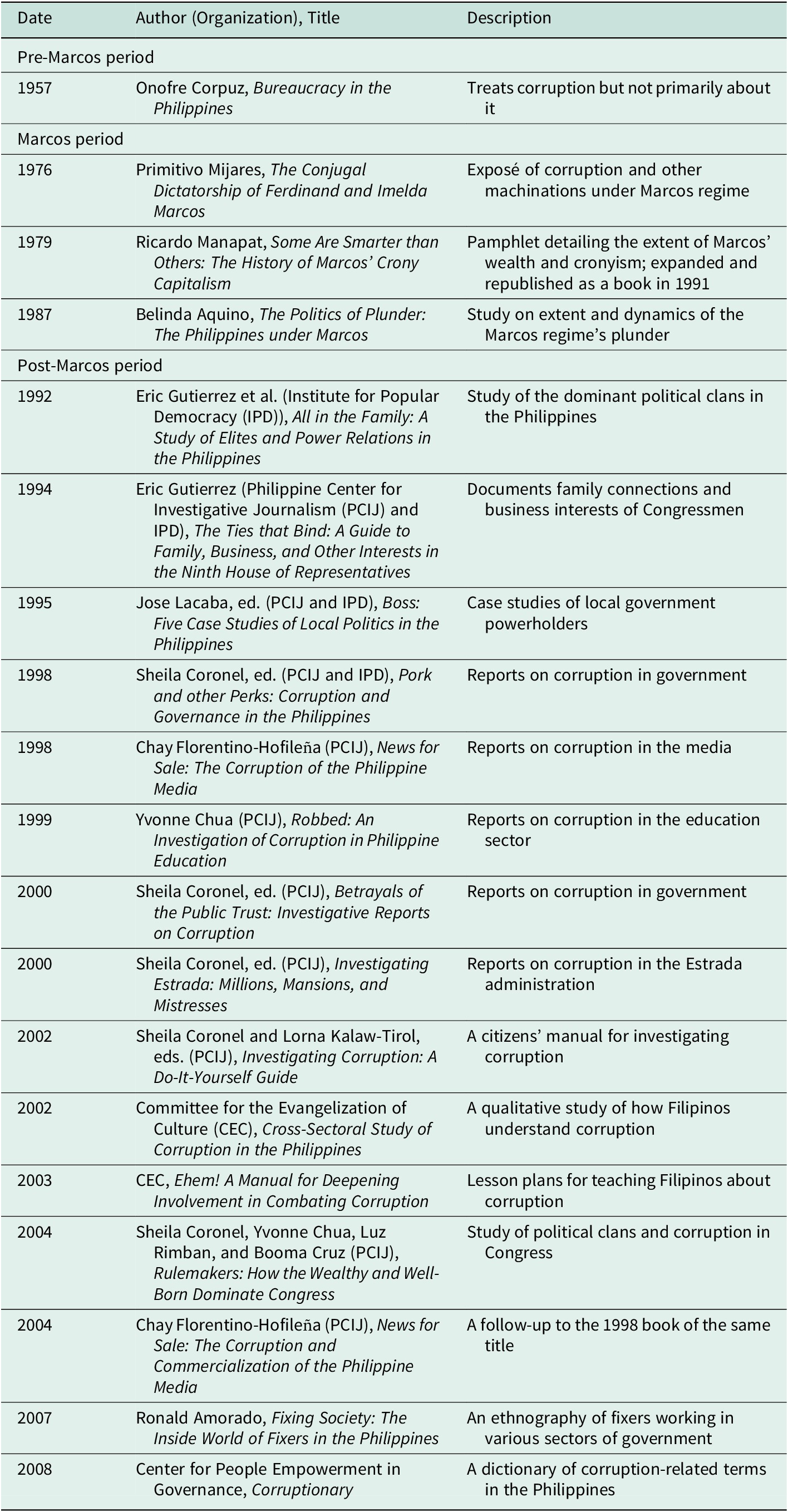
Many NGOs identified with the anti-corruption agenda of the times. They championed a “new politics” in opposition to the old or traditional politics associated with corruption—an anti-pulitika. Key anti-corruption organizations include the Institute for Popular Democracy (IPD), founded in 1986, which conducts research in service of political reform, and the Philippine Center for Investigative Journalism (PCIJ), founded in 1989, which, early on, largely focused on exposing corruption in government. The IPC and PCIJ published, individually and collaboratively, a series of impactful studies on corruption in various areas of Philippine government and society throughout the 1990s and 2000s (see appendix 1). Through this scholarship they helped cultivate public intolerance for corruption.
It is important to note that Filipino “civil society” comprised a relatively small social circle based primarily in Metro Manila (Mojares Reference Mojares2006), and even then mainly in the Quezon City area.Footnote 6 Generally speaking, these people knew or knew of one another. They were similar sociologically: urban-based, college educated, with many of them having cut their teeth in the anti-Marcos movement as students. Their constituency, likewise, was demographically limited to the urban middle class. The Filipino middle class grew rapidly over the course of the 1990s and 2000s as the result of expanding opportunities in producer services and overseas work (Pinches Reference Pinches, Dahles and Muijzenberg2003). Whereas the old middle class had been created largely through their connections with government in the forms of civil service and patronage, this new middle class took shape largely independently of such connections. This meant that its members could freely commit to an anti-corruptionism without contradiction. Indeed, scholarship on the group describes them as virulently anti-corruption, in principle at least (Clarke and Sison Reference Clarke and Sison2003).
The Rise of a Global Anti-corruption Regime
There is more to this moment than the churning of Philippine politics and society. A new model was being articulated on the global stage. This would be the model taken up by anti-corruption agents on the ground in the Philippines and elsewhere. Whereas the old model understood corruption in the context of particular societies, the new one conceived corruption in terms of a rational action/principal-agent framework—that is, in general terms. In this model, corruption is conceived as individual utility-maximizing behavior. It may take on various cultural hues but there is something universal at the core of it: self-interest. Simply put, people abuse public office or public trust because it is in their self-interest to do so (Rose-Ackerman Reference Rose-Ackerman1999). The proponents of this model were, unsurprisingly, economists. It was adopted and promulgated by powerful organizations, particularly the World Bank and the IMF, as well as the U.S. government, OECD, and the UN. Key events helped put corruption, so conceived, on the global policy map: the founding of Transparency International in 1993 and a speech given by World Bank president James Wolfensohn in 1996 denouncing the “cancer of corruption.” Finally, the new model complemented the broader push for economic liberalization ongoing at the time. A view of corruption as an impediment to market integration and economic growth served to advance prevailing development policy (Hough Reference Hough2013).Footnote 7
In the 1990s, a new “consensus” had emerged around how to approach corruption (Johnston Reference Johnston2005: 18). It consisted of two main views. First, that corruption should be seen as a generic problem as opposed to a cultural one. Because it is driven primarily by self-interest, it can be studied largely independently of social and historical context. In other words, corruption is seen as being essentially the same problem everywhere, whether Denmark or Burkina Faso, and thus susceptible to the same remedies. The second view was that corruption is a social problem as opposed to a sociological one. This view emphasizes the cost or negative consequences of corruption, not just economic but political, social, and cultural. It makes an explicitly normative appeal, underscoring the urgency of the problem. Because the priority is solving the problem of corruption rather than understanding it, the focus is on anti-corruption. Quah (Reference Quah2011) provides a good illustration of this new approach. He attributes corruption in the Philippines to so many bad incentives, including low salaries, red tape, low risk of detection and punishment, and culture, particularly in the form of strong family ties. On the latter, he approvingly cites a local bishop’s description of the Filipino family as a “corruption syndicate” (ibid.: 132). How different from Corpuz’s approach! Recall that, for Corpuz, the family was not simply an impediment to political reform but an essential context for understanding how politics in the Philippines actually worked.
The anti-corruption field grew enormously over the course of the 2000s. The value of goods and services procured by donor agencies for anti-corruption projects is estimated to have ballooned from $100 million in 2003 to almost $5 billion in 2009 (Michael and Bowser Reference Michael, Bowser, Wolf and Schmidt-Pfister2010). Sampson (Reference Sampson2010) describes the formation of an anti-corruption “industry” consisting of a set of actors organized around a common framework, inspired by key texts, making use of the same tools and indicators, and implementing similar projects and programs. As the anti-corruption discourse thickened, the economic model grew in refinement—definitions became more elaborate, distinctions more subtle, and measurements more fastidious—and the fundamental premises underlying it sunk deeper into orthodoxy.
These premises are reflected in the anti-corruption literature produced in the Philippines from the late 1990s through the mid-2000s (appendix 1). These works make up a distinct genre insofar as they share the same rhetorical structure: (1) They define corruption in terms of institutional transgression, basically as the abuse of public office for private gain; and (2) they count its costs.
According to one important publication of the period (Coronel and Kalaw-Tirol Reference Coronel and Kalaw-Tirol2002: 16–22), corruption impedes economic growth, worsens income inequality and poverty, damages political legitimacy and stunts democracy, endangers public office and safety, and results in bureaucratic inefficiency and demoralization. This grim accounting is accompanied by pictures of poor and miserable-looking children, the purported victims of corruption: (1) They illustrate the magnitude of the problem using examples close at hand; and (2) they urge greater public involvement in the anti-corruption effort, listing anti-corruption resources such as laws, government agencies, and local and international NGOs. This literature defines corruption as a triple negative, that is, in terms of transgression, cost, and moral unacceptability—an image the very opposite of what politics should look like.
In sum, the anti-corruption movement may have been galvanized by the trauma of the Marcos years, but it was shaped in constitutive ways by a global policy regime, which, in addition to financial, organizational, and moral support, provided it with a new way of seeing corruption.
The Vicissitudes of Corruption in the Post-Marcos Period, 1986–2023
Intolerance of corruption may have been higher than ever historically, yet corruption scandals continued to break with regularity. Cory Aquino was tainted by association. The main scandal of her administration was called “kamaganak, inc,” meaning that she was seen as favoring relatives (kamaganak) and allowing them to influence political outcomes. Her brother, Jose “Peping” Cojuangco, was particularly influential. He was instrumental in weakening a critical land reform bill and managing to retain control of his (and Cory’s) family’s 6,000-hectare estate (Claudio Reference Claudio2013). Meanwhile, PLDT, the company of Aquino’s cousin, Antonio “Tony Boy” Cojuangco, was sequestered by the Presidential Commission on Good Government for its links to the Marcos regime but then released six months later allegedly because of Aquino’s intercession.
Aquino’s successor, Fidel Ramos, proved to be an effective reformer. His administration promoted economic liberalization, privatization, deregulation, breaking up cartels and monopolies (including PLDT), and infrastructural development (De Dios and Hutchcroft Reference De Dios, Hutchcroft, Balisacan and Hill2003)—and yet it was plagued by scandal. The biggest one was the PEA-Amari deal, a joint venture agreement to develop three islands off the coast of Manila. The developer, Amari, allegedly paid US$40 million in kickbacks to various brokers and politicians (an amount nearly equal to the land’s purchase price), including several million to the campaign kitty of Ramos’ political party. The senator who broke the deal described it, without the least bit of hyperbole, as “the grandmother of all scams” (Tordesillas and Coronel Reference Tordesillas, Coronel and Coronel1998: 85).
With Aquino and then Ramos, people learned that it was not enough that the president was personally clean or effective. Perhaps taking a harder line against corruption was necessary. Joseph Estrada provided the perfect target for the exercise of greater intolerance. Estrada’s corruption may not have been as large in scale as his predecessor, Ramos, or, for that matter, his successor, Arroyo, but it was flagrant—the PCIJ (Coronel Reference Coronel2000b) found dozens of business interests and properties in the names of Estrada’s family members, mistresses included—and it was vulgar. Reportedly, kickbacks from the illegal gambling game jueteng would be delivered directly to Estrada’s house by the bayong (palm-leaf thatch bags used for wet marketing). The PCIJ’s reports of Estrada’s “midnight cabinet”—late-night gambling, drinking, and karaoke sessions with cronies—excited public indignation. As with Marcos, the scandal was not the illegality so much as the immorality of public behavior.
In 2000, barely halfway into his presidency, Estrada was impeached for bribery, graft, betrayal of the public trust, and violating the Constitution. House investigators cited PCIJ reports as providing the basis for three of these charges. The trial, which was televised, engrossed the public. Bautista described it, aptly, as a morality play (Reference Bautista and Doronila2001: 5). As such, it proved irresistible. When the trial was ultimately derailed by Estrada’s allies in the Senate, civil society snapped into action. People amassed along Epifanio de los Santos Avenue (EDSA) as they had before in 1986. After four days of demonstrations (17–20 January 2001), Estrada abdicated and his vice-president Gloria Macapagal Arroyo was installed as president.
Edsa 2, as the demonstrations were called, represented a victory for the anti-corruption movement. At the time it seemed like Corpuz’s dismal outlook that no Filipino politician, much less the president, would ever be convicted of corruption—which, for decades, pundits had been citing to the point of prophecy—was about to be refuted. It felt like the country was on the cusp of a new politics. The World Bank published a report commending the PCIJ for “rousing the country’s non-critical media into action” and for providing a model of anti-corruption investigation (Møller and Jackson Reference Møller and Jackson2001). In 2002, the PCIJ published Investigating Corruption: A Do-It-Yourself Guide, aimed at helping ordinary citizens get involved in the fight against corruption (Coronel and Kalaw-Tirol Reference Coronel and Kalaw-Tirol2002).
Upon the publication of Estrada’s mugshot in the papers, his supporters in Manila amassed along EDSA in even greater numbers and for longer than his opponents had months before. If Edsa 2 resulted from the corruption scandals surrounding Joseph Estrada, we might think of Edsa 3 as the result of an “anti-corruption scandal”—the perceived mistreatment of Estrada at the hands of anti-corruption forces. These opposite perspectives were rooted in different social positions (see Garrido Reference Garrido2019). As Mojares (Reference Mojares2006: 40) wrote, “Edsa Tres shook the triumphalist stance of ‘civil society’ after Estrada’s ouster by revealing part of the face of the large ‘hidden’ population ‘civil society’ did not quite encompass.” Indeed, most of the people who had attended Edsa 2—74 percent according to one survey (Bautista Reference Bautista and Doronila2001)—were middle class or middle class-adjacent, whereas the Edsa 3 demonstrators were largely urban poor. Civil society responded to Edsa 3 with disbelief, then derision, and then alarm as the crowd swelled and a contingent one hundred thousand-strong made their way to the gates of the presidential palace, and then, once the uprising had been quelled, with carefully orchestrated soul searching. Anti-corruption groups redoubled their efforts to “evangelize,” to the poor especially.
The Jesuits in the country convened the Committee for the Evangelization of Culture (CEC) with the explicit aim of teaching the poor that corruption was unacceptable. In 2002 the CEC published Cross-Sectoral Study of Corruption, and in 2003 Ehem! A Manual for Deepening Involvement in Combating Corruption. The first book described how Filipinos understand corruption based on twenty-four focus group discussions with various social groups from around the country. The second sought to provide them with a better, stricter understanding. It comprises lesson plans, modules, exercises, assessments, readings, and resources, and is meant to be used by civil society groups in anti-corruption workshops. The title of the book was chosen to underscore the importance of disrupting traditional patterns of behavior, with the interjection “ehem!” seen as a way of calling attention to, confronting, and hopefully deterring unacceptable behavior.
The evangelical moment was cut short by the Hello Garci scandal. Gloria Arroyo was found to have intervened in the 2004 presidential election. A tape leaked of her asking the Commissioner on Elections Virgilio Garcillano to “secure” her victory by at least one million votes (exactly the margin by which she won). The nasally inflected greeting of her call, “Hello Garci,” went viral. It became a song, a ringtone, a punchline—various humor-coated expressions of disgust. In the short time Arroyo had been president (three years, the remainder of Estrada’s term), the sense had already developed that she was at least corruption-adjacent; the scandals of those early years had mainly involved the First Gentleman. But the Hello Garci scandal removed any doubt. While there was talk in civil society of an Edsa 4, people were suffering from “people power fatigue” (Coronel Reference Coronel2007), and they questioned what good it would do. It was people power that had swept Arroyo into office in the first place, and civil society leaders found her prospective replacement, Vice President Noli de Castro, a news broadcaster with masa (lower-class) appeal, unpalatable. Electoral fraud was a cardinal sin, but then Arroyo was the “lesser evil,” so people rationalized (Garrido Reference Garrido2019). Corruption scandals followed Arroyo for the rest of her term in office such that, by 2007, one survey (cited in Hutchcroft Reference Hutchcroft2008) ranked her the most corrupt president in Philippine history: before Estrada, whom she had to replace because of corruption, and even before Marcos. As for Estrada, after languishing in detention for seven years, he was finally convicted of plunder in 2007 and sentenced to life imprisonment. Yet, it was a hollow victory for the anti-corruption movement, since Estrada was pardoned the following month by Arroyo and went on to compete in the 2010 presidential race, coming in second, and then to become mayor of the city of Manila for two terms.
The latter Arroyo years (2004–2010) were a period of “historical exhaustion” in the sense Muir (Reference Muir2016) used the term (i.e., a surrender to fatalism). A feeling of “total corruption” was reflected in the literature produced at the time. Corruptionary, published by the Center for People Empowerment in Governance (CenPEG) in 2008, comprised 442 Philippines-specific corruption-related terms listed alphabetically. It defined them and illustrated their use in context, featuring local words for corruption such as tong, SOP, raket, grasya (grease), and padulas (to make slippery); words for corrupt politicians such as kangkongressman, tongressman, and representatheif; and labels for corrupt institutions such as Department Store of Justice—or, to add one that I heard on the radio, Commission or Audit? instead of Commission on Audit. There were corrupt strategies such as ACDC for the media (Attack-Collect, Defend-Collect); and corruption-related codewords such as martial law, indicating, ironically, the suspension of corrupt activities. The book’s remarkable cover features a wraparound illustration of a world overrun by corruption, resembling, in detail and perversity, a Hieronymus Bosch triptych done in the style of Filipino komiks. It portrays people from all walks of life on the take. We see officials receiving bags of money, people queuing to have their papers fixed, some of them crocodiles, all blissfully corrupt.
Cory Aquino’s sudden death in August 2009 shook people out of their malaise. Mourning turned to anger as political scandals mounted around Arroyo. Abinales (Reference Abinales2011) described her as being cursed in the voodoo sense. Aquino’s passing set Arroyo’s corruption in relief, and a clamor grew for her son, Benigno “Noynoy” Aquino, a relatively undistinguished senator, to stand for president in the coming election. He was unwilling at first, but popular pressure was great. A veritable social movement had formed around his candidacy. In people’s eyes, Noynoy Aquino ran as his mother’s deputy and the anti-Arroyo candidate. The anti-corruption thrust of his campaign was perfectly encapsulated by the slogan kung walang korap, walang mahirap (if there’s no corruption, there’s no poverty)—a simple equation, no doubt, but, by this point, a resonant one.
The centerpiece of the second Aquino administration was an anti-corruption program called Daang Matuwid (literally, the straight path). In this effort, Aquino scored some wins early on. He banned the use of sirens by non-emergency vehicles (bigwigs had been using them to cut through traffic), improved revenue collection by pursuing tax evaders, and prosecuted Arroyo and her abettors on corruption charges. Eventually, however, scandal caught up with Noynoy, too. In 2013 it was discovered that pork barrel funds for local infrastructure had been going to ghost projects and into the pockets of legislators. The list of politicians participating in the scheme was long and included administration officials. Aquino was criticized for mainly going after political enemies, including his vice president, who belonged to an opposition party and was planning a run for the presidency in 2016. Public enthusiasm for Aquino’s reform agenda was dampened by other crises concerning not corruption but his capacity to govern: there was a bungled hostage standoff in 2010, a slow response to a major typhoon in 2013, and a bloody clash with Islamic rebels in 2015. By the end of his term, the prevailing mood was one of disappointment.
A Second Turning Point?
Rodrigo Duterte’s election in 2016 may represent a second turning point in the history of corruption in the Philippines. The first culminated in Ferdinand Marcos’ ouster and ushered in a period of high anti-corruption. A dichotomous view of politics, in terms of the corrupt and the clean, became salient. While this model was not particular to the post-Marcos period—recall that the 1953 election between Quirino and Magsaysay was defined in this way—it now became predominant during that time: Marcos was dirty and Cory clean, Estrada was dirty and Arroyo clean, Arroyo was dirty and Noynoy clean. Duterte represented a different way of dividing the political field: not in terms of corrupt and clean leaders but strong and weak ones. This is not a new way of apprehending Philippine politics so much as a newly cogent one. Perhaps the sense had crystallized that thirty years of fervid anti-corruption (1986 to 2016)—marked by dozens of laws, nearly a dozen agencies, countless initiatives in government and society, and the ouster of two presidents—had produced little real change. This sense gave rise to a different political demand.
Strength or “political will” was an integral part of candidate Duterte’s self-presentation. He touted his bloody record in Davao City, where, as mayor, he extirpated the city’s criminal and insurgent elements partly through the use of a paramilitary death squad. He promised (threatened) to do the same for Manila and the rest of the country. This message resonated with an electorate frustrated by the prior Aquino administration’s selective and slow-moving reform agenda (Thompson Reference Thompson2016). Upon election, Duterte moved swiftly, targeting drug dealers and users in and around Manila. Within the first seven months of his administration, the Philippine National Police reported more than seven thousand drug-related killings by police and vigilante groups (Amnesty International 2017). Filipinos reacted to Duterte’s war on drugs with ambivalence. They expressed considerable unease with his methods but generally applauded the results (Garrido Reference Garrido2021).
Duterte also declared war on corruption but proved far less effective on this front. His administration was riddled with corruption scandals, including “ninja cops” who sold the drugs seized in police raids, two separate Customs commissioners accused of drug smuggling, and the graft-ridden procurement of medical supplies during the COVID-19 pandemic. By the end of his term, Duterte basically admitted defeat, conceding that corruption in the Philippines was “endemic” (Dela Peña Reference Dela Peña2022). He remained popular, nevertheless, because he was perceived to be effective (Kreuzer Reference Kreuzer2020; Ducanes, Rood, and Tigno Reference Ducanes, Rood and Tigno2023). Although Duterte won the presidency with less than 40 percent of the vote, he came to enjoy approval ratings of around 80 percent for nearly the entirety of his six-year term.
The vote for Ferdinand “Bongbong” Marcos (BBM) in 2022 was a vote for continuity. According to Dulay et al. (Reference Dulay, Hicken, Menon and Holmes2023), two factors strongly predicted electoral support for him: positive perceptions of the elder Marcos and/or martial law, and support for Rodrigo Duterte. Duterte endorsed Marcos, and his daughter Sara ran as Marcos’ vice-president (although the position is voted on separately in the Philippines). Marcos’ main rival, Maria Leonor “Leni” Robredo, ran on a good-governance platform and presented herself in contrast to the corruption of the Marcos dynasty. Her campaign slogan proclaimed that “with honest government, everybody’s life improves” (sa gobyernong tapat, angat buhay lahat). These appeals successfully mobilized a segment of the population but failed to resonate more broadly, and Marcos won resoundingly. Survey data on the election suggest that, for many people, anti-corruption was simply not the priority it used to be (Claudio Reference Claudio2023). While the good governance model will likely remain relevant as a mobilizing framework for some time, it seemed clear in 2022 at least that it was no longer the predominant model of politics.
Coda: A Struggle over the Soul of Politics
Appendix 2 provides a list of the most prominent corruption scandals since independence. Scanning it, one gets the impression that nothing has changed, and the Philippines is hopelessly corrupt. Certainly this is the sense that people have on the ground, that corruption is endemic and thus seventy-eight years of corruption may as well have been a thousand. I have argued against this account. The history of corruption/anti-corruption tells a story of change. Although corruption scandals have been chronic, overall, tolerance for corruption has lowered and an anti-corruption model of politics has become salient. Read more intensively, the history describes both an emotional arc and moral education: the euphoria of People Power followed by frustration over the return of pulitika in the Aquino and Ramos administrations; a moment of exultation following Estrada’s ouster, a period of evangelical zeal, and then exhaustion over the course of Arroyo’s interminable tenure; reinvigoration with Noynoy’s candidacy and then, ultimately, disappointment with his presidency; and, finally, with Duterte’s election, a turn away from the good governance model toward a strong governance one, a trend deepened with Marcos’ election in 2022.
This is a history marked not by stagnation but churning. It may be experienced by individuals, especially those whose lives encompass its gamut, as a slow and wrenching process; nevertheless, it has been a process of transformation. For this reason, it would be misleading simply to track the incidence of corruption scandals over time because the count is not objective. That is to say, corruption is not the same object throughout this history. Filipinos’ relation to corruption changed before and after Marcos. It changed even across the post-Marcos period. For example, the practice of channeling pork barrel funds to NGOs was instituted by Cory Aquino as a progressive measure (Clark Reference Clarke1998: 192);Footnote 8 under the administration of Noynoy Aquino, however, it came to be seen as facilitating corruption.
How corruption is conceived has also changed. A view of corruption as informed and to some extent justified by social structure and cultural logics has given way to a view of corruption as disembedded from society. In this view, corruption is a thing apart, related to society in the same way that a malignant tumor is related to the body. That is, corruption is a rot on the body politic that has to be—and can be—excised. This conception has enabled a more intolerant approach to it. It has fostered a view of corruption as the cause of political dysfunction and led to the embrace of anti-corruption as the most important political cause, by the upper and middle classes especially.
A dialectical approach provides us with a different view. We see that corruption is not a thing apart from politics. It is not even a thing, really. Historically, corruption as a label has been used to highlight a set of prominent if not common political practices as unacceptable, including patronage/clientelism, graft or rent-seeking, nepotism, and electoral fraud and violence. Anti-corruption has been the effort to reform these practices according to a different standard of politics. We see that the history of corruption and anti-corruption in the Philippines has been a popular struggle over the conduct of politics, specifically over whether certain uses of public office are acceptable. Notably, people have decided this question in the context of particular historical moments and a distinctly Filipino moral economy. There have been many scandals, after all, but those that have truly galvanized the nation—leading to Edsas 1 and 2 (and even the “anti-corruption scandal” leading to Edsa 3)—have exceeded the strictly formal definition of corruption. They have been about the immorality of certain public behaviors and not just their illegality.
Something else has changed: if in the postwar decades there was a danger of corruption tolerance, in the late post-Marcos period there is a danger of anti-corruption fundamentalism: an insistence on politics-as-it-should-be without regard for politics-as-it-is (whereas tolerance favored the latter term). As I will elaborate in the following section, the danger lies in the rejection of actually existing politics.
Against Fundamentalism
Anti-corruption fundamentalism has gained adherents over the course of the post-Marcos period as a result of anti-corruption mobilization and proselytizing. It has been enabled by a disembedded approach to corruption, and its danger enhanced. It is not, however, historically new. Huntington saw it as part of the process of modernization. The desire to modernize gives rise to “unreasonable puritanical standards,” he wrote. The uncritical embrace of these ideals “leads to a denial and rejection of the bargaining and compromise essential to politics and promotes the identification of politics with corruption.” “Paradoxically,” he continued, “this fanatical anti-corruption mentality has ultimate effects similar to those of corruption itself. Both challenge the autonomy of politics: one substituting private goals for public ones and the other replacing political values with technical ones” (Reference Huntington1968: 62–63). Both threaten to override the real needs of society. Thus reducing corruption is not just a matter of bringing behavior into alignment with ideals, but also of bringing ideals into alignment with social and political norms. It requires movement on both sides, as it were, toward a modus pulitika.
Fundamentalism, meanwhile, insists that one side move all the way. This amounts to a negation of reality. Let me provide an example.
On 27 July 2023, a bangka (a native boat with outriggers on both sides) buffeted by a sudden swell overturned off the coast of Binangonan, Rizal, drowning twenty-seven people. A Senate probe convened to investigate the incident discovered a number of infractions on the part of the bangka captain and a Philippine Coast Guard (PCG) inspector (Chi Reference Chi2023; Cruz Reference Cruz2023; Ramos Reference Ramos2023): The bangka was overloaded with sixty-five passengers despite a seating capacity of forty-two. It had a wooden hull and not a fiberglass one as required by the Maritime Industry Authority. The captain, Donald Anain, had failed to submit a blueprint for the vessel to the Authority for review. Moreover, he had no official license, only a permit. Most damningly, he admitted to “bribing” the PCG inspector 100 pesos (US$2) worth of bananas to let the boat pass. He claimed that providing pampangiti (literally, to make smile) was simply standard operating procedure and that all bangka operators did the same.
This was not the first tragedy of its kind. Four months prior, a ferry had caught fire off the coast of Basilan, leaving twenty-eight people dead from burning or drowning. That incident and the Binangonan one were blamed squarely on corruption. After the Basilan tragedy, the Philippine Daily Inquirer ran an editorial decrying the “culture of corruption” abetting unscrupulous operators and lax inspectors. It was titled “Drowning in Neglect, Corruption” (4 April 2023). The headline for the Binangonan story was virtually identical: “Corruption, Negligence Blamed for Laguna de Bay Tragedy” (9 August 2023). “If only you had done your job,” Senator Raffy Tulfo chided the PCG inspector. “Maybe we can ask you ‘how much’ was the reason [you let the boat sail without inspecting it].” Senator Grace Poe asked the bangka captain why he sailed with an overloaded vessel. Anain explained that he can barely afford to make the trip even with the boat overloaded. Given the number of boats plying the lake, he only goes out once a day three or four times a week and even then operates at a loss. “So why do you do it?” Poe pressed. “This is our livelihood,” Anain responded. His testimony further revealed that he and other operators build their bangka themselves. They cannot afford to buy a manufactured vessel or, for that matter, have a naval architect supervise their construction, as required.
If the question were simply should the rules have been followed, then the answer can only be in the affirmative. But the matter is not so simple, as Anain’s testimony suggests. It is not that operators do not follow the rules; it is that they cannot. In this situation, corruption is meaningless. We must look beyond bad actors at the social worlds they inhabit. In Binangonan, the relevant context is its rapid development. In the last thirty years, its population has grown by 250 percent and its economy has transformed, shifting from agriculture and artisanal fishing to commercial and industrial activities (Binangonan 2021). As the demand for overseas transportation increased, fishermen became ferry operators. While they were making more money, they also needed money more than ever and were still just managing to eke out a living. They could hardly afford a fiberglass hull or the services of a naval architect. PCG inspectors have little choice but to accommodate this reality. This is the proper context for understanding, and judging, Anain’s responses—as well as the demeanor with which he delivered them: his openness, candor, and utter lack of defensiveness. In his world, he was simply acting normally. A fundamentalist attitude toward corruption overlooks this world entirely or discounts it as just another excuse for not taking corruption seriously. If this approach cannot admit reality into consideration, then how can its solutions be anything but utopian?
More generally, I would argue that anti-corruption fundamentalism has fostered a rejection of politics, particularly among the upper and middle classes, its staunchest adherents. It has bred cynicism, justified disengagement from basic political activities, including voting, and has led people to reorient (once again) toward an anti-politics in the form of a strong leader who stands above pulitika and dominates it. The connection between fundamentalism and the country’s illiberal turn is an emotional one at core. People feel that after thirty years of strident anti-corruption nothing has changed. They scan the expanse of current history beginning in 1986 and see only corruption scandals. How can this not be wearisome? They are misdiagnosing the problem, however. It is not that Filipinos keep failing to live up to the standard of political modernity and falling back on old corrupt ways, but that this standard is impossible to meet.
Corpuz (Reference Corpuz, Abueva and de Guzman1969) made this point a long time ago, but it seems not to have been taken to heart. Specifically, he took issue with the view, prevalent at the time, and still, that Filipino political institutions were merely bad copies of Western ones.
The implication [of this view] is that the standard for assessing or appraising Filipino political development must be an alien standard. If so, we will be forced to adjudge Filipino republicanism and democracy as imperfect imitations, or even perverted copies, of alien systems.
This is ridiculous! Alien political systems evolved under unique cultural circumstances, within the framework of definite historical givens, and in answer to special ethnic and racial resources, capabilities, and purposes. We do not judge ourselves by the irrelevant idiosyncrasies, eccentricities, and even wishes, of alien nations (ibid.: 9).
He argued that Philippine politics should be understood with reference to the reality of the country, that is, its particular history, social structure and institutions, social psychology, and economic conditions. Otherwise we end up absorbed by “a never never land of Filipino politics,” making pronouncements that are palpably empty and passing laws that no one can quite bring themselves to enforce except vindictively (ibid.: 17). While parts of Corpuz’s analysis are certainly outdated—notably, his functionalist view of anti-corruption efforts—his rejection of an imposed, ideal, and ultimately impossible standard remains striking. It feels like a radical self-assertion at a moment of overwhelming self-flagellation.
We must be clear, however. Taking reality into account does not mean resigning ourselves to corruption. An embedded approach does not preclude anti-corruption efforts in the form of making discriminations according to local knowledge. In fact, Huntington (Reference Huntington1968) took the ability of a society to make these kinds of discriminations—between “honest” and “dishonest” graft, as he put it—as a sign of its political maturity. He reminds us, citing Leys (Reference Leys1965), that at one point in time England accepted the sale of peerages but not ambassadorships and the United States the sale of ambassadorships but not judgeships (ibid.: 63). In a way, I have been documenting this process all along in the case of the Philippines, although mainly at the national level. The “churning” at stake originates at the communal level, however, and bears examining in vernacular detail.
In 2002, the Jesuit-run Committee for the Evangelization of Culture convened twenty-four focus groups around the country that brought together ordinary Filipinos from all walks of life. Participants were asked to discuss various cases of corruption. Recall that the CEC took for granted a view that corruption is a cultural problem and sought to build an anti-corruption counterculture. The focus groups were a part of this effort. Interestingly, and perhaps in opposition to the wishes of their convenors, participants engaged in all sorts of discriminations. They found only two of the seven cases completely intolerable, one involving vote padding and the other money laundering. The other five were ambiguous. Participants could justify, or at least understand, the “corruption” at issue with respect to a host of considerations: Did the benefits outweigh the harm? Was the practice culturally normal? Was the person’s need sufficiently great? Did they have other options? Did the circumstances warrant leniency? Nepotism, the orphanage funded by illegal loggers and jueteng [gambling] lords, the school paying employees below minimum wage—all these cases of “corruption” could be justified to some degree as the practice of diskarte—making ends meet. There was even disagreement over whether a taxi driver who had returned a bag of money left behind in his cab to its owner was a hero or an idiot.
This is as it should be, I think. The process of figuring out which behaviors are appropriate based on the countless and changing factors impinging on conduct represents the exercise of political autonomy, as Huntington understood it. It reflects the embedded approach to politics Corpuz advocated. The uncertainty of judgment follows from taking Philippine reality into account, and in particular the reality of scarcity. Thus, for most Filipinos, the line between corruption and diskarte is rarely clear. Put another way, they simply cannot afford to be precious about it. In opposing anti-corruption fundamentalism, my aim is to preserve a space for this kind of deliberation. Fundamentalism would evacuate this space, drawing a hard line against a pre-constructed class of practices and holding it steady. This involves a reduction of reality, as we have seen. Moreover, it can be counterproductive with respect to the fight against corruption. Unrealistic standards make for neither effective nor legitimate interventions. Worse, they corrode people’s sense of agency and destroy national self-confidence. The Philippines desperately needs to recover a view of politics as a worthy engagement. This begins by recognizing a history of movement, change, and even progress.
Acknowledgments
I am grateful to Leloy Claudio and the other anonymous CSSH reviewers for their astute comments on the manuscript as well as to Nikki Huang for her research assistance.
Appendix 1. Books about Corruption in the Philippines
These are books, not articles, produced for a domestic Filipino, not international, audience, focusing mainly on corruption or some form of it in the Philippines. No books fit these criteria before the Marcos period, and so I include Corpuz (Reference Corpuz1957), which is not primarily about corruption but treats it at length. We might consider these books as artifacts of particular moments in the fight against corruption. The spectacular growth of this literature in the late 1990s through early 2000s, for instance, reflects the ascendance of the anticorruption movement.
Appendix 2. National Corruption Scandals in the Philippines since Independence

Sources: Coronel, ed. Reference Coronel1998; Reference Coronel2000a; Reference Coronel2000b; Coronel and Kalaw-Tirol, eds. Reference Coronel and Kalaw-Tirol2002; Corpuz Reference Corpuz1965; Dela Peña Reference Dela Peña2022; Ombudsman 2013; Syjuco Tan, ed. Reference Tan and Felisa2015a; Reference Tan and Felisa2015b; Reference Tan and Felisa2017; Reference Tan and Felisa2023; Wikipedia 2023. I also searched all issues of the Philippine Daily Inquirer in 2023 (keyword: corruption).
Note: This list is drawn from the sources cited above. It pertains to corruption in the public sector involving government agents. Although the list is organized by presidential administration, not all of these scandals involved the president; they simply broke during their administration. Although scandals have visited every administration, not all have been equally corrupt. These are scandals that have garnered national-level public attention. They mainly involve allegations, not always substantiated, of graft, bribery, fraud, theft or embezzlement, the malversation of public funds, and, in some cases, extravagant or immoral activity. The list is almost certainly incomplete and tends toward better documented and more recent scandals.


 Open access

