







1 Introduction
1.1 Trace and observability inequalities
For $d\ge 2$
and
$d\ge 2$
and $\lambda \in \sqrt {\mathbb {N}}= \{\sqrt {n} : n \in \mathbb {N}\}$
, let
$\lambda \in \sqrt {\mathbb {N}}= \{\sqrt {n} : n \in \mathbb {N}\}$
, let $\mathcal {S}^{d-1}_\lambda = \mathbb {Z}^d \cap \lambda \mathbb {S}^{d-1}$
. The eigenspace associated to the eigenvalue
$\mathcal {S}^{d-1}_\lambda = \mathbb {Z}^d \cap \lambda \mathbb {S}^{d-1}$
. The eigenspace associated to the eigenvalue $-4 \pi ^2 \lambda ^2$
of the Laplacian
$-4 \pi ^2 \lambda ^2$
of the Laplacian $\Delta $
on the torus
$\Delta $
on the torus $\mathbb {T}^d = \mathbb {R}^d / \mathbb {Z}^d$
is given by
$\mathbb {T}^d = \mathbb {R}^d / \mathbb {Z}^d$
is given by
 $$ \begin{align*} E_\lambda = \biggl\{ \sum_{k \in \mathcal{S}^{d-1}_\lambda} \widehat{u}_k e^{2\pi i k \cdot x} : \widehat{u}_k \in \mathbb{C}, \ \forall k \in \mathcal{S}^{d-1}_\lambda \biggr\}. \end{align*} $$
Let $\mathcal {P}(\mathbb {T}^d)$
be the set of Borel probability measures on
$\mathcal {P}(\mathbb {T}^d)$
be the set of Borel probability measures on $\mathbb {T}^d$
. For
$\mathbb {T}^d$
. For $\mu \in \mathcal {P}(\mathbb {T}^d)$
, let
$\mu \in \mathcal {P}(\mathbb {T}^d)$
, let $\mathfrak {C}_\mu $
resp.
$\mathfrak {C}_\mu $
resp. $\mathfrak {c}_\mu $
be the infimum of all
$\mathfrak {c}_\mu $
be the infimum of all $\mathfrak {C} \in [0, \infty ]$
resp.
$\mathfrak {C} \in [0, \infty ]$
resp. $\mathfrak {c} \in [0,\infty ]$
such that for all
$\mathfrak {c} \in [0,\infty ]$
such that for all $u \in \bigcup _{\lambda \in \sqrt {\mathbb {N}}} E_\lambda $
, there holds
$u \in \bigcup _{\lambda \in \sqrt {\mathbb {N}}} E_\lambda $
, there holds
 $$ \begin{align} \int_{\mathbb{T}^d} |u|^2 \mathop{}\!\mathrm{d} \mu \leq \mathfrak{C} \int_{\mathbb{T}^d} |u|^2 \mathop{}\!\mathrm{d} x, \quad \text{resp.} \quad \int_{\mathbb{T}^d} |u|^2 \mathop{}\!\mathrm{d} x \leq \mathfrak{c} \int_{\mathbb{T}^d} |u|^2 \mathop{}\!\mathrm{d} \mu. \end{align} $$
If the first inequality holds for some $\mathfrak {C} < \infty $
, then we say that the trace inequality (of toral eigenfunctions) holds true for
$\mathfrak {C} < \infty $
, then we say that the trace inequality (of toral eigenfunctions) holds true for $\mu $
. If the second inequality holds for some
$\mu $
. If the second inequality holds for some $\mathfrak {c} < \infty $
, then we say that the observability inequality (of toral eigenfunctions) holds true for
$\mathfrak {c} < \infty $
, then we say that the observability inequality (of toral eigenfunctions) holds true for $\mu $
.
$\mu $
.
1.2 State of the art
Known results are as follows: the trace inequality holds if
-
• $d=2$
and
$\mathop {}\!\mathrm {d} \mu = f \mathop {}\!\mathrm {d} x$
, where
$f \in L^2(\mathbb {T}^d)$
. This was proved by Zygmund [Reference Zygmund39].
$d=2$
and
$\mathop {}\!\mathrm {d} \mu = f \mathop {}\!\mathrm {d} x$
, where
$f \in L^2(\mathbb {T}^d)$
. This was proved by Zygmund [Reference Zygmund39]. -
•
$d \geq 2$
and
$\widehat {\mu } \in \ell ^{\frac d {d-1}}$
, where
$\widehat {\mu } : \mathbb {Z}^d \to \mathbb {C}$
denotes the Fourier transform of
$\mu $
. This is a consequence of the work by Jakobson [Reference Jakobson28], see also Aïssiou [Reference Aissiou1]. -
•
$d=2,3$
and
$\mu $
is the superficial measure on a nonempty open subset of a smooth (
$d=2$
) or analytic
$(d=3)$
hypersurface with nonvanishing Gaussian curvature. This was proved by Bourgain and Rudnick [Reference Bourgain and Rudnick10]. -
•
$d \geq 2$
and
$\mu $
is the superficial measure on a nonempty open subset of a rational hyperplane (i.e., a hyperplane whose normal vector has rationally dependent coordinates). This is due to Huang and Zhang [Reference Huang and Zhang26].


The observability inequality holds if
-
•
$d=2$
and
$\mathop {}\!\mathrm {d} \mu = \mathbf {1}_E \mathop {}\!\mathrm {d} x$
where E is a Borel set of positive Lebesgue measure. This is due to Zygmund [Reference Zygmund38], and implies the same for
$\mathop {}\!\mathrm {d} \mu = f \mathop {}\!\mathrm {d} x$
where
$f \in L^1(\mathbb {T}^d)$
. -
•
$d \geq 2$
and
$\mathop {}\!\mathrm {d} \mu = \mathbf {1}_E \mathop {}\!\mathrm {d} x$
where E is a nonempty open set. This is due to Connes [Reference Connes19] and implies the same for continuous densities.


The observability inequality does not hold if $\operatorname {\mathrm {supp}} \mu $
is contained in the zero set of an eigenfunction. This obstruction prompts the definition of the semiclassical observability inequality, which requires the existence of
$\operatorname {\mathrm {supp}} \mu $
is contained in the zero set of an eigenfunction. This obstruction prompts the definition of the semiclassical observability inequality, which requires the existence of $\mathfrak {c} \in [0,\infty )$
and
$\mathfrak {c} \in [0,\infty )$
and $\lambda _0 \in [0,\infty )$
such that the second estimate in (1.1) holds for all
$\lambda _0 \in [0,\infty )$
such that the second estimate in (1.1) holds for all $u \in \bigcup _{\lambda _0 < \lambda \in \sqrt {\mathbb {N}}} E_\lambda $
. The optimal constant
$u \in \bigcup _{\lambda _0 < \lambda \in \sqrt {\mathbb {N}}} E_\lambda $
. The optimal constant $\mathfrak {c}$
as
$\mathfrak {c}$
as $\lambda _0 \to \infty $
is denoted
$\lambda _0 \to \infty $
is denoted $\mathfrak {c}_\mu ^{\operatorname {sc}}$
.
$\mathfrak {c}_\mu ^{\operatorname {sc}}$
.
-
• The semiclassical observability inequality holds if
$d=2,3$
and
$\mu $
is the superficial measure on a nonempty open subset of an analytic hypersurface with nonvanishing Gaussian curvature, a result by Bourgain and Rudnick [Reference Bourgain and Rudnick10].


By contrast, the semiclassical observability inequality does not hold if $ \mu $
is supported on a rational hyperplane, or on a cylinder of the type
$ \mu $
is supported on a rational hyperplane, or on a cylinder of the type $\{ (x_1,\dots x_d) \in \mathbb {T}^d : (x_1,\dots x_k) \in Z \}$
, where
$\{ (x_1,\dots x_d) \in \mathbb {T}^d : (x_1,\dots x_k) \in Z \}$
, where $k \leq d-1$
and Z the zero set of an eigenfunction in
$k \leq d-1$
and Z the zero set of an eigenfunction in $\mathbb {T}^k$
. Indeed, there are eigenfunctions with arbitrarily large eigenvalues vanishing on such sets. The semiclassical observability inequality does not hold either for measures supported on general hyperplanes, as a consequence of a Diophantine approximation argument.
$\mathbb {T}^k$
. Indeed, there are eigenfunctions with arbitrarily large eigenvalues vanishing on such sets. The semiclassical observability inequality does not hold either for measures supported on general hyperplanes, as a consequence of a Diophantine approximation argument.
Finally, the very recent manuscript [Reference Burq and Zhu14] by two of the authors of the present paper addresses the question of observability for the time-dependent Schrödinger equation (with potential) on the torus, which is closely related to the observability of eigenfunctions. This paper shows that, under rather weak conditions, trace inequality implies observability inequality. In particular, it shows that (weak forms of) uniform $L^p$
bounds (
$L^p$
bounds ( $p>2$
) for eigenfunctions imply observability from Borel sets with positive measures.
$p>2$
) for eigenfunctions imply observability from Borel sets with positive measures.
1.3 Broader context
The trace inequality studied in this manuscript is uniform in $\lambda $
. Some toral eigenfunction bounds, however, do grow with
$\lambda $
. Some toral eigenfunction bounds, however, do grow with $\lambda $
, and a complementary line of research aims at finding optimal estimates in this regime [Reference Bourgain5, Reference Bourgain and Demeter9, Reference Huang and Zhang26]. One can also consider quasimodes, that is, functions with narrow spectral localization [Reference Germain and Myerson24, Reference Germain22].
$\lambda $
, and a complementary line of research aims at finding optimal estimates in this regime [Reference Bourgain5, Reference Bourgain and Demeter9, Reference Huang and Zhang26]. One can also consider quasimodes, that is, functions with narrow spectral localization [Reference Germain and Myerson24, Reference Germain22].
This trace inequality has a natural counterpart in Euclidean spaces. Choosing $\mu $
as a probability measure on
$\mu $
as a probability measure on $\mathbb {R}^d$
, the problem is to find conditions on
$\mathbb {R}^d$
, the problem is to find conditions on $\mu $
such that the Fourier extension operator
$\mu $
such that the Fourier extension operator $g \mapsto \mathcal {F}(g \mathop {}\!\mathrm {d} \sigma _{\mathbb {S}^{d-1}})$
(where
$g \mapsto \mathcal {F}(g \mathop {}\!\mathrm {d} \sigma _{\mathbb {S}^{d-1}})$
(where $\mathcal {F}$
is the Fourier transform on
$\mathcal {F}$
is the Fourier transform on $\mathbb {R}^d$
) is a bounded map from
$\mathbb {R}^d$
) is a bounded map from $L^2(\mathbb {S}^{d-1})$
to
$L^2(\mathbb {S}^{d-1})$
to $L^2(\mathop {}\!\mathrm {d} \mu )$
(note that the parameter
$L^2(\mathop {}\!\mathrm {d} \mu )$
(note that the parameter $\lambda $
disappears by scale invariance). A sufficient condition on
$\lambda $
disappears by scale invariance). A sufficient condition on $\mu $
was conjectured by Mizohata and Takeuchi and was very recently disproved [Reference Cairo15], see also [Reference Carbery, Iliopoulou and Wang16] and references therein for positive results.
$\mu $
was conjectured by Mizohata and Takeuchi and was very recently disproved [Reference Cairo15], see also [Reference Carbery, Iliopoulou and Wang16] and references therein for positive results.
Eigenfunction bounds have also been investigated for general compact Riemannian manifolds. Universal estimates are known [Reference Burq, Gérard and Tzvetkov13, Reference Sogge37] and are usually saturated on spheres.
Similarly, one can ask about observability inequalities for general compact Riemannian manifolds. The answer depends strongly on the global geometry of the manifold. For instance, observability inequalities from nonempty open sets hold true on surfaces with negative curvature [Reference Jin30, Reference Dyatlov, Jin and Nonnenmacher21], but not on spheres, where highest weight spherical harmonics may concentrate on great circles.
Finally, a last line of research consists in adding a potential on the torus and asking for observability inequalities; for this we refer to [Reference Burq and Zhu14].
1.4 Necessary conditions
We now present our main results. Readers may refer to Subsection 1.6 for notations and conventions used in their statements and throughout the paper.
Recall that a Borel measure $\mu $
on
$\mu $
on $\mathbb {T}^d$
is upper
$\mathbb {T}^d$
is upper $\alpha $
-regular if
$\alpha $
-regular if
 $$ \begin{align*} \mu(B_r(x_0)) \lesssim r^\alpha, \quad \forall x_0 \in \mathbb{T}^d,\ \forall r \in (0,1), \end{align*} $$
where $B_r(x_0)$
is the (geodesic) ball on
$B_r(x_0)$
is the (geodesic) ball on $\mathbb {T}^d$
centered at
$\mathbb {T}^d$
centered at $x_0$
with radius r.
$x_0$
with radius r.
We obtain the following necessary conditions for the trace and observability inequalities.
Theorem 1.1 (Necessary condition for the trace inequality)
Let $d \geq 2$
. If the trace inequality holds for
$d \geq 2$
. If the trace inequality holds for $\mu \in \mathcal {P}(\mathbb {T}^d)$
, then
$\mu \in \mathcal {P}(\mathbb {T}^d)$
, then $\mu $
is upper
$\mu $
is upper $(d-2)$
-regular, and hence the Hausdorff dimension of its support is
$(d-2)$
-regular, and hence the Hausdorff dimension of its support is $\geq d-2$
.
$\geq d-2$
.
This result is proved in Section 5, see that section for more precise and improved necessary conditions on $\mu $
in low dimensions
$\mu $
in low dimensions $d=2,3,4$
.
$d=2,3,4$
.
Theorem 1.2 (Necessary condition for the observability inequality)
Let $d \geq 2$
. If the observability inequality holds for
$d \geq 2$
. If the observability inequality holds for $\mu \in \mathcal {P}(\mathbb {T}^d)$
, then the Minkowski dimension of its support is
$\mu \in \mathcal {P}(\mathbb {T}^d)$
, then the Minkowski dimension of its support is $\geq d-2$
.
$\geq d-2$
.
This result is proved in Section 6, see that section for more necessary conditions on measure $\mu $
supported on
$\mu $
supported on $d-2$
and
$d-2$
and $d-3$
dimensional hypersurfaces. For both results, the number
$d-3$
dimensional hypersurfaces. For both results, the number $d-2$
corresponding to the power law in
$d-2$
corresponding to the power law in $\# \mathcal {S}^{d-1}_\lambda \sim _d \lambda ^{d-2}$
plays a crucial role (this equivalence is true in dimension
$\# \mathcal {S}^{d-1}_\lambda \sim _d \lambda ^{d-2}$
plays a crucial role (this equivalence is true in dimension $\geq 5$
, but fluctuations appear in smaller dimensions).
$\geq 5$
, but fluctuations appear in smaller dimensions).
1.5 Sufficient conditions
Is the $(d-2+\epsilon )$
-regularity (where
$(d-2+\epsilon )$
-regularity (where $\epsilon> 0$
) also sufficient for the trace inequality to hold? This is conceivable since we do not have counter-examples. Notice that the trace inequality for
$\epsilon> 0$
) also sufficient for the trace inequality to hold? This is conceivable since we do not have counter-examples. Notice that the trace inequality for $(d-2+\epsilon )$
-regular measures implies two major conjectures in the field (see Subsection 2.2 for more on various open questions):
$(d-2+\epsilon )$
-regular measures implies two major conjectures in the field (see Subsection 2.2 for more on various open questions):
-
• The trace inequality for hypersurfaces [Reference Bourgain and Rudnick11];
-
• The estimate for eigenfunctions:
$\| u \|_{L^p} \lesssim \| u \|_{L^2}$
if
$p < \frac {2d}{d-2}$
proposed in [Reference Bourgain5, Reference Bourgain8].


As far as the observability inequality goes, some curvature assumptions are certainly needed beyond the Minkowski dimension condition, as can be seen in the case of flat hypersurfaces.
We now turn to the sufficient conditions we are able to prove.
1.5.1 Fourier decay
In Sections 4 and 7, using point counting techniques and dimension induction, we establish the trace and observability inequalities when certain Fourier decay conditions hold for $\mu $
. In the following theorems
$\mu $
. In the following theorems $(\widehat {\mu }_k)_{k\in \mathbb {Z}^d}$
denote Fourier series of
$(\widehat {\mu }_k)_{k\in \mathbb {Z}^d}$
denote Fourier series of $\mu $
.
$\mu $
.
Theorem 1.3. Let $d \geq 2$
. The trace and observability inequalities hold for
$d \geq 2$
. The trace and observability inequalities hold for $\mu \in \mathcal {P}(\mathbb {T}^d)$
if for some
$\mu \in \mathcal {P}(\mathbb {T}^d)$
if for some $\epsilon>0$
:
$\epsilon>0$
:
 $$ \begin{align*} |\widehat{\mu}_k| \lesssim |k|^{2-d-\epsilon}. \end{align*} $$
Note that the decay rate $d-2$
in the previous theorem is sharp, see Remark 7.3. If
$d-2$
in the previous theorem is sharp, see Remark 7.3. If $d \ge 5$
, this theorem can be improved to reach a condition which shares the same scaling invariance as
$d \ge 5$
, this theorem can be improved to reach a condition which shares the same scaling invariance as $(d-2)$
-regular measures.
$(d-2)$
-regular measures.
Theorem 1.4. For $d \ge 5$
, the trace and observability inequalities hold for
$d \ge 5$
, the trace and observability inequalities hold for $\mu \in \mathcal {P}(\mathbb {T}^d)$
if
$\mu \in \mathcal {P}(\mathbb {T}^d)$
if
 $$ \begin{align*} \sum_{j \ge 0} 2^{j(d-2)} \sup_{|k| \in [2^j,2^{j+1}]} |\widehat{\mu}_k| < \infty. \end{align*} $$
1.5.2 Sobolev regularity
In Section 8, we turn to Sobolev functions, for which a key tool is the $\ell ^2$
decoupling theorem of Bourgain and Demeter [Reference Bourgain and Demeter9].
$\ell ^2$
decoupling theorem of Bourgain and Demeter [Reference Bourgain and Demeter9].
Theorem 1.5. Let $d \geq 2$
. The trace and observability inequalities hold for
$d \geq 2$
. The trace and observability inequalities hold for $\mu \in \mathcal {P}(\mathbb {T}^d)$
if for some
$\mu \in \mathcal {P}(\mathbb {T}^d)$
if for some $\epsilon> 0$
:
$\epsilon> 0$
:
 $$ \begin{align*} \mathop{}\!\mathrm{d} \mu = f \mathop{}\!\mathrm{d} x, \quad f \in W^{\epsilon,\frac{d+1}{2}}(\mathbb{T}^d). \end{align*} $$
When $d=2$
, the condition may be relaxed to
$d=2$
, the condition may be relaxed to $f \in W^{\epsilon ,p}(\mathbb {T}^d)$
for any
$f \in W^{\epsilon ,p}(\mathbb {T}^d)$
for any $p \ge 1$
. In applications, it is often most relevant to choose
$p \ge 1$
. In applications, it is often most relevant to choose $f = \mathbf {1}_E$
in the above theorem, and the question becomes to characterize sets E such that
$f = \mathbf {1}_E$
in the above theorem, and the question becomes to characterize sets E such that $\mathbf {1}_E \in W^{\epsilon ,p}(\mathbb {T}^d)$
. It is explored in Appendix A.
$\mathbf {1}_E \in W^{\epsilon ,p}(\mathbb {T}^d)$
. It is explored in Appendix A.
1.6 Notations
The following notations are used throughout the paper.
-
• For any set of parameters A, we write
$f \lesssim _A g$
resp.
$f \gtrsim _A g$
if, for some finite constant
$C>0$
depending solely on A, the inequality
$f \le C g$
resp.
$f \ge C g$
holds. We write
$f \sim _A g$
if both
$f \lesssim _A g$
and
$f \gtrsim _A g$
hold. We will also use
$C_A$
, without further specification, to denote a finite and strictly positive constant depending solely on A. Therefore, the relations
$f \lesssim _A g$
and
$f \gtrsim _A g$
are respectively equivalent to
$f \le C_A g$
and
$f \ge C_A g$
. -
• We will use
$\|\cdot \|_{L^2(\mathop {}\!\mathrm {d} \mu )}$
to denote the
$L^2$
-norm with respect to the measure
$\mu $
. We will use
$\|\cdot \|_{L^2}$
to denote the
$L^2$
-norm with respect to the Lebesgue measure on the torus
$\mathbb {T}^d$
. -
• For any distribution u on
$\mathbb {T}^d$
, we denote by
$\widehat {u}_k = \int _{\mathbb {T}^d} e^{-2\pi i k\cdot x} u(x) \mathop {}\!\mathrm {d} x$
(
$k \in \mathbb {Z}^d$
) its Fourier coefficients.


2 Perspectives
2.1 Implications of the trace and observability inequalities
The trace and observability inequalities studied here are not only intrinsically interesting but also have various implications.
2.1.1 Cantor–Lebesgue theorems and spherical summation of Fourier series
If E is a measurable subset of $\mathbb {T}^d$
, observability for the measure
$\mathbb {T}^d$
, observability for the measure $\mathbf {1}_E \mathop {}\!\mathrm {d} x$
is defined as the following property
$\mathbf {1}_E \mathop {}\!\mathrm {d} x$
is defined as the following property
 $$ \begin{align} \sum_{|k|^2=n} |c_k|^2 \lesssim & \biggl\| \sum_{|k|^2=n} c_k e^{2\pi i k \cdot x} \biggr\|_{L^2(E)}^2, \quad \forall n \in \mathbb{N} \end{align} $$
We saw that this statement was known if $d=2$
and E is Borel with positive measure [Reference Zygmund38] or
$d=2$
and E is Borel with positive measure [Reference Zygmund38] or $d \geq 3$
and E is open (and nonempty) [Reference Connes19]. It is also true if
$d \geq 3$
and E is open (and nonempty) [Reference Connes19]. It is also true if $\mathbf {1}_E$
is in
$\mathbf {1}_E$
is in $W^{\epsilon ,\frac {d+1}{2}}(\mathbb {T}^d)$
as proved in the present article. For completeness, we give a nontrivial example of such a set in Appendix A, see also [Reference Lombardini32] for the proof of the von Koch snowflake
$W^{\epsilon ,\frac {d+1}{2}}(\mathbb {T}^d)$
as proved in the present article. For completeness, we give a nontrivial example of such a set in Appendix A, see also [Reference Lombardini32] for the proof of the von Koch snowflake $S \subset \mathbb {R}^2$
such that
$S \subset \mathbb {R}^2$
such that $\mathbf {1}_S \in W^{s,1 } (\mathbb {R}^2)$
for any
$\mathbf {1}_S \in W^{s,1 } (\mathbb {R}^2)$
for any $s \in \bigl (0, 2 - \frac {\ln 4}{\ln 2} \bigr )$
. The observability (O) has the following corollary
$s \in \bigl (0, 2 - \frac {\ln 4}{\ln 2} \bigr )$
. The observability (O) has the following corollary
 $$ \begin{align*} \biggl\| \sum_{|k|^2=n} c_k e^{2\pi i k \cdot x} \biggr\|_{L^2(E)} \overset{n \to \infty}{\longrightarrow} 0 \quad\implies\quad \sum_{|k|^2=n} |c_k|^2 \overset{n \to \infty}{\longrightarrow} 0 \end{align*} $$
Cantor–Lebesgue theorems refer to a pointwise version of the above, namely
 $$ \begin{align} &\sum_{|k|^2=n} c_k e^{2\pi i k \cdot x} \overset{n \to \infty}{\longrightarrow} 0,\ \forall x \in E \quad \implies \quad \sum_{|k|^2=n} |c_k|^2 \overset{n \to \infty}{\longrightarrow} 0. \end{align} $$
As observed in [Reference Zygmund38], Egorov’s theorem implies that condition (O), when satisfied on measurable sets of positive Lebesgue measure, yields (CL) for such sets. In particular, when $d=2$
, condition (CL) holds for every set with positive Lebesgue measure. Separately, Connes [Reference Connes19] applied Baire’s category theorem to show that (O) on open sets implies (CL) for open sets. Thus, if
$d=2$
, condition (CL) holds for every set with positive Lebesgue measure. Separately, Connes [Reference Connes19] applied Baire’s category theorem to show that (O) on open sets implies (CL) for open sets. Thus, if $d\ge 3$
, then (CL) holds for all nonempty open sets. Cantor–Lebesgue theorems are a crucial step in proving uniqueness of Fourier series by spherical summation. A key result in this theory is the following
$d\ge 3$
, then (CL) holds for all nonempty open sets. Cantor–Lebesgue theorems are a crucial step in proving uniqueness of Fourier series by spherical summation. A key result in this theory is the following
 $$ \begin{align*} \lim_{n \to \infty} \sum_{|k|^2 \leq n} c_k e^{2\pi i k \cdot x} \overset{n \to \infty}{\longrightarrow} f(x),\ \forall x \in \mathbb{T}^d \quad \implies \quad c_k = \widehat{f}_k,\ \forall k \in \mathbb{Z}^d. \end{align*} $$
under the assumption that $f \in L^1(\mathbb {T}^d)$
and everywhere finite. This is due to Ash and Wang [Reference Ash and Wang2] following Bourgain [Reference Bourgain6]. How much the assumption “for all
$f \in L^1(\mathbb {T}^d)$
and everywhere finite. This is due to Ash and Wang [Reference Ash and Wang2] following Bourgain [Reference Bourgain6]. How much the assumption “for all $x \in \mathbb {T}^d$
” can be relaxed to “for all
$x \in \mathbb {T}^d$
” can be relaxed to “for all $x \in E$
”, for some set E, is not well-understood; the complements of such sets E are known as sets of uniqueness for spherical summation. We refer to the reviews [Reference Cooke20, Reference Ash and Wang3] for more on Cantor–Lebesgue theorems and uniqueness of Fourier series by spherical summation.
$x \in E$
”, for some set E, is not well-understood; the complements of such sets E are known as sets of uniqueness for spherical summation. We refer to the reviews [Reference Cooke20, Reference Ash and Wang3] for more on Cantor–Lebesgue theorems and uniqueness of Fourier series by spherical summation.
2.1.2 Trace and observability for the Schrödinger equation on the torus
By using orthogonality in time of $e^{i 4\pi ^2 n t}$
with
$e^{i 4\pi ^2 n t}$
with $n \in \mathbb {N}$
, it follows that (see, e.g., [Reference Germain, Moyano and Zhu23, Reference Burq and Zhu14]):
$n \in \mathbb {N}$
, it follows that (see, e.g., [Reference Germain, Moyano and Zhu23, Reference Burq and Zhu14]):
 $$ \begin{align*} \mathfrak{c}_\mu^{-1}\| u_0\|_{L^2}^2 \leq \int_{0}^{1} \int_{\mathbb{T}^d} |e^{it\Delta/(2\pi)} u_0 |^2 \mathop{}\!\mathrm{d} \mu \mathop{}\!\mathrm{d} t \leq \mathfrak{C}_\mu \| u_0\|_{L^2}^2. \end{align*} $$
If $\mathop {}\!\mathrm {d} \mu = \mathbf {1}_E \mathop {}\!\mathrm {d} x$
, then the Hilbert Uniqueness Method of Lions [Reference Lions31] gives the equivalence of the exact controllability of the Schrödinger equation from E with the nonvanishing of the constant on the left-hand side. We refer to [Reference Burq and Zhu14] for an overview of the observability of the Schrödinger equation on the torus.
$\mathop {}\!\mathrm {d} \mu = \mathbf {1}_E \mathop {}\!\mathrm {d} x$
, then the Hilbert Uniqueness Method of Lions [Reference Lions31] gives the equivalence of the exact controllability of the Schrödinger equation from E with the nonvanishing of the constant on the left-hand side. We refer to [Reference Burq and Zhu14] for an overview of the observability of the Schrödinger equation on the torus.
2.1.3 Quantum measures
By definition, a quantum measure on $\mathbb {T}^d$
is a weak-
$\mathbb {T}^d$
is a weak- $*$
limit, in the space of Radon measures, of a sequence
$*$
limit, in the space of Radon measures, of a sequence $|u_n|^2 \mathop {}\!\mathrm {d} x$
, where
$|u_n|^2 \mathop {}\!\mathrm {d} x$
, where $u_n \in E_{\lambda _n}$
are
$u_n \in E_{\lambda _n}$
are $L^2$
-normalized and
$L^2$
-normalized and $\lambda _n \to \infty $
as
$\lambda _n \to \infty $
as $n \to \infty $
. On
$n \to \infty $
. On $\mathbb {T}^d$
, quantum measures are absolutely continuous with respect to the Lebesgue measure due to Bourgain, see [Reference Jakobson28] and [Reference McGrath36] where additional properties are also proved. It is natural to ask whether trace and observability estimates for eigenfunctions have a counterpart for quantum measures. Formally, for a quantum measure f, it is tempting to write
$\mathbb {T}^d$
, quantum measures are absolutely continuous with respect to the Lebesgue measure due to Bourgain, see [Reference Jakobson28] and [Reference McGrath36] where additional properties are also proved. It is natural to ask whether trace and observability estimates for eigenfunctions have a counterpart for quantum measures. Formally, for a quantum measure f, it is tempting to write
 $$ \begin{align} \mathfrak{c}_\mu^{-1} \le \liminf_{\sqrt{\mathbb{N}} \ni \lambda \to \infty} \inf_{u \in E_\lambda} \frac{\int_{\mathbb{T}^d} |u|^2 \mathop{}\!\mathrm{d} \mu}{\int_{\mathbb{T}^d} |u|^2 \mathop{}\!\mathrm{d} x} \leq \int_{\mathbb{T}^d} f \mathop{}\!\mathrm{d} \mu \leq \limsup_{\sqrt{\mathbb{N}} \ni \lambda \to \infty} \sup_{u \in E_\lambda} \frac{\int_{\mathbb{T}^d} |u|^2 \mathop{}\!\mathrm{d} \mu}{\int_{\mathbb{T}^d} |u|^2 \mathop{}\!\mathrm{d} x} \le \mathfrak{C}_\mu, \end{align} $$
but this remains to be justified carefully — even giving a meaning to $\int _{\mathbb {T}^d} f \mathop {}\!\mathrm {d} \mu $
is not obvious if
$\int _{\mathbb {T}^d} f \mathop {}\!\mathrm {d} \mu $
is not obvious if $\mathop {}\!\mathrm {d} \mu $
is not given by an
$\mathop {}\!\mathrm {d} \mu $
is not given by an $L^\infty $
density. This can be done in the framework which we now describe.
$L^\infty $
density. This can be done in the framework which we now describe.
Suppose that X is a Banach space of distributions on $\mathbb {T}^d$
. We say that the space X satisfies the uniform trace inequality if for all
$\mathbb {T}^d$
. We say that the space X satisfies the uniform trace inequality if for all $u \in \bigcup _{\lambda \in \sqrt {\mathbb {N}}} E_\lambda $
and
$u \in \bigcup _{\lambda \in \sqrt {\mathbb {N}}} E_\lambda $
and $\varphi \in X$
, there holds
$\varphi \in X$
, there holds
 $$ \begin{align*} |\langle |u|^2, \varphi \rangle| \lesssim_X \| \varphi \|_X. \end{align*} $$
By this and using $C^\infty (\mathbb {T}^d) \subset X'$
, a sequence of
$C^\infty (\mathbb {T}^d) \subset X'$
, a sequence of $L^2$
-normalized eigenfunctions
$L^2$
-normalized eigenfunctions $(u_n)_{n}$
satisfies
$(u_n)_{n}$
satisfies ${\| |u_n|^2 \|_{X'} \lesssim 1}$
. By the Banach–Alaoglu theorem, the sequence
${\| |u_n|^2 \|_{X'} \lesssim 1}$
. By the Banach–Alaoglu theorem, the sequence $( |u_n|^2 )_{n}$
converges, up to a subsequence, with respect to the weak-
$( |u_n|^2 )_{n}$
converges, up to a subsequence, with respect to the weak- $*$
topologies in both
$*$
topologies in both $X'$
and the space of Radon measures on
$X'$
and the space of Radon measures on $\mathbb {T}^d$
to some
$\mathbb {T}^d$
to some $f \in L^1$
. This is the density of a quantum measure.
$f \in L^1$
. This is the density of a quantum measure.
This proves the validity of (2.1) when $\mu \in X$
, for in this case one has
$\mu \in X$
, for in this case one has
 $$ \begin{align*} \langle f, \mu \rangle = \lim_{n \to \infty} \int_{\mathbb{T}^d} |u_n|^2 \mathop{}\!\mathrm{d} \mu. \end{align*} $$
An explicit example of X is given by $X = W^{\epsilon ,\frac {d+1}{2}}(\mathbb {T}^d)$
(Theorem 8.1). A natural function space for which the uniform trace inequality holds is the completion of
$X = W^{\epsilon ,\frac {d+1}{2}}(\mathbb {T}^d)$
(Theorem 8.1). A natural function space for which the uniform trace inequality holds is the completion of $C^\infty (\mathbb {T}^d)$
with respect to the norm
$C^\infty (\mathbb {T}^d)$
with respect to the norm $\lvert \lvert \lvert \varphi \rvert \rvert \rvert = \mathfrak {C}_\varphi $
. See [Reference Burq and Zhu14] for further developments of this idea.
$\lvert \lvert \lvert \varphi \rvert \rvert \rvert = \mathfrak {C}_\varphi $
. See [Reference Burq and Zhu14] for further developments of this idea.
2.2 Open questions
We gather here some open questions if $d \geq 3$
in increasing order of difficulty and describe how they relate to each other.
$d \geq 3$
in increasing order of difficulty and describe how they relate to each other.
-
(1) Does the observability inequality hold on
$\mathbb {T}^d$
(
$d \ge 3$
) if
$\mathop {}\!\mathrm {d} \mu = \mathbf {1}_E \mathop {}\!\mathrm {d} x$
, where E is a set of positive Lebesgue measure? -
(2) Does the trace inequality hold on
$\mathbb {T}^d$
for the superficial measure of-
(a) a smooth hypersurface if
$d \geq 4$
(conjectured in [Reference Bourgain and Rudnick11]); or -
(b) a smooth surface of codimension two if
$d \geq 5$
?
-
-
(3) Same question for the observability inequality under an appropriate curvature condition.
-
(4) Does there exist a strict Young function F (which is by definition a positive, finite, convex and superlinear function) such that for all
$L^2$
-normalized
$u \in \bigcup _{\lambda \in \sqrt {\mathbb {N}}} E_\lambda $
, The validity of this statement (for some F) is conjectured in [Reference Burq and Zhu14] and implies the existence of another strict Young function G such that the trace inequality holds for all measures of the type
$$ \begin{align*} \int_{\mathbb{T}^d} F(|u|^2) \mathop{}\!\mathrm{d} x \lesssim 1? \end{align*} $$
$\mathop {}\!\mathrm {d} \mu = f \mathop {}\!\mathrm {d} x$
provided that Indeed, letting G be the Legendre transforms of F, then Young’s inequality gives:
$$ \begin{align*} \int_{\mathbb{T}^d} G(f) \mathop{}\!\mathrm{d} x < \infty. \end{align*} $$
$$ \begin{align*} \int_{\mathbb{T}^d} |u|^2 f \mathop{}\!\mathrm{d} x \leq \int_{\mathbb{T}^d} F(|u|^2) \mathop{}\!\mathrm{d} x + \int_{\mathbb{T}^d} G(f) \mathop{}\!\mathrm{d} x. \end{align*} $$
-
(5) Does the trace inequality hold on
$\mathbb {T}^d$
for measures of the type
$f \mathop {}\!\mathrm {d} x$
with
$f \in L^p(\mathbb {T}^d)$
with
$p> \frac d2$
? This was conjectured in [Reference Bourgain5, Reference Bourgain8]. -
(6) Does the trace inequality hold on
$\mathbb {T}^d$
for general
$(d-2+\epsilon )$
-regular measures? This question arises naturally in light of the results obtained in the present paper.


The implications between positive answers to the above questions are as follows
 $$ \begin{align*} (6) \implies (5) \implies (4) \implies (1) \qquad \mbox{and} \qquad (6) \implies (2). \end{align*} $$
The only nontrivial implication is $(4) \implies (1)$
which is proved in [Reference Burq and Zhu14]. Question (6) is the most difficult. It would already be very interesting to have more nontrivial examples of
$(4) \implies (1)$
which is proved in [Reference Burq and Zhu14]. Question (6) is the most difficult. It would already be very interesting to have more nontrivial examples of $(d-2+\epsilon )$
-regular measures for which the trace inequality holds. The only example we currently know of is provided by Theorem 7.1, see Remark 7.2
$(d-2+\epsilon )$
-regular measures for which the trace inequality holds. The only example we currently know of is provided by Theorem 7.1, see Remark 7.2
3 Preliminaries
3.1 Classical definitions
Let $\mathcal {M}(\mathbb {T}^d)$
be the space of signed Radon measures on
$\mathcal {M}(\mathbb {T}^d)$
be the space of signed Radon measures on $\mathbb {T}^d$
. By the Riesz representation theorem, we have the duality
$\mathbb {T}^d$
. By the Riesz representation theorem, we have the duality $\mathcal {M}(\mathbb {T}^d) \simeq C(\mathbb {T}^d)'$
where
$\mathcal {M}(\mathbb {T}^d) \simeq C(\mathbb {T}^d)'$
where $C(\mathbb {T}^d)$
is the space of continuous real-valued functions on
$C(\mathbb {T}^d)$
is the space of continuous real-valued functions on $\mathbb {T}^d$
. The set of Borel probability measures on
$\mathbb {T}^d$
. The set of Borel probability measures on $\mathbb {T}^d$
is
$\mathbb {T}^d$
is

For $E \subset \mathbb {T}^d$
and
$E \subset \mathbb {T}^d$
and $s \geq 0$
, the s-dimensional Hausdorff measure of E is defined by
$s \geq 0$
, the s-dimensional Hausdorff measure of E is defined by

The Hausdorff dimension of E is then defined by

Let $N_\delta (E)$
denote the minimal number of closed balls of radius
$N_\delta (E)$
denote the minimal number of closed balls of radius $\delta> 0$
needed to cover E. Then the upper Minkowski dimensions is defined as
$\delta> 0$
needed to cover E. Then the upper Minkowski dimensions is defined as

3.2 Elementary properties of the trace and observability inequalities
The following lemma gives the basic structures of the set of measures satisfying the trace and observability inequalities respectively. Its proof is straightforward and will be omitted. For convenience in the statements, we extend the trace and observability inequalities to general Borel measures in an obvious way (i.e., we abandon the requirement that the measure be a probability measure).
Lemma 3.1. Let $\mu ,\nu $
be positive Borel measures on
$\mu ,\nu $
be positive Borel measures on $\mathbb {T}^d$
. Then
$\mathbb {T}^d$
. Then
-
•
$\mathfrak {C}_\mu \geq |\mu |$
and
$\mathfrak {c}_\mu \geq |\mu |^{-1}$
. -
•
$\mathfrak {C}_\mu \leq \mathfrak {C}_\nu $
and
$\mathfrak {c}_\mu \geq \mathfrak {c}_\nu $
if
$\mu \leq \nu $
. -
•
$\mathfrak {C}_{a \mu + b \nu } \leq a \mathfrak {C}_{\mu } + b \mathfrak {C}_\nu $
and
$\mathfrak {c}_{a \mu + b \nu }^{-1} \leq a \mathfrak {c}_{ \mu }^{-1} + b \mathfrak {c}_\nu ^{-1} $
if
$a,b \geq 0$
. -
•
$\mathfrak {C}_{T_{x_0} \# \mu } = \mathfrak {C}_\mu $
and
$\mathfrak {c}_{T_{x_0} \# \mu } = \mathfrak {c}_\mu $
where
$T_{x_0}$
is the translation by
$x_0 \in \mathbb {R}^d$
. -
•
$\mathfrak {C}_{\mu * \nu } \leq \min (|\nu | \mathfrak {C}_{\mu }, |\mu | \mathfrak {C}_{\nu })$
and
$\mathfrak {c}_{\mu * \nu }^{-1} \ge \min (|\nu |\mathfrak {c}_{\mu }^{-1},|\mu |\mathfrak {c}_{\nu }^{-1})$
.


3.3 Some results on lattice points on spheres
In the remaining of the paper, we denote
 $$ \begin{align*} N_d(\lambda) = \# \mathcal{S}^{d-1}_\lambda, \qquad N_d(\lambda,r) = \sup_{x_0 \in \mathbb{R}^d} \# \bigl( \mathcal{S}^{d-1}_\lambda \cap B_r(x_0) \bigr). \end{align*} $$
In other words $N_d(\lambda )$
is the number of integer points on
$N_d(\lambda )$
is the number of integer points on $\lambda \mathbb {S}^{d-1}$
and
$\lambda \mathbb {S}^{d-1}$
and $N_d(\lambda ,r)$
is the largest possible number of integer points on spherical caps of radius
$N_d(\lambda ,r)$
is the largest possible number of integer points on spherical caps of radius $\le r$
on
$\le r$
on $\lambda \mathbb {S}^{d-1}$
.
$\lambda \mathbb {S}^{d-1}$
.
The following lemma will be useful.
Lemma 3.2 (Sphere with more points than average)
For any $R>0$
, there exists
$R>0$
, there exists $\lambda \in [R-1,R+1] \cap \sqrt {\mathbb {N}}$
such that
$\lambda \in [R-1,R+1] \cap \sqrt {\mathbb {N}}$
such that $N_d(\lambda ) \gtrsim _d \lambda ^{d-2}$
.
$N_d(\lambda ) \gtrsim _d \lambda ^{d-2}$
.
Proof. This is an immediate consequence of the pigeonhole principle.
Next, we turn to classical results on the number of lattice points on spheres centered at $0$
, for which we refer to [Reference Grosswald25, Reference Iwaniec and Kowalski27, Reference Bateman4] and references therein.
$0$
, for which we refer to [Reference Grosswald25, Reference Iwaniec and Kowalski27, Reference Bateman4] and references therein.
Theorem 3.3 (Cardinality of
$\mathcal {S}^{d-1}_\lambda $
)

The following estimates hold:
-
•
$N_2(\lambda ) \lesssim \exp \bigl \{C \ln \lambda /\ln \ln \lambda \bigr \}$
for some
$C>0$
. -
•
$N_3(\lambda ) \lesssim \lambda \ln \lambda \ln \ln \lambda $
and
$\limsup _{\lambda \to \infty } N_3(\lambda ) / (\lambda \ln \ln \lambda )> 0$
. -
•
$0 < N_4(\lambda ) \lesssim \lambda ^2 \ln \ln \lambda $
and
$\limsup _{\lambda \to \infty } N_4(\lambda ) / (\lambda \ln \ln \lambda )> 0$
. -
•
$\mathcal {N}_d(\lambda ) \sim _d \lambda ^{d-2}$
for all
$d \ge 5$
.


Next, we recall upper bounds on the number of integer points on spherical caps. These upper bounds easily follow from the estimates obtained by Bourgain and Rudnick [Reference Bourgain and Rudnick11, Appendix A].
Lemma 3.4 (Counting lattice points in caps)
For $d \geq 3$
and
$d \geq 3$
and $r \ge 1$
, we have
$r \ge 1$
, we have
-
• If
$d\ge 3$
, then
$N_d(\lambda ,r) \lesssim _\epsilon \lambda ^\epsilon r^{d-2}$
for
$\epsilon> 0$
. -
• If
$d \ge 5$
, then
$N_d(\lambda ,r) \lesssim _{d,\epsilon } \lambda ^{-1} r^{d-1} + \lambda ^\epsilon r^{d-3+\epsilon }$
for
$\epsilon> 0$
.


Considering now lattice points on spheres which are possibly lower-dimensional and not centered at zero, we record the following lemma, which only incurs a sub-polynomial loss compared to the best possible estimate.
Lemma 3.5 (Counting lattice points on lower-dimensional spheres [Reference Huang and Zhang26], Lemma 4)
If $2 \le d \le n$
and if
$2 \le d \le n$
and if $S^{d-1}_\lambda $
is a
$S^{d-1}_\lambda $
is a $(d-1)$
-sphere embedded in
$(d-1)$
-sphere embedded in $\mathbb {R}^n$
with radius
$\mathbb {R}^n$
with radius $\lambda $
, then for any
$\lambda $
, then for any $\epsilon>0$
 $$ \begin{align*} \# (S^{d-1}_\lambda \cap \mathbb{Z}^n) \lesssim_{d,\epsilon} \lambda^{d-2 + \epsilon}. \end{align*} $$
The following lemma, originally stated by Connes [Reference Connes19] for the case $d=n$
, remains valid for any
$d=n$
, remains valid for any $(d-1)$
-sphere embedded in
$(d-1)$
-sphere embedded in $\mathbb {R}^n$
. This is because the proof relies solely on volume estimates of spherical caps, which are invariant under translation.
$\mathbb {R}^n$
. This is because the proof relies solely on volume estimates of spherical caps, which are invariant under translation.
Lemma 3.6 (Clustering for lattice points on spheres [Reference Connes19], Lemma 1.)
If $2 \le d \le n$
and if
$2 \le d \le n$
and if $S^{d-1}_\lambda $
is a
$S^{d-1}_\lambda $
is a $(d-1)$
-sphere embedded in
$(d-1)$
-sphere embedded in $\mathbb {R}^n$
with radius
$\mathbb {R}^n$
with radius $\lambda $
, then one may cover
$\lambda $
, then one may cover $S^{d-1}_\lambda \cap \mathbb {Z}^n$
by its subsets
$S^{d-1}_\lambda \cap \mathbb {Z}^n$
by its subsets $(\Omega _\alpha )_\alpha $
where each
$(\Omega _\alpha )_\alpha $
where each $\Omega _\alpha $
lives in an affine subspace of dimension
$\Omega _\alpha $
lives in an affine subspace of dimension $\le d-1$
and, if
$\le d-1$
and, if $\alpha \ne \beta $
, then
$\alpha \ne \beta $
, then
 $$ \begin{align*} \mathrm{dist}(\Omega_\alpha,\Omega_\beta) \gtrsim_d \lambda^{2/(d+1)!}. \end{align*} $$
Connes constructed this partition by viewing $\mathcal {S}^{d-1}_\lambda $
as a graph: two distinct points
$\mathcal {S}^{d-1}_\lambda $
as a graph: two distinct points $ p, q \in \mathcal {S}^{d-1}_\lambda $
are connected by an edge if
$ p, q \in \mathcal {S}^{d-1}_\lambda $
are connected by an edge if $|p - q| \lesssim _d \lambda ^{2/(d+1)!}$
. The clusters
$|p - q| \lesssim _d \lambda ^{2/(d+1)!}$
. The clusters $(\Omega _\alpha )_\alpha $
are then defined as the connected components of this graph. Particularly, when
$(\Omega _\alpha )_\alpha $
are then defined as the connected components of this graph. Particularly, when $d=2$
, this lemma, which was first stated by Jarník [Reference Jarník29] (see also [Reference Cilleruelo and Cordoba18] for an improvement), implies
$d=2$
, this lemma, which was first stated by Jarník [Reference Jarník29] (see also [Reference Cilleruelo and Cordoba18] for an improvement), implies
 $$ \begin{align} \#\Omega_\alpha \le 2, \quad \operatorname{\mathrm{diam}} \Omega_\alpha \lesssim \lambda^{1/3}, \quad \forall \alpha. \end{align} $$
3.4 A result on Fourier transforms of measures
Lemma 3.7. If $\mu \in \mathcal {P} (\mathbb {T}^d)$
satisfies
$\mu \in \mathcal {P} (\mathbb {T}^d)$
satisfies $\lim _{k \to \infty } \widehat {\mu }_k = 0$
, then
$\lim _{k \to \infty } \widehat {\mu }_k = 0$
, then $ \sup _{k \neq 0} |\widehat {\mu }_k| < 1$
.
$ \sup _{k \neq 0} |\widehat {\mu }_k| < 1$
.
Proof. We argue by contradiction and assume that $|\widehat {\mu }_k| = 1$
for some
$|\widehat {\mu }_k| = 1$
for some $k \in \mathbb {Z}^d \setminus \{0\}$
. Then
$k \in \mathbb {Z}^d \setminus \{0\}$
. Then $e^{2\pi i k\cdot x} = e^{i\theta }$
for some
$e^{2\pi i k\cdot x} = e^{i\theta }$
for some $\theta \in \mathbb {R}$
and all
$\theta \in \mathbb {R}$
and all $x \in \operatorname {\mathrm {supp}} \mu $
. Hence
$x \in \operatorname {\mathrm {supp}} \mu $
. Hence $e^{2\pi i Nk\cdot x} = e^{iN\theta }$
for all
$e^{2\pi i Nk\cdot x} = e^{iN\theta }$
for all $N \in \mathbb {N} \setminus 0$
. Therefore
$N \in \mathbb {N} \setminus 0$
. Therefore $\widehat {\mu }_{Nk} = e^{iN\theta }$
and thus
$\widehat {\mu }_{Nk} = e^{iN\theta }$
and thus $|\widehat {\mu }_{Nk}|=1$
. This contradicts the hypotheses of the lemma.
$|\widehat {\mu }_{Nk}|=1$
. This contradicts the hypotheses of the lemma.
4 The case of dimension 2
It is instructive to consider first the case of the two-dimensional torus. The following theorem combines the results of Zygmund [Reference Zygmund38] and Bourgain and Rudnick [Reference Bourgain and Rudnick10]. The proofs are short and elegant, and they are a source of inspiration throughout the present paper.
Theorem 4.1. When $d=2$
, the following statements hold:
$d=2$
, the following statements hold:
-
(i) The trace inequality and the semiclassical observability inequality hold true if
(4.1)
$$ \begin{align} |\widehat{\mu}_k| \lesssim |k|^{-\epsilon}, \quad \forall k \in \mathbb{Z}^2. \end{align} $$
-
(ii) The trace inequality and the observability inequality hold true if
$$ \begin{align*} \mathop{}\!\mathrm{d} \mu = f \mathop{}\!\mathrm{d} x,\quad f \in L^2(\mathbb{T}^2). \end{align*} $$


Proof. For $u(x) = \sum _{k \in \mathcal {S}^{d-1}_\lambda } \widehat {u}_k e^{2\pi i k\cdot x}$
in
$u(x) = \sum _{k \in \mathcal {S}^{d-1}_\lambda } \widehat {u}_k e^{2\pi i k\cdot x}$
in $E_\lambda $
, write
$E_\lambda $
, write
 $$ \begin{align*} \int_{\mathbb{T}^2} |u|^2 \mathop{}\!\mathrm{d} \mu = \sum_{k,\ell \in \mathcal{S}^1_\lambda} \widehat{\mu}_{k-\ell} \widehat{u}_k \overline{\widehat{u}_\ell}. \end{align*} $$
The trace inequality: If $\mathop {}\!\mathrm {d} \mu = f \mathop {}\!\mathrm {d} x$
with f in
$\mathop {}\!\mathrm {d} \mu = f \mathop {}\!\mathrm {d} x$
with f in $L^2$
, then
$L^2$
, then $(\widehat {\mu }_k)_{k \in \mathbb {Z}^2} \in \ell ^2$
by Parseval’s theorem. Furthermore, any
$(\widehat {\mu }_k)_{k \in \mathbb {Z}^2} \in \ell ^2$
by Parseval’s theorem. Furthermore, any $\xi \in \mathbb {Z}^2$
can be represented as
$\xi \in \mathbb {Z}^2$
can be represented as $k-\ell $
with
$k-\ell $
with $k,\ell \in \mathcal {S}^1_\lambda $
in at most two different ways. With the Cauchy–Schwarz inequality, this gives
$k,\ell \in \mathcal {S}^1_\lambda $
in at most two different ways. With the Cauchy–Schwarz inequality, this gives
 $$ \begin{align*} \biggl| \sum_{k,\ell \in \mathcal{S}^1_\lambda} \widehat{\mu}_{k-\ell} \widehat{u}_k \overline{\widehat{u}_\ell} \biggr| \leq \biggl( \sum_{k,\ell \in \mathcal{S}^1_\lambda} |\widehat{\mu}_{k-\ell}|^2 \biggr)^{1/2} \biggl( \sum_{k,\ell \in \mathcal{S}^1_\lambda} |\widehat{u}_k|^2 |\widehat{u}_\ell|^2 \biggr)^{1/2} \leq \sqrt{2} \| f \|_{L^2} \| u \|_{L^2}^2. \end{align*} $$
If $|\widehat {\mu }_k| \lesssim |k|^{-\epsilon }$
, we use Jarnik’s lemma (Lemma 3.6 or, more precisely, (3.1)) which gives a splitting of
$|\widehat {\mu }_k| \lesssim |k|^{-\epsilon }$
, we use Jarnik’s lemma (Lemma 3.6 or, more precisely, (3.1)) which gives a splitting of $\mathcal {S}^1_\lambda $
into sets
$\mathcal {S}^1_\lambda $
into sets $(\Omega _\alpha )$
such that
$(\Omega _\alpha )$
such that $\# \Omega _\alpha \leq 2$
and
$\# \Omega _\alpha \leq 2$
and $\mathrm {dist}(\Omega _\alpha ,\Omega _\beta ) \gtrsim \lambda ^{1/3}$
for
$\mathrm {dist}(\Omega _\alpha ,\Omega _\beta ) \gtrsim \lambda ^{1/3}$
for $\alpha \neq \beta $
. Write
$\alpha \neq \beta $
. Write
 $$ \begin{align} \sum_{k,\ell \in \mathcal{S}^1_\lambda} \widehat{\mu}_{k-\ell} \widehat{u}_k \overline{\widehat{u}_\ell} = \sum_\alpha \sum_{k,\ell \in \Omega_\alpha} \widehat{\mu}_{k-\ell} \widehat{u}_k \overline{\widehat{u}_\ell} + \sum_{\alpha \neq \beta} \sum_{k \in \Omega_\alpha} \sum_{\ell \in \Omega_\beta} \widehat{\mu}_{k-\ell} \widehat{u}_k \overline{\widehat{u}_\ell}. \end{align} $$
By the Cauchy–Schwarz inequality and the bound $\sharp \mathcal {S}^1_\lambda = N_1(\lambda ) \lesssim _\epsilon \lambda ^{\epsilon /4}$
for any
$\sharp \mathcal {S}^1_\lambda = N_1(\lambda ) \lesssim _\epsilon \lambda ^{\epsilon /4}$
for any $\epsilon>0$
, we deduce
$\epsilon>0$
, we deduce
 $$ \begin{align*} \biggl| \sum_{k,\ell \in \mathcal{S}^1_\lambda} \widehat{\mu}_{k-\ell} \widehat{u}_k \overline{\widehat{u}_\ell} \biggr| & \leq \biggl|\sum_\alpha \sum_{k,\ell \in \Omega_\alpha} \widehat{\mu}_{k-\ell} \widehat{u}_k \overline{\widehat{u}_\ell} \biggr| + \biggl| \sum_{\alpha \neq \beta} \sum_{k \in \Omega_\alpha} \sum_{\ell \in \Omega_\beta} \widehat{\mu}_{k-\ell} \widehat{u}_k \overline{\widehat{u}_\ell} \biggr| \\ & \lesssim_\epsilon \sum_\alpha \sum_{k,\ell \in \Omega_\alpha} | \widehat{u}_k \widehat{u}_\ell | + \lambda^{-\epsilon/3} \sum_{k,\ell \in \mathcal{S}^1_\lambda } |\widehat{u}_k \widehat{u}_\ell| \\ & \lesssim \sum_\alpha \sup_\alpha \#\Omega_\alpha \sum_{k \in \Omega_\alpha} |\widehat{u}_k|^2 + \lambda^{-\epsilon/3} N_1(\lambda) \sum_{k \in \mathcal{S}^1_\lambda} |\widehat{u}_k|^2 \lesssim \| u \|_{L^2}^2. \end{align*} $$
The observability inequality: Similarly, we reuse (4.2) and estimate
 $$ \begin{align*} \biggl| \sum_{\alpha \neq \beta} \sum_{k \in \Omega_\alpha} \sum_{\ell \in \Omega_\beta} \widehat{\mu}_{k-\ell} \widehat{u}_k \overline{\widehat{u}_\ell} \biggr| \lesssim \begin{cases} \sum_{|k| \gtrsim \lambda^{-1/3}} |\widehat{\mu}_k|^2, & \mu \in L^2; \\ C_\epsilon \lambda^{\epsilon/4} \lambda^{ - \epsilon/3}, & |\widehat{\mu}_k| \lesssim |k|^{-\epsilon}. \end{cases} \end{align*} $$
The important point is that the right-hand side goes to zero as $\lambda \to \infty $
. There remains the first sum in the above equation. We analyze the following two cases separately:
$\lambda \to \infty $
. There remains the first sum in the above equation. We analyze the following two cases separately:
-
• If
$\Omega _\alpha = \{p\}$
is a singleton, then clearly
$$ \begin{align*} \sum_\alpha \sum_{k,\ell \in \Omega_\alpha} \widehat{\mu}_{k-\ell} \widehat{u}_k \overline{\widehat{u}_\ell} = |\widehat{u}_p|^2. \end{align*} $$
-
• If
$\Omega _\alpha = \{p,q\}$
is a doubleton, then
$$ \begin{align*} \sum_\alpha \sum_{k,\ell \in \Omega_\alpha} \widehat{\mu}_{k-\ell} \widehat{u}_k \overline{\widehat{u}_\ell} & = |\widehat{u}_p|^2 + |\widehat{u}_q|^2 + \widehat{\mu}_{p-q} (\widehat{u}_p \overline{\widehat{u}_q} + \widehat{u}_q \overline{\widehat{u}_p}) \\ & \ge (1-|\widehat{\mu}_{p-q}|) (|\widehat{u}_p|^2 + |\widehat{u}_q|^2). \end{align*} $$
This estimate is uniform among all such
$\Omega _\alpha $
since by Lemma 3.7, we have
$$ \begin{align*} 1-|\widehat{\mu}_{p-q}| \ge 1 - \sup_{k \in \mathbb{Z}^2 \setminus 0} |\widehat{\mu}_k|> 0. \end{align*} $$


This proves the semiclassical observability for both cases $(i)$
and
$(i)$
and $(ii)$
. In the case
$(ii)$
. In the case $(ii)$
, there remains to prove the observability for eigenfunctions with bounded eigenvalues. This is immediate, since trigonometric polynomials cannot vanish on sets of positive Lebesgue measure.
$(ii)$
, there remains to prove the observability for eigenfunctions with bounded eigenvalues. This is immediate, since trigonometric polynomials cannot vanish on sets of positive Lebesgue measure.
Remark 4.2. A number of remarks and consequences are of interest.
-
• The condition (4.1) is satisfied if
$\mu $
is given by a smooth density on a smooth curve with nonvanishing curvature — this was the original motivation of Bourgain and Rudnick. Since the zero set of eigenfunctions of the Laplacian can include curves of nonzero curvature, this example shows that the observability inequality can be satisfied in the limit
$\lambda \to \infty $
although it is not satisfied for small values of
$\lambda $
. -
• If
$\epsilon $
is the optimal polynomial decay rate of the Fourier transform of the measure in (4.1), then
$2\epsilon $
is called the Fourier dimension of the measure, see Mattila [Reference Mattila33] for many examples and an introduction to this theory. -
• We prove that the trace inequality constant
$\mathfrak {C}_\mu $
is bounded by
$\sup _k | \widehat {\mu }_k| |k|^\epsilon $
and
$\| \mu \|_{L^2}$
in assertions
$(i)$
and
$(ii)$
respectively. The semiclassical observability constant
$\mathfrak {c}_\mu ^{\operatorname {sc}}$
is bounded by
$(1 - \sup _{k \neq 0} |\widehat {\mu }_k|)^{-1}$
in both cases. -
• The assertion
$(ii)$
implies observability for any probability measure of the form
$\mathop {}\!\mathrm {d} \mu = f \mathop {}\!\mathrm {d} x$
with
$f \in L^1$
. Indeed, let
$f_M = \min \{f,M\}$
with
$M>0$
sufficiently large, then
$f_{ M} \in L^2$
and
$f \geq f_{M} $
. The observability inequality for
$f_M$
implies that for f.


Remark 4.3. The above theorem can be extended rather straightforwardly to the following cases
-
• Superficial measures supported on nonsmooth curves,
$\mathop {}\!\mathrm {d} \mu = \mathop {}\!\mathrm {d} \sigma _\Gamma $
. One may assume either
$\Gamma $
is twice continuously differentiable with nonvanishing curvature, or
$\Gamma $
is convex and rely on [Reference Chakhkiev17] to obtain decay for the Fourier transform. -
• Functions in Sobolev spaces
$W^{\epsilon ,p}$
with
$\epsilon> 0$
and
$p \ge 1$
(clearly it gives new results only when
$p \in [1,2)$
). To show this, it suffices to use Jarnik’s lemma as above, and notice that the Sobolev regularity gives polynomial gain in
$\lambda $
while the number of lattice points on the circle is subpolynomial.


Motivated by these results, it is natural to investigate whether the trace and observability inequalities extend to broader classes of measures and sets. In particular, the following cases are of interest and open to the best of our knowledge:
-
• Trace inequality: Densities belonging to
$ L^p(\mathbb {T}^2) $
for
$ 1 < p < 2 $
. -
• Trace inequality: Densities in
$ L^p(\Sigma ) $
, where
$ \Sigma \subset \mathbb {T}^2 $
is a smooth curve. -
• Observability inequality: Subsets of a smooth curve
$ \Sigma \subset \mathbb {T}^2 $
with nonvanishing curvature, provided these subsets have positive measure. -
• Trace and observability inequalities: Measures supported on sets with Hausdorff dimension strictly greater than 1.


5 Necessary conditions for the trace inequality
We will show in this section that probability measures which are $(d-2)$
-regular are critical to have the trace inequality. The first examples which come to mind are
$(d-2)$
-regular are critical to have the trace inequality. The first examples which come to mind are
-
•
$\mathop {}\!\mathrm {d} \mu = f \mathop {}\!\mathrm {d} x$
where f is smooth away from
$x=0$
and
$ f(x) \sim |x|^{-2}$
near
$x =0$
. -
•
$\mathop {}\!\mathrm {d} \mu = \phi \mathop {}\!\mathrm {d} \sigma _\Gamma $
where
$\Gamma $
is a smooth
$(d-2)$
-dimensional manifold and
$\phi \in C^\infty (\Gamma )$
.


Our idea is to use concentration properties of the so-called Bourgain eigenfunctions. Precisely, these are eigenfunctions of the form
 $$ \begin{align} \varphi_{\lambda,x_0} (x) = \sum_{k \in \mathcal{S}^{d-1}_\lambda} e^{2\pi i k \cdot (x- x_0)}, \quad \lambda \in \sqrt{\mathbb{N}}, \ x_0 \in \mathbb{T}^d. \end{align} $$
Clearly $\|\varphi _{\lambda ,x_0}\|_{L^2} = \sqrt {N_d(\lambda )}$
and
$\|\varphi _{\lambda ,x_0}\|_{L^2} = \sqrt {N_d(\lambda )}$
and $\varphi _{\lambda ,x_0}(x_0) = N_d(\lambda )$
. Notice that, there exists
$\varphi _{\lambda ,x_0}(x_0) = N_d(\lambda )$
. Notice that, there exists $c_0> 0$
such that, if
$c_0> 0$
such that, if $x \in B_r(x_0)$
with
$x \in B_r(x_0)$
with $r\lambda \le c_0$
, then
$r\lambda \le c_0$
, then $\cos \bigl (2\pi k\cdot (x-x_0)\bigr ) \ge \frac {1}{2}$
for all
$\cos \bigl (2\pi k\cdot (x-x_0)\bigr ) \ge \frac {1}{2}$
for all $k \in \mathcal {S}^{d-1}_\lambda $
. For such x,
$k \in \mathcal {S}^{d-1}_\lambda $
. For such x,
 $$ \begin{align} |\varphi_{\lambda,x_0}(x)| \ge |\Re \varphi_{\lambda,x_0}(x)| \ge \sum_{k \in \mathcal{S}^{d-1}_\lambda} \cos\bigl(2\pi k\cdot(x-x_0)\bigr) \ge \frac{1}{2} N_d(\lambda). \end{align} $$
Proposition 5.1. If $d \geq 3$
and if the trace inequality holds for
$d \geq 3$
and if the trace inequality holds for $ \mu \in \mathcal {P} (\mathbb {T}^d)$
, then
$ \mu \in \mathcal {P} (\mathbb {T}^d)$
, then $\mu $
is upper
$\mu $
is upper $(d-2)$
-regular, that is,
$(d-2)$
-regular, that is, $\mu \bigl (B_r(x_0)\bigr ) \lesssim r^{d-2}$
for all
$\mu \bigl (B_r(x_0)\bigr ) \lesssim r^{d-2}$
for all $r>0$
and
$r>0$
and $x_0 \in \mathbb {T}^d$
. Consequently,
$x_0 \in \mathbb {T}^d$
. Consequently,
 $$ \begin{align*} \dim_{H} (\operatorname{\mathrm{supp}} \mu) \geq d-2. \end{align*} $$
Proof. Choosing $c_0> 0$
as above. By Lemma 3.2, when
$c_0> 0$
as above. By Lemma 3.2, when $r>0$
is sufficiently small, there exists
$r>0$
is sufficiently small, there exists $\lambda \in [ c_0 r^{-1}, 2 c_0 r^{-1} ] \cap \sqrt {\mathbb {N}}$
such that
$\lambda \in [ c_0 r^{-1}, 2 c_0 r^{-1} ] \cap \sqrt {\mathbb {N}}$
such that $N_d(\lambda ) \gtrsim _d \lambda ^{d-2}$
. For such
$N_d(\lambda ) \gtrsim _d \lambda ^{d-2}$
. For such $\lambda $
and
$\lambda $
and $x_0 \in \mathbb {T}^d$
, define
$x_0 \in \mathbb {T}^d$
, define $\varphi _{\lambda ,x_0} \in E_\lambda $
as in (5.1). By (5.2) and the trace inequality for
$\varphi _{\lambda ,x_0} \in E_\lambda $
as in (5.1). By (5.2) and the trace inequality for $\mu $
, there holds
$\mu $
, there holds
 $$ \begin{align} \begin{aligned} \mu \bigl(B_{r} (x_0)\bigr) = \int_{B_r (x_0)} \mathop{}\!\mathrm{d} \mu & \lesssim \frac{1}{N_d(\lambda)^2} \int_{\mathbb{T}^d} |\varphi_{\lambda,x_0} |^2 \mathop{}\!\mathrm{d}\mu \\ & \lesssim_\mu \frac{1}{N_d(\lambda)^2} \int_{\mathbb{T}^d} |\varphi_{\lambda,x_0}|^2 \mathop{}\!\mathrm{d} x = \frac{1}{N_d(\lambda)} \lesssim \frac{1}{\lambda^{d-2}} \lesssim_d r^{d-2}. \end{aligned} \end{align} $$
Applying Frostman’s Lemma we conclude the proof.
When $d=2$
, the above proposition holds true, but the statement “
$d=2$
, the above proposition holds true, but the statement “ $\mu $
is upper
$\mu $
is upper $0$
-regular” is trivial. In the following proposition, we obtain a nontrivial estimate.
$0$
-regular” is trivial. In the following proposition, we obtain a nontrivial estimate.
Proposition 5.2. Let $d=2$
. There exists
$d=2$
. There exists $C> 0$
such that, if the trace inequality holds for
$C> 0$
such that, if the trace inequality holds for $\mu \in \mathcal {P} (\mathbb {T}^d)$
, then for any
$\mu \in \mathcal {P} (\mathbb {T}^d)$
, then for any $r \in (0,1)$
and
$r \in (0,1)$
and $x_0 \in \mathbb {T}^2$
, we have
$x_0 \in \mathbb {T}^2$
, we have
 $$ \begin{align*} \mu(B_r(x_0)) \lesssim r^{\frac{C}{\ln \ln (1/r)}}. \end{align*} $$
Proof. We follow a line of argument already appearing in [Reference Germain, Moyano and Zhu23]. Let $P_n$
be the product of all prime numbers which are
$P_n$
be the product of all prime numbers which are $\equiv 1 \pmod {4}$
and
$\equiv 1 \pmod {4}$
and $\le n$
. By [Reference McCurley34] and [Reference McCurley35], we have
$\le n$
. By [Reference McCurley34] and [Reference McCurley35], we have $\ln P_n \sim n$
. For
$\ln P_n \sim n$
. For $r> 0$
, choose n such that
$r> 0$
, choose n such that $\sqrt {P_{n-1}} \le 1/r\le \sqrt {P_n}$
, then
$\sqrt {P_{n-1}} \le 1/r\le \sqrt {P_n}$
, then $n \sim \ln (1/r)$
. Then there holds
$n \sim \ln (1/r)$
. Then there holds
 $$ \begin{align} \sqrt{P_n} \le \frac{1}{r} \frac{\sqrt{P_n}}{\sqrt{P_{n-1}}} \le \frac{\sqrt{n}}{r} \lesssim \frac{\sqrt{\ln(1/r)}}{r}. \end{align} $$
Next, let $\pi _n$
be the number of prime numbers
$\pi _n$
be the number of prime numbers $\le n$
which are
$\le n$
which are $\equiv 1 \pmod {4}$
and recall that, by the prime number theorem for arithmetic progressions,
$\equiv 1 \pmod {4}$
and recall that, by the prime number theorem for arithmetic progressions, $\pi _n \sim n/\ln n$
.
$\pi _n \sim n/\ln n$
.
Let $r>0$
be sufficiently small and let
$r>0$
be sufficiently small and let $\lambda = \sqrt {P_n}$
. By (5.4), we have
$\lambda = \sqrt {P_n}$
. By (5.4), we have $1/r \le \lambda \lesssim \sqrt {\ln (1/r)}/r$
. Let
$1/r \le \lambda \lesssim \sqrt {\ln (1/r)}/r$
. Let $\rho = r/\sqrt {\ln (1/r)}$
. We claim that, when
$\rho = r/\sqrt {\ln (1/r)}$
. We claim that, when $r \le e^{-1}$
(which is always the case since r is sufficiently small), there holds
$r \le e^{-1}$
(which is always the case since r is sufficiently small), there holds $\rho \le r \le \rho \sqrt {\ln (1/\rho )}$
. Indeed, by definition
$\rho \le r \le \rho \sqrt {\ln (1/\rho )}$
. Indeed, by definition $\rho \le r/\sqrt {\ln e} = r$
and
$\rho \le r/\sqrt {\ln e} = r$
and $r = \rho \sqrt {\ln (1/r)} \le \rho \sqrt {\ln (1/\rho )}$
. Combining these estimates gives
$r = \rho \sqrt {\ln (1/r)} \le \rho \sqrt {\ln (1/\rho )}$
. Combining these estimates gives
 $$ \begin{align*} \frac{1}{\rho \sqrt{\ln(1/\rho)}} \le \lambda \lesssim \frac{1}{\rho}. \end{align*} $$
Therefore, by Jacobi (see [Reference Grosswald25]) and the definition of the primorial $P_n$
, letting
$P_n$
, letting $d_j(n)$
be the number factors of n that are
$d_j(n)$
be the number factors of n that are $\equiv j \pmod {4}$
, then for some
$\equiv j \pmod {4}$
, then for some $C,C',C">0$
,
$C,C',C">0$
,
 $$ \begin{align} \begin{aligned} N_2(\lambda) & = 4 \bigl(d_1(P_n) - d_3(P_n)\bigr) = 4 d_1(P_n) \\ & = 4 \times 2^{\pi_n} \ge 4 \times 2^{C n/\ln n} \gtrsim \lambda^{C'/\ln\ln\lambda} \ge \rho^{-C"/\ln\ln(1/\rho)}. \end{aligned} \end{align} $$
For $x_0 \in \mathbb {T}^2$
, define
$x_0 \in \mathbb {T}^2$
, define $\varphi _{\lambda ,x_0}$
as in (5.1). Fix a sufficiently small
$\varphi _{\lambda ,x_0}$
as in (5.1). Fix a sufficiently small $\delta>0$
(independent of r or
$\delta>0$
(independent of r or $\lambda $
) such that, by (5.2), if
$\lambda $
) such that, by (5.2), if $x \in B_{\delta \rho }(x_0)$
, then
$x \in B_{\delta \rho }(x_0)$
, then $|\phi _{\lambda ,x_0}(x)| \gtrsim N_2(\lambda )$
. Arguing as in (5.3) gives
$|\phi _{\lambda ,x_0}(x)| \gtrsim N_2(\lambda )$
. Arguing as in (5.3) gives
 $$ \begin{align*} \mu \bigl(B_{\delta\rho} (x_0)\bigr) = \frac{1}{N_2(\lambda)} \lesssim \rho^{-C"/\ln\ln(1/\rho)}.\\[-45pt] \end{align*} $$
When $d=3,4$
, the number
$d=3,4$
, the number $N_d(\lambda )$
exceeds
$N_d(\lambda )$
exceeds $\lambda ^{d-2}$
by an arbitrarily large factor. This causes the failure of the trace inequality for these critical measures, as is stated in the following theorem.
$\lambda ^{d-2}$
by an arbitrarily large factor. This causes the failure of the trace inequality for these critical measures, as is stated in the following theorem.
Proposition 5.3. When $d=3,4$
the trace inequality does not hold for
$d=3,4$
the trace inequality does not hold for $\mu \in \mathcal {P} (\mathbb {T}^d)$
if for all
$\mu \in \mathcal {P} (\mathbb {T}^d)$
if for all $\lambda \in \sqrt {\mathbb {N}}$
, there exists
$\lambda \in \sqrt {\mathbb {N}}$
, there exists $x_\lambda \in \mathbb {T}^d$
such that
$x_\lambda \in \mathbb {T}^d$
such that
 $$ \begin{align} \mu\bigl(B_{\lambda^{-1}}(x_\lambda)\bigr) \gtrsim \lambda^{2-d}. \end{align} $$
Remark 5.4. It is known that (Theorem 3.3), for $d=3,4$
, there exists
$d=3,4$
, there exists $(\lambda _n)_{n \ge 0} \in \sqrt {\mathbb {N}}$
such that
$(\lambda _n)_{n \ge 0} \in \sqrt {\mathbb {N}}$
such that
 $$ \begin{align} \lim_{n \to \infty} \frac{N_d(\lambda_n)}{\lambda_n^{d-2} \ln \ln \lambda_n}> 0. \end{align} $$
From the proof below, one immediately sees that the condition (5.6) can be relaxed to
 $$ \begin{align*} \limsup_{n \to \infty} \mu\bigl(B_{\lambda_n^{-1}}(x_{\lambda_n})\bigr) \lambda_n^{d-2} \ln\ln \lambda_n = \infty. \end{align*} $$
Proof. Let $\lambda _n$
satisfy (5.7) and define
$\lambda _n$
satisfy (5.7) and define $\varphi _n = \varphi _{\lambda _n,x_{\lambda _n}}$
as in (5.1). By (5.2), there exists
$\varphi _n = \varphi _{\lambda _n,x_{\lambda _n}}$
as in (5.1). By (5.2), there exists $\delta \in (0,1)$
such that that
$\delta \in (0,1)$
such that that $|\varphi _n(x)| \gtrsim N_d(\lambda _n)$
for all
$|\varphi _n(x)| \gtrsim N_d(\lambda _n)$
for all $x\in B_{\delta \lambda _n^{-1}}(x_{\lambda _n})$
. Therefore, as
$x\in B_{\delta \lambda _n^{-1}}(x_{\lambda _n})$
. Therefore, as $n \to \infty $
,
$n \to \infty $
,
 $$ \begin{align*} \frac{1}{N_d(\lambda_n)} \int_{\mathbb{T}^d} |\varphi_n|^2 \mathop{}\!\mathrm{d} \mu \gtrsim N_d(\lambda_n) \mu(B_{\delta \lambda_n^{-1}}(x_{\lambda_n} )) \gtrsim_\delta \ln \ln \lambda_n \to \infty. \end{align*} $$
We conclude this section with the following proposition, which excludes the possibility of observability on linear subspaces of codimension 2. Unlike previous examples, whose constructions relied on eigenfunctions concentrating at a point, the proof here involves a sequence of eigenfunctions concentrating along the entire subspace. For simplicity, the subspace considered is aligned with the coordinate axes; however, the argument should extend to arbitrary rational linear subspaces of codimension 2.
Proposition 5.5. For $d \geq 3$
, the trace inequality fails for
$d \geq 3$
, the trace inequality fails for $\mu \in \mathcal {P}(\mathbb {T}^d)$
if
$\mu \in \mathcal {P}(\mathbb {T}^d)$
if
 $$ \begin{align*} \operatorname{\mathrm{supp}} \mu \subset S = \{x \in \mathbb{T}^d: x_1=x_2 =0 \}. \end{align*} $$
Proof. For $n \ge 0$
, let
$n \ge 0$
, let $\lambda _n = \sqrt {P_n}$
where the primorial
$\lambda _n = \sqrt {P_n}$
where the primorial $P_n$
is defined in the proof of Proposition 5.2. By (5.5), we have
$P_n$
is defined in the proof of Proposition 5.2. By (5.5), we have $\lim _{n \to \infty } N_2(\lambda _n) = \infty $
. For
$\lim _{n \to \infty } N_2(\lambda _n) = \infty $
. For $x = (x_1,\ldots ,x_d) \in \mathbb {T}^d$
, put
$x = (x_1,\ldots ,x_d) \in \mathbb {T}^d$
, put
 $$ \begin{align*} g_n(x) = \sum_{(k_1,k_2) \in \mathcal{S}^1_\lambda} e^{2\pi i (k_1 x_1 + k_2 x_2)}. \end{align*} $$
Then $\| g_n \|_{L^2} = \sqrt {N_2(\lambda _n)}$
and
$\| g_n \|_{L^2} = \sqrt {N_2(\lambda _n)}$
and $g_n(x) = N_2(\lambda _n)$
for
$g_n(x) = N_2(\lambda _n)$
for $x \in S$
. We conclude with
$x \in S$
. We conclude with
 $$ \begin{align*} \lim_{n \to \infty} \frac{\int_{\mathbb{T}^{d}} |g_n(x)|^2 \mathop{}\!\mathrm{d} \mu }{\int_{\mathbb{T}^d} |g_n(x)|^2 \mathop{}\!\mathrm{d} x} = \lim_{n \to \infty} N_2(\lambda_n) = \infty.\end{align*} $$
6 Necessary conditions for the observability inequality
Before considering general measures, see Proposition 6.6, we start with the case of superficial measures on submanifolds.
Proposition 6.1 (Necessary conditions for observability on local manifolds)
Let $d\geq 3$
and let
$d\geq 3$
and let $S \subset \mathbb {T}^d$
be a compact, nontrivial and smooth submanifold of integer dimension
$S \subset \mathbb {T}^d$
be a compact, nontrivial and smooth submanifold of integer dimension $\beta \le d-2$
. There exists an
$\beta \le d-2$
. There exists an $\epsilon>0$
such that for any
$\epsilon>0$
such that for any $x_0 \in S$
, the observability inequality does not hold for the probability measure
$x_0 \in S$
, the observability inequality does not hold for the probability measure $\mu _{x_0,\epsilon } \in \mathcal {P}(\mathbb {T}^d)$
defined by
$\mu _{x_0,\epsilon } \in \mathcal {P}(\mathbb {T}^d)$
defined by
 $$ \begin{align*} \mathop{}\!\mathrm{d} \mu_{x_0, \epsilon} = \frac{\mathbf{1}_{B_\epsilon(x_0) \cap S}}{\mathcal{H}^\beta (B_\epsilon(x_0) \cap S)} \mathop{}\!\mathrm{d} \mathcal{H}^\beta. \end{align*} $$
Precisely, for any $x_0\in S$
, there exists an increasing sequence
$x_0\in S$
, there exists an increasing sequence $(\lambda _n)_{n \ge 0}$
in
$(\lambda _n)_{n \ge 0}$
in $\sqrt {\mathbb {N}}$
and a sequence of
$\sqrt {\mathbb {N}}$
and a sequence of $L^2$
-normalized eigenfunctions
$L^2$
-normalized eigenfunctions $(u_n)_{n\ge 0}$
with
$(u_n)_{n\ge 0}$
with $u_n \in E_{\lambda _n}$
such that
$u_n \in E_{\lambda _n}$
such that
 $$ \begin{align} \lim_{n \to \infty} \int_{\mathbb{T}^d} |u_n|^2 \mathop{}\!\mathrm{d} \mu_{x_0, \epsilon} = 0. \end{align} $$
Proposition 6.2 (Necessary conditions for observability on global manifolds)
Let $d \ge 3$
and
$d \ge 3$
and $S \subset \mathbb {T}^d$
be a compact, nontrivial, smooth submanifold of integer dimension
$S \subset \mathbb {T}^d$
be a compact, nontrivial, smooth submanifold of integer dimension $\beta $
, where
$\beta $
, where $\beta \le d-2$
for
$\beta \le d-2$
for $d=3,4$
and
$d=3,4$
and $\beta \leq d-3$
for
$\beta \leq d-3$
for $d\ge 5$
. Then the observability inequality does not hold for the probability measure
$d\ge 5$
. Then the observability inequality does not hold for the probability measure $\mu \in \mathcal {P}(\mathbb {T}^d)$
defined by
$\mu \in \mathcal {P}(\mathbb {T}^d)$
defined by
 $$ \begin{align*} \mathop{}\!\mathrm{d} \mu = \frac{\mathbf{1}_{S}}{\mathcal{H}^\beta (S)} \mathop{}\!\mathrm{d} \mathcal{H}^\beta. \end{align*} $$
Precisely, there exists an increasing sequence $(\lambda _n)_{n \ge 0}$
in
$(\lambda _n)_{n \ge 0}$
in $\sqrt {\mathbb {N}}$
and a sequence of
$\sqrt {\mathbb {N}}$
and a sequence of $L^2$
-normalized eigenfunctions
$L^2$
-normalized eigenfunctions $(u_n)_{n\ge 0}$
with
$(u_n)_{n\ge 0}$
with $u_n \in E_{\lambda _n}$
such that
$u_n \in E_{\lambda _n}$
such that
 $$ \begin{align} \lim_{n \to \infty} \int_{\mathbb{T}^d} |u_n|^2 \mathop{}\!\mathrm{d} \mu = 0. \end{align} $$
Remark 6.3. From our proofs, the convergence rates of (6.1) and (6.2) are faster than any negative power of $\lambda _n$
. Consequently, no observation estimates can hold even with loss of derivatives.
$\lambda _n$
. Consequently, no observation estimates can hold even with loss of derivatives.
Proof of Proposition 6.1
Since S is compact, there exists $\epsilon _0> 0$
such that for any
$\epsilon _0> 0$
such that for any $x_0 \in S$
, the submanifold S is parametrized as
$x_0 \in S$
, the submanifold S is parametrized as $S_{x_0} = \{(x',\varphi (x')) : x' \in \epsilon _0 B\}$
near
$S_{x_0} = \{(x',\varphi (x')) : x' \in \epsilon _0 B\}$
near $x_0$
, where
$x_0$
, where $B \subset \mathbb {R}^\beta $
is the unit ball centered at the origin, and
$B \subset \mathbb {R}^\beta $
is the unit ball centered at the origin, and $\varphi : \mathbb {R}^\beta \to \mathbb {R}^{d-\beta }$
a smooth and
$\varphi : \mathbb {R}^\beta \to \mathbb {R}^{d-\beta }$
a smooth and $x_0$
-dependent function.
$x_0$
-dependent function.
For $k \in \mathcal {S}^{d-1}_\lambda $
, the trace of the eigenfunction
$k \in \mathcal {S}^{d-1}_\lambda $
, the trace of the eigenfunction $e^{2\pi i k\cdot x}$
on
$e^{2\pi i k\cdot x}$
on $S_{x_0}$
is
$S_{x_0}$
is $e^{2\pi i k \cdot (x',\varphi (x'))}$
. Next, let
$e^{2\pi i k \cdot (x',\varphi (x'))}$
. Next, let $\chi \in C_c^\infty (\mathbb {R}^\beta )$
be such that it equals to one in the unit ball B and is supported in
$\chi \in C_c^\infty (\mathbb {R}^\beta )$
be such that it equals to one in the unit ball B and is supported in $2B$
. When
$2B$
. When $0 < \epsilon < \frac {1}{2} \epsilon _0$
, for
$0 < \epsilon < \frac {1}{2} \epsilon _0$
, for $a_k \in \mathbb {C}$
where
$a_k \in \mathbb {C}$
where $k \in \mathbb {S}^{d-1}_\lambda $
, one defines
$k \in \mathbb {S}^{d-1}_\lambda $
, one defines $g_\lambda \in C_c^\infty (\mathbb {R}^\beta )$
as
$g_\lambda \in C_c^\infty (\mathbb {R}^\beta )$
as
 $$ \begin{align*} g_\lambda(x') = \chi \Bigl(\frac {x'} {\epsilon}\Bigr) \sum_{k \in \mathcal{S}^{d-1}_{\lambda}} a_k e^{2\pi i k \cdot (x',\varphi(x'))}. \end{align*} $$
Since $\operatorname {\mathrm {supp}} g_\lambda \subset 2\epsilon B$
, we may naturally regard it as a
$\operatorname {\mathrm {supp}} g_\lambda \subset 2\epsilon B$
, we may naturally regard it as a $4\epsilon \mathbb {Z}^\beta $
-periodic function, so that it lives henceforth in
$4\epsilon \mathbb {Z}^\beta $
-periodic function, so that it lives henceforth in $\mathbb {T}^\beta _{4\epsilon } = \mathbb {R}^\beta / 4\epsilon \mathbb {Z}^\beta $
. Expanding it in Fourier series, one writes
$\mathbb {T}^\beta _{4\epsilon } = \mathbb {R}^\beta / 4\epsilon \mathbb {Z}^\beta $
. Expanding it in Fourier series, one writes
 $$ \begin{align*} g_\lambda(x') = (4\epsilon)^{-\beta} \sum_{\ell \in \mathbb{Z}^\beta} e^{2\pi i \frac{\ell}{4\epsilon} \cdot x'} \widehat{g}_\lambda(\ell), \quad \widehat{g}_\lambda(\ell) = \sum_{k \in \mathcal{S}^{d-1}_\lambda} a_k A^\epsilon_\lambda(k,\ell), \end{align*} $$
where the linear coefficients are
 $$ \begin{align*} A^\epsilon_\lambda(k,\ell) = \int_{\mathbb{T}^\beta_{4\epsilon}} \chi \Bigl(\frac {x'} {\epsilon}\Bigr) e^{-2\pi i \frac{\ell}{4\epsilon} \cdot x'} e^{2\pi i k \cdot (x',\varphi(x'))} \mathop{}\!\mathrm{d} x'. \end{align*} $$
We will fix parameters $0 < \epsilon < \eta $
depending solely on d and
$0 < \epsilon < \eta $
depending solely on d and $\beta $
. Then we will find an increasing sequence of
$\beta $
. Then we will find an increasing sequence of $\lambda _n$
and a sequence of nontrivial constants
$\lambda _n$
and a sequence of nontrivial constants $(a^{(n)}_k:k \in \mathcal {S}^{d-1}_{\lambda _n})$
such that the Fourier coefficients
$(a^{(n)}_k:k \in \mathcal {S}^{d-1}_{\lambda _n})$
such that the Fourier coefficients $\widehat {g}_{\lambda _n}(\ell )$
vanish when
$\widehat {g}_{\lambda _n}(\ell )$
vanish when $|\ell | \le \eta \lambda _n$
. This leads to solving the linear systems:
$|\ell | \le \eta \lambda _n$
. This leads to solving the linear systems:
 $$ \begin{align} \widehat{g}_{\lambda_n}(\ell) = \sum_{k \in \mathcal{S}^{d-1}_{\lambda_n}} a_k^{(n)} A^\epsilon_{\lambda_n}(k,\ell) = 0, \quad \ell \in \mathbb{Z}^\beta, \ |\ell| \le \eta \lambda_n. \end{align} $$
The number of equations is $\lesssim _\beta \eta ^\beta \lambda ^\beta $
and the number unknowns (which are
$\lesssim _\beta \eta ^\beta \lambda ^\beta $
and the number unknowns (which are $(a^{(n)}_k:k \in \mathcal {S}^{d-1}_{\lambda _n})$
) is
$(a^{(n)}_k:k \in \mathcal {S}^{d-1}_{\lambda _n})$
) is $N_d(\lambda _n)$
. By Lemma 3.2, we may choose
$N_d(\lambda _n)$
. By Lemma 3.2, we may choose $\lambda _n$
such that
$\lambda _n$
such that $N_d(\lambda _n) \gtrsim _d \lambda _n^{d-2}$
. Since
$N_d(\lambda _n) \gtrsim _d \lambda _n^{d-2}$
. Since $\beta \le d-2$
, if
$\beta \le d-2$
, if $\eta $
is small and n is large, the system (6.3) admits a nontrivial solution
$\eta $
is small and n is large, the system (6.3) admits a nontrivial solution $(a_k^{(n)}:k \in \mathcal {S}^{d-1}_{\lambda _n})$
, which we may further assume to be normalized in
$(a_k^{(n)}:k \in \mathcal {S}^{d-1}_{\lambda _n})$
, which we may further assume to be normalized in $\ell ^2(\mathcal {S}^{d-1}_{\lambda _n})$
.
$\ell ^2(\mathcal {S}^{d-1}_{\lambda _n})$
.
Fix these solutions. By Lemma 6.4 below, since $\epsilon < \eta $
, if
$\epsilon < \eta $
, if $|\ell |> \eta \lambda _n$
, then for all
$|\ell |> \eta \lambda _n$
, then for all $N \ge 0$
,
$N \ge 0$
,
 $$ \begin{align*} |\widehat{A}^\epsilon_{\lambda_n}(k,\ell)| \lesssim_{d,\beta,\varphi,\epsilon,\eta,N} \ell^{-3N}. \end{align*} $$
For $N \geq d$
, by the Cauchy–Schwartz inequality, this leads to
$N \geq d$
, by the Cauchy–Schwartz inequality, this leads to
 $$ \begin{align*} |\widehat{g}_{\lambda_n}(\ell)| \le \Bigl( \sum_{k \in \mathcal{S}^{d-1}_{\lambda_n}} |A_{\lambda_n}^\epsilon(k,\ell)|^2\Bigr)^{1/2} \lesssim_{d,\beta,\varphi,\epsilon,\eta,N} |\ell|^{-3N} N_d(\lambda_n) \lesssim_{d,\eta} |\ell|^{-2N}. \end{align*} $$
Recalling that $\widehat {g}_{\lambda _n} (\ell ) =0$
when
$\widehat {g}_{\lambda _n} (\ell ) =0$
when $|\ell | \leq \eta \lambda _n $
, by Parseval’s identity we deduce
$|\ell | \leq \eta \lambda _n $
, by Parseval’s identity we deduce
 $$ \begin{align*} \| g_{\lambda_n} \|_{L^2 (\mathbb{T}^\beta_{4\epsilon})}^2 \sim_{\beta,\epsilon} \sum_{|\ell| \geq \eta \lambda_n } |\widehat{g}_{\lambda_n} (\ell)|^2 \lesssim_{d,\beta,\varphi,\epsilon,\eta,N} \lambda_n^{- 4N + \beta} \le \lambda_n^{-N}. \end{align*} $$
Finally, letting $u_n(x) = \sum _{k \in \mathcal {S}^{d-1}_{\lambda _n}} a_k^{(n)} e^{2\pi i k\cdot x} \in E_{\lambda _n}$
, then
$u_n(x) = \sum _{k \in \mathcal {S}^{d-1}_{\lambda _n}} a_k^{(n)} e^{2\pi i k\cdot x} \in E_{\lambda _n}$
, then
 $$ \begin{align*} \| u_n \|_{L^2(\mu_{x_0,\epsilon})}^2 \lesssim_{\beta,\epsilon} \| g_{\lambda_n} \|_{L^2 (\mathbb{T}^\beta_{4\epsilon})}^2 \lesssim_{d,\beta,\varphi,\epsilon,\eta,N} \lambda_n^{-N}.\\[-41pt] \end{align*} $$
Lemma 6.4. If $0 < \epsilon < \eta $
and
$0 < \epsilon < \eta $
and $|\ell |> \eta \lambda $
, then for all
$|\ell |> \eta \lambda $
, then for all $N \in \mathbb {N}$
, there holds
$N \in \mathbb {N}$
, there holds
 $$ \begin{align*} |A_\lambda^\epsilon(k,\ell)| \lesssim_{d,\beta,\varphi,\epsilon,\eta,N} |\ell|^{-N}. \end{align*} $$
Proof. Write $k = (k',k") \in \mathbb {Z}^\beta \times \mathbb {Z}^{d-\beta }$
and let
$k = (k',k") \in \mathbb {Z}^\beta \times \mathbb {Z}^{d-\beta }$
and let $\psi ^\epsilon _{k,\ell }(x') = (k' -\frac {\ell }{4\epsilon }) \cdot x' + k" \cdot \varphi (x')$
. Then
$\psi ^\epsilon _{k,\ell }(x') = (k' -\frac {\ell }{4\epsilon }) \cdot x' + k" \cdot \varphi (x')$
. Then
 $$ \begin{align*} A_\lambda^\epsilon(k,\ell) = \int_{\mathbb{T}^\beta_{4\epsilon}} \chi\Bigl(\frac{x'}{\epsilon}\Bigr) e^{2\pi i \psi^\epsilon_{k,\ell}(x')} \mathop{}\!\mathrm{d} x'. \end{align*} $$
Since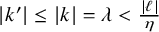 $|k'| \le |k| = \lambda < \frac {|\ell |}{\eta } $
, to conclude, we integrate by part and use the estimate:
$|k'| \le |k| = \lambda < \frac {|\ell |}{\eta } $
, to conclude, we integrate by part and use the estimate:
 $$ \begin{align*} |\nabla_{x'} \psi^\epsilon_{k,\ell} (x')| = \Bigl|\Bigl(k' - \frac \ell \epsilon, k" \cdot \nabla_{x'} \varphi\Bigr) \Bigr| \geq \frac{|\ell|} \epsilon - |k'| \geq |\ell| \Bigl(\frac{1}{\epsilon} - \frac{1}{\eta}\Bigr).\\[-42pt] \end{align*} $$
Proof of Proposition 6.2
By the compactness of $\mathcal {S}$
, there exists
$\mathcal {S}$
, there exists $\epsilon _0> 0$
and a finite open covering
$\epsilon _0> 0$
and a finite open covering $S = \bigcup _{j=1}^K S_j$
where, for each j, there exists a smooth function
$S = \bigcup _{j=1}^K S_j$
where, for each j, there exists a smooth function $\varphi _j : \mathbb {R}^\beta \to \mathbb {R}^{d-\beta }$
such that
$\varphi _j : \mathbb {R}^\beta \to \mathbb {R}^{d-\beta }$
such that ${S_j = \{(x',\varphi _j(x') : x' \in \epsilon _0 B) \}}$
under a certain system of coordinates.
${S_j = \{(x',\varphi _j(x') : x' \in \epsilon _0 B) \}}$
under a certain system of coordinates.
We proceed as in the proof of Proposition 6.1 and let
 $$ \begin{align*} g^j_\lambda(x') = \chi \Bigl(\frac {x'} {\epsilon}\Bigr) \sum_{k \in \mathcal{S}^{d-1}_{\lambda}} a_k e^{2\pi i k \cdot (x',\varphi_j(x'))} = (4\epsilon)^{-\beta} \sum_{\ell \in \mathbb{Z}^\beta} e^{2\pi i \frac{\ell}{4\epsilon} \cdot x'} \widehat{g}^j_\lambda(\ell). \end{align*} $$
Fix an increasing sequence $(\lambda _n)_{n \ge 0}$
such that
$(\lambda _n)_{n \ge 0}$
such that
-
• If
$d=3,4$
, then
$N_d(\lambda _n) \gtrsim \lambda _n \ln \ln \lambda _n$
; -
• If
$d\ge 5$
, then
$N_d(\lambda _n) \gtrsim _d \lambda _n^{d-2}$
.


Setting $\eta = 1$
, we solve the following linear systems:
$\eta = 1$
, we solve the following linear systems:
 $$ \begin{align*} \widehat{g}^j_{\lambda_n}(\ell) = 0, \quad \ell \in \mathbb{Z}^\beta,\ |\ell| \le \lambda_n, \ 1 \le j \le K. \end{align*} $$
Now the number of equation is $\lesssim _\beta K \lambda _n^\beta $
. It is smaller than
$\lesssim _\beta K \lambda _n^\beta $
. It is smaller than $N_d(\lambda _n)$
, the number of the unknowns (which are
$N_d(\lambda _n)$
, the number of the unknowns (which are $(a_k)$
), under the assumption of the proposition (either
$(a_k)$
), under the assumption of the proposition (either $d=3,4$
and
$d=3,4$
and $\beta \le d-2$
or
$\beta \le d-2$
or $d \ge 5$
and
$d \ge 5$
and $\beta \le d-3$
). Hence, for large n, we find an
$\beta \le d-3$
). Hence, for large n, we find an $\ell ^2$
normalized solution
$\ell ^2$
normalized solution $(a^n_k)_{k \in \mathcal {S}^{d-1}_{\lambda _n}}$
to this system.
$(a^n_k)_{k \in \mathcal {S}^{d-1}_{\lambda _n}}$
to this system.
To conclude, one defines the eigenfunction $u_n \in E_{\lambda _n}$
as previously, apply the previously obtained estimates of
$u_n \in E_{\lambda _n}$
as previously, apply the previously obtained estimates of $u_n$
on each coordinate patch, and combines these estimate:
$u_n$
on each coordinate patch, and combines these estimate:
 $$ \begin{align*} \|u_n\|_{L^2(\mathop{}\!\mathrm{d}\mu)}^2 \le \sum_{1 \le j \le K} \| \boldsymbol{1}_{S_j} u_n \|_{L^2(\mathop{}\!\mathrm{d}\mu)}^2 \lesssim_{\beta,\epsilon} \sum_{1 \le j \le K} \| g^j_{\lambda_n} \|_{L^2 (\mathbb{T}^\beta_{4\epsilon})}^2 \lesssim_{d,\beta,\varphi,\epsilon,\eta,N} K \lambda_n^{-N}. \end{align*} $$
Remark 6.5. Propositions 6.1 and 6.2 (the latter under the requirement $\beta \leq d-3$
) can be extended to a general compact Riemannian manifold M of dimension d. In this generalization, eigenfunctions are replaced by quasimodes of
$\beta \leq d-3$
) can be extended to a general compact Riemannian manifold M of dimension d. In this generalization, eigenfunctions are replaced by quasimodes of $\Delta _M$
, the Laplacian on M. Specifically, for some
$\Delta _M$
, the Laplacian on M. Specifically, for some $\delta> 0$
, one considers functions in the space
$\delta> 0$
, one considers functions in the space
 $$ \begin{align*} E_{\lambda,\delta} = \bigoplus_{\mu \in (\lambda^2 - \delta, \lambda^2 + \delta)} \ker(-\Delta_M - \mu). \end{align*} $$
Indeed, at least along a sequence $\lambda _n \to \infty $
, the lower bound
$\lambda _n \to \infty $
, the lower bound
 $$ \begin{align*} \dim E_{\lambda,\delta} \gtrsim_{M,\delta} \lambda^{d-2} \end{align*} $$
follows directly from Weyl’s law:
 $$ \begin{align*} \#\{ \lambda \in \sigma(-\Delta) : \lambda \leq \Lambda \} \sim_M \Lambda^d. \end{align*} $$
In the preceding proofs, the only torus-specific ingredient is the explicit form of the eigenfunctions on $\mathbb {T}^d$
, which makes it possible to precisely identify the oscillatory behavior of the traces
$\mathbb {T}^d$
, which makes it possible to precisely identify the oscillatory behavior of the traces $g_\lambda $
. This structure enables the integration by parts argument in Lemma 6.4. However, on a general compact Riemannian manifold, this exact eigenfunction description can be replaced by suitable approximate representations of quasimodes (see, e.g., [Reference Sogge37, Chapter5] and [Reference Burq, Gérard and Tzvetkov12, Lemma 2.3]).
$g_\lambda $
. This structure enables the integration by parts argument in Lemma 6.4. However, on a general compact Riemannian manifold, this exact eigenfunction description can be replaced by suitable approximate representations of quasimodes (see, e.g., [Reference Sogge37, Chapter5] and [Reference Burq, Gérard and Tzvetkov12, Lemma 2.3]).
We now turn to the case of general measures. The reader can refer to Section 3 for a definition of the upper Minkowski dimension.
Proposition 6.6 (Necessary conditions for observability for general measures)
If $d \geq 3$
and
$d \geq 3$
and $\overline {\dim }_{\mathrm {M}} (\operatorname {\mathrm {supp}} \mu ) < d-2$
, then the observability inequality does not hold true. Equivalently, there exists a sequence of
$\overline {\dim }_{\mathrm {M}} (\operatorname {\mathrm {supp}} \mu ) < d-2$
, then the observability inequality does not hold true. Equivalently, there exists a sequence of $L^2$
-normalized eigenfunction
$L^2$
-normalized eigenfunction $\{u_n \}_{n}$
where
$\{u_n \}_{n}$
where $u_n \in E_{\lambda _n}$
with
$u_n \in E_{\lambda _n}$
with $\lambda _n \to \infty $
, such that
$\lambda _n \to \infty $
, such that
 $$ \begin{align*} \lim_{n \to \infty} \int_{\mathbb{T}^d} |u_n|^2 \mathop{}\!\mathrm{d} \mu = 0. \end{align*} $$
We start with a preparatory lemma.
Lemma 6.7. For all $\lambda \ge 1$
, all
$\lambda \ge 1$
, all $\ell \in \mathbb {Z}^d$
and all
$\ell \in \mathbb {Z}^d$
and all $x_0 \in \mathbb {T}^d$
, there exists a linear functional
$x_0 \in \mathbb {T}^d$
, there exists a linear functional $\alpha _{\lambda ,\ell ,x_0} : C^\infty (\mathbb {T}^d) \to \mathbb {C}$
such that, if
$\alpha _{\lambda ,\ell ,x_0} : C^\infty (\mathbb {T}^d) \to \mathbb {C}$
such that, if $u \in C^\infty (\mathbb {T}^d)$
is
$u \in C^\infty (\mathbb {T}^d)$
is $L^2$
-normalized and satisfies
$L^2$
-normalized and satisfies $\widehat {u}_k = 0$
for
$\widehat {u}_k = 0$
for $|k|> \lambda $
, then for all
$|k|> \lambda $
, then for all $R>0$
and all
$R>0$
and all $N \in \mathbb {N}$
, there holds
$N \in \mathbb {N}$
, there holds
 $$ \begin{align*} \sup_{4 \lambda |x-x_0| \le 1} \biggl| u(x) - \sum_{|\ell| \leq R} \alpha_{\lambda,\ell}(u) e^{2\pi i \ell \cdot \lambda x} \biggr| \lesssim_{d,N} \lambda^{d/2}R^{-N}. \end{align*} $$
Proof. Up to a translation, we may assume that $x_0 = 0$
. Let
$x_0 = 0$
. Let $\chi \in C^\infty _c(\mathbb {R}^d)$
be supported in
$\chi \in C^\infty _c(\mathbb {R}^d)$
be supported in $\frac {1}{2} B = \{x \in \mathbb {R}^d : |x| \le \frac {1}{2}\}$
. For
$\frac {1}{2} B = \{x \in \mathbb {R}^d : |x| \le \frac {1}{2}\}$
. For $u \in C^\infty (\mathbb {T}^d)$
, let
$u \in C^\infty (\mathbb {T}^d)$
, let
 $$ \begin{align*} g(y) = \chi (y) u \left(\frac{y}{\lambda} \right) = \chi(y) \sum_{k \in \mathbb{Z}^d} \widehat{u}_k e^{2 \pi i k \cdot y/\lambda}. \end{align*} $$
Since $\operatorname {\mathrm {supp}} g \subset \frac {1}{2} B$
, we may extend it periodically to
$\operatorname {\mathrm {supp}} g \subset \frac {1}{2} B$
, we may extend it periodically to $\mathbb {T}^d$
and still denote this extension by g. Let
$\mathbb {T}^d$
and still denote this extension by g. Let $(\widehat {g}_\ell )_{\ell \in \mathbb {Z}^d}$
be Fourier coefficients of g and let
$(\widehat {g}_\ell )_{\ell \in \mathbb {Z}^d}$
be Fourier coefficients of g and let $\widehat {\chi }$
be the Fourier transform of
$\widehat {\chi }$
be the Fourier transform of $\chi $
in
$\chi $
in $\mathbb {R}^d$
. Then, define
$\mathbb {R}^d$
. Then, define
 $$ \begin{align*} \alpha_{\lambda,\ell,x_0}(u) = \widehat{g}_\ell = \sum_{k \in \mathbb{Z}^d} \widehat{u}_k \int_{\mathbb{T}^d} \chi(y) e^{2\pi i (k/\lambda - \ell)\cdot y} \mathop{}\!\mathrm{d} y = \sum_{k \in \mathbb{Z}^d} \widehat{u}_k \widehat{\chi}\Bigl(\ell-\frac{k}{\lambda}\Bigr). \end{align*} $$
Now assume that $\widehat {u}_k = 0$
when
$\widehat {u}_k = 0$
when $|k|> \lambda $
. By the Cauchy–Schwartz inequality and the rapid decay of
$|k|> \lambda $
. By the Cauchy–Schwartz inequality and the rapid decay of $\widehat {\chi }$
, one deduces that, for all
$\widehat {\chi }$
, one deduces that, for all $N \ge 0$
,
$N \ge 0$
,
 $$ \begin{align*} |\widehat{g}_\ell|^2 \lesssim_{\chi,N} \|u\|_{L^2}^2 \sum_{|k|\le \lambda} \Bigl(1 + \Bigl|\ell - \frac{k}{\lambda}\Bigr|^2\Bigr)^{-N} \le \lambda^d (1+|\ell|)^{-2N} \|u\|_{L^2}^2. \end{align*} $$
This implies that, for all $R \ge 1$
, we have
$R \ge 1$
, we have
 $$ \begin{align*} \sup_{4\lambda |x| \le 1} \biggl|u(x)-\sum_{|\ell| \le R} \widehat{g}_\ell e^{2\pi i \ell \cdot \lambda x}\biggr| \le \biggl\|g(y) - \sum_{|\ell| \le R} \widehat{g}_\ell e^{2\pi i \ell \cdot y}\biggr\|_{L^\infty} \le \sum_{|\ell|> R} |\widehat{g}_\ell| \lesssim_{\chi,d,N} \lambda^{d/2} R^{-N}. \end{align*} $$
Proof of Proposition 6.6
Let $\phi $
be a Schwartz function in
$\phi $
be a Schwartz function in $\mathbb {R}^d$
such that
$\mathbb {R}^d$
such that $\widehat {\phi } \in C_c^\infty (\mathbb {R}^d)$
and satisfies
$\widehat {\phi } \in C_c^\infty (\mathbb {R}^d)$
and satisfies $\widehat {\phi }(\xi )=1$
for
$\widehat {\phi }(\xi )=1$
for $|\xi | \le 2$
. For
$|\xi | \le 2$
. For $\lambda \ge 1$
, let
$\lambda \ge 1$
, let $\Phi \in C^\infty (\mathbb {T}^d)$
be such that
$\Phi \in C^\infty (\mathbb {T}^d)$
be such that $\widehat {\Phi }_k = \widehat {\phi }(k/\lambda )$
for
$\widehat {\Phi }_k = \widehat {\phi }(k/\lambda )$
for $k \in \mathbb {Z}^d$
. Particularly
$k \in \mathbb {Z}^d$
. Particularly $\widehat {\Phi }_k = 1$
when
$\widehat {\Phi }_k = 1$
when $|k| \le 2\lambda $
. Consequently, if
$|k| \le 2\lambda $
. Consequently, if $u \in E_\lambda $
, then
$u \in E_\lambda $
, then
 $$ \begin{align*} \int_{\mathbb{T}^d} |u|^2 \mathop{}\!\mathrm{d}\mu = \int_{\mathbb{T}^d} \Phi * (|u|^2) \mathop{}\!\mathrm{d}\mu = \int_{\mathbb{T}^d} |u|^2 \mathop{}\!\mathrm{d}(\Phi * \mu). \end{align*} $$
By the Poisson summation formula and Fourier rescaling properties, one has
 $$ \begin{align*} \Phi(x) = \sum_{k \in \mathbb{Z}^d} \widehat{\phi}\Bigl( \frac{k}{\lambda} \Bigr) e^{2\pi i k\cdot x} = \lambda^d \sum_{q \in \mathbb{Z}^d} \phi(\lambda (x-q)). \end{align*} $$
From this, one immediately sees that $\Phi $
is concentrated near
$\Phi $
is concentrated near $\mathbb {Z}^d$
(i.e.
$\mathbb {Z}^d$
(i.e. $0 \in \mathbb {T}^d$
). Quantitatively, letting
$0 \in \mathbb {T}^d$
). Quantitatively, letting $B_{\lambda ^{-1+\epsilon } }(0) = \{x \in \mathbb {T}^d : \mathrm {dist}(x,0) \le \lambda ^{-1+\epsilon }\}$
, then the following estimates hold:
$B_{\lambda ^{-1+\epsilon } }(0) = \{x \in \mathbb {T}^d : \mathrm {dist}(x,0) \le \lambda ^{-1+\epsilon }\}$
, then the following estimates hold:
-
•
$|\Phi (x)| \lesssim _{\phi ,d} \lambda ^d $
for
$x \in B_{\lambda ^{-1+\epsilon } }(0)$
; -
•
$|\Phi (x)| \lesssim _{\phi ,d,N, \epsilon } \lambda ^{-N} $
for
$N \ge 0$
and
$x \notin B_{\lambda ^{-1+\epsilon } }(0)$
.


Therefore, to conclude the proof it is enough to show that there exist $\epsilon>0$
and a sequence of
$\epsilon>0$
and a sequence of $L^2$
-normalized eigenfunctions
$L^2$
-normalized eigenfunctions $u_n \in E_{\lambda _n}$
with
$u_n \in E_{\lambda _n}$
with $\lambda _n \to \infty $
such that
$\lambda _n \to \infty $
such that
 $$ \begin{align*} \lim_{n \to \infty} \int_{\mathbb{T}^d} |u_n|^2 \mathop{}\!\mathrm{d} \mu_n^\epsilon = 0, \quad \text{ where } \mu_n^\epsilon = \lambda_n^d \cdot \mathbf{1}_{B_{\lambda_n^{-1+\epsilon} }(0)} * \mu. \end{align*} $$
Let $\beta = \overline {\dim }_{\mathrm {M}} (\operatorname {\mathrm {supp}} \mu )$
and choose
$\beta = \overline {\dim }_{\mathrm {M}} (\operatorname {\mathrm {supp}} \mu )$
and choose $\epsilon> 0$
such that
$\epsilon> 0$
such that $\beta + 2d\epsilon < d-2$
. Then, from the Minkowski dimension definition, we note that there exists
$\beta + 2d\epsilon < d-2$
. Then, from the Minkowski dimension definition, we note that there exists $K \lesssim _{d,\mu } \lambda ^{\beta + d\epsilon }$
and
$K \lesssim _{d,\mu } \lambda ^{\beta + d\epsilon }$
and $(x_j)_{j=1}^K$
in
$(x_j)_{j=1}^K$
in $\mathbb {T}^d$
such that
$\mathbb {T}^d$
such that
 $$ \begin{align*} \operatorname{\mathrm{supp}} \mu_n^\epsilon \subset B_{\lambda_n^{-1+\epsilon} }(0) + \operatorname{\mathrm{supp}} \mu \subset \bigcup_{1 \le j \le K} B_{\lambda_n^{-1}/6}(x_j). \end{align*} $$
Let $\alpha _{\lambda ,\ell ,x_j}$
be defined as in Lemma 6.7. For any
$\alpha _{\lambda ,\ell ,x_j}$
be defined as in Lemma 6.7. For any $n \in \mathbb {N}$
we can find an
$n \in \mathbb {N}$
we can find an $L^2$
-normalized eigenfunction
$L^2$
-normalized eigenfunction $u^{(n)} \in E_{\lambda _n}$
satisfying the following conditions:
$u^{(n)} \in E_{\lambda _n}$
satisfying the following conditions:
 $$ \begin{align} \alpha_{\lambda_n,\ell,x_j}(u^{(n)}) = 0, \quad 1 \le j \le K, \ |\ell| \le \lambda^\epsilon. \end{align} $$
Interpreting (6.4) as a linear system in the unknowns $(\widehat {u}^{(n)}_k)_{k \in \mathcal {S}^{d-1}_{\lambda _n}}$
, the number of unknowns is
$(\widehat {u}^{(n)}_k)_{k \in \mathcal {S}^{d-1}_{\lambda _n}}$
, the number of unknowns is $N_d(\lambda _n)$
, which satisfies
$N_d(\lambda _n)$
, which satisfies $N_d(\lambda _n) \gtrsim \lambda _n^{d-2}$
for a suitably chosen sequence
$N_d(\lambda _n) \gtrsim \lambda _n^{d-2}$
for a suitably chosen sequence $(\lambda _n)$
(see Lemma 3.2). In contrast, the number of equations satisfies the bound
$(\lambda _n)$
(see Lemma 3.2). In contrast, the number of equations satisfies the bound $\lesssim _d K \lambda _n^{d\epsilon } \lesssim _{d,\mu } \lambda _n^{\beta + 2d\epsilon }$
. Since
$\lesssim _d K \lambda _n^{d\epsilon } \lesssim _{d,\mu } \lambda _n^{\beta + 2d\epsilon }$
. Since $\beta + 2d\epsilon < d-2$
, for this sequence and sufficiently large n, a nontrivial solution always exists.
$\beta + 2d\epsilon < d-2$
, for this sequence and sufficiently large n, a nontrivial solution always exists.
For such $u^{(n)}$
, by Lemma 6.7, for all
$u^{(n)}$
, by Lemma 6.7, for all $j \in \{1,\ldots ,K\}$
and
$j \in \{1,\ldots ,K\}$
and $N \ge 0$
, there holds
$N \ge 0$
, there holds $|u^{(n)}(x)| \lesssim _{d,N} \lambda _n^{d/2-\epsilon N}$
for
$|u^{(n)}(x)| \lesssim _{d,N} \lambda _n^{d/2-\epsilon N}$
for $x \in B_{\lambda _n^{-1}/6}(x_j)$
. Therefore, taking N large, one obtains as
$x \in B_{\lambda _n^{-1}/6}(x_j)$
. Therefore, taking N large, one obtains as $n \to \infty $
:
$n \to \infty $
:
 $$ \begin{align*} \int_{\mathbb{T}^d} |u_n|^2 \mathop{}\!\mathrm{d} \mu_n^\epsilon & \leq \sum_{1 \le j \le K} \|u\|_{L^\infty(B_{\lambda_n^{-1}/6}(x_j))}^2 \times \mu_n^\epsilon(B_{\lambda_n^{-1}/6}(x_j)) \\ & \lesssim_{d,N} \sum_{1 \le j \le K} \lambda_n^{d-2\epsilon N} \times \lambda^{ d \epsilon} \lesssim_{d} \lambda_n^{(\beta + 2 d\epsilon) + (d-2\epsilon N)} \to 0.\end{align*} $$
7 Pointwise Fourier decay
Theorem 7.1. Let $d\geq 3$
. The observability inequality and the trace inequality hold true for
$d\geq 3$
. The observability inequality and the trace inequality hold true for $\mu \in \mathcal {P}(\mathbb {T}^d)$
if, for some
$\mu \in \mathcal {P}(\mathbb {T}^d)$
if, for some $\epsilon>0$
, it satisfies the Fourier decay estimate:
$\epsilon>0$
, it satisfies the Fourier decay estimate:
 $$ \begin{align} |\widehat{\mu}_k| \lesssim |k|^{-(d-2 + \epsilon)}. \end{align} $$
Remark 7.2. A typical example of measures satisfying (7.1) is given by $\mathop {}\!\mathrm {d} \mu = f \mathop {}\!\mathrm {d} x$
with the density f being smooth except at the origin, where it behaves as
$\mathop {}\!\mathrm {d} \mu = f \mathop {}\!\mathrm {d} x$
with the density f being smooth except at the origin, where it behaves as $|f(x)| \sim |x|^{\epsilon -2}$
, see Remark 7.3 for a related example. Note that such a measure is upper
$|f(x)| \sim |x|^{\epsilon -2}$
, see Remark 7.3 for a related example. Note that such a measure is upper $(d-2+\epsilon )$
-regular.
$(d-2+\epsilon )$
-regular.
Remark 7.3. The decay rate $d-2$
in the statement is sharp for the trace inequality. More precisely, for any
$d-2$
in the statement is sharp for the trace inequality. More precisely, for any $\epsilon> 0$
, one may construct a probability measure
$\epsilon> 0$
, one may construct a probability measure $\mu \in \mathcal {P}(\mathbb {T}^d)$
with Fourier decay
$\mu \in \mathcal {P}(\mathbb {T}^d)$
with Fourier decay $|\widehat {\mu }_k| \lesssim |k|^{-(d-2-\epsilon )}$
such that the trace inequality does not hold. We define the measure by setting
$|\widehat {\mu }_k| \lesssim |k|^{-(d-2-\epsilon )}$
such that the trace inequality does not hold. We define the measure by setting $\mathop {}\!\mathrm {d} \mu = C f \mathop {}\!\mathrm {d} x$
where
$\mathop {}\!\mathrm {d} \mu = C f \mathop {}\!\mathrm {d} x$
where $C> 0$
is a normalizing constant that makes
$C> 0$
is a normalizing constant that makes $\mu $
a probability measure and
$\mu $
a probability measure and
 $$ \begin{align*} f(x) =\sum_{k \in \mathbb{Z}^d} \phi_\epsilon(x+k), \quad \forall x\in [0,1)^d, \qquad \phi_\epsilon(x) = e^{-|x|^2}/|x|^{2+ \epsilon} \quad \forall x \in \mathbb{R}^d. \end{align*} $$
A straightforward computation leads to $\widehat {f}_0 = \widehat {\phi }_\epsilon (0) = \frac {1}{C}>0 $
and
$\widehat {f}_0 = \widehat {\phi }_\epsilon (0) = \frac {1}{C}>0 $
and $\widehat {f}_k =\widehat {\phi }_\epsilon (k) \sim _{d,\epsilon } |k|^{-(d-2-\epsilon )} $
for all
$\widehat {f}_k =\widehat {\phi }_\epsilon (k) \sim _{d,\epsilon } |k|^{-(d-2-\epsilon )} $
for all $k \in \mathbb {Z}^d \setminus \{ 0\}$
. We conclude the invalidity of the trace inequality by applying Proposition 5.1, noticing that f is not upper
$k \in \mathbb {Z}^d \setminus \{ 0\}$
. We conclude the invalidity of the trace inequality by applying Proposition 5.1, noticing that f is not upper $d-2$
-regular. For
$d-2$
-regular. For $d=3,4$
one may set
$d=3,4$
one may set $\epsilon =0$
by applying Proposition 5.3.
$\epsilon =0$
by applying Proposition 5.3.
Our proof relies on the cluster structure of $\mathcal {S}^{d-1}_\lambda $
, and more specifically on Lemma 3.6 due to Connes [Reference Connes19], which enables a dimensional reduction. The core idea is as follows. If
$\mathcal {S}^{d-1}_\lambda $
, and more specifically on Lemma 3.6 due to Connes [Reference Connes19], which enables a dimensional reduction. The core idea is as follows. If $\mathcal {S}^{d-1}_\lambda = \bigcup _\alpha \Omega _\alpha $
is the decomposition given by Lemma 3.6, then for any
$\mathcal {S}^{d-1}_\lambda = \bigcup _\alpha \Omega _\alpha $
is the decomposition given by Lemma 3.6, then for any $u \in E_\lambda $
, we have
$u \in E_\lambda $
, we have
 $$ \begin{align} \|u\|_{L^2 (d\mu)}^2 = \sum_{k,\ell \in \mathcal{S}^{d-1}_\lambda} \widehat{\mu}_{k-\ell} \widehat{u}_k \overline{\widehat{u}_\ell} = \sum_\alpha \sum_{k,\ell \in \Omega_\alpha} \widehat{\mu}_{k-\ell} \widehat{u}_k \overline{\widehat{u}_\ell} + \sum_{\alpha \ne \beta} \sum_{k \in \Omega_\alpha} \sum_{\ell \in \Omega_\beta} \widehat{\mu}_{k-\ell} \widehat{u}_k \overline{\widehat{u}_\ell}. \end{align} $$
Because the clusters $\Omega _\alpha $
are well separated and the measure
$\Omega _\alpha $
are well separated and the measure $\mu $
exhibits Fourier decay, the cross-cluster interaction (the second term) is expected to be small and can be treated as an error term. It therefore suffices to establish the trace and observability inequalities for functions whose frequencies lie within a single cluster
$\mu $
exhibits Fourier decay, the cross-cluster interaction (the second term) is expected to be small and can be treated as an error term. It therefore suffices to establish the trace and observability inequalities for functions whose frequencies lie within a single cluster $\Omega _\alpha $
. Since each cluster is contained in a lower-dimensional sphere, this structure naturally supports an inductive argument on the dimension.
$\Omega _\alpha $
. Since each cluster is contained in a lower-dimensional sphere, this structure naturally supports an inductive argument on the dimension.
Note that, in order for the error term to be small, one needs $\lambda $
to be sufficiently large. More precisely, it turns out from the proof that, one only needs
$\lambda $
to be sufficiently large. More precisely, it turns out from the proof that, one only needs $\operatorname {\mathrm {diam}} \operatorname {\mathrm {supp}} \widehat {u}$
to be sufficiently large. This leads to the consideration, for
$\operatorname {\mathrm {diam}} \operatorname {\mathrm {supp}} \widehat {u}$
to be sufficiently large. This leads to the consideration, for $r> 0$
, of the following space:
$r> 0$
, of the following space:
 $$ \begin{align*} \mathcal{T}_r = \{u \in C^\infty(\mathbb{T}^d) : \operatorname{\mathrm{diam}} \operatorname{\mathrm{supp}} \widehat{u} \le r\}. \end{align*} $$
In other words $\mathcal {T}_r$
is the space of all trigonometric polynomials whose Fourier supports have diameters
$\mathcal {T}_r$
is the space of all trigonometric polynomials whose Fourier supports have diameters ${\le r}$
. The following lemma establish quadratic estimates for trigonometric polynomials in
${\le r}$
. The following lemma establish quadratic estimates for trigonometric polynomials in $\mathcal {T}_r$
, and it will be used in both this and the next section.
$\mathcal {T}_r$
, and it will be used in both this and the next section.
Lemma 7.4. If $\operatorname {\mathrm {supp}} \mu $
is not contained in the zero set of any nonzero trigonometric polynomial, then uniformaly for all
$\operatorname {\mathrm {supp}} \mu $
is not contained in the zero set of any nonzero trigonometric polynomial, then uniformaly for all $u \in \mathcal {T}_r$
, there holds
$u \in \mathcal {T}_r$
, there holds
 $$ \begin{align*} \|u\|_{L^2(\mathop{}\!\mathrm{d} \mu)} \sim_{d,\mu,r} \|u\|_{L^2}. \end{align*} $$
Proof. Indeed, by the translation invariance of these norms in the Fourier space, we only need to consider trigonometric polynomials whose Fourier supports are within the $2r$
neighborhood of the origin. Such functions form a finite dimensional space. Therefore, there exist the maximum and the minimum of the continuous function
$2r$
neighborhood of the origin. Such functions form a finite dimensional space. Therefore, there exist the maximum and the minimum of the continuous function
 $$ \begin{align*} u \in \{ L^2 (\mathbb{T}^d) : \| u \|_{L^2} =1\} \mapsto \|u\|_{L^2(\mathop{}\!\mathrm{d} \mu)}^2. \end{align*} $$
Finally, by the assumption that $\operatorname {\mathrm {supp}} \mu $
is not contained in the support of any nonzero trigonometric polynomials we have that the minimum is nonzero, concluding the proof.
$\operatorname {\mathrm {supp}} \mu $
is not contained in the support of any nonzero trigonometric polynomials we have that the minimum is nonzero, concluding the proof.
Remark 7.5. This lemma applies to any $\mu \in \mathcal {P}(\mathbb {T}^d)$
that satisfies (7.1). Indeed, by [Reference Mattila33, Theorem 2.8 and Section 3.6], it implies
$\mu \in \mathcal {P}(\mathbb {T}^d)$
that satisfies (7.1). Indeed, by [Reference Mattila33, Theorem 2.8 and Section 3.6], it implies
 $$ \begin{align*} \dim_{\mathrm{H}} \operatorname{\mathrm{supp}} \mu \geq \dim_{\mathrm{F}} \operatorname{\mathrm{supp}} \mu \ge 2(d-2+\epsilon)> d-1. \end{align*} $$
In the following, we first present a proof for the $d=3$
case (the proof for the general case will be given afterwards). A related result is implicit in [Reference Bourgain and Rudnick11], where the authors consider measures with Fourier decay
$d=3$
case (the proof for the general case will be given afterwards). A related result is implicit in [Reference Bourgain and Rudnick11], where the authors consider measures with Fourier decay $|k|^{-1}$
and rely on the oscillatory structure of the Fourier coefficients. In our setting, we assume slightly faster decay, of the form
$|k|^{-1}$
and rely on the oscillatory structure of the Fourier coefficients. In our setting, we assume slightly faster decay, of the form $|k|^{-(1+\epsilon )}$
, which enables a simpler argument.
$|k|^{-(1+\epsilon )}$
, which enables a simpler argument.
Proof of Theorem 7.1 for
$d = 3$

By Lemma 7.4, it remains to establish the trace and observability estimates for eigenfunctions with $\operatorname {\mathrm {diam}} \operatorname {\mathrm {supp}} \widehat {u}> r$
for some sufficiently large r.
$\operatorname {\mathrm {diam}} \operatorname {\mathrm {supp}} \widehat {u}> r$
for some sufficiently large r.
For any such $L^2$
-normalized eigenfunction
$L^2$
-normalized eigenfunction $u \in E_\lambda $
, one has
$u \in E_\lambda $
, one has $\lambda \gtrsim r$
. By Lemma 3.6, write
$\lambda \gtrsim r$
. By Lemma 3.6, write $\mathcal {S}^2_\lambda = \bigcup _\alpha \Omega _\alpha $
where each
$\mathcal {S}^2_\lambda = \bigcup _\alpha \Omega _\alpha $
where each $\Omega _\alpha $
lives in an affine subspace of dimension
$\Omega _\alpha $
lives in an affine subspace of dimension $\le 2$
and
$\le 2$
and $\mathrm {dist}(\Omega _\alpha ,\Omega _\beta )> C \lambda ^{2/4!}$
some
$\mathrm {dist}(\Omega _\alpha ,\Omega _\beta )> C \lambda ^{2/4!}$
some $C>0$
whenever
$C>0$
whenever $\alpha \ne \beta $
. Then we invoke the decomposition formula (7.2). We firstly estimate the second summand. Let
$\alpha \ne \beta $
. Then we invoke the decomposition formula (7.2). We firstly estimate the second summand. Let $j_\lambda = \max \{j \in \mathbb {N} : 2^j \le C \lambda ^{2/4!}\}$
. Then
$j_\lambda = \max \{j \in \mathbb {N} : 2^j \le C \lambda ^{2/4!}\}$
. Then
 $$ \begin{align*} \biggl| \sum_{\alpha\ne\beta} \sum_{k \in \Omega_\alpha} \sum_{\ell \in \Omega_\beta} \widehat{\mu}_{k-\ell} \widehat{u}_k \overline{\widehat{u}_\ell} \biggr| & \le \sum_{|k-\ell|> C \lambda^{2/4!}} |\widehat{\mu}_{k-\ell} \widehat{u}_k \overline{\widehat{u}_\ell}| \le \sum_{j \ge j_\lambda} \sum_{2^j \le |k-\ell| \le 2^{j+1}} |\widehat{\mu}_{k-\ell} \widehat{u}_k \overline{\widehat{u}_\ell}| \\ & \lesssim \sum_{j \ge j_\lambda} \max_{2^j \le |\xi| \le 2^{j+1}} |\widehat{\mu}_\xi| \sum_{2^j \le |k-\ell| \le 2^{j+1}} \bigl( |\widehat{u}_k|^2 + |\widehat{u}_\ell|^2 \bigr) \\ & \lesssim \sum_{j \ge j_\lambda} N_3(\lambda,2^{j+1}) \max_{2^j \le |\xi| \le 2^{j+1}} |\widehat{\mu}_\xi| \\ & \lesssim_\epsilon \sum_{j \ge j_\lambda} \lambda^{\epsilon/4!} 2^j \times 2^{-j(1+\epsilon)} \lesssim \sum_{j \ge j_\lambda} 2^{-j\epsilon/2} = o(1)_{r \to \infty}. \end{align*} $$
To conclude, we use the following claim: for each $\alpha $
, there holds
$\alpha $
, there holds
 $$ \begin{align} \sum_{k,\ell \in \Omega_\alpha} \widehat{\mu}_{k-\ell} \widehat{u}_k \overline{\widehat{u}_\ell} \sim_\mu \sum_{k \in \Omega_\alpha} |\widehat{u}_k|^2. \end{align} $$
Indeed, even though we are in the $d=3$
setting, the sets
$d=3$
setting, the sets $(\Omega _\alpha )_\alpha $
each lies within a two dimensional affine hyperplane and is thus contained in a circle of radius
$(\Omega _\alpha )_\alpha $
each lies within a two dimensional affine hyperplane and is thus contained in a circle of radius $r_\alpha $
. Therefore the exact same proof as Theorem 4.1 (for the Fourier decay case) applies. This proof establishes the trace inequality and the semiclassical observability, that is, the observability inequality holds when
$r_\alpha $
. Therefore the exact same proof as Theorem 4.1 (for the Fourier decay case) applies. This proof establishes the trace inequality and the semiclassical observability, that is, the observability inequality holds when $r_\alpha $
is sufficiently large. The full observability is guaranteed by Lemma 7.4.
$r_\alpha $
is sufficiently large. The full observability is guaranteed by Lemma 7.4.
We now turn to the general case $d \geq 3$
. Our idea is to perform mathematical induction on the affine dimension of supports of eigenfunctions.
$d \geq 3$
. Our idea is to perform mathematical induction on the affine dimension of supports of eigenfunctions.
Definition 7.6. For any $\Omega \subset \mathbb {R}^d$
, we denote by
$\Omega \subset \mathbb {R}^d$
, we denote by $\dim _{\mathrm {aff}} \Omega $
the dimension of the affine hull of
$\dim _{\mathrm {aff}} \Omega $
the dimension of the affine hull of $\Omega $
, that is,
$\Omega $
, that is, $\dim _{\mathrm {aff}} \Omega $
equals the dimension of the smallest affine subspace in
$\dim _{\mathrm {aff}} \Omega $
equals the dimension of the smallest affine subspace in $\mathbb {R}^d$
that contains
$\mathbb {R}^d$
that contains $\Omega $
.
$\Omega $
.
Proof of Theorem 7.1 for
$d\geq 3$

By Lemma 7.4, it remains to establish the trace and observability estimates for eigenfunctions with $\operatorname {\mathrm {diam}} \operatorname {\mathrm {supp}} \widehat {u}> r$
for some sufficiently large r.
$\operatorname {\mathrm {diam}} \operatorname {\mathrm {supp}} \widehat {u}> r$
for some sufficiently large r.
We will achieve this by using mathematical induction on the affine dimension of $\operatorname {\mathrm {supp}} \widehat {u}$
. Precisely, we will prove the following statement: if r is sufficiently large, then for all
$\operatorname {\mathrm {supp}} \widehat {u}$
. Precisely, we will prove the following statement: if r is sufficiently large, then for all $n \in \{1,\ldots ,d\}$
and any toral eigenfunction u satisfying
$n \in \{1,\ldots ,d\}$
and any toral eigenfunction u satisfying $\operatorname {\mathrm {diam}} \operatorname {\mathrm {supp}} \widehat {u}> r$
and
$\operatorname {\mathrm {diam}} \operatorname {\mathrm {supp}} \widehat {u}> r$
and $\dim _{\mathrm {aff}} \operatorname {\mathrm {supp}} \widehat {u} = n$
, there holds
$\dim _{\mathrm {aff}} \operatorname {\mathrm {supp}} \widehat {u} = n$
, there holds
 $$ \begin{align} \|u\|_{L^2 (\mathop{}\!\mathrm{d} \mu)} \sim_{d,n,\mu,r} \| u \|_{L^2 (\mathbb{T}^d)}. \end{align} $$
We use mathematical induction. First we prove the case $n=1$
. In this case
$n=1$
. In this case $\# \operatorname {\mathrm {supp}} \widehat {u} \le 2$
and we denote
$\# \operatorname {\mathrm {supp}} \widehat {u} \le 2$
and we denote $\operatorname {\mathrm {supp}} \widehat {u} = \{ k, \ell \}$
. Let
$\operatorname {\mathrm {supp}} \widehat {u} = \{ k, \ell \}$
. Let $\delta>0$
be such that
$\delta>0$
be such that $\sup _{\xi \in \mathbb {Z}^d \setminus 0} |\widehat {\mu } (\xi )| \leq 1 - \delta $
(Lemma 3.7). Then, as in Section 4,
$\sup _{\xi \in \mathbb {Z}^d \setminus 0} |\widehat {\mu } (\xi )| \leq 1 - \delta $
(Lemma 3.7). Then, as in Section 4,
 $$ \begin{align*} \|u\|_{L^2}^2 \gtrsim \int_{\mathbb{T}^d} |u|^2 \mathop{}\!\mathrm{d} \mu = |\widehat{u}_k|^2 + |\widehat{u}_\ell|^2 + 2 \widehat{\mu}_{k-\ell} \widehat{u}_k \widehat{u}_\ell \geq \delta ( |\widehat{u}_k|^2 + |\widehat{u}_\ell|^2 ) = \delta \|u\|_{L^2}^2. \end{align*} $$
We now prove the induction step $n \Rightarrow n+1$
with
$n \Rightarrow n+1$
with $n \leq d-1$
. Fix any
$n \leq d-1$
. Fix any $L^2$
-normalized eigenfunction
$L^2$
-normalized eigenfunction $u \in E_\lambda $
with
$u \in E_\lambda $
with $\dim _{\mathrm {aff}} \operatorname {\mathrm {supp}} \widehat {u} = n+1$
. Now
$\dim _{\mathrm {aff}} \operatorname {\mathrm {supp}} \widehat {u} = n+1$
. Now $\operatorname {\mathrm {supp}} \widehat {u}$
is contained in an n-sphere of radius
$\operatorname {\mathrm {supp}} \widehat {u}$
is contained in an n-sphere of radius $\rho \gtrsim r$
. By Lemma 3.6, we write
$\rho \gtrsim r$
. By Lemma 3.6, we write $\operatorname {\mathrm {supp}} \widehat {u} = \bigcup _\alpha \Omega _\alpha $
where
$\operatorname {\mathrm {supp}} \widehat {u} = \bigcup _\alpha \Omega _\alpha $
where $\dim _{\mathrm {aff}} \Omega _\alpha \le n$
for all
$\dim _{\mathrm {aff}} \Omega _\alpha \le n$
for all $\alpha $
and
$\alpha $
and $\mathrm {dist}(\Omega _\alpha ,\Omega _\beta ) \ge C_n \rho ^{2/(n+1)!}$
for some
$\mathrm {dist}(\Omega _\alpha ,\Omega _\beta ) \ge C_n \rho ^{2/(n+1)!}$
for some $C_n> 0$
whenever
$C_n> 0$
whenever $\alpha \ne \beta $
. Then we invoke the decomposition formula (7.2) and for each
$\alpha \ne \beta $
. Then we invoke the decomposition formula (7.2) and for each $\alpha $
, we use the induction hypothesis and obtain
$\alpha $
, we use the induction hypothesis and obtain
 $$ \begin{align*} \sum_\alpha \sum_{k,\ell \in \Omega_\alpha} \widehat{\mu}_{k-\ell} \widehat{u}_k \overline{\widehat{u}_\ell} \sim_{d,n,\delta} \sum_\alpha \sum_{k \in \Omega_\alpha} |\widehat{u}_k|^2 = \|u\|_{L^2}^2. \end{align*} $$
To estimate the second summand term in (7.2), we let $j_s = \max \{j \in \mathbb {N} : 2^j \le C_n s^{2/d!}\}$
and write
$j_s = \max \{j \in \mathbb {N} : 2^j \le C_n s^{2/d!}\}$
and write
 $$ \begin{align*} \sum_{|k-\ell|> c_{d-1} \lambda^{2/d!}} |\widehat{\mu}_{k-\ell} \widehat{u}_k \overline{\widehat{u}_\ell}| & \le \sum_{j \ge j_\rho} \sum_{2^j \le |k-\ell| \le 2^{j+1}} |\widehat{\mu}_{k-\ell} \widehat{u}_k \overline{\widehat{u}_\ell}| \\ & \lesssim \sum_{j \ge j_\rho} \max_{2^j \le |\xi| \le 2^{j+1}} |\widehat{\mu}_\xi| \sum_{2^j \le |k-\ell| \le 2^{j+1}} \bigl( |\widehat{u}_k|^2 + |\widehat{u}_\ell|^2 \bigr) \\ & \lesssim \sum_{j \ge j_\rho} \sup_{k \in \operatorname{\mathrm{supp}} \widehat{u}} \# \bigl(\operatorname{\mathrm{supp}} \widehat{u} \cap B_{2^{j+1}}(k)\bigr) \times \max_{2^j \le |\xi| \le 2^{j+1}} |\widehat{\mu}_\xi|. \end{align*} $$
Next, we separate the discussion of the two cases: $n=d-1$
and
$n=d-1$
and $n<d-1$
:
$n<d-1$
:
-
• If
$n=d-1$
, then
$\# \bigl (\operatorname {\mathrm {supp}} \widehat {u} \cap B_{2^{j+1}}(k)\bigr ) \le N_d(\lambda ,2^{j+1}) \lesssim _d \lambda ^\epsilon 2^{j(d-2)}$
and
$\lambda =\rho \ge r$
. Therefore, the error term is bounded by
$$ \begin{align*} \sum_{j \ge j_\lambda} \lambda^{ \epsilon/d!} 2^{j(d-2)} \times 2^{-j(d-2+\epsilon)} \lesssim \sum_{j \ge j_\lambda} 2^{-j\epsilon/2} = \sum_{j \ge j_r} 2^{-j\epsilon/2} = o(1)_{r \to \infty}. \end{align*} $$
-
• If
$n \leq d-2$
, then
$\# \bigl (\operatorname {\mathrm {supp}} \widehat {u} \cap B_{2^{j+1}}(k)\bigr ) \lesssim _n 2^{n j} \lesssim 2^{(d-2) j}$
by the area method. Therefore, the error term is bounded by
$$ \begin{align*} \sum_{j \ge j_\rho} 2^{(d-2)j} \times 2^{-j(d-2+\epsilon)} \lesssim \sum_{j \ge j_\rho} 2^{-j\epsilon} = \sum_{j \ge j_r} 2^{-j\epsilon} = o(1)_{r \to \infty}. \end{align*} $$


We finish the induction process by combining these estimates above and formula (7.2). They yield the following estimate:
 $$ \begin{align*} \sum_{k,\ell \in \mathcal{S}^{d-1}_\lambda} \widehat{\mu}_{k-\ell} \widehat{u}_k \overline{\widehat{u}_\ell} \sim_{d,n,\delta} 1 + o(1)_{r \to \infty}.\\[-49pt] \end{align*} $$
When $ d \ge 5$
, we can relax the decay condition on
$ d \ge 5$
, we can relax the decay condition on $\mu $
.
$\mu $
.
Theorem 7.7. For $d \ge 5$
, the trace and observability inequalities hold if
$d \ge 5$
, the trace and observability inequalities hold if $\mu $
satisfies
$\mu $
satisfies
 $$ \begin{align} \sum_{j \ge 0} 2^{j(d-2)} \sup_{|\xi| \in [2^j,2^{j+1}]} |\widehat{\mu}_\xi| < \infty. \end{align} $$
Proof. The proof follows the same outline as before, with only minor adjustments noted below:
-
• The condition (7.5) implies the Fourier decay
$|\widehat {\mu }_\xi | = o(|\xi |^{-(d-2)})_{\xi \to \infty }$
. Therefore we still have
$\dim _{\mathrm {H}} \operatorname {\mathrm {supp}} \mu> d-1$
to apply Lemma 7.4. -
• In the
$n=d-1$
case, we use the finer estimate
$N_d(\lambda ,2^{j+1}) \lesssim _{d,\epsilon } \lambda ^{-1} 2^{j (d-1)} + \lambda ^{\epsilon /d!} 2^{j(d-3+\epsilon )}$
. Since it suffices to sum over those j with
$ { \lambda ^{2/d!} } \lesssim 2^j \lesssim \lambda $
, we may further bound
$N_d(\lambda ,2^{j+1}) \lesssim 2^{j(d-2)}$
. Therefore, the error term is bounded by
$$ \begin{align*} \sum_{j \ge j_\lambda} 2^{j(d-2)} \sup_{2^j \le |\xi| \le 2^{j+1}} |\widehat{\mu}_\xi| \le \sum_{j \ge j_r} 2^{j(d-2)} \max_{2^j \le |\xi| \le 2^{j+1}} |\widehat{\mu}_\xi| = o(1)_{r \to \infty}. \end{align*} $$
-
• In the
$n\leq d-2$
case, it suffices to notice that, by keeping
$\max _{2^j \le |\xi | \le 2^{j+1}} |\widehat {\mu }_\xi |$
in the summation, the remainder term satisfies the same estimate:
$$ \begin{align*} \sum_{j \ge j_r} 2^{j(d-2)} \sup_{2^j \le |\xi| \le 2^{j+1}} |\widehat{\mu}_\xi| = o(1)_{r \to \infty}.\\[-43pt] \end{align*} $$


8 Sobolev regularity
In this section we prove observability and trace inequalities under suitable Sobolev regularity assumptions of the measure. They are closely related to the estimates with subpolynomial loss
 $$ \begin{align*} \| u \|_{L^p} \lesssim \lambda^\epsilon \| u \|_{L^2}, \quad p \le \frac{2(d+1)}{d-1}, \end{align*} $$
for any eigenfunction $u \in E_\lambda $
. If
$u \in E_\lambda $
. If $d=3$
, this estimate was mentioned without proof in [Reference Bourgain7], and was generalized to
$d=3$
, this estimate was mentioned without proof in [Reference Bourgain7], and was generalized to $d \geq 3$
through the
$d \geq 3$
through the $\ell ^2$
decoupling theorem [Reference Bourgain and Demeter9].
$\ell ^2$
decoupling theorem [Reference Bourgain and Demeter9].
Theorem 8.1. For $d \geq 3$
, the trace and observability inequality holds true if
$d \geq 3$
, the trace and observability inequality holds true if $ \mathop {}\!\mathrm {d} \mu = g \mathop {}\!\mathrm {d} x$
where
$ \mathop {}\!\mathrm {d} \mu = g \mathop {}\!\mathrm {d} x$
where $g \in W^{\epsilon ,\frac {d+1}{2}} (\mathbb {T}^d)$
for some
$g \in W^{\epsilon ,\frac {d+1}{2}} (\mathbb {T}^d)$
for some $\epsilon>0$
. Furthermore, under the same assumption, this trace inequality is uniform in the sense that for all toral eigenfunctions:
$\epsilon>0$
. Furthermore, under the same assumption, this trace inequality is uniform in the sense that for all toral eigenfunctions:
 $$ \begin{align} \int_{\mathbb{T}^d} |u|^2 \mathop{}\!\mathrm{d} \mu \lesssim_{ d,\epsilon} \| g \|_{W^{\epsilon , \frac{d+1}{2} }} \| u \|_{L^2}^2. \end{align} $$
Remark 8.2. It is interesting and relevant in applications to apply this theorem to characteristic functions of sets, that is, $\mathop {}\!\mathrm {d} \mu = \mathbf {1}_E \mathop {}\!\mathrm {d} x$
. In Appendix A, we explore the case where C is a fat Cantor set and prove that
$\mathop {}\!\mathrm {d} \mu = \mathbf {1}_E \mathop {}\!\mathrm {d} x$
. In Appendix A, we explore the case where C is a fat Cantor set and prove that $\mathbf {1}_C \in W^{\epsilon , 1}$
for suitable
$\mathbf {1}_C \in W^{\epsilon , 1}$
for suitable $\epsilon>0$
. See also [Reference Lombardini32] for the fractional Sobolev regularity of
$\epsilon>0$
. See also [Reference Lombardini32] for the fractional Sobolev regularity of $\mathbf {1}_S$
where
$\mathbf {1}_S$
where $S \subset \mathbb {R}^2$
is the von Koch snowflake.
$S \subset \mathbb {R}^2$
is the von Koch snowflake.
Remark 8.3. Since now the measure $\mu $
is absolutely continuous with respect to the Lebesgue measure on
$\mu $
is absolutely continuous with respect to the Lebesgue measure on $\mathbb {T}^d$
, Lemma 7.4 applies.
$\mathbb {T}^d$
, Lemma 7.4 applies.
We chose to provide first a separate proof for the case $d = 3$
which relies on elementary tools. It is then generalized to the case
$d = 3$
which relies on elementary tools. It is then generalized to the case $d \geq 3$
with the help of the
$d \geq 3$
with the help of the $\ell ^2$
decoupling theorem [Reference Bourgain and Demeter9].
$\ell ^2$
decoupling theorem [Reference Bourgain and Demeter9].
Proof of Theorem 8.1 for
$d=3$

The proof follows the same structure as that of Theorem 7.1, specifically the proof for the $d=3$
case. That is, we apply the cluster decomposition and invoke the formula (7.2). We now estimate the second summand in (7.2). We first observe that, by Lemma 3.5, for all
$d=3$
case. That is, we apply the cluster decomposition and invoke the formula (7.2). We now estimate the second summand in (7.2). We first observe that, by Lemma 3.5, for all $\epsilon> 0$
it holds
$\epsilon> 0$
it holds
 $$ \begin{align*} \sum_{|k- \ell|> C \lambda^{2/4!}}|\widehat{\mu}_{k-\ell}|^2 & \leq \sum_{|\xi| > C \lambda^{2/4!}} \# \Bigl( (-\xi + \mathcal{S}^2_\lambda) \cap \mathcal{S}^2_\lambda \Bigr) \times |\widehat{\mu}_{\xi}|^2 \\ & \lesssim_\epsilon \lambda^{\epsilon/4!} \sum_{|\xi| > C \lambda^{2/4!}} |\widehat{\mu}_{\xi}|^2 \lesssim \sum_{|\xi| > C \lambda^{2/4!}} |\xi|^{2\epsilon} |\widehat{\mu}_{\xi}|^2. \end{align*} $$
Hence, by the Cauchy Schwarz inequality and using $g \in H^\epsilon $
,
$g \in H^\epsilon $
,
 $$ \begin{align*} \sum_{|k- \ell|> C \lambda^{2/4!}} |\widehat{\mu}_{k-\ell} \widehat{u}_k \overline{\widehat{u}_\ell}| & \leq \biggl ( \sum_{|k- \ell| > C \lambda^{2/4!}} |\widehat{\mu}_{k-\ell}|^2 \biggr )^{1/2} \biggl (\sum_{|k- \ell| > C \lambda^{2/4!}} | \widehat{u}_k \overline{\widehat{u}_\ell}|^2 \biggr )^{1/2} \\ & \lesssim_\epsilon \biggl ( \sum_{|\xi| > C \lambda^{2/4!}} |\xi|^{2 \epsilon} | \widehat{\mu}_{\xi}|^2 \biggr )^{1/2} \| u \|_{L^2}^2 = o(1)_{\lambda \to \infty}. \end{align*} $$
Then for each $\alpha $
, we obtain the estimate (7.3) by the exact same proof as in Theorem 4.1 (the case with
$\alpha $
, we obtain the estimate (7.3) by the exact same proof as in Theorem 4.1 (the case with $L^2$
densities). Particularly, the constant for the trace inequality is bounded by
$L^2$
densities). Particularly, the constant for the trace inequality is bounded by $\|g\|_{H^\epsilon }$
.
$\|g\|_{H^\epsilon }$
.
We now turn to the general case $d \geq 3$
using the decoupling theory [Reference Bourgain and Demeter9].
$d \geq 3$
using the decoupling theory [Reference Bourgain and Demeter9].
Proof of Theorem 8.1 for
$d \geq 3$

It remains to establish (7.4) for any toral eigenfunction u satisfying $\operatorname {\mathrm {diam}} \operatorname {\mathrm {supp}} \widehat {u}> r$
, where r is sufficiently large, and
$\operatorname {\mathrm {diam}} \operatorname {\mathrm {supp}} \widehat {u}> r$
, where r is sufficiently large, and $\dim _{\mathrm {aff}} \operatorname {\mathrm {supp}} \widehat {u} = n$
. Regarding the uniform trace inequality, we will also show that (8.1) for such eigenfunctions.
$\dim _{\mathrm {aff}} \operatorname {\mathrm {supp}} \widehat {u} = n$
. Regarding the uniform trace inequality, we will also show that (8.1) for such eigenfunctions.
We use mathematical induction. The case $n=1$
is the same as in the proof of Theorem 7.1. We now prove the inductive step
$n=1$
is the same as in the proof of Theorem 7.1. We now prove the inductive step $n \Rightarrow n+1$
with
$n \Rightarrow n+1$
with $n \leq d-1$
. We perform the cluster decomposition on the n-sphere that supports
$n \leq d-1$
. We perform the cluster decomposition on the n-sphere that supports $\widehat {u}$
, where u is an
$\widehat {u}$
, where u is an $L^2$
-normalized eigenfunction. Let
$L^2$
-normalized eigenfunction. Let $\rho $
be the radius of this sphere, then
$\rho $
be the radius of this sphere, then $\rho \gtrsim r$
. Recall that these clusters are well-separated: if
$\rho \gtrsim r$
. Recall that these clusters are well-separated: if $\alpha \ne \beta $
, then
$\alpha \ne \beta $
, then $\mathrm {dist}(\Omega _\alpha ,\Omega _\beta )> N = C_n \rho ^{2/(n+2)!} $
. Let
$\mathrm {dist}(\Omega _\alpha ,\Omega _\beta )> N = C_n \rho ^{2/(n+2)!} $
. Let $\mathbb {P}_N$
be a smooth spectral projector onto the frequency set
$\mathbb {P}_N$
be a smooth spectral projector onto the frequency set $\{k \in \mathbb {Z}^d : |k| \le N\}$
, and write
$\{k \in \mathbb {Z}^d : |k| \le N\}$
, and write
 $$ \begin{align} \int_{\mathbb{T}^d} |u|^2 g \mathop{}\!\mathrm{d} x = \int_{\mathbb{T}^d} |u|^2 \mathbb{P}_N g \mathop{}\!\mathrm{d} x + \int_{\mathbb{T}^d} |u|^2 (1-\mathbb{P}_N) g \mathop{}\!\mathrm{d} x. \end{align} $$
To bound the first term on the right-hand side of (8.2), we use
 $$ \begin{align*} \int_{\mathbb{T}^d} |u|^2 { \mathbb{P}_N g} \mathop{}\!\mathrm{d} x = \sum_{\alpha} \sum_{k, \ell \in \Omega_{\alpha}} \widehat{\mathbb{P}_N g}_{k-\ell} \widehat{u}_k \overline{\widehat{u}_\ell}. \end{align*} $$
Since $\Omega _\alpha $
is contained in an affine n-plane, we may apply the inductive hypothesis for each
$\Omega _\alpha $
is contained in an affine n-plane, we may apply the inductive hypothesis for each $\alpha $
 $$ \begin{align*} \sum_{k \in \Omega_\alpha} |\widehat{u}_k|^2 \lesssim_{d,n,\delta} \sum_{k, \ell \in \Omega_{\alpha}} \widehat{\mathbb{P}_N g}_{k-\ell} \widehat{u}_k \overline{\widehat{u}_\ell} \lesssim_{d,n, \delta} \|\mathbb{P}_N g\|_{W^{\epsilon,\frac{d+1}{2}}} \sum_{k \in \Omega_\alpha} |\widehat{u}_k|^2. \end{align*} $$
We now bound the second term in the right-hand side of (8.2). We first observe that for $s \ge 0$
and
$s \ge 0$
and $p\in [1,\infty )$
, there holds
$p\in [1,\infty )$
, there holds
 $$ \begin{align*} \|\mathbb{P}_N\|_{W^{s,p} \to W^{s,p}} \lesssim_{d,s,p} 1, \quad \| (1- \mathbb{P}_N)g \|_{W^{s,p} \to L^p} \lesssim_{d,s,p} N^{-s}. \end{align*} $$
Using this, the Hölder’s inequality, the decoupling theorem [Reference Bourgain and Demeter9, Theorem 2.2] we conclude
 $$ \begin{align*} \int_{\mathbb{T}^d} |u |^2 (1-\mathbb{P}_N) (g) \mathop{}\!\mathrm{d} x & \le \| u \|_{L^{ \frac{d+1}{d-1}}}^2 \| (1-\mathbb{P}_N) g \|_{ L^{\frac{d+1}{2}}} \lesssim_{d,\epsilon} N^{\epsilon/2} \| u \|_{L^2}^2 \| (1-\mathbb{P}_N)g \|_{ L^{\frac{d+1}{2}}} \\ & \lesssim_{d,\epsilon} N^{- \epsilon/2} \| u \|_{L^2}^2 \| (1-\mathbb{P}_N)g \|_{ W^{\epsilon, \frac{d+1}{2}}} \lesssim \| u \|_{L^2}^2 \| g \|_{ W^{\epsilon, \frac{d+1}{2}}} = o(1)_{r \to \infty}.\end{align*} $$
A Sobolev regularity of sets
A.1 The basic question
From our discussions in Section 2, a natural question is to characterize the Sobolev regularity of measurable sets. Recall that, for $s \in [0,\infty )$
,
$s \in [0,\infty )$
, $p\in [0,\infty )$
and an open set
$p\in [0,\infty )$
and an open set $G \subset \mathbb {R}^d$
, the fractional Sobolev space
$G \subset \mathbb {R}^d$
, the fractional Sobolev space $W^{s,p}(G)$
is defined as
$W^{s,p}(G)$
is defined as
 $$ \begin{align*} W^{s,p}(G) = \bigl\{ f \in L^p(G) : [f]_{W^{s,p}} < \infty \bigr\}, \end{align*} $$
where $[f]_{W^{s,p}}$
is the Gagliardo seminorm given by
$[f]_{W^{s,p}}$
is the Gagliardo seminorm given by

Applying (A.1) to the characteristic function of $E \subset G$
, we see that if
$E \subset G$
, we see that if $sp< 1$
, then
$sp< 1$
, then
 $$ \begin{align*} \| \mathbf{1}_E \|_{[W^{s,p}]} = \left[ 2\int_{E} \int_{G\setminus E} \frac{1}{|x-y|^{sp+d} } \mathop{}\!\mathrm{d} x \mathop{}\!\mathrm{d} y \right]^{1/p} = \| \mathbf{1}_E \|_{[W^{sp,1}]}. \end{align*} $$
Since we are interested in the range $sp< 1$
, we will focus in the following on the case
$sp< 1$
, we will focus in the following on the case $p=1$
.
$p=1$
.
A.2 The example of the fat Cantor set
We construct the fat Cantor set, a modified version of the classical ternary Cantor set such that at the $(n+1)$
-th step we remove
$(n+1)$
-th step we remove $2^n$
sets of size
$2^n$
sets of size $\alpha ^{n+1}$
where
$\alpha ^{n+1}$
where $\alpha \in (0, 1/3)$
. In the classical construction of the Cantor set one chooses
$\alpha \in (0, 1/3)$
. In the classical construction of the Cantor set one chooses $\alpha =1/3$
.
$\alpha =1/3$
.
We construct the fat Cantor set with parameter $\alpha $
by an iterative process. Let
$\alpha $
by an iterative process. Let $C_0 = [0,1] $
. Suppose that for
$C_0 = [0,1] $
. Suppose that for $n \in \mathbb {N}$
, we are given
$n \in \mathbb {N}$
, we are given $C_n$
as a disjoint union of
$C_n$
as a disjoint union of $2^n$
closed intervals
$2^n$
closed intervals $ \{ C_{k, n} \}_{k=1}^{2^n}$
of length larger than
$ \{ C_{k, n} \}_{k=1}^{2^n}$
of length larger than $\alpha ^n$
. Let
$\alpha ^n$
. Let $I_{k, n} $
is the unique open subinterval of
$I_{k, n} $
is the unique open subinterval of $C_{k, n}$
with the same center of
$C_{k, n}$
with the same center of $C_{k, n}$
and of length
$C_{k, n}$
and of length $\alpha ^{n+1}$
. Then write
$\alpha ^{n+1}$
. Then write
 $$ \begin{align*} C_{k, n} \setminus I_{k, n} = C_{2k-1,n+1} \cup C_{2k,n+1} \end{align*} $$
as a disjoint union of closed intervals with length larger than $\frac {1}{2}(\alpha ^n - \alpha ^{n+1})> \alpha ^{n+1}$
. Then define
$\frac {1}{2}(\alpha ^n - \alpha ^{n+1})> \alpha ^{n+1}$
. Then define $C_{n+1} \subset C_n$
as the union of
$C_{n+1} \subset C_n$
as the union of $ \{C_{k,n+1}\}_{k=1}^{2^{n+1}}$
. Finally, we define
$ \{C_{k,n+1}\}_{k=1}^{2^{n+1}}$
. Finally, we define
 $$ \begin{align} \mathcal{C}_\alpha = \bigcap_{n \ge 0} C_n = \bigcap_{n \ge 0} \bigcup_{1 \le k \le 2^n} C_{k, n} = C_0 \setminus \bigcup_{n \ge 0} \bigcup_{1 \le k \le 2^n} I_{k, n}. \end{align} $$
Lemma A.1. If $\alpha \in (0,1/3)$
and
$\alpha \in (0,1/3)$
and $\epsilon \in (0, 1 + \ln 2 / \ln \alpha )$
, then
$\epsilon \in (0, 1 + \ln 2 / \ln \alpha )$
, then $\mathbf {1}_{\mathcal {C}_\alpha \setminus \{0,1\}} \in W^{\epsilon , 1} (0,1)$
.
$\mathbf {1}_{\mathcal {C}_\alpha \setminus \{0,1\}} \in W^{\epsilon , 1} (0,1)$
.
Proof. Let $\mathcal {C} = \mathcal {C}_\alpha \setminus \{0,1\}$
. By (A.1) and (A.2), we have
$\mathcal {C} = \mathcal {C}_\alpha \setminus \{0,1\}$
. By (A.1) and (A.2), we have
 $$ \begin{align*} \| \mathbf{1}_{\mathcal{C}} \|_{[W^{\epsilon, 1}]} = \int_{\mathcal{C}} \int_{(0,1)\setminus \mathcal{C}} \frac{1}{|x-y|^{1+\epsilon}} \mathop{}\!\mathrm{d} x \mathop{}\!\mathrm{d} y = \| \mathbf{1}_{(0,1)\setminus \mathcal{C}} \|_{[W^{\epsilon, 1}]} \leq \sum_{n\ge 0} \sum_{1 \le k \le 2^n} \| \mathbf{1}_{I_{k, n}} \|_{[W^{\epsilon, 1}]}. \end{align*} $$
For each term in the summation, we compute
 $$ \begin{align*} \| \mathbf{1}_{I_{k, n}} \|_{[W^{\epsilon, 1}]} & \leq \int_{I_{k, n}} \int_{[0,1] \setminus I_{k, n}} \frac{1}{|x-y|^{1+\epsilon}} \mathop{}\!\mathrm{d} x \mathop{}\!\mathrm{d} y \leq \int_0^{\alpha^{n+1}} \int_{\alpha^{n+1}}^1 \frac{1}{|x-y|^{1+\epsilon}} \mathop{}\!\mathrm{d} x \mathop{}\!\mathrm{d} y \\ & = \frac{\alpha^{(n+1)(1- \epsilon)} + (1- \alpha^{n+1})^{1- \epsilon} -1 }{\epsilon (1- \epsilon)} \leq \frac{\alpha^{(n+1)(1- \epsilon)}}{\epsilon (1- \epsilon)}. \end{align*} $$
Therefore, if $\epsilon \in (0, 1 + \ln 2 / \ln \alpha )$
, then
$\epsilon \in (0, 1 + \ln 2 / \ln \alpha )$
, then
 $$ \begin{align*} \| \mathbf{1}_{\mathcal{C}} \|_{[W^{\epsilon, 1}]} \leq \frac{1}{\epsilon (1- \epsilon)} \sum_{n \ge 0} 2^{n+1} \alpha^{(n+1)(1- \epsilon)} < \infty. \\[-47pt] \end{align*} $$
A.3 An example of an irregular set
For $n \ge 3$
, let
$n \ge 3$
, let $h_n = \frac {1}{n (\ln n)^2}$
, then
$h_n = \frac {1}{n (\ln n)^2}$
, then $\sum _{n \ge 3} h_n \le \frac {1}{\ln 2}$
. We may construct a sequence
$\sum _{n \ge 3} h_n \le \frac {1}{\ln 2}$
. We may construct a sequence $(a_n)_{n \geq 3}$
such that
$(a_n)_{n \geq 3}$
such that $a_{n-1} - a_n= 2 h_n$
and
$a_{n-1} - a_n= 2 h_n$
and $\lim _{n \to \infty } a_n = 0$
. Then, let
$\lim _{n \to \infty } a_n = 0$
. Then, let
 $$ \begin{align*} A= \bigcup_{n \geq 3} ( a_n, a_n + h_n ) \subset (0,3). \end{align*} $$
Lemma A.2. We have $\mathbf {1}_A \notin W^{\epsilon , 1} (0,3)$
for any
$\mathbf {1}_A \notin W^{\epsilon , 1} (0,3)$
for any $\epsilon>0$
.
$\epsilon>0$
.
Proof. Since $a_{n-1} - a_n= 2 h_n$
, the following estimate holds true
$a_{n-1} - a_n= 2 h_n$
, the following estimate holds true
 $$ \begin{align*} \| \mathbf{1}_A \|_{[W^{\epsilon, 1}]} & \geq \sum_{n \geq 4} \int_{a_{n}}^{a_n + h_n} \int_{a_n + h_n}^{a_{n-1}} \frac{1}{|x-y|^{1+ \epsilon}} \mathop{}\!\mathrm{d} x \mathop{}\!\mathrm{d} y \geq \sum_{n \geq 4} \int_{a_{n}}^{a_n + h_n} \int_{a_n+h_n}^{a_n+2h_n} \frac{1}{|x-y|^{1+ \epsilon}} \mathop{}\!\mathrm{d} x \mathop{}\!\mathrm{d} y \\ & = \sum_{n \geq 4} \int_{0}^{ h_n} \int_{ h_n}^{2h_n} \frac{1}{|x-y|^{1+ \epsilon}} \mathop{}\!\mathrm{d} x \mathop{}\!\mathrm{d} y = \frac{2 - 2^{1- \epsilon}}{\epsilon (1- \epsilon)} \sum_{n \geq 4} h_n^{1- \epsilon} = \infty.\end{align*} $$
Acknowledgments
Massimo Sorella would like to thank Luigi De Rosa for insightful discussions.
Competing interest
The authors have no competing interests to declare.
Financial support
The research of Nicolas Burq has received funding from the European Research Council (ERC) under the European Union’s Horizon 2020 research and innovation programme (Grant agreement 101097172 - GEOEDP). Pierre Germain was supported by the Simons Foundation Collaboration on Wave Turbulence, a start up grant from Imperial College and a Wolfson fellowship. Massimo Sorella acknowledges support from the Chapman Fellowship at Imperial College London. Hui Zhu was partially supported by the Simons Foundation Collaboration on Wave Turbulence.


 Open access

