


Carey Young, Intake Room, Police Station, Bruges, Belgium (2023). Colour photograph from Surfaces of Law.
Hic bibitur
A doubling, both retrospective and prospective, can act comedically as an opening. In the mid 1550s, forced into isolation by the severity of the plague in Toulouse, the constitutional theorist and doctor of laws Jean de Coras embarked upon the translation of an anonymous Latin text, a Dialogue between the Emperor Hadrian and the Philosopher Epictetus with the addition of an expansive commentary.Footnote 1 Like many in isolation he wished to revert to beginnings and so adopted the foundational theatrical mode of juristic treatise, the dialogue, ‘a form very ancient and significant’ of pedagogic explication, and here a play between the emperor and his nomikos, an adviser on law, in its full sense of speech of the sovereign.Footnote 2 The intercourse, of course, could equally have been between prince and chancellor, doctor of civil law and apprentice at the Inns of Court, a philosopher and a student of common law, or even Cardinal Pole and Sir Thomas Lupset in dense interlocution on whether to replace Anglican common law with the Roman corpus iuris.Footnote 3 What was necessary was a dramatisation, a doubling of the beginning through a series of enigmas posed as questions of origin stranded in the dangerous comedy of definitions. Retrospective resolutions to classical conundrums, the literal legitimacy of social and legal forms needs hindsight, the angel of history, to take a contemporary form and performance.
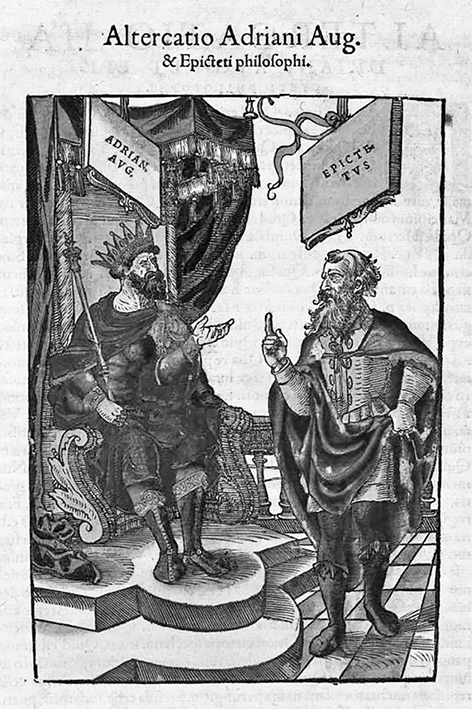
In prospective mode, in review of Peters’ magnum opus, summum, and pandect of performative law up until 1678, the plague years had thrown Coras to contemplation of the future. Another doubling. The initial question in the dialogue, opening for content, is a genuine enigma: What do we see in the body of a pedagogue? The answer is epistola, a letter missive. The question opens the body to knowledge and simultaneously constitutes the subject as a carapace, an envelope and vehicle of epistolisation. The interrogation moves immediately to questions of communication, the encryption of relay and the heavy signifiers of transmission. The next question is thus quid est epistola? and the answer is tacitus nuntius or silent messenger. Mute eloquence, gesture and writing, body and text in this early sense, imitate the naked corporeal carapace, another skin containing a hidden message. In the argot of the era, a hieroglyph and in addition, in the Latin text, an image of the dialogists, emperor and philosopher, which provides a visual portal and access to the exchange.Footnote 4
The image, from Alciatus’ Notitia dignitatum, of Hadrian and Epictetus, the former on his throne, sceptre in the right hand, an open palm welcoming and receiving discourse in his left (see Figure 9.1).Footnote 5 The image shows rather than says what the protagonists in turn indicate through gesture, the chironomia and indigitation, the dactylograms that perform through visual manifestation, staging, and enactment in the colour print of the early text. Epictetus grasps his robe in his left hand and points upward with the index finger of his right, demanding attention and, according to canon XX of the Chironomia, threatening to denounce if attention wanders.Footnote 6 It is a pedagogic image of near equivalence, the standing philosopher is at the same height in this exchange as the sedentary emperor; the teacher is master of the sovereign and vice versa, although the dais, throne, and awning indicate nonetheless a hierarchy, and order of transmission. The imperial scena, the gold cathedra, is a last instance or dignity whereby the image both signifies and conceals that of which it is the representation and doubling. The throne is visually a stage and staging, replete with curtains, fronds, and rod of office. The emperor is after all seated and, it can be added, in the pose of the judge: sedementariam vitam & recte sedendo.Footnote 7 Hadrian is not just sovereign and messenger, vicarius Dei, but also seated and judging. Here then is the crux, a double message, sovereign and didactic, legislative and philosophical, juridical and pedagogical, an amphibological signification which arrives most explicitly in the answer to the third potentially self-reflective question, quid est pictura? Veritas falsa – what is a painting? A false truth. Following the order of enigmas, the naked body, the missive epistle, and the painting are all subject to suspicion, both objects of belief, acts of faith, and modes of fantasy, poetic license, and deception. For performative purposes, all three are surfaces, costumes – hirsute skin, chirograph, and epistle – and then paintings that all figure hidden causes. The body hidden by clothes, the epistolary inscription, and the image share the enigmatic status of enacting in variable forms an absent source. Although diversely so, they are not what they represent, no matter how true their figuration. Body, missive, image – the corporeal bears a message that the letter transmits and the picture depicts so as to manifest a trajectory of transmission through the diverse media of its passage.
Emperor Hadrian and the Philosopher Epictetus, from Alciatus, Notitia dignitatum utraque iuris (1552). Wikicommons.
The false truth of the image is in effect the culmination of the biblical haec imago or ‘this face’, the human similitude of the ineffable and invisible divinity, the unseen cause of causes and message in the envelope that both conceals and relays. Staying with this key topos, the conjunction veritas falsa, it is evident that in the terms argued extensively in Law as Performance, the theatrical characteristics of the legal process fall directly within the trajectory of the dyad of body and missive that combine to form the performative image of law as enigmatically true and simultaneously false.Footnote 8 This thesis gains incremental expression in Peters’ advancing argument as to the affective force of oratorical action and the value created by the impression of reality that legal advocates at their best wield. In her formulation ‘legal performance is at once a technology of representation and a crucial ethical practice’ (86). The jurist’s illusions become reality, or are made, which is to say fabricated into actions and juridical determinations: ‘The advocate’s artful reality effect, heightened through actio, did not offer a mere illusion of reality (as the actor’s did): it made reality appear as real as it really was’ (86). By the end of the book, it is not only the Horatian jus or sauce but the sorcery of law that has become the acting of real life. Illusion, play, and revel resemble legal enactment, and juridical hypokrisis, as the etymon suggests, is itself a form of illusion; it is a performance, a play, a fantasm that ironically shows law in actu and as legis actio. This is how law is ‘actually performed’. This is ‘as real as law gets’ (295). And in twenty-first-century terms of nibbles and bytes, this means the rule of theatre in the modality of theatrocracy unwired, reality on speed (302), true and false in an accelerated imaginal form.
Comedy of Law
There are many exempla in the book, but entry for content, and so we begin with a comedy staged in Tothill Fields, the last trial by combat or duelling decision in the English common law tradition. The fields, which were later to become, appropriately enough, a cricket ground and then or also a prison, themselves provide a trajectory from theatre to law to play, as evinced in Peters’ flamboyant narrative of the melodrama of the contestants mock fighting after they knew that the case had been earlier resolved. The forum for this particular, now faux, property dispute was an open air, public stage, mimetically reproducing, which is to say doubling, re-enacting and so exposing the scenography of ordinary trial. As this is not the theatre of the law court itself, with its architectural confinement and limitations of time and procedure, we are thrown directly into the foolosophy of justice, the serio-ludere of the agon of trial and the definitive trajectory of the triunity of ordo, then lex, then comœdium. What we see, where we start, is with the visibility and audibility of the lawsuit, the audience as it used to be called. Hypokrisis, actio, delivery, and the last term can be punned deconstructively as de-livery, removal of livery, law putting on its costume so as to get undressed by the gaze of the spectator. This is primarily because comedy is the oldest theatrical form, laughter being, according to Addison, an original sin.Footnote 9 The first point to be made is thus that comedy, the ludic enactment, and here re-enactment of law, the legis actio or climactic outcome of legal conflict, is the form that legality necessarily takes. Persons, things, actions are replicated in Coras’ body, letter, and image and these in turn can be conceived and triggered as ordo, lex, comœdium.
In the imaginal context of contemporary transmission, the logical order of juridical progression has to be ludically reversed: Comedy is our introduction to the legal, to the epistolarity of transmission, to the bodies of the players. This is serious. A matter as Selden puts it, instar omnium, the form and formulary of all, by means of ius imaginum or entry of law’s dramatis personae.Footnote 10 The jocastic de-livery, the undressed performance, exposure of the tersichorean art of law in the variable modes of its social presence are inevitably comic. Lenton makes the point best in the epigraphs to his Characterismi: dum vivo video, et dum video rideo (errorem in humanis et terrorem in libris).Footnote 11 To see is to laugh at the pretensions of the costumed animal, the monkey in a toga, and the cachinnating coifed codpiece, the clothed codex conspiring judge. Vision precedes decision. Conflict generates the case, and it is in these all too human escapades, out of the corporeography of adversity, the verbal and gestural articulations of advocacy, that law and the happy hum of order, the capriole and merry dance, are later redacted to the monochrome regimentations of the page. The initial document, transcribed in memory, transmitted orally, recalled visually, is the comedy, the stage play itself, in which the litigants, spectators, assessors and judges come together to perform in a field. It is in this sense that Rosenstock-Huessy suggests that progress in law may well ‘depend on the regulating power of humour’.Footnote 12 Peters too notes the legitimating force, the entry into the family line that such legal ludi on Tothill Fields will relay.
Returning to the complex conjunction veritas falsa as applied to the picture portrayed and to the costumed lawsuit enacted, it is precisely figures of things to which Coras refers in his classically orientated discussion of the Philosopher’s response. Illustrating the answer that Epictetus has given to the question quid est pictura, Zeuxis and Parrhasius are invoked, the painting of grapes that fools the birds, and the curtain that appeared to conceal a work of art but was in fact itself the painting. The figure of truth is both semblance and dissemblance, false and true, comic and serious, and it is this juxtaposition that needs desideration. What is true or at least evident is the manifestation of legality in the agonistic moment that generates the leges actiones, in the performative scene of what in the case of Tothill Fields is a prospective ‘tryal by battail’ and these, according to the legal antiquarian Sir Henry Spelman, referencing Glanvill, are called leges apparentes – laws made visible.Footnote 13 What is it then that appears or is rendered apparent by this vast theatrical scene? For Peters the event collapses the difference between court and stage, trial and combat, because both enact the agon of conflict and its resolution via the medium – comœdium – of the juridical liturgy of a verdict. The mystery or arcanum of legal judgment depends upon the staging of a conflict that will act as the image of a judgment that is invented, which is to say organised and ordained behind the veil of the dramatic agon of dispute. Again, conjunction and disjunction, the alternating current and Janus face of arcanum iuris decked out with coif and cloak, robes, furs and taffeta. A sartorial presence, a costume of colours, livery and delivery, habits of the robes and performative exposure.
One might here recall Nietzsche’s cautel, that truth is a metaphor, an illusion so grounded in practice that we have forgotten its illusory roots.Footnote 14 How then does this scene act ad apparentiam and more specifically how is its falsity a reference to its truth? Peters in paromoion style sides with Parrhasius: This painted cloth, this theatrical staging, is the reality of law. It generates the truth through the fictive process of trial and, as Kantorowicz elaborates, the apposite maxim is fictio figura veritatis, fiction is the figure of truth, the form it takes being veritas falsa, or that law does not die. Hers is a neo-materialist view in which the excessively dramatic character of the mock trial – the ‘battail’ after all never took place because settlement had been agreed one day before – can only have representational purposes. The elaborate staging provides an image of legal relations that corresponds to the force of law, that decisions are always in camera, hidden from view, as with the accord that preceded Tothill Fields, or that otherwise occurs in judicial chambers, or where ex tempore in the unlit theatre of the judicial skull. Performance, in other depiction, is manifestation and outcome, the speeding (publication) of judgment through the spectacle and modality of its theatrical relay. This then is an event, an encounter that in a correspondence theory of knowledge, accurately reflects the legal relation. The performance enacts what is not there, the arcanum iuris, or mysterium, which is, in its very absence, non-existent except in its theatrical apparition. At the same time, reflection distorts, and correspondence to the real, to the event, is an epistolary exchange, body to body, letter to letter, image to image, diffracted through the very means of its conveyance.
At one level the event depicts the triumph of law over trial by combat: Duels are illegal because settlement should be judicial and symbolic rather than exsanguinated and merely theatrical. Ironically an apparent trial by combat was necessary to show that such violence was not to occur. Remaining with the reality of the event, it evidences first the itinerancy of the legal, that law does not, to borrow a phrase, inhabit any specific territory. The trial by combat has no fixed place, no locus or to borrow from Glanvill, duellum non locum habet.Footnote 15 The theatrical presence of law is its presence, its real – the cloth is the picture – and that means historically an atmosphere and aura of juridism that travels with its personnel and their performances. The itinerant court, the assize, is also a verb, a mobile matterphor, meaning a momentary material symbol, a sudden sitting or temporary theatre, that like the trial at Tothill Fields, appears and fades, arrives and then disperses. The significance, the verum, is that of manifestation and not that of duration. The sovereign appears in the person of its judges and other officials. The Emperor Hadrian has left his seat and remained on his throne so as to appear in the vicarious form of his delegates, in his other body, as principal and principle directing the persons, bonds, and comedy – ordo, lex, comœdium – of this particular, itinerant case. The emotion has set the law in motion, to perform the page, while writing; ratio scripta itself is but the stage, the material sign or physical presence of the jural relations to and with which it corresponds.
The second point is thus that performance embodies, and it is that incorporation in actu that creates the corporation of lawyers, the itinerant and expanded personae, the real representatives of the absent sovereign in the symbolic form of a mobile legality. No law without incorporation, manifestation, visible presence. The comedy of being there is necessary, the costumed monkey, the sartorial simian, must appear to invent and instigate the commons and consensus of common law or within the civilian tradition, the ius commune with its regalia and universalia, maxims and mottoes, dicta and dogma. In this rhetorical and performative dimension, it is real presence that might be termed the liturgical transubstantiation of what after all is in practice a Roman Catholic law. The esoterica, the various encryptions, argot and inkpot words of the symbolæographs and other instruments cannot be for lawyers alone but rather the parchment has to become public and become law in the sense of decision which Vico terms certa lex, meaning both scriptum and particularity.Footnote 16 In broader formulation, the performance on Tothill Fields is a scene of determination in which, in the language of Leges Henrici Primi, love conquers law, accord vanquishes combat, a comedy closes, but in the same instance a judicial status and certum is conveyed.Footnote 17 For law even more than for theatre, the show must go on. Something happens, nothing happens. Veritas falsa in the sense that the formal, open air proceedings, preceded by ‘oyez oyez’, re-enact a scene of judgment by way of settlement that had occurred the day before. The theatre of law – but this is always the case – is a repetition, a restaging that makes the juridical arcana present in personam, just as much in the rite of settlement as in prosecution and execution. It is always, in other words, an indexical form of manifestation, a reference to a chain such that being there is also veritas falsa, in the necessary semiotic sense that visual signs are always references, vanishing concatenations that reference absent precedential and experiential forms, and lead from the image to the thing signified, or in the ecclesiastical maxim, ab imagine ad rem significatam.
What the lawyers of the period dubbed anima lex or lex loquens is precisely the scripted performance of the dead letters of the parchment rules. The leges apparentes are the public mobilisation of legality in the bodies of participants and the commonality of the crowd, the common audience of common law. The falsum of the performative image of the proceedings, the fact of its being mere appearance is, ironically perhaps in modern eyes, the invention of a humanist certum in the sense that Quintilian uses and that Vico adapts. While the performance may appear to be a toroid spectacle, a non-event, this misses the point that the encounter itself, in full theatrical couture and custom is gauged to the sensus communis and the old sense of certum, which is that of consensus.Footnote 18 This may not be festa fullorum nor entirely ad jocunditatem, but it is theatrical entertainment, the allure of the spectacle and show that also draws the crowd and makes the instant a synonym of the case. One can borrow from Quintilian and his exhortation to learn Latin from the comic poets – a comicis – because that is the language, the vernacular that the people speak.Footnote 19 Turn it around, speak law, and the falsum of appearance and display, manifests the certum of the case, the particularity of an event, a decision that is made in exemplary style in the public sphere as an apparition of law and as the sensibility of the commons. In customary form, the lawyers have to learn a comicis, just as much as the crowd needs to see and recognise legality. This is, to put a point on it, a two-way street, a dialectic and dialogue in which jurisdictions meet in mutual interdependence: the comedic sensibility as expressed in auctoritates poetarum, as the jurisdiction of poets and philosophers.Footnote 20 Charles Lamb, in his essay on ‘Stage Illusion’, surprises by making the comic point well: ‘It is … a proof of the highest skill in the comedian when, without absolutely appealing to an audience, he keeps up a tacit understanding with them; and makes them, unconsciously to themselves, a party in the scene.’Footnote 21 The necessity of such spectacle and histrionic symbiosis, the pluralisation of the commonality of common law, gains direct expression precisely in the serio-ludere of the Tothill theatrics and the multiple meanings of the comedy that it stages.
Various digressions upon the incertitude of the enthymeme, on the legal rhetoric of the probable, and the falsum of verisimilitude are possible at this point, but it is the integral element of the comedic in both order and law, sensibility and judgment that forms the most important focus of the triune conjunction. Just as the comic is necessary, the apparent is real, and the false is always in relation to the true. This can be elaborated in the juristic maxim fictio figura veritatis, but it is in its rhetorical form that it is encountered in our study as a feature of the ancient rules of law, antiquæ fabulæ, of which Jouvancy provides the following: quid est fabula – est sermo falsus veritatem effigens, hoc est, falsa quidem et fictio narratio est: at sub fabuloso verborum cortice veritas semper latet aliqua, et utilis sensus and translates for current purposes as ‘drama is a discourse that figures the truth, that is to say that it is false and fictive but, under the cover and artifice of words, traces a truth and a useful sense’.Footnote 22 The effigy or portrayal of verdict and veracity, here the staging of peace, through the rites of images, signs, symbols and words, is legally the record of both veritas and judgment, verum et certum, and it is the curiosity of law, its pragmatic edict, to endeavour in performing to deny its social and imagistic lineage, its other likeness and shadow similitude. The picture provides the equity of decision that performs and legitimates in familial and familiar form, relating decision precisely to antiquæ fabulæ, the narrative justification of the juristic tradition. The monotheism of legality, the emphasis on serio and not ludere, leads to the dissimulated fashioning of the juridical in the mode of denial, via the claim of an abyssal distance of the leges actiones from theatre, rite and revel. The imagery of legal ritual and its recording, the bodies that make up comedy, and play a role in their variable linguistic forms are in doctrine supposed to be lost in the monochrome regimentations of the linear page. Repression, however, rules the inscription of instruments and laws whose language is necessarily the bearer of the images of the causes and conflicts that collide symptomatically in the text.
In the classical Roman law of accession, Gaius in his Institutes treats the image, tabula picta, as an exception to the principle of alluvion: ‘If someone has painted upon my panel (tabula), namely an image (veluti imaginem) … the opinion preferred [is] that the panel accedes to the image.’ The Digest is (at one point) in accord.Footnote 23 In an age of pietas, the image, being closer to the spirit or unseen cause, took precedence over the substance and led more directly, and so too in the view of the warring theologians of the Tothill Fields epoch, ab imagine ad rem significatam – from the image to the thing signified.Footnote 24 Taking the comic seriously, exploiting the ludic etymon of the illusive and illusion (in-ludere, in play), a degree of profanation is necessary to recognise the democratising character of thinking law a comicis or in, on, and of the commons. The Tothill duello didn’t happen, save in symbolic legal form, and so is especially comic, with the gladiatorial costumed champion, the thespian Nayler, refusing to return the glove, stating no, demanding the ritual of combat and occasion of play. In this instance otium is negotium, the latter containing the former linguistically and legally. Such equality between comedy and regulation, theatre and law serves as a powerful reminder of the plus ultra of the rule, of the image that subtends and triggers, that precedes and determines what is said and inscribed. As Peters has it, the illusion is real and the real is illusion, but always understood through the ludic and illusive root of the illusory, in apprehension in common and a comicis. Life, one might say, precedes the still life of the legal tableau. The dead letter of the juristic text becomes law only in its performances, both scribal and theatrical, aesthetic and ludic, ordo et comœdium, verum et certum.
The point is that law needs its comedy so as to be embodied, to become real and part of what is common. The body of the populace, which is also to say the mood and the sensibility of the commons, its humour and comicality interact with and invent, open up and open up to the juridical in its more public manifestation. The spectacle, for Peters, has to be both veritas et falsa, and this entails, within a triune tradition, a third and more expansive point. That law still engages in the agonistic procedures, the leges apparentes as conducted symbolically in the palaestra of the courthouse or in the extra-foraneous serio-ludere of Tothill Fields, and this leads to another conflict, as ancient as the Old Testament, the generative antinomy of wit and judgment. Addison, who is not always the best comic guide, in essay 249 published on Saturday, December 15, 1711, as adverted earlier, recounts reading a sermon in which the Roman priest ‘laid it down as a Point of Doctrine, that Laughter was the Effect of Original Sin and that Adam could not laugh before the Fall’.Footnote 25 The dogmatic thesis is that laughter is mad but if we recall the context of the exodus from Eden, it was the necessary jocastic act of sartorial awareness, of putting on raiment, costuming up for social presence and performance. The wittier implication, however, is that laughter confronts the sacred with the profane, rule with invention, verum with certum. Where the Garden was closed and static, an atemporal order of a nebulous law, the exit from such inactuality and stasis is the emblem and exemplum of beginning, just as laughter is the respiratory, facial and pectoral mark of the inauguration, or the inventive beginning of thought.
The purpose of the biblical detour, the reference to the original ban on laughter and the comic, is simply to pose the role of wit as the motor of judgment. Eden is utter boredom, eternal stasis, the absence of events. Comedy is mobility, affect, and the instance of exeunt. Laughter moves, it unsettles, innovates, creates, changes by embracing the breaking of the rule so as to escape the confinement of the precedent. Like dreams for Freud, law is ‘insufferably witty’, because the rule is constantly broken. ‘Joke work’ is the art of expanding the rule beyond its breaking point. The law of performance, that Peters so brilliantly tracks is the record of comic interventions into judgment, of the mobilising contestation of the rule, rebellion at judgment. From Calefurnia mooning the bench, the heretic Jan Hus laughing and mimicking the ecclesiastics who had sentenced him to death, to the filius terrae, clowns, revels and the lord of misrule, to the delightful puns of the fog bound Cambridge wit, Ignoramus, the thrust of legal theatrics is the exception, the mobilising moment of thought that alters or alpers the rule.Footnote 26 The joke, if one can formulate it so, as evident in Tothill Fields as elsewhere in practice, is that the law is everywhere except in law. That sense of the absurd that is the comedic concomitant of any act of law application, the performance of decision in its ritual, liturgical, effectual sense is always also a susurration or smirking breach of the generality, the guffaw that accompanies the unexpected overturning of a word, role, meaning or posture that preceded it.
The jurist as agelast is far from the mark because order and law depend upon comedy and the trinity of ordo, lex, comœdium is an active, inventive and propulsive combination. Borrowing from Sir John Doderidge Knight (spelled here with the elegance of an ‘e’ as fourth letter, although this is sadly not always the case), the language of law is drawn a comicis, from the conversation of the commons, from the dialogic imagination generated by the social use, the history and conflict from which cases emerged and customary norms were drawn.Footnote 27 Law then, though I intend no particular order, is the interactive reformulation of the social symbolic, the symbolæographic inscription of the heavy signifiers of status, role, and relationship into a sociolinguistic system that comedy both propels and parodies, and in breaching, innovates in better and worse forms. Comœdium finds its place in Blount’s Glossography as traveling plays that visit up and down the country, using fables ‘representing, as in a Mirror, the similitude of a civil and private life, beginning for the most part with some troubles, but ending with Agreement or joy’.Footnote 28 The comedy is the imaginative performance of the casuistical, the vaticinate invention of future decisions, while the comediographer, the writer of comedies, is as close to a definition of a lawmaker or poet as legislator as one could devise. What better disarticulation of the case method, of the reporting of judgments, detailing as they do both with the conflict of the parties and its resolution in judicial fiat, than the comediography of law? And both itinerant, the players and the Assize judges, thespians and lawyers traversing their circuits in parallel.Footnote 29
How, finally, does the comedy of the juridical work? It is perceived as a minor genre, a marginal exornation and peripheral drama of gesture and diction appropriate at best to collections of facetiæ, merriments or uncommon laws.Footnote 30 According to Bossuet in his ‘Maxims and Reflections on Comedy’, which is printed just after his much lengthier ‘Funeral Orations’, picking up on Addison’s theme, ‘peals of laughter (les éclats de rire) make one forget the presence of God … and the seriousness of the Christian life’.Footnote 31 The pleasure given via the eyes and ears promote the body while they ‘soften the soul’. Laughter is in effect sacrilegious, a futile, histrionic endeavour, stultiloquium that explicitly profanes the Scriptures. It is in that theological condemnation that the power of the theatrical manifests its critical force. The profane quality of the performance of law is a direct challenge to the legislative hierarchy and to the privileged place of lawyers. As Peters shows in multiple vignettes, in the immaculately detailed substance of her history, performativity necessarily brings the populace into law in inventive acts both of transmission and of revolt. When Jan Hus laughs all the way through his ritual defrocking at the end of his heresy trial, the ambiguous character of the performance of law, of comedic challenge, and of the indexicality of the relay of tradition in visual, which is to say imaginal forms is fully on display.
Far from excluding laughter or always compelling gravitas, ingravescence, the tragic modality of legal actions, the decorum of law has to encompass both the Apollonian and the Dionysian, the sedentary and the terpsichorean, formalism and the comedy of carnival or inversion as in the Hus trial. The theatrical character of law, of trials, but also of architectural, archival, artistic, and now also filmic representations, is essential to the transmission of law as tradition, meaning sensus communis as the commonality of law. It is crucially a manner of passing on not the substance of law but its form, its visible exterior, its gestural and aesthetic or decorous modalities. It is the phantasm of normative citizenship, the fantasy of a shared social reality that is relayed in the repetitive formulae and recognisable manual expressions of legal presence, of delivery as enactment. Performance, one can argue, performs the symptoms of law, meaning that the figures or fictions act out hidden causes, prior decisions, previously archived rules and regimentations. In Tothill Fields, to pursue again the exemplum, the legal settlement and decision on title to the property had been made the day before the performative spectacle of an aborted trial by combat. The enactment was in one sense ‘make believe’ (3) precisely in the sense of fostering credulity, engaging citizenry and in moving things on.
Conclusion
The last point can form the basis of a conclusion, let us say a con-ludere of comediography, in terms of what Law as Performance, ending as it does in 1678, might convey to the contemporary. What is offered is in one sense a critical symptomatology of performance, gauged to the visible movement of legality, and the mobilisation of its presence. What could be termed the aura hysterica of the social is manifested in the style of juridical events that are apprehended most directly in the expressions of pathology that come to public enactment in the mode of trials. These are the optical motors that symptomatically express structural change. In Tothill Fields the end of the trial by battle was enacted for the populace and the dance of the combatants gives ocular expression to the riddle of the death of a particular social form of dispute resolution. That, however, is only a start. The widdershin or dancing backward in front of an audience, the gestural mode and its chironomic forms, the nomograms, dactylograms, and further symbolic gestures, such as the Neapolitan Andrea de Jorio so famously collected, are the perduring dynamic of law’s transmission.Footnote 32 Performance is the mode of setting precedent, the mobile act of scoring decision into public record and social memory. The incidence of the incidental, the supposedly marginal enactment, the histrionics of trial, are in fact the key to the transmission of forms that would otherwise suffer the desuetude of the archive. The law in books, ratio scripta, is the memory of the guild, the argot of lawyers, itself drawn from the spectacle of agonistic trials. It is hard law in the view of the judicial author of three comedic volumes of Miscellany-at- Law, symptomatically subtitled ‘A Diversion for Lawyers and Others’.Footnote 33 While Judge Megarry means that the miscellaneous is incidental and occasional, the comedy of events reminds the attentive of the sense of diversion as change, of direction, of attention, and of humour. The narratives and shows, the performances at trial, the records of comedy – comœdium legalis – are the transport of precedent and the social relay of law. The diversionary belongs to the miscellaneous style, as Shaftesbury so eloquently expatiated, but it is more than that, it is the symptom of the real, the peripheral facet that encrypts author and cause, and at its best is the essence of wit and vehicle of insight.Footnote 34
Performance, to use the old argot, expresses the soul through the body, but lawyers cannot visibly be too histrionic and must not reveal the extent of the affect that invents decision and so propels precedents that otherwise appear to lie dead on the page. They cover up and go sedentary at the moment that law’s art of performance intensifies and threatens to demonstrate the sensible form and imaginal life of legality. Performance historicises and politicises. It breaks out of the closure of the system and pillories the anachronic mode of reason as immaterial and incorporeal. Time, which is of course the medium of change, is operative here comedically. The performance-symptom, the power of law’s comédie humaine is what Aby Warburg named the dynamogram, namely the force of occurrences of survival in the transmission of forms.Footnote 35 It is in seeing the law performed that it becomes both common and alive, reanimated in alternating and changing enactments as law by, with and for us. The dynamogram traces the life of a form, the morphology of figures, the aesthetic of forces and the intensity of affects as they are transmitted through performance. An audience that laughs remembers just as much as the body that is branded or the witness that weeps. The power of the histrionic performance lies in its corporeal and comedic expression, as a litmus of affective force, which the dynamographic history of performance here traces to excellent effect. The decorum of legality has one of its roots in dream and a closer etymon in dignitas, meaning office and perdurance as in that which does not die but rather passes on. The dream of law is its decor, its performativity and the oscillating twitch of its wax nose.
The power of legal action lies in its bringing law to light, to public manifestation, both as spectacle and as inscription in memory. The dynamographic function of the theatrical form is thus to instil both the drama and the sensibility of the legal norm, as sensus communis, legislative act, and comedy of the social form. The life of law, the offices and dignities of the extant tradition are juridical fictions, antique circumbilifabulations, images inherited as licit forms that collide comedically with the present and action. What Peters achieves in Law as Performance is the massive and erudite historical narrative of the mobilisation of Code and precedent, and specifically the moments when theatre challenges the limits of law by making its staging visible. The comediographer depicts the performative passage of laws made visible, alive, comedic in the multiple senses of active, common, comic, becoming imaginal and anachronic survivals, facets of a continuing sensibility that attaches necessarily to the limits of law. For comediography, for the forms that transmit and appear again in these records, in this argument, it is what Warburg terms the seismograph that reaches the level of form and force, the visible movement of invisible agitations, such as those that appear in their paradoxical mode in the drama of Tothill Fields. It is the antinomy of the visible and its unseen cause that instigates the comic punctum, the performative dimension of legality. This is the ludus, the joke, the realisation of the limits of the system and the lawlessness of law which is embedded precisely in laughter, in what is impossible to write or say but that can exist only as the motivating affect and mobile poetics of moving from text to action, from iuris vinculum to legis actio, from lex to comœdium, and in sum and jape from the regimentation of the page to the anarchy of decision.
Marleen Gorris’ feminist classic A Question of Silence (1982) features what may well be one of the most powerful fictional court scenes ever filmed: an extended scene of wild laughter that grows and grows to eventually engulf all the women in a courtroom during the trial of three women prosecuted for the murder of a man. The women break the law by committing murder, then by breaking out in laughter, but this is no ordinary breach. Creating a laughterhood among the women in the courtroom,Footnote 1 it is a transgression that cannot be re-contained by law, and it re-signifies the murder itself as uncontainable by law’s own terms. Placed towards the end of the film, the scene is cathartic, and yet it works only if one has been tuned into that potential of uncontainability all along. The force of the scene is that it taps into a certain embodied knowledge of the here and now, as well as its potential elsewhere. If the knowledge of the here and now is derived from accumulations of lived experience, the knowledge of its potential elsewhere is also embodied, a heterotopia that is conjectured and conjured from within the laughterhood. We know it is (t)here.
There is of course an economy to the chosen setting for this powerful depiction of the force and potential of feminist refusal. Bodily acts (including acts of speech, but also gestures and indeed laughter) matter in unusually accentuated ways in public trials, where performative operations of law are at their most exposed. As I parse elsewhere by distinguishing between legal performativity and legal performance to think their linkages more carefully, what allows law to operate as if it were fate (the masquerade whereby legal performatives pass as constatives) is more prone to unravelling in this particular setting.Footnote 2 This is why trial scenes, fictional or actual, always have strong dramatic potential. But the trial scene in A Question of Silence is potent even if read merely literally, as a scene of forensic refusal: the refusal in and of the forum. In critical legal literature, acts of refusal in trials have been figured primarily in terms of resistance and rupture. In this chapter, I draw on another critical legal theme, ‘minor jurisprudence’, to explore refusal in the alluring terms proposed by Bonnie Honig in A Feminist Theory of Refusal (2021): not only as rejecting the here and now, but also as practising the elsewhere in the here and now. Something of a counter-forum emerges in the collective laughter of A Question of Silence, but where and what is it? I attempt an answer through a close reading of the film and by juxtaposing its trial scene with a number of other scenes of feminist refusal, to ask after the role and workings of the uncontainable, the untameable, the inassimilable in the forum.
A caveat as I revise this chapter for publication in the immediate aftermath of the bizarre judgment of the Supreme Court of the United Kingdom (UKSC) in For Women Scotland Ltd., and as we witness the even more bizarre ways in which the judgment is interpreted in transphobic campaigns in the UK and beyond. The film this chapter focuses on is now more than four decades old, and its immediate references in feminist literature are also of a period whose radical feminism is nominally claimed today in grotesquely essentialist ways. There has been much feminist thinking over the past few decades, including trans-feminist work, on how to read the seeming biological essentialism of some key feminist texts of the past century. It is beyond the scope of this chapter to delve into that rich discussion, but suffice it to say that when I write of ‘women’, I do not claim the category as an exclusive territory that must be guarded against incursions. In effect, the appeal to law in For Women Scotland for its paternalistic aegis, the call to reinscribe women’s ‘sex’ as a ‘characteristic’ whose ‘protection’ requires a practice of exclusion could not be further from the orientation vis-à-vis law that I describe here in terms of feminist refusal.Footnote 3
She Can Communicate But Sees No Point in It
Our protagonist is Janine van den Bos, a well-respected forensic psychiatrist at the height of her career. She’s upper-middle class, attractive, married to a successful lawyer. They make something of a power couple, with an even distribution of power within the couple: he (too) cooks and cleans, she (too) initiates sex, her professional career (too) is all-important, and so on. That’s the set-up. The plot? Janine needs to write a report. She is to provide her expert opinion to the court on the mental state of three women involved in the gruesome killing of a man, the proprietor of a boutique for women’s clothes. But it is not an easy case to make sense of. None of the women knew the victim or each other before the killing. They all readily and in good humour admit their responsibility for the crime at the police station where they are brought the following day. This is also where they first learn each other’s names. None have any prior criminal records or histories of violence. The killing was seemingly unprovoked but very violent, as the forensic pathologist reports to Janine drily:
injuries to the whole body inflicted by blows and kicks, with hands, shoes and several blunt and sharp instruments like coat hangers and a shopping cart … The blows were mainly aimed at the head, the abdomen and the genitals … The torso has a deep cut from the Adam’s apple, which was also heavily damaged, to the lower abdomen, probably caused by a broken plastic coat-hanger wielded with great violence. The genitals are barely recognizable as such.
This excess of blood and gore has all the male characters – the inspector, the prosecutor, the judges, even Janine’s lawyer husband who has nothing to do with the case – convinced that the three women are insane, or at least were temporarily so at the time of the crime: ‘There’s no doubt about it, they’re completely crazy. But I don’t have to explain what you know professionally,’ says one official to Janine before she has even met the women. At a later stage in her investigation, ‘it’s obvious’, says Janine’s husband, oblivious to what Janine has just been telling him about them. ‘These women are completely deranged.’ But it is not so open-and-shut for Janine, whose opinion is technically meant to be the one that counts. And the more she engages with the women, the more she sees that something is wrong not with them, but rather with the world that surrounds them.
Janine recognizes them as three ‘really very ordinary women’ (Figure 10.1): the oldest, Annie, is a waitress at a greasy spoon, a divorcee who is also estranged from her daughter and lives alone. We get a glimpse of her daily banter with the male clientele of the cafeteria, where she bats off the sexist missiles coming her way with raw wit and wild laughter. The other two are younger. Andrea is beautiful, brilliant, single. She works as an executive secretary at an international corporation. Her work there is well above her pay grade, indispensable, and invisibilized. There is a scene at a board meeting where she makes a well-reasoned proposal concerning the company’s trade activities – her speech is barely tolerated and does not register. She is the only woman at the meeting. Minutes later, the same proposal is offered by another attendee, as if spoken for the first time – ‘Good thinking, Bob’, says the chair. The third woman is Christine, married to a minor civil servant, mother of three, a housewife. She has stopped speaking altogether. Janine first thinks that it is catatonia induced by the killing, but it turns out that Christine stopped speaking long before the killing, and it is not pathology but a clear choice, a refusal. As Annie has to explain to Janine: ‘Do you really wonder why Christine stopped talking? Nobody is listening.’
Three ‘really very ordinary women’: Annie, Christine, Andrea. Still from A Question of Silence.
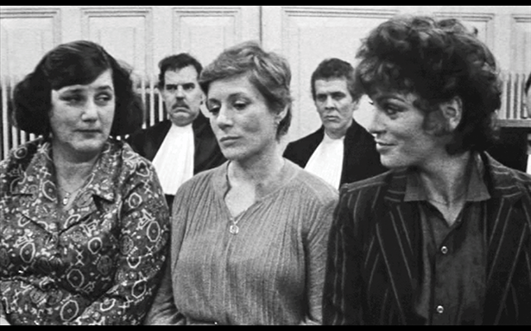
Figure 10.1 Long description
The middle woman, with trim blond hair and a violet blouse, looks down, while the women on either side look over their shoulder toward her. Two men sit in the gaps behind, looking sternly on.
It is Christine’s silence that gives Marleen Gorris’ film its original title, De stilte rond Christine M., which translates as The Silence around (or surrounding) Christine M. Her silence is indeed quite central to the film’s plot line, as that which Janine keeps trying to crack. Reading Christine’s silence first as pathology, Janine tries to crack it open into speech – any speech. Then understanding it as a choice and the refusal that it is, she tries to pry it open for potential mitigation of punishment. Finally, Janine tries to break through Christine’s silence for her own need of connection, once the three women make it clear that they have come to the end of their tolerance for her and her interviews. ‘You don’t understand people at all, do you?’ says Andrea. ‘And certainly not women’. The film’s English title is A Question of Silence, offering a more capacious sense of what it depicts, namely silence in its two related guises:Footnote 4 as a condition imposed on women, and as a form that women’s refusal takes. As an imposed condition, silence also has to do with that which cannot be mediated through speech: the difficulty of bringing to language the minor but relentless manifestations, operations and effects of patriarchy and sexism. As a form of refusal, silence is about that which is better left unmediated in language: women’s solidarity against patriarchy is depicted in the film as a silent agreement that not only needs no words, but is also wary of them.
Silence is crucial to the narrative arc of the film, which is character-led and can be read as the story of Janine, an accomplished professional, seemingly a master of her speech, with recognized jurisdiction as an acclaimed and effective forensic psychiatrist, eventually arriving at this silent complicity with the women. She finally fully recognizes the silence of Christine M., and also understands the other silences that initially perplex her, such as that of a number of unidentified women at the boutique who must have witnessed the crime but never came forward to testify. We, the viewers, know what the men of law never figure out but Janine eventually will: that a diverse cohort of four women eye-witnesses silently agree to a pact of silence after watching the maiming, mutilation and killing of the shopkeeper from the beginning to the end of the attack. Yet Janine’s own route to this silent complicity is not so straightforward. ‘I can’t reach them,’ she admits, exasperated, at a late stage in her investigation. It is further a personal affront to Janine that the women mock her conviction that her report will actually speak: that it will communicate to the court, register and effect some form of justice, possibly leading to a finding of diminished responsibility and a mitigation in the sentences, particularly if Janine is to pathologize them by declaring them insane for the crime that the women sanely avow and readily take responsibility for. By eventually becoming convinced that these women are all too sane, and finally refusing to pathologize them before the law, despite the prosecutor aggressively pressing her and the chief judge practically begging her to do so, Janine too comes to arrive at silence as a form of refusal, adopting what she says about Christine’s silence: ‘She can communicate but sees no point in it.’
Janine’s eventual arrival at this point of there-really-is-no-point is depicted in the most dramatic scene of the film towards the end, during her testimony as an expert witness in the trial of the three women. It is a wild and astonishingly brilliant scene of women’s collective and contagious laughter that erupts in the courtroom and disrupts the proceedings (Figure 10.2). The onslaught of laughter cathartically resolves an extended build-up of tension around Janine’s speech in previous scenes. As an expert witness, her speech is supposed to chime into the exercise of juris-diction, the speaking of the law that is taking place in that space, but instead it proves inassimilable. Her statement of expert opinion that ‘the three women are completely sound of mind’, sends shockwaves through the audience and outrages the prosecutor, who begins to push Janine with a liberal dose of casual sexism, implying that she is speaking as a woman and not an expert, and that she is obviously failing in her duty to be objective. The faceoff continues after a lunch break, during which Janine’s husband, who has been watching the proceedings, asks her to hold off on her ‘peculiar ideas’, express herself ‘less vehemently’, and be ‘more realistic’ – that is, to consider the damage she could inflict on her (read: his own) reputation and career if she were to insist on her opinion. Angered but resolved to stay on course, Janine returns to the courtroom and is questioned further on her report by the judge and the prosecutor, who now ask her to provide her opinion as to the motive behind the killing. Janine hesitates to speak what is a matter of silence, but begins to try to put into words what has in the course of the movie become crystal clear: ‘It surely didn’t escape your attention that these women killed a man who also happened to be the owner of a boutique.’ The prosecutor dismissively retorts that the case would be no different if one hypothetically swapped genders, say, if the women had killed a female shop owner, or if the killers were three men. This is when Annie’s rambunctious laughter first fills the courtroom, then spreads to the four witnesses in the audience, to the other two defendants, and finally to Janine, who makes one last-ditch attempt to explain the situation to a bewildered chief judge before fully surrendering to laughter: ‘It’s really quite funny,’ she says. ‘What did you say?’ the judge asks, Janine gestures never-mind with a flick of her hand. The wild, contagious laughter continues in waves for nearly three minutes on screen until the end of the scene.
The laughterhood. Stills from A Question of Silence.
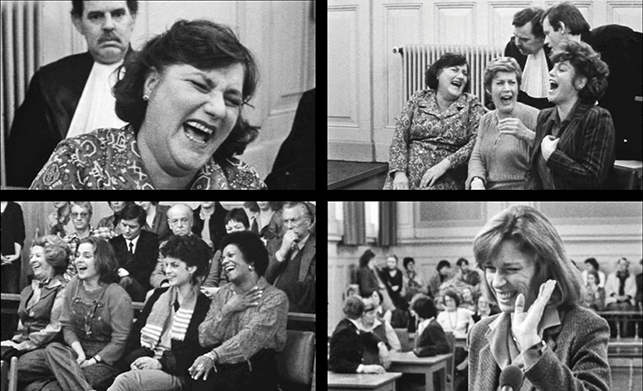
Figure 10.2 Long description
Top left: A woman laughs heartily, in a close-up. A man looks sternly from behind. Top right: Three women, seated shoulder to shoulder, laugh contagiously, mouths agape. Bottom left: Four women, different from those above, smile and laugh sincerely from a bench. Two rows behind sit in refined postures. Bottom right: A close-up of a woman, in business attire, who laughs fully. Her hand is raised mid-laugh.
Silence and laughter are thus presented as key manifestations of women’s refusal in A Question of Silence. Commentators have heard the echoes of Hélène Cixous’ influential essay ‘Laugh of the Medusa’ in the coupling of silence and laughter, and have fittingly situated the film in relation to feminist work on phallogocentrism and within a milieu of thinking about écriture féminine. While ‘neither self-conscious nor particularly intellectual’,Footnote 5 nor anywhere as formally daring as the avant-garde feminist filmmaking of its time,Footnote 6 the film does take up in a kindred spirit some of the key themes in Cixous’ ebullient call for women to ‘confirm women in a place other than that which is reserved in and by the symbolic, that is in a place other than silence’, for us to ‘break out of the snare of silence’, ‘in order to smash everything, to shatter the framework of institutions, to blow up the law, to break up the “truth” with laughter’.Footnote 7 The scene of laughter in the courtroom in A Question of Silence is so powerful because after depicting the ceaselessly minor, relentlessly mundane, mercilessly banal operations of patriarchy in every nook and cranny of women’s life, the film finally offers the trial scene as a bold literalization of patriarchy and its symbolic authority as ‘law’, performed with the requisite gravitas on the stage of a trial by men in judicial costumes. And then it just shatters it with something so simple and so readily available as laughter.
Obscene Protest
What brings me back to this scene is something that jumped out at me in the work that instigated this collection: Julie Stone Peters’ Law as Performance. This is a book rich in historical detail on the ways in which performance has been central to Western jurisprudence as its constitutive element. In one regard, the dazzling array of resources that Peters has gathered can be read as the long Western history of saning, taming and engineering legal performance; an account of just how much ink and sweat has been spent in trying to subdue this unavowably essential element in law. Then again, what had drawn me to Peters’ previous work on law and performance was her incisive formulation of the ever-present risk of the untameability of legal performance, and her formulation of the deep ambivalence that law has to its constitutive dependency on its performance as that which will make it, but might just also break it.Footnote 8
I must already have been looking for the untameable as I was reading Peters’ book. I read it as a PDF on my computer, and so I fantasize that what jumped out at me is presented in the form of a pop-up in the actual tangible book, because it is right around the middle, in chapter 4: an image depicting Calefurnia in the court, baring her ass to the judge. Peters gleaned this image from a mid fifteenth-century tract, but she also includes an earlier image of Calefurnia in the book, one that apparently ‘circulated widely in late medieval Europe’,Footnote 9 having first appeared in thirteenth-century illustrated editions of an influential compilation of Saxon law. Calefurnia here is depicted as scolding the judge, cursing him with one hand and holding her crotch with the other. The illustration was included in the compilation to explain the exclusion of women from the forum, accompanied by the caption, ‘no woman may be a pleader, nor may she bring a suit without a guardian’.Footnote 10 Then again, Calefurnia defied the judge in this way because she was furious at not being allowed to plead for herself. So what we have here is a fabulous causality, that strange self-fulfilling temporality of patriarchy, whereby the exclusion that is presented as a reasonable response to the obscene protest is in fact the very thing that the protest was a response to. Peters suggests that Calefurnia may have inspired another woman whose obscene protest is featured prominently in the book: Catharina Arndes, a well-respected late fifteenth-century townswoman, who during a confrontation with a delegation seeking to impose the archbishop’s new rules on the local women’s monastery, effectively chases the clergymen away by lifting up her skirts at them.Footnote 11 ‘Let the priests tremble’, writes Cixous half a millennium later, ‘we’re going to show them our sexts!’Footnote 12
In her Laughter: Notes on a Passion, Anca Parvulescu suggests that there is a ‘special relation’ between exposed female genitals and laughter.Footnote 13 Parvulescu reads Cixous’ ‘Laugh of the Medusa’ as crystallizing this special link, as it introduces a key twist on Sigmund Freud’s reading of the myth of Medusa in a brief research note from 1922. Here Freud famously suggests that ‘to decapitate = to castrate’Footnote 14 and that Medusa’s severed and petrified head ‘takes the place of a representation of the female genitals’, the paradigmatic sight that arouses terror of castration, which Freud describes as what happens ‘when a boy … catches sight of the female genitals, probably those of an adult … and essentially those of his mother’.Footnote 15 Cixous’ twist is simple and precise: ‘You only have to look at the Medusa straight on to see her. And she’s not deadly. She’s beautiful and she’s laughing.’Footnote 16 It turns out that the link between women’s laughter and public exposure of genitals has a bountiful archive: Parvulescu draws on Cixous’ other works on laughter, on other figurations of Medusa, and also on other ancient figures of ‘gaping mouths’, such as the old woman, Baubo, who helps bring Spring back to earth, jolting Demeter out of her depression by getting her to laugh at the sight of her aged vulva. There is also the ‘exuberantly vaginal’Footnote 17 and ‘cunt-threatening’Footnote 18 Celtic ‘old hag’ figure of Sheela na gig, powerfully refigured in artist Nancy Spero’s work to emphasize that the threat laughingly posed by exposed female genitals is not merely one of castration but also of engulfment (‘and essentially those of his mother’).Footnote 19
A further term that Parvulescu brings into this discussion of laughter and exposure is the ‘revolution’, and although I consider ‘refusal’ a more generative term to think with here, it is worth a brief detour, if only to get us to the question of violence, which I will eventually return to. Parvulescu’s route to revolution is via another text on the politics of the figure of the Medusa: Neil Hertz’s discussion of a scene of two women on the barricades in Paris during the June 1848 uprising, lifting their skirts at armed soldiers while shouting obscenities at them. This a scene purportedly reported by Victor Hugo (with the preface ‘the June uprising … displayed suddenly, to a horrified society, monstrous and unknown forms’),Footnote 20 but might well have been fantasized by him, as Hertz is careful to note in his discussion of male hysteria finding expression in the representation of political threats as sexual threats: ‘What the revolution is said to be doing figuratively is precisely what – in a moment – each of the women will be represented as doing literally, suddenly displaying monstrous and unknown forms to a horrified society.’Footnote 21
Women’s self-exposure in defiance, medieval European scenes of which we find in Peters’ book, is indeed a long-standing repertoire of contention that continues to have currency around the world. Naminata Diabate, who conceptualizes the act in terms of ‘naked agency’, notes that ‘the aggressive disrobing of mature women is a practice documented since medieval times in Africa’ as well, and writes of having documented hundreds of acts of naked protest around the world over the past couple of decades.Footnote 22 One key suggestion of Diabate’s study is that it may be misguided to consider this form of protest always and everywhere non-violent as such, as some instances clearly draw on traditions of genital cursing and thus aim to bring about the social or literal death of their targets.Footnote 23 Notably, the Catharina Arndes scene that Peters relates, which apparently may have involved other townswomen joining Arndes in the action but reportedly did not involve any physical contact or scuffle, was described by the chroniclers of the time as ‘violent’.Footnote 24
A Minor Jurisprudence of Refusal?
Forensic refusal breaches orderly legal proceedings, the rituals and paraphernalia of dignity, authority and majesty. The breach causes but a temporary suspension, and it justifies (both retroactively and preventively in that strange self-fulfilling temporality of patriarchy) the permanent exclusion – or at least, the perpetual alienation – of the outragers from the forum, rather than transforming the forum itself. This breach is not quite the ‘strategy of rupture’ that is based on identifying and exploiting the contradictions in sovereign recourses to law. Forensic rupture, as Emilios Christodoulidis succinctly defines it via Jacques Vergès, is brought about by ‘an act of resistance’ that ‘registers without being absorbed, integrated or co-opted into the system against which it stands’.Footnote 25 Representations of Calefurnia’s breach are absorbed into the forum as the commonsensical justification for women’s exclusion from the forum. ‘The hearing will continue in the absence of the defendants,’ announces the chief judge following the breach of collective laughter in A Question of Silence, as the laughing women are escorted out of the courtroom.
It is in fact difficult to discern a ‘strategy’ in this type of breach, particularly when we know how laughter in the courtroom can work strategically: in classic rhetoric, laughter is considered a forensic weapon, and rhetoricians have sought to engineer its tamed and disciplined versions for timely deployment against an opponent whose ridicule may well tip the scales in one’s favour. But the laughers of A Question of Silence laugh themselves out of the courtroom, just as Calefurnia’s exposure results in (the retroactive justification of) her expulsion. How to understand these performances of refusal, particularly in their ancient, mythical and persistent dimensions, as more than just amusing one-liners – that is, as more than acts that merely cancel themselves out once the laughter settles?
The opening scene of Peters’ Law as Performance is the trial by battle at Tothill Fields in 1571, a time when such proceedings were no longer common. It is a strange and fascinating event that allows Peters to lay out a number of the key questions that drive her inquiry about the centrality of performance to law. But perhaps most importantly, it crystallizes Peters’ important point that ‘the public spectacle ensures the validity of the legal decision’.Footnote 26 The spectacle that can validate can, of course, also invalidate. Yet one thing we come to understand in the course of Peters’ discussion is that there are no magically total operations of validation or invalidation, but rather a vast range in between, and this range in between is precisely what makes the inquiry into performance in law and law as performance actually interesting. Valuable in this regard is Peters’ literary studies approach of ‘dwelling on small but significant moments’.Footnote 27 In turn, this reading practice and methodological orientation undergirds a key claim of the book, namely that ‘it is not only sovereigns, legislatures, and judges who create law through grand edicts; so do its subjects, not only through words but through actions large and small’.Footnote 28 Peters thus suggests that performance can be understood as a form of ‘minor jurisprudence’, and then (perhaps too swiftly) adds that sometimes it is ‘not minor at all’.Footnote 29
We do not get a more extensive discussion of minor jurisprudence than this one gesture in the book, but Peters evokes the concept with reference to Peter Goodrich’s 1996 book Law in the Courts of Love: Literature and Other Minor Jurisprudences. This is where Goodrich discussed the fifteenth-century High Court of Love in Paris as ‘but one instance of an alternative jurisdiction or forum of judgment drawn from the diversities of the legal and literary past’,Footnote 30 and suggested that there is ‘a much larger and as yet unwritten history of repressed, forgotten and failed jurisdictions’.Footnote 31 While Goodrich’s key example was indeed that of a specific court and a specific minor tradition of jurisdiction, he proposed the notion in the more capacious sense of jurisprudence, counting, for example, ‘lost critical and satirical traditions of jurisprudence’, and contemporary critical legal studies as minor jurisprudences.Footnote 32 Panu Minkkinen had also used the formulation in a similar sense in his 1994 paper on Kafka’s ‘minor jurisprudence’ – reworking Gilles Deleuze and Félix Guattari’s notion of ‘minor literature’ into ‘minor legal literature’.Footnote 33 In this regard, Peters’ suggestion concerning performance as a minor jurisprudence is borne out by her extensive review of the legal canon on performance, but the suggestion is further that unstudied and perhaps unrehearsed performance practices by law’s subjects in the forum may too have the capacity to constitute what may be understood as a minor jurisprudence. I hold on to this for thinking about my juxtaposed scenes of refusal.
A more recent collective re-visitationFootnote 34 of Goodrich and Minkkinen’s earlier formulations attests that the concept of minor jurisprudence(s) may owe its evocativeness and attractiveness in part to its fuzziness. Commentators tend to problematize both component terms of the phrase, but ‘minor’ more so. One key question has been around how the minor relates to the major, with some general agreement that it must always be defined as such in relation to the major. Genevieve Painter, for example, writes that ‘the idea of the minor needs the major’,Footnote 35 while Christopher Tomlins puts it in more theatrical terms, proposing that the thinking of minor jurisprudences ‘embrace a “major” as their stage or backdrop’.Footnote 36 Mark Antaki tries something different in article that explores the boundaries of the concept, tackling it from numerous directions at once and asking it a somewhat discordant set of questions. He asks, for instance, whether minor jurisprudence can be understood as ‘not a minor to a major but something beyond (existing?) minor-major dualities’.Footnote 37 But he also questions the ‘jurisprudence’ component of the notion as well. What if, Antaki suggests, ‘“Minor Jurisprudence” does away with law as we know it and invites us to a life “beside” – but not “in” or “of” or “with” law?’Footnote 38 Can minor jurisprudence, he further asks, be understood as ‘an anti-, or better yet, a non-, jurisprudence?’Footnote 39 In the end, Antaki too opts to preserve the relationship to the major and to jurisprudence as such in the concept. He does this through a more elaborate and sustained engagement with the vicissitudes of Deleuze and Guattari’s definition of ‘minor literature’, which allows him to point out that ‘the minor is a “practice” of the major’, that they are ‘different modalities of the same’Footnote 40 and that there is thus ‘an inter-belonging of minor and major’.Footnote 41
In thinking about a minor jurisprudence of refusal, there may be some value in holding on to those questions that Antaki raises about the jurisprudentiality of minor jurisprudences and their prepositionality to ‘law as we know it’, even if these questions may at first seem to push the concept even beyond its own fuzzy boundaries. Here one notable aspect of Goodrich’s early definition of minor jurisprudences is that it implies a definition of major jurisprudence as that which is not quite what it makes itself out to be. Minor jurisprudences are ‘a challenge to the science of law and a threat to its monopoly of legal knowledge’.Footnote 42 They are ‘forms of legal knowledge that escape the phantom of a sovereign and unitary law’ and ‘interrupt the idolatry of one law’.Footnote 43 So the minor is also what exposes, challenges and perhaps thereby undermines the phantasmatic and the imaginary elements that allow the major to constitute itself as such. It is perhaps primarily in this sense that minor jurisprudences are interruptive, that they ‘cut holes in the in the fabric of the law’, but while actually ‘inhabiting institutional space’.Footnote 44 Hence the tried and tested utility of ‘minor jurisprudence’ for theorizing the place of critique vis-à-vis law. But what about refusal? In bringing the concept to bear on my juxtaposed scenes, I wish to repurpose for refusal the questions that have been asked of it regarding critique: How does refusal work within law while also remaining without it? How to think about the elsewhere of refusal that also occupies institutional space? Is it possible to seek minor jurisprudences in bursts and pockets of extra-legality that may spill over the frames that attempt to contain them – frames of, say, madness, crime, contempt? It is suggested that minor jurisprudences are a ‘taking away from, abrogating, suspending, unfinishing’,Footnote 45 but can minor jurisprudences be discerned in a turning away from, withdrawing, refusing?
To return to A Question of Silence in attempting to tackle these questions, one key figuration of the women’s refusal in the film is their refusal of mediation, particularly the mediation of law. Peter Goodrich writes of ‘the foundational character of law as a medium, a symbolic and discursive enterprise’Footnote 46 and Cornelia Vismann draws upon the work of Antoine Garapon to propose the ‘mediality of the justice system’, which, in a criminal case, is meant ‘to translate the criminal act into a symbolic form’ by providing a frame within which a speechless and unrepresentable act is captured in words’.Footnote 47 If Vismann is right in suggesting that the justice system ‘seems to have forgotten its own mediality’,Footnote 48 it is one of the surprising gifts of the film that it represents this mediality so captivatingly, particularly in its subtler moments. The film is bracketed by two obvious guises of law: the police arresting each of the three women at the beginning of the film, and the trial scene at the end. But between these bookends, law is represented mainly through its recording, copying, filing and surveillance practices and technologies (Figure 10.3). Indeed, if it weren’t for the camera’s studious attention to these mechanic workings of legal media technologies, we could mistake the prison that the women are kept in for some kind of residential care unit, a colourful and benign space of confinement with bookshelves, indoor plants and kindly women guards who look more like social workers.
Law is represented mainly through its recording, copying, filing, and surveillance practices in A Question of Silence. Stills from the film.
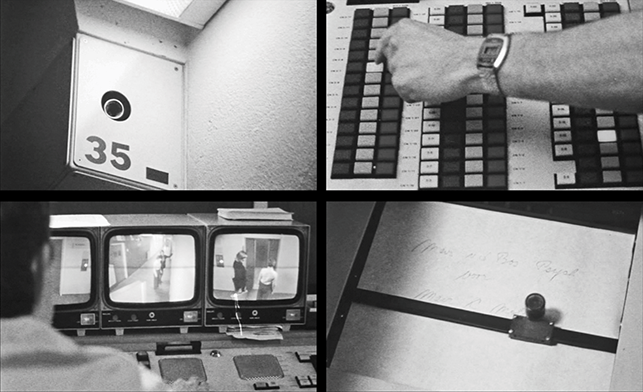
Figure 10.3 Long description
Top left: A security camera, mounted in an upper corner of a white space. The number 35 in grey font appears beneath the lens. Top right: A control board features vertical rows of blue, yellow, and red keys. A hand stretches across, reaching for a lit-up key. Bottom left: Three security monitors appear in focus; the guard who monitors these feeds is blurred in the foreground. Bottom right: Two slips of paper, neatly filed, with hand-written font indecipherable.
Janine herself is clearly part of this legal apparatus of mediation as a court-appointed psychiatrist, and she is keen to successfully fulfil her duty to mediate between the women and the law. She is never without her tape recorder while interviewing the women, and she spends sleepless nights with this device, playing and replaying extracts from the interviews (Figure 10.4). Her coming around to join in the women’s refusal – their silence and their laughter – is often read as the result of a process of identification. Ruby Rich suggests that ‘she comes to doubt the women’s insanity and to understand their motive as potentially, hypothetically, her own’.Footnote 49 Likewise, for Jane Arthurs, in this film ‘“identification” depends to an extent on an intellectual alignment with a middle-class professional’s growing realization of her own oppression, through a rational process of investigation that reveals the institutionalized forms of patriarchal power’.Footnote 50 So the suggestion is not only that Janine comes to identify with the three women through her forensic methods, but also that the viewer is drawn into the film’s world of meaning cerebrally by means of the same methods, through a rational identification with her. While the film does indeed work through identification with Janine for viewers who would be inclined to identify with her, in the narrative world of the film, it is not the rationalized bureaucratic process of forensic mediation that brings Janine around, but rather her decisive break with it. At a critical turning point, as the women begin to lose patience with her and push back, we see her lose mastery of her speech in the interviews: her sentences are left incomplete, her tape recorder on pause. Her participation in the laughter in the courtroom is her final break with law’s mediality. Is that break therefore to be interpreted as an embrace of immediacy and unmediation? Or is it rather that we arrive at another (a minor?) type of mediation, another modality of ‘hearing’?
Janine with her tape recorder. Stills from A Question of Silence.
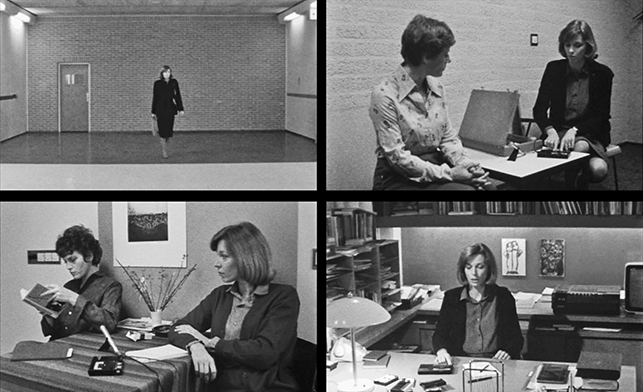
Figure 10.4 Long description
Top left: A woman walks forward in an otherwise empty room. She holds a briefcase in her right hand. Top right: Two women sit across from each other at a low table. A briefcase and tape recorder sit on the table between them. Bottom left: Two women sit at a table. Various books, linens, and flowers fill the room. A tape recorder sits on the table. Bottom right: A woman sits at a desk and credenza filled with books, facing the camera. Her right hand is raised, ready to press the tape recorder that sits in front of her.
Violence
I have emphasized silence and laughter as two key manifestations of women’s refusal in A Question of Silence. But there is also, of course, the violence. Perhaps because of how the killing is framed in the film, or rather because the entire film is about reworking its framing, commentators on the film tend to shy away from reckoning with the act of killing itself. This avoidance may be seen to be facilitated by its decisively limited visual depiction. We understand what happened to the victim through the dry forensic pathology report, tidily packaged and self-contained. There is eventually a scene of the attack in a flashback: The shopkeeper catches Christine as she steals an item of clothing. He approaches her, takes it out of her bag and smugly points to the price tag. Christine takes it back and calmly stuffs it and then a few other items into her bag. Amused by this scene of defiance, the other two women join in, taking their time to methodically stuff garments in their bags in full view of the shopkeeper. The women then slowly circle around and close in on him. A push, a push, a slap – he is down. A kick, a shopping trolley, a broken plastic hanger – he stops groaning. Another kick, a broken glass shelf, a heavy glass ashtray, and on it goes: taking their time and acting with calm deliberation, the three women improvise weapons to torture, mutilate and kill the boutique owner. Except for two momentary glimpses of it on the ground before any blood is spilled, the body of the victim remains out of frame: no gore, no graphic visual depiction, only some campily exaggerated sound effects overlaid on a 1980s experimental electronic musical score. ‘Stylized through a deliberate, almost ritual execution, and a camera calmly intent on the slayers, not the slain’,Footnote 51 the scene’s pace and choreography indeed unfold as if it were a sacrificial rite, as if the women are ‘performing or reenacting an already rehearsed scene’.Footnote 52 Perhaps we are watching a modern retake on a mythical scene: Pentheus being torn apart by the bacchants (Figure 10.5).Footnote 53
Pentheus amid the bacchants. Stills from A Question of Silence.
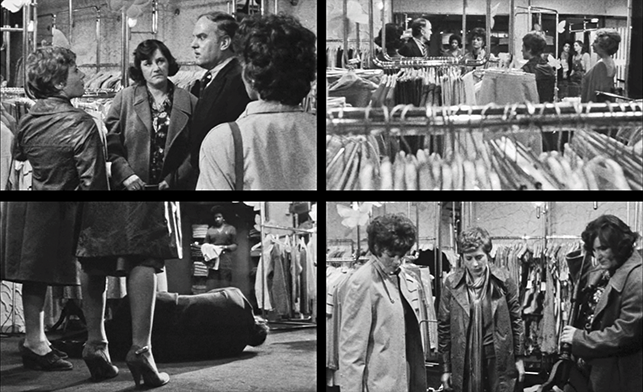
Figure 10.5 Long description
Top left: Four people stand conversing amongst racks of clothes, shown from the waist up. Top right: Metal hangars on a clothes rack fill the foreground. Shoppers stand behind. Bottom left: A close-up of the heeled pumps of two shoppers in A-line skirts. A man lies on the ground, as if he has fallen. His back is to the camera, face not shown. Bottom right: Three women stand in a circle, looking down, as if a man has fallen there. Clothes racks fill out the background.
Gorris’ decision to not show the victim’s body seems to have served as a kind of license to look away from the violence, with commentators treating the act of killing merely as a metaphor, or an unpleasant yet indispensable plot device. Whereas the legal system, as depicted rather realistically in the film, can only register the act as crime and madness,Footnote 54 most sympathetic readings of the film, in not paying close attention to the formal aesthetics of the killing, tend to frame it as a ‘feminist snap’Footnote 55 in response to an accumulation of ‘the small indignities of women’s lives’,Footnote 56 thus excusing and, worse, explaining it away. But in thinking refusal through, we may need to read the scene of the attack more boldly on its own terms. Geetha Ramanathan does precisely this, and proposes that the killing is in effect a ‘speech act’ that is an articulation of women’s political desire: ‘their desire for female solidarity and their desire to undo patriarchy’.Footnote 57 Pointing out the significance of the boutique as a male owned female ‘public’ space in the discursive arrangement of the text,Footnote 58 Ramanathan interprets the act of killing as the women reclaiming that space for themselves by acting in concert, and thus ‘rewriting their identities as women in a public space’.Footnote 59 She reads the silent complicity of the witnesses as their approval, validation and legitimation of the killing as ‘an act of battle by the women rather than a sudden spontaneous “feminine” outburst of rage’.Footnote 60
Cinema as Counter-Forum
Ramanathan’s reading partially problematizes Linda Williams’ influential reading of the film as skilfully tapping into what Elaine Showalter has defined as the ‘wild zone’ of women’s culture: a mysterious zone of women’s experience that is ‘conceived outside the limits of all existing language, all “known” reality’.Footnote 61 This is risky territory for feminist artists according to Williams, but necessary to engage with to validate women’s ‘muted’ experiences. She praises Gorris’ film for doing so while avoiding ‘the pitfalls of a facile or utopian feminist revision’.Footnote 62 Williams too reads ‘the violence of the crime’ as ‘a form of speech’,Footnote 63 but then does not fully follow through with the implications of this. Taking shelter in the film’s motif of silence, Williams suggests that the film demonstrates the heroic moment of feminist consciousness as the moment of solidarity ‘with an identity that has not yet been spoken and that cannot yet speak itself’.Footnote 64 But for Ramanathan, ‘The greater act of courage, as the film presents it, is that the women speak to what has been named in such an extraordinary way: female desire as violence.’Footnote 65 What is interesting here is that Williams, finding the power of the film in ‘its refusal to narrate the positive, utopian identity of women’,Footnote 66 holds on to an ideal of a feminist utopia that nevertheless must be protected from articulation because it will be just too crass to speak of it.Footnote 67 The wild zone is to thrill, it is to excite feminist desires, and to inform feminist aesthetics, but it must do all this while remaining a no-place. But what if that zone is not so much a utopia which shall remain unspoken of and uninhabited, but a heterotopia that is a space and time of rehearsal, a space for prefigurative practices towards another way of living? A heterotopia that thus may well be both very here/now and elsewhere at once, much in the way desire desires?
I borrow the heterotopia formulation from Bonnie Honig’s A Feminist Theory of Refusal, where she offers an alluring reading of Euripides’s play the Bacchae as yielding an understanding of refusal as not merely an act, but as having an arc, which has ‘the city as its destination’.Footnote 68 The arc of refusal means that the heterotopian escape from the city to the Cithaeron, where the women render inoperative their productive and reproductive capacities, has to be followed up by a return to the city to claim it:
Heterotopias valuably serve as spaces or times of rehearsal where alternative forms of life can be tried out and explored. … The bacchants teach the importance of that experience as rehearsal and example when they complete the arc of their refusal by returning to the city to claim it. At that point, it is up to the city: is it ready to receive them?Footnote 69
While the play is commonly read in centuries of reception as the tragedy of Agave (who with her sister and other bacchants ‘maddened’ by Dionysus, kills her son the king Pentheus on Cithaeron, mistaking him for a lion cub while in bacchic delirium) or that of King Pentheus (who is punished by Dionysus with death by his mother’s hand because he refuses to recognize the god as one), for Honig the tragedy is that of the city, because it is not ready to receive the women as they complete their arc of refusal. This argument necessitates a re-signification of the killing of Pentheus, an act that is so ‘nauseatingly horrifying’ that it ‘leads most readers or viewers to condemn the women who committed the violence and to see them as mad’.Footnote 70 Then again, we would do well to remember how, Honig suggests, ‘the conventional center holds on to power in the face of such challenges … : by turning such heterotopias into sites of madness or exception’.Footnote 71 Approaching the killing of Pentheus for its political meaning much as Ramanathan approaches the killing in the film, Honig pursues the question of ‘what it would mean to see the women’s violence as, in some way, deliberate and free: a refusal’.Footnote 72 In Honig’s reading, the killing of Pentheus is not merely a tragically unknowing filicide, but also and primarily a regicideFootnote 73 that is part of the larger and deliberate regicidal project (a ‘slow regicide’) of the bacchants, a project apparent in their every act. For Honig, ‘when the bacchants kill the king, they release everyone and him, too, from the false idolatry of patriarchal sovereignty’.Footnote 74 Their return to the city to demand to be celebrated for the ‘hunt’ is a return that therefore ‘has the power to inaugurate a politics’,Footnote 75 but only if the city is indeed ready to receive the women and their regicidal politics.
While many film critics and feminist film scholars, particularly at the time, read A Question of Silence as promoting separatism (on Cithaeron, perhaps), it is possible to read this film with Honig as bearing an arc that involves a return to the city. For this, we must return to the scene of laughter. One rather challenging and compelling proposal that Anca Parvulescu makes is that in thinking about laughter we must ‘focus on the burst of laughter itself’, rather than doing what most ‘theories of laughter’ do, which is to focus on the something else that laughter is a response to: ‘the comic, jokes, humor, the grotesque, the ridiculous, the ludicrous etc.’.Footnote 76 What would it mean to consider laughter in the courtroom scene as untethered from its object, the law? In Parvulescu’s reading of the film at the end of her book, the scene already depicts this very untethering:
Soon all the protagonists, spectators to the spectacle of law, are roaring with laughter. … Slowly, laughter dislocates itself from its object, the gender-blind court of law, and, by extension, the law itself. It is a laughter that has its own raison d’être, apart from any specific laughable object. And laughter reproduces itself, laughter asks for more laughter. It not only interrupts, but repeats itself and spreads.Footnote 77
What gets created in this contagion of laughter is a ‘laughterhood’Footnote 78 of laughers. But this laughterhood is importantly both on screen and off: the contagion of laughter in the courtroom spreads beyond the screen to the film theatre, thus constituting the latter as a counter-forum, a site of minor jurisprudence that emerges precisely due to the avowed medial force of the space.
‘Interestingly, at each screening of the film that I attended, this infectious rupture spread to the theater audience, producing a moment of stunning solidarity,’Footnote 79 testifies Barbara Kruger. The film ‘works on its viewers as forcefully as water on dehydrated food, reconstituting its proper audience even as it unreels upon the screen. … It is a gendered audience to which Gorris appeals, a subversive audience of women scattered throughout the movie theater, rising up in instinctive laughter’, writes Ruby Rich.Footnote 80 Linda Williams attests to ‘the genuine sense of danger and excitement’ generated by two screenings of the film she attended,Footnote 81 and Sheila Johnston writes of how the ‘implied sense of solidarity is – irrationally, perversely – exhilarating’.Footnote 82 This, perhaps, is the episode of the ‘return to the city’ in refusal’s arc: the film’s own mediality reconstitutes the space of the film theatre as a counter-forum, as the site of a minor jurisprudence of laughter. But what jurisdiction could this refusal have? I will leave two anecdotes here to begin to imagine answers. The first is by Jane Root who worked at Cinema of Women, the film’s British distributor at the time of its release in London. It was, she says, ‘a film which dramatically divided audiences. Some women stood up and cheered, while other (often male) viewers left enraged. … I was told that the Pizza Hut restaurant next door to one of the cinemas was full, night after night, with couples engaged in deep and sometimes angry arguments about the film’.Footnote 83 And one from Ruby Rich: ‘At the New Directors preview in New York, the audience recapitulated the film’s own ending: man after man rose to confront Gorris with hostile or garbled questions, only to encounter raucous laughter from most of the women in the audience. Gorris wasn’t surprised; she had observed this pattern everywhere the film had shown.’Footnote 84 It is in and through this laughter that the city prepares to receive the bacchants upon their return from Cithaeron.
It was supposed to be a straightforward process, and a familiar scene. Following the 2016 elections for the Legislative Council, or Hong Kong’s legislature, the incoming lawmakers took their oath of office one by one inside the Council’s chamber. However, there was drama that year. When it was his turn, Leung Kwok-hung, a veteran legislator returning for a new term after a landslide victory, approached the stand holding a giant yellow umbrella and other props, and shouted pro-democracy slogans along the way. He read out the oath loudly and aggressively, and also inserted dramatic pauses at unexpected moments. Dissatisfied with the manner in which he took the oath, the Hong Kong government initiated proceedings against him. It argued that Leung’s antics rendered his oath invalid and that he should be disqualified from office.
The Court of First Instance (CFI) agreed with the government. It opined that Leung’s behaviour at the stand amounted to no more than a ‘theatrical performance’, and that he had therefore failed to exhibit the sincerity and solemnity required for the oath.Footnote 1 The Court of Appeal (CA) affirmed the lower court’s decision.Footnote 2
In this chapter, I take the Leung case as a point of entry for exploring the relationship between law, theatre, and performance. My question is: what does the courts’ characterization of Leung’s oath as theatrical performance tell us about the nature and operation of law? In Law as Performance, Julie Stone Peters boldly contends that, far from being a set of ‘jurisprudential footnotes’, legal performance is ‘a constitutive idea in Western jurisprudence’.Footnote 3 In other words, theatre and performance are crucial to understanding what law is. Moving from the ancient world to early modern Europe, she demonstrates how notions of theatricality (‘law needs theatre’) and anti-theatricality (‘law must avoid theatre at all costs’) lie at the heart of how we talk and think about law. By examining the case in light of Peters’ insights, I posit that the proceedings can be understood as an encounter between law on the one hand, and performance on the other, that reconfigures the boundary between them in order to expose the nature of law as performance. I then analyse law’s strategies at keeping that boundary in place.
I will begin by providing the legal and political context for the Leung case in Section 11.1. In Section 11.2, I interpret the case as a clash between Leung’s theatricality and law’s anti-theatricality. I then home in on law’s anti-theatrical language in Section 11.3, and draw on J. L. Austin’s lectures on the performative and the constative, as well as Jacques Derrida’s reinterpretation of those two concepts, to explore the nature of legal performance. Theatricality and anti-theatricality appear to be on opposite sides in this case – Leung embraces theatre, the government (and the courts) reject it – but as Peters points out, the two are not necessarily polar opposites: while they are often marked out as ‘antinomies’, they can also be ‘proximate’ to one another, sometimes ‘perilously’ so. Footnote 4 In the final section, I examine how theatricality and anti-theatricality both stand apart and come together in the courts’ reasoning, and contend that the judicial insistence that theatre has no place in the oath-taking process can be understood as an attempt on the part of law to disavow its own performative nature.
11.1 The Legal and Political Context
The legal proceedings in Leung took place amidst a long-standing debate about the pace of democratization in Hong Kong. China resumed sovereignty over Hong Kong in 1997, after 156 years of British colonial governance in the territory. The Basic Law, Hong Kong’s post-handover constitutional document, guarantees fundamental rights and freedom,Footnote 5 an independent judiciaryFootnote 6 and the continuation of the common law system inherited from the British regime.Footnote 7 It also guarantees that the capitalist economic system and way of life before 1997 will ‘remain unchanged for fifty years’ after the retrocession.Footnote 8 The idea of ‘One Country, Two Systems’ is at the core of the post-colonial constitutional order: Hong Kong is part of China, a one-party socialist state, but it is meant to exist as a liberal enclave with ‘a high degree of autonomy’.Footnote 9 Most importantly for understanding the oath-taking controversy, the Basic Law was understood by many people in Hong Kong at the time to guarantee a gradual transition to democracy: it states that the ‘ultimate aim’ is for both Hong Kong’s leader (the Chief Executive) and its legislators to be selected by ‘universal suffrage’, and that the pace of democratization is to be determined according to the principle of ‘gradual and orderly progress’ and ‘in light of the actual situation’ in the city.Footnote 10 In the case of the Chief Executive, candidates for election would be nominated by a committee that is ‘broadly representative’ of Hong Kong society.Footnote 11
In part because of these constitutional guarantees, questions of when and how Hong Kong would become democratized became a focus of political and constitutional debate in local society. As years passed, however, frustration grew at the slow pace of democratization. This frustration spilled over in Occupy Central, a civil disobedience movement in 2014 that lasted more than two and a half months, during which people occupied the main roads, flyovers and public squares to demand democratic elections. There also arose increasing localist and anti-China sentiments, and localist parties calling for Hong Kong’s independence from China formed in the aftermath of Occupy. Alarmed by these developments, the Central Government in Beijing began to tighten political control over the city, and sought to curb the influence of these pro-democracy and localist parties.Footnote 12 Leung belonged to the radical wing of these parties, and was also a prominent figure in Occupy Central. In this context, it becomes obvious that his election victory, and the victories secured by candidates at the same end of the political spectrum, were a major cause of consternation for the authorities in both Hong Kong and Beijing.
Leung was amongst a group of legislators whose oaths were held to be invalid by the courts. The text of the Legislative Council Oath is set out in the Oaths and Declaration Ordinance (ODO): an incoming legislator has to swear that they will ‘uphold the Basic Law of’ and ‘bear allegiance to’ the Hong Kong Special Administrative Region of the People’s Republic of China, and that they will serve Hong Kong ‘conscientiously, dutifully, in full accordance with the law, honestly and with integrity’.Footnote 13 The oath can be taken in English or Chinese. The fact that an incoming legislator who does not take a valid an oath is barred from office is closely tied to the history of this ordinance.Footnote 14 The ODO was first enacted in 1972; it was revised after the 1997 retrocession but the wording and structure remained essentially the same.Footnote 15 The 1972 ordinance was itself largely modelled on the United Kingdom’s Promissory Oaths Act (1868). As Han Zhu and Albert Chen point out, there are two differences between the Hong Kong ordinances and the UK legislation that would turn out to be critical to the events of 2016.Footnote 16 First, the 1868 act applies to judges and holders of high-level public office in the UK, but it does not apply to legislators, whose oaths are governed by a separate statute known as the Parliamentary Oaths Act (1866). In contrast, the ODO applies to, amongst others, principal officials, judges and legislators. Second, while judges and other holders of high-level public office in the UK are disqualified if they do not take a valid oath under the 1868 Act, legislators who fail to take a valid oath are not automatically disqualified under the 1866 Act: they do not have to vacate their seat, even though they cannot sit in any debate or vote in parliamentary proceedings.Footnote 17 In contrast, ODO does not stipulate different consequences for different officials. Zhu and Chen demonstrate that the differences between UK and Hong Kong law can be traced to the structure of colonial governance: they note that the ODO was enacted in Hong Kong ‘at a time when all major organs of the colonial government, including both the Legislative Council and the Executive Council, consisted of members appointed by the Governor, and there were no elected representatives of Hong Kong people in the legislature’.Footnote 18 Under those circumstances, there was no need to treat legislators more leniently on the grounds that they were chosen by the people, and hence no need for the ordinance to ‘distinguish between the legal consequences of failing to take the required oath by Executive Council members and judges on the one hand and Legislative Council members on the other hand’. As a result of this historical legacy, an incoming legislator in twenty-first-century Hong Kong such as Leung whose oath is deemed invalid cannot take office.
There were two separate legal cases in the oath-taking saga of 2016. The first concerned Sixtus Leung (no blood relation to Leung Kwok-hung) and Yau Wai-ching. When the candidates took their oaths, they both carried a flag bearing the words ‘Hong Kong is not China’. They referred to Hong Kong as an independent nation, and substituted ‘China’ with a derogatory word for the country which the Japanese used during the Second World War.Footnote 19 The president of the Legislative Council determined that their oaths were invalid, but made the decision to allow them to retake them. This was the point at which the Hong Kong government initiated disqualification proceedings. Moreover, under Article 158 of the Basic Law the Standing Committee of the National People’s Congress in Beijing has the power of final interpretation over the constitutional document. Its interpretations are binding on the Hong Kong courts.Footnote 20 Before Hong Kong’s CFI decided on the case, the Standing Committee issued an interpretation of Article 104, which is the article governing oath-taking. The interpretation states that, according to the true meaning of Article 104 as decided by the Committee, the incoming lawmaker must (i) adhere to the form and content of the oath, without altering, adding to, or omitting any of the words, (ii) take the oath in a solemn and sincere manner, and (iii) sincerely believe in and strictly abide by the pledges in the oath. Furthermore, (iv) if the oath is invalid then the oath-taker will be disqualified from office without the opportunity to retake the oath.Footnote 21 Yau and Sixtus lost their case at both the lower courts and on appeal.Footnote 22
The second case involved Leung and three other candidates. In addition to Leung, there was Nathan Law, who adopted what the courts called a ‘distinct rising tone’ of mockery whenever he pronounced the Chinese character for ‘country’. He also prefaced the oath with an opening statement that included the English words ‘You can chain me, you can torture me, you can even destroy this body, but you will never imprison my mind,’ and concluded his oath with a renewed call for resistance. There was Yiu Chung-yim, who inserted extra words into the oath. And there was Lau Siu-lai, who separated the ninety words constituting the oath by placing six-second pauses between them as she read. Lau subsequently announced on her Facebook page that she intended her performance of the text not to be interpreted as the rendition of a coherent oath of office, but as the vocalization of ninety distinct words that had no connection between them. They, like Leung, lost their case and were barred from taking office.Footnote 23 Out of the four legislators in the second case, Leung was the only one who appealed, and he also lost in the CA.Footnote 24
The oath-taking cases generated strong reactions across the political spectrum in Hong Kong. While the behaviour of these legislators was widely condemned as disrespectful and even insolent, the high-handed disqualification of the candidates who were chosen by the electors as their representatives in the legislature gave rise to grave concerns that Beijing was undermining the city’s autonomy and interfering with the independence of its judiciary, both of which are constitutionally guaranteed. Particularly troubling was the timing of the interpretation – the fact that it was rendered before the Hong Kong courts had had a chance to decide on the issue seemed to suggest that Beijing was pre-empting a ruling in favour of the candidates.Footnote 25
Given that Leung’s oath was the only one explicitly characterized by the courts as theatrical, I will focus on him in the remainder of this chapter. However, the legal and political context indicates that his case constitutes a focal point around which anxieties about the entanglements between politics, law, theatre and performance crystallized, and testifies to the efforts on the part of the authorities to separate them.
11.2 The Greatest Showman?
Leung’s rendition of the oath was a political spectacle, and it is worth describing it in some detail. When the clerk called his name, Leung walked to the stand wearing a black T-shirt with the words ‘Civil Disobedience’ written in Chinese. In his right hand was a big yellow umbrella, the symbol of Occupy Central. Slogans were written on the umbrella, such as ‘End One-Party Rule!’ and ‘Release the Prisoners!’. In his left hand, he held a piece of cardboard on which was written the title of a legal decision on Hong Kong’s democratization handed down by Beijing; a giant black cross was scrawled over the title. Beijing’s decision, commonly known as the 831 Decision to mark the day it was handed down (31 August 2014), was regarded by many as China’s way of ensuring that only candidates acceptable to the Communist Party would be eligible to run for the office of the Chief Executive, and it was the immediate trigger for Occupy.
As Leung approached the stand, he shouted slogans such as ‘Self-determination for the people!’, ‘Civil disobedience without fear!’, ‘We will not be cowed!’ and ‘I demand double universal suffrage [for choosing both the Chief Executive and the legislators]!’ When he read out the oath, he deliberately paused at random points and varied his rhythm in the text to disrupt its flow. The sloganeering began again as soon as he completed the reading. He then took out another replica of Beijing’s Decision, tore it up in front of the clerk administering the oath, and, in a flamboyant final gesture, threw the paper fragments into the air.Footnote 26
This was the performance which the CFI condemned, and its description of Leung’s oath as theatre was not questioned by the CA. The CFI said that the sloganeering and the destruction of the Decision’s replica were simply ‘theatrical acts’, and as such were ‘totally unrelated’ to the oath.Footnote 27 Moreover, it held that when interpreted against his ‘theatrical conducts’, Leung’s characterization of his own attitude towards the ceremony as solemn seemed sarcastic at best. The import of this ‘theatrical performance’ in the Council Chamber, according to the CFI, was that the defendant had failed to respect the seriousness and importance of the oath-taking exercise.Footnote 28 The Court further observed that he had not demonstrated the sincere attitude the process required. His oath was therefore held to be invalid.
The proceedings can be thought of as a clash between two different conceptions of the place of theatre within the legal domain. The courts’ stance can be described as anti-theatrical: in the eyes of law, Leung’s theatrical performance signifies pretence, frivolity and impudence. As such, it is antithetical to the qualities that it regards as both prerequisites for, and definitive of, oath taking, including ‘sincerity’, ‘solemnness’, ‘respect’ and ‘seriousness’ – these are words that appear repeatedly in the judgment.Footnote 29 The courts’ approach here can be understood as a part of a long-standing cultural suspicion of theatricality. As Jonas Barish has argued, opposition to theatricality has persisted for centuries across multiple cultural domains: from Plato’s distrust of mimetic experience to the modernist dramatists’ interrogations of their own medium, theatricality has been associated with superficiality, falsity, immorality and danger. The judicial imagination, like the anti-theatrical mind which Barish explores, confers on theatricality the ‘savor of forbidden fruit’, and casts it as something that tantalizes, provokes, seduces and ultimately corrupts.Footnote 30
Law’s anti-theatrical stance lies at the core of a contrast it establishes between Leung’s behaviour and the oath taking by pro-Beijing legislators who were allowed to take office. It could be argued that what the courts regarded as problematic here is not the fact that Leung performs, but that he gave the wrong kind of performance: if he had given the correct kind of performance, if he had taken his oath ‘properly’, he would have been able to take office. As such, what law objects to in reality is not performance per se, but a performance that goes against or beyond the theatrical norms that are legally acceptable. Yet if law does indeed accept some version of performance, it does not recognize itself as doing so. In other words, a crucial dimension of the courts’ anti-theatricality is its refusal to associate oath-taking with performance. This non-recognition is reflected in the insistence on ‘sincerity’ as a defining element of the oath. Sincerity can be thought of as a form of transparency: to be sincere is to allow others to see directly into your heart, to observe your true feelings. By this logic, to do something sincerely is precisely to not engage in theatre or performance of any kind. The sincerity requirement, then, is tantamount to a legal requirement that Leung’s oath be completely natural, that it give access to his true feelings, that it contain no form of acting. The Standing Committee’s interpretation is clear on this point: the oath taker must not only strictly abide by their oath, but ‘must sincerely believe’ in it, otherwise they would have taken ‘a false oath’.Footnote 31 The demand for sincerity is therefore less a demand for a particular kind of performance, proper or otherwise, than a demand for artlessness and transparency. In the eyes of the law, Leung was playacting, while the successful candidates offered true, unmediated allegiance.
Ironically, though, what is striking about the process of oath taking in this context is that it has an inherently theatrical quality to it: unlike merely signing one’s name on a piece of paper and putting it in the post, the legislative oath is publicly enacted and delivered a viva voce; as such, it requires an audience to see and hear it. There can be no effective or meaningful oath without sound, body and spectacle.Footnote 32 Leung clearly embraced theatricality, and deployed it as a way of advocating for Hong Kong’s democratization. Through his performance, he makes bare the essence of oath taking as a kind of political performance and renders visible its inherently theatrical quality.
His oath taking constitutes a performance in two overlapping senses: performance as that which can ‘describe a particular form of expression’ for a real or imagined audience, as in something theatregoers see in a playhouse, and performance as that which can ‘diagnose a universal ontological condition’ about an entity such as law.Footnote 33 Leung’s verbal expression and bodily presentation constitute, firstly, a performance in the more particular or conventional sense of the word: they are designed to draw attention, to put oneself on display for dramatic effect, to entertain and elicit a reaction from the audience. Given the Council’s standard practice of filming its meetings and ceremonies, Leung may have had in mind an audience that extended beyond the incoming and existing lawmakers who were in the room with him, but that also included people likely to see the footage from the day on their television or computer screens.
Leung’s words and actions can be further construed as a performance in the second, more ontological sense: law and politics come about through a series of repeated gestures, and his deeds and utterances are arguably part of an ongoing attempt to bring about a change in the law, to enact a transformation in the political system, to hasten the coming-into-being of a different, more democratic, constitutional order. In How to Do Things with Words, J. L. Austin introduces a distinction between constative and performative utterances. He posits that constative utterances are those that describe an existing state of affairs: ‘The grass is green’ or ‘I am hungry’ are constative, in that they report on a reality that is already there. Performative utterances, by contrast, do not merely describe reality, but impact upon or enact a change in reality. An example Austin gives is ‘I give and bequeath my watch to my brother’ in the context of a will: Footnote 34 the statement is performative because the act of uttering it is, or at least partly constitutes, the performance of an action. As Başak Ertür succinctly glosses it, ‘in Austin’s scheme, performative utterances do rather than describe; they produce or transform a situation, or at least attempt to do so’.Footnote 35
In this instance, Leung’s sartorial choices, his sloganeering, his use of props such as the yellow umbrella, his dramatic tearing up of the mock Decision in public, and the ostentatiousness of his overall delivery and self-presentation can be collectively read as a performance that seeks to be politically and legally performative, in the sense of actively adding to, amplifying and furthering the efforts at creating concrete political and legal changes that were gaining momentum in Hong Kong society at the time. As Austin points out, oath making is already a performative act exemplar, and Leung’s tactic of using it as a means to push for universal suffrage, political participation and more expansive rights and freedoms takes the performativity in a different direction from what was expected in the Legislative Council. Jacques Derrida has criticized Austin for placing intention at the core of his conceptualization of speech acts, and argues for foregrounding the role of iteration. While it could be questioned whether intention is indeed as central to Austin’s framework as Derrida contends, the foregrounding of iteration helpfully brings the force of Leung’s performance into view.Footnote 36 As footage of his performance was relayed across televisual news channels and various social media outlets, as it proliferated on the front page of the broadsheets, they intensified discontent with Hong Kong’s slow pace of democratization and galvanized the public’s demand for reform, thereby compounding the impact of Leung’s theatre. When seen through an anti-theatrical lens, however, these acts take the form of parodies or bastardized versions of the requisite oath, and as empty gestures with no legal effect. Theatre becomes indistinguishable from theatrics, political performance appears as farce and in a dynamic spanning hundreds of years that Barish has traced, theatricality slides once again into anti-theatricality.
11.3 Law’s Temporal Performances
Leung’s faith in the power of theatre was countered by an institutional distrust of theatre as sham in the proceedings, and the courts construed his actions as an empty performance and therefore as the antithesis of law. Yet in what sense might law itself be thought of as performance, as Peters contends? And if it is a kind of performance, is it merely performance, or does performance here signify differently such that it is not simply the opposite of the real? One of the doctrinal questions raised in the CA regarding the Standing Committee’s interpretation serves as a point of entry: given that the interpretation was rendered after Leung attempted to take the oath, does it have retroactive effect so as to render his oath invalid?Footnote 37 In other words, does the interpretation take effect only from the moment it was rendered by the Standing Committee (in which case it does not apply to Leung), or does it take effect before that moment (in which case it does)?
The CA held that the interpretation applies retroactively: like the Standing Committee’s other interpretations of the Basic Law, it ‘has retrospective effect back to 1st July, 1997’, or the day of the retrocession.Footnote 38 As such, the interpretations must be construed to state ‘what the law has always been since the coming into effect of the Basic Law on that date’. This question about retrospectivity, or temporality, is crucial to understanding the relationship between law, theatre and performance. To understand why this is so, it is helpful to examine the judicial discussion of retroactivity in light of Derrida’s contention that retroactivity can be ‘fabulous’ (in the sense of fiction, or fashioning, or forming).Footnote 39
In ‘Declarations of Independence’, which examines the significance of the act of signing in the context of the US Declaration of Independence, Derrida posits that the signing constitutes a troubling of the distinction between the performative and the constative which then gives rise to a temporal disjuncture he calls ‘fabulous retroactivity’. Derrida asks: what might it mean for the representatives from the thirteen colonies to sign ‘in the name and by the authority of the good people’? Specifically:
Is it that the good people have already freed themselves in fact and are only stating the fact of this emancipation in the Declaration? Or is it rather that they free themselves at the instant of and by the signature of his declaration?Footnote 40
What, in other words, is the nature of the Declaration, and how does it operate? Is it a constative utterance, in the sense that the people in the thirteen colonies have ‘already freed themselves’, such that the Declaration is ‘only stating the fact of this emancipation’ in reality?Footnote 41 Or is it a performative utterance, in the sense that it is the signing of the Declaration that produces the state of freedom?
Derrida contends that the Declaration cannot be thought of as either constative or performative, but hovers undecidedly between the two registers. Crucially, he further posits that this undecidability is not a logical fallacy or error in the document, but is constitutive of the very process of origination that the Declaration is meant to announce and achieve. The positing of a politico-legal regime rests on a fundamental ‘equivocation’, and in the American context, the Declaration depends on this equivocal undecidability to found the nation.Footnote 42
He makes a similar argument in his analysis of the idea of the people in the Declaration. On the one hand, the representatives sign the Declaration in the name of the ‘good people’ who are already there to lend their authority to the signers. On the other hand, ‘this people does not exist’, in the sense that the category or concept of ‘the people’ that functions as the representatives’ source of authority does not come into being before the signing. As such, ‘the signature invents the signer’. The signature, then, both presumes the existence of ‘the good people’ and performatively brings them into being as such.
This dynamic is what Derrida calls ‘fabulous retroactivity’: the signature shuttles between being underwritten by a pre-existing freedom, and enacting the very freedom from which it draws its authority. In the same vein, the representatives sign in the name of the people, while also bringing the people into being through their signatures. The moment of signing produces, in the present, that which is already there all along. The Declaration therefore oscillates continuously between stating a reality and forging it, between the constative and the performative.
Ertür brilliantly teases out the theatrical implications of this relation of undecidability, and traces it back to Austin. She points out that early on in How to Do Things with Words, Austin underscores that some performatives can disguise themselves as constatives, in the sense of taking on the form of an utterance that describes the world when it is actually creates or transforms it. Austin calls these utterances ‘masqueraders’,Footnote 43 and as Ertür notes, his metaphor is noteworthy for its theatrical connotations:
The metaphor brings the excluded theatrical through the back door into Austin’s theory, as part and parcel of his initial definition of the performative. The performative, we are told, is that which often disguises or passes itself off as constative. So there is already a staging involved in the performative, whereby it disguises the fact of its enactment.Footnote 44
The ‘undecidability between the two modes’ of the performative and the constative is a masquerade – in other words, a form of theatre, or the ‘staging’ of a disguise.Footnote 45
When we return to the question of the interpretation’s retroactivity in Leung and place it in the interpretative frame that Derrida, Austin and Ertür give us, it becomes evident that, as a speech act, the interpretation is characterized by a similar relation of undecidability between the constative and the performative. The CA’s reasoning relies heavily on Lau Kong Yung v. Director of Immigration, in which Hong Kong’s CFA held that the temporal significance of a Standing Committee interpretation should be understood in the following way:
The Interpretation … dates from 1 July 1997 when the Basic Law came into effect. It declared what the law has always been.Footnote 46
The Interpretation has effect from 1 July 1997.Footnote 47
The statements ‘The Interpretation has effect from 1 July 1997’ and ‘The Interpretation … dates from 1 July 1997 when the Basic Law came into effect’ are constatives: they describe or report a state of affairs in reality, the state of affairs being that the meaning of the Basic Law as stated in the Standing Committee’s interpretation has been there from the very beginning of Hong Kong’s post-colonial existence. However, at the same time, the court acknowledges that the Interpretation ‘declared what the law has always been’. Verbs can be good indicators of performatives: ‘I do’ (as in a wedding ceremony) ‘I order’ (as spoken by a judge in court), ‘I promise’ and ‘I bequeath’ are some common examples. The verb here – ‘to declare’ – is a classic performative, a doing verb that creates a state of affairs in reality: by declaring what the meaning of the Basic Law from the very beginning, the interpretation produces the reality that the meaning it contains is the one that the text of the Basic Law has expressed all along. The interpretation is therefore a speech act that hovers between the two registers of the constative and the performative, between describing and declaring, between stating and generating. If, as Derrida notes, the relations of undecidability between the performative and the constative are constitutive of the act of origination, and if, as Ertür foregrounds, the metaphor of the masquerade brings in the theatrical, then the situation analysed in Lau Kong Yung can be interpreted as a form of theatre, in the sense of a performative utterance which masquerades as a constative one. The temporality operative in this instance is a ‘fabulous retroactivity’ that destabilizes two linguistic registers.
To trace the ways in which the ‘performative-constative masquerade’ is at work here is not to offer a critique of Hong Kong law or Chinese law per se, nor to imply any wilful political deception by the authorities in the case.Footnote 48 Staging, disguise and masquerade – in short, elements of theatrical performance – are unavoidable in any act of linguistic interpretation undergirding a moment of founding, be it by the signatories and readers of the American Declaration of Independence, the members of the Standing Committee, or the judges of the law courts. In fact, the CFA in Lau Kong Yung explicitly makes reference to the common law declaratory theory of judicial decisions, the fiction whereby judges do not create law but merely find it, in its reasoning about the retroactivity of the Standing Committee’s interpretations.Footnote 49 To underscore that undecidability, or masquerade, is constitutive of the speech acts of law is to make a jurisprudential inquiry into what law is and how law operates as a linguistic product and a process of interpretative reasoning.
This masquerade also takes the form of precedential reasoning in Leung. In ‘Force of Law: the “Mystical Foundation of Authority”’, Derrida famously observes that ‘the founding and justifying moment that institutes law implies a performative force, which is always an interpretative force’.Footnote 50 To interpret in the institutional context of law, to discern a pre-existing meaning in a legal text by turning to previous cases as common law lawyers are wont to do, is to actively posit and perpetuate that meaning through acts of interpretation. An interpretative act not only restates meaning, but enforces and amplifies it; that is why the ‘interpretative force’ is also a ‘performative force’. When interpreting the text of the Standing Committee’s interpretation of Article 104, the CA cites, and re-cites, the previous cases on the nature of the Standing Committee’s interpretation: it refers to its own judgment in the Sixtus Leung and Yau case, which states that the interpretation sets out the true and proper meaning of Article 104 ‘from day one’.Footnote 51 It then gives further force to this reading of the Standing Committee’s interpretation by citing the CFA’s decision in the same case, in which the Appeal Committee similarly concludes that a Standing Committee interpretation represents ‘what the law is and has always been’.Footnote 52 By building the foundation of its judgment from these precedent cases, the decisions by the courts in each of these cases restate, constatively, what is already acknowledged as the reality of the Basic Law’s meaning since the establishment of Hong Kong as a Special Administrative Region of China, but in doing so, they entrench and amplify that reality performatively, as a legal institution, through a highly visible recourse to a purely legal doctrine, that of stare decisis. To think of law as performance is emphatically not to think of it as merely performance, but to recognize that a continuous process of quotation, repetition and self-referencing lies at the core of the way it constitutes itself. The drama of common law reasoning here is the process through which the ‘foundation’ of law, or law’s originary moment, becomes indissociable from the ‘conservation’ of law, or the performance of law as law.Footnote 53
Conclusion: Performance, Theatricality, Anti-theatricality
We are in a position to return to the question at the beginning of this chapter. What does the courts’ view of Leung’s oath as a theatrical performance tell us about the nature and operation of law? In other words, what is the jurisprudential significance of their anti-theatrical stance? The proceedings can be approached as an attempt, whether conscious or unconscious, to establish a relationship of absolute opposition between law on the one hand, and performance on the other. By adopting an anti-theatrical stance, law casts the performance of a man who embraces, and indeed relishes, his own theatricality as a kind of reckless playfulness that is ill suited for the occasion. At the same time, the anti-theatrical language, or the representation of an invalid oath not as an oath that is problematically performed but as one that is performed at all, enables law to represent the legally valid oaths as, by contrast, pure artlessness rather than instances of performance. In Leung, the qualities which law accepts and identifies with, such as solemnity, seriousness and sincerity, are framed as non-theatrical. The legal presents itself as synonymous with the absence of theatre. In other words, by representing Leung’s performance as having no place in the legal domain, by framing it as little more than theatrics, the courts’ anti-theatricality situates theatrical performance as the antithesis of law.
However, as I have argued in the previous sections, performance is in fact an integral part of law, even though law does not acknowledge it to be so. Both law and the man whom law condemns perform. There are two sets of inter-connected performances on each side. Leung’s actions can be said to be a show that deliberately seeks to entertain, shock and even scandalize his audience. At the same time, they enact a form of advocacy and therefore ‘perform’ in Austin’s sense of the word, as a set of utterances and bodily gestures which aim to bring into being a different political and constitutional order.
Law’s performance can be understood firstly as a form of linguistic theatre that throws into question the division between the constitutive and the performative, and that enacts a Derridean fabulous retroactivity troubling the linear timelines on which legal reasoning depends. It can also be understood as a performance of law as law, in the form of a public citation and recitation of legal authorities that gives rise to a continuing and necessary spectacle of a hallowed ‘artificial reason’ that can be traced to Sir Edward Coke, whereby the judgment of law proceeds according to a foundation and logic specific to law itself.Footnote 54
What the clash between (the Leung’s) theatricality and (the courts’) anti-theatricality in the case ultimately reveals is that the two stances are not only ‘proximate’ to one another, but ‘perilously’ so: they point to the fact that performance lies at the core of law as much as it lies at the core of the spectacle which the courts condemn.Footnote 55 When law and theatre collide, when they are read across one another, they begin to hum and echo in a way which exposes their common foundation of self-constitution in performance. In this uncanny encounter, the boundary between the two arenas starts to blur, the epistemological distinction between them starts to look less certain and law’s performances start to become more visible.
In this light, law’s anti-theatricality can be read as the symptom of a disavowal of its own nature as performance: the rejection of theatre constitutes a way for law to displace its gaze from the theatrical dimension of its own reasoning and the fictionality which, as Derrida points out, cannot be dissociated from the undecidability which gives rise to the temporal disjuncture known as fabulous retroactivity.Footnote 56 In other words, anti-theatricality can be said to be a way of exteriorizing performance: by aligning performance with a figure held to be lacking in the qualities of sincerity, solemnity and seriousness that define law, the courts suggest that performance cannot logically be part of law. The oath-taking saga in Hong Kong shows how anti-theatricality can be a means through which law expurgates performance from its discursive domain and stages its own formal existence.Footnote 57
The erasure of the body in civilized societies has everything to do with fear of the very violence upon otherized bodies on which civilization is built.
We cannot address the history of modern surfaces without also asking after the other history of skin, the violent, dysphoric one – the one about racialized nakedness inherited from the Enlightenment so necessary to Western constructions of humanity and the one that speaks of the objectification, commodification, and fetishization of racialized skin, especially black female skin.
Literature in the legal humanities has begun to turn toward performance as a new site of analysis: as source, representation, and intervention. From Law and Performance (2018) to Law as Performance (2022), this belated comparison has garnered increasing traction.Footnote 1 But methods from dance and performance studies, those wayward disciplines where corporeality supersedes the literary, still make only passing appearances. The repercussions, however, exceed the methodological toward the most material. This chapter underscores the consequences for this absence by centering the lone figure, “Naked Athena,” as a femme body in protest whose choreographic aesthetic of whiteness allowed particular flexibility under the law. Through her balletic performance of resistance, themes of discipline, elegance, and decorum swirl against the indecent, vulgar, and obscene labels afforded other protesters in the same scene. Motivated by this duality, I survey histories of the publicly exposed body as righteously revealed or promiscuously pornographic, a distinction theorized within aesthetics as the difference between nakedness and nudity yet left ambiguous in legal terms.
Naked Athena: An Ambivalent Apparition
In response to the federal occupation of Portland, Oregon, in 2020, an uncanny figure emerged from the crowded protest scenes which spawned across the nation a rally cry for Black Lives Matter (BLM): a photograph features a young, femme body sporting only a face mask and stocking cap who approaches heavily armed officers and then poses in postures later captioned as ballet. At least ten law enforcement officers stand en face, armed, shielded, and planted in a wide, assertive stance. Uniformed, they aggregate as a living barricade. The glare of a police vehicle’s headlights illuminates the pavement between the parties as both stage and interrogation, unsure which side is audience and which is performer; positioned directly across from the figure and photographer alike, the car beams cast a haloed glow around her “apparition.”Footnote 2 Police lights elsewhere cast the periphery in a pale pink haze, a surrealist dreamscape all too real. From within this spotlight, she moves through a series of poses with her full front on display to the onlooking officers. Keeping her identity anonymous, news media christened this woman “Naked Athena,” a heroic icon laid bare in a collision of vulnerability and bravery.
This arresting moment marked a summer of racial outcry against anti-Black violence following the murder of George Floyd, wherein inflamed participation resulted in the contentious call for Oregon’s national guard to enter the arena.Footnote 3 Armored in the repertoire of ballet as a costume of whiteness, this Naked Athena sidestepped accusations thrown upon other protestors at the same time; rather than a looter or rioter (supposedly) worthy of social, political, and legal critique, nomenclature elevated her status to the divine.Footnote 4 Her open flesh starkly contrasted the camouflage fatigues, gear, and helmets of the state agents. In her exposed form, she approached the officers unequivocally unarmed, offering no excuse for reasonable alarm, retaliation, or subsequent justifications of imagined weaponry so often tabulated. She nevertheless caused a stir.
Juridical logics prompt us to emphasize legal moments in which accusations have been made – arrests, trials, and contract breaches – in order to understand the legitimacy of the claims. Less frequently do we pause to consider moments in which allegations have not been raised, in spite of their greater ubiquity. The scene of Naked Athena prompts such inverted attentions, as her nudity and the subsequent nonpolicing of her exposure – aimed directly at police authorities – becomes the focal point of my attention. I do not intend to exalt this singular figure and consequently overshadow the pressing stakes of the larger protest movement. Such words continue to need to be written and read. But here, I read deeply into what this scene reveals about the entanglement between legal and performance aesthetics and the subsequent corporeal ambiguity which emerges when not understood together. Obscenity doctrine and discernment of indecency coheres at this nexus, wherein perceptions of offense and calculated shock define prevailing orders of modesty. If clothing fashions a particular type of containment for the naked body, ballet styles a different restriction on the otherwise natural body and facilitates the civilizing transition from perverse nakedness to permissible nudity. Unclothed and unnamed, the nude dancing body becomes site of critical concern for those of us attuned to the covert ways in which race, gender, and sexuality continue to animate legal hierarchies. This extends to the discernment of the obscene body in motion.
In the case of Naked Athena, her splayed legs and masked face could have been invoked to depict her as lewd, perverse, kink, or otherwise outside the normative bounds of the law. She herself would clarify an antagonizing intent when reflecting, “This fury arose in me … I said, I want to be naked. I want to confront them.”Footnote 5 However, perhaps due to her slim figure and light skin, news media instead scripted her as “urban and civilized,” “an apparition.” No charges were filed against her wayward actions. Such a reading, while on the one hand progressive for its openness to sexuality and the nude body, foregrounds an ableist and racialized legal aesthetic in which nudity is elevated to rhetoric of deity when ascribed to white femininity: what Robin Bernstein laconically names as a “holy obliviousness” and Rebecca Chaleff extends to the imperial project of the ballet blanc.Footnote 6 The variously applied boundaries of obscenity seemingly emerge from a legal history in which whiteness has been constructed as property, secured and otherwise performed within hierarchies of race and desire.Footnote 7
Instead, the deviance on display was read as nonviolent, arousing neither fear nor aggression, instead deflated by the vulnerability of exposed skin susceptible to wounding. In a world in which Blackness itself is already feared as a weapon, however, I caution against the conclusion that nakedness itself was enough to protect. Rather, her aesthetic legibility as a normative figure featured her perceived whiteness in spite of self-identification as a non-Black person of color, an interpretation further reinforced by her performance of the classical lines of ballet. The particular politics of her framing underscore this aesthetic ambivalence: a New York Times article suggests her to be a “light-skinned person of color,” though others originally suggested her to be white.Footnote 8 From the embedded racial ambiguity we can conclude she passed as white, willfully or not. This motivates my reading of her whiteness in spite of factual claims toward her self-identified race. Additionally, I want to highlight the ways in which Naked Athena was allowed to remain anonymous, at most claiming the name (and potential pseudonym) “Jen” on a radio show after the event; anonymity itself can serve as a marker of racial privilege as people of color are historically over-surveilled. I intentionally draw attention toward the aesthetic logics of her circulation in excess of her politics for, as I will argue, it allows us to understand this nonpolicing within a larger narrative of modernism, not divorced from colonial efforts of missionne civilisatrice. From her performance and its mediated attention, I theorize an aesthetics of the legal rooted in racialized interpretations of the lewd, the indecent, and the obscene that can be traced through classical and modern aesthetics when read via dance studies.
The readings of Naked Athena that emphasize the balletic repertoire synthesize an underlying tension of race and privilege in the narrative surrounding the protest. On the one hand, such an interpretation passes as justified: Her straight spine, flexible limbs, and symmetric poses follow the aesthetics of ballet rehearsed for centuries. One photograph in particular mimics the balletic position of a posé: Her right leg lifts until her foot is pressed against the inside of her left knee as if in the resting position of a flamingo, her arms lifted overhead in informal port-de-bras, chin raised slightly. Yet a closer analysis contradicts such claims of this corporeal genealogy: Her supporting leg remains in parallel rather than the external rotation definitive of ballet training, her palms flex outward in her overhead reach against a balletic carriage, and her foot rests flatly in its entirety against the inside of her leg rather than articulated through a pointed position. In this sense, the media outlets who instead chose to read her gestures as reminiscent of yoga positions had as much grounds for doing so, not least for the symmetry, flexibility, and static nature of the various positions associated with the non Euro-American practice. Her ascription as goddess further builds upon formulations of the Apollonian frame as the moral fetishization of the upright body as dignified and noble reflective of a normative, idealized body rooted in an ableist and classist aesthetic.Footnote 9
I belabor this point of ambivalence to suggest that the choice not to center yoga, or the choice to center ballet in spite of the inaccuracy of the naming, suggests a decision based upon something other than corporeal analysis. The imposed passing then, assisted by quasi-balletic signals of class and race, begets a legal interpretation of white femininity that presumed nonthreatening intent. Translated to the street, the postures veil a confrontational (if still peaceable) disposition, with entrenched perceptions of decorum overriding legal lines of decency. Allowed to exit the scene without notable physical harm or arrest, her performance as a ballerina rendered her legible as an obedient, docile, and civil body in spite of her overt protest, willful defiance, and illicit gestures.Footnote 10 She escaped the bodily scrutiny leveraged elsewhere. Under this viewing her repertoire veils the politics beneath the choice to not police her public nudity as race, law, and aesthetics become entangled in unarticulated ways. Jen acknowledged the interpretative lens of nudity when she summarized intent: “My nakedness is political. It’s my expression.”Footnote 11 Her nakedness was nevertheless converted into a sheath of nudity, attesting to the politics projected onto her surface.
Exposed Form: A Review of Public Indecency
Oregon has unique leniency in its nudity laws, allowing for some exposure of the human figure without invoking indecency, be it public or private. In many ways echoing the Miller test for obscenity, the state tolerates nudity so long as there does not exist “the intent of arousing the sexual desire of the person or another person,” or in the case of its private indecency laws, so long as exposure would not “reasonably … be expected to alarm or annoy the other person.”Footnote 12 Portland maintains its own authority on the matter, declaring under City Code 14A.40.030 (Indecent Exposure): “It is unlawful for any person to expose his or her genitalia while in a public place or place visible from a public place, if the public place is open or available to persons of the opposite sex.” Despite clear appreciation for the demonstrative force of the body, these legal codes place a greater emphasis on intent than reception – a term decidedly linked to the theatrical and performative and left largely undetermined in the legalese.
Not all exposure, however, is created equal. Given the historic hypersexualization of Black and Brown bodies, the invocation of “reasonable alarm” opens the possibility of racial bias in its interpretation as some figures are deemed inherently sexual a priori to the establishment of intent.Footnote 13 In most US states, indecent exposure laws are significantly gendered, as public lewdness extends to the exposure of all genitalia but only female nipples (exceptions occur in Hawaii, Maine, Ohio, New York, and Texas). This binarized legacy extends from The People & C. Respondent v. Ramona Santorelli and Mary Lou Schloss (1992), whose topless summer solstice picnic in Central Park intentionally led to their arrest and contestation of Penal Law § 245.01, to the desnudas performers of Times Square whose patriotically painted torsos leave little left unseen amongst other critical flashpoints in the legal regulation of the exposed form. It becomes further gendered given the antiwoman logic that female genitalia are less threatening than male genitalia for which public exposure/indecency laws are more stereotypically invoked (even while modesty of the femme form has received greater social scrutiny). Legal anxiety toward the trans body and homophobic attitudes only accentuate the disparate application of obscenity laws on the aesthetics of race, gender, and sexuality.
Legal concerns toward indecent exposure, public lewdness, and the obscene have been challenged under First Amendment protections of expressive material, including contemporary evaluation of immoral and scandalous remarks.Footnote 14 Classified as a misdemeanor, penalties for public exposure and indecency occur rather infrequently – as in the case of the Naked Athena whose performance went unrecorded before the law. From interpretations to the First Amendment’s expressive freedoms to the Fourteenth Amendment’s Equal Protection Clause, discerning nudity under legal provision remains an ambiguous task.Footnote 15 Even when toplessness and other partial nudity has been deemed permissible, arrests still frequently occur, as artist-advocate Holly Van Voast intentionally accentuates through performative interventions. Idiosyncratic and incomplete, these collective errancies in this law’s application raise the questions: What purpose does obscenity doctrine serve if so subjectively enforced? Who is it meant to protect? Phrased in its inversion, who is it meant to criminalize?
An answer lies submerged in the entangled histories of law, aesthetics, and the nude. These categories, if often kept separate in academic discourse, converge to solidify hierarchies of race. Motivated by the famed nudity of twentieth-century performer Josephine Baker, humanities scholar Anne Cheng writes on the intimacies of modernism and primitivism as a site for understanding implications of racial difference. “The march of progress,” submits Cheng, “is thus equated with the suppression and erasure of erotic material excess, deemed to be the exclusive and natural domains of sexual and savage primitives.”Footnote 16 Modernity, morality, and flesh become overlapping projects. To make this argument, Cheng draws upon Adolf Loos’s Ornament and Crime (2013), the title itself linking aesthetics and law. If Cheng emphasizes an aesthetic teleology that disappeared nakedness in its march of progress, such momentum reanimates through legal codes which regulate that very aesthetic space.
I return to Cheng’s argument, however, as Naked Athena offers a near-perfect inversion of Cheng’s primary case study, Josephine Baker: an anonymous twenty-first-century figure versus a twentieth-century celebrity, performed in the context of public protest versus proscenium-cabaret stage, a white-coded body performing ballet versus a Black body performing theatrical dance. Both examples center live events with visual and film circulation of the youthful, able-bodied female “wearing her nakedness like a sheath.”Footnote 17 Located within these aesthetic developments, “the trope of skin/surface thus occupies a central place in the making of modern aesthetic and philosophical theory,” writes Cheng. To this list, I would add legal codes, as concerns of morality sharpen at the same time, if in distinct and unacknowledged ways. Civil codes that restrict the naked body echo the aesthetic values of modernism, at least modern architecture, “defined as specifically the liberation from ‘primitive’ and ‘feminine’ inclinations.”Footnote 18 A comparative reading, then, allows us to extend the aesthetic argument of Cheng toward new contexts, including legal domains with material stakes in the present moment.
Contested Mythology: Classical and Contemporary Views
Naked Athena of Portland, however, is far from the first woman to invoke her white femininity in exchange for legal protection. Against interpretations that Naked Athena’s acceptance is a contemporary phenomenon indicative of some teleological progress of moral acceptance or anticonservative Christian becoming of society, I want to return to the Greek narrative of Phryne, uncanny in its parallels. One might be quick to recall her fabled biography (and question the adoption of Athena for this anonymous 2020 figure given her association as the goddess of warfare in lieu of the more analogous Phyrne): a Greek hetaira known for beauty, Phryne became infamous during her trial for impiety (or asebeia), having “removed her robes, let down her hair and walked into the sea in full view of the other celebrants.”Footnote 19 When the orator Hyperides defended her around 350 BCE, rhetoric alone failed to persuade the jury of her innocence. In an improvised act of sexuality, Phryne disrobed before the court. When the jury saw her bare breasts, she was acquitted: non Hyperidis actione … sed conspectus corporis.Footnote 20 The imagery of bare breasts in the courtroom as defense repeats throughout the centuries as a celebrated motif of protest when cast upon the white figure. Such reproductions include Orientalist Eugène Delacroix’s Liberty Leading the People (1830), amongst other lauded examples. Yet rather than rhetoric of the primitive used at the time to describe the culture of colonized peoples who were similarly disrobed, Delacroix suggested instead that his painting depicted the “modern subject,” again calling into question the racialized and heterosexual aesthetic gaze that undergirds sociolegal interpretations of indecency.Footnote 21
Although the facticity of these events are disputed, including if Phryne disrobed herself or if this act was executed by the orator Hyperides (390–322 BCE), what remains consistent across the various accounts is that the revelation of Phyrne’s breasts induced acquittal – that is, that her nude body was a legal advantage, not an illicit act of indecency (if accounts of the partiality of her nakedness differ). Reflecting on Phryne, classics scholar Ioannis Ziogas summarizes that “Female beauty, like [the] male heroism” of exposing wounds to evidence military courage, “acts as a barrier that checks the punitive hand of law.”Footnote 22 Ziogas invites us to read Phryne’s “irresistible beauty” in context of The Trojan Woman and the judgment of Helen, affirmed as nudity given its intertextual references to Greek myths and the divine. The parallel extends theorization of the aesthetics of law toward a larger attention to beauty and desire.Footnote 23 These themes slide analogously into the twenty-first century through repeated motifs in the scene of Naked Athena in which body made bare remained protected before the law. The masculinist bent of the intended audience repeats across each of these narratives, although in the most contemporary case, the all-male jury has been replaced by the masculine authority of the police.
I return to this courtroom performance by Phryne, not simply because it reveals a tension between rhetorical authority and embodied expression as evidence in legal scenes of judgment. Rather, I am also invested in the aloof shifting between nudity and nakedness presented in its retelling. For example, Quintilian asserts that “people believe that Phryne was acquitted not by Hyperides’ speech, however admirable it was, but at the sight of her stunning body, which she bared by drawing aside her tunic.”Footnote 24 Others yet “introduced Phryne in pitiable garb, beating her naked breast and tearing her tunic, and the jurors saw and acquitted her out of pity.”Footnote 25 This shift in language toward the naked simultaneously invokes the wretched, far from the stunning sight of nudity previously framed. The jurors’ reactions shift in these retellings too, as their affective response modulates from awe to pity respectively; the semantics, more than translational difference, code for ambivalence of law and the uncertainty of fleshly revelation.
Implicit to the logics of these retellings compiled here lies a juridical value in the aesthetic distinction between the naked and nude lost in contemporary applications of the law that continues to animate legal debate. This affective shift toward the exposed body, then, reflects the continued ambiguity associated with the articulation of emotional and aesthetic reception. Turning back to scholar Anne Cheng, she writes: “In spite of our political sophistication today, we still have few tools and little language for addressing what I call visual pleasure in the contaminated zone: those uneasy places of visual exchange where pleasure, law, and resistance converge.”Footnote 26 This distinction also accounts for the varied reactions to exposed bodies across legal history, not least the “irreverent performances” of Calefurnia and Catherina Arndes featured by Julie Stone Peters.Footnote 27 Such is the renewed sophistication called for in this chapter, wherein knowledge from aesthetics and performance studies can inform corners of legal ambiguity still held within invocations of public exposure.
Nude versus Naked: A Moralizing Aesthetic Coded by Law
Underneath the ambiguous articulations of the exposed body percolates an aesthetic distinction between the naked and the nude form already rehearsed within discourses of art history. Canonical authorities on the matter write:
To be naked is to be oneself. To be nude is to be seen naked by others and yet not recognized for oneself. A naked body has to be seen as an object in order to become a nude. (The sight of it as an object stimulates the use of it as an object.) Nakedness reveals itself. Nudity is placed on display. To be naked is to be without disguises.Footnote 28
To be naked is to be deprived of our clothes, and the word implies some of the embarrassment most of us feel in that condition. The word “nude,” on the other hand, carries, in educated usage, no uncomfortable overtone. The vague image it projects into the mind is not of a huddled and defenseless body, but of a balanced, prosperous, and confident body: the body re-formed.Footnote 29
Clark’s aesthetic interpretation of the nude permeates public imagination including interpretation of legal codes that police the undressed body, if it has been critiqued as sexist and elitist. Interpreting Clark’s The Nude, Harry Berger links the aesthetic values of affect, culture, and race when he asks “who the unembarrassed and uncivilized minority” might be, before going on to associate nakedness with the female body in particular.Footnote 30 Each, while discrete, acknowledge the sensitive differences between the naked and the nude as an aesthetic marker laden with sociocultural investment.
Across the larger lexicon, nudity becomes associated with the artistic, the refined, and the sublime whereas nakedness becomes proxy for excess, vulnerability, and shame – the contrasting values assigned to the dual forms of Naked Athena and Josephine Baker, respectively. Across both weave concerns for proximity, exposure, intimacy, legibility, and recognition. Nudity signals the transformation of naked toward an ideal of “proportion, symmetry, and harmony” – that is, the forms of ballet most legible to a mainstream public.Footnote 31 Read under these aesthetic conditions, nakedness, but not nudity, is disavowed under the American legal tradition, if its language does not always parse it with such clarity.
The distinction between the naked and nude body that took place across the fields of visual arts, medical research, and religious morality. Ideals of nudity over nakedness presume a moralizing stance endowed with Christian dogma. For many, nakedness as an illegal act follows the original sin in the fall from paradise, as sexuality became an illicit behavior and virginity cherished.Footnote 32 Contemporary Euro-American orientations toward the unclothed body continue to follow from Christian, medieval, and Enlightenment era traditions, replete with moralizing overtones. When Berger writes that “to be naked is to be deprived of our nudity,” he implies it to be deprived of dignity, that is, without legible values before social norms – indicators codified by legal codes in the names of public decency.Footnote 33 If Berger views the nude as a “fictional ideal of the body,” its implications linger in material and ideological ways despite any supposed facticity.Footnote 34 For example, reviews of an ivory figure of Phryne suggest that “the sculpture also tells much about mid-nineteenth century taste, which considered nudity acceptable if the subject were of a moralizing or ‘improving’ nature.”Footnote 35 Such manifestation includes contemporary interpretations of codes of public decency and reveals larger tensions within the secular and separatist attitudes claimed by the US government.
Language of intention and consent contained within contemporary public exposure law repeat within critical formulations of the nude. “Consent is crucial when it comes to nakedness,” writes queer theorist Rocío Pichon-Rivière. She continues: “On both sides of the intentional relation that is perception, consent is necessary to have intimacy rather than mere exposure.”Footnote 36 This commentary productively challenges the legal language of indecent exposure, in which reception usurped intent. Power dynamics continue to vibrate: “While … the history of colonial sexual violence explains why skin exposure got to be seen as a loss of dignity, I add that nudity enforcement to this day perpetuates that economy of dignity. I think that the assumption implicit in the equation … is that being naked is always-already exposing oneself to domination by an abusive other (perhaps even ‘asking for it’).”Footnote 37 That nudity might be a sheath but nakedness an invitation to violence synthesizes the stakes of transdisciplinary engagement across law, aesthetics, and performance.
Beneath this terminology of the nude or naked amasses a question of the revealed body and its racialized reception. As dance choreographers and critics have probed in the US racialized society, can anything but the white body be seen as universal?Footnote 38 Put otherwise, does the racialized body – in dance or drawings or scenes of protest – always signal the particular? Afterall, as Margaret Miles writes in Carnal Knowing, “The nude body achieves universality at the expense of particularity.”Footnote 39 By consequence, in a raced society, can the exposed body ever be viewed as nude and not naked, and thus not in violation and need of police response once exposed? Even as laws shift, aesthetic attitudes of the police state can be slow to keep up.Footnote 40
Interpreted through these aesthetic frames, indecency laws criminalize the naked body but not the nude body. Such an observation forces acknowledgment of the racialized aesthetic practice behind this distinction. Although these binaries are false imaginaries of imperial import, their force still saturates contemporary legal theory. Nudity becomes an artful abstraction while nakedness becomes shorthand for the primitive, contributing to aesthetic categories of the civilized and uncivilized body. This canon invites simile between nakedness and the bare body, on the one hand, and the political body, on the other hand, in which only the latter engenders protection. As Ernesto Lacau distinguishes, “In Art History the distinction is often made between the nude (a body represented as it is, without reference to dress, as in Ancient sculpture) and the naked (where the absence of dress is fully visible, as in Northern painting of the Middle Ages and early Renaissance).Footnote 41 When scholars such as Berger locate nudity’s “historical provenance in the art of antiquity,” they omit any acknowledgment of non-Western tradition in which the unclothed body held its own aesthetic implications.Footnote 42 The distinction between nude and naked, then, separated low and high art across geopolitical lines. Put more assertively, “colonialism is a history of racist nudity enforcement,” which reverberates throughout contemporary politics of the publicly exposed body.Footnote 43
Civilized or Civilizing: Codes of Exposed Flesh
Beyond the singular instance of Naked Athena’s permissible protest, the wider argument of this chapter suggests the conflation of the civil body – as legal, political, and social being – and the civilized body – as aesthetic, ranked, and historical – that is, the Western body. As Julie Stone Peters argues, legal actors were historically trained in an aesthetics of decorum, disavowing the indecency of bodily gestures and dictating that one “should move around gracefully.”Footnote 44 If she theorizes this performative act of dignity via rhetoric and oration, or what Cicero has termed the “eloquence of the body,” it is also a choreographic space in which aesthetics of Western law were solidified. Such disciplined decorum became expected of the civilized body outside of the courtroom and halls of authority (where ballet also began). Whereas the line of each choreographed gesture for the ballerina connotes a sense of composure and premeditation, gestures on the non-balletically codified figure arouse potential anxieties toward the unruly, the wayward, the unrest.Footnote 45 By considering these entangled aesthetic legacies via dance studies, we can begin to untangle the racializing force of law that continues to be enforced today in spite of law’s supposed neutrality.
In Law as Performance, Julie Stone Peters draws our attention to decorum via Cicero’s theorization on bodily eloquence. If not explicit, traces of civilizing aesthetics animate this text. Consider the following commentary by Thierry of Chartres on Cicero’s De inventione (ca. 1130–1140):
There was a time at the beginning of the world when men were savage and lived in the manner of beasts, [using] only their bodily strength, without any reason. At this time there was a certain man who was wise and eloquent, [and] recognized that … man was open to persuasion; and so … the wise man began to use eloquence and he drove out the savagery and brought men together to live by law, and he instructed the assembled people in the laws of living according to what is right.Footnote 46
As Peters points out, there is an ethical ambiguity for Cicero on bodily eloquence as it contains both danger and virtue; strength sparred against reason. But there is also an aesthetic ambiguity that maps all too well onto the distinction of nude contra naked within concerns for indecency. For Cicero, decorum is that which has “three elements: beauty, tact, and taste” against the crude, the explicit, the vulgar.Footnote 47 Indeed, the legal containment of the naked body over the nude body expresses a civilizing function of law rooted in Euro-American aesthetic concerns for the appropriate body – that is, the civil body.
Beyond religious themes of purity, however, attention toward the nude body has frequently been invoked in state of nature philosophy, which parallels Eurocentric imaginaries of the (un)civilized as a political philosophical state of being. The protective valence of whiteness that shrouds Naked Athena bears traces to American modern and postmodern dance aesthetics in which the natural body was celebrated and whiteness was assumed as the epitome of (legal) neutrality.Footnote 48 Dance historian Ann Daly’s scholarship on choreographer Isadora Duncan, an American icon and pioneer of the modern dance tradition, illustrates this lineage of concert dance’s attention toward the divine. Reflecting on Duncan’s desire for the natural body as embraced by the Greeks, Daly writes:
Nature was Duncan’s metaphorical shorthand for a loose package of aesthetics and social ideals: nudity, childhood, the idyllic past, flowing lines, health, nobility, ease, freedom, simplicity, order, and harmony. Through a series of correspondences, she elided Nature with science, religion, the Greeks, and finally, Culture. The Natural body was thus “civilized” (and white) as opposed to “primitive” (and Black). Functioning as the foundation trope for her artistic practice, the grace and clarity of the Natural body thus served to purify and elevate. … Functioning, too, as the foundational trope for her social agenda, it provided not just a blueprint for social order and harmony but also a template of social control, at a time of backlash against immigrants.Footnote 49
Influenced by Dionysian values, Duncan sought to be “done into dance” as an act of divine purity – a Naked Athena prior to its pop-cultural circulation in 2020.
Duncan’s aesthetic line of inquiry stands not as an exception but an exemplar of a larger dance movement that continues to dominate Euro-American concert dance. Cheng too highlights the importance of Isadora Duncan as an “apt example of the intimacy between neoclassicism and primitive and orientalist tropes.”Footnote 50 From royal origins of court dance in France to modern figures like Martha Graham and Isadora Duncan, there exists in concert dance a prevalence of Greek and Roman themes that shape the affiliated movement vocabularies of grace, dignity, and decorum. As Clark writes, the nude represents “a far wider and more civilizing experience” than the naked, which has been deemed closer to the natural state. This aesthetic standard extends to less codified places, including ballroom culture where the American standards of whiteness are performed for categorical likeness or realness. But this invocation of the natural body in dance extends beyond the reach of art aesthetic into the realm of the legal, as concerns for the nude body become policed under law.
Wayward Aesthetics and Beautiful Futures
Julie Stone Peters establishes the theatrical manipulations and rhetorical theories inherent to the courtroom, as lawyers and litigants attempt to persuade a particular affective response to given evidence, reminiscent of Phryne’s courtroom stunt. She writes that, in the courtroom, “the body may express the divinity of the human form; it may signify; it may entertain. Or it may be … indecorous, accidental, leaky, or sublimely obscene.”Footnote 51 Yet queued by terms such as hypokrisis, action, and pronuntiatio, Peters narrows performance and bodily expression toward its animation in oral delivery – an emphasis on orator Hyperides over the gestures of Phryne. And in spite of her chapter’s title, “Courtroom Oratory, Forensic Delivery, and the Wayward Body in Medieval Rhetorical Theory,” waywardness and race fall from view (appearing only once on the penultimate page of the chapter). From Phryne’s narrative to Naked Athena’s performance, the exposed figure resurfaces these attentions when read in light of contemporary concerns for the indecent body.
The subtle yet strategic shifts between nude and naked opens space for wayward aesthetics of the exposed. Saidiya Hartman opens Wayward Lives (2019) with a cast of characters, nudging the reader into a liminal but illuminating space betwixt the theatrical and the theoretical, the performative and the political, the not-quite-real but more-than-mere-fiction. In other words, the possible. For Hartman, the wayward is the minor and anonymous figure, if not all together erased figure, of Black femme life in the twentieth century who “refuse[s] the terms of visibility imposed on them” – or she who capitalizes on the inability for history’s gaze to see them any other way.Footnote 52 The wayward, then, assumes her own agency in deciding if she is to be viewed as naked or nude, uncivil or civilized, and ultimately, lawful or not. Perhaps Naked Athena is wayward as she dislocates classical ballet to open fire and pavement. Perhaps she is wayward as she approaches police authority against instinct to retreat. Or perhaps she rehearses a wayward aesthetic for as she bares it all, she refuses the protest to be about anything other than skin.
Hartman dwells on a different nude image as she breathes life into the beautiful experiments of wayward lives, including that of a young Black girl lying naked on an arabesque sofa for a prying, pseudo-scientific gaze, “a forensic picture of an act of sexual violence not deemed a crime at all.”Footnote 53 In the case of Naked Athena, her verticality subverts characterization as a living odalisque mapped onto the other nude and anonymous figure. Her balletic postures render her legible as beautiful, as beyond the need for legal intervention into civilizing matters. I pause on Hartman’s haunting questions when considering the images together: “Was it possible to annotate the image? To make my words into a shield that might protect her, a barricade to deflect the gaze and cloak what has been exposed?”Footnote 54 Time, place and historical contrast are markedly different as I shuttle between these two images, but nevertheless I am struck by the profound difference between the perceived flesh of these scenes. For the wayward youth of Hartman’s attention, no authority recognized the legal violations inflicted upon her. For Naked Athena, no authority recognized the legal codes of which she herself was in violation. Read in their intimate reliefs, together these two figures contribute to a larger history of racialized femininity – one I have aimed to read here within legal discourse of the indecent.
Naked Athena’s actions and subsequent nonpolicing invite an entanglement of race, gender, and aesthetics of the unclothed body read through contemporary legal regulations of public exposure. Articulating the politics of aesthetic categorization, Hartman writes: “Beauty is not a luxury; rather it is a way of creating possibility in the space of enclosure, a radical art of subsistence, an embrace of our terribleness, a transfiguration of the given. It is a will to adorn, a proclivity for the baroque, and the love of too much.”Footnote 55 Exposure may very well be that too much when not predetermined as promiscuous, lewd, or indecent. My aim has not been to offer a normative or moralizing vision of the future of nudity in the United States, but to gesture toward the very real stakes held within the aesthetic values of law. The balletic performance in the heightened public scene of protest allowed for this reading, one scene of many in which wayward aesthetics of the civil body have been coopted toward classical lines.
coda: Période musicale, vive et brillante, qui termine un morceau.
coda: see cauda.
cauda or (low) coda: a tail. … caudam trahere, i.e. to be mocked, coda illa Verrina. – The privy member.
cado: to fall, fall down, descend.
coda: an implement for driving horses, goad or whip, … animating, inspiring … exalted by the inspiring.
Invited to write something as a finale to this extraordinary collection of essays, I was unsure what to call it. “Conclusion” was clearly wrong: the essays did not invite conclusion, but its opposite, opening up a new world of thought. I tried “Envoi” – was I not sending these essays forth? – but Peter Goodrich, as coeditor, gently nixed that idea: “Envoi” was already taken, he noted, and surely secondhand Derrida at this late date was a bad idea. It suddenly struck me: “Coda”! Since my musical education had ended when I was eight (about the same time as my mathematical education), I wasn’t too sure what a coda was. So I decided to look it up. When I found it in the Trésor de la langue française, I was delighted: “Période musicale, vive et brillante, qui termine un morceau.”Footnote 1 My termination would be lively! Brilliant! Musical! Of course, all that Italian sprezzatura might need a bit of Latin gravitas. So I turned to T. Lewis Charlton’s Elementary Latin Dictionary. There, under “coda,” I read: the “low” (vulgar) form of cauda: a tail; also “the privy member” (as Charlton delicately puts it); and, in the locution caudam trahere, “to be mocked” (literally, to drag one’s tail).Footnote 2 Oh, what a falling off was here!Footnote 3 Not just a tail, but a dragging “privy member” subject to mockery! Before my eyes, the vowels were rearranging themselves, anagrammatically, into the word “cado”: I descend … I fall.
Then I remembered Calefurnia’s cauda. It appears in a pair of images at roughly the center of my book: apparently the most popular part of the book, so I take the liberty of reproducing the images here (in the hope of boosting sales) (Figures 13.1 and 13.2).Footnote 4 In the first image, which comes from a c.1295–1304 illustrated manuscript of the thirteenth-century code of laws called the Sachsenspiegel, a brush-like tail protrudes from Calefurnia’s backside. Here, one might say with Shakespeare’s Touchstone, thereby hangs a tale.Footnote 5 For the image of her tail in fact comes with a tale explaining a legal rule: Calefurnia was angry “because her demands could not proceed without a spokesman,” and so, “in a fit of rage,” she “misbehaved before the emperor” (the judge in the case). She thus “forfeited [for] all [women]” the right to bring a suit or plead in court. A later commentary concludes that this “misbehavior” took the form we see in the second image: there, she turns her back to the judge, bends over, lifts her skirts, and – as Başak Ertür puts it – “bar[es] her ass to the judge.” (Ertür envisions this as a pop-up.)Footnote 6 Mooning the judge, embracing her fallen condition, Calefurnia seems to declare (with that prolific author Anonymous), “the law is an ass.”
Calefurnia (tail exposed) tells her tale to the judge in an illustrated manuscript of the Sachsenspiegel (ca.1295–1304). Heidelberg University Library, Cod. Pal. germ. 164.
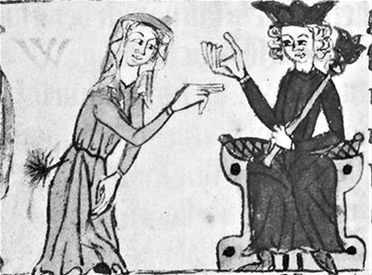
Calefurnia moons the judge in an edition of Martin le Franc’s profeminist Champion of Women [Champion des dames] (1488). Sig. s8r. Newberry Library, Chicago, Special Collections.

Calefurnia (and her creators) may be innocent of etymological tales. But, turning tail on the law while goading the judge, she nonetheless expresses the origin of the origin of the word cauda in the Sanskrit coda, which signifies (according to Sir Monier Monier-Williams’s Sanskrit-English Dictionary) “an implement for driving horses, goad or whip.”Footnote 7 (Presumably for driving asses too.) The Latin cauda (“coda” in the vulgar form) clearly emerged from the Sanskrit, in one of those frequent metonymic transfers between subject (whip) and object (tail). The two in fact continued to merge in English penal metaphors, for instance in the cat-o-nine-tails (a tail that whips tails) or “whipping at the cart’s tail” (using a tail to whip a tail hitched to a tail). One can see (again thanks to Sir Monier Monier) that the ambiguity of the Sanskrit adjectival forms – “animating,” “inspiring,” “exalted by the inspiring” – similarly merge subject and object. For the coda is both a goad that inspires and the thing inspired.
It may appear that I am simply chasing my tail here, but what precedes has in fact led me, however dizzily, to some of the things I would like to say. First, this thing I am calling a coda is both mine and that of the marvelous contributions here that have inspired it. They are the exalted subject – the consciousness – of which this is the mere object, coming to life only because their ideas have animated my words, as I have tried to think alongside them. Second, the essays in this collection offer radically new ways of thinking about the conjunction of law and performance: that is, they are not the tail (appended to my book); I am the tail appended to theirs. Third, I have treated these essays as an invitation to “attempt a self-criticism” (to paraphrase Nietzsche).Footnote 8 In taking up this invitation, I may be fated to caudam trahere: to drag my tail or, like Calefurnia, expose myself, in defiance of my own dignity. But if in this I fall (cado) from the heights to which I aspire, it is, I think, a Fortunate Fall, and the occasion for it – these essays – a great gift: a cadeau.
The Revenge of the Ontological Id, or the Methodological Über-Ich Unbound
Among the central things these essays have helped me see anew are the methodological rules I laid down for myself in writing my book. The aim of these rules – a set of strict prohibitions – was to keep my eye on a sharply defined topic: law as performance; “law itself” as a performance practice. It seemed to me that these prohibitions would allow me to say something very specific: not merely that law is performative, or that performances can influence law, but that “showing doing” is central to law in a very concrete institutional way. I wanted to show the centrality of sensory, kinesthetic, embodied, enacted expression to law as an institution, law’s modes of self-expression. These prohibitions were clearly self-imposed, but they seemed to come to me in the stentorian voice of a scholarly Über-Ich. No stage plays or other modes of extralegal performance, even if their subject was law! No mere verbal rulings, even if their subject was performance! No attention to legal words alone (however “performative” those words)! That would be cheating.
But, a confession: while I tried not to, I did sometimes cheat, rebelling against my scholarly superego. No fiction allowed, and yet I couldn’t resist Calefurnia, a creature of wild fantasy with only the faintest resemblance to her origins in the first-century BCE plebeian Caia Afrania. My last chapter ended with the “Trial of the Sorcerer” at the Gray’s Inn revels in 1594, featuring the Sorcerer and the Prince of Purpoole.Footnote 9 Those moments of rebellion were symptoms, pointing to the tension between my methodological boundaries and the book’s central claims. For instance, if I tried to separate fictional texts from “the things real people did in real legal arenas” (to focus solely on the latter), I also insisted that “[l]aw and its aesthetic representation are not always radically distinct kinds of things.”Footnote 10 If I tried to segregate the extralegal from the legal, I also insisted that “real law” could not be hermetically sealed off from theatrics, or anything else. If I tried to sideline texts to focus on performance, my sources were of course mostly texts: texts whose lively textuality I treated as key to how people viewed and understood legal performance. My central claims – which sought to deconstruct the false ontological boundaries separating fiction from the real, law from not law, text from performance – were in fact deconstructing my methodological boundaries. Ontology was at war with methodology, surging up like a primal drive from the book’s depths to flout its prohibitions. Just as, in the image, Calefurnia wags her cauda defiantly at the law, so did my ontological Id wag itself defiantly at my methodological prohibitions.
In his essay, Jesús Velasco generously likens me – methodologically speaking – to a physicist: “as a physicist would set aside air resistance to produce an experiment,” so Law as Performance set aside texts, fictions, the “extralegal” (he implies) in order to test its central hypothesis (120). True, I tried to be scientific, but (as he also suggests) marvelous things happen when one opens the window, lets the air flow back in over the barriers, and watches ideas free themselves, take flight, and soar. That is what the essays in this collection do: something like what Velasco describes as the museum at night, when at dusk objects come to life and begin to “d[o] all sorts of things and kee[p] all sorts of conversations while we sleep, … mixed up, and … in our dreams … shap[ing] some of the ways we will think at sunrise” (129).
What follows is my attempt to describe all the things that have come to life in this collection, while registering the ways that the essays here shake loose the distinctions that sustained my methodological strictures, unbinding the rigid dichotomies on which they depended. In this animated museum that is also a legal dreamscape, we have the hetaira Phryne, her breasts bared for the jury; beer-belching judges; a modern-day Little Red Riding Hood; an oath-taking legislator with a giant yellow umbrella and an X through the laws; “Naked Athena” the ballerina; Lady Rhetorica as a courtesan (meretrix); “the oscillating twitch of [law’s] wax nose.”Footnote 11 We have assize circuits modeled on the cosmos, open-air moothills and courts of piepowder, the scripting of visible affect and courtroom tears, chironomia and indigitation and dactylograms, legal didascalia, silence and laughter, and the “mute eloquence” of the letter.Footnote 12
The Play of the Text, or the Word Unbound
[P]erformance [is] a distinctive form of expression, palpably different from … textual expression. [8]
If the letter of the law is mutely eloquent, it also actively mutes eloquence. As Derek Miller puts it, “legal writing seems designed to leave performance out” (116). The “all too human escapades” that law strives to master, writes Goodrich, “the corporeography of adversity, the verbal and gestural articulations of advocacy, … the happy hum of order, the capriole and merry dance” (and, let it be said, also the toll of the bell and the death march) “are later redacted to the monochrome regimentations of the page” (198). In Lorna Hutson’s description, “once codified or assimilated to the body of knowledge called law,” legal decisions “are promptly abstracted and insulated from th[e] crowd-pleasing compromises of their origins,” that is, from the “[a]uditory and sensory reactions and distractions” that shaped them (36). The legal severing of performance and text is not a natural occurrence but an act of force: looking at the history of legal performance, notes Ertür, one realizes “just how much ink and sweat has been spent in trying to subdue [it]” (221).
Miller offers us a concrete critical program for seeing where text has suppressed performance: seeing between the lines of “the legal performances” that texts “encode or anticipate.” “By searching for dialogue, speech prefixes, stage directions, paratext, and didascalia,” he writes, “we will find some of law’s essential performances – sometimes concealed, sometimes hiding in plain sight,” showing us “what legal texts prioritize and exclude, … the slippages between legal texts and legal performances” (102). He vividly illustrates such slippage in his evocation of a scene from the film My Cousin Vinny (114). A college student named Bill believes the police have arrested him for accidentally stealing a can of tuna from a convenience store, but in fact they have arrested him for the murder of the convenience store clerk. After Bill admits to taking the tuna, the sheriff asks him: “At what point did you shoot the clerk?” Bill repeats with increasing incredulity: “I shot the clerk, … I shot the clerk. … ” In court, the sheriff reads Bill’s “statement” as a confession to murder: “He said, ‘I shot the clerk. I shot the clerk.’” As Miller points out, it is very hard to render this tonal slippage in a purely textual medium: You would have to hear it (115), or, better, to see it.
So too would you have to hear and see the tonal slippage in the Hong Kong legislator’s oath-taking ceremony that Marco Wan discusses. In his account, dissident legislators used the oath-taking ceremony as an opportunity to protest Beijing’s political control and the slow disintegration of democratic governance. Their protest took the form not only of visible theatrics but of aural effects meant to estrange the words of the oath: ironic tones, extreme pauses. Nathan Law, for instance, adopted a “‘distinct rising tone’ of mockery whenever he pronounced the Chinese character for ‘country’” (244). Veteran legislator Leung Kwok-hung “read out the oath loudly and aggressively [and] inserted dramatic pauses at unexpected moments” (244). Lau Siu-lai paused for six seconds between each of the words as she read. All of the protestors lost their cases and were barred from taking office.
In both of these cases, law works retroactively: in My Cousin Vinny, its transcription takes control of oral meaning; in the Hong Kong cases, it crushes tonal insubordination. But law also proactively scripts performance, as Miller suggests. If “[a]nima lex” is “lex loquens” (speaking law), lex loquens often consists in “the scripted performance of the dead letters of the parchment rules” (Goodrich 202). One can see such scripted performance at work in the confessional and inquisitorial dialogues Velasco describes. Working “algorithmically” (as he writes), they may appear to instantiate a legal “I-thou”: the interrogator’s follow-up questions depend on the answers of the penitent or the accused. But they are in fact coercive catechisms: “scripted strophe-antistrophe[s]” that “forc[e] the translation of the vernacular into orthodox legal language” in order to “produce an archivable object that can be used as proof”: a text that constitutes legal “truth” (121).
Nevertheless, all that “ink and sweat” spent “trying to subdue [performance]” ultimately fails. As in the Hong Kong ceremonies, the extempore thrusts itself into the scripted scene, disrupting the text. “[O]n one side, enter the formalization and regulation of dialogue,” writes Velasco, “and, on the other side ente[r] improvisation, unscripted action, unpredictable affect,” which “may undo the script” (121). If “legal writing seems designed to leave performance out,” it cannot. For law restlessly “move[s] between texts and acts,” as Miller writes (97).Footnote 13 In My Cousin Vinny, the tonal slippage is not merely from performance to text, but from performance to text to performance: from the police station, where Bill’s words are “redacted to the monochrome regimentations of the page”; to the courtroom, where the sheriff’s voice invests those “monochrome regimentations” with new meaning, transforming incredulity into confession. What these instances remind us is that the dichotomy between text on the page and embodied performance is a false one: law consists in both the textualization of performance and the performance of the text, and the textualization of the performance of the text (and so on, in a never-to-be-disentangled set of transferences). Is performance “a distinctive form of expression, palpably different from … textual expression”? I’m not so sure.
The idea that text and performance can be severed becomes especially doubtful when one looks at the centrality of the performed word in the rhetorical tradition. Both when memorizing their speeches and when preparing to improvise, legal orators drew on a set of established techniques, as Lorna Hutson reminds us: a repertoire of both verbal and performance devices guided by long-standing rhetorical principles. Quintilian may have admired Demosthenes’s response when asked to name the three most important elements of oratory (“Delivery, … delivery, … delivery”). But, as she points out, Quintilian’s discussions of delivery look like a sideline, when set beside his elaborate discussions of inventio, dispositio, elocutio, status, proofs, narrative, and other verbal skills. Hutson rightly insists that we not elide “the contribution of rhetoric as inventio with its contribution as performative technique” (55). She also reminds us that, in the law court, the script – wrought through inventio, dispositio, elocutio (and so on) – could not be severed from performance. If the art of the orator lay in verbal and narrative technique, verbal and narrative technique was performance technique.
This never ceased to be true, as we can see in the eighteenth- and nineteenth-century guides to cross-examination that Simon Stern discusses. In The Advocate: His Training, Practice, Rights and Duties (published serially in the 1830s), Edward William Cox explains that the advocate must at once “be a good actor” and a master of narrative manipulation:
[G]o at once to the marrow of the story he has told, as if you were not afraid of it; make him repeat it; then, carry him away to some distant and collateral topic, and try his memory upon that, so as to divert his thoughts from the main object of your inquiry, and prevent his seeing the connection between the tale he has told and the questions you are about to put to him. Then, by slow approaches, bring him back to the main circumstances, by the investigation of which it is that you purpose to show the falsity of the story. (Stern 158)
For Thomas Erskine – lawyer for a tailor-plaintiff who demanded payment of his bill (from a perhaps improvident client) – the key was not only to trap the witness but to get a rise out of the audience. As Stern tells the story, the witness “testified that a coat had been poorly made, with one sleeve longer than the other.” The dialogue that followed went something like this:
Erskine: You will swear that one of the sleeves was longer than the other?
Witness: Yes. …
Erskine: Now, sir, will you swear that one of them was not shorter than the other?
Witness: Yes.Footnote 14
Erskine won the case.
The Manifolds of Space and Time, or Performance and Law Unbound
I have tried to keep my eye squarely on performance in legal arenas. … [Historical legal records] describe events in the world at large, [but] are frustratingly silent on … how events in specifically legal arenas looked, sounded, felt; … in short, performance by and before the law. [21]
Accounts of moments like Erskine’s trap have the structure of theatrical peripeteia: emotional, narrative, and performative concentration; recognition, reversal, and a moment of awe. We could take the trial as the paradigmatic legal performance, envisioning it as akin to theatre (in its normative institutional setting): a roughly two-hour spectacle in a fixed location with a beginning, middle, and end. Certainly, both rhetorical theorists and contemporary commentators often encourage us to think of trials as having that structure: both Cicero and Quintilian have theatre in mind as a model. But trials have their own temporality, far longer and more temporally and spatially diffuse than theatre’s. They partake of a more expansive mode of performance: not delimited in space and time or governed by the human visual and auditory sensorium. In this, we might pay heed to Subha Mukherji’s warning that we must not “essentialise” performance (71). For performance appears in this collection as a kaleidoscopically mutable thing. For instance, the assize trials Piyel Haldar describes may have been “theatrical and even melodramatic events,” as he writes, but “the performance of law took place on a wider stage than those [stages] provided by the assize courts themselves” (Haldar 83). What is it “to keep [one’s] eye squarely on performance in [specifically] legal arenas, … performance by and before the law”? What counts as performance and where are the boundaries of legal arenas? I am not sure.
Haldar’s account of the assize circuits as performance spaces stands as a particularly helpful challenge, given the importance of the circuits to Anglo-American law. “[A]ssize trials and the court buildings in which they were held were no more than nodal points in [an] organized network of communication that extended over the entire social and geographic terrain,” writes Haldar. “[I]t was the itinerancy of the regional circuits themselves,” the “paths and routes between shires and assize towns,” that “provided a larger, more significant, stage for the presentation of law” (83). Certainly, the nineteenth-century lawyer-novelist-archivist John Cordy Jeaffreson envisioned the assize judges’ processions from town to town as a magnificent spectacle for the entertainment of the populace:
When they moved, crimson and gold, burnished steel and floating ancient [pennants] gladdened the eye: [and] the ear was addressed by the blare of trumpets. (Haldar 85, quoting Jeaffreson)
At the same time, as Haldar shows, the circuits called upon a larger, more mystical spatial, visual, and auditory imaginary. Providing choreographic direction, the Crown acted as “an all-seeing mechanism, a primum mobile in a Pythagorean/heliocentric system, that set the whole mechanism of the circuits in motion,” following the era’s “Pythagorean poetics” (Haldar 83). Haldar quotes Sir Francis Bacon:
You that are Judges of the Circuits are as it were the planets of the Kingdom. … Do therefore as they do; move always and be carried with the motion of your first mover, which is your sovereign. (Haldar 83)
As Haldar reminds us, material and symbolic space cannot be disaggregated. “In their circuits and revolutions,” he writes, “microcosm resembled macrocosm and revealed the greater order of the universe” (83).
While the assize circuits had a spatial and temporal form that was entirely different from that of the piepowder courts Haldar discusses, both had a profound relationship to the land that was at once material and symbolic. The circuits traveled “paths wired into the landscape.” The piepowder courts, held in marketplaces during market fairs, located law in the earthiness of the marketplace, a fact registered in their name: the pye-poudre, or curia pedis pulverizati. According to Blackstone, that name derived from the dusty feet (the “pied poudré”) of the suitors to the court: the “travelling merchants, itinerant chapmen, shepherds vagabonds and drovers” who “by their motion raise pulverem vel lutum (dust and mud)” (Haldar 90).
It is not only in Haldar’s essay that we can see legal performance as something far more spatially and temporally fluid than the normative model of theatre would suggest. In Anna Jayne Kimmel’s “Naked Athena,” for instance, legal performance takes place in the space of the political demonstration: a space of ceaselessly shifting boundaries, as the conflict between protestors and police unfolds. There, we can see the time of the event as similarly mutable, expanding space as time expands. Does the legal performance take place in the moment the photographer captures the protester, arms and legs spread wide, seemingly suspended in air? Or does it take place in the more extended time of the police crackdown, or of the protest itself? Or does it take place in the time of the transmission of the photograph and its manifold interpretations (its “beautiful futures” [276])? Or is its time (as Kimmel seems to argue) that of the long history of representations of the naked and the nude, the primitive and the civilized, – of “racialized interpretations of the lewd, the indecent, and the obscene” (262)? The time of performance moves as it moves in us, expanding and collapsing, crossing planes of experience, its speed ever-changing (a high-speed train one moment, then the slow and steady rhythm of a heart). So does legal time, which is not, of course, only the time of the trial or execution or the endless-seeming time of prison, but the time (as Velasco puts it) of “memories being activated, living voices becoming dead voice becoming living voices again by dint of remembrance,” those “snippets of memory” that register “the true duration of the legal proceeding” (145).
The central question here is: should we view the photograph Kimmel shows us as outside the frame of law? To place a “cordon sanitaire” around law (to use Velasco’s phrase [128]) – treating some things as inside law, and others as outside law – is to replicate law’s own historic project of erecting a wall around its domain, attempting to preserve a hermetic space in which law can retain its institutional purity. We find an expression of that project in the Siete Partidas’ insistence that “the language of the law must be understood according to its technical characteristics” (Velasco 139): technical legal language is itself a technique for sealing law off from the vernacular world. But, as Velasco suggests, the “juridification of the world” means that “there is nothing” outside of “the affective universe of the law” (131). Law violates its own boundaries, seeps “under the lintel, [across] the threshold,” travels through the latticework of the confessional (Velasco 133). It works not only through action but through inaction, as Kimmel points out: not only when it raises allegations but when “allegations [are] not raised” (Kimmel 260). It is there in its own “palpable silences”: in “time lost in translation; all the time that has fallen between the folds” (Velasco 142).
The Veritas Falsa, or The Real Unbound
[I]n the temptation to interpret the politics and poetics of [fictional] text[s], it is very easy to lose sight of the things real people did in real legal arenas. [22]
If law is everywhere – if we cannot separate the legal from the extralegal – the distinction between “the things real people did in real legal arenas” and fictional texts representing law begins to collapse. The “real” of law is a fiction, as the etymology of “fiction” reminds us (fictio, a making or fashioning): law is eternally in the process of being fabricated. The legal subject is an imaginary subject, created simultaneously by law and by the media representations that (as Jisha Menon writes) “rela[y] and consolidat[e] pernicious narratives” (the “repetition [of] cultural imagery”) (168). Even courts of law are “artificial, fabricated, fictionalized, just as all artifices of truth are fictionalized” (Velasco 130). Law’s scenes and personages are as “fantasmatic” as those of the theatre.
This recognition is central to Hutson’s account of the parallel formation of legal and theatrical rhetoric in the early modern period. Discussing Ludovico Ariosto’s 1509 play, I Suppositi (The Supposes), Hutson argues that both law and early modern theatre developed rhetorical supposition as a crucial means of fabricating realities beyond the immediately visible world (44). Both lawyers and playwrights asked listeners to imagine worlds elsewhere, outside of the immediately perceptible scene, “to infer, from characters’ uses of probable arguments, all the backstories, motives and hidden truths of [a] play’s story” (44). Such inferential logic was key to “the newly illusionistic power of theatre to make audiences think they have seen things they haven’t seen, and to infer and imagine the fictional world of the play,” creating the kinds of expansive and yet coherent fictional worlds on which our experience of fiction still depends today (48).
Subha Mukherji similarly insists on the parallel between legal and theatrical fictionality in what she describes as a “provocation against [the] assumption of a fundamental difference between the fiction of the theatre and the truth and reality of the law court” (63). Mukherji seeks to replace hierarchy (the treatment of “real” law as superior to theatrical fiction) with “a horizontal placement of legal and theatrical engagements” (64). Paradoxically, the distinction between theatre and law is necessary to her deconstruction of that distinction. To explore the “pain and pleasure of the scaenius of law,” she writes, we “need the scaenius of the theatre” (76). Theatre – in its difference from law – turns out to be ideally suited to revealing the fictionality of law. It is uniquely capable of “tuning into the fiction, construction, and the affective realties underpinning ‘real’ trials.” It “can mine this dimension of the ontology of law the more freely because it does not share institutional law’s investment in factual truth or its veridical telos” (64). It is “at home in hypokrisis,” and can thus make visible “[t]he epistemic yearning” to expose the hypokrisis that “structur[es] judicial encounters, the proficiency of legal representation at playing to it, the semiotic remit of subject-positions” (76).
We can see this yearning to expose judicial hypokrisis in early modern plays like King Lear, in which (writes Mukherji) “the fantastic nature of the trial [on the heath] lays bare the performative insides of the legal machine, its fictive ontology” (64), while “tuning into the fiction, construction, and the affective realties underpinning ‘real’ trials” (64). And we can see it in contemporary plays like those Menon discusses: David Farr’s 2019 adaptation of The Hunt and Steven Fechter’s 2000 The Woodsman. Both plays show how theatre – in providing an alternative legal-affective space – may alert us to the affective realties underpinning trials today, and specifically to the emotional realities of “criminalized people we may not otherwise encounter in life.” Both highlight the ways in which relations of power shape the social subjection that is “the ground for the emergence of legal subjecthood” (176): subjecthood that often appears hardened into binaries (criminal / victim, child abuser / savior).
The Woodsman’s “specters, doubles, and doppelgangers” offer a challenge to such binaries, revealing what Menon (following Emmanuel Levinas) calls “the internal antagonism of these characters” (186). “[O]nly partially in possession of their own motives and desires,” characters are “infiltrated by the presence of real and spectral others”: they “waver, shuttle, and oscillate between subject positions,” somehow “elud[ing] the binary categories of criminal law” (188). Reading these plays through Levinas and Judith Butler, Menon suggests how attention to “vulnerability” might “move us beyond the antinomies enshrined in criminal law” (177). “Thinking with vulnerability” may allow us “to rethink the foundations of our social contract in ways that acknowledge both our precariousness and the sovereign violence that holds us in its thrall” (177). “If for Hobbes human vulnerability is the precondition that legitimates a powerful carceral state,” she writes,
for Emmanuel Levinas, vulnerability heightens our awareness of the intersubjective constitution of our subjectivity. Preceding our entry into language, this intersubjective, embodied encounter with others ensures that the trace of another is constitutive of the self.
Vulnerability and resistance are not antonyms. For (writes Menon) vulnerability “gestures [toward] a broader condition of interdependency” that reveals interdependency as “an agentic mode of political action” (179).
Pointing to the ways that theatrical fictions reveal the fictionality of law, Menon and Mukherji implicitly invoke the age-old claim about the paradoxical truths of fiction, which we find (via Goodrich) in the third question in Jean de Coras’s dialogue between Hadrian and Epictetus: “[Q]uid est pictura? Veritas falsa – what is a painting? A false truth” (196). Similarly, “[Q]uid est fabula[?]” (asks the pedagogue Joseph de Jouvancy). In Goodrich’s translation (which helpfully renders fabula as “drama”):
Drama is a discourse that figures the truth, that is to say that it is false and fictive but, under the cover and artifice of words, traces a truth and a useful sense.
Theatrical fictions figure truth, revealing the fictionality of law, its vera falsitas (true falsehood). So the fictionality of law reveals the truth of theatrical fictions, its veritas falsa (false truth). It is tempting to reverse these: for after all, theatre is really true even in its supposed falsehood, and law false even in its supposed truth. Both (as Hutson shows us) depend on “supposes,” hypotheticals, counterfactuals, falsehoods that may be true or truths that may be false. As Goodrich writes: “The theatrical characteristics of the legal process” produce a “performative image of law as enigmatically true and simultaneously false” (197). In this enigmatic image, law is “a performance, a play, a fantasm which ironically shows law in actu, and as legis actio” (in the act, as legal action) (197), fabricating the real. As Marco Wan puts it, in law, “the performative masquerades as the constative, bringing a new order into being.”Footnote 15
The Last Laugh: The Coda-Cauda as a “Minor Jurisprudence of Refusal”Footnote 16
In the courtroom in Marleen Gorris’s 1982 film, A Question of Silence, three women laugh. In Başak Ertür’s account, they have committed a horrific and seemingly unmotivated murder, shown in a slow flashback in which the women “improvise weapons to torture, mutilate and kill [a] boutique owner” (232). They “all readily and in good humour admit their responsibility” (215). During the trial, when the prosecutor says that the case would be no different if the killers were men or if the shopkeeper were a woman, one of the defendants begins to laugh. The four witnesses begin to laugh, then the other defendants, and finally the female lawyer for the defense. The laughter is wild, contagious, and lasts for nearly three minutes on screen (time it, and you will see how long three minutes is: a three-minute laugh violates all narrative-cinematic norms). They are laughing at what Goodrich describes as “the costumed animal, the monkey in a toga, and the cacchinnating coifed codpiece clothed, codex conspiring judge” (198). They are laughing at us.
Ertür points out that “[i]n classic rhetoric, laughter is considered a forensic weapon.” Rhetoricians “have sought to engineer its tamed and disciplined versions for timely deployment against an opponent whose ridicule may well tip the scales in one’s favor” (225). We can see this use of laughter – timely deployment of ridicule against an opponent – in Simon Stern’s evocation of slick lawyer Thomas Erskine’s humiliation of the witness in the case of the tailor, as well as in an anecdote Stern tells us about Chief Justice John Roberts. An alleged stalker was on trial for sending more than a thousand text messages to his victim, including some with threats, for instance “Don’t need you,” “Die.” But Roberts, who was determined to cast the victim as a hysterical woman threatening male prerogative, chose to read one message aloud during oral arguments: “Staying in cyber life is going to kill you. Come out for coffee. You have my number.” He then remarked, “I can’t promise I haven’t said that”: laughter. (According to Stern, he was so pleased that he read the message three times) (162). In our pleasure in Erskine’s one-upmanship, it’s easy to forget that this is a nasty legal trick. Harder in Roberts’s case if you’ve ever been stalked. Being funny isn’t always funny.
But the laughter that Ertür finds in Gorris’s film is of an entirely different kind. It is more like what Anca Parvulescu describes in her account of the film’s key scene:
Slowly, laughter dislocates itself from its object, the gender-blind court of law, and, by extension, the law itself. It is a laughter that has its own raison d’être, apart from any specific laughable object. And laughter reproduces itself, laughter asks for more laughter. It not only interrupts, but repeats itself and spreads.
Ertür helps us to a better understanding of the views that Goodrich reports: Bishop Bossuet’s claim that “peals of laughter (les éclats de rire) make one forget the presence of God” (208); or that of the Roman priest who (according to Joseph Addison) “laid it down as a Point of Doctrine, that Laughter was the Effect of Original Sin and that Adam could not laugh before the Fall” (206). Cado, ergo rideo (I fall, therefore I laugh). As Goodrich writes, “[l]aughter is in effect sacrilegious” (208).
In A Question of Silence, the women forget the presence of God the Father, eat the apple, refuse Adam’s dominion. They turn “palpable silences” into resounding refusal: registered not in the language of the so-called civilization that has silenced them (words, or Cicero’s elegant “eloquence of the body,” or the balletic posture attributed to “Naked Athena”) but in hyperbolic, raucous cacophony. Here we have a feminist version of Foucault’s “illégalismes populaires.”Footnote 17 We might be tempted to think of this zone of laughter as utopian, suggests Ertür, but utopia is always in the future, remaining “unspoken of and uninhabited” (235). What if “that zone is not so much a utopia [as] a heterotopia?” she asks (drawing on Bonnie Honig):
a space and time of rehearsal, a space for prefigurative practices towards another way of living? … both very here/now and elsewhere at once, much in the way desire desires? … ‘spaces or times of rehearsal where alternative forms of life can be tried out and explored.’
Such heterotopias are “wild zone[s],” creating an arena that is at once its own place and “a no-place” (Ertür 235). Citing Barthes’s S/Z, Mukherji describes how a text may hold back “‘one last meaning … whose place it keeps free and signifying’”: This holding back of meaning is how “‘law’s subjects’” turn subjection around into irreducible subjecthood, acutest at its vanishing point (69).Footnote 18 In the courtroom in A Question of Silence, subjection becomes irreducible subjecthood, vanishing into the heterotopia of laughter.
Here, I return to my coda, or rather, to Calefurnia’s cauda. Citing Hélène Cixous (via Parvulescu), Ertür notes that there is a “‘special relation’ between exposed female genitals, the revolution and laughter.” In Freud’s reading of the myth of Medusa, the “Medusa’s severed and petrified head ‘takes the place of a representation of the female genitals’” (Ertür 222). As Ertür writes, “Cixous’s twist is simple and precise: ‘You only have to look at the Medusa straight on to see her. And she’s not deadly. She’s beautiful and she’s laughing’” (222). “Let the priests tremble,” writes Cixous, “we’re going to show them our sexts!” (Ertür 222).
Calefurnia’s cauda does not change the law prohibiting women from bringing their own cases. And Gorris’s laughing murderesses do not escape law’s vengeance. And Wan’s wildly theatrical oath-takers? They too lost their cases, tempting one to say: not all performatives that masquerade as constatives succeed in their masquerades. Not all bring a new order into being. For Wan the “oath-taking saga” – which showed how law “stages its own formal existence” by “expurgat[ing] performance” (257) – clearly failed. But law changes. Who is to say what “uncanny encounter[s]” (257) – what moments of fantasmatic legal poetics help it to do so? And – as the other “uncanny encounter[s]” of recent years make us wonder – who is to say which ones will bring good, and which will bring evil?
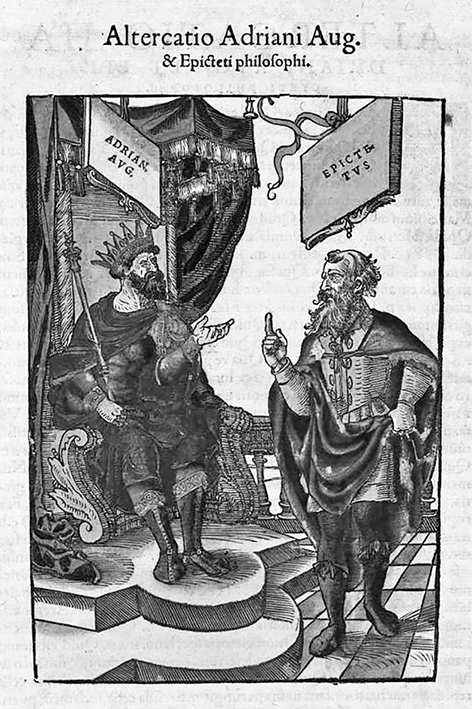
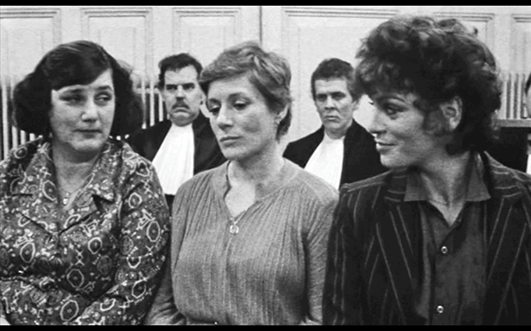
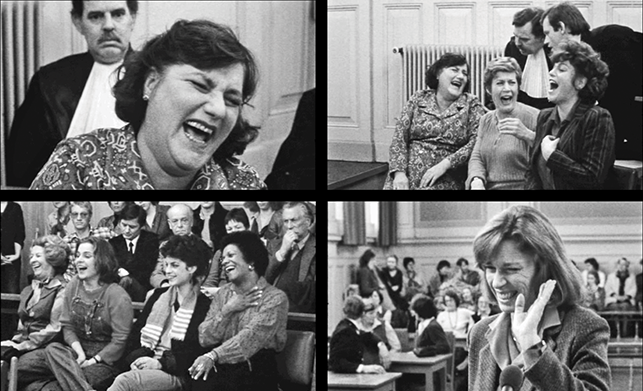
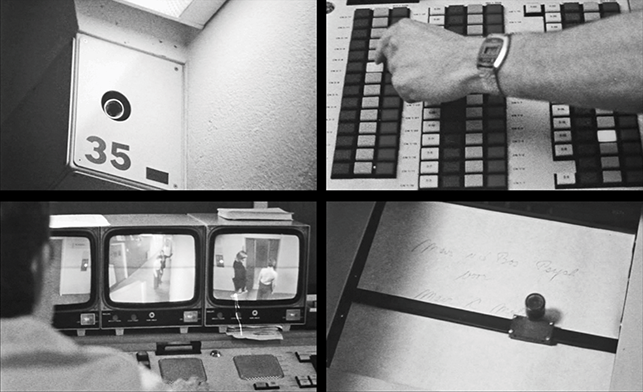
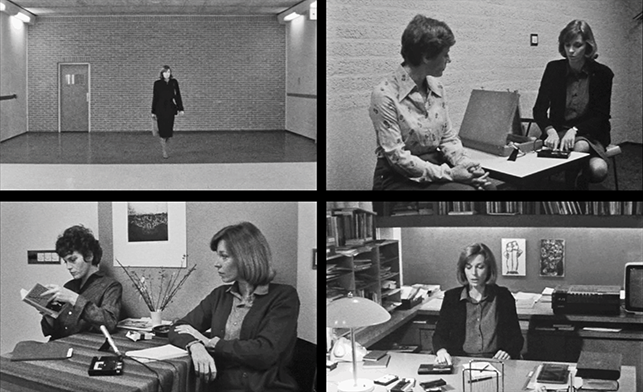
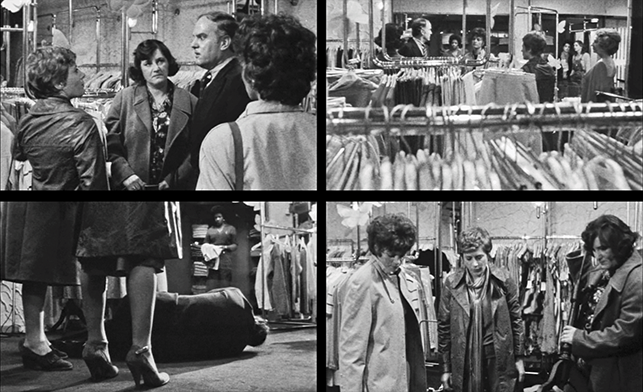
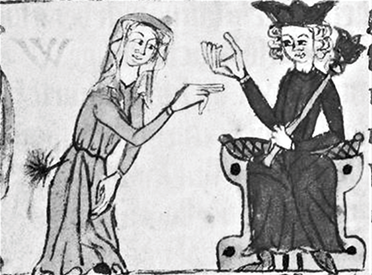
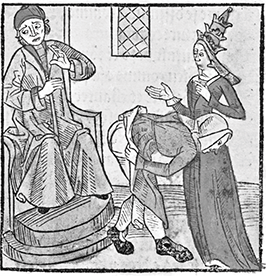

 Open access