



Quantitative research methods are most often used in the nutritional sciences because the focus of research from the 20th century onwards has been to understand the interactions between diet and disease or health from a biological perspective( Reference Beauman, Cannon and Elmadfa 1 , Reference Liquori 2 ). Indeed, nutrition and dietetics has promoted itself as a science-based profession and continues to espouse the biomedical model of research and practice( Reference Fox and Gingras 3 ). Despite the usefulness of quantitative research, qualitative research methodologies are equally needed to allow researchers to better understand the important social and environmental factors affecting food choice and eating habits( Reference Beauman, Cannon and Elmadfa 1 , Reference Sobal, Bisogni and Devine 4 , Reference Wansink 5 ). These factors are best examined through exploring people’s perceptions and meaning-making of food experiences in their everyday lives( Reference Harris, Gleason and Sheean 6 ). It is only through marrying both quantitative and qualitative research methodologies that the full gamut of nutrition and food-related phenomena can be understood( Reference Harris, Gleason and Sheean 6 ).
If qualitative research is to be viewed as worthwhile and credible by a broad community of nutrition researchers and practitioners, it must be well-designed and rigorous, with clear description of the chosen methodology or guiding theoretical framework( Reference Harris, Gleason and Sheean 6 ). Narrative inquiry, a well-established qualitative research methodology, has been embraced by professions such as education, nursing, medicine and occupational therapy( Reference Riessman and Speedy 7 ); however, its uptake in food and nutrition research is limited. A notable exception comes from a group researching food justice, who has acknowledged the importance of narrative inquiry to more deeply understand the constraints on people as they try to nourish themselves (see Dixon)( Reference Dixon 8 ).
Yet narrative inquiry has much to offer public health nutrition researchers and practitioners, as it shows how knowledge is constructed in people’s ordinary, everyday experiences as they interact and communicate with one another and make sense of their lives through what narrative researchers name ‘story-telling’( Reference Riessman and Speedy 7 , Reference Caine, Estefan and Clandinin 9 ). The present paper suggests that examining more closely the storied landscape of people’s everyday food experiences can improve our understanding of people’s complex relationship to food( Reference Fischler 10 ).
Ontologically, narrative inquirers view narrative as both a phenomenon under study and a research methodology( Reference Caine, Estefan and Clandinin 9 , Reference Clandinin 11 ); that is, ‘people by nature lead storied lives and tell stories of those lives, whereas narrative researchers describe such lives, collect and tell stories of them, and write narratives of experience’( Reference Connelly and Clandinin 12 ) (p. 2). Experiences are interactive, patterned and structured, such that the doing and the consequences of that doing are in relationship, providing meaning for the people involved( Reference Dewey 13 ). Experiences result in changes to both the people and the context in which they interact( Reference Caine, Estefan and Clandinin 9 ).
Background
The present study
The food-related doctoral research project presented herein began with an interest in people’s experience of procuring food from five different food-ways. As with other narrative research, there was a curiosity about the constituents of people’s experiences( Reference Caine, Estefan and Clandinin 9 ), such as the connections between food shoppers and the producer, family, friends and others in the food system; between eaters and the earth; and how these connections affect people’s meaning-making of food and pathways to food citizenship. It was the complexity of these inter-connections, as participants linked stories of past food experiences with their current experiences, that was of particular interest in the research. The research question asked was: what does people’s participation in their usual food procurement environment and their relationship to food reveal about pathways to food citizenship? ‘Food citizenship’ is defined by Wilkins( Reference Wilkins 14 ) (p. 271) as:
‘the practice of engaging in food-related behaviours (defined narrowly and broadly) that support, rather than threaten, the development of democratic, socially and economically just, and environmentally sustainable food systems.’
Design: narrative inquiry methodology
Narrative inquiry has evolved from its origins in sociology and anthropology early in the 20th century with ‘realist’ orientations to its use in a multiplicity of disciplines and professions. It adopts a range of orientations, including ‘constructivism’, ‘post-modernism’ and ‘post-structuralism’( Reference Riessman and Speedy 7 , Reference Lai 15 – Reference Michie 18 ). It was the influence of the sociolinguists Labov and Waletzky in the 1960s, with their analysis of the structural features of oral narratives of people’s ordinary everyday experiences, that was pivotal in the shift away from realism for many narrative researchers. Matters of context, language, interactions, inter-subjectivity and the power in the research relationship started to come to the fore( Reference Chase 16 , Reference Riessman 17 ).
In the 1980s, Bruner( Reference Bruner 19 ) argued that there are two modes of thought – paradigmatic and narrative – which, while complementary, have distinct ways of ordering experience and constructing reality. Paradigmatic thinking, or logico-scientific thinking, labels something as belonging to a particular category, and is used in quantitative and some qualitative research designs( Reference Bruner 19 , Reference Polkinghorne 20 ). In contrast, a person using a narrative way of thinking applies a bottom-up approach and uses the text or story to explore reality; to reconstruct or deconstruct it, acknowledging its relational, temporal and continuous nature( Reference Bruner 19 , Reference Clandinin and Rosiek 21 ). The narrative ‘imagination’ leads to good stories that are believable, but not necessarily ‘true’ in all contexts. It deals more with the changeable nature of people’s intentions and actions as part of life’s course and situates experience in time and place. Paradigmatic thinking can establish a ‘truth’ through formal and empirical proofs, while narrative thinking establishes verisimilitude( Reference Bruner 19 ).
In contemporary narrative analysis, it is vital to avoid losing the context of each person’s story( Reference Chase 16 ), which can occur through a line-by-line analytical method. It is important in narrative inquiry to ensure that both the stories and the people remain visible in the interpretive text( Reference Pinnegar and Daynes 22 ). It is the contextual knowledge gained( Reference Goodfellow 23 – Reference Halliday and Hasan 25 ) that provides the first analytical depth. As the researcher engages with study participants, converses with them and learns about their lives, then holds this tension with the researcher’s own contextual and scientific knowledge and personal experiences, that deeper analysis becomes possible.
In the present paper, the authors declare a constructivist stance, asserting that subjective and inter-subjective social knowledge is co-constructed by participants and researcher( Reference Guba and Lincoln 26 ). Hence, the five co-constructed narratives from each food-way used the voices of the participants as much as possible, to achieve an authentic representation of their meaning-making of food. In the final interpretive analysis phase, the researchers’ authoritative voices are heard, as they uncover the commonalities and differences across the five narratives.
Polkinghorne’s( Reference Polkinghorne 20 ) methods of organising story were chosen, given the participants’ and researchers’ understanding of Western narrative structure( Reference Riessman and Speedy 7 ), acknowledging that there are always diverse, alternative narrative representations( Reference Chase 16 , Reference Barton 27 , Reference Bresler 28 ). Polkinghorne( Reference Polkinghorne 20 ) describes ‘story’ as a particular type of discourse that shapes events and actions into a unified whole by means of a plot. The plot is temporally organised, with a beginning, middle and end, and provides the structure through which people describe the choices they make in their lives( Reference Polkinghorne 20 ). Stories, though, have other important functions. They provide a meaning-making function for people, a way to make sense of their experiences and construct their identity( Reference Riessman 17 , Reference Mishler 29 ).
Stories retain the complexity of a situation in which an action occurred, while holding the emotional and motivational meaning attached to it( Reference Polkinghorne 20 ). They also offer a way to reconstruct memories of our past, which may be somewhat fragmented and possibly painful( Reference Riessman 17 , Reference Cousin 24 ). They are useful for the audience, too, because humans live storied lives, so when others tell their stories, those receiving the story can understand the actions of others through recognition of similar experiences in their own life( Reference Polkinghorne 20 , Reference Mishler 29 , Reference Clandinin and Connelly 30 ). Narrative inquiry is a research methodology that is holistic, revealing life with all its complexities, contingencies and contradictions in an ever-changing context of time, experiences, places and people( Reference Riessman 17 ).
Quality frameworks in narrative inquiry
Narrative inquiry is an interpretive process that starts as the researcher interprets the opinions and interpretive stories told by participants and then constructs a story from research material or a story about stories. Further interpretations are made again by the reader as he/she engages with the participants’ and researcher’s stories( Reference Riessman 17 ). A narrative presents possibilities for interpretation as readers reflect on their own storied experiences and consider the trustworthiness, plausibility and verisimilitude of the stories contained within( Reference Bruner 19 , Reference Polkinghorne 20 , Reference Pinnegar and Daynes 22 , Reference Clandinin and Connelly 30 , Reference Polkinghorne 31 ). A key feature of narrative inquiry is that it focuses on the particular rather than attempting to generalise or theorise across stories( Reference Riessman 17 , Reference Polkinghorne 20 , Reference Pinnegar and Daynes 22 ).
Authenticity and trustworthiness
To evaluate qualitative research findings, ‘authenticity’ is used rather than validity( Reference Guba and Lincoln 26 ). A reader should consider whether the findings from a piece of research are sufficiently authentic that others would be moved to act on their implications; that is, are the findings trustworthy and congruent with the way others might construct their social world?
Drafted stories should be returned to participants, for them to check whether the interpretations were plausible representations of what they had said. Participants can be encouraged to clarify their thoughts and to delve further into the meanings of their viewpoints and stories, to enable a faithful interpretation of their story( Reference Polkinghorne 31 , Reference Blumenfeld-Jones 32 ).
A further aspect of authenticity is the notion of fairness( Reference Guba and Lincoln 26 ). Some participants are bound to say more than others, but all perspectives and voices should be included in the stories. As stories are compiled, the researcher must give voice to participants by using their own words as much as possible( Reference Guba and Lincoln 26 ), which will enable the reader to track the views and stories of individuals while reading the entire story. It is this attention to the particular that leads to resonance, plausibility and verisimilitude( Reference Connelly and Clandinin 12 ).
Methods
Setting and subjects
The Canberra region in south-eastern Australia was chosen to speak to people who procured their food from one of five food-ways: community gardens, a community-supported agriculture (CSA) enterprise, a farmers’ market, fresh food markets and supermarkets. A ‘settings approach’ was applied in the research, as it is a strategic approach used in health promotion that considers the physical, social and cultural environment in which people live( Reference Fleming and Parker 33 ), and is congruent with an exploration of food citizenship.
There were fifty-two participants in the study. The six community gardener participants were members of the Canberra Organic Growers’ Society Inc. (COGS), a non-profit organisation that operates eleven community gardens in the ACT. Four participants were members of a small CSA situated in a town (pseudonym – ‘Bundalea’) near Canberra. Ten participants regularly shopped at the Capital Region Farmers’ Market; eight participants shopped at one of the two large fresh food markets in Canberra; and twenty-four participants used supermarkets to purchase their food, including fresh food. Table 1 provides details of participant demographics.
Participants’ demographics, Canberra region of Australia
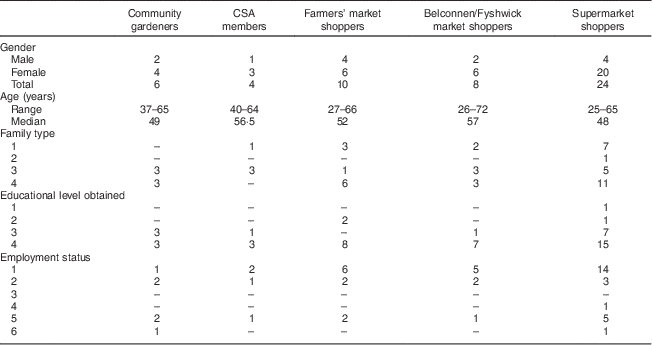
CSA, community-supported agriculture.
Family type: 1=single/divorced/widowed without children at home; 2=single/divorced/widowed with children at home; 3=married/de facto without children at home; 4=married/de facto with children at home.
Educational level obtained: 1=Year 10 schooling; 2=Year 12 schooling; 3=trade certificate; 4=university diploma/degree.
Employment status: 1=working full-time; 2=working part-time; 3=still in education; 4=unemployed; 5=retired; 6=other (home duties/casual employment).
Occupation: most participants’ occupations were either professional (such as academics, teachers, accountants, economists, health professionals, engineers, building contractors and ICT workers) or administrative (such as public servants, office workers and sales assistants). There was one electrician and no unskilled workers.
Data gathering
Focus groups were used for data gathering, as they offer a useful way to access both the depth and breadth of people’s insights, attitudes and experiences on a topic within a social environment( Reference Davidson, Halcomb and Gholizaheh 34 , Reference Hesse-Biber and Leavy 35 ). Food procurement is a social activity( Reference Madgwick and Ravenscroft 36 ) and the social connections that occur while shopping was a key aspect of the research. Thus, focus groups that mimic other social settings by stimulating interaction, conversation and even lively debate between participants( Reference Davidson, Halcomb and Gholizaheh 34 , Reference Hesse-Biber and Leavy 35 , Reference Barbour 37 ) made them an attractive method for gathering research data.
There were epistemological reasons for using focus groups for data gathering too. Focus groups can serve to assuage concerns about establishing a hierarchy between the researcher and the participants( Reference Hesse-Biber and Leavy 35 , Reference Frey and Fontana 38 ). As constructivist researchers, the authors were comfortable taking responsibility for the direction of the research, but were also committed to generating data that reflected multiple voices, which together create co-constructed stories( Reference Hesse-Biber and Leavy 35 , Reference Frey and Fontana 38 ).
The methods for conducting each focus group followed standard procedures( Reference Barbour 37 , Reference Bloor, Frankland and Thomas 39 , Reference Bassett 40 ). All processes and materials were approved by the University of Canberra Human Research Ethics Committee.
Sampling and recruitment methods
Purposive and snowball sampling was used for the community garden, CSA and farmers’ market focus groups, to select people with particular, crucial insights to answer the research question( Reference Liamputtong 41 , Reference Barbour 42 ). Within the population of fresh food market and supermarket shoppers, convenience sampling was possible, as it allowed recruitment of those who were conveniently available and willing to participate( Reference Liamputtong 41 ).
Results: narrative inquiry in practice
Analysis of narrative or narrative analysis
According to Polkinghorne( Reference Polkinghorne 20 ) there are two different kinds of narrative inquiry: ‘analysis of narrative’ and ‘narrative analysis’. ‘Analysis of narrative’ uses stories as data, from which themes are developed that hold across all the stories, while ‘narrative analysis’ uses descriptions of events that are configured by the researcher into a story by means of a plot. McCormack’s( Reference McCormack 43 ) approach draws on both narrative inquiry frameworks using a process described as ‘storying stories’, which was adapted for the present research.
The analytical process
In conducting the present research, the attraction to McCormack’s( Reference McCormack 43 ) method of transcript analysis lay in her desire to avoid fracturing the data into codes and building themes that hold across stories that fit into a researcher’s conceptual framework. Instead, her approach to analysis maintains the complexity of people’s lives, which was appealing for its transparency and lifelikeness( Reference Bruner 19 , Reference Dibley 44 ).
In practical terms, McCormack’s( Reference McCormack 43 ) methods were adapted for the current project in two main ways. First, the food procurers’ group narratives were constructed from transcripts that contained stories told by a number of people who attended a focus group, rather than individuals who were interviewed several times over a number of years. Second, the focus group participants had not storied all their experiences, but had provided viewpoints in answering the research question, which were then incorporated in storied form.
Howie’s( Reference Howie 45 ) method of narrative analysis is drawn from Goodfellow( Reference Goodfellow 23 ) and Polkinghorne( Reference Polkinghorne 20 ) and offers a practical, yet slightly formulaic, approach to narrative analysis. Her methods proved useful, as they offered guidance on systematically stepping through different phases of the story creation process( Reference Howie 45 ). Briefly, Howie( Reference Howie 45 ) describes three main steps in data analysis, beginning with reviewing the transcript, followed by story preparation and then story creation, which will be expanded upon in phase 1 of the draft story process, with examples. It is through adhering to these rigorous processes that a deeper understanding of the experiences of the participants is ultimately revealed.
Phase 1: shaping the stories
The first step of the story creation process required full immersion in the transcript to get a sense of the whole focus group discussion( Reference McCormack 43 , Reference Howie 45 ). During this process, particular attention was paid to some of the novel ideas that emerged, the use of language, metaphors and imagery and the strength with which stories or viewpoints were told( Reference Howie 45 ). Active listening to the recordings, checking their accuracy, noting the dynamics within the group, the main characters in the conversation, and participant and researcher reactions to others( Reference McCormack 43 , Reference Howie 45 ) were also an important part of the initial processes of story construction.
The stories told by the participants were then located in the transcript. The narrative process of ‘stories’ is differentiated from surrounding text by boundaries with a beginning (an orientation describing who, what, where and when) and an end or coda, which brings the story to a close. The intervening sections of a story contain an abstract, which summarises the point of the story, and an evaluation, which conveys the storyteller’s emotions and attitudes to the narration( Reference Riessman 17 , Reference Labov and Waletzky 46 , Reference Labov 47 ). The story will also usually contain a series of linked events or complicating actions that may be organised thematically or chronologically( Reference Riessman 17 , Reference McCormack 43 , Reference Labov and Waletzky 46 ).
Other narrative processes that may not be represented as stories, such as theorising, argumentation, augmentation and description, were then identified in the transcript( Reference McCormack 43 , Reference Rosenthal 48 ). For example: as people tell stories they may ask themselves why they behaved in a particular fashion – which is theorising – or they may include an abstracted element outside the story – which is argumentation( Reference Rosenthal 48 ). Augmentation is the process people use to make additional comments to their story to help with plot development, while description gives details about people or places that help the listener to get a more complete picture of the story( Reference McCormack 43 ). Not all stories contain each of these narrative processes and there may be variations in their sequence( Reference Riessman 17 ).
Some of the contextual considerations that were applied to the present research concerned the interactions between group members in the focus groups: who did most of the talking? Why did some focus groups have extended periods of silence, while others moved very rapidly? Attention was given to the wider cultural, historical and political context in which these focus groups took place: who used strong language in relation to the politics of food and why? Who drew on distant historical influences on their lives as they told their stories? What can be learned from those who acknowledged the importance of culture in relation to the way food is procured and used? As people storied their lives and reconstructed their sense of self, how did they accommodate, resist or challenge the cultural context of their lives? Were there epiphanies in people’s lives, or moments where they altered the way they viewed themselves and their direction in life( Reference McCormack 43 )?
An extract from the supermarket story illustrates some elements of narrative processes and language described above. Clive, a supermarket shopper, tells a story to explain the difference in his experience of shopping at the supermarket to other ways of sourcing his food. The researcher added the orientation.
Orientation
Clive enjoys closer connections with those who produce the food he eats and explains that,
Abstract
‘When I shop at the supermarket; what about it? I don’t care. But if I buy [food] from a roadside stall or if I’m going to someone’s place and they’re cooking it,
Description
and they’ve said, oh, you know, we slaughtered the cow and shucked the corn and do all this sort of stuff,
Abstract
I do have a different appreciation of what’s going on there;
Evaluation
the contact between – the distance is much less. I feel more available to that process than I do just picking it up off a shelf. I disconnect from that.
Theorising
I just go in there and go into remote, I think. Just look for the ingredients to go home and do the thing.’
Augmentation
Even the fresh eggs given to him by his next door neighbour, occasionally, just ‘taste different’. They have that ‘chicken coop taste;
Coda
I mean that’s appreciation,’ he exclaims.
The next step in the analytical process was story preparation, which begins with creating headings that reflect the central concepts and events relating to the research questions( Reference Howie 45 ). For example, in the present research, the first two headings chosen were ‘social connections in the food system’ and ‘appreciation of food’ and all relevant materials were colour-coded in the transcripts accordingly. In preparation for constructing each draft story, the key stories and ideas presented under these headings were recorded as brief summaries, making note of the line numbers in the transcript. During this process, it became clear that other pertinent headings were required, as participants made political statements about the dominant food system and told stories of their connections with the earth as they grew some of their own food. So, two further headings were created: ‘politics in the food system’ and ‘connections with nature in the food system’, which were also colour-coded. An additional heading was used for each story constructed for the community gardeners, called ‘history of gardening’, as this was a major focus of discussion in this group. Again, the pertinent material in the transcripts was colour-coded with assigned colours. Under these new headings, the additional views and stories proffered by participants were added as brief summaries to each preparatory story, with line numbers from the transcript noted.
The third step in the analysis was the story creation, where the process of creating an interpretive story of participants’ experiences began( Reference Howie 45 ). Howie( Reference Howie 45 ) recommends the use of third person past tense in the construction of a story, adding direct references from the transcript where appropriate. As each section of a story under the headings was constructed, by expanding on the summaries, transcripts were checked and participants’ words were used as much as possible, so that meaning and nuances were not lost.
As the prose was developed, Polkinghorne’s( Reference Polkinghorne 20 ) guidelines for constructing life history stories (based on Dollard)( Reference Dollard 49 ) proved useful. These guidelines were adapted to create stories that conveyed people’s connections in their chosen food system and the way in which they made meaning of food at that time in their life. As each story’s plot developed, the historical continuity of each participant, the impact that family and friends had on his/her views and experiences, and the motivations that led to his/her chosen actions and pursuit of personal goals, were all considered. To create coherent stories the research material was configured in a chronological fashion or towards an outcome that was plausible and understandable( Reference Polkinghorne 20 ). Narrative smoothing techniques were used, including only the key elements and stories from the transcript that contributed meaningfully to the development of the plot, as not all of the participants’ conversations conformed to a coherent storyline( Reference Polkinghorne 20 ). Draft stories were produced using this protocol, which were returned to the participants via email to allow them to offer feedback on researcher interpretations( Reference Howie 45 ).
Phase 2: refining group narrative stories
At some point in the narrative inquiry process, the researcher must claim interpretive authority( Reference Chase 50 ). In the present research, the first step in the process of refinement started by returning to the draft stories relating to each food procurement environment. While the voices of all participants are heard in each narrative, the narrative smoothing techniques that had been used for the drafted stories were employed again( Reference Polkinghorne 20 ). After the group story middle of each narrative was constructed, the next step was to create the beginning (orientation) and end (coda) for each( Reference McCormack 43 ). The orientation created the context for what was to come in the middle section of each narrative and the way people felt at the end of the focus groups was conveyed in the coda. An expression that came directly from a participant, which captured the thoughts of the whole group, was used to construct a title for each story.
The last step in refining the construction of group narratives was selected secondary analyses, as after each group narrative was constructed, there were elements that roused curiosity and demanded further analysis. Participants were emailed, asking them to explain their thinking more fully, so that the narratives were as faithful to participants’ meaning as possible( Reference Polkinghorne 31 , Reference Blumenfeld-Jones 32 ). From their clarification and additional information each of these narratives was enhanced and contributed to their validity( Reference Polkinghorne 31 ).
Interpretive narrative analysis phase
After each of the group narratives was constructed, the narrative analysis phase begins, where the researcher constructs a broader interpretive framework, applying his/her own interpretations of the narratives as a whole( Reference Riessman 17 , Reference Polkinghorne 31 , Reference Ezzy 51 ). It is at this stage that the researcher becomes immersed in each of the narratives, taking careful note of the similarities and differences between them. For the present research, it was important to return to the key components of the research question, which was concerned with each group’s relationships to food and what these relationships meant about pathways to food citizenship.
One of the first themes to emerge from this further coding process was an ‘instrumental food culture’ experienced by the supermarket shoppers. For this group, food procurement and preparation was concerned with pragmatics. ‘Clock’ time dominated the shopping experience – ‘in out grab go’ – and food preparation was considered ‘catering’ through the week and ‘cooking’ on weekends. In contrast, the food procurers from the local food systems described their meaning-making of food in some different and significant ways to those using the dominant food system. Deep analyses of the narratives revealed the multiple intrinsic and extrinsic qualities of food that the local food procurers judged to be valuable, which elucidated a complex conceptual framework, named by the researchers as a ‘contemporary relational food culture’. The research project elucidated several sub-themes derived inductively from the narratives that helped to build this complex conceptual framework; further elaboration of these sub-themes can be found elsewhere (G O’Kane, unpublished results).
Discussion and implications
The human relationship to food is complex and multidimensional( Reference Fischler 10 ). It has a biological function of nourishing the body, and a cultural function of symbolising belonging and love, for example. On another dimension, food links the individual to the collective through its psychological and social functions( Reference Fischler 10 ). In essence, food is central to our identity, as individuals and as members of a cultural group( Reference Fischler 10 , Reference Coveney 52 , Reference Lupton 53 ). Yet, despite the integral role that food plays in people’s lives, nutrition research has, until recently, been dominated by the biological effects of food consumption on health( Reference Beauman, Cannon and Elmadfa 1 ).
One of the strengths of narrative inquiry for public health nutrition is that it enables the researcher to reveal the complexities and contingencies of people’s everyday experiences with food. It weaves together the different constituents of people’s food experiences, revealing the ‘hows’ and ‘whats’ of their story-telling and the consequent meaning-making( Reference Chase 16 ). The authors, through detailed explanations of their approach to constructing narratives, have taken account of how the participants communicated their meaning of food, how they made sense of their food experiences within particular historical and cultural discourses, but also how they even resisted or transformed those discourses in the telling of their experiences( Reference Chase 16 ). Such contextual knowledge gained through narrative inquiry has the potential to help public health nutritionists develop more relevant, targeted and effective interventions that lead to improvements in people’s eating patterns and the food environments in which they live.
Conclusion
The current paper has offered public health nutrition researchers one systematic and rigorous way to undertake narrative inquiry research. It does not purport to provide the only way to conduct such research. However, it does reveal the ontological and epistemological positioning of the researchers that may assist others in making informed decisions about their own research pathways. The authors contend that close attention to hearing, reading and interpreting people’s food stories can offer alternative ways that public health nutritionists can understand people’s meaning-making of food. The deep understanding that emerges as stories resonate with both researchers and practitioners can be used to support individual behaviour change and advocate for improvements to the broader food environment.
Acknowledgements
Acknowledgements: The first author (G.O.) would like to thank her two other PhD supervisors, Dr Coralie McCormack and Associate Professor Katja Mikhailovich, for their expertise and support during the candidature. This paper is G.O.’s original work and that of Professor Barbara Pamphilon and it has not been published previously, nor has it been submitted to another journal for publication. Financial support: This research received no specific grant from any funding agency in the public, commercial or not-for-profit sectors. Conflict of interest: None. This paper has been generated from G.O.’s PhD work and there was in-kind support from supervisors from the Faculty of Education, Science, Technology and Mathematics, and the University of Canberra. Authorship: G.O. conceptualised the manuscript and wrote the first draft. B.P. edited the manuscript and extended the original concepts. Ethics of human subject participation: The study was approved by the University of Canberra Human Research Ethics Committee.



