

Mithraic places
From the early 2nd c. CE, individuals and small groups across the Roman world embraced worship of the Persianate deity Mithras: from the urban heart of the empire, in dozens of sanctuaries that dotted the neighborhoods of Rome and Ostia; to the towns and cities across the empire, especially in the West; to the army communities on the edges of the empire, in the canabae around forts; to the rural inhabitants of villas and small vici. Around 100 sanctuaries to the god have been excavated over the last 200 years, with varying degrees of attention given to artefacts and ecofacts; over 500 inscribed dedications to him have been published; and hundreds more reliefs, statues, and paintings showing Mithras stabbing a bull have been discovered. Mithras, and an assemblage of material culture that related to his worship, could be found on rural villa sites, in small towns, and in cities across the Roman Empire.
Despite Mithras’s broad popularity, and the rich archaeological data tied to his worship, a set of fundamental problems remain in conceptualizing and modeling the relationships among pieces of this wider assemblage. To what extent does this fragmentary body of material represent a coherent and relatively homogenous assemblage: a cult, a religion, Mithraism? What is it that forms the linkages between historically situated persons, sites, and objects to create this assemblage: some overarching doctrine or set of propositional claims;Footnote 1 a unique semiotic system, perhaps drawing on astrology to create a distinctive form of meaning-making via “star-talk”;Footnote 2 individual cult leaders or ritual experts;Footnote 3 shared ritualized practices (like initiatory mysteria); or even a particular signifier (the god’s name)?Footnote 4 How do we explain commonalities and differences in the cult through time and space? Indeed, even observationally establishing the degree of homogeneity or difference across the cult poses challenges, and depends upon whether an interpreter privileges some ideal of cult underpinning its diverse instantiations or the rather diverse materializations of worship practices.
Yet among the mass of material tied to Mithras, sanctuaries have often been taken as one of the most archaeologically recognizable and least variable aspects of the cult. Sanctuaries identified as Mithraic often took a particular architectural form, whether they were purpose-built or inserted into pre-existing structures (houses, baths, cryptoportici, the scholae of collegia) that dictated some aspects of their layout. They were designed with a focus on elongated, interior rooms (in contrast to the outdoor focus of most other Roman sanctuaries). On the short side of these Mithraic rooms, opposite the entrance, the scene of Mithras stabbing the bull was displayed, and raised podia might flank a central nave running through the space.Footnote 5 Such sanctuaries offered a clear set of affordances: they were essentially group dining rooms, allowing worshippers to recline on the podia and creating a commensal space where humans could share meals with each other and with the deity.Footnote 6 Variations on this basic design – especially the use of single or asymmetrical benches – have been explained as the product of Late Antique shifts in the social dynamics of the cult and increasing heterogeneity.Footnote 7 But – with one key exceptionFootnote 8 – mithraea and their distinctive layouts have been seen as essential for the practice of the cult and its mysteria. “No mithraeum, no Mysteries of Mithras,” as Roger Beck succinctly put it.Footnote 9 These distinctive spaces and the activities they afforded stand in contrast to most other sanctuaries in the wider Roman world and have become the hallmarks of modern reconstructions of Mithraism.
In modern scholarship, there is also a sense that Mithraism had a distinctive form of place-making by its human worshippers, going beyond how they physically crafted spaces for worship and extending into the significances that were predicated upon these spaces. Beck and others have argued for the essentialness of a standard mithraeum layout for Mithras-worship because of its particular symbolic associations.Footnote 10 Such arguments are predicated on a 3rd-c. textual exegesis of Homer written by the Neoplatonist philosopher Porphyry. Building on earlier (now lost) Greek accounts of Mithras, Porphyry describes Zoroaster dedicating a cave to Mithras as eikon of the cosmos, then worshippers celebrating the teletai of the god in both natural and hand-made caves.Footnote 11 This detail has been used in conjunction with archaeological evidence to bolster both notions of common symbol-systems across Mithraic communities and their core “meaning” as tied to an imagined transmigration of souls, perhaps itself tinged with Platonic ideals.Footnote 12 The cult of Mithras thus becomes entirely non-locative, a symbolic human-made imposition on the material world that could be recreated anywhere: again in Beck’s terms, “there is no unique or proper place on earth to worship Mithras or perform his mysteries.”Footnote 13 Mithras-worship, in other words, is seen to involve a particular kind of symbolic, artificial, and non-locative place-making, and with it, a particular kind of semiotic practice.
Here, we want to challenge these lines of interpretation by asking to what extent a particular, shared Mithraic mode of place-making may have operated across communities and tied Mithras-worship together as a coherent assemblage. To answer, we focus on a single Mithraic sanctuary set in the hills above ancient Epidaurum, Dalmatia (modern Cavtat, Croatia) at modern Močići and the dynamics of place-making with which it engaged.Footnote 14 The sanctuary has never been fully excavated or published in plan; its visible remains have simply been loosely noted and described by travelers and scholars from the late 19th c. onwards.
Building from a new study and photogrammetric modeling of the site, we draw attention to the ways that Močići defies expectations, built in modernity, of what a Mithraic sanctuary ought to look like and how it ought to function to make three arguments: historical, methodological, and theoretical. Historically, it points to the flexibility of Mithras-worship, and the ways that particular, situated worshippers and communities might have acted as bricoleurs to appropriate and adapt signifiers and acts in dialogue with their distinctive material worlds: aspects of a koine could be harnessed to create rather different experiences and practices of worshipping Mithras. Instead of building a symbolic microcosm, the Močići community embraced the real terrain of the landscape that surrounded them in ways that may have dovetailed with other aspects of their lived experience and wider sets of practices. This sanctuary was deeply locative. Močići may also encourage broadening notions of what constituted Mithras-worship and critically reflecting on the categories imposed by modernity on diverse ancient practices. On a smaller scale, we suggest methodologically that there is still much that can be learned by revisiting and restudying mithraea that have long been recognized but not documented or analyzed in detail. While much recent work on Mithras-worship has focused on small finds and what they reveal about forms of ritualized consumptionFootnote 15 – in very productive ways – even re-examining the physical dimensions of sites like Močići can continue to deepen our understanding of the cult. Finally, on the theoretical front, we seek to build on recent work focused on place-making – especially in religious contexts – to suggest that these models ought to be broadened beyond their current focus on human ritual-in-space and the recent turn towards material agency, extended to encompass sets of semiotic practices.
Ultimately, the Močići site points to the ways that worshippers might have constructed and situated Mithras-worship in dialogue with landscape in myriad ways. Cult was not a set of symbols imposed on the physical world, but a set of material relationships in the world, including semiotic relationships, that were always deeply entangled with their localness.
Religious place-making
Outside of Mithraic scholarship, “place” has increasingly found its way into the heart of religious studies and archaeology: yet how “place” is conceived and mobilized as a heuristic or historical category has varied widely in these disciplines.Footnote 16 Building largely from the anthropological work of Henri Lefebvre on the multiplicities of space and their construction, there is a widespread acknowledgement that “space” and “place” ought to be treated as separate and socially constructed phenomena.Footnote 17 Space is something neutral, abstract, empty, or potential: a site plan, a geometric concept, or a void. Place, by contrast, is something discrete, particular, and generated by agents: something experienced phenomenologically;Footnote 18 an outcome of practices;Footnote 19 or an articulation of different social, economic, material, and semiotic relationships. Physical spaces and buildings – the passive site-plans from which archaeology often builds formal typologies and upon which it predicates identifications (“this structure was a mithraeum”) – are only one aspect of making places; a much broader range of agents and relationships were needed to turn space into place. Yet accounts of Mithraic sanctuaries have seen such places as wholly anthropogenic built spaces or as simple containers of cult activity.Footnote 20 Rather than departing from static plans, measuring coherence with or departure from fixed typologies, it may be more productive to think about place-making activities and the webs of relationships in which they participate: relationships that, in the case of Močići, depend upon the natural geology of a site and the affordances it presents to human worshippers for both action and semiotic imagination.
In dialogue with this wider spatial turn, studies of religious place-making – in the ancient world and beyond – have become increasingly common in the last 25 years,Footnote 21 even if they are rarely brought into dialogue with Mithraic evidence.Footnote 22 These have generally arisen from three complementary ontological and epistemic shifts that have shaped the particular configuration of how religious place-making is conceived. The first is the increasing focus on religion-as-ritual,Footnote 23 particularly in the case of Roman religion and the archaeology of cult; after all, archaeological enquiry can leverage the traces of activities to generate thick descriptions of cult where ethnographic sources are inaccessible.Footnote 24 Whether encapsulated in Scheid’s pithy “faire, c’est croire,”Footnote 25 or developed more fully, religion in the Roman world is sometimes cast as almost entirely coterminous with ritualized activities. Second, studies of “lived ancient religion” have worked to stress individual experience in dealing with the gods: a phenomenological and sensory bend that has dovetailed with aspects of the spatial turn.Footnote 26 And third is the wider embrace of some tenets of New Materialism, with their opposition to seeing material things as representing something beyond themselves.Footnote 27 Instead, studies drawing on New Materialism emphasize both multiplex relationality over typological categorization and the ways that non-human agents (things, environments) can work reciprocally with humans to create religion.Footnote 28 Built environments and features of the landscape are brought into these relationships, often for the ways they shape a worshipper’s experience in ritualized practice; for example, the slopes of hillside sanctuaries demanded exertion in climbing; the views they granted inspired emotive responses and shaped conceptions of scale and order.Footnote 29 Material agency is identified primarily in the somatic demands that sanctuaries and their settings place on worshippers.Footnote 30
These three shifts are, of course, never independent of one another; their confluence, however, has often generated one particular model of religious place: religious space is where ritual happens, and ritual experience produces a sense of sacred place.Footnote 31 In such practical and material models, the locales of worship are imagined as akin to Tim Ingold’s “taskscapes,” which downplay or ignore the semiotic role of materials and environments.Footnote 32 Indeed, even when stressing material agency, human activities take center-stage: sanctuary architecture is foregrounded as an anthropogenic environment built to support particular ritual activities, while naturally occurring features are downplayed.Footnote 33 When such natural features – especially mountains, caves, and springs – are discussed, they are often still either left as evocative of a primitive numinous power (reminiscent of early 20th-c. ethnographies) or elevated to the status of godly agents.Footnote 34 In addition, such studies have also tended to reinforce a binary distinction between “sacred” and “profane” spaces and forms of place-making:Footnote 35 problematic category boundaries that much work on lived religion has sought to transcend via relational models.Footnote 36
Using Močići, we look to build upon and extend this scholarship on religious place-making in three directions. The first is to recognize the ways that the natural, geological affordances of a karstic landscape could shape a sanctuary within a type of cult long seen as privileging symbolic and anthropogenic space. That landscape was not only shaped for and by ritualized practices, but generated novel forms of worship distinct to this community. The agency of these natural features was one of the dynamics that resisted the creation of a homogenous “Mithraism.” Second, worship in the sanctuary was intimately entangled with localized pastoral lifeways, dissolving the boundaries between secular and sacred spaces, again particularizing Mithras-worship at Močići. And finally, the emplacement of the sanctuary, mobilizing and augmenting a natural cave and spring in relation to a wider set of Mithraic signs, suggests that the material dimensions of a religious place – its physical affordances and integrations into lifeways – never existed independent of its semiotic potential.
The Močići mithraeum: situating the sanctuary
The sanctuary to Mithras at Močići has long drawn interest, if little sustained investigation. Set just under 4 km from modern Cavtat, on the hilly edge of the Konavle Valley, a karstic polje that stretches between the Adriatic coast and the rugged mountain spine of the dolomitic Dinaric Alps, the site was first published by Sir Arthur Evans, who noted a rock-cut relief of Mithras over the “mouth of a limestone grotto” that housed a natural spring (Figs. 1–2).Footnote 37 Evans’s account remains the primary publication of the site; later discussions have included photos and general comments,Footnote 38 but the sanctuary has never been published with drawings or plans – perhaps due to the difficulty in capturing its irregular, three-dimensional space in a technical drawing. The main ritual space has often been assumed to sit inside the cave, and the sanctuary set within a specific regional koine of rural, rock-cut mithraea that included better-known sites like Arupium and Jajce.Footnote 39
Location of Močići mithraeum. (Map: Ian Wilson, on basemap from Google Earth.)

Overall view of Močići mithraeum. (Photo: Ian Wilson.)
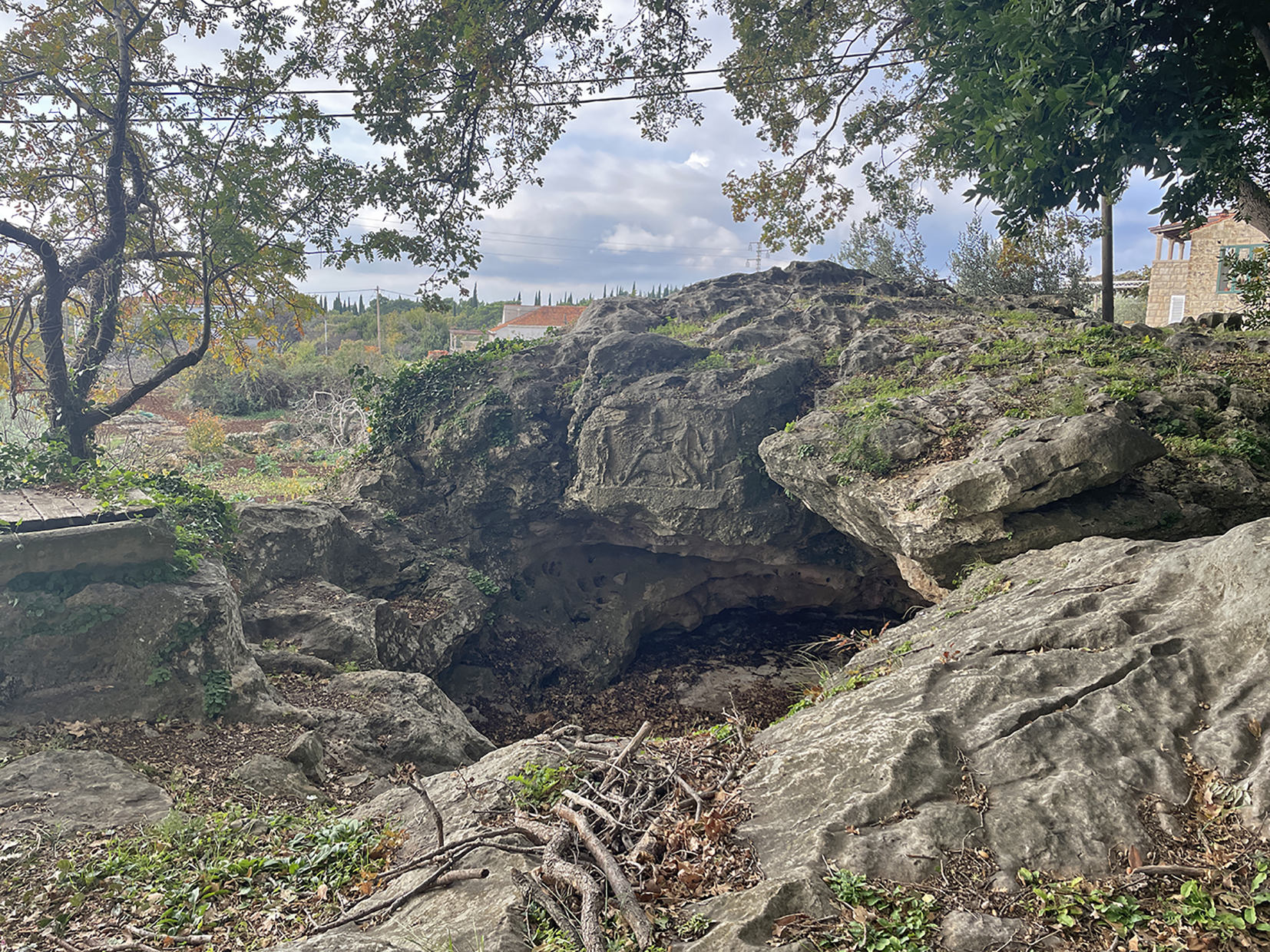
Today, the mithraeum sits within forested, karstic hills, on the edge of the modern village of Močići. Here, a limestone hillock forms a natural clearing in a depression about 14 m in diameter, its shape further defined by modern stone walls at the edges. This space is relatively flat and grassy, with only a few small trees. On the western end of this clearing is a mound of limestone hollowed out through karstic erosion to form a shallow cave. The cavern is 1.95 m at its maximum height (floor to the base of the relief), with its western (back) wall sloping to the floor 2.6 m beyond the apex of its overhang. The other sides of the cave basin progress unevenly to its floor, forming tiers of rock around the rest of the pit. This rim is unbroken in all but one place, at the northern end, where a fissure provides a side opening of 50 × 34 cm. A set of nine steps have been carved into the eastern edge of the basin, providing access from the clearing to the cave floor. At the base of the depression is a natural spring, fed by aquifers in the same distinctive karst geology of the region that created the grotto.Footnote 40 The spring still serves as a water-source, a fact attested by the modern construction of a concrete well head and grate to keep it free from debris. Most of the cave floor is paved with irregularly shaped blocks, set in a modern period.
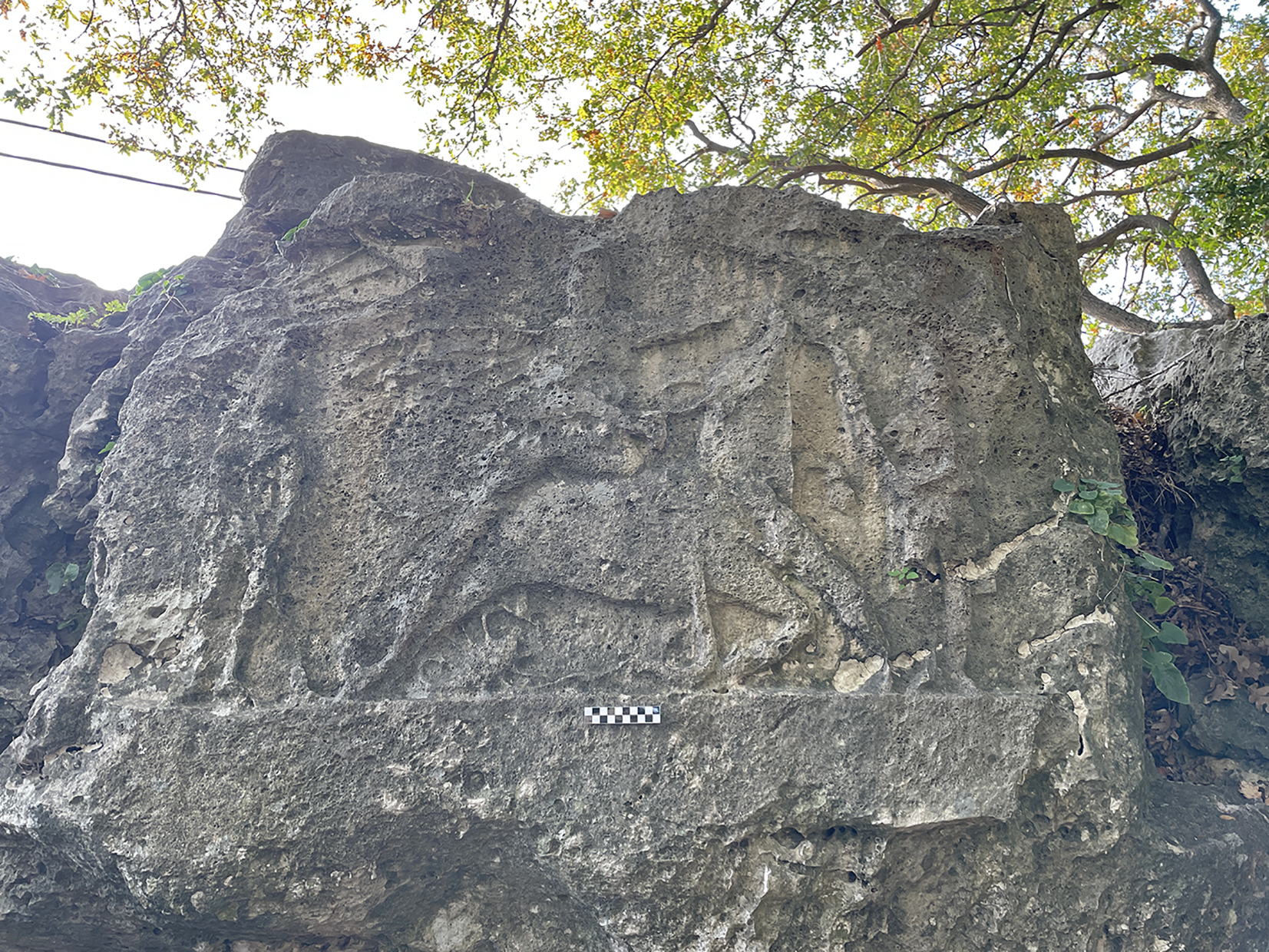
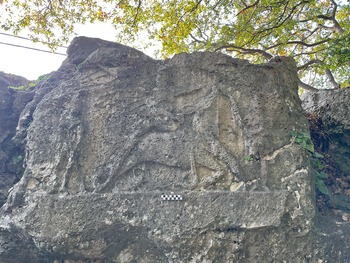
At the apex of the cave overhang is a weathered Mithraic tauroctony measuring 0.75 m high by 1.10 m wide (Fig. 3)Footnote 41 ; this is the object that first attracted Evans’s attention and the evidence for this site being used to worship the Persianate god. The bas-relief was carved into the rock in a way that suggests careful shaping, as this face is notably flat and rectilinear in comparison with the surrounding rock. It can be seen from all angles of the clearing and even the entry path. The carving depicts Mithras slaying the bull in motion, the dog, snake, and scorpion accompanying his strike. The god is flanked by Cautes and Cautopates with their raised and lowered torches. Representations of Sol and Luna fill the upper corners, and the raven hovers over Mithras’s billowing cape. That is, in its iconography, the relief reproduced a widely shared visual type, replete with menagerie of animals and celestial personifications. A second relief of a single, standing figure once decorated the basin, almost facing Mithras; the figure seems to have been both intentionally damaged and then heavily worn, leaving only a pair of legs and making conclusive identification nearly impossible. While most have identified it as Silvanus,Footnote 42 based on the goat-like appearance of the legs, others have seen the figure as one of the Mithraic torchbearers:Footnote 43 a less probable reading, given that the legs do not seem to be crossed.
Detail of tauroctony relief at Močići. (Photo: Ian Wilson.)
There is no clear way to date the use of this space for worshipping Mithras. The absence of excavation and artefactual assemblages, or even epigraphy, leaves only dubious stylistic analysis of a relief carved by local stoneworkers or supposed chronological trajectories of Mithras-worship in this microregion (often without any better dating criteria). A supposed Late Antique (4th-c.) date for the use of the sanctuary is based on coin finds from a second Mithraic site nearby: a problematic supposition, even if such stray coins were not simply evidence for one phase of usage rather than the entire life-course of the site.Footnote 44 All that can be said is that Mithras-worship probably took place for an indeterminate length of time during the period when the cult was broadly popular in the empire: that is, between the 2nd and mid-4th c. CE.
The nearest major settlement was – like most cities in Dalmatia – a coastal port, Epidaurum, set on a peninsula that sheltered twin harbors. If little is known of the ancient city’s archaeology beyond its aqueduct,Footnote 45 results from a handful of rescue excavations, and the inscriptions that demonstrate it was a site meriting elevation to a colonia under Caesar or Augustus, even less is known of its hinterland.Footnote 46 Several elite maritime villas dotted the coast, including one owned by Cornelius Dolabella, propraetor of Illyricum under Tiberius.Footnote 47 The limestone hills that stretch back from the coast were presumably (as with other colonia in the province) dominated by villa economies engaged in animal husbandry and agriculture, as well as resource exploitation (quarrying, logging).Footnote 48 The valley floor – now partially occupied by the Dubrovnik airport – must have been one of the most agriculturally rich zones of the region, and it was centuriated when Epidaurum was made a colony (though only some faint traces of that centuriation survive).Footnote 49
Location played a role in shaping the contours of the Mithraic worship community. The Močići sanctuary most likely belonged to one of the villa estates. A scatter of Roman rooftiles – with stamps dating them to the Tiberian period – and ceramics was noted about 600 m south of the mithraeum: possible evidence for a villa structure.Footnote 50 The sanctuary may have drawn worshippers either from the villa’s inhabitants or from the colonia below; today, the hike from Cavtat to the site takes around an hour. The road that connected Epidaurum to Risinium – a Hellenistic Illyrian capital, which probably became a colonia under Augustus – almost certainly ran through this valley, as did the major highway connecting Aquileia to Dyrrachium, which threaded its way through one of the two passes that connected coastal zones to the Balkan inlands through the Dinaric Alps. Some have suggested that scatters of Roman pottery (sometimes in secondary position, but indicating Roman-period activity nearby), field boundaries, and a modern road suggest a third Roman road closer to the coast, approximately 4 m in width, which would have passed closer to the Močići site; this, however, remains an unproven hypothesis.Footnote 51 Set adjacent to these major routes, the Močići mithraeum still demanded a hike into the hills; it was not a roadside sanctuary.Footnote 52 It was, in other words, a destination sanctuary, requiring intention and commitment from visitors and worshippers.
The Močići sanctuary is also not alone in these microregional, rural, and rocky milieux. At least two other Mithraic sites sat in the hinterland of Epidaurum, also probably on rural estates. The first was located on the St. George hill, seemingly in a suburban zone outside the colonia. During his travels, Arthur Evans was shown a heavily worn bull-stabbing relief partially buried in rubble,Footnote 53 near which he also found coins of Aurelian, Constantius Chlorus, and Constantius II;Footnote 54 the relief was later cut out of its original setting and relocated to a private antiquities collection in Cavtat.Footnote 55 Although recent work has suggested that the relief was carved directly on the hillside, Evans’s description makes clear that it was a free-standing “rock,” as does its subsequent relocation; the mithraeum itself must have been free-standing, even if it used some of the natural rock for carved features. A second mithraeum seems to have sat on the island of Lopud, just off the coast of Epidaurum, where part of a relief with Cautopates was discovered.Footnote 56 Another Mithraic relief, whose original provenance is unknown, was part of a private family collection in Cavtat.Footnote 57 In general, Mithras-worship seems to have been primarily a rural affair in this part of Dalmatia: a far cry from the more urban cult practiced in adjacent regions.Footnote 58
Yet even within a microregional koine of rural Mithraic sanctuaries, the Močići sanctuary and its community of users stands out as distinctive for how it engages with its setting and the landscapes around it.
Modeling a distinctive Mithraic space and its affordances
As much as it may generally resemble these other Mithraic sanctuaries in its rural and rocky setting, the Močići sanctuary had its own, distinctive affordances and resonances. These emerge through modeling of the space in three dimensions and speak to the ways that the worship of Mithras could be far more flexible, adaptable, and tied to a material world beyond itself than has often been recognized. Indeed, instead of pointing to the universality and artificiality of Mithraic space, the Močići sanctuary points to its deep locativity: its particularization of a place pre-existing in the world and bound up with certain lifeways, rather than its portability and reproducibility via human action.
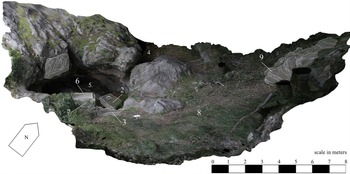
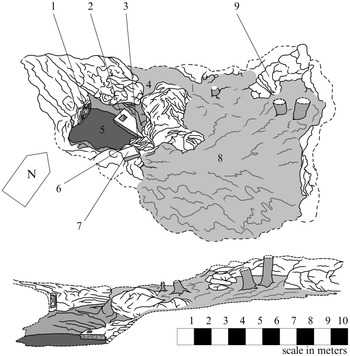
In order to study and communicate the complex topography and unique features of the site, we created a digital model of the Močići mithraeum using AgiSoft Metashape Pro and interpretive drawing of the cave and surrounds (Figs. 4–5). This was accomplished through a campaign of photography and measurement, with the permission of local landowners and the support of Museums and Galleries Konavle (MiGK). We used Structure from Motion (SfM) photogrammetry to capture the site, and placed 10 coded targets to provide dimension to the rendering. Our digital model makes more visible the traces (or absence) of human shaping on the rocky surfaces of the clearing and cave basin. It also serves as a crucial aid for engaging with the convoluted topography of the temple, which confounds remote study. Particularly clear from the model is the relationship between the tauroctony and the broader clearing, which forms a theater-like semi-circle around this raised focal point.
Photogrammetric model of Močići site. 1: bull-stabbing relief. 2: modern concrete wellhead. 3: rock-cut steps. 4: fissure in rock. 5: cave floor (modern). 6: relief of Silvanus. 7: modern concrete feature. 8: clearing. 9: steps into clearing. (Model: Ian Wilson and Matthew McCarty.)

Drawing of cave and clearing. For key, see Fig. 4. (Drawing: authors.)

In the absence of excavation, little can be said directly about the worship practices here based on artefactual and ecofactual repertoires. Given the rocky terrain with shallow sedimentation, and continuous use of the site, new excavation would be unlikely to remedy this lacuna. Similarly, post-ancient use of the spring, and interventions that include its cement covering and conversion into a well, make it difficult to discern whether the shaping activities within the cave date to the Roman period. The kinds of activities that took place to worship Mithras here must instead be assumed based on parallels from other sanctuaries: gathering in a group, forms of ritualized pageantry that might have included revelatory mysteria, and dining.Footnote 59 These activities and practices, though, have also been assumed for those other Mithraic sites, rather than directly attested. Still, the rare images of Mithras found outside of spaces where communal, ritualized activities took place – a handful of gems, which might represent very personal and individualized appropriations and adaptations of Mithras’s bull-stabbing image,Footnote 60 and perhaps some smaller “portable” reliefsFootnote 61 – suggest the likelihood that where there was a Mithraic image, there was a set of small-group rites.
Accounts of the Močići sanctuary cast the sunken cave as the place where worshippers would gather for such ritualized practices, but there are a number of reasons to question this interpretation. First, the cave space has very limited dimensions. The enclosed area offers roughly 17.7 m2 of floor space, a portion of which would be too narrow to comfortably accommodate people. The usable area may have been enough to fit fewer than 20 tightly packed, standing adults. Even the smallest built mithraea offer considerably more space,Footnote 62 and the average interior space of a main cult room, counting only benches and nave, is around 68 m2. Although part of the cave has a low ledge in the rock, with signs of undatable anthropogenic shaping visible in pick-marks, the ceiling over this ledge is low enough that it would not have afforded space for diners to recline or sit. That is, there is not adequate room for one of the main activities attested at all excavated mithraea: ritualized dining.Footnote 63 Second, the location of the Mithraic relief suggests the cave interior was not the primary ritual space. Within Mithraic sanctuaries, the image of Mithras stabbing the bull always sits at the focal point of the shrine, at one end. While there is evidence in some sanctuaries that such images might have been concealed and revealed in ways that play with sight and (in)visibility,Footnote 64 the cult relief is always set at a point where it could be seen by worshippers in the sanctuary. Yet from the interior of the Močići cave, the relief, set above the entrance to the rocky depression, is positioned at a very awkward viewing angle. This, too, suggests that the primary space for worship was not within the cave, even if the cave and spring may have been used by worshippers in ritualized practices.
Indeed, the bowl-shaped clearing outside the cave seems a far more probable candidate for placing the small-group, collective practices of Mithras-worship. The bull-stabbing relief is visible from everywhere in the clearing: that is, only this exterior zone affords some of the visual experience common across mithraea. The area also would have allowed a much larger group to come together: at over 14 m in diameter, with extra definition provided by modern stone walls, the clearing offers around 120 m2 of potential gathering space.
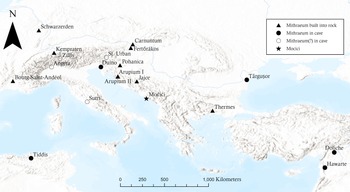
And, unlike other known Mithraic sanctuaries, this space seems to have been open-air: a category of site once proposed for certain mithraea, but subsequently largely rejected.Footnote 65 There are, of course, a host of other mithraea that used the rocky surfaces of cliffs and outcrops for carving their cult image,Footnote 66 many of them within this geographic microregion, but these are complemented by built, roofed enclosures (Fig. 6).Footnote 67 At Jajce, the relief was carved against a rocky hill, but drystone walls created a foundation for earth-built walls, and a threshold stone was discovered that delimits the sanctuary.Footnote 68 At Fertőrákos, a community with military ties from Carnuntum built a small mithraeum into a rocky hillside;Footnote 69 another community built a mithraeum at Rožanec by carving a relief into an earlier quarry cut into a limestone outcrop.Footnote 70 Outside of Arupium, a relief was cut into a small hillock; although no traces of a structure survive, large quantities of roof tiles suggest one.Footnote 71 Recent test excavations at the site led the excavator to posit a light, post-built structure with a tile roof.Footnote 72 A second mithraeum near the site, outside the modern village of Čovići,Footnote 73 has been identified as a freestanding, open-air relief on a rocky outcrop in a field;Footnote 74 others, however, have dismissed this suggestion, largely on the basis of the first Arupium mithraeum, suggesting that any trace of a structure was simply removed long before the first published account of the site, or by the dynamiting that is attested in the vicinity.Footnote 75 Most notably, one edge of the outcrop has been sloped to create a roofline, suggesting the likelihood of a building. Further afield, the mithraea at Bourg Saint-Andéol and Schwarzerden are both carved onto the rocky surfaces of hills, with cuttings that clearly show rafters and gabled roofs installed against the rock face.Footnote 76
Sites using natural rock or caves for Mithraic sanctuaries. (Map: M. McCarty, using basemap by Esri, FAO, USGS, NOAA, and Esri community users.)

The Močići mithraeum, though, shows no signs of construction or roofing. There are no cuttings or shaping at the top of the outcrop for roof beams or purlins, as at Schwarzerden and Bourg Saint-Andéol. When Evans visited the site, he found no traces of roof tiles, nor are any such remains visible near the mithraeum today; admittedly, such items may have been cleared away and reused in some post-antique period. No traces of postholes or other structural cuttings are visible in the rock around the site, which has generally undergone less intervention than the rocks around the Arupium mithraeum. All shaping of the rocky landscape was strictly to promote accessibility: sets of steps leading into the basin, and a further nine steps leading downwards into the cave, although neither can be dated. A light structure around the sunken bowl cannot be ruled out, though again, the absence of postholes or cuttings in the rock face make this less probable. Any gathering space for worship at Močići was most likely open-air in the basin: a near unicum among currently known sites for Mithras-worship.
The only other possible open-air sanctuary to Mithras shares some characteristics with Močići, despite its geographic distance, but it may have had an adjoining built structure. At modern Thermes (Thrace), set in a rural zone off the via Egnatia and roughly 1 km from a Roman fortlet guarding this strategic transit zone, a Mithraic relief was carved on a natural rock face.Footnote 77 Here, too, a natural spring emerges from the rock: presumably one of the reasons the location was embellished as a cult site. The relief shows no signs of a built gathering area, although the zone around it has not been cleared or excavated to rule out structures. Just to the north of the Mithraic relief, a building with vaulted roof was cut into the same rock face; beyond cuttings in the rock for roof supports and the relief that served as its focal point, the structure no longer survives. The use of a vault for a secondary room is unusual and may indicate a special purpose for the space. Perhaps this structure served as a Mithraic gathering building.
At Močići, the lack of a built structure had its own entailments for how worshippers might practice their cult in ways that enhanced their connection to this natural space. Without a clear area to securely store cult paraphernalia – no antechamber closets, like the one at Riegel where dining wares were kept to be trotted out for communal mealsFootnote 78 – worshippers would have had to haul their materials up to the site for every event. If dining was a key part of the rites – which seems probable, as an activity that appears to have underpinned most forms of worship and other small-group associations – foodstuffs, too, would have had to be brought to the site. If meat was involved – animals suited for small groups, like chickens, piglets, and ovicaprines are the most commonly attested species in mithraeaFootnote 79 – it may well have arrived on the hoof: perhaps drawing a tight connection to the forms of pastoralism practiced in these hills. Most notably, there were no permanent benches, and carrying heavy, wooden, movable furniture out to the site on a regular basis seems unlikely. Diners may have sat or reclined directly on the ground here, connecting them more explicitly to the place and landscape.
Mithraic resonances
If it did not offer key affordances for the ritualized practices of Mithras-worship – especially communal feasting – and demanded effort to reach it, why was this particular location chosen and embellished, making Mithras present through the relief? The answer may, as many have previously noted, relate to the ways that the unique karstic geology of the site resonated with a host of Mithraic interpretants: caves, rocks, water.Footnote 80 And yet this loose set of associations could be foregrounded (or ignored), materialized or mediated, by a range of means. Here, too, Močići suggests not only the variability of rites, but the variability of signifying practices.
The grotto resonates with a broader set of Mithraic signs, shared across communities of worshippers and in circulating traditions about the deity. In the earliest Latin literary mention of Mithras, which was roughly contemporary with the appearance of designated Mithraic sanctuaries in the Roman world,Footnote 81 Statius sets a rocky cave as a central attribute of Mithras, the place where he “twists horns.”Footnote 82 That is, by the later 1st c. CE, Mithras might have been imagined as a god who was active in caves: a marked difference from other earlier and geographically distant versions of Mitra, where he is imagined as a god of “wide pastures.”Footnote 83 Although some have seen Porphyry’s claims about Mithras’s cave as microcosm as the keys to unlocking a wider Mithraic semiotic system, such allegorical readings more probably reflect a process of symbolic meaning-making tied to the particular hermeneutic milieu in which Porphyry operated.Footnote 84
Still, caves became a shared touchpoint for Mithras-worshippers. Many Mithraic worship groups worked to create the experience of caves for visitors, using a host of techniques. Some were in linguistic denotation: a handful of sanctuaries were explicitly labelled as spelaea by their builders or restorers (a practice not – as is sometimes suggested – confined to Italy), in contrast to the more usual temple-terms (templum, aedes) preferred by other communities.Footnote 85 Only one of these cave-dedication inscriptions has a clear provenance, which suggests that this cave language could be strictly metaphorical; the “cave” in question was the cellar of a podium temple.Footnote 86 Israel Campos Méndez has recently suggested that “cave” language was preferred during an initial dedication, but that restorations tended to use templum language as a means of enhancing the prestige of the renovator.Footnote 87 If true, this also suggests that practices of denotation were deeply contextual: a “cave” could become something else, and lose its metaphorical resonance, quite easily, only to be resituated in a host of other euergetic practices.
Still, even in the absence of calling sanctuaries caves, a number of Mithraic temples used different materials to create grotto-like effects for users: at Gross-Krotzenburg, chunks of basalt were attached to the vaulted ceiling to make it seem more cave-like.Footnote 88 On a smaller scale, images of Mithras stabbing the bull could also incorporate iconographies that set the act within a cave: rocky, chiseled textures arching around the central scene. These iconographic caves, though, were popular in a fairly restricted area, especially in Italy and Sicily.Footnote 89 At Močići, the natural grotto with its textured karst limestone needed little human intervention or artifice.
And the cave at Močići was not altered in ways that made its space a sign that obviously represented something else: there are no traces of decoration that encouraged users to imagine the cave as an eikon of the cosmos, privileging allegorical interpretation of the site akin to how Porphyry imagines mithraea. Simply being a cave, rather than a sign standing in for something else, was enough. Even the relief of Mithras stabbing the bull lets the cave setting speak for itself: it is delimited by a simple, linear border, rather than the serpentine, rocky borders used on some monuments, including one from Salona.Footnote 90 In most of the rock-cut mithraea of Dalmatia, worshippers harness their landscape similarly, letting the rocky setting itself create a sense of cave, rather than relying on iconography.
Sometimes related to caves, rockiness, too, was a quality foregrounded by some communities. At Močići and the other mithraea carved on rock faces, the stony outcrops forming the sanctuary foregrounded this dimension of the deity, as he emerges from living rock. In multi-paneled tauroctonies, Mithras is represented as emerging from a snake-wrapped rock in one of the smaller scenes,Footnote 91 probably as part of the narrativization of a wider Mithraic myth. Statues showing this same scene are the most widespread free-standing images of Mithraic figures after the bull-stabbing and the torchbearers.Footnote 92 This emergence from rock could be cast in allegorical or symbolic terms: a statue from Housesteads replaces the rock-pile with a cracked egg from which Mithras emerges, surrounded by a zodiac that gives the scene cosmic significance. It may not be surprising to find such imagery within a sanctuary that stresses the chronocosmic dimensions of Mithraic worship in other ways, with a dedication made to Sol Invictus Saecularis.Footnote 93 Still, most representations of the rock-birth seem to operate as scenes from a Mithras-myth where the rock itself is what matters.Footnote 94 In a scene from Augusta Emerita, Mithras emerges from a carved stone block with drafted edges: the rock need not be natural, but its material was communicated to viewers via illustrating a working technique reserved for stone,Footnote 95 indicating the material was clearly a priority. Other communities – especially in Pannonia – celebrate Mithras as born from a Mother-Rock (Petra Genetrix), even making dedications to this goddess in her own right.Footnote 96 Rockiness itself seems to be a material quality embraced at some sanctuaries; at Apulum Mithraeum III, large unworked stones were used as facings for the benches lining the nave to add a rocky texture.Footnote 97 Some mithraea also incorporate chunks of rock into their architecture: rough pieces of volcanic pumice were built into ceilings and walls in a number of sanctuaries in Rome and Ostia (whose urban contexts precluded engagement with living rock or caves).Footnote 98 In the Ostian Casa di Diana mithraeum, the pumice was encastrated but then painted: the artifice of the rock foregrounded.Footnote 99 Rockiness mattered for many worshippers – but how this rockiness was mediated and communicated differed widely, creating a range of relations between god and material world.
Even so, some communities set rocky landscapes in dynamic tension with expectations around places of worship. In the same geographic region as Močići, in the same political province of empire and a similar karstic landscape, the carver of the tauroctony relief at Jajce set the bull-stabbing relief within a gabled frame.Footnote 100 Atop that frame, palmetto antefixes appear: a means of making the rocky setting more visually akin to a monumental temple, with tiled roof and architectural ornament. In other sanctuaries, instead of rocky and cave-like features, worshippers covered their walls and ceilings with painted compositions that would be equally at home in other sanctuaries, public spaces, or homes: panels meant to represent colored-marble veneers, garden scenes, or other solid panels.Footnote 101 Mithras-worship comprised a host of relationships with both material and signifying worlds.
The karstic spring at Močići, too, invited Mithras-worshippers to see a widely shared repertoire of symbols at this particular place in their landscape. To a general sense in the wider Roman world of the sacrality of springs, and their development as cult sites,Footnote 102 Mithras-worship added additional layers of practical and mythological significance. Water features have long been recognized as important aspects of mithraea, both practically and symbolically, though a wider archaeological study of the relations between Mithras-worship and different elements of this kind is sorely needed. Cultic cooking demanded water (washing, stewing), and wine mixed with warm water seems to have been a staple of many Mithraic meals.Footnote 103 On a mythological front, one of the oft-repeated scenes in Mithraic iconography is the “water miracle,” in which the god induces a spring of salubrious water to flow from a rock by piercing it with an arrow.Footnote 104 A relief from Poetovio stresses this theme in a scene with Mithras presiding over Cautes and Cautopates while his followers drink the water spilling from the rock.Footnote 105 A similar relief was discovered in Besigheim (Germany) and several dedications to Fons Perennis (“Year-Round Spring”Footnote 106 ) are known from a range of mithraea, especially in Pannonia.Footnote 107 Indeed, a host of Mithraic sanctuaries show evidence of water features, mostly in the form of basins (sometimes with pipes for feeding or draining), that may have had both signifying and more workaday functions;Footnote 108 others seem deliberately to have been set next to streams; and a handful, like Močići, even took advantage of natural springs.Footnote 109
Still, there is a marked difference in how the site and community at Močići related to water when compared to these other sanctuaries. The dedications to Fons often seem metaphorical, divorced from any water features. While most come from excavated mithraeum buildings,Footnote 110 only one is from a mithraeum with evidence for water features, a piped basin at Poetovio Mithraeum II. That is, for the vast majority of Pannonian communities who made the Year-Round Spring a focus of their dedicatory practices, flowing water was imagined rather than materialized. At Močići, by contrast, the natural year-round spring generated by the hydrogeology of the region seems wholly integral to the choice of location. The natural environment shaped where worshippers gathered, rather than being built into an artificial microcosm.
One final feature of the site ties the community deeply to a discrete sense of place: the carving of the second figure facing the cave opening, most probably Silvanus (Fig. 7). The relief is invisible from the clearing and can only be seen when standing inside the cave or at its mouth, facing out. While the relationship of this relief to the mithraeum sanctuary has been explained in various ways – including seeing the Mithraic community as displacing an earlier sanctuary to SilvanusFootnote 111 – it is more probable that the two deities cohabited in this sanctuary. Like most Roman sanctuaries, those dedicated to Mithras could host dedications and cult for other deities; as Wolfgang Spickermann has noted, Mithras was regularly incorporated into wider local pantheons and joined in sanctuaries by other deities.Footnote 112 Silvanus enjoyed wide popularity in Dalmatia,Footnote 113 in ways that integrated the god directly into landscapes. In neighboring Pannonia, Silvanus was equally popular, but tied to urban and military milieux and frequently brought into households with the epithet domesticus. Footnote 114 Along the limestone outcrops of the Dalmatian coast, Silvanus instead occupied a peri-urban and rural sphere, with sanctuaries set in caves, reliefs, and dedications carved from living rock.Footnote 115 Indeed, Danijel Dzino has argued that this preference for caves was a distinctive regional phenomenon: a way of enacting “popular” cults as a form of subaltern resistance to elite-controlled religion.Footnote 116 Silvanus could also be tied to springs in Dalmatia, especially when grouped with nymphs.Footnote 117 At Močići, the same natural features – a rural, karstic cave and spring – made the place just as fitting for this regional Silvanus as it was for Mithras.
Relief with legs of Silvanus. Photo: courtesy B. Bijađija.

In carving a dedication to Silvanus and building this god of rural affairs into a space for Mithras-worship, the cult became even more distinctive and localized. Few other mithraea pair these two deities; an exception may be the mithraeum in the Casa di Diana at Ostia, where a Silvanus relief found nearby has been interpreted as forming a link between a “working-class” cult and Mithras’s incorporation into the life of a professional collegium.Footnote 118 At Močići, the pairing of the gods may have played a similar role, perhaps connecting the Mithras-worshippers to the shepherding activities of this hilly landscape. Even the distinctive goat-legs of Silvanus mark him as a regional version of the god – one who shared iconographic attributes (and perhaps a portfolio of powers) with Pan – and iconically tie him to local pastoral lifeways.Footnote 119 Despite a dearth of high-resolution archaeological data on Imperial-period animal husbandry in the region, ovicaprine pastoralism has historically played a significant role in this coastal zone, and at the few sites with published faunal assemblages, ovicaprines dominate between the Iron Age and medieval period.Footnote 120 In modernity, the cave spring has helped to water these flocks; whether it played a similar role in antiquity, before or during the site’s time as a Mithraic sanctuary, cannot be known. Those who gathered around the cave for worship were not necessarily themselves shepherds, but goat-legged Silvanus’s presence in the sanctuary contributed to a unique pantheon connected to this place and the productive activities that took place in the landscape around it.
In short, the Močići cave site seems to have been selected for its natural features – grotto and spring – and the way they fitted into wider, adaptable symbol systems woven around the worship of Mithras (and Silvanus): placed in a cave, rock-born, tied to springs. Such a confluence of signifiers latent in the landscape invited worshippers to depart from the main road, to trek up from Epidaurum or their residences within a villa estate – not simply and conveniently to walk to a neighborhood mithraeum (like those in Rome, Ostia, or even provincial cities like Carnuntum, Aquincum, or ApulumFootnote 121 ) or one set close to workplaces on a villa. Yet these features were also shaped and adapted to make them suitable for worship. The reliefs were added to guarantee divine presence in this particular place: landscape alone was not enough to actualize those signifiers. Even so, the natural features of the site had their own distinctive entailments for worship practice; that is, these features encouraged specific responses from the humans worshipping alongside them. Worshippers at Močići dined al fresco, perhaps reclining on the ground itself: a markedly different experience than that of other Mithras-worshippers, in their enclosed, dark, bench-lined rooms.
Placing Mithras
There was not one, homogenous form of Mithraic signification, experience, or ritualized practice in the Roman world: the uniqueness of the Močići site makes that much clear. It is not simply that some Mithraic sanctuaries were laid out differently than others, or that there was diversification through time, driven by wider social changes in the Roman world. Nor is the Močići sanctuary the exception that proves the rule. Mithraic place-making was not simply the human projection of a particular cosmological ideal into the world via a particular built form. More than merely challenging notions of a homogenous “Mithraism,” with standardized formal features (particular spaces or sanctuary layouts) or fixed significances (cave signifying cosmos), Močići encourages reconsideration of the variable dynamics of Mithraic place-making, semiosis, and situation in ancient cult. The Močići site points to the ways that “Mithraism” should be seen as a polythetic set of signifiers, associations, and resonances that could be selected, recombined, and activated in dialogue with the localized, material worlds in which they were situated. And these locations were always relational: to landscape and physical space; to lifeways and production; to materialized signifiers.
Mithras-worship was shaped and inflected not just by local personnel and practices – here, Dalmatian preference for rural and rocky mithraea (and sites of engaging with gods more generally) and the pastoral lifeways that invited goaty Silvanus into the sanctuary – that created distinctive idioms within a shared Mithraic language, but by the landscape and geology of this particular locale. But geography – whether conceptualized as a provincial microregion or as the relationship between city and countryside – also sat in a recursive relationship with particular lifeways. Here, in the hills between the agricultural polje below and the coast, pastoralism has ethnographically and historically been a foundation of economic activity, diet, and experience: marked by Silvanus with his goat legs, at a water source that has long served to support shepherding. The affordances of the wider landscape, and human relations with it, shaped and inflected the particular concerns and practices of this Mithras- and Silvanus-worshipping community.
Adopting this grotto space in turn shaped how visitors worshipped, dictating potentially quite distinctive practices and experiences for worshipping Mithras. With no evidence for a built sanctuary, and limited gathering space within the cave, the clearing in front stands as the most likely candidate for hosting group activities. If the predominant models for Mithraic place-making stress the ways worshippers might create artificial, symbolic places as signifiers that point beyond themselves and evoke other worlds, Močići shows instead how physical and natural spaces might offer their own affordances and shape their own distinctive forms of worship. Mithras-worship at Močići was heavily inflected by relationships with geology and landscape: “Mithraism” here was not the anthropogenic cosmo-creation seen by many scholars as the hallmark of a coherent cult system.
But landscapes, geology, and the relationships that worshippers had with these spaces are still only part of the story; practices of semiosis, of imagining links between a signifier and something else, are also central to place-making. At Močići, natural geology and the confluence of karst cave–spring were mobilized as signifiers, tied to a wider package of broadly shared, imagined qualities of the god, or relationships between a god and the material world. Mithras and his worship were connected with caves; he was a rocky god; he was linked to water-bearing. Caves, rocks, and water were shared touchpoints for many Mithras-worshipping communities, but foregrounded (or not) and mediated in vastly different ways. Ephemeral practices – stories and myths, told or performed in mysteria – may well have stressed these aspects. But myths and stories, told and retold, embellished by knowledge-keepers and performers, were always fluid and adaptable to new situations. The Močići cave was neither generically numinous nor simply a marker of divine presence in the landscape; it was the physical elaboration of a more widely shared signification.
And the material dimensions of these signifiers were equally flexible. Mithras could iconographically or physically be placed in a cave; his worshippers could gather in a grotto or in the cellar of a temple that they called a “cave.” Or neither. Rockiness, too, could be highlighted in different ways: making dedications to the Rock-Mother, erecting individual reliefs or free-standing statues of Mithras emerging from a rock-pile, or simply carving the deity from living stone. Even water and water features seem to have been foregrounded in different ways, along a continuum of fully physical and real (sites with springs or piped water) to wholly metaphorical and devotional (sites celebrating an Eternal Spring that lacked any water features).
In other words, even if Mithras-worshippers might share certain imagined referents, there was not a distinctive or homogenous Mithraic semiotic system, applied either to the making of places or to the signifiers within them. The ways that processes of shaping, occupying, and imagining spaces configured to create places was neither fixed nor universal, even in the case of worshipping a particular deity like Mithras.
What drew Mithraic communities together was a wide repertoire of shared signs: a rocky god, caves, springs. This polythetic set of qualities might form a loose assemblage – the signs by which a genus can be identified, both in antiquity or modernity – but each species and individual adapted in dialogue with distinctive and localized environments, geologies, lifeways, and social practices. Accounting for Mithras-worship, or any form of “religion” in antiquity, means recognizing this full web of relationships, and how they articulate in particular places and moments.
More broadly, Močići also encourages rethinking what it means to grapple with the materiality of cult places in the ancient world. Recognizing the ways that material dynamics – whether the affordances of a natural site, or the lifeways built in dialogue with an environment – shaped cult at Močići does not mean abandoning semiosis and representation.Footnote 122 Signification, even if it embraced a host of relations with the physical world, with nature, and with artifice, sat at the heart of Mithras-worship, forming the connective threads that bound a host of persons, objects, and spaces together as an assemblage. Focusing on the semiotics of cult, and practices of meaning-making, does not demand rejecting materiality; nor does focusing on materiality mean speaking only of the physical qualities of space and bodily practices.
Indeed, the semiotic potential of the natural features converging at the Močići site outweighed many of the ritual demands of Mithras-worship. The physical environment mattered. As Arthur Evans noted when first publishing the Močići mithraeum, “the cavern seemed singularly appropriate for its religious purpose.”Footnote 123 It seems that those ancient worshippers who invested in carving the rock-face, who trekked up to the site hauling ritual paraphernalia, who may have reclined in the clearing around it, and who lived alongside the pastoral activities of this zone, must have felt similarly.
Acknowledgments
We are grateful to Helena Puhara and Bruno Bijađija for their generosity in sharing information about the site and unpublished material; to Lucinda Dirven, Kevin Fisher, and the anonymous reviewers for their helpful suggestions on a draft of this work; and to the audiences who have provided feedback on preliminary versions of this research.



 Open access

