




Introduction
Palliative care faces a workforce crisis. Seriously ill patients far surpass the supply of palliative care clinicians (Kamal et al. Reference Kamal, Bull and Swetz2017, Reference Kamal, Wolf and Troy2019) and clinical workloads continue to rise. Moreover, the nature of palliative care work leads clinicians to face an onslaught of emotionally charged situations, repeated loss, and extreme suffering. These experiences occur within healthcare systems that are not yet built to foster comprehensive emotional processing and facilitate communal support. As such, interprofessional palliative care clinicians regularly and repeatedly experience vicarious trauma and unprocessed grief (Zanatta et al. Reference Zanatta, Maffoni and Giardini2020–Reference Zanatta, Maffoni and Giardini2020)
These experiences can have serious and deleterious consequences on clinicians, leading to poor clinical decision-making, compassion fatigue, moral distress, and burnout (Sanchez-Reilly et al. Reference Sanchez-Reilly, Morrison and Carey2013). Research conducted before the pandemic demonstrates concerning burnout rates (one-third of all respondents) in the field. Further, palliative care clinicians who reported burnout were 1.4 times more likely to leave the field early as compared to their peers who did not report burnout (Kamal et al. Reference Kamal, Wolf and Troy2019). The pandemic only accelerated these trends (Conversano et al. Reference Conversano, Marchi and Miniati2020). In addition, divisive politics, a burgeoning sense of instability in our world, and widespread recognition of systemic inequities all impact our ability to carry the weight of these broken systems, especially clinicians from historically minoritized communities (Rosa and Leiter Reference Rosa and Leiter2024). In sum, palliative care risks losing its engaged, empathetic clinicians.
Mitigating moral distress and burnout requires complex, system-level solutions (Amos and Epstein Reference Amos and Epstein2022; Burston and Tuckett Reference Burston and Tuckett2013; West et al. Reference West, Dyrbye and Shanafelt2018, Reference West, Dyrbye and Sinsky2020). And the pace of system-level change can be glacial. Individual clinicians are ill-equipped to address the system-level determinants of burnout and clinical attrition (Ripp et al. Reference Ripp, Privitera and West2017; West et al. Reference West, Dyrbye and Shanafelt2018, Reference West, Dyrbye and Sinsky2020) and a focus on increasing personal resilience risks asking the victims of systemic failures to accept, adapt, and be complicit with those very systems that are failing them. While many healthcare organizations provide wellness programs, such as integrative therapy and brief psychoeducational seminars, (Holliday et al. Reference Holliday, Ricke and Ricklefs2024) these do not necessarily address the lasting distress or countertransference that PC clinicians regularly experience. We urgently need new interventions to retain our workforce and ensure that clinicians thrive in this emotionally complex landscape.
Storytelling represents a promising path forward. In response to widespread loneliness and moral distress among PC clinicians before, during, and after the early months of the COVID-19 pandemic, (Biber et al. Reference Biber, Ranes and Lawrence2022) we created the Palliative Story Exchange (PSE), a storytelling intervention that seeks to create intentional community, decrease isolation, and help clinicians rediscover the shared meaning in their work. In this article, we describe the PSE’s development and theoretical underpinnings and describe initial program evaluation data demonstrating its potential impact on participants.
Storytelling to foster meaning and build resilience
The scholar Peter Brooks wrote, “Our very definition as human beings is bound up with the stories we tell about our own lives and the world in which we live.” (Abbott Reference Abbott2020) In clinical medicine and training, we often focus on our patients’ stories to form the basis of their histories, our understanding of their personhood, and the foundation of the patient–clinician relationship. Nevertheless, like rain drops hitting the water’s edge, our patients’ stories have ripple effects into our lives and vice versa. All of which often goes relatively unexplored in our clinical work. We lack intentional rituals to process the suffering that we see and understand the impact and meaning-making this has in our lives. In Toni Morrison’s 1993 Nobel Laureate lecture she reflects on this concept by saying, “… Tell us your particularized world. Make up a story. Narrative is radical, creating us at the very moment it is being created.” (Morrison Reference Morrison1993) In other words, we generate meaning through stories, those we hear and those we create. Within this exchange we have the potential to cultivate presence, awareness, and community.
In addition to the benefits of storytelling, the tenets and teachings of Narrative Medicine demonstrate that reflective writing can be a method to enhance self-awareness, promote reflection, and increase empathic engagement in clinicians, otherwise termed “narrative competence.” (Charon Reference Charon2001) To build awareness, and therefore meaning, clinicians must be able to pause amid busy days and notice; notice what we are feeling, seeing, and how we are inherently creating stories in our mind’s eye. Viewing our work through a “writer’s eye,” or prioritizing observation and awareness alongside our clinical work, enables us to be present and better understand what we carry with us from day to day.
The PSE represents an innovative storytelling intervention which builds on these evidence-based benefits of reflective writing (Charon Reference Charon2001) and active listening, and adds critical elements of group reflection and community co-creation to promote self-awareness, empathy, meaning-making, and sustainability. Together we shape the stories we tell ourselves. We do this by creating intentional space for clinicians to share their narratives, which are reflective rather than case based, in an open format with a group of active listeners. The power of this exchange is therefore 2-fold. As one of the founders of Narrative Medicine, Dr. Rita Charon, reflects, “Writing, or telling, gives a speaker the authority and the opportunity to reveal the self … Reading, or listening, requires an equally perilous and daring ability to acknowledge another..” (Charon Reference Charon2008) Once a story is complete, we take time to reflect as a group on the story’s resonances and impact. This exchange creates space for vulnerability, connection, and meaning making. Storytelling, in an intentional, casual format with facilitated, modeled reflection, may therefore represent an innovative and accessible path forward to promote sustainability and clinician wellness.
Methods
Development
The PSE began as an evening storytelling event in the Spring of 2020 for the palliative care divisions at the Dana-Farber Cancer Institute (DFCI) and Massachusetts General Hospital (MGH), tertiary/quaternary academic medical centers in Boston, MA, which had both faced unprecedented challenges in the first surge of the COVID-19 pandemic. The event, 90 minutes in length and held over Zoom (Version 5) (Zoom Video Communications) was led by two palliative care physicians with experience and training in both narrative medicine and the medical humanities (A.D. and R.E.L.). We invited all interprofessional members of both palliative care teams to attend and tell stories. Over 30 clinicians attended this initial, evening event, and qualitative, anecdotal feedback was overwhelmingly positive.
Given the first PSE’s success, we have held quarterly sessions for the DFCI/MGH communities. Our intervention’s impact spread by word of mouth, and in our first 2 years we held a Story Exchange for medical interpreters at MGH and for palliative care clinicians across the state of MA. As the intervention continued to grow, we partnered with a pediatric palliative care social worker with expertise in group facilitation, medical improvisation, and narrative interventions (R.R.).
The PSE has since expanded nationally and internationally. We have held virtual and in-person events at conferences such as the McGill International Palliative Care Congress and the Memorial Sloan Kettering (MSK) U.S. Celebration of World Hospice and Palliative Care Day which had over 500 participants from around the world. We have also been part of continuing medical education courses such as Ariadne Lab’s Serious Illness Care Program Summit, which had 150 participants from around the world, and Harvard Medical School’s Practical Aspects of Palliative Care course. Lastly, we have held Story Exchanges as part of subspecialty palliative care training, such as with the Palliative Care Fellowship Program at the University Health Network in Toronto, Canada.
Logistics
Our events thus far have either been local and arranged by the PSE team (such as at DFCI/MGH) or have been fostered through partnership and interest from national or international programs. One month prior to a PSE, we send an invitation by email (Suppl Fig 1) informing potential participants of the event and inviting them to consider sharing a story. Importantly, other than events specifically facilitated for a singular clinical discipline, all our events are intentionally interprofessional. We seek to empower a diverse group of storytellers from varied professional backgrounds, lived experience, places of work, etc. To leave space for participants to share the stories most important to them, we encourage potential storytellers to reflect on what has moved them in recent months, be it at work or at home. Rather than provide a directive, we ask the open-ended question “What can you not stop thinking about?” We do instruct storytellers to move away from traditional medical case reports, and instead focus on their emotional reactions to moments in their professional and personal lives.
Sample invitation.

Interested storytellers click on a hyperlink to a Google Form, (Google Forms) where they share demographic information (e.g. professional background, location of practice), and information about their story (e.g. tone, theme, etc.). This information allows us to create a storytelling lineup that represents voices across professional disciplines and geographic regions (for national and international events), and emotionally “flows” from one story to the next.
As an intervention focused on sharing and community-building rather than public speaking or performance, we require storytellers to write their stories down and read them during the event. Before we begin each session, we introduce ourselves and provide background information to the group. We then share ground rules with the intent of creating a brave and accountable space. These guidelines include asking all participants to be intentionally present (and on-camera, away from phones), the need for confidentiality, the importance of self-care if a story activates strong emotions, and a zero-tolerance policy for expressions of racism, transphobia, homophobia, sexism, or other bias.
Storytellers then read their stories to the group. After each story, we lead the group in an open, reflective discussion. We ask participants what parts of the story resonated with them, how they found themselves reacting, and how the story’s themes may have connected with their own experiences. As facilitators we are ready to offer comments to pave the way for others to share, while also leaving adequate silence for participants to gather their thoughts. Both on Zoom and in person we marvel at how each group’s connectedness emerges. We hypothesize that this connection results from vulnerability in the stories shared, and the interplay of the reflective space created between each sharing. Each time there is always a powerful exchange and a bidirectional sense of affirmation between storyteller and listeners. This unguarded dialogue increases connection and fosters moments of healing, and may promote the flattening of professional hierarchies
Survey design
We developed a self-administered post-then-pre survey (Levinson et al. Reference Levinson, Gordon and Skeff1990; Pratt et al. Reference Pratt, McGuigan and Katzev2000) that we ask participants to voluntarily and anonymously complete after they participate in a PSE. This survey (Supplementary 1) assesses participants’ self-reported change regarding the connection they feel to their own stories, work, and colleagues. Given that many participants may already have had a certain level of interest or involvement in writing and storytelling, we utilized a post-then-pre survey tool to decrease response shift bias (Kaushal Reference Kaushal2016) and assess participant’s perception of change. We also used the post-then-pre design to help increase our response rate, recognizing that busy clinicians are more likely to complete a single survey at a voluntary sustainability intervention. These data were collected as part of our internal program evaluation and thus not subject to IRB review.
Results
Since its inception, over 1,000 interprofessional palliative care clinicians and trainees have experienced the PSE. The breadth of stories shared, and the diversity of professional backgrounds has been astonishing. The themes shared vary from one Story Exchange to another. Clinicians from across the globe have shared stories about caring for patients in rural settings, family illness, experiences of racism, coming out to family members who are nearing the end of life, and the tension between one’s work and one’s religion. Some stories are funny. Others are grief-stricken. Many stories are both. All stories share storytellers’ vulnerability. At every event, we had first-time storytellers who had never written a personal narrative. Lastly, quite a few participants have gone onto publish their stories, which they were inspired to write only by signing up to read a story at a PSE.
Our initial program evaluation data shows promise. We have only just begun collecting data in October 2022. Surveys were not distributed at some of the larger conferences we have participated in and therefore survey responses, while significant, are fewer than our number of participants. We estimate that our response rate is 20%. We have collected 130 anonymous, post-then-pre-surveys. Participants represent a diverse group of professional backgrounds (please see Table 1) including: 33.8% social workers, 20.8% physicians, 13.8% nurses, 6.9% nurse practitioners, 3.9% chaplains, 1.6% psychologists, 1.6% music therapists and expressive arts professionals, 0.8% rehabilitation specialists, among others. Respondents were from a breadth of locations of practice including 39.1% from academic medical centers, 13% from community hospitals, 7.8% from ambulatory palliative care clinics, 10.4% from home-based hospice, 4.3% inpatient hospice, 3.5% community organizations, and 21.9% other. While most respondents (60%) were from the United States, they represent geographic regions across the country in both rural and urban areas. We also received surveys from participants across the globe including, 9.2% 12 respondents) from Canada, 5 respondents (6%) from Africa (Ghana, South Africa, and Nigeria) 2 respondents (2.4%) from Southeast Asia (Malaysia and Indonesia), 2 (2.4%) from India, and 2 (2.4%) from the Middle East (Iran and Saudi Arabia).
Profession of participants

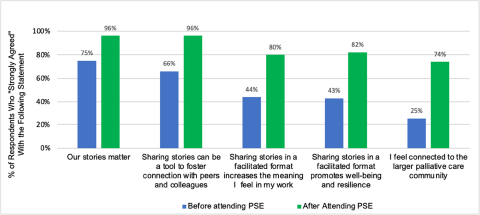
Questions focused on the impact of participating in a PSE using a post-then-pre retrospective survey (see Supplement and Fig. 2). The percentage of survey participants who strongly agreed with the statement, “Our stories matter,” increased from 68.5% before attending to 96.9% after attending. The percentage of participants who strongly agreed that “Sharing stories can be a tool to foster connection with peers and colleagues,” increased from 61.5% before attending to 96.2% after attending. The percentage of participants who strongly agreed with the statement, “Sharing stories in a facilitated format increases the meaning I personally feel in my work” increased from 43.8% to 81.5% after attending the PSE. The percentage of participants who strongly agreed that “sharing stories in a facilitated format promotes well-being and resilience” increased from 41.5% before attending the PSE to 83.8% after attending. Similarly, the percentage of participants who strongly agreed that they “feel connected to the larger palliative care community” increased from 21.7% before attending the PSE to 76.5% after attending.
Initial PSE survey results.

Those who read stories also reported a positive impact. 79.4% of storytellers strongly agreed that “Reading my story and hearing reflections increased the meaning my story has for me,” and 90.6% strongly agreed that “Reading my story and hearing reflections increased the connection I feel with peers and colleagues.” Overall, nearly all participants (96%) were very likely or extremely likely to recommend attending a PSE event to a colleague.
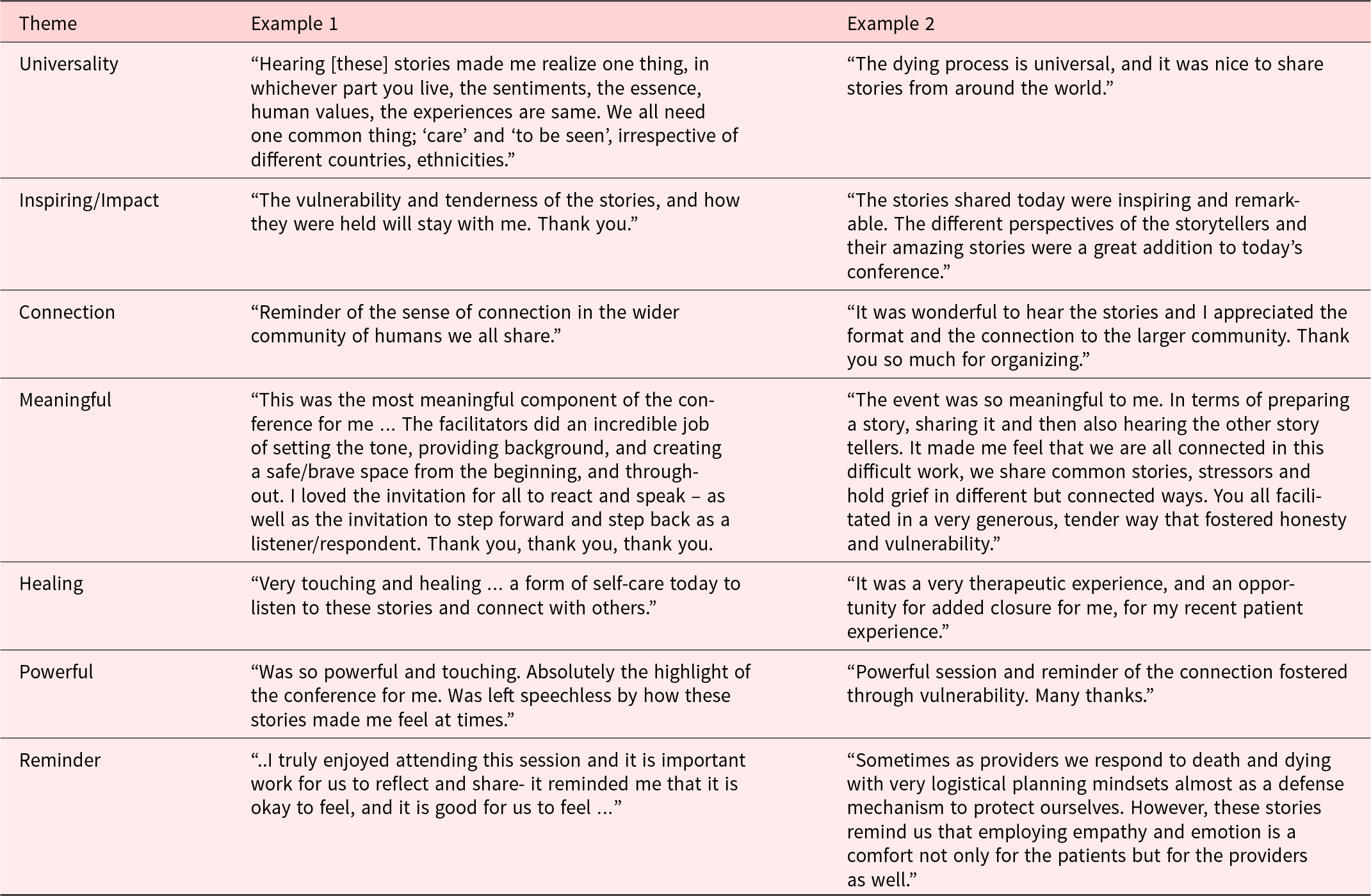
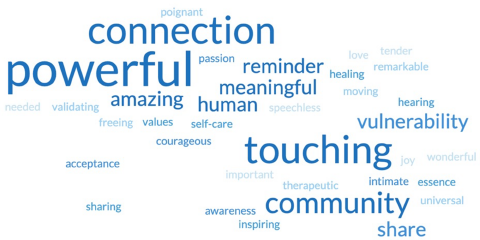
Many themes arose in the free-text comments we have gathered as part of our surveys. More than half of all responses used the terms, “touching,” “meaningful,” “healing,” “moving,” “powerful,” “highlight,” “universal,” “reminder,” or “inspiring,” to describe participating in a PSE. Overall, these qualitative comments point to the PSE’s impact on participants. A few quotes that highlight these themes are as follows. Please see Table 2 and Figure 3 for examples.
Representative themes and quotes from free text survey questions

Themes and feedback word cloud.

Discussion
Our manuscript describes the creation of a novel storytelling intervention for palliative care clinicians, the PSE, and the intervention’s early program evaluation data. Through a combination of storytelling, active listening, and facilitated group reflection, we find that the PSE helped clinicians appreciate the importance of sharing stories, increased their sense of shared meaning, and amplified their feeling of connection with colleagues and the broader palliative care community. The PSE therefore holds promise as an intervention that may foster resilience and mitigate burnout in palliative care clinicians and those that care for seriously ill patients more broadly.
Palliative care clinicians regularly sit next to significant suffering (Funk et al. Reference Funk, Peters and Roger2017; Lobb et al. Reference Lobb, Oldham and Vojkovic2010; Zanatta et al. Reference Zanatta, Maffoni and Giardini2020). Yet our healthcare systems have minimal mechanisms in place to support clinicians to process and make meaning of these experiences, which can have detrimental impact on palliative care clinicians’ clinical decision making, empathy, and sustainability. Ultimately, for a multitude of reasons, the palliative care workforce faces a crisis (Hart et al. Reference Hart, Paetow and Zarzar2019). The PSE model builds upon the evidence-based benefits of narrative practices (Charon Reference Charon2001; Sanchez-Reilly et al. Reference Sanchez-Reilly, Morrison and Carey2013) such as reflective writing and active listening (Kamal et al. Reference Kamal, Bull and Swetz2017) to promote self-awareness, meaning-making, and foster resilience. Research demonstrates that self-awareness, a clinician’s ability to combine “self-knowledge and a dual awareness of both his or her own subjective experience and the needs of the patient,” serves as the most important factor in the clinician’s ability to function well in the face of personal and professional stressors (Charon Reference Charon2001).. Reflective writing incorporates this awareness into stories, which hold meaning and form the stories we tell ourselves and each other about our work. This ability to make meaning is critical. A 2019 study on resilience in palliative care health professionals’ states, “The cognitive ability to give meaning and shape to stress appears to determine resilience development or maintenance.” (Zanatta et al. Reference Zanatta, Maffoni and Giardini2020) In addition, through active listening we create psychological safety for vulnerability and narrative knowing, or the ability to create shared understanding (Buckley et al. Reference Buckley, McCormack and Ryan2018; Sandelowski Reference Sandelowski1994) which can provide affirmation and healing.
The PSE and our initial survey data add to the landscape of humanities-based initiatives that have sought to improve student’s and interdisciplinary clinician’s reflective abilities, sustainability, and patient care. From a training perspective, Mangione, et al.’s 2018 study demonstrates that exposure to the humanities such as literature, music, theatre, and visual arts, increased medical students’ “positive personal qualities” such as empathy and self-efficacy (Mangione et al. Reference Mangione, Chakraborti and Staltari2018). In a 2018 study evaluating the effects of reflective writing on burnout in a cohort of medical students, researchers found that reflective writing reduced students’ emotional exhaustion and depersonalization from pre-to-post course assessments (Charon Reference Charon2008). Subspecialties have also integrated the humanities in various ways to improve wellness. For example, the Association of American Radiologists held a 1-time storytelling intervention after which participants reported a positive impact on their sense of wellbeing (Belfi et al. Reference Belfi, Jordan and Chetlen2022). Further, a 2017 study published by Saint-Louise and Bourjolly details the experience of healthcare professionals who participated in a monthly narrative oncology group. Overall, participants expressed having a positive experience relating to themes such as “bearing witness,” “shared perspective,” and “safe space.” (Saint-Louis and Bourjolly Reference Saint-Louis and Bourjolly2018) Similar findings emerged from a narrative medicine intervention implemented for OBGYN residents (Winkel Reference Winkel2016). Lastly, a recent 2023 study with 67 interdisciplinary health professions students demonstrated that a narrative medicine intervention helped students have an increased sense of professional identity, self- reflection, and emotional catharsis (Liao and Wang Reference Liao and Wang2023)..
While the PSE model has some overlap with existing storytelling programs, (Airway Stories; Silverman Reference Silverman2024) the combination of our format, interprofessional accessibility, and broad reach are innovative. The PSE intervention integrates the benefits of narrative writing and storytelling with community co-creation. We have found that the combination of intentionally building an accountable, safe space, emphasizing the importance of active listening to aid group reflection and form connections, and modeling and facilitating this group reflection is unique. In our experience, and what our survey data demonstrates, is that this fusion lends itself to moments of profound resonance, meaning, and connection.
Another novel aspect of our model is the emphasis we place on moving away from patient cases and asking storytellers to write down and read their story aloud at the event itself. This practice has enabled a breadth of interprofessional storytellers, some of whom are first time writers, because it removes the barrier of performing. Lastly, our work has thus far been unique in that our initial data demonstrates that participants feel a sense of community and meaning whether they know one another and work together (such as MGH and DFCI) or are relative strangers prior to the event, such as at MSK World Hospice and Palliative Care Day of Celebration or the McGill International Palliative Care Congress. We have also found that many participants care for patients and families experiencing serious illness but do not necessarily work in palliative care. For example, At the 4th Annual U.S. Celebration of World Hospice and Palliative Care Day, only 26% of participants identified as working in hospice or palliative care, which speaks to the enthusiasm for this work beyond palliative care as well.
Alongside the benefits thus far, our intervention has limitations. We estimate that our survey response rate is around 20% which is low compared to the total number of participants. We hypothesize that this is because we only began to use this particular survey beginning in October 2022, we were not able to distribute this survey at a larger conference workshop which therefore reduced possible respondents by a significant number, and because we have not yet given participants time to complete the survey at the end of the event itself. Therefore, we have depended on participants completing the survey after the event in their own time. Secondly, given that some clinicians are very interested in the medical humanities, we remain unsure whether the rate of positive response reflects the impact of the intervention or equally due to participant selection bias. Although some participants likely joined events such as our Story Exchanges with MGH and DFCI with a prior appreciation of the humanities, our events with MSK and Ariadne were part of a larger conference curriculum. We therefore hypothesize that many of these participants did not have a preexisting interest in the humanities. Lastly, we did not conduct a formal qualitative analysis on survey responses. Rather, in review we summarized salient themes and highlighted representative quotes.
As our community grows, we hope to increase our response rate to better reflect the diversity of our participants. Moreover, as with other sustainability interventions, the PSE will not appeal to all interprofessional clinicians. While wellness initiatives exist in healthcare systems across the country, it is important to acknowledge the impossibility of developing a “one size fits all” solution given the complexity of forces driving clinician burnout. Some may find this type of interaction burdensome, too vulnerable, or stressful. Survey results will therefore reflect those drawn to the PSE and similar narrative programs. However, the positive quantitative and qualitative results from our initial survey provide a signal to suggest the PSE’s strengths.
Ultimately, as the PSE continues to gain traction, we hope to grow outside of palliative care and scale the PSE to create a sustainable, accessible, empowering international intervention with facilitator champions at the helm. We aim to design and implement a facilitator leadership course to equip facilitator champions to implement the PSE at their home institution or lead Story Exchanges around the country. We hope to support a community of practice, (Smith et al. Reference Smith, Radigan and Maloney2022) and to maintain synergy, evaluate lessons learned, and build community, we plan to hold quarterly check-ins with facilitator champions and use surveys and focus groups to continue to learn about successes and barriers and to continue to grow. Lastly, we plan to have a yearly retreat for facilitators and participants from around the country and internationally to foster community and shared meaning outside of our professional settings.
Given the immense impact of burnout, both on clinician’s physical and mental health and on workforce attrition and patient care, we need authentic, innovative interventions that support clinicians to build community, decrease isolation, and foster shared meaning in their work (Raimo et al. Reference Raimo, LaVine and Spielmann2018). Without accountable and safe communal spaces to process our work’s singular emotional complexity, we risk perpetuating feelings of inefficacy and isolation among interprofessional palliative care clinicians and clinicans at large. While our healthcare systems work to catch up to the current needs of its workforce, we urgently need sustainability interventions that challenge the current failings of our healthcare system. These programs must be more than checkboxes and QI initiatives; they must seek to foster clinicians to continue to feel connected and fulfilled in their work, with patients and in collaboration and community with each other. The PSE represents an encouraging pathway forward.
Supplementary material
The supplementary material for this article can be found at https://doi.org/10.1017/S1478951524001226.
Funding
The authors have no funding to report.
Competing interests
The authors have no conflicts of interest to report.




 Open access

