



Introduction
The emergence of asymmetries in social and economic standing in prehistoric communities has long been a central focus of archaeological research (e.g. Price & Feinman Reference Price and Feinman1995; Mulder Borgerhoff et al. Reference Mulder Borgerhoff2009). The primary approach to the study of past inequality relies on objects included in burials that are thought to reflect differences in the deceased's status, indicated by differential access to non-local materials or by grave goods that exhibit superior craftsmanship. With the spread of agriculture, social differentiation and hereditary inequality eventually became correlated with political and ideological complexity (Price Reference Price, Price and Feinman1995). Bronze and Iron Age burials containing lavish concentrations of durable and ‘costly’ goods may be read as signalling marked status differences in later prehistoric Europe (Parker Pearson Reference Parker Pearson1999). During the European Neolithic, however, variation in grave goods is not easily attributable to status differences. The presence and quantity of exotic materials may not directly reflect an individual's social standing during life, but may have been motivated by performances by surviving kin, aimed at mitigating death and the processes surrounding it (Robb Reference Robb, Tarlow and Stutz2013). Ornaments may also simply reflect personal taste or style, even if they are made from non-local materials or are finely crafted.
The human skeleton, however, provides an independent archive to apprehend the links between social standing in life and treatment in death. Osteological markers of activity and episodic stress offer one approach (e.g. Robb et al. Reference Robb, Bigazzi, Lazzarini, Scarsini and Sonego2001), while stable carbon and nitrogen isotopes (δ13C and δ15N), which yield insights into aspects of an individual's diet, offer another. The intersection between variability in grave goods and in stable isotope values permits more robust investigation of socioeconomic inequality in early farming societies. Mulder Borgerhoff and colleagues (Reference Mulder Borgerhoff2009), for example, have found that long-term inequality depends on the extent to which the most important forms of wealth are transmitted within families and across generations. Of particular interest is the finding that in pastoral and agricultural economies, cattle, land and other material wealth tend to be transmitted directly by simple transfer, within a framework of social conventions of inheritance. The rise and expansion of multi-household settlements, and the presence of easily transferable material wealth (e.g. permanent fields and cattle), provided fertile ground for the emergence of socioeconomic inequality (Mulder Borgerhoff et al. Reference Mulder Borgerhoff2009).
Here, we explore the link between diet and socioeconomic inequality, reflected by copper grave goods in burials from Osłonki 1, a multi-generation Neolithic settlement of the fifth millennium BC in north-central Poland. We present δ13C and δ15N data from bone collagen for 30 human and 128 faunal samples, and new AMS radiocarbon dates for 17 individuals. Osłonki provides a robust archive against which we can test hypotheses concerning the relationship between social complexity and differential access to food, as well as between mortuary treatment and individual life experiences.
Investigating status in life and death
To date, utilising stable isotope analyses to investigate links between diet and social status in prehistoric Europe have had varying success. In later prehistory and the medieval period, high-status individuals, or those identified as ‘warriors’, have been shown to have higher δ15N values, plausibly interpreted as representing preferential access to animal protein (Le Huray & Schuktowski Reference Le Huray and Schutkowski2005; Knipper et al. Reference Knipper2015; see also Privat et al. Reference Privat, O'Connell and Richards2002). Few studies, however, have identified such links for the Neolithic. Despite disparities in grave goods, no corresponding isotopic differences were identified, for example, at either the Early Neolithic Linearbandkeramik (LBK) site of Herxheim, or the Middle Neolithic site of Trebur, both in southern Germany (Dürrwächter et al. Reference Dürrwächter, Craig, Collins, Burger and Alt2006). Of course, this need not indicate that no dietary differences existed, only that they involved foods that were not isotopically distinct.
Individuals in Middle Neolithic chamber graves in the Languedoc-Roussillon region of southern France had significantly higher δ15N values than those interred in simple pit graves at neighbouring sites, suggesting higher meat consumption for the former. This was interpreted as a partitioning of the landscape between herders and farmers rather than intra-community inequality (Le Bras-Goude et al. Reference Le Bras-Goude, Herrscher and Vaquer2013). A similar subdivision of the landscape on an even finer spatial scale has been suggested for the Late Neolithic/Early Chalcolithic communities in the Ebro Valley of north-central Spain who interred their dead in caves rather than in megalithic monuments (Fernández-Crespo & Schulting Reference Fernández-Crespo and Schulting2017).
Osłonki and the Brześć Kujawski Group of the North European Plain
During the fifth millennium BC, the Polish lowlands of the North European Plain witnessed renewed expansion and consolidation of sedentary communities practising a mixed farming economy. The Brześć Kujawski Group (BKG) was a regional variant of the Lengyel Culture, a major post-LBK culture of East-central Europe (Bogucki & Grygiel Reference Bogucki, Grygiel, Barker and Goucher2015). Sites previously abandoned by LBK groups were reoccupied, new locations chosen and persistent occupations with multiple large structures emerged, suggesting the consolidation of a new phase of agricultural communities in the lowlands (Czerniak et al. Reference Czerniak, Marciniak, Ramsey, Dunbar, Goslar, Barclay, Bayliss and Whittle2016; Bogucki Reference Bogucki, Gleser and Hofmann2019).
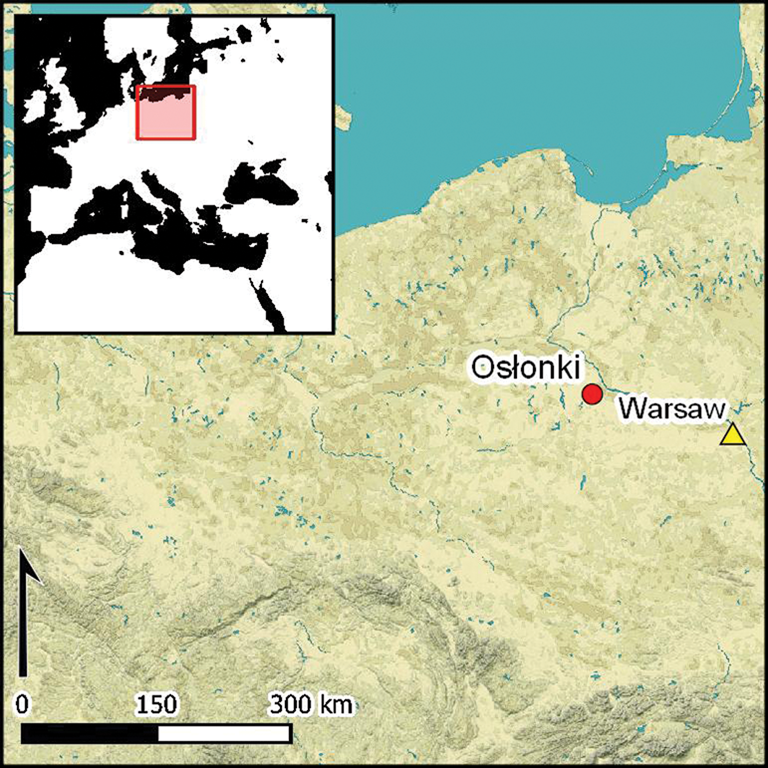
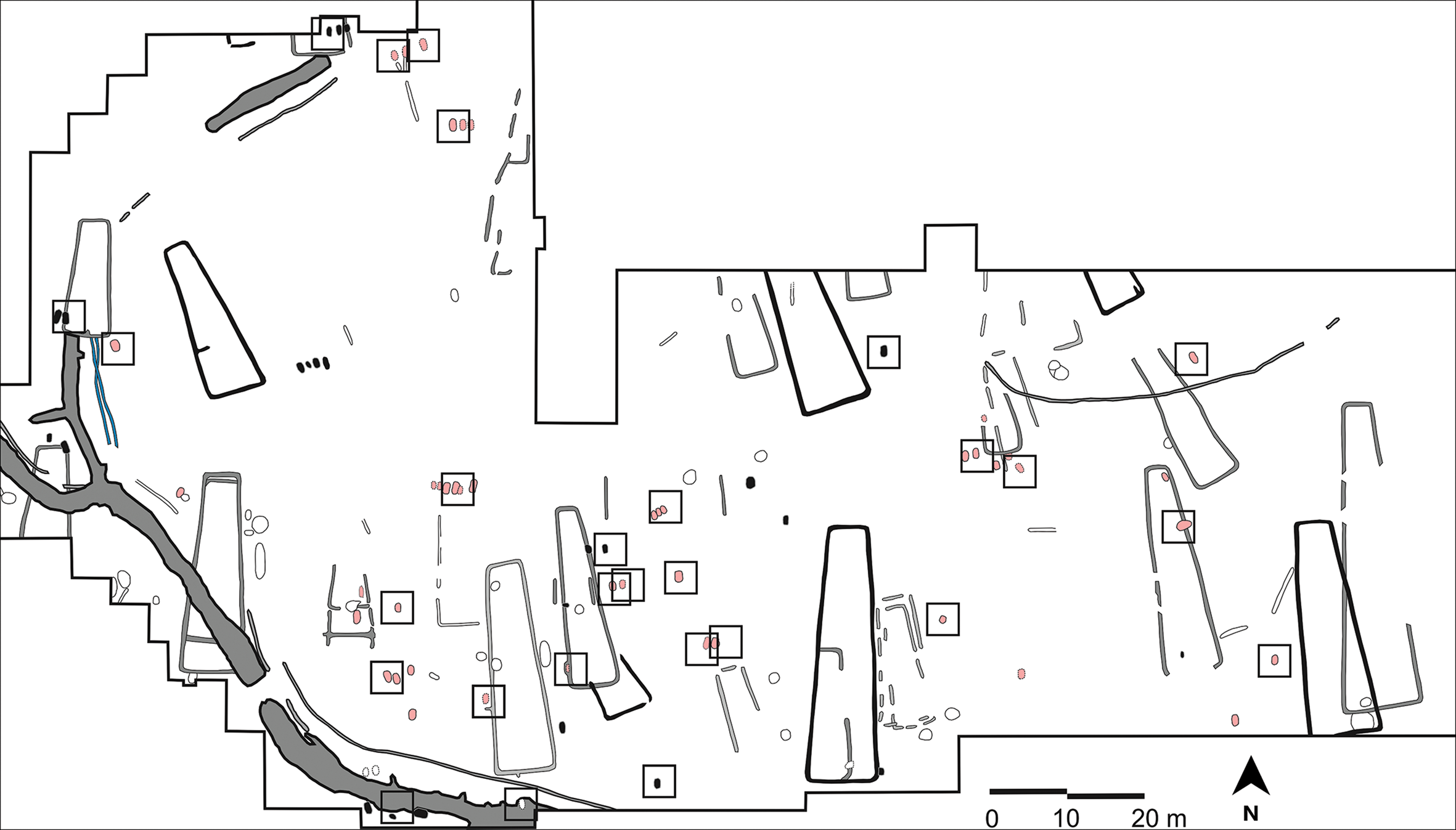
Osłonki 1 is a large settlement located in the Kuyavia region of north-central Poland, approximately 10km west of the town of Brześć Kujawski on the Kuyavian plain (Figure 1). Extensive excavations undertaken between 1989 and 1994 have revealed over 30 longhouses and more than 80 graves containing 92 human skeletons, along with a defensive ditch and palisade (Grygiel Reference Grygiel2008). An initial series of 30 conventional radiocarbon assays on charcoal provided a date range for the BKG occupation of c. 4600–4100 BC (Grygiel Reference Grygiel2008; Bogucki & Grygiel Reference Bogucki, Grygiel, Barker and Goucher2015). Like most Neolithic dryland open sites in temperate Europe, Osłonki presents a palimpsest of features whose chronology is difficult to disentangle. Based on these legacy ‘conventional’ radiocarbon dates and typological analysis of ceramics, Grygiel (Reference Grygiel2008) defined three phases—‘early’, ‘classic’ and ‘late’—for BKG sites in the Brześć Kujawski-Osłonki region. At Osłonki, early materials are confined to the southern edge of the excavated area, while classic and late features are found across the site. Construction of the fortification ditch separates the classic from the late phases. Although these phases are assumed to represent a continuous sequence, our new AMS dates from the Osłonki burials raise the possibility of one or more temporal breaks, even though burials occurred throughout the occupation of Osłonki, across the entire excavated area (Figure 2). Often, they are found adjacent to houses, leading to their incorporation into a settlement model of household clusters (Bogucki Reference Bogucki, Gleser and Hofmann2019: 50). In several cases, the graves form ‘microcemeteries’ of two to five adjacent burials.
Map of the lower Vistula drainage showing areas of Brześć Kujawski Group settlement and locations of sites mentioned in the text (figure by P. Bogucki).

Simplified plan of the settlement at Osłonki, showing trapeziform longhouses and the distribution of burials. Burials outlined with black squares were isotopically analysed for this project; burials shaded in red contained copper artefacts (after Grygiel Reference Grygiel2008: fig. 404).
The mortuary behaviour of the BKG and other Lengyel groups is highly structured and ritualised, with attention paid to skeletal positioning and the inclusion of many types of grave goods. These include copper ornaments (the earliest in Northern Europe), hip belts made of shell beads, bone armlets, and, occasionally, antler axes and bone daggers. BKG communities interacted over long distances and developed complex social relationships, as illustrated by the presence of exotic materials and objects in graves (Grygiel Reference Grygiel2008; Bogucki & Grygiel Reference Bogucki, Grygiel, Barker and Goucher2015).
Palaeobotanical evidence from Osłonki and nearby BKG sites indicates that a suite of domestic species, dominated by emmer wheat (Triticum dicoccum), with smaller quantities of einkorn (Triticum monococcum), ‘new type’ glume wheat (Triticum sp.) and peas (Pisum sativum) (Bieniek Reference Bieniek, Colledge and Conolly2007; Mueller-Bieniek et al. Reference Mueller-Bieniek, Kittel, Muzolf, Cywa and Muzolf2016), were exploited. Domestic cattle and sheep/goat remains dominate the BKG faunal assemblage at Osłonki, representing ~34 and ~35 per cent of the assemblage respectively, while pig bones comprise ~25 per cent of the identified specimens (Bogucki Reference Bogucki and Grygiel2008). Wild fauna, such as red and roe deer (Cervus elaphus and Capreolus capreolus) are present, although not abundant, alongside small quantities of wild pig (Sus scrofa), wild horse (Equus ferus), beaver (Castor fiber) and aurochs (Bos primigenius). Terrestrial and aquatic birds were also exploited, along with fish (including perch (Perca fluviatilis), pike (Esox lucius) and cyprinids) and pond turtle (Emys orbicularis). The faunal assemblage suggests a focus on meat production, supplemented by dairying (Bogucki Reference Bogucki and Grygiel2008), with the wild fauna and flora providing additional dietary variety and perhaps helping to offset periodic resource shortfalls.
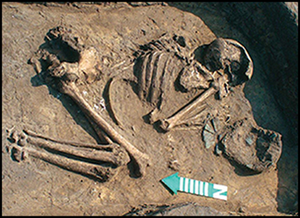
Of the 92 individuals buried at Osłonki, 22 (approximately 24 per cent) were accompanied by copper objects. These range from a worn fragment of copper in burial 34a to a diadem composed of some 50 rectangular copper strips, along with 200 beads and five pendants, in burial 13 (Grygiel Reference Grygiel2008; see Table S1 in the online supplementary material (OSM)). Copper artefacts accompanied both male and female adolescents and adults, as well as two young children (<5 years). Twelve burials with copper ornaments (Figure 3) were among the 30 analysed here. Although no definitive provenance data are yet available, the nearest known copper sources exploited during the fifth millennium BC are located several hundred kilometres away in the Eastern Alps and the Carpathians. Similar copper forms occur in contemporaneous sites in Silesia and Bohemia (Grygiel Reference Grygiel2008).
Burial 54 at Osłonki: left) arrangement of the skeleton with copper plaques visible near the hand; right) copper plaques and beads, shell beads and other ornaments (after Grygiel Reference Grygiel2008: fig. 813).

Copper and shell beads are the two most common artefact categories in the Osłonki burials. Shell beads are by far the most abundant, with several individuals having hip belts made of 600–700 beads. The range of other grave goods include amber objects, calcite beads, perforated animal tooth pendants, bone ornaments, bone and flint tools, T-shaped antler axes, stone axes and ceramics (Grygiel Reference Grygiel2008). While there are no clear associations between burials with copper and any other specific artefact category, graves with copper tend to contain a higher number of other artefact types overall: 1.45 against 0.61 in graves lacking copper, a difference that is statistically significant (Mann-Whitney test, p <0.001). This applies to the site as a whole, as well as to the subset of graves analysed isotopically. Thus, graves with copper are more likely to contain other objects, although whether this reflects ‘wealth’ or some other form of social or symbolic capital is not discernible at this point in time.
Stable isotopes and diet
Stable isotope analysis for palaeodietary reconstruction is based on the principle that 13C and 15N in foods is incorporated into the consumer's tissues (Lee-Thorp Reference Lee-Thorp2008; Makarewicz & Sealy Reference Makarewicz and Sealy2015). Briefly, δ13C values vary between plants following C3 and C4 photosynthetic pathways, and between terrestrial and marine systems. At Osłonki, the isotopic ecology is entirely C3-based, with access to marine foods unlikely, given that the site lies approximately 200km inland from the Baltic coast. Freshwater systems are more variable in their range of δ13C and need to be addressed case by case (Dufour et al. Reference Dufour, Bocherens and Mariotti1999). As for δ15N, this refers primarily to trophic level, increasing by approximately 3–5‰ from herbivore to carnivore (Hedges & Reynard Reference Hedges and Reynard2007). Confounding factors include aridity (not an issue in North-central Europe) and anthropogenic inputs, most notably manuring. The latter significantly elevates soil 15N, and hence the δ15N values of plants growing on these soils (Bogaard et al. Reference Bogaard2013). When interpreting stable isotope results, it is important to recognise that measurements on bone collagen are biased towards dietary protein in the case of δ13C, meaning that plant foods will typically be underrepresented as they contain less protein (Ambrose & Norr Reference Ambrose, Norr, Lambert and Grupe1993). As nitrogen is found predominantly in protein, δ15N informs only on that macronutrient, again emphasising animal foods. Measurements made on adult bone collagen provide an average of foods eaten over the last decade or so of life.
Diet in life
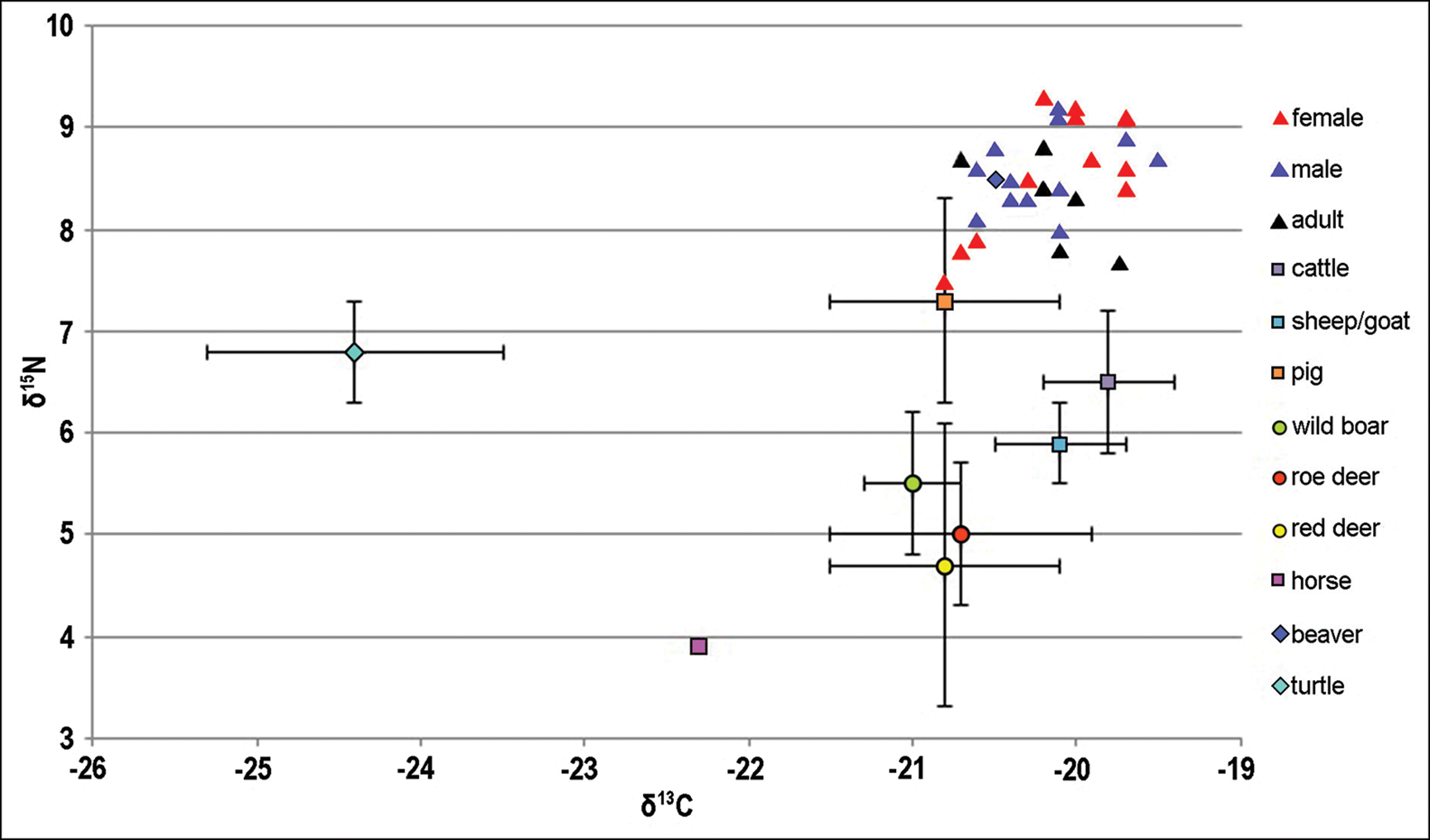
The faunal isotopic results are consistent with a temperate C3 ecosystem (Table 1 & Figure 4; OSM 1). The combined domestic (cattle and sheep/goat) and wild herbivore (red and roe deer) δ13C values show little variation, together averaging −20.5±0.5‰ (n = 93). Values for domestic pigs (−20.9±0.7‰) and wild boar (−21.0±0.4‰) are slightly lower (Mann-Whitney U-test comparing herbivores and domestic pig/wild boar; Z = 3.27; p = 0.001), possibly reflecting more foraging in closed canopy forest conditions by pigs (cf. Bonafini et al. Reference Bonafini, Pellegrini, Ditchfield and Pollard2013). The δ15N values of domestic pigs (7.3±1.0‰; n = 20) are significantly elevated above both wild boar (5.5±0.8‰; n = 6) and herbivores (5.7±1.0‰; n = 93) (ANOVA with Bonferroni post-hoc corrections, p <0.001), suggesting that, in addition to foraging, they were fed village scraps, including animal products. While no freshwater fish remains were available for sampling, five pond turtle bones average −24.4±0.9‰ and 6.8±0.5‰ for δ13C and δ15N, respectively, confirming that the local freshwater system is 13C-depleted relative to the terrestrial system.
δ13C and δ15N graph for human and faunal bone collagen (figure by C. Budd).
Summary of δ13C and δ15N values from human and fauna bone collagen.
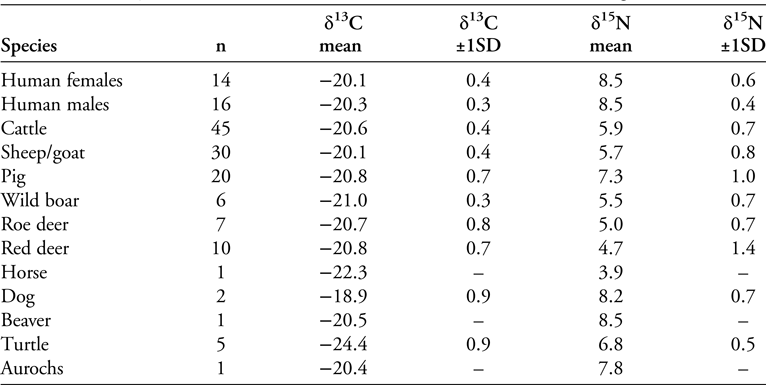
Carbon and nitrogen isotope data for carbonised cereals at Osłonki 1 have been recently published (n = 9), providing δ13C values of −20.2±0.3‰ and δ15N values of 4.2±0.6‰, with the latter suggesting a moderate level of manuring (Mueller-Bieniek et al. Reference Mueller-Bieniek, Nowak, Styring, Lityńska-Zając, Hoyo, Sojka, Paszko, Tunia and Bogaard2019: tab. 3). Considered against these faunal and flora results, human δ13C and δ15N values (δ13C = −20.2±0.3‰; δ15N = 8.5±0.5‰) at Osłonki 1 are entirely consistent with a reliance on terrestrial plant and animal protein resources. No significant differences are observed between the sexes for either δ13C (p = 0.525) or δ15N (p = 0.897), nor are any differences apparent within the adolescent and adult age categories (no infants or children were included in the study). The herbivore average of 5.7±1.0‰ is 2.8‰ below the human average. This is less than a trophic-level enrichment, and is thus consistent with the consumption of both plants and animal products (e.g. meat and/or milk).
Linking status in life and in death
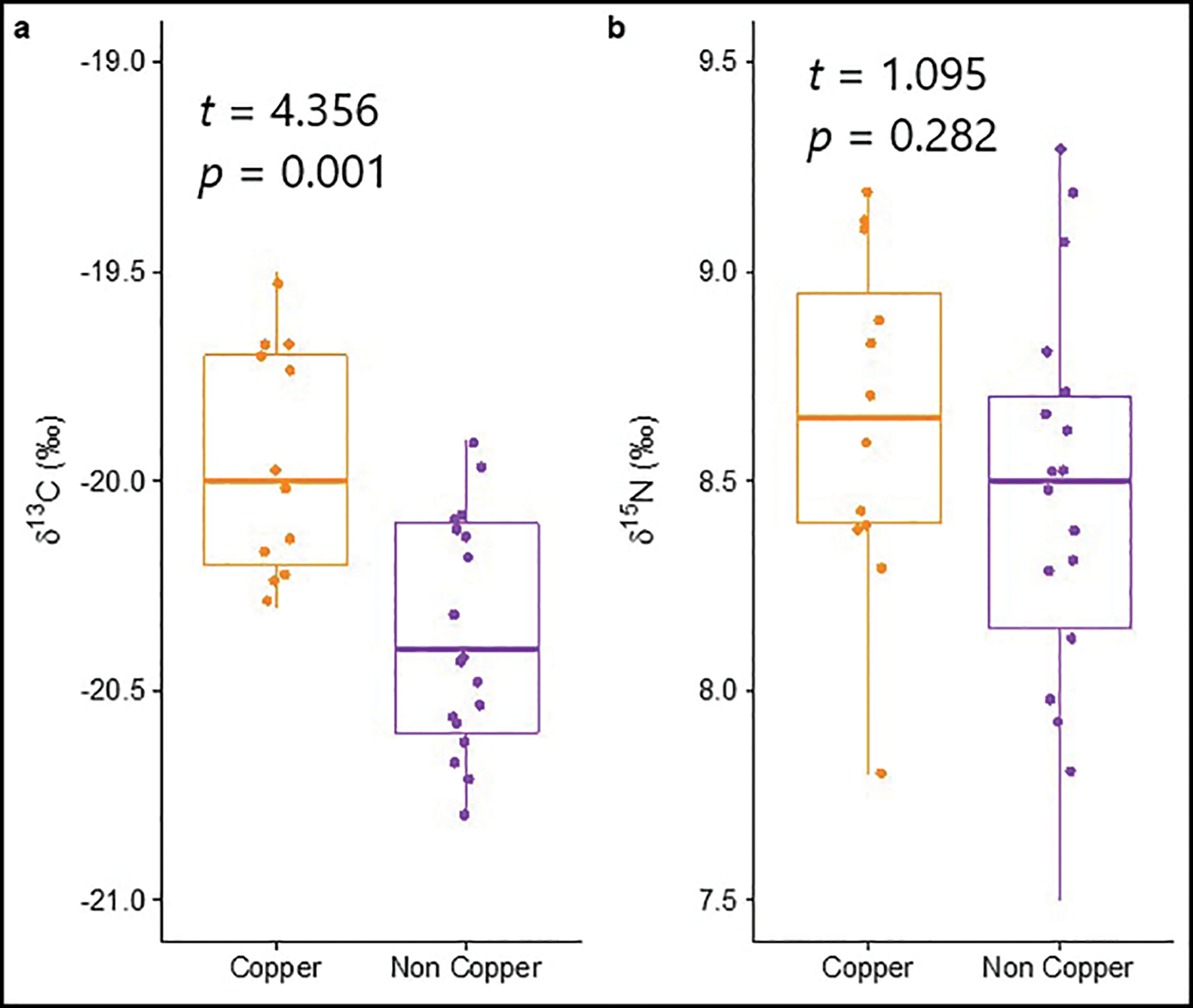
The limited variability in human δ13C and δ15N values and the fact that they are typical for Neolithic farmers across much of Central and Northern Europe (Hedges et al. Reference Hedges, Bickle and Whittle2013; Schulting Reference Schulting, Lee-Thorp and Katzenberg2018) initially suggest that there is little of interest beyond documenting known regional trends. Osłonki 1, however, provides the opportunity to compare individuals interred with copper grave goods to those without. As noted above, this distinction appears to have been observed by the community, albeit subtly, in that individuals buried with copper objects were more likely to also have a greater variety of other non-perishable grave offerings. Individuals interred with copper grave goods have, on average, more positive δ13C values than those without such goods (−19.9±0.3‰ against −20.4±0.3‰; t = 4.36; p = 0.001) (Figure 5; OSM 1). Cohen's d measures the difference between the two means expressed in pooled standard deviations; by convention, values above 0.8 are characterised as large (Cohen Reference Cohen1988). For δ13C at Osłonki, Cohen's d = 1.56. The difference observed here is therefore meaningful, as well as statistically significant. There is no corresponding difference in δ15N values (8.6±0.4‰ against 8.5±0.5‰; t = 1.09; p = 0.282).
δ13C and δ15N boxplots (figure by C. Budd).
Dating the Osłonki burials
The calibrated dates for 17 burials at Osłonki (OSM 3) range from 4445–4261 to 4227–3972 cal BC (using OxCal v.4.2.2 with IntCal13 calibration curve at 95.4 per cent probability; Reimer et al. Reference Reimer2013; Bronk Ramsey Reference Bronk Ramsey2019). There is no evidence for freshwater reservoir effects based on δ15N values. This is consistent with the paucity of aquatic resources (cf. Juras et al. Reference Juras2017). In the absence of stratigraphic or other independent dating evidence, the burials are treated as belonging to a single phase of activity for Bayesian analysis (Bronk Ramsey Reference Bronk Ramsey2009a). The onset of burial activity is modelled in the range 4385–4260 BC, ending at 4220–3990 BC (at 95.4% confidence). Importantly for the present discussion, radiocarbon dates demonstrate that individuals with and without copper grave offerings are contemporaneous (Figure 6; OSM 3).
Bayesian model for dated human burials at Osłonki (Reimer et al. Reference Reimer2013; Bronk Ramsey Reference Bronk Ramsey2019; figure by R. Schulting).
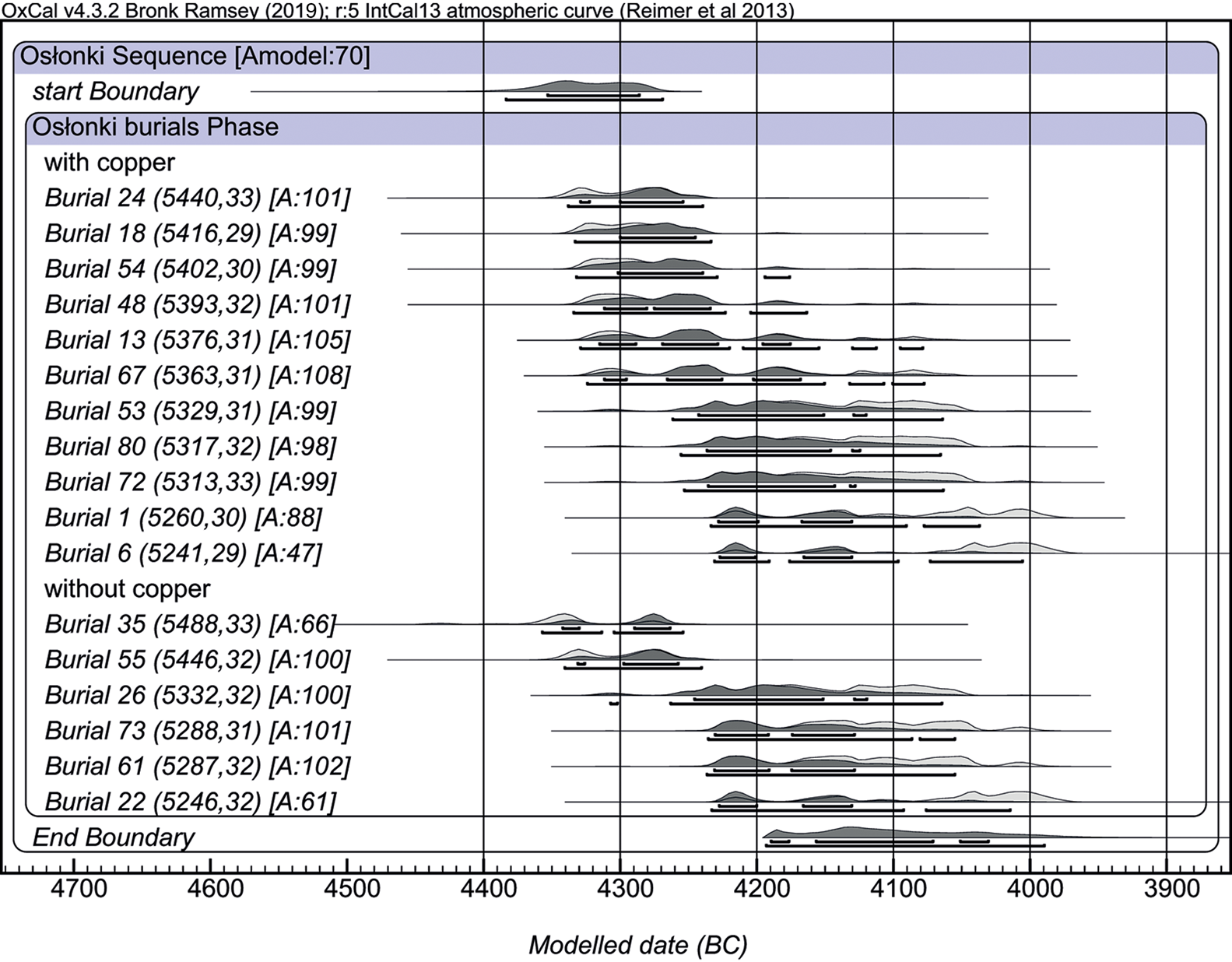
The modelled dates on human bone are also largely consistent with previously available determinations made on charcoal (Grygiel Reference Grygiel2008; Bogucki & Grygiel Reference Bogucki, Grygiel, Barker and Goucher2015), modelled using a ‘charcoal outlier model’, which assumes a variable degree of in-built age due to the old wood effect (Bronk Ramsey Reference Bronk Ramsey2009b). When unconstrained by the burials, the start of occupation at Osłonki is modelled as 4515–4280 BC, ending at 4235–3945 BC (Figure 6). When constrained by the burials, the modelled start date shifts only slightly to 4415–4275 BC. The close agreement of the two series further indicates that any significant freshwater reservoir offsets affecting the human dates are unlikely. The human results are comparable to dates (mainly on faunal bone) from Racot 18, another Late Lengyel BKG site (Figure 1), modelled as starting at 4385–4285 BC and ending at 3965–3915 BC (Czerniak et al. Reference Czerniak, Marciniak, Ramsey, Dunbar, Goslar, Barclay, Bayliss and Whittle2016: 626). Three determinations on humans from the settlement and burial site of Krusza Zamkowa (Figure 1) also date to c. 4300–4000 cal BC (Juras et al. Reference Juras2017).
Discussion
The most notable outcome of our study is that individuals interred with copper grave goods at Osłonki have, on average, significantly higher δ13C values compared to their counterparts without copper artefacts. The question remains as to how this outcome can be interpreted in terms of diet. That a corresponding difference is not observed in δ15N makes it challenging to identify the underlying food sources. A diet richer in animal protein, for example, should result in higher δ15N values, although this can be complicated by 15N-enrichment in plants due to the manuring of fields (Fraser et al. Reference Fraser2011; Bogaard et al. Reference Bogaard2013), for which there seems to be evidence at Osłonki (Mueller-Bieniek et al. Reference Mueller-Bieniek, Nowak, Styring, Lityńska-Zając, Hoyo, Sojka, Paszko, Tunia and Bogaard2019).
Given their importance in the faunal assemblage at Osłonki (especially when considering meat-weight), cattle probably dominated the animal-protein component of the diet, providing both meat and milk (Salque et al. Reference Salque, Bogucki, Pyzel, Sobkowiak-Tabaka, Grygiel, Szmyt and Evershed2013). Dairy products are depleted in 13C, but have δ15N values similar to those for meat, and could therefore lead to the observed differences: individuals interred without copper grave goods could have consumed more dairy products. Despite abundant evidence of cheese-making by LBK communities in Kuyavia during the late sixth millennium BC (Salque et al. Reference Salque, Bogucki, Pyzel, Sobkowiak-Tabaka, Grygiel, Szmyt and Evershed2013), there is currently little direct evidence of dairying at Osłonki a millennium later, other than two fragments of strainers amongst the nearly 36 000 pottery sherds (Grygiel Reference Grygiel2008: figs 428 & 668).
Comparing the isotopic values of cattle remains from different contexts at Osłonki constitutes another approach. A significant difference is seen in the average δ13C values of samples taken from four pits, each providing at least four specimens (ranging from 4–26) (ANOVA, F = 2.93, p = 0.03); Bonferroni post-hoc comparisons indicate that the difference is driven by pit 137 (see Grygiel Reference Grygiel2008 for context information). Assuming discrete depositional events, this suggests that some cattle were reared on isotopically distinct pastures, raising the possibility of long-term, intra-community differences in cattle management. Confirmation of this will require additional analyses, combined with radiocarbon dating to exclude a diachronic trend. The site's relatively short occupation period and the contexts of the pits suggest that changes over time are not the cause of the pattern observed here.
If we accept that the evidence from pit 137 indicates differential pasturing of animals, then it is possible to suggest that different members or sections of the community may have had long-term access to plants and animals from isotopically distinct areas of land (cf. Bogaard et al. Reference Bogaard, Krause and Strien2011). Larger fields and pastures, because they are exposed to higher light levels, would be expected to be slightly enriched in 13C compared to smaller, more shaded fields (cf. Bonafini et al. Reference Bonafini, Pellegrini, Ditchfield and Pollard2013)—as would the animals grazing on them. Such fields and pastures would also be more productive and desirable in what was still a largely wooded landscape (Bogucki et al. Reference Bogucki, Nalepka, Grygiel and Nowaczyk2012). Perhaps founding members of the community had privileged access to these fields, and, by extension, to the exchange networks that brought exotic copper ornaments this far north. Although speculative, this is a plausible scenario given the abundant ethnographic evidence for the importance ascribed to the ‘first settlers’ in a region and/or to a community's founders (Freeman Reference Freeman1970; Strathern Reference Strathern1971; Kopytoff Reference Kopytoff and Kopytoff1987). Such ‘first settlers’ were perhaps the people identified in a preliminary analysis of ancient DNA from Osłonki and Krusza Zamkowa as comprising primarily individuals with immigrant farmer ancestry, ultimately of Near Eastern origin, but with some individuals retaining mitochondrial markers of hunter-gatherer ancestry (Lorkiewicz et al. Reference Lorkiewicz, Płoszaj, Jędrychowska-Dańska, Żądzińska, Strapagiel, Haduch, Szczepanek, Grygiel and Witas2015; Juras et al. Reference Juras2017). Furthermore, there are indications that distinctions were made in Early Neolithic Central Europe, with individuals buried with stone adzes—important markers of identity and status—in LBK cemeteries being more likely to be of local origins (Bentley et al. Reference Bentley, Price, Lüning, Gronenborn, Wahl and Fullagar2002, Reference Bentley2012).
The main point here is that a significant difference exists in δ13C values between individuals interred with and without copper artefacts. As stable isotope measurements on bone collagen reflect foods consumed over the last decade or more of adult life, this variation implies a long-term divergence in diet, whether as a result of consuming different foods, or of consuming essentially the same foods but obtained from isotopically distinct parts of the surrounding landscape. This helps reinforce the image projected by the funerary treatment accorded to these individuals.
The multi-generation differences in human diet and unequal access to exotic grave goods observed at Osłonki—possibly underpinned by differential access to high-quality cattle pasture—are consistent with the interpretive framework of socioeconomic inequality advanced by Mulder Borgerhoff and colleagues (Reference Mulder Borgerhoff2009) and with the emerging view of Lengyel society during the fifth millennium BC. Grave goods and mortuary rites at Lengyel settlements, such as Alsónyék-Bátaszék, Zengővárkony and Aszód-Papi földek in Hungary (Siklósi Reference Siklósi, Kozłowski and Raczky2007; Zalai-Gaál Reference Zalai-Gaál2010; Osztás et al. Reference Osztás, Zalai-Gaál and Bánffy2012) and Svodín in Slovakia (Demján Reference Demján2015), have been interpreted as indicating social differentiation. The isotopic evidence from Osłonki supports this scenario.
During the fifth millennium BC, Lengyel Culture communities flourished from Croatia to the North European Plain. The Lengyel Culture sensu lato has been characterised as an ‘interaction sphere’ within which materials circulated and practices were widely shared (Czerniak & Pyzel Reference Czerniak and Pyzel2016), the BKG being a prominent regional participant. Whether the Lengyel Culture, in its many forms, meets the formal attributes of an interaction sphere (as defined by Caldwell Reference Caldwell, Caldwell and Hall1964) is a worthwhile topic of discussion, to which the Osłonki data can contribute. In such an interaction sphere, local elites seek to acquire exogenous materials as markers of status, which are often displayed within a ritual context, while local subsistence and craft production practices function independently (Hayden & Schulting Reference Hayden and Schulting1997).
The association between copper ornaments and diet observed in the Osłonki burials speaks for the engagement of the BKG with a larger Lengyel interaction sphere. The copper found in mortuary contexts provides evidence for the supra-local circulation of goods used to advance the interests of a privileged segment of society, which would have signalled values and behaviour connecting prominent inhabitants of Osłonki with other parts of the Lengyel world and beyond. Rather than simply viewing them as commodities, we can consider the copper artefacts at Osłonki as markers of participation in a trans-regional interaction sphere by individuals with differential access to dietary resources. Perhaps this entailed preferential access to better fields and pastures by lineages claiming descent from community founders.
Finally, it is worth commenting on the evidence for episodes of interpersonal violence at Osłonki, one of which resulted in the construction of a palisade and ditch (Grygiel Reference Grygiel2008; Lorkiewicz Reference Lorkiewicz, Schulting and Fibiger2012). The eventual abandonment of Osłonki was not an isolated occurrence, as occupation at other BKG sites also appears to have ceased at the end of the fifth millennium (Czerniak et al. Reference Czerniak, Marciniak, Ramsey, Dunbar, Goslar, Barclay, Bayliss and Whittle2016). This raises the possibility that a regional collapse occurred prior to the arrival of another tradition, the Funnel Beaker Culture (Bogucki Reference Bogucki1996; Grygiel Reference Grygiel2016). Moreover, the exchange networks that introduced copper ornaments to Northern Europe broke down, and did not re-appear for a millennium (Osipowicz et al. Reference Osipowicz, Kuriga, Makowiecki, Bosiak and Grygiel2018). Thus, as well as linking diet with status, Osłonki provides an example of the precarious nature of socioeconomic inequality.
Conclusions
Osłonki provides some of the earliest direct evidence in Europe for a relationship between diet in life and treatment in death. Copper artefacts were included as grave goods for some 200 years at this location, suggesting that the dichotomy of copper- vs non-copper-containing burials reflects a real difference in the long-term diets of members of the community. That the system appears quite short-lived highlights that early attempts at developing hierarchical structures were not always successful in the long term. On a broader level, our study shows that isotopic analyses are not merely a sophisticated analytical tool, but capable of giving insights into the socioeconomic structure that underpins a community's existence.
Acknowledgements
The authors would like to thank Peter Ditchfield (Research Laboratory for Archaeology and the History of Art, University of Oxford) for assistance with mass spectrometry. The Wetland Archaeology & Environments Research Centre at the University of Hull provided radiocarbon funding.
Supplementary material
To view supplementary material for this article, please visit https://doi.org/10.15184/aqy.2020.102.


 Open access

