




1. Introduction
In the traditional dialect of the Swedish island of Gotland (Gutnish), there is a periphrastic passive construction involving a reflexive element, si, appearing directly to the right of the neuter form of the past participle, as shown in (1a–b). This si-passive, which appears to be unique for Gutnish, has never been seriously considered before, either within traditional dialectology or in more recent studies of the passive in Scandinavian. This article therefore aims to present a thorough description of the Gutnish si-passive, as well as an analysis of its semantic and structural properties, primarily in relation to the regular periphrastic passive.
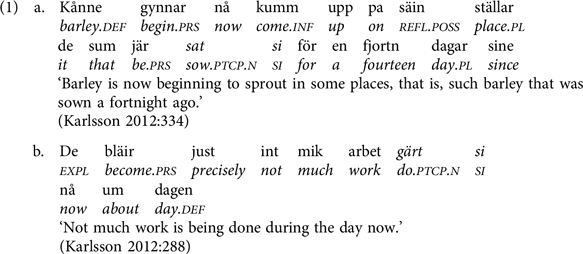
As can be seen in (1), the si-passive may occur with two types of auxiliary: either with be (as with jär ‘is’ in (1a)) or become (cf. bläir ‘becomes’ in (1b)). The subject is most often the expletive de ‘it’ (1b), but in some cases it may correspond to the internal argument of the main verb, for instance in the form of a relativized subject (1a). The si element is homophonous with the reflexive pronoun si in examples like ha kambar si ‘she combs her hair (lit. herself)’. Still, in (1), si clearly does not function as a reflexive. Instead, the combination of participle and si has more or less the same meaning as the simple participle in the regular periphrastic passive when it is used in similar contexts; see (2a–b).
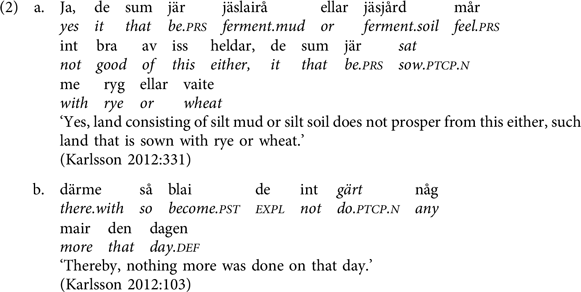
However, there is a subtle difference in the aspectual implications of the si-passive in (1) on the one hand and the regular periphrastic passive in (2) on the other. Crucially, si highlights the process rather than the result. Thus, in (1a), the focus is on the actual sowing that took place a fortnight ago, whereas in (2a), the focus is instead on the present state of the land as a product of such sowing. As can be seen, this difference in focus is manifested in the reference of the subject: in (1a), the relativized subject corresponds to the seeds, but in (2a) to the land. Further, the si-passive with become tends to favour habitual contexts (as in (1b)), where the processual nature of regular work is foregrounded. Purely resultative cases like (2b), where the end-point of doing chores is in focus, instead tend to be expressed with the regular become passive.
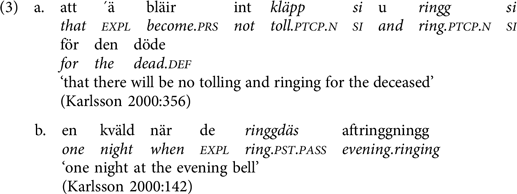
There are also contexts where the si-construction lacks a regular counterpart. Consider (3a) below, where si combines with the participle of two unergative verbs. In cases such as these, there is no regular periphrastic counterpart. Instead, the only possible paraphrase is with the morphological passive, shown in (3b); the morphological passive is formed by a combination of an active verb form, in the case at hand ringg-dä ‘ring-pst’, and the suffix -s.
I will argue that the si-passive involves a participle ending consisting of the original neuter participle ending merged with the si element. This structure is the result of reanalysis of the reflexive object si (in VP) as part of the participle morphology between VP and vP (in an AspP, following Fábregas & Putnam Reference Fábregas and Putnam2020). It accounts for the durative nature of the si-construction (compared to the regular periphrastic passive) as well as the restrictions on the subject. Historically, the si-passive is quite recent, and its emergence appears to be linked to changes in participle morphology taking place during the eighteenth century.Footnote 1
This article is outlined as follows. Section 2 shows the geographic spread of the si-passive, based on attestations in dictionaries and archival records. Section 3 presents the Gutnish corpus, and Section 4 introduces Gutnish passives in general and participles in particular. Section 5 contains the empirical bulk of the article; here, I lay out the details in the usage of the si-passive in the Gutnish corpus. Section 6 presents the syntactic analysis of the si-construction, and Section 7 seeks its origin. Finally, Section 8 contains the conclusions.
2. Geographical distribution of the si-passive
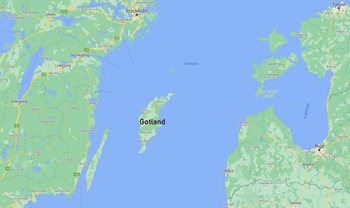
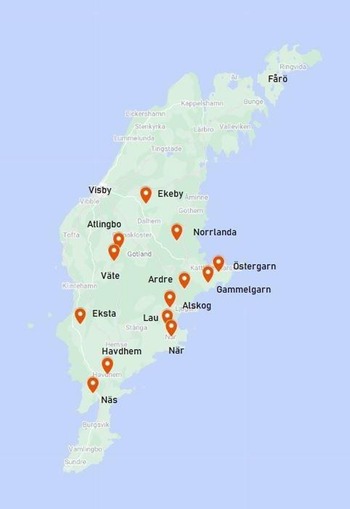
Map 1 shows the location of Gotland in the Baltic Sea. Map 2 shows Gotland in more detail. Here, I indicate with map pins all parishes (represented by the position of the parish church) where the si-passive has been attested. Most attestations are drawn from the general dictionary of Gutnish (GO), but I have also used the dictionary of the dialect of the parish of Lau (OL) as well as two unpublished field reports kept at the ISOF archive in Uppsala (Wessén 1916, Carlsson 1918).Footnote 2 As can be seen, both the northernmost part of the area (including the island of Fårö) and the western parts of the main island (including the area around the main town of Visby) lack attestations. As for the western parts close to Visby, they are generally more poorly documented than the more rural southeast. Thus, we cannot exclude that the si-passive existed here, although it has not been recorded. For this possibility speaks the fact that Carlsson, in passing, notes that the si-passive exists all over the main island (Carlsson 1918:3–4).
Gotland in the Baltic Sea.
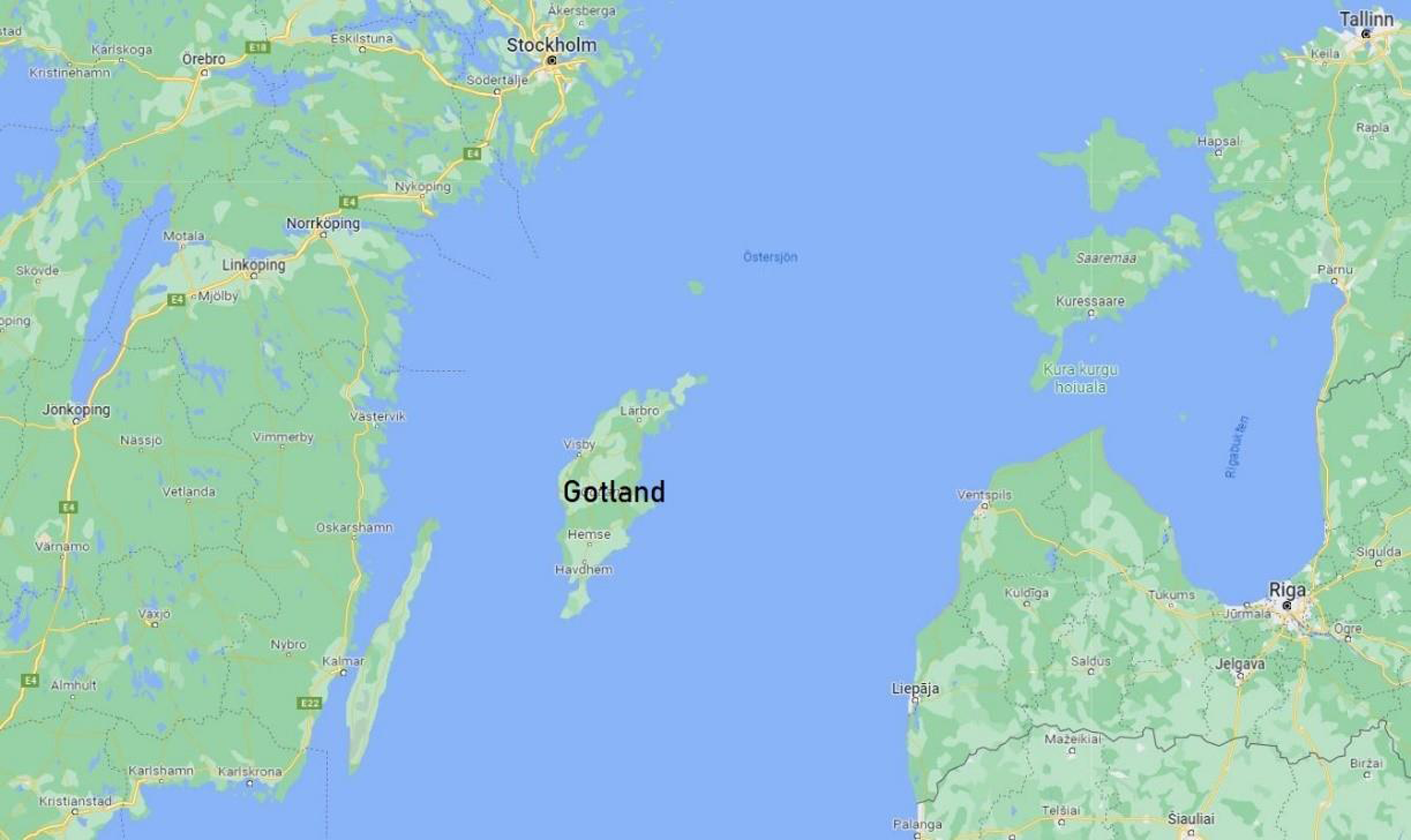
Map 1 Long description
The map displays the Baltic Sea region with a focus on the island of Gotland. Key locations such as Stockholm, Tallinn, and Riga are labeled. The map includes surrounding areas of Sweden, Estonia, and Latvia. Major cities and towns like Norrkoping, Linkoping, and Visby are also marked. The map provides a clear view of the geographic layout and the relative positions of these locations.
Gotlandic parishes where the si-passive has been attested.
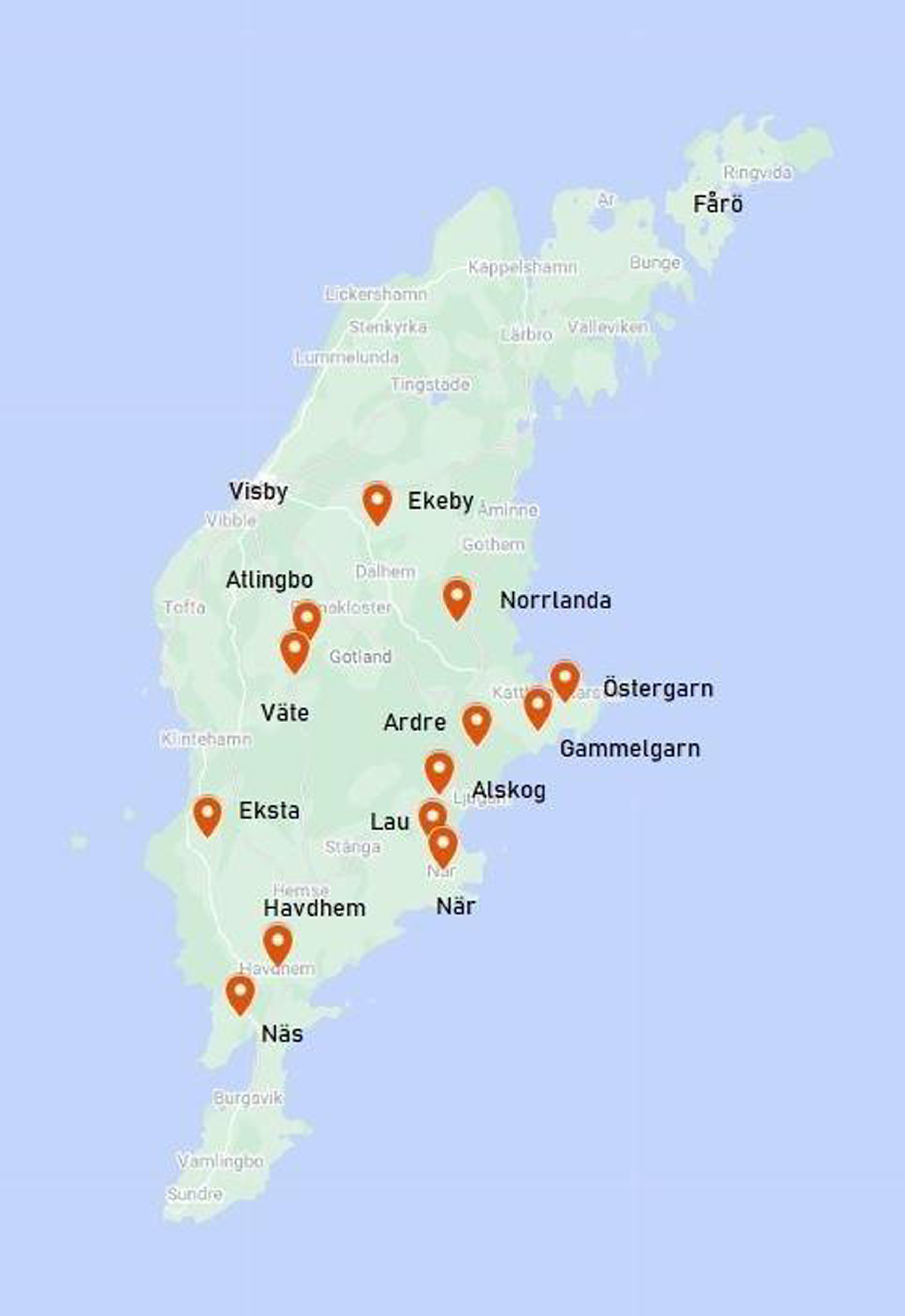
Map 2 Long description
The map displays the geographic region of Gotland in the Baltic Sea, highlighting various parishes where the si-passive has been attested. Key locations such as Visby, Atlingbo, Vate, Eksta, Havdhem, Nas, Ekeby, Norrlanda, Ardre, Lau, Alskog, Nar, Ostergarn, and Gammelgarn are marked with orange pins. The map provides a visual representation of the distribution of the si-passive in these parishes, aiding in the understanding of linguistic patterns across Gotland.
As for Fårö, Carlsson refrains from making any claims: he simply states that Fårö is beyond his knowledge (Carlsson 1918:4). In GO, there are no si-passives from Fårö. Naturally, it is always difficult to draw certain conclusions from the absence of data. However, Fårö Gutnish, representing the most archaic of the Gutnish varieties, has received quite intense scholarly attention from the mid 1800s onwards, including a survey of verbal morphology by Säve & Lindström (Reference Säve and Lindström1854). I therefore find it very unlikely that the Fårö variety has ever had the si-passive, since it would surely have been documented in that case. This presumed lack of si-passives in Fårö is also supported by the testimony of the most diligent student of the Fårö variety in recent years, Kristina Hagren (see e.g. Hagren Reference Hagren2002, Reference Hagren2007). Although being well aware of the si-passive, she maintains (p.c.) that she has never heard it in Fårö.
3. The Gutnish corpus: Jakob Karlsson’s letters
To be able to study the usage of the si-passive, I have compiled a corpus consisting of letters written in Gutnish by Jakob Karlsson.Footnote 3 Karlsson was born in the parish of Lau in southeastern Gotland (see Map 2) in 1857, where he lived as a farmer all his life (he died in 1933). In 1889, he started writing letters in his Lau dialect to linguist Mattias Klintberg, whose efforts eventually led to a comprehensive dictionary of the Lau dialect (OL, mentioned in Section 2). Karlsson’s letter writing continued until 1929. The original letters, 262 in total, are kept in the Visby branch of the Swedish National archives, and they amount to no less than 4263 folio pages and 35 smaller pages (Karlsson 2000:8, 21). The first 59 of Karlsson’s letters have been transcribed and published in two volumes (Karlsson 2000, 2012). It is the contents of these two volumes that make up the corpus of Gutnish used in this article: the first 59 letters span from 1889 to 1895 and consist of approximately 530,000 words. In practice, to be able to perform searches in the text (see further Section 5.1), I have used an electronic version of the two volumes, which has been generously provided by Gutamålsgillet, a local non-profit organization promoting the Gutnish dialect (see http://www.gutamal.org/).
Compared to the original handwritten letters by Karlsson, the edited version is somewhat modified. For instance, intermediate headings have been added, the text has been divided into paragraphs, and orthographic measures have been taken to help readers, e.g. by adding punctuation and harmonizing the use of capital letters. However, and crucially, ‘grammatical errors have … been left unaltered’ (Karlsson 2000:10).Footnote 4 In other words, I have no reason to believe that the editorial efforts have affected the usefulness of the text for grammatical purposes.
The corpus of Karlsson’s letters constitutes my primary source of Gutnish data throughout the article. More specifically, it is on the language use of this single informant that I base my analysis of the si-passive outlined in Section 6. I supplement my own excerpts with examples from Karlsson occurring in OL. As for more occasional examples of the si-passive that I have found in other sources (see Section 2), they all fall within the boundaries of the construction, as it is used by Karlsson; see the Appendix for quantitative data.
The more recent development of the si-passive lies beyond the scope of this article; I leave this task to future research.
4. Passives and participles in Gutnish
4.1 Gutnish regular passives in a Scandinavian context
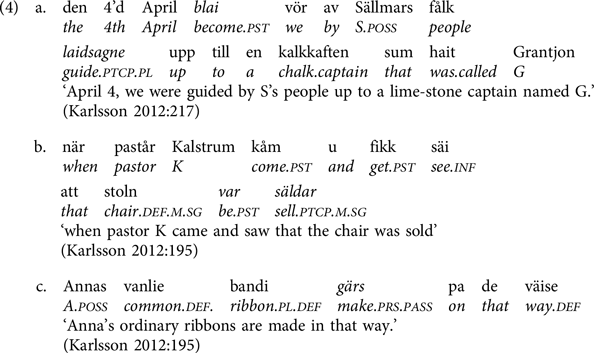
Setting aside the si-construction, Gutnish passives are very similar to passives in standard Swedish. Like Mainland Scandinavian languages in general, Gutnish has a periphrastic passive, formed either with become, giving an episodic reading (see (4a) below), or with be, giving a stative reading (see (4b)). In addition, there is a morphological passive, formed with the suffix -s; see (4c). As can be seen in (4a–b), the participle agrees with the subject in number and, in the singular, also in gender: the -e in laidsagne in (4a) is thus triggered by the plural subject vör, and in (4b) -ar in säldar agrees with the masculine singular noun stoln. The more precise nature of the Gutnish agreement endings in participles is the topic of Section 4.2.
As emphasized in the previous literature (e.g. Hulthén Reference Hulthén1944:192–194, Laanemets Reference Laanemets2012:28–32, Engdahl Reference Engdahl, Sheehan and Bailey2018, Faarlund Reference Faarlund2019:174–176, Fábregas & Putnam Reference Fábregas and Putnam2020:67, 69; see also Larsson & Petzell Reference Larsson, Petzell, Larsson and Petzell2021:27–29), Swedish stands out among the Mainland Scandinavian languages in favouring the s-passive in all tenses. More specifically, Swedish prefers s-passives even in the past tense and the tenses formed with auxiliary have and the supine (i.e. perfects and pluperfects), where the morphological passive is highly marginal in Danish and Norwegian. Gutnish patterns with Swedish in this respect.
Consequently, there are plenty of Gutnish s-forms of the supine, one of which is given in (5a) below, as well as past tense s-forms as in (5b). Now, consider the Swedish and Norwegian equivalents to the examples in (5). In Swedish, the s-passive is the preferred strategy in both contexts, as shown in (6). In contrast, Norwegian has the periphrastic passive; see (7).
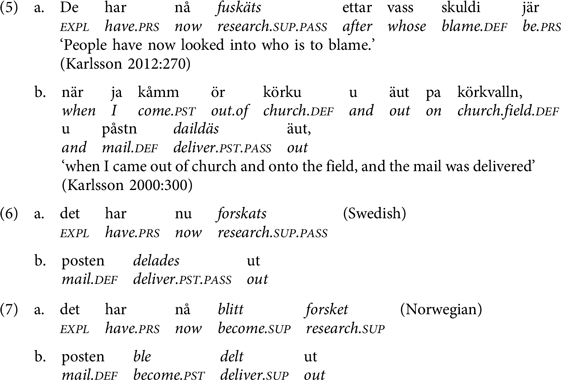
In sum, Gutnish employs all the passive strategies that are known to occur in Mainland Scandinavian, but the morphological strategy is clearly the unmarked one. Although Gutnish is thus on a par with standard Swedish (cf. (5) with (6)), it is not likely that the similarity is an effect of Gutnish having adapted to the standard language. Instead, the dominance of the s-passive falls neatly into the geographical pattern identified by Holm (Reference Holm1952:170–171), who concludes that eastern and especially southeastern Swedish dialects are particularly prone to resorting to morphological passives.
4.2 Weak and strong participles in Gutnish
In (4a) above, the form of the participle ending deviates from what we find in most Scandinavian varieties (including standard Swedish). The form in question, laidsag-n-e, is the plural form of the passive participle, which can be compared with standard Swedish ledaga-d-e. Consider also the s-form of the supine känn-ä-s in (8) below, which differs from the corresponding standard Swedish supine kän-t-s.
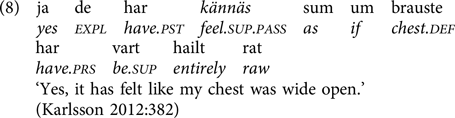
What the forms laidsagne and kännäs reveal is that verbs of the weak conjugations (first and second in the cases at hand) do not form participles with a dental affix involving d and t (like standard Swedish), but instead the n-based suffix of the strong paradigms. As can be seen, it is clear that the n-suffix is present in laidsagne, less so, however in kännäs; this form therefore deserves a comment. In standard Swedish, the ä of the ending corresponds to -et, which is the neuter version of the n-suffix: cf. the two standard Swedish examples in (9).

By contrast, in Gutnish, word final -t (regardless of morphological status) is always deleted when it is preceded by an unstressed vowel (Gustavson Reference Gustavson1948:207). The form kännäs is thus derived by deletion of final -t from an underlying kännät, to which the s-suffix is then added.
Now, we have concluded that the inflection pattern of strong participles appears to be spreading to the weak conjugations in Gutnish. However, if we consider the entire verbal paradigm, the diachronic distribution of weak and strong forms is less straightforward. For instance, weak forms even appear to be gaining ground over time in the past tense; see Jordan (Reference Jordan2023) for details. In the following, I address the shifts in participle morphology only, focusing in particular on the neuter form since this is directly relevant to the si-passive.
In the corpus, both originally weak and new strong forms of participles occur. Besides new strong forms like laidsagne and kännäs, we thus find weak gärt (in e.g. (1b)) rather than gärä, and weak säldar (in (4b)) rather than säln. OL certainly maintains that the strong n-suffix has become the general participle ending in the Lau dialect (vol. IV:1839). Nevertheless, it is clear from the paradigms given in OL (vol. IV:1839–1844) that weak forms and new strong forms live side by side, often even varying within the same lexeme, e.g. kokän/kåuktar (‘boiled’) naikän/naiktar (‘denied’), saän/sadär (‘sown’) (vol. IV:1845). Apparently, the strong participle endings have spread to weak verbs all over Gotland. In GO, it is thus stated that ‘[n]owadays [i.e. in 1945], in Gotland proper, the strong form has replaced the weak one: friestn frestad [i.e. “tempted”], lastn lastad [i.e. “loaded”], hitn hittad [i.e. “found”] etc.’ (vol. II:lii; cf. however Jordan Reference Jordan2023 for a less categorical account). The wording ‘Gotland proper’, in Swedish det egentliga Gotland, is crucial. It refers to the main Gotlandic island, explicitly excluding Fårö. In other words, the spread of the strong forms never reached Fårö, where participles instead remained more similar to standard Swedish.
The Fårö dialect also patterns with standard Swedish in upholding a formal difference between neuter passive participles and non-agreeing active participles (supines) in the strong conjugation classes. By contrast, the other Gutnish varieties lack this distinction, as I show in (10) below with the originally strong verb ‘drink’, where the neuter participle and the supine coincide.Footnote 5 As we see here, the ending is identical in the infinitive (-ä) and in the neuter participle/supine (-ä), the original final -t in the latter case, as mentioned before, having been deleted for phonological reasons; the underlying form is given within parentheses. Still, the infinitive is distinct from the participle/supine, since in the originally strong paradigms, there is a difference between the present stem vowel, in the case at hand i, which is used in the infinitive, and the past stem vowel, here u, which is used in the participle.

In the originally weak inflection classes, the difference between infinitives and participles/supines is encoded only in the ending: we have -ä in the former case and -t in the latter, as shown in (11a) with the verb for ‘dig’. Here, the participle ending is not preceded by a vowel and is therefore intact. However, as the strong inflection takes over, neuter -t ends up in a position where it is indeed deleted, as shown in (11b). Given that stem vowel variation plays no role in the weak paradigms, the ambiguity is therefore expanded to including also the infinitive.

So, in the end, the spread of the strong participle inflection into the weak paradigms creates forms that are triply ambiguous, between the neuter participle (gravä), the supine (gravä), and the infinitive (gravä) as in (11b). In Section 7, I propose that this relatively new (and increasing) ambiguity has led to the emergence of the si-passive, initially as a strategy to separate infinitives from neuter participles. Seeing that the Fårö dialect is unaffected by the development towards more ambiguity, the striking lack of si-passives from Fårö (see Section 2) gets a natural explanation.
5. Jakob Karlsson’s use of the si-passive
In this section, I present my investigation of the si-passive in the Gutnish corpus. In Section 5.1, I outline the excerption method. The results are presented in detail in Section 5.2, and then summarized in Section 5.3.
5.1 Retrieving examples
As stated in Section 3, I have used an electronic version of the two editions of letters written by Jakob Karlsson between 1889 and 1895. In the data file, I have tried to find all examples of the si-passive by performing various searches. To get a selection of examples to work with manually, I have searched for all possible neuter participle endings directly followed by si. Weakly inflected participles that end in a -t with no vowel before it (e.g. gärt) are easy to retrieve since the ending is always intact. By contrast, participles where the -t is preceded by a vowel and therefore deleted (e.g. gravät>gravä) are much harder to collect. This follows from the fact that the ä-ending is often deleted too when it precedes a word that begins with a consonant like si.Footnote 6 Consequently, a sequence like gravä si does not occur in the corpus but instead appears like this: grav si. Thus, to be able to find combinations of participles ending in a deleted -ä, as it were, I have had to search for words ending in any consonant directly followed by si. Since the searches returned many false positives, I went through all hits and identified the si-passives manually.
Although I have certainly aimed at finding all examples of si-passives in the corpus, I could of course have missed some examples when going through the search results. Therefore, I have also browsed through all instances of si in the corpus, not least to ensure that I have not missed any unexpected uses of the si-passive that the searches for combinations of participle endings preceding a si could not yield. However, I have found nothing that indicates that the construction is fundamentally different than previous documentations have indicated: passive si is indeed restricted to contexts where it appears to the right of the neuter form of the past participle.
As for other types of passive examples, my aim has not been to obtain a complete set of examples. Instead, the regular passives function as points of comparison in order to better understand the role that the si-passive plays in the passive system. I have collected my regular examples in different ways. To retrieve regular periphrastic passives, I have searched for various combinations of a passive auxiliary (i.e. be or become) and the neuter pronoun de, and to find s-passives, I have simply gone through lists of words ending in -s.
5.2 Results
The various searches in the corpus (see Section 5.1 for details) have yielded 58 examples of si-passives. Also, 21 additional examples from Jakob Karlsson occurring in OL have been included in the sample. Below, I address these in total 79 examples in detail. How common the si-passive is in relation to the regular periphrastic passive is hard to specify, since it depends on what selection one compares it with. Amongst periphrastic passives in general, the si version is of course quite marginal, since, due to subject limitations, it is more or less restricted to impersonal constructions.
The more precise nature of the subject limitation is the topic of Section 5.2.1, and in Section 5.2.2, I deal with the main verb and its non-subject arguments. When we consider impersonal periphrastic passives in general, it is quite clear that the version involving si and the regular type satisfy different needs. The si-passive describes processes, while in the regular construction, the result is instead in focus. I consider this contrast in Section 5.2.3. Further, in Section 5.2.4, I compare periphrastic passives in Gutnish and standard Swedish, concluding that the higher frequency in be passives in Gutnish is directly related to the si-construction. Finally, Section 5.3 summarizes the results.
Sometimes, but not always, I refer to specific numbers when describing various uses of the si-passive. To access all numbers, the reader is referred to Tables A1–A4 in the Appendix, where the occasional examples of si-passives that occur in other sources (see Section 2) are included for comparison.
5.2.1 The subject in si-passives
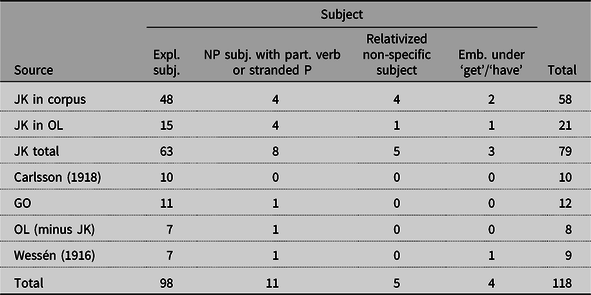
Out of the 79 examples of si-passives in my sample, 63 have an expletive subject as in (12).
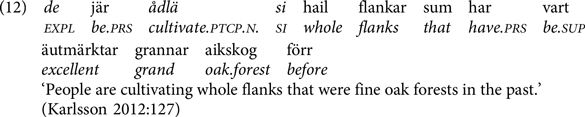
Although expletive subjects are clearly the dominant subject type, there are 16 si-examples that do not have an expletive subject. These exceptional cases fall into three subgroups. First, there are eight si-examples where the subject is a noun phrase, as in (13) below. In all these cases, the subject either corresponds to the complement of a preposition that is stranded in the VP (e.g. me ‘with’ in (13a)), or to the internal argument of a particle verb (as with avdailt, lit. ‘off-sectioned’, in (13b)).
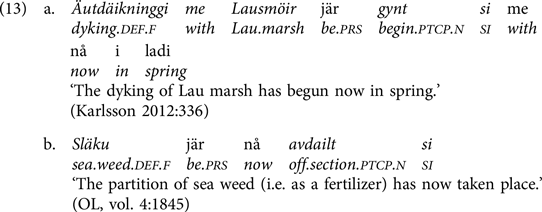
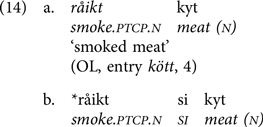
Note that the form of the participle is the same here as in the examples where the subject is an expletive, that is, the neuter singular, either ending in -ä (cf. ådlä in (12)) or -t (cf. gynt, avdailt in (13)); see Section 4.2 for details. As shown in Section 4.1 above, in the regular periphrastic passive, participles in Gutnish agree with the subject of the clause. In the regular construction, feminine noun phrases such as äutdikningg and släka in (13) would not combine with the t-form. The usage of the neuter form in si-passives across-the-board could indicate either that the participle does not agree in si-passives or that there is agreement with the expletive, which is expected to trigger neuter agreement and which would then have to be elliptic in examples like (13). However, when we consider other contexts where we know there is neuter agreement, like the attributive use of a participle in a neuter noun phrase in (14a) below, there are never any si-participles; cf. (14b). The absence of examples like (14b) suggests that the no-agreement alternative is the correct one.
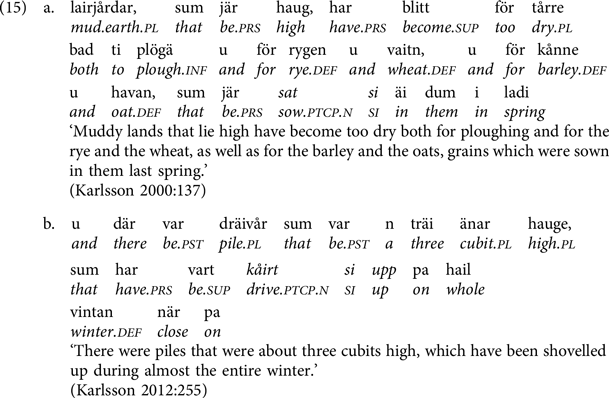
Second, si-passives may occur in relative clauses, where the relativized subject can be interpreted as having non-specific reference. There are five examples of this sort in the sample, one of which is given in (15a) below. I have not found any si-passives in relative clauses where the relativized subject must be interpreted as having specific reference. At first, the example in (15b) may certainly look like precisely such a case: here the relativized subject refers to the specific piles of snow being introduced in the matrix clause. However, in (15b), the subject is the argument of a particle (i.e. upp), which means that it actually belongs in the first group, exemplified in (13).
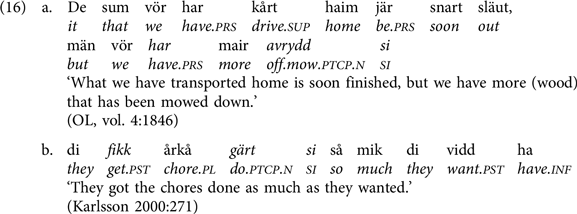
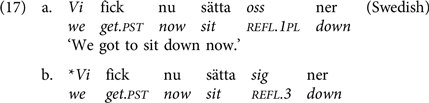
Most si-passives involve the auxiliaries be or become (on the distribution between them, see Section 5.2.3 and the Appendix). Only three si-passives occur in another context. Two of them are embedded under have, as shown in (16a) below, and one under get; see (16b). In si-examples of this sort, there is no expletive subject but instead a referential subject in the matrix clause. Contexts like (16a), where this matrix subject is the first person, clearly indicate that si is not a reflexive. If we consider the behaviour of reflexives in a corresponding construction in standard Swedish, where binding works as in Gutnish, we find that first person vi is incompatible with sig; cf. (17a–b).
In Section 7 below, I argue that the get context is where the si-passive has emerged in the first place.
5.2.2 The si-complex and its non-subject arguments
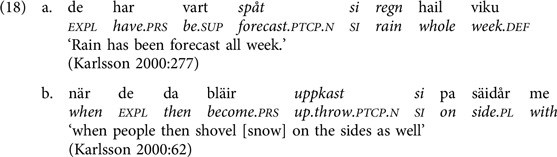
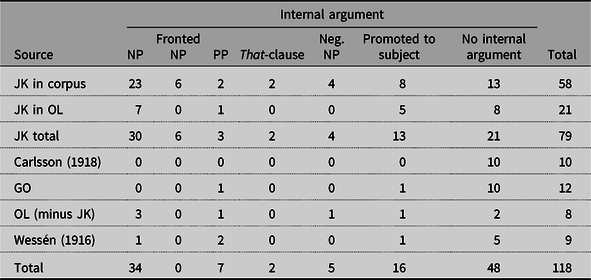
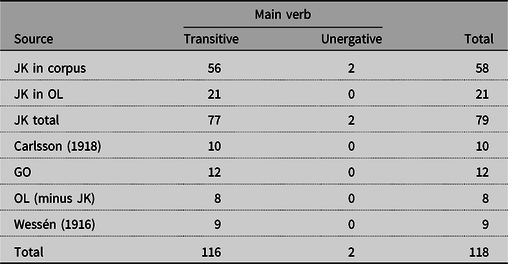
The vast majority of the si-examples in the sample (77/79) involve transitive verbs. The transitive examples often contain an explicit internal argument in the form of a noun phrase, like regn in (18a) below. But they may also lack such an argument, as in (18b).
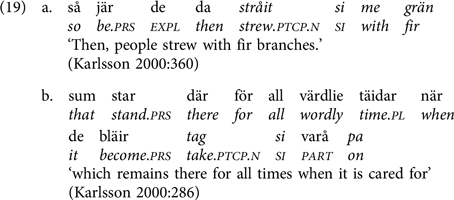
The internal argument can also be a prepositional phrase (PP). As with noun phrases, the PPs sometimes remain in their base position in VP; see (19a) below. Unlike noun phrases governed directly by the main verb, noun phrases governed by P may indeed, as we have seen (in (13a) above), escape the VP to become the subject; another such example is given in (19b), where the preposition pa is stranded. Note that de is not an expletive in (19b) but the regular (referring) neuter pronoun.
Transitive verbs that are used without an internal argument, as in (18b), resemble unergatives. The verb in (18b), uppkastä ‘shovel’ (lit. ‘toss up’), may certainly be construed with such an argument, typically snåi ‘snow’. Nevertheless, the verb is on its own in this context. Prytz (Reference Prytz2016) has proposed that Swedish transitives denoting activities (like ‘shovel’) are structurally intransitive when they are used without an explicit object. Consequently, on her account, (18b) and examples like it could be classified as unergative. However, and mainly for reasons of transparency, I have sorted them as transitives in Table A4 of the Appendix, and included them in the column for examples lacking an internal argument in Table A3.
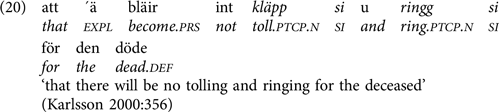
True unergatives do occur in si-passives, but they are very rare: I have found only two unergative main verbs in a si-construction; see (20) below (= (3a) above). The verbs in question, ringgä and kläppä, are unable to ever take a proper object, although there may be a PP present where the item used for the act of ringing is specified (as in ringgä/kläppä i klokku, lit. ‘ring/toll in the bell’).Footnote 7
Finally, a note on agentivity: common to all examples in the sample, transitives and unergatives alike, is that although there is always an agent implied, it is never explicitly expressed. The lack of explicit agents will be directly related (structurally) to the presence of si in Section 6.1.
5.2.3 Impersonal passives with and without si
As shown in Section 5.2.2, the main verb of a si-passive can be unergative. However, turning to the regular periphrastic passive, I have not come across any unergative examples in the corpus. To be more precise, regular passive participles in Gutnish always need to be tied to an internal argument, which often leads to a resultative meaning. Si-passives, on the other hand, typically focus on the process. I believe that this focus follows from the lack of a structural link between participle and internal argument (see Section 6.1 for details).
Many of the main verbs occurring in the si-construction are indeed process verbs, as in (21) with ‘transport’.

However, punctual verbs may also occur if they are used iteratively or in habituals. Thus, in (22a) below, the act of handing out a book was performed over and over again, and in (22b), the act of leaving a pitchfork behind in the mud is described as a rare routine.
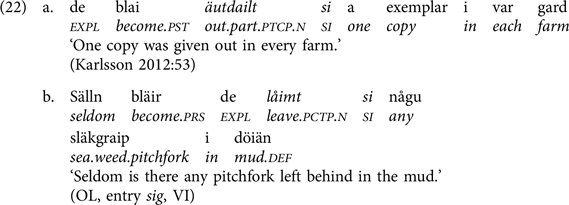
Again, iterative and habitual uses are expected given the processual nature of the periphrastic passive with si. By contrast, when a particular result (or lack thereof) is highlighted, the periphrastic passive tends to be si-less as in (23); cf. also (2b) above.

Sometimes, the si-passive and the regular periphrastic passive are used in very similar contexts. Consider the example pair in (24) below, where ‘decide’ is used with si in (24a) and without it in (24b).
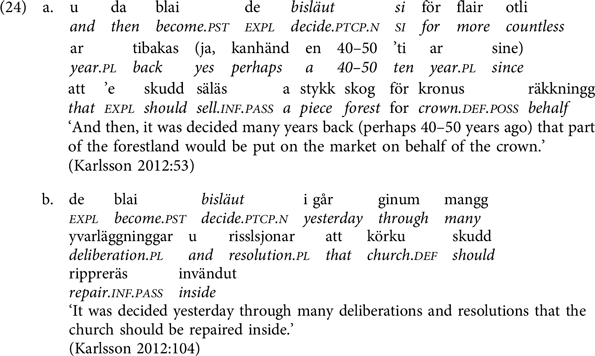
In the regular periphrastic passive in (24b), although the decision was apparently preceded by negotiations, the decision itself is described as taking place at one particular point in time, i.e. ‘yesterday’. The example with si in (24a) certainly contains a time frame as well, indicating that the decision was made many years back. However, from the context, it is quite clear that there was a rather complex decision process, involving several parties, putting a large estate on the market in portions over a long period of time. To reflect this complexity, Karlsson uses the si-passive rather than the regular periphrastic passive.
5.2.4 A comparative comment on impersonal passives
As shown by Engdahl & Laanemets (Reference Engdahl and Laanemets2016), periphrastic impersonal passives are highly marked in standard Swedish, unlike in Norwegian and Danish. For instance, Swedish unergatives are strikingly bad with periphrasis (Engdahl & Laanemets Reference Engdahl and Laanemets2016:133). As we have seen, Gutnish too avoids the regular periphrastic passive in such contexts. In fact, setting aside the si-passive, the use of the periphrastic impersonal passive is very similar in Gutnish and standard Swedish, which is in line with the general closeness in passive choices between the varieties concluded already in Section 4.1. In Swedish, the only context where periphrastic impersonal passives occur more regularly according to Engdahl & Laanemets (Reference Engdahl and Laanemets2016:139–140) is precisely the context exemplified in (23), involving a negated resultative. Presumably, this generalization is valid for Gutnish as well. Although I have not made any full scale investigation of the regular periphrastic passive in the corpus (as mentioned in Section 5.1), my impression is that examples such as these are very typical. Still, the periphrastic strategy is of course much more common in impersonal passives on the whole in Gutnish than in Swedish. However, this difference is due to the Gutnish-specific si-construction, which broadens the range of periphrastic passives.
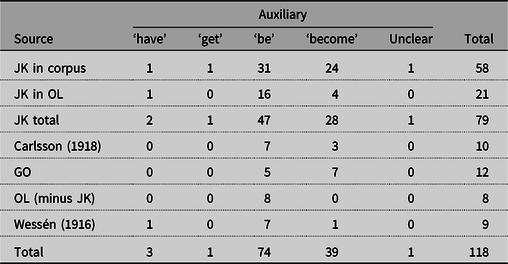
The broadened range is particularly conspicuous when we consider the usage of the different passive auxiliaries be and become. As noted in Section 4.1, in the regular periphrastic passive, become renders an episodic reading and be a stative reading. With the processual si-participle, however, the stative reading under be is, in fact, lost. Instead, we appear to get an almost progressive outcome when the si-complex is combined with be. Consequently, it is often appropriate to translate these si-passives to English using an ing-form; cf. e.g. ‘manure is being transported’ in (21). In other words, the be passive has spread to new contexts due to the processual semantics of the participle accompanied by si. In practice, impersonal passives with si involve auxiliary be to a much larger extent than regular impersonal passives. Again, I have not excerpted all regular passives in the corpus. However, we can note that Engdahl & Laanemets (Reference Engdahl and Laanemets2016) only investigate cases with become when they address periphrastic impersonal passives in standard Swedish. By contrast, in the Gutnish corpus, si-passives with be are almost twice as frequent as si-passives with become; this tendency is clear also in the other Gutnish sources (see the Appendix for exact numbers). In Section 6, I propose that structurally, the processual semantics of the si-passive follows from the fact that si occupies the same syntactic position as the participial agreement suffix. Unlike the participle ending, si is never linked to the internal argument, and this difference, I argue, leads to the aspectual difference at hand.
5.3 Summary
The subject in si-passives is an explicit expletive in the vast majority of cases; there is also a handful of examples involving relative clauses where the relativized subject has non-specific reference. When, on occasion, there is a regular noun phrase subject, this demands a certain type of VP: there has to be either a particle involved, or a stranded preposition.
The form of the participle is always the same as neuter singular, although the si-complex as a whole is unable to agree with a neuter noun phrase (see (14)).
Most verbs in the si-construction are transitives (with and without internal arguments of various sorts), but usage with unergatives is also attested. What unites all main verbs in the si-construction is that they all presuppose a deliberate action. Although there are never any explicit agents present, there is always an agent implied.
The si-passive typically describes processes, unlike the regular periphrastic passive, which is instead resultative. Presumably, it is the processual nature of si-passives that makes them suitable for usage with unergative verbs, which do not occur in the regular construction.
The si-complex is most often combined with the auxiliaries be or become. Marginally, it may also be embedded under get and have.
6. Si in syntax
In the following, I present a formal account of the passive participle that accounts for the nature of the si-passive. In (25) below, I summarize the descriptive facts about the si-passive brought forth by the survey in Section 5.
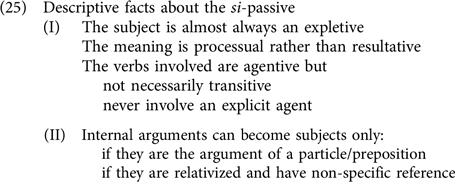
I address the facts in (I) in Section 6.1 as I present the mechanisms of the formal analysis. I consider the more exceptional cases in (II) in Section 6.2. Section 6.3 summarizes the syntactic analysis.
6.1 Outlining the formal analysis
My idea is that si in the si-construction has evolved from a reflexive pronoun to an integral part of the participial ending, the result of which is a participial ending containing nominal features (φ). I show this development in (26a–b) below with a weak and a strong participle. I address the circumstances leading up to the reanalysis in more detail in Section 7. Here, I direct my attention solely to the result of the reanalysis, that is, the forms to the right of the arrow in (26). As can be seen, the si-complex is, in fact, not a participle + si, but instead a participle where the participial suffix ends in -si. In short: a si-participle.
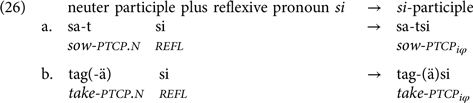
Crucially, this reanalysis leads to a participle ending that is nominal rather than adjectival. Consequently, it does not agree with the internal argument. Instead, it fills the same syntactic slot as an external argument, which means that it blocks other external arguments from ever occurring, rendering an impersonal interpretation of si-passives. I have found that the analysis of Scandinavian passive participles argued for by Fábregas & Putnam (Reference Fábregas and Putnam2020) is particularly accurate in predicting the morphosyntactic behaviour of tsi/(ä)si. In the following, I will therefore adopt their model and show how it can help us understand what structural correlate the limitations on the si-passive might have.Footnote 8 The model is designed to handle voice in general. However, it would lead us too far astray to engage in a more general discussion of voice here; readers with such an interest are therefore referred back to Fábregas & Putnam (Reference Fábregas and Putnam2020:85–98) and the references cited.Footnote 9
Fabregas & Putnam propose that the locus of passive participial morphology (ptc) is an aspectual head located between VP and vP, as shown in (27); the analysis of the participial affix as a realization of grammatical aspect goes back to Embick (Reference Embick2004:383).

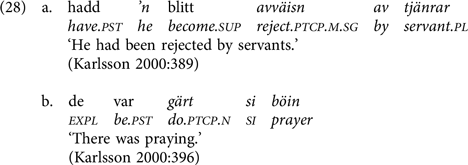
If we thus give participle morphology aspectual relevance by locating it in an Asp head between VP, where we have internal arguments, and vP, where external arguments typically holding an agentive role reside, the differences between si-participles and ordinary passive participles can be accounted for quite straightforwardly. Recall my proposal that the ending of the si-participle has a nominal rather than an adjectival character. Translated into more technical terms, the participial affix, corresponding to tsi/(ä)si in (26), does not involve uninterpretable phi-features (uφ) such as regular participle endings, but instead interpretable phi-features (iφ) such as nouns and pronouns. This has several consequences for how the derivation of the si-participle proceeds compared to regular passive participles. I will now illustrate these consequences by deriving the (participial structure of) the two examples from the corpus in (28) below,Footnote 10 using the model in (27); see (29). I should say that the analysis is somewhat simplified in order for the derivation to be relatable to the actual output. More specifically, I classify the individual morphemes as taking part in the syntactic derivation, although transference to phonological form is a later step.
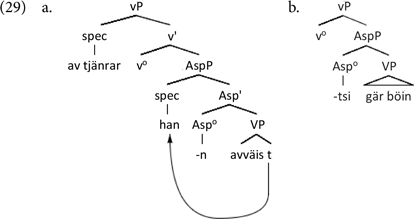
In the regular example in (29a), -n in Aspo hosts uninterpretable phi features, which need to be matched with an appropriate bundle of interpretable features: -n thus probes for iφ, finds it on the pronoun han in VP and matching takes place. As a result of the matching, the pronoun raises to the specifier of AspP from where it can, eventually, move on and become the subject of the clause.Footnote 11 By contrast, -tsi in (29b) hosts interpretable phi-features itself, and therefore there is never any probing into the VP; as a result, the internal argument böin is trapped in its base position and can never become the subject of the clause.Footnote 12 The contrast between agreeing -n and non-agreeing -tsi is thus directly responsibly (structurally) for the difference in subject limitation between si-passives and regular periphrastic passives.
Moreover, the difference between agreeing and non-agreeing Aspo also has aspectual consequences. It is expected that the linking of an aspectual affix to an argument of V has an impact on the semantics of the event, crucially enabling a resultative interpretation. Since precisely this linking is absent in the si-participle, it lies close at hand to relate it to the processual nature of si-passives. In other words, the fact that si-passives often describe processes can be analysed as reflecting the lack of the resultative aspect otherwise characteristic of passive participles. On the other hand, si-passives may occur in iteratives and habituals (see (22) above), which suggests that the V-domain is more complex than the present analysis is able to reveal. A split V-domain of the Ramchandian type (see Ramchand Reference Ramchand2008), where processual and resultative semantics are represented by separate heads, could probably help us understand the more subtle semantic details of the si-passive. However, I will leave this task for future research.Footnote 13
Further, we have seen above that si-passives, unlike regular periphrastic passives, may occur with unergative verbs, that is, agentive verbs that lack an internal argument (see (20) above). Given that Aspo never probes for a VP internal goal in si-participles but always does so in agreeing participles, the unergative difference follows straightforwardly. Without any VP-internal bundle of interpretable phi-features, the derivation of the regular participle is bound to crash. In contrast, the presence of such a bundle in si-participles has no structural relevance.
Finally, the analysis in (29b) offers an explanation of the lack of explicit agents in si-passives. Since -tsi, unlike regular participle endings, has interpretable phi features, -tsi is a perfect goal for vo, probing for a nominal match. Consequently, there is no need to merge an external argument in spec-vP, as in the regular participle in (29a).Footnote 14 Nevertheless, we still have to assume that vP is indeed present in si-participles, since, as we have seen, si-passives are restricted to agentive verbs (and in the model adopted here, vP is where agents are introduced).Footnote 15
So far, I have said nothing of the order between the verbal stem and the participle ending. Clearly, there is need for some displacement mechanism that puts the stem before the ending, so that the final output of the syntactic derivation matches the actual usage. However, I will not pursue the matter here, since nothing hinges on the exact formulation of such a mechanism. What is crucial is that my analysis treats regular participle endings and the tsi/(ä)si-elements as realizations of the same head (i.e. Aspo). Consequently, whatever rule derives the correct order between stem and ending in the regular case, e.g. -n avväis → avväis-n in (29a), will also derive correct si-participles, e.g. -tsi gär → gär-tsi in (29b).
6.2 Escaping the VP or remaining there in silence
As shown in Section 6.1, our formal analysis predicts that in si-passives, VP-internal arguments are never subjects, since the lack of a structural link between Aspo and the internal argument (‘participle agreement’) leads to the entrapment of the internal argument in its base position in VP. However, as shown in Section 5.2.1 above, the internal argument can indeed become the subject if it leaves a preposition or a particle behind in VP. I interpret this condition as an indication that both prepositions and particles are able to project a specifier position through which the internal argument can escape the VP; see the analysis of (13a–b) above in (30) below. This analysis is inspired by Fábregas & Putnam’s analysis of pseudo-passives, where subject promotion is assumed to be structurally dependent on a stranded preposition having created a specifier for the subject to move through (Fábregas & Putnam Reference Fábregas and Putnam2020:136).
(30)
a.
[TP Äutdikninggij … [PP tj [P
o me] tj]]
b.
[TP Släkuj … [PartP tj [Part
o av] tj]]
Some particles are incorporated in the verb. This is the case in (13b) involving avdailt ‘partitioned’. However, I assume (with e.g. Zeller Reference Zeller1997) that incorporation is a late derivational step, and that av is still on its own at the stage shown in (30b).
I move on now to the relativized subjects in si-passives. As concluded above, they can all be interpreted as having non-specific reference, which is shown in (31a) below, reusing the relevant part of (15a) above.Footnote 16 This makes them semantically similar to many of the internal arguments of regular si-passives with explicit expletives as in (31b) below (= (28b) above); here, the naked noun phrase böin refers to praying in general rather than a specific prayer. There are no si-passives of this sort where the internal argument is instead a definite noun phrase pointing to a specific referent; examples as in (31c) are thus unattested. I believe that the ungrammaticality of (31c) and the demand for non-specific reference in relativized subjects of si-passives follow from the same mechanism. This mechanism is often referred to as the definiteness effect, the exact formulation of which need not concern us here (for an overview, see Fischer et al. Reference Fischer, Kupisch and Rinke2016).
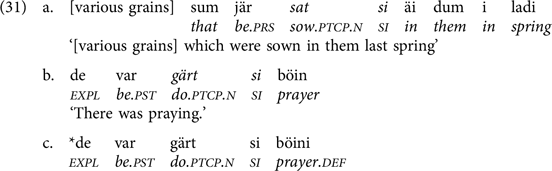
The question, then, is how the internal argument of sat si in (31a) can become the subject, although there is no preposition/particle to create a way out of VP. The answer is, I think, that the internal argument in fact never leaves the VP. Instead it remains in its base position, but is never spelled out; see (32) below where this silent presence is represented by e. The semantic content of e comes from the operator subject, Op, mediating between e and the antecedents of the matrix clause (in the case at hand the various grains under consideration). Presumably, Op is base-generated in spec-TP (i.e. as a subject), from where it binds e in VP and then moves on to the C-domain, as shown in (32).
(32)
[CP Opj … [TP tj … [VP [V’ e]]]]
Although the analysis in (32) is admittedly a bit speculative, it at least accounts for the lack of an overt expletive in these particular cases, as well as the linking between the internal argument position and the antecedents. An overt expletive would be untenable here, since it cannot move to spec-CP in a relative clause; also, it cannot bind e like an operator.Footnote 17
6.3 Summary
In my analysis of the si-passive, I treat si as part of the participle ending, located in Aspo between vP and VP. Crucially, si brings phi-features to Aspo, which means that there can be no agreement between Aspo and the internal argument as in regular passive participles. Instead, the contents of Aspo can satisfy the nominal needs of vo, ruling out the merger of an explicit agent.Footnote 18 The lack of agreement accounts for the process-oriented meaning of si-passives, given that resultativity is manifested (structurally) in the agreement link between Aspo and internal argument. The lack of agreement also leads to the entrapment of the internal argument and the subsequent need to insert an expletive subject. For the internal argument to be able to become the subject, it is required that VP contains an additional head, a preposition or a particle. This head projects a specifier working as an escape hatch for the internal argument on its way to TP. Alternatively, the internal argument can remain in silence in VP, where it is bound by a relative operator.
7. The birth of the si-passive
The geographical spread of the si-passive (see Section 2) largely coincides with the increasing use of strong participle endings (see Section 4.2). Both phenomena are found on the main island, but both are absent in Fårö. I find it hard to believe that the correspondence between strong participles and the si-passive is a mere coincidence. Instead, I will treat it as a sign that the si-passive is dependent on the changes in participle morphology. Although it is hard to exactly date the two phenomena, the clues we do have indicate that the participle changes predate the introduction of the si-passive. I have not come about any si-passives that are older than the 1830s.Footnote 19 The shifts in the Gutnish verbal system, which includes the strong participle ending spreading in the weak paradigms, appear to be somewhat earlier. According to Jordan (Reference Jordan2023:38), these changes had come a long way already in the eighteenth century. In other words, chronologically, it would be possible for the participle changes to make way for the birth of the si-passive. In Section 7.1 below, I outline the details in such a series of events. I also address the theoretical implications of the suggestion, concluding that the development of the si-element represents a case of syntactic grammaticalization. Finally, Section 7.2 provides a summary.
7.1 Reanalysing si to get rid of ambiguity
I propose that the spread of strong participle endings leads to the introduction of the si-passive. The reason that this development triggers the emergence of the si-passive is as follows: when the strong forms take over, this crucially creates new homonymy between the regular infinitive and the neuter participle (see Section 4.2 for details). Adding si, presumably, starts out as a strategy to separate such new doubles, by associating a passive meaning to si rather than a reflexive one, which is compatible with both the infinitive and the participle. What contexts would have been the starting point? Among the embedded si-examples, there is a context where both infinitives and participles occur, i.e. under get. Such contexts are truly ambiguous when they involve verbs that are conjugated strongly, such as ‘dig’ in (33) below; note that (33) is not from the corpus but construed by me to illustrate the proposal.

Reflexive si can be added in this context to the infinitive and participle alike, as shown in (34) below. The addition of the reflexive introduces an explicit beneficiary of the digging which is coreferential with the subject, as indicated in the translation.
(34)
ha fikk grav si a grop
‘she got to dig a pit for herself’ OR ‘she got a pit dug for herself’
In standard Swedish, the addition of a reflexive object (i.e. sig) in a corresponding context does not add very much to the meaning: even without the reflexive, one would probably presuppose that the subject (if anyone) is the implicit beneficiary. Since the use of reflexives in general (i.e. modulo the si of si-passives) is very similar in Gutnish and standard Swedish, we have good reason to believe that the addition of si in examples like (34) would have a similar, i.e. only marginal, effect on the semantic outcome. This leaves the floor open for reanalysis. Given that grav is ambiguous, it would lie close at hand for speakers to associate the semantically quite empty si with one of the possible interpretations of the verb. I think that si therefore came to be reanalysed as a marker of the participle, but not the infinitive, that is, as a sort of passive marker instead of a reflexive object.
Such a reanalysis is predicted to lead to a spread of the si usage to other contexts where passive participles but not infinitives occur, and also to contexts where there is no third person referent to bind si, which should now be fine, given that si is no longer a reflexive. Both criteria are met in the authentic example in (35a) below, where the matrix subject is ‘we’ (unable to bind reflexive si), and the matrix verb have, which does not combine with infinitives.Footnote 20 Similarly, get examples with Arg-V order (as in (35b) = the beginning of (16b) above) would be secondary too, since such a word order is only compatible with a participle interpretation. Participles may either precede (as in (35a)) or follow (cf. (35b)) the internal argument in this context, whereas infinitives always come first, as shown in (36).
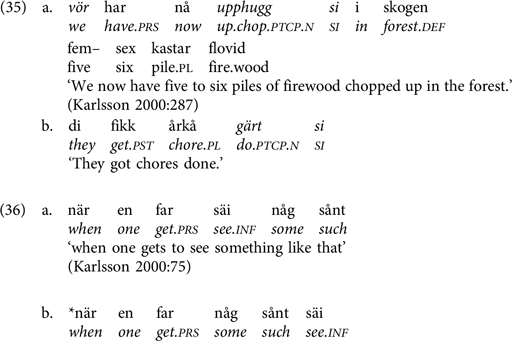
How the si-complex also spread to non-embedded impersonal constructions is hard to say. The scarcity of examples makes any suggestion quite speculative. Still, we know that change in general starts with ambiguity, and the get environment in (34) clearly offers that. A fair guess is that the expansions in (35), which are structurally quite similar to the presumed bridge construction in (34), precede the spread into other contexts for passive participles, i.e. combinations with be and become.
The proposed reanalysis of si, namely as encoding the passive component of the participle rather than being a reflexive, can be characterized as a case of syntactic grammaticalization in the sense of Roberts & Roussou (Reference Roberts and Roussou1999, Reference Roberts and Roussou2003). Si starts out as a (reflexive) object within VP and then becomes part of the participial head higher up in the syntactic tree, Aspo in the analysis proposed here. In other words, it becomes more grammatical as it climbs up the syntactic spine. The categorical shift from phrase (i.e. the complement of V) to head (i.e. Aspo) is also expected given the so-called Head Preference Principle (van Gelderen Reference Gelderen2004). Presumably, the s of the morphological passive comes from the reflexive too, although this development is much earlier and has occurred in all North Germanic (see further Öhlin Reference Öhlin1918:11–14, Wessén Reference Wessén1956:160–163). In the model adopted here, the s of the s-passive has climbed even further than si, all the way up to VoiceP.
Typologically, it is not uncommon for reflexive pronouns to develop into affixes (Lehmann Reference Lehmann2015:49). However, it might be that the direct transition from reflexive to passive that has (presumably) taken place in the case of si is a bit exceptional. A more expected scenario would perhaps be for the reflexive construction to first develop into, for example, an anticausative or a middle before becoming a true passive (see Haspelmath Reference Haspelmath1990:42–46 for examples).Footnote 21
7.2 Summary
Following changes in the Gutnish verb conjugations during the eighteenth century, infinitives and neuter participles became increasingly ambiguous. I have suggested that the si-passive emerged as a strategy to eliminate such ambiguity. In contexts where both infinitives and participles occur and where a reflexive adds very little semantic content, si, originally an object of the verb, came to be interpreted as a marker of the passive participle. Since the conjugation changes never affected Fårö, the absence of the si-passive in Fårö can be felicitously predicted.
8. Conclusions
Like the other North Germanic languages, Gutnish has both a morphological passive, formed with the suffix -s(t), and a periphrastic passive, formed with be or become combined with a passive participle. In addition, Gutnish has the si-passive. Like the periphrastic passive, it involves the auxiliaries be or become and a participle. Unlike the participle in the regular construction, the participle in the si-passive is non-agreeing: although the participle looks like a neuter participle, it cannot agree with a neuter noun. I have interpreted this non-agreement as a consequence of si in fact being part of the participle ending in Aspo, located between VP and vP. Originally a reflexive, si has nominal features and therefore keeps Aspo from being linked to the internal argument in VP.
Without an agreement link, the internal argument is trapped in VP and never available for T, probing for a subject. Most si-passives in my sample thus have an expletive subject. For the internal argument to be visible for T, it needs to make use of an escape hatch, a specifier position, created by either a preposition or a particle. Alternatively, the internal argument can remain silent in VP, bound by a subject operator. The lack of agreement in the si-participle can also account for the process focus that is typical for si-passives, given that the resultativity of regular participles follows precisely from the link between Aspo and VP that agreement establishes.
My primary source for the Gutnish si-passive is the language of Lau farmer Jakob Karlsson, preserved in letters he wrote from the late 1880s onwards. In addition, to be able to map the construction, I have collected occasional si-passives in dictionaries and archival records: the si-passive is attested all over the main island, but it does not occur in the northern island of Fårö. Fårö is also unaffected by changes in participle morphology that have occurred elsewhere, crucially creating new ambiguity between infinitives and neuter participles. I have proposed that in the get construction, this ambiguity led to a reanalysis of the reflexive object si as part of the participle ending. Presumably, this crucial reanalysis took place sometime around 1800. Karlsson, born in the 1850s, thus represents the second or third generation of si-passive users. The details in the subsequent development of the si-passive during the twentieth century, as well as its present status among the few remaining speakers of traditional Gutnish, remains to be dealt with in future research.
Acknowledgements
I want to thank the three anonymous reviewers for their constructive criticism. Thanks also to Elisabet Engdahl and to editor Marit Julien for helpful comments and suggestions. Finally, I want to mention Thure Stenström, whose reflections on the linguistic endeavours of his early 20s (Stenström Reference Stenström2000; see also Stenström Reference Stenström1949) inspired me to investigate the Gutnish si-passive more thoroughly. Needless to say, any remaining errors and/or inconsistencies are my responsibility. This research is funded by the the Swedish Research Council (VR, grant number 2019-02631).
Competing interests
The author declares none.
Sources
Carlsson, Nils. 1918. En syntaktisk företeelse i nygutniskan [A syntactic phenomenon in early modern Gutnish] (ULMA 441:17, i). Ms. in the ISOF archive in Uppsala.
GO = Gustavson, Herbert. 1918–1945. Gotländsk ordbok: På grundval av C. och P.A. Säves samlingar [Gotlandic dictionary: Based on the collections of C. and P.A. Säve]. Uppsala: Landsmålsarkivet.Footnote 22
Karlsson, Jakob. 2000. Fäi-Jakås fyst brevi: Jakob Karlssons första 20 brev till Mathias Klintberg 1889–1890 [The first letters by Fäi-Jakå: Jakob Karlsson’s first 20 letters to Mathias Klintberg 1889–1890]. Visby: Ödins Förlag AB.
Karlsson, Jakob. 2012. Flair brev fran Fäi-Jakå: Gotlandsbonden Jakob Karlssons brev till lektor Mathias Klintberg 1891–1895 [More letters from Fäi-Jakå: Gotland farmer Jakob Karlsson’s letters to Mathias Klintberg 1891–1895]. Visby: Gutamålsgillet.
OL = Klintberg, Mathias & Herbert Gustavson. 1972–1986. Ordbok över laumålet på Gotland [Dictionary of the Lau dialect on Gotland]. Uppsala: Landsmålsarkivet.Footnote 23
Wessén, Elias. 1916. Grammatiska anteckningar från Eksta [Grammatical notes from the parish of Eksta] (ULMA 268:8). Ms. in the ISOF archive in Uppsala.
Appendix: Quantitative results
Tables A1, A2, A3, and A4 include all si-examples from my sample, that is, si-examples found in the Gutnish corpus as well as si-examples from Jakob Karlsson (JK) occurring in OL (see Section 3). In addition, the tables include all si-examples I have found in other sources.
The subject in si-passives
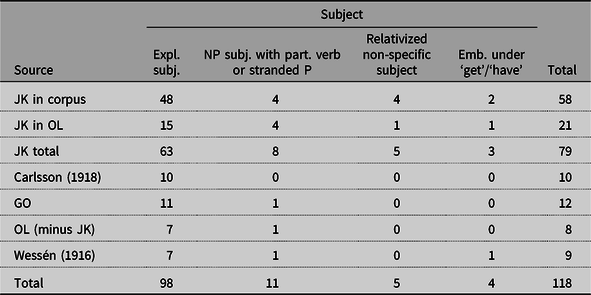
Table A1 Long description
The table presents data on the distribution of different subject types in si-passives across various sources. It includes columns for explicit subjects, NP subjects with participle verbs or stranded prepositions, relativized non-specific subjects, and embedded subjects under 'get' or 'have'. The rows list different sources such as JK in corpus, JK in OL, JK total, Carlsson 1918, GO, OL minus JK, and Wessén 1916, with a total row summarizing the data. Each cell contains numerical values representing the count of each subject type in the respective sources. Notable trends include the highest total count for JK in corpus and the lowest for Carlsson 1918.
The auxiliary in si-passives
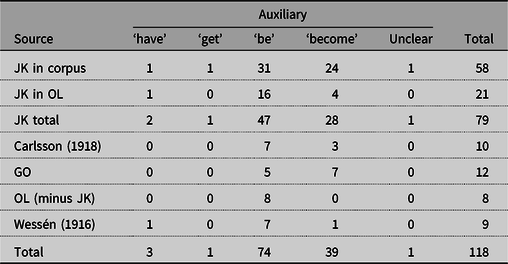
Table A2 Long description
The table presents the distribution of auxiliary verbs in si-passives across various sources and categories. It includes data for 'have', 'get', 'be', 'become', and unclear instances. The table has six rows and six columns, with the columns labeled 'Source', 'have', 'get', 'be', 'become', 'Unclear', and 'Total'. The sources include JK in corpus, JK in OL, JK total, Carlsson 1918, GO, OL (minus JK), and Wessén 1916. The row labels indicate different sources, and the columns show the count of each auxiliary verb used. Notable trends include a high frequency of the auxiliary 'be' across all sources, with JK in corpus showing the highest count at 31. The 'become' auxiliary also shows significant usage, particularly in the JK total row with a count of 28. The 'have' and 'get' auxiliaries are used less frequently. The 'Unclear' category has minimal entries. The total counts for each source vary, with JK in corpus having the highest total at 58.
The internal argument in si-passives
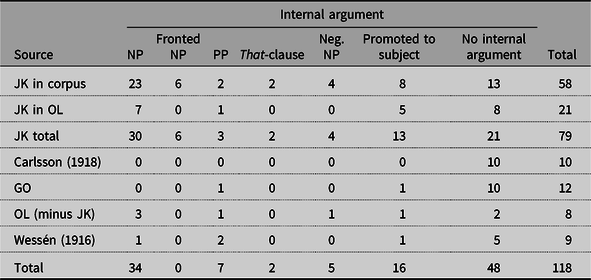
Table A3 Long description
The table presents data on the internal argument in si-passives, categorized by source and type. It includes columns for different types of internal arguments such as NP, Fronted NP, PP, That-clause, Neg. NP, Promoted to subject, and No internal argument. The sources listed are JK in corpus, JK in OL, JK total, Carlsson 1918, GO, OL minus JK, Wessén 1916, and a total row. Each row provides counts for each category, with notable entries including JK total with 79 instances and the overall total of 118 instances. The table highlights the distribution and frequency of different internal argument types across various sources.
The main verb in si-passives
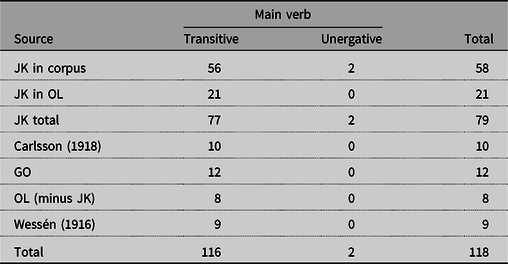
Table A4 Long description
The table presents data on the use of main verbs in si-passives, categorized by source and verb type. It includes rows for JK in corpus, JK in OL, JK total, Carlsson 1918, GO, OL minus JK, Wessén 1916, and a total row. The columns are labeled Transitive, Inergative, and Total. Row 1: JK in corpus, Transitive 56, Inergative 2, Total 58. Row 2: JK in OL, Transitive 21, Inergative 0, Total 21. Row 3: JK total, Transitive 77, Inergative 2, Total 79. Row 4: Carlsson 1918, Transitive 10, Inergative 0, Total 10. Row 5: GO, Transitive 12, Inergative 0, Total 12. Row 6: OL minus JK, Transitive 8, Inergative 0, Total 8. Row 7: Wessén 1916, Transitive 9, Inergative 0, Total 9. Row 8: Total, Transitive 116, Inergative 2, Total 118.



 Open access

