





Peer victimization is a major problem in childhood and adolescence (Solberg & Olweus, Reference Solberg and Olweus2003) with important negative consequences for the victims (Ettekal et al., Reference Ettekal, Li, Chaudhary, Luo and Brooker2022; Moore et al., Reference Moore, Norman, Suetani, Thomas, Sly and Scott2017). It can take many forms, including physical aggression, explicit insults and humiliation, and forms of rejection and social isolation (Crick & Bigbee, Reference Crick and Bigbee1998). In the last two decades, along with the traditional forms of aggression, online aggression has emerged, which includes sending offensive videos, images, and messages about the victim through social networks. When aggressions are repetitive toward the same victim, who is in a situation of inferiority, they constitute what is known as bullying (Olweus, Reference Olweus2013) and cyberbullying (Menesini et al., Reference Menesini, Nocentini, Palladino, Frisén, Berne, Ortega-Ruiz, Calmaestra, Scheithauer, Schultze-Krumbholz, Luik, Naruskov, Blaya, Berthaud and Smith2012). Cyberbullying has some specific characteristics that result from the use of electronic media, including higher anonymity of the aggressor, a greater potential to reach a large audience, and fewer time and space restrictions (Sticca & Perren, Reference Sticca and Perren2013). Across 80 studies, the mean prevalence rates were 15% for offline peer victimization, 35% for offline aggression perpetration, 15% for online peer victimization, and 16% for online aggression perpetration (Modecki et al., Reference Modecki, Minchin, Harbaugh, Guerra and Runions2014).
Aggressive behavior as a reaction to peer victimization
Many adolescents react aggressively to peer victimization (Choi & Park, Reference Choi and Park2021; Gámez-Guadix et al., Reference Gámez-Guadix, Gini and Calvete2015; Royuela-Colomer et al., Reference Royuela-Colomer, Calvete, Gámez-Guadix and Orue2018), which may contribute to the co-occurrence of perpetration and victimization (Hoglund & Hau, Reference Hoglund and Hau2021; Lozano-Blasco et al., Reference Lozano-Blasco, Cortés-Pascual and Latorre-Martínez2020; Waasdorp & Bradshaw, Reference Waasdorp and Bradshaw2015; Walters, Reference Walters2021) and to the perpetuation of victimization over time (Falla et al., Reference Falla, Ortega-Ruiz, Runions and Romera2022; Morea & Calvete, Reference Morea and Calvete2022). Several explanations for victims’ aggressive reactions have been proposed. Victimization can be traumatic and lead to a cognitive-affective state of hostility in victims (Walters & Espelage, Reference Walters and Espelage2018). In the same vein, victims could perceive the aggression as unjust, seek revenge, and consequently react aggressively toward their perpetrators (Calvete, Orue, et al., Reference Calvete, Orue, Fernández-González and Prieto-Fidalgo2019). Finally, through a social learning mechanism, victims may repeat the behaviors observed in the aggressors (Walters, Reference Walters2021).
However, not all adolescents react aggressively when provoked or victimized by their peers. Therefore, variables that can predict adolescents’ reactions when they are victimized have received considerable research interest (Troop-Gordon et al., Reference Troop-Gordon, Gordon, Schwandt, Horvath, Ewing Lee and Visconti2019). According to the general aggression model, several individual factors, including personality characteristics and biological variables, may interact with the situation in determining aggressive behaviors (Allen et al., Reference Allen, Anderson and Bushman2018). For example, gender might be an important variable. In fact, previous some studies found that victimization was more strongly related to emotional problems in girls and with behavioral problems in boys (Kim et al., Reference Kim, Colwell, Kata, Boyle and Georgiades2018), suggesting that males are more likely to perpetrate aggression after being victimized (Zsila et al., Reference Zsila, Urbán, Griffiths and Demetrovics2019). However, other studies found that sex did not moderate the relationship between victimization and perpetration (Royuela-Colomer et al., Reference Royuela-Colomer, Calvete, Gámez-Guadix and Orue2018). The general aggression model proposes that biological variables may also influence aggression reactions. In the present study, we are focusing on the combination of testosterone (T) and cortisol (C) as a potential moderator of adolescents’ aggressive responses when they are victimized by peers.
Testosterone and aggressive behavior
A long-standing body of research has examined the role of T in aggressive behavior (Geniole et al., Reference Geniole, Bird, McVittie, Purcell, Archer and Carré2020). T is a hormone that results as the end product of the hypothalamus–pituitary–gonadal (HPG) axis (Terburg et al., Reference Terburg, Morgan and van Honk2009). It increases significantly during adolescence, especially in boys, and has been considered a key hormone for understanding aggressive and other social status-related behaviors for decades (Archer, Reference Archer2006). Several studies and meta-analyses have examined this association (Archer et al., Reference Archer, Graham-Kevan and Davies2005; Duke et al., Reference Duke, Balzer and Steinbeck2014; Geniole et al., Reference Geniole, Bird, McVittie, Purcell, Archer and Carré2020). For example, Geniole et al. (Reference Geniole, Bird, McVittie, Purcell, Archer and Carré2020) concluded that the associations between endogenous T (both baseline and acute changes) and aggressive behavior are relatively weak. Furthermore, they found that the role of T was moderated by sex, as baseline and context-dependent changes in T were associated with aggression in men but not in women. The latter result was contrary to that found in a previous meta-analysis (Archer et al., Reference Archer, Graham-Kevan and Davies2005), in which the association between baseline T and aggression was stronger in female than in male samples. Importantly, Geniole et al. (Reference Geniole, Bird, McVittie, Purcell, Archer and Carré2020) found an important limitation in the sample sizes of the reviewed studies. Specifically, the mean sample size for the baseline T studies was 117, which is insufficient to detect small effect sizes such as those found in their meta-analysis. Moreover, Duke et al. (Reference Duke, Balzer and Steinbeck2014), in their review focused on studies on adolescent boys, indicated as a limitation due to the paucity of longitudinal studies.
The role of cortisol in the association between testosterone and aggression
The lack of conclusive results has led to the proposal that the role of T as an explanatory factor for aggressive behavior would be moderated by other hormones. The dual-hormone hypothesis (DHH; Mehta & Josephs, Reference Mehta and Josephs2010) proposes that C levels moderate the role of T in status-relevant behavior, including aggressive behavior, such that high T would be associated with aggressive behavior only when C is low. In contrast, when C levels are high, the DHH predicts that the association between T and aggressive behavior would be blocked or inhibited (Mehta & Prasad, Reference Mehta and Prasad2015). Therefore, C would be key for modulating the effect of T according to the DHH. C is a hormone that results as the end product of the hypothalamus–pituitary–adrenal (HPA) axis (Terburg et al., Reference Terburg, Morgan and van Honk2009). The HPA axis is activated in the presence of stress and is associated with the initiation and maintenance of the fight-or-flight response, which occurs when an individual is confronted with a stressor. Regarding the direct relationship between C and aggressive behavior, although some studies have found that low levels of C are associated with aggression in adolescents (De Vries-Bouw et al., Reference De Vries-Bouw, Jansen, Vermeiren, Doreleijers, de Ven and Popma2012; Platje et al., Reference Platje, Jansen, Raine, Branje, Doreleijers, de Vries-Bouw, Popma, van Lier, Koot, Meeus and Vermeiren2013), the results are inconclusive and often contradictory. A meta-analysis revealed that the role of C in aggressive behavior may depend on the developmental stage (Alink et al., Reference Alink, van IJzendoorn, Bakermans-Kranenburg, Mesman, Juffer and Koot2008). At the physiological level, there is a complex interplay between C and T. Whereas T inhibits HPA functioning at the hypothalamic level, C inhibits HPG axis functioning at several levels (Terburg et al., Reference Terburg, Morgan and van Honk2009).
Despite the interest in the DHH, its empirical support has been modest. A meta-analysis (Dekkers et al., Reference Dekkers, van Rentergem, Meijer, Popma, Wagemaker and Huizenga2019) found only marginal support for the DHH, with a very small effect size for the interaction between T and C on status-relevant behaviors. One of the limitations the researchers noted was the relative lack of power in most of the studies, as they generally did not have large enough samples to test the complex interactions between hormone levels. In the same meta-analysis, the authors examined whether sex moderated the effects of the T × C interaction. Although they found that there were no significant differences between men and women, they noted that the effects were even smaller in women and recommended studies with larger samples that could delve into possible sex differences. Recently, in a sample of adolescents, Shields et al. (Reference Shields, Brandes, Reardon, España and Tackett2021) found that three-way T × C × sex interactions across methods and hormone measures were nonsignificant. However, separate analyses of the subsamples of boys and girls indicated that the interaction between T and C was not equivalent in the two subsamples.
In addition, some studies have found statistically significant T × C interactions but with patterns different from that proposed by the DHH. For example, in a small sample of healthy undergraduate women who were insulted and subsequently given the opportunity to retaliate by administering blasts of white noise targeting the provocateur, basal T positively predicted reactive aggression but only among participants with high concentrations of basal C (Denson et al., Reference Denson, Mehta and Tan2013). This finding suggests that the combination of high T and C is associated with a stronger aggressive reaction to provocation. Interestingly, a recent study found that combinations of high T and high C or low T and low C were associated with aggressive reactive behavior in a sample of university students (Armstrong et al., Reference Armstrong, Wells, Boisvert, Lewis, Cooke, Woeckener and Kavish2021). Furthermore, the effect was only observed in the female subsample. However, the male sample was considerably smaller, which may have reduced the power needed to detect effects. Finally, in one of the few studies that evaluated DHH using a longitudinal design, Susman et al. (Reference Susman, Peckins, Bowes and Dorn2017) assessed a sample of 135 children and young adolescents at six-month intervals over one year. They found that combinations of low levels of diurnal T and low reactivity in C and high diurnal T levels and high C reactivity tended to be associated with a number of variables related to conduct problems and antisocial behavior in boys. In their study, the findings for girls were not above the level of chance. They proposed several explanations for these results. For example, an adolescent with both low C reactivity and low diurnal T levels might be inhibited and avoids stressful situations, especially those involving dominance or aggression, but at the same time the adolescent might show self-regulatory difficulties in situations initiated by others (e.g., victimization) (Susman et al., Reference Susman, Peckins, Bowes and Dorn2017). In contrast, an adolescent with high C and high T (positive coupling) levels may externalize aggressive behavior in aversive contexts.
Furthermore, although most studies that have examined the DHH have tested whether there was a statistical interaction between T and C levels that could explain aggressive behavior, another line of research has focused on the role of the T/C ratio (Terburg et al., Reference Terburg, Morgan and van Honk2009). In this way, attempts have been made to prove that a higher T/C ratio, indicating high T and low C, is associated with aggressive and antisocial behavior. In a study with adolescents, Platje et al. (Reference Platje, Popma, Vermeiren, Doreleijers, Meeus, van Lier, Koot, Branje and Jansen2015) tested both ways of studying the interplay between T and C. They found that the interaction between T and C was not statistically significantly associated with aggressive behavior and that the T/C ratio was, although only in the subsample of girls.
Joint role of testosterone and cortisol in the aggressive reactions to victimization
In general, previous research has focused on studying the direct relationship between T and/or C levels and aggressive behavior and has not specifically examined whether they moderate victims’ aggressive reactions, as proposed in this study. The idea that these hormone levels may interact with peer victimization in determining the likelihood of aggressive reactions is consistent with the proposal that biological factors may not be directly associated with aggressive behavior but rather moderate how youths respond to social stressors such as victimization (Rudolph et al., Reference Rudolph, Troop-Gordon and Granger2010). Specifically, it has been suggested that the link between T and antisocial behavior would depend on the occurrence of several other risk factors, including negative social experiences (Yildirim & Derksen, Reference Yildirim and Derksen2012). For example, Yildirim and Derksen (Reference Yildirim and Derksen2012) proposed that T levels may be associated with antisocial behavior when individuals experience social stressors like peer rejection and not when they experience positive experiences.
In one of the few studies examining the role of hormones as moderators of aggressive responses to peer victimization, Rudolph et al. (Reference Rudolph, Troop-Gordon and Granger2010), in a sample of 132 children, found a significant interaction between peer victimization and C levels in the prediction of aggressive response in a laboratory-based peer-oriented social challenge task. Specifically, victimization was significantly associated with aggression when C levels were high or average, but not when they were low. In the same study, the direct association between C and aggression during the task was not statistically significant.
Thus, levels of T and combinations of T and C would also interact with the occurrence of victimization. Although there is a significant gap in terms of studies examining the interaction between these hormones and the level of victimization, the results of some studies suggest that such an interaction is probable. For example, in a study on adults, a higher T/C ratio was associated with greater aggression against the partner, but this association was weaker under provoked conditions (Manigault et al., Reference Manigault, Zoccola, Hamilton and Wymbs2019). Moreover, some of the studies that found different T and C profiles associated with aggressive behavior focused on provocation-reactive aggressive behaviors (Armstrong et al., Reference Armstrong, Wells, Boisvert, Lewis, Cooke, Woeckener and Kavish2021; Geniole et al., Reference Geniole, Carré and McCormick2011).
The current study
Victims of peer aggression often react aggressively (Choi & Park, Reference Choi and Park2021; Walters, Reference Walters2021), which contributes to the perpetuation of aggression over time (Morea & Calvete, Reference Morea and Calvete2022). Therefore, it is important to identify the individual factors that predict a stronger aggressive response when victimized. The aim of this study was to evaluate whether two hormones (T and C) jointly moderated aggressive behaviors as response to peer victimization. This aim involved assessing the effects of the T × C × peer victimization interaction in aggressive adolescent behavior. Thus, the current study attempts to fill an important gap in studies on the role of hormones as potential moderators of victim reactions.
According to the DHH (Mehta & Josephs, Reference Mehta and Josephs2010), it is the combination of high T and low C that is associated with aggressive behavior. However, as mentioned, some studies have found that other combinations of hormones, such as high levels of T and C or low levels of T and C, are associated with increased aggressive behavior (Armstrong et al., Reference Armstrong, Wells, Boisvert, Lewis, Cooke, Woeckener and Kavish2021; Denson et al., Reference Denson, Mehta and Tan2013; Susman et al., Reference Susman, Peckins, Bowes and Dorn2017). Moreover, in situations of provocation-reactive aggressive behaviors, which are characteristics of peer victimization, the combination of high T and low C does not seem to be linked to aggressive behavior (Armstrong et al., Reference Armstrong, Wells, Boisvert, Lewis, Cooke, Woeckener and Kavish2021; Geniole et al., Reference Geniole, Carré and McCormick2011). Given these mixed results regarding the joint effects of T and C and the absence of previous studies examining the interaction between these hormones and peer victimization, this study was exploratory, and we did not establish a priori hypotheses.
In this study, we included both offline and online aggression. Given that differential characteristics of the online environment, such as anonymity or the lack of contact, can increase the probability of the use of rude language and aggression due to online disinhibition (Wachs & Wright, Reference Wachs and Wright2019), we expected to find a higher association between victimization and perpetration in aggressive online behavior compared to aggressive offline behavior.
Finally, the study attempted to overcome some of the methodological limitations of previous research. Most previous studies have been cross-sectional (Duke et al., Reference Duke, Balzer and Steinbeck2014) and have generally used relatively small samples (Geniole et al., Reference Geniole, Bird, McVittie, Purcell, Archer and Carré2020), which do not provide the necessary power to test the complex interactions proposed by the DHH and specially to examine sex differences in the model (Dekkers et al., Reference Dekkers, van Rentergem, Meijer, Popma, Wagemaker and Huizenga2019). For this reason, this study used a longitudinal design with a large sample of adolescent boys and girls. Furthermore, given that one stream of research has assessed the T/C ratio as an alternative indicator of the combination of both hormones (Korpel et al., Reference Korpel, Varkevisser, Hoppenbrouwers, Van Honk and Geuze2019; Platje et al., Reference Platje, Popma, Vermeiren, Doreleijers, Meeus, van Lier, Koot, Branje and Jansen2015), in this study we also examined the interaction between the T/C ratio and victimization.
Method
Participants
The participants in this study were part of a larger sample of a project focused on a preventive intervention of depression and other psychological problems in adolescents (Calvete, Fernández-González, et al., Reference Calvete, Fernández-González, Orue, Echezarraga, Royuela-Colomer, Cortazar, Muga, Longa and Yeager2019). In the initial sample, 10 schools participated out of 20 randomly invited schools from the total of 166 schools of secondary education in Bizkaia (Basque Country, Spain). Due to budget constraints, it was only possible to collect biological samples from seven of the 10 schools and these constitute the sample for this study. A total of 577 adolescents (50.4% girls) between 12 and 17 years of age (M = 14.64, SD = 0.96) participated in the study. In terms of school year, the distribution was 31% in the second year of compulsory secondary education, 48.4% in the third year, 14.5% in the fourth year, and 6% in the first year of a baccalaureate. In terms of social status according to the parents’ profession, the distribution was as follows: 12.8% low, 13.4% medium-low, 33.1% medium, 28.7% medium-high, and 11.9% high. This distribution is consistent with the characteristics of the population in Bizkaia (Basque Institute of Statistics, 2021). A post hoc power analysis conducted with G*Power Version 3.1.9.7 showed that the sample (N = 577) provided a power of 97.8% to detect an effect size of 0.05 at α = .05.
The adolescents were invited to respond to measures and provide salivary samples in three waves at six-month intervals. The percentages of adolescents who failed to answer in any of the waves were 1.2%, 13.1%, and 19.7%, respectively for Wave 1 (W1), Wave 2 (W2), and Wave 3 (W3). The age of the adolescents who failed to answer at some time was higher than that of those who completed all waves (M = 15.01, SD = 1.08 vs M = 14.54, SD = 0.91, t = 5.01, p < .001).
Measures
Offline aggression
The Revised Peer Experiences Questionnaire (Prinstein et al., Reference Prinstein, Boergers and Vernberg2001) was used to assess offline victimization and perpetration of aggressive behavior. Both the perpetration and victimization scales contain nine items, with five response options ranging from 1 (never) to 5 (a few times a week). The items describe forms of overt (e.g., threatened to hurt or beat a peer up) and relational aggressions (e.g., someone left me out of an activity or conversation that I really wanted to be included in). The Cronbach coefficients for this study were 0.83, 0.87, and 0.91 at W1, W2, and W3, respectively, for offline aggressive behavior perpetration and 0.83, 0.87, and 0.88 at W1, W2, and W3, respectively, for offline victimization.
Online aggression
The Cyberbullying Questionnaire (Calvete et al., Reference Calvete, Orue, Estévez, Villardón and Padilla2010) was used to measure online aggressive behavior perpetration and victimization. Both scales contain nine items and a four-point Likert response scale, ranging from 0 (never) to 3 (5 or more times). The item responses were averaged to obtain the scores. This has shown excellent psychometric properties (Calvete et al., Reference Calvete, Orue, Estévez, Villardón and Padilla2010; Gámez-Guadix et al., Reference Gámez-Guadix, Orue, Smith and Calvete2013). In this study, the Cronbach coefficients were 0.83, 0.89, and 0.93 at W1, W2, and W3, respectively, for online aggressive behavior perpetration and 0.78, 0.85, and 0.90 at W1, W2, and W3, respectively, for online victimization.
Testosterone (T) and cortisol (C)
Saliva samples were collected in the classrooms. On the day of the salivary sample collection, the participants were instructed to avoid brushing their teeth and avoid consuming a meal or drinking at least 60 min prior to sample donation. They were also asked to avoid intense exercise 8 hr prior to data collection. The research team confirmed with each participant that they had followed the guidelines before sample collection. If the guidelines had not been followed, the sample was considered invalid. Saliva samples contaminated with blood were also discarded. The saliva samples were collected, on average, at 11:02 am (SD = 1.25), approximately 3 hr after waking up. The participants were instructed to spit at least 2 mL of saliva into a plastic cup. Within 1 hr of data collection, the researchers brought the samples to the Igualatario Médico Quirúrgico Laboratory. The samples were stored in a freezer (−20 °C) until assayed.
Saliva samples were assayed for T (pg/ml) and C (nmol/L) levels in duplicate determinations. The following assays were used: Salimetrics® Testosterone Enzyme Immunoassay Kit and Cortisol II (electrochemiluminescence immunoassay, ECLIA). The Salimetrics® Testosterone Enzyme Immunoassay Kit (Item No.1-2402, 96-Well Kit) is a competitive immunoassay specifically designed and validated for the quantitative measurement of salivary T. Samples with a pH <4.0 or >9.0 were discarded. According to the manufacturer, inter-assay coefficients range between 1.9 and 6.7%, the minimal concentration of T that can be distinguished from 0 is 0.458 pg/ml, and the functional sensitivity of the salivary ER T assay is 0.68 pg/mL. The ECLIA “Cortisol II” was used on the automated analyzer Cobas e 602 (Roche, Switzerland) to measure C levels. According to the manufacturer, inter-assay coefficients range between 1.7% and 9.3%, and the lowest concentration that can be detected is 1.5 nmol/L. A total of 31 samples (1%) were discarded for not meeting the requirements (e.g., failure of participants to follow instructions).
Procedure
Active informed consent from parents and adolescents was required to participate in the study. The acceptance rate was 74%. The first wave of the study began in October 2016, and the last wave ended in January 2018. Measurements were taken by research assistants during the adolescents’ usual class time. The adolescents provided salivary samples and then answered the victimization and aggressive behavior questionnaires. All procedures were approved by the ethics committee of the University of Deusto.
Statistical Analyses
Outliers in T and C were winsorized at 3 SD above the mean. A total of 32 values were winsorized. C values were logarithmically transformed, as they were not normally distributed. Before computing the T/C ratios, C and T values were standardized separately for boys and girls and then transformed into T scores (Mean = 50; SD = 10). After these operations, the measures of C, T, and T/C ratios were normally distributed. To create interaction terms between victimization and hormones, the variables were transformed into z scores.
Little’s Missing Completely At Random (MCAR) test was statistically significant (χ2 (432) = 692, p < .001), and therefore we used full information maximum likelihood (FIML), which recommended for dealing with missing values when they are not distributed completely at random. FIML estimates the parameters using all the available data, including cases without data (Little, Reference Little2013). Furthermore, in the sensitivity analyses, we repeated the main analyses using multiple imputation to deal with missingness. Multiple imputation is an adequate approach when missingness is random and when it is not random (Little et al., Reference Little, Lang, Wu, Rhemtulla and Cicchetti2016). Mplus provides multiple imputation of missing data using Bayesian analysis (Rubin, Reference Rubin1987; Schafer, Reference Schafer1997). Multiple data sets generated using multiple imputation can be analyzed using a special feature of Mplus. Parameter estimates are averaged over the set of analyses, and standard errors are computed using the average of the standard errors over the set of analyses and the between-analysis parameter estimate variation (Rubin, Reference Rubin1987; Schafer, Reference Schafer1997).
We conducted several multilevel analyses with MPLUS-8.8 to test whether the T × C interaction and the T/C ratio moderated the longitudinal associations between victimization and perpetration of aggressive behavior. The first models were conducted to examine whether T × C interaction moderated the longitudinal associations between victimization and aggressive behavior. At level 1, the models consisted of repeated measures of the variables, and perpetration of aggressive behavior was modeled as explained by victimization, T, C, T × C, victimization × T, victimization × C, and victimization × T × C interaction terms. Level 2 consisted of person-level predictors and included age and sex as predictors of the intercepts. Age was included to control age differences in hormone levels (Kamin & Kertes, Reference Kamin and Kertes2017; Konforte et al., Reference Konforte, Shea, Kyriakopoulou, Colantonio, Cohen, Shaw, Bailey, Chan, Armbruster and Adeli2013). Age was grand-mean centered. The intervention group was included in the model as a covariate. This model was estimated separately for online and offline aggressive behaviors.
The models for the T/C ratio were very similar, but at Level 1 they included peer victimization, T/C ratio, and the interaction term between victimization and T/C ratio as predictors of aggressive behavior. The intercepts were specified as random in all the models.
Finally, we examined the invariance of these models for boys and girls. To this end, we estimated configural models in which all path coefficients were freely estimated for each group and invariant models in which these coefficients were set as equal. Changes in χ2 between models were used as an indicator to decide whether the invariance of the models was acceptable. Data are available at OSF (doi: 10.17605/OSF.IO/WY94K).
Results
Table 1 presents the descriptive statistics and correlation coefficients between all the variables. Victimization and aggressive behavior perpetration measures were highly correlated (range between .56 and .78). Correlations between offline and online victimization and between offline and online perpetration were also high. Likewise, the same measures were correlated over time. Overall, most correlations between hormone measures and self-report variables were not significant. Many correlation coefficients between T levels and measures of aggressive behavior were statistically significant but small in size.
Correlation coefficients between the variables of the study
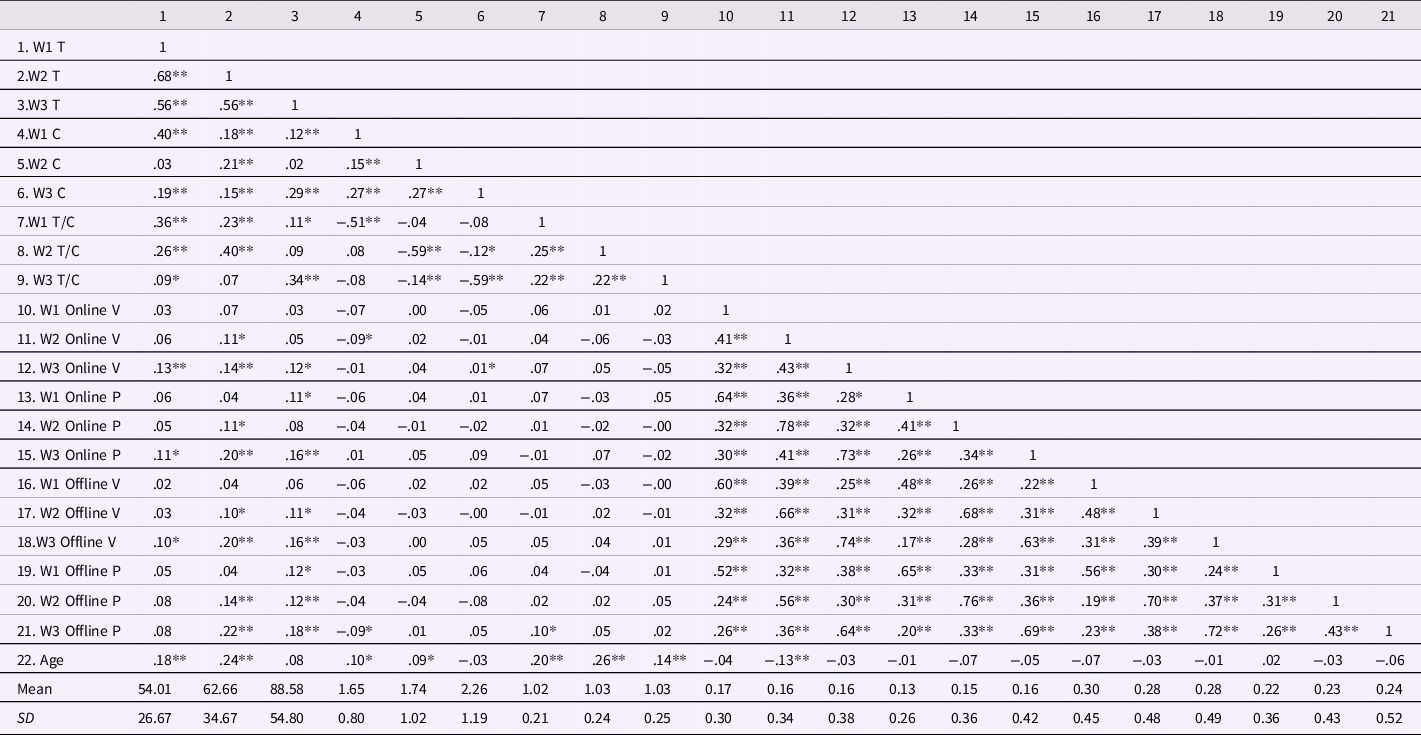
Note. *p < .05, **p < .001. T = Testosterone, C = Cortisol, V = victimization, P = perpetration.
T × C models
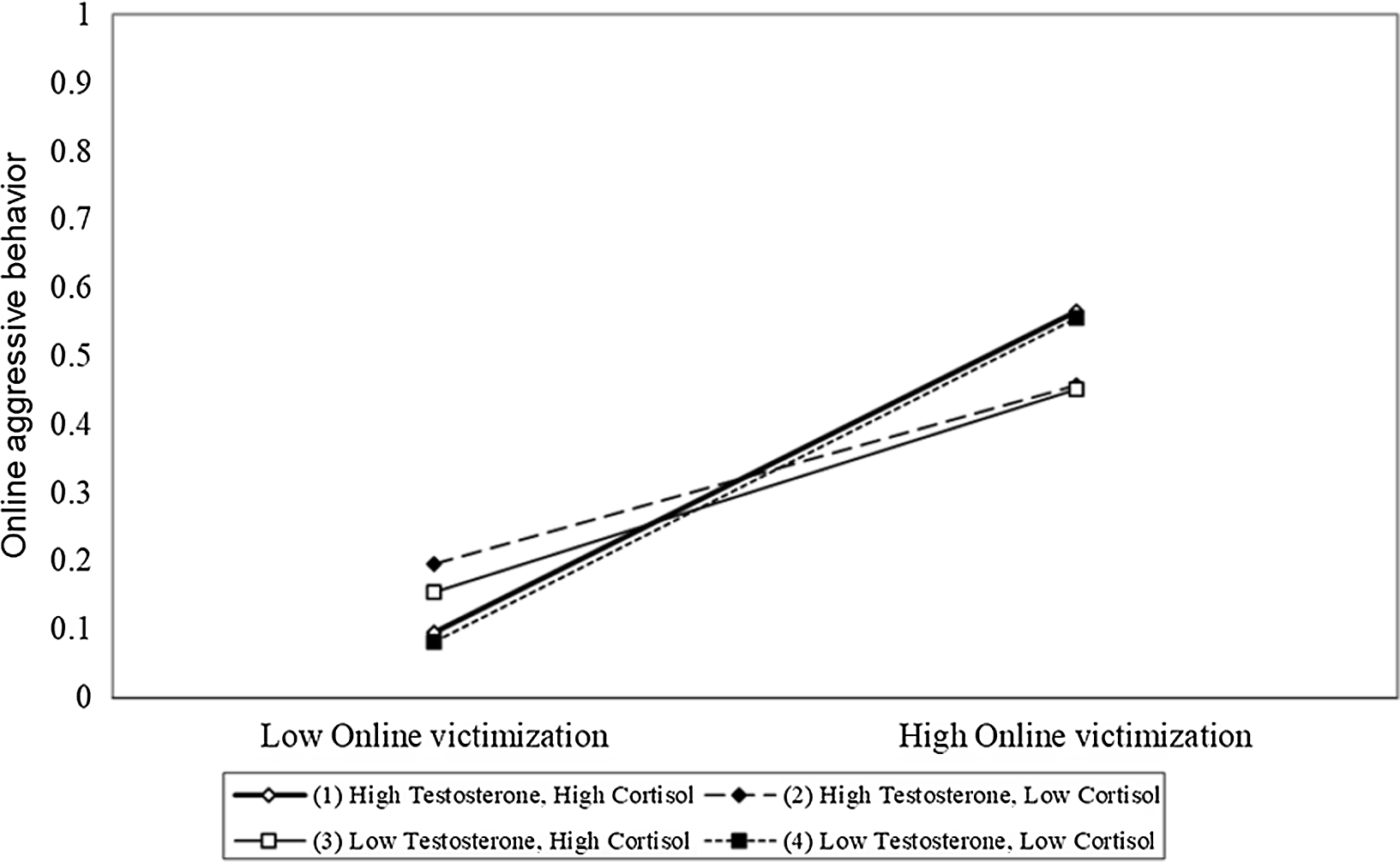
In T × C models, intraclass correlation was .36 for aggressive online behavior and .37 for aggressive offline behavior. Table 2 displays the main parameters of the models. As can be seen, both online and offline aggressive behavior were significantly predicted by victimization experiences. More importantly, the three-way interaction T × C × victimization was statistically significant for both online and offline aggressive behavior. Figure 1 shows the shape of the association between online victimization and aggressive online behavior for low (1 SD below the mean) and high (1 SD above the mean) values of T and C. Although the association between online victimization and online aggressive behavior was significant in all cases, the slope was significantly higher (p < .001) when both T and C were high (β = .24, t = 16.18, p < .001) and when both were low (β = .24, t = 16.88, p < .001) than when the level of one of these hormones was low and the other was high (β = .13, t = 8.81, p < .001 for T high and C low and β = .15, t = 8.42, p < .001 for T low and C high).
Interplay between testosterone, cortisol, and victimization predicting aggressive online behavior.
Results of the T × C models
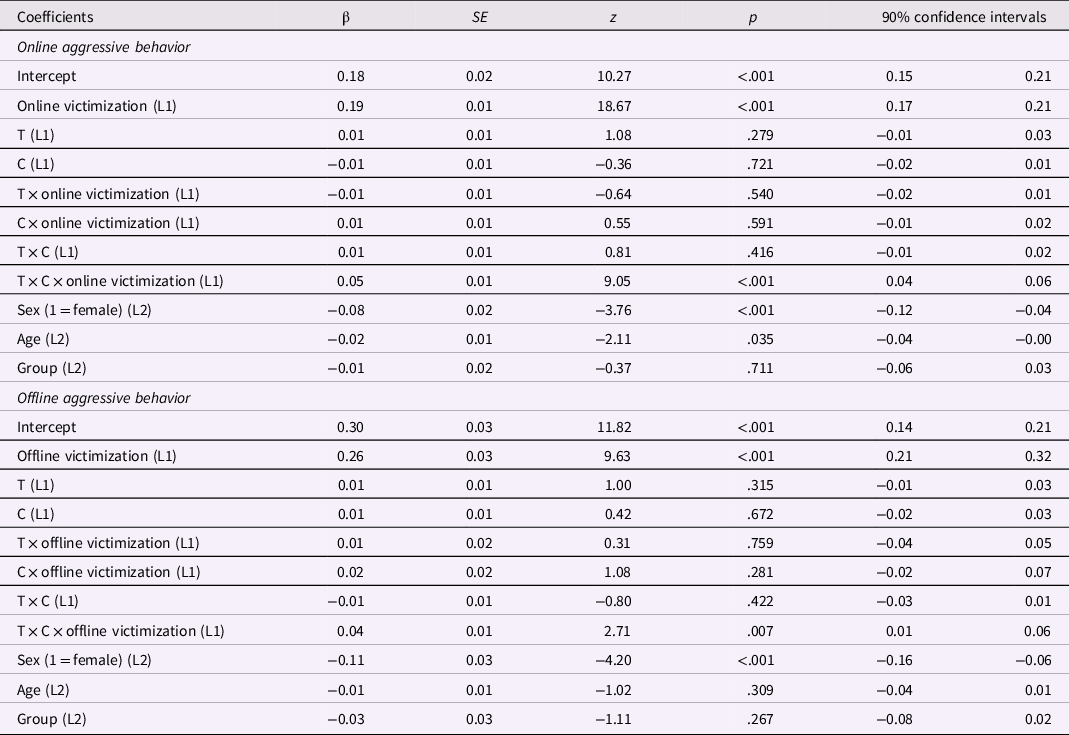
Note. T = testosterone; C = cortisol; L1 = Level 1; L2 = Level 2; Group (1 = Preventive intervention).
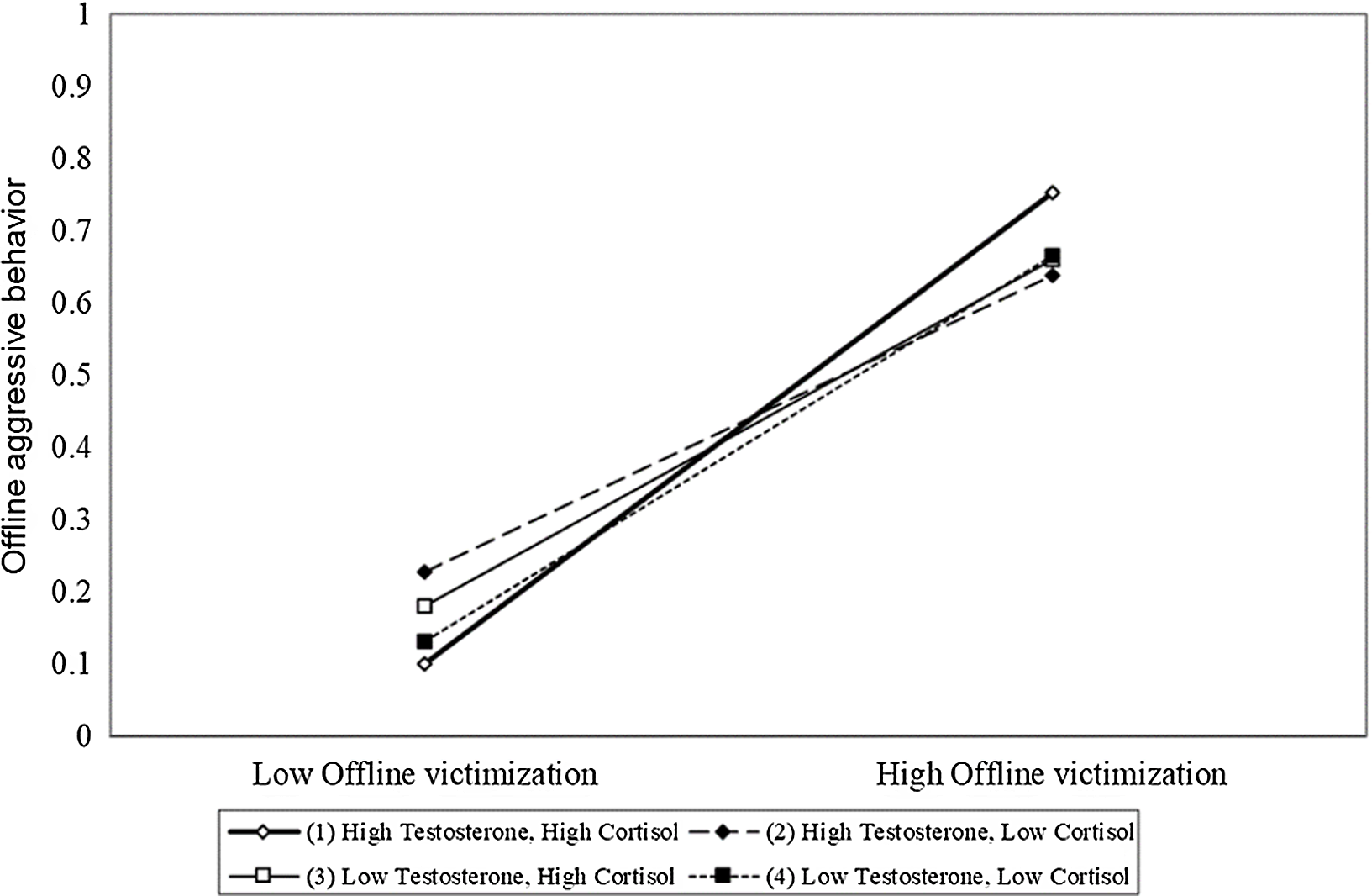
The model for offline aggressive behavior was quite similar and is displayed in Figure 2. The association between offline victimization and offline aggressive behavior was significant in all cases. When both T and C were high, the slope of the association between victimization and aggressive behavior (β = 0.33, t = 10.52, p < .001) was significantly higher (p < .05 for the differences) than when T was high and C was low (β = .21, t = 5.82, p < .001) or T was low and C was high (β = .24, t = 4.53, p < .001). The slope when both T and C were low (β = .27, t = 8.21, p < .001) was higher than when T was high and C was low (p = .023 for the difference).
Interplay between testosterone, cortisol, and victimization predicting aggressive offline behavior.
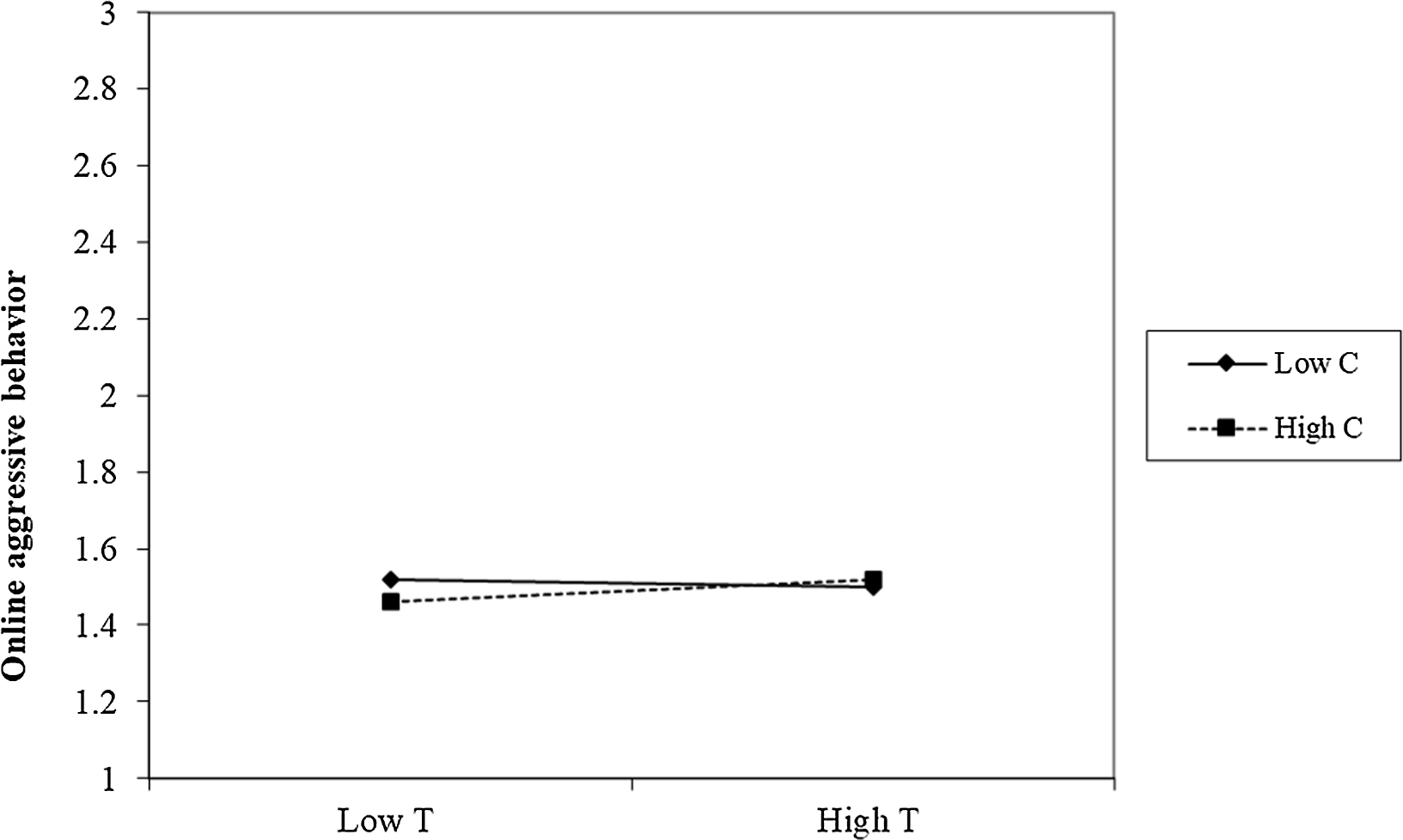
Finally, we examined the models separately in the subsamples of boys and girls. The model of online aggressive behavior was similar in both subsamples, with the interaction T × C × online victimization being statistically significant in both boys and girls (p < .001 in both cases). Furthermore, T × C significantly predicted online aggressive behavior in girls (β = 0.02, SE = 0.01, z = 2.83, p = .004) but not in boys (β = −0.01, SE = 0.01, z = −0.38, p = .707), although the sex difference was only marginally significant (Δχ2(1) = 3.55, p = .059). The form of this interaction in the sample of girls is shown in Figure 3. In girls, when C was high the association between T and aggressive online behavior was positive (β = 0.03, t = 1.98, p = .049) whereas it is negative when C is low (β = −0.01, t = −2.54, p = .012). In the offline aggressive behavior model, the T × C × offline victimization interaction was statistically significant in boys (β = 0.06, SE = 0.01, z = 3.80, p < .001) but not in girls (β = 0.02, SE = 0.02, z = 0.73, p = .468). The sex difference in this path was marginally significant (Δχ2(1) = 3.49, p = .062).
Moderating role of cortisol in the association between testosterone and the perpetration of aggressive online behavior in girls (N = 291).
T/C ratio models
In the T/C ratio models, intraclass correlation was .41 and .40, respectively, for aggressive online behavior and aggressive offline behavior. As shown in Table 3, neither the T/C ratio nor T/C × victimization interaction predicted aggressive behavior.
Results of the T/C ratio models
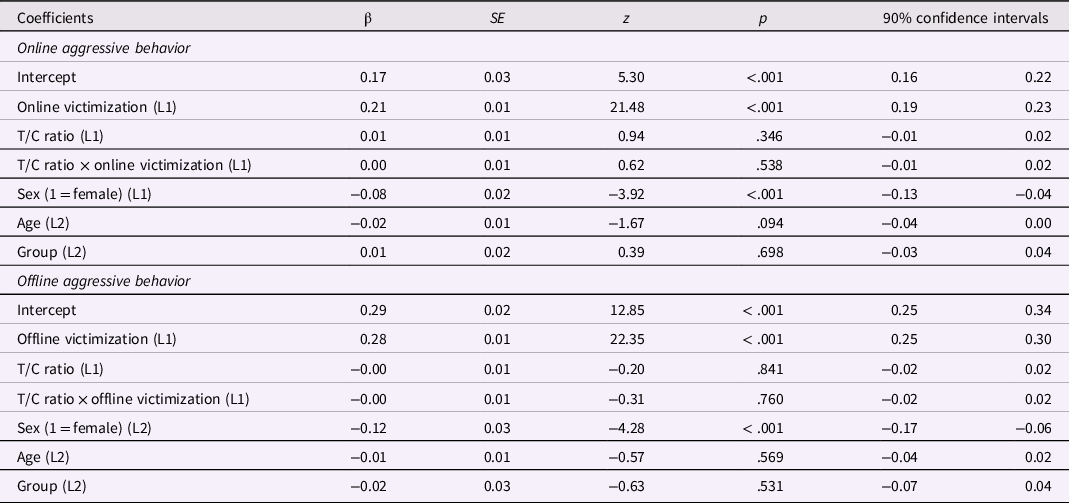
Note. T = testosterone; C = cortisol; L1 = Level 1; L2 = Level 2; Group (1 = Preventive intervention).
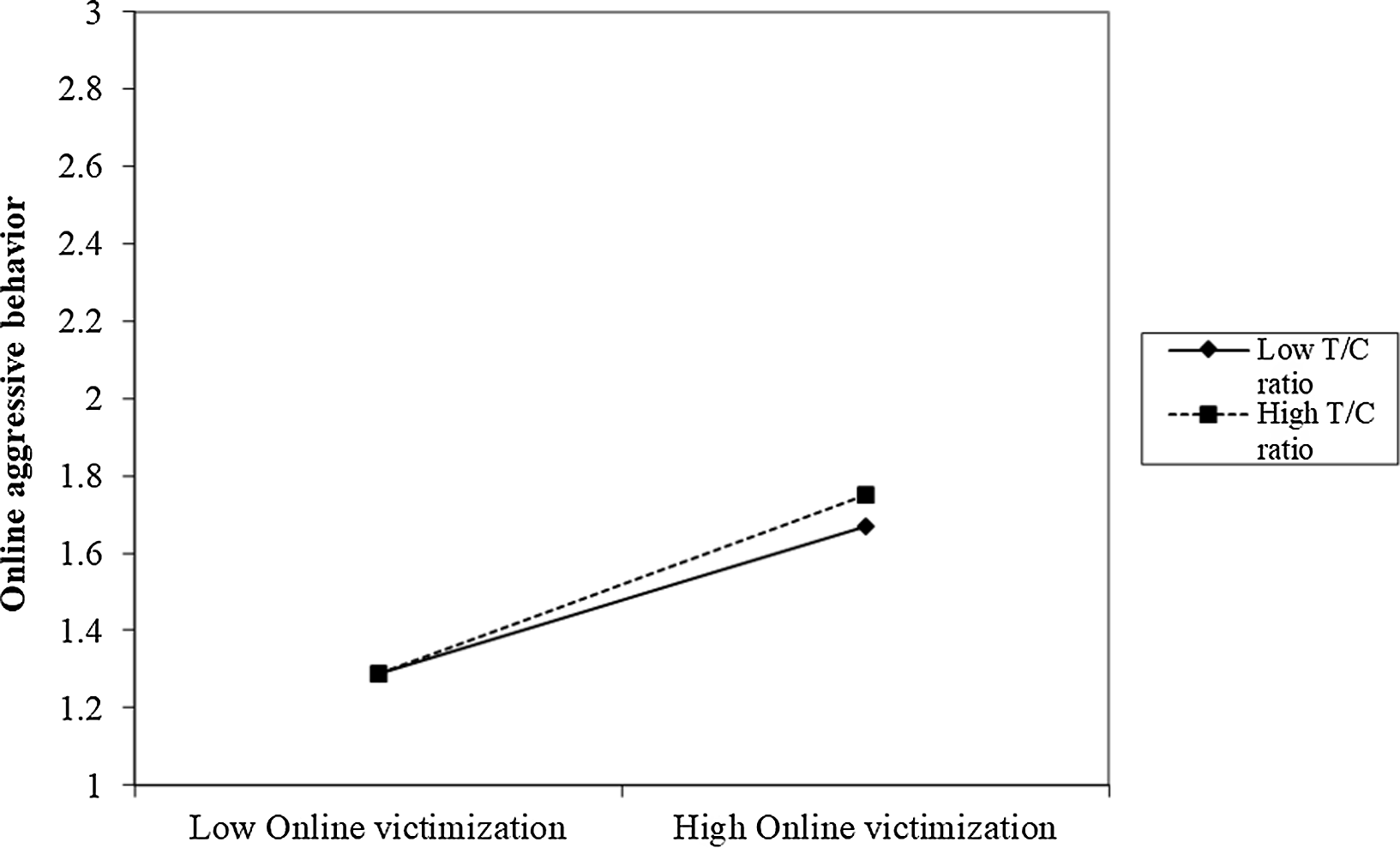
The T/C ratio models were estimated separately in the subsamples of boys and girls. While in the model for offline aggressive behavior there was no significant effect of T/C ratio and T/C ratio × victimization in any subsample, in the model for online aggressive behavior, both the T/C ratio (β = 0.02, SE = 0.01, z = 2.27, p = .023) and T/C ratio × victimization (β = 0.02, SE = 0.01, z = 2.49, p = .013) were significantly associated with online aggressive behavior in the subsample of girls. Invariance tests indicated that the sex difference in the path for T/C ratio × victimization was marginally significant (χ2 (1) = 2.82, p = .093), while the difference for the path for the T/C ratio was not statistically significant (χ2 (1) = 1.24, p = .265). The form of the T/C ratio × victimization interaction in the sample of girls is displayed in Figure 4.
Moderating role of the T/C ratio in the association between online victimization and the perpetration of aggressive behavior in girls (N = 291).
Discussion
This study aimed to assess the joint role of T and C in adolescents’ aggressive responses when they are victimized by peers. Grounded on the DHH model (Mehta & Josephs, Reference Mehta and Josephs2010), we examined whether victimization interacted with T and C levels in predicting adolescents’ aggressive reactions. The results, in general, do not support the DHH and show the complexity of the joint action of both hormones in explaining aggressive behavior when adolescents are peer victimized. The main findings are discussed below.
Consistent with previous research (e.g., Choi & Park, Reference Choi and Park2021; Lozano-Blasco et al., Reference Lozano-Blasco, Cortés-Pascual and Latorre-Martínez2020; Morea & Calvete, Reference Morea and Calvete2022), a strong association was found between victimization and perpetration. This association was moderated by the interaction between T and C for both online and offline aggression. In the case of online aggression, it was the adolescents with high T/high C or low T/low C who responded with more aggressive behaviors when victimized or provoked by peers. In the case of offline aggression, the results were similar for the profile high T/high C, but the profile characterized by low T/low C only displayed higher reactivity than the profile high T/low C. These results are opposite to what is predicted by the DHH, which proposes that T is associated with more aggressive behavior only when C is low (Mehta & Josephs, Reference Mehta and Josephs2010; Mehta & Prasad, Reference Mehta and Prasad2015). However, the results are consistent with findings obtained in other studies that examined provocation-reactive aggressive behaviors (Armstrong et al., Reference Armstrong, Wells, Boisvert, Lewis, Cooke, Woeckener and Kavish2021; Denson et al., Reference Denson, Mehta and Tan2013; Geniole et al., Reference Geniole, Carré and McCormick2011).
Interestingly, Terburg et al. (Reference Terburg, Morgan and van Honk2009) suggested a parallel between the biological mechanisms between T and C and the psychological mechanisms proposed in the motivational imbalance model (Arnett, Reference Arnett1997). This model posits that high C levels would be related to the behavioral inhibition system, which involves increased sensitivity to punishment, while high T levels would be related to the behavioral activation system, which involves risk-taking behavior in an attempt to obtain a reward (Braams et al., Reference Braams, van Duijvenvoorde, Peper and Crone2015). From this perspective, the results of this study could be interpreted as suggesting that adolescents with low T and low C may be characterized at the behavioral level by the avoidance of situations involving aggression and dominance (i.e., low T and low behavioral activation), but at the same time they may react aggressively when provoked by others due to a lower fear of punishment (i.e., low C and low functioning of the behavioral inhibition system). In contrast, adolescents with high T and high C may show a behavioral profile of externalizing aggressive behavior in aversive contexts (Susman et al., Reference Susman, Peckins, Bowes and Dorn2017). For example, although high C is associated with the behavioral inhibition system and fear of punishment, these adolescents might also be characterized by a high motivation to have their status respected (i.e., high T and high behavioral activation), especially because victims of peer bullying are likely to have a low social status or face the threat of losing their former status (Pozzoli & Gini, Reference Pozzoli and Gini2021). Due to their high levels of C, they could exhibit emotional regulation difficulties in stressful victimization situations, leading them to lose control and react impulsively. The results for the combination of high T and high C are also consistent with the proposal that current traumatic experiences would increase the level of C to cope with the stress, and this initial increase in C would be associated with an increase in T to deal with the threatening environment, implying a positive coupling between C and T (Fragkaki et al., Reference Fragkaki, Cima and Granic2018).
In this study, we also evaluated the role of the T/C ratio as an alternative indicator of the combination of T and C (Korpel et al., Reference Korpel, Varkevisser, Hoppenbrouwers, Van Honk and Geuze2019; Platje et al., Reference Platje, Popma, Vermeiren, Doreleijers, Meeus, van Lier, Koot, Branje and Jansen2015). Overall, the results were not statistically significant, except in the subsample of girls, in which both the T/C ratio and the interaction between the T/C ratio and victimization significantly predicted aggressive online behavior. The result in this case was consistent with the DHH, as the ratio was positively associated with aggressive behavior, and victimization predicted perpetration more strongly when the ratio was higher. However, the results obtained for the T/C ratio may be partially masking the joint effect of both hormones. In this study, it was the combinations of high T/high C and low T/low C that increased the association between victimization and the perpetration of aggressive behaviors. This effect was only visible through the interaction analyses between T and C since the T/C ratio does not allow capturing the effect of all possible T and C combinations. The T/C ratio when both are similar (i.e., both high or both low) tends to approach 1. This implies that if in situations of reactive aggressive behavior, such as those in this study, it is the combinations of T and C that are associated with a ratio close to 1 that are associated with more aggressive reaction to victimization, then the relationship between this ratio and aggressive behavior is not linear but curvilinear. Thus, the extremes in ratio values would be associated with less aggressive behavior, and intermediate values close to 1 would be associated with higher levels of aggressive behavior when victimized. For this reason, we recommend examining the interactions between both variables instead of using the ratio between them, at least in studies where the social situation may determine the complex interplay between both hormones. Sollberger and Ehlert (Reference Sollberger and Ehlert2016) also cautioned about the difficulties in using and interpreting hormone ratios and proposed that moderation analysis was often a more insightful approach.
Finally, separate analyses by sex indicated some differences. In the case of online aggressions, the triple interaction between T, C, and victimization was similar in boys and girls, whereas the interaction for offline aggressions was significant only in boys. This is contradictory to what was found in a previous study on young people (Armstrong et al., Reference Armstrong, Wells, Boisvert, Lewis, Cooke, Woeckener and Kavish2021). In that study, the interaction between C and T only predicted aggressive reactive behavior significantly among women. However, there are some differences to be considered. For example, the age of the study sample may be important because of developmental changes in hormones. In the study by Armstrong et al. (Reference Armstrong, Wells, Boisvert, Lewis, Cooke, Woeckener and Kavish2021), the participants were 20-year-olds, whereas in the present study they were adolescents. T and C levels increase throughout adolescence (Kamin & Kertes, Reference Kamin and Kertes2017; Konforte et al., Reference Konforte, Shea, Kyriakopoulou, Colantonio, Cohen, Shaw, Bailey, Chan, Armbruster and Adeli2013). Furthermore, the increase of T is particularly high among boys at this stage (Hibberd et al., Reference Hibberd, Hackney, Lane and Myers2015). In addition, as mentioned, the T/C ratio was only significantly associated with online behavior in girls, although the reliability of this result, in the context of the other findings of this study, is questionable.
This study has some notable strengths. Unlike most previous studies, the study used a large sample of adolescents, providing the necessary power to study the complex interactions between the study variables. Moreover, the study included subsamples of boys and girls large enough to study the models separately. In addition, the study used measurements over time for one year, making this one of the few longitudinal studies that has been conducted to assess adolescent DHH (Sollberger & Ehlert, Reference Sollberger and Ehlert2016). It is also one of the few studies to examine the role of hormones in online victimization and thus contributes to fill an important gap in the knowledge of the variables that predict victims' reactions.
The study also has limitations, which offer new opportunities and challenges for future research. Measures of C and T were taken at one time of day, but it would be desirable to include measures throughout the day to obtain, for example, the area under the curve in the case of C or to include measures of change in T and C in controlled provocation paradigms, as other studies have done (e.g., Denson et al., Reference Denson, Mehta and Tan2013; Susman et al., Reference Susman, Peckins, Bowes and Dorn2017). Another limitation concerns the exclusive use of self-reports for the assessment of victimization and aggression measures, which could have contributed to the high association between the two variables due to shared variance. Although several studies have obtained high correlations between peer victimization and perpetration (Choi & Park, Reference Choi and Park2021; Morea & Calvete, Reference Morea and Calvete2022; Walters, Reference Walters2021), it would be beneficial for future studies to also include reports from others (peers and teachers reports).
Furthermore, since the sample came from a previous research project, it was not possible to perform an a priori power analysis, which was limited to a post hoc analysis. Also related to power, in this study we conducted separate models for offline and online aggressions because including both modalities in a single model would have required the addition of many more predictors, which could have reduced the power and even hindered the interpretation of the results. However, given the correlations between both forms of aggression, it would be interesting for future studies to include the predictive relationships between the two. Similarly, offline aggressions include physical aggressions, such as hitting and fighting, in which the role of hormones may be different, so the effects of hormones should be studied separately for various forms of aggressions. Finally, this study focused on the conjoint role of T and C as a moderator of aggressive reactions when adolescents are victimized by peers, but future research should consider that the relationships between victimization and perpetration are often bidirectional (Choi & Park, Reference Choi and Park2021; Walters, Reference Walters2021).
In conclusion, the results of this study suggest that in situations of peer victimization, adolescents with high levels of both hormones or low levels of both hormones are most likely to react with more aggressive behaviors when victimized by others.
Supplementary material
The supplementary material for this article can be found at https://doi.org/10.1017/S0954579422001456
Funding statement
This research was supported by a grant from the Spanish Government (Ref. PSI2015-68426-R) and from the Basque Country (IT1532-22).
Conflicts of interest
None.


 Open access

