




Introduction
Governments implemented a range of public health measures to restrict visitation in long-term care (LTC) homes early in the COVID-19 pandemic. Early directives tended to be highly restrictive and were subsequently eased to permit on-site visitation, typically in small outdoor contexts, and through “support visitations”, whereby a designated person is allowed access to assist with care tasks. The growing literature on these restrictions raises serious concerns about their impacts on the well-being of residents, families, and staff (Cohen-Mansfield & Meschiany, Reference Cohen-Mansfield and Meschiany2022; Estabrooks et al., Reference Estabrooks, Straus, Flood, Keefe, Armstrong and Donner2020; Nash, Harris, Heller, & Mitchell, Reference Nash, Harris, Heller and Mitchell2021; Saad et al., Reference Saad, Magwood, Benjamen, Haridas, Hashmi and Girard2022). Canadian researchers have made a “call to action” to understand the impacts of these restrictions and how to improve the design and implementation of these polices in the future (Tupper, Ward, & Parmar, Reference Tupper, Ward and Parmar2020).
This research note responds to this call with a comparative study on the implementation of family visitation policies over the course of the pandemic in British Columbia (Canada), England (United Kingdom), and The Netherlands. Interviews with key informants in select jurisdictions were conducted in order to identify key challenges and leading practices. This research explores the processes that can improve resident, family, and staff outcomes by understanding the considerations necessary to increase the presence and meaningful engagement of family in LTC during the pandemic. It is one part of a Canadian Foundation for Healthcare Improvement Implementation Science Team project led by Dr. Janice Keefe (Mount Saint Vincent University) titled “Implementation of Policies that Support and Hinder Families as Partners in Care during the COVID-19 Pandemic.”
Methods
Key informants from British Columbia (Canada), England (United Kingdom), and The Netherlands have been identified to share their experiences implementing visitation programs in the COVID-19 context. These jurisdictions were selected on the basis of the prevalence and trajectory of COVID-19 in LTC, the presence of family visitation LTC programs, and access to informant(s) who can speak to program implementation barriers and enablers at the institutional level. Although there are differences in how the LTC sector is regulated, managed, and funded across the three chosen jurisdictions, there are similarities in how family visitation policies were implemented. The key informants are professionals who are knowledgeable about the visitation policy in their respective jurisdiction and/or are responsible for implementation of the policy at the facility level. These include: (1) directors of LTC policy at the respective Ministry of Health and managers of LTC facilities, (2) directors of care in LTC facilities (in some contexts this may be the same person), and (3) academic experts in LTC in the respective jurisdictions. Participants were identified by researchers through existing networks and/or Web-based searches using a mix of purposive and snowball sampling.
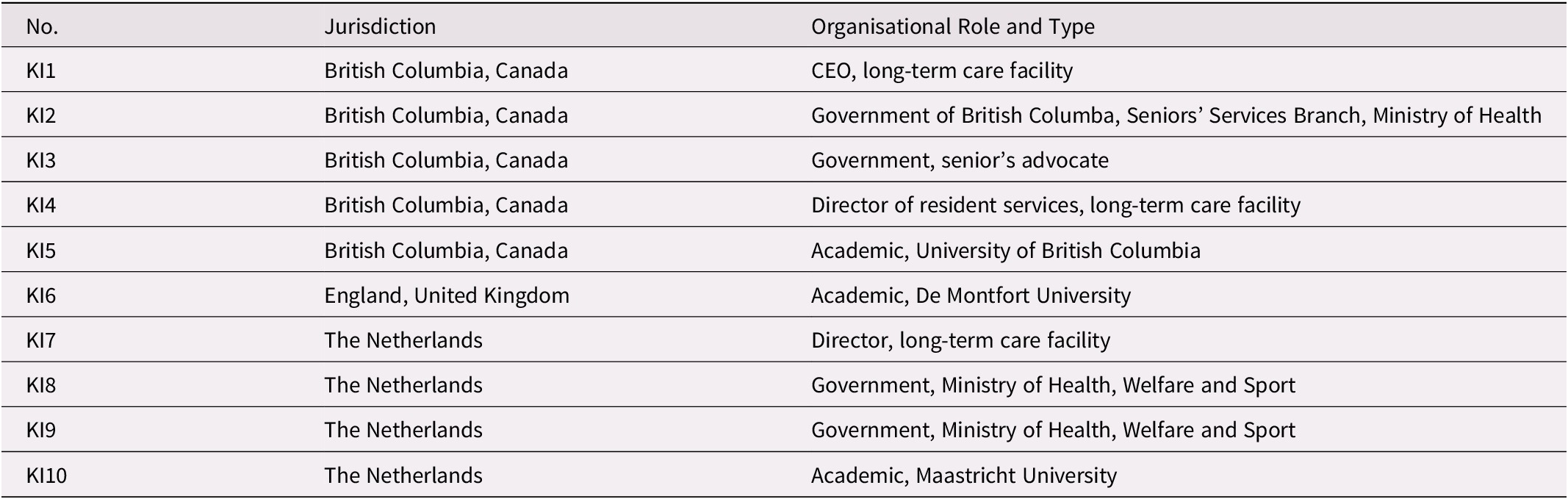
The semi-structured interviews focused on understanding how policy directives regarding family visitation during the pandemic were interpreted and implemented at the operational level. In total, 10 interviews were conducted between April and May 2021: 5 in British Columbia, 1 in the United Kingdom, and 4 in The Netherlands (Table 1). All interviews were conducted via Zoom and typically lasted from 40 minutes to 1 hour, with both researchers present. Interview guides were prepared for each interviewee type (academic, minister, facility manager) with similar questions focusing on roles and responsibilities, the communication of directives, key lessons (central challenges and leading practices), and changes in policies over time. The transcribed text from interviews has been analysed by one researcher for key themes employing a mix of interpretive analysis (deep reading) to understand context (see Walsham, Reference Walsham2006) and thematic coding to identify the key challenges and leading practices (Kiger & Varpio, Reference Kiger and Varpio2020). The researchers were unable to obtain interviews with directors of LTC in England or senior government officials. This is a recognised limitation of the study as is the analysis of transcripts by a single researcher (as opposed to by both independently).
Key informants by jurisdiction and organisational role and type
Findings
Early on in the pandemic, government officials, residents, and the care/sectoral organisations that support them struggled to adapt as conditions were quickly changing and lines of communication were not yet well developed. All interviewees reported on change over time, from the first wave of the pandemic to subsequent second and third waves when there were more established policies and practices. A common theme is that there was a major focus on the hospital sector at the onset of the pandemic and much less so on that of the LTC sector and its unique needs. In British Columbia, one key informant noted: “all of the energy and resources went to acute care in the beginning of the pandemic and the long term care sector was not adequately supported” (Key Informant [KI] 5). Experiences in the United Kingdom and Netherlands were reportedly similar. In the United Kingdom there was a reported lack of guidance for the LTC sector; seniors were moved from acute care in hospitals to LTC facilities where COVID-19 then spread (Bell et al., Reference Bell, Comas-Herrera, Henderson, Jones, Lemmon and Moro2020). In The Netherlands, there were few testing facilities and a lack of personal protective equipment (PPE) for the LTC sector at the onset of the pandemic (KI7). In all countries, health and/or infections disease ministries/institutes provided public health directives including around visitation in the LTC sector. Table 2 outlines the key actors for the communication of health directives and advice in each jurisdiction. In all jurisdictions, the steep toll of no/limited visitation policies on residents has been recognised, leading to increased efforts to facilitate visitation through outdoor visits, the use of PPE, increasing rates of vaccination, and the establishment of essential visitor status as the pandemic endured (Comas-Herrera et al., Reference Comas-Herrera, Glanz, Curry, Deeny, Hatton and Hemmings2020; Daly, Reference Daly2020; Van der Roest et al., Reference Van der Roest, Prins, van der Velden, Steinmetz, Stolte and van Tilburg2020). Table 3 shares the key features of the LTC facilities interviewed including the communications tools and technology solutions that they have used over the course of pandemic.
Key actors, COVID-19 directives and communications

Note: Source: Own elaboration based on respondents, cross-referencing.
Key features of residential care facilities interviewed

Note: Source: Own elaboration based on respondents.
Pandemic management in The Netherlands went through three stages. First, there was the total closure of care homes to visitation; later on, there was an approach to differentiate among regions, depending on the number of COVID-19 cases; and finally, there has been an emphasis on flexibility so that care homes may determine what is best for them and implement visitation policies accordingly (KI8). The National Institute for Public Health and the Environment is responsible for public health rules around immunisation alongside regional health authorities (a structure similar to that in British Columbia). Regional health authorities gather local information on the spread of infectious diseases and report this to the national level (Jansen, De Leeuw, Hoeijmakers, & De Vries, Reference Jansen, De Leeuw, Hoeijmakers and De Vries2012). They also collect information from local health care providers. It is reported that there were strong lines of communication among these actors over the course of the pandemic (KI8). Facilities were closed early on in the pandemic, with no family members being permitted inside the facility. Despite these precautions, COVID-19 cases occurred in facilities as staff members exposed residents to the illness. Early in the first wave, the government had not permitted facilities the use of medical grade masks. Facilities went against government directives in order to externally source and import medical grade masks and other PPE at this time; these measures were found to have successfully decreased infection rates (KI7). PPE procurement was later centralised (Langins, Curry, Lorenz-Dant, Comas-Herrera, & Rajan, Reference Langins, Curry, Lorenz-Dant, Comas-Herrera and Rajan2020). The Netherlands is somewhat unique in having a large number of medical and paramedic professionals external to LTC facilities who provide occasional services; for example, physiotherapists and psychologists (KI7). These professionals were not permitted to enter the homes, though some did continue to provide their services via video conferencing. By the second wave of the pandemic, the negative impacts of the lockdown on residents’ quality of life was reported by LTC staff (KI7). In response, facilities provided family members with protective clothes and masks in order to facilitate visits with family members (to a maximum four people) (KI7). This was especially important for visitations with the terminally ill. Today, a more flexible approach to visitation has been adopted (Verbeek, Zwakhalen, Schols, Kempen, & Hamers, Reference Verbeek, Zwakhalen, Schols, Kempen and Hamers2020; Verenso, 2022).
The province of British Columbia had the earliest publicly reported outbreak among LTC homes in Canada, first reported on March 5, 2020. Unlike The Netherlands, British Columbia’s response to the COVID-19 pandemic established “essential visitor” protocol in LTC facilities during the first wave. As such, some visitation was permitted (there was not a total shut down). Information about infection prevention and control guidance was published through the Centre for Disease Control at the onset of the pandemic; this included visitation control measures in LTC facilities. The director of licencing and the assistant deputy minister of health communicated directives through a public health order. Subsequently, three of the five health authorities in British Columbia issued medical health officer orders for visitation, which LTC operators were required to follow (KI2). Access to residents was prohibited from March 16, 2020 to mid-June except for those deemed essential visitors (i.e., those who provide a demonstrated care need, compassionate care at end of life). Despite this guidance, there have been reported differences in what may constitute an “ssential” visitor (KI 1, KI2, KI4). In the words of one interviewee:
One of the biggest issues was determining those who can see their loved ones. Tight controlling of visits to half an hour in a common area under observation. Those are not quality care visits. In BC, long term care facilities closed visitation but permitted essential visitors –this was interpreted in very different ways. There was a risk aversion to permit individuals and as such, some people were not deemed essential when they could have been under the guidance (KI3).
Facilities were required to interpret the guidance, and this may have led to extreme risk aversion in some cases, limiting the scope of essential visitor status. In order to establish a fair and rigorous process around these decisions, one facility established a panel of interdisciplinary team members to determine which visitors should be considered “essential” under the policy (KI4). The committee met weekly to approve or deny essential visitor status and was composed of care aides, a nurse, a charge nurse, a psychiatrist, the director of care, and a member of administration (KI4). Decisions could be appealed to the Patient Quality Care Offices in Health Authorities and, if elevated, to the Ministry of Health. In some cases, facilities kept running companion (volunteer) programmes to support residents (e.g., organising excursions) in order to ensure that there was quality of care. Starting in July 2020, residents were able to have one designated social visitor a week. The pandemic has highlighted the importance of clearly communicating the authority under which guidance is developed, including recourse for appeals and challenges. As in The Netherlands, the residences interviewed for this study reported challenges in accessing PPE in the early days of the pandemic and proactively ordered PPE their own for residents, staff, and visitors (KI1, KI4).
The United Kingdom has experienced three waves of the pandemic to date. In the first wave, a national lockdown to protect the National Health Service (NHS) was announced as of March 23, 2020. From this time (and in some cases earlier), a “no visitation” policy was implemented in LTC homes in order to protect residents along with restricted access by NHS professionals who provided services to LTC residents (with the exception of visitation at the end of life) (Low et al., Reference Low, Hinsliff-Smith, Sinha, Stall, Verbeek and Siette2021). At the same time, the government directed hospitals to clear beds in acute care in to accommodate rising demand from COVID-19 patients. Patients were sent home or to LTC facilities absent testing for COVID-19; cases subsequently spread to the LTC population. PPE was not provided to LTC homes and beyond the “no visitation” policy, there was limited guidance from the Ministry of Health and Social Care, or from regional or local health authorities about how to manage outbreaks in diverse types of LTC facilities (KI6). The British Geriatric Society formed the first policy guidelines for home visitation followed by the Ministry of Health and Social Care and public health authorities. However, “interpretation is completely down to the care home manager or the management of the care home” and the manner in which care homes communicated policy directives to residents varied substantially across homes” (KI6). After the first wave lockdown, each of the devolved administrations of the United Kingdom have implemented their own health directive guidance. The Ministry of Health and Social Care’s most recent visitation guidance stresses the importance of family members and the use of discretion in determining practices.
Providers should facilitate visiting as described in this guidance wherever it is possible to do so in a risk-managed way and in line with the principles set out below. Providers should develop a dynamic risk assessment to help them decide how to provide the visiting opportunities outlined in this guidance, in a way that takes account of the individual needs of their residents, and the physical and other features unique to the care home (Ministry of Health and Social Care UK, 2021).
As such, the mental health impacts on residents and family members has been increasingly recognised. Visitation has been facilitated through the use of lateral flow tests and PPE. As of October 2021, the guidance specifies that every care home resident can have “named visitors” who will be able to enter the care home for regular visits as well as an “essential caregiver” who may visit the home to attend to essential care needs in most circumstances (even if there is an outbreak in the home) (Ministry of Health and Social Care UK, 2021). The pandemic has highlighted that LTC homes are not part of the NHS; guidance to care homes was slow to be developed and there was a lack of access to appropriate PPE. It is reported that care home staff, residents, and their families have felt isolated from decision making and that there have been lags and inconsistencies among United Kingdom government guidance, care association policies, and care home protocols (as noted in Low et al., Reference Low, Hinsliff-Smith, Sinha, Stall, Verbeek and Siette2021).
Leading Practices and Key Challenges in Comparative Perspective
As the pandemic has progressed, there has been significant learning on how to manage safe family visitation in LTC homes. As noted by one key informant: “Family visitation was treated as a homogenous issue in many respects—family members were not seen as critical to the care of residents even when we know that they are and there has been a lack of focus on the impact of COVID-19 restrictions on family members and not just residents” (KI3). Over successive waves, there has been a growing focus on how to safely accommodate visitation through the appropriate use of PPE and testing. This section shares the leading practices and key challenges identified by key informants.
Leading Practices
Safe, socially distanced family visitation practices
Facilities have adopted a range of solutions to accommodate family connection and visitation such as the use of conference calls, outdoor visitation spaces, screens, new visitation protocols with the use of PPE, and rapid antigen testing. There have been creative efforts to adapt to public health directives over time while safeguarding the health of residents. Over the successive five waves of the pandemic, the impact of very limited visitation policies on resident well-being has been increasingly recognised. In the Netherlands, research has demonstrated that safe visitation can be established with the use of PPE.
Governance structures at facility level
A major theme across all jurisdictions has been the importance of crisis management at the facility level to ensure robust, responsive, and evidence-based decision making. For example, the facility in The Netherlands established a crisis organisation team, an operational team, and a strategic level team to manage issues throughout the pandemic. Facilities in British Columbia established implementation teams to support visitation and to determination essential visitation status (KI1, KI4). In all cases, these structures were seen as essential to effective management and communication. Family member representatives were not integrated into these structures.
Mental health supports and resilience training
Managing the pandemic in LTC facilities has been extremely stressful for staff, residents, and family members. In The Netherlands, it was reported that at the beginning of the pandemic, every facility was provided with a mental health team composed of a social worker and a psychologist. This team would support staff and residents in dealing with traumatic events. One residence interviewed in British Columbia received resources from the Ministry of Health in order to conduct emergency resilience training for the pandemic designed for nurses in a live Webinar format (multiple sessions) (KI1).
Communications
In all facilities, there were efforts to increase communications between and among residents, staff, and family members through e-mails and newsletters. In The Netherlands, short videos were used to communicate COVID-19 protocols and provide updates to residents and visitors/family members. Staff newsletters in The Netherlands and British Columbia focused on communicating protocols. For example, a “code orange” plans was developed in the case of an outbreak detailing how to manage visitation, PPE, in British Columbia (KI4).
Data analytics to manage crisis response
In The Netherlands, the LTC organisation (composed of multiple facilities) created a dashboard with analytics in order to inform decision making and protocols. This dashboard included instances of death, COVID-19 cases among staff and residents, and general illness among employees. Based on these indicators, a plan was developed to adjust the type of care provided on the bases of the number of employees present. For example, if a third of the workforce were ill, only basic care services would be provided for that day.
Wage leveling and full-time employees
Consistent, reliable, and well-compensated staff are critical for high quality care (KI5). Early on in the pandemic, it was recognised that staff—particularly part-time staff working across multiple residences—could be a source of COVID-19 transition in LTC facilities. In an effort to address this while not harming workers, the province of British Columbia brought in wage- levelling legislation and single site order (Government of British Columbia, 2021). This is reported to have positively impacted family members, because regular full-time staff are more likely to have a stronger relationship with the family (KI5).
Living laboratory model for evidence-informed decision making
Among the countries studied, The Netherlands has taken a unique approach to the reopening of LTC homes. The Dutch Ministry of Health engaged Maastricht University’s “Living Lab in Ageing and Long-Term Care” to evaluate the visitation ban rule in LTC homes, by collecting data from one nursing home in each of 25 regions (KI 9, 10). The “Living Lab” pilot followed the reopening experiences of 26 homes implementing visitation access with rules regarding hand hygiene and the wearing of PPE for visitors, staff, and residents. This pilot demonstrated that it is safe to have visitation when the appropriate PPE and hygiene measures are taken. The ongoing research project has further demonstrated that there are now a diversity of approaches taken in LTC homes to safeguard visitation, even in the cases of a resident having COVID-19 and in accordance with the rates of vaccination of their populations. The “living lab” model supports a close working relationship between the government (Ministry of Health) and Dutch universities to support evidence-informed decision making (Verbeek et al., Reference Verbeek, Gerritsen, Backhaus, de Boer, Koopmans and Hamers2020).
Key Challenges
Lack of understanding of key role of family/friends to long term care residents’ well-being
“The biggest challenge that we faced in the long-term care sector was a lack of understanding and valuing of the family member relationship in long term care” (KI7). This has been a recurring statement across the academic and facility management key informants interviewed. In the first wave of the pandemic in particular there was a reported disproportionate focus on the hospital sector to the detriment of LTC facilities when residents were moved from acute care (in some cases without adequate COVID-19 testing). Stop visitation directives in all jurisdictions, with the exception of British Columbia where there was essential visitor status early on in the pandemic, led to reported decreased well-being of residents. As such, in subsequent waves of the pandemic additional efforts were made to increase contact.
Lack of adequate training resources
Considerable staff training and time were needed to mange visitation practices. For example, staff need to be trained in intake of visitors, screening, contact-tracing protocols, and taking temperatures of visitors (K11, KI4). In some cases, for example, British Columbia and England, there was no additional funding for such training and resources were limited. Facilities were under-resourced to take on these responsibilities.
Public communications of directives leaving no time for facilities to adjust and respond
The timing of public health directives has in come cases left facilities with no time to plan for implementation. For example, in British Columbia, facilities reported receiving government health directives at the same time as the public (from the chief public health officer), This provided the facility with little time to respond to directives and organise new visitation protocols.
Lack of streamlined or conflicting or absent guidance
Interviewees in British Columbia and the United Kingdom reported finding it very difficult to follow the volume of information and guidance and to interpret it operationally. For example, in the United Kingdom, there was a reported lack of guidance early on in the pandemic for LTC facilities and “guidance changed frequently and was conflicting and could not always be implemented, for example when personal protection equipment was extremely expensive and difficult to source” (Rajan, Comas-Herrera, & Mckee, Reference Rajan, Comas-Herrera and Mckee2020).
Lack of PPE and limited testing capacity
All jurisdictions reported lack of PPE in the early days of the first lockdown. This was subsequently resolved in most cases; however in some, facilities were competing against public health authorities to procure protective equipment (British Columbia). In The Netherlands, a lack of testing capacity for employees and residents has also been identified as a barrier. By the second wave of the pandemic this was addressed; however, there remained a lack of testing for other staff, such as facility managers. The facility gained access to rapid tests through their open procurement in order to be responsive in this regard. In England it has been reported that “managers were unable to effectively implement isolation policies and reported that workforce and funding support did not always reach them” (Rajan et al., Reference Rajan, Comas-Herrera and Mckee2020).
Lack of funding for mandated directives
Public health measures have imposed significant costs on LTC facilities that they have not been compensated for. For example, in British Columbia, the facility reported a lack of funding for mandated measures such as front door screeners, booking systems, renovations to common areas, additional PPE, or additional staffing expenses to accommodate safe visitation (KI4).
There has been significant learning as the pandemic has progressed on how to manage safe family visitation in LTC homes. As noted by one key informant: “Family visitation was treated as a homogenous issue in many respects – family members were not seen as critical to the care of residents even when we know that they are and there has been a lack of focus on the impact of COVID-19 restrictions on family members and not just residents” (KI3). Over successive waves there has been a growing focus on how to safely accommodate visitation through the appropriate use of PPE and testing.
In many cases, residential care facilities have developed their own networks of support to manage family visitation. In the words of one key informant: “there is an appetite for comparative learning and solution seeking which could have been facilitated from the public authorities” (British Columbia, KI4). Going forward, adequate access to PPE, training, and improved processes will be critical for ongoing pandemic management; LTC facilities need to be resourced to effectively meet these requirements.
Conclusion
We can’t have long term care without family being present. Not permitting visitation is inhumane and it is not effective in terms of infection control (KI5).
The COVID-19 pandemic unravelled as a series of unknowns, with public officials and LTC managers needing to manage risk and protect those who are most vulnerable while balancing the potentially detrimental impacts of these decisions. This has been a learning process with the LTC sector challenged to shift, adapt, and now prepare for future pandemics in different ways. The quote at the beginning of this section compellingly asserts that LTC residents need their families. What we have learned is that there are ways to manage the risks of visitation while protecting this right. This requires investments in training personnel, access to PPE and testing, establishing safe spaces (e.g., air filtration and ventilation), managing human resources, communicating clear guidance, and appropriately funding mandates. The interviews also stress the importance of communications within LTC organisations and building a culture of trust and respect. In all countries studied, interviewees expressed criticism that public officials were focused on the health care sector foremost, with the LTC sector being an afterthought. It is hoped that one of the main lessons coming out of the COVID-19 pandemic is the importance of support for the LTC sector. In Canada, unacceptable neglect of LTC residents has led to a public inquest in Quebec. These are mistakes we must never repeat.


 Open access

