




Introduction
The study of wartime collaboration has been a large and contentious field since the 1950s, yet it continues to expand in the twenty-first century. Arguably, the centre of this field has shifted from France’s Vichy Regime to collaboration with the empire of Japan in wartime East Asia. Understanding collaboration remains vital in East Asia because of the continued political and societal significance of the collective memory of war and colonialism, yet the diversity of experience under occupation, as well as the development of diverse societies in twenty-first century East Asia, have resulted in a complicated historical memory with high stakes. Despite the emotional, societal, and political importance of this memory, the field has moved further away from the dichotomy of patriot and collaborator that once defined it.
The memory of Zhang Wojun (張我軍 1902–1955), a Taiwanese-born writer and educator who lived in Beijing for 25 years, serves as an excellent case study on the dissolution of this standard dichotomy. As will be shown below, advocates of Taiwanese literature remember him for his contributions to Taiwan’s New Literature Movement, contributions which inadvertently set the stage for nativist writers such as the ‘father of Taiwanese Literature’ Lōa Hô 賴和; Zhang’s children have remembered him as a Chinese nationalist who established important links between Taiwan and mainland China and also protested against Japanese imperialism; and critics have remembered him as a collaborator with the Japanese empire for his support of some of the Japanese initiatives to establish the cultural and intellectual foundations of the Greater East Asia Co-Prosperity Sphere. All three of these perspectives can be supported through a documentary study of Zhang’s life and writing between 1924 and 1945, but the seeming conflict in his actions to support Taiwan, China, and Japan points to continued efforts to remember the intellectual elite in terms of their contributions to the nation and state.
Shortly after the end of the war with Japan, a number of patriotic Chinese branded Zhang Wojun as a hanjian 漢奸, a traitor to the Han people, for a few of his wartime actions.Footnote 1 In terms of its usage to criticize the betrayal of those seen as cooperating with the enemy, especially during times of war, the term hanjian has some equivalence with the English word ‘collaborator’ or the French ‘collaborateur’, a term which Sartre connected to both political and sexual betrayal.Footnote 2 Collaboration is thus defined in opposition to loyalty and, as Chien-hsin Tsai has shown, loyalty in colonial Taiwan was a fluid and ambiguous concept. David Der-wei Wang and Tsai develop an understanding of ‘postloyalism’ to ‘move existing politico-cultural discourse on Taiwanese identity beyond a false opposition of being and not-being Taiwanese’, envisioning a modern and sometimes ambiguous form of loyalty that is not limited by traditional restrictions.Footnote 3 This is useful in examining Zhang Wojun, as we consider the meanings underlying the accusations of betraying (or remaining loyal to) China posited against a Taiwanese-born writer.
Decades after his death, Zhang’s ‘betrayal’ would be largely excused, and he would be reimagined as a Chinese nationalist. Zhang Wojun, and many other so-called collaborators like him, could initially be seen only along one axis. This axis stretched from a hanjian, in league with the Japanese oppressors, to a Chinese patriot who had resisted the occupation and fought the Japanese. However, the memory of Zhang is much more complicated. In the 1970s and 1980s, Zhang was remembered for his role in bringing May Fourth ideas to Taiwan’s literary circles and furthering the intellectual connections between Taiwan and mainland China. Although academics still hold Zhang’s contributions in high regard, his pro-China politics have diminished his position in public memory in Taiwan.
Narratives of complex identities, such as that of Zhang Wojun, have often been silenced or distorted by meta-narratives of ‘nation’ that have dictated readings of history. This article hopes to show alternative possibilities for such characters by considering their work and life within the contexts of their multiple national and personal identities and their writing before the occupation, as well as the memory of their contributions decades after their actions. I consider the fluidities of identity and experience that accompany intellectual collaboration, especially for one who was raised in colonial Taiwan. Like many of those accused of collaboration, Zhang Wojun cannot be easily categorized under postwar nationalist paradigms. Instead, I situate him through both the contradictions and continuities that can be established between his wartime work and that of decades earlier, accepting that the various ways of remembering his contributions to history are all equally valid from different subjective viewpoints. To situate Zhang in this way, this methodology results in a narrative progression that cycles through time rather than one that follows a linear progression.
Remembering collaboration
In his 1961 Wretched of the Earth, Fanon highlighted the ubiquity of intellectual collaborators in the colonial experience. He largely relegated their decisions to the economic sphere: ‘Colonialism secures for itself the services of these confidential agents by pensioning them off at a ransom price.’Footnote 4 This representation sets the stage for an enduring moral binary, but one that has been steadily chipped away at for decades, accompanying a shift from Eurocentric memories of war and collaboration towards East Asia memories.
In the 1980s and 1990s, the democratization of South Korea included an often-bitter return to issues of collaboration, as efforts were made to bring justice to bear on those who had benefitted from war and colonization.Footnote 5 This struggle spread across East Asia and soon became a popular focus for academics, as debates in politics and society drove historians towards contentious questions. Poshek Fu’s 1991 Passivity, Resistance, and Collaboration marked an important turning point in the study of collaboration in East Asia through Fu’s efforts to disrupt the established binary by adding a neutral position: passivity.Footnote 6 However, this did little to end the debate on the moral significance of collaboration. Most notably, in 2012 the Journal of Asian Studies published articles showing contending perspectives on collaboration, with John Whittier Treat arguing that historians must inevitably judge collaborators and Timothy Brook arguing that historians should refrain from making judgements when both the subject and the historian are inescapably tied to historical contexts.Footnote 7
Attempting to tackle this issue with a new approach, Jonathan Henshaw, Norman Smith, and I presented translations of texts related to collaboration, including diaries, articles, and letters, alongside analyses written by historians for the edited volume Translating the Occupation: The Japanese Invasion of China, 1931–1945.Footnote 8 This approach combined primary and secondary sources to allow readers to make their own judgements on history, while also having the context provided by the historians. The success of this approach had limitations, as this works for some texts and individuals better than for others.
Inevitably, a detailed documentary approach that focuses on the relevant primary sources as well as the secondary writings by those who best know the historical and individual contexts produces a more nuanced understanding of an event and its changing historical significance. Therefore, this article examines Zhang’s own writings and intellectual work, later writings from his family on both sides of the Taiwan Strait, as well as academic and political sources that position and remember Zhang.
Memory and identity are inseparable, and as memory driven by state or society changes—as it has done in Taiwan—commemoration of the past inevitably changes as well. Following James E. Young’s 1993 study of the Holocaust, many studies of memory, commemoration, and monuments focused on the memory of war and trauma.Footnote 9 However, in recent decades, the connection between nation and memory/commemoration has become an emerging sub-field as historians have acknowledged the ways in which nationalists have constructed and reconstructed the ‘imagined community’ through memory and commemoration of the past.Footnote 10 In Taiwan, this process has been particularly convoluted as successive governments and a changing societal elite have vied to control narratives of the past and public commemoration in the present.Footnote 11 As these constructions of the historical narratives of nation become myths to serve the present, it becomes increasingly difficult to situate those whose histories create contradictions for national myths.
Zhang Wojun: Representing Taiwan, Japan, and China
The Japanese took control of Manchuria in 1931 and occupied Beijing and Shanghai from 1937, but Taiwan, the birthplace of Zhang Wojun, had been part of the Japanese empire since 1895, shortly after China’s loss in the first Sino-Japanese War. In 1902, Zhang’s parents indicated their love for China when they named their son Qingrong 清榮, meaning glory to the Qing, a name that would soon be outdated. However, Zhang received much of his early education in the Japanese colonial system. This was before the Japanese policy of dōka 同化– (assimilation), but it still ensured that he had a firm grasp of written and spoken Japanese.Footnote 12 In 1919 he moved to China to work for a Japanese bank in Xiamen. Shortly afterwards, he went to Beijing where he became the first Taiwanese to graduate from a mainland university. Although he graduated from Beijing Normal University’s Chinese department, he was immediately hired to lecture Japanese.Footnote 13
Zhang found himself playing the role of a cultural and linguistic intermediary, often expressing his love for both China and Japan. Even in his questionably pro-Japanese writing during the late stages of the war, when he argued for the participation of the Chinese people in the Greater East Asia Co-Prosperity Sphere, Zhang still emphasized the importance of the Chinese nation as a separate entity. And he took his role as a cultural intermediary very seriously, often hoping to bridge divides through his translation and language teaching. In 1943, he wrote:
Both Japan and our own country were constructed in Asia. Our territories lie close together. In any respect, we can be said to be brothers, and the opportunities for mutual interaction have been many. However, the depth of our understanding of this brotherly country have not been as deep as his understanding of our own culture, inevitably leading to very inconvenient events and unavoidable disagreements. Although there are many reasons for the issues between our two countries, our lack of understanding of Japanese culture is certainly one of these reasons.Footnote 14
At the same time, Zhang was fiercely opposed to the Japanese empire’s control over Taiwan. He was a vocal supporter of the movement to establish a Taiwanese parliament in the 1920s and was well-connected with many of the intellectuals leading the movement.Footnote 15 Throughout the 1920s, he supported Taiwan’s publications, encouraging Taiwanese writers to look to Chinese and Japanese literature as the ‘model teachers’ 師表.Footnote 16 When he published in China, he used the term ‘Our China’ 我中國, and when he published in Taiwan, he used the term ‘Our Taiwan’ 我臺灣.Footnote 17
The tripartite complexity of Zhang’s nationalism must have difficult for many Chinese nationalists to accept in the years after the war. However, all are in agreement that his early writings opposed Japanese rule over Taiwan. For example, in a short piece Zhang published in Shaonian Taiwan (少年臺灣 Taiwan’s Youth), of which Zhang was editor-in-chief in 1927, he lambasted the colonial government: ‘The freedom of the Taiwanese has already been stripped away until there is nothing left. Now they wish to go a step further by taking away the Taiwanese people’s very right to existence.’ This article encouraged young Taiwanese to follow China’s May Fourth generation in opposing imperialism. In fact, the very name Shaonian Taiwan was taken from Shaonian Zhongguo (少年中國 China’s Youth), a journal and society established by Li Dazhao and others in 1919, emulating Giuseppe Mazzini’s Young Italy Society and his movement to unite Italy.Footnote 18 Zhang borrowed concepts from prominent May Fourth intellectuals, referring to the Taiwanese as a ‘weak and small nation’ (弱小民族), the term for a colonized people popularized by Chen Duxiu in 1919.Footnote 19 And he made efforts to influence those with a voice, famously complaining to Lu Xun in 1926 that China and Chinese intellectuals had forgotten about Taiwan.Footnote 20
Over the 1920s, 1930s, and 1940s, Zhang unapologetically incorporated Chinese, Japanese, and Taiwanese perspectives into his intellectual landscape. As Fong Shiaw-Chian has pointed out, ‘Under the colonizers’ modernizing and assimilating assault, the nationalism that Taiwanese intellectuals had learned from their Japanese professors was fundamentally ambiguous. It referred to a nationalist “I” that could be Taiwanese, or Chinese, or Japanese, or all of them.’Footnote 21 However, although Zhang certainly experienced some of the assimilation (dōka) efforts of the colonial administration, he was educated in the 1910s, and left Taiwan in the 1919, one year before the policy of ‘gradual assimilation’ began and four years before the publication of Shibata Sunao’s famous Taiwan dōkasaku ron (On Assimilation Policy in Taiwan 臺灣同化策論).Footnote 22 Leo Ching has shown how this policy accelerated throughout the 1920s and 1930s until it was fully established as colonial policy in 1937.Footnote 23
Beginning in 1897, colonial subjects from Taiwan held a Japanese passport, but in his writings Zhang identified as both Taiwanese and Chinese. Today, historians from both Taiwan and China consider Zhang Wojun to have been part of the Chinese anti-imperialism movement because his work in the 1920s was resistant to Japanese domination and he accepted Taiwan literature as being a tributary of Chinese literature.Footnote 24 Even in his writings from occupied Beijing, he continued to refer to Taiwan as a part of China.Footnote 25 And Zhang’s role in what Taiwanese academics call the ‘New-Old Literatures Debate’ also connected strongly with China and the intellectual purview of the mainland Chinese educated elite. Following the May Fourth Movement, with ideas imported into Taiwan from both China and Japan, the New-Old Literatures Debate concerned the rejection of traditional forms of literature and language in favour of ‘modern’ forms. It was of critical importance in the construction of Taiwan’s modern national identities. Writing under his zi (courtesy name), Yi Lang 一郎, Zhang fired some of the first shots in this debate, famously attacking the confines of traditional poetry with his first articles in 1924: ‘A Letter to the Young People of Taiwan’ 給臺灣青年的一封信 and ‘The Deplorable Nature of Taiwan’s Literary World’ 糟糕的臺灣文學界.Footnote 26 The simple vernacular style and exasperated antagonism of these first articles left Taiwan’s literary circles reeling:
Why don’t you read some books of value that can be put to practical use for society, rather than spending each day writing poems that may look important but are really of no use, remaining slaves to old rhymes and rhythms, or talking about those so-called eight-legged essays, holding onto the stench of our ancestors (Taiwan’s poetry and other literary forms have never witnessed true literary value and have seen no hint of reform. Instead, they writhe in the dunghill. Writhing for a hundred years or a thousand, all this will leave them with is the stink of shit).Footnote 27
This resulted in Zhang occupying a rather odd position in the history of Taiwanese literature. He is seen as one of the pivotal intellectual voices, setting the stage for the rise of a literature independent of China. Yet Zhang was opposed to this perspective on Taiwanese literature, vocally arguing that it should be seen as a branch of Chinese literature and privileging the Beijing vernacular over the Hokkien Taiwanese vernacular that some of his colleagues were promoting in the 1920s. Still, the best-known chroniclers of Taiwanese literature have immense respect for Zhang’s contributions. Yeh Shih-tao 葉石濤 regarded Zhang’s Beijing writings ‘as an important cornerstone that lay the foundations and development of Taiwan’s New Literature’.Footnote 28 In his canonical History of New Taiwan Literature 台灣新文學史, Chen Fangming 陳芳明 dealt with the problem of Zhang’s contribution with a mixture of respect and incredulity:
Examining the trajectory of history, we find that Zhang Wojun’s contribution is undeniable. However, he was subject to the limitations of his time. He argued that: ‘Taiwan Literature was a distributary flowing from the river of Chinese Literature. Therefore, when the main river undergoes any changes, the distributary must change in accordance with the river.’ When Zhang Wojun expounded upon this perspective, he entirely ignored the reality of Taiwan as a colonial society. As the rights to speech in colonial Taiwan were firmly held in the fist of the Japanese, almost everything from education to newspaper publishing was monopolized by the colonizers. This cultural environment cannot in any way be compared with China’s society at that time. Zhang’s subjective desire for Taiwan literature to follow along with the development of Chinese literature was clearly out of step with objective reality. The later development of Taiwan literature hurriedly departed from the path that Zhang had desired.Footnote 29
Despite his opinions on Taiwan’s relationship to China, the Taiwanese literary world remembers Zhang with respect for his theoretical contributions, as well as his modern poetry and translation work. In the early 1920s, he moved from Xiamen to Beijing to study the Beijing vernacular, which he then eagerly promoted to Taiwanese readers, especially through the Taiwan Minbao (Taiwan People’s News), a then weekly journal that was crucial for the dissemination of Chinese and Japanese intellectual trends in the 1920s.Footnote 30 In 1925, Zhang returned to Taiwan, taking up the position of editor at the Taiwan Minbao, and published Taiwan’s first collection of vernacular poetry, Love in a Chaotic City 亂都之戀.Footnote 31 The ‘chaotic city’ that serves as a background for Taiwan’s first collection was Beijing, where Zhang had fallen in love with Luo Xinxiang 羅心鄉. Zhang would not stay in Taiwan long, but his work writing for and editing Taiwan Minbao was of critical significance for the development of Taiwan’s literary scene. It was also at this time that he built his name as a great translator of Japanese fiction.
Between 1925 and 1945, Zhang translated a wide variety of literature, philosophy, and academic texts by writers such as Abe Isoo 安部 磯雄 (1865–1949), Mushanokōji Saneatsu 武者小路 実篤 (1885–1976), Arishima Takeo 有島 武郎 (1878–1923), Yamakawa Hitoshi 山川均 (1880–1958), Toyoshima Yoshio 豊島与志雄 (1890–1955), Hayama Yoshiki葉山嘉樹 (1894–1945), Oka Asajirō 丘浅次郎 (1866–1944), Tanizaki Jun’ichirō 谷崎 潤一郎 (1886–1965), Takahashi Teiji 高橋禎二 (1890–1954), Miyajima Shinzaburo 宮島新三郎 (1892–1934), Sasaki Gesshō 佐々木月樵 (1875–1926), Sōseki Natsume 夏目漱石 (1867–1916), Nagano Akira 長野郎 (1888–1975), Tokuda Shūsei 徳田秋聲 (1872–1943), and Shimazaki Tōson 島崎藤村 (1872–1943).Footnote 32
Many of these writers were the most influential socialist thinkers in 1920s and 1930s Japan. Zhang played a pivotal role in expanding socialist thought in both China and Taiwan, and it is for introducing these important works to a Chinese readership that he is remembered in China.Footnote 33 Zhang continued this work throughout the occupation, publishing dozens of translations—including many book-length works—in Shanghai and Beijing between 1937 and 1945.
Commemorating the writings of a ‘Chinese nationalist’
Partly due to his contributions to Taiwan’s New-Old Literatures Debate, publishers returned to Zhang’s writings and created two important compilations of his work within a span of ten years. The first was Zhang Wojun Wenji (張我軍文集 A Collection of Zhang Wojun’s Writings) published in the Republic of China on Taiwan in 1975, 26 years after the Civil War and in the final year of Chiang Kai-shek’s life, while Taiwan remained under strict martial law. The second, Zhang Wojun Xuanji (張我軍選集 The Selected Works of Zhang Wojun), was published in the People’s Republic of China ten years later in 1985. Zhang’s son, Harvard professor of archaeology and vice-president of Academia Sinica, K. C. Chang 張光直, edited and introduced the book published in Taiwan. Zhang Wojun’s eldest son, Zhang Guangzheng 張光正, edited the second compilation and wrote an emotional postscript describing their separation in Beijing. The Zhang family returned to Taiwan as part of the Japanese withdrawal at the beginning of 1946, but, like many at that time, the family was divided by the Chinese Civil War when Zhang Guangzheng chose to live in Beijing.
Both of the compilations reflect the influence of the states in which they were published, but both repeatedly emphasize Zhang Wojun’s contributions as a patriot. The volume published in Taiwan concentrates on Zhang’s move to China, where he was able to ‘directly experience the culture of the land of his ancestors’.Footnote 34 It tells of ‘the love of a Chinese person from Taiwan for China’.Footnote 35 The introduction thereby affirms the official discourse on nation, emphasizing the importance of the people of Taiwan showing love for China at a time when pro-independence sentiments were on the rise and censors were still careful.Footnote 36 The postscript of the compilation published in the People’s Republic puts more emphasis upon Zhang’s contribution to the May Fourth Movement, a pivotal event in the construction of modern Chinese nationalism. It also recalls his ‘fierce love’ for China and his contributions in translating socialist literature from Japanese into Chinese.Footnote 37
Zhang Guangzheng continued this work for decades. He published the Complete Works of Zhang Wojun (Zhang Wojun Quanji 張我軍全集) in 2000 and followed this with the Addendum to the Complete Works of Zhang Wojun (Zhang Wojun Quanji Buyi 張我軍全集補遺) in 2016, adding various texts that had been found in later years. It is possible that the sensitivities of earlier times had diminished, but certainly new technologies played a role in allowing access to texts that were once difficult to unearth.
The editors’ introductions and postscripts to the 1976 and 1985 collections do not mention the Greater East Asia Writers’ conferences, and the lists of Zhang’s works include very little from the War of Resistance period. Regretfully, K. C. Chang explained, much of his father’s work was lost in the family’s frequent moves after Zhang Wojun’s death.Footnote 38 Nevertheless, Zhang’s attendance at the Greater East Asia Writers’ conferences and his work in Beijing under Japanese occupation was an important part of his life. Due to this, many people considered him to be a ‘cultural traitor to the Han’. However, it is the ways in which these past acts of collaboration have been rationalized or explained that are of interest to this article.
Intellectual collaboration: The Greater East Asia Writers’ conferences
In 2012, Hsu Chun-Ya 許俊雅, one of the most prominent researchers of Taiwanese literature, edited a collection of academic writings on Zhang Wojun from Taiwan, China, and Japan. Simply titled Zhang Wojun, this volume gives us insight into the various foci of research on Zhang over time, including his contributions to New Literature, his translation of Japanese fiction, and his efforts as an educator, producing textbooks for the study of Japanese. However, many of the chapters, including those by Hsu Chun-Ya and Zhang’s son Zhang Guangzheng, begin with an explanation and justification of Zhang’s attendance at the Greater East Asian Writers’ conferences.Footnote 39 Despite Zhang’s various contributions to the intellectual history of both modern China and Taiwan, academics still felt the need to justify his actions in relation to the conferences.
These conferences—held in 1942, 1943, and 1944—and known as the Greater East Asia Writers’ conferences, were ostensibly concerned with the establishment of a literature that rejected Western imperialism and embraced an East Asian identity. Critics argue, however—and with good reason—that for the Japanese government, which organized the conferences, they were the cultural arm of an imperialist project that was colonizing China. After the end of the Second World War, both the Kuomintang (Nationalists, KMT) and the Communist Party branded those writers who had represented China at these conferences as traitors for supporting Japan’s imperial agenda and Asianist ideology, and their works were pushed to the periphery or disappeared altogether, as did the writers themselves.
Organized by the Japanese Literary Patriotic Association, the Greater East Asia Writers’ conferences were intended to unite the literature of East Asian countries.Footnote 40 Although the stated mission concerned the ‘four nations’ of China, Manchuria, Mongolia, and Japan (which at that time included Taiwan and Korea) the emphasis was clearly upon bringing China and Japan closer together under the Japanese framework of a Greater East Asia.Footnote 41 Perhaps that is why the majority of the Japanese representatives were experienced writers, while those from other countries were generally quite young.Footnote 42 Over a hundred representatives from China, Manchuria, and Mongolia participated in the conferences. Some of the ideas that achieved a level of success in relation to these conferences included: establishing an organization for East Asian cultural research; having a major annual conference; establishing Greater East Asia literary awards; and outlining general rules for the translation of literature.Footnote 43 Although participating in such a conference may seem to be a fairly benign form of collaboration, participants suffered greatly for their involvement.Footnote 44
Guan Lu 關露, another Chinese representative at the conferences, was terribly victimized for her participation. A member of the Communist Party with connections to the Japanese embassy, she was forced by the party into attending the conferences as a spy. After the war, her superiors failed to make public the reasons for her actions and she was therefore imprisoned. Inside prison she suffered a mental breakdown. Although she was released and treated a few years later, after spymaster Pan Hannian 潘漢年 revealed the nature of her work, she was still repeatedly attacked and imprisoned over the next three decades. She was finally exonerated in late 1982, after the opening of China under Deng Xiaoping, yet she committed suicide a few months later.Footnote 45
The Manchukuo writer Mei Niang 梅娘 was awarded novel of the year for Crabs (Xie) at the 1944 conference, with many comparing her to Zhang Ailing, one of the most popular Chinese women writers in history. However, when the Japanese lost the war a few months later, this award would spell the end of her popularity.Footnote 46
A number of writers about whom we have information after the war shared similar experiences. However, for those involved in such ‘collaboration’, the situation was exceedingly complex. At the time of these conferences, Japan was the dominant power in Asia. The second conference was held after the Battle of Midway and Guadalcanal, now considered to be the battles when the tide turned towards the Allies. And the third conference was held in November 1944, not long before Japan’s fall. Of course, there was no way for the people of that time to know this. The writers living in Beijing saw total Japanese domination and had to be prepared for the possibility that this new world order was there to stay. Furthermore, it is not possible to judge intent from texts left behind. This is certainly true of the texts by Zhang Wojun. Decades later it has become possible to consider these works again; however, efforts to understand the motives and intentions of these writers have been strongly influenced by nationalist understandings of history.
A 1975 memoir by one of his Beijing friends, Hong Yanqiu 洪炎秋, states that Zhang’s reasons for attending the conferences were twofold. First, Hong argues that his older colleagues Zhou Zuoren 周作人 and Qian Daosun 錢稻孫 had asked him to go. And, secondly, as a teacher of Japanese language and literature, Zhang had wanted to visit Japan and meet some of the authors he had long admired.Footnote 47 Chō Kin 張欣, who quotes Hong in an article published in 2000, states that Zhang’s ‘motivations were pure and simple. He should not be persecuted for his actions.’Footnote 48 Although I agree with Chō’s final verdict that Zhang should not have been persecuted, it seems likely that Zhang was a very complicated individual, and his motivations were most likely ambiguous and complicated. Investigating this history with a research question that pivots upon whether or not Zhang should be blamed for his actions is problematic, as it reveals that the historian is still working within the limiting confines of a nationalist history.
Zhang himself offered a short and self-deprecating explanation of his attendance at the first conference in a 1942 review of the event:
Not only have I never made a significant contribution to the literary world, I have increasingly become a bookworm in recent years. Therefore, although I am certain that my attendance at this conference will have little influence, I could not refuse the sincerity of those who offered the invitation or the exhortations of Mr. Zhou Zuoren…Now that I have reached middle-age, I yearn for accomplishments with heart and soul, but this is simply my idiocy. It is unlikely that this conference will lead to any measurable contributions that are of benefit to our compatriots in Greater East Asia. And this is of great shame.Footnote 49
Putting aside his allusion to Asianism for the moment, there are a few things we can learn from this text. Unlike Zhou Zuoren, Zhang had not accepted a position in the Beijing government under occupation. Zhang’s choice to refer to himself as a ‘bookworm’ 書呆子 was mostly likely intended to distinguish him from Zhuo Zuoren, who had served as Minister of Education from 1941 to 1943.Footnote 50 However, he had continued to work at universities, which were important centres for collaboration across the occupied areas.Footnote 51 In the second half of the excerpt, Zhang disparaged both his own intellectual contributions and the potential contributions of the conference. This could have been his sincere belief or it could have been an attempt to counter accusations of collaboration. It seems even more likely that Zhang Wojun’s tripartite identity had made him aware of how to use ambiguities to achieve heteroglossia, speaking to different camps at the same time. It was imperative that he maintained a positive relationship with both the Japanese occupiers and the occupied Chinese.
I raise these possibilities, not to provide a revisionist history of an intellectual somewhat complicit in collaboration with Japanese occupiers, but to complicate our memory of those who engaged in collaboration, and to point out that the various reasons behind their actions do not need to result in labelling them as either collaborator or patriot.
As an educator in Japanese literature and culture in Beijing, Zhang was responsible for the monthly publication of the journal Japanese Literature and Language. He also translated dozens of influential books from Japanese into Chinese, including the works of the famous humanist writer, Mushanokōji Saneatsu, who Zhang met on three occasions after the occupation of Beijing.Footnote 52 Zhang’s efforts intensified during the war years, when new funding from the Japanese government opened up new possibilities for exchange and a deeper understanding of Japanese literature and culture. Finally, in 1942, Zhang had his first opportunity to travel to Japan and attend the first Greater East Asia Writers’ Conference as a representative not of colonial Taiwan but of the North China Writers’ Association. At this conference, he not only presented a conference paper, but actively engaged with the scholars by proposing his elaborate plans for cultural exchanges between professors and students of Japan and China. His plans for exchange included detailed ideas for selection, the number of students and educators to be involved, and possibilities expanding the programme in future years. His appeal to contemporary pan-Asian sentiments may have been in order to convince his Japanese audience of the necessity of funding this operation: ‘Beginning now, each of the various nationalities of East Asia must try to unite as an ever-lasting group.’Footnote 53 Using Asianist language to appeal for support from Japan was a common strategy used by Chinese intellectuals from the nineteenth century to today, but that Zhang had decades of history with these ideas should not be discounted.
Zhang’s Asianist writing
The concept of Asianism—or pan-Asianism, as it is often referred to in the Japanese context—was a complex set of potentials tied together by the common denominator of an emphasis on the unity of Asia. In the 1920s, intellectuals often raised the discourse of Asian unity as an anti-imperialist strategy, one that demanded equality among Asian nations and could be used to demand the autonomy of Taiwan and Korea. However, during the Second World War, the Japanese military elite appropriated Asianist discourse to justify the occupation of much of East Asia. Therefore, historians should be careful when casting judgement on an intellectual’s use of Asianist language. These very different contexts are crucial to understanding Zhang’s uses of Asianism in 1925 and 1943.
In the days after attending the second Greater East Asian Writers’ Conference in 1943, Zhang published a short article titled ‘Destroy British and American Literature’. This article does not appear in either of Zhang’s collected works mentioned above, and the few academics who have discussed it see it as forced propaganda. Zhang Quan 張泉 has compared it to similar pieces by other attendees, arguing that ‘Zhang Wojun’s short article is more abstract and much further from reality’.Footnote 54 The article was very critical of China’s allies, Britain and America, but its central argument was a critique of imperialism, a perspective that Zhang had maintained for decades:
East Asia is for East Asians. And for East Asia, all East Asians must use the totality of their power to defeat Britain and America. We cannot place the responsibility all on Japan, leaving it to be the lone country involved. In this world of East Asia lie the tombs of our ancestors. It is here that we were born and here that we grew into adults. All nationalities of all countries must raise the entirety of their strength and face Britain and America. The final victory must be ours!’Footnote 55
‘Destroy British and American Literature’Footnote 56 was a half-page article well in line with the official agenda of the second Greater East Asia Writers’ Conference, which concentrated on stamping out ‘the liberalism, individualism and materialism from Europe and America that has been contaminating literature since the May Fourth Movement [of 1919]’.Footnote 57 Although it was published in the journal Chinese Literature in 1944, it did not appear in any of the compilations of his works and thus managed to escape detection for decades.Footnote 58 The contents of the article are a very straightforward attack on all elements of Western literature that had ‘infected’ the literature of Greater East Asia. Like many anti-imperialist texts of the time, it argued that British and American literature were literatures of imperialism and should be purged from East Asia. The reasons for doing so were for the greater good of East Asians: ‘In order to establish the Greater East Asia Co-prosperity Sphere and strive for the happiness of all the various nationalities of East Asia, no matter how, we must rid all East Asian areas of British and American culture.’Footnote 59
Texts published under the shadow of Japanese imperialism are all suspect sources. Texts could be written for any number of complicated reasons which we may not be able to understand. Many collaborators wrote under pressure, influenced by intimidatory tactics ranging from financial threats to physical harm to their families or themselves. However, texts published after the Second World War are also problematic. Due to state pressures on both sides of the Taiwan Strait, writers have been forced to conform to the standards set by the KMT and the Chinese Communist Party, labelling so-called collaborators as hanjian or arguing that they were forced into collaboration against their will and are in fact Chinese nationalists.
This history, as well as the problems associated with the memory of such texts, is common across the former empire of Japan. Jonathan Glade has shown a very similar narrative in the words and memory of the Korean Son Kijŏng, who wrote in a 1943 edition of the Keijō nippō (Seoul Daily), ‘When better than now for the youth of the Peninsula to take part in the fight of the ongoing Great East Asia War?’Footnote 60 Similarly, Chen Yan has pointed out that the well-known Manchukuo writer Mei Niang, whose writing was ‘once characterized by Chinese patriotic themes’, encouraged young women to support the ‘Greater East Asia Holy War’ in the pages of Funv Zazhi from occupied wartime Beijing.Footnote 61 Although Chen Yan argues that Mei Niang made a conscious decision to support Japan when writers around her did not, I find that we should situate her within the same issues of collaboration, as the particular contexts of her personal situation will never be fully understood.
Not only were their ideological circumstances similar, these intellectuals often moved in the same groups. In 1942, Zhang’s North China Writers’ Association joined with the Manchukuo Writers’ Association.Footnote 62 Like Zhang, Mei Niang’s husband Liu Longguang served as a leading figure and editor for the writers’ associations, and he made a spirited defence of the Greater East Asia Writers’ conferences on the radio in August 1943.Footnote 63 As Mei Niang and Liu moved to Beijing in 1942, it can be assumed that they had many more opportunities to work together.
The above article—and the memory of Zhang Wojun—lends itself well to an analysis of the complexities of collaboration during Japan’s occupation of Beijing. From the extreme rhetoric and the placement of the article alongside similar pieces, one can surmise that, if Zhang did write this, he may well have been writing it to support a government that he did not willingly back. What is particularly different about this article from Zhang Wojun’s other writing is his consistent use of military metaphors throughout the work. Not only in the title, but throughout the article, Zhang makes reference to military might and the need to take up weapons in this war against Western literature. This is markedly different from an introduction to his 1935 journal Japanese Literature and Language日文與日語, in which he clearly articulated his opposition to war, demanding that those who teach culture must oppose war.Footnote 64 However, in the same introduction, Zhang extolled the culture of Japan and berated the Chinese for not learning enough about Japan. This is a theme that is consistent throughout Zhang’s work of the 1930s and 1940s, although it does not explain the Asianist content in this article.
‘East Asia is for East Asians’ was an Asianist phrase common in both China and Japan, especially during the 1930s. The phrase was adapted from an American Monroist slogan and indicated that non-Asians should not meddle in Asian affairs or exert their hegemony in Asian countries.Footnote 65 Zhang was not unfamiliar with Asianism before the war. When Sun Yat-sen died in 1925, Zhang wrote a short memorial to the Chinese leader, emphasizing the Asianist beliefs that Sun had expressed shortly before his death:
These words, and his strong support for Sun Yat-sen, show Zhang’s Chinese nationalism in 1925. However, the particular wording that he used was not only related to Sun’s speech on ‘Great Asianism’ but was also connected to Taiwan’s movement for autonomy.
Taiwan Minbao and its influence on Zhang
Although he was based in Beijing, Zhang remained well-connected to Taiwan’s academic circles during this time. It is to some of these connections that we return to understand the contexts of Zhang’s later writings. In 1925, he became editor of the Taiwan Minbao (see Figure 1), Taiwan’s most significant intellectual journal during a complicated decade that saw the rise of the movement for a Taiwanese parliament—a significant period in the history of the Taiwanese independence movement, as the elite submitted 15 petitions for a Taiwanese parliament to the Imperial Diet between 1921 and 1934. Although these petitions never made mention of independence, the authors’ insistence on the particular nature of Taiwan led detractors to see them as part of this movement.Footnote 67 Although those in the field of literature see the Taiwan Minbao as the catalyst that ushered in the era of vernacular literature,Footnote 68 the journal’s contributions to discussions of autonomy marked its political significance. The Taiwan Minbao played a role in political initiatives, with other leading editors from the same time period—particularly Chiang Wei-shui 蔣渭水 (1890–1931) and Chen Feng-yuan 陳逢源 (1893–1982)—regularly promoting ideas for Taiwan’s autonomy, including some that connected to popular ideas of Asianism.
Taiwan Minbao staff and the delivery of the special New Year edition, 6 January 1925. Chiang Wei-shui is at the back left and Zhang Wojun at the back on the right. Source: Jiang Chaogen 蔣朝根 (ed.), Zijue de Niandai: Jiang Weishui Lishi Yingxiang Jishi (Taipei: Guoli Guofu Jinianguan, 2009), p. 122.

Chiang Wei-shui was at the height of his involvement in anti-imperial political activism in the 1920s. In 1921, he had established the Taiwan Cultural Association 臺灣文化協會 alongside Chen Feng-Yuan, Lin Hsien-Tang 林獻堂, Lōa Hô, and many others. Writing in the inaugural issue of the Association’s report, he stated: ‘Should we hope for world peace, we must first establish the Union of Asian Nations 亞細亞民族同盟. Should we wish to establish the Union of Asian Nations, we must strive for friendly relations between Japan and China 日華親善.’Footnote 69 The Taiwanese had been emboldened and encouraged by the 1919 Sam-il Movement in Korea and Chiang hoped to liberate the Asian people by making an appeal to solidarity. He continued with these ideas throughout the 1920s. While Zhang was working for the Taiwan Minbao, Chiang made the same argument in their journal, using almost identical words as those found in Zhang’s eulogy of Sun Yat-sen:
The Taiwanese people hold as their mission the Friendly Relations between Japan and China. Such relations are imperative before we can build the Union of Asian Nations 亞細亞民族聯盟, and only through the Union of Asian Nations, can we attain world peace.Footnote 70
Chen Feng-Yuan had also invoked Asianist ideas as part of his efforts towards achieving a Taiwan parliament. In 1923, he had penned a form of federalism that would allow for the autonomy of nations within the empire. Chen argued that, in order to achieve ‘friendly federationism’ 友聯主義, Japan ‘must charge forward as a leader based on a righteous and humanitarian pan-Asianism’, indicating that Japan should support its colonies of Korea and Taiwan with such humanitarianism, end its policies of assimilation, and support the cultural particularities of these colonies through systems of autonomy 自治制度.Footnote 71
While Zhang was editor of the Taiwan Minbao, the weekly journal introduced many Asianist texts, with article titles such as ‘Uniting the Asian Nations’ 亞細亞民族的團結 and ‘Our hopes for Sun Yat-sen’ 對孫文的希望.Footnote 72 The journal reprinted Sun’s ‘Great Asianism’ speech as ‘Mr. Sun’s Speech on “The Union of the Asian Nations”’, matching the language used by Chiang Wei-shui.Footnote 73 Taiwan Minbao published dozens of articles on Sun after his death, repeatedly emphasizing the union of the Asian nations and sometimes repeating Sun’s criticisms of Japan or even openly criticizing Japanese colonial policies.Footnote 74 Such texts would not have been allowed to be published in Taiwan due to strict colonial censors, so the journal was published in Tokyo until it moved to Taipei in 1927. Nevertheless, throughout the 1920s it served to introduce Taiwanese readers to the latest intellectual trends from both China and Japan and in both Chinese and Japanese.
Zhang Wojun was foremost among those at the Taiwan Minbao commemorating Sun Yat-sen and connecting his political thought to Taiwan’s colonial situation.Footnote 75 Therefore, we can argue that, although Zhang was influenced by colleagues such as Chiang Wei-shui and Chen Feng-yuan, Sun’s death was an important catalyst in prompting Zhang to adopt Asianism as a tool to criticize the Japanese empire.
Like a number of Chinese intellectuals, many Taiwanese intellectuals had a positive perspective on Asianism in the 1920s and 1930s. Zhang and the Taiwan Minbao played a role in shaping and developing this perspective. Elements of the ideology raised the possibility of more autonomy for Taiwan in a united East Asian future.Footnote 76 At the same time, many Beijing intellectuals promoted Asianist ideals before war broke out in 1937, after which time the different political context changed the tone of Asianism from a revolutionary agenda to an imperialist design. Prewar publications such as the popular Kuomintang journal New Asia 新亞細亞 explicitly identified Asianism as the international extension of Sun Yat-sen’s Three Principles in 1930, a perspective that Wang Jingwei maintained throughout the war.Footnote 77 Zhang was an important connection between intellectual circles in Beijing and Taipei throughout the 1920s and 1930s, and undoubtedly promoted such ideas on both sides of the Taiwan Strait. His role in the development of Taiwan’s contemporary intellectual thought is palpable, yet he has all but disappeared from public memory.
Pushing the commemoration of Zhang Wojun to the margins
Historical memory in Taiwan is often a battleground for those seeking to use its power for specific political agendas. In recent decades, the Kuomintang and the Democratic Progressive Party (DPP) have vied for control of this memory, with the DPP finally establishing the Transitional Justice Commission (TJC) 促進轉型正義委員會 in 2018 to investigate injustices that occurred between 1945 and 1992. One of the most visible of the TJC’s actions has been the mass removal of statues across Taiwan. Discussions on the implicit meaning of statues and the memory that they maintain continue to dominate public debate, with the proposed removal of Chiang Kai-shek’s imposing statue from his iconic memorial hall inciting heated debate throughout much of 2021 and 2022.Footnote 78 Zhang Wojun’s statue (see Figure 2) does not invoke such controversy, but it too has been removed from the public eye. His complicated position means that he cannot be a flag bearer for any popular perspective today. Although, as shown above, historians respect the important contributions Zhang made to intellectual developments in both Taiwan and China, the public memory of this figure has been gently pushed to the margins.
Bust of Zhang Wojun, Banqiao Elementary School. Sculpted by Yang Chun-Sen 楊春森. Source: Photo taken by the author.
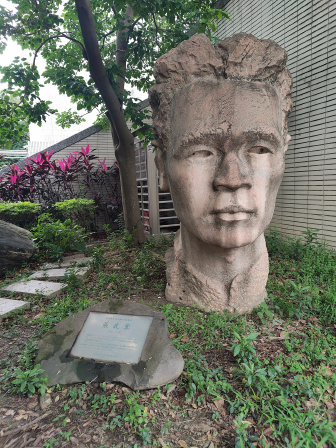
In 1997, what was then known as the Government of Taipei County, now New Taipei City, erected a statue of Zhang at the site of his former school, the Banqiao Public School 板橋公學校 (now the Banqiao Elementary School 板橋國小) (see Figure 2). The statue was erected as part of the county government’s ‘Statues of Local Talent’ 為鄉里人傑塑像 series, to remember the contributions of locals. Although it was originally placed at the entrance to the school, the large bust is now hidden away behind the gymnasium and near the back of the school, inaccessible to the general public and even difficult for the students and teachers to notice. No newspaper articles made note of this quiet change. While the memory of Chiang Wei-shui has become increasingly celebrated in Taiwan, with a road, highway, and memorial park named in his honour, the memory of his colleague Zhang Wojun has inched closer to the dustbin of history behind a gymnasium.
The plaque in front of his bust (see Figure 3) indicates Zhang’s contributions to Taiwan’s New Literature Movement and his importance as the author of the Banqiao Elementary School Song in 1949, a song that encourages students to grow up to be good citizens.Footnote 79 Ironically, Zhang is honoured for his impressive contributions to Taiwan literature, a genre that he felt should not exist.
Plaque at Banqiao Elementary School. This plaque indicates Zhang’s importance to Taiwan’s literary development and his contributions to the school, including his writing of the school song. Source: Photo taken by the author.

Conclusion
In Wretched of the Earth, Frantz Fanon famously investigated the collaboration of intellectuals, stating: ‘He is thus obliged to lead a double life.’Footnote 80 However, this binary of collaborator and patriot becomes meaningless in many contexts, especially when it is imposed upon those leading a triple life, rather than a double life, or historical actors who had to assume these and other roles when the need arose. In this respect, for the intellectual under occupation, patriotism and collaboration were sometimes performance. To understand the individual and their historical contributions, we must look back to their actions before and during occupation and forward to the memory of the individual after the resolution of the conflict.
Zhang provided crucial contributions to the construction of Taiwanese literature, even though he was opposed to it as a form of national literature. He engaged in intellectual collaboration with the Japanese empire, even though he was also a Chinese patriot and opposed to Japanese imperialism. Zhang Wojun was a complicated formation of a complicated time. Much like his famous colleague Zhou Zuoren, who was regularly accused of disloyalty to China, Zhang could not be easily classified.Footnote 81 As Lu Yan has shown for Zhou Zuoren, Poshek Fu’s tripartite assessment of one’s action under occupation—passivity, resistance, and collaboration—can all apply to one person.Footnote 82 Timothy Cronin remarks on this: ‘For Zhou, the integrity of the nation…was secondary to fundamental questions of individual well-being and maintaining conditions amenable to its flourishing.’Footnote 83 The same may or may not have been true for Zhang, but from his translation work and writings, we can see that he valued human society over the nation and state. He loved Japanese literature, he loved China, he loved Taiwan—and he loved East Asia.
This is not to say that Zhang was an Asianist, but only that Asianism is one, albeit multifaceted, discourse that would have influenced him, and he was at least sympathetic to Sun Yat-sen’s interpretation. It is correct to call Zhang Chinese, Japanese, and Taiwanese. However, instead of labelling Zhang, I prefer to emphasize the ambiguity of identity that is evident when examining his work, an ambiguity that is also a product of the time. The study of the Greater East Asia Writers’ conferences, the so-called collaborators, and Zhang Wojun, in particular, offer us a perspective on the occurrence of multiple and, at times, contesting forms of identity. These should also be considered to be legitimate voices of dissent, or at least of difference, that have been pushed to the periphery or altogether silenced by histories that are shaped by teleologies of emerging Chinese or Taiwanese nationhood and the concentration on the grand narrative of the nation as a collective and unified historical subject.
Competing interests
The author declares none.


 Open access

