

Introduction
In September 1965, a full-page advertisement for Equitable Life Insurance ran in Newsweek, a prominent American weekly news magazine.Footnote 1 The ad was in the form of a cartoon in which a husband and wife talk as they get ready for work in the morning (see Figure 1).
Cropped panel from a full-page advertisement showing parents discussing their child’s New Math education and reflecting common cultural tropes of the 1960s and 1970s. The Equitable Life Assurance Society of the United States, advertisement, Newsweek, Sept. 13, 1965, 16. Reproduced under fair use for scholarly and educational purposes.

Dad: Did you know Tom is studying the new math in school?
Mom: Oh yes—we were just discussing Diophantine equations.
Dad: I still don’t understand the old math.
This ad would have seemed familiar to a middle-aged man in the 1960s, schooled in a different time and living through the social and cultural changes of the emerging Space Age. His son (and his wife, apparently) are firmly in the new age with the New Math, while the man feels left behind. The ad continues with the man comforting himself that at least he has practical knowledge—“horse sense”—which leads him to the wise decision to buy a life insurance policy. His wife looks at him lovingly and responds, “You may not be much at math, but you’re summa cum laude in my book.”
Advertisements like this and the themes they embody raise issues of significant interest both to historians and modern education reformers. Ideas that originate in academia are inherently complex, but, as they are disseminated, they can crystallize into sound bites and tropes. While simplified versions lose their detail and nuance, they still carry embedded assumptions and normative evaluations of a dominant societal narrative. Advertisements and other popular culture artifacts that drew on New Math to make a product more appealing—or perhaps to make a joke in a comic strip resonate—signified a choice to leverage the rich associations that are embedded in the term. Any middle-aged, middle-class man in the 1960s would have instantly grasped the implied message of the Equitable Life Insurance ad. He would have understood that his anxiety and ambivalence about societal changes is shared. New Math transformed his son into a citizen of the Space Age, equipped with new ideas and a bewildering vocabulary, but also left him, the father, behind. With so much meaning packed into every carefully chosen word, advertisements and other popular culture references to New Math provide a rich vehicle for investigating dominant narratives about mathematics and mathematics education in the midcentury period and the social realities that those narratives created.
This study contributes to our understanding of the public’s relationship with the twentieth-century New Math reform movement by analyzing 191 cultural artifacts from the 1960s and 1970s. The study reveals that the public’s understanding of New Math was shaped less by the content of the curriculum reforms and more by their resonance with dominant cultural themes about technology, progress, and generational change. This finding has implications for understanding how educational reforms are interpreted, embraced, or rejected through the lens of existing societal narratives.
Literature
New Math: Origins and Implementation
The American New Math reform movement emerged in the 1950s as part of a broader international effort to modernize mathematics education. While the international movement comprised “very different phenomena in the various countries involved,”Footnote 2 the global reform efforts were all connected by a basic shared premise—that mathematical learning is more effective if the “fundamental unifying ideas of mathematics are stressed” (emphasis in original).Footnote 3 In other words, rather than presenting the subject as a collection of discrete topics and procedures, reformers believed, a curriculum should present mathematics as a coherent structure built on fundamental ideas. These fundamental unifying ideas, in turn, came from advances in research mathematics in the previous decades.Footnote 4 While reformers were concerned with improving mathematics for all children,Footnote 5 a core intention of the movement was also to cultivate and prepare an intellectual elite of students to work at “the frontiers of pure and applied mathematics.”Footnote 6
The reform movement developed in parallel on both sides of the Atlantic through distinct processes. In Europe, international meetings bringing together mathematicians, psychologists, and educators laid the groundwork,Footnote 7 culminating in the influential 1959 Royaumont seminar, near Paris, organized by the Organization for European Economic Co-operation (OEEC).Footnote 8 After this watershed event, the OEEC convened experts in Dubrovnik, Croatia in 1960 to create specific curriculum recommendations, catalyzing reform initiatives across Europe—from textbook development in England to teacher training programs in the Netherlands and innovative instructional materials in Belgium.Footnote 9
The American New Math movement, while influenced by the Europeans, developed through a distinct process. The reforms unfolded not primarily through gatherings of experts, but instead through a variety of domestic initiatives with various governmental and private funding sources, where curriculum developers and textbook writers enjoyed substantial autonomy to follow their own vision.Footnote 10 One early benchmark in the United States was an experimental high school curriculum produced by a group led by Max Beberman at the University of Illinois in the early 1950s, which was used at the high school affiliated with the university.Footnote 11 The curriculum was “strikingly abstract” and unlike anything the students or teachers at the school would have seen before.Footnote 12
While the American New Math movement had roots going back to the early 1950s and arguably even earlier, Footnote 13 the spark that ignited the “great fever of education reform,”Footnote 14 was the 1957 Soviet launch of the Sputnik satellite. The launch created a sense of urgency over the readiness of students to participate in the technological revolution that would be required to defend against the Soviet threat. In this post-Sputnik environment, the American government took a new role in funding and steering the direction of K-12 education, particularly toward subjects deemed necessary for the national defense.Footnote 15 The largest and most well-funded of the American reform groups—Edward G. Begle’s School Mathematics Study Group (SMSG)—emerged from a new grant from the National Science Foundation.Footnote 16 The group involved hundreds of people in its curriculum-writing and training activities and lasted for well over a decade.Footnote 17
The SMSG initially focused on producing and testing materials for middle and high schools but in the early 1960s expanded down to fourth grade. Like Max Beberman’s group at the University of Illinois, Begle’s SMSG represented the radical nature of the era’s reforms through its emphasis on abstract reasoning.Footnote 18 The materials produced by groups like SMSG often served as models for private textbook publishers, who adhered to the movement’s principles to varying degrees.Footnote 19 Because of the decentralized nature of the rollout, there remains significant disagreement about how widespread New Math actually was at its peak.Footnote 20 Even when textbooks aligned with New Math philosophies, they were not always implemented as intended—whether because teachers ignored difficult or unfamiliar concepts or simply misunderstood them. In a 1976 postmortem on New Math, Bruce Vogeli of Teachers College, Columbia University, estimated that 1967 marked the high point of New Math’s influence in American elementary and middle schools, a time when textbooks were scarcely marketable unless they claimed to be “modern.”Footnote 21 Yet despite the movement’s popularity, Vogeli, drawing on hundreds of his own classroom observations, noted that its ideals were often not meaningfully realized in classrooms.Footnote 22 For purposes of this study, the objective is not to dig into the complex realities in classrooms but instead to focus on the public perception of New Math. However widely reforms were implemented, New Math was “by far the most widely recognized educational innovation of the postwar era.”Footnote 23
The curriculum and training initiatives are too numerous and varied to detail here, but it is helpful to focus on certain illustrative examples from materials prepared by the SMSG. While the examples cited here may represent some of the more extreme examples of reform curriculum, they are significant because, as we will see, the new topics became closely associated with New Math in public discourse. One notable example was the introduction of “sets,” one of the foundational, unifying concepts of modern mathematics, which was presented as the first topic in the fourth grade SMSG book.Footnote 24 Another was the inclusion of number systems with bases beyond the familiar decimal (base-ten) system. Students using a SMSG textbook might work in binary (base-two) or other numerical bases with the intention that they would learn to reason about numeration more abstractly.Footnote 25 These two topics in particular became a lightning rod for critics.Footnote 26
Even when the content itself was not new, parents were seeing their young children work with symbols and terminology previously reserved for higher grades. Statements of equality and inequality, such as “2 + 7 = 11 – 2” or “8 > 3,” which were previously introduced in algebra classes, were now introduced in the context of arithmetic.Footnote 27 Similarly, while young children previously studied some aspects of geometry, such as the area and perimeter of simple shapes, those topics were not referred to as geometry, a term previously associated more typically with high school classes and Euclidean proofs.Footnote 28 The fourth grade SMSG book, however, now introduced this term to young children, explaining, “The study of space and location is part of mathematics. This part of mathematics is called geometry” (emphasis in original).Footnote 29 The treatment of geometry was, like other topics, highly abstract and based on foundational concepts. The same fourth grade book spends two pages defining a “point” and distinguishing it from the dot on the page that represents a point.Footnote 30 As we will see, inequalities and geometry also became associated with New Math in the public imagination.
It would also become important to the public discourse that an overall emphasis of some major curriculum initiatives was abstract reasoning rather than practical skills and applications. The textbooks, for example, stressed the properties of arithmetic operations rather than the procedures. The same fourth grade SMSG book has a chapter, for example, on “Properties of Multiplication and Division” in which students learn that 3 × 2 = 2 × 3 because of the commutative property of multiplication.Footnote 31 To critics of New Math, this emphasis on abstract reasoning led to caricatures of the curriculum, suggesting that getting the right answer did not matter.Footnote 32 This focus on reasoning may also have contributed to the narrative, as this study will show, that New Math may be necessary for preparing young mathematicians but not practical in ordinary life.
The legacy of New Math remains a topic of heated debate. But it is uncontroversial to assert that factions within the education community—as well as conservative politicians and members of the media who capitalized on the controversy—pushed against New Math.Footnote 33 This opposition gained traction in the 1970s, buoyed by Morris Kline’s 1973 book Why Johnny Can’t Add, and ushered in a call to go “back to basics” by focusing again on computation and other narrow mathematical skills.Footnote 34
The Media Environment for the American New Math Movement
While Sputnik catalyzed the policy changes that enabled New Math reforms, the media environment of the era was crucial in shaping how the public understood and embraced these educational changes. As Walter McDougall argues in his book about the politics of the Space Race, journalists covering the post-Sputnik period were as uninformed as the public about the technical realities of space technology.Footnote 35 In this low-information media environment, he argues, two conflicting themes emerged in response to Sputnik: alarm and clamor for an overhaul of the American institutions that contribute to scientific advancement on one hand, and a reactionary pride and projected confidence in those same institutions on the other. In the chapter she contributed to the book Remembering the Space Age, Emily Rosenberg similarly speaks about the panic over Sputnik, but also its flip side, which was what she calls “Space Age Spectacularity.”Footnote 36 Rosenberg uses this term to describe the trend in which the government and the media displayed triumphant and grandiose visions of the Space Race. Although some dystopian depictions of a technology-centered future existed in American mass media at this time, print media, television, and movies as a whole were closely aligned with NASA’s public relations efforts, promoting their vision of American achievement in science and technology.Footnote 37 While this messaging became more complicated in the late 1960s with Vietnam-era disillusionment in American institutions, we will see that this early Space Race narrative shaped the dominant discourse of the New Math curriculum reforms.
This dual narrative of crisis and confidence created the perfect climate for educational reform, with New Math becoming not just an educational movement but a cultural phenomenon that permeated American society. As mathematics education transformed in classrooms across the nation, New Math simultaneously entered the public consciousness, becoming an element in the broader cultural landscape of Cold War America. The movement’s visibility and impact can be traced through its numerous appearances in popular media and cultural artifacts of the era.
This is not the first piece to connect New Math to the media environment as part of an effort to explore the social and cultural dynamics of the New Math era. As evidence that the curriculum movement in Western Europe was intertwined with ideology, Bob Moon cited cartoons that parodied a major German reform project as a “hippy” idea.Footnote 38 Dirk De Bock analyzed newspaper pieces in his exploration of themes in the public debate over the Belgian movement.Footnote 39 Christopher Phillips used mass media references to support his argument about a public backlash against New Math in the United States.Footnote 40 This study advances beyond these precedents by conducting a broader and more systematic analysis of the public discourse, offering a more comprehensive understanding of how the American New Math movement was perceived within broader social and cultural contexts. As Geert Vanpaemel recently emphasized in his call for more research into the global New Math movement, what is needed is not only an evaluation of the reforms themselves, “but rather the analysis of the social and cultural dynamics which have become visible throughout the New Math era.”Footnote 41 The recent and ongoing digitization of media archives now makes such comprehensive analysis feasible, allowing this study to examine mass media artifacts at a scale that creates new methodological possibilities for understanding the complex relationship between curriculum reform and public reception.
Methodology
To identify the New Math references analyzed here, this study began by searching for the terms new math and modern mathematics in American newspapers and magazines from 1960 through 1979 in three databases: newspapers.com, the ProQuest Historical Newspapers database, and the ProQuest Magazines database. The search yielded thousands of results, including both popular culture references and newspaper articles about New Math. This study focuses specifically on popular culture artifacts—media meant to appeal to a broad audience for advertising or entertainment purposes. The analysis excludes mass media written by or for stakeholders in the curriculum reforms, as these do more to shape than to reflect public sentiment. The popular culture artifacts used in this study either use the term New Math as a brief reference in an unrelated context, such as in an advertisement to sell shoes or life insurance, or they use the reference in an entertainment context, such as in a comic strip or TV show.
Through manual review, popular culture artifacts were identified from within the larger pool of documents with New Math references. While the search was, of necessity, not exhaustive, the sample size and consistency of the patterns observed provide confidence in the validity of the findings. Where search results captured references to television shows or songs about New Math, the original works were included when accessible rather than the advertisements referencing them. Because artifacts that appeared across multiple publications were counted only once, each of them is unique. One of the artifacts was a 1965 satirical song called “New Math,” written by Tom Lehrer, and the author also interviewed Lehrer about his song for this study by telephone on July 5, 2024. In all, the search captured 191 popular culture artifacts referencing New Math in the period 1960 through 1979, including advertisements, lifestyle articles in magazines, comic strips, television shows, a sports article, a popular science article, a satirical political piece, a short story, and a song.
Two dominant and interrelated themes emerged from a review of the sources: (1) New Math as a powerful and mysterious new technology and (2) New Math as “belonging” to the younger generation. Once identified, all artifacts were coded for these themes. While alternative themes are certainly possible, this study focused on themes that aligned with broader Space Age cultural narratives, and the prevalence and consistency of these themes suggest that the artifacts do reflect a widespread social reality. Each artifact was also coded according to type of artifact (advertisements, lifestyle pieces, etc.) and the specific mathematical terms or content it contained.
Findings
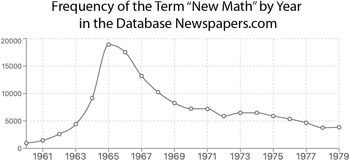
Though Sputnik’s 1957 launch catalyzed curriculum reforms across the United States, New Math remained largely outside public consciousness until 1964-1965. This delayed public awareness, visualized in Figure 2’s sudden spike in newspaper mentions, coincided with the curriculum’s implementation in elementary schools. The reforms gained widespread attention when tens of thousands of generalist elementary teachers suddenly needed training in unfamiliar mathematical approaches—a development Christopher Phillips aptly characterizes as a “bomb” dropped on elementary schools by district superintendents.Footnote 42 Unlike reforms of secondary education, elementary school reforms also affected households more directly. Parents of young children typically have greater visibility into their children’s schoolwork than parents of older students, so large numbers of parents began seeing glimpses of New Math textbooks. Thus, while New Math was hardly new in the mid-1960s, the reforms suddenly became relevant to the wider culture as the curriculum entered elementary classrooms and, consequently, American homes. As shown in Figure 2, the term’s use in mass media peaked in approximately 1965, then gradually tapered off into the late 1970s. The term eventually fell out of use, both in popular culture and in education, even if some actual reforms remained.Footnote 43
Chart showing the sudden spike in newspaper mentions of New Math around 1964-1965, coinciding with the implementation of the curriculum reforms in elementary schools when they became visible to parents and the wider public.

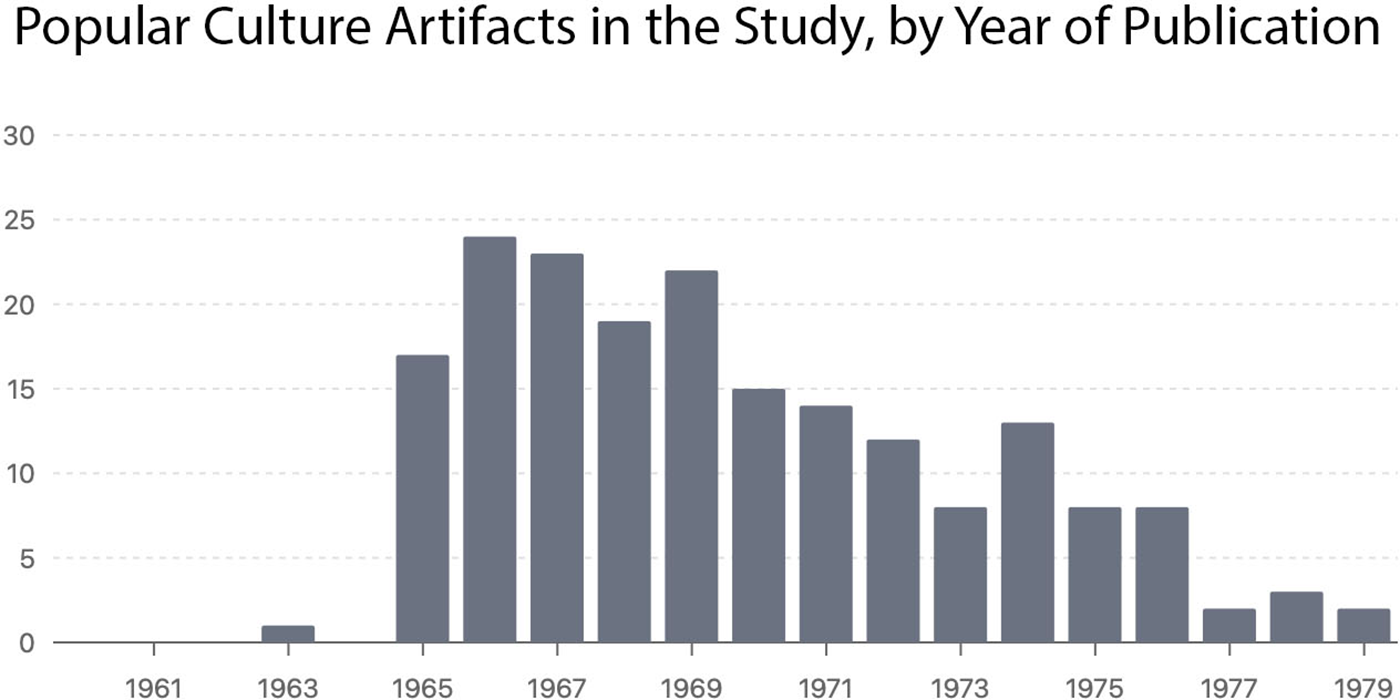
Figure 3 shows the distribution by year of the 191 artifacts in the study. The distribution roughly mirrors that of the general frequency of the term New Math in newspapers during the same period, which gives further confidence that the sample was representative. Altogether, the study includes 152 advertisements, twenty-one lifestyle articles, eleven comic strips, two television shows, a sports article, a popular science article, a satirical political piece, a short story, and a song. The most common types of advertisements were those for retail fashion and financial products (approximately half of the advertisements). The artifacts overall were strikingly diverse and directed at different genders, income levels, and ages. The mathematical topics mentioned among the artifacts were geometry (seventeen), equations and inequalities (fourteen), set theory (eight), combinatorics (three), and matrices (one). Another thirteen artifacts either referenced alternate number bases explicitly or displayed incorrect equations (such as 2 + 2 = 22) that likely referenced alternate number bases indirectly, as discussed below.Footnote 44
Chart showing the frequency of New Math references in advertisements, lifestyle articles, comics, and other popular media, demonstrating how cultural interest peaked in the mid-1960s and declined through the 1970s.

What Was New Math in the Public Discourse of the 1960s and 1970s?
To say that the term New Math became widespread does not mean that there was widespread public agreement on its meaning. Given that scholars disagree about how to characterize the American New Math movement and whether it even existed as a coherent movement, it is unsurprising that the public had no clear or consistent conception of what the term meant.Footnote 45 And yet, while education experts were cautious about asserting that New Math existed, in popular culture there was no such caution. The clear assumption in popular media was that New Math exists, and we all (sort of) know what it is. A cartoon published in the New Yorker magazine on April 17, 1965, and then reprinted in newspapers around the country illustrates this. It shows a family of four having dinner together, and a small boy says to his father, “Dad, you can’t expect to pick up the basics of the new math in a simple dinner table conversation.”Footnote 46 This cartoon carries a number of implications. Notice, for example, that the boy did not say, “You can’t expect to understand my math homework”; he said, instead, “You can’t expect to understand the basics of the new math” (emphasis added). The reader understands that the boy was studying “the new math” in school, and his father wanted to understand what it was. The very use of the term in this context—that “the new math” is something that a man could ask a boy to explain to him—implies that the curriculum reform changes around the country were part of a single, named movement—one whose major ideas could be stated and described.
This conception of New Math as an identifiable set of ideas is typical of the treatment of the term in popular culture, and it raises an important question. If New Math existed as an idea in popular culture, then what did the public believe that it was? While the term New Math referred to a particular concept in the popular imagination, that does not mean its meaning was clear. The joke implied by many of the popular culture references in fact is that ordinary people did not really know what New Math was. An advertisement for used cars, for example, made this joke about its prices: “+ – NEW MATH + – ? We’re not sure either.”Footnote 47 For many educated people, New Math was a known unknown—something that they “knew” existed but could not give a meaningful explanation for, perhaps similar to black holes or nuclear fusion.
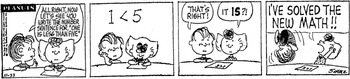
At the most concrete level, the public associated New Math with certain specific examples of mathematical content it regarded as new or high-level. An installment of the Peanuts comic strip in 1965, for example, shows Linus helping Sally with her homework.Footnote 48 Linus asks her to “write the number sentence for ‘one is less than five.’” Sally writes “1 < 5” and shouts proudly, “I SOLVED THE NEW MATH!!” (see Figure 4). This example shows that people associated the notation of inequalities with New Math and also hints at the perception of the subject’s difficulty. The same basic perception was communicated in a 1969 advertisement in which the Shell oil company bragged about its donations to education. It noted that students “today” have more to learn than adults did in the previous generation, including specific New Math topics: “Remember fifth grade before the new math, morphemes, and earth sciences? … Math to us was adding and subtracting. Today kids study ‘sets’ and ‘sub-sets.’ They even start learning geometry in the fifth grade.”Footnote 49
An installment of a Peanuts comic strip illustrating how inequality notation became associated with New Math in the public imagination. Charles Schulz, “Peanuts,” Lake Charles (LA) American Press, Nov. 23, 1965, 21. Reproduced under fair use for scholarly and educational purposes.

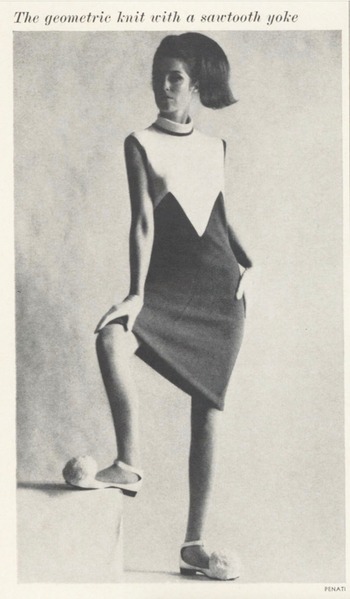
The association of New Math with geometry in the public imagination was particularly strong. Seventeen advertisements from the set of artifacts in this study linked New Math with geometry, often in the context of the dresses with geometric designs that were popular in the late 1960s and into the 1970s. A 1976 advertisement for Saks Fifth Avenue department store, for example, shows a woman in a geometric print dress and states, “Plain geometry? Not on me! This is the kind of new math I can relate to.”Footnote 50 Another advertisement shows how fashion magazines took advantage of the public’s association of New Math with modernism and geometry. Vogue magazine describes a dress that represents “some of the niftiest geometrics a body could shape into. Strictly new math”Footnote 51 (see Figure 5). Most of the popular culture references in this study, however, were not even this explicit about what New Math was; the public appeared to regard it instead as a general method or approach to mathematics, not a curriculum with specific mathematical content.
Image cropped from a fashion article that describes geometric-patterned clothing as “strictly new math”—demonstrating how the term became associated with modernism and innovation. “Spring Send-off,” Vogue, Feb. 15, 1966, 150. Reproduced under fair use for scholarly and educational purposes.

New Math as a Powerful New Technology
The popular culture references analyzed in this study frequently portrayed New Math as a powerful technology with the potential to transform society. An advertisement for the department store Bergdorf Goodman captured this narrative, announcing that its rayon shift dresses with geometric designs were “the fashion equivalent of new math. Quite as revolutionary.”Footnote 52 An episode of the television sitcom Hazel from 1966 called “A Little Bit of Genius” offers a window into just how little the public understood about New Math even at its peak and how, at the same time, people were willing to buy into its transformative power.Footnote 53 In the episode, a boy “genius,” whose intelligence is clear to the audience because the boy wears glasses and reads a book on Lucretius, walks over to his father, who has been struggling all evening to find his error in adding up a column of numbers. (This was before calculators were widely available.) To his father’s astonishment, the boy adds the figures in his head and explains, “I used new math. It’s much faster and more accurate.” A similar comment is made (in jest) in Better Homes and Gardens magazine in 1966: A boy watching his father labor over taxes remarks that by the time he grows up, New Math will make doing his taxes “a snap.”Footnote 54 Even advertisements for calculators exploited the idea that New Math was a powerful calculating technique; one touted the calculator’s “New Math Power at an Unbelievably Low Price!”Footnote 55 New Math, whatever it may have been, was not a quick method of calculation. It has been criticized in fact for being the opposite—a curriculum reform that emphasized conceptual understanding and teaching of higher-level concepts at the expense of skill in ordinary arithmetic. Whether or not the writers understood this, these references to New Math tapped into the narrative that New Math was a cutting-edge innovation.
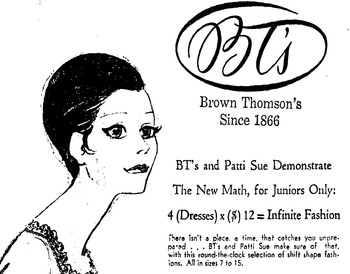
It was common in the late 1960s and early 1970s for advertisers to capitalize on the mystique of New Math to imply that it could make a benefit materialize out of thin air. An advertisement for Macy’s Department Store in 1967 declared that with New Math, a four-piece suit with reversible jacket and vest turns into twelve outfits: “Macy’s teaches the New Math. That’s when a four part suit equals twelve different outfits.”Footnote 56 A 1965 advertisement for a sale on dresses took the idea even further, declaring that their New Math produces “infinite fashion”: “The New Math, for Juniors Only: 4 (Dresses) x ($) 12 = Infinite Fashion” (see Figure 6).Footnote 57 An advertisement for a savings account in 1971 made a similar but more modest claim: Through the New Math of compound interest, you could turn a 6 percent interest rate into a 6.18 percent rate.Footnote 58 According to other advertisements, the New Math could also perform “wonders” in saving you money,Footnote 59 and it might even lower your golf score.Footnote 60
Cropped image from an advertisement using mathematical equation “4 (Dresses) x ($) 12 = Infinite Fashion” to promote junior dresses, capitalizing on the public perception of New Math as transformative and powerful. Brown Thomson’s, advertisement, Hartford Courant, Oct. 31, 1965, 3A. Reproduced under fair use for scholarly and educational purposes.

Another reflection of the public’s view of the creative power of New Math is a 1971 newspaper piece highlighting a new dressmaking method that involved making dresses from a photograph and without a pre-made commercial pattern.Footnote 61 The method, called the “new math of home sewing,” we are told, is not easy to learn and is in fact only for “the more serious and intense among the millions of home seamstresses that will take to pattern drafting.” The article refers to New Math five times; the comparison is not an afterthought. While the article is not explicit about the connection, it seems the idea is that New Math involves some creativity, in contrast to the rote methods of the past. Additionally, we are presented with a notion about New Math that appears in other popular culture references—that New Math is a mysterious and powerful method. And like New Math, the sewing method is difficult to learn and, we are told, perhaps not for everyone.
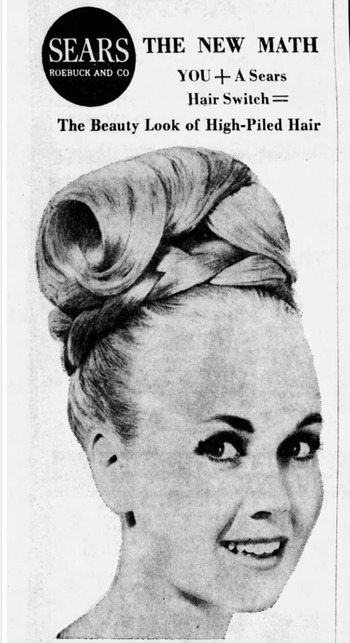
Adjacent to the idea of New Math as a kind of modern alchemy was the popular cliché that New Math used seemingly absurd mathematical equations. The source of this idea may be people’s awareness that some of the reform curricula included arithmetic in alternate number bases, where peculiar equations like 4 + 4 = 13 could be true.Footnote 62 A 1968 advertisement for health insurance, for example, started with the eye-catching equation “1 + 1 = 3” and invited customers to “learn the new math,” where “the whole is equal to more than the sum of its parts.”Footnote 63 A 1969 advertisement for juice similarly announced, “New math from Vita-Pakt: 20¢ + 20¢ = 50¢,” promising customers more savings the more they buy.Footnote 64 In some cases the equations were not just incorrect but nonsensical, such as an advertisement for a hair salon at Sears department store, which showed a woman with a typical 1965 beehive hairdo and said, “The New Math: You + A Sears Hair Switch = The Beauty Look of High-Piled Hair” (see Figure 7).Footnote 65 The implication for many of these advertisements, including the examples given above, was that unforeseen benefits were hidden in the new unconventional mathematics.
Cropped image featuring a woman with a beehive hairstyle and using a playful equation—“You + A Sears Hair Switch = The Beauty Look of High-Piled Hair”—to evoke New Math’s cultural perception as a mysterious force capable of creating dramatic transformations through unconventional mathematical logic. Sears, advertisement, Minneapolis Tribune, Oct. 3, 1965, 24W. Reproduced under fair use for scholarly and educational purposes.

Critical voices of the New Math reforms became more common in American mass media in the 1970s, and these critiques found their way into popular culture in ways that reframed the term’s meaning. What emerged was an alternate, parallel meaning of New Math as a method that did not make sense or did not work. A New Yorker cartoon from 1971 captured this sentiment through its depiction of a suspension bridge collapsing into the water as an onlooker remarks, “Well, so much for the new math.”Footnote 66 Here, New Math is impractical, a failure—even dangerous. In a similar vein, a 1971 political advertisement in support of the conservative Silent Majority attacked “the welfare state” with the accusatory phrase: “The arithmetic of Social Security: new math, old tricks.”Footnote 67 Here, the phrase implies that liberal politicians are trying to deceive the public with opaque mathematics.
Despite these negative portrayals, such examples are few among the artifacts captured by this study. Instead, the public’s understanding of New Math as an exciting, paradigm-shifting approach proved remarkably durable. A New York Times classified advertisement for Wells Management appearing as late as 1976—years after the publication of Kline’s critical book and the rise of the back-to-basics movement—referenced the company’s “alternate approach,” one with “greater earning potential,” as its New Math.Footnote 68 The dominant narrative about New Math in 1970s popular culture continued to reflect the public’s awe and trust—until the term simply fell out of common use.
New Math as “Belonging” to the Younger Generation
In the mind of the public, New Math would prepare American youth to take their place as citizens in an unrealized and unknown future. Some popular culture artifacts marveled at children’s ability to understand New Math. A 1966 advertisement for a series of board games, for example, remarked, “These are designed for grownups, but things being the way they are, with what new math and all, the kids will probably catch on quicker than their elders.”Footnote 69 An ad for a typewriter in 1967 showed an image of the stubby hand of a child and reasoned that it makes sense to buy a typewriter for a young child because, after all, children are so advanced today that they are doing New Math in second grade.Footnote 70 In a lifestyle piece published in a women’s magazine in 1968, the author similarly marveled, “The ability of small children in knee socks to master the new math is shocking.”Footnote 71
But ancillary to the idea that New Math was for the young was the view that it was difficult for adults. An advertisement for financial planning, for example, sympathized with the older generation about an accelerating sophistication of knowledge required of ordinary people: “Yesterday your kids learned simple multiplication tables, chemists knew only 82 elements, and you heard music from a crystal radio. Today your kids learn the set theory of the new math.”Footnote 72 Other artifacts portrayed adults who were bemused by their own confusion over New Math. A lifestyle piece about swimming joked that like the experience of learning New Math, it was “disconcerting” to learn as an adult that one has been swimming “wrong” all along.Footnote 73 Another advertisement for office equipment shared a lighthearted lament on behalf of adults: “A lot of us are finding out you can’t teach an old dog new math.”Footnote 74 An advertisement for a restaurant directed toward parents with young children stated, “At last. A kind of new math even I understand.”Footnote 75 This light amusement over parents not understanding New Math was a common sentiment and existed even when New Math enthusiasm was at its peak in the mid-1960s.
Another corollary of the narrative that New Math was for the young and for the future was that it was not useful for adults navigating the world as it currently existed. This dichotomy is illustrated by an insurance advertisement from 1969 (see Figure 8).Footnote 76 The ad portrays a fictional man named John Clayton working with his young son on his homework. The photo of the two characters is warm and inviting. The father has his arm around his son. A college flag for a Midwestern state college hangs behind them, and we can see from the clock that it is 5:45, probably almost dinner time. The text of the ad tells the reader that John is a “young family man” who needs life insurance protection. It explains, “John Clayton doesn’t understand new math. But he knows good old-fashioned arithmetic, so he bought solid protection at a sensible price.” The reference to New Math here reflects New Math’s generation gap. It is clear that John is invested in preparing his son for the future, and New Math, while hard, is a necessary part of that future. But it is also implied that, for John, New Math is not necessary (and perhaps not even relevant) to solving the quotidian problems of his own life in the present. For the father, we are told, “good old-fashioned arithmetic” is good enough.
Allstate advertisement (cropped) showing a father helping his son with New Math homework, emphasizing that though the father does not understand New Math, he knows “good old-fashioned arithmetic” for practical matters like life insurance. Allstate, advertisement, Newsweek, Sept. 22, 1969, 28. Reproduced under fair use for scholarly and educational purposes.

A daily installment of the newspaper comic strip Little Iodine from 1967 presents the same theme, but this time with hyperbole and satire.Footnote 77 It tells the story of an accountant who loses his job because his daughter’s New Math homework confuses him so much that he can no longer do basic arithmetic. As in the life insurance ad with John Clayton and his son, here the image of the child doing New Math homework is a positive one. The girl smiles as she does her homework and then marches off to bed smiling when she is finished. The comic strip takes a dark turn, however, when the father tries to read the girl’s books after she goes to bed. The last panel of the strip shows the man wearing old, tattered clothes and selling New Math products door to door, while another man remarks, “Say! Usen’t you be head accountant with Bigdome & Co.” Again, New Math is portrayed here optimistically as “belonging” to the younger generation while also being incompatible with the concerns of present life.
A 1965 song by Tom Lehrer is another satirical take on New Math, but one offering a slightly different angle on New Math’s inscrutability and impracticality. Through much of the song Lehrer “explains” how to do a simple subtraction problem, but the joke is that with New Math’s emphasis on explanation and reasoning, it becomes excessively complicated. The first verse is as follows:
By the end of the song, the listener is exhausted with the singer’s overwrought effort to explain the arithmetic. Just as the song seems to be over, Lehrer adds, “Now, that actually is not the answer that I had in mind, because the book that I got this problem out of wants you to do it in base eight.” Throughout the song, Lehrer humorously leverages the public’s perception that New Math is complicated (perhaps overly complicated) and disconnected from the practical math that adults learned in school. In an interview conducted for this study, Lehrer elaborated on this idea, describing the reforms as “silly” in the level of abstraction and formality with which they presented commonsense ideas.Footnote 79
This idea that New Math was complicated and impractical was also captured in a turn of phrase that commonly appeared in popular culture at the time: “You don’t need new math to know …” or variations of that phrase. The phrase was typically followed by an example of something simple to compute or figure out through common sense. A search of the database newspapers.com for the period 1960 to 1979 revealed that variations of this phrase appeared at least sixty-nine times.Footnote 80 Below are some examples:
• You don’t need to know the new math to figure out that the cost of paying state employees…
• You don’t need the new math to figure that doubling the number of teams also doubles the number of players.
• You don’t need new math to figure out the savings on Viking long-sleeve shirts.Footnote 81
Notice that in each of these examples, the view of New Math as difficult and impractical is double-edged. While the adults with their “old-fashioned” lives and “old-fashioned” jobs are perhaps better off with plain arithmetic, that does not necessarily imply that children are better off that way. In fact, the idea that children could do higher-level math that adults could not understand was often portrayed as charming. It aligned with the larger, optimistic media narrative that American children were preparing themselves for an uncertain future in which advanced mathematics would take a central role. Even as the accountant struggles with New Math in the Little Iodine strip, for example, his daughter says she does not need help with homework: “It’s the new math, Daddy, but I don’t need any help, thanks.” Tom Lehrer, too, for all his biting satire about New Math, never implied that children struggled with it. As a Harvard-trained mathematics teacher, Lehrer certainly understood the nuances of the debate. Throughout the song, he repeats the refrain, “It’s so simple/So very simple/That only a child can do it,” highlighting the generational divide. In fact, when asked about his motivation for writing the song, Lehrer said that he writes about what amuses him, and when he saw adults struggling with New Math, he said, “I thought I’d get a laugh out of it.”Footnote 82
It is worth noting that several of the installments of Peanuts that Charles Schulz produced in 1965 were about children struggling with New Math. These strips are often cited in that context, but a wider perspective reveals that Schulz’s message was more complex.Footnote 83 One Peanuts installment from that year shows the character Linus struggling with his New Math homework, but we also see his older sister, Lucy, encouraging him. Lucy says matter-of-factly, “You’ll get on to it. It just takes time.”Footnote 84 In various installments of the comic strip appearing later in the year, Linus seems to have mastered New Math and is helping his friend, Sally, as she complains and struggles. One shows Sally saying, “I couldn’t be less interested! What do I care about the ‘new math’? I’m only going to be a housewife!”Footnote 85 Importantly, the joke is on Sally, not on New Math. The other children who appear in the various installments of Peanuts around that time—Lucy’s brother Charlie Brown and his friend Linus—do not struggle or complain and in fact try to persuade Sally to focus on her work. Taken together, Peanuts was at best ambivalent about children struggling with New Math and was one of the few popular culture media examples that depicted that struggle.
New Math was not just for young children; it was also an element of modern teen and young adult culture. Teenagers were the “new math generation.”Footnote 86 The advertising examples below, many of which come from fashion advertising, show that New Math was modern, fun, and “hip”:
• “the hottest new math yet!” (1966)
• “popular as the ‘new math’” (1966)
• “digs the new math” (1966)
• “get in on the new math” (1968)
• “[m]odern as new math” (1969)
• “as up-to-date as the New Math” (1969)
• “You’ve found ‘the new math’ full of surprises. Here’s one of the pleasantest.” (1969)
• “[E]asy as new math. And almost as much fun.” (1971)Footnote 87
Note how remarkable it is that a mathematics curriculum reform movement would be embraced by young people in this way, given that school mathematics is otherwise so often depicted as an unwanted burden that elders impose on children. One clear indication that New Math had become trendy was its presence in Seventeen magazine, a fashion and lifestyle magazine for teenage girls. New Math appeared in at least nine popular culture references in Seventeen magazine from 1965 to 1970. These references were made in fashion advertisements, a short story about a strong female protagonist who loves math class, and in various lifestyle pieces. In one piece about palm reading, readers were advised to look for a boyfriend with hands that are strong and well-proportioned because a boy with these features will have many positive qualities, including a mind for New Math: “He digs both the Beatles and Beethoven—and can be a genius on the guitar, a dazzler on the dance floor, a whiz at the new math.”Footnote 88 Other women’s magazines like Cosmopolitan, Vogue, and Harper’s Bazaar similarly capitalized on New Math’s positive image to sell a youthful, modern lifestyle and the products that accompany it.
As late as 1976, in an episode of the TV sitcom Welcome Back, Kotter, New Math was depicted as belonging to the younger generation. In the episode, Mr. Kotter, a social studies teacher in an urban public school in Brooklyn, must retake a high school exam in mathematics. We know from the context that his students are lovable troublemakers, uninterested in academics, but this time they take on the role of teacher and help him. Mr. Kotter is frustrated by the word integer, which is new to him, and by the confusing phrasing of a nonsensical question his student, Arnold Horshack, reads to him from textbook:
Mr. Kotter: “What’s an integer?!”
Juan (student): “That’s the new math” (pointing at his book).
Mr. Kotter: “Well, what was wrong with the old math?”
Vinnie (student): “I bet this new math is really easy. Why don’t you keep on reading, Horshack?”Footnote 89
Mr. Kotter barely passes the exam, and his students’ scores are all higher. The implication is that New Math is opaque and frustrating for adults—even for an otherwise capable high school teacher. Yet the more prominent message in this vignette is that New Math is hard only for adults. The students—even these students—are just fine because they speak the language.
Conclusion
In the mid-1960s, New Math emerged as a popular cultural phenomenon. The term became a cultural shortcut for various complex ideas associated with educational reforms in mathematics. The public generally believed that New Math would equip children with the skills needed to thrive in a future in which mathematics and technology would play a central role. To the broad public, New Math also had a romantic mystique unlike any other mathematical curriculum reform movement in American history. It represented modernity, youth, and sophistication—a reputation that fashion advertisements and women’s magazines capitalized on in their marketing and messaging. Even when popular culture references reflected anxieties and ambivalence about the role of adults in this new world, there was rarely a hint in popular culture that New Math would not live up to its pledge of preparing the nation’s youth for the technological age that lay ahead.
This popular understanding of New Math did not emerge in isolation but was deeply embedded in the technological optimism that characterized Space Age America. The public’s uncritically positive perception of New Math in fact would be odd—even inexplicable—if not for the wider cultural themes of the Space Race that included an unquestioning optimism in America’s technological future. The School Mathematics Study Group, one of the major curriculum-writing projects, explicitly aligned itself with the ideals of the Space Age when it told fourth graders:
We are living in the space age. Man has already traveled in space and more space exploration will be done. Suppose we were to plan a trip to Mars… . To reach it we must know its location in space, its speed in space, and its direction of travel.Footnote 90
The message to children was clear: To become citizens of the Space Age, you must study mathematics. Even for the general public, for whom the message was not as explicit, mathematics—and New Math in particular—was associated with technology and modernity because the public’s view of the New Math reforms was filtered through a media environment that romanticized space travel and the technology that made it possible. Although adults may have understood only that New Math was complicated and involved esoteric concepts like set theory and number bases, they generally trusted the mathematicians and government agencies involved in funding and implementing curriculum reforms that the changes were necessary to prepare their children for an uncertain, technology-driven future.
This popular culture discourse about New Math was largely disconnected from the more informed discussions taking place among educators and critics. Morris Kline, New Math’s most vocal critic, argued that the reforms focused too heavily on logic and deductive reasoning rather than experimentation and intuition. Despite Kline’s criticisms reaching wide audiences through his 1973 book Why Johnny Can’t Add, the most pervasive and harshest criticisms of New Math never seemed to penetrate the popular culture discourse very deeply.Footnote 91
This study of New Math demonstrates how educational reforms can become embedded in broader cultural narratives that transcend their pedagogical origins. This phenomenon reveals a critical gap between expert discourse and public understanding—a gap through which educational reforms are transformed, simplified, and invested with cultural meaning. What emerges is not simply a watered-down version of academic ideas, but rather a new cultural construct that serves social and commercial purposes beyond education itself. This finding has potential implications for understanding the complex relationship between education, media, and public perceptions.
Sian Zelbo (sez2105@tc.columbia.edu) is an Assistant Professor of Teaching in the Department of Mathematics, Science & Technology at Teachers College, Columbia University. The author thanks Managing Editor Milton Gaither for his exceptional efforts throughout the review process, the late Tom Lehrer for his generous July 2024 interview, and the anonymous reviewers who provided invaluable feedback on earlier drafts.