
INTRODUCTION
In the broader history of scholarship on the Roman marble trade the numerous marble-clad bar or shop counters at Pompeii and Herculaneum stand out as a largely untapped dataset. While marble as a decorative material is almost synonymous with élite display in the Roman world, these counters provide remarkable testimony to the demand for prestigious marble beyond public buildings and upper-class houses. At the same time, close study of the marble on these counters offers an insight into the salvaging and reuse of building materials within Pompeii and Herculaneum that few other bodies of evidence can match. This paper presents the results of a five-year project, the specific aim of which was to examine the pervasiveness of the wider Mediterranean marble trade and the economics of reuse of this material through the lens of these marble-clad bar counters.
Often labelled simply tabernae and sometimes thermopolia, cauponae or popinae, the premises that these counters adorned apparently sold a range of food and drink, and possibly even other commodities. We will refer to them simply as ‘bars’, following Steven Ellis (Reference Ellis2005: 2–3), though some perhaps functioned more as shops. At Pompeii, especially, these bars were ubiquitous: in his catalogue, Ellis (Reference Ellis2005: 50) has identified 158 extant examples, and in almost all of them their counter was the prime focus of attention, usually decorated and placed to be visible directly from the street (Mac Mahon, Reference Mac Mahon, Mac Mahon and Price2005: 75). Seventy-three of the 158 documented bars at Pompeii (46%) had marble-clad counters, and between 2004 and 2008, 49 of these, with 6,047 individual pieces of marble, were documented by the current project (Fig. 1).Footnote 1 In 2009, eight bars at Herculaneum, decorated with 2,088 fragments, were added to this catalogue (Fig. 2). This is not a complete dataset — many bars are too damaged to allow study, are behind glass or are closed for safety reasons — but it is large enough for analysis.Footnote 2 For each of these bars, drawings were produced of all the marble-clad surfaces (Fig. 3), inventory numbers assigned to each piece of stone and its type, dimensions and location on the counter recorded. Measurement of irregular pieces was done by a standardized protocol of recording the greatest width and taking a measurement at right angles to that. Depth was noted where possible. Signs of previous use, of restoration or of loss of material were documented, and all of this information was stored in a relational database.
Distribution maps of all bars at Pompeii and those with marble-clad counters. (Drawing: B. Russell.)

Distribution map of bars studied at Herculaneum. (Drawing: B. Russell.)

Drawing of the bar counter-top at IV.15 at Herculaneum. (Drawing: S.J. Barker.)

The first half of this paper concentrates on the range of materials used in these bars, how they were displayed, and the distribution of marble-clad counters. In the second half, we turn to from where materials were sourced, how they ended up being used on the bars and what this reveals about broader demand for prestigious building materials in the Vesuvian cities. First, though, a word on the authenticity of these counters is necessary.
AUTHENTICITY
Despite the potential insight it offers, the marble-cladding on these counters has been ignored almost entirely in scholarship on the bars (Ellis, Reference Ellis, Mattusch, Donohue and Bauer2004a; Ellis, Reference Ellis2004b; Ellis, Reference Ellis2004c; Ellis, Reference Ellis2005; Mac Mahon, Reference Mac Mahon, Mac Mahon and Price2005; DeFelice, Reference DeFelice, Dobbins and Foss2007; Monteix, Reference Monteix2010; also Kleberg, Reference Kleberg1957; La Torre, Reference La Torre, De Simone, Varone, De Lellis, Miele, Pisapia and La Torre1988). On the one hand, this is because the more than 10,000 fragments of stone on these counters represent an enormous dataset to analyse and process. On the other, the niggling issue of Pompeii's history of undocumented restoration raises the question of whether these marble-clad surfaces are original at all.
That this marble-cladding is not the fanciful creation of modern restorers is shown by paintings and early photographs of Pompeii and Herculaneum, revealing counters during excavation or soon thereafter (Fig. 4; Maiuri, Reference Maiuri1932: 41). William Cooke's early paintings of Pompeii show several marble-clad bars (Cooke and Donaldson, Reference Cooke and Donaldson1827: vol. 2, 8–11); and in his earlier account of discoveries at Herculaneum, Niccolò Venuti (Reference Venuti and Skurray1750: 110–11) described one in detail and reported that others were being stripped of their marble. This practice of cladding bars with marble was not even unique to the Vesuvian cities. At Ostia, seven marble-clad counters have survived (Hermansen, Reference Hermansen1981: 126–83), and there is a further example on the Via dei Pilastri at Alba Fucens, which is given a terminus post quem by a coin of Antoninus Pius found embedded in its mortar (De Visscher et al., Reference De Visscher, De Ruyt, De Laet and Mertens1954: 336–7, fig. 19, pl. 12.1–2).Footnote 3
Caupona of Asellina at Pompeii during excavation (neg. C 438). (Reproduced courtesy of the Ministero per i Beni e le Attività Culturali — Soprintendenza Speciale per i Beni Archeologici di Napoli e Pompei.)

The faithfulness of the reconstruction of the marble-clad bars that do survive is a more problematic issue (Monteix, Reference Monteix2010: 94–5). The key question is whether the marbles used for the restoration were those found on, or at least close to, the counter. Photographs in the archive at Pompeii, documenting bars before and after restoration, suggest most were. Restorers often used impressions left in the bedding mortar to guide their reconstruction (Fig. 5). Moving materials between premises generally was avoided, even if sometimes material had to be moved around on a particular counter.Footnote 4 When large gaps had to be filled or rebuilt, machine-cut limestone panels — available from any local bathroom supplier — seem to have been preferred to ancient marble ones (especially for stepped shelves, as at I.3.2 and I.3.21–22).
Bar at IX.7.24–25 at Pompeii before and after restoration (neg. D 28622 and 28901). (Reproduced courtesy of the Ministero per i Beni e le Attività Culturali – Soprintendenza Speciale per i Beni Archeologici di Napoli e Pompei.)
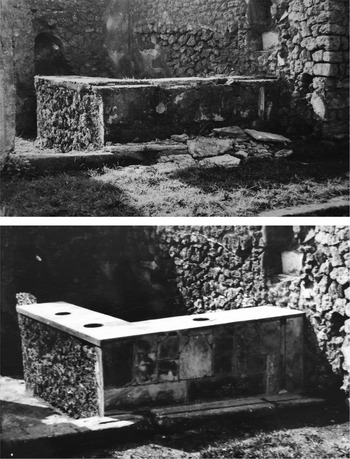
Occasionally more aggressive restoration had to be undertaken. Though their faces survived, the tops of the counters at I.8.8 and I.9.4 were discovered ruined, and have since been rebuilt, though apparently with marble found within the premises.Footnote 5 While we are confident that most of the bars studied at Pompeii and Herculaneum have been restored faithfully, any that are suspect have been eliminated from our dataset. These include those at VI.2.5 and II.4.7; though both originally were marble-clad, these counters were rebuilt in the nineteenth and mid-twentieth centuries respectively.Footnote 6
MATERIALS
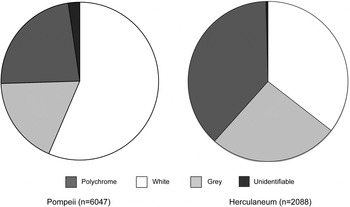
A total of 8,135 panels of stone was documented during the course of this project, 6,047 at Pompeii and 2,088 at Herculaneum. Overall, 50% of these panels were white stones, mostly marble, 20% were grey and 27% polychrome (marble here being defined, as in antiquity, as any stone capable of taking a polish).
Different varieties of white or grey marbles generally were not distinguished between, except when it was possible to do so confidently, as for Luna bardiglio or greco scritto. Archaeometric analysis was impractical, since we were dealing with over 4,000 pieces of white marble alone. Five test samples from the counter at VI.17.3–4 were analysed using paramagnetic resonance spectroscopy by Donato Attanasio in 2005.Footnote 7 All were chosen because they did not look like Luna marble, which seems to be the most common material used at both Pompeii and Herculaneum. The results showed that three were in fact Luna, while the other two were Pentelic. Analyses performed on marble objects in several Pompeian houses show that a range of white marbles was imported into Pompeii, but that, for uses of any substantial volume, Luna was the default material.Footnote 8
Polychrome marbles, in contrast, can be identified by eye and the most attested on the bar counters are cipollino (9% of the total), giallo antico (5%), africano and portasanta (each 4%). A range of other imported materials is found in much smaller quantities, including breccia di Settebasi and pavonazzetto, various alabasters, rosso antico, breccia corallina, breccia di Aleppo and fior di pesco. None of these materials could be considered particularly unusual for central Italy in the first century ad. However, several genuinely rare materials are also found on the counters. Eight fragments of Egyptian granites, of which two appear to be of Bekhen stone from Wadi Hammamat, were built into the bar at V.9–10 in Herculaneum (below, Fig. 13). At Pompeii, a large rectangular panel of green-grey granito della sedia di San Lorenzo from Wadi Umm Wikala, was used in the face of the bar at VI.10.1/19 (below, Fig. 10), and a disc of the black variety of Aswan granite (lapis syenites or Thebaicus) was used in the same way at VII.15.5 (below, Fig. 12).Footnote 9 These granites are unusual even at Rome in this period, and are absent from domestic contexts in the Vesuvian cities. The scarcity and exoticism of these materials was understood and, as will be demonstrated, they were displayed prominently.
While the range of lithotypes recorded at both Pompeii and Herculaneum is broadly similar, there are noticeable differences in their quantities at the two sites. There is a striking discrepancy, in particular, in the ratio of white, grey and polychrome marbles (Fig. 6). Since the sample size at the two sites differs, we should be careful not to read too much into this, but the extant bar counters at Herculaneum clearly employed a far higher proportion of polychrome marbles than is normal at Pompeii. Other slight differences can be noted in terms of the actual marbles attested (Fig. 7). The top four polychrome marbles at both sites are cipollino, africano, giallo antico and portasanta; but while cipollino dominates at Pompeii, roughly equal quantities of these materials are found at Herculaneum. In actual quantities, the eight bar counters examined at Herculaneum employ almost the same number of giallo antico pieces as the 49 at Pompeii (212 compared to 228), more breccia di Settebasi (66 pieces to 52) and more alabaster (37 to 21).
Percentages of white, grey and polychrome stones on the bar counters at Pompeii and Herculaneum. (Drawing: B. Russell.)
Different varieties of polychrome stones on the bar counters at Pompeii and Herculaneum. (Drawing: B. Russell.)

Differences in the quantities and range of materials used can be noted also between individual premises. Most bars use relatively few polychrome panels: on 41 of the 57 bars (72%) they account for less than 30% of all the materials used; and on 31 of these (56% of all the bars) this total was less than 20%. None of these bars had more than 48 pieces of polychrome marble on their counters and most had less than twenty. However, a much smaller number of bars makes considerable use of polychrome marbles. On eight bars (14% of the total), polychrome marbles accounted for over 40% of the materials used (below, Fig. 16a).Footnote 10 Six bars, in fact, four of them at Herculaneum, had more than 100 pieces of polychrome marble on them.Footnote 11
Even on this particular sub-group of colourful bars, however, considerable variation can be identified in the varieties of marbles attested (Fig. 8). These hint at certain idiosyncrasies in the way these materials were supplied that are further suggested by particular concentrations of marble types across Pompeii. Half of all the cipollino identified on the counters at Pompeii, for instance, comes from the bars of Regio VI, even though these provide just 36% of all the panels in the dataset; on the bars at VI.3.18–20 as many as 25% of all the panels used were cipollino, and the same is true of VI.8.8. One can identify similarly anomalous distribution patterns in the case of materials that are much rarer on the bars, like rosso antico. Only 27 panels of this marble have been documented on the bars at Pompeii and 23 of these come from just two premises, I.8.8 and VII.2.32–33. How these materials were sourced and what these distribution patterns reveal about this practice will be examined in full below.
Varieties of stone found on four bars: V.9–10 and IV.10 at Herculaneum, and VI.3.18–20 and I.8.8 at Pompeii. (Drawing: B. Russell.)

DECORATION
Just as the range of materials found on individual bars varies, so too does the way in which they were displayed. In general, the bar counters at Pompeii and Herculaneum are built of masonry, typically fairly rough opus incertum, though wood counters are also attested (Ellis, Reference Ellis2004c: 41; Reference Ellis2005: 48). They were then covered in a range of surface treatments, of which marble-cladding was just one option. Plaster was used more widely. Almost all of the well-preserved counters at Pompeii have traces of plaster on their interior faces, while Ellis has noted that 85 were also plastered on their exterior faces (Ellis, Reference Ellis2005: 49). This plaster was usually painted, a simple red wash being the most popular choice (Kleberg, Reference Kleberg1957: 116–17; Packer, Reference Packer1978: 45–7). Painted motifs and figured scenes are attested on the bars at I.6.5, VI.16.32–33 and IX.6.b, while seven counters were decorated with painted imitation marble (marmo finto) (Ellis, Reference Ellis2005: 49; on marmi finti; Fant, Reference Fant, Dobbins and Foss2007).
Marble-cladding, when it was used, usually was employed alongside these other surface coverings. Painted plaster, in fact, is found on most of the vertical faces of the marble-clad bars. Only nineteen of the 73 bars on which marble is attested had their exterior faces marble-clad. This is perhaps because applying marble panels to a vertical surface is more difficult than laying them on a horizontal one. Sometimes these vertical faces were painted to imitate the marble of the counter-tops, as at VI.1.2, VI.15.15 and IX.9.1, but mixing of media also occurred on the same face: at I.11.10–11 a single panel of coloured marble was inserted into an otherwise fully-painted scheme (Jashemski, Reference Jashemski1973: 40). The relative costs of these different surface treatments can only be guessed. A simple layer of plaster was probably cheaper than painted plaster, and painted plaster was probably cheaper than marble-cladding, though if expensive pigments were used this might not necessarily have been so.Footnote 12 What is clear, however, is that the deployment of marble-cladding was generally judicious and sparing rather than wholesale. As a result, interior walls, seen only by service personnel, were never marble-ized. While marble is sometimes found elsewhere in the bars — on a niche in IX.7.24–25 at Pompeii or on the floor of V.9–10 at Herculaneum —, but these instances are rare and marble usually was saved for the counters.
Marble-cladding could have been applied by professionals or amateurs. The haphazard arrangements found on most bars suggest amateurs, but even on these efforts were made to locate panels with straight sides along the edges of counter-tops and faces. On other bars, regular panels were lined up along the base of the vertical faces to create a baseboard; grey slates was used for this at IV.15 in Herculaneum. On nine bars at Pompeii, however, a more ornate arrangement is apparent, and in these cases it is tempting to identify the hands of specialist decorators. Simple schemes are found on the counters at I.9.4 (though it is very damaged) and IX.7.24–25 (see Fig. 5), where the face is carefully covered with alternating rectangular panels above a baseboard.
On seven counters at Pompeii even more ambitious designs, echoing contemporary patterns in opus sectile flooring, were attempted. Interestingly, on only one of these, at I.9.11, was attention paid to its counter-top, in this case comprising a row of opus sectile hexagons framed by rectangular slabs. Efforts were instead lavished on exterior vertical faces. On three counters, the face was divided into horizontal zones of decoration. At V.4.6–8 rows of rectangular slabs of white and grey marble at the top and bottom frame a central zone of diamond and triangular polychrome opus sectile, Guidobaldi's Q2 pattern, bordered by narrow fillets (Fig. 9) (Guidobaldi, Reference Guidobaldi and Pensabene1985: 182–6). At I.11.1 a lower baseboard of rectangular slabs is surmounted by a central zone of diamond opus sectile panels set within squares (Guidobaldi's Q2 pattern), on top of which is a row of square and diamond panels. These panels easily could have been lifted whole from single floors. A less ornate but carefully structured scheme was employed for the counter at VI.10.1/19, on which the large rectangular panel of granito della sedia di San Lorenzo discussed above is set into a series of horizontal rows of rectangular panels and alongside a large opus sectile diamond in africano (Fig. 10).
Vertical face of the bar at V.4.6–8 at Pompeii. (Photo: J.C. Fant.)
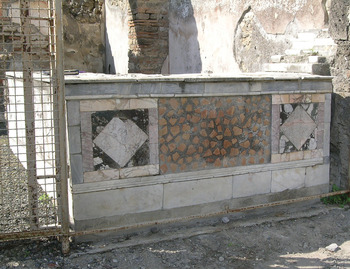
Vertical face of the bar at VI.10.1/19 at Pompeii. (Photo: J.C. Fant.)

The faces of two other bars were decorated with vertically arranged zones of decoration. At I.8.8, the face is divided into three rectangular zones, each containing a circular opus sectile panel. At VII.2.32–33, a similar designs puts the emphasis on clusters of opus sectile triangles and diamonds (Fig. 11). A different approach altogether is attested at VII.15.5, where the small, hidden-away counter is faced elegantly, entirely in white marble panels set around the large disc of black granite mentioned above (Fig. 12). What this example highlights is the attention that was paid to displaying exotic material prominently. The same can be said for the counter at VI.10.1/19, with its green granite centrepiece, and that at I.11.1, on which the two central diamond panels are in porfido verde, a rare material represented by only nine panels on all the bars at Pompeii. With the exception of the counter at VII.15.5, all of these highly decorated faces fronted directly onto the street.
Vertical face of the bar at VII.2.32–33 at Pompeii. (Drawing: B. Russell.)

The bar at VII.15.5 at Pompeii. (Photo: B. Russell.)
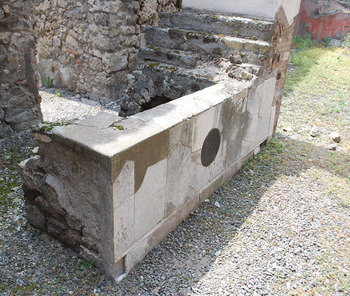
Fewer of the bars at Herculaneum have faces on which the panels are obviously arranged with decorative intent. Only the bar at V.9–10, which has a series of small cipollino pilasters built into its faces, can be classed alongside the Pompeian examples above (Fig. 13). Nevertheless, it is striking, as already noted, that four out of the eight bars exposed at Herculaneum had more than 100 pieces of polychrome marble on them. These were extremely colourful structures. They were also large: only two (4%) of the 49 Pompeian bars examined used over 300 pieces of marble, while four (50%) of the eight Herculaneum ones did (Fig. 14).
The bar at V.9–10 at Herculaneum. (Photo: B. Russell.)

Number of stone panels used on bar counters at Pompeii and Herculaneum. (Drawing: B. Russell.)

DISTRIBUTION PATTERNS
Decorated counter-tops are revealing of a level of investment, and, as an index of this investment, their distribution shows some interesting trends. Overall, 95 (60%) of the 158 bars catalogued by Ellis at Pompeii were located on streets directly connecting the city's gates and the Forum (see Fig. 1); this rises to 115 (73%) if other major thoroughfares are included (Ellis, Reference Ellis2004b: 378). Ellis has shown also that proximity to intersections was favoured and that the traffic these bars were targeting was mainly pedestrian, rather than vehicular: certain streets with very deep wheel ruts, therefore, have no bars, while some of the streets that do have bars have no wheel ruts (Tsujimura, Reference Tsujimura1990; Ellis, Reference Ellis2005: 132). The marble-clad bars follow this overall pattern, as one might expect. At Pompeii, 47 of the 73 bars (64%) that we know were originally marble-clad are positioned on the streets leading directly to the city gates, and were well-placed to take advantage of passing traffic (see Fig. 1). At Herculaneum, even though only a fraction of the site has been excavated (see Fig. 2), it is also clear that the largest bars currently exposed are located on prominent junctions (Maiuri, Reference Maiuri1958: 251, 433–4, 446); the bar at IV.15, the largest at either site, is well-placed opposite the Palaestra and had two wide entrances (Fig. 15).
The bar at IV.15 at Herculaneum. (Photo: S.J. Barker.)

A clear relationship can be noted also between the location of bars and their decoration. The most polychromatic bars, those with the highest number of panels on them and most of those on which planned decorative schemes can be identified are found on the most important streets (Fig. 16). Of the five Pompeian bars on which over 40% of the panels were polychrome, two are on the Via dell'Abbondanza (I.8.8 and I.11.1), two are on the Via Stabiana (V.1.1/32 and IX.1.6), and one is on the Via Consolare (VI.3.18–20). Most of those with between 30% and 40%, meanwhile, are similarly located (I.9.4, II.1.6, VI.8.8, VII.2.32–33, IX.1.15–16), with only the bar at I.9.11 on a backstreet. The majority of these bars is also large (Fig. 16b): those at I.8.8, I.9.4, VI.3.18–20, VI.8.8 and VII.2.32–33 used over 200 panels, while that at V.1.1/32 employed 162, still well above the average of 143. The only other bars to use over 200 panels were on the southern stretch of the Via Stabiana, at I.2.7–8, and on the Via di Nola, at V.4.6–8.
Of the nine bars at Pompeii on which planned decorative schemes can be identified, only three were located off a main street — those at I.9.11, IX.7.24–25 and VII.15.5 (Fig. 16c). The latter of these, the small bar on the Vicolo del Gallo, was clearly a restaurant or inn. It had large rooms with wall-paintings, one with an opus sectile floor, a small garden and a separate kitchen (Van Buren, Reference Van Buren1932: 43). It was evidently a prosperous outfit serving an affluent clientele. While many bars appear to have been set up to target passing traffic, the Vicolo del Gallo bar catered to a different client-base. In fact, it is striking that there are distinct clusters of bars with marble-clad counters well away from the major thoroughfares: in Regio IX (IX.6.b, IX.7.21–22, IX.7.24–25), along the Vicolo del Citarista (I.3.28, I.2.18–19, I.2.20–21), and the Via di Castricio (I.7.13–14, I.9.11, I.11.10–11). These appear to have served primarily residents of their neighbourhoods. Rather than to attract passing trade, then, their decorated counters were to satisfy local, perhaps long-standing, patrons.
Distribution maps showing the bars at Pompeii with the highest percentages of polychrome marbles, the highest number of pieces and those on which planned decorative schemes can be identified. (Drawing: B. Russell.)

What the distribution of bars shows above all is that these were not insalubrious establishments kept away from élite houses (a suggestion put forward by Ray Laurence (Reference Laurence1994: 87)). In fact, there are marked concentrations of bars along the Via Consolare and on the central stretch of the Via dell'Abbondanza, where some of the richest houses in the city were located. Many of these bars were immediately adjacent to wealthy houses. Bars performed a range of services vital to the functioning of the urban economy of the city. Most appear to have been simple food and drink purveyors, supplying the large proportion of the population who did not have extensive cooking facilities at home (and perhaps many who did) with their day-to-day needs.
REUSE ON THE BARS
This brings us to the second half of this paper and the question of how these bars came to be decorated with imported marbles. Close analysis of the data collected from both Pompeii and Herculaneum suggests that much of the marble used in the bars was second-hand. Around 700 marble pieces from Pompeii and Herculaneum show signs of working or former use. Fragmentary inscriptions are obvious examples and have been found on the counters at I.2.11, VI.1.5, VI.4.8–9, VI.10.1/19, VI.17.3–4 at Pompeii (Mac Mahon, Reference Mac Mahon, Mac Mahon and Price2005: 73). In addition, 127 revetment mouldings also have been identified on the counters at both sites, most simple torus or ovolo forms, but also shallow cyma mouldings. Usually these were redeployed in decorative schemes but not always; sometimes they were cut back or smoothed, as at VI.10.3 and VI.17.31, showing they were not just valued for decoration. Fifty-four pieces of marble retain traces of rust or iron pins, associated with their original use, probably as wall revetment.Footnote 13 A sizeable number of panels with characteristic indentations showing they previously had been used as threshold blocks or window-sills is also attested on the bars.Footnote 14
The largest category of material that can be positively identified as reused, however, is shaped opus sectile panels. A total of 170 of these panels has been recorded at Pompeii, 125 at Herculaneum. They include the standard range of shapes (rectangles, triangles, discs, hexagons and diamonds), and most are in polychrome marbles (65%). Strikingly, even though opus sectile panels are found on 27 counters at Pompeii, just four bars contain 67% of all of these pieces: the three bars near each other at I.8.8, I.9.11 and I.11.1 on the Via dell'Abbondanza, and the bar at VII.2.32–33, all of which have carefully planned decorative schemes. The bar with the highest number of reused opus sectile panels on it, a total of 42, is that at V.9–10 at Herculaneum, the counter of which also employs the miniature fluted cipollino pilasters and eight panels of rare Egyptian granites.
A little under 10% of the panels documented on the bars, then, can be positively identified as reused. Whether the remaining 90% of panels were also second-hand is demonstrated less easily, though there are reasons to believe this was the case. Very little of this material was new: most panels are irregular and nearly 75% are broken, rather than cut, on all four sides. They are quite different from the neatly-cut revetment panels found stacked in the kitchen of the Sulpicii villa at Murecine ready to be applied to the walls of the baths (De Simone and Nappo, Reference De Simone and Nappo2000: 49–75, 190). Some of these panels might be leftovers or offcuts from workshops making opus sectile for private and public structures. Opus sectile flooring is typically 0.5–2 cm thick and, even though it is difficult to measure thicknesses, panels this thin are found on the bars. However, while this might reveal where some panels came from, it does not explain the majority. Most of the panels are 1.5–6 cm thick, meaning they are more likely to have been wall revetment than opus sectile flooring. At the same time, the panels at Pompeii are on average 17 cm along their longest axis and 13 cm along the axis perpendicular to this; at Herculaneum they are only slightly smaller. Many panels are much larger: the bar at VI.8.9 made use of three cipollino panels that are 70–90 cm in length and two of bardiglio over 1 m long (Fig. 17). These are panels that easily could have been put to use on floors or walls, if cut down to size, and are consequently unlikely to be simple leftovers.
Large fragments of cipollino and bardiglio on the façade of the counter at VI.8.9 at Pompeii. (Photo: J.C. Fant.)

SOURCES OF MATERIAL
While a small proportion of this material might constitute leftovers from the production of flooring, revetment or opus sectile, most of it seems to have been second-hand. This raises two questions: where did this material come from, and how did it end up on the bars?
The most likely answer to the first of these questions is that the panels used on the bars were generated by refurbishment or demolition projects, of either public building or private houses. The range of materials found on the bars matches those attested in these contexts. Indeed, the higher quantity of polychrome marbles found on the Herculaneum bars compared to their Pompeian counterparts mirrors the view from other structures: the use of polychrome marbles in the élite houses at Herculaneum overshadows anything found at Pompeii (Wallace-Hadrill, Reference Wallace-Hadrill2011: 302). Differences are observable also in public buildings. At Herculaneum, where the most common polychrome material used on the bars is giallo antico, we know that the orchestra of the theatre, built in the Augustan period, was paved with thick slabs of this material (described by Adolphe Pezant (Reference Pezant1839: 306–10)). At Pompeii, in contrast, the theatre seems to have been decorated with cipollino and grey marble revetment, with perhaps Luna marble architectural elements, probably all dating to the Augustan period refurbishment (Pensabene, Reference Pensabene2005: 80–5).
The stripping and recycling of building materials from standing or ruined structures, whether public or private, is often regarded as a distinctly late antique phenomenon (De Lachenal, Reference De Lachenal1995; Kinney, Reference Kinney2001). Indeed at Ostia, Russell Meiggs (Reference Meiggs1973: 428) assigned all of the marble-clad bars to the third century ad and later, when he reasoned the second-hand market in marble was at its peak. However, recent analysis has shown that recyclable materials were systematically removed from buildings being remodelled or demolished throughout the late Republican and Imperial periods (Barker, Reference Barker, Camporeale, Dessales and Pizzo2011; Reference Barker, Gutiérrez Garcia-Moreno, Mercadal and Rodà de Llanza2012). At Pompeii, salvaging and reuse was common, especially following the ad 62 earthquake: the restorations of the Temple of Venus, Central Baths and Sanctuary of Apollo, underway at the time of the ad 79 eruption, all used a combination of new and salvaged material (Richardson, Reference Richardson1988: 90–1; Jacobelli and Pensabene, Reference Jacobelli and Pensabene1995–6: 51–2, 72; Bruno et al., Reference Bruno, Conti, Pensabene, Turi, Herrmann, Herz and Newman2002: 282–5; Dobbins, Reference Dobbins, Dobbins and Foss2007: 174). Evidence for the salvaging of materials can be found also in domestic contexts. The Villa of the Papyri and Villa A at Oplontis, for example, were being stripped of opus sectile and revetment when the eruption took place (Guidobaldi and Olevano, Reference Guidobaldi, Olevano and Pensabene1998: 233–4; Guidobaldi and Esposito, Reference Guidobaldi, Esposito and Zarmakoupi2010: 23, 45–50). And this was evidently not just a post-earthquake phenomenon, since the opus sectile flooring of room 15 at the Casa delle Vestali in Pompeii was completely stripped in the Augustan period (Jones and Robinson, Reference Jones and Robinson2004: 116–19).
Identifying exactly what proportion of the panels in our sample came from public or private buildings is obviously impossible. Unfortunately, the robbing of marble — both ancient and more recent — has been far too extensive (Richardson, Reference Richardson1988: 25–6, 204–5). There is evidence, however, to indicate that public and private sources were exploited. Most of the threshold blocks and window-sills attested on the bar counters are small and so likely to have come from houses. The pieces of opus sectile could have come from either public or private buildings, but the shapes and marble types used on the counters find close parallels in domestic pavements, such as those in the Casa di Cervi (IV.21) and Casa dell'Atrio a Mosaico (IV.1–2) at Herculaneum, or the Casa dell'Efebo (I.7.11) at Pompeii (Guidobaldi and Olevano, Reference Guidobaldi, Olevano and Pensabene1998: tav. 13.2; PPM I: 682–5). The very largest slabs, especially those over 70 cm in length and up to 6 cm thick, also could have come from palatial domestic contexts. However, panels of this size and thickness are more common in the major public buildings of both cities. Large panels of grey and white marble, as well as cipollino, are still visible on the façade and interior of the Macellum, for example (PPM VII: 331, 349, 352). And John Dobbins has argued that the marble revetment on the Sanctuary of the Genius of Augustus and the Eumachia building was also redone after the ad 62 earthquake, along with many of the walls, a process that must have led to the discarding of earlier damaged panels (Dobbins, Reference Dobbins1994: 665).
SUPPLY OF SECOND-HAND MATERIAL
This brings us to the question of how this material ended up on the bars. Was it sold on the open market, perhaps by specialist traders in salvaged material? Or did the individuals responsible for decorating these bars acquire material through other, less commercial channels — directly from associates either involved in the building trade or having building work done, or perhaps connections within their extended familia? Many of these bars, of course, were closely connected to élite houses that were themselves decorated with imported marbles.
Specialists in demolition and the supply of second-hand building materials certainly existed. A guild of demolition experts (collegium subrutorum) is attested at Rome (CIL VI 940). At Pompeii we have direct evidence for the selling of salvaged material. A painted sign in Insula III.7 advertises the sale of second-hand building material, in this case various types of roof tiles (Fig. 18). The sign reads TEGULA CUMULAR OPERCULA COLLIQUIA VEN. CONVENITO INDIDE, advertising for sale (ven[alia]) tiles taken from the salvage of old houses: imbrices (opercula) and gutter-tiles (collicia). The phrase convenito indide(m) may refer to the place of business of the vendor, possibly given on a notice higher up on the wall (CIL IV 7124 = ILLRP 1121; Della Corte, Reference Della Corte1936: 333; Frank, Reference Frank1938).Footnote 15 The lettering and subsequent plastering over of this sign indicate a late Republican date. It is not hard, though, to imagine marble workshops or salvage dealers with similar signs advertising the sale of salvaged marble later. Those with the skills and contacts to salvage, transport and sell on this material could have made a substantial profit from doing so. A comparison of estimated manpower requirements for the production and salvage of marble veneer based on nineteenth-century building manuals shows that new panels are roughly five times more laborious to source than second-hand ones.Footnote 16
Dipinto advertising second-hand building material for sale. (After Della Corte, 1936: 332–3.)

In this context, it is useful to remember Cicero's comment on second-hand material from public building projects. Addressing Verres about his restoration of the Temple of Castor at Rome, he states that ‘if you cut out any [material] for the operation, let [the contractor] replace it … Let him keep materials from the old buildings for himself’ (Cicero, Against Verres 2.146–8, 2.156). Presumably the contractor in this scenario could legitimately sell or reuse these materials in another project. The fact that demand for second-hand materials of this kind continued is demonstrated by a pair of senatus consulta, recorded in an inscription found at Herculaneum, which banned the purchase of private houses in Italy purely in order to demolish them and clear a profit from selling the building materials (Smallwood, Reference Smallwood1967: no. 365 = ILS 6043; Lintott, Reference Lintott1993: 135). Specific edicts to the same effect were issued under Vespasian and Hadrian, and similar rulings were promulgated again later (Codex Iustinianus VIII.10.2, 6–7; SHA, Life of Hadrian 18). There clearly was a demand for second-hand building materials, which made this kind of targeted demolition or stripping profitable. None of this legislation, however, limits the sale of second-hand material leftover from legitimate demolition or refurbishment projects, or even the sale of scrap or leftovers from building projects (Pensabene and Panella, Reference Pensabene and Panella1993–4: 128–30).
Supplies of salvaged materials undoubtedly peaked at different times and for different reasons, but it is easy to see how large-scale demolition projects and natural disasters, like the ad 62 earthquake, would have served to flood the market with them (Mac Mahon, Reference Mac Mahon, Mac Mahon and Price2005: 73–4).Footnote 17 After ad 62, even the public authorities at Pompeii and Herculaneum could have recouped some of their losses by selling on damaged marble panels, from the floors and walls of public buildings. Large blocks could be reused on site, as they were for the restoration projects discussed above, but thin broken panels were comparatively useless. There was clearly enough demand for second-hand material to make it worthwhile for builders to salvage old marble, tiles or metal fixtures for sale or reuse on later projects. At Oplontis, the workers responsible for the marble decoration flooring seem to have sourced material from other projects, as shown by a fragmentary inscription, found overturned and reused as a threshold between two pillars in Ambulatio 91 (De Caro, Reference De Caro and MacDougall1987: 124, cat. no. 43, pl. 40). Stefano De Caro suggested that the size and quality of the letters seem to indicate that it may have belonged to a public inscription, perhaps from Pompeii or Herculaneum.
Whether the market for second-hand materials operated on a regional or at least city-wide level — so that material from demolition in work in Pompeii's Regio I could end up on a bar in Regio VI — is unclear. The existence of specialist dealers and the advert mentioned above suggest that this might have been the case. However, it is also possible that redistribution worked on a much more localized level within the various neighbourhoods. The bars could have been supplied directly, in other words, from demolition or redecoration projects within their insula and perhaps even have been worked on by the same craftsmen. Proving exactly where material came from is almost impossible, but it is noticeable that some of the houses close to the ornate bars at I.8.8, I.9.11 and I.11.1 appear to have been given new floors post-ad 62, many containing opus sectile panels (either fragments set in cocciopesto or mosaic or decorative emblemata); these include the Casa di Pasquius Proculus, Casa del Sacerdos Amandus and Casa dell'Efebo in Insula I.7 and the Casa del Bell'Impluvio in Insula I.9. The bars at I.8.8 and I.11.1 actually were directly connected to larger properties, presumably houses, which had marble flooring in other rooms. At I.8.8, four rooms of the adjoining property had opus sectile panels set into their floors, including squares of portasanta, triangles of africano, portasanta and pavonazzetto, as well as rectangles of rosso antico, all materials found on the bar (PPM I: 802–25). In room 2, behind the bar, there are even four squares of palombino, which again seem to have been lifted from an earlier floor. Most of these floors have been dated to after ad 62, indicating that the decoration of the bar was part of a wider refurbishment programme.
The bar at VII.2.32–33 also shares an insula with a series of large houses (the Casa dell'Orso Ferito, Casa di C. Vibius Italus, Casa di N. Popidius Priscus), most of which have marble flooring in at least one room. The Casa di N. Popidius Priscus, the largest in the insula, was actually having refurbishment work done at the time of the eruption. Stores of raw materials, comprising a pair of small roughed-out columns, a series of slabs of cipollino and rough blocks of porfido verde, were found in the peristyle, some of which could have been intended for new flooring (PPM VI: 649–50). There is no evidence of any connections between the bar at VII.2.32–33 and this house, but it is this kind of renovation that generated new stocks of the old materials with which the bars were clad.
The concentration of cipollino on the bars of Regio VI has been noted already, but it is also noticeable that the largest panels used on any of the bars at Pompeii are found in this area, especially on the counters along the Via Consolare and the Via delle Terme, just north of the Forum. In fact, the massive panels of grey marble and cipollino on the bars at VI.8.8 and VI.8.9 are of almost identical size and thickness to those still preserved on the interior and exterior of the Macellum. How these bars acquired these panels can only be guessed, but again this indicates that the redistribution of material might have been relatively localized.
The question of the ownership of bars, although rarely possible to address in particular cases, may still help to explain these localized distribution patterns and suggest avenues of acquisition beyond that of simple market distribution. While we are not in doubt that most proprietors of bars were people of modest means — the economizing use of marble, and the failure of half of the bars at Pompeii to upgrade at all from masonry are clear evidence for this —, some owners at least may have had access to marble beyond that of their own economic level through patronage. The role of slave agents and freedmen still linked to their former owners through obligations of obsequium (obedience), operae (personal service) and testamentum (residual claim against estates) is now well explored (Sirks, Reference Sirks1981; Aubert, Reference Aubert1994; Mouritsen, Reference Mouritsen2011: 212–16). Since, as Felix Pirson (Reference Pirson1999: 138–9) noted, 69% of all tabernae at Pompeii form part of the fabric of houses, it is likely — even without parsing legal distinctions between lease and ownership — that most bar proprietors had active patrons if freed, and of course owners if still slaves. In some of these cases a patron or dominus may have been able to secure privileged access to marble stocks outside normal market mechanisms. This may apply particularly to supplies from the demolition of public buildings, but the influence of even middling patrons could have potency in their own neighbourhoods.
CONCLUSIONS
The marble-clad counters of Pompeii and Herculaneum, which to date largely have been overlooked, reveal a number of interesting conclusions about the use and reuse of marble in these cities. In general terms, the marble on these counters adds to our understanding of the Campanian marble trade. It does not change our view of the import of white marble: there was certainly plenty of this at both Pompeii and Herculaneum, as evidence from public buildings, élite houses and now the bar counters demonstrates; Luna marble seems to have been most common, but only a wide campaign of archaeometric analysis can prove this. However, the range of polychrome marbles attested on the counters is noteworthy. These imported materials in the past have been assumed to make their debut on a large scale at Pompeii only in the Flavian period (Fant, Reference Fant, Dobbins and Foss2007: 340–3). The fact that they are found reused in large quantities on the bar counters, though, suggests that this date should be pushed forward into the Julio-Claudian period. Local élites at Pompeii and Herculaneum might well, therefore, have been working hard to keep up with fashions at Rome for longer than previously thought. And this is further indicated by the handful of exotic Egyptian stones found on the bar counters. Some of these are from tiny quarries in the Eastern Desert, which had been prospected and developed to supply the imperial court, and their discovery in the Vesuvian cities shows the rapidity with which court trends were adopted outside the capital. Those responsible for decorating the bar counters appear to have understood the value of these materials and took care to display them conspicuously.
Overall, while the marble panels reused on these bar counters might have been second-hand and significantly less expensive to source than new revetment, marble-cladding never can have been a cheap solution. In part the investment in these materials appears to have been targeted at attracting passers-by, and the most lavish decorative schemes and colourful materials were placed on the vertical faces of counters facing directly on to important streets in both cities. However, it is also clear that certain bars served a more restricted neighbourhood market, and while fewer of these acquired a wide range of marble varieties, they nevertheless enthusiastically engaged in this fashion for marble-cladding. A certain propensity for the re-employment of old architectural elements has long been noted in the various public building and restoration projects underway in Pompeii in ad 79, but reuse of prestigious materials in other contexts has not been documented widely before. Evidence for the salvaging of marble flooring and revetment is widespread in the Roman Imperial period, and the bar counters reveal the fruit of this labour. Restoration, refurbishment and demolition projects, of both public and private structures, generated considerable quantities of second-hand material. Some of this was probably sold on the open market via specialized merchants or through building contractors, but other bars were perhaps decorated with materials from their manager's own house or patron's property — as a by-product, in other words, of building work within the familia. The distribution patterns of particular materials or sizes of panels certainly seem to indicate that sourcing was often highly localized, whatever the mechanisms through which it was carried out.



