


1. Introduction
With an ever-growing bilingual population, an increasing number of people who develop aphasia after neurological damage are bilingual (Ansaldo & Saidi, Reference Ansaldo and Saidi2014). That is, they use or have used more than one language on a regular basis (Grosjean, Reference Grosjean, Grosjean and Li2013). Bilingualism has implications for the diagnosis and rehabilitation of aphasia. Treatment of both languages is not always feasible, and the likelihood of cross-linguistic transfer depends on many factors (Goral & Lerman, Reference Goral and Lerman2020). In addition, it is difficult to ascertain the premorbid level of proficiency in each language.
When a bilingual develops aphasia, this can result in different recovery patterns across languages (e.g., Fabbro, Reference Fabbro2001; Paradis, Reference Paradis2001). Bilingual persons with aphasia (bPWA) may have parallel impairments in both languages or selective impairments in one of their languages. Recovery patterns are determined by a multitude of factors, including age of acquisition, language use and history, premorbid language proficiency, and stroke-related variables such as time post-onset as well as size and location of the lesion (Lerman, Goral & Obler, Reference Lerman, Goral and Obler2019). A meta-analysis investigated the relationship between these factors (Kuzmina, Goral, Norvik & Weekes, Reference Kuzmina, Goral, Norvik and Weekes2019), and showed that the general pattern is that bPWA perform better in their first-acquired language (L1) than in their other language (L2), an effect modulated by age of acquisition and, to a lesser extent, premorbid language proficiency and frequency of use (see Kuzmina et al., Reference Kuzmina, Goral, Norvik and Weekes2019, for a more extensive discussion).
Besides different recovery patterns, bilingual aphasia can lead to cross-language intrusions. Pathological language mixing is a rare phenomenon that refers to the unintended use of two languages within a single utterance, whereas switching happens between utterances (Fabbro, Reference Fabbro2001). Although mixing and switching is frequently observed in all bilinguals, it becomes “a pathological behavior when it is inappropriately used within a context where speakers do not share both language codes” (Ijalba, Obler & Chengappa, Reference Ijalba, Obler, Chengappa, Bhatia and Ritchie2004, p. 82). bPWA have been found to switch more frequently and their codeswitches result in miscommunication more often as compared to healthy bilinguals (Muñoz, Marquardt & Copeland, Reference Muñoz, Marquardt and Copeland1999).
Involuntary mixing or switching is caused by an impairment in bilingual language control, the set of functions necessary to use more than one language effectively (e.g., Abutalebi & Green, Reference Abutalebi and Green2007). There is compelling evidence that both languages are active and compete for selection, either directly (e.g., Costa, Miozzo & Caramazza, Reference Costa, Miozzo and Caramazza1999; Hermans, Bongaerts, de Bot & Schreuder, Reference Hermans, Bongaerts, de Bot and Schreuder1998; Kroll, Bobb & Wodniecka, Reference Kroll, Bobb and Wodniecka2006; van Heuven, Schriefers, Dijkstra & Hagoort, Reference van Heuven, Schriefers, Dijkstra and Hagoort2008) or indirectly by activating competitors in the target language (Roelofs, Piai, Garrido Rodriguez & Chwilla, Reference Roelofs, Piai, Garrido Rodriguez and Chwilla2016). One important model for bilingual language production is Green's Inhibitory Control model (1998), which argues that language selection is a competitive process in which interference is resolved by inhibitory control. This inhibition ability is hypothesized to be domain general: that is, it encompasses both linguistic and non-linguistic control.
Inhibition is one of the often-postulated executive control (EC) functions. updating of working memory and shifting between mental sets are the other two components of an influential proposal about the taxonomy of EC (Friedman, Miyake, Young, DeFries, Corley & Hewitt, Reference Friedman, Miyake, Young, DeFries, Corley and Hewitt2008; Friedman & Miyake, Reference Friedman and Miyake2017; Miyake, Friedman, Emerson, Witzki, Howerter & Wager, Reference Miyake, Friedman, Emerson, Witzki, Howerter and Wager2000a; Miyake & Friedman, Reference Miyake and Friedman2012), although other models of EC have been put forward (e.g., Braver, Reference Braver2012; Duncan, Reference Duncan2010). In this proposal, inhibition is defined as the ability to suppress dominant or prepotent responses, shifting refers to the ability to switch between mental sets, operations or tasks, and updating indicates the active manipulation of incoming information in working memory. Miyake et al. (Reference Miyake, Friedman, Emerson, Witzki, Howerter and Wager2000a) found that updating, inhibition, and shifting are clearly distinguishable on the behavioral level, but share underlying commonality. EC functions are components of the attention system in the brain (e.g., Posner, Reference Posner2012; Posner & Raichle, Reference Posner and Raichle1994), and together, they allow for complex and goal-directed behavior.
While Green (Reference Green1998), among others, suggested that the mechanisms for resolving language interference rely on domain-general EC, there is considerable disagreement about the nature of bilingual language control. Another proposal is that bilingual language control relies on functions that are specific to the language domain. One line of research attempts to clarify this by looking for associations between tasks that rely on language control and domain-general EC. The findings of these behavioral studies are mixed. Some find that performance in the two domains correlates (Declerck, Grainger, Koch & Philipp, Reference Declerck, Grainger, Koch and Philipp2017; Prior & Gollan, Reference Prior and Gollan2011), suggesting overlap; while other evidence suggests that the overlap is only partial (Branzi, Calabria, Boscarino & Costa, Reference Branzi, Calabria, Boscarino and Costa2016; Calabria, Branzi, Marne, Hernández & Costa, Reference Calabria, Branzi, Marne, Hernández and Costa2015; Calabria, Hernández, Branzi & Costa, Reference Calabria, Hernández, Branzi and Costa2012; Klecha, Reference Klecha2013). Secondly, evidence from neuroimaging research indicates that domain-general EC and language control share neural circuits (e.g., De Baene, Duyck, Brass & Carreiras, Reference De Bruin, Treccani and Della Sala2015; De Bruin, Roelofs, Dijkstra & FitzPatrick, Reference De Bruin, Roelofs, Dijkstra and FitzPatrick2014). A third approach is to investigate how bilingual language control demands in everyday life affect EC. For example, language switching experience has been found to predict non-linguistic switching performance (Barbu, Orban, Gillet & Poncelet, Reference Barbu, Orban, Gillet and Poncelet2018; Prior & Gollan, Reference Prior and Gollan2011; Soveri, Rodriguez-Fornells & Laine, Reference Soveri, Rodriguez-Fornells and Laine2011; Verreyt, Woumans, Vandelanotte, Szmalec & Duyck, Reference Verreyt, Woumans, Vandelanotte, Szmalec and Duyck2016).
The third approach is closely related to another lively debate in the bilingualism literature: the hypothesis that bilinguals exhibit enhanced EC due to a lifelong practice with managing two languages. Since the first article reporting evidence for improved performance on a non-linguistic inhibition task (Bialystok, Craik, Klein & Viswanathan, Reference Bialystok, Craik, Klein and Viswanathan2004), dozens of studies have been published on this topic, but the results are often inconsistent. Review articles and meta-analyses come to varying conclusions: from full support for an advantage (Adesope, Lavin, Thompson & Ungerleider, Reference Adesope, Lavin, Thompson and Ungerleider2010), to partial support (Hilchey & Klein, Reference Hilchey and Klein2011; Van den Noort, Struys, Bosch, Jaswetz, Perriard, Yeo, Barisch, Vermeire, Lee & Lim, Reference Van den Noort, Struys, Bosch, Jaswetz, Perriard, Yeo, Barisch, Vermeire, Lee and Lim2019), to reviews concluding that there is no convincing evidence for an advantage (De Bruin, Treccani & Della Sala, Reference De Baene, Duyck, Brass and Carreiras2015; Donnelly, Reference Donnelly2016; Lehtonen, Soveri, Laine, Järvenpää, de Bruin & Antfolk, Reference Lehtonen, Soveri, Laine, Järvenpää, de Bruin and Antfolk2018; Paap, Johnson & Sawi, Reference Paap, Johnson and Sawi2015). In other words, the status of the bilingual advantage hypothesis remains unclear to date.
Despite the inconclusive evidence, it could be argued that enhanced EC is especially beneficial for PWA. From monolingual populations with aphasia (mPWA) it is already known that they often experience deficits in EC (e.g., Christensen, Wright & Ratiu, Reference Christensen, Wright and Ratiu2018; Fridriksson, Nettles, Davis, Morrow & Montgomery, Reference Fridriksson, Nettles, Davis, Morrow and Montgomery2006; Hunting-Pompon, McNeil, Spencer & Kendall, Reference Hunting-Pompon, McNeil, Spencer and Kendall2015; Kuzmina & Weekes, Reference Kuzmina and Weekes2017; Murray, Reference Murray2012; Olsson, Arvidsson & Johansson, Reference Olsson, Arvidsson and Johansson2019). The prevalence of such impairments has led some researchers to suggest that aphasia reflects non-linguistic attentional impairments that negatively impact language processing (Hula & McNeil, Reference Hula and McNeil2008; McNeil & Pratt, Reference McNeil and Pratt2001) and that EC can — at least in part — explain the inter- and intra-subject variation that is frequently observed in aphasia (Kolk, Reference Kolk2007).
Impairment in EC may lead to more severe aphasia symptoms because it prevents PWA from compensating for linguistic difficulties, which involves continuously recruiting relatively spared verbal and non-verbal communication skills. Therefore, EC has been shown to be important for functional communicative abilities and recovery of linguistic skills after stroke (Fridriksson et al., Reference Fridriksson, Nettles, Davis, Morrow and Montgomery2006; Olsson et al., Reference Olsson, Arvidsson and Johansson2019; Ramsberger, Reference Ramsberger2005). Moreover, evidence from neuroimaging research indicates that activation of brain regions responsible for domain-general EC correlates with recovery and language performance of mPWA (Brownsett, Warren, Geranmayeh, Woodhead, Leech & Wise, Reference Brownsett, Warren, Geranmayeh, Woodhead, Leech and Wise2014).
Research discussed thus far evidently reveals open questions. We know that mPWA often suffer from non-linguistic EC impairments. For bPWA, these impairments could be particularly noticeable if they rely on these functions to manage their two languages effectively. In the literature on neurologically healthy bilinguals, two prominent debates concern the domain generality of bilingual language control and the bilingual advantage hypothesis. Because there is an increasing bilingual population with aphasia and an apparent link between aphasic symptoms and EC, it is worthwhile to investigate these issues in bPWA. In addition, advantages for bilinguals with aphasia could be particularly beneficial, as they may contribute to cognitive reserve and offer a protective effect (e.g., Craik, Bialystok & Freedman, Reference Craik, Bialystok and Freedman2010). Various researchers have started to pursue this line of research in the past decade, but findings are not always clear-cut.
In the present article, we synthesize the research published on this topic thus far. We first address the question whether non-linguistic EC deficits have been observed in bPWA. Secondly, we review the literature on domain generality of language control by investigating associations between impairments in bilingual language control and EC. Finally, we evaluate the evidence for bilingual advantages in EC for individuals with aphasia.
2. Methods
2.1 Literature search
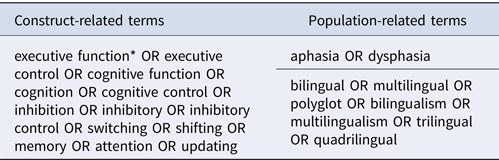
Various bibliographic databases were searched: MLA International Bibliography, Linguistics and Language Behavior Abstracts, PubMed, CINAHL, Embase, MEDLINE, PsycINFO, ERIC, Web of Science. Construct- (executive control) and population-related (aphasia and bilingualism) search terms were used, which are presented in Appendix A. We included studies published between each database's coverage start date and March 2020. We inspected the Aphasiology archives separately for conference proceedings of the Clinical Aphasiology Conference. Lastly, bibliographies of previous reviews and studies were examined.
2.2 Inclusion and exclusion criteria
We included studies that reported on EC measures in bi- or multilingual individuals with aphasia. Studies were selected if they included participants who were adults (>18 years) with non-progressive aphasia due to acquired neurological damage of any etiology. Presence and severity of aphasia was determined using a standardized aphasia test or based on a clinician's evaluation. Participants had to be bi- or multilingual, but there were no specific restrictions regarding the type of bilingualism (such as age, manner of acquisition or premorbid proficiency). The studies had to be peer reviewed and include a measure of EC, either with standardized tests or compared to a matched control group of healthy participants. Finally, the article had to be written in English or Dutch. Studies were excluded if they failed to meet these criteria, if they did not include original data (e.g., meta-analyses, reviews), or if participants were duplicated in multiple studies.
2.3 Selection procedure
The literature search yielded 466 results in total. We checked the results and removed duplicates, resulting in 314 articles. The remaining papers were screened and assessed on eligibility based on their titles and abstracts. We retrieved the full text of the articles that were left in the final selection. There were 27 articles that met all requirements. The entire selection procedure is illustrated in a PRISMA-flowchart (Moher, Liberati, Tetzlaff, Altman & the PRISMA Group, Reference Moher, Liberati, Tetzlaff and Altman2009) given in Figure 1.
PRISMA flowchart of search process.

3. Results
3.1 Deficits in non-linguistic EC
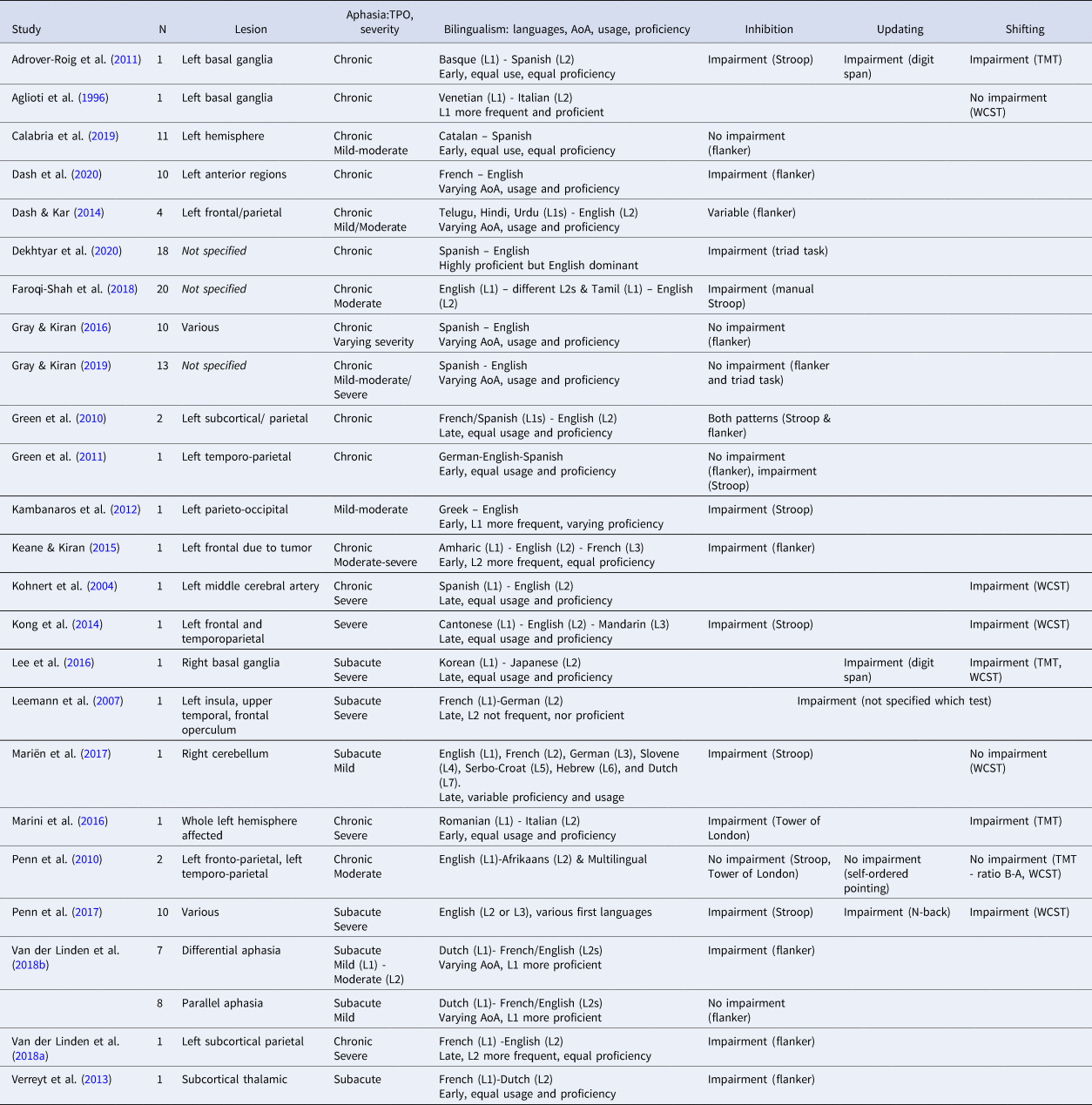
All articles that included a comparison between bPWA and a healthy control group or that used standardized measures were suitable to evaluate whether EC impairments are observed in bPWA. Following Miyake et al. (Reference Miyake, Friedman, Emerson, Witzki, Howerter and Wager2000a), we divided EC into inhibiting, updating, and shifting, which have been shown to play a role in normal language performance (see Roelofs & Ferreira, Reference Roelofs, Ferreira and Hagoort2019, for a review). The results for each study are presented in Table 1.
Summary of studies reporting on non-linguistic EC impairments in bilingual aphasia. Abbreviations used in the table: TPO: time post-onset (acute: ≤2 weeks, subacute: ≤6 months, chronic: ≥6 months), AoA: Age of acquisition, TMT: Trail Making Test, WCST: Wisconsin Card Sorting Test.
Inhibiting
inhibition turned out to be the most-often researched EC component in the included studies. Twenty studies investigated inhibition abilities in bPWA. Nine studies used the Stroop task (Stroop, Reference Stroop1935), in which a deficit is typically operationalized as the relative difference in reaction time (RT) or accuracy between congruent and incongruent conditions (e.g., say “red” to the red ink color of the word red or green, respectively). The Stroop task is taken to be a measure of prepotent response inhibition, a component of inhibition that involves the ability to suppress dominant or automatic responses (Friedman & Miyake, Reference Friedman and Miyake2004; Miyake et al., Reference Miyake, Friedman, Emerson, Witzki, Howerter and Wager2000a; but see Roelofs, Reference Roelofs2021; Shao, Roelofs, Martin & Meyer, Reference Shao, Roelofs, Martin and Meyer2015; Sikora & Roelofs, Reference Sikora and Roelofs2018, for evidence against this interpretation).
A large majority (37/39) of bPWA, reported on in eight studies, showed abnormally high interference in the Stroop task (Adrover-Roig, Galparsoro-Izagirre, Marcotte, Ferre, Wilson & Ansaldo, Reference Adrover-Roig, Galparsoro-Izagirre, Marcotte, Ferre, Wilson and Ansaldo2011; Faroqi-Shah, Sampson, Pranger & Baughman, Reference Faroqi-Shah, Sampson, Pranger and Baughman2018; Green, Grogan, Crinion, Ali, Sutton & Price, Reference Green, Grogan, Crinion, Ali, Sutton and Price2010; Green, Ruffle, Grogan, Ali, Ramsden, Schofield, Leff, Crinion & Price, Reference Green, Ruffle, Grogan, Ali, Ramsden, Schofield, Leff, Crinion and Price2011; Kambanaros, Messinis & Anyfantis, Reference Kambanaros, Messinis and Anyfantis2012; Kong, Abutalebi, Lam & Weekes, Reference Kong, Abutalebi, Lam and Weekes2014; Mariën, van Dun, van Dormael, Vandenborre, Keulen, Manto, Verhoeven & Abutalebi, Reference Mariën, van Dun, Van Dormael, Vandenborre, Keulen, Manto, Verhoeven and Abutalebi2017; Penn, Barber & Fridjhon, Reference Penn, Barber and Fridjhon2017). Two bPWA, on the other hand, exhibited normal interference (Penn, Frankel, Watermeyer & Russell, Reference Penn, Frankel, Watermeyer and Russell2010). Most studies report a case (series) design, except for Penn et al. (Reference Penn, Barber and Fridjhon2017) and Faroqi-Shah et al. (Reference Faroqi-Shah, Sampson, Pranger and Baughman2018), who conducted group studies. The results of the Stroop task indicate that most bPWA experience inhibition impairments. However, the linguistic nature of the task (i.e., naming and reading) complicates disentangling non-linguistic inhibition impairments from disordered language skills. In two studies, this validity issue is partially circumvented by administering an adapted version of the task, requiring a non-verbal response (Faroqi-Shah et al., Reference Faroqi-Shah, Sampson, Pranger and Baughman2018; Penn et al., Reference Penn, Barber and Fridjhon2017), but this does not reduce the reading demands. Moreover, the individuals who performed the adapted Stroop also showed impaired performance on this task.
The Eriksen flanker task (Eriksen & Eriksen, Reference Eriksen and Eriksen1974) is another frequently used test. Here, participants manually respond to a visually presented target stimulus (e.g., >) while ignoring interference from flanked congruent (i.e., >>>>>) or incongruent (i.e., >><>>) non-target stimuli. This task is frequently used to assess resistance to distractor interference, a subcomponent of inhibition that involves the ability to resist or resolve interference from irrelevant information (Friedman & Miyake, Reference Friedman and Miyake2004). Inhibition abilities in this task are operationalized as interference effects or ratios, which is the relative difference in RT or accuracy between incongruent and congruent conditions. A smaller difference typically points to more efficient conflict resolution. Therefore, impaired inhibitory control is generally defined as markedly larger conflict ratios. However, other authors have defined impaired inhibitory control as the absence of interference effects (Gray & Kiran, Reference Gray and Kiran2016, Reference Gray and Kiran2019).
bPWA also show impairments on the flanker task: 21 bPWA reported on in six studies experienced larger interference compared to healthy control participants (Dash, Masson-Trottier & Ansaldo, Reference Dash, Masson-Trottier and Ansaldo2020; Green et al., Reference Green, Grogan, Crinion, Ali, Sutton and Price2010; Keane & Kiran, Reference Keane and Kiran2015; Van der Linden et al., Reference Van der Linden, Dricot, De Letter, Duyck, de Partz, Ivanoiu and Szmalec2018a, Reference Van der Linden, Verreyt, De Letter, Hemelsoet, Mariën, Santens, Stevens, Szmalec and Duyck2018b; Verreyt, De Letter, Hemelsoet, Santens & Duyck, Reference Verreyt, De Letter, Hemelsoet, Santens and Duyck2013). However, a larger number of bPWA shows unimpaired performance on this task: 44 participants in six studies (Calabria, Grunden, Serra, García-Sánchez & Costa, Reference Calabria, Grunden, Serra, García-Sánchez and Costa2019; Gray & Kiran, Reference Gray and Kiran2016, Reference Gray and Kiran2019; Green et al., Reference Green, Grogan, Crinion, Ali, Sutton and Price2010, Reference Green, Ruffle, Grogan, Ali, Ramsden, Schofield, Leff, Crinion and Price2011; Van der Linden et al., Reference Van der Linden, Verreyt, De Letter, Hemelsoet, Mariën, Santens, Stevens, Szmalec and Duyck2018b). The results of the putatively non-linguistic inhibition task thus show a more mixed pattern of impairments as compared to the Stroop task.
The results on the triad task, another test measuring resistance to distractor interference, were also found to be mixed. On this test, participants match stimuli on color or shape based on a cue while ignoring distractors. Eighteen bPWA showed impaired performance (Dekhtyar, Kiran & Gray, Reference Dekhtyar, Kiran and Gray2020), whereas 13 bPWA did not (Gray & Kiran, Reference Gray and Kiran2019). It is important to note, however, that impaired performance was operationalized differently in these studies. Dekhtyar et al. (Reference Dekhtyar, Kiran and Gray2020) compared performance of the bPWA with a control group, whereas the presence of interference effects or ratios was indicative of unimpaired performance in Gray and Kiran (Reference Gray and Kiran2019).
Four of the studies that did not find abnormal interference nevertheless found bPWA to be significantly slower and/or less accurate overall on tasks (Calabria et al., Reference Calabria, Grunden, Serra, García-Sánchez and Costa2019; Gray & Kiran, Reference Gray and Kiran2016, Reference Gray and Kiran2019; Van der Linden et al., Reference Van der Linden, Verreyt, De Letter, Hemelsoet, Mariën, Santens, Stevens, Szmalec and Duyck2018b).Footnote 1 This shows that while the specific ability to resist interference from distractors may be intact, other cognitive abilities necessary to perform the task, such as processing speed or sustained attention, may be below normal performance.
Finally, the studies discussed above included bPWA who varied in their time post-onset and this may inform us about the transiency of inhibition impairments. The acute phase of recovery typically lasts two weeks, the subacute stage six months, followed by the chronic stage (Kiran, Reference Kiran2012). Three out of four studies that reported on inhibition in the subacute phase found abnormal scores (Mariën et al., Reference Mariën, van Dun, Van Dormael, Vandenborre, Keulen, Manto, Verhoeven and Abutalebi2017; Penn et al., Reference Penn, Barber and Fridjhon2017; Verreyt et al., Reference Verreyt, De Letter, Hemelsoet, Santens and Duyck2013) and one study reported differences between bPWA with parallel and selective impairments (Van der Linden et al., Reference Van der Linden, Verreyt, De Letter, Hemelsoet, Mariën, Santens, Stevens, Szmalec and Duyck2018b). In the subacute phase, spontaneous and guided recovery is still expected, and these impairments may therefore resolve over time. Notably, one study that conducted a comparison between six- and twelve-weeks post onset found that inhibiting impairments persisted (Penn et al., Reference Penn, Barber and Fridjhon2017). Moreover, the remaining studies investigated bPWA with chronic aphasia and frequently observed inhibiting deficits, indicating that these impairments persist.
When we focus on inhibiting abilities, we can conclude that the majority of bPWA show impairments when measured with the Stroop task. On flanker and triad tasks, the majority of bPWA shows unimpaired inhibition abilities. These contradictory findings could be due to the difference in the linguistic demands of each task, or to the type of inhibition that was measured.
Updating
Four studies investigated updating abilities in bPWA. Penn et al. (Reference Penn, Frankel, Watermeyer and Russell2010) found the performance of two chronic bPWA on a self-ordered pointing task to be within the normal range. In this task, stimuli are arranged differently across trials, and participants point to a different item in each trial (Petrides & Milner, Reference Petrides and Milner1982). Conversely, three studies found updating to be impaired in 12 bPWA. Adrover-Roig et al. (Reference Adrover-Roig, Galparsoro-Izagirre, Marcotte, Ferre, Wilson and Ansaldo2011) and Lee et al. (Reference Lee, Moon, Lim, Cho, Choi and Pyun2016) describe case studies in which patients showed impaired performance on backward digit and/or visual span tasks, in which stimuli must be recalled in reverse order. In a group study (N = 10), Penn et al. (Reference Penn, Barber and Fridjhon2017) found that bPWA were impaired on a non-linguistic N-back task, in which pictures are presented successively and participants manually indicate whether a new stimulus is the same as the one N back. At first sight, the majority (12/14) of bPWA appear to have impairments in updating ability.
This observation, however, needs to be nuanced when we consider time post-onset. Most (11/12) bPWA with impaired updating ability were in the subacute phase of recovery (Lee et al., Reference Lee, Moon, Lim, Cho, Choi and Pyun2016; Penn et al., Reference Penn, Barber and Fridjhon2017). Results by Penn et al. (Reference Penn, Barber and Fridjhon2017) show that updating improved over time, though significant differences with control participants remained at 12 weeks post-onset. Therefore, as updating appears to be susceptible to improvement, we cannot rule out the possibility that updating impairments will recover toward the chronic phase of recovery.
Besides time post-onset, the operationalization of updating should call for cautious interpretation of the results. Firstly, backward span tasks tap a broader working memory capacity than the more specific updating ability (Diamond, Reference Diamond2013). Still, latent-variable analyses have shown that working memory maintenance and updating appear to rely on similar underlying constructs (Schmiedek, Hildebrandt, Lövdén, Wilhelm & Lindenberger, Reference Schmiedek, Hildebrandt, Lövdén, Wilhelm and Lindenberger2009; Waris, Soveri, Ahti, Hoffing, Ventus, Jaeggi, Seitz & Laine, Reference Waris, Soveri, Ahti, Hoffing, Ventus, Jaeggi, Seitz and Laine2017) and performances on the N-back and backward span tasks overlap considerably (Byrne, Gilbert, Kievit & Holmes, Reference Byrne, Gilbert, Kievit and Holmes2019). Secondly, only the self-ordered pointing and N-back task are non-linguistic in nature, as backward span tasks require some linguistic processing. Taking these considerations into account, updating impairments are observed in bPWA, though the results appear to be mixed.
Shifting
Finally, there were nine studies that investigated shifting ability in bPWA. Six studies, including 15 participants, found it to be impaired (Adrover-Roig et al., Reference Adrover-Roig, Galparsoro-Izagirre, Marcotte, Ferre, Wilson and Ansaldo2011; Kohnert, Reference Kohnert2004; Kong et al., Reference Kong, Abutalebi, Lam and Weekes2014; Lee et al., Reference Lee, Moon, Lim, Cho, Choi and Pyun2016; Marini et al., Reference Marini, Galetto, Tatu, Duca, Geminiani, Sacco and Zettin2016; Penn et al., Reference Penn, Barber and Fridjhon2017), and three studies, including four participants, report unimpaired shifting abilities (Aglioti, Beltramello, Girardi & Fabbro, Reference Aglioti, Beltramello, Girardi and Fabbro1996; Mariën et al., Reference Mariën, van Dun, Van Dormael, Vandenborre, Keulen, Manto, Verhoeven and Abutalebi2017; Penn et al., Reference Penn, Frankel, Watermeyer and Russell2010).
Like the findings for updating, most (11/15) of the bPWA with impaired switching ability were in the subacute phase of recovery, compared to one out of four bPWA with unimpaired shifting abilities. Again, Penn et al.'s (2017) study showed that shifting improves during recovery, indicating that shifting impairments may diminish over time.
It is important to consider the tasks that were used to measure shifting ability. The studies reported here administered the Wisconsin Card Sorting Test (WCST; Grant & Berg, Reference Grant and Berg1948) and the Trail Making Test (TMT; Army Individual Test Battery, 1944). Only the WCST can be characterized as a non-linguistic task, as the TMT requires sequencing of letters and therefore relies on linguistic knowledge. When we eliminate the linguistic demands and only focus on the outcomes of the WCST, the majority (13/17) of bPWA are still found to be impaired.
Besides linguistic demands, both tasks require complex cognitive processing. Although shifting is an essential component of performance on the WCST (Miyake et al., Reference Miyake, Friedman, Emerson, Witzki, Howerter and Wager2000a), it is a multifactorial task that also requires other functions such as conceptual ability, problem solving, and attentional processing (Greve, Love, Sherwin, Mathias, Ramzinski & Levy, Reference Greve, Love, Sherwin, Mathias, Ramzinski and Levy2002; O'Donnell, Macgregor, Dabrowski, Oestreicher & Romero, Reference O'Donnell, Macgregor, Dabrowski, Oestreicher and Romero1994). The TMT is not only a measure of shifting ability, but also relies on visuo-perceptual abilities and working memory (Sánchez-Cubillo, Periáñez, Adrover-Roig, Rodríguez-Sánchez, Rios-Lago, Tirapu & Barceló, Reference Sánchez-Cubillo, Periáñez, Adrover-Roig, Rodríguez-Sánchez, Rios-Lago, Tirapu and Barceló2009). As with the other EC components, operationalization of the constructs is challenging but crucial for the right interpretation of results. In conclusion, the literature suggests that most bPWA experience shifting problems.
3.2 Domain generality of bilingual language control impairments
This section of our review is about the nature of bilingual language control in PWA. If bilingual language control impairments are consistently paired with EC impairments, this may have implications for recovery because the integrity of EC is crucial for aphasia recovery and treatment (Olsson et al., Reference Olsson, Arvidsson and Johansson2019; Simic, Bitan, Turner, Chambers, Goldberg, Leonard & Rochon, Reference Simic, Bitan, Turner, Chambers, Goldberg, Leonard and Rochon2020). Similarly, if language control relies on domain-general EC, training of the latter could lead to improvements in language (Kiran & Gray, Reference Kiran, Gray, Miller, Bayram, Rothman and Serratrice2018). Another reason to investigate domain generality in bPWA is that the selectivity of their impairments can inform us about associations and dissociations between cognitive functions (Calabria, Costa, Green & Abutalebi, Reference Calabria, Costa, Green and Abutalebi2018).
In what follows, we first examine studies that adopted an experimental design to compare EC and language control abilities. Next, we discuss studies that report problems with bilingual language control in functional communication, demonstrated by selective recovery or pathological switching and mixing of the two languages.
Domain generality: evidence from experiments
Nine studies directly investigated the relationship between EC and bilingual language control in controlled experiments (Table 2). The majority of studies focused on receptive language control abilities measured with lexical decision tasks (Green et al., Reference Green, Grogan, Crinion, Ali, Sutton and Price2010, Reference Green, Ruffle, Grogan, Ali, Ramsden, Schofield, Leff, Crinion and Price2011; Van der Linden et al., Reference Van der Linden, Dricot, De Letter, Duyck, de Partz, Ivanoiu and Szmalec2018a, Reference Van der Linden, Verreyt, De Letter, Hemelsoet, Mariën, Santens, Stevens, Szmalec and Duyck2018b; Verreyt et al., Reference Verreyt, De Letter, Hemelsoet, Santens and Duyck2013), semantic judgment tasks (Gray & Kiran, Reference Gray and Kiran2016, Reference Gray and Kiran2019), or a linguistic version of the flanker task (Dash & Kar, Reference Dash and Kar2014; Gray & Kiran, Reference Gray and Kiran2019). One study measured expressive language control abilities using language switching tasks or picture naming tasks (Calabria et al., Reference Calabria, Grunden, Serra, García-Sánchez and Costa2019). The Stroop task, used by Green et al. (Reference Green, Grogan, Crinion, Ali, Sutton and Price2010, Reference Green, Ruffle, Grogan, Ali, Ramsden, Schofield, Leff, Crinion and Price2011), is a peculiar case, as it requires receptive language abilities (i.e., reading), expressive language abilities (i.e., naming colors), but only limited lexical or semantic knowledge.
Summary of studies reporting bilingual language control and EC measures. Abbreviations used in the table: TPO: time post-onset (acute: ≤2 weeks, subacute: ≤6 months, chronic: ≥6 months), BLC: bilingual language control.
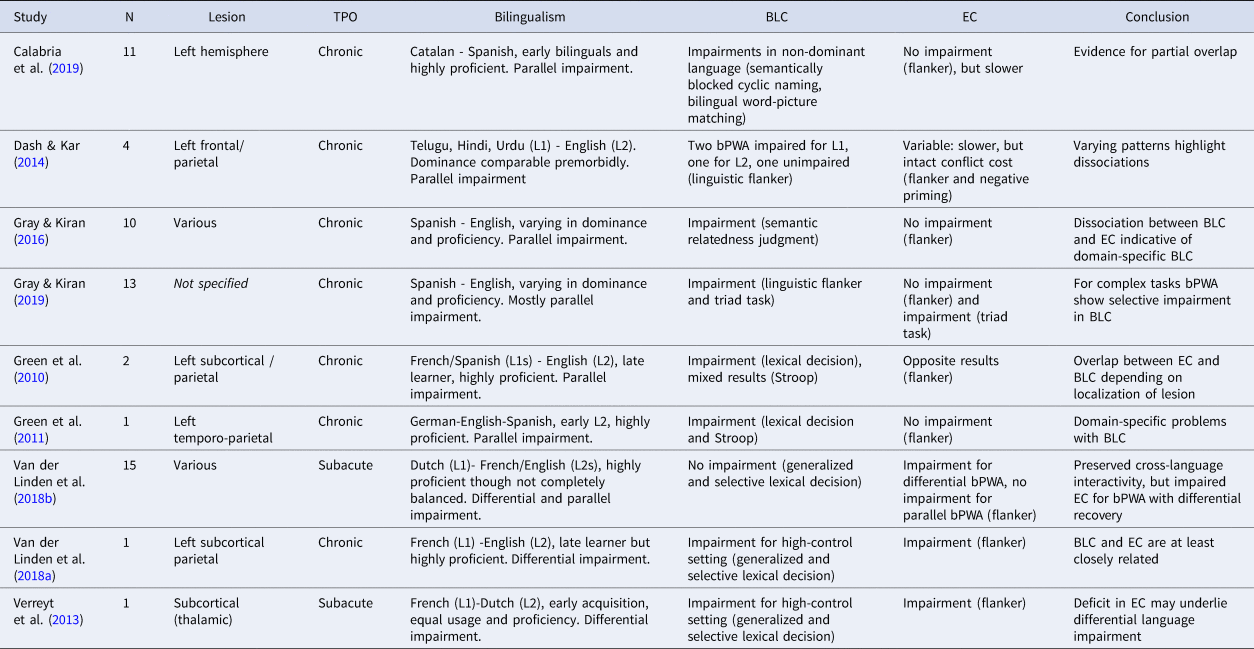
The first study to explicitly investigate the overlap between language control and EC was conducted by Green et al. (Reference Green, Grogan, Crinion, Ali, Sutton and Price2010). Two bPWA performed verbal lexical decision (LD), the Stroop task, and a non-linguistic flanker task. Their results indicated that, despite their parallel recovery pattern, both bPWA had problems managing interference. However, one participant's impairments were limited to the verbal domain, whereas the other participant demonstrated an association between linguistic and non-linguistic control impairments. Green and colleagues argue that overlap between the two processes can be explained by the localization of lesions. The first bPWA had left subcortical damage, which according to Green et al. (Reference Green, Grogan, Crinion, Ali, Sutton and Price2010) is consistent with domain-specific language control problems. The other participant had extensive left parietal damage, explaining the domain-general control problems.
Subsequent studies also reported dissociations between language control and EC. Green et al. (Reference Green, Ruffle, Grogan, Ali, Ramsden, Schofield, Leff, Crinion and Price2011) report on a case of a trilingual individual with parallel recovery of three languages. The PWA showed impaired LD and Stroop performance, but performed within normal limits on the flanker task, demonstrating that her language control difficulties were dissociable from non-linguistic control issues. Gray and Kiran (Reference Gray and Kiran2016) made a similar observation in one of the few group studies that have been conducted (N = 10). They administered a semantic relatedness judgment task, measuring bilingual language control, and a flanker task. On the non-linguistic task, both the bPWA group and the control group showed interference effects. On the linguistic control task, though, the control group showed significant interference ratios whereas the bPWA group did not. According to the authors, these dissociations are indicative of a domain-specific impairment in bilingual language control.
Dash and Kar (Reference Dash and Kar2014) investigated four bPWA in a case series design. They relied on Braver's (Reference Braver2012) dual-mechanisms framework, in which variability in functions is explained in terms of the temporal dynamics of control. Braver distinguishes proactive control, measuring resistance to interference that is expected, and reactive control, measuring resistance to interference after it has occurred. These were tested by looking at slow and fast trials, respectively. Dash and Kar used a non-linguistic negative priming task, and a linguistic (i.e., with letters instead of arrows) and non-linguistic version of the flanker task. RT analyses revealed that bPWA were impaired in proactive control and primarily used reactive control on the negative priming task. The participants showed effective control mechanisms on the non-linguistic flanker task. For the linguistic version, however, results were more variable both between participants, and within participants between languages. This variability not only demonstrates the inter-subject variance, but Dash and Kar argue that it also stresses the difference between language control and EC mechanisms. These findings are at odds with the results of another research group (Van der Linden et al., Reference Van der Linden, Dricot, De Letter, Duyck, de Partz, Ivanoiu and Szmalec2018a, Reference Van der Linden, Verreyt, De Letter, Hemelsoet, Mariën, Santens, Stevens, Szmalec and Duyck2018b; Verreyt et al., Reference Verreyt, De Letter, Hemelsoet, Santens and Duyck2013). The latter compared bPWA's performance on flanker and LD tasks, and found that performances in both domains were associated.
Associations in impairments, however, may not be required to conclude that bilingual language control and executive control rely on the same underlying mechanism. Although the bPWA (N = 11) in a study by Calabria et al. (Reference Calabria, Grunden, Serra, García-Sánchez and Costa2019) did not exhibit deviant interference ratios on inhibitory control tasks, their performance on these tasks was significantly correlated with linguistic control (see Gray, Reference Gray2020, for converging evidence). Due to small sample sizes, however, findings of correlational analyses should be interpreted with caution.
A final issue we address here is task complexity as a potentially modulating factor for domain generality of language control. Gray and Kiran (Reference Gray and Kiran2019) investigated this in a group of bPWA (N = 13) by contrasting relatively easy linguistic and non-linguistic flanker tasks with more complex linguistic and non-linguistic triad tasks. They found that bPWA and the control group scored similarly on easier tasks but performed differently on more complex tasks. On the non-linguistic triad task, both groups showed interference, but on the linguistic triad only the control group did. Furthermore, the control group showed significant interference ratios for all tasks, whereas the bPWA showed significant ratios only for the non-linguistic tasks. Consequently, Gray and Kiran propose that bPWA have selective impairments on complex tasks that require participants to manage and process more information simultaneously. This claim was supported by correlational analyses. However, it is important to note that on the linguistic flanker task, neither the control group nor the bPWA showed interference effects, complicating the interpretation of these results. Nonetheless, task complexity appears to be an important factor to consider when investigating control abilities.
Our review of the experimental studies on the nature of bilingual language control reveals mixed findings. Several studies report dissociations between bilingual language control and EC impairments, suggesting that problems experienced by bPWA are restricted to language control (Dash & Kar, Reference Dash and Kar2014; Gray & Kiran, Reference Gray and Kiran2016, Reference Gray and Kiran2019; Green et al., Reference Green, Ruffle, Grogan, Ali, Ramsden, Schofield, Leff, Crinion and Price2011). Other studies report overlap (Van der Linden et al., Reference Van der Linden, Dricot, De Letter, Duyck, de Partz, Ivanoiu and Szmalec2018a, Reference Van der Linden, Verreyt, De Letter, Hemelsoet, Mariën, Santens, Stevens, Szmalec and Duyck2018b; Verreyt et al., Reference Verreyt, De Letter, Hemelsoet, Santens and Duyck2013), although differing regarding the extent of the overlap (Calabria et al., Reference Calabria, Grunden, Serra, García-Sánchez and Costa2019; Green et al., Reference Green, Grogan, Crinion, Ali, Sutton and Price2010).
Domain generality: evidence from functional communication
Problems with bilingual language control can lead to symptoms such as translation difficulties or involuntary language switching, and differential recovery of languages. A frontal-basal ganglia connection, the anterior control loop, has been identified as a crucial circuitry for language control (Abutalebi & Green, Reference Abutalebi and Green2007; Green & Abutalebi, Reference Green and Abutalebi2008). It has been argued that language control impairments cause selective recovery patterns through inhibitory mechanisms (Green, Reference Green1986; Green & Abutalebi, Reference Green and Abutalebi2008; Paradis, Reference Paradis, Stemmer and Whitaker1998). Languages can be inhibited to a similar degree (parallel recovery), one language can be inhibited more strongly (selective recovery), or inhibition can shift from one language to the other (antagonistic recovery). When inhibition cannot be selectively applied, this results in involuntary language switching and mixing. The question we address here is whether non-linguistic EC impairments are observed when bPWA show deviant recovery patterns or language control impairments in functional communication.
First, some studies report differential recovery of the L1 or the L2. Four studies report cases showing better recovery of the L2 (Adrover-Roig et al., Reference Adrover-Roig, Galparsoro-Izagirre, Marcotte, Ferre, Wilson and Ansaldo2011; Aglioti et al., Reference Aglioti, Beltramello, Girardi and Fabbro1996; Lee et al., Reference Lee, Moon, Lim, Cho, Choi and Pyun2016; Van der Linden et al., Reference Van der Linden, Dricot, De Letter, Duyck, de Partz, Ivanoiu and Szmalec2018a). Aglioti et al. (Reference Aglioti, Beltramello, Girardi and Fabbro1996) report on a case of bilingual subcortical aphasia in which the participant's L2 was better preserved than her L1. In addition, translation abilities from L2 to L1 were worse than vice versa. This pattern is unexpected considering that premorbidly the L1 was used more frequently and proficiently. Aglioti et al. propose that a lesion in the left basal ganglia, a brain region also crucial for implicit memory systems, mainly impacts the L1. The L2, typically relying more heavily on explicit memory systems, is therefore better preserved. However, the bPWA's performance on EC tasks (updating and shifting) were within normal range, leading the authors to suggest that the impairment is predominantly linguistic.
Other studies describe, however, that differential recovery patterns co-occur with EC problems. Adrover-Roig et al. (Reference Adrover-Roig, Galparsoro-Izagirre, Marcotte, Ferre, Wilson and Ansaldo2011) report on a case with damage to the left basal ganglia showing worse L1 production compared to the L2 and translation difficulties from L2 to L1, despite being equally proficient in both language premorbidly. The bPWA also experienced problems on the TMT, showing that the language control problems were part of a wider ranging impairment. Likewise, Van der Linden et al. (Reference Van der Linden, Dricot, De Letter, Duyck, de Partz, Ivanoiu and Szmalec2018a) argue that their participant with subcortical damage shows differential recovery of the L2 due to a domain-general impairment, illustrated by deviant flanker task performance. Finally, Lee et al. (Reference Lee, Moon, Lim, Cho, Choi and Pyun2016) describe differential impairment of the L1 in a case of crossed aphasia that resulted from subcortical damage to the right basal ganglia, which was accompanied by problems with EC. All four studies report selective recovery of the L2 following damage to subcortical areas. While Aglioti et al. (Reference Aglioti, Beltramello, Girardi and Fabbro1996) did not find evidence for accompanying EC deficits, the other studies report that the participants in their studies experienced problems with EC.
Evidence for a more direct relationship between EC deficits and selective recovery of one language is provided by Verreyt et al. (Reference Verreyt, De Letter, Hemelsoet, Santens and Duyck2013) and corroborated by the group comparison of Van der Linden et al. (Reference Van der Linden, Verreyt, De Letter, Hemelsoet, Mariën, Santens, Stevens, Szmalec and Duyck2018b). They investigated bPWA's language control and EC abilities and found that bPWA with differential recovery of their languages tentatively showed more difficulties with both linguistic control and inhibitory control, compared to bPWA with parallel recovery. Therefore, the authors conclude that a deficit in EC may underlie selective recovery of one language. The importance of the control network in recovery of two languages is confirmed by findings from an fMRI experiment (Radman, Mouthon, Di Pietro, Gaytanidis, Leemann, Abutalebi & Annoni, Reference Radman, Mouthon, Di Pietro, Gaytanidis, Leemann, Abutalebi and Annoni2016). They found that although improvements in language control functions alone were not sufficient to fully explain recovery patterns, the involvement of the control network in recovery was nevertheless essential.
Problems with bilingual language control can also lead to pathological mixing and switching. This has been reported in several studies, and more recent case studies allow us to investigate the relationship with EC. In one case, Leemann, Laganaro, Schwitter and Schnider (Reference Leemann, Laganaro, Schwitter and Schnider2007) observed involuntary switching to the L2, which had never been fluent nor used after late acquisition in school. The authors suggest that this switching pattern is due to reliance on explicit memory systems used for L2 processing. Kong et al. (Reference Kong, Abutalebi, Lam and Weekes2014) report on a highly proficient trilingual with damage to frontal regions who showed involuntary switching across three languages. Lastly, Mariën et al. (Reference Mariën, van Dun, Van Dormael, Vandenborre, Keulen, Manto, Verhoeven and Abutalebi2017) describe a multilingual PWA who involuntarily switched between languages when speaking in one of his several second languages, but not in his L1. This patient suffered a cerebellar stroke, and the authors hypothesize that this damage led to functional disruption of the dorsolateral prefrontal areas, causing control impairments. Importantly, these three cases showed co-occurring deficits in non-linguistic EC, indicating a connection between impaired language control and EC.
Two treatment studies provide additional evidence for this connection. Firstly, Kohnert (Reference Kohnert2004) conducted a cognitive and cognate-based treatment study in which a bPWA showed modest improvement on various language tests, after receiving training on a range of non-linguistic cognitive functions, including shifting and inhibiting. The transfer effect from the non-linguistic cognitive domain to the language domain is interpreted as indirect evidence for overlap between functions. Secondly, Keane and Kiran (Reference Keane and Kiran2015) performed a semantic treatment study that further informs us on this relationship. The chronic trilingual PWA experienced lexical deficits that manifested as pathological switching during naming and, importantly, showed problems with EC. The individual received semantic treatment to improve naming deficits, which did not lead to cross-language generalization but instead resulted in an increase of cross-language intrusions from the treated language. Keane and Kiran argue that these are an effect of a failure to inhibit the non-target language and result from impairments in domain-general control mechanisms, which is supported by the finding that this PWA had EC impairments.
In summary, a convincing majority of studies that report differential recovery profiles or involuntary language mixing or switching find co-occurring deficits in EC (except Aglioti et al., Reference Aglioti, Beltramello, Girardi and Fabbro1996), indicative of domain-general control issues. Another prominent finding is that many of the individuals who show this behavior suffer from lesions in subcortical or frontal areas of the brain, parts of the anterior control loop (Abutalebi & Green, Reference Abutalebi and Green2007; Green & Abutalebi, Reference Green and Abutalebi2008). Lastly, transfer effects of EC training to language performance and lack of cross-linguistic generalization due to inhibition impairments also point to overlapping control domains.
3.3 Bilingual advantage for populations with aphasia
Research with healthy bilinguals suggests that their lifelong practice managing their languages may have favorable consequences for non-linguistic EC (e.g., Adesope et al., Reference Adesope, Lavin, Thompson and Ungerleider2010; Bialystok & Martin, Reference Bialystok and Martin2004). However, not all studies have replicated these results (e.g., Paap et al., Reference Paap, Johnson and Sawi2015, Reference Paap, Myuz, Anders, Bockelman, Mikulinsky and Sawi2017), leaving the status of the cognitive consequences of bilingualism uncertain. Here, we report on the studies that investigated whether bPWA experience EC advantages relative to mPWA. Therefore, only studies that included mPWA as a control group were reviewed.
Penn et al. (Reference Penn, Frankel, Watermeyer and Russell2010) were the first to conduct a study on the bilingual advantage for individuals with aphasia. EC abilities were measured with a test battery that included inhibition, updating, and shifting tasks. They compared two bPWA with eight mPWA. Penn et al. found that the bilinguals in their experiment had significantly better-preserved EC abilities and showed better conversation skills. While this is an important starting point for further enquiries, these findings should be regarded as preliminary due to the small sample size.
Perhaps more compelling evidence for a bilingual advantage in persons with neurological damage was provided by Alladi, Bak, Mekala, Rajan, Chaudhuri, Mioshi, Krovvidi, Surampudi, Duggirala and Kaul (Reference Alladi, Bak, Mekala, Rajan, Chaudhuri, Mioshi, Krovvidi, Surampudi, Duggirala and Kaul2016). They evaluated the protective effect of bilingualism for cognitive outcome after stroke by examining data of over 600 patients from a stroke registry. They found that the incidence of aphasia was similar for mono- and bilinguals (12% versus 11%). However, bilinguals showed unimpaired performance on cognitive measures more often than monolinguals (41% versus 20%). The authors measured cognitive performance with the Addenbrooke's Cognitive Examination revised (ACE-R; Mioshi, Dawson, Mitchell, Arnold & Hodges, Reference Mioshi, Dawson, Mitchell, Arnold and Hodges2006). It is important to note that both the memory and attention tests of the ACE-R rely on verbal abilities (word repetition and recall, serial subtraction), which complicates separating non-linguistic cognitive abilities from language capacities. Alladi et al.'s results demonstrate that the protective effect of bilingualism for stroke survivors lies in the non-linguistic cognitive abilities rather than the linguistic domain.
If bPWA have benefits in the non-linguistic domain, their aphasic symptoms could be less severe when compared to mPWA. A recent study has demonstrated this pattern in a large group (N = 68) of bilingual and monolingual PWA (Paplikar, Mekala, Bak, Dharamkar, Alladi & Kaul, Reference Paplikar, Mekala, Bak, Dharamkar, Alladi and Kaul2018), who were at least three months post stroke. The bPWA showed significantly better performance on language, attention, memory, and visuospatial subtests of the ACE-R. The authors conclude that bilingualism does not reduce the likelihood of developing aphasia after acquired neurological damage but can reduce impairment symptoms through enhanced EC. Strengthened EC may facilitate compensation for aphasic deficits. Paplikar et al.'s results point to the need to examine this relationship more systematically.
Faroqi-Shah et al. (Reference Faroqi-Shah, Sampson, Pranger and Baughman2018) carried out an experimental investigation into the relationship between word retrieval and EC. They compared mPWA (N = 18) with two groups of bPWA (N = 10 in each group). One bilingual group was English dominant and had various L2s, the other bilingual group spoke Tamil as L1 and English as L2. Each group was matched for age and education level with healthy control groups. Their study showed a bilingual advantage in interference ratios on the Stroop task for the control groups and the English-dominant bPWA, but not the Tamil-English bPWA. The authors give two explanations for this difference. First, it could be due to opposing proficiency patterns for reading (necessary for the Stroop task) and speaking (necessary for word retrieval tasks). Tamil-English bilinguals may have stronger reading proficiency in their L2 and stronger speaking proficiency in their L1. The English-dominant bilinguals did not have such a potential confound. Second, the authors suggest that in Tamil-English bPWA, the EC advantage does not surpass the EC impairments following aphasia. To conclude, Faroqi-Shah et al.'s (2018) results show the importance of cross-linguistic replications but are inconclusive about the bilingual advantages for PWA.
Recently, two articles were published in which bilingual advantages were investigated with a similar approach. Dekhtyar et al. (Reference Dekhtyar, Kiran and Gray2020) assessed inhibitory control abilities with a triad task in monolingual and bilingual groups with and without aphasia. The groups were matched on demographic variables, language abilities, and non-linguistic EC measured with a composite score of the Cognitive Linguistic Quick Test (CLQT; Helm-Estabrooks, Reference Helm-Estabrooks2001). The bPWA (N = 18) in their study showed significantly shorter RTs on incongruent trials of the triad task, compared to mPWA (N = 18). Such a difference was absent on congruent trials. Interestingly, bilingual advantages on the inhibitory control task were also absent in the healthy control group. Dekhtyar et al. (Reference Dekhtyar, Kiran and Gray2020) suggest that bilingualism may contribute to cognitive reserve in bPWA, whereas its advantages do not surface in healthy individuals. Finally, the authors found that shorter RTs were not correlated with language or executive function scores, suggesting that cognitive advantages are subtle and may not be picked up by standardized diagnostic tests.
Other attentional mechanisms, in addition to EC, were investigated by Dash et al. (Reference Dash, Masson-Trottier and Ansaldo2020). They used the Attention Network Task (ANT; Fan, McCandliss, Sommer, Raz & Posner, Reference Fan, McCandliss, Sommer, Raz and Posner2002), an adaptation to the flanker task designed to disentangle alerting, orienting, and EC (i.e., resistance to interference) mechanisms of attention (Posner, Reference Posner2011; Posner & Raichle, Reference Posner and Raichle1994) by providing warning cues for alerting or location cues for orienting. In addition to the analysis of the difference scores, Dash et al. examined the RT distributions with an ex-Gaussian analysis. While the group analysis did not reveal statistically significant differences in mean RT between the bPWA and mPWA groups (N = 10 and N = 7), a comparison based on the RT distribution revealed significant differences for alerting. For the Gaussian part of the distribution (faster responses, automatic processing) bilinguals outperformed monolinguals, whereas the opposite pattern was observed for the exponential part (slower responses, controlled processing). The authors interpret this as evidence that for bPWA, alerting is more automatized, whereas mPWA are more helped by the alerting cue in controlled processing. Furthermore, Dash and colleagues found significant correlations between language scores and EC abilities for bPWA, while this correlation was absent in the monolingual group. bPWA experienced no clear benefits on the other attentional mechanisms.
When we recapitulate the findings of a bilingual advantage for populations with aphasia, all studies published thus far seem to point in the direction of confirmation of the bilingual advantage hypothesis. Nonetheless, there are also some caveats. Some report on small sample sizes (Penn et al., Reference Penn, Frankel, Watermeyer and Russell2010), others included rather coarse measures of linguistic and cognitive abilities (Alladi et al., Reference Alladi, Bak, Mekala, Rajan, Chaudhuri, Mioshi, Krovvidi, Surampudi, Duggirala and Kaul2016; Paplikar et al., Reference Paplikar, Mekala, Bak, Dharamkar, Alladi and Kaul2018), and in other cleverly designed group studies researchers have observed contradicting findings (Dash et al., Reference Dash, Masson-Trottier and Ansaldo2020; Faroqi-Shah et al., Reference Faroqi-Shah, Sampson, Pranger and Baughman2018).
4. Discussion
In our review of the literature, it appeared that, at first glance, a majority of bPWA shows impaired performance on inhibition tasks. However, some of these tasks partially rely on language processing, and when we only focused on studies that reported on an exclusively non-linguistic task, this pattern was weaker or absent. Studies on mPWA have also observed discrepancies between linguistic and non-linguistic EC, as the latter appears to be intact more often than the former (Christensen et al., Reference Christensen, Wright and Ratiu2018; Kuzmina & Weekes, Reference Kuzmina and Weekes2017). Updating abilities, much less researched in this population, varied considerably between studies. Shifting impairments were found in most bPWA; but here too, the employed tasks are likely to recruit other cognitive functions, including language. We can conclude that, despite the variability, bPWA often suffer from deficits outside the linguistic domain. This is in accordance with the literature on mPWA, in which EC impairments are frequently observed (Murray, Reference Murray2012; Olsson et al., Reference Olsson, Arvidsson and Johansson2019; Purdy, Reference Purdy2002).
Aphasia characteristics can partly explain the observed variability. Based on the available data on time post-onset, we found that inhibiting deficits are likely to persist, while most evidence for updating and shifting impairments was found in bPWA in the subacute phase. Aphasia severity may impact performance on EC tasks that rely more heavily on language processing. In addition, persons with more severe aphasia may have suffered larger lesions and may therefore experience more extensive cognitive deficits. Evaluating the influence of aphasia severity proved to be difficult, as this is operationalized differently across studies. But at first sight, it appears that all studies that included patients with (moderate to) severe aphasia also report deficits in EC (Keane & Kiran, Reference Keane and Kiran2015; Kohnert, Reference Kohnert2004; Kong et al., Reference Kong, Abutalebi, Lam and Weekes2014; Lee et al., Reference Lee, Moon, Lim, Cho, Choi and Pyun2016; Leemann et al., Reference Leemann, Laganaro, Schwitter and Schnider2007; Marini et al., Reference Marini, Galetto, Tatu, Duca, Geminiani, Sacco and Zettin2016; Penn et al., Reference Penn, Barber and Fridjhon2017; Van der Linden et al., Reference Van der Linden, Dricot, De Letter, Duyck, de Partz, Ivanoiu and Szmalec2018a).
However, severity of aphasia alone is not enough to predict EC performance, as the EC results for bPWA with mild aphasia are more mixed. In addition, the studies that directly investigated the influence of aphasia severity on EC also report opposing results. Dash et al. (Reference Dash, Masson-Trottier and Ansaldo2020) found that bPWA experience less interference if they have higher language scores. Other studies did not find performance on inhibition tasks to correlate with the degree of language impairment (Calabria et al., Reference Calabria, Grunden, Serra, García-Sánchez and Costa2019; Dekhtyar et al., Reference Dekhtyar, Kiran and Gray2020; Gray & Kiran, Reference Gray and Kiran2019). Gray and Kiran (Reference Gray and Kiran2019) found that aphasia severity did not correlate with the interference ratios for flanker and triad tasks, but it correlated with processing speed in the flanker task. More research on the relationship between aphasia severity and EC is needed to elucidate this matter.
Next, we discussed evidence for and against domain generality of bilingual language control, the set of mechanisms responsible for managing more than one language. An increasing number of studies investigated this by comparing performance on experiments tapping language control to tasks measuring EC. Results were found to be mixed, as the number of studies concluding overlap, partial overlap, or dissociations was essentially equally distributed. Contradicting findings are also reported in the literature on healthy participants (e.g., Declerck et al., Reference Declerck, Grainger, Koch and Philipp2017; Prior & Gollan, Reference Prior and Gollan2011; Branzi et al., Reference Branzi, Calabria, Boscarino and Costa2016).
The conflicting results for bPWA cannot resolve the debate about domain generality of bilingual language control. bPWA may experience linguistic control problems in absence of non-linguistic control problems, which could be interpreted as evidence for a domain-specific nature of control in bPWA (Gray & Kiran, Reference Gray and Kiran2016, Reference Gray and Kiran2019). However, Gray and Kiran also acknowledge that more research is needed to provide definite conclusions. In addition, the question arises whether a dissociation between linguistic control and EC is necessary to explain patterns of impairments, or whether a domain-general EC problem could explain both patterns, an issue also raised by Green et al. (Reference Green, Grogan, Crinion, Ali, Sutton and Price2010). EC always interacts with another function: it “manages, integrates, regulates, coordinates, or supervises other cognitive processes” (Valian, Reference Valian2015, p. 5). In this view, EC would interact with language in tasks measuring linguistic control. Aphasic impairments are most pronounced in the language domain and, therefore, tasks tapping linguistic control will be relatively harder for PWA than tasks requiring non-linguistic EC. Consequently, if bPWA have difficulties with linguistic control tasks, a domain-general EC impairment may underlie these problems even if the control issues may not surface outside the linguistic domain in less demanding tasks (cf. Spearman, Reference Spearman1927). This way, selective impairments in linguistic control could nonetheless be the result of a domain-general EC problem.
The variability in findings for domain generality of control impairments in bPWA leads us to suggest a partial dissociation between language control and non-linguistic EC in bPWA (Murray, Reference Murray1999, Reference Murray2012; Villard & Kiran, Reference Villard and Kiran2017). This is supported by correlational analyses in Calabria et al. (Reference Calabria, Grunden, Serra, García-Sánchez and Costa2019), who also advocate partial overlap. More recently, Gray (Reference Gray2020) found an association between bilingual language control and non-linguistic EC for bPWA, but not for healthy bilinguals. Gray (Reference Gray2020) argues that this association may be due to the increased cognitive load bPWA experience in order to process language. Increased demands in language processing for bPWA requires them to rely more heavily on non-linguistic EC.
A partial dissociation is in line with the view that relatively spared EC can facilitate compensation for language deficits of persons with aphasia. EC has been identified as an important mediator in compensating for linguistic deficits in monolingual PWA. For example, research into mPWA has found a relationship between functional communication abilities and EC (Fridriksson et al., Reference Fridriksson, Nettles, Davis, Morrow and Montgomery2006), especially for persons with severe aphasia (Olsson et al., Reference Olsson, Arvidsson and Johansson2019). In addition, Simic, Rochon, Greco and Martino (Reference Simic, Rochon, Greco and Martino2019) carried out a systematic review and argue that baseline EC ability is a robust indicator of language therapy outcome, independently of time post-onset.
We suspect that similar mechanisms are at play in bilingual populations. In addition, better-preserved EC could increase flexibility, efficient inhibition of the non-intended language, or more effective switching between languages – and, this way, improve functional communication. For example, it has been shown that language mixing in aphasia is associated with lexical retrieval problems (Lerman, Pazuelo, Kizner, Borodkin & Goral, Reference Lerman, Pazuelo, Kizner, Borodkin and Goral2019), and that individuals with more severe aphasia codeswitch more often (Goral, Norvik & Jensen, Reference Goral, Norvik and Jensen2019). Similarly, Muñoz et al. (Reference Muñoz, Marquardt and Copeland1999) suggested that mixing is an (un)conscious strategy to access a lexical item and could be a compensatory approach.
Our review of the literature showed that language control problems in functional communication – most notably, selective impairments or involuntary language switching – are consistently paired with non-linguistic EC deficits (Adrover-Roig et al., Reference Adrover-Roig, Galparsoro-Izagirre, Marcotte, Ferre, Wilson and Ansaldo2011; Kong et al., Reference Kong, Abutalebi, Lam and Weekes2014; Lee et al., Reference Lee, Moon, Lim, Cho, Choi and Pyun2016; Leemann et al., Reference Leemann, Laganaro, Schwitter and Schnider2007; Mariën et al., Reference Mariën, van Dun, Van Dormael, Vandenborre, Keulen, Manto, Verhoeven and Abutalebi2017; Van der Linden et al., Reference Van der Linden, Dricot, De Letter, Duyck, de Partz, Ivanoiu and Szmalec2018a, 2018b; Verreyt et al., Reference Verreyt, De Letter, Hemelsoet, Santens and Duyck2013). In most cases, such impairments follow damage to subcortical areas, part of the anterior control loop (Abutalebi & Green, Reference Abutalebi and Green2007; Green & Abutalebi, Reference Green and Abutalebi2008). Involuntary language switching in absence of aphasic deficits has also been observed (Fabbro, Skrap & Aglioti, Reference Fabbro, Skrap and Aglioti2000). In this case, the bilingual speaker suffered a lesion in parts of the anterior control loop, which resulted in a defective language control system while the rest of the language network remained intact. This is indicative of dissociations between aphasia in absence of involuntary switching (impairments to language network), aphasia with instances of involuntary switching (impairments to language and control network), and involuntary switching in absence of aphasia (impairments to control network). Considering that there is much variance in the specific lesion locations of these cases, more research is needed to shed light on this issue. However, it appears that in bilingual aphasia, if involuntary language switching is observed, it is often paired with EC deficits.
In the final part of the review, we addressed the bilingual advantage hypothesis for bPWA. Only a few studies investigated this issue in populations with aphasia, but all provide indications for the existence of such an advantage for bPWA. Yet, it is important to consider potential methodological weaknesses such as small sample sizes. In addition, in the literature on neurologically healthy bilinguals, researchers have started to cast doubt upon the validity of the bilingual advantage hypothesis, as there is evidence for a publication bias (De Bruin et al., Reference De Baene, Duyck, Brass and Carreiras2015), an issue to consider when reviewing the aphasiology literature too. While there is controversy surrounding the bilingual advantage hypothesis, there are reasons to assume that beneficial effects may be larger for bPWA. Age appears to be a modulating factor for the bilingual advantage (Van den Noort et al., Reference Van den Noort, Struys, Bosch, Jaswetz, Perriard, Yeo, Barisch, Vermeire, Lee and Lim2019) and advantages are more consistently demonstrated in older (Bak, Vega-Mendoza & Sorace, Reference Bak, Vega-Mendoza and Sorace2014; Kavé, Eyal, Shorek & Cohen-Mansfield, Reference Kavé, Eyal, Shorek and Cohen-Mansfield2008; Perquin, Vaillant, Schuller, Pastore, Dartigues, Lair & Diederich, Reference Perquin, Vaillant, Schuller, Pastore, Dartigues, Lair and Diederich2013) and vulnerable populations (Alladi, Bak, Shailaja, Gollahalli, Rajan, Surampudi, Hornberger, Duggirala, Chaudhuri & Kaul, Reference Alladi, Bak, Shailaja, Gollahalli, Rajan, Surampudi, Hornberger, Duggirala, Chaudhuri and Kaul2017; Woumans, Santens, Sieben, Versijpt, Stevens & Duyck, Reference Woumans, Santens, Sieben, Versijpt, Stevens and Duyck2015). This is in line with Dekhtyar et al.'s (2020) results, who found evidence for a bilingual advantage in bPWA, but not in matched control participants.
Reviewing bilingual advantages for populations with aphasia revealed promising findings. But how is superior performance on EC tasks helpful in a bPWA's daily life? mPWA with better EC show enhanced functional communication, recovery, and generalization of skills taught in therapy (Fridriksson et al., Reference Fridriksson, Nettles, Davis, Morrow and Montgomery2006; Helm-Estabrooks, Reference Helm-Estabrooks2002; Olsson et al., Reference Olsson, Arvidsson and Johansson2019). If EC is enhanced in bilinguals, this compensatory mechanism is more effective in bPWA compared to mPWA and, as a result, could lead to better functional communication. The results of Penn et al. (Reference Penn, Frankel, Watermeyer and Russell2010) can be regarded as first evidence: they showed that bPWA performed better on EC tasks and exhibited better conversational skills than mPWA.
In summary, bPWA appear to experience benefits as a consequence of their bilingualism and these benefits may have a positive impact on improvement of their language performance. Importantly, that is not the whole story. Findings in neurologically healthy populations show that bilinguals may be disadvantaged in lexical retrieval abilities (Bialystok, Reference Bialystok2009). Similarly, Hope, Jones, Grogan, Crinion, Rae, Ruffle, Leff, Seghier, Price and Green (Reference Hope, Jones, Grogan, Crinion, Rae, Ruffle, Leff, Seghier, Price and Green2015) assessed how suitable post-stroke prognostic models are to predict language impairments in bPWA when these models are trained with monolingual data. They found that models tend to be over-optimistic; bilinguals had worse language skills than expected based on the model. Again, this stresses the importance of careful separation of linguistic and non-linguistic skills and warrants the need to further investigate the contributions of each of these in functional communication of bilinguals with aphasia.
Tackling this validity issue is our first suggestion of how research on EC in bilingual aphasia should advance. Our review showed that many of the administered EC tasks also engage language processing and/or other cognitive functions. This is referred to as the impurity problem, which has been particularly problematic in the investigation of EC (Burgess, Reference Burgess and Rabbitt2004; Miyake et al., Reference Miyake, Friedman, Emerson, Witzki, Howerter and Wager2000a). The fact that EC interacts with other cognitive functions makes it difficult, if not impossible, to fully isolate EC from other abilities, including language. When investigating PWA, it is even more important to administer EC tests that allow for separation of linguistic and non-linguistic abilities, to ensure the possibility of drawing conclusions about the integrity of non-linguistic functions (Keil & Kaszniak, Reference Keil and Kaszniak2002). For example, the Stroop task measures prepotent response inhibition, but its verbal demands complicate administering and interpreting this task in populations with aphasia. In line with Miyake, Emerson and Friedman (Reference Miyake, Emerson and Friedman2000b), we suggest using simpler EC tasks and making explicit which subcomponent of EC it is supposed to measure. Good examples of such tasks are flanker or triad tasks (tapping resistance to interference), while the WCST or the TMT are less suitable.
Furthermore, some studies found slower performance on EC tasks, in absence of impaired interference. Calabria et al. (Reference Calabria, Grunden, Serra, García-Sánchez and Costa2019) suggest that overall slower response speed indicates a deficit in conflict monitoring rather than resolution. However, being slower to perform any task may be caused by general cognitive slowing rather than a specific problem with EC (Purdy, Reference Purdy2002). Discrepancies between RTs and accuracy, as well as negative correlations between the two, can also be indicative of a difference in speed/accuracy trade-off. Participants may favor quick over accurate responding or vice versa. Faroqi-Shah et al. (Reference Faroqi-Shah, Sampson, Pranger and Baughman2018) found that, in contrast to healthy participants, bPWA's Stroop performance was characterized by a negative correlation between RTs and accuracy. Therefore, reporting both RTs and accuracy is recommended.
Inter-individual variability is a key feature of research into bilinguals as well as studies involving PWA. Bilingual experience and aphasia-related factors can have profound (combined) effects on recovery and linguistic and non-linguistic control abilities (e.g., Green, Reference Green1998; Kuzmina et al., Reference Kuzmina, Goral, Norvik and Weekes2019). For example, Calabria et al. (Reference Calabria, Grunden, Serra, García-Sánchez and Costa2019) found evidence for a relationship between language dominance and control abilities, and Dash and Kar (Reference Dash and Kar2014) found language proficiency to influence language control. Due to the variation in the included studies of the current review, a systematic analysis of these factors proved to be difficult. Therefore, we advise to report these factors consistently and take these into consideration when interpreting results of bPWA.
Another recommendation for future research is to investigate expressive language control abilities. We have shown that many previous studies have focused on receptive linguistic control, for example, as involved in making lexical decisions. As anomia is one of the most pervasive problems for PWA (e.g., Goodglass & Wingfield, Reference Goodglass and Wingfield1997), a next step is to investigate bilingual language control in language production. A final way to advance research on bilingual aphasia is to investigate whether the positive findings for a bilingual advantage in PWA can be replicated and extended to benefit everyday functional communication.
5. Conclusion
We systematically reviewed the literature on the role of EC in bilingual aphasia. Our first finding was that bPWA's impairments are not limited to the linguistic domain and that non-linguistic EC impairments are frequently observed. Next, we examined domain generality of bilingual language control by reviewing whether linguistic control impairments were associated with EC impairments and found that the experimental results were mixed. However, bPWA who show problems with bilingual language control in everyday communication, such as differential recovery or pathological switching and mixing, nearly always show problems with EC, indicative of overlapping mechanisms. Finally, research on bilingual advantages in bPWA published thus far points to beneficial effects for this population.
Acknowledgments
We thank three anonymous reviewers for helpful comments.
Appendix A: Search strings


 Open access

