




1. Introduction
This article claims that Yoruba has changed from a language that makes categorical choices against consonant clusters and codas to a language that variably permits them through invention, preservation, and hypercorrectionFootnote 1. This diachronic change is conceptualized in terms of Optimality Theory (OT) constraint re-ranking in line with the assumptions of Miglio and Moren (Reference Miglio, Moren and Eric Holt2003). The resulting variation is assessed against existing OT approaches to synchronic variation and lexical stratification, including the ranked-winners approach of Coetzee (Reference Coetzee2004), the indexed constraint approach of Itô and Mester (Reference Itô, Mester, Beckman, Dickey and Urbanczyk1995a, Reference Itô, Mester and Goldsmithb, Reference Itô, Mester and Tsujimura1999), the partial-order co-phonology of Anttila (Reference Anttila, Hinskens, van Hout and Leo Wetzels1997), and the Maximum Entropy (MaxEnt) model of Goldwater and Johnson (Reference Goldwater and Johnson2003). None of these approaches is able to account for the variation without further mechanisms. However, it is shown that a MaxEnt model augmented with lexical indexation provides the most successful account of the Yoruba data.
I identify some major contributions of this article to linguistic theory. First, I show how different theoretical approaches to a particular phenomenon can be harmonized in the face of new data. Second, I reveal a new kind of lexical stratification and synchronic variation that may inform linguistic theory. More specifically, I show how a core–periphery structure of the lexicon can be organized differently from the patterns documented in Hsu and Jesney (Reference Hsu and Jesney2018). Third, I introduce conflation tableaux that represent several tableaux simultaneously. Lastly, I show how change in progress can be modeled in a linguistic theory predicting synchronic variation only if it is, indeed, a matter of change in progress rather than stable variation.
Consensus on Yoruba phonology is that it disallows both consonant clusters and codas (Ola Reference Ola1995, Akinlabi Reference Akinlabi, Lawal, Sadiku and Dopamu2004, etc.). These facts shape loanword outputs in Yoruba, so that if a loanword has clusters, the clusters are resolved by epenthetic vowels (1a–d), and if a loanword contains a coda, the coda is resolved by deletion, as in (1c), or epenthetic vowel insertion, as in (1e).
(1)


Most loans in Yoruba come from English and Arabic, but most recent loans are from English. Most Arabic loans have diffused into Yoruba to the extent that most Yoruba speakers do not even know their origin (see Badmus Reference Badmus2020: 386 for example). One such example is sánmà, “sky”, adapted from the Arabic word samah. However, given the increase in the number of English–Yoruba bilingual speakers, coupled with the prestige of English among the Yoruba people in Nigeria, these adaptation strategies have dramatically changed in the synchronic grammar of Yoruba speakers, whether bilingual or monolingual, and whether they live in a rural or an urban area. Most English loans in Yoruba today are adapted with clusters (observed in Ufomata Reference Ufomata1991 and in Adeniyi Reference Adeniyi2015) and codas (also recognized in Ufomata Reference Ufomata1991), both in writing and in speech. In Aláròyé, a popular Yoruba newspaper, for example, we find mínístà ‘minister’, fráìde ‘Friday’, etc. Aláròyé (Alaroye TV 2021) uses the title ‘Tinubu n sun lọwọ, ẹ ma DISTỌỌBU rẹ’ where the cluster in distọọbu, ‘disturb’, is retained while the coda is resolved. Yoruba movies, radio, and television programs are also permeated with English loanwords adapted with their clusters and codas intact. These new adaptation strategies have, however, given rise to contact-induced variation so that for example, rather than have a situation as in (2a), what we now have is a situation where (2b) holds. A pattern similar to (2b) where a single loan form has more than one variant is also found in Kang et al. (Reference Kang, Kenstowicz and Ito2008) for Korean.
(2)

I analyze these emerging phonological phenomena in Yoruba as evidence for a major diachronic change in the grammar of the language. To this end, I present evidence from neologisms (such as flẹ́ńjọ̀ ‘enjoy’ and wòós ‘hey’), which are formed with either clusters or codas. I also present evidence from a cluster hypercorrection phenomenon in which both native Yoruba words (3a) and loanwords (3b) now undergo vowel deletion in an attempt to create consonant clusters where they did not originally exist. Further evidence is adduced from coda hypercorrection, where vowel deletion results in word-final codas (3c).
(3)

In order to motivate these diachronic changes, I propose the following periods in the development of Yoruba phonology in accordance with its contact with English. According to Taiwo (Reference Taiwo2009), English first arrived in Nigeria in the late sixteenth century when British merchants and Christian missionaries settled in the coastal town of Badagry, near Lagos. Since written documents in Yoruba do not emerge until much later, little or nothing is known about the Yoruba of that time period. I will refer to the Yoruba spoken at that period as Contact Yoruba, and the period before the arrival of the British as Pre-Contact Yoruba. The first recorded collection of Yoruba words was written by Bowdich in 1817 and published in 1819 in Mission from Cape Coast to Ashantee (Bamgbose Reference Bamgbose and Bamgbose1982). Other written documents followed, and these include the vocabulary collections by Hannah Kilham in 1828, Clapperton in 1829, and sample-sentence and vocabulary collections by John Raban in 1830, 1831, and 1832 (Bamgbose Reference Bamgbose and Bamgbose1982). Major work on Yoruba grammar did not emerge until the 1840s when Bishop Samuel Ajayi Crowther published his Vocabulary of the Yoruba language and began the translation of the Bible into Yoruba. I will refer to the Yoruba represented in the collections by Bowdich in 1817 through to those by Raban in 1832 as Pre-Crowther Yoruba, and the Yoruba spoken beginning with the work of Ajayi Crowther and the Church Missionary Society (CMS) in Lagos till the end of the nineteenth century as Crowther Yoruba. The Yoruba spoken from the beginning of the twentieth century until the present is referred to as Contemporary Yoruba.
Since we do not have concrete information about Pre-Contact Yoruba or Contact Yoruba, I will not discuss them further. The Yoruba recorded in Pre-Crowther Yoruba is one characterized by impermissibility of clusters and codas. Although the grammars presented in Crowther Yoruba mainly portray Yoruba as a language without clusters or codas, the first recorded instance of cluster retention is at the end of the nineteenth century. In the Yoruba Bible that emerged during that period, the word ‘Christ’ was adapted as kristi, where the cluster is retained and the coda is resolved. The first recorded cluster retention in Contemporary Yoruba can be found in A Dictionary of Yoruba Language published by the Church Missionary Society in 1913 where the word ‘Christ’ was also adapted as krístì and the word ‘apostle’ was adapted as àpóstílì (CMS 1913). The first recorded instance of cluster and coda retention in spoken speech did not emerge until Ufomata (Reference Ufomata1991). Adeniyi (Reference Adeniyi2015) is a more recent attestation of cluster retention in spoken Contemporary Yoruba. It follows then that we can recognize two major periods in the development of Yoruba phonology: Period 1, where clusters and codas are not permitted in any word (Pre-Crowther Yoruba) and Period 2, where codas and clusters are permitted in some words (Crowther Yoruba and Contemporary Yoruba). Period 3 is a period where the change (in progress) from Period 2 has gone to completion or continues to mirror Period 2. This will be schematized in Figure 2, found in section 4.1.
My focus in this article is on Periods 1 and 2. I briefly look at the transition between the two periods and analyze the patterns found in Period 2 as synchronic variation. I claim that the transition from Period 1 to Period 2 constitutes a major diachronic change in the grammar of the language, a movement from total impermissibility of clusters and codas to permissibility of clusters and codas in some words. The question of whether this synchronic variation is a stable variation that will persist, or else a change in progress that will lead to eventual completed change (Period 3), I leave to future research.
The data presented in this article are based on more than 120 hours of sociolinguistic interviews, 18 months’ worth of participant observation, and grammaticality judgments in Oyo, Lagos, and Ogun states (Nigeria). Details on data collection will be found in Appendix A. The data are presented from the viewpoint of Optimality Theory (Prince and Smolensky Reference Prince and Smolensky2004 [1993]), where the grammar of a language is expressed in terms of constraint ranking. According to this theory, languages have the same constraints, but differ in how the constraints are ranked (McCarthy Reference McCarthy2007). I take British English to be the primary source of all English loans described throughout this article. One may ask why Nigerian English is not the main source of these loans. Two things would make this problematic. First, the English variety named Nigerian English is not homogenous. In fact, it is a collection of several Englishes found in Nigeria, such as Hausa English, Igbo English, and Yoruba English (Gut Reference Gut2008: 38). One might then ask: Why isn't Yoruba English the main source of the loans? The reason is that it is a variety of English that is conditioned by the Yoruba grammar in the first place. This is not to say that there are no loans (such as nabteb ‘NABTEB’, k-leg ‘knock knee’, etc.) which originate from the collection tagged ‘Nigerian English’. Neither can it be denied that Nigerian English and Nigerian Pidgin English may play a role in the ongoing change in the Yoruba syllable structure; but these considerations lie beyond the scope of this article.
The rest of this article is organized as follows. Section 2 describes how consonant clusters and codas are resolved in traditional (Pre-Crowther) Yoruba phonology. In section 3, I outline contact-induced patterns that can now be found in the syllable structure of Contemporary Yoruba phonology. Section 4 presents diachronic and synchronic OT analyses. Section 5 outlines the major predictions of the analyses. Section 6 provides a summary of the major results of the article.
2. Syllable structure in pre-Crowther Yoruba phonology
According to Ola (Reference Ola1995) and Akinlabi (Reference Akinlabi, Lawal, Sadiku and Dopamu2004), Yoruba has only two types of syllables: a syllable that contains only a vowel (the V-type) and one that contains a consonant and a vowel (the CV type). Bilabial and alveolar nasals can be moraic, and so can stand as a syllable on their own, bearing at least a tone. They are categorized under the V type of syllable structure. In the examples in (4), the segments that constitute the respective Yoruba syllable types are in boldface.
(4)

Coding this fact about Yoruba syllable structure into an Optimality-theoretic model follows straightforwardly. Based on (4), we can state the following generalizations about the Pre-Crowther Yoruba phonology: a) Consonant clusters are forbidden; and b) codas are forbidden. The relevant OT well-formedness constraints that ensure that phonological outputs in Pre-Crowther Yoruba do not appear with a cluster or with a coda are *Complex and NoCoda respectively (5a–b). I follow Itô and Mester (Reference Itô, Mester and Tsujimura1999) and abbreviate the Input/ Output faithfulness constraints Dep and Max as Faith in (5c), since ranking among faithfulness constraints is not essential to the discussions that follow.
(5)
a. *Complex: Complex onset and complex codas are forbidden (McCarthy Reference McCarthy2008, originally formulated in Prince and Smolensky Reference Prince and Smolensky2004 [1993]), whether tautosyllabic or heterosyllabic.
b. NoCoda: Syllables must not have codas (Tesar Reference Tesar and McCarthy2004)Footnote 3.
c. Faith:
(i) Max: Every segment of the input has a correspondent in the output: no phonological deletion (McCarthy and Prince Reference McCarthy, Prince, Beckman, Dickey and Urbanczyk1995, Reference McCarthy, Prince, Kager, van der Hulst and Zonneveld1999).
(ii) Dep: Every segment of the output has a correspondent in the input: no phonological epenthesis (McCarthy and Prince Reference McCarthy, Prince, Beckman, Dickey and Urbanczyk1995, Reference McCarthy, Prince, Kager, van der Hulst and Zonneveld1999).
In Pre-Crowther Yoruba phonology, the ranking argument in (6) produces the optimal candidates. The tableau in (6) shows that both native words (6.I) and loanwords from Arabic (6.II) and English (6.III) abide by the two high-ranking constraints *Complex and NoCoda. This suggests that in Pre-Crowther Yoruba phonology, these markedness constraints determine the shape of both native and loan outputs.
(6) Pre-Crowther Yoruba ranking argument: *Complex, NoCoda>> Faith
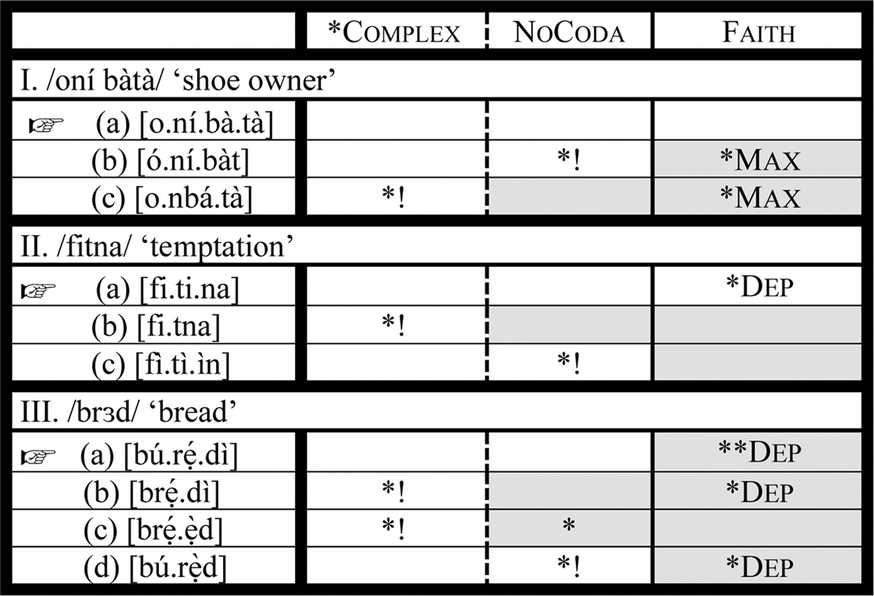
The tableau in (6) shows that there is no ranking between *Complex and NoCoda, since all output forms satisfy them. A candidate needs only to violate one of them for the form to be ruled out by the grammar. The Pre-Crowther ranking argument in (6) appears to be extremely active in the earlier stage of contact between English and Yoruba, as well-established nativized loanwords like búrẹ́dì in (6.III) show. We see in (6.III) that clusters and codas in English loanwords are resolved by epenthesis to satisfy the two high-ranking constraints. The ranking argument in (6) is thus motivated: even though the winning candidates violate Faith, they emerge as the winner for obeying both top-ranking constraints. This ranking adjusts the structures of loanwords coming into Yoruba to the phonotactic rules of the language, ensuring that, in this specific case, markedness of the target is more important than faithfulness to the source. However, the constraints in the tableau in (6) have now been re-ranked to generate new optimal candidates, and formerly inactive constraints have been re-ranked to an active position so that some of the ungrammatical candidates in Pre-Crowther Yoruba are now parsed as grammatical. A discussion of these emerging phonological forms follows in the next section.
3. Emergence of new grammars in contemporary Yoruba phonology
In this section, I show that diachronic changes in Yoruba phonology have already taken place, leading to synchronic variation in the realization of clusters and codas. In the previous section, I discussed both native and loan words in Yoruba that contain neither clusters nor codas. It has been suggested that the Pre-Crowther Yoruba phonological lexicon is characterized by the absence of codas and clusters. I assume that this generalization is also true of the earlier stage of the English–Yoruba contact, judging from the form of the well-established English loans in the language, and the fact that researchers did not begin to notice sporadic cluster and coda realization before the early nineties (see Ufomata Reference Ufomata1991 and Adeniyi Reference Adeniyi2015). If these assumptions are accurate, it follows that the Pre-Crowther Yoruba phonological lexicon is unstratified along the lines of clusters and codas. In Contemporary Yoruba, however, a diachronic stratification along the line of codas and clusters appears to have taken place. For ease of exposition I now present the evidence, assuming that special attention to input/output correspondence is necessary. Similarly, and for ease of discussion of the OT approaches to variation discussed in the next section, I refer to each input/output correspondence as Grammar 1, Grammar 2, etc. I provide a few examples for each pattern; more examples for each pattern can be found in Appendix B.
(7) The Core: Grammars 1–4

In Grammar 1, clusters and codas are disallowed, and their resolution is done via epenthesis with a high vowel or by deletion. In Grammar 2, however, clusters are left unresolved while codas are resolved. Grammar 3 is a cluster-resolving but coda-retaining grammar. In Grammar 4, both clusters and codas are preserved. Grammars 1–4 exemplified in (7) above form the core of the Yoruba stratified lexicon in that this stratification is extremely productive in the grammar of all contemporary Yoruba monolingual and English–Yoruba speakers of Yoruba language, regardless of age, gender, or geographic region. Sociolinguistic stratification is thus a matter of quantitative variation, rather than a categorical one where a sociolinguistic category may preclude use of clusters or codas. Sociolinguistic variation is, however, outside the scope of this article, but has been addressed in Adebayo (Reference Adebayo2022).
In addition to these four grammars, there are three more, taken to form the Periphery in the Contemporary Yoruba phonological lexicon, as they only apply to a (growing) number of native and loan words. The unifying characteristic of the Periphery grammars exemplified in (8) is that they all involve hypercorrection of either consonant clusters or codas. That is, codas or clusters that are absent in the input are realized in the output. Hypercorrection is a well-documented phenomenon in variationist sociolinguistics since Labov (Reference Labov and Bright1966). While it can refer to people using a particular prestigious feature more than expected (called quantitative hypercorrection by Janda and Auger Reference Janda and Auger1992), hypercorrection in this article is what these authors refer to as qualitative hypercorrection, where a prestigious linguistic feature not found in the input surfaces in the output (see similar examples in Winford Reference Winford1978, Chung Reference Chung2006, Chappell Reference Chappell2014). Grammars 5 and 6 are illustrated here (and in Appendix B) with only English loans because no native Yoruba word has been found to simultaneously exhibit cluster hypercorrection and coda retention/coda hypercorrection. Grammar 5, as shown in (8), creates clusters not found in the input while retaining codas found in the input. That is, there is both cluster hypercorrection and coda retention. Also shown in (8), Grammar 6 (coda-resolving, cluster hypercorrection grammar) is so called because despite hyper-corrected clusters in the output, codas in the input are resolved.
(8) Cluster hypercorrection grammars: Grammars 5 and 6

Note that in (8d), the word paracetamol is adapted as parastamọ́ọ̀ with one instance of cluster hypercorrection and prastamọ́ọ̀ with two instances of cluster hypercorrection. This shows that there can be two instances of cluster hypercorrection within a single word, an instance of what Kimpa (Reference Kimpa2011) calls local variation. In (8a), the word president is adapted as prẹ́sdẹ́ǹt and prẹ́sdẹ́ǹtì. Cluster hypercorrection (sd) takes place even though a cluster (pr) is already present in the input. This also suggests that cluster hypercorrection can take place in a form already containing a cluster. Grammar 7, exemplified in (9), consists of mainly native words where codas are hypercorrected. Loan words with coda hypercorrection are rare (but see Appendix B for a few examples).
(9) Coda hypercorrection grammar: Grammar 7

We can now summarize the major generalizations that emerge from the data presented in (7) through (9) and in Appendix B. First, we have seen that Yoruba now not only permits clusters and codas but is creating clusters and codas where they did not originally exist. Since hypercorrection has been documented to be involved in language change (e.g., Janda and Auger Reference Janda and Auger1992: 202), the hypercorrection data in examples (8 and 9) and in Appendix B provide further support for an important claim of this article: that Yoruba now permits clusters and codas. Hypercorrection examples are evidence that the phonotactic rules that Yoruba is borrowing from English through loanwords have been phonologized in the synchronic grammar of Yoruba speakers. The implication of this is that Yoruba speakers are not only borrowing segments from English (e.g., the borrowing of /p/ (Ufomata Reference Ufomata1991)) but are also borrowing phonotactic rules from the language.
Second, an interesting generalization that emerges from the data described above is that cluster and coda hypercorrections are achieved mainly by syncope or apocope of high vowels /i/ and /u/.Footnote 4 Interestingly, these are also the two vowels that Yoruba uses to resolve clusters and codas. This suggests that hypercorrection follows a well-organized pattern: non-high vowels are more harmonic than high vowels, and so high vowels are deleted at a much higher rate than non-high vowels. This is approximately the harmonic scale proposed for Yoruba vowels in Pulleyblank (Reference Pulleyblank and Bobda2008): Non High > High Back > High Front. Going by Steriade's (Reference Steriade, Hanson and Inkelas2009) P-map hypothesis, it can be suggested that high vowels are closer to zero than non-high vowels. This would explain why high vowels are the default epenthetic vowels (see Pulleyblank's Reference Pulleyblank and Bobda2008 redundancy rules), and why they are deleted more in hypercorrection and other processes such as vowel hiatus resolution.
There also appears to be a harmonic hierarchy when it comes to hypercorrection, as cluster hypercorrection and coda hypercorrection do not operate at the same rate. Also, processes such as vowel deletion and consonant epenthesis which lead to hypercorrection do not operate at the same pace. Cluster hypercorrection appears to take place at a much higher rate than coda hypercorrection as can be seen in Appendix B, where there are more examples of cluster hypercorrection than coda hypercorrection. Syncope is, thus, more likely than apocope. This means that vowel deletion in word-final position is more costly than in less perceptually salient word-medial position. Interestingly, /s/ is primarily involved in the consonant insertion hypercorrection forms. What is even more interesting is that hypercorrection takes place word-finally at a much higher rate than word medially: only one instance of word-medial consonant insertion is attested in Appendix B (brèskọ́yọn), whereas there are several word-final examples, in direct contrast to vowel deletion.
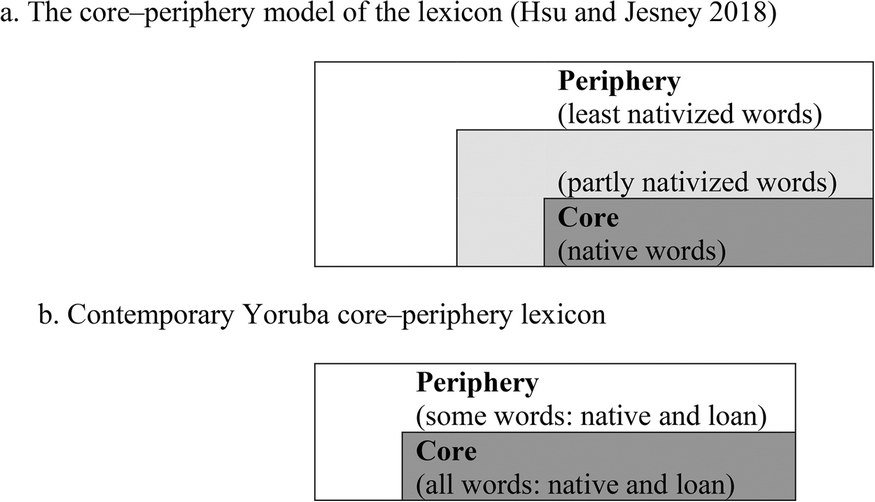
Third, a major distinction can be made between the Core of the Yoruba phonological lexicon and its Periphery. The Core is characterized by free variation. An input with a cluster and a coda comes out as four optimal forms: one in which the cluster and the coda are resolved (Grammar 1), another in which the coda is resolved but the cluster is retained (Grammar 2), another in which the cluster is resolved but the coda is retained (Grammar 3), and a final one in which both the cluster and the coda are retained (Grammar 4). The Periphery is characterized by hypercorrection of clusters (Grammars 5 and 6) and codas (Grammar 7) where such hypercorrection does not exist for the Core. The distinction between the Core and the Periphery can further be illustrated as in the following diagram:
The illustration in Figure 1 suggests that, unlike the Pre-Crowther Yoruba, where categorical choices are made against clusters and codas, the contemporary Yoruba phonological lexicon is one characterized by degrees of permissibility. This pattern, however, differs from the core–periphery structures reported so far for natural language. Hsu and Jesney (Reference Hsu and Jesney2018) report that there are three patterns found in the core–periphery model of the lexicon displayed in (10a).
(10)
Contemporary Yoruba Phonological Lexicon

A major characteristic of the core–periphery model of the lexicon is that phonological generalizations that hold in the core ‘vary in how far they extend into the less nativized periphery’ (Hsu and Jesney Reference Hsu and Jesney2018, after Holden Reference Holden1976). It is generally assumed for the core–periphery model in (10a) that native words occupy the core where markedness restrictions native to a language are strictly enforced. Non-native words, on the other hand, occupy the periphery, where the restrictions become weaker and weaker as one moves from one stratum to another. Hsu and Jesney (Reference Hsu and Jesney2018) have shown that, in addition to this ‘superset at periphery’ pattern, there are at least two other patterns found in natural language: one in which markedness restrictions that are enforced on loanwords are inactive for native words (‘subset at periphery’) and another one in which marked structures are resolved differently in the core and the periphery (‘divergent repair’). What we have in the Yoruba data captured by (10b), however, differs from the native-in-the-core/foreign-in-the periphery pattern of (10a) in that phonological generalizations that hold in the core hold of all words whether they are a native word like brẹ́gẹ́ẹ̀d ‘be elaborate’ (→ brẹ́gẹ́ẹ̀d, brẹ́gẹ́ẹ̀dì, búrẹ́gẹ́ẹ̀d, búrẹ́gẹ́ẹ̀dì) or a loanword like bread (→ brẹ́ẹ̀d, brẹ́di, búrẹ́ẹ̀d, búrẹ́dì), while phonological generalizations that hold in the periphery apply to some words whether they are native like gbẹ̀gìrì (→ gbegri ‘ a kind of soup’) or a loan word like supermarket (→ spamakẹẹt). This suggests that the pattern documented in Hsu and Jesney (Reference Hsu and Jesney2018) in (10a) is not the only way by which a core–periphery structure can be organized. In section 4, I provide an Optimality-theoretic account of the pattern in (10b), reviewing some current OT approaches to diachronic changes, lexical stratification, and synchronic variation. I show in section 4.5 that adopting a lexically indexed MaxEnt model enables us to properly identify the stratification depicted in (10b) as a special kind of the ‘superset at periphery’ pattern.
Fourth, I have suggested that the changes reported in this section are due to influences of English. But the question could be asked whether clusters and codas existed already in some ideophone stratum of Pre-Crowther Yoruba phonology. As far as I am aware, no work has documented clusters and codas for Yoruba ideophones. Though Ola Orie (p.c.) suggests that oral rendition of the Bata drum may have clusters like krákrá, there is evidence to suggest that presence of clusters and codas in Yoruba ideophones is an invention of Contemporary Yoruba: (1) some Pre-Crowther Yoruba ideophones now undergo cluster hypercorrection: fúkẹ́fúkẹ́ → fkẹ́fkẹ́ ‘rising spontaneously’, gbirigidi → gbrigidi ‘a manner of rolling on the floor’, sírísírí → srísrí ‘flowing in bits’; (2) ideophones with clusters and codas are recent neologisms: gbaas-gbòós ‘fracas’, flapàpà ‘fumble’. In sum, there is as yet no evidence, as far as I am aware, to suggest that clusters and codas existed in Pre-Crowther Yoruba or that a Pre-Crowther ideophone stratum is responsible for the variation that now characterizes Contemporary Yoruba syllable structure.
4. Optimality-theoretic (OT) analyses
Before we provide an OT account, we need to re-assess the set of constraints that we are working with. In section 2, we see that three major constraints are sufficient to capture the syllable structure of Pre-Crowther Yoruba phonology. We made use of NoCoda, *Complex, and of course Faith, which is an abbreviation for [Max and Dep]. Given the data presented in the previous section, it is necessary to update this constraint set if we are to provide a useful account of the Contemporary Yoruba phonology. NoCoda, *Complex, and Faith continue to be relevant, but there are additional constraints that are motivated by the data in section 3, which must be added to the set.
In Appendix B, it can be seen that the loanword ‘Sprite’ is adapted as spráìt, spráìtì, sípíráìt, and sípráìti. The forms sípráìti and sipráìt stand out in that they suggest that a constraint against a cluster of more than two consonants is active in the grammar. There are other examples like srọ́ọ̀ ‘straw’, sréèt ‘straight’, etc. for which this constraint seems to be active. This constraint is formalized as in (11a). Coda and cluster hypercorrections in examples (8–9) also suggest that we need markedness constraints that penalize candidates without clusters and those without word-final codas. As a heuristic, I formalize the constraint that penalizes candidates without clusters as in (11b) and follow McCarthy (Reference McCarthy2008) in assuming the existence of a constraint that penalizes candidates without word-final codas as shown in (11c).
-
(11)
a. *CCC: triconsonantal sequences are forbidden (see, e.g., Pater Reference Pater, Bateman, O'Keefe, Reilly and Werle2007).
b. CC-Sequence (CC-Seq): a word without at least a sequence of two consonants (tautosyllabic or hetero-syllabic) is forbidden.
c. *V#: ‘assign one violation mark for every word that ends in a vowel’ (McCarthy Reference McCarthy2008: 171)
I refer to the constraints in (11b–c) as hypercorrection markedness constraints to highlight the fact that they are direct opposites of *Complex and NoCoda, respectively. Constraints (11b–c) can be motivated on two independent grounds. First, this is not the first time that a constraint that directly opposes well-established constraints has been proposed, and there is typological evidence for both constraints. *V# is used by McCarthy (Reference McCarthy2008: 8–12) to explain data from Yawelmani. Itô and Mester (Reference Itô, Mester, Beckman, Dickey and Urbanczyk1995a) also propose two opposing constraints, Pal and Depal, to account for palatalization in the context of front vowels. Although they later offer an analysis in Itô and Mester (Reference Itô and Armin2003) that replaces Depal with Contrast, allowing directly opposing markedness constraint will depend on one's ultimate theory of CON. There is nothing intrinsic to OT against such constraints. Typological evidence can also be invoked in support of *V#. Blevins (Reference Blevins2006: 336) reports that in languages like Olgol/Oykangand, Dvaravati Old Mon and language branches like the modern Palaungic, Khmuic, and Aslian, all words end in a consonant. This suggests that the postulation of *V# is motivated on typological grounds. This means that even though it is common for languages (e.g., Pre-Crowther Yoruba) to forbid word-final codas, there are languages that prefer the opposite. Also, although it is uncommon for languages to forbid structures without clusters, there is documented evidence that some languages create clusters in output forms that are not present underlyingly, not to satisfy any particular well-formedness condition but due to social pressures. Specifically, Chappell (Reference Chappell2014: 33, 38) reports that Dominican Spanish speakers insert pre-cluster and pre-coda /s/ as a marker of prestige. This means that while it is almost impossible for a language to independently require the presence of consonant clusters in optimal forms, social pressure could lead to just this situation. CC-Seq can then be said to be motivated by the consequences of social pressure on linguistic forms.
Second, there are no well-established constraints that fill the role of *V# and CC-Seq in the analyses that follow. Since most of the hypercorrection cases outlined in section 3 involve deletion of high vowels, one may be tempted to propose a constraint like *HI against high vowels; but we have seen that both low and mid vowels also are deleted, in some words. Even if we posit *Low and *Mid, we cannot account for cases where hypercorrection arises as a result of consonant insertion (e.g., brèkọ́yọ̀n→ brèskọ́yọ̀n ‘bra’; wòó→ wóòs ‘look here’). A reviewer suggests that perhaps Max-V can account for cluster and coda hypercorrection, since hypercorrection involving vowel deletion is more frequent than those involving consonant insertion. Such an analysis, however, still does not account for hypercorrections involving consonant insertion. For this reason, I do not pursue this analysis. Instead, I argue that *V# and CC-Seq are sufficiently motivated. With the relevant set of constraints defined, I turn now to providing an OT account.
4.1 Diachronic changes in Yoruba as constraint re-ranking
One of the fundamental principles of OT is that Universal Grammar (UG) consists largely of well-formedness constraints out of which individual grammars are constructed (Prince and Smolensky Reference Prince and Smolensky2004 [1993]. This means that different rankings of the same universal constraints yield different grammars of different languages (McCarthy Reference McCarthy2008, etc.). For instance, English and Yoruba have the same constraints such as NoCoda, Faith, and *Complex. The difference between the two languages is simply in how these constraints are ranked. This principle successfully accounts for cross-linguistic variation among languages. However, one implication of this theoretical assumption is that different speakers of the same language may employ different rankings of the same constraints across social contexts and points in time. OT, therefore, should be able to account for both speaker variation and diachronic variation. This, in fact, is the position of such works as Jacobs (Reference Jacobs and Beckman1995 and Reference Jacobs, Parodi, Quicoli, Saltarelli and Zubizarreta1996), Gess (Reference Gess1996), Hutton (Reference Hutton1996), Holt (Reference Holt1997), Miglio and Moren (Reference Miglio, Moren and Eric Holt2003). Miglio and Moren (Reference Miglio, Moren and Eric Holt2003: 192), in particular, observe that “since grammars are conceived of as specific ranking of the same universal constraints, it follows that language change must be a re-ranking of those universal constraints.” Although language change is not a formulated part of original OT, its theoretical validity follows straightforwardly from its main assumptions.
To account for changes in the syllable structure of Yoruba phonology, I follow Miglio and Moren's (Reference Miglio, Moren and Eric Holt2003) framework for language change within OT. For them there are three stages of language change: the inert stage, the second stage, and the final stage. At the inert stage, the traditional or language-specific ranking of the universal constraints is maintained. At the second stage, at least one of the constraints has been re-ranked, while at the final stage, constraint re-ranking has been phonologized in the synchronic grammar of the next generation of speakers. The diagram in Figure 2, incorporating Miglio and Moren's (Reference Miglio, Moren and Eric Holt2003) three stages of change in OT, gives a visual description of the timeline of the changes taking place in Yoruba and in possible future trajectories.
Diachronic changes in Yoruba syllable phonology

Stage 1 corresponds to the Pre-Crowther Yoruba phonology as described in section 2. I argue that the period of time between Crowther Yoruba and Contemporary Yoruba corresponds to the second stage, where at least one of the active constraints in Yoruba syllabic phonology has been re-ranked, leading to variation in cluster and coda realization. The third stage of the change, where syncope and apocope of vowels (leading to coda and cluster hypercorrection) occur without lexical stratification, is not yet attested. For this reason, I focus on the second stage, by providing a synchronic account of the variation in line with current OT approaches to variation; a variationist study of this sociolinguistic situation can be found in Adebayo (Reference Adebayo2022).
Before proceeding to an OT account of the variation described in section 3, let us sum up. Stage 1, Pre-Crowther Yoruba, is an inert stage characterized by the following ranking argument: *Complex, NoCoda>> Faith. The relevant constraint set is {NoCoda, *Complex, Faith}. Following Miglio and Moren (Reference Miglio, Moren and Eric Holt2003), re-ranking these constraints should describe all the data outlined in section 2. However, no ranking argument containing only these three constraints suffices to account for the variation discussed in section 3. In addition to re-ranking, the set of active constraints whose effects manifest in a synchronic grammar has expanded. This, therefore, means that some diachronic changes may not result solely from constraint re-ranking, but also from the expansion of the set of active constraints. The idea is that a language has two sets of constraints at any given point: a) a set of active constraints which shape phonological outcomes and b) a set of inactive constraints whose effect cannot be seen in the language at a given point in time. Expanding the set of active constraints in a synchronic grammar entails re-ranking since formerly inactive constraints are re-ranked to be active, but re-ranking does not entail expansion, since the same set of active constraints can be re-ranked to yield new outputs. While *Complex, NoCoda>> Faith has been re-ranked, the set of active constraints has also been expanded as a result of the fact that three formerly inactive constraints, *CCC, CC-Seq, and *V#, have been re-ranked so that they are now a member of the set of active constraints.
There are four main OT approaches to synchronic variation and lexical stratification considered in this article. These are: the ranked-winners approach (Coetzee Reference Coetzee2004), the indexed constraint approach (Itô and Mester Reference Itô, Mester, Beckman, Dickey and Urbanczyk1995a, Reference Itô, Mester and Goldsmithb and Reference Itô, Mester and Tsujimura1999; Fukazawa Reference Fukazawa1998), the partial-order multiple grammars approach (Anttila Reference Anttila, Hinskens, van Hout and Leo Wetzels1997, Reference Anttila2002; Anttila and Cho Reference Anttila and Cho1998), and the MaxEnt model of Goldwater and Johnson (Reference Goldwater and Johnson2003). I review each of these four approaches against the Yoruba data in section 3 and show that none of them account for it without invoking further mechanisms. I demonstrate in section 4.5, however, that the most economical model, requiring minimal ad hoc stipulations, is the MaxEnt model.
4.2 Yoruba data and the ranked-winners approach
A major assertion of Coetzee's (Reference Coetzee2004) is that the same ranking argument can generate more than one optimal candidate. Most OT tableaux in the literature have only one winning candidate – even when two winners are allowed, they must have equal number of violations (McCarthy Reference McCarthy2008). However, we know from language variation and change research that there is often more than one way of saying the same thing, so that, for example, an OT account of in/ing in some varieties of English (e.g., Mendoza-Denton Reference Mendoza-Denton1997) must allow for the emergence of more than one optimal candidate. This follows straightforwardly if we pursue OT's assumptions to its logical conclusions. The assumption that the winning candidate emerges by incurring fewer violations on high-ranking constraints than losing ones have done implies that the candidates generated by GEN can be arranged on a hierarchy by EVAL so that the winning candidate is the most harmonic, while the candidate that incurs second-fewest violations is the second most harmonic, and so on. This is the conclusion reached in Coetzee (Reference Coetzee2004), who proposes that EVAL imposes ‘a harmonic rank-ordering’ on candidate sets so that some losers are better than others. In this model, there is room for more than one optimal candidate, which can be arranged on a scale such as the following: most optimal >> second most optimal >> and so on. The implication of this is that losers have the potential to become optimal in a synchronic grammar, but the grammar specifies the ‘critical cut-off point’ on the constraint hierarchy (Coetzee Reference Coetzee2004: 366), which determines the range of optimal candidates in a candidate set.
Coetzee's approach, however, runs into some serious problems with the Yoruba data by the simple fact that a single ranking argument cannot generate all the optimal outputs described in section 3. As we will see below, some form of constraint re-ranking is needed. Consider the following tableau (for purposes of illustration and simplicity, I omit *CCC from the discussion):
(12) One ranking argument, multiple winners Footnote 5

Let us start from this observation: with a given input like /brɜd/ (12.I), the optimal candidates can be arranged on a scale that depicts decreasing degrees of nativity (i.e., native ([bú.rẹ́.dì]) → less native ([brẹ́.dì])/ ([bú.rẹ́. ẹ̀d) → least native ([brẹ́.ẹ̀d])). Employing Coetzee's ranked-winners grammar entails that we must find a ranking argument that ensures precisely this harmonic rank-ordering. Insofar as we have something close to this harmonic rank-ordering, the ranking argument in (12) is motivated, to some heuristic extent.
According to Coetzee (Reference Coetzee2004: 23), language users do not access a candidate that is disfavored by a constraint above the critical cut-off point, if there is a candidate that is not disfavored by such a constraint. In the tableau in (12.I), the critical cut-off point (indicated by the double vertical lines) is drawn in the Max column, indicating that candidates [bẹ́d] and [bẹ́.dì] (violating Max) are not accessed by the language user. As expected, the grammar generates four optimal outputs (a, b, c, and d) in (12.I). As it stands, [bú.rẹ́.dì] is the optimal candidate while [brẹ́.dì] is the second best candidate. [bú.rẹ́.ẹ̀d] is the third best candidate, while [brẹ́.ẹ̀d] is the fourth best candidate. This harmonic rank-ordering contrast with the expected rank ordering ([bú.rẹ́.dì] (optimal) → [brẹ́.dì]/ ([bú.rẹ́.d] (second best) → [brẹ́.ẹ̀d] (third best)). This problem is trivial, given that we can ensure the correct rank-ordering by assuming that there is no ranking between *Complex and NoCoda. The cluster hypercorrection example in (12.II) reveals a different kind of problem. Even though the grammar produces the correct rank-ordering ([ju.bi.lé.é.tì] → [ju.bi.lé.èt]→ [ju.blé.é.tì] → [ju.blé.èt]), not all the winning candidates are correctly predicted to be optimal.
The coda-hypercorrection example in (12III) too has the correct harmonic rank-ordering ([bẹ́.ẹ̀.ni]→ [bẹ́.ẹ̀n]). The problem with this example is that the coda-hypercorrection optimal candidate ([bẹ́.ẹ̀n]) is predicted to be impossible since it violates Max, a constraint above the critical cut-off point. Apart from all the various problems identified so far, the ranked-winners approach also does not provide us with a straightforward way to capture the core–periphery organization inherent to the Contemporary Yoruba phonological lexicon depicted in (10b).
4.3 Yoruba data and the indexed constraint approach
Let us consider next the indexed constraint approach to synchronic variation/phonological stratification (Itô and Mester Reference Itô, Mester, Beckman, Dickey and Urbanczyk1995a, Reference Itô, Mester and Goldsmithb, Reference Itô, Mester and Tsujimura1999; Fukazawa Reference Fukazawa1998; Pater Reference Pater2000). According to Pater (Reference Pater2004), there are different versions of this approach: those in which lexical items are indexed with specific ranking of two or more constraints (McCarthy and Prince Reference McCarthy and Prince1993, Nouveau Reference Nouveau1994, Pater Reference Pater1994, etc.), and those in which constraints are indexed to some particular lexical stratum or morphological category (Itô and Mester Reference Itô, Mester, Beckman, Dickey and Urbanczyk1995a, Reference Itô, Mester and Goldsmithb, Reference Itô, Mester and Tsujimura1999; Fukazawa Reference Fukazawa1998; Pater Reference Pater2000). These two approaches are further divided into different variants, but I focus only on the latter approach, specifically that advanced in Itô and Mester (Reference Itô, Mester, Beckman, Dickey and Urbanczyk1995a, Reference Itô, Mester and Goldsmithb, Reference Itô, Mester and Tsujimura1999).
Itô and Mester (Reference Itô, Mester, Beckman, Dickey and Urbanczyk1995a, Reference Itô, Mester and Goldsmithb, Reference Itô, Mester and Tsujimura1999) observe that the phonological lexicon of Japanese is stratified along the lines of lexical origin so that different phonological processes characterize different groups of words. They posit four strata for Japanese: Yamato, Sino-Japanese, Assimilated Foreign and Unassimilated Foreign. This stratification is organized in terms of a core–periphery structure in the following fashion: Yamato→ Sino-Japanese→ Assimilated Foreign→ Unassimilated Foreign. Movement from Yamato to Unassimilated Foreign correlates with movement from the core to the periphery, similar to what I have described in section 4.2 as ‘decreasing degrees of nativity’. In order to retain the ‘crucial ranking’ assumption of classical OT, Itô and Mester (Reference Itô, Mester and Tsujimura1999) propose that Japanese can be accounted for with a fixed ranking of markedness constraints, with the re-ranking of only faithfulness constraints at different lexical strata. As we move from the core to the periphery, more and more markedness constraints are violated by optimal candidates in peripheral strata. Let us illustrate this with the Yoruba data in the following tableau.Footnote 6 Shaded columns indicate that a given re-ranking of Faith is inactive. In this illustration, Stratum 1 corresponds to Grammar 1, Stratum 2 to Grammar 2, etc.
(13) Indexed constraint tableau
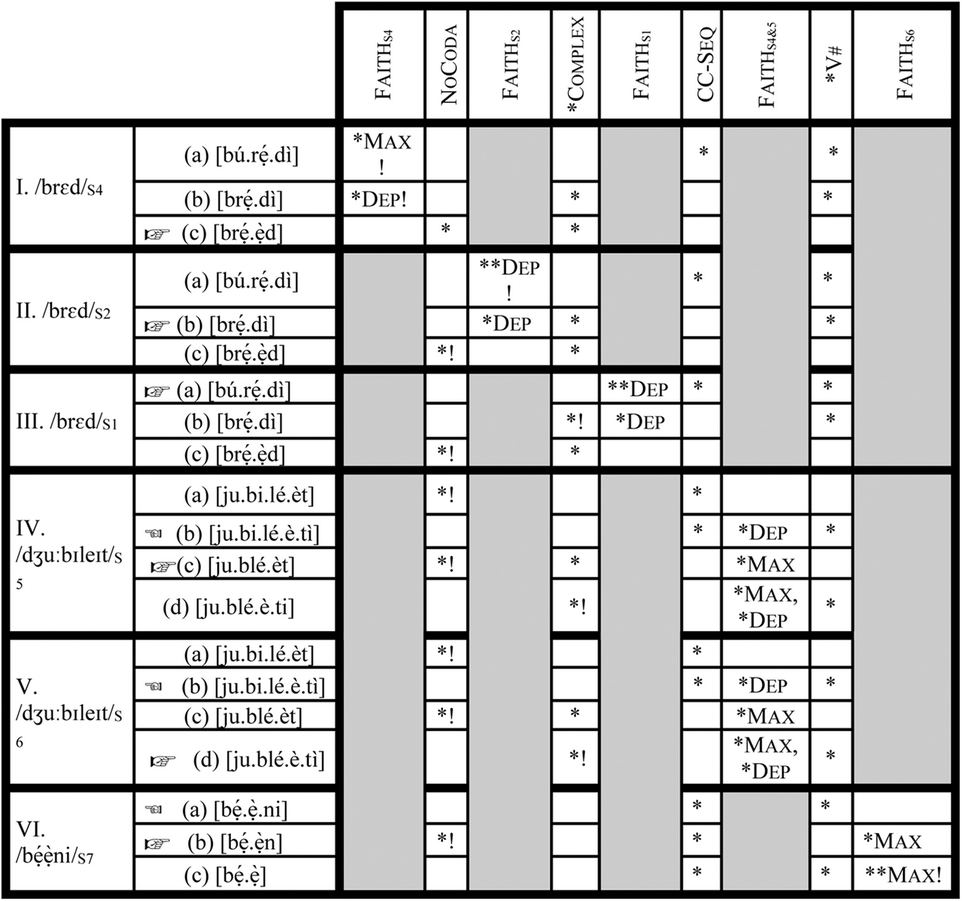
I first assume, based on the lexical organization in Figure 1, that contemporary Yoruba phonology is characterized by the crucial ranking of markedness constraints in (14a). I then further assume that Faith is re-ranked at each stratum as in (14b).
(14)
a. NoCoda>>*Complex>>CC-Seq>>*V#
b. FaithS4>> NoCoda>> FaithS2>> *Complex>>FaithS1>> CC-Seq>> FaithS5/6>> *V#>> FaithS7
Each re-ranking of Faith corresponds to a stratum. The stratification is thus Faith-based (Inkelas and Zoll Reference Inkelas and Cherryl2007:135). This approach works perfectly for the Core of Yoruba phonological lexicon (if Stratum 3 is not included). Indeed, as we move from Stratum 1 to Stratum 4 in (13), more and more markedness constraints are violated by optimal candidates in the strata. In (13.III), exemplifying Grammar 1, the coda-resolving, cluster-resolving candidate ([bú.rẹ́.dì]), which obeys both of the markedness constraints (NoCoda and *Complex) ranked above FaithS1, wins against both the coda-retaining and cluster-preserving candidate ([brẹ́.ẹ̀d]) and the coda-resolving, cluster-preserving candidate ([brẹ́.dì]) which violate either of the two constraints. As we move from Stratum 1 to Stratum 2 (13.II), we encounter a grammar in which the optimal candidate [brẹ́.dì] violates one of the markedness constraints (*Complex) which the optimal candidate in Stratum 1 must not violate. In Stratum 4, we find a grammar in which the optimal candidate [brẹ́.ẹ̀d] violates both NoCoda and *Complex. The Core of Yoruba phonology (minus Stratum 3), based on this characterization, is thus a perfect example of what Itô and Mester (Reference Itô, Mester and Tsujimura1999: 62) describe as nesting of constraint domains.
The trouble with this approach, however, begins when we incorporate Stratum 3 in the analysis. As the Faith-based re-ranking in (14b) stands, there is no way to generate Stratum 3 optimal forms without re-ranking *Complex so that it outranks NoCoda. Since re-ranking of markedness constraint is not allowed in this approach, we have no way to account for Stratum 3. We encounter further problems as we move to the Periphery of the Yoruba lexicon. First, the re-ranking of Faith is problematic. There is no way to rank it with respect to the four markedness constraints such that it yields all seven strata. The problem is that Grammars 5 and 6 are distinguished only with respect to whether or not coda is resolved in a cluster-hypercorrection form. Since NoCoda is already present, choosing between these categorical choices, no new markedness constraint can be introduced such that it is active in either Stratum 5 or 6, and Faith is re-ranked with respect to it. It also does not matter whether we include *CCC or not. This approach, therefore, forces us to incorrectly conflate FaithS5 and FaithS6 into FaithS5/6 in (13). This conflation may not be damaging to the theory, if it were to correctly predict the optimal candidates in Grammars 5–7 as it does for Grammars 1–4 (excluding Grammar 3). This is not the case, however, as we see in (13.IV–VI). In each of Grammars 5–7 (13.IV–VI respectively), wrong candidates are predicted as winners, while optimal candidates are predicted to be losers. In (13.IV), exemplifying Grammar 5, the coda-resolving non-cluster-hypercorrection candidate [jubiléètì] incorrectly wins against the optimal coda-preserving cluster-hypercorrection candidate [jubléèt]. This scenario is exactly what we find in in (13.V), where the same coda-resolving non-cluster-hypercorrection candidate [jubiléètì] wins against the optimal coda-resolving cluster-hypercorrection candidate [jubléètì]. The same thing happens in (13.VI), where Candidate (a) incorrectly wins, and the optimal Candidate (b) loses.
That the Faith-based indexed constraint approach runs into this conceptual problem with the Yoruba data is not surprising; we have already seen that any approach that does not allow re-ranking of markedness constraints is bound to encounter problems with the Yoruba data. The main difference between the Core of Yoruba lexical phonology and its Periphery is markedness reversal. The Core requires *Complex and NoCoda to be more active than the hypercorrection constraints CC-Seq and *V# at some point, while the Periphery requires the opposite. This fact of markedness reversal in the Yoruba data is thus a major problem for the Faith-based indexed constraint approach of Itô and Mester (Reference Itô, Mester, Beckman, Dickey and Urbanczyk1995a, Reference Itô, Mester and Goldsmithb, Reference Itô, Mester and Tsujimura1999). This problem of markedness reversal was in fact already identified by Inkelas and Zoll (Reference Inkelas and Cherryl2007:157–159). Despite these problems, Itô and Mester's (Reference Itô, Mester, Beckman, Dickey and Urbanczyk1995a, Reference Itô, Mester and Goldsmithb, Reference Itô, Mester and Tsujimura1999) Faith-based indexed-constraint approach offers useful insights on stratificational patterns found in the phonological lexica of natural languages. The idea that the lexicon of some languages is organized in a core–periphery structure allows us to construct an adequate theoretical explanation for the Yoruba data in section 4.5.
It should be clear by now that to account for the Yoruba data, we need an approach that allows some form of markedness constraint re-ranking which is constrained enough not to over-predict. As we have seen, the re-ranking of markedness constraints is important to capture the markedness reversal described above. In what follows, I show how the partial-order co-phonology model (Anttila Reference Anttila, Hinskens, van Hout and Leo Wetzels1997, Reference Anttila2002 and Anttila and Cho Reference Anttila and Cho1998) allows us to account for the markedness reversal found in the Yoruba data, although it ultimately runs into a major problem of its own.
4.4 Yoruba data and the partial-order co-phonology
The partial-order co-phonology is a restrictive version of the general co-phonology/multiple grammars approach advanced in Kroch (Reference Kroch1989), Kiparsky (Reference Kiparsky1993), Orgun (Reference Orgun1996), and Inkelas (Reference Inkelas, Booij and Marle1998). The general co-phonology approach assumes that a grammar is comprised of other sub-grammars/co-phonologies which are different as a result of different crucial rankings of the same optimality-theoretic constraints. Since these rankings are arbitrary (Anttila and Cho, Reference Anttila and Cho1998: 40), the general multiple grammars approach has the potential to generate unattested sub-grammars for a given language. The partial-order model of the multiple grammars approach proposes to solve this problem by assuming that constraints are partially ranked with respect to one another. In standard Optimality Theory, grammars are assumed to have the properties of irreflexivity (i.e., a constraint x cannot be ranked above or below itself), asymmetry (i.e., a constraint x which is ranked above another constraint y cannot be ranked below y), transitivity (i.e., if a constraint x ranks above another constraint y, and y ranks above z, then the grammar also requires a ranking of x above z) and connectedness (i.e., every constraint is crucially ranked with respect to every other constraint). The partial-order model assumes that the grammar of a language is characterized by all of these properties except the property of connectedness (Anttila and Cho Reference Anttila and Cho1998: 36, Anttila Reference Anttila2002: 20). The main grammar (master constraint ranking) of an individual is thus partially determined so that the remaining rankings among all the active constraints are determined by the co-phonologies/sub-grammars. For convenience, let us follow Anttila (Reference Anttila and de Lacy2007) and refer to the main grammar of an individual as grammar and the co-phonologies/ subgrammars as ‘grammars’. The grammar of an individual is not a random collection of grammars but a proper superset of all the grammars. The grammars are sets of ordered constraint pairs grouped into natural classes based on their shared rankings (Anttila Reference Anttila, Hanson and Inkelas2009). Grammars are thus connected to one another just as they are connected to a grammar. This assumption enables the partial-order model to be able to capture the core–periphery structure that is one of the major hallmarks of the indexed-constraint approach described above. This relationship between a grammar and its grammars can be represented in a grammar lattice where higher nodes represent variant grammars and lowest nodes represent invariant grammars.
The Yoruba data in section 3 is better analyzed in the partial-order model than in the previous approaches discussed, but as we will see below, it runs into a major problem in that it requires too many ad hoc stipulations. First, I assume that the partial ranking that characterizes the Yoruba grammar is *CCC>> *Complex. As we will see in the next section, CCC and CCCC clusters are consistently reduced to CC in appropriate contexts, suggesting that this ranking is motivated. Besides, ranking *Complex (a more general constraint) above *CCC (its more specific counterpart) will constitute an anti-Paninian ranking for which we have no evidence in the Yoruba data. Assuming that this partial ranking defines the Contemporary Yoruba phonology, the grammar lattice in example (30) of Appendix C is assumed to represent the Yoruba grammar and its different grammars identified in section 3.
This grammar lattice presents a Yoruba grammar which contains different grammars that are all connected back to one main grammar in a core–periphery fashion. The lattice thus demonstrates that the dataset that we have seen in the previous section is not a collection of random facts about the Contemporary Yoruba phonology but, as Itô and Mester (Reference Itô, Mester and Tsujimura1999: 69) observe, the result of a simple generalization that holds of any given stratified lexicon. One thing to note in each of the lowest leaves in the lattice is that they are not in themselves total rankings of all the six constraints that we are working with, such that every constraint is crucially ranked with respect to every other constraint, but rather partial rankings where the ranking between some constraints is not fixed. This means that the partial ranking in each of the lowest leaves is not just one tableau but a collection of several tableaux where the winner in each stratum will always emerge no matter how the remaining partial rankings are fixed. The major advantage of having several tableaux producing the winner in each stratum is that it introduces a quantitative paradigm into the system, which can be exploited to calculate the frequency of variants in the strata. Anttila and Cho (Reference Anttila and Cho1998: 39) formalize this quantitative dimension as follows:
(15) Quantitative interpretation of partially ordered grammar (Anttila and Cho Reference Anttila and Cho1998: 39)
a. A candidate is predicted by the grammar iff it wins in some tableau.
b. If a candidate wins in n tableaux and t is the total number of tableaux, then the candidate's probability of occurrence is n/t.
This quantitative interpretation is often checked against usage data (actual frequency) acquired by sociolinguists, and it has proven successful so far (see Anttila Reference Anttila, Hinskens, van Hout and Leo Wetzels1997, Reference Anttila2002; Anttila and Cho Reference Anttila and Cho1998; and Zamma Reference Zamma2005).Footnote 7
Let us now look at the grammars and how the lexical items in Yoruba relate to them. Abstracting away from the lexical indexation employed in Itô and Mester (Reference Itô, Mester and Tsujimura1999), I assume that every lexical item in the phonological lexicon of Contemporary Yoruba is indexed with a grammar in which a variant of it is optimal. Consider jubilate and parade to illustrate why lexical indexation is important. Jubilate comes out as jubiléètì (Grammars 1 and 2), jubiléèt (Grammar 3, 4 and 7), jubléètì (Grammar 6), and jubléèt (Grammar 5), whereas parade comes out as pàréèdì (Grammars 1 and 2) and pàréèd (Grammars 3, 4 and 7). Why are *préèdì and *préèd excluded as optimal variant of parade? We have the answer if we assume that the lexical entry for jubilate contains an indexation for Grammars 1–7, but that the entry for parade contains an indexation for only Grammars 1–4 and 7. Similarly, while a transformation such as oṣòdì (‘an area in Lagos) → oṣòòd is legitimate to create a coda hypercorrection form oṣòòd, a process such as àwòdi (‘hawk’) → *àwòòd is illegitimate. As such, *àwòòd is ungrammatical. Also, a transformation such as sùgbọ́n (‘but’) → sgbọ́n is legitimate to create a cluster hypercorrection form sgbọ́n, while a transformation such as àṣìgbọ́ (‘mishearing’)→ *àsgbọ́ is illegitimate, making *àsgbọ́ to be ungrammatical. Given that oṣòdì and àwòdì, on the one hand, and sùgbọ́n and àṣìgbọ́, on the other hand, have similar phonological contexts favorable to coda hypercorrection and cluster hypercorrection respectively, one would expect that both these forms should undergo hypercorrection, but that is not the case. This expectation would have been borne out if hypercorrection were a general phonological rule applying across all relevant lexical items in the Contemporary Yoruba lexicon. We have a straightforward account if we assume that forms like àwòdi and àṣìgbọ́ are not (or probably not yet) indexed for Grammars 5–7. We then make the following observation: every lexical item in Yoruba (foreign or native) is indexed for Grammars 1–4, meaning that a variant of them will always win in each of Grammars 1–4, even if the variant is a single optimal form. Indexation for Grammars 1–4, therefore, is redundant, while active indexation takes place at the periphery. This observation becomes clearer in the light of the informal definitions below:
(16) Informal definitions of the seven grammars
a. Grammar 1 (cluster-/coda-resolving grammar): if you are an input with a consonant cluster and/or a coda, your consonant cluster and coda are resolved. Otherwise, you come out as you enter the grammar.
b. Grammar 2 (cluster-preserving, coda-resolving grammar): if you are an input with a consonant cluster and/or a coda, your consonant cluster is preserved while your coda is resolved. Otherwise, you come out as you enter the grammar.
c. Grammar 3 (cluster-resolving, coda-preserving grammar): if you are an input with a consonant cluster and/or a coda, your consonant cluster is resolved while your coda is preserved. Otherwise, you come out as you enter the grammar.
d. Grammar 4 (cluster-/coda-preserving grammar): if you are an input with a consonant cluster and/or a coda, your consonant cluster and your coda are preserved. Otherwise, you come out as you enter the grammar.
e. Grammar 5 (coda-preserving cluster hypercorrection grammar): if you are an input with a coda but without a consonant cluster, your coda is preserved but you come out with a cluster. If you already contain a cluster, your cluster is preserved.
f. Grammar 6 (coda-resolving cluster hypercorrection grammar): if you are an input with a coda but without a consonant cluster, your coda is resolved, and you come out with a cluster. If you already contain a cluster, your cluster is preserved.
g. Grammar 7 (coda hypercorrection grammar): if you are an input with or without a word-final coda, you come out with a word-final coda.
Assuming that these informal definitions are accurate, we can now make the following claims:
(17)
a. All lexical items in Yoruba (foreign or native) are indexed for Grammars 1–4, while some lexical items are also indexed for Grammars 5 and 6 or Grammar 7.
b. All lexical items indexed for either Grammars 5 and 6 or Grammar 7 are also indexed for Grammars 1–4 but not all lexical items indexed for Grammars 1–4 are also indexed for either Grammars 5 and 6 or for Grammar 7.
With the observations in (16) and (17) in place, we are now ready to examine how winners emerge in each of the strata. The tableau that follows (and those in Appendix D) are not just one single tableau but a conflation of several tableaux where a given winner always emerges. To be able to represent all of them at once, I have deployed the conventions in (18).
(18) Conflation tableau conventions
a. If a constraint X in a constraint set with the ranking [V>>W>>X>>Y>>Z] is annotated as ‘X…’ as in [V>>W>>X…>>Y>>Z], this means that X is unranked with respect to constraints Y and Z even though V outranks every constraint in the set; W outranks X, Y, and Z; and Y outranks Z.
b. If a constraint X in a constraint set with the ranking [V>>W>>X>>Y>>Z] is annotated as ‘…X’ as in [V>>W>>…X>>Y>>Z], this means that X is unranked with respect to constraints V and W even though V outranks W, Y, and Z; W outranks Y and Z; X outranks Y and Z; and Y outranks Z.
c. If a constraint X in a constraint set with the ranking [V>>W>>X>>Y>>Z] is annotated as ‘X (…V)’ as in [V>>W>>X (…V) >>Y>>Z], this means that even though all the rankings hold, X is unranked with respect to V.
d. As usual, vertical broken lines and a comma between two constraints indicate that the constraints are unranked with respect to each other.
The convention in (18a) states that in a ranking where A>>…B>>C, both A>>B>>C and B>> A>>C are true, while the convention in (18b) says that in a ranking where A>>B…>>C, both A>>B>>C and A>>C>>B are true.
Based on the informal definitions in (16), Grammar 1 is a grammar that resolves both clusters and codas. As we see in (19.I), if an input contains a cluster or/and a coda, the cluster and the coda are resolved, and this is how Candidate (19.I.a) emerges as the winner. If, as we see in (19.II), the input does not contain a cluster or a coda, the most faithful candidate (19.II.a) emerges as the winner.
(19) Grammar 1: NoCoda>> *V#…>> *CCC>> *Complex>> Faith, CC-Seq
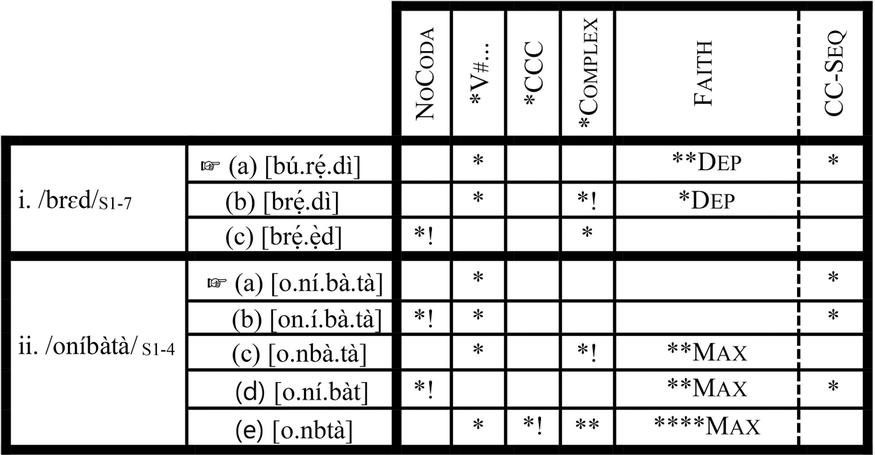
Given space constraints, I have limited the discussion of how winners emerge in our partial-order analysis to Grammar 1, but the tableaux for the remaining six grammars can be found in Appendix D. I turn now to summarizing the facts about Yoruba grammar with the examples in the following lexical stratification table (Table 1).
Yoruba lexical stratification

Some progress in capturing the Yoruba data within OT has been made by using a partial-order co-phonology, but this stands only because we have borrowed indexation from the indexed constraint approach. Despite this progress, the lexically-indexed partial-order analysis presented above cannot handle all the variation that currently characterizes Contemporary Yoruba phonology. Specifically, we are still unable to capture the variation in (20):
(20) Gradient cluster variation
-
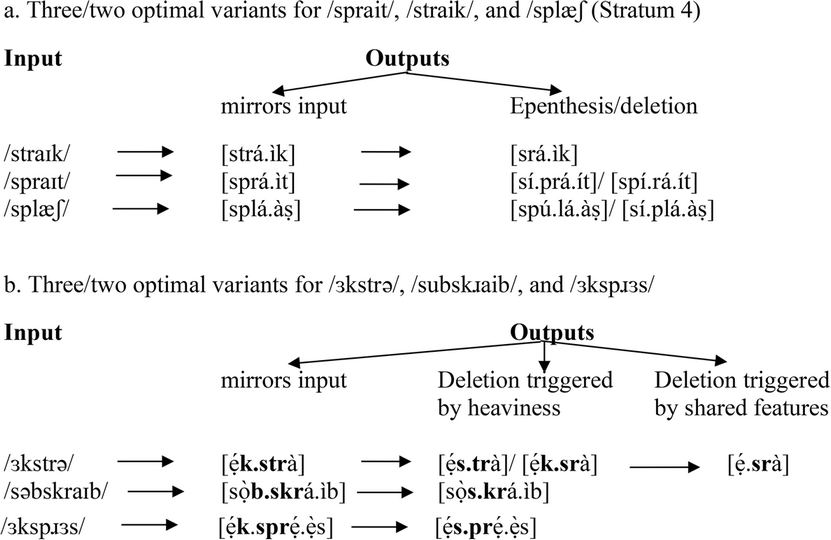
The variation exemplified in (20a,b) relates to how many of the consonants in a cluster in an input is present in the output. The variation exemplified in (20a) is not the full range of possible variants for each of the examples. For instance, the full range for /straik/ is: /straik/→ [strá.ìk] ~ [srá.ìk] ~ [strá.ìkì] ~ [srá.ìkì]. I have included pairs that differ only with respect to the number of consonants in a cluster, to highlight the point of discussion here. We do not have a way to capture this dimension in the stratification presented so far.
To account for this gradience, I argue that we need a model of variation that can handle all the data presented so far with minimal ad hoc stipulations. But before we consider other models of variation, let us consider some alternatives. We could say that perhaps we have four additional strata in our partial-order model: one which allows CCC clusters and resolves codas, one which allows CCC clusters but preserves codas, one which allows CCCC clusters and resolves codas, and one which allows CCCC clusters but preserves codas. The problem is that it not only unnecessarily and uneconomically duplicates Grammars 2 and 4, but also misses the question of why we have the grammars in the first place. The main distinction between the grammars is whether a cluster and/or a coda is resolved or hypercorrected, and not to what extent a cluster and/or a coda is resolved or hypercorrected, which is what our hypothetical grammars suggest should be the main distinction. This hypothetical path also misses the generalization that, for instance, the difference between examples like sípráìt and spráìt or sípráìtì and spráìtì (Sprite), is strictly a matter of harmonic gradience rather than a categorical one. Instead, we could incorporate Coetzee's (Reference Coetzee2004) ranked-winners approach so that, for example, it could be suggested that cluster-preserving grammars (mainly Grammars 2 and 4) give room for two candidates to become winners, but only along a single dimension (i.e., the dimension of consonant sequence). This line of investigation is however found to be too ad hoc. In the next section, I consider learning-theoretic models of variation and argue that despite the fact that these models alone cannot account for all the patterns of variation described above for Yoruba, they do not lead to as many ad hoc stipulations. Therefore, of all the models assessed, learning-theoretic OT models prove to be superior to non-probabilistic categorical grammars such as those discussed in sections 4.2, 4.3, and 4.4.
4.5 The Yoruba data and learning-theoretic models (GLA and Maximum Entropy)
Optimality Theory (Prince and Smolensky Reference Prince and Smolensky2004 [1993]) started out as a non-probabilistic model of language producing categorical grammars. Most of the OT models proposed for handling free variation such as the indexation, co-phonology, and ranked-winners approaches have equally been mainly non-probabilistic in nature. However, a line of research that seeks to address the question of learnability within OT has given rise to learning algorithms that aim to model how grammar is acquired, given a set of well-defined constraints and input data. The first such algorithmic model (Constraint Demotion) was proposed in Tesar and Smolensky (Reference Tesar and Smolensky2000), but other ranking algorithms have been proposed in Broihier (Reference Broihier1995), Pulleyblank and Turkel (Reference Pulleyblank, Turkel, Barbosa, Fox, Hagstrom, McGinnis and Pesetsky1998), among others. However, stochastic OT models such as the Gradual Learning Algorithm (GLA, Boersma (Reference Boersma1997)) and Maximum Entropy (MaxEnt, in Goldwater and Johnson Reference Goldwater and Johnson2003) are a departure from other models in that they are able to handle data with free variation and noisy inputs (Goldwater and Johnson Reference Goldwater and Johnson2003). In this section, I show how a stochastic OT model fits the Yoruba data with fewer ad hoc stipulations, compared to the (non-probabilistic) categorical models discussed in the previous subsections.
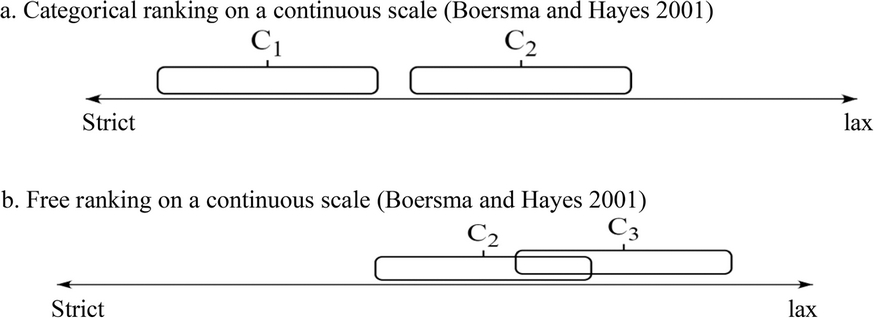
The GLA, first of all, assumes that constraints are arranged on a linear scale (Boersma and Hayes 2001), as graphically represented in (21). A higher value indicates the higher ranking of a constraint, while a lower value shows that a constraint is ranked low.
(21) Constraint ranking on a continuous scale (Boersma and Hayes 2001)

In (21), Constraint C1 crucially dominates C2. This is so because the ranking values for the Constraints C1, C2, and C3 are assumed to be single points on the scale. The GLA proposes instead that the ranking values should be understood as ranges, so that the selection point (within the range) for a given constraint is fixed at evaluation time. When the ranges of two given constraints do not overlap, as in (22a), categorical grammars are produced without any variation. The pattern in (22a), then, is that assumed in Standard OT. On the other hand, free variation results when the ranges overlap, as in (22b). If, for example, the selection value for C2 is at the leftmost edge of its range and that of C3 is at the rightmost edge of its range, this will result in the ranking C2>> C3, and a candidate that does best on this ranking will become the winner. A converse of this, where the selection value for C3 is at the leftmost edge of its range and that of C2 is at the rightmost edge of its range, will result in the ranking C3>> C2, and produce a candidate that performs best (given this ranking) as a winner.
(22)
The MaxEnt model introduced in Goldwater and Johnson (Reference Goldwater and Johnson2003) operates on these same fundamental assumptions. In other words, the algorithms of the GLA and the MaxEnt model are based on these assumptions (see Boersma and Hayes 2001 for more details on the GLA, and Goldwater and Johnson (Reference Goldwater and Johnson2003) for the MaxEnt model).Footnote 8
While both models operate on the fundamental assumptions outlined above, they differ in three respects. First, the MaxEnt model is able to account for cumulative constraint violation while the GLA cannot (Goldwater and Johnson Reference Goldwater and Johnson2003). Second, the MaxEnt model, whose application goes well beyond phonology, appears to be more mathematically motivated than the GLA, which is a ‘somewhat ad hoc model’ developed specifically for learning linguistic constraints (Goldwater and Johnson Reference Goldwater and Johnson2003). These two differences seem to suggest that the MaxEnt model is superior to the GLA. However, the third difference is an area where the GLA performs better: the GLA learns on-line while the MaxEnt model learns off-line (Jager Reference Jager, Grimshaw, Maling, Manning, Simpson and Zaenen2007). Because human language works on-line, the GLA provides a model of language acquisition that is closer to how language is actually acquired than the MaxEnt model does (Jager Reference Jager, Grimshaw, Maling, Manning, Simpson and Zaenen2007). In the following analysis, I adopt the MaxEnt model available in the MaxEnt Grammar Tool, noting however that this could equally be done with the GLA model in OT Soft, since ‘there is no empirical evidence to favour the one model above the other’ (Jager Reference Jager, Grimshaw, Maling, Manning, Simpson and Zaenen2007).
Before beginning the MaxEnt analysis proper, we must update the set of constraints we used in order to accommodate the new pattern of variation illustrated in (20), generalizable in the following way: CCCC clusters are considered to be too heavy in Contemporary Yoruba. For this reason, they are reduced to CCC by deleting the first C in the sequence. This deletion seems to be constrained by the fact that the first C in CCCC sequences is less sonorous than the following C. This idea that the less-sonorous C deletes in a given CC sequence is further reinforced by the reduction of [strá.ìk] to [srá.ìk], where the deleted /t/ is the less sonorous in the sequences /st/ and /tr/. Deletion triggered by shared features is well-documented in the literature. Guy and Boberg (Reference Guy and Boberg1997: 154), for instance, have observed that deletion is more likely to apply to sequences of segments that have some distinctive features in common. The generalization that in a sequence of two consonants it is the less sonorous consonant that deletes contrasts with the findings in Zec (Reference Zec and de Lacy2007: 194) and Gnanadesikan (Reference Gnanadesikan, Kager, Pater and Zonneveld2004) where it is shown that it is the more sonorous segment in a CC sequence that deletes. Deletion of a less sonorous segment has also been found, however, as in Alber and Plag (Reference Alber and Plag2001: 828) in Sranan. The fact that both of these patterns are found in Daasanach (Nishiguchi Reference Nishiguchi2004) suggests that both of these patterns may be attested even in a single language.
Reduction of CCCC to CCC takes place only through deletion. However, reduction of CCC to CC takes place through both deletion and epenthesis. The question then is: What determines if a CCC cluster will be reduced to CC by epenthesis or by deletion? What can be drawn from the data in (20) is that deletion takes place in CCC clusters only if two adjacent consonants share the same place of articulation. Otherwise, epenthesis takes place. Now consider the following constraints; I assume the sonority hierarchy in (23e).
(23)
a. Max-C/Contrast=Place (Max-C/C=P): Deletion of a consonant that does not agree in place of articulation with an adjacent segment is forbidden (See Côté Reference Côté2000: 170).
b. Max-C>SON[CC]: for a sequence of two consonants CC present in the input, the most sonorous C is also present in the output.
c. Dep[CCCC]D: Phonological epenthesis is forbidden in the domain of a CCCC cluster.
d. Dep[CC/Share= Place]D (Dep[CC/Share=P]): Phonological epenthesis is forbidden in the domain of CC sequences where the two consonants share the same place of articulation.
e. Sonority Hierarchy: Obstruents (Stops < Fricatives) < Nasals < Liquids (l < r) < Glides < Vowels (highV < lowV) (Cho and King Reference Cho, King, Féry and de Vijver2003).
All of these constraints are motivated by the descriptions above. (23a) prevents deletion of a segment that does not share any feature with an adjacent segment. (23b) ensures that if deletion must occur, then it must be the less sonorous C that deletes. (23c) is motivated by the generalization discussed above that CCCC clusters are reduced to CCC only through deletion while epenthesis is forbidden. This means that epenthesis is forbidden in the supper-heavy (CCCC) cluster domain, even though it is allowed in CCC cluster domain. (23d) also is motivated by the generalization that CCC clusters, where two of the consonants share the same place of articulation, reduce to CC via deletion, while epenthesis is forbidden. Let us first consider the question of why some CCCC sequences reduce to CCC and then to CC, but some others reduce only to CCC as seen in (20).
(24) CCCC cluster reduction

The tableau in (24) shows that Max-C>SON[CC] is highly ranked, meaning a single violation is fatal. All the winning candidates in (24.I) and (24.II) obey it. Max-C/C=P, on the other hand, is more flexible in that winners can violate it once. If we were to incorporate Coetzee's (Reference Coetzee2004) ranked-winners approach in a partial-order grammar, as mentioned in section 4.4, we would suggest that the critical cut-off point for Max-C/C=P is specified to be below the best two evaluations, where no-violation is the best evaluation, and a single violation is second best. If the grammar were so designed, then only candidates that do not violate Max-C>SON[CC] and earn at most a single violation on Max-C/C=P could be optimal. But the problem lies in defining and constraining the placement of critical cut-off points below the standard ‘best’ evaluation. Besides, incorporating this ranked-winners mechanism in a partial-order grammar already enhanced with the addition of lexical indexation leads to too many ad hoc stipulations, unnecessary in the face of more economical models. Consider in the following tableau why epenthesis does not apply in CCCC sequences and how the repair of CCC clusters is effected by either epenthesis or by deletion.
(25) CCCC and CCC reduction: deletion, and epenthesis

The fact that candidates such as (25.I.g) in this grammar are not optimal, due to violating Dep[CCCC]D, captures the generalization that epenthesis is disfavored in CCCC cluster domains. In CCC cluster reduction, two conditions need to be met for deletion to take place: the deleting consonant must share the same place of articulation with adjacent segments (captured by Max-C/C=P), and the C to be deleted must be the one that is the least sonorous in a CC sequence. Candidates like (25.IV.b), which obey these two constraints, successfully reduce a CCC cluster to a CC cluster via deletion. Candidates like (25.II.d and 25.III.d) are not grammatical due to fatal violations on Max-C/C=P. Since deletion fails in these two competitions, epenthesis takes place, making Candidates (25.II.b, 25.II.c, and 25.III.b and 25.III.c) optimal. The epenthetic Candidates (25.IV.c and 25.IV.d) violate Dep[CC/SHARE=P]. I have gone into these details to illustrate how the constraints used in the MaxEnt analysis that follows work independently of a learning algorithm. With this updated set of constraints, let us now proceed to a MaxEnt analysis. For this analysis, I prepared an input file with 28 input forms. Table 2 shows a MaxEnt grammar learned by the algorithm at mu=0.0, sigma^2=100000.0). All MaxEnt grammars reported here are, by default, learned at these values.
All lexical items in a single lexicon with a single grammar

Since there is no data available to train the MaxEnt algorithm, all winning candidates are specified for a frequency of 1, while all losing candidates are specified for a frequency of 0.Footnote 9 The grammar reported in Table 2 is constructed in such a way that for any given input, all the optimal candidates are specified as winners, or in other words, it is an attempt to model all the variation reported above within a single grammar using a single unstratified lexicon. The grammar in Table 2 correctly portrays the generalization that Max-C>SON, Dep[CCC], Max-C[CC] strictly dominate other constraints, even when these given constraints have weights closer to one another (a pattern suggesting non-strict domination and the possibility of re-ranking, especially in the case of Max-C>SON and Dep[CCCC]D). This grammar also correctly captures the ranking among *CCC, Faith, NoCoda, and *Complex. The fact that *CCC and Faith have similar weights suggests that they could be re-ranked at evaluation time to generate optimal forms that satisfy Faith at the expense of *CCC, and optimal forms that satisfy *CCC at the expense of Faith. Also, even though the ranking among Faith, NoCoda, and *Complex holds, the fact that their weights are not far apart suggests that they could be re-ranked at evaluation time in a way that would lead to the generation of the variation related to cluster and coda retention and resolution. However, this grammar fails in two respects: (1) it incorrectly suggests that the hypercorrection constraints, *[.V#] and CC-Seq, are inactive given that they are judged to have a weight of 0, contrary to what we have empirically established; (2) this grammar over-generates. Consider Table 3 for concreteness:
Candidates' probability of occurrence
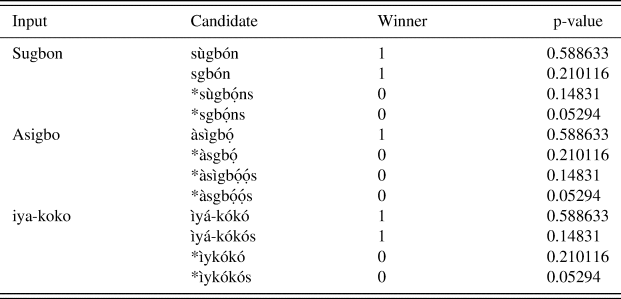
Table 3 shows the probabilities generated by the MaxEnt grammar in Table 2 for some of the outputs. The grammar suggests that faithful candidates like sugbon, devoid of clusters and codas, will occur at chance 59% of the time, cluster hyper-correction forms 21% of the time, and coda hypercorrection 14% of the time. While this pattern might be accurate for inputs that simultaneously have faithful, cluster hypercorrection, and coda hypercorrection optimal forms, no input as yet has all of these optimal forms. An input either has faithful and cluster hypercorrection optimal forms, or faithful and coda hypercorrection optimal forms. This means that we have no way yet to explain the following: a) why faithful and cluster hypercorrection candidates are optimal for sùgbọ́n but not for àsìgbọ́; b) why coda hypercorrection forms are not optimal for all of these inputs; c) why only faithful candidates are optimal for àsìgbọ́—as it stands, this grammar incorrectly rates sgbọ́n, and àsgbọ́ as grammatical; and d) why only faithful and coda hypercorrection forms are optimal for an input like ìyá-kókó. Without further mechanism, this grammar inappropriately over-generates unattested forms like àsgbọ́.
This problem of over-generation was noted by Moore-Cantwell and Pater (Reference Moore-Cantwell and Pater2016) who observe that the MaxEnt model in its unelaborated form is appropriate for (free) variation but not lexically-conditioned variation (or exceptionality). The main obstacle encountered by the grammar reported in Table 2 lies in the fact that it cannot handle lexically-specific constraints which do not hold of all the lexical items in the Contemporary Yoruba lexicon. See Anttila and Magri (Reference Anttila and Magri2018) for further discussion on how the MaxEnt model overgenerates. To avoid the problem of over-generation, I incorporate lexical indexation into the MaxEnt model reported in Table 2, as in Moore-Cantwell and Pater (Reference Moore-Cantwell and Pater2016). This way, the Contemporary Yoruba lexicon is characterized by stratification, where there is the Core Stratum (henceforth CS) comprising all lexical items (LIs) in Yoruba, whether native or loan; the Cluster Hypercorrection Periphery Stratum (henceforth ClS) comprising only a set of those LIs that permit cluster hypercorrection; and Coda Hypercorrection Periphery Stratum (henceforth CoS), comprising only those LIs that are subject to *[.V#]. It can be proposed that at evaluation time, speakers have access to the information that CC-Seq and *[.V#] are indexed respectively for the ClS and CoS so that they are more appropriately represented as CC-SeqClS and *[.V#]CoS. During evaluation, the grammar does not assess any of the candidates for non-hypercorrection inputs like asípa and àsìgbọ́ against the lexically-indexed hypercorrection constraints, CC-SeqClS and *[.V#]CoS; this is because these inputs are not indexed for ClS and CoS, but belong only to CS. Candidates generated for cluster hypercorrection inputs like sùgbọ́n and popular are assessed against CC-SeqClS in addition to the rest of the constraints because they are indexed for it. They are not assessed by *[.V#]CoS because they are not indexed for it. Likewise, candidates generated for coda hypercorrection inputs like ṣàgámù are assessed by *[.V#]CoS for the same reason that they are indexed for it and not by CC-SeqClS because they are not indexed for it. This kind of MaxEnt evaluation that is constrained by lexical indexation can be represented as in (26):
(26) A lexically-indexed MaxEnt grammar
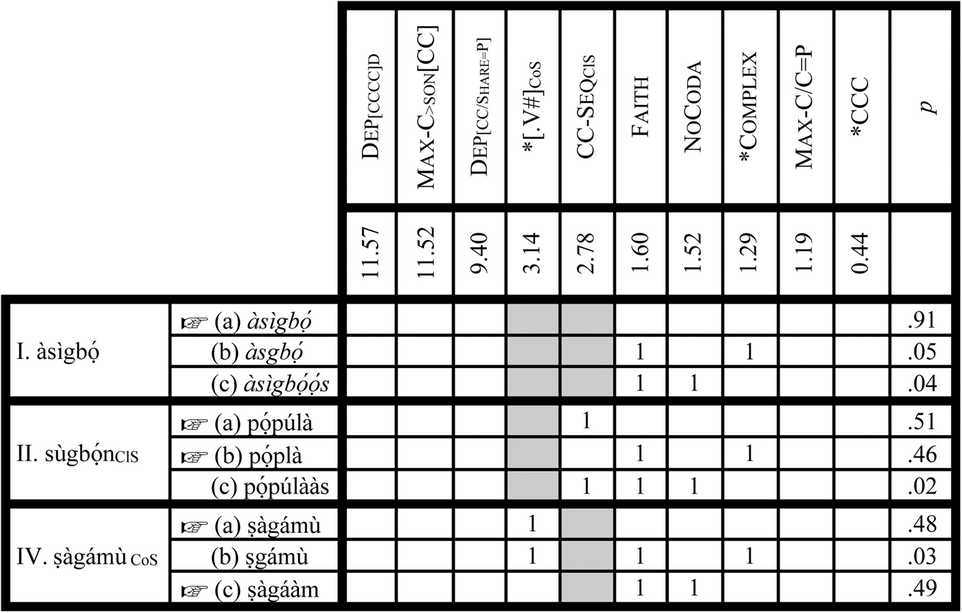
In (26), the row immediately below the constraints indicates the weights learned by the MaxEnt model for each of the constraints, which determine the hierarchy of the constraints. As mentioned previously, the fact that the weights for some of the constraints are close to one another means that they can be re-ranked at evaluation time to produce the two kinds of regular variation manifested in Contemporary Yoruba Phonology: (a) categorical variation: BÚRẸ́DÌ, BRẸ́DÌ, BÚRẸ́Ẹ̀D and BRẸ́Ẹ̀D; and (b) gradient variation: Ẹ́KSTRÀ, Ẹ́STRÀ, Ẹ́KSRÀ, and Ẹ́SRÀ. The last column, labeled p, indicates the frequency probability generated by the model for each of the relevant candidates. For example, the model predicts that Candidate (26.I.a) will be optimal 91% of the time, as opposed to the other candidates whose probabilities of occurrence are very low.
This MaxEnt analysis is in line with the claim in section 4.4 that the ongoing changes in Yoruba actively take place at the periphery, where it is possible that more and more LIs may be indexed to any of the periphery strata, until the two periphery constraints become part of the core grammar of the language. In the various analyses discussed in this article, we have seen that none of the approaches examined is able to independently account for all the categorical, gradient, and lexically-conditioned variation that characterizes Contemporary Yoruba. However, of all the variation approaches assessed, the MaxEnt model appears to be the most economical and the most successful in that we only need to augment it with lexical indexation for it to be able to capture the full extent of the variation in the Yoruba data. The analysis is also more elegant in another respect: rather than postulating a proliferation of seven grammars, the lexically-indexed MaxEnt model generates only three sub-grammars: the Core grammar which all lexical items are subject to, and two peripheral grammars which only a select number of lexical items are subject to. This model also helps us to situate the core–periphery structure of the Yoruba lexicon within the three patterns of lexical stratification documented in Hsu and Jesney (Reference Hsu and Jesney2018). The lexically indexed MaxEnt model in (26) reveals that there are two independent supersets at the periphery of the Yoruba phonological lexicon: a) one which contains all LIs in the Core (subject to the Core constraints) and those that are subject to the Periphery constraint CC-SeqClS and b) another one that equally contains all LIs in the Core (subject to the Core constraints) and all those lexical items subject to the Periphery constraint *[.V#]CoS. It could be concluded that Yoruba provides evidence for a core–periphery pattern that might be termed ‘double supersets at periphery’, where two peripheral strata exhibiting the ‘superset at periphery’ pattern are characterized by phonological generalizations that hold independently for each stratum.
5. Predictions of the analyses
One important prediction that I have made in my analysis is that if the variation seen is indeed a case of change in progress, then it follows that the final stage of the change (Period 3b) will not be characterized by constraint re-ranking or further stratification, but rather by changes in lexical indexation, so that more and more lexical items are indexed for CC-SeqClS and *[.V#]CoS until these two constraints become part of the core grammar, and many new lexical items emerge with invented clusters and codas. To be sure, there is only one more grammar that can be admitted into the Yoruba grammar that we have established, typologically speaking, involving coda hypercorrection and cluster hypercorrection simultaneously and thus only surfacing at the Periphery. It follows then that the eventual change will be in terms of more words being indexed to the existing grammars at the Periphery. The culmination of the change will be a point in time where hypercorrection holds of all lexical items in the lexicon with the right phonological context. At such a point, forms like *awood ‘hawk’ and *àsgbọ́ ‘mishearing’ with the right condition for hypercorrection will be grammatical. As a result of this, our analysis also makes a prediction that change in progress must be understood in terms of a core–periphery structure, where ongoing change actively takes place at the periphery spreading through the entire lexicon one at a time until the periphery becomes part of the core so that grammatical innovations that hold of some words at the periphery gradually spread until they become a regular part of the core of a language's grammar. This way, the general assumption in the sociolinguistic literature (e.g., Aitchison Reference Aitchison2004: 4) that change takes place gradually is put in theoretical perspective.
6. Conclusion
The following generalizations have emerged from the foregoing discussion on Contemporary Yoruba phonology: a) Yoruba is in the second stage of a diachronic change, where variation is the major hallmark of its grammar; b) this resulting variation is either a stable variation which will continue for a long time to come, or a change in progress that will eventually culminate in the lexically unconstrained permission of clusters and codas; c) if this variation is an instance of change in progress, then the final stage is going to be characterized mainly by changes in lexical indexation, rather than further constraint re-ranking; d) the different patterns of cluster and coda realization described in section 3 are not random, but are a well-organized stratification in a phonological lexicon; e) this stratification is organized in a core–periphery fashion where the Core is characterized by free and gradient variation and the Periphery is characterized by lexically-conditioned variation; f) ranked-winners, indexed constraint, partial-order co-phonology, and MaxEnt approaches to variation and lexical stratification are inadequate to independently account for the variation now observable in Yoruba; g) however, a MaxEnt model augmented with lexical indexation provides the most successful and parsimonious account of the Yoruba data. Overall, more research is needed to understand fully the contact-induced phenomena described in this article. Future work would do well to shed light on how the seven grammars identified for Yoruba are acquired by children. It is furthermore the hope that this article will inspire similar investigations in other African languages with similar prolonged contact with a former colonial language.
Appendices
Appendix A: Data Collection
Three methods were employed in the collection of the data reported in this paper: sociolinguistic interviews, participant observation, and grammaticality judgment. In the following paragraphs, I briefly describe each of these methods.
I conducted 120 sociolinguistic interviews at five different locations in the Yoruba-speaking Southwestern part of Nigeria. I covered two states, Oyo and Lagos. In Oyo State, I interviewed 36 participants in the capital city (Ibadan), 24 in a town (Iseyin), and 12 in a village (Gbonkan village). In Lagos State, I interviewed 36 participants in what I define as the Lagos Megacity (which is a conglomerate of erstwhile towns that have now merged into a huge megacity) and 12 in the village called Oke Agbo, located around the Gberigbe area of Ikorodu. I also conducted participant observations in these locations as well as in Abeokuta, Ogun State. My participant observation was structured in such a way that I moved around with individuals and groups of individuals engaged in activities like watching soccer, working in a workshop, selling wares in a shop or at a market, etc. While doing this, I documented their speech behaviours that were relevant to my research design. This took place between May 2019 and November 2020. The data reported in the main body of the paper and in Appendix B were acquired through these two methods. However, since sociolinguistic interviews and participant observation can yield only positive evidence, which is not enough to answer the question of which form is acceptable and which is not (a question especially relevant for the analysis of lexically conditioned variation at the periphery of the Yoruba grammar), I complemented these methods with a grammaticality judgment task, part of which is reported in Table 4.
Grammaticality judgment

Table 4 is structured in the following way. The first column contains hypercorrected forms with their respective original words in parenthesis. The third row contains the pseudonyms for the ten participants that were drawn from Iseyin specifically for this task. The participants include five men and five women all between the ages of 18 and 40. They responded to a Likert scale which ranges from 5 to 1, where 5 is interpreted as ‘this form is very grammatical’, 4 as ‘this form is grammatical’, 3 as ‘I doubt if this form is grammatical’, 2 as ‘this form is not grammatical’, and 1 as ‘this form is not grammatical at all’. To adjudge a form as grammatical in a speaker's grammar, I take 4 to be the benchmark for grammaticality, meaning that if a form is rated 4 or 5 by a speaker, then that form is grammatical in their grammar. If it is rated 3 or below, then the form is not grammatical in the respondent's grammar.
Three different generalizations, which provide the basis for the discussion in the main text of the paper, arise from this table: (a) some forms like bọ́skọ̀rọ̀, bẹ́skẹ́, àskò, bọ́skọ́nà, ṣagaam, and méjèèj whose rating ranges only between 4 and 5 are already well established in the Contemporary Yoruba grammar; (b) forms like ìláàd, ìbáàd, agííd, àjànààk, àsgbọ́, atro, atra, with the right context for hypercorrection are yet to be established in the grammar given that their ratings do not go beyond 3; and (c) forms like orisrisi, abẹkta, traka, am, ajeej, akaam, and ọlaaj are intermediate between being totally grammatical or totally forbidden in everyone's grammar. If this population is expanded to include people of other age groups and people from other locations, it could well turn out that the intermediate pattern is the main fashion in which this hypercorrection variation is organized: lexical conditioning of hypercorrection is different from one individual to another. This would mean that the lexicon for Contemporary Yoruba speakers is not organized uniformly. The lexically indexed MaxEnt model proposed in the main text accounts for this variation in a straightforward way.
Appendix B: The Seven Grammars of Contemporary Yoruba PhonologyFootnote 10
(27) Core lexicon (Grammars 1, 2, 3, and 4)
(28) Cluster hypercorrection periphery of the lexicon (Grammars 5 and 6)
(29) Coda hypercorrection periphery of the lexicon (Grammar 7)


Appendix C: Grammar Lattice For a Partial-Order Analysis
(30)
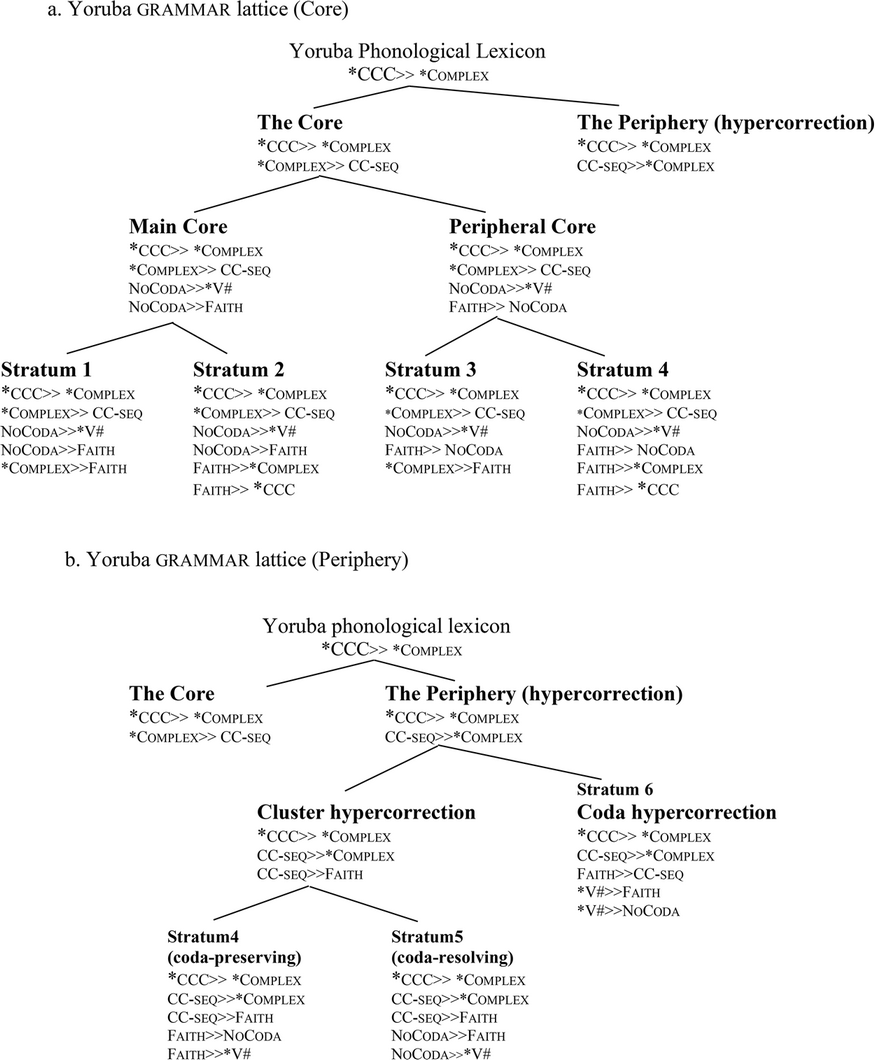
Appendix D: Grammars 2–7 In a Lexically Indexed Partial-Order Co-Phonology
(31)
a. Grammar 2: NoCoda>> *V#…>> Faith>> *CCC >> *Complex>> CC-Seq
b. Grammar 3: *CCC >> *Complex >> Faith >> *V#, CC-Seq, NoCoda
c. Grammar 4: Faith>> *CCC >> NoCoda>>*V#…>> CC-Seq >> *Complex
d. Grammar 5: CC-Seq>> Faith>> *V#…>> NoCoda>> …*CCC >> *Complex
e. Grammar 6: NoCoda>> …CC-Seq, *V#…>> Faith…>> …*CCC >> *Complex
f. Grammar 7: *V#>> NoCoda (…Faith, CC-Seq)>> Faith>> CC-Seq>>…*CCC >> *Complex
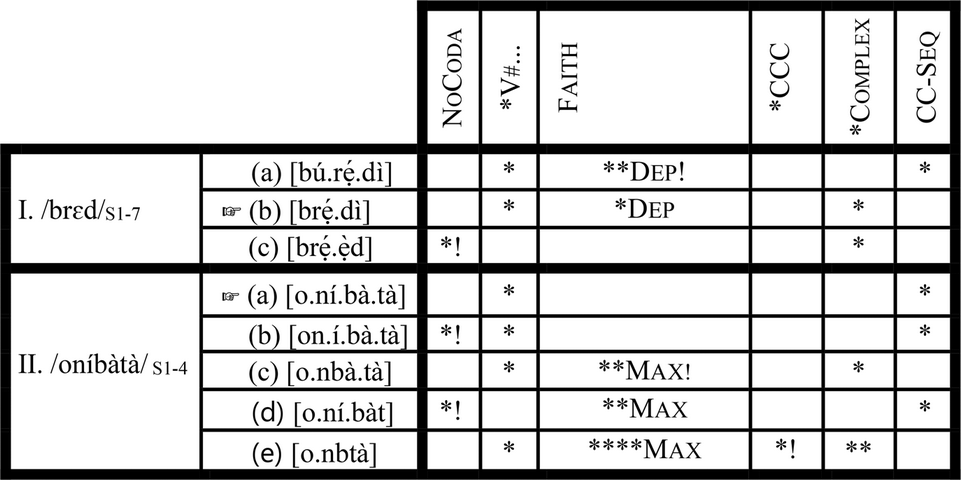
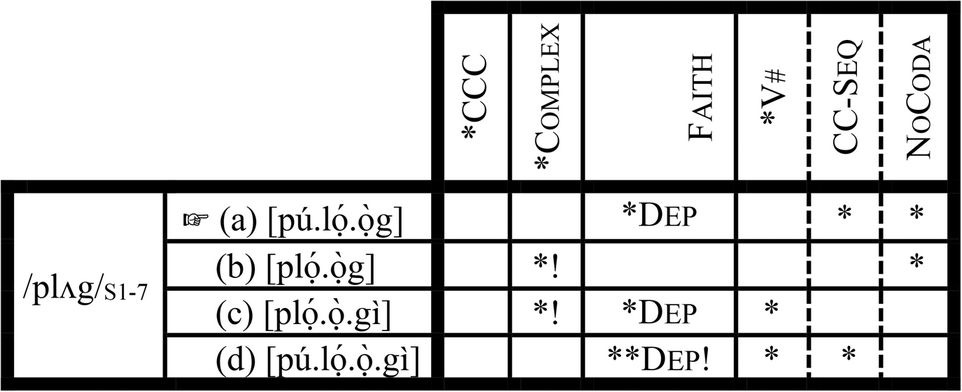

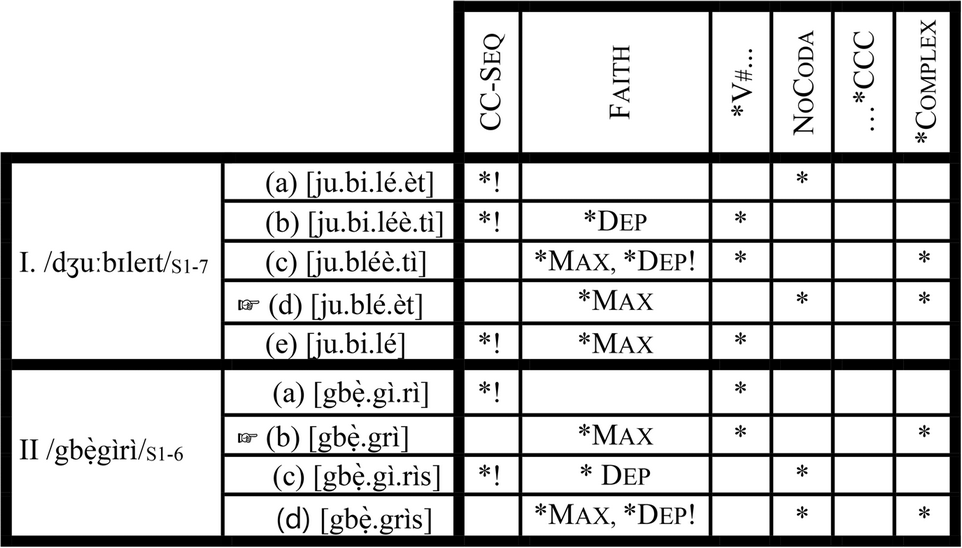
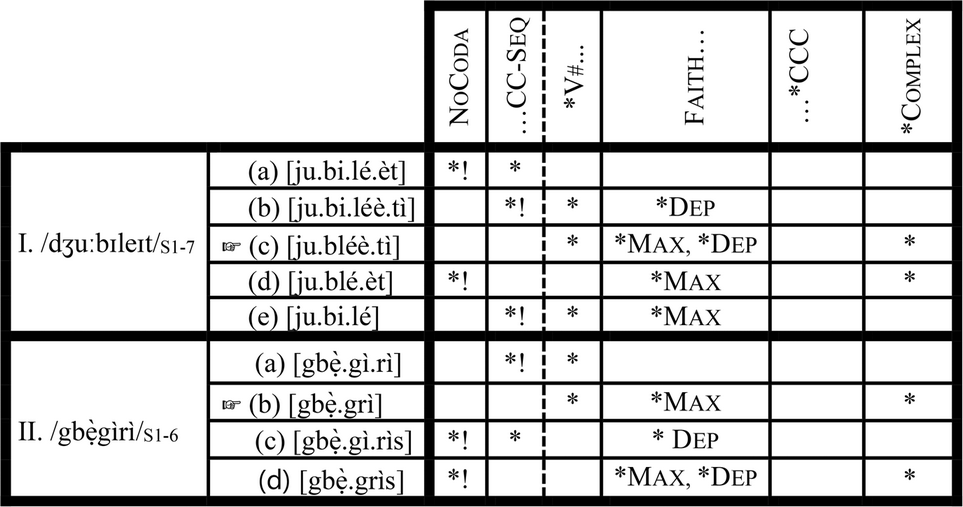
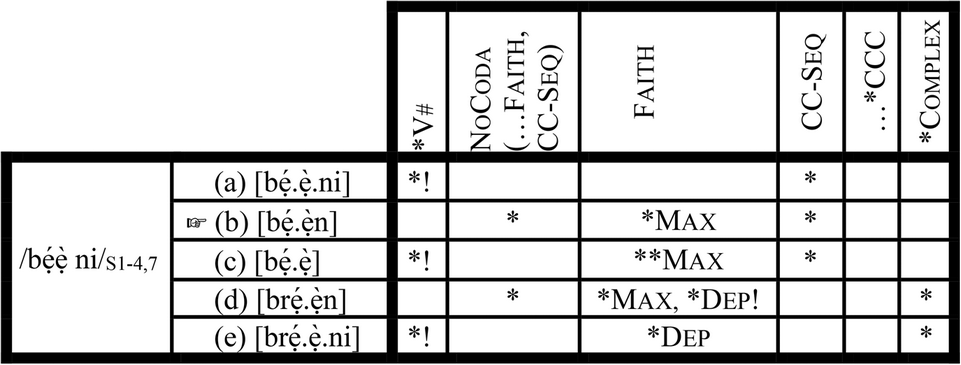


 Open access

