





On the morning of 5 February 1924, a perfect storm was brewing over US–German relations. Former US President Woodrow Wilson had passed away just two days earlier and the German embassy in Washington had failed to set its flag at half-mast, thereby defying diplomatic protocol as much as common courtesy. While the French, British and Italian embassies were all paying their symbolic respects to the former US president, the German Republic's flagstaff was defiantly empty. This German action prompted immediate outrage among the American public. The German embassy and consulates in the United States were inundated with angry letters; major newspapers berated the display of ‘Teutonic’ arrogance; a mob of enraged citizens drove to the German embassy and hoisted an American flag on its front lawn.Footnote 1 Not since the sinking of the Lusitania in 1915 or the release of the Zimmermann telegram in 1917 (when Berlin had promised Mexico parts of the United States in case of a German-Mexican alliance), contemporaries claimed, had so intense a wave of anti-German resentment washed over the United States.Footnote 2 But why did so small a diplomatic fumble create such a furore?
At first glance, the episode appears puzzling. By early 1924, wartime hatreds between Germany and the United States had mellowed considerably and both countries had a vested interest in transatlantic reconciliation. German foreign policy makers courted the United States for financial and political support, while the United States considered the political reintegration and financial reconstruction of Germany as critically important to European recovery and had taken first steps towards that end. Why, then, would German diplomats run the danger of ruining the prospects of US support by so obvious an undiplomatic folly? And why would Americans react so strongly over what was – certainly compared to the sinking of the Lusitania – a trifling misstep? In fact, US outrage seems hardly commensurate with German action. By 1924, many Americans were neither particularly fond of Woodrow Wilson nor particularly interested in the intricacies of diplomatic protocol. The case becomes more startling still when we consider that the German embassy in Washington immediately backpedalled, setting the flag at half-mast and then passed off its actions – albeit inacurrately – as a regrettable misunderstanding.Footnote 3 The apparent foolishness of the German blunder as well as the intensity of US outrage, this article argues, can only be understood in light of the two countries’ complicated post-war relationship, especially the ambivalent emotions over US aid to Germany. The article uses this diplomatic faux-pas as a case study to illustrate just how difficult it was for German elites to feel and express gratitude towards the recent enemy, and just how much Americans expected such gratitude, even as few admitted it openly. As will be shown, a better understanding of the complex relations between gratitude, national dignity and power is central to making sense of the flag incident and of interwar transatlantic relations at large.
International history has traditionally given little critical attention to questions of gratitude and its adjacent emotions.Footnote 4 Beneficiaries of humanitarian aid, in particular, are often cast in the role of passive and naturally grateful recipients, having limited agency of their own.Footnote 5 Such portrayals seem especially odd with regard to European countries, which were on the receiving end of the majority of humanitarian aid in the first half of the twentieth century. Why would countries that were otherwise famously preoccupied with their national interests and prejudices suddenly abandon these concerns upon becoming ‘recipients’? Certainly, there is extensive evidence to challenge this idea. The German Foreign Ministry Archives, for example, are replete with files on when (and when not!) to display an appropriate degree of gratitude. Professing gratitude was clearly part of foreign policy agendas and we need to know more about the interests, biases and emotions that shape national elites’ expressions of gratitude at a certain time. Conversely, there is remarkably little research on the public and diplomatic impact of ‘ingratitude’. Despite much new research on humanitarian and development aid, historians of foreign relations have usually focused on the strategic rather than the social expectations attached to foreign aid and gift-giving. As diplomatic historians are well aware, the giving of aid often serves discrete interests: it is to build trust, prestige and influence abroad and, by extension, to translate into foreign policy advantages.Footnote 6 But what about the social expectations attached to giving aid, most notably the expectation of gratitude? And what happens when this expectation is disappointed, that is, when recipients are deemed ‘ungrateful’?Footnote 7 Indeed, while humanitarian aid is often framed as a self-less endeavour that asks nothing in return, it entails strong social expectations of recipient gratitude. Sociologists even speak of a ‘gratitude imperative’.Footnote 8 What is more, even aid provided by private charity and voluntary agencies (such as the US organisation CARE after the Second World War) tends to come with the expectation that recipient gratitude will accrue to donor nations at large (e.g. the United States). Accordingly, questions of gratitude and ingratitude almost by default pertain to foreign relations.
The relative dearth of historical scholarship on these questions is perhaps not entirely surprising. Historians tend to rely heavily on textual sources, and social expectations, by their very nature, often go unarticulated and unwritten. Expectations of gratitude, in particular, are seldom communicated, since much of the value of gratitude derives from it being unsolicited and of the recipient's own volition. Accordingly, one would have to search far and wide for any humanitarian or statesman admitting that they expected, let alone asked for, gratitude. And yet, the ubiquity of these expectations is demonstrated by the fact that the absence of gratitude tends to register immediately. It is for this reason that the article takes one historical instance of perceived ‘ingratitude’ – the flag incident – to study the unspoken expectations attached to humanitarian aid, why it can be difficult for ‘recipients’ to meet them and what happens when the donors are disappointed.
The article is built on the premise that American–German relations after the First World War offer a particularly illuminating case study. The wartime mobilisation of public sentiment on both sides of the Atlantic, and the sea change in transatlantic influence it wrought, that is, the decline of Germany and the ascendancy of the United States, made gratitude an especially emotional and contested issue. In all, the article illustrates how questions of (in)gratitude allow for a new reading of transatlantic relations in the aftermath of the world wars.
The article proceeds in three parts. First, if offers some thoughts on the state of post-war German–American relations as they relate to humanitarian aid and (in)gratitude. Second, it zooms in on the flag incident and its emotional and psychological backdrop. It thereby explores the reasons for Germany's blunder as well as for US outrage. Finally, a third part moves away from German–American relations and to other European countries. It locates the German case study within a larger transatlantic context of gratitude and ingratitude in the first half of the twentieth century.
Reluctant Benefactors, Reluctant Beneficiaries: German–American Relations after the First World War
The flag incident can be understood only if we acknowledge how ambivalent the American–German relationship was after the First World War. That ambivalence was a product of the war and post-war period. Among the US public, wartime mobilisation had resulted in considerable vilification of and substantial resentment against Germany and Germans. ‘The Germans’, claimed the New York Sun at some point during US belligerence, ‘are not human beings in the common acceptation of the term’.Footnote 9 In Germany, too, the fact that the United States seemed to have favoured the Allies already during the period of its neutrality, 1914–17, and then had entered the war against Germany in April 1917 aroused much hostility.Footnote 10 At the same time, the American–German relationship contained a seed of sincere hope and interest. German politicians and officials always considered the United States a more disinterested power than either France or Great Britain and they placed their hopes in President Woodrow Wilson when it came to negotiating a bearable peace settlement and avoiding the more punitive design of the Allies.Footnote 11 Even after the Versailles Treaty of mid-1919 had dashed their hopes, German foreign policy makers continued to look to the United States. Its financial prowess and its position as Allied creditor gave the United States considerable influence over the settlement of the hotly contested reparations issue and made it, to German minds at least, the most likely country to finance German reconstruction. What is more, Berlin's manifest interest in a more cordial transatlantic relationship was at least partly shared by Washington. US policy makers, too, considered German stability key to European stability at large and would for that reason eventually back its economic reconstruction.Footnote 12 Still, they were cautious not to get ahead of a still anti-German and increasingly isolationist US public sentiment.Footnote 13 Transatlantic resentments resurfaced repeatedly in the first post-war years.
The ambivalence of the American–German relationship was especially visible in US humanitarian aid to Germany, or, put more precisely, in just how reluctantly the US provided that aid and in just how reluctantly Germany accepted it. In the first half of the 1920s, the United States’ new financial position in the world became tangible in its humanitarian aid to Europe. American generosity re-constructed villages in northern France, fed undernourished children in Poland and Hungary, resettled refugees in the Mediterranean and averted the spread of famine in civil war Russia.Footnote 14 Germany, the former enemy, was no exception. In the early 1920s, Americans, especially those of German birth or descent, provided large sums for humanitarian aid to Germany. Individually, they sent millions of packages to German families; the American Young Men's Christian Association (YMCA) provided financial support to German students; and the American Friends Service Committee (AFSC) and US humanitarian Herbert Hoover created a post-war child-feeding programme that by mid-1921 fed a million German schoolchildren a day.Footnote 15 US aid to Germany reflected several different motivations. German Americans, who provided the brunt of financial support, were eager to aid family members abroad and express their sympathy with the country of their birth or origin.Footnote 16 US humanitarian groups such as the AFSC or the YMCA saw relief work as a way to pacify and reconcile a resentful Germany.Footnote 17 Herbert Hoover and many of his associates, finally, supported German relief for more immediately political reasons, not least to keep Bolshevism at bay and promote the image of a benevolent America.Footnote 18
But aiding the former enemy always remained controversial. Years of wartime propaganda had bred deep suspicion of German statements. From the armistice in November 1918, when German distress first became public, Americans doubted whether Germans were going hungry at all, or at least as hungry as they claimed. Many Americans were convinced (and not always wrongly) that Germans overstated the extent of their suffering to gain international sympathies in the months before the peace treaty, and to ward off French reparation demands thereafter.Footnote 19 In 1921 the popular US weekly magazine Outlook claimed: ‘The German people are as healthy and fat as they ever were, not excepting the children. . . . Germany is glad to have America feeding its children, since this helps in their argument against paying the indemnity.’Footnote 20 Even those Americans that accepted German claims of distress often found other countries more deserving of US charity.Footnote 21 With larger parts of Europe in the throes of famine and disorder, US statesmen and humanitarians preferred to give to Germany's victims such as Poland or France. At times, those that wanted to aid Germany even faced violent attacks.Footnote 22 As late as 1924, one American, when commenting on a fundraising campaign for German children, found ‘it hard . . . to conceive of any real [emphasis added] American taking any interest whatever in the affairs of the Germans’.Footnote 23 Such comments are indicative of how slowly the American public culturally demobilised after the war.Footnote 24 Moreover, and importantly for the purpose of this article, the great reluctance with which many Americans approached US aid to Germany resulted in particularly high expectations of gratitude and a particularly close monitoring of German behaviour. As Americans grudgingly gave to Germany, they at the very least expected Germans to show humble appreciation.
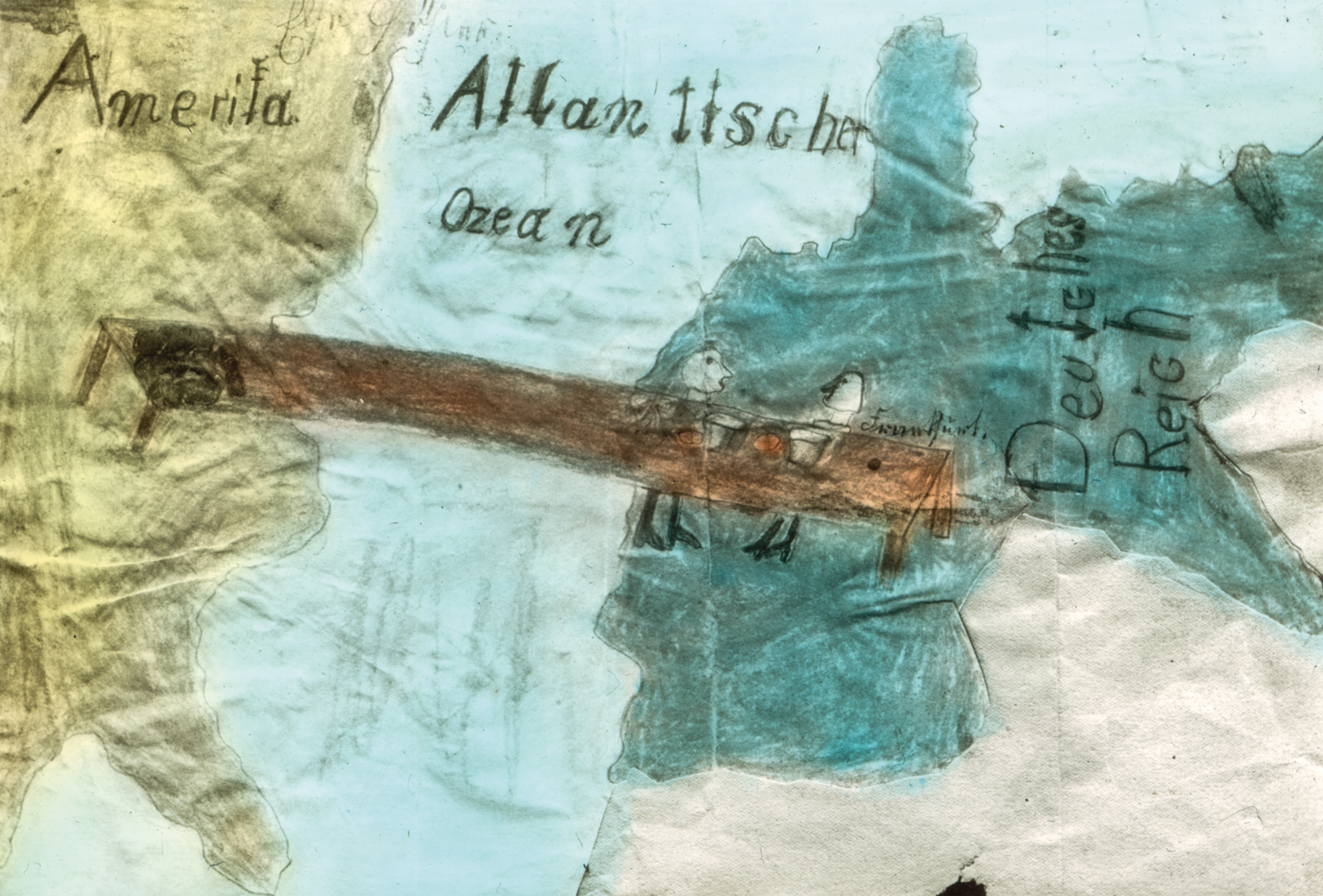
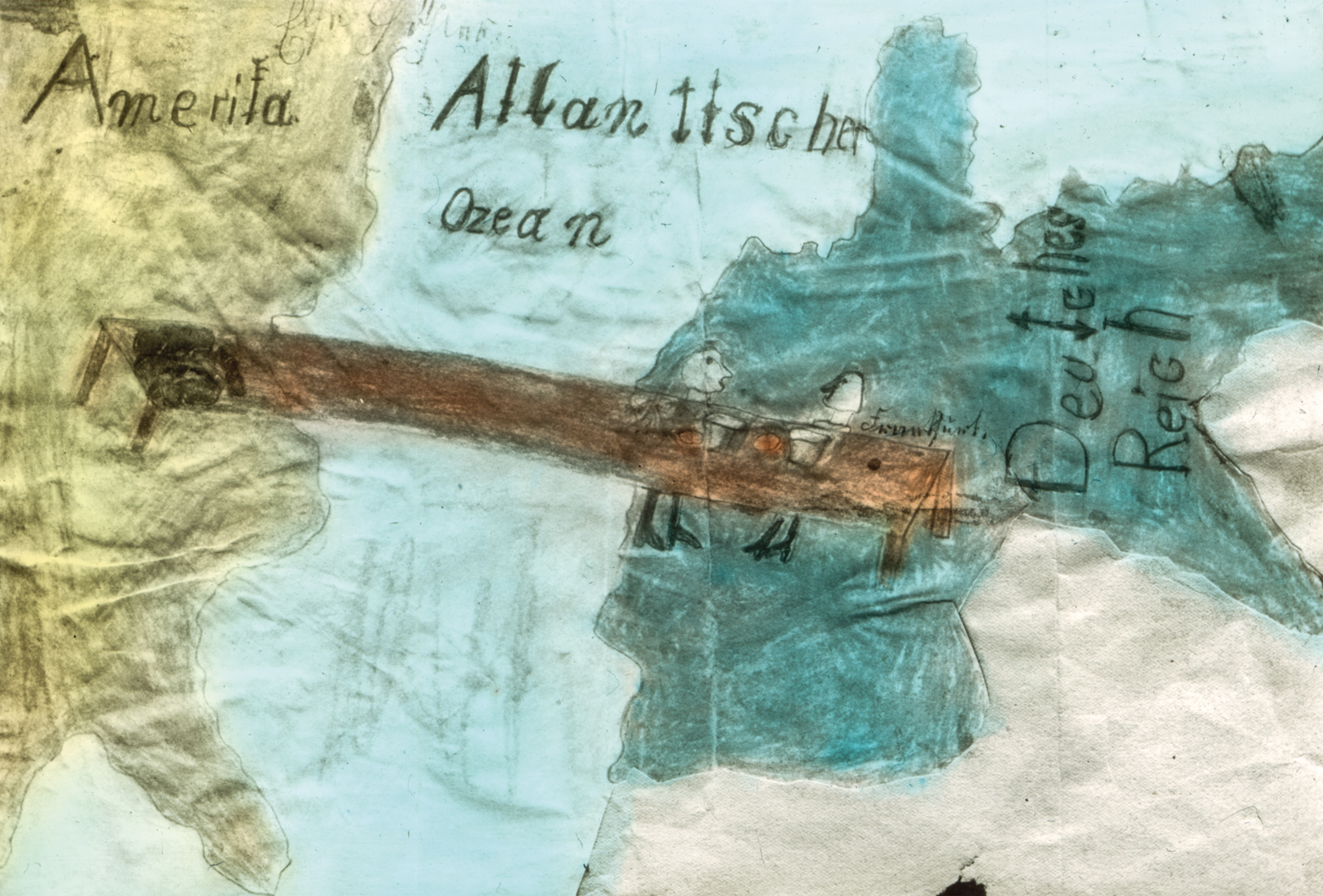
Yet many Germans were as hesitant about receiving aid as Americans were about giving it. Of course, there was a significant share of the German population that faced great need after the war and sincerely appreciated US help. The AFSC Archives in Philadelphia are replete with tokens of German gratitude. German children painted pictures, wrote letters, and crafted intricate objects in order to give thanks to US benefactors. These are authentic, if clearly adult-supervised, expressions of gratitude (Figure 1). Moreover, German welfare organisations and state ministries engaged in a good deal of performative gratitude. The AFSC delegation was regularly invited to tea at the German Chancellery, Herbert Hoover and Rufus Jones, the head of the AFSC, were among the first enemy nationals to receive honorary doctorates from German universities after the war, and the German embassy and consulates presented small tokens of appreciation (porcelain figurines, signed photographs of the Reich President, precious antiques) to US donors, most of them German Americans.Footnote 25 In 1921, the German Red Cross created a medal solely for the purpose of thanking foreign, especially American, benefactors. It hoped, in particular, to compensate for the Weimar Republic's lack of state decorations, which was felt to limit Germany's ability to show gratitude and establish influence with foreigners. The German ambassador to Washington noted that ‘one cannot exaggerate the addiction to medals in this democratic country [USA]. With the elimination of decorations . . . we Germans have deprived ourselves of a powerful means of influence abroad.’Footnote 26 As such statements show, displays of gratitude were inherently political. They were performed in a way that was intended to maintain the flow of US charity as well as to improve ties with the US public.
The International Bridge, painting by a German child showing a table stretching from the US to Frankfurt, Germany, c. 1920; as a side note: Germany is shown in its pre-war borders. Swarthmore College Friends Historical Library, American Friends Service Committee lantern slides of First World War relief work.
And yet, there remained also a great embarrassment and uneasiness about US aid, and about what it might mean for Germany. While there were myriad official and unofficial expressions of German gratitude, there was also, particularly in right-wing milieux, a strong resentment toward American ‘alms’ and the German officials that dared accept and appreciate them.Footnote 27 Even the liberal Frankfurter Zeitung concluded: ‘We are defeated, but we have no intention of humiliating ourselves. We have lost the war, but we retain our dignity. We have not yet learned, and will not learn in future, to associate with other nations except on terms of equality . . . we want no alms.’Footnote 28 For this reason, Germans paid exacting attention to who gave and why. Aid from German Americans or the Quakers was usually above reproach as both groups had been opposed to the war and now showed an honest concern for German well-being. Their aid could thus be interpreted as tokens of love and transatlantic solidarity, not charity. As a Berlin newspaper noted, the Quakers were welcome in Germany not only because of their wartime pacifism but because their quiet and humble demeanour did not ‘injure the dignity of the German people, who were world leading in the field of social reform and charity prior to the unfortunate outcome of the war’.Footnote 29 The Kieler Neueste Nachrichten, a large German daily newspaper of bourgeois-nationalist persuasion, was even more blunt. ‘Of course, it is bitter to accept relief from the hands who recently hurt us so violently’, it commented on 27 April 1920. ‘We also know that the Anglo-Saxon race likes to . . . give public alms after having broken the backbone of a people. However, the Friends [Quakers] have preached against war and vandalism ever since they came into being [and] are not responsible for the treason of their nation.’Footnote 30 The Quakers inspired intense feelings of gratitude in Germany, albeit – and contrary to what many Americans liked to believe – not because they were Americans but despite of it.
Accepting aid from recent enemies, as above comments illustrate, raised difficult questions of national dignity. This was all the more the case because the Allies were often blamed for German distress. German students in Marburg, for example, roiled against a child-feeding programme undertaken by the British Quakers, considering it ‘incompatible with the honour of a nation which was defeated but not dishonoured’.Footnote 31 Under these circumstances, many Germans struggled to gratefully accept Allied alms. To do so seemed tantamount to condoning the humiliating peace treaty and to approving the second-rate position that Germany now occupied in the world. German officials, politicians and journalists instinctively realised what theorists have since emphasised: that donor/recipient relations are built on – and can further cement – imbalances in power. Non-reciprocal forms of international giving, such as humanitarian aid, impose on the recipient country a set of unspoken obligations and circumscribe the actions that country may take by expectations of humble deference. Hence a vanquished Germany's profound uneasiness about accepting, gratefully no less, the aid of its former enemies.
Far from just inspiring gratitude, then, US aid could also accentuate German feelings of decline and dependence and create new resentment towards US power, no matter how benevolent it appeared on the surface. German author Erwin Carlé (pseud.: Rosen), who had emigrated to the United States in the late nineteenth century and written several popular Amerika books in the years before the First World War, encapsulated the great disquiet that Germans felt about the rise of the American colossus shortly after the war. In opening his 1920 book on Die Amerikaner, Rosen described the American thus:
There stands a person, with hard face, sharp lines around the corners of his mouth, cool grey-blue eyes, and this person holds in his hands a pair of scales: if he moves his little finger, then one dish of the scales lowers, and Europe hungers. But if he moves his little finger once more, the dish of the scales rises, and Europe has flour, bacon, gold . . . This is the American, who has won the Great War!Footnote 32
Beyond all public displays of appreciation, such descriptions paint a dystopian vision of US food power. They also remind us that the First World War had engendered a sea change in prestige and influence and that Germany and the United States in particular had to fundamentally recalibrate their relationship to account for that change. Whereas Germany found itself a vanquished and impoverished pariah state, the United States emerged from the war more prosperous and influential than ever before. This transatlantic renegotiation would play out, in part, over gratitude.
Dignity, (In-)gratitude and the Washington Flag Incident
It was these different emotions and expectations, I would argue, that came to a head in the flag incident of early 1924.Footnote 33 As noted above, the German embassy in Washington failed to set the German flag at half-mast when US President Wilson passed away on 3 February 1924. The US public responded with outrage. But at its heart the episode was not about the violation of diplomatic protocol but about questions of dignity and gratitude as well as the renegotiation of transatlantic power.
The flag incident occurred at a decisive moment in the post-war period. For years, Germany had sought to interest the United States in its affairs, particularly a new and hopefully more favourable reparations settlement to be followed by US loans to Germany. In 1923, a year marked by the Franco-Belgian occupation of the industrial Ruhr district and German hyperinflation, German Foreign Minister Gustav Stresemann and Otto Wiedfeldt, the German ambassador in Washington, had been busy advertising the urgency of the German crisis in terms they believed would resonate with the US public. They had stressed the ‘militarism’ of the French, described the desperate plight of German children and argued that there could be no productive and stable Europe without a productive and stable Germany.Footnote 34 In early 1924, their efforts had finally paid off. Several prominent ‘Anglo-Americans’ were busy organising an America-wide fundraising campaign for German children and the US government appointed two American businessmen, Charles G. Dawes and Owen D. Young, to survey and solve the reparations impasse. Both developments were gaining momentum just as Wilson lay dying. The flag incident thus occurred at a moment when US goodwill was supremely important to Germany. Ironically, this made the German blunder not only particularly foolish but in a sense also, I would argue, particularly probable.
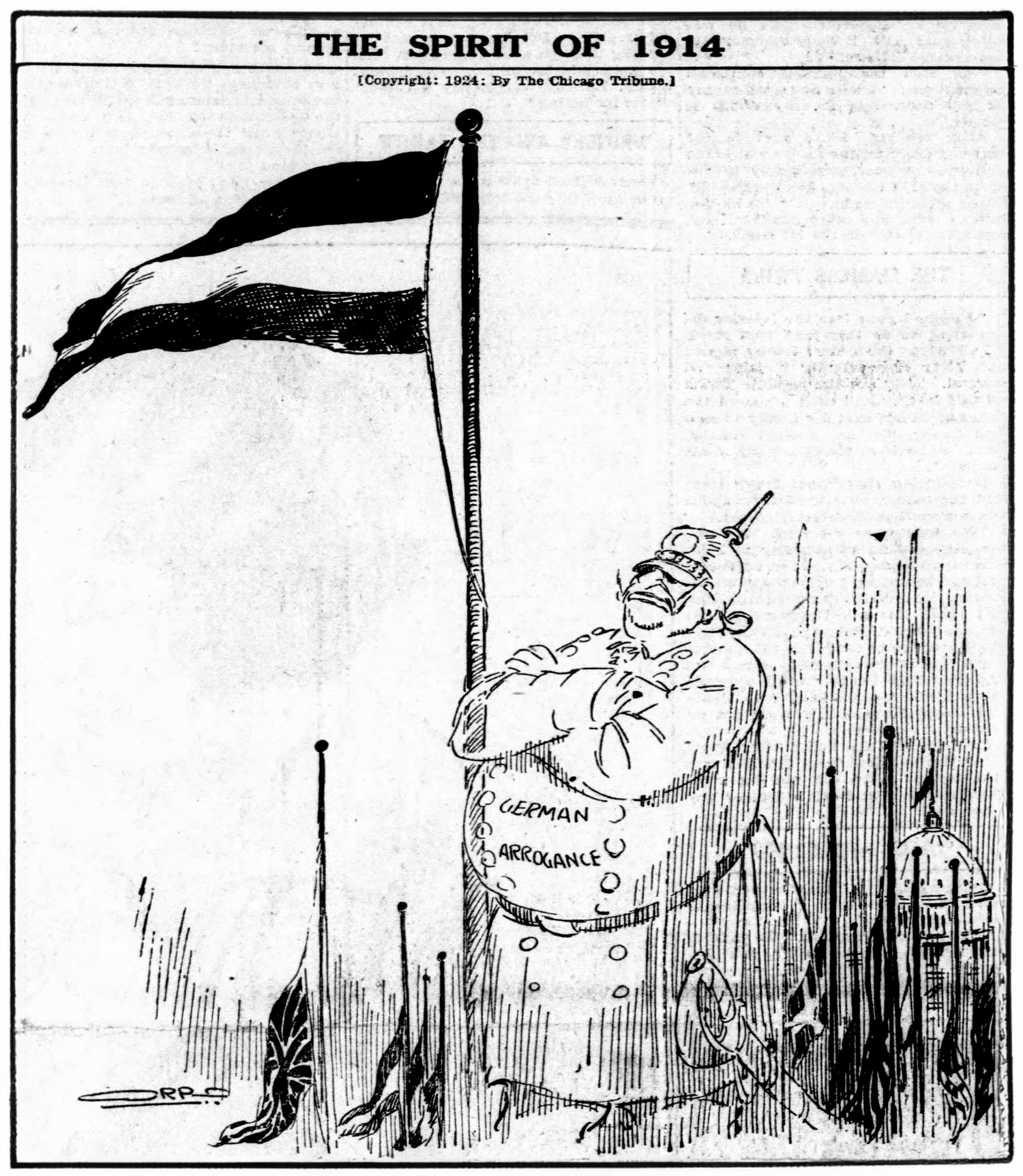
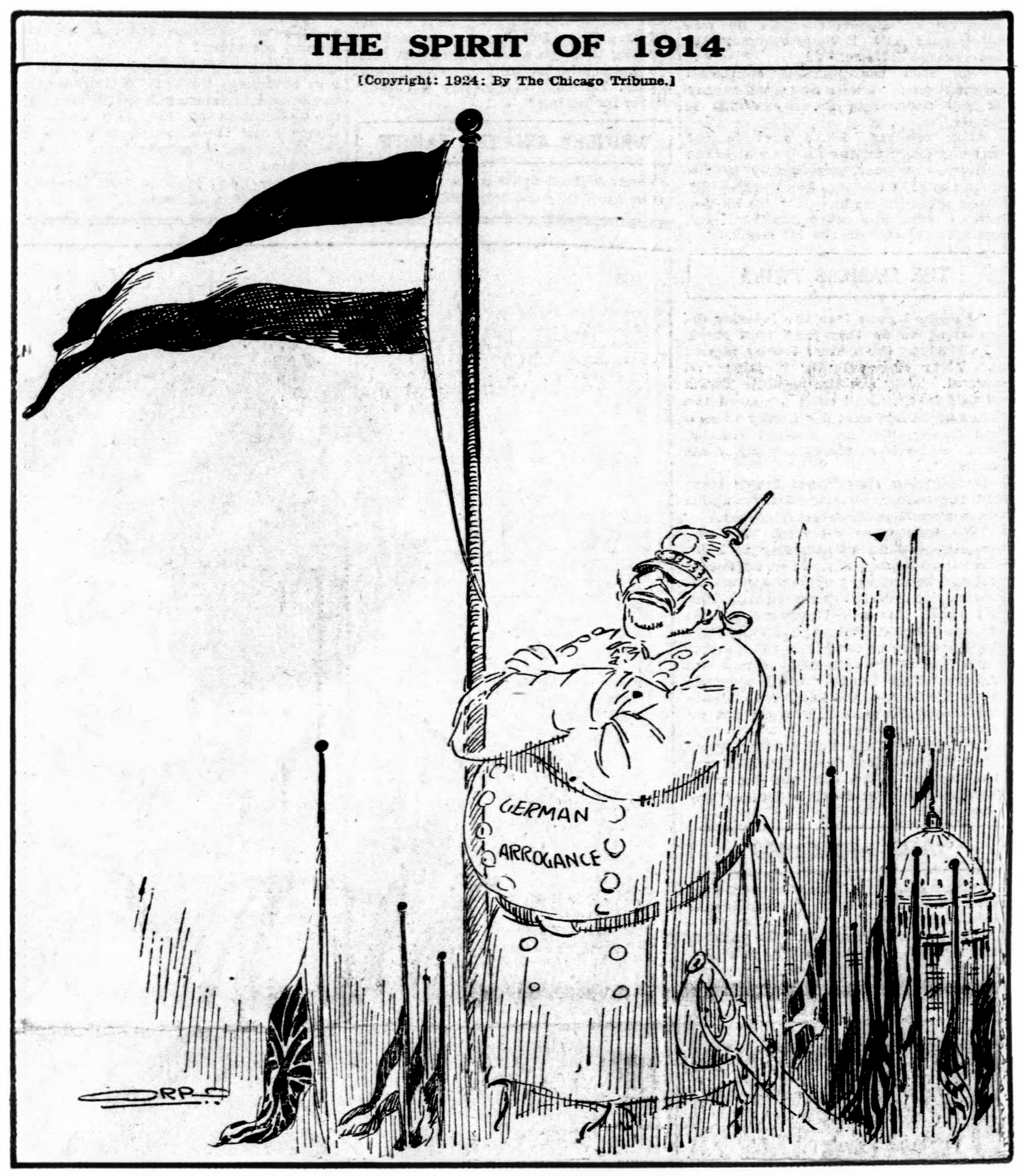
The German embassy would later pass off the flag incident as a simple ‘misunderstanding’, a regrettable protocollary mishap.Footnote 35 But that was far from the truth. In fact, the instruction not to set the flag at half-mast had come directly from Stresemann and the German Foreign Office in Berlin. Learning of Wilson's deteriorating condition, German ambassador Wiedfeldt, a businessman and former manager of the Krupp Iron Works, had presciently cabled Berlin for instructions on what actions to take in the case of Wilson's death. In particular, he had realised that once Wilson passed away Germany would have to express its condolences to the US government and that, given Wilson's enormous unpopularity in Germany (the ex-president being personally blamed for the Versailles Treaty), this would cause considerable dismay among German published opinion. Accordingly, Wiedfeldt had asked Berlin to brief the German press in advance, explaining why the embassy needed to show this basic diplomatic courtesy.Footnote 36 Rather than appreciating Wiedfeldt's foresight, however, the German Foreign Office had told him in no uncertain terms to abstain from all official expressions of condolence.Footnote 37 What is more, it stuck to this course even as US criticism became widespread. It took Wiedfeldt's and many prominent Americans’ warning that the flag incident was bound to ‘destroy the results of two years of laborious work and would strongly imperil the chance of US political, financial and humanitarian aid in the future’Footnote 38 for Stresemann to reverse – and most reluctantly soFootnote 39 – his original decision.Footnote 40 Stresemann then proceeded to blame the incident on ambassador Wiedfeldt.Footnote 41 What is astonishing about this episode is that it so clearly contradicts what historians have identified as Stresemann's single greatest strength as foreign minister in the 1920s: his ability to understand and accommodate the psychology of others.Footnote 42 In fact, American observers saw the incident as yet another prime example of Germany's famed ‘deficiency of psychology’, eerily reminiscent of Imperial daysFootnote 43 (Figure 2). So why would Berlin act as it did?
Orr, ‘The Spirit of 1914’, Chicago Tribune, 8 February 1924, p. 1. The depiction is inaccurate in that the German flag did not fly at full-mast; the embassy flew no flag that day.
The answer lies in German concern for national dignity, its great dependence on US aid and the subsequent renegotiation of the transatlantic relationship. This is not to say that it had nothing to do with Wilson's persona or the role he had allegedly played in the peace negotiations. It is no exaggeration to say that Wilson was singularly unpopular, even hated in Germany at the time, with many Germans blaming him for the harsh peace treaty. Whereas the German left-wing press was at times willing to see him as a tragic figure and a failed idealist, German conservatives saw him as a sinister character whose promises of a lenient peace treaty had deliberately tricked a militarily undefeated Germany into laying down its arms in the fall of 1918 – with the gravest of consequences.Footnote 44 The obituaries published in German newspapers in 1924 left no doubt as to the intense resentment against Wilson.Footnote 45 Under these circumstances, to express any appreciation for Wilson was politically and emotionally out of the question for a liberal conservative German politician like foreign minister Stresemann, even if it meant alienating the US public.Footnote 46 Following the flag incident, the nationalist Berliner Börsen-Zeitung expressed German sentiment in drastic terms. It regretted the flag incident's impact on business, but considered it ‘equally clear that nations and peoples deceived by Wilson, in the first line Germany, cannot feel sympathy and cannot participate [in offering condolences]. For the overwhelming majority of Germans, Wilson was summoned much too late before his Supreme judge.’Footnote 47
Yet if Stresemann's action was in that sense specific to Wilson, the flag incident also reflected Germany's general struggle to come to terms with its lost great power status. If, on first sight, it had little to do with Germany's reluctance to show ‘gratitude’, it clearly spoke to the same issues. What was really at stake was the question of German sovereignty and international standing and in how far its actions could be constrained by the expectations of others. Could the German state still voice its felt truths with the impunity of a great power, even as it depended on the goodwill of the United States? Critics on the political right tellingly took the flag incident, or more accurately, the fact that German officials eventually did set the flag at half-mast, to accuse the German government of a ‘politics of submission’ towards the former enemy.Footnote 48 As such responses show, to honour Wilson would have demanded a degree of self-denial and deference entirely at odds with German ideas of their own importance in the world. Just as many Germans refused to accept their status as objects of foreign ‘alms’,Footnote 49 they could not bring themselves to pay their respects to Wilson, even as they asked for US support at the same time. In terms of foreign policy, this was, of course, greatly irrational and counterproductive. It could potentially have derailed or slowed the long-awaited US intervention in the reparations question. But it was precisely because German dependence had never been greater that questions of national dignity and the assertion of sovereignty weighed so very heavy on German minds. Having been brought into an unacceptable position of dependence and despair by the Allies, especially Wilson, they believed, entitled them to withhold expressions of international courtesy.Footnote 50 Seen from that perspective, not setting the flag at half-mast was an act of defiance, a rejection of the meek and passively grateful role Germany felt assigned to play in transatlantic relations – and this is precisely how many Americans understood it.
Indeed, American public and published opinion reacted to the flag incident with a nearly unprecedented degree of outrage.Footnote 51 The German consulate in Chicago reported that the incident ‘has almost completely destroyed two-year successful attempts to establish ties with Americans’.Footnote 52 Clearly, the incident revealed the continuing force of anti-German sentiment half a decade after the war;Footnote 53 and, no doubt, it would have always raised uncomfortable questions about the former enemy's state of mind. But the fact that it occurred just when Americans were trying to save Germany's children and ease its reparations burden turned the incident into something different altogether: a scandalous display of German ‘ingratitude’. In fact, US outrage was driven by what Americans deemed a shocking lack of German gratefulness. Local fundraising committees for German children, just painfully assembled, fell apart within hours and the leader of the fundraising drive, General Henry T. Allen, former commander of the US army of occupation in the Rhineland, besieged the German ambassador to disobey his ‘false orders’ from the Foreign Ministry; a plea that hints at the depth of frustration when coming from a military general.Footnote 54 An experienced fundraiser from Iowa would later find that ‘in all campaigns I have ever been in, I have never seen so much viciousness hurled at men of good repute as in this [German child-feeding] campaign here’.Footnote 55 Even many German Americans, although not favourably inclined towards the former president, regretted the embassy's action, as it seemed only to hurt US–German relations and, by extension, German Americans.Footnote 56 A large Midwestern newspaper recognised the resentment many Germans felt towards Wilson but still considered the flag incident an ‘exhibition of swinish discourtesy’ just when ‘German children are enjoying the bounty of American charity. . . . The thing is positively unbelievable and entirely beyond any printable comment.’Footnote 57 US consternation was especially pronounced because Wilson himself had supported the relief drive for Germany. There was a widespread sense in US published opinion that he ‘was the greatest benefactor of the German people and [his] last thought was for hungry German children’.Footnote 58 An enraged letter to the New York Times contrasted the ‘pettiness of the German Embassy’ with Wilson's ‘grandeur of feeling’, with his last concern having allegedly been for destitute Germans.Footnote 59 Several prominent US fundraisers sought to defuse the situation by calling on German President Friedrich Ebert to submit a declaration of German good will and gratitude. In a telegram to Allen, Ebert thus obliged, declaring that Germans were partaking in US mourning and would never forget America's noble charity.Footnote 60
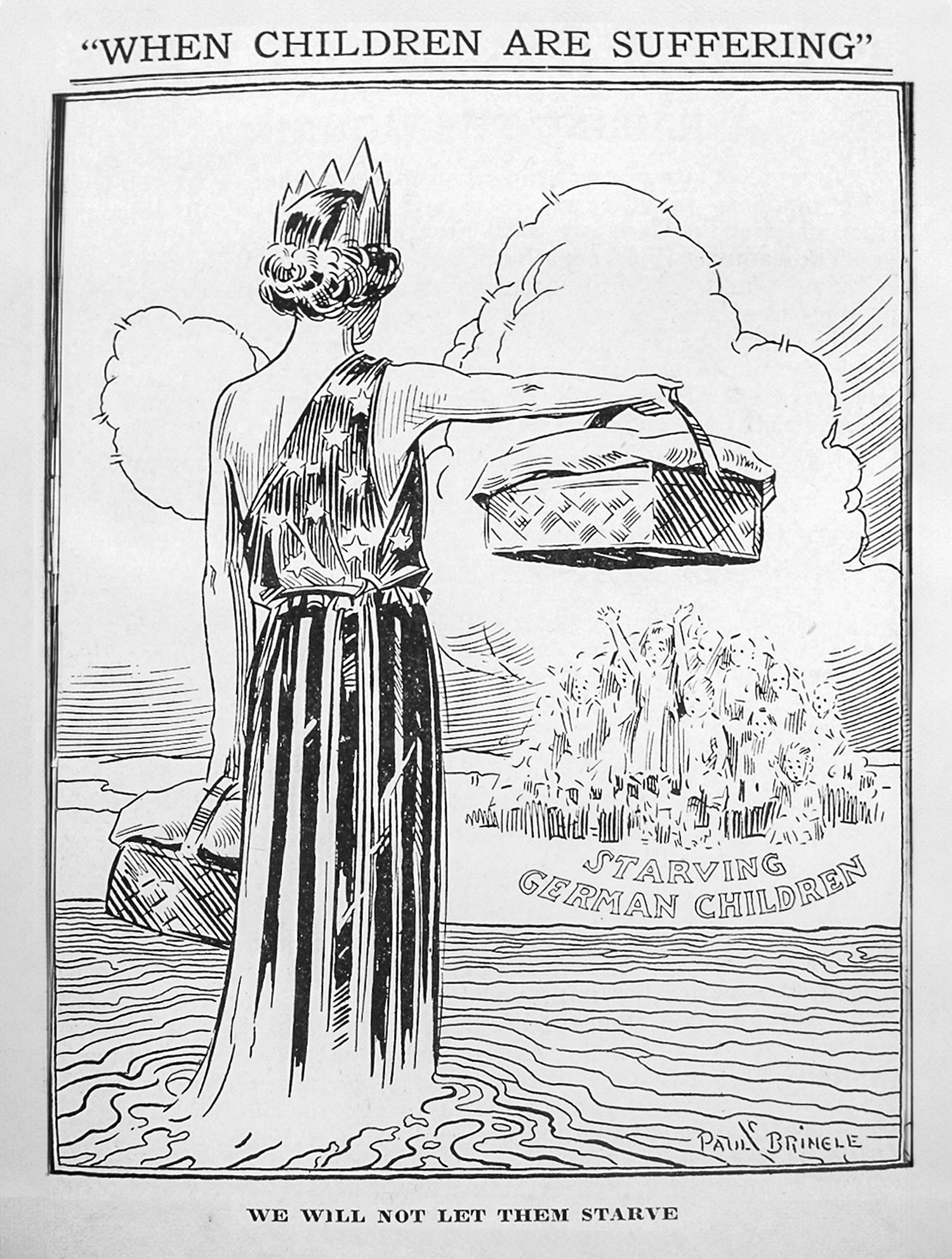
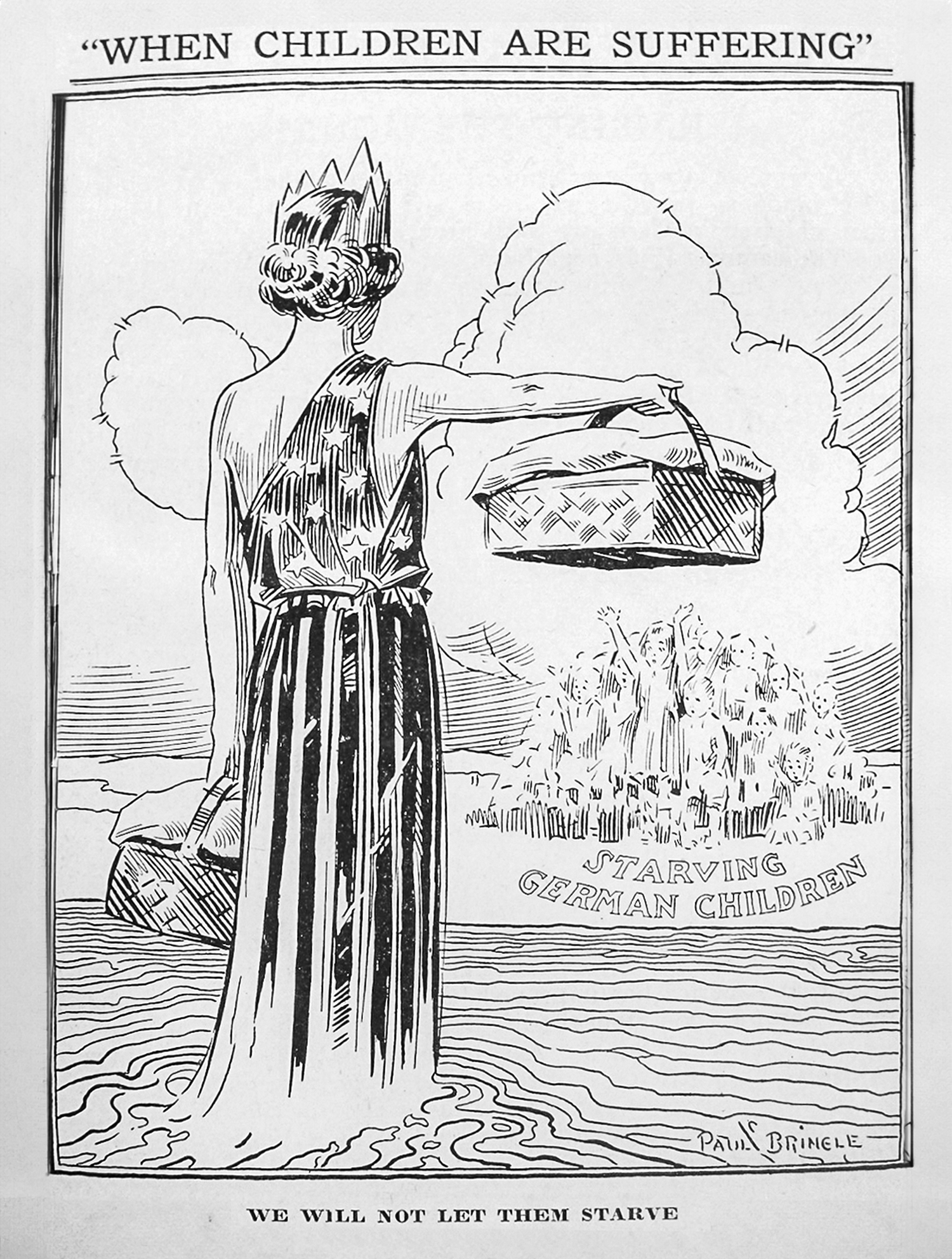
The widespread charge of German ‘ingratitude’ should be regarded as a moment of clarity. For one, it once more laid bare the survival of considerable prejudice and suspicion against Germany. Many of those Americans who had continued to doubt the veracity of German suffering or had accused Germany of ruining its currency on purpose, saw the incident as long-awaited proof of German duplicity and ill-will.Footnote 61 The vitriol of obituaries in the German press – faithfully cabled over to the United States by US news correspondents in Berlin – also thwarted German efforts to pass the incident off as a misunderstanding. Moreover, the flag incident revealed sharply diverging views of the transatlantic relationship and the role of the United States in the world. Americans conceived of their country as an exceptional and benevolent force (Figure 3) and considered their former president an honest, if imperfect, champion of an equitable peace. For that role they expected the acknowledgement, appreciation and, well, gratitude of those he had tried to help. One American of German descent expressed his outrage over the conduct of the German embassy in a letter to the New York Times. The flag incident, he claimed, was based on an altogether ‘wrong’ picture of Wilson. The former president, he asserted, ‘did more for the German people than any other man then in power’, and in fact was ‘their greatest friend and benefactor’.Footnote 62 Reading the press comments at the time, one cannot help but feel that the incident was not about Wilson per se. Rather, it was about US self-understanding as a benevolent hegemon, and in how far a vanquished Germany could be made to publicly accept that image.
Campaign poster of the fundraising campaign for German children. January 1924, Manuscript Division, Library of Congress, Henry T. Allen Papers, Box 29.
The flag incident did not ultimately derail the Dawes Plan, the fundraising drive for German children or the US–German rapprochement of the coming years. As Manfred Berg has shown, this was partly due to the US administration's decision to publicly ignore the incident.Footnote 63 Moreover, the relief campaign (like many before it) had always emphasised the innocence and deservingness of Germany's children despite the objectionable deeds of their elders. With such objectionable German behaviour at hand, this assumption unfolded a logic of its own and allowed the fundraising campaign to continue.Footnote 64 But the stark differences of perception, and their strongly emotional framing, unearthed unspoken assumptions and hitherto invisible fault lines. They highlight the contested nature of US–German relations after the war. Above all, the incident shows the public force of disappointed social expectations, and the limits such expectations impose on the actions of otherwise sovereign recipient nations. Even as the flag incident did not preclude the transatlantic reconciliation of years to come, it demonstrated how emotionally fraught this process was going to be.Footnote 65
(In)gratitude and Transatlantic Relations: Negotiating Aid and Power
What, if anything, does this episode tell us about gratitude and transatlantic relations more generally? I would hold that the expectations of gratitude – as well as the management and disappointment of such expectations – played a greater role in transatlantic relations than historians have so far acknowledged. Questions of gratitude were not unique to post-war Germany. As this special issue illustrates, gratitude and its adjacent emotional responses permeated transatlantic relations in the twentieth century. Even if the German case was complicated by recent enmity, it exemplifies more general European struggles to come to terms with US aid and ascendancy.Footnote 66
This is apparent when we look at European reactions to US economic and humanitarian aid in the era of the First World War. By the end of the war, European countries had received billions of dollars from the United States in both loans and charity. Wartime and armistice loans had gone toward financing US armament and munitions as well as large-scale ‘humanitarian’ food aid to wartime France and Belgium, and many countries thereafter.Footnote 67 In addition to loans, the United States had also provided hundreds of millions of dollars in public and private charity. In the aftermath of the war, US philanthropy fed European children in Berlin, Vienna, Budapest and Warsaw, rebuilt universities and libraries and repatriated refugees in Eastern Europe and the Mediterranean.Footnote 68 For this aid, whether loaned or gifted, Americans expected gratitude and appreciation in return.
The European beneficiaries of US aid were well aware of these expectations and sought to manage them in a number of ways. The most immediate way to do so, of course, was simply to express gratitude. This was often done in a spontaneous and heartfelt manner. In occupied Belgium, for example, where during the First World War US diplomats and relief workers provided a main source of sustenance and a window to the outside world, gratitude abounded. On New Year's Day 1915, Belgians descended on the US legation in Brussels and, the US minister reported, ‘something very beautiful occurred. Spontaneously, quietly, all day long, a stream of Belgians poured into the Legation leaving cards and signing names in a little book. . . . Over three thousand in all, to express their thanks for what America has done. . . . Nobody need tell me anymore that . . . there is no gratitude in the world.’Footnote 69 Such spontaneous expressions often stood alongside highly organised ones. The American Commission for Relief in Belgium received thousands of letters of gratitude from Belgian villages, which were ‘practically word for word the same, expressive of gratitude towards America’.Footnote 70 It was Belgians, in fact, who elevated gratitude to an art form as they masterfully embroidered US flour sacks, which were then returned to the United States with messages of gratitude and Belgian-American friendship.Footnote 71 In 1919, the Belgian king and queen visited the United States to once more give thanks for US food aid and, it seems, to align their country with the powerful United States in the future. And Belgium was not alone. In the early post-war years, all European countries put on splendid shows of gratitude to Americans: they handed out a prodigious number of medals and decorations, awarded honorary degrees, dedicated statues and squares, and forwarded a flood of individual letters of gratitude to US benefactors. Clearly, displays of gratitude became a way to build cordial relations with the United States in the decade after the war.
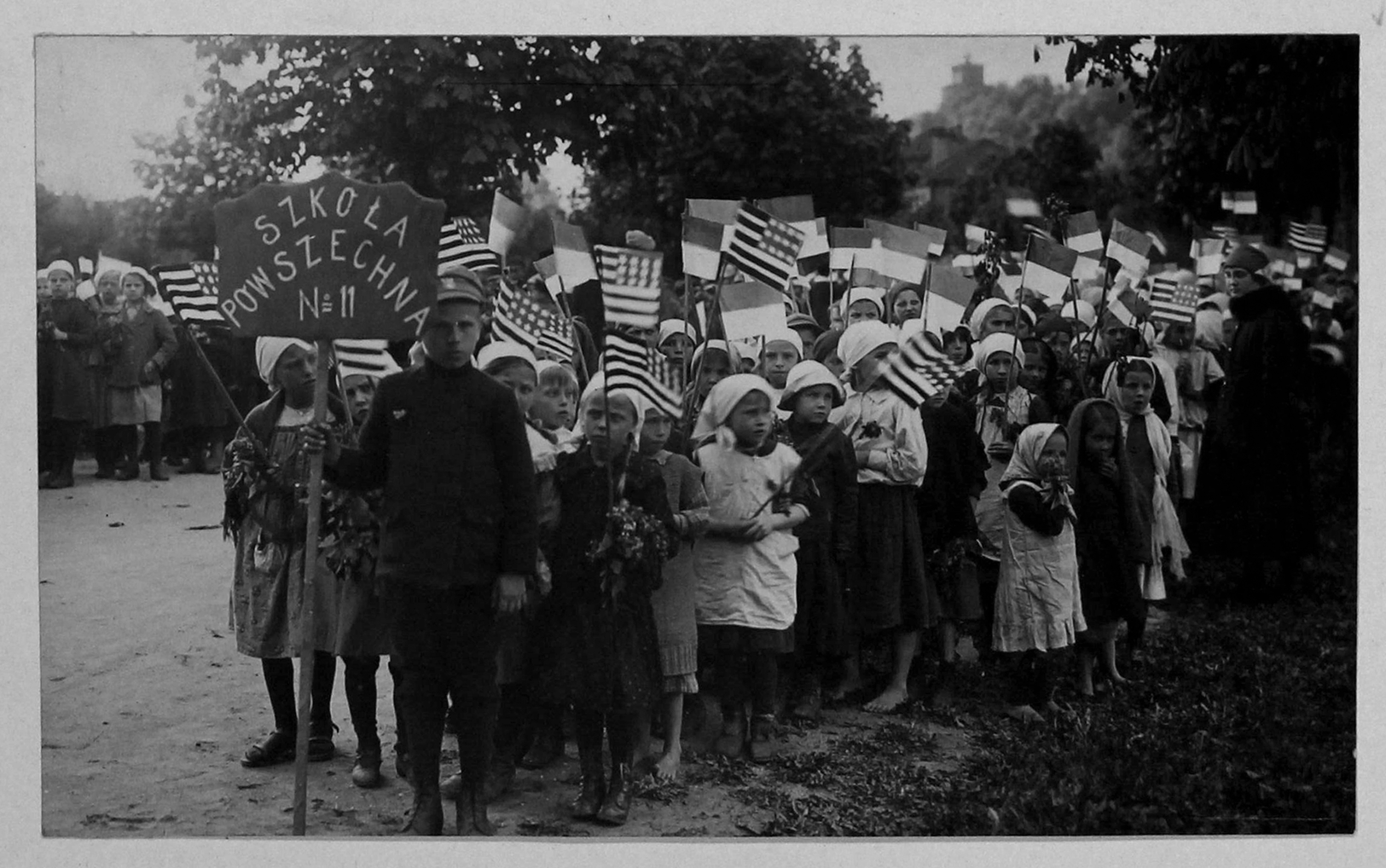
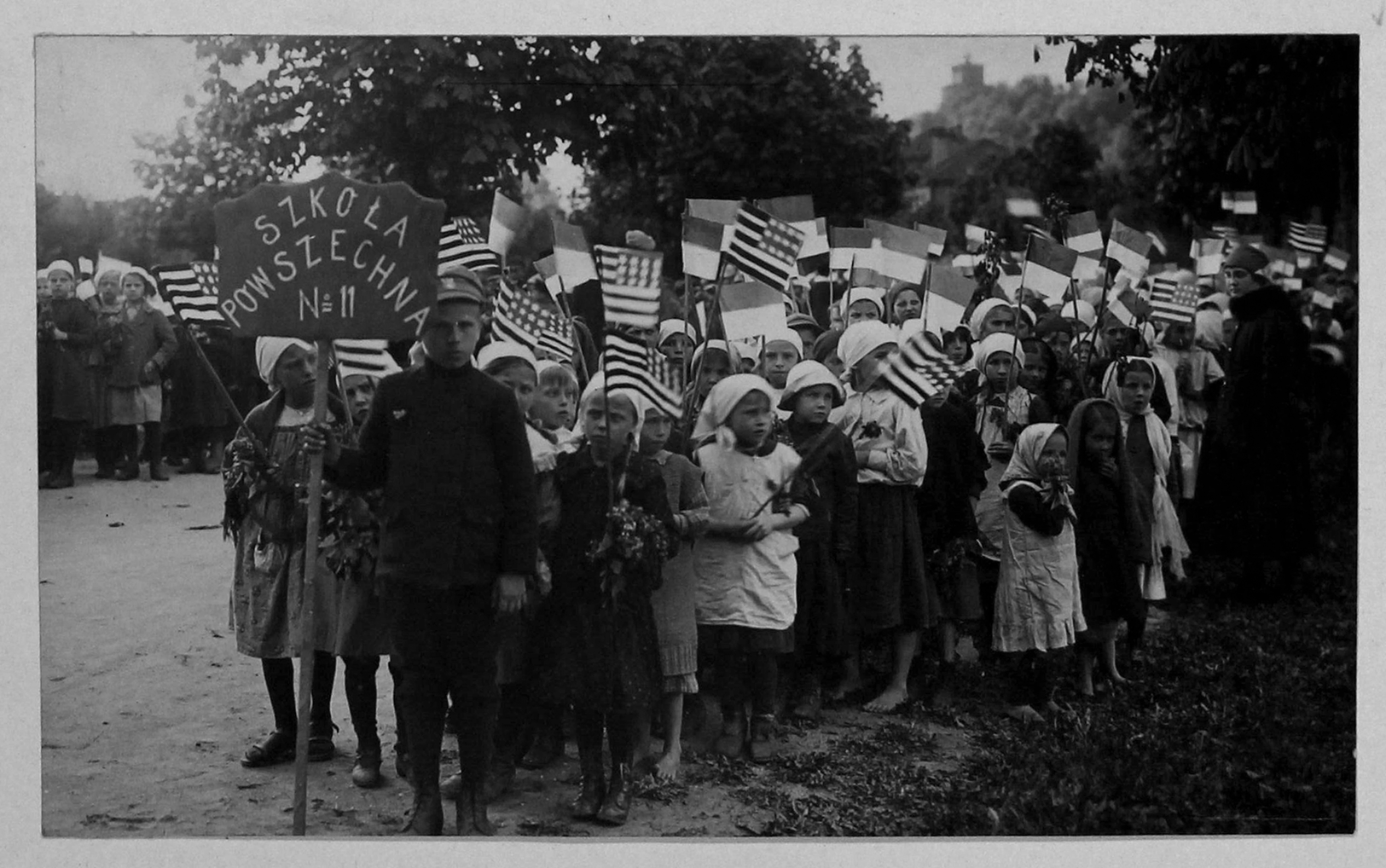
No doubt, ‘being grateful’ was on the whole easier for US allies than it was for Germany. After all, in the allied case, expressions of gratitude could always double as celebrations of ‘special relationships’ or commemorations of wartime alliance and victory. And still, many European countries struggled to remain grateful, and increasingly so in the later 1920s. All positive emotions aside, there was also a sense of humiliation and embarrassment in having to accept and acknowledge foreign aid in the first place. This was especially the case because many elite Europeans, especially those on the political right (including many diplomats), already felt very uneasy about US cultural and economic expansion at the time and because it was obvious that US aid entailed certain obligations towards the United States.Footnote 72 Recipient countries hence adopted a number of strategies to meet and manage US expectations and to sidestep some of the embarrassment that came with receiving US aid. The first strategy was to organise expressions of gratitude through children. For example, when Herbert Hoover visited Warsaw in 1919 and in 1922 (on the later occasion to attend the dedication of Hoover Square with a four-meter Monument of Gratitude to America in its centre), the Polish government arranged for tens of thousands of children ‘to demonstrate their gratitude’.Footnote 73 The endless rows of schoolchildren parading by and waving little American flags moved US onlookers to tears.Footnote 74 The prominent participation of children in displays of national gratitude was logical, of course. Children were among the major beneficiaries of US aid, and the universal appeal of suffering children (or happy, well-fed ones) made for excellent publicity and continued donationsFootnote 75 (Figure 4). But the focus on children also helped defuse difficult questions of national dignity since children were not bound by the dictates of personal and national honour as much as adults, especially adult men.
Polish children assemble in Herbert Hoover's honour, Warsaw, 1919. Photograph album of Lithuanian schools, orphanages, and scenes 1919–20, William Parmer Fuller papers, Hoover Institution Library & Archives.
Recipients, as a second strategy, also commonly recast US aid as an act of solidarity, not charity. This could be done by highlighting the common identity of donors and beneficiaries, e.g. through thank-you notes from Belgian mothers to American mothers, or by emphasising the reciprocity of aid relations. France and US Francophiles, in particular, excelled at this latter strategy, commonly presenting US wartime and post-war aid as the repayment of long-standing cultural and military debts to France. US aid was variously seen as a rightful compensation for the French blood toll during the First World War, for the ‘gift’ of French high culture or for French support during the Revolutionary War.Footnote 76 By re-balancing gift relations, such presentations helped sidestep the more humiliating aspects of the ‘gratitude imperative’. In these ways, recipient countries sought to avoid the feeling of inferiority, sense of obligation and real imbalance in status that being a ‘grateful’ aid recipient implied.
And yet, these strategies were never fully successful. For one, it became increasingly difficult for European countries to profess their undying gratitude as the war's moral and emotional alliances waned over the course of the 1920s. The question of the repayment of Allied war debts to the US creditor, in particular, strained US relations with France, Belgium and the United Kingdom. Whereas Americans insisted on the repayment of US war and post-war loans,Footnote 77 the former Allies accused the US (now short for Uncle Shylock) of war profiteering and of intending to further bleed dry those European nations, which in contrast to the United States, had already ‘bled and suffered and sacrificed everything’.Footnote 78 Waves of resentment and anti-American feeling washed over Western Europe from the mid-1920s, laying bare very different understandings of what the two sides owed each other.Footnote 79 In fact, in many a French mind, the French death toll had already settled all debt to the United States, moral as well as financial. If anything, US debt forgiveness, and continued US financial and humanitarian support, was not a matter of US pity or compassion but something that France was entitled to due to its service and sacrifice.
Yet, many Americans, or so it seems, adhered to a much simpler narrative whereby the United States had ‘saved’ Europe and was thus owed not only debt repayment but also an appropriate degree of gratitude. As in the German case, this latter expectation was rarely articulated but became readily apparent when disappointed. It is notable, indeed, that in the 1920s, Americans were rather quick to interpret legitimate disagreements with their former allies as a lack of gratitude. As William Keylor has shown, it took only a few years until post-war France acquired a number of unflattering adjectives in the United States, including, ‘exploitative, spendthrift, . . . militaristic, disorderly, immoral and unsanitary’, as well as plain ‘ungrateful.’Footnote 80 When Frank Simonds, an influential US journalist, travelled to Europe in 1926 he was not alone to discover widespread resentment among those who, by US accounts, should have been most grateful. ‘The French feel’, Simonds recorded, ‘we are making them pay in money as they already have paid in blood for our war.’Footnote 81 Simonds was particularly disappointed when crossing into Belgium, which many Americans (partly due to earlier Belgian expressions of gratitude) believed to have saved from wartime famine. Even there, he found the memory of US kindness clouded by the question of debt repayment, which included repayment of food loans. ‘The Belgians’, found Simonds, ‘believe we promised to feed them and are now making them pay for it, after taking world credit.’Footnote 82 Just a few years after the First World War, Europe seemed to feel little gratitude to the United States.
It is difficult to know, of course, how such questions of gratitude shaped transatlantic relations, but it does seem probable that the vista of an ungrateful Europe further reinforced the isolationist tendencies of the US public in the 1920s and 1930s. It is also likely that the feeling of dependence on the United States – made tangible through expectations of gratitude – furthered steps towards an inner-European, especially Franco-German, accord on debt and reparations that would have promised greater freedom from US influence (such as the one contemplated at Thoiry in 1926).Footnote 83 What can be said with certainty is that interwar developments had a manifest influence on how US aid was organised and received after the Second World War. In fact, as another period of post-war reconstruction loomed in the early 1940s, would-be US aid providers and would-be European aid recipients drew clear lessons from the 1920s. Americans and Europeans clearly recognised the transatlantic strains that had developed over questions of aid, dependence and gratitude and sought to devise less contentious ways to organise post-war assistance. Rather than organise official humanitarian aid through strictly American and bilateral outlets, as had been done after the First World War, Washington decided to pool some of its resources in the multilateral United Nations Relief and Rehabilitation Administration (UNRRA), where differences between donor and recipient nations were intended to be less stark. ‘Relief as such’, recognised a 1942 US policy paper, ‘always creates an abnormal and, to a considerable extent, an unhealthy situation. It gives too much power to the giver, and tends to create a sense of inferiority on the part of the recipient. . . . We [Americans] ought not to play “lady Bountiful” and expect that world to thank us for being so rich.’Footnote 84 US largesse, American analysists and humanitarians predicted, could be spent to better effect in terms of US leadership and world peace if given via an international organisation. The former recipients, for their part, had arrived at distinct lessons of their own. Perhaps the most notable lesson – albeit often hard to follow – was that if one wanted to be respected and treated like a great power it was best to forego US charity altogether.Footnote 85
Conclusions
In all, there is much that international history scholarship can gain from studying questions of gratitude, especially with regard to foreign aid. On the side of ‘recipients’, we ought to think more thoroughly about gratitude as a form also of symbolic capital and explore its strategic and performative dimensions. Personal letters of gratitude, thank-you ceremonies or the dedication of monuments can be political instruments to build rapport with an influential donor, to convey advantageous national images or to create or reinforce ‘special relationships’. Gratitude, in short, can be an incredibly useful diplomatic tool and we should study it as such. Yet expectations of gratitude can also pose serious challenges. At its most basic, gratitude is the result of unbalanced gift relations and hence implies a sense of indebtedness and obligation. How exactly individuals and states balance the up- and downsides of gratitude and in how far they can tolerate the dependence it signals can tell us much about their self-image and sense of importance in the international order.
But for the study of benefactors, too, gratitude is important. When disappointed, expectations of gratitude can engender deeply emotional responses. In general, we should not underestimate the strong, even irate responses that perceptions of ‘ingratitude’ can produce. Actions that might normally pass as inconsiderate or tactless (as in the case of the flag incident) suddenly become deeply offensive. Taking ‘ingratitude’ seriously might help explain actions that seem otherwise incomprehensible. In fact, the article suggests that instances of perceived ‘ingratitude’ should be regarded as moments of clarity, when unarticulated assumptions become tangible to historians. With regard to aid, historians might well use these moments to study the power asymmetries inherent in donor/recipient relations, the set of obligations they entail and the recipient's efforts to meet or avoid them.
Above all, they might take these moments to explore humanitarian aid as a relational and multidirectional phenomenon that goes beyond giving on the one side and receiving on the other. Instead, gratitude, how it is expected and how it is expressed, can offer insight into how international relationships are negotiated. In particular, expectations of gratitude and instances of perceived ingratitude can throw a different light on the emotional and psychological fault lines of transatlantic relations. As diplomatic historians delve deeper into the emotions of foreign affairs, they should pay more attention to questions of gratitude.

 Open access

