




Introduction
Massive and sudden releases of meltwater have repeatedly taken place in the history of the Earth (Carrivick and Rushmer, Reference Carrivick and Rushmer2006), triggered by the melting of continental ice sheets (Clague and Evans, Reference Clague and Evans2000; Kershaw et al., Reference Kershaw, Clague and Evans2005; Murton et al., Reference Murton, Bateman, Dallimore, Teller and Yang2010; Baker, Reference Baker, Herget and Fontana2020) or alpine glaciers (Herget et al., Reference Herget, Agatova, Carling and Nepop2020; Turzewski et al., Reference Turzewski, Huntington, Licht and Lang2020). The last (i.e., Weichselian) glaciation in particular generated many glacial lake outburst floods (GLOFs) (Carling et al., Reference Carling, Burr, Johnsen, Brennand, Burr, Carling and Baker2009; Margold et al., Reference Margold, Jansen, Codilean, Preusser, Gurinov, Fujioka and Fink2018; O’Connor et al., Reference O’Connor, Baker, Waitt, Smith, Cannon, George and Denlinger2020; Wells et al., Reference Wells, Dugmore, Beach, Baynes, Sæmundsson and Luzzadder-Beach2022) that left distinct landforms in the formerly glaciated areas. The timing of these events can potentially be determined by optically stimulated luminescence (OSL) dating since all these landforms carry clastic sediments with suitable grain sizes. Several GLOFs have so far been OSL dated (Zolnikov et al., Reference Zolnikov, Deev, Kotler, Rusanov and Nazarov2016; Fisher, Reference Fisher2020; Last and Rittenour, Reference Last and Rittenour2021), however with various levels of success. Less successful dating highlights a risk of partial sediment bleaching (Agatova and Nepop, Reference Agatova and Nepop2017; Herget et al., Reference Herget, Agatova, Carling and Nepop2020; Hu et al., Reference Hu, Min, Zhou, Yang, Wang, Wang, Wang, Wang, Wang and Fan2022) because of the very rapid sedimentation and turbid water typical for catastrophic fluvial events (Yang et al., Reference Yang, Wang, Liu, Hu, Liu, Wu and Hu2022).
The Suwałki megafloods, which have recently been discovered in NE Poland, represent a continental GLOF-type flood with likely 2 × 10⁶ m3/s of water released (Weckwerth et al., Reference Weckwerth, Wysota, Piotrowski, Adamczyk, Krawiec and Dąbrowski2019a, Reference Weckwerth, Kalińska, Wysota, Krawiec, Adamczyk and Chabowski2022). This flood was originally considered to have occurred in at least two episodes at ∼19 ka BP and probably shortly after 16 ka BP based on the bimodal orientation of scour marks (Weckwerth et al., Reference Weckwerth, Wysota, Piotrowski, Adamczyk, Krawiec and Dąbrowski2019a) and the regional chronology of the ice-sheet retreat during the Weichselian glaciation in NE Poland (Marks, Reference Marks2012). Nevertheless, no direct chronology has so far been provided for this event except for several OSL ages for the GLOF fans, which mainly appear to overestimate the true age (Weckwerth et al., Reference Weckwerth, Kalińska, Wysota, Krawiec, Alexanderson and Chabowski2024). The present study is the first attempt to constrain the age of this flood by dating the sandy deposits found in giant bedforms (megadunes) and in a meltwater spillway. We discuss a possible cause of partial sediment bleaching encountered in some samples and place our results in a wider regional chronological context. Furthermore, several sediment samples are examined in microscale for grain roundness and surface texture to better constrain their origin. Our data serve as paleoenvironmental proxies to understand the complex relationships between the sediment formation, its age, and bleaching history.
Regional setting
General framework
The study area is located in northeastern Poland close to the Lithuanian border in the heavily undulating landscape of the Eastern Suwałki Lakeland and the Augustów Plain (Fig. 1A). Large relief differences are observed here with the lowest areas at ∼30 m above sea level (asl) in the valleys and the highest area of the Wiżajny upland rising to nearly 300 m asl. The Wiżajny upland generally drops from north to south, and it borders the topographically lower Western and Eastern Suwałki lakelands and the Augustów Plain in the west, east, and south, respectively (Fig. 1). The ice-sheet and meltwater activity combined with postglacial transformation shaped this complex landscape (Smolska, Reference Smolska2007a, Reference Smolska2007b, Reference Smolska2008), which mainly consists of a till plain hosting end moraines, thrust and squeezed-up ridges, eskers, kettle holes, and crevasse-fill features (e.g., Kondracki and Pietkiewicz, Reference Kondracki, Pietkiewicz, Galon and Dylik1967; Ber, Reference Ber1974, Reference Ber1982, Reference Ber2000). Several subglacial meltwater valleys of different sizes hosting the Hańcza, Szeszupa, Jeleniewo, and Great Szelment lakes dissect the till plain into separate geomorphic units. The Augustów Plain lies between 130 m asl and 190 m asl and is a vast, slightly undulating outwash plain formed by proglacial meltwater activity and cut by numerous tunnel valleys (Kondracki and Pietkiewicz, Reference Kondracki, Pietkiewicz, Galon and Dylik1967; Ber, Reference Ber1974; Bogacki, Reference Bogacki1976, Reference Bogacki1980; Zieliński, Reference Zieliński1989, Reference Zieliński1993; Krzywicki, Reference Krzywicki2002).
(A) Location of the study area in NE Poland and Europe (insert), and (B) its geomorphology. PM and L-P refer to the Pomeranian Phase and the Leszno-Poznań Phase of the last glaciation, respectively. Sites: 1 = Bryzgiel 1; 2 = Biała Woda 1-4; 3 = Płociczno 3; 4 = Płociczno 1; 5 = Ateny 2; 6 = Ateny 1; 7 = Ateny 4; 8 = Suwałki-Utrata 1; 9 = Osinki 2; 10 = Lipowo.

Previous chronology
Age determinations are limited in the study area and derive mainly from boulder exposure dating and thermoluminescence (TL) dating studies, where mainly glacial tills and meltwater silt from the Augustów Plain were dated to between 180 ka (no error bars given; Żurek, Reference Żurek1990) and 23.5 ± 3.5 ka (UG-2607-09; Krzywicki, Reference Krzywicki2002). These results suggested two tills deposited during the Saalian glaciation (Marine Oxygen Isotope Stage [MIS] 6) followed by one more till of the Świecie Stadial (MIS 3). The silt was deposited during the Grudziądz Interstadial and the Main Stadial (MIS 2) prior to the maximum ice-sheet advance (Krzywicki, Reference Krzywicki2002). Several TL ages are particularly important since they date the sediments almost directly below the sandy series of the Augustów Plain, and thus possibly constrain the age of the Augustów Plain to between 59.0 ± 8.8 to 53.7 ± 8.1 ka and 31.8 ± 4.8 to 23.5 ± 3.5 ka (see fig. 11 in Krzywicki [Reference Krzywicki2002]). However, direct dating of tills by luminescence, although frequent in the last century, is highly questionable (Gemmell, Reference Gemmell1988).
Cosmogenic 36Cl-exposure ages have been reported for 31 erratic boulders in the Suwałki Lakeland and gave results between 28.5 ± 4.4 ka and 14.4 ± 1.0 ka, which is a time period between the advance of the ice sheet to its maximum position and the final ice melting in the Szeszupa subglacial valley, respectively (Dzierżek and Zreda, Reference Dzierżek and Zreda2007), thus giving a wide age bracket for the surface sediments in the region. This is narrowed by the 10Be ages for the Pomeranian Phase in northeastern Poland (Fig. 1A) that yielded the mean ages of 16.6 ± 1.2 ka and 14.8 ± 0.4 ka specifically in the Suwałki area (Rinterknecht et al., Reference Rinterknecht, Marks, Piotrowski, Raisbeck, Yiou, Brook and Clark2005). The most recent recalculated 10Be surface exposure age along the Mazury Ice Stream section of the Pomeranian Phase ice-marginal belt gave a mean age of 16.4 ± 0.3 ka, including two ages from boulders located on the landforms from the maximum extent of that phase with a mean age of 16.5 ± 0.4 ka (Tylmann et al., Reference Tylmann, Rinterknecht, Woźniak, Guillour and Team2022), which is consistent with the previous inferences about the timing of the flood. The newest study determined that the flood is older than 13.2 ± 0.9 ka based on OSL dating (Weckwerth et al., Reference Weckwerth, Kalińska, Wysota, Krawiec, Alexanderson and Chabowski2024).
Megaflood signatures in the Suwałki area
The northern part of the Eastern Suwałki Lakeland and the Augustów Plain hosts a unique inventory of flood-related subglacial and proglacial features (Weckwerth et al., Reference Weckwerth, Wysota, Piotrowski, Adamczyk, Krawiec and Dąbrowski2019a). The northern part of the Augustów outwash plain is the key junction area where floodwaters discharging through the Bachanowo, Szeszupka, Jeleniewo, and Prudziszki meltwater gates flowed through the Western and Eastern spillways, merged slightly north of Suwałki, and continued to the south (Fig. 1B). The Western Spillway was generated by a double floodwater outflow with a water depth as high as 22 m (Weckwerth et al., Reference Weckwerth, Wysota, Piotrowski, Adamczyk, Krawiec and Dąbrowski2019a). A similar water depth is considered for the Eastern Spillway, however with a flow velocity higher than in the Western Spillway owing to a larger hydraulic gradient. These outflows deposited the central part of the Augustów Plain consisting of four outwash plain levels, with the first (highest) level being the oldest and the fourth (lowest) being the youngest (Figs. 1B and 2B). These outwash systems are in places dissected by subglacial channels, sometimes hosting kames, eskers, and glacial curvilineations (Fig. 1B).
(A) Sediment logs from the meltwater outburst plain, (B) their detailed locations, and (D, E) examples of sedimentary structures from sampled sections. See Table 1 for details of the sedimentary structures. (C) shows the uppermost part of the Osinki 2 synthetic section. GLOFs, glacial lake outburst floods; OSL, optically stimulated luminescence; CAM, Central Age Model; MAM-3, minimum age model with three parameters.

The bottom part of the Western Spillway was also affected by downcutting and lateral erosion by floodwaters that generated two outburst flood terraces located below outwash plain level 2. These terraces are traceable from the Szeszupka Gate (Fig. 1B) and the Prudziszki Gate (Fig. 2B) to the town of Suwałki and Wigry Lake, and correspond to outwash plain levels 3 and 4, respectively (Weckwerth and Wysota, Reference Weckwerth, Wysota and Migoń2024). Further south, the extensive outwash plain level 2 hosts numerous megadunes arranged in several clusters (Figs. 1B and 3A).
(A) Location of logs from the megadune field, and (B) sediment logs from the Płociczno 3 and 1 and Bryzgiel 1 sites. See Table 1 for details of the sedimentary structures. GLOFs, glacial lake outburst floods; OSL, optically stimulated luminescence; CAM, Central Age Model.

Methods
Fieldwork and sampling
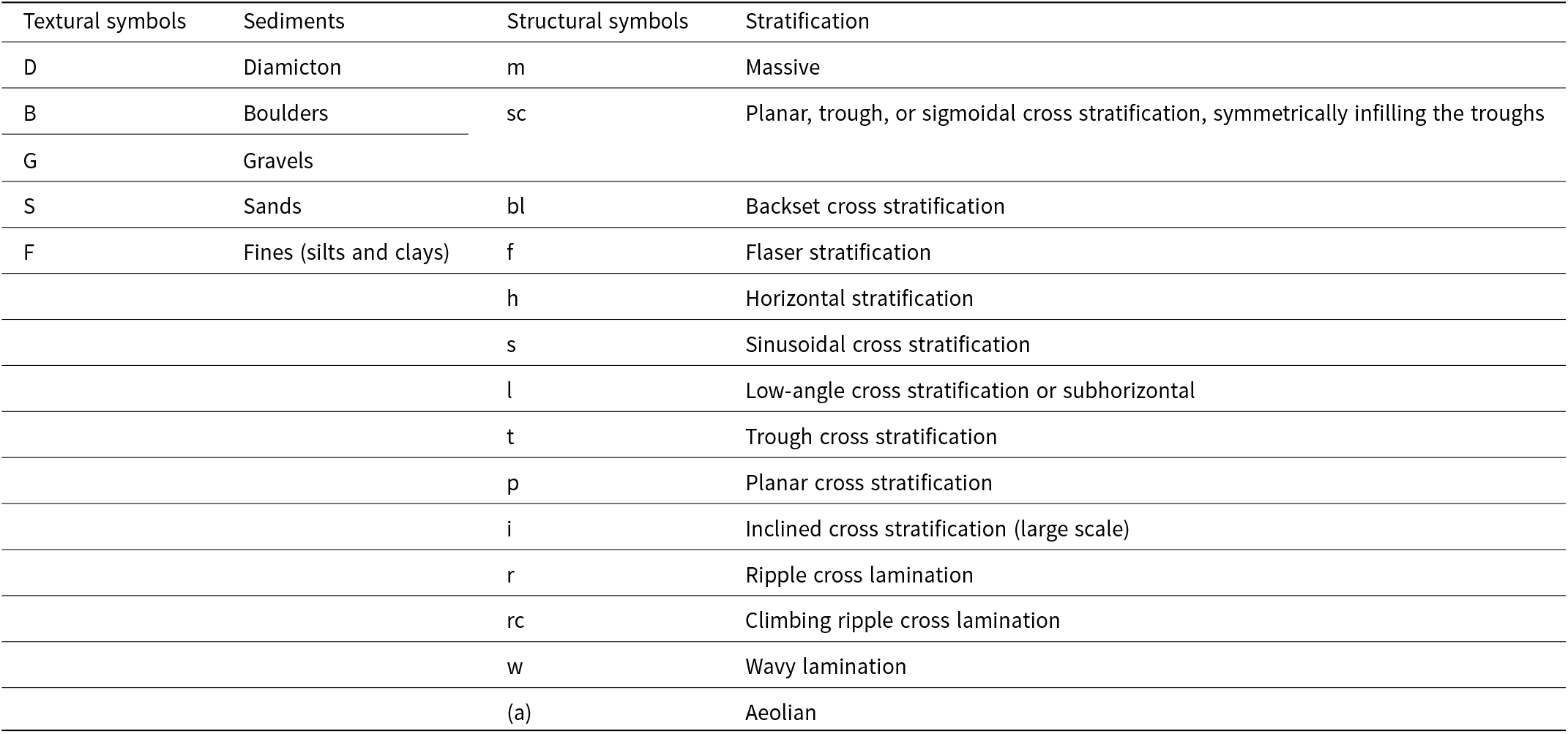
For the preliminary selection of fieldwork sites, a detailed light detection and ranging (LIDAR)-based digital elevation model was used. In the field, eight key sites (sand and gravel pits) were investigated: Biała Woda 1-4, Suwałki-Utrata 1, Płociczno 1 and 3, Bryzgiel 1, and Ateny 1, 2, and 4 (for location see Figs. 2B and 3A). Each site was subjected to sedimentologic investigations (Figs. 2A, 3B, and 4, Table 1) subsequently used to determine the stage of the flood (Table 2). For the determination of microscale sediment properties (Table 3), around 500 g of sand were taken parallel with the OSL sampling and transported to the Laboratory of Environmental Analyses, Nicolaus Copernicus University in Toruń, Poland for further investigation.
Sediment logs from the Ateny 1, 2, and 4 sites. See Table 1 for details of the sedimentary structures. GLOFs, glacial lake outburst floods; OSL, optically stimulated luminescence; CAM, Central Age Model; MAM-3, minimum age model with three parameters.

Lithofacies codes used for logging sediment characteristics (modified after Miall Reference Miall1978, Reference Miall1985; Lang et al. Reference Lang, Brandes and J2017a, Reference Lang, Sievers, Loewer, Igel and Winsemann2017b, Reference Lang, Le Heron, Van den Berg and Winsemann2021; Winsemann et al. Reference Winsemann, Lang, Polom, Loewer, Igel, Pollok and Brandes2018).

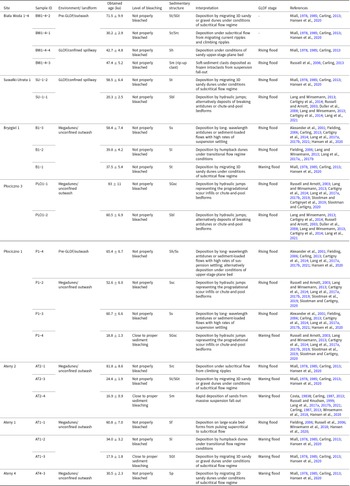
Sedimentary structures subjected to optically stimulated luminescence dating, their interpretation, and bleaching level.

See Table 1 for abbreviations of the sedimentary structures.
GLOF, glacial lake outburst flood.
Results of the Cailleux (Reference Cailleux1942) method modified by Mycielska-Dowgiałło and Woronko (Reference Mycielska-Dowgiałło and Woronko1998). a

a NU, fresh grains with no traces of transportation; RM, well-rounded grains with matt surface; EM/RM, partially rounded grains with matt surface; EL, well-rounded grains with shiny surface; EM/EL, partially rounded grains with shiny surface; C, cracked grains with at least 30% of grain missing; and others usually with highly weathered surface.
For the OSL sampling, we chose outwash sand that contained structures indicative of water flow conditions most favorable for effective sediment bleaching according to the recommendations by Weckwerth et al. (Reference Weckwerth, Przegietka, Chruścińska and Pisarska-Jamroży2013). Approximately 20-cm-long opaque PVC tubes were horizontally inserted into the sand, excavated, sealed, and transported to the laboratory in opaque bags securing full light protection. A total of 22 samples (Table 4) were shipped to the Lund Luminescence Laboratory (LLL), Lund University, Sweden for dating.
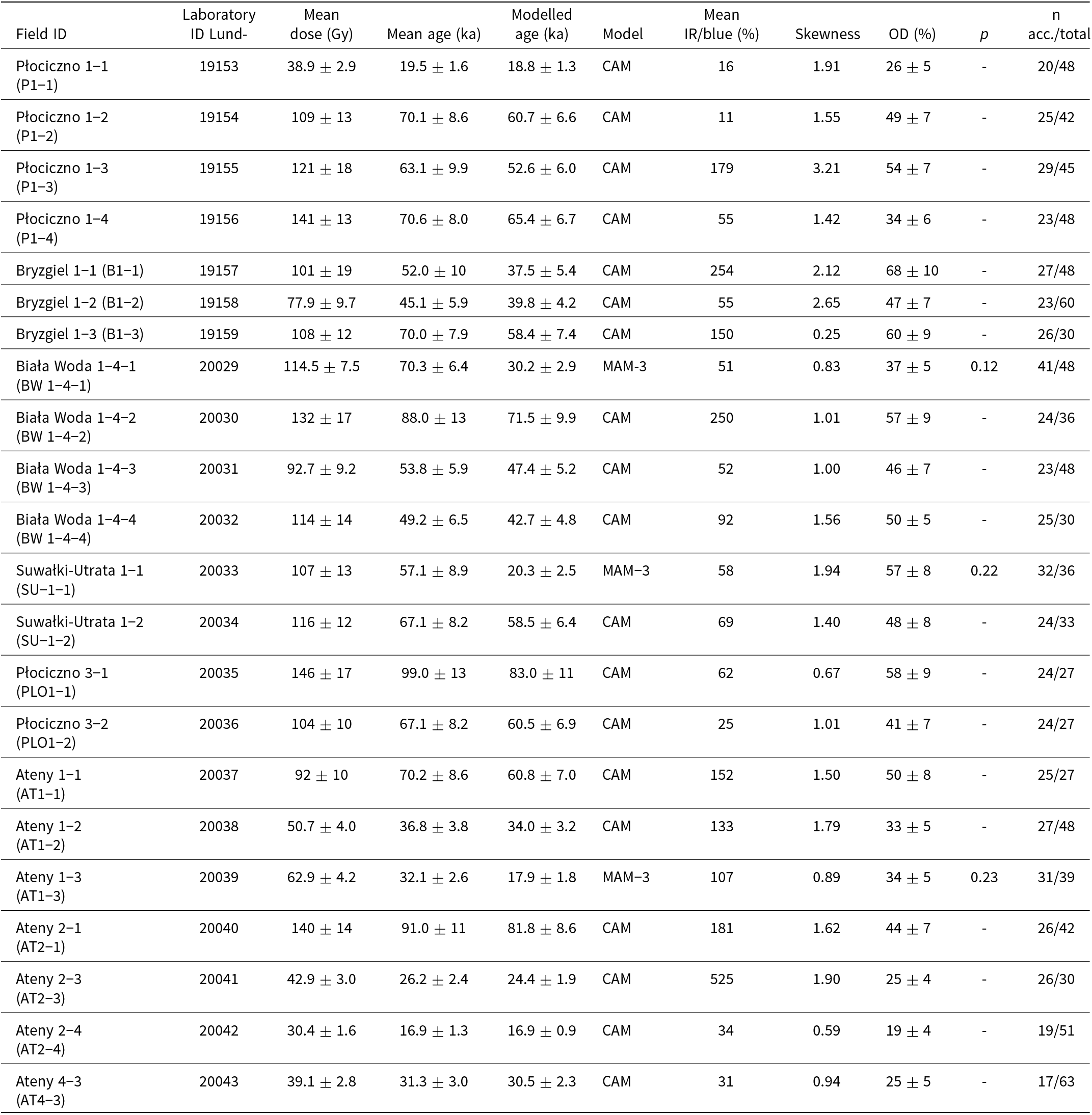
Summary of doses, mean ages, modelled ages, model used, mean infrared (IR) and blue ratio, skewness, overdispersion (OD), selected probabilities (p), and number (n) of accepted and total aliquots. Probabilities close to zero are marked with a hyphen.

For the OSL sampling, we chose outwash sand that contained structures indicative of water flow conditions most favorable for effective sediment bleaching according to the recommendations by Weckwerth et al. (Reference Weckwerth, Przegietka, Chruścińska and Pisarska-Jamroży2013). Approximately 20-cm-long opaque PVC tubes were horizontally inserted into the sand, excavated, sealed, and transported to the laboratory in opaque bags securing full light protection. A total of 22 samples (Table 4) were shipped to the Lund Luminescence Laboratory (LLL), Lund University, Sweden for dating.
OSL sample preparation
Samples in opaque PVC tubes were opened under subdued red light conditions at the LLL. Sediment from the outer part of the tube, which may have experienced light exposure during sampling, was separated and subjected to further dose rate and water content determination. Subsequently, the inner part of the sediment in the tube was wet-sieved. The 180–250 µm fraction was used for a two-step chemical treatment. In the first step, 10% HCl was used to remove carbonates and 10% H2O2 to remove any organic material followed by a density separation at 2.62 g/cm3 (LST Fastfloat) to separate quartz and feldspars. In the second step, quartz extracts were treated with 40% HF for 40 min to remove remaining impurities and to etch the outer surface of the grains followed by a 10% HCl treatment to clean out any fluorides. Once the extract was dry, a magnet was used to remove magnetic grains, and then the extract was re-sieved to make sure that a strict 180–250 µm fraction was used for further measurements.
The first outer sediment part of the tube was dried at 105°C, heated to 450°C for 24 hours, mechanically ground and homogenized with warm wax, and cast in a defined geometry in the Nordic Laboratory for Luminescence Dating, Risø, Denmark. The casts were stored for at least 3 weeks to ensure equilibrium between radon and its daughter nuclides. The sediment dose rate was determined by high-resolution gamma spectrometry, and the total environmental dose rate was calculated in the DRAC online calculator (Durcan et al., Reference Durcan, King and Duller2015).
In the second outer sediment part, the weight of water per dry mass was determined to obtain the field water content and then the sample was saturated for 24 hours and dried at 105°C for 24 hours to obtain the saturated water content.
Equivalent dose measurements, calculations, and statistical treatment
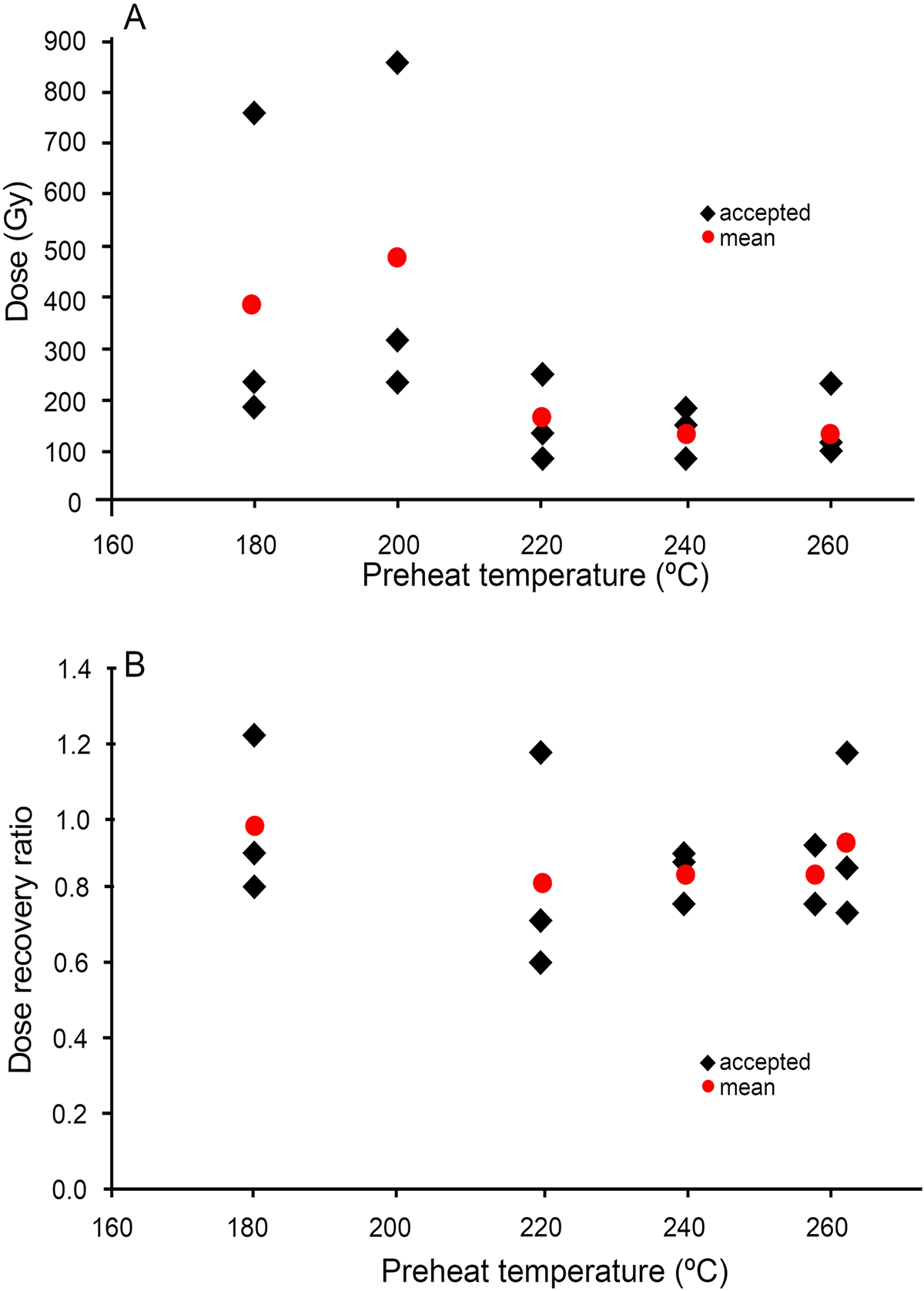
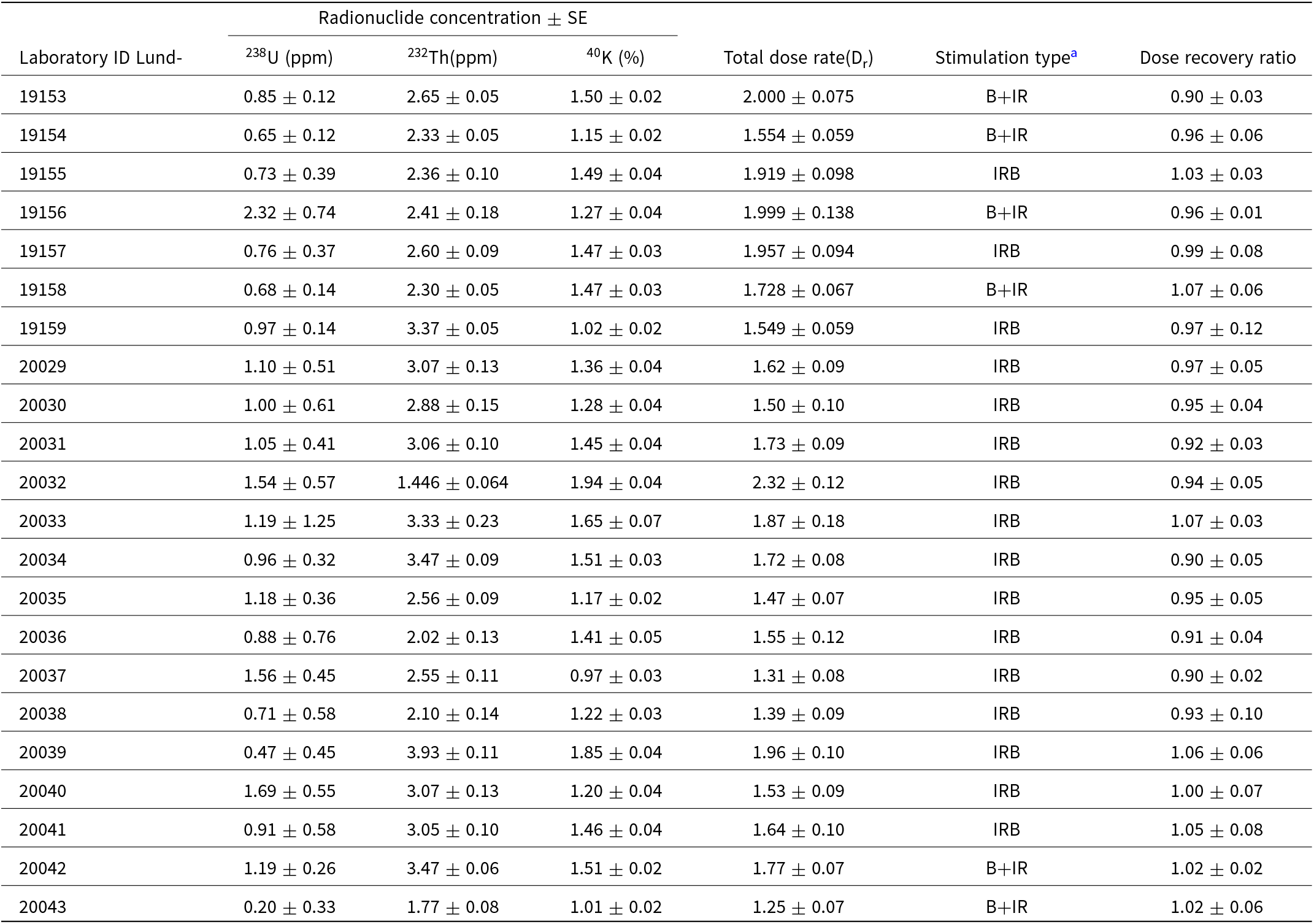
Small (2 mm) single aliquots of 180–250 μm quartz were analyzed in a Risø TL/OSL reader model DA-20 (Bøtter-Jensen et al., Reference Bøtter-Jensen, Thomsen and Jain2010). OSL stimulation was by blue light sources (470 ± 30 nm) and detection was through 7 mm of U340 glass filter, whereas infrared stimulated luminescence (IRSL) stimulation was by infrared (IR) light (870 nm) and detection was through a Schott BG39 filter. For quartz, the first 0.8 s of the signal were integrated for the peak, followed by 0.8 s for the early background. Single aliquot regenerative (SAR) protocols (Murray and Wintle, Reference Murray and Wintle2000, Reference Murray and Wintle2003) were used, with preheat and cutheat temperatures of 260°C and 240°C, respectively, for most of the samples (Fig. 5A) except for a lower temperature combination for samples 19159 (180/180°C; Fig. 5B) and 20030 (220/180°C). A preheat plateau test and dose recovery with different preheat temperatures were used to determine the temperatures that were considered most suitable for the samples (Fig. 5A and B). The dose recovery ratio was between 0.90 ± 0.03 and 1.07 ± 0.06 (Table 5), thus being acceptable and meaning that the temperatures were correctly set up.
(A) Preheat plateau test for sample 20029 (Biała Woda 1-4-1) with scattered low temperature results and more stable doses (a plateau) for higher temperatures (≥220°C) and (B) dose recoveries with different preheat and cutheat temperatures for sample 19159 (Bryzgiel 1-3) with two sets of measurements at 260°C (preheat/cutheat combinations 260/240°C and 260/260°C, respectively).

Summary of radionuclide concentrations, total dose rates (Dr), stimulation types, and dose recovery ratios.

a IRB, post-infrared blue; B+IR, blue with added infrared-test.
The laboratory dose rate was in the order of 0.16–0.20 Gy/s. Doses were calculated in the Risø Analyst 4.57 software using exponential curve fitting (Fig. 6A) and for higher doses a combination of exponential with linear curve fitting (Fig. 6B).
(A) Examples of optically stimulated luminescence decay and growth curves for sample 20042 (Ateny 2-4) with a steady rise of signal with dose and (B) for sample 19159 (Bryzgiel 1-3) with an aliquot that is at saturation. Decay curves in both cases show a relatively strong peak, which rapidly decays to a low background and predominance of a fast component.

Aliquots were accepted when they had a test dose error of <10%, a recycling ratio within 10% of unity, and recuperation <5% of the natural. Aliquots with De > 2D0 (i.e., close to saturation) were not rejected following Lowick et al. (Reference Lowick, Buechi, Gaar, Graf and Preusser2015). Nevertheless, about 35% of aliquots had to be rejected owing to apparent feldspar contamination, poor recycling, and, in some cases, test signal error.
IR-tests reveal that the mean IR/blue ratio has a wide range between 11 and 525% (samples 19154 and 20041, respectively; Table 4). For most samples, a double SAR protocol with post-IR blue stimulation was therefore used (Murray and Roberts, Reference Murray and Roberts1998), but for samples with only a few aliquots with an IR/blue ratio >10%, blue stimulation with an extra recycling with post-IR blue stimulation was applied to identify any aliquots with significant feldspar contamination (Duller, Reference Duller2003; Murray and Wintle, Reference Murray and Wintle2003). Importantly, the doses do not show any significant dependence on the apparent feldspar contamination (IR/blue ratio) despite quite high values in some cases.
The mean recycling ratio, which indicates the ability to repeat a measurement, falls close to unity, which is ideal. Similarly, recuperation, which reveals the response to zero dose, is below 5% of the natural signal.
Doses for age calculation were determined using the arithmetic mean (Guérin et al., Reference Guérin, Christophe, Philippe, Murray, Thomsen, Tribolo and Urbanova2017) and the Central Age Model (CAM) (Galbraith et al., Reference Galbraith, Roberts, Laslett, Yoshida and Olley1999). Ages for samples with significantly positively skewed dose distributions (Fig. 7; Supplementary material) were also calculated using the minimum age model with three parameters (MAM-3; Galbraith et al., Reference Galbraith, Roberts, Laslett, Yoshida and Olley1999; Burow, Reference Burow2021). However, MAM ages are only considered reliable for three samples (20029, 20033, and 20039), samples which had more than 30 accepted aliquots and significant probability values for the MAM age (0.12, 0.22, and 0.23, respectively). Probabilities close to zero hamper similar MAM-3 calculations for the rest of the samples. The overdispersion of the dose recovery was used for sigma b in the calculations.
Examples of equivalent dose distributions (abanico plots) for the three samples revealing the youngest ages (19153, 20039, and 20042; A, B, C), sample 19159 of the lowest skewness (D), and two samples (19155 and 19158) of the highest skewness (E, F).

Sediment textural properties
Three sediment samples (AT2-9, AT2-11, and AT2-12) from the uppermost part of the Ateny 2 section (Fig. 4) taken from periglacially reworked massive sand lacking any diagnostic sedimentary structures were subjected to textural analysis to help constrain their origin. These sediment samples were dried at 105°C for 24 hours and dry-sieved to retain 0.5–0.8 mm and 0.8–1.0 mm sediment fractions. These fractions were treated with HCl to remove any carbonates, rinsed several times with distilled water, dried, and further viewed under a binocular microscope to determine the grain roundness and the type of grain surface following the method of Cailleux (Reference Cailleux1942) modified by Mycielska-Dowgiałło and Woronko (Reference Mycielska-Dowgiałło and Woronko1998), which considers the following types of grains: aeolian-type (well-rounded and partially rounded with a matt surface; RM and EM/RM, respectively), fluvial-type (well-rounded and partially rounded with a shiny surface; EL and EM/EL, respectively), cracked with at least 30% of the grain missing (C), fresh with no traces of transportation (NU), and others usually with a highly weathered surface.
Results and interpretation
Geomorphology
The first set of OSL-dated sediments (samples 20029–20034; Table 4) comes from different outwash plain levels and different distances from the floodwater outlets (Fig. 1B). The Biała Woda 1-4 site is located in the proximal reach of the Eastern Spillway (Fig. 2B). This part of the Eastern Spillway is referred to as outwash plain level 2 and is characterized by at least two topographic levels with different morphologies. The lower level, where the Biała Woda 1-4 site is located, is incised by 2–4 m below the surrounding terrain at 192–193 m asl and is intersected by a system of second-rank braided channels, locally arranged in concentric arches (Weckwerth et al., Reference Weckwerth, Wysota, Piotrowski, Adamczyk, Krawiec and Dąbrowski2019a, Reference Weckwerth, Kalińska, Wysota, Krawiec, Adamczyk and Chabowski2022). The Suwałki-Utrata 1 site occurs at 165.6 m asl and is referred to as outwash plain level 4, which lies 7–8 m below outwash plain level 2 (Fig. 2B). The differences in altitude and presumed directions of floodwater outflows (Fig. 2B) show that outwash plain level 2 predates level 4. Moreover, the occurrence of scabland-like topography with many bedforms typical of repeated high-energy scour-and-fill processes (Weckwerth et al., Reference Weckwerth, Kalińska, Wysota, Krawiec, Adamczyk and Chabowski2022) and the location of the Biała Woda 1-4 site around 3 km southwards of the floodwater outlet (the Prudziszki Gate) clearly distinguish this setting from the characteristics of the Suwałki-Utrata 1 site. The latter is located 18.5 km from the meltwater outlet (Bachanowo Gate) in a two-times narrower outwash track.
The second set of OSL-dated sediments (samples 19153–19159 and 20035–20043; Table 4) comes from giant bedforms (megadunes) found in two different locations and within two spatial clusters. The first cluster is located south of Suwałki, while the second is located south of Wigry Lake (Fig. 1B), and continues further southeast (Suwiński and Weckwerth, Reference Suwiński and Weckwerth2024). Each of them comprises ridges with parallel and semiparallel crests. As shown by the orientation of the megadune crests within the cluster located south of Suwałki (Figs. 1B and 3A), the direction of meltwater flow was to the south. By contrast, the orientation of the megadune crests located south of Wigry Lake indicates water flow to the southwest. These morphological characteristics show different water sources and times of megadune formation. The megadune field south of Suwałki lies on outwash plain level 2, which was inundated by floodwater outflows probably at the same time through the Bachanowo, Szeszupka, and Prudziszki gates, located between 23.7 km and 14.6 km to the north.
Sediment architecture
In the proximal part of the Eastern Spillway, the pre-flood sediments are represented by a several-meters-thick series of small- and medium-scale cross-stratified sandy and gravelly lithofacies (Biała Woda 1-4 site; Fig. 2A and B). The up to 4-m-thick megaflood sedimentary succession is dominated by massive, poorly sorted, and matrix-supported boulders and cobbles with an admixture of pebbles and it contains sandy rip-up clasts (Fig. 2A and D). Within the flood sediments, pebbles and cobbles compose subhorizontal layers with crude bedding, while horizontally stratified sands form discontinuous interbeds (Fig. 2A and D).
Based on the morphological setting, the sedimentary succession at the Suwałki-Utrata 1 site represents a younger event and deposition in a more distal and confined portion of the floodwater track than at Biała Woda 1-4 (Fig. 1B). At the Suwałki-Utrata 1 site, GLOF deposits have a thickness of more than 5 m. In its middle part, large-scale gravelly scour infills occur (Gsc facies), which are capped by backset cross-stratified sands and trough cross-stratified sands (Sbl and St facies, respectively; Fig. 2A and E). In the upper part, large-scale backset cross-stratified gravels occur (Gbl).
Regarding the spatial changes in the sedimentary successions, the megadune deposits south of Suwałki show downstream-coarsening sequences from the sand-dominated sites Płociczno 3 and 1 to gravelly successions in sites Ateny 1, 2, and 4 (Figs. 3B and 4). In the proximal location (Płociczno 3 site), backset cross-stratified and scoured sands with an admixture of gravels dominate (SGbl, SGsc facies). These deposits grade into sandy-gravelly clinoforms at Płociczno 1 (SGi, GSi facies; Fig. 3B) and sands in the lower part of megadune successions at Ateny 1 and 2 (Fig. 4). Above the coarse-grained cross-bedded units are co-sets of trough cross-stratified gravels with an admixture of sand (GSt, SGt facies). These sediments are overlain by or interbedded with massive gravels (lithofacies Gm and GSm) or trough cross-stratified sands (St). The upper parts of the megadune successions are occupied by massive gravels (Gm) or massive sands (Sm), which, in many places, are capped by massive aeolian sands (Sm(a)). Moreover, the megadune sediments are deformed by a series of normal faults dipping towards the axes of the megadune crestal depressions (sites Ateny 1 and 2 and Bryzgiel 1; Figs. 3B, 4, 8A, C, and D).
Examples of sedimentary structures from sections sampled in the megadune field: (A) Bryzgiel 1, (B) Płociczno 1, (C) Ateny 1, and (D) Ateny 2 sites. See Table 1 for details of the sedimentary structures.

Textural properties of sediments in the upper part of the megadune succession
The uppermost, massive part of the Ateny 2 section reveals a combination of aeolian-type (well-rounded and partially rounded with a matt surface), fluvial-type (well-rounded and partially rounded with a shiny surface), and cracked grains, the latter constituting the largest share (above 50%) in the two examined sand fractions (Table 3). The topmost sample of AT2-12 (Fig. 4) is characterized by the highest share of aeolian-type grains (RM and EM/RM)—37% and 43% for the 0.5–0.8 mm and 0.8–1.0 mm fractions, respectively—whereas the proportion of aeolian-type grains in samples AT2-11 and AT2-9 (lower part of the section) does not exceed 30%. The fluvial-type grains constitute more than 26% of the share in the 0.5–0.8 mm fraction of sample AT2-11, and only 8% in the 0.8–1.0 mm fraction of sample AT2-12. Therefore, the topmost AT2-12 sample originates from aeolian deposition, whereas the aeolian input is lower in AT2-11 and AT2-9.
Luminescence characteristics
All investigated samples reveal aliquots with a clear fast signal component and fulfil the standard methodological tests as described above (Fig. 6A and B). However, occasional aliquots, especially those with high apparent feldspar contamination, also have significant medium and/or slow signal components. Growth curves reveal a steady growth of signal with dose, but most samples have at least some aliquots close to saturation. For example, sample 19159 stands out with 60% of aliquots with De > 2D0 (Fig. 6B).
The mean De values of the samples show a wide spread between 146 ± 17 Gy and 30.4 ± 1.6 Gy (Table 4), whereas the total dose rate values differ between 1.25 ± 0.07 Gy/ka and 2.32 ± 0.12 Gy/ka (Table 5). The latter is for sample 20032 and is higher than the rest of the values. The mean ages range from 16.9 ± 1.3 ka to 99 ± 13 ka, and the CAM ages are slightly younger, between 16.9 ± 0.9 ka and 83 ± 11 ka. For three samples (20029, 20033, and 20039) the MAM-3 model yielded ages between 17.9 ± 1.8 ka (20039) and 30.2 ± 2.9 ka (20029) with probability (P) values between 0.12 and 0.23 (Table 4), and these younger modelled ages are further discussed. Overall, the youngest obtained ages are: 16.9 ± 0.9 ka for the uppermost part of the Ateny 2 section (20042), 17.9 ± 1.8 ka for the uppermost part of Ateny 1 (20039), 18.8 ± 1.3 ka for the uppermost part of Płociczno 1 (19153), and finally 20.3 ± 2.5 ka for the uppermost part of Suwałki-Utrata 1 (20033). Overdispersion for the dated samples is considered small for the uppermost part of Ateny 1 (19%; sample 20042; Table 4) and large for the rest, reaching as high as 68% for the uppermost part of the Bryzgiel 1 section (sample 19157).
Discussion
The obtained OSL ages combined with the previous chronological study in NE Poland (Dzierżek and Zreda, Reference Dzierżek and Zreda2007; Marks, Reference Marks2012) allow us to consider the three youngest results between 16.9 ± 0.9 ka and 18.8 ± 1.3 ka as the most probable depositional time of the flood sediments, and this is discussed in the context of the most recent chronological data from the adjacent sediment sections. Results older than 20.3 ± 2.5 ka do not seem to mark the real time of sediment deposition, except for one (58.4 ± 7.4 ka). Furthermore, several luminescence-related issues are raised regarding the age consistencies, purity of samples, De distribution, and the saturation of some samples.
The luminescence context
From the age–depth perspective, the dates are more or less consistent in the investigated sections, and the Suwałki-Utrata 1, Płociczno 3, Bryzgiel 1, and Ateny 1 and 2 sections in particular reveal older ages in the bottom parts followed by the youngest ages in the upper parts (Figs. 2A, 3B, and 4). Some age inversions occur in other investigated sections, and in particular the largest inversions of 9 ka and 8 ka are seen in the bottom parts of the Biała Woda and Płociczno 1 sections, respectively (Figs. 2A and 3B); however, they are statistically insignificant (errors within 1 sigma). Otherwise, the dates appear in stratigraphic order, though mostly with several thousand year distances between the dates, which is larger than geologically feasible.
The IRSL/OSL ratios clearly show that only one quartz sample is relatively feldspar free (Table 4), and this clean sample comes from the Płociczno 1 site that reveals an age of 60.7 ± 6.6 ka (19154), followed by the topmost sample (19153) that marks the megaflood event at 18.8 ± 1.3 ka with a mean IR/blue ratio of 16%. In contrast, the highest feldspar-contaminated sample (20041; as high as 525%) reveals an only slightly older age of 24.4 ± 1.9 ka. With an average IRSL/OSL ratio of ∼115%, most samples reveal a significant feldspar contamination, which, however, does not correspond with older or younger ages. Other studies showed that feldspar contamination may affect more significantly older samples (Tsukamoto and Rades, Reference Tsukamoto and Rades2016; Long et al., Reference Long, Tsukamoto, Buylaert, Murray, Jain and Frechen2019).
All but one (19159) sample show a significant skewness in De distribution (Sk ranges between 0.59 and 3.21; Fig. 7; Supplementary material). Considering a normal dose distribution for sample 19159 (skewness = 0.25; Fig. 7), the fully bleached log dose population must be represented by this sample as assumed by the commonly used statistical models of MAM-3 and MAM-4 (with four parameters) (Peng et al., Reference Peng, Li and Jacobs2020) and thus shows a depositional age of 58.4 ± 7.4 ka at the bottom of the Bryzgiel 1 profile, discussed later in the text. Additionally, since overdispersion is larger than 15% for multigrain samples from well-bleached sediments (Arnold and Roberts, Reference Arnold and Roberts2009), the above suggests that most of the samples experienced only partial grain bleaching.
The MAM-3 model may help in extracting the aliquots that are best bleached, and thus closest to the true burial age of the sediments, by identifying the lowest normal dose distribution within a population (Galbraith and Roberts, Reference Galbraith and Roberts2012; Yang et al., Reference Yang, Wang, Liu, Hu, Liu, Wu and Hu2022). In our study, MAM-3 gave statistically reliable results for three samples, but among them, only one age of 17.9 ± 1.8 ka (20039) from the Ateny 1 section was considered as representing the true depositional age in the context of the regional paleogeography (see below).
According to Duller (Reference Duller2012), saturation of the OSL signal from quartz is commonly observed and becomes more likely with the increasing age of the samples. As stated earlier, some aliquots close to saturation occur in our data set; however, a sample from the lowermost part of the Bryzgiel 1 section (19159), with an age of 58.4 ± 7.4 ka, exceeds 50% of saturated aliquots, and thus may likely be underestimating the dose (with a narrow distribution though; Fig. 7).
Timing of megadune formation and its paleogeographic context
Out of the 22 dated sediment samples, three fall into the expected time frame based on the previously obtained chronologies and inferences for the Suwałki area (e.g., Weckwerth et al., Reference Weckwerth, Wysota, Piotrowski, Adamczyk, Krawiec and Dąbrowski2019a), 16.9 ± 0.9 ka, 17.9 ± 1.9 ka, and 18.8 ± 1.3 ka (samples 20042, 20039, and 19153 from the Ateny 2, Ateny 1, and Płociczno 1 profiles, respectively; Figs. 3B and 4), with no plausible explanation for older ages: These three ages overlap within a 1σ interval and point to flood sediment deposition between 16.9 ± 0.9 ka and 18.8 ± 1.3 ka. The youngest age of 16.9 ± 0.9 ka refers to the massive topmost sands at the Ateny 2 site (Fig. 4), which are preliminarily considered either as (1) aeolian deposits, implying that dry conditions prevailed and the flooding event happened earlier, or (2) deposits from the final stage of the flood. Either way, this date provides a minimum age for megadune formation. This age is nearly 3 ka older than the aeolian dune formation in adjacent southern Lithuania, where the proximal outwash plain deposition ceased and was replaced by dune formation at 13.9–13.8 ka (Kalińska-Nartiša et al., Reference Kalińska-Nartiša, Thiel, Nartišs, Buylaert and Murray2015). This fact, coupled with the Cailleux analysis results (Table 3), suggests that the massive sand was deposited during the terminal flood stage when the megadune crests were finally shaped, rather than being formed by aeolian accumulation. This is further indicated by the abundance of cracked quartz grains in samples AT2-9 and AT2-11 with a modest share of aeolian-type grains, contrary to what was found in sample AT2-12 (Table 3) where grains with matt surfaces dominate (Kalińska, Reference Kalińska2012; Kalińska-Nartiša and Nartišs, Reference Kalińska-Nartiša and Nartišs2016). Our dates between 18.8 ± 1.3 ka and 16.9 ± 0.9 ka mark a time span of nearly 2 ka when at least two major glacial floods occurred in NE Poland (Weckwerth et al., Reference Weckwerth, Wysota, Piotrowski, Adamczyk, Krawiec and Dąbrowski2019a). Regarding the local perspective of the Suwałki area and the previously obtained chronologies mentioned earlier, our OSL data set may be considered as corresponding with 10Be ages of 17.2 ± 1.7 ka from the bottom part of outwash plain level 3, and 17.3 ± 1.7 ka from the till plain (see Table 1 in Tylmann et al., Reference Tylmann, Rinterknecht, Woźniak, Guillour and Team2022). Furthermore, our dates are consistent with the 36Cl age of 17.9 ± 1.3 ka from the top of a glacial curvilineation ridge adjacent to Hańcza Lake (Dzierżek and Zreda, Reference Dzierżek and Zreda2007).
The results of our dating fall generally between the Poznań (Frankfurt) Phase and the Pomeranian Phase of the last glaciation, which have approximate ages of 19 ka and 16 ka, respectively (Marks, Reference Marks2002, Reference Marks2012; Tylmann et al., Reference Tylmann, Rinterknecht, Woźniak, Bourlès, Schimmelpfennig, Guillou, Aumaître and Keddadouche2019; Marks et al., Reference Marks, Bitinas, Błaszkiewicz, Börner, Guobyte, Rinterknecht, Tylmann, Palacious, Hughes, Garcia-Ruiz and Andres2022), or even correspond to the Gardno Phase with its latest deglaciation age of 16.5 ± 0.6 ka (Tylmann and Uścinowicz, Reference Tylmann and Uścinowicz2022). Importantly, the Pomeranian ice-marginal belt covers the ca. 20–15 ka period, with the eastern sector (including NE Poland) retreating later to the north than its western sector (Tylmann et al., Reference Tylmann, Rinterknecht, Woźniak, Guillour and Team2022). New chronological inferences from the key Osinki site (Fig. 2C) indicate till deposition after ∼15.0–15.3 ka (massive sand in ice-wedge pseudomorphs) and before 13.8 ± 1.0 ka (massive sand atop till) in NE Poland (Wysota, W. et al., unpublished data; Figs. 2C and 9), which indicates an ice sheet advance between ∼1.6 and 3.8 ka earlier than the deposition of the flood sediments suggested by the OSL ages obtained in this study. The flooding occurred shortly after the maximum extent of the Scandinavian Ice Sheet during the Pomeranian Phase, because the flood landforms and sediments are incised into the till plain (Fig. 1B) dated to 15.0–15.3 ka. In southern Lithuania, only a few tens of kilometers east of the study area, the age of the Baltija ice limit is considered to be around 14.7 10Be ka (Rinterknecht et al., Reference Rinterknecht, Bitinas, Clark, Raisbeck, Yiou and Brook2008). However, as stated by Hardt and Böse (Reference Hardt and Böse2018), this data set should be considered as being 9–15% older than the original age, i.e., around 15.3 ± 1.4 10Be ka (see the supplementary material in Hardt and Böse [Reference Hardt and Böse2018]), because the regional 10Be production rates can be significantly lower than the scaled global production rate, which results in older exposure ages. Similarly, the youngest 36Cl age of 14.4 ± 1.0 ka from an erratic boulder (Dzierżek and Zreda, Reference Dzierżek and Zreda2007) corresponds with the age of the Baltija ice limit if made older by 10% and it is consistent with the new chronology after W. Wysota et al. (unpublished data; Fig. 2C). Considering the above, our dates may be slightly older than the true age of the flood.
We note an occurrence of organic deposition in the adjacent Lipowo paleolake, which is believed to have taken place between 16.49 ± 0.80 cal ka BP and 13.01 ± 0.89 ka (Rychel et al., Reference Rychel, Sokołowski, Sieradz, Hrynowiecka, Mirosław-Grabowska, Sienkiewicz and Niska2023; lacustrine organic matter and lacustrine sands in Fig. 9) that is after our OSL ages. However, the former date is questionable because of the sampling proximity to a diamicton likely resulting in a significant admixture of carbonates as documented by those authors (Rychel et al., Reference Rychel, Sokołowski, Sieradz, Hrynowiecka, Mirosław-Grabowska, Sienkiewicz and Niska2023). Accordingly, the paleolake may have existed for a shorter time than originally suggested, that is between 14.625 ± 0.650 cal ka BP and 13.01 ± 0.89 ka (see Fig. 2C in Rychel et al. [Reference Rychel, Sokołowski, Sieradz, Hrynowiecka, Mirosław-Grabowska, Sienkiewicz and Niska2023] and OSL ages for lacustrine sands in Fig. 9) similar to other paleolakes in the region (Karasiewicz et al., Reference Karasiewicz, Hrynowiecka, Weckwerth, Pawłowski, Rzodkiewicz and Krzymińska2024) so that the time window for the Suwałki flood would be between 15.0 ka and 14.625 ± 0.650 cal ka BP followed by some ordinary meltwater drainage at 13.2 ± 0.9 ka (Fig. 9; Weckwerth et al., Reference Weckwerth, Kalińska, Wysota, Krawiec, Alexanderson and Chabowski2024).
Relationships between the obtained ages and the environmental factors (stage of the flood and distance from the source) influencing the bleaching level of the glacial lake outburst flood sediments.

Significantly older dates and their reliability
The formation of some local “normal” outwash deposits corresponds to moderate ice-marginal fluctuations prior to the ice advance to the last glacial maximum position (LGM; Leszno Phase at 24 cal/10Be/36Cl ka [Marks, Reference Marks2012] during the broad LGM between 29 ka and 19 ka defined by Hughes [Reference Hughes, Palacious, Hughes, Garcia-Ruiz and Andres2022] and Hughes et al. [Reference Hughes, Palacios, García-Ruiz, Andrés, Palacious, Hughes, Garcia-Ruiz and Andres2022]) and the R2 and the R3 runoff events of the European drainage river system (Toucanne et al., Reference Toucanne, Soulet, Freslon, Silva Jacinto, Dennielou, Zaragosi, Eynaud, Bourillet and Bayon2015; Weckwerth, Reference Weckwerth2018; Fersi et al., Reference Fersi, Penaud, Wary, Toucanne, Waelbroeck, Rossignol and Eynaud2021). This outwash deposition took place in northeastern Germany at 31 ± 4 ka and 30 ± 4 ka and at the southernmost ice extent of the Weichselian glaciation (Lüthgens et al., Reference Lüthgens, Hardt and Böse2020), and it also occurred repeatedly in the area of ice-marginal valleys between 30 ka and 22 ka, i.e., before the Leszno Phase in Poland (Weckwerth et al., Reference Weckwerth, Przegietka, Chruścińska and Pisarska-Jamroży2013; Weckwerth and Chabowski, Reference Weckwerth and Chabowski2013; Weckwerth, Reference Weckwerth2018), and again between 20.1 ± 1.6 ka and 19.4 ± 2.4 ka in front of the active ice margin of the Pomeranian Phase in northeastern Germany (Lüthgens et al., Reference Lüthgens, Böse and Preusser2011). Our ages between 34.0 ± 3.2 ka and 20.3 ± 2.5 ka (Ateny 1 and Suwałki-Utrata 1, respectively) seem to preliminarily correspond with the above mentioned “normal” outwash events, but considering the morphostratigraphic position of the GLOF sediments and new chronological inferences in NE Poland (i.e., the key Osinki site; Fig. 2C), the ages older than 20.3 ± 2.5 ka are substantially too old and should be disregarded in determining the age of the GLOF. One date of 58.4 ± 7.4 ka (Bryzgiel 1) in this old data set seems reliable because of a normal dose distribution (sample 19159 in Fig. 7; Lamsters et al., Reference Lamsters, Kalińska-Nartiša, Zelčs and Alexanderson2017; Kalińska et al., Reference Kalińska, Weckwerth and Alexandeson2023) indicating well bleached particles; however, the dated sediment was clearly deposited by the flood (facies Ss; Fig. 3B) and we therefore consider this old age as representing bleaching during some previous event.
The issue of the reliability of our numerous evidently too old OSL ages can be addressed in different ways, for example, by comparison of the OSL results from multiple grain-size fractions from fine silt to sand (Nian et al., Reference Nian, Zhang, Wang, Sun and Chen2021); support by IRSL measurements on the slower bleaching feldspar (Clemmensen et al., Reference Clemmensen, Hougaard, Murray and Pedersen2018); TL measurements (Gueli et al., Reference Gueli, Garro, Palio, Pasquale, Politi, Stella and Turco2018); thermally transferred OSL (TT-OSL) (Kim et al., Reference Kim, Duller, Roberts, Wintle, Lee and Yi2010); and independent age control (Kang et al., Reference Kang, Wang and Lu2013) by comparison with existing radiocarbon ages (Thomas et al., Reference Thomas, Murray and Sandgren2003), historical records (Medialdea et al., Reference Medialdea, Thomsen, Murray and Benito2014), historical maps (Quik and Wallinga, Reference Quik and Wallinga2018), sedimentary context (Arnold and Roberts, Reference Arnold and Roberts2011), radionuclide ages (Hu et al., Reference Hu, Yi, Zhang, Cao, Pan, Liu, Jiang, Yi, Li and Huang2018), electron spin resonance (Beerten et al., Reference Beerten, Verbeeck, Laloy, Vanacker, Vandenberghe, Christl, De Grave and Wouters2020), and many more. In our study, independent controls practically do not exist except for the sedimentary context as discussed below. Therefore, internal scrutiny of luminescence characteristics should be applied to test whether dating is reliable or not. SAR-OSL dating has many inbuilt rigor checks for testing the reliability of measuring laboratory-given doses, such as recycling, recuperation, IR depletion ratio tests, thermal stability tests, or the dose recovery test (e.g., Trandafir et al., Reference Trandafir, Timar-Gabor, Schmidt, Veres, Anghelinu, Hambach and Simon2015). All these tests were performed in our study and yielded acceptable results (see “Methods” for details). Additionally, the quartz revealed a sufficient signal brightness, which suggests that the sediments have undergone many cycles of reworking and/or burial under different transport distances to improve their sensitivity. Nevertheless, our ages reveal a 66 ka spread, many dates suffer from partial grain bleaching, and the obtained ages are difficult to reconcile with the previously documented geologic history of the region. For example, two outburst events are clearly seen between the Biała Woda 1 and Suwałki-Utrata 1 sites from the hypsometric and geomorphic evidence (Fig. 2B), with the former site assigned to the older event and the latter to the younger event. Yet, the OSL ages at both sites reveal a 20 ka overlap between ∼60 ka and 40 ka with the oldest age of 71.5 ± 9.9 ka (sample 20030) in the bottom part of the Biała Woda 1 site, with no significant age difference between these sites (Fig. 2A), and with no continuous deposition. Additionally, the sediment in the top part of Biała Woda 1 yielded an age of 47.4 ± 5.2 ka (sample 20031), which corresponds within a 1σ interval with the age of 42.7 ± 4.8 ka of sand slightly below, and is younger than the lower date of 58.5 ± 6.4 ka at the Suwałki-Utrata 1 site.
Partial sediment bleaching versus environmental factors
Different environments provide various levels of daylight exposure whereby subglacial or proglacial transport at night experiences no exposure at all (Rhodes, Reference Rhodes2011). We consider several environmental factors in the discussion of effective sediment bleaching: (1) sedimentary structures as proxies of transport mode, (2) distance from the water source, and (3) phase of flooding: rising and waning stages (Table 2, Fig. 9).
Among the sediments that yielded the youngest dates considered closest to the depositional age of the megadunes (e.g., 17.9 ± 1.8 ka [20039] in the Ateny 1 section; Figs. 4 and 8C), three types of structures appear: GSi, SGt, and Sm. Dates that are too old come from similar sedimentary structures, for example, 71.5 ± 9.9 ka (20030), 58.5 ± 6.4 ka (20034), 52.6 ± 6.0 ka (19155), 37.5 ± 5.4 ka (19157), 30.5 ± 2.3 ka (20043), and 24.4 ± 1.9 ka (20041) from St/SGt in the lowermost part of the Biała Woda 1-4 section, Suwałki-Utrata 1, Płociczno 1, Bryzgiel 1, Ateny 4, and Ateny 2 sites, respectively (Figs. 2A, 3B, 4, 8A, and 8D, Table 2). The age of 60.8 ± 7.0 ka (20037) was obtained on a sample from Si facies in the Ateny 1 section (Figs. 4 and 8C) and 47.4 ± 5.2 ka (20031) from GSm facies in Biała Woda 1-4 (Fig. 2A and D).
The fact that both ages that are close-to-true and too old come from similar sedimentary structures suggests that a megaflood setting does not ensure effective sediment bleaching, contrary to observations in ordinary rivers (Weckwerth et al., Reference Weckwerth, Przegietka, Chruścińska and Pisarska-Jamroży2013). According to Weckwerth et al. (Reference Weckwerth, Przegietka, Chruścińska and Pisarska-Jamroży2013), ripple cross-laminated sands (Sr) accumulated on a floodplain and horizontally stratified fine-grained sand (Sh) from shallow water flows offer the best potential for effective bleaching. Also, the distal ends of bars (King et al., Reference King, Robinson and Finch2014) and top surfaces of braid-bars (Flindt et al., Reference Flindt, Benediktsson, Alexanderson and Möller2018) are expected to be completely bleached. In our study, these structures are rather scarce except for a few OSL samples obtained from Sh. Interestingly, this most promising group of samples provided the oldest ages of 65.4 ± 6.7 ka at Płociczno 1 (Fig. 3B) and 42.7 ± 4.8 ka at Biała Woda 1-4 (Fig. 2A and D). The Src facies in the lowermost part of the Ateny 2 section (Figs. 4 and 8D) is not promising either as it reveals a very old age of 81.8 ± 8.6 ka. In contrast, massive sands (Sm), revealing low proneness to sunlight bleaching because of particle mixing due to high flow turbulence and a high content of suspended particles reducing the optical transparency of the water column (Thrasher et al., Reference Thrasher, Mauz, Chiverrell, Lang and Thomas2009; Weckwerth et al., Reference Weckwerth, Przegietka, Chruścińska and Pisarska-Jamroży2013), gave the youngest age of 16.9 ± 0.9 ka (Figs. 4 and 8D). Accordingly, we conclude that sedimentary structures do not help when selecting the best-bleached deposits for determining the age of a flood.
Sediments located at a distance of several kilometers from the ice-sheet margin are believed to have been sufficiently bleached (Fuchs and Owen, Reference Fuchs and Owen2008; Alexanderson and Murray, Reference Alexanderson and Murray2012), thus potentially providing the depositional age. Therefore, the southernmost megadune sediments in our study area are predicted to be better bleached than those close to the floodwater outlet. Some of our OSL dates from different reaches of the drainage pathways are consistent with this expectation (Fig. 9), but the overall pattern is diffuse. The better-bleached sediments occur at Płociczno 1 and Ateny 1 and 2 located in the middle part of the megadune field (Figs. 1 and 3A) and representing superimposed bedforms. However, sections in the most distal megadunes (Ateny 4 and Bryzgiel 1) yielded too old ages between 39.8 ± 4.2 ka and 30.5 ± 2.3 ka. Sediments in the proximal part of the outwash plains (Biała Woda 1-4 and Suwałki-Utrata 1 sites; Figs. 1 and 2B) are not properly bleached either, but this is understandable given their proximity to the water source and short transport distance.
The stage of flooding may be deciphered from the succession of deposits, especially when the fining of sediment grain sizes marks a drop in flood energy (Costello and Walker, Reference Costello and Walker1972; Marren, Reference Marren2005; Carling Reference Carling2013; Sobota et al., Reference Sobota, Weckwerth, Grajewski, Dziembowski, Greń and Nowak2018; Weckwerth et al., Reference Weckwerth, Greń and Sobota2019b; see Table 2). Several sites such as Płociczno 1 (Fig. 3B) and all of the Ateny sites (Fig. 4) reveal upward-fining successions, and their sediments (except for Ateny 4) seem bleached to some extent judging from the young ages obtained. The topmost part of the Ateny 4 section (sample 20043; Fig. 4) with an age of 30.5 ± 2.3 ka is similar to the uppermost part of Ateny 1 dated to 32.1 ± 2.6 ka (sample 20039 before applying the MAM-3 model), both marking the waning flood (Table 2). Since the MAM-3 model cannot be used for sample 20043 owing to a probability (p) value close to zero (Table 4) and too few measured aliquots, the age of 30.5 ± 2.3 ka cannot be recalculated as for sample 20039. In contrast to the flood termination, its rising is more difficult to trace in the sediment record mostly because of its erosive nature and sharp contacts between the pre-flood and flood sediments, such as in most of the megadune sections (Ateny 2 in Fig. 4). Assuming that the rising flood is marked by the coarse sediments, most ages obtained there are too old.
Best suited for determining the age of a flood are the deposits accumulated at the end of a flooding event (Fig. 9), with some exceptions (Table 2). This is consistent with studies on flooding in ordinary fluvial systems, where the waning flood sediments reveal a narrow age distribution reflecting a higher degree of bleaching contrary to the maximal flood stages characterized by a strong mix of different ages, resulting in a wide range of ages (Knight and Evans, Reference Knight and Evans2018; Bejarano-Arias et al., Reference Bejarano-Arias, Wees, Alexanderson, Janočko and Perić2023).
Conclusions
The first OSL dating of the sandy glacial outburst flood deposits of the Suwałki megafloods in NE Poland yielded 22 ages in a wide time span between 83 ± 11 ka and 16.9 ± 0.9 ka. Dated were sediments from megadunes and outwash plains. All ages are considered technically reliable, because their aliquots reveal the occurrence of the fast luminescence signal component along with all fulfilled tests to adapt the analytical SAR protocol to suit each sample. However, unfavorable depositional conditions, and especially a short transport distance, give a risk of partial sediment bleaching.
The youngest ages between 18.8 ± 1.3 ka and 16.9 ± 0.9 ka were obtained from the topmost part of a megadune, and this bracket corresponds with the time of the Poznań and Gardno phases of the last glaciation in Poland. However, the most recent chronologies from the region may suggest that the Suwałki flooding events were slightly younger, given an ice advance after ∼15.0 ka and onset of paleolake deposition at ∼14.625 cal ka BP.
The ages older than 20.3 ka suffer from incomplete bleaching, which is seen through a broad dose distribution, large overdispersion values, and no correspondence with the regional paleogeography. Based on the occurrence of some bleached grains, the most likely environmental factor ensuring proper sediment bleaching is transport and deposition during the waning stage of the flood.
Supplementary material
The supplementary material for this article can be found at https://doi.org/10.1017/qua.2024.50.
Acknowledgments
Phil Hughes, Juergen Herget, and Jason Dortch are thanked for their constructive comments on the manuscript. Marek Chabowski and Arkadiusz Krawiec are thanked for their help with fieldwork. This study was carried out as part of a scientific project financed by the National Science Centre, Poland (project No. 2018/31/B/ST10/00976) and was supported by the project to develop international collaboration with the world’s top academic institutions by members of Emerging Fields under the Excellence Initiative – Research University program (project no: 90-SIDUB.6102.9.2021.PMEF1), the Research University – Initiative of Excellence: “CatFlood Research Team,” the Emerging Field “Global Environmental Changes,” and the “CatFlood Research Team” at Nicolaus Copernicus University in Toruń, Poland.





 Open access

