



1 Introduction and basic notations
1.1 Context and motivation
The main topic of this work is the study of symplectic forms on homogeneous spaces of the form $G/MA \cong T^*\mathbb {F}$
, where
$G/MA \cong T^*\mathbb {F}$
, where $\mathbb {F}$
denotes the maximal flag manifold associated with a semisimple Lie group G. We provide an explicit description of the symplectic structure on
$\mathbb {F}$
denotes the maximal flag manifold associated with a semisimple Lie group G. We provide an explicit description of the symplectic structure on $T^*\mathbb {F}$
by analyzing the curvature
$T^*\mathbb {F}$
by analyzing the curvature $2$
-form of specific principal bundle realizations of
$2$
-form of specific principal bundle realizations of $G/MA$
, combined with appropriate linear functionals.
$G/MA$
, combined with appropriate linear functionals.
In [Reference Gasparim, Grama and San Martin4], several geometric realizations of $T^*\mathbb {F}$
were established, including its interpretation as:
$T^*\mathbb {F}$
were established, including its interpretation as:
-
• the homogeneous space $G/MA$
, and
$G/MA$
, and -
• a (co)adjoint orbit through a regular element in the Cartan subalgebra
$\mathfrak {h} \subset \mathfrak {g} = \operatorname {Lie}(G)$
.


The geometry of (co)adjoint orbits is a classical topic in Lie theory and symplectic geometry, with numerous applications (see, for instance, [Reference Azad, van den Ban and Biswas2, Reference Báez and San Martin3, Reference Gasparim, San Martin and Valencia5–Reference Jurdjevic8, Reference Martínez Torres11]).
While [Reference Gasparim, Grama and San Martin4] investigated various aspects of the symplectic geometry of $T^*\mathbb {F}$
, including the study of Lagrangian submanifolds, it left open the following fundamental question:
$T^*\mathbb {F}$
, including the study of Lagrangian submanifolds, it left open the following fundamental question:
When is the standard Kostant–Kirillov—Souriau (KKS) symplectic form on a complex adjoint orbit exact?
Our investigation begins with the special case of $\mathfrak {sl}(n+1,\mathbb {C})$
. Recall that for a regular coadjoint orbit
$\mathfrak {sl}(n+1,\mathbb {C})$
. Recall that for a regular coadjoint orbit $\mathcal {O}$
equipped with the imaginary part
$\mathcal {O}$
equipped with the imaginary part $\mathrm {Im}\,\Omega $
of the standard complex symplectic form, Arnold established the following theorem.
$\mathrm {Im}\,\Omega $
of the standard complex symplectic form, Arnold established the following theorem.
Theorem 1.1 [Reference Arnold1]
The orbit $(\mathcal {O}, \mathrm {Im}\,\Omega )$
is symplectomorphic to
$(\mathcal {O}, \mathrm {Im}\,\Omega )$
is symplectomorphic to $(T^*\mathbb {F}, \omega _{\text {Liouville}})$
if and only if all eigenvalues of some (hence any) representative matrix are real. Here,
$(T^*\mathbb {F}, \omega _{\text {Liouville}})$
if and only if all eigenvalues of some (hence any) representative matrix are real. Here, $\Omega $
denote the standard complex symplectic form on the coadjoint orbit
$\Omega $
denote the standard complex symplectic form on the coadjoint orbit $\mathcal {O}$
.
$\mathcal {O}$
.
In this article, we extend this result to arbitrary simple Lie groups.
Our approach is based on describing the Liouville 1-form and the canonical symplectic form on $T^*\mathbb {F}$
in terms of connections and curvatures of principal bundles diffeomorphic to
$T^*\mathbb {F}$
in terms of connections and curvatures of principal bundles diffeomorphic to $T^*\mathbb {F}$
. The identification of
$T^*\mathbb {F}$
. The identification of $T^*\mathbb {F}$
with the appropriate principal bundle arises naturally from the Lie-theoretic description of coadjoint orbits of G (specifically, via the fibration
$T^*\mathbb {F}$
with the appropriate principal bundle arises naturally from the Lie-theoretic description of coadjoint orbits of G (specifically, via the fibration $G \to G/MA \cong T^*\mathbb {F}$
– see the next section for notation).
$G \to G/MA \cong T^*\mathbb {F}$
– see the next section for notation).
More precisely, as is usual in reductive homogeneous spaces, the choice of complementary subspace induces a left-invariant connection (horizontal distribution) in the principal bundle $G \rightarrow G/MA$
. The curvature of this connection yields an
$G \rightarrow G/MA$
. The curvature of this connection yields an $\mathfrak {m} \oplus \mathfrak {a}$
-valued
$\mathfrak {m} \oplus \mathfrak {a}$
-valued $2$
-form on G. Composing this curvature form with invariant linear functionals on
$2$
-form on G. Composing this curvature form with invariant linear functionals on $\mathfrak {m} \oplus \mathfrak {a}$
produces
$\mathfrak {m} \oplus \mathfrak {a}$
produces $2$
-forms that descend to closed
$2$
-forms that descend to closed $2$
-forms on
$2$
-forms on $G/MA$
. In many important cases, these descended forms are in fact symplectic.
$G/MA$
. In many important cases, these descended forms are in fact symplectic.
The main results are the following (see Section 5 for details): let G be a simple Lie group with Lie algebra $\mathfrak {g}$
, and fix the identification
$\mathfrak {g}$
, and fix the identification $T^*\mathbb {F} \cong G/MA \cong \mathrm {Ad}(G)H_0$
, where
$T^*\mathbb {F} \cong G/MA \cong \mathrm {Ad}(G)H_0$
, where $H_0$
is a regular element in the center of
$H_0$
is a regular element in the center of $\mathfrak {m} \oplus \mathfrak {a}$
satisfying
$\mathfrak {m} \oplus \mathfrak {a}$
satisfying $\mathrm {Ad}(K)H_0 = \mathbb {F}$
.
$\mathrm {Ad}(K)H_0 = \mathbb {F}$
.
Theorem 1.2 Let the identification of $ T^{\ast } \mathbb {F} $
with
$ T^{\ast } \mathbb {F} $
with $ G/MA $
be made by equating both to an adjoint orbit
$ G/MA $
be made by equating both to an adjoint orbit $ \mathrm {Ad}(G) H_0 $
, where
$ \mathrm {Ad}(G) H_0 $
, where $ H_0 $
is in the center of
$ H_0 $
is in the center of $ \mathfrak {m} \oplus \mathfrak {a} $
and regular in the sense that
$ \mathfrak {m} \oplus \mathfrak {a} $
and regular in the sense that $ \mathrm {Ad}(K) H_0 = \mathbb {F} $
. Then, the Liouville form on
$ \mathrm {Ad}(K) H_0 = \mathbb {F} $
. Then, the Liouville form on $ T^{\ast } \mathbb {F} = G/MA $
is given by
$ T^{\ast } \mathbb {F} = G/MA $
is given by
 $$ \begin{align*} \lambda_{H_0,0}^{\ast} \left( \omega - \omega_{K \times K} \right) \end{align*} $$
where $ \lambda _{H_0} (\cdot ) = \langle H_0, \cdot \rangle $
is the “height function.” Therefore, the canonical symplectic form on
$ \lambda _{H_0} (\cdot ) = \langle H_0, \cdot \rangle $
is the “height function.” Therefore, the canonical symplectic form on $ T^{\ast } \mathbb {F} $
is
$ T^{\ast } \mathbb {F} $
is
 $$ \begin{align*} \Gamma = \lambda_{H_0,0}^{\ast} \left( \Omega - \Omega_{K \times K} \right) \end{align*} $$
where $ \Omega $
and
$ \Omega $
and $ \Omega _{K \times K} $
are the curvatures. In this expression, the component
$ \Omega _{K \times K} $
are the curvatures. In this expression, the component $ \lambda _{H_0,0}^{\ast } \Omega = \Omega _{\lambda _{H_0}} $
is the KKS form of the adjoint orbit by
$ \lambda _{H_0,0}^{\ast } \Omega = \Omega _{\lambda _{H_0}} $
is the KKS form of the adjoint orbit by $ H_0 $
.
$ H_0 $
.
Corollary 1.3 If $ H_0 \in \mathfrak {a} $
is a regular real element, then the KKS form
$ H_0 \in \mathfrak {a} $
is a regular real element, then the KKS form $ \kappa _{H_0} $
of the adjoint orbit
$ \kappa _{H_0} $
of the adjoint orbit $ \mathrm {Ad}(G) H_0 $
coincides with the canonical symplectic form
$ \mathrm {Ad}(G) H_0 $
coincides with the canonical symplectic form $ \Gamma $
of
$ \Gamma $
of $ T^{\ast } \mathbb {F} $
and is therefore an exact form. In terms of connections,
$ T^{\ast } \mathbb {F} $
and is therefore an exact form. In terms of connections,
 $$ \begin{align*} \kappa_{H_0} = d \left( \lambda_{H_0}^{\ast} \left( \omega - \omega_{K \times K} \right) \right) \end{align*} $$
where $ \omega $
is the
$ \omega $
is the $ G $
-invariant connection on
$ G $
-invariant connection on $ G \to G / MA $
.
$ G \to G / MA $
.
These results provide new insights into the interplay between Lie group symmetries, principal bundle geometry, and exact symplectic forms, with potential applications in geometric mechanics and mathematical physics.
In the next section, we recall some well-known facts from the semisimple Lie theory.
1.2 Basic notations and preliminaries concepts
Let us fix the notation we use throughout this article. We will closely follow the references [Reference Knapp9, Reference Knapp and Trapa10, Reference Martin12].
Let us fix a (global) Cartan involution of a connected reductive group G, that is, an automorphism $\theta $
of G with
$\theta $
of G with $\theta ^2 = 1$
and let
$\theta ^2 = 1$
and let $K = \{g \in G \mid \theta g = g\}$
be the subgroup of elements in G left fixed by
$K = \{g \in G \mid \theta g = g\}$
be the subgroup of elements in G left fixed by $\theta $
.
$\theta $
.
We abuse the notation and denote also by $\theta $
the differential of
$\theta $
the differential of $\theta $
at
$\theta $
at $e\in G$
. This is an automorphism of
$e\in G$
. This is an automorphism of $\mathfrak {g}$
with
$\mathfrak {g}$
with $\theta ^2 = 1$
. It is called the Cartan involution of
$\theta ^2 = 1$
. It is called the Cartan involution of $\mathfrak {g}$
.
$\mathfrak {g}$
.
Decompose the Lie algebra $\mathfrak {g}$
of G as
$\mathfrak {g}$
of G as
 $$ \begin{align} \mathfrak{g} = \mathfrak{k} \oplus \mathfrak{p} \end{align} $$
for the corresponding eigenspace decomposition for $\theta $
, associated with the eigenvalues
$\theta $
, associated with the eigenvalues $+1$
and
$+1$
and $-1$
, respectively.
$-1$
, respectively.
This decomposition is called the Cartan decomposition of $\mathfrak {g}$
. The decomposition has the following properties:
$\mathfrak {g}$
. The decomposition has the following properties:
-
•
$[\mathfrak {k}, \mathfrak {k}] \subseteq \mathfrak {k}$
,
$[\mathfrak {k}, \mathfrak {p}] \subseteq \mathfrak {p}$
,
$[\mathfrak {p}, \mathfrak {p}] \subseteq \mathfrak {k}$
. -
•
$\mathfrak {k}$
is the Lie algebra of K.


We remark that the subgroup K is the maximal compact subgroup of G.
A reductive Lie algebra is a Lie algebra that is the direct sum of two ideals, one equal to a semisimple Lie algebra and the other equal to an abelian Lie algebra.
Fix a linear connected reductive group G, and let $\mathfrak {a}$
be any maximal abelian subspace of
$\mathfrak {a}$
be any maximal abelian subspace of $\mathfrak {p}$
.
$\mathfrak {p}$
.
For $\lambda \in \mathfrak {a}^*$
, let
$\lambda \in \mathfrak {a}^*$
, let $\mathfrak {g}_\lambda $
be the corresponding simultaneous eigenspace, namely,
$\mathfrak {g}_\lambda $
be the corresponding simultaneous eigenspace, namely,
 $$\begin{align*}\mathfrak{g}_\lambda = \{X \in \mathfrak{g} \mid (\operatorname{ad} H)X = \lambda(H)X \text{ for all } H \in \mathfrak{a}\}. \end{align*}$$
If $\lambda \neq 0$
and
$\lambda \neq 0$
and $\mathfrak {g}_\lambda \neq 0$
, then
$\mathfrak {g}_\lambda \neq 0$
, then $\lambda $
is a restricted root, and any
$\lambda $
is a restricted root, and any $X \in \mathfrak {g}_\lambda $
is called a restricted-root vector. Let
$X \in \mathfrak {g}_\lambda $
is called a restricted-root vector. Let $\Pi $
be the set of all restricted roots. The result of the previous paragraph is that we obtain a direct sum decomposition
$\Pi $
be the set of all restricted roots. The result of the previous paragraph is that we obtain a direct sum decomposition
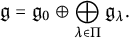 $$\begin{align*}\mathfrak{g} = \mathfrak{g}_0 \oplus \bigoplus_{\lambda \in \Pi} \mathfrak{g}_\lambda. \end{align*}$$
This is called the restricted-root space decomposition of $\mathfrak {g}$
.
$\mathfrak {g}$
.
It is well known that $\mathfrak {g}_0$
decomposes into
$\mathfrak {g}_0$
decomposes into $\mathfrak {g}_0 = \mathfrak {a} \oplus \mathfrak {m}$
, where
$\mathfrak {g}_0 = \mathfrak {a} \oplus \mathfrak {m}$
, where $ \mathfrak {m} = Z_{\mathfrak {k}}(\mathfrak {a})$
is the centralizer of
$ \mathfrak {m} = Z_{\mathfrak {k}}(\mathfrak {a})$
is the centralizer of $\mathfrak {a}$
in
$\mathfrak {a}$
in $\mathfrak {k}$
, and
$\mathfrak {k}$
, and $\mathfrak {a}$
is the maximal abelian subspace of
$\mathfrak {a}$
is the maximal abelian subspace of $\mathfrak {p}$
, fixed at the begging. Moreover, the sum is orthogonal with respect to the Cartan–Killing form.
$\mathfrak {p}$
, fixed at the begging. Moreover, the sum is orthogonal with respect to the Cartan–Killing form.
Let $\Pi ^+$
be the set of positive roots of
$\Pi ^+$
be the set of positive roots of $\Pi $
. Now we consider the Lie subalgebra of
$\Pi $
. Now we consider the Lie subalgebra of $\mathfrak {g}$
given by
$\mathfrak {g}$
given by
 $$\begin{align*}\mathfrak{n} = \bigoplus_{\lambda \in \Pi^+} \mathfrak{g}_\lambda. \end{align*}$$
Let A and N be the subgroups of G with Lie algebras $\mathfrak {a}$
and
$\mathfrak {a}$
and $\mathfrak {n}$
, respectively. We can now state the Iwasawa decomposition, first on the level of Lie algebras and then on the level of Lie groups. In the next proposition,
$\mathfrak {n}$
, respectively. We can now state the Iwasawa decomposition, first on the level of Lie algebras and then on the level of Lie groups. In the next proposition, $\mathfrak {k}$
is as in Equation (1.1), while
$\mathfrak {k}$
is as in Equation (1.1), while $\mathfrak {a}$
denotes, as before, the maximal abelian subspace of
$\mathfrak {a}$
denotes, as before, the maximal abelian subspace of $\mathfrak {p}$
fixed at the beginning.
$\mathfrak {p}$
fixed at the beginning.
Proposition 1.4 (Iwasawa Decomposition)
For G connected reductive, $\mathfrak {g}$
is a direct sum
$\mathfrak {g}$
is a direct sum
 $$\begin{align*}\mathfrak{g} = \mathfrak{k} \oplus \mathfrak{a} \oplus \mathfrak{n}. \end{align*}$$
Here:
-
•
$\mathfrak {a}$
is abelian; -
•
$\mathfrak {n}$
is nilpotent; -
•
$\mathfrak {a} \oplus \mathfrak {n}$
is solvable; -
•
$[\mathfrak {a} \oplus \mathfrak {n}, \mathfrak {a} \oplus \mathfrak {n}] = \mathfrak {n}$
.


Theorem 1.5 (Iwasawa decomposition for Lie groups)
For a connected reductive G, let A and N be subgroups with Lie algebras $\mathfrak {a}$
and
$\mathfrak {a}$
and $\mathfrak {n}$
, respectively. Then:
$\mathfrak {n}$
, respectively. Then:
-
• A, N, and
$AN$
are simply connected closed subgroups of G; -
• the multiplication map
$K \times A \times N \to G$
given by
$(k, a, n) \mapsto kan$
is a diffeomorphism onto G.



Next, we define $M = Z_K(\mathfrak {a})$
to be the centralizer of
$M = Z_K(\mathfrak {a})$
to be the centralizer of $\mathfrak {a}$
in K, that is, the set of all
$\mathfrak {a}$
in K, that is, the set of all $k \in K$
such that
$k \in K$
such that $\operatorname {Ad}(k)H = H$
for all
$\operatorname {Ad}(k)H = H$
for all $H \in \mathfrak {a}$
. Let us enumerate some basic properties of M:
$H \in \mathfrak {a}$
. Let us enumerate some basic properties of M:
-
(1) M is a closed subgroup of K, hence compact.
-
(2) M centralizes
$\mathfrak {a}$
and normalizes each
$\mathfrak {g}_\lambda $
. -
(3) M centralizes A and normalizes N. In fact,
$\operatorname {Ad}(m)\mathfrak {g}_\lambda \subseteq \mathfrak {g}_\lambda $
for all
$\lambda \in \Pi $
and
$m \in M$
. -
(4)
$MAN$
is a closed subgroup of G.





The subgroup $MAN$
is called a minimal parabolic subgroup of G. The homogeneous space
$MAN$
is called a minimal parabolic subgroup of G. The homogeneous space $G/MAN$
is called maximal flag manifold of G, and will be denoted by
$G/MAN$
is called maximal flag manifold of G, and will be denoted by $\mathbb {F}$
.
$\mathbb {F}$
.
2 Invariant G-connections and symplectic forms in
$T^{\ast }\mathbb {F}$

Keep the notation of the previous section. The main topic of this work is the study of symplectic forms in homogeneous space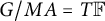 $G/MA = T\mathbb {F}$
, where
$G/MA = T\mathbb {F}$
, where $\mathbb {F}$
denotes the maximal flag manifold of the semisimple Lie group G. By endowing the flag manifold with a Riemannian metric, one can identify
$\mathbb {F}$
denotes the maximal flag manifold of the semisimple Lie group G. By endowing the flag manifold with a Riemannian metric, one can identify $T\mathbb {F}$
with
$T\mathbb {F}$
with $T^*\mathbb {F}$
. In what follows, we abuse notation and will denote
$T^*\mathbb {F}$
. In what follows, we abuse notation and will denote $G/MA = T^\ast \mathbb {F}$
. We will define symplectic forms as the curvatures of connections in the principal bundle
$G/MA = T^\ast \mathbb {F}$
. We will define symplectic forms as the curvatures of connections in the principal bundle $G \to G/MA$
with structure group
$G \to G/MA$
with structure group $MA$
.
$MA$
.
The homogeneous space $G/MA$
is reducible in the sense that the isotropy algebra
$G/MA$
is reducible in the sense that the isotropy algebra $\mathfrak {m} \oplus \mathfrak {a}$
admits a complementary subspace that is invariant under the adjoint representation of
$\mathfrak {m} \oplus \mathfrak {a}$
admits a complementary subspace that is invariant under the adjoint representation of $MA$
. As usually happens in a reducible homogeneous space, the complementary subspace defines a connection (horizontal distribution) in the principal bundle
$MA$
. As usually happens in a reducible homogeneous space, the complementary subspace defines a connection (horizontal distribution) in the principal bundle $G \rightarrow G/MA$
, and such connection is left invariant. The curvature of this connection is a
$G \rightarrow G/MA$
, and such connection is left invariant. The curvature of this connection is a $2$
-form on G with values in
$2$
-form on G with values in $\mathfrak {m} \oplus \mathfrak {a}$
. The composition of this
$\mathfrak {m} \oplus \mathfrak {a}$
. The composition of this $2$
-form with invariant linear functionals on
$2$
-form with invariant linear functionals on $\mathfrak {m} \oplus \mathfrak {a}$
defines
$\mathfrak {m} \oplus \mathfrak {a}$
defines $2$
-forms that project onto closed
$2$
-forms that project onto closed $2$
-forms on
$2$
-forms on $G/MA$
. In many cases, these
$G/MA$
. In many cases, these $2$
-forms on
$2$
-forms on $G/MA$
are symplectic forms.
$G/MA$
are symplectic forms.
This construction of connections and symplectic forms will be discussed in detail below.
The isotropy Lie algebra $\mathfrak {m} \oplus \mathfrak {a}$
admits the complementary space
$\mathfrak {m} \oplus \mathfrak {a}$
admits the complementary space $\mathfrak {n}^{+} \oplus \mathfrak {n}^{-}$
, which is invariant under the adjoint representation of
$\mathfrak {n}^{+} \oplus \mathfrak {n}^{-}$
, which is invariant under the adjoint representation of $MA$
, since if
$MA$
, since if $mh \in MA$
, then
$mh \in MA$
, then $\mathrm {Ad}(mh)$
leaves each root space invariant.
$\mathrm {Ad}(mh)$
leaves each root space invariant.
By taking left translations, define
 $$ \begin{align*} \mathcal{H}_{g} = \left( dL_{g} \right)_{1} \left( \mathfrak{n}^{+} \oplus \mathfrak{n}^{-} \right) \end{align*} $$
which is a left-invariant distribution on G. This distribution is a left-invariant connection on the principal bundle $G \rightarrow G/MA$
because if
$G \rightarrow G/MA$
because if $mh \in MA$
, then
$mh \in MA$
, then
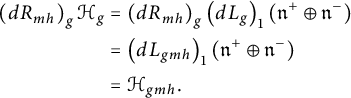 $$ \begin{align*} \left( dR_{mh} \right)_{g} \mathcal{H}_{g} &= \left( dR_{mh} \right)_{g} \left( dL_{g} \right)_{1} \left( \mathfrak{n}^{+} \oplus \mathfrak{n}^{-} \right) \\ &= \left( dL_{gmh} \right)_{1} \left( \mathfrak{n}^{+} \oplus \mathfrak{n}^{-} \right) \\ &= \mathcal{H}_{gmh}. \end{align*} $$
The connection form $\omega $
corresponding to
$\omega $
corresponding to $\mathcal {H}_{g}$
is a
$\mathcal {H}_{g}$
is a $1$
-form with values in the isotropy algebra
$1$
-form with values in the isotropy algebra $\mathfrak {m} \oplus \mathfrak {a}$
and is given by
$\mathfrak {m} \oplus \mathfrak {a}$
and is given by
 $$ \begin{align*} \omega_{g}\left( v \right) = \mathrm{proj}_{\mathfrak{m} \oplus \mathfrak{a}} \left( \left( dL_{g^{-1}} \right)_{g} v \right) \qquad v \in T_{g}G \end{align*} $$
where $\mathrm {proj}_{\mathfrak {m} \oplus \mathfrak {a}}$
is the projection onto
$\mathrm {proj}_{\mathfrak {m} \oplus \mathfrak {a}}$
is the projection onto $\mathfrak {m} \oplus \mathfrak {a}$
with respect to the decomposition
$\mathfrak {m} \oplus \mathfrak {a}$
with respect to the decomposition $\mathfrak {g} = \mathfrak {m} \oplus \mathfrak {a} \oplus \mathfrak {n}^{+} \oplus \mathfrak {n}^{-}$
.
$\mathfrak {g} = \mathfrak {m} \oplus \mathfrak {a} \oplus \mathfrak {n}^{+} \oplus \mathfrak {n}^{-}$
.
The values of $\omega $
on invariant vector fields are given as follows:
$\omega $
on invariant vector fields are given as follows:
-
(1) If
$X^{l}\left ( g \right ) = \left ( dL_{g} \right )_{1} \left ( X \right )$
is a left-invariant vector field, then
$\omega \left ( X^{l} \right )$
is constant and given by
$$ \begin{align*} \omega \left( X^{l} \right) = \mathrm{proj}_{\mathfrak{m} \oplus \mathfrak{a}} X. \end{align*} $$
In particular, if
$X \in \mathfrak {n}^{+} \oplus \mathfrak {n}^{-}$
, then
$X^{l}$
is a horizontal vector field. -
(2) If
$X^{r}\left ( g \right ) = \left ( dR_{g} \right )_{1} \left ( X \right )$
is a right-invariant vector field, then (2.1)since
$$ \begin{align} \omega_{g}\left( X^{r}\left( g \right) \right) = \mathrm{proj}_{\mathfrak{m} \oplus \mathfrak{a}} \left( \mathrm{Ad}\left( g \right) X \right) \end{align} $$
$X^{r}\left ( g \right ) = \left ( \mathrm {Ad}\left ( g \right ) X \right )^{l}\left ( g \right )$
.







The curvature $\Omega $
of the connection is obtained from the structure equation
$\Omega $
of the connection is obtained from the structure equation
 $$ \begin{align*} d\omega \left( X,Y\right) =-\frac{1}{2}\left[ \omega \left( X\right) ,\omega \left( Y\right) \right] +\Omega \left( X,Y\right) \end{align*} $$
where $d\omega \left ( X,Y\right ) =X\omega \left ( Y\right ) -Y\omega \left ( X\right ) -\omega \left [ X,Y\right ]$
. If X and Y are horizontal vector fields, then
$d\omega \left ( X,Y\right ) =X\omega \left ( Y\right ) -Y\omega \left ( X\right ) -\omega \left [ X,Y\right ]$
. If X and Y are horizontal vector fields, then $\omega \left ( X\right ) =\omega \left ( Y\right ) =0$
and thus
$\omega \left ( X\right ) =\omega \left ( Y\right ) =0$
and thus
 $$ \begin{align*} \Omega \left( X,Y\right) =-\omega \left[ X,Y\right] \qquad X,Y\in \mathcal{H}. \end{align*} $$
Since the connection is left-invariant, both the connection form $\omega $
and the curvature are left-invariant differential forms, that is,
$\omega $
and the curvature are left-invariant differential forms, that is, $L_{g}^{\ast }\omega =\omega $
and
$L_{g}^{\ast }\omega =\omega $
and $L_{g}^{\ast }\Omega =\Omega $
, for all
$L_{g}^{\ast }\Omega =\Omega $
, for all $g\in G$
.
$g\in G$
.
It is possible to write the connection and its curvature using a basis of $1$
-forms that are left-invariant on G. This basis is chosen starting with a basis
$1$
-forms that are left-invariant on G. This basis is chosen starting with a basis $\{X_{1},\ldots ,X_{r},Y_{1},\ldots ,Y_{s}\}$
of
$\{X_{1},\ldots ,X_{r},Y_{1},\ldots ,Y_{s}\}$
of $\mathfrak {g}$
such that the first r elements form a basis of
$\mathfrak {g}$
such that the first r elements form a basis of $\mathfrak {m}\oplus \mathfrak {a}$
and the remaining elements form a basis of
$\mathfrak {m}\oplus \mathfrak {a}$
and the remaining elements form a basis of $\mathfrak {n}^{+}\oplus \mathfrak {n}^{-}$
. Thus, the basis of
$\mathfrak {n}^{+}\oplus \mathfrak {n}^{-}$
. Thus, the basis of $1$
-differential forms, written as
$1$
-differential forms, written as $\{\varepsilon _{1},\ldots ,\varepsilon _{r},\delta _{1},\ldots ,\delta _{s}\}$
, is such that at the origin it is the dual basis of
$\{\varepsilon _{1},\ldots ,\varepsilon _{r},\delta _{1},\ldots ,\delta _{s}\}$
, is such that at the origin it is the dual basis of $\mathfrak {g}^{\ast }$
to the basis of
$\mathfrak {g}^{\ast }$
to the basis of $\mathfrak {g}$
.
$\mathfrak {g}$
.
With this choice, the invariant connection $\omega $
is defined on a left-invariant vector field X by
$\omega $
is defined on a left-invariant vector field X by
 $$ \begin{align} \omega \left( X\right) =\varepsilon_{1}\left( X\right) X_{1}+\cdots +\varepsilon_{r}\left( X\right) X_{r} \end{align} $$
since this is the vertical component of the invariant vector field. It follows from this and the expression for the curvature that if X and Y are left-invariant horizontal vector fields, then
 $$ \begin{align} \Omega \left( X,Y\right) =-\left( \varepsilon_{1}\left( \left[ X,Y\right] \right) X_{1}+\cdots +\varepsilon_{r}\left( \left[ X,Y\right] \right) X_{r}\right). \end{align} $$
An alternative way to view the connection and curvature is through the extension of the Cartan–Killing form $\langle \cdot , \cdot \rangle $
on
$\langle \cdot , \cdot \rangle $
on $\mathfrak {g}$
. This form is symmetric and invariant under the adjoint representation. Therefore, it extends to a pseudo-Riemannian (nonpositive-definite) metric on G. Let this metric be denoted by
$\mathfrak {g}$
. This form is symmetric and invariant under the adjoint representation. Therefore, it extends to a pseudo-Riemannian (nonpositive-definite) metric on G. Let this metric be denoted by $\mathcal {K}$
. Since
$\mathcal {K}$
. Since $\mathfrak {m}\oplus \mathfrak {a}$
is orthogonal to
$\mathfrak {m}\oplus \mathfrak {a}$
is orthogonal to $\mathfrak {n}^{+}\oplus \mathfrak {n}^{-}$
with respect to the Cartan–Killing form, the left-invariance of the horizontal and vertical spaces of the connection implies that they are orthogonal with respect to
$\mathfrak {n}^{+}\oplus \mathfrak {n}^{-}$
with respect to the Cartan–Killing form, the left-invariance of the horizontal and vertical spaces of the connection implies that they are orthogonal with respect to $\mathcal {K}$
. That is, the horizontal spaces of the connection are the
$\mathcal {K}$
. That is, the horizontal spaces of the connection are the $\mathcal {K}$
-orthogonal subspaces to the vertical spaces.
$\mathcal {K}$
-orthogonal subspaces to the vertical spaces.
Thus, if X is a left-invariant vector field, then $\omega (X)$
is the element of
$\omega (X)$
is the element of $\mathfrak {m} \oplus \mathfrak {a}$
whose left-invariant vector field is the orthogonal projection of X (with respect to
$\mathfrak {m} \oplus \mathfrak {a}$
whose left-invariant vector field is the orthogonal projection of X (with respect to $\mathcal {K}$
) onto the vertical subspace
$\mathcal {K}$
) onto the vertical subspace $\mathfrak {m} \oplus \mathfrak {a}$
, which is orthogonal to the horizontal subspace
$\mathfrak {m} \oplus \mathfrak {a}$
, which is orthogonal to the horizontal subspace $\mathfrak {n}^{+} \oplus \mathfrak {n}^{-}$
. The curvature
$\mathfrak {n}^{+} \oplus \mathfrak {n}^{-}$
. The curvature $\Omega [X, Y]$
is the orthogonal projection of
$\Omega [X, Y]$
is the orthogonal projection of $-[X, Y] = [Y, X]$
.
$-[X, Y] = [Y, X]$
.
The curvature $\Omega $
, when composed with linear functionals, can be “projected” onto the quotient space, often resulting in simple forms. This is done by the following construction.
$\Omega $
, when composed with linear functionals, can be “projected” onto the quotient space, often resulting in simple forms. This is done by the following construction.
A linear functional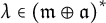 $\lambda \in \left ( \mathfrak {m}\oplus \mathfrak {a} \right )^{\ast }$
is
$\lambda \in \left ( \mathfrak {m}\oplus \mathfrak {a} \right )^{\ast }$
is $MA$
-invariant if
$MA$
-invariant if $\lambda \circ \mathrm {Ad}(g) = \lambda $
for all
$\lambda \circ \mathrm {Ad}(g) = \lambda $
for all $g \in MA$
. Let
$g \in MA$
. Let $\lambda $
be an
$\lambda $
be an $MA$
-invariant linear functional and define on G the 2-form
$MA$
-invariant linear functional and define on G the 2-form $\left ( \lambda \Omega \right ) \left ( X,Y \right ) = \lambda \left ( \Omega \left ( X,Y \right ) \right )$
where
$\left ( \lambda \Omega \right ) \left ( X,Y \right ) = \lambda \left ( \Omega \left ( X,Y \right ) \right )$
where $\Omega $
is the curvature of
$\Omega $
is the curvature of $\omega $
. This 2-form is right-invariant by
$\omega $
. This 2-form is right-invariant by $MA$
since if
$MA$
since if $g \in MA$
, then
$g \in MA$
, then
 $$ \begin{align} R_{g}^{\ast}\left( \lambda \Omega \right) = \lambda \left( R_{g}^{\ast} \Omega \right) = \lambda \left( \mathrm{Ad} \left( g^{-1} \right) \Omega \right) = \lambda \Omega. \end{align} $$
Moreover, $\Omega $
is a tensorial 2-form, that is,
$\Omega $
is a tensorial 2-form, that is, $\Omega \left ( X,Y \right ) = 0$
if either X or Y is vertical (this is a general property of curvatures in principal bundles). It follows that
$\Omega \left ( X,Y \right ) = 0$
if either X or Y is vertical (this is a general property of curvatures in principal bundles). It follows that $\lambda \Omega $
is the pull-back
$\lambda \Omega $
is the pull-back $\lambda \Omega = \pi ^{\ast } \Omega _{\lambda }$
by the projection
$\lambda \Omega = \pi ^{\ast } \Omega _{\lambda }$
by the projection $\pi : G \rightarrow G/MA$
of a 2-form
$\pi : G \rightarrow G/MA$
of a 2-form $\Omega _{\lambda }$
on
$\Omega _{\lambda }$
on $G/MA$
.
$G/MA$
.
The Bianchi identity for a curvature states that $d \Omega \left ( X, Y, Z \right ) = 0$
if
$d \Omega \left ( X, Y, Z \right ) = 0$
if $X, Y, Z$
are horizontal. Applying the functional
$X, Y, Z$
are horizontal. Applying the functional $\lambda $
, the same identity holds for
$\lambda $
, the same identity holds for $\lambda \Omega $
in place of
$\lambda \Omega $
in place of $\Omega $
. This implies that
$\Omega $
. This implies that $d \Omega _{\lambda } = 0$
, that is,
$d \Omega _{\lambda } = 0$
, that is, $\Omega _{\lambda }$
is a closed 2-form for any
$\Omega _{\lambda }$
is a closed 2-form for any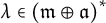 $\lambda \in \left ( \mathfrak {m}\oplus \mathfrak {a} \right )^{\ast }$
that is
$\lambda \in \left ( \mathfrak {m}\oplus \mathfrak {a} \right )^{\ast }$
that is $\mathrm {Ad}(MA)$
-invariant. Therefore, if
$\mathrm {Ad}(MA)$
-invariant. Therefore, if $\lambda $
is such that
$\lambda $
is such that $\Omega _{\lambda }$
is non-degenerate, then
$\Omega _{\lambda }$
is non-degenerate, then $\Omega _{\lambda }$
is a symplectic form.
$\Omega _{\lambda }$
is a symplectic form.
Example 2.1 (The KKS symplectic form of an adjoint orbit)
A general situation in which $\Omega _{\lambda }$
is a symplectic form is obtained by functionals
$\Omega _{\lambda }$
is a symplectic form is obtained by functionals $\lambda = \lambda _{H}$
defined by
$\lambda = \lambda _{H}$
defined by $\lambda _{H}\left ( \cdot \right ) = \langle H, \cdot \rangle $
,
$\lambda _{H}\left ( \cdot \right ) = \langle H, \cdot \rangle $
, $H\in \mathfrak {m}\oplus \mathfrak {a}$
. These linear functionals are
$H\in \mathfrak {m}\oplus \mathfrak {a}$
. These linear functionals are $\mathrm {Ad}(MA)$
-invariant if and only if H commutes with
$\mathrm {Ad}(MA)$
-invariant if and only if H commutes with $M $
. This occurs if
$M $
. This occurs if $H \in \mathfrak {a}$
or if H belongs to the center of
$H \in \mathfrak {a}$
or if H belongs to the center of $\mathfrak {m}$
.
$\mathfrak {m}$
.
In this case, $\Omega _{\lambda }$
at the origin is given by
$\Omega _{\lambda }$
at the origin is given by
 $$ \begin{align} \Omega_{\lambda}\left( X, Y \right) = \lambda \left( \Omega \left( X, Y \right) \right) = -\lambda_{H}\left( \omega \left[ X, Y \right] \right). \end{align} $$
That is,
 $$ \begin{align} \Omega_{\lambda}\left( X, Y \right) = -\langle H, \left[ X, Y \right] \rangle. \end{align} $$
This is the expression at the origin of the KKS symplectic form on the adjoint orbit $\mathrm {Ad}\left ( G \right ) \left ( -H \right )$
. The two symplectic forms
$\mathrm {Ad}\left ( G \right ) \left ( -H \right )$
. The two symplectic forms $\Omega _{\lambda _{H}}$
and KKS are invariant under
$\Omega _{\lambda _{H}}$
and KKS are invariant under $\mathrm {Ad}\left ( G \right )$
. Since they coincide at the origin, they are equal.
$\mathrm {Ad}\left ( G \right )$
. Since they coincide at the origin, they are equal.
The discussion above can be summarized in the following result.
Proposition 2.2 Let $H\in \mathfrak {m}\oplus \mathfrak {a} $
be a regular element (i.e.,
$H\in \mathfrak {m}\oplus \mathfrak {a} $
be a regular element (i.e., $\alpha (H)\neq 0$
, for all
$\alpha (H)\neq 0$
, for all $\alpha \in \Pi $
). Then
$\alpha \in \Pi $
). Then $\Omega _{\lambda _{H}}$
is the KKS symplectic form of the adjoint orbit
$\Omega _{\lambda _{H}}$
is the KKS symplectic form of the adjoint orbit $\mathrm {Ad}\left ( G \right ) \left ( -H \right )$
.
$\mathrm {Ad}\left ( G \right ) \left ( -H \right )$
.
3 Orbits in the product
$\mathbb {F}\times \mathbb {F}^* = \mathbb {F}\times \mathbb {F}$

The homogeneous space $G/MA$
is a special case of an orbit in the flag product
$G/MA$
is a special case of an orbit in the flag product $\mathbb {F}\times \mathbb {F}^*$
.
$\mathbb {F}\times \mathbb {F}^*$
.
When $\mathbb {F}$
is the maximal flag, its dual
$\mathbb {F}$
is the maximal flag, its dual $\mathbb {F}^*$
is
$\mathbb {F}^*$
is $\mathbb {F}$
itself with a translated origin, viewed as the homogeneous space
$\mathbb {F}$
itself with a translated origin, viewed as the homogeneous space $G/P^-$
where
$G/P^-$
where $P^- = MAN^- = P^{w_0}$
, with
$P^- = MAN^- = P^{w_0}$
, with $P^{w_0} = w_0 P w_0^{-1}$
and
$P^{w_0} = w_0 P w_0^{-1}$
and $w_0$
representing the principal involution in K.
$w_0$
representing the principal involution in K.
The diagonal action of G on $\mathbb {F}\times \mathbb {F}^*$
is given by
$\mathbb {F}\times \mathbb {F}^*$
is given by $g(x,y) = (gx,gy)$
. This action is not transitive – its orbits are parameterized by the Weyl group
$g(x,y) = (gx,gy)$
. This action is not transitive – its orbits are parameterized by the Weyl group $\mathcal {W}$
. Let
$\mathcal {W}$
. Let $x_0$
be the origin of
$x_0$
be the origin of $G/P$
and define
$G/P$
and define $x_w = w x_0$
(the origin of
$x_w = w x_0$
(the origin of $G/P^w$
where
$G/P^w$
where $P^w = wPw^{-1} = MAN^w$
). The orbits are
$P^w = wPw^{-1} = MAN^w$
). The orbits are
 $$ \begin{align*} \mathcal{O}_w = G\cdot (x_0, x_w). \end{align*} $$
Since G acts transitively on $\mathbb {F}$
, every orbit intersects the fiber
$\mathbb {F}$
, every orbit intersects the fiber $\{x_0\}\times \mathbb {F}^*$
. The intersection with a diagonal orbit is a P-orbit because
$\{x_0\}\times \mathbb {F}^*$
. The intersection with a diagonal orbit is a P-orbit because $g(x_0,y) = (x_0,z)$
iff
$g(x_0,y) = (x_0,z)$
iff $g \in P$
and
$g \in P$
and $y,z$
lie in the same P-orbit.
$y,z$
lie in the same P-orbit.
The stabilizer satisfies $g(x_0,x_w) = (x_0,x_w)$
iff
$g(x_0,x_w) = (x_0,x_w)$
iff $g \in P \cap P^w$
, yielding the homogeneous space:
$g \in P \cap P^w$
, yielding the homogeneous space:
 $$ \begin{align*} G\cdot (x_0,x_w) = G/(P \cap P^w). \end{align*} $$
For $w=1$
,
$w=1$
, $P^w=P$
and the orbit is compact (coinciding with the flag). For
$P^w=P$
and the orbit is compact (coinciding with the flag). For $w=w_0$
(principal involution),
$w=w_0$
(principal involution), $P^{w_0} = P^-$
and
$P^{w_0} = P^-$
and $P \cap P^{w_0} = MA$
, making the orbit
$P \cap P^{w_0} = MA$
, making the orbit $G/MA$
– the first case is closed (compact), and the second is open and dense.
$G/MA$
– the first case is closed (compact), and the second is open and dense.
Let $p_1:\mathbb {F}\times \mathbb {F}^* \to \mathbb {F}$
and
$p_1:\mathbb {F}\times \mathbb {F}^* \to \mathbb {F}$
and $p_2:\mathbb {F}\times \mathbb {F}^* \to \mathbb {F}^*$
be the projections. Their restrictions to
$p_2:\mathbb {F}\times \mathbb {F}^* \to \mathbb {F}^*$
be the projections. Their restrictions to $\mathcal {O}_w$
are surjective, with fibers being Bruhat cells of type w.
$\mathcal {O}_w$
are surjective, with fibers being Bruhat cells of type w.
Specifically:
-
• the fiber of
$p_1$
is
$\{x_0\}\times (P\cdot x_w) = \{x_0\}\times (N\cdot x_w)$
, a Bruhat w-cell; -
• for other fibers:
$p_2(p_1^{-1}\{x\}) = g(N\cdot x_w)$
covers all type-w Bruhat cells; -
• similarly,
$p_1(p_2^{-1}\{y\}) = g(N^w\cdot x_0)$
is also a type-w cell.


For the closed orbit $\mathcal {O}_1$
, the corresponding Bruhat cells reduce to points, making both projections diffeomorphisms. For the open orbit
$\mathcal {O}_1$
, the corresponding Bruhat cells reduce to points, making both projections diffeomorphisms. For the open orbit $\mathcal {O}_{w_0}$
, the Bruhat cells are open and dense.
$\mathcal {O}_{w_0}$
, the Bruhat cells are open and dense.
The Lie algebra structure is
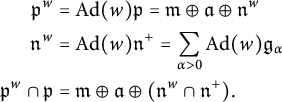 $$ \begin{align*} \mathfrak{p}^w &= \mathrm{Ad}(w)\mathfrak{p} = \mathfrak{m}\oplus \mathfrak{a}\oplus \mathfrak{n}^w \\ \mathfrak{n}^w &= \mathrm{Ad}(w)\mathfrak{n}^+ = \sum_{\alpha>0} \mathrm{Ad}(w)\mathfrak{g}_\alpha \\ \mathfrak{p}^w \cap \mathfrak{p} &= \mathfrak{m}\oplus \mathfrak{a}\oplus (\mathfrak{n}^w \cap \mathfrak{n}^+). \end{align*} $$
Defining $\Pi _w^+ = w\Pi ^+ \cap \Pi ^+$
, we can express
$\Pi _w^+ = w\Pi ^+ \cap \Pi ^+$
, we can express
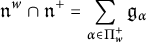 $$ \begin{align*} \mathfrak{n}^w \cap \mathfrak{n}^+ = \sum_{\alpha \in \Pi_w^+} \mathfrak{g}_\alpha \end{align*} $$
and consequently,
 $$ \begin{align*} \mathfrak{p}^w \cap \mathfrak{p} = \mathfrak{m}\oplus \mathfrak{a}\oplus \sum_{\alpha \in \Pi_w^+} \mathfrak{g}_\alpha. \end{align*} $$
4
$K \times K$
-invariant connections

The group G acts on $\mathbb {F} \times \mathbb {F} = \mathbb {F} \times \mathbb {F}^{\ast }$
via the diagonal action
$\mathbb {F} \times \mathbb {F} = \mathbb {F} \times \mathbb {F}^{\ast }$
via the diagonal action $g\left ( x, y \right ) = \left ( gx, gy \right )$
. This action is the restriction to the diagonal subgroup
$g\left ( x, y \right ) = \left ( gx, gy \right )$
. This action is the restriction to the diagonal subgroup
 $$ \begin{align} \Delta _{G} = \{\left( g, g \right) : g \in G\} \end{align} $$
of the action of $G \times G$
on
$G \times G$
on $\mathbb {F} \times \mathbb {F}$
. The isotropy group of the orbit of
$\mathbb {F} \times \mathbb {F}$
. The isotropy group of the orbit of $\left ( x_{0}, x_{w_{0}} \right )$
is the intersection of
$\left ( x_{0}, x_{w_{0}} \right )$
is the intersection of $P = MAN$
with
$P = MAN$
with $P^{-} = MAN^{-}$
, and therefore it is
$P^{-} = MAN^{-}$
, and therefore it is $MA$
. This means that
$MA$
. This means that $G\cdot \left ( x_{0}, x_{w_{0}} \right ) = G/MA$
, and this homogeneous space embeds in
$G\cdot \left ( x_{0}, x_{w_{0}} \right ) = G/MA$
, and this homogeneous space embeds in $\mathbb {F} \times \mathbb {F}$
. Bundles, connections, symplectic forms, etc. on
$\mathbb {F} \times \mathbb {F}$
. Bundles, connections, symplectic forms, etc. on $\mathbb {F} \times \mathbb {F}$
restrict to geometric objects on
$\mathbb {F} \times \mathbb {F}$
restrict to geometric objects on $G/MA$
, which are generally not invariant under G, but are invariant under the group
$G/MA$
, which are generally not invariant under G, but are invariant under the group $K \times K$
, which acts transitively on
$K \times K$
, which acts transitively on $\mathbb {F} \times \mathbb {F}^{\ast }$
, the maximal flag manifold of the group
$\mathbb {F} \times \mathbb {F}^{\ast }$
, the maximal flag manifold of the group $G \times G$
. Here, the subgroup K denotes the maximal compact subgroup of G (cf. Section 1.2), and we remark that K also acts transitively on the flag manifold
$G \times G$
. Here, the subgroup K denotes the maximal compact subgroup of G (cf. Section 1.2), and we remark that K also acts transitively on the flag manifold $\mathbb {F}$
(see [Reference Gasparim, Grama and San Martin4]).
$\mathbb {F}$
(see [Reference Gasparim, Grama and San Martin4]).
Next, we will discuss connections on principal bundles over $\mathbb {F} \times \mathbb {F}^{\ast }$
whose restrictions to the open orbit
$\mathbb {F} \times \mathbb {F}^{\ast }$
whose restrictions to the open orbit $G\cdot \left ( x_{0}, x_{w_{0}} \right ) = G/MA$
provide connections on principal bundles over
$G\cdot \left ( x_{0}, x_{w_{0}} \right ) = G/MA$
provide connections on principal bundles over $G/MA$
.
$G/MA$
.
Initially, connections on a general flag of a semisimple group will be described. Subsequently, these connections will be specialized to the flags $\mathbb {F} \times \mathbb {F}^{\ast }$
of
$\mathbb {F} \times \mathbb {F}^{\ast }$
of $G \times G$
.
$G \times G$
.
4.1 General case
The homogeneous space $G/N$
is a principal bundle
$G/N$
is a principal bundle $G/N \rightarrow G/MAN = \mathbb {F}$
with structural group
$G/N \rightarrow G/MAN = \mathbb {F}$
with structural group $MA$
because N is normal in
$MA$
because N is normal in $MAN$
and
$MAN$
and $MAN/N \approx MA$
. The left action of G on
$MAN/N \approx MA$
. The left action of G on $G/N$
commutes with the right action of
$G/N$
commutes with the right action of $MA$
, meaning that G acts on the principal bundle
$MA$
, meaning that G acts on the principal bundle $G/N \rightarrow \mathbb {F}$
by bundle automorphisms.
$G/N \rightarrow \mathbb {F}$
by bundle automorphisms.
If $y_{0} = 1N$
is the origin of
$y_{0} = 1N$
is the origin of $G/N$
, then the orbit
$G/N$
, then the orbit $Ky_{0}$
is the homogeneous space
$Ky_{0}$
is the homogeneous space $K/\left ( K \cap N \right ) = K/\{1\} = K$
. This orbit is a subbundle (reduction) of
$K/\left ( K \cap N \right ) = K/\{1\} = K$
. This orbit is a subbundle (reduction) of $G/N$
with structural subgroup M, and
$G/N$
with structural subgroup M, and $K \rightarrow K/M$
is the canonical projection associated with the action of K on
$K \rightarrow K/M$
is the canonical projection associated with the action of K on $\mathbb {F}$
.
$\mathbb {F}$
.
The right action of A allows us to write $G/N = \left ( Ky_{0} \right ) A$
, and in this way,
$G/N = \left ( Ky_{0} \right ) A$
, and in this way, $G/N$
becomes a principal A-bundle over the K-orbit
$G/N$
becomes a principal A-bundle over the K-orbit $Ky_{0}$
. This principal bundle can be viewed in terms of homogeneous spaces through the canonical fibration
$Ky_{0}$
. This principal bundle can be viewed in terms of homogeneous spaces through the canonical fibration $G/N \rightarrow G/AN = K$
, which is a principal bundle with structural group
$G/N \rightarrow G/AN = K$
, which is a principal bundle with structural group $AN/N = A$
.
$AN/N = A$
.
This bundle is trivial (unlike the bundle over $\mathbb {F}$
) because, by the Iwasawa decomposition,
$\mathbb {F}$
) because, by the Iwasawa decomposition, $G/N$
is diffeomorphic to
$G/N$
is diffeomorphic to $K \times A$
, which allows us to write
$K \times A$
, which allows us to write
 $$\begin{align*}G/N = K \times A, \end{align*}$$
that is, $G/N$
is identified with
$G/N$
is identified with $K \times A$
, where in this identification, the origin
$K \times A$
, where in this identification, the origin $1 \cdot N$
of
$1 \cdot N$
of $G/N$
is identified with
$G/N$
is identified with $\left ( 1,1 \right ) \in K \times A$
.
$\left ( 1,1 \right ) \in K \times A$
.
The bundle $K \rightarrow K/M = \mathbb {F}$
has a K-invariant (left) connection where the horizontal space
$K \rightarrow K/M = \mathbb {F}$
has a K-invariant (left) connection where the horizontal space $\mathcal {H}_{1}$
at the origin is the space orthogonal to the isotropy algebra
$\mathcal {H}_{1}$
at the origin is the space orthogonal to the isotropy algebra $\mathfrak {m}$
:
$\mathfrak {m}$
:
 $$\begin{align*}\mathcal{H}_{1} = \sum_{\alpha} \mathfrak{k}_{\alpha} \end{align*}$$
with $\mathfrak {k}_{\alpha } = \mathfrak {k} \cap \left ( \mathfrak {g}_{\alpha } \oplus \mathfrak {g}_{-\alpha } \right )$
.
$\mathfrak {k}_{\alpha } = \mathfrak {k} \cap \left ( \mathfrak {g}_{\alpha } \oplus \mathfrak {g}_{-\alpha } \right )$
.
This connection extends to a connection on $G/N \rightarrow \mathbb {F}$
since
$G/N \rightarrow \mathbb {F}$
since $K \rightarrow \mathbb {F}$
is a subbundle. The extension is also K-invariant. The connection form is denoted by
$K \rightarrow \mathbb {F}$
is a subbundle. The extension is also K-invariant. The connection form is denoted by $\omega _{K}$
. The same notation is used for both bundles
$\omega _{K}$
. The same notation is used for both bundles $K \rightarrow \mathbb {F}$
and
$K \rightarrow \mathbb {F}$
and $G/N \rightarrow \mathbb {F}$
. On K, this form takes values in
$G/N \rightarrow \mathbb {F}$
. On K, this form takes values in $\mathfrak {m}$
, while on
$\mathfrak {m}$
, while on $G/N$
, the form
$G/N$
, the form $\omega _{K}$
takes values in
$\omega _{K}$
takes values in $\mathfrak {m} \oplus \mathfrak {a}$
.
$\mathfrak {m} \oplus \mathfrak {a}$
.
The curvature $\Omega _{K}$
of the connection on K is given by
$\Omega _{K}$
of the connection on K is given by $\Omega _{K}(A, B) = [A, B]_{\mathfrak {m}}$
, where A and B are left-invariant vector fields on K, and the subscript
$\Omega _{K}(A, B) = [A, B]_{\mathfrak {m}}$
, where A and B are left-invariant vector fields on K, and the subscript $\mathfrak {m}$
indicates the component in the direction of
$\mathfrak {m}$
indicates the component in the direction of $\mathfrak {m}$
. Note that
$\mathfrak {m}$
. Note that $\Omega _{K}$
is a 2-form on K with values in
$\Omega _{K}$
is a 2-form on K with values in $\mathfrak {m}$
.
$\mathfrak {m}$
.
The curvature on $G/N$
is obtained from the curvature on K by right translations by elements of A. In general, a curvature satisfies the property
$G/N$
is obtained from the curvature on K by right translations by elements of A. In general, a curvature satisfies the property
 $$\begin{align*}R_{h}^{\ast}\Omega_{K} = \mathrm{Ad}\left( h^{-1} \right) \Omega_{K}. \end{align*}$$
The group A commutes with $\mathfrak {m}$
, so
$\mathfrak {m}$
, so $\mathrm {Ad}\left ( h^{-1} \right )$
is the identity on
$\mathrm {Ad}\left ( h^{-1} \right )$
is the identity on $\mathfrak {m}$
. Hence, on
$\mathfrak {m}$
. Hence, on $G/N$
, the curvature
$G/N$
, the curvature $\Omega _{K}$
also takes values in
$\Omega _{K}$
also takes values in $\mathfrak {m}$
.
$\mathfrak {m}$
.
The component in the direction of $\mathfrak {a}$
of the curvature
$\mathfrak {a}$
of the curvature $\Omega _{K}$
vanishes. The same does not happen with the
$\Omega _{K}$
vanishes. The same does not happen with the $\mathfrak {a}$
-component of the connection
$\mathfrak {a}$
-component of the connection $\omega _{K}$
. Next, we will derive an expression for this component by composing the connection with linear functionals of
$\omega _{K}$
. Next, we will derive an expression for this component by composing the connection with linear functionals of $\mathfrak {a}$
.
$\mathfrak {a}$
.
If $\lambda \in (\mathfrak {m} \oplus \mathfrak {a})^{\ast }$
is a linear functional, then the composition
$\lambda \in (\mathfrak {m} \oplus \mathfrak {a})^{\ast }$
is a linear functional, then the composition $\lambda (\omega _{K})$
is a 1-form on
$\lambda (\omega _{K})$
is a 1-form on $G/N$
. The following proposition provides a description in terms of the Cartan–Killing form for a composition
$G/N$
. The following proposition provides a description in terms of the Cartan–Killing form for a composition $\lambda _{H}(\omega _{K})$
when
$\lambda _{H}(\omega _{K})$
when $\lambda _{H}(\cdot ) = \langle H, \cdot \rangle $
is the linear functional dual to
$\lambda _{H}(\cdot ) = \langle H, \cdot \rangle $
is the linear functional dual to $H \in \mathfrak {m} \oplus \mathfrak {a}$
. The formula presented in the next proposition holds for an
$H \in \mathfrak {m} \oplus \mathfrak {a}$
. The formula presented in the next proposition holds for an $MA$
-invariant functional
$MA$
-invariant functional $\lambda _{H}$
, which occurs if H is in the center of
$\lambda _{H}$
, which occurs if H is in the center of $\mathfrak {m} \oplus \mathfrak {a}$
(e.g., if
$\mathfrak {m} \oplus \mathfrak {a}$
(e.g., if $H \in \mathfrak {a}$
or any H in the case of a complex algebra, because in this case
$H \in \mathfrak {a}$
or any H in the case of a complex algebra, because in this case $\mathfrak {m} \oplus \mathfrak {a}$
is a Cartan subalgebra and thus abelian).
$\mathfrak {m} \oplus \mathfrak {a}$
is a Cartan subalgebra and thus abelian).
Proposition 4.1 Consider $G = KAN$
with its corresponding Iwasawa decomposition, and for
$G = KAN$
with its corresponding Iwasawa decomposition, and for $g \in G$
, write
$g \in G$
, write $g = k h n$
for the Iwasawa decomposition of g, where
$g = k h n$
for the Iwasawa decomposition of g, where $k \in K$
,
$k \in K$
, $h \in A$
, and
$h \in A$
, and $n \in N$
. Let
$n \in N$
. Let $Z \in \mathfrak {g}$
, and denote by
$Z \in \mathfrak {g}$
, and denote by $\widetilde {Z}$
the vector field on
$\widetilde {Z}$
the vector field on $G / N$
induced by Z. Let
$G / N$
induced by Z. Let $x_{0} = 1 \cdot N$
be the origin of
$x_{0} = 1 \cdot N$
be the origin of $G / N$
. Then,
$G / N$
. Then,
 $$ \begin{align} \lambda_{H}(\omega_{K}(\widetilde{Z}(gx_0))) = \langle \mathrm{Ad}(k) H, Z \rangle. \end{align} $$
Proof The formula is checked first at the origin $x_0 = 1 \cdot N$
and with
$x_0 = 1 \cdot N$
and with $g = 1$
. Write the decomposition
$g = 1$
. Write the decomposition $Z = X + A + Y \in \mathcal {H}_1 \oplus (\mathfrak {m} \oplus \mathfrak {a}) \oplus \mathfrak {n}^{+}$
where, as mentioned above,
$Z = X + A + Y \in \mathcal {H}_1 \oplus (\mathfrak {m} \oplus \mathfrak {a}) \oplus \mathfrak {n}^{+}$
where, as mentioned above, $\mathcal {H}_1 = \sum _{\alpha } \mathfrak {k}_{\alpha }$
and
$\mathcal {H}_1 = \sum _{\alpha } \mathfrak {k}_{\alpha }$
and $\mathfrak {k} = \mathcal {H}_1 \oplus \mathfrak {m}$
. By definition,
$\mathfrak {k} = \mathcal {H}_1 \oplus \mathfrak {m}$
. By definition, $\omega _K(\widetilde {Z}(x_0)) = A$
, and thus
$\omega _K(\widetilde {Z}(x_0)) = A$
, and thus $\lambda _H \omega _K(\widetilde {Z}(x_0)) = \lambda _H(A) = \langle H, A \rangle $
.
$\lambda _H \omega _K(\widetilde {Z}(x_0)) = \lambda _H(A) = \langle H, A \rangle $
.
However, in the decomposition $\mathfrak {g} = \mathfrak {k} \oplus \mathfrak {a} \oplus \mathfrak {n}^{+}$
, the
$\mathfrak {g} = \mathfrak {k} \oplus \mathfrak {a} \oplus \mathfrak {n}^{+}$
, the $\mathfrak {a}$
component is orthogonal (with respect to the Cartan–Killing form) to
$\mathfrak {a}$
component is orthogonal (with respect to the Cartan–Killing form) to $\mathcal {H}_1 \oplus \mathfrak {n}^{+}$
. Therefore,
$\mathcal {H}_1 \oplus \mathfrak {n}^{+}$
. Therefore, $\langle H, A \rangle = \langle H, Z \rangle $
, showing that
$\langle H, A \rangle = \langle H, Z \rangle $
, showing that $\lambda _H \omega _K(\widetilde {Z}(x_0)) = \langle H, Z \rangle $
.
$\lambda _H \omega _K(\widetilde {Z}(x_0)) = \langle H, Z \rangle $
.
Still at the origin $x_0$
, but with
$x_0$
, but with $g = n \in N$
, the equality continues to hold because in the Iwasawa decomposition of g, the component
$g = n \in N$
, the equality continues to hold because in the Iwasawa decomposition of g, the component $k = 1$
.
$k = 1$
.
Now, consider a point $x = g x_0$
with
$x = g x_0$
with $g = ma \in MA$
. This point is also given by
$g = ma \in MA$
. This point is also given by $R_g(x_0)$
, since the left and right actions of
$R_g(x_0)$
, since the left and right actions of $MA$
on the fiber over the origin coincide. Furthermore, the equality
$MA$
on the fiber over the origin coincide. Furthermore, the equality $\widetilde {Z}(R_g x_0) = (R_g)_{\ast }(\widetilde {Z}(x_0))$
holds because the left action of G commutes with the right action of
$\widetilde {Z}(R_g x_0) = (R_g)_{\ast }(\widetilde {Z}(x_0))$
holds because the left action of G commutes with the right action of $MA$
. Therefore,
$MA$
. Therefore,
 $$ \begin{align} \omega_K(\widetilde{Z}(gx_0)) = \omega_K((R_g)_{\ast}(\widetilde{Z}(x_0))) = (R_g^{\ast} \omega_K)(\widetilde{Z}(x_0)). \end{align} $$
But $R_g^{\ast } \omega _K = \mathrm {Ad}(g^{-1}) \omega _K$
, and since
$R_g^{\ast } \omega _K = \mathrm {Ad}(g^{-1}) \omega _K$
, and since $\lambda _H$
is
$\lambda _H$
is $MA$
-invariant, it follows that
$MA$
-invariant, it follows that $\lambda _H(R_g^{\ast } \omega _K) = \lambda _H(\omega _K)$
for
$\lambda _H(R_g^{\ast } \omega _K) = \lambda _H(\omega _K)$
for $g \in MA$
. Hence,
$g \in MA$
. Hence,
 $$ \begin{align} \lambda_H(\omega_K(\widetilde{Z}(gx_0))) = \lambda_H(\omega_K(\widetilde{Z}(x_0))) = \langle H, Z \rangle, \end{align} $$
where the last equality follows from the calculation at $x_0$
. If
$x_0$
. If $g_1$
is such that
$g_1$
is such that $x = g_1 x_0 = g x_0$
, then
$x = g_1 x_0 = g x_0$
, then $g_1 = g n = ma n$
with
$g_1 = g n = ma n$
with $n \in N^{+}$
, and as in the case of the origin, multiplication on the right by
$n \in N^{+}$
, and as in the case of the origin, multiplication on the right by $n \in N^{+}$
does not affect the terms of the equality. This concludes the proof of (4.2) for points in the fiber over the origin
$n \in N^{+}$
does not affect the terms of the equality. This concludes the proof of (4.2) for points in the fiber over the origin $x_0$
.
$x_0$
.
For other fibers, the result is obtained by translating by $k \in K$
. From
$k \in K$
. From $\widetilde {Z}(kx) = k_{\ast } \widetilde {\mathrm {Ad}(k^{-1}) Z}(x)$
, it follows that
$\widetilde {Z}(kx) = k_{\ast } \widetilde {\mathrm {Ad}(k^{-1}) Z}(x)$
, it follows that
 $$\begin{align*}\omega_K(\widetilde{Z}(kx)) = \omega_K(\widetilde{\mathrm{Ad}(k^{-1}) Z}(x)). \end{align*}$$
Therefore, if x is in the fiber over the origin, then
 $$\begin{align*}\lambda_H(\omega_K(\widetilde{Z}(kx))) = \lambda_H(\omega_K(\widetilde{\mathrm{Ad}(k^{-1}) Z}(x))) = \langle H, \mathrm{Ad}(k^{-1}) Z \rangle = \langle \mathrm{Ad}(k) H, Z \rangle, \end{align*}$$
which proves the equality (4.2) for points in the fiber over $kx_0$
. Since K acts transitively on the fibers, this concludes the proof.
$kx_0$
. Since K acts transitively on the fibers, this concludes the proof.
The second term $\langle \mathrm {Ad}(k)H, Z \rangle $
in (4.2) is the “height function”
$\langle \mathrm {Ad}(k)H, Z \rangle $
in (4.2) is the “height function” $f_Z$
with respect to Z, defined by the Cartan–Killing form on the adjoint orbit
$f_Z$
with respect to Z, defined by the Cartan–Killing form on the adjoint orbit $\mathrm {Ad}(K)H$
. More precisely, for each
$\mathrm {Ad}(K)H$
. More precisely, for each $Z \in \mathfrak {g}$
, we define the height function on the adjoint orbit
$Z \in \mathfrak {g}$
, we define the height function on the adjoint orbit $f_Z : \mathrm {Ad}(K)H \to \mathbb {C}$
by
$f_Z : \mathrm {Ad}(K)H \to \mathbb {C}$
by
 $$\begin{align*}f_Z(\mathrm{Ad}(k)H) = \langle \mathrm{Ad}(k)H, Z \rangle. \end{align*}$$
If $H \in \mathfrak {a}$
, then this adjoint orbit is a flag manifold of
$H \in \mathfrak {a}$
, then this adjoint orbit is a flag manifold of $\mathfrak {g}$
. However, if
$\mathfrak {g}$
. However, if $H \in \mathfrak {m}$
, then
$H \in \mathfrak {m}$
, then $\mathrm {Ad}(K) H$
is an adjoint orbit of K in
$\mathrm {Ad}(K) H$
is an adjoint orbit of K in $\mathfrak {k}$
. For example, if
$\mathfrak {k}$
. For example, if $\mathfrak {g}$
is a complex algebra, then
$\mathfrak {g}$
is a complex algebra, then $\mathfrak {m} = i\mathfrak {h}_{\mathbb {R}}$
is the imaginary part of the Cartan subalgebra, and if
$\mathfrak {m} = i\mathfrak {h}_{\mathbb {R}}$
is the imaginary part of the Cartan subalgebra, and if $H \in i\mathfrak {h}_{\mathbb {R}}$
, then the K-adjoint orbit is also a flag manifold of
$H \in i\mathfrak {h}_{\mathbb {R}}$
, then the K-adjoint orbit is also a flag manifold of $\mathfrak {g}$
.
$\mathfrak {g}$
.
From these observations about the K-adjoint orbits and formula (4.2), we obtain the following vanishing properties of $\lambda _H \omega _K$
.
$\lambda _H \omega _K$
.
Corollary 4.2 Let H be in the center of $\mathfrak {m} \oplus \mathfrak {a}$
. Then, the following properties hold:
$\mathfrak {m} \oplus \mathfrak {a}$
. Then, the following properties hold:
-
(1) If
$Z \in \mathfrak {s}$
and
$H \in \mathfrak {m}$
, then
$\lambda _H \omega _K \left ( \widetilde {Z} (x) \right ) = 0$
. -
(2) If
$Z \in \mathfrak {k}$
and
$H \in \mathfrak {a}$
, then
$\lambda _H \omega _K \left ( \widetilde {Z} (x) \right ) = 0$
.


Proof In both cases, Z is orthogonal (with respect to the Cartan–Killing form) to the adjoint orbit of H, and therefore the results follow from
 $$ \begin{align*} \lambda_H \left( \omega_K \left( \widetilde{Z} (x) \right) \right) = \langle \mathrm{Ad}(k) H, Z \rangle \end{align*} $$
as stated in (4.2).
The hypothesis that H is in the center of $\mathfrak {m} \oplus \mathfrak {a}$
is automatically satisfied in cases where
$\mathfrak {m} \oplus \mathfrak {a}$
is automatically satisfied in cases where $\mathfrak {m}$
, and therefore
$\mathfrak {m}$
, and therefore $\mathfrak {m} \oplus \mathfrak {a}$
, is an abelian algebra. In these cases, the above corollary ensures that the
$\mathfrak {m} \oplus \mathfrak {a}$
, is an abelian algebra. In these cases, the above corollary ensures that the $\mathfrak {m}$
or
$\mathfrak {m}$
or $\mathfrak {a}$
component of
$\mathfrak {a}$
component of $\omega _K$
vanishes, and therefore the connection takes values in the other component.
$\omega _K$
vanishes, and therefore the connection takes values in the other component.
Corollary 4.3 If $\mathfrak {m} \oplus \mathfrak {a}$
is an abelian algebra (e.g., in the case where
$\mathfrak {m} \oplus \mathfrak {a}$
is an abelian algebra (e.g., in the case where $\mathfrak {g}$
is a complex algebra), then
$\mathfrak {g}$
is a complex algebra), then
-
(1)
$\omega _K \left ( \widetilde {Z} (x) \right ) \in \mathfrak {a}$
if
$Z \in \mathfrak {s}$
, and -
(2)
$\omega _K \left ( \widetilde {Z} (x) \right ) \in \mathfrak {m}$
if
$Z \in \mathfrak {k}$
.


4.2 Specializing to
$\mathbb {F} \times \mathbb {F} = \mathbb {F} \times \mathbb {F}^{\ast }$
, the maximal f lag of
$G \times G$


Definition 4.4 Consider the Iwasawa decomposition of $G \times G$
, given by
$G \times G$
, given by $(K \times K)(A \times A)(N^{+} \times N^{-})$
. The maximal flag manifold is
$(K \times K)(A \times A)(N^{+} \times N^{-})$
. The maximal flag manifold is
 $$ \begin{align} \mathbb{F} \times \mathbb{F} = (G \times G) / (M \times M)(A \times A)(N^{+} \times N^{-}), \end{align} $$
which is based at the point $(x_{0}, x_{w_{0}}) \in \mathbb {F} \times \mathbb {F}$
, where
$(x_{0}, x_{w_{0}}) \in \mathbb {F} \times \mathbb {F}$
, where $w_{0}$
denotes the principal involution of the Weyl group
$w_{0}$
denotes the principal involution of the Weyl group $\mathcal {W}$
.
$\mathcal {W}$
.
Proposition 4.5 The diagonal action of G on $\mathbb {F} \times \mathbb {F}^{\ast }$
, given by
$\mathbb {F} \times \mathbb {F}^{\ast }$
, given by $g(x, y) = (gx, gy)$
, has a unique open orbit, namely,
$g(x, y) = (gx, gy)$
, has a unique open orbit, namely,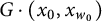 $G \cdot (x_{0}, x_{w_{0}})$
. As a homogeneous space, this open orbit is
$G \cdot (x_{0}, x_{w_{0}})$
. As a homogeneous space, this open orbit is $G/MA$
.
$G/MA$
.
Proof The isotropy groups of $x_{0}$
and
$x_{0}$
and $x_{w_{0}}$
are
$x_{w_{0}}$
are $MAN^{+}$
and
$MAN^{+}$
and $MAN^{-}$
, respectively. Their intersection is therefore
$MAN^{-}$
, respectively. Their intersection is therefore $MA$
, as claimed.
$MA$
, as claimed.
The homogeneous space $(G \times G) / (N^{+} \times N^{-})$
is diffeomorphic to
$(G \times G) / (N^{+} \times N^{-})$
is diffeomorphic to $G/N^{+} \times G/N^{-} = (K \times A) \times (K \times A)$
. Moreover, the projection
$G/N^{+} \times G/N^{-} = (K \times A) \times (K \times A)$
. Moreover, the projection
 $$ \begin{align} (G \times G) / (N^{+} \times N^{-}) \rightarrow \mathbb{F} \times \mathbb{F}^{\ast} = (G \times G) / (M \times M)(A \times A)(N^{+} \times N^{-}) \end{align} $$
defines a principal $(M \times M)(A \times A)$
-bundle.
$(M \times M)(A \times A)$
-bundle.
Lemma 4.6 The projection
 $$ \begin{align} (G \times G) / (N^{+} \times N^{-}) \rightarrow (G \times G) / (A \times A)(N^{+} \times N^{-}) = K \times K \end{align} $$
is a principal bundle with fiber $A \times A$
, which is trivial since
$A \times A$
, which is trivial since
 $$ \begin{align} (G \times G) / (N^{+} \times N^{-}) = (K \times K) \times (A \times A), \end{align} $$
where this identification is chosen so that the origin $(1,1)\cdot (N^{+} \times N^{-})$
corresponds to
$(1,1)\cdot (N^{+} \times N^{-})$
corresponds to $((1,1),(1,1))$
.
$((1,1),(1,1))$
.
Proposition 4.7 The diagonal action of G on $(G \times G)/(N^{+} \times N^{-})$
, given by
$(G \times G)/(N^{+} \times N^{-})$
, given by
 $$\begin{align*}g(g_{1}N^{+}, g_{2}N^{-}) = (gg_{1}N^{+}, gg_{2}N^{-}), \end{align*}$$
has trivial isotropy at the origin $o = (1,1)(N^{+} \times N^{-})$
. Hence, the orbit
$o = (1,1)(N^{+} \times N^{-})$
. Hence, the orbit $G \cdot o$
is diffeomorphic to G.
$G \cdot o$
is diffeomorphic to G.
Proof Since $N^{+} \cap N^{-} = \{1\}$
, the isotropy group is trivial.
$N^{+} \cap N^{-} = \{1\}$
, the isotropy group is trivial.
For $z = (m_{1}h_{1}, m_{2}h_{2})(N^{+} \times N^{-})$
with
$z = (m_{1}h_{1}, m_{2}h_{2})(N^{+} \times N^{-})$
with $m_{i}h_{i} \in MA$
, the isotropy group of the G-action remains trivial, and its orbits project onto the open orbit
$m_{i}h_{i} \in MA$
, the isotropy group of the G-action remains trivial, and its orbits project onto the open orbit $G/MA = G \cdot (x_{0}, x_{w_{0}}) \subset \mathbb {F} \times \mathbb {F}$
.
$G/MA = G \cdot (x_{0}, x_{w_{0}}) \subset \mathbb {F} \times \mathbb {F}$
.
The restriction of the principal bundle
 $$\begin{align*}(G \times G) / (N^{+} \times N^{-}) \rightarrow \mathbb{F} \times \mathbb{F} \end{align*}$$
to the open orbit $G \cdot (x_{0}, x_{w_{0}})$
is an
$G \cdot (x_{0}, x_{w_{0}})$
is an $(MA) \times (MA)$
-principal bundle whose G-orbits (under the diagonal action) are diffeomorphic to G. Each orbit remains invariant under the right action of
$(MA) \times (MA)$
-principal bundle whose G-orbits (under the diagonal action) are diffeomorphic to G. Each orbit remains invariant under the right action of
 $$ \begin{align} \Delta_{MA} = \{(h,h):h \in MA\}, \end{align} $$
and hence these orbits form subbundles with structural group $\Delta _{MA}$
.
$\Delta _{MA}$
.
The group $G \times G$
acts on
$G \times G$
acts on $K \times K$
, which is identified with
$K \times K$
, which is identified with $G \times G / \left ( AN^{+} \times AN^{-} \right )$
. Therefore,
$G \times G / \left ( AN^{+} \times AN^{-} \right )$
. Therefore, $G \approx \Delta _{G}$
acts on
$G \approx \Delta _{G}$
acts on $K \times K$
via the diagonal action (restriction of the action of
$K \times K$
via the diagonal action (restriction of the action of $G \times G$
to the diagonal
$G \times G$
to the diagonal $\Delta _{G}$
). If
$\Delta _{G}$
). If $\overline {w}_{0}$
is a representative in
$\overline {w}_{0}$
is a representative in $\mathrm {Nor}_{K} \left ( A \right )$
of the principal involution
$\mathrm {Nor}_{K} \left ( A \right )$
of the principal involution $w_{0}$
, then the orbit
$w_{0}$
, then the orbit $G \cdot \left ( 1, \overline {w}_{0} \right )$
is open in
$G \cdot \left ( 1, \overline {w}_{0} \right )$
is open in $K \times K$
and projects to the unique open orbit in
$K \times K$
and projects to the unique open orbit in $\mathbb {F} \times \mathbb {F}^{\ast }$
.
$\mathbb {F} \times \mathbb {F}^{\ast }$
.
The action of $G \times G$
on
$G \times G$
on $\left ( K \times K \right ) \times \left ( A \times A \right ) = \left ( G \times G \right ) / \left ( N^{+} \times N^{-} \right )$
decomposes into the action on
$\left ( K \times K \right ) \times \left ( A \times A \right ) = \left ( G \times G \right ) / \left ( N^{+} \times N^{-} \right )$
decomposes into the action on $K \times K$
and the cocycle
$K \times K$
and the cocycle $\rho ^{\#}: \left ( G \times G \right ) \times \left ( K \times K \right ) \rightarrow A \times A$
defined by
$\rho ^{\#}: \left ( G \times G \right ) \times \left ( K \times K \right ) \rightarrow A \times A$
defined by
 $$ \begin{align} \rho^{\#} \left( \left( g, h \right), \left( k, u \right) \right) = \left( \rho \left( g, k \right), \rho \left( h, u \right) \right), \end{align} $$
where $\rho : G \times K \rightarrow A$
is, as before, the cocycle defined by
$\rho : G \times K \rightarrow A$
is, as before, the cocycle defined by
 $$ \begin{align} gu = x \rho \left( g, u \right) n \in KAN^{+}, \end{align} $$
which factors to a cocycle over $\mathbb {F}$
given by
$\mathbb {F}$
given by $\rho \left ( g, x \right ) = \rho \left ( g, u \right )$
.
$\rho \left ( g, x \right ) = \rho \left ( g, u \right )$
.
With the cocycle notation (cf. Equation (4.11)), the action of $G \times G$
on
$G \times G$
on $\left ( K \times K \right ) \times \left ( A \times A \right )$
is determined by
$\left ( K \times K \right ) \times \left ( A \times A \right )$
is determined by
 $$ \begin{align} \left( g, h \right) \cdot \left( \left( k, u \right), \left( 1, 1 \right) \right) = \left( \left( g \cdot k, h \cdot u \right), \left( \rho \left( g, k \right), \rho \left( h, u \right) \right) \right), \end{align} $$
where in the first-ordered pair on the right-hand side, $\cdot $
denotes the action of G on K. (For an arbitrary point
$\cdot $
denotes the action of G on K. (For an arbitrary point $\left ( \left ( k, u \right ), \left ( a, b \right ) \right )$
, the action is obtained by right invariance.)
$\left ( \left ( k, u \right ), \left ( a, b \right ) \right )$
, the action is obtained by right invariance.)
In particular, the diagonal action of G is given by
 $$ \begin{align} \left( g, g \right) \cdot \left( \left( k, u \right), \left( 1, 1 \right) \right) = \left( \left( g \cdot k, g \cdot u \right), \left( \rho \left( g, k \right), \rho \left( g, u \right) \right) \right). \end{align} $$
If $\overline {w}_{0}$
is a representative in
$\overline {w}_{0}$
is a representative in $\mathrm {Nor}_{K}(A)$
of the principal involution
$\mathrm {Nor}_{K}(A)$
of the principal involution $w_{0}$
of the Weyl group, then the orbit
$w_{0}$
of the Weyl group, then the orbit $G \cdot \left ( \left ( 1, \overline {w}_{0} \right ), \left ( 1, 1 \right ) \right )$
under the diagonal action is diffeomorphic to G because the isotropy group is
$G \cdot \left ( \left ( 1, \overline {w}_{0} \right ), \left ( 1, 1 \right ) \right )$
under the diagonal action is diffeomorphic to G because the isotropy group is $N^{+} \cap N^{-} = \{1\}$
.
$N^{+} \cap N^{-} = \{1\}$
.
An orbit of this type is the subset of $\left ( K \times K \right ) \times \left ( A \times A \right )$
given by
$\left ( K \times K \right ) \times \left ( A \times A \right )$
given by
 $$ \begin{align*} G \cdot \left( \left( 1, \overline{w}_{0} \right), \left( 1, 1 \right) \right) &= \left\{ \left( \left( g \cdot 1, g \cdot \overline{w}_{0} \right), \left( \rho \left( g, 1 \right), \rho \left( g, \overline{w}_{0} \right) \right) \right) : g \in G \right\} \\ &= \left\{ \left( \left( g \cdot 1, g \cdot \overline{w}_{0} \right), \left( \rho \left( g, x_{0} \right), \rho \left( g, x_{w_{0}} \right) \right) \right) : g \in G \right\}. \end{align*} $$
That is, by writing the Iwasawa decompositions $g = kan^{+} \in KAN^{+}$
and
$g = kan^{+} \in KAN^{+}$
and $g = uhn^{-} \in KAN^{-}$
, one obtains
$g = uhn^{-} \in KAN^{-}$
, one obtains $a = \rho \left ( g, 1 \right )$
,
$a = \rho \left ( g, 1 \right )$
, $h = \rho \left ( g, \overline {w}_{0} \right )$
,
$h = \rho \left ( g, \overline {w}_{0} \right )$
, $k = g \cdot 1$
, and
$k = g \cdot 1$
, and $u = g \cdot \overline {w}_{0}$
. Therefore, the orbit is given by the points
$u = g \cdot \overline {w}_{0}$
. Therefore, the orbit is given by the points
 $$ \begin{align} \left( \left( k, u \right), \left( \rho \left( g, x_{0} \right), \rho \left( g, x_{w_{0}} \right) \right) \right) \qquad g = kan^{+} = uhn^{-}, \end{align} $$
and these ordered pairs also provide the diffeomorphism between G and the orbit $G \cdot \left ( \left ( 1, \overline {w}_{0} \right ), \left ( 1, 1 \right ) \right )$
from the chosen origin.
$G \cdot \left ( \left ( 1, \overline {w}_{0} \right ), \left ( 1, 1 \right ) \right )$
from the chosen origin.
Summarizing, we have proven the following.
Proposition 4.8 The orbit $G \cdot ((1,\overline {w}_0),(1,1))$
is
$G \cdot ((1,\overline {w}_0),(1,1))$
is
 $$ \begin{align*} G \cdot ((1,\overline{w}_0),(1,1)) &= \left\{ \big( (g \cdot 1, g \cdot \overline{w}_0), (\rho(g,x_0), \rho(g,x_{w_0})) \big) : g \in G \right\}, \end{align*} $$
and is diffeomorphic to G.
Since an orbit $G \cdot \left ( \left ( 1, \overline {w}_{0} \right ), \left ( 1, 1 \right ) \right )$
is diffeomorphic to G, its admits the Cartan decomposition
$G \cdot \left ( \left ( 1, \overline {w}_{0} \right ), \left ( 1, 1 \right ) \right )$
is diffeomorphic to G, its admits the Cartan decomposition $G = SK$
. Therefore, the orbit is diffeomorphic to the product
$G = SK$
. Therefore, the orbit is diffeomorphic to the product $S \times K$
.
$S \times K$
.
To see this decomposition as subsets of $\left ( K \times K \right ) \times \left ( A \times A \right )$
contained in the orbit, first consider the K component, whose orbit is
$\left ( K \times K \right ) \times \left ( A \times A \right )$
contained in the orbit, first consider the K component, whose orbit is
 $$ \begin{align*} K \cdot \left( \left( 1, \overline{w}_{0} \right), \left( 1, 1 \right) \right) = \left\{ \left( \left( k, k \overline{w}_{0} \right), \left( 1, 1 \right) \right) : k \in K \right\} = \left( K \times K \overline{w}_{0} \right) \times \left\{ \left( 1, 1 \right) \right\}. \end{align*} $$
The image of an arbitrary element $g = sk \in SK$
is obtained by applying k and then s to the origin
$g = sk \in SK$
is obtained by applying k and then s to the origin $\left ( \left ( 1, \overline {w}_{0} \right ), \left ( 1, 1 \right ) \right )$
. Using the expression in k and the equality (4.13), the result is
$\left ( \left ( 1, \overline {w}_{0} \right ), \left ( 1, 1 \right ) \right )$
. Using the expression in k and the equality (4.13), the result is
 $$ \begin{align*} \left( s, s \right) \cdot \left( \left( k, k \right), \left( 1, 1 \right) \right) = \left( \left( s \cdot k, s \cdot k \right), \left( \rho \left( s, k \right), \rho \left( s, k \overline{w}_{0} \right) \right) \right). \end{align*} $$
In particular, if $s = h = e^{H} \in A$
and
$s = h = e^{H} \in A$
and $\left ( k, k \right ) = \left ( 1, 1 \right )$
, then
$\left ( k, k \right ) = \left ( 1, 1 \right )$
, then
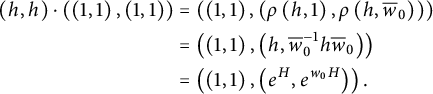 $$ \begin{align*} \left( h, h \right) \cdot \left( \left( 1, 1 \right), \left( 1, 1 \right) \right) &= \left( \left( 1, 1 \right), \left( \rho \left( h, 1 \right), \rho \left( h, \overline{w}_{0} \right) \right) \right) \\ &= \left( \left( 1, 1 \right), \left( h, \overline{w}_{0}^{-1} h \overline{w}_{0} \right) \right) \\ &= \left( \left( 1, 1 \right), \left( e^{H}, e^{w_{0} H} \right) \right). \end{align*} $$
Let $\theta $
be the Cartan involution on G given by the Cartan decomposition
$\theta $
be the Cartan involution on G given by the Cartan decomposition $G = KS$
.
$G = KS$
.
An element $g \in G$
viewed in the open orbit of
$g \in G$
viewed in the open orbit of $\left ( K \times K \right ) \times \left ( A \times A \right )$
is given by
$\left ( K \times K \right ) \times \left ( A \times A \right )$
is given by
 $$ \begin{align*} g = \left( \left( k, u \right), \left( \rho \left( g, x_{0} \right), \rho \left( g, x_{w} \right) \right) \right), \end{align*} $$
where $g = k \rho \left ( g, x_{0} \right ) n^{+} = u \rho \left ( g, x_{w} \right ) n^{-}$
are Iwasawa decompositions.
$g = k \rho \left ( g, x_{0} \right ) n^{+} = u \rho \left ( g, x_{w} \right ) n^{-}$
are Iwasawa decompositions.
Applying $\theta $
to these Iwasawa decompositions, we obtain
$\theta $
to these Iwasawa decompositions, we obtain
 $$ \begin{align*} \theta \left( g \right) = \theta \left( k \right) \theta \left( \rho \left( g, x_{0} \right) \right) \theta \left( n^{+} \right) = \theta \left( u \right) \theta \left( \rho \left( g, x_{w} \right) \right) \theta \left( n^{-} \right). \end{align*} $$
The Cartan involution $\theta $
is the identity on K and is the inverse on S, and moreover,
$\theta $
is the identity on K and is the inverse on S, and moreover, $\theta \left ( N^{+} \right ) = N^{-}$
and
$\theta \left ( N^{+} \right ) = N^{-}$
and $\theta \left ( N^{-} \right ) = N^{+}$
. Thus, we obtain the Iwasawa decompositions
$\theta \left ( N^{-} \right ) = N^{+}$
. Thus, we obtain the Iwasawa decompositions
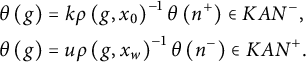 $$ \begin{align*} \theta \left( g \right) &= k \rho \left( g, x_{0} \right)^{-1} \theta \left( n^{+} \right) \in KAN^{-}, \\ \theta \left( g \right) &= u \rho \left( g, x_{w} \right)^{-1} \theta \left( n^{-} \right) \in KAN^{+}. \end{align*} $$
Hence, $\theta \left ( g \right )$
viewed in the open orbit of
$\theta \left ( g \right )$
viewed in the open orbit of $\left ( K \times K \right ) \times \left ( A \times A \right )$
is
$\left ( K \times K \right ) \times \left ( A \times A \right )$
is
 $$ \begin{align*} \theta \left( g \right) = \left( \left( u, k \right), \left( \rho \left( g, x_{w} \right)^{-1}, \rho \left( g, x_{0} \right)^{-1} \right) \right). \end{align*} $$
This means that the involution $\theta $
viewed in the open orbit is given by
$\theta $
viewed in the open orbit is given by
 $$ \begin{align} \theta : \left( \left( k, u \right), \left( h_{1}, h_{2} \right) \right) \longmapsto \left( \left( u, k \right), \left( h_{2}^{-1}, h_{1}^{-1} \right) \right). \end{align} $$
In summary, we have the following lemma.
Lemma 4.9 Let $\theta $
be the Cartan involution on G given by
$\theta $
be the Cartan involution on G given by $G=KS$
. For
$G=KS$
. For $g=k\rho (g,x_0)n^{+}=u\rho (g,x_w)n^{-}$
, the involution acts as
$g=k\rho (g,x_0)n^{+}=u\rho (g,x_w)n^{-}$
, the involution acts as
 $$ \begin{align} \theta(g)=((u,k),(\rho(g,x_w)^{-1},\rho(g,x_0)^{-1})). \end{align} $$
Consequently, on the open orbit,
 $$ \begin{align} \theta : ((k,u),(h_1,h_2)) \mapsto ((u,k),(h_2^{-1},h_1^{-1})). \end{align} $$
An application of formula (4.2) provides the following expressions for compositions of linear functionals with the connection $\omega _{K \times K}$
on the bundle
$\omega _{K \times K}$
on the bundle $G \rightarrow G / MA$
.
$G \rightarrow G / MA$
.
Proposition 4.10 Let $H_{1}, H_{2}$
be elements of the center of
$H_{1}, H_{2}$
be elements of the center of $\mathfrak {m} \oplus \mathfrak {a}$
and consider the linear functional
$\mathfrak {m} \oplus \mathfrak {a}$
and consider the linear functional $\lambda _{H_{1}, H_{2}}$
on
$\lambda _{H_{1}, H_{2}}$
on $\left ( \mathfrak {m} \oplus \mathfrak {a} \right ) \times \left ( \mathfrak {m} \oplus \mathfrak {a} \right )$
defined by
$\left ( \mathfrak {m} \oplus \mathfrak {a} \right ) \times \left ( \mathfrak {m} \oplus \mathfrak {a} \right )$
defined by
 $$ \begin{align*} \lambda_{H_{1}, H_{2}} \left( A, B \right) = \langle H_{1}, A \rangle + \langle H_{2}, B \rangle. \end{align*} $$
Then the composite $\lambda _{H_{1}, H_{2}} \left ( \omega _{K \times K} \right )$
is given by
$\lambda _{H_{1}, H_{2}} \left ( \omega _{K \times K} \right )$
is given by
 $$ \begin{align*} \lambda_{H_{1}, H_{2}} \left( \omega_{K \times K} \left( \widetilde{Z}_{1} \left( g_{1} x_{0} \right), \widetilde{Z}_{2} \left( g_{2} x_{w} \right) \right) \right) = \langle \mathrm{Ad} \left( k_{1} \right) H_{1}, Z_{1} \rangle + \langle \mathrm{Ad} \left( k_{2} \right) H_{2}, Z_{2} \rangle \end{align*} $$
where $\left ( g_{1}, g_{2} \right ) \in G \times G$
,
$\left ( g_{1}, g_{2} \right ) \in G \times G$
, $\left ( Z_{1}, Z_{2} \right ) \in \mathfrak {g} \times \mathfrak {g}$
, and
$\left ( Z_{1}, Z_{2} \right ) \in \mathfrak {g} \times \mathfrak {g}$
, and $g_{1} = k_{1} a_{1} n^{+} \in KAN^{+}$
,
$g_{1} = k_{1} a_{1} n^{+} \in KAN^{+}$
, $g_{2} = k_{2} a_{2} n^{-} \in KAN^{-}$
are the components of
$g_{2} = k_{2} a_{2} n^{-} \in KAN^{-}$
are the components of $g_{1}$
and
$g_{1}$
and $g_{2}$
with respect to the opposite Iwasawa decompositions.
$g_{2}$
with respect to the opposite Iwasawa decompositions.
Proof This follows directly from the general expression (4.2) applied to $\omega _{K\times K}$
.
$\omega _{K\times K}$
.
In particular, taking $Z_{1} = Z_{2}$
, the vector field
$Z_{1} = Z_{2}$
, the vector field $\left ( \widetilde {Z}, \widetilde {Z} \right )$
,
$\left ( \widetilde {Z}, \widetilde {Z} \right )$
, $Z \in \mathfrak {g}$
, comes from the diagonal action of G. By identifying G with the orbit
$Z \in \mathfrak {g}$
, comes from the diagonal action of G. By identifying G with the orbit $G \cdot o$
,
$G \cdot o$
, $\left ( \widetilde {Z}, \widetilde {Z} \right )$
becomes the right-invariant vector field
$\left ( \widetilde {Z}, \widetilde {Z} \right )$
becomes the right-invariant vector field $Z^{r}$
, and the 1-form
$Z^{r}$
, and the 1-form $\omega _{K \times K}$
on G is given by
$\omega _{K \times K}$
on G is given by $\omega _{K \times K} \left ( Z^{r} \right ) = \omega _{K \times K} \left ( \widetilde {Z}, \widetilde {Z} \right )$
.
$\omega _{K \times K} \left ( Z^{r} \right ) = \omega _{K \times K} \left ( \widetilde {Z}, \widetilde {Z} \right )$
.
Corollary 4.11 If $H_{1}, H_{2}$
belong to the center of
$H_{1}, H_{2}$
belong to the center of $\mathfrak {m} \oplus \mathfrak {a}$
, then the composition
$\mathfrak {m} \oplus \mathfrak {a}$
, then the composition $\lambda _{H_{1}, H_{2}} \left ( \omega _{K \times K} \right )$
evaluated at the right-invariant field
$\lambda _{H_{1}, H_{2}} \left ( \omega _{K \times K} \right )$
evaluated at the right-invariant field $Z^{r}$
on G, which coincides with
$Z^{r}$
on G, which coincides with $\left ( \widetilde {Z}, \widetilde {Z} \right )$
,
$\left ( \widetilde {Z}, \widetilde {Z} \right )$
, $Z \in \mathfrak {g}$
, is given by
$Z \in \mathfrak {g}$
, is given by
 $$ \begin{align*} \lambda_{H_{1}, H_{2}} \left( \omega_{K \times K} \left( Z^{r} \left( g x_{0}, g x_{w} \right) \right) \right) &= \lambda_{H_{1}, H_{2}} \left( \omega_{K \times K} \left( \widetilde{Z} \left( g x_{0} \right), \widetilde{Z} \left( g x_{w} \right) \right) \right) \\ &= \langle \mathrm{Ad} \left( k_{1} \right) H_{1}, Z \rangle + \langle \mathrm{Ad} \left( k_{2} \right) H_{2}, Z \rangle \end{align*} $$
where $g = k_{1} a_{1} n^{+} \in KAN^{+}$
and
$g = k_{1} a_{1} n^{+} \in KAN^{+}$
and $g = k_{2} a_{2} n^{-} \in KAN^{-}$
are the components of g with respect to the opposite Iwasawa decompositions. Note that
$g = k_{2} a_{2} n^{-} \in KAN^{-}$
are the components of g with respect to the opposite Iwasawa decompositions. Note that $G = KAN^{+} = KAN^{-}$
.
$G = KAN^{+} = KAN^{-}$
.
5 Canonical symplectic form on
$T^{\ast }\mathbb {F}=G/MA=\mathrm {Ad}(G) H_{0}$

The goal here is to describe the Liouville 1-form and the canonical symplectic form of the cotangent bundle $T^{\ast }\mathbb {F}$
in terms of the connections
$T^{\ast }\mathbb {F}$
in terms of the connections $\omega $
and
$\omega $
and $\omega _{K \times K}$
constructed in the previous sections (Proposition 4.1 and Corollary 4.11), using the fact that
$\omega _{K \times K}$
constructed in the previous sections (Proposition 4.1 and Corollary 4.11), using the fact that $T^{\ast }\mathbb {F}$
is diffeomorphic to the homogeneous space
$T^{\ast }\mathbb {F}$
is diffeomorphic to the homogeneous space $G/MA$
(see [Reference Gasparim, Grama and San Martin4, Section 5.2]).
$G/MA$
(see [Reference Gasparim, Grama and San Martin4, Section 5.2]).
5.1 Generalities
Let $\pi : T^{\ast }M \rightarrow M$
be a cotangent bundle.
$\pi : T^{\ast }M \rightarrow M$
be a cotangent bundle.
-
(1) The Liouville 1-form
$\Lambda $
on
$T^{\ast }M$
is defined by
$\Lambda _{p}(v) = p(\pi _{\ast } v)$
, and the canonical symplectic form is
$\Gamma = d\Lambda $
. -
(2) If g is a diffeomorphism of M, its lift is given by
$g^{\#} \cdot \alpha = \alpha \circ \left ( dg^{-1} \right )_{gx}$
for
$\alpha \in T^{\ast }_x M$
. The lift
$g^{\#}$
is also a diffeomorphism and is linear on each fiber. The forms
$\Lambda $
and
$\Gamma $
are invariant under
$g^{\#}$
, that is,
$\left ( g^{\#} \right )^{\ast } \Lambda = \Lambda $
and
$\left ( g^{\#} \right )^{\ast } \Gamma = \Gamma $
. The invariance of
$\Gamma $
under
$g^{\#}$
means that
$g^{\#}$
is a symplectic diffeomorphism. (A converse also holds: a diffeomorphism of
$T^{\ast }M$
is a lift if and only if
$\Lambda $
is invariant.) -
(3) If X is a vector field on M, its lift
$X^{\#}$
is the vector field whose flow is
$\left (X_{t}\right )^{\#}$
, where
$X_{t}$
is the flow of X.The vector field
$X^{\#}$
is the Hamiltonian field (with respect to
$\Gamma $
) of the function
$h(\alpha ) = \alpha (X(x))$
, where
$\alpha \in T_x^{\ast }M$
.By definition,
$h(\alpha ) = \Lambda (X^{\#})$
, that is,
$$ \begin{align*} X^{\#} = \mathrm{ham}(\Lambda(X^{\#})). \end{align*} $$
Since the lifts
$\left (X_{t}\right )^{\#}$
leave
$\Lambda $
invariant, the Lie derivative
$L_{X^{\#}} \Lambda = 0$
. (The converse also holds:
$L_{Y} \Lambda = 0$
if and only if Y is a lift,
$Y = X^{\#}$
.) -
(4) Given a function f on M, define
$f^{\#} = f \circ \pi $
, which is constant along the fibers. The Hamiltonian vector field
$\mathrm {ham}(f^{\#})$
is the “vertical” vector field that is constant on each fiber and is given by
$$ \begin{align*} \mathrm{ham}(f^{\#})(p) = p + df_{x}, \qquad p \in T_x^{\ast}M. \end{align*} $$
The trajectories of
$\mathrm {ham}(f^{\#})$
are the straight lines
$p + t \, df_{x}$
contained in the fibers.By general properties of Hamiltonian fields,
$$ \begin{align*} \Gamma \left( X^{\#},\mathrm{ham}f^{\#}\right) =\left( \mathrm{ham} f^{\#}\right) \Lambda \left( X^{\#}\right) =-X^{\#}f^{\#}=-Xf. \end{align*} $$
-
(5) Lie group actions: Let G be a Lie group acting on M, where the infinitesimal action of the Lie algebra
$ \mathfrak {g}$
is denoted by
$X\in \mathfrak {g}\mapsto \widetilde {X}$
. The lifts
$g^{\#}$
,
$g\in G$
, define an action of G on
$T^{\ast }M$
. This action is symplectic (with respect to
$\Gamma $
) because the lifts
$g^{\#}$
are symplectic diffeomorphisms.The corresponding infinitesimal action is given by the lifts
$X^{\#}$
of the vector fields
$\widetilde {X}$
on M with
$X\in \mathfrak {g}$
.A lift
$X^{\#}$
is the Hamiltonian field (with respect to
$\Gamma $
) of the function
$\Lambda \left ( X^{\#}\right )$
. This implies that the action of G on
$T^{\ast }M$
is Hamiltonian (as well as symplectic).The moment map
$\mu :T^{\ast }M\rightarrow \mathfrak {g}^{\ast }$
is defined by (5.1)
$$ \begin{align} \mu \left( p\right) \left( X\right) =\Lambda _{p}\left( X^{\#}\left( p\right) \right) \qquad p\in T^{\ast }M,~X\in \mathfrak{g}. \end{align} $$
An alternative description of the moment map
$\mu $
can be given more directly from the action: denote the action on M by
$\phi :G\times M\rightarrow M$
with
$\phi \left ( g,x\right ) =g\cdot x$
. For each
$x\in M$
, let
$\phi _{x}:G\rightarrow M$
be defined by
$ \phi _{x}\left ( g\right ) =g\cdot x$
. With this notation,
$\widetilde {X} \left ( x\right ) =\left ( d\phi _{x}\right ) _{1}\left ( X\right ) $
,
$X\in \mathfrak {g}=T_{1}G$
. If
$p\in T_{x}^{\ast }M$
, then
$$ \begin{align*} \Lambda _{p}\left( X^{\#}\left( p\right) \right) =p\left( \widetilde{X} \left( x\right) \right) =p\circ \left( d\phi _{x}\right) _{1}\left( X\right). \end{align*} $$
However, by the definition of the adjoint linear transformation,
$ p\circ \left ( d\phi _{x}\right ) _{1}=\left ( d\phi _{x}\right ) _{1}^{\ast }\left ( p\right ) $
.Therefore, in terms of the action
$\phi $
, the moment map is given by (5.2)
$$ \begin{align} \mu _{\left\vert T_{x}^{\ast }M\right. }=\left( d\phi _{x}\right) _{1}^{\ast}. \end{align} $$
-
(6) Equivariance of the moment map: The moment map on
$T^{\ast }M$
defined via the Liouville form
$\Lambda _{p}\left ( X^{\#}\left ( p\right ) \right ) $
is equivariant, meaning
$$ \begin{align*} \mu \left( g^{\#}p\right) =\mathrm{Ad}^{\ast }\left( g\right) \mu \left( p\right) \qquad p\in T^{\ast }M,~g\in G. \end{align*} $$
Indeed, if
$p\in T_{x}^{\ast }M$
, then
$g^{\#}p\in T_{gx}^{\ast }M$
, and we have
$$ \begin{align*} \mu \left( g^{\#}p\right) \left( X\right) &=\Lambda _{g^{\#}p}\left( X^{\#}\left( g^{\#}p\right) \right) =g^{\#}p\left( \widetilde{X}\left( gx\right) \right) =p\left( g_{\ast }^{-1}\widetilde{X}\left( gx\right) \right) =p( \widetilde{\mathrm{Ad}\left( g^{-1}\right)} \\ & X\left( x\right) ) =\mu \left( p\right) \left( \mathrm{Ad}\left( g^{-1}\right) X\right) =\left( \mathrm{Ad}^{\ast }\left( g\right) \mu \left( p\right) \right) \left( X\right). \end{align*} $$
The equivariance of
$\mu $
implies that the image of an orbit
$ G^{\#}\cdot p$
under the action of G on
$T^{\ast }M$
is the coadjoint orbit
$\mathrm {Ad}^{\ast }\left ( G\right ) \cdot \mu \left ( p\right ) \subset \mathfrak {g}^{\ast }$
. Furthermore, if
$\omega _{\mu \left ( p\right ) }$
is the KKS symplectic form on the orbit
$\mathrm {Ad} ^{\ast }\left ( G\right ) \cdot \mu \left ( p\right ) $
, then the restriction of the symplectic form
$\Gamma $
to
$G^{\#}\cdot p$
is the pullback
$\mu ^{\ast }\omega _{\mu \left ( p\right ) }$
.





























5.2 Flag manifolds
The maximal flag manifold $\mathbb {F}$
is given by a K-adjoint orbit
$\mathbb {F}$
is given by a K-adjoint orbit $ \mathrm {Ad}\left ( K\right ) H_{0}=K/M$
. The tangent bundle
$ \mathrm {Ad}\left ( K\right ) H_{0}=K/M$
. The tangent bundle $T\mathbb {F}$
and cotangent bundle
$T\mathbb {F}$
and cotangent bundle $T^{\ast }\mathbb {F}$
are realized as the G-adjoint orbit
$T^{\ast }\mathbb {F}$
are realized as the G-adjoint orbit $\mathrm {Ad}\left ( G\right ) H_{0}=G/MA$
with same
$\mathrm {Ad}\left ( G\right ) H_{0}=G/MA$
with same $H_{0}$
. For
$H_{0}$
. For $\mathrm {Ad}\left ( K\right ) H_{0}$
to indeed represent the maximal flag manifold,
$\mathrm {Ad}\left ( K\right ) H_{0}$
to indeed represent the maximal flag manifold, $H_{0}$
must be chosen appropriately, which occurs, for instance, in the following cases.
$H_{0}$
must be chosen appropriately, which occurs, for instance, in the following cases.
-
(1)
$H_{0}\in \mathfrak {a}^{+}$
is a regular real element. -
(2)
$\mathfrak {g}$
is a complex Lie algebra where
$\mathfrak {m}\oplus \mathfrak {a}=\mathfrak {h}$
is a (complex) Cartan subalgebra with
$ \mathfrak {a}=\mathfrak {h}_{\mathbb {R}}$
as the real part and
$\mathfrak {m}=i \mathfrak {h}_{\mathbb {R}}$
as the imaginary part. In this case, an orbit
$\mathrm {Ad}\left ( K\right ) H_{0}$
represents the maximal flag manifold if
$H_{0}$
is regular (real or not).


In both $\mathrm {Ad}\left ( K\right ) H_{0}=K/M$
and
$\mathrm {Ad}\left ( K\right ) H_{0}=K/M$
and $\mathrm {Ad}\left ( G\right ) H_{0}=G/MA$
, the origin
$\mathrm {Ad}\left ( G\right ) H_{0}=G/MA$
, the origin $x_{0}$
is precisely
$x_{0}$
is precisely $H_{0}$
.
$H_{0}$
.
The fibers of the bundles are in bijection with affine subspaces.
-
(1) The fiber of
$T\mathbb {F}$
over
$\mathrm {Ad}\left ( k\right ) H_{0}$
is
$ \mathrm {Ad}\left ( k\right ) \left ( H_{0}+\mathfrak {n}^{-}\right ) $
,
$k\in K$
. The bijection associates
$\mathrm {Ad}\left ( k\right ) \left ( H_{0}+Y\right )$
,
$Y\in \mathfrak {n}^{-}$
, with the tangent vector
$\widetilde {Y}\left ( kx_{0}\right )$
. -
(2) The fiber of
$T^{\ast }\mathbb {F}$
over
$\mathrm {Ad}\left ( k\right ) H_{0}$
is
$\mathrm {Ad}\left ( k\right ) \left ( H_{0}+\mathfrak {n}^{+}\right )$
,
$k\in K$
. The bijection associates
$\mathrm {Ad}\left ( k\right ) \left ( H_{0}+X\right )$
,
$X\in \mathfrak {n}^{+}$
, with the linear functional
$p\in T_{kx_{0}}^{\ast }$
defined by
$p\left ( \widetilde {Y}\left ( kx_{0}\right ) \right ) =\langle X,Y\rangle $
, where
$Y\in \mathfrak {n}^{-}$
and
$\langle \cdot ,\cdot \rangle $
is the Cartan–Killing form of
$\mathfrak {g}$
.










The affine subspaces of $\mathfrak {g}$
contained in
$\mathfrak {g}$
contained in $\mathrm {Ad}\left ( G\right ) H_{0}$
, which appear as fibers of
$\mathrm {Ad}\left ( G\right ) H_{0}$
, which appear as fibers of $T\mathbb {F}$
and
$T\mathbb {F}$
and $T^{\ast } \mathbb {F}$
, are determined by the following Lie algebra decompositions.
$T^{\ast } \mathbb {F}$
, are determined by the following Lie algebra decompositions.
First, consider the decomposition $\mathfrak {g}=\mathfrak {m} \oplus \mathfrak {a}\oplus \mathfrak {n}^{+}\oplus \mathfrak {n}^{-}$
arising from the root spaces. More generally, for
$\mathfrak {g}=\mathfrak {m} \oplus \mathfrak {a}\oplus \mathfrak {n}^{+}\oplus \mathfrak {n}^{-}$
arising from the root spaces. More generally, for $k\in K$
, consider the conjugated decomposition:
$k\in K$
, consider the conjugated decomposition:
 $$ \begin{align*} \mathfrak{g}=\mathfrak{m}^{k}\oplus \mathfrak{a}^{k}\oplus \left( \mathfrak{n }^{+}\right) ^{k}\oplus \left( \mathfrak{n}^{-}\right) ^{k}, \end{align*} $$
where the superscript indicates conjugation by k ( $\mathfrak {m}^{k}=\mathrm {Ad}\left ( k\right ) \mathfrak {m}$
, etc.).
$\mathfrak {m}^{k}=\mathrm {Ad}\left ( k\right ) \mathfrak {m}$
, etc.).
With this notation, the affine subspaces are given by:
 $$ \begin{align*} \mathrm{Ad}\left( k\right) \left( H_{0}+\mathfrak{n}^{-}\right) =\mathrm{Ad} \left( k\right) H_{0}+\left( \mathfrak{n}^{-}\right) ^{k}, \!\!\!\qquad \mathrm{Ad}\left( k\right) \left( H_{0}+\mathfrak{n}^{+}\right) =\mathrm{Ad}\left( k\right) H_{0}+\left( \mathfrak{n}^{+}\right) ^{k}, \end{align*} $$
where the first is identified with the tangent space $T_{x}\mathbb {F}$
and the second with
$T_{x}\mathbb {F}$
and the second with $T_{x}^{\ast }\mathbb {F}$
when
$T_{x}^{\ast }\mathbb {F}$
when $x=\mathrm {Ad}\left ( k\right ) H_{0}$
.
$x=\mathrm {Ad}\left ( k\right ) H_{0}$
.
The identifications of the tangent and cotangent spaces with affine subspaces of $\mathfrak {g}$
are used below to describe the Liouville and canonical forms of the cotangent bundle
$\mathfrak {g}$
are used below to describe the Liouville and canonical forms of the cotangent bundle $T^{\ast }\mathbb {F}$
. These forms are obtained from the moment map
$T^{\ast }\mathbb {F}$
. These forms are obtained from the moment map $\mu $
associated with the Hamiltonian action of G on
$\mu $
associated with the Hamiltonian action of G on $T^{\ast }\mathbb {F}$
, derived from the lift of the action
$T^{\ast }\mathbb {F}$
, derived from the lift of the action $\phi : G \times \mathbb {F} \rightarrow \mathbb {F}$
on
$\phi : G \times \mathbb {F} \rightarrow \mathbb {F}$
on $\mathbb {F}$
. As shown in (5.2), the following equality holds:
$\mathbb {F}$
. As shown in (5.2), the following equality holds:
 $$ \begin{align*} \mu _{\vert T_{x}^{\ast }M }=\left( d\phi _{x}\right)_{1}^{\ast}. \end{align*} $$
The isotropy algebra of the action $\phi $
at the point
$\phi $
at the point $x = kx_{0}$
is given by
$x = kx_{0}$
is given by $\mathfrak {m}^{k} \oplus \mathfrak {a}^{k} \oplus \left ( \mathfrak {n}^{+} \right )^{k}$
. Consequently, if
$\mathfrak {m}^{k} \oplus \mathfrak {a}^{k} \oplus \left ( \mathfrak {n}^{+} \right )^{k}$
. Consequently, if $Z \in \mathfrak {g}$
decomposes as
$Z \in \mathfrak {g}$
decomposes as
 $$ \begin{align*} Z = Z_{\mathfrak{m}} + Z_{\mathfrak{a}} + Z_{\mathfrak{n}^{+}} + Z_{\mathfrak{n}^{-}} \in \mathfrak{m}^{k} \oplus \mathfrak{a}^{k} \oplus \left( \mathfrak{n}^{+} \right)^{k} \oplus \left( \mathfrak{n}^{-} \right)^{k}, \end{align*} $$
then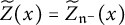 $\widetilde {Z}(x) = \widetilde {Z}_{\mathfrak {n}^{-}}(x)$
, with
$\widetilde {Z}(x) = \widetilde {Z}_{\mathfrak {n}^{-}}(x)$
, with $x = kx_{0}$
. Thus,
$x = kx_{0}$
. Thus,
 $$ \begin{align*} \left( d\phi_{x} \right)_{1}(Z) = \widetilde{Z}_{\mathfrak{n}^{-}}(x) \qquad Z \in \mathfrak{g}. \end{align*} $$
Identifying $T_{x}\mathbb {F}$
, where
$T_{x}\mathbb {F}$
, where $x = kx_{0}$
, with
$x = kx_{0}$
, with $\left ( \mathfrak {n}^{-} \right )^{k} = \mathrm {Ad}(k)\mathfrak {n}^{-}$
, the linear map
$\left ( \mathfrak {n}^{-} \right )^{k} = \mathrm {Ad}(k)\mathfrak {n}^{-}$
, the linear map $\left ( d\phi _{x} \right )_{1}$
corresponds to the projection
$\left ( d\phi _{x} \right )_{1}$
corresponds to the projection $\mathrm {proj}_{\left ( \mathfrak {n}^{-} \right )^{k}}$
of
$\mathrm {proj}_{\left ( \mathfrak {n}^{-} \right )^{k}}$
of $\mathfrak {g}$
onto
$\mathfrak {g}$
onto $\left ( \mathfrak {n}^{-} \right )^{k}$
, with respect to the decomposition
$\left ( \mathfrak {n}^{-} \right )^{k}$
, with respect to the decomposition
 $$ \begin{align*} \mathfrak{g} = \mathfrak{m}^{k} \oplus \mathfrak{a}^{k} \oplus \left( \mathfrak{n}^{+} \right)^{k} \oplus \left( \mathfrak{n}^{-} \right)^{k}. \end{align*} $$
The moment map $\mu $
is the adjoint
$\mu $
is the adjoint $\left ( d\phi _{x} \right )_{1}^{\ast }$
, that is,
$\left ( d\phi _{x} \right )_{1}^{\ast }$
, that is,
 $$\begin{align*}\mu\left( \alpha \right)\left( Z \right) = \alpha \circ \left( d\phi_{x} \right)_{1}^{\ast} \left( \widetilde{Z}\left( x \right) \right) = \alpha \circ \left( d\phi_{x} \right)_{1}^{\ast} \left( \widetilde{Z_{\left( \mathfrak{n}^{-} \right)^{k}}} \left( x \right) \right), \quad \alpha \in T_{x}^{\ast}\mathbb{F}, \, Z \in \mathfrak{g}. \end{align*}$$
Therefore, $\mu \left ( \alpha \right )\left ( Z \right ) = \mu \left ( \alpha \right )\left ( Z_{\left ( \mathfrak {n}^{-} \right )^{k}} \right )$
.
$\mu \left ( \alpha \right )\left ( Z \right ) = \mu \left ( \alpha \right )\left ( Z_{\left ( \mathfrak {n}^{-} \right )^{k}} \right )$
.
Identifying $\mathfrak {g}^{\ast }$
with
$\mathfrak {g}^{\ast }$
with $\mathfrak {g}$
using the Cartan–Killing form
$\mathfrak {g}$
using the Cartan–Killing form $\langle \cdot , \cdot \rangle $
, the subspace
$\langle \cdot , \cdot \rangle $
, the subspace $\mathfrak {m}^{k} \oplus \mathfrak {a}^{k}$
vanishes on
$\mathfrak {m}^{k} \oplus \mathfrak {a}^{k}$
vanishes on $\left ( \mathfrak {n}^{-} \right )^{k}$
, so
$\left ( \mathfrak {n}^{-} \right )^{k}$
, so $\mu \left ( \alpha \right )$
lies in the nilpotent algebra
$\mu \left ( \alpha \right )$
lies in the nilpotent algebra $\left ( \mathfrak {n}^{+} \right )^{k}$
.
$\left ( \mathfrak {n}^{+} \right )^{k}$
.
It is now possible to interpret the moment map using the identification of $T^{\ast }\mathbb {F}$
with
$T^{\ast }\mathbb {F}$
with $G/MA=\mathrm {Ad}\left (G\right ) H_{0}$
. This adjoint orbit is the union
$G/MA=\mathrm {Ad}\left (G\right ) H_{0}$
. This adjoint orbit is the union
 $$ \begin{align*} \mathrm{Ad}\left( G\right) H_{0} = \bigcup_{k\in K} \mathrm{Ad}\left(k\right) \left( H_{0} + \mathfrak{n}^{+} \right). \end{align*} $$
An element $H_{0}^{k} + X^{k} = \mathrm {Ad}\left (k\right ) \left (H_{0} + X\right )$
, with
$H_{0}^{k} + X^{k} = \mathrm {Ad}\left (k\right ) \left (H_{0} + X\right )$
, with $X \in \mathfrak {n}^{+}$
, is viewed as a linear functional on the tangent space
$X \in \mathfrak {n}^{+}$
, is viewed as a linear functional on the tangent space $T_{x}\mathbb {F} = \mathrm {Ad}\left ( k \right ) \left (H_{0} + \mathfrak {n}^{-}\right )$
, where
$T_{x}\mathbb {F} = \mathrm {Ad}\left ( k \right ) \left (H_{0} + \mathfrak {n}^{-}\right )$
, where $x = \mathrm {Ad}\left (k\right ) x_{0}$
, and is expressed as
$x = \mathrm {Ad}\left (k\right ) x_{0}$
, and is expressed as $\langle X, Y \rangle $
with
$\langle X, Y \rangle $
with $Y \in \mathfrak {n}^{-}$
.
$Y \in \mathfrak {n}^{-}$
.
Summarizing, we have the following proposition.
Proposition 5.1 Let $\mu :T^{\ast }\mathbb {F} \rightarrow \mathfrak {g}^{\ast }$
be the moment map induced by the linear action of G on
$\mu :T^{\ast }\mathbb {F} \rightarrow \mathfrak {g}^{\ast }$
be the moment map induced by the linear action of G on $T^{\ast }\mathbb {F}$
. Using the identifications
$T^{\ast }\mathbb {F}$
. Using the identifications $\mathfrak {g}^{\ast } \approx \mathfrak {g}$
(via the Cartan–Killing form
$\mathfrak {g}^{\ast } \approx \mathfrak {g}$
(via the Cartan–Killing form $\langle \cdot , \cdot \rangle $
) and
$\langle \cdot , \cdot \rangle $
) and $T^{\ast }\mathbb {F} \approx \mathrm {Ad}\left (G\right ) H_{0}$
, the map
$T^{\ast }\mathbb {F} \approx \mathrm {Ad}\left (G\right ) H_{0}$
, the map $\mu $
is given by
$\mu $
is given by
 $$ \begin{align} \mu \left( H_{0}^{k} + X^{k} \right)\left(Z\right) = \langle X^{k}, Z \rangle, \end{align} $$
where the superscript k indicates $X^{k} = \mathrm {Ad}\left (k\right ) X$
, and similarly for other terms.
$X^{k} = \mathrm {Ad}\left (k\right ) X$
, and similarly for other terms.
This expression for the moment map $\mu $
provides descriptions of the canonical symplectic form on
$\mu $
provides descriptions of the canonical symplectic form on $T^{\ast }\mathbb {F}$
.
$T^{\ast }\mathbb {F}$
.
One description is given in terms of nilpotent orbits in $\mathfrak {g}$
. A key property of an equivariant moment map (as is the case here) is that the image of a group orbit is a coadjoint orbit of the representation. Furthermore, the restriction of the symplectic form to the orbit is the pullback of the KKS form on the coadjoint orbit.
$\mathfrak {g}$
. A key property of an equivariant moment map (as is the case here) is that the image of a group orbit is a coadjoint orbit of the representation. Furthermore, the restriction of the symplectic form to the orbit is the pullback of the KKS form on the coadjoint orbit.
In this case, the orbits of the linear action of G on $T^{\ast }\mathbb {F}$
are given by
$T^{\ast }\mathbb {F}$
are given by
 $$ \begin{align*} G^{\#} \cdot p = \{ p \circ dg_{x}^{-1} : g \in G \} \qquad p \in T_{x}^{\ast }\mathbb{F}, \end{align*} $$
with $x \in \mathbb {F}$
being arbitrary, as the action of G on
$x \in \mathbb {F}$
being arbitrary, as the action of G on $\mathbb {F}$
is transitive.
$\mathbb {F}$
is transitive.
By identifying $T^{\ast }\mathbb {F} \approx \mathrm {Ad}\left (G\right ) H_{0}$
, an element
$T^{\ast }\mathbb {F} \approx \mathrm {Ad}\left (G\right ) H_{0}$
, an element $\alpha \in T_{x_{0}}^{\ast }\mathbb {F}$
, where
$\alpha \in T_{x_{0}}^{\ast }\mathbb {F}$
, where $x_{0} = H_{0}$
, is given by
$x_{0} = H_{0}$
, is given by $\alpha = H_{0} + X$
, with
$\alpha = H_{0} + X$
, with $X \in \mathfrak {n}^{+}$
.
$X \in \mathfrak {n}^{+}$
.
From (5.3), we have $\mu \left (H_{0} + X\right ) = \langle X, \cdot \rangle $
. Hence, the following description of the canonical symplectic form
$\mu \left (H_{0} + X\right ) = \langle X, \cdot \rangle $
. Hence, the following description of the canonical symplectic form $\Gamma $
on
$\Gamma $
on $T^{\ast }\mathbb {F}$
is obtained.
$T^{\ast }\mathbb {F}$
is obtained.
Proposition 5.2 Consider the identification $T^{\ast }\mathbb {F} \approx \mathrm {Ad}\left (G\right ) H_{0}$
. Then, the canonical symplectic form
$T^{\ast }\mathbb {F} \approx \mathrm {Ad}\left (G\right ) H_{0}$
. Then, the canonical symplectic form $\Gamma $
on
$\Gamma $
on $T^{\ast }\mathbb {F}$
, restricted to the orbit
$T^{\ast }\mathbb {F}$
, restricted to the orbit $G^{\#} \cdot \left (H_{0} + X\right )$
,
$G^{\#} \cdot \left (H_{0} + X\right )$
, $X \in \mathfrak {n}^{+}$
, is the pullback of the KKS form on the coadjoint orbit of
$X \in \mathfrak {n}^{+}$
, is the pullback of the KKS form on the coadjoint orbit of $\langle X, \cdot \rangle $
.
$\langle X, \cdot \rangle $
.
Via the identification $\mathfrak {g}^{\ast } \approx \mathfrak {g}$
, the coadjoint orbit of
$\mathfrak {g}^{\ast } \approx \mathfrak {g}$
, the coadjoint orbit of $\langle X, \cdot \rangle $
corresponds to the adjoint orbit of the nilpotent element X.
$\langle X, \cdot \rangle $
corresponds to the adjoint orbit of the nilpotent element X.
Explicitly, if $p = \mathrm {Ad}\left (k\right )\left (H_{0} + X\right )$
, then
$p = \mathrm {Ad}\left (k\right )\left (H_{0} + X\right )$
, then
 $$ \begin{align} \Gamma_{p}\left(\widetilde{Y}, \widetilde{Z}\right) = \langle X, \left[Y, Z\right] \rangle \qquad Y, Z \in \mathfrak{g}, \end{align} $$
where $\widetilde {Y} = \mathrm {ad}\left (Y\right )$
and
$\widetilde {Y} = \mathrm {ad}\left (Y\right )$
and $\widetilde {Z} = \mathrm {ad}\left (Z\right )$
are the linear vector fields on
$\widetilde {Z} = \mathrm {ad}\left (Z\right )$
are the linear vector fields on $\mathfrak {g}$
defined by Y and Z.
$\mathfrak {g}$
defined by Y and Z.
Another application of the moment map formula (5.3) is that it provides an expression for the Liouville form $\Lambda $
in terms of the difference
$\Lambda $
in terms of the difference $\omega - \omega _{K \times K}$
, where
$\omega - \omega _{K \times K}$
, where $\omega $
and
$\omega $
and $\omega _{K \times K}$
are the connections that are G-invariant and
$\omega _{K \times K}$
are the connections that are G-invariant and $K \times K$
-invariant, respectively. From this, an expression for the canonical symplectic form in terms of the difference
$K \times K$
-invariant, respectively. From this, an expression for the canonical symplectic form in terms of the difference $\Omega - \Omega _{K \times K}$
of the respective curvatures is obtained.
$\Omega - \Omega _{K \times K}$
of the respective curvatures is obtained.
For this interpretation, it must be assumed that $H_{0}$
lies in the center of
$H_{0}$
lies in the center of $\mathfrak {m} \oplus \mathfrak {a}$
so that
$\mathfrak {m} \oplus \mathfrak {a}$
so that $\lambda _{H_{0}}$
is
$\lambda _{H_{0}}$
is $MA$
-invariant. The condition
$MA$
-invariant. The condition $\mathrm {Ad}\left (K\right ) H_{0} = \mathbb {F}$
is still used, as
$\mathrm {Ad}\left (K\right ) H_{0} = \mathbb {F}$
is still used, as $\mathrm {Ad}\left (G\right ) H_{0}$
must be identified with
$\mathrm {Ad}\left (G\right ) H_{0}$
must be identified with $T^{\ast }\mathbb {F}$
.
$T^{\ast }\mathbb {F}$
.
The relationship between $\Lambda $
and
$\Lambda $
and $\mu $
is given by
$\mu $
is given by $\mu \left (Z\right ) = \Lambda \left (Z^{\#}\right )$
, where
$\mu \left (Z\right ) = \Lambda \left (Z^{\#}\right )$
, where $Z \in \mathfrak {g}$
. Combining this equality with (5.3) yields
$Z \in \mathfrak {g}$
. Combining this equality with (5.3) yields
 $$ \begin{align} \Lambda_{p}\left(Z^{\#}\left(p\right)\right) = \langle X^{k}, Z \rangle \qquad Z \in \mathfrak{g}, \end{align} $$
where $p = H_{0}^{k} + X^{k} = \mathrm {Ad}\left (k\right )\left (H_{0} + X\right )$
is an element of the cotangent space
$p = H_{0}^{k} + X^{k} = \mathrm {Ad}\left (k\right )\left (H_{0} + X\right )$
is an element of the cotangent space $T_{x}^{\ast }\mathbb {F} = \mathrm {Ad}\left (k\right )\left (H_{0} + \mathfrak {n}^{+}\right )$
, with
$T_{x}^{\ast }\mathbb {F} = \mathrm {Ad}\left (k\right )\left (H_{0} + \mathfrak {n}^{+}\right )$
, with $x = H_{0}^{k} = \mathrm {Ad}\left (k\right ) H_{0}$
.
$x = H_{0}^{k} = \mathrm {Ad}\left (k\right ) H_{0}$
.
The second term in the equality above can be rewritten as
 $$ \begin{align} \langle X^{k}, Z \rangle = \langle H_{0}^{k} + X^{k}, Z \rangle - \langle H_{0}^{k}, Z \rangle. \end{align} $$
This expression is interpreted in terms of connections as follows.
-
(1) Let
$\omega $
be the G-invariant connection on
$G \rightarrow G/MA$
. Then, the first term on the right-hand side of (5.6) is given by (5.7)where
$$ \begin{align} \langle H_{0}^{k} + X^{k}, Z \rangle = \lambda_{H_{0}}\left(\omega_{g} Z^{r}(g)\right), \end{align} $$
$Z^{r}$
is the right-invariant vector field defined by
$Z \in \mathfrak {g}$
,
$g \in G$
is any element such that
$\mathrm {Ad}(g) H_{0} = H_{0}^{k} + X^{k}$
, and
$\lambda _{H_{0}}(\cdot ) = \langle H_{0}, \cdot \rangle $
.
Indeed, at the origin
$H_{0}$
with
$g = 1$
, the equality holds because
$\omega _{1} Z^{r}(1)$
is the component of Z in the direction of
$\mathfrak {m} \oplus \mathfrak {a}$
with respect to the decomposition
$\mathfrak {g} = \mathfrak {m} \oplus \mathfrak {a} \oplus \mathfrak {n}^{+} \oplus \mathfrak {n}^{-}$
, which is orthogonal with respect to the Cartan–Killing form. At the origin, for
$g \in MA$
, the equality still holds since
$H_{0}^{k} + X^{k} = \mathrm {Ad}(g) H_{0} = H_{0}$
.For a general point, note that
$\omega _{g}(Z^{r}(g)) = \omega _{1}((\mathrm {Ad}(g^{-1}) Z)^{r}(1))$
because
$\omega $
is left-invariant. Thus, which, using the equality at
$$ \begin{align*} \lambda_{H_{0}}(\omega_{g} Z^{r}(g)) = \lambda_{H_{0}}\left(\omega_{1}((\mathrm{Ad}(g^{-1}) Z)^{r}(1))\right), \end{align*} $$
$H_{0}$
, becomes if
$$ \begin{align*} \lambda_{H_{0}}\left(\omega_{1}((\mathrm{Ad}(g^{-1}) Z)^{r}(1))\right) &= \langle H_{0}, \mathrm{Ad}(g^{-1}) Z \rangle = \langle \mathrm{Ad}(g) H_{0}, Z \rangle \\ &= \langle H_{0}^{k} + X^{k}, Z \rangle, \end{align*} $$
$\mathrm {Ad}(g) H_{0} = H_{0}^{k} + X^{k}$
. This concludes the proof of (5.7), which provides the first term on the right-hand side of (5.6) in terms of the G-invariant connection.
-
(2) The component
$\langle H_{0}^{k}, Z \rangle = \langle \mathrm {Ad}(k) H_{0}, Z \rangle $
was computed in terms of the connection
$\omega _{K \times K}$
in Corollary 4.11. The element
$H_{0} \in \mathfrak {a}$
lies in the center of
$\mathfrak {m} \oplus \mathfrak {a}$
, and thus
$\left (H_{0}, 0\right )$
is in the center of
$\left (\mathfrak {m} \oplus \mathfrak {a}\right ) \times \left (\mathfrak {m} \oplus \mathfrak {a}\right )$
. Consequently, Corollary 4.11 applies to the linear functional
$\lambda _{H_{0}, 0}$
, showing that where
$$ \begin{align*} \lambda_{H_{0}, 0}\left(\omega_{K \times K}\left(Z^{r}(gx_{0}, gx_{w})\right)\right) &= \lambda_{H_{0}, 0}\left(\omega_{K \times K}\left(\widetilde{Z}(gx_{0}), \widetilde{Z}(gx_{w})\right)\right)\\ &= \langle \mathrm{Ad}(k) H_{0}, Z \rangle, \end{align*} $$
$g = khn^{+}$
are the components of g in the Iwasawa decomposition
$G = KAN^{+}$
. This computes
$\langle \mathrm {Ad}(k) H_{0}, Z \rangle $
in terms of the connection
$\omega _{K \times K}$
.
















The combination of the previous two items expresses the Liouville form of $ T^{\ast } \mathbb {F} $
in terms of the difference
$ T^{\ast } \mathbb {F} $
in terms of the difference $ \omega - \omega _{K \times K} $
between the connections. If
$ \omega - \omega _{K \times K} $
between the connections. If $ \lambda $
is an
$ \lambda $
is an $ MA $
-invariant linear functional on
$ MA $
-invariant linear functional on $ \left ( \mathfrak {m} \oplus \mathfrak {a} \right )^2 $
, then
$ \left ( \mathfrak {m} \oplus \mathfrak {a} \right )^2 $
, then $ \lambda \omega - \lambda \omega _{K \times K} $
is a right-invariant 1-form on the principal bundle
$ \lambda \omega - \lambda \omega _{K \times K} $
is a right-invariant 1-form on the principal bundle $ \left ( G \times G \right ) / \left ( N^+ \times N^- \right ) \to G / MA = T^{\ast } \mathbb {F} $
, which vanishes on the vertical spaces (since this is the behavior of the difference between two connections). Therefore,
$ \left ( G \times G \right ) / \left ( N^+ \times N^- \right ) \to G / MA = T^{\ast } \mathbb {F} $
, which vanishes on the vertical spaces (since this is the behavior of the difference between two connections). Therefore, $ \lambda \omega - \lambda \omega _{K \times K} $
is the pullback of a 1-form on
$ \lambda \omega - \lambda \omega _{K \times K} $
is the pullback of a 1-form on $ G / MA $
. This 1-form on
$ G / MA $
. This 1-form on $ G / MA $
is denoted by
$ G / MA $
is denoted by $ \lambda ^{\ast } \left ( \omega - \omega _{K \times K} \right ) $
.
$ \lambda ^{\ast } \left ( \omega - \omega _{K \times K} \right ) $
.
Proposition 5.3 Let the identification of $ T^{\ast } \mathbb {F} $
with
$ T^{\ast } \mathbb {F} $
with $ G/MA $
be made by equating both to an adjoint orbit
$ G/MA $
be made by equating both to an adjoint orbit $ \mathrm {Ad}(G) H_0 $
, where
$ \mathrm {Ad}(G) H_0 $
, where $ H_0 $
is in the center of
$ H_0 $
is in the center of $ \mathfrak {m} \oplus \mathfrak {a} $
and regular in the sense that
$ \mathfrak {m} \oplus \mathfrak {a} $
and regular in the sense that $ \mathrm {Ad}(K) H_0 = \mathbb {F} $
. Then, the Liouville form on
$ \mathrm {Ad}(K) H_0 = \mathbb {F} $
. Then, the Liouville form on $ T^{\ast } \mathbb {F} = G/MA $
is given by
$ T^{\ast } \mathbb {F} = G/MA $
is given by
 $$ \begin{align*} \lambda_{H_0,0}^{\ast} \left( \omega - \omega_{K \times K} \right) \end{align*} $$
where, as before, $ \lambda _{H_0} (\cdot ) = \langle H_0, \cdot \rangle $
. Therefore, the canonical symplectic form on
$ \lambda _{H_0} (\cdot ) = \langle H_0, \cdot \rangle $
. Therefore, the canonical symplectic form on $ T^{\ast } \mathbb {F} $
is
$ T^{\ast } \mathbb {F} $
is
 $$ \begin{align*} \Gamma = \lambda_{H_0,0}^{\ast} \left( \Omega - \Omega_{K \times K} \right) \end{align*} $$
where $ \Omega $
and
$ \Omega $
and $ \Omega _{K \times K} $
are the curvatures. In this expression, the component
$ \Omega _{K \times K} $
are the curvatures. In this expression, the component $ \lambda _{H_0,0}^{\ast } \Omega = \Omega _{\lambda _{H_0}} $
is the KKS form of the adjoint orbit by
$ \lambda _{H_0,0}^{\ast } \Omega = \Omega _{\lambda _{H_0}} $
is the KKS form of the adjoint orbit by $ H_0 $
.
$ H_0 $
.
As previously seen, the $ \mathfrak {a} \oplus \mathfrak {a} $
-component of the curvature
$ \mathfrak {a} \oplus \mathfrak {a} $
-component of the curvature $ \Omega _{K \times K} $
vanishes, that is,
$ \Omega _{K \times K} $
vanishes, that is, $ \Omega _{K \times K} $
takes values in
$ \Omega _{K \times K} $
takes values in $ \mathfrak {m} \oplus \mathfrak {m} $
. Therefore, if
$ \mathfrak {m} \oplus \mathfrak {m} $
. Therefore, if $ H_1 $
and
$ H_1 $
and $ H_2 $
are in
$ H_2 $
are in $ \mathfrak {a} $
, then
$ \mathfrak {a} $
, then $ \lambda _{H_1, H_2}^{\ast } \Omega _{K \times K} = 0 $
. Taking, as in the previous proposition,
$ \lambda _{H_1, H_2}^{\ast } \Omega _{K \times K} = 0 $
. Taking, as in the previous proposition, $ (H_1, H_2) = (H_0, 0) $
where
$ (H_1, H_2) = (H_0, 0) $
where $ H_0 \in \mathfrak {a} $
, it follows that the canonical symplectic form reduces to
$ H_0 \in \mathfrak {a} $
, it follows that the canonical symplectic form reduces to $ \Gamma = \lambda _{H_0, 0}^{\ast } \Omega $
. The functional
$ \Gamma = \lambda _{H_0, 0}^{\ast } \Omega $
. The functional $ \lambda _{H_0, 0} $
restricted to the diagonal
$ \lambda _{H_0, 0} $
restricted to the diagonal $ \{ (H, H) \in \mathfrak {a} \oplus \mathfrak {a} \} $
coincides with the functional
$ \{ (H, H) \in \mathfrak {a} \oplus \mathfrak {a} \} $
coincides with the functional $ \lambda _{H_0} $
on
$ \lambda _{H_0} $
on $ \mathfrak {a} $
. Therefore,
$ \mathfrak {a} $
. Therefore, $ \lambda _{H_0, 0}^{\ast } \Omega $
is seen as
$ \lambda _{H_0, 0}^{\ast } \Omega $
is seen as $ \lambda _{H_0}^{\ast } \Omega $
, which is in turn the KKS form of the adjoint orbit
$ \lambda _{H_0}^{\ast } \Omega $
, which is in turn the KKS form of the adjoint orbit $ \mathrm {Ad}(G) H_0 $
. This shows that this KKS form is exact.
$ \mathrm {Ad}(G) H_0 $
. This shows that this KKS form is exact.
Corollary 5.4 If $ H_0 \in \mathfrak {a} $
is a regular real element, then the KKS form
$ H_0 \in \mathfrak {a} $
is a regular real element, then the KKS form $ \kappa _{H_0} $
of the adjoint orbit
$ \kappa _{H_0} $
of the adjoint orbit $ \mathrm {Ad}(G) H_0 $
coincides with the canonical symplectic form
$ \mathrm {Ad}(G) H_0 $
coincides with the canonical symplectic form $ \Gamma $
of
$ \Gamma $
of $ T^{\ast } \mathbb {F} $
and is therefore an exact form. In terms of connections,
$ T^{\ast } \mathbb {F} $
and is therefore an exact form. In terms of connections,
 $$ \begin{align*} \kappa_{H_0} = d \left( \lambda_{H_0}^{\ast} \left( \omega - \omega_{K \times K} \right) \right) \end{align*} $$
where $ \omega $
is the
$ \omega $
is the $ G $
-invariant connection on
$ G $
-invariant connection on $ G \to G / MA $
.
$ G \to G / MA $
.
To conclude this section, we record some remarks regarding the preceding constructions.
-
(1) The fact that the canonical symplectic form
$ \Gamma $
is written as the difference of two curvatures is in agreement with the Chern–Weil homomorphism, which shows that for an invariant functional
$ \lambda $
and two curvatures
$ \Omega _1 $
and
$ \Omega _2 $
, the
$ 2 $
-forms
$ \lambda ^{\ast } \Omega _1 $
and
$ \lambda ^\ast \Omega _2 $
are cohomologous. Therefore, the difference between them is an exact form, as is the case with the canonical form in a cotangent bundle. -
(2) The cotangent bundle
$ T^{\ast } \mathbb {F} $
has been identified with the adjoint orbit
$ \mathrm {Ad}(G) H_0 $
(with
$ \mathbb {F} = \mathrm {Ad}(K) H_0 $
), where the fibers are the orbits of
$ k N^+ k^{-1} $
with
$ k \in K $
. The symmetric (dual) construction can be made with
$ N^{-} $
instead of
$ N^+ $
. For this, the origin of the flag must be shifted, now viewed as the orbit
$ \mathrm {Ad}(K) (w_0 H_0) $
, where
$ w_0 $
is the principal involution. This means that
$ \mathbb {F} $
is now seen as
$ \mathbb {F}^{\ast } $
. In this new origin, the Iwasawa decomposition
$ G = KAN^{-} $
is considered, and the constructions work in the same way. This provides another diffeomorphism between
$ T^{\ast } \mathbb {F} $
and the adjoint orbit (in fact,
$ T^{\ast } \mathbb {F}^{\ast } $
).In terms of the immersion of
$ T^{\ast } \mathbb {F} $
in
$ \mathbb {F} \times \mathbb {F}^{\ast } $
(as an open orbit), in the first diffeomorphism, the fibers are the fibers
$ p_1^{-1}\{x\} $
with respect to the projection onto the first coordinate. In the second diffeomorphism, the fibers are
$ p_2^{-1}\{y\} $
with respect to the projection onto the second coordinate.Changing the choice of diffeomorphism also changes the canonical symplectic form in the open orbit. For the first diffeomorphism, the linear functional
$ \lambda _{H_0,0} $
was used in the proposition above. For the second choice, one simply takes the functional
$ \lambda _{0, w_0 H_0} $
, when the canonical symplectic form is given by
$ \lambda _{0, w_0 H_0}^{\ast } (\Omega - \Omega _{K \times K}) $
, with the Liouville form
$ \lambda _{0, w_0 H_0}^{\ast } (\omega - \omega _{K \times K}) $
. -
(3) The diffeomorphism between
$ T^{\ast } \mathbb {F} $
and the adjoint orbit
$ \mathrm {Ad}(G) H_0 $
with
$ \mathbb {F} = \mathrm {Ad}(K) H_0 $
is such that the cotangent space
$ T_{x}^{\ast } \mathbb {F} $
becomes the orbit
$ N^k \cdot x $
, where
$ x = \mathrm {Ad}(k) H_0 \in \mathbb {F} $
. In the diffeomorphism between
$ T^{\ast } \mathbb {F} $
and the open orbit of the diagonal action
$ G \cdot o = G \cdot (x_0, x_w) $
, the base
$ \mathbb {F} $
becomes the
$ K $
-orbit
$ K \cdot (x_0, x_w) = \{(kx_0, kx_w) : k \in K\} $
, and a fiber
$ T_{x}^{\ast } \mathbb {F} $
,
$ x = (kx_0, kx_w) $
, is also the
$ N^k $
-orbit
$ N^k \cdot x $
. This orbit coincides with the fiber
$ p_1^{-1} \{kx_0\} $
, where
$ p_1 : G \cdot o \to \mathbb {F} $
is the projection onto the first coordinate.The fibers
$ T_{x}^{\ast } \mathbb {F} $
are Lagrangian submanifolds with respect to
$ \Gamma $
, as happens in any cotangent bundle. This can also be seen in the expression for
$ \Gamma $
in terms of the difference
$ \omega - \omega _{K \times K} $
of connections. To see this, take, for example, the fiber
$ N^+ \cdot o $
over the origin, which is the projection of
$ \pi (N^+) $
with respect to
$ \pi : G \to G/MA $
. Given
$ X, Y \in \mathfrak {n}^+ $
, the curvature
$ \Omega $
computed on the left-invariant vector fields is
$ \Omega (X^l, Y^l) $
, which is the
$ \mathfrak {m} \oplus \mathfrak {a} $
component of the bracket
$ [X, Y] $
. Hence, the curvature vanishes since
$ [X, Y] \in \mathfrak {n}^- $
. Therefore, the component
$ \lambda _{H_0,0}^{\ast } \Omega $
of the symplectic form vanishes on the fiber. The other component also vanishes on the fiber because
$ \Omega _{K \times K} $
, computed on tangent vectors to the second coordinate, takes values in the second coordinate of
$ (\mathfrak {m} \oplus \mathfrak {a})^2 $
, where the functional
$ \lambda _{H_0,0} $
vanishes. The same argument works for any
$ x = k(x_0, x_w) $
, by replacing
$ N^+ $
with
$ k N^+ k^{-1} $
. This shows that the fibers
$ T_{x}^{\ast } \mathbb {F} = (\{x\} \times \mathbb {F}^{\ast }) \cap G \cdot o $
are Lagrangian submanifolds of the symplectic form
$ \lambda _{H_0,0}^{\ast }(\Omega - \Omega _{K \times K}) $
.By switching the first and second coordinates, it is proven that the submanifolds
$ T_{x}^{\ast } \mathbb {F} = (\mathbb {F} \times \{y\}) \cap G \cdot o $
are Lagrangian for
$ \lambda _{0, w_0 H_0}^{\ast }(\omega - \omega _{K \times K}) $
.












