

Introduction
In October 1931, Indian independence leader Mahatma Gandhi met Italian educator Maria Montessori in London. Gandhi, age sixty-two, dressed in a simple loincloth and shawl even in the autumn chill of the British Isles, had galvanized worldwide attention to the cause of Indian independence the previous year through leading the Dandi Salt March, a 240-mile protest walking from Gandhi's ashram to collect salt from the ocean in defiance of Britain's monopoly. Now Gandhi was demanding that the British government “Quit India” at the Second Round Table Conference on the future of India. At the same time that he was focused on India's political future, Gandhi was intimately concerned with how education could help build a cohesive new nation. In contrast to the British colonial education model, which emphasized English assimilation and a standardized curriculum via textbooks, exams, and strictly regulated schedules, Gandhi had created an experimental school at his Sabarmati ashram in Gujarat, India, with an emphasis on preserving Indian languages, educating children of all religious and caste backgrounds, and teaching them the dignity of manual labor.Footnote 1 He would later propose a model for an independent India in Basic Education (1937), and he was particularly interested in the Montessori method.Footnote 2
Maria Montessori, an Italian doctor and educator, was Gandhi's close contemporary at age sixty-one, and she had spent the last three decades developing a system of education that had gained worldwide recognition. Using her scientific training of observation and experimentation, she began in 1900 working first with children with disabilities and subsequently poor children in Rome to develop a hands-on learning system for young children. In contrast to traditional schools, Montessori envisioned a program that developed children's independence. Children could move freely around the classroom and outdoors, choose their work, and change tasks without the direction of a teacher. In contrast to the play-based Froebelian kindergartens popular at the time, Montessori observed that children were uninterested in toys, preferring instead to master tasks relevant to their daily life such as preparing a snack or washing a table. Building off the work of nineteenth-century French educators Jean-Marc-Gaspard Itard and Édouard Séguin, Montessori developed a series of learning materials with which children could practice a task until they had gained mastery.Footnote 3 In contrast to early twentieth-century education that emphasized standardized, teacher-directed learning with children seated in desks, children in a Montessori classroom chose their work, experiencing freedom and developing independence. These components of education have been shown to be aligned with cognitive science and child development, helping children develop sustained concentration, motivation to learn, and deep engagement.Footnote 4 Stories of some of Italy's poorest four-year-olds spontaneously learning to read garnered global attention. As news of this educational innovation spread, the Montessori method exploded globally throughout the 1910s and ’20s with schools and Montessori associations forming in Europe, Russia, Australia, China, India, and the United States.Footnote 5 While Montessori couldn't foresee it in 1931, in 1939 she would head to India for nearly a decade, offering training, expanding Montessori education around India and further developing her method.
In their meeting, Gandhi and Montessori described themselves as kindred spirits, “linked” by a common commitment to pacifism and social change, or as Montessori described it, they both “teach children to live, to live that spiritual life upon which alone can be built up the peace of the world.”Footnote 6 A few weeks after their private meeting, Gandhi observed a Montessori class in London, and afterward he delivered a speech to the teachers in training and demonstrated his own practical life exercise, hand-spinning thread to make Indian khadi fabric, part of his protest against Britain's fabric monopoly in India (see Figure 1).Footnote 7
Mahatma Gandhi demonstrates the spinning wheel to Montessori students, London, October 30, 1931 (Daily Mirror).

Since the first Montessori school opened in India in 1915, Gandhi had visited a number of the schools, but he was still struck by what he observed in London. In letters to Sabarmati staff and students, he described the Montessori method in detail, marveling at how “the children felt no burden of learning as they learnt everything as they played” and advising the ashram children to replicate Montessori's silence game, where a group of children attempt to sustain silence for as long as possible.Footnote 8 The admiration was mutual: Montessori described Gandhi as having “been in my thoughts for years and years. I have followed him with my soul.”Footnote 9 Montessori presented Gandhi with a training certificate, making him one of the few people to gain Montessori recognition without taking a course, notable at the time given that Montessori's tight control over teacher training had already led to rifts with her closest students in several countries including the United States and Germany.Footnote 10
Despite their philosophical alignment, even in this first encounter, Gandhi raised concerns about how Montessori education was spreading in India, identifying fault lines in the movement that have continued over nearly a century. Gandhi wanted the method to be accessible “not only for the children of the wealthy and the well-to-do” but for “the millions of children of the semi-starved villages of India . . . and I asked myself as my heart went out to those children, ‘Is it possible for me to give them those lessons and the training that are being given under your system, to those children [in London]?’”Footnote 11 Gandhi's question of who would receive a Montessori education was repeated over two decades of friendship and disagreement with Maria Montessori, and was taken up subsequently by others in the intervening years.Footnote 12
This question of whom Montessori education has served in India and how it has been adapted to these various audiences is now only beginning to be examined by researchers. Education historians have recognized Montessori education's status as a movement “on the margins,” and indeed, Montessori historical studies in academic journals and books have been rare and are only now starting to see an increase.Footnote 13 Alongside biographical studies of Maria Montessori and the global dissemination of her pedagogy,Footnote 14 more recent scholarship has focused on key Montessori educators, who often were transnational in spreading the method to several countries,Footnote 15 and on excavating the “hidden figures” of non-white educators who brought Montessori to Black, Latinx, and Indigenous communities.Footnote 16 Other studies have focused on the Montessori movement's growth in specific countries,Footnote 17 and a few have focused on government-funded Montessori around the globe.Footnote 18
In considering transnational trends, scholars have documented how the Montessori movement has followed three primary “waves” of interest and accompanying declines across the twentieth century.Footnote 19 While this wave metaphor helps illustrate repeating patterns of Montessori dissemination around the globe, it suggests a natural, organic phenomenon when in fact these declines were often precipitated by intense partisan fights between Montessori factions.Footnote 20 Some of the largest fault lines were established by Maria Montessori's efforts to control and preserve her method, what historian Jana Tschurenev calls the “orthodox approach.”Footnote 21 As a result, Montessori often clashed with other educators who sought to adapt the method to their local context.Footnote 22 Although scholars have noted how much Montessori education has maintained a continuity of practice, particularly when contrasted with other progressive movements, Montessori leaders have had limited success in trademarking, licensing materials, and training, which has resulted in a complex, decentralized landscape of organizations and schools.Footnote 23 Moreover, there is no consensus within the Montessori community about appropriate levels of adaptation. To some extent, the ability to adapt language materials and practical life exercises has made Montessori education versatile across cultures, yet educators and researchers debate to what extent Montessori can be adapted beyond these curricular templates and still be considered “Montessori,” and at what point is the adaptation so extreme that it becomes something else entirely.Footnote 24 Often, this issue is intricately tied up with the audience of children receiving Montessori education.
Recent case studies of Montessori in India and the United States have identified patterns whereby wealthy elite children are likely to receive “orthodox” Montessori while poor children more often receive adapted Montessori.Footnote 25 While these studies represent a timely acknowledgment of both the historical and contemporary elitism of the Montessori movement, and they excavate counternarratives of those who sought to make it otherwise, this identification of a class-based binary simplifies the numerous ways Montessori education has emerged globally. Instead, this article envisions Montessori education's global dissemination as a series of adapted, competing, and contested framings, whose proponents developed differing ideas regarding the model's purpose, its intended audience, and how much it could be adapted.Footnote 26 This framework contributes to transnational studies of education, a small but growing literature documenting the long history of progressive education in India, and comparative international studies of Montessori.Footnote 27
The comparably long and uninterrupted history of the Montessori method in India makes it a fertile venue for demonstrating the process of adaptation, competition, and contestation. Many historical accounts of Montessori in India focus extensively on the personal biography of the method's founder,Footnote 28 and India is often referenced among Montessori educators as an example of the method's universal applicability to children worldwide.Footnote 29 Others have examined how India shaped Maria Montessori's educational philosophy, highlighting the important cultural exchanges with Theosophy and Indian art and religions that took place during Montessori's India sojourn.Footnote 30 Indian Montessori educators have also documented Montessori's history for an audience of fellow supporters.Footnote 31 Only two studies have critically considered Gandhi's question of who receives Montessori education and how the method has been adapted in India, documenting the tensions between an orthodox-elite and adapted-for-the-masses Montessori.Footnote 32 In spite of their enormous historical contribution, both studies conclude in the 1970s, omitting significant developments in the Indian Montessori movement over the last fifty years.
There are admittedly considerable challenges in depicting a multifaceted and geographically disparate educational movement over the span of more than a hundred years in a country of 1.38 billion people marked by linguistic, religious, and socioeconomic diversity. Still, the longer scope of this study demonstrates repeated patterns in how different constituencies have adapted Montessori through competing and conflicting framings, emphasizing different elements of the method to suit their varying educational purposes.Footnote 33 In contrast to representations of a “universal” child and universal Montessori method, Montessori education in India has been adapted into four primary frames serving different audiences and purposes, as summarized in Table 1. While these frames have often been pitted against each other, there are also overlaps of ideas, organizations, and actors, particularly with respect to nation-building and uplift for the poor. The four frames are as follows: first, beginning in 1915 with the opening of the first Montessori school in India and ending in 1939 with the death of Montessori educator Gijubhai Badheka, Indian educators envisioned that Montessori could be used to support nation-building efforts by teaching independence, unifying children across religious and caste groups, and teaching local languages and cultures. Second, in a parallel development spanning from 1915 to 2021, elite Montessori for wealthy children focused on individual development, cultivating freedom, and happiness.
Competing Montessori frames in India, 1915–2021

Third, education for India's poorest children emphasized Montessori for its supposedly civilizing purposes, efforts that began in earnest in the 1950s with Tarabai Modak's development of the anganwadi and balwadi model and continue today in government Montessori efforts and with the support of foundations and religious organizations.Footnote 34 Finally, since the 1990s, with the growth of private early childhood education throughout India, Montessori has become an attractive brand, signifying international learning and academic competitiveness, used by childcare franchises, often with limited connections to Montessori pedagogy.
While nation-building was the first central framing of Montessori in India, it was gradually eclipsed by the elite frame that has remained dominant to today, a frame reinforced by Maria Montessori and her emphasis on preserving the fidelity of her method through expensive training and materials. Only recently, support for providing wider Montessori access to poor students has begun gaining momentum across India along with the rise in middle-class-branded Montessori via franchises. These varied constituencies help explain why Montessori has stayed relevant for over a century in India. However, the competition between these groups and disagreements over what form Montessori should take and who it can serve helps explain why Montessori has stayed marginal to broader educational change in India.
Nation-Building and Elite Montessori, 1915–1939
Early Montessori education efforts in India were intertwined with India's burgeoning independence movement. In the early twentieth century, Indian early childhood education was marginal in scale, largely delivered to foreign and urban elite children by English and Scottish missionaries following the British infant school model or the German Froebelian kindergarten model. With early childhood education options limited, Montessori education was enthusiastically adopted around India, and the term Montessori school often became synonymous with preschool, whether or not the school had any explicit connection to the method.Footnote 35 Four years after the first Montessori Children's House opened in Rome in 1907, the Times of India featured Montessori education in 1911, and the Maharaja of Mysore sent Paul Chinappa, an Indian, to attend the first international Montessori training course in 1913.Footnote 36 Two years later, two social workers, Motibhai Amin and Darbar Gopaldas Desai, opened the first Indian Montessori school in Baroda.Footnote 37 In the 1910s, the Times of India reviewed at least six books about Montessori education, describing them as a “rising tide of Montessori literature.”Footnote 38
From these books, Indian nationalists formed an early Montessori constituency, emphasizing the nation-building potential of a method that emphasized children's independence, innate spirituality, and the value of manual labor. Writing in the Times of India in 1915, Chinappa, who opened the first Montessori school in Bangalore, reflected on the critical importance of preparing children for national independence. Political independence was a “habit of the mind formed by a long chain of life experiences.” Without people gaining early practice at being independent in a classroom, their political independence risked being “a borrowed sentiment [that] will pass like a puff of smoke, however patriotic it may appear.”Footnote 39 As education lecturer Kamalakanta Mookerjee noted approvingly in the Calcutta Review in 1937, “the watchword of the Montessori method” was “freedom first, freedom second, and freedom last.”Footnote 40
Nation-building Montessori educators were closely connected to the independence struggle and envisioned a nurturing education system that could unite children from diverse religious and caste backgrounds.Footnote 41 Principal among these was Gijubhai Badheka, widely considered the father of “indigenized” Indian preschool education, who discovered Montessori while searching for a non-punitive education for his son.Footnote 42 He ultimately abandoned his legal practice to devote himself to the education of young children. Badheka was closely affiliated with Gandhi; he ran childcare for protestors participating in the Salt March. With Tarabai Modak, a former college principal from a wealthy Mumbai family, they harnessed Montessori's ideas to bring together young Indian children from varying religious and caste backgrounds by establishing a school, Bal Mandir (Children's House), in 1920, adapting the name of Montessori's Children's House (Casa dei Bambini) in Rome.Footnote 43 In these early nation-building efforts, Badheka and Modak's school exemplified the values proposed for an independent India: pluralist and united in its diversity.
A significant challenge in the early global spread of Montessori was accessing teacher training and materials, whose expense and limited availability often kept the method restricted to elite circles.Footnote 44 In the early 1920s, Badheka and Modak removed these obstacles, creating a Montessori infrastructure in Indian languages, pulling the movement from elite to nation-building purposes. They created a teacher training center; a supplier for Indian-made Montessori materials; translations of Montessori's books into Gujarati; a monthly journal, Shikshan Patrika, published in Gujarati, Hindi, and Marathi; and a national Montessori organization, the Nutan Bal Shikshan Sangh (NBSS, New Child Education Society), that held its first conference in 1925. Badheka and Modak also incorporated oral traditions and handicrafts into Montessori education and developed practical life exercises for Indian households through activities like rolling chapatis (unleavened flatbread) and using Gandhi's takli (wool spinner).Footnote 45
Parallel nation-building Montessori efforts included a network of Bengali Montessori schools set up by artist and nationalist Rabindranath Tagore and another cluster in Southern India led by the Theosophical Society and the Women's Indian Association in Chennai. Each of these pro-independence groups created Montessori schools, training programs, materials manufacturing, and book distribution.Footnote 46 Although nation-building Montessori educators’ schools represented roughly only a dozen of the estimated fifty or so Indian Montessori schools created between 1915 and 1948, they dominated training programs and the distribution of materials, creating momentum and infrastructure for expanding this particular framing of Montessori around the Indian subcontinent.Footnote 47
This nation-building vision was limited by several factors, including Maria Montessori herself. Starting in the early 1910s, Montessori tightened restrictions on Montessori societies and training programs around the globe, viewing them as part of her intellectual property and on which her income depended, leading to organizational splits and fallings-out with adherents in multiple countries.Footnote 48 A similar pattern occurred in India. In 1933, Badheka asked a colleague traveling to Europe to update Montessori on his work. Montessori was reportedly displeased that Indian training, materials, and translations had been created without her permission. Badheka passed away in 1939, just as Montessori was about to arrive in India, a rupture that limited the nation-building frame of Montessori education around India.Footnote 49
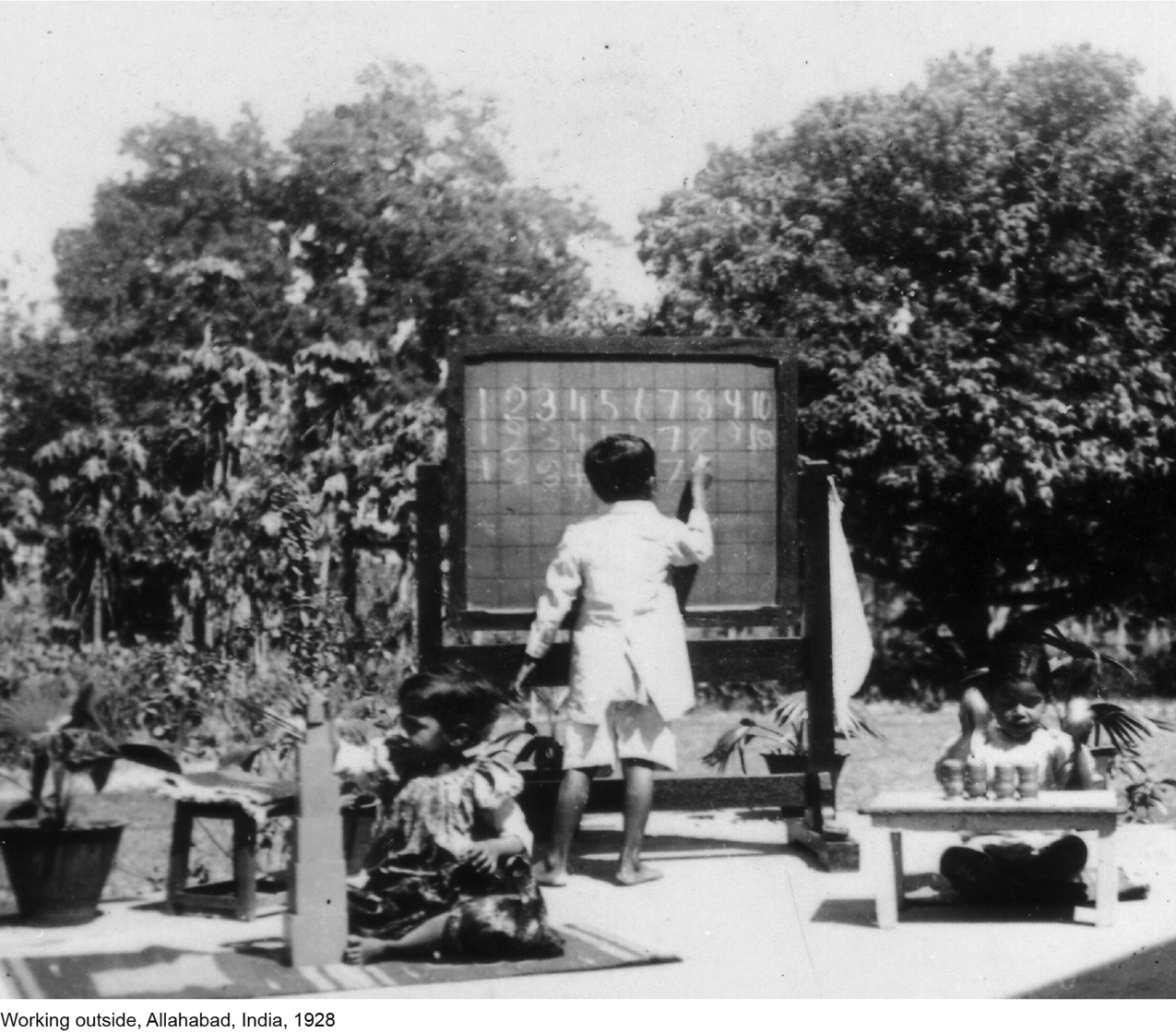
Instead, Montessori education was already rapidly spreading among wealthy Indians, eventually crowding out nation-building Montessori efforts. These elite Montessori projects included palace schools for Indian royals and Montessori sections in elite English-medium schools in Mumbai, Kolkata, and Chennai.Footnote 50 Early classrooms were often held outside, following both progressive educational trends and earlier precolonial Indian education models (see Figure 2).Footnote 51
Children in a Montessori classroom working outside, Allahabad, 1928. Photo taken by educator Elise Braun Barnett, who came to Allahabad from a Montessori school in Vienna.Footnote 55 Photo courtesy of Hedi Siegel.
Wealthy Parsi industrialists—members of India's small Zoroastrian community, in particular—embraced Montessori for its British cachet, and a number of young Parsi women traveled to Europe to train in the method.Footnote 52 This new class of teachers was described in the Times of India as “married women from cultured homes . . . who teach not to earn a living or with the idea to start a school but simply because they love children and enjoy the work.”Footnote 53 The representation of early childhood educators as “loving children” and not needing a salary is still reflected in the gendered work and poor pay conditions for Indian early childhood educators today. Casa Montessori, an elite private preschool founded in 1934 by Parsi Dinoo Mehta and among the oldest continuously operating Montessori schools in the world, received praise in the Times for its “modern equipment, and hygienic classrooms,” resulting in children who “are so interested and happy that they are reluctant to leave at closing time.”Footnote 54
Sometimes, one enthusiastic individual could simultaneously support Montessori for nation-building while creating schools for the elite and schools for the poor. Sarala Devi Sarabhai, the wife of a Gujarati textile magnate, fiscally supported Gandhi's independence efforts and set up a Montessori school for her eight children on the family's estate in Ahmedabad, complete with a gym, swimming pool, and noted British Montessori biographer E.M. Standing as the teacher. Sarabhai also brought Montessori to the poor, creating a school for the children of textile workers, and she later became a member of both NBSS and the Indian branch of Montessori's international organization, the Association Montessori Internationale (AMI), seeking in both roles to expand access to Indian Montessori education.Footnote 56 But Sarabhai was rare in her ability to envision and implement Montessori with multiple framings and audiences.
Between 1915 and 1939, the few Montessori schools for the poor were supported by a wealthy benefactor like Sarabhai. There were, however, a few notable exceptions, including a Montessori program set up by the Bombay Bhagini Samaj (Sister Society) for street sweepers’ children, many of whom were Dalits, people from the lowest caste in India.Footnote 57 Ultimately, almost fifty Montessori schools and programs opened around India between 1915 and 1939, with the majority enrolling elite students.
Montessori's Visit to India: Reinforcing Elite Frames, 1939–1949
Maria Montessori's visit to India in November 1939 with her son Mario presented an opportunity to expand the movement in India and further connect with Indian nationalists. Because of World War II, the suspension of travel and their classification as citizens of an enemy power, this visit stretched to almost a decade in length. This long stay allowed Montessori to train a new generation of Indian Montessori educators, though the dominance of elite frames continued to overshadow the impact of a nationalist vision of Montessori education.
The nationalist importance of Montessori's visit is clear from her circle of contacts. Independence advocates included Theosophical Society leaders George Arundale and Rukmini Devi Arundale, who hosted her visit, and Sarala Devi Sarabhai, with whom she stayed in Ahmedabad.Footnote 58 She met with future prime minister Jawaharlal Nehru, whose daughter, another future prime minister, Indira Gandhi, attended a Montessori school in Ahmedabad.Footnote 59
Montessori initially supported the Indian nationalist framing of her method by working to develop a sustainable local infrastructure. She partnered with Rukmini Devi Arundale's arts school, Kalakshetra, to develop her materials in several Indian languages, and Kalakshetra also became the primary global publisher of works on her method.Footnote 60 This momentum was interrupted by Italy declaring war against the Allies in July 1940, leading the British to classify both Montessoris as enemy aliens because of their nationality, despite their opposition to the Italian Fascist regime. Mario, who acted as Maria's main translator from Italian into English, was soon taken away to a British labor camp in Ahmednagar in central India, leaving his mother alone and unable to communicate with those around her. Although her lobbying efforts succeeded in getting him released on her seventieth birthday, both Montessoris had travel restrictions imposed on them until 1944, limiting their ability to offer training courses and rendering them financially dependent on the Theosophical Society for much of their time in India.Footnote 61
What essentially became five years of quarantine, much of it spent in the colonial hill station of Kodaikanal, was a period of intellectual flourishing that also reinforced Montessori's connection to an elite audience of students and families. Student Lena Wikramaratne helped Maria and Mario Montessori to create a preschool for wealthy European, American, and Indian children that, at parents’ request, expanded to include older children.Footnote 62 This experimental school helped the Montessoris continue developing the elementary curriculum, already underway in Europe, now inspired by the Montessoris’ exposure to Indian arts, religions, Theosophy, and the forests of Kodaikanal. The emerging curriculum emphasized cosmic education (“great stories” narrating the creation of life and the cosmic task of each individual) and an emphasis on the natural world.Footnote 63 Montessori also arrived at a new understanding of infant development from observing Indian babies, ultimately shared in The Absorbent Mind, published in 1949. Mario Montessori later reflected on the unexpected gift of being stuck in Kodaikanal during the war years, noting that when “we looked back upon all that had been accomplished during that period . . . [we understood that] had we been free, nothing of this would have been realized. In our busy life, we should not have had the time.”Footnote 64
When travel resumed after the end of World War II, Maria Montessori, Mario Montessori, and their close associate Albert Max Joosten traveled as far south as Ceylon, now Sri Lanka, and as far north as Srinagar, Kashmir, and Karachi (now part of Pakistan), offering a total of sixteen courses that trained over 1,500 educators.Footnote 65 This new generation included S. R. Swamy, who, with Joosten, took over Indian Montessori efforts, and Lena Wikramaratne and Lakshmi Kripalani, who contributed to a Montessori revival in North America.Footnote 66
Yet, along with developing a local infrastructure that could have further supported the nation-building framing, Maria Montessori continued to gravitate toward an elite Indian audience. On arrival in India, the Montessoris were flown on the private plane of one of the richest men in India, auto industrialist J. R. D. Tata, who later helped to establish the Montessori Research and Training Trust in Hyderabad in the 1990s, and their accommodation in Chennai was a large two-story bungalow on the verdant 250-acre compound of the Theosophical Society.Footnote 67 The 207 students from India, Ceylon, and Burma who were enrolled in Montessori's three-month training course lived in minimalist accommodations and sat for lessons on the floor of an open-air shed, but they also needed to be fluent in English, the main medium of instruction and a language spoken by very few Indians at the time.Footnote 68 Although Montessori noted in letters to her grandchildren that, unlike most European visitors to India who stayed in the British cantonments, she was a “missionary among the natives,” she was still experiencing an elite slice of Indian life.Footnote 69
Furthermore, despite her connections to Indian nationalist leaders, Montessori's contribution to their efforts was limited by her Eurocentrism, and, in private, she echoed colonial and racist tropes. Initial letters written to her grandchildren and students soon after her arrival repeatedly contrasted “civilized” Europe with her “Black” and “uncivilized” Indian students, echoing racist language she used elsewhere describing Mexicans, Filipinos, and Native Americans.Footnote 70 For example, in a November 1939 letter to her student and future daughter-in-law, Adà Pierson, she shared the following description of Indians, including her English-speaking students, as
isolated from civilization, completely separated from the ‘invaders’, the ‘masters’, the English. I am one of them. I am dedicated to this primitive people, I am actually giving a course to the Indians - black, with rings in their ears (the men), with painted foreheads, their feet bare, and sometimes their chest as well. I watch my black students squatting on the ground. . . . I have taught them to shake hands, which made them happy (see Figure 3).Footnote 71
Maria Montessori observing children at work at the Theosophical compound, Adyar, India, 1940–1941. Image taken by Dutch photographer Coen Woldringh. Courtesy of the Maria Montessori Archives, Amsterdam, Netherlands.

While her initial description followed colonial and racist caricatures, several months later, Montessori had a clearer grasp of her Indian students’ professional backgrounds and feminist and nation-building aspirations. In a letter to student Donna Maraini, she described how the three hundred students included professional men, among them “many doctors from the university, heads of institutes and heads of families and women, just a few of whom were teachers in search of methods for immediate use in their schools, but most of them Indian women avid for liberation, cultivated, and interested in the destiny of their country.”Footnote 72 By late 1940, the war mostly suspended correspondence, and few of Montessori's letters to Europe survived, limiting an analysis of how her perspective might have shifted further as she spent more time in India. Others point to the many enduring relationships she formed with her students around India. For example, Devyani Akka, who completed a training course with Montessori in Kodaikanal in 1942, noted that in her class, “there were no hierarchies.”Footnote 73
Although Montessori forged close connections with her students, her idealization of a tightly controlled Montessori tradition kept it tilted toward an elite framework. Even after years in India, Maria Montessori's training lectures highlighted a model Dutch Montessori school equipped with a swimming pool and gymnasium—amenities unaffordable for nearly all Indian communities. Furthermore, the insistence on directly training all teachers and that each classroom have a full set of Montessori materials placed further limitations on the method's expansion.Footnote 74
Still, some of her students, such as Radha Raman, found ways to combine the elite frame and nation-building frame, creating innovative schools such as the Birla Montessori school in the Rajasthani village of Pilani, opened in 1944 and funded by the Birla Trust, which included early childhood and elementary programs and the first Montessori high school in India.Footnote 75 Indian children from all regions and religions enrolled; and the entire art deco building was decorated with murals by local artists and designed to fit the young child, from small furniture to lowered stair railings. Montessori, who formally opened the new building, reportedly described it as “the embodiment in bricks and mortar of her ideals.”Footnote 76 Although the Birla school showed the potential for Indian Montessori schools to support nation-building by unifying a diverse, elite group of Indian children, this adapted vision ultimately challenged Maria Montessori's intellectual authority and economic control. Like Badheka and Modak's efforts a decade earlier, Raman's development of an elementary curriculum and training program without authorization led to his falling out with AMI, severing connections between the Birla school and the broader Indian Montessori movement.Footnote 77
Eventually, critics began publicly calling Montessori education elitist, and pushed for an alternate framing in which Montessori education was more accessible to poor children. In discussions with his followers in 1935, Gandhi continued these critiques, calling people like Badheka “fools” who “blindly imitate . . . the way [Montessori] is practised in Europe.”Footnote 78 In 1946, Gandhi suggested to Sarabhai that trying to bring Montessori to Indian villages would “prove useless and might even prove harmful” because of the high costs of implementation and the method's perceived incompatibility with rural Indian culture.Footnote 79
Still, Gandhi sought Montessori's help in 1944 when they met to discuss expanding his Basic Education Scheme to early childhood. According to Radha Raman, who observed the exchange, Gandhi again stressed the abject poverty of the children in India's seven hundred thousand villages, which he termed “dung-heaps,” and emphasized their lack of basic materials, including water. Having provided this context, he appealed to Montessori: “Your type of education we need; we shall be happy of your help. Make a plan suitable to these conditions and come to me personally any time of the day or of the night.” Montessori's ambiguous response to Gandhi hewed toward the elite framing—“I am not a tailor. I have produced the cloth. If you want to wear it in a special way in India, it is for your teachers to cut it according to their taste.”Footnote 80 While she was willing for others to take inspiration from her ideas, she refused to adapt Montessori education or permit others to do so using her name, even if such control limited its access to Indians living in poverty.
After coming home to postwar Europe in 1946, Montessori returned to India the following year to establish Arundale Montessori College in Chennai, fulfilling her long-standing dream of establishing a permanent teacher training college, after prior attempts in Italy and Spain.Footnote 81 Unfortunately, the Indian training college was rapidly derailed by Indian independence and the violence following the partition of India and Pakistan, and a falling-out with the Theosophical Society, whose leaders determined that supporting the Montessoris was fiscally unsustainable and subsequently severed their college's Montessori affiliation in 1949.Footnote 82 When Montessori departed India in 1949, she had trained 1,500 students and increased Indians’ interest and awareness of the importance of early childhood education. Yet the failure to create a permanent Montessori training center or adapt the method to poor and rural Indian students limited Montessori education's expansion around India.
Post-Independence Montessori: Elite Development and Diffusion to the Poor, 1949–1989
Despite an increasing public interest in early childhood education, the newly independent Indian government's immediate post-independence educational goals, outlined in several socialist five-year plans, were directed elsewhere. Immediate concerns included addressing India's high illiteracy rates (at independence, only 27 percent of adult males and 9 percent of females were literate) through a plan of universal elementary education.Footnote 83 In practice, given the country's limited financial resources, these plans were more aspirational than realistic. Without the necessary funding, India's political leaders delegated education to state governments and a variety of non-state actors, reinforcing existing educational inequalities. Also, the patchwork system of schools was not especially pedagogically innovative. Some states made varying efforts to implement Gandhi's Basic Education model, but ultimately, the perception that English-medium, scientific, and European-aligned curriculum would help with India's economic development outweighed the goals of nation-building through cultural affirmation and mastery of handicrafts.Footnote 84
For early childhood education in particular, the central government's message was one of community self-help. As of 1951, there were only 303 early childhood programs around India serving twenty-eight thousand students, a fraction of the total population.Footnote 85 In 1952, Prime Minister Nehru acknowledged the critical importance of early childhood education, at a stage of life when the “child was most receptive . . . to ensure a bright future for the country,” laying the founding stone for a Montessori school in Bhilsa.Footnote 86 Community groups were often called upon to make up the funding gaps, leading to a flourishing private sector that also reinforced inequalities of social class, caste, and religion.Footnote 87 In the absence of government support, educators and parents created local education societies to open schools all over India. These included Montessori schools and robust Montessori communities in Delhi, Kolkata, and Hyderabad.Footnote 88
These efforts were simultaneously grassroots and elite, often microschools with a handful of children and staffed with an English-educated teacher who had trained with Maria Montessori or A. M. Joosten. Khursheed Taraporewalla, who opened a school in Hyderabad in 1953, described herself and her colleagues as “soldiers—to fight the battle for the child.” Despite working in private schools, they saw their work as a “battle” against traditional education and parenting practices as they worked to convince parents and the broader community of the ability and independence of the young child.Footnote 89 Taraporewalla and her colleagues created two English-language journals, Montessori Magazine (from 1946 to 1950) and Around the Child (from 1956 to 1975), and Balak, published in Marathi. These journals documented Montessori's growth both in India and globally, and their articles celebrated the autonomy and discoveries of young children, something rare in the larger Indian educational landscape of that era.Footnote 90
During this period, the terms Montessori and preschool/kindergarten were often interchangeable. Some of these schools had Montessori materials and teachers trained in the method, some were adapted, and a large number of others used the term Montessori kindergarten as shorthand for early childhood education more broadly, with no connection to the pedagogy.Footnote 91
Maria Montessori's chosen representative, Dutchman Joosten, and his assistant S. R. Swamy created the Indian Montessori Training Courses (IMTC), recognized by Montessori's central organization, Association Montessori Internationale (AMI), which contested adaptations and false claims, working to preserve the fidelity of the method, actions that kept the Indian Montessori network focused on a primarily elite Indian audience. Throughout the 1960s, AMI maintained tight control over training and the recognition of diploma holders, schools, and local associations around India, maintaining a list and threatening legal action against those without recognition.Footnote 92 These efforts were part of international efforts to preserve Montessori fidelity and crack down on those falsely co-opting the Montessori name, in India and elsewhere.Footnote 93
IMTC's English-language training courses, offered in rotating locations around India, helped seed Montessori in a range of cities, but in no way kept up with the demand.Footnote 94 Montessori educators in Kolkota described the feeling of being “orphaned,” waiting seven years for the next course to return to their city.Footnote 95 Courses of 150 students were often oversubscribed, resulting in Montessori teachers representing a tiny fraction of teachers needed by the new nation. As they waited for a new training offered nearby, schools struggled to retain trained teachers and justify the costs and restrictions of AMI recognition, sometimes concluding that it was too difficult to maintain a Montessori program.Footnote 96 These factors, plus a gap in trainers as Joosten died in 1980 and Swamy neared retirement, led to a slowdown of Montessori school growth throughout the 1970s and 1980s.Footnote 97
With restrictions from international Montessori organizations resulting in a narrow network of formally recognized Indian Montessori schools, training centers, and associations serving India's English-speaking elite, other Montessori adherents developed a competing frame, adapting the model for poor students, spreading the pedagogy widely around India. Montessori-inspired experiments during this period included Leenaben Sarabhai's Shreyas School in AhmedabadFootnote 98 and Mayadevi Balachandra's system of thirty-five AMI-recognized and state government-funded Montessori village schools and a training center in Yeotmal.Footnote 99 Starting in 1968, Montessori also became the preschool curriculum for Tibetan refugee schools around India, helping to preserve Tibetan language and culture to children growing up in exile.Footnote 100 The most far-reaching example was the work of Tarabai Modak and the NBSS to develop the balwadi, or “children's garden,” and anganwadi (“courtyard garden” or outdoor preschool, programs that modified Montessori for rural villages in an inexpensive, codified method of best practices.Footnote 101 Already in the 1940s, Modak had lamented the dominance of the elite Montessori framing, stating in an NBSS speech in 1944 that “most Montessori schools in India have been [run] in such a fashion that they seem to be fit for the very rich only.”Footnote 102 Setting out to change that, starting in the early 1950s, Modak began bringing Montessori to Dalit communities and Adivasi tribal communities in rural Gujarat. Because Montessori materials and training were deemed too expensive, Modak improvised, creating daily activities based around village life, made materials from found objects like shells, seeds, and bamboo, and employed women from the community as educators (see Figure 4).
In Balwadis in Rural Areas (1958), Tarabai Modak shares examples of accessible balwadi activities centered around village life and adapted from Maria Montessori's practical life activities. Courtesy of the Indian Department of Agriculture and Farmers’ Welfare.

Yet the underlying philosophy of the program was Montessori to the core: a homelike space with custom materials where children could explore in a caring, non-punitive environment.Footnote 103 In 1975, Modak's system was adopted nationwide by the governmental Integrated Child Development Services (ICDS) scheme. Today, ICDS serves sixteen million children as the largest public preschool program in the world.Footnote 104 Modak's innovative, low-cost model envisioned preschool as the foundation for child and maternal health and nutrition services. As an educational program, ICDS's results have been more mixed: relying on minimally trained and poorly compensated staff has led to educational instruction and Montessori implementation tiered according to children's socioeconomic status.Footnote 105 Adapters like Tarabai Modak and Leenaben Sarabhai expanded Montessori's vision in order to support a broader population of students, but ultimately their expanded frames were excluded from the traditional Montessori establishment in India.
Middle-Class Branding and Elite Montessori Growth, 1989–2021
For most of the post-independence period, traditional schools, usually English-medium, remained the favored form of education for upwardly mobile Indians.Footnote 106 This began to change as economic liberalization in the 1990s resulted in an expanded Indian middle class who saw preschool and international pedagogies like International Baccalaureate and Montessori as status markers ensuring further academic success.Footnote 107 In addition, parents from elite backgrounds sought alternative education like Montessori to provide a more individualized, holistic educational alternative to traditional Indian schools’ focus on rote memorization and high-stakes exams.Footnote 108
First, the new Indian middle class saw Montessori education as a desirable international and aspirational brand, and entrepreneurs quickly recognized the strong franchising potential, a global pattern beginning in the 1990s.Footnote 109 Whether or not the school or training center actually offered Montessori instruction was often secondary. Montessori franchise advertisements appeared frequently in Indian newspapers starting in the early 2000s. While some of these schools reference Montessori-trained teachers on their website, often the accompanying photos show non-Montessori environments, such as children sitting at desks or playing with plastic toys instead of Montessori materials (see Figure 5). The Indo American Montessori Preschool chain, for example, with twenty-seven locations around India, has no discernible link to Montessori pedagogy on its website.Footnote 110
The website for the International Institute of Montessori Teacher Training in Yavatmal, Maharashtra, features stock photographs of white children and a teacher and non-Montessori materials (doll, teddy bear, high shelves outside of children's reach).Footnote 117

To market to the new middle class, preschools were framed as a necessary first step on the competitive pathway into the “cram circuit” of elite primary and secondary schools.Footnote 111 Speaking about the rise of these “branded” preschools to the Times of India in the early 2000s, parent Medha Jalota explained, “Selecting the right playschool for your child is as important as selecting the right university.”Footnote 112 Enrollment at some sought-after Montessori preschools like Casa Montessori in Mumbai became so competitive that in 1996, seventy parents camped out overnight to enroll their children. In perhaps a demonstration of middle-class resentment against wealthier parents who made their servants wait in line for them, one mother called the police to complain, and “all hell broke loose” until the police were able to restore order.Footnote 113
This middle-class branding also emphasized Montessori as a European pedagogy, suggesting its potential to develop Indian students who might one day study and work abroad. Few of these school websites mention Montessori's Indian connection.Footnote 114 In fact, to emphasize Montessori's international cachet, several Indian Montessori schools and training centers feature white children and teachers on their websites, part of a larger school marketing strategy observed around India, particularly in smaller cities, where private schools’ advertisements use images of white children as status markers.Footnote 115
For some middle-class-branded Montessori preschools, appealing to parents with Montessori alone was not deemed sufficiently innovative. Anita Alimchandani of the Kolkata-based Academy of Progressive Montessori training center, which combines other progressive pedagogies with Montessori, remarked, “Today we can't rely on the Montessori method alone.”Footnote 116 To maintain a competitive advantage, a number of private Montessori preschools stressed on their websites and in public news reports that they were supplementing Montessori with project-based learning and other Western approaches, including the Froebelian model, the play way approach, the Reggio Emilia model, and Gardner's theory of multiple intelligences. From a marketing perspective, combining multiple European pedagogies together might be said to offer parents more for their tuition money, but it defied the traditional Montessori communities’ insistence that Montessori education be singular and not combined with other approaches, setting up for renewed conflict among Montessori groups.
As much as middle-class-branded Montessori preschools were taking off around India, educators and elite parents with greater knowledge of Montessori fretted about the proliferation of low-quality preschools that made the choice harder for parents. Parent Divya Kumar recounted visiting schools until her “head was spinning. . . . [There were] Montessori and just-claiming-to-be-Montessori schools, the shiny new kids of the block and the grand old dames of the education circuit, the neo-hippie schools with classrooms under banyan trees and the structured, it's-never-too-early-for-exams schools.”Footnote 118 Newspaper articles emphasized how to evaluate the authenticity of a Montessori preschool.Footnote 119 The Indian Montessori Centre instituted a quality control system for recognizing schools in Bangalore, Kerala, and Tamil Nadu, explaining such efforts had become “essential” because of the rise of middle-class-branded Montessori schools who “in a bid to cash in on this popularity claim to be following the Montessori System while in reality they seldom do so.”Footnote 120 Trying to separate out authentic schools from those embracing the Montessori name without adopting the central practices was an effort to maintain the fidelity—and, by extension, the elite reputation—of Montessori education.
In addition, as preschool Montessori grew, wealthy parents sought to extend their children's Montessori education through elementary and in some cases middle school programs in order to focus on holistic, individualized, and low-stress learning, a different orientation than that of middle-class branding. IMTC Chennai director Uma Shanker explained to readers in The Hindu that Montessori's rising appeal was primarily among “educated parents who do not want to put academic pressure on their children till the higher classes.”Footnote 121 Parent Veena Murali, who chose to enroll her daughter in a Montessori school, explained, “I do not want my daughter to hate school the way I did, because it was only about exams and marks. With the Montessori system, she will be able to learn at a speed she is comfortable with.”Footnote 122 In contrast to the other schools that emphasized foreign cachet and featuring photos of white students, these elite schools boasted professionally designed websites featuring stately campuses that recounted their long Montessori history, such as the Taraporewallas school in Hyderabad, open since 1953 and now expanded to three sites around the city, with classes spanning from infancy to high school.
In the last thirty years, elite Montessori growth has been strongest in India's wealthy tech cities, including Gurugrum (also known as Gurgaon, located southwest of Delhi), and in the southern cities of Hyderabad, Bangalore, and Chennai, places with “well-travelled parents [who] do not mind shelling out some extra money.”Footnote 123 For example, the Indian Montessori Centre documented a doubling of the number of Montessori schools in the city of Bangalore alone between 2006 and 2011, and today the IMC and the Indian Montessori Foundation document approximately 420 schools connected to their organizations.Footnote 124 This framing of elite Montessori as less competitive and more holistic has also led to an expansion of Montessori elementary and middle schools.Footnote 125 In 2020, Bangalore had twenty Montessori elementary schools, Hyderabad had fifteen; there were also new elementary programs in Mumbai, Coimbatore, Erode, and Salem. In 2017, Pragnya Montessori in Hyderabad opened an adolescent program in India following Maria Montessori's farm-based Erdkinder (children of the earth) model, with several others added around India since then.Footnote 126
Despite the elite framing, all private schools are required to follow the 2009 Right to Education (RTE) law by setting aside a quarter of seats to low-income students, though it is unclear how many private schools, including Montessori schools, actually adhere to the law. Abacus Montessori student Srinidhi Madhusudhan commented on the benefits of RTE to The Hindu in 2012, “We have mixed age classrooms in our school. Now, we will have people from mixed backgrounds too. . . . This is one way we bridge the gap and while they learn from us, we might end up learning more from them.”Footnote 127 Similarly, several of the Indian Montessori organizations have stated a priority to expand access to Montessori education, demonstrating an interest in moving beyond the elite frame.Footnote 128
Given the increased demand for Montessori around India, there have been competing visions among Indian Montessori educators about which frames to support and how to ensure Montessori fidelity, leading to schisms between various groups. In 1999, Meenakshi Sivaramakrishnan, an AMI-trained educator and AMI board member who had taken over the Indian Montessori Centre after the death of Swamy in 1993, split off from AMI in order to gain autonomy over training and to expand grassroots efforts.Footnote 129 IMC now operates Indian Montessori Training Courses (IMTC) in twelve locations around India.Footnote 130 In contrast, AMI, which oversees teacher training from its international headquarters in Amsterdam, slowed expansion. Trainers were required to be in residence for one of three to four years of training at a second training site, often overseas. Indian AMI trainers Zarin Malva and Rukmini Ramachandran, who run AMI training centers in Mumbai and Chennai, respectively, and co-founded the Indian Montessori Foundation, were only able to complete the overseas portion of their training through scholarships and support from family abroad. Subsequently, Ramachandran has worked to build a cohort of AMI trainers within India rather than relying on foreign trainers who fly in to give courses, and both have worked to increase coordination of AMI Montessori efforts around the country.Footnote 131 AMI now has permanent Montessori training centers based in Chennai, Mumbai, Hyderabad, and Bangalore. To an external viewer, IMTC and AMI training programs might not seem that different: they are usually taught in English over nine to ten months, the content originates from Montessori's lectures and albums, and teacher trainers complete an additional three to four years of study. In addition, there are several training programs that are not affiliated with AMI or IMC offering training programs of varying levels of Montessori fidelity. Yet pedagogical and organizational differences have kept all of these Indian Montessori efforts almost entirely separate, with their own affiliated schools and programs, limiting communication and opportunities for greater Montessori expansion around India.Footnote 132 As a result, the structure of the training programs and the separation between them prevent collaborative efforts to expand access, ultimately maintaining the predominance of an elite framing of Montessori in India.
Expanding Montessori for Poor Children, 2004–2021
Alongside the expansion of elite and middle-class frames, there have been renewed efforts to heed Gandhi and Modak's call to bring Montessori education to poor children and their families through foundation- and government-funded Montessori programs. In contrast to previous efforts that significantly adapted Montessori, this renewed effort has prioritized high-quality teacher training and Montessori materials. Yet although the method may be faithfully adapted, the framing for this audience frequently differs. While all Montessori programs emphasize developing children's independence, concentration, and love of learning, some Indian Montessori initiatives for poor children aim to “civilize” them through proper hygiene and preparation for traditional education, mirroring Maria Montessori's concerns working with poor children in Rome as well Indian colonial public school projects for the poor.Footnote 133
The southern technology hub of Chennai has been the site of an ambitious government-funded Montessori project for urban poor and lower-middle-class children. Since 2004, the Greater Chennai Corporation (GCC) that governs the city partnered with the Sri Ramacharan Charitable Trust (SRCT), Child Vikaas International, and Uma Shanker and the IMTC Chennai to train teachers and run Montessori early childhood classes in their city's public schools, called Corporation schools.Footnote 134 Private funders and the GCC underwrite the considerable start-up costs of training (all teachers receive an IMTC diploma) and Montessori materials.Footnote 135 While most Montessori training programs in India are offered in English, Corporation teachers are trained in Tamil.Footnote 136 Building upon the success of these Corporation schools, foundation support from the SRCT and Nishkam Trust has also introduced Montessori to several Chennai balwadis.Footnote 137
In contrast to the emphasis of many private Montessori schools around Chennai, the rationale for offering Montessori to poor students often follows a civilizing narrative. Also, while the elite frame favors expanding Montessori through elementary school, the GCC programs only last through preschool. Rather than focusing on individual exploration, public reports about the Corporation Montessori programs emphasize academic gains, documenting lower absentee rates and smoother transitions into elementary school.Footnote 138 This framing is especially pronounced with regard to hygiene and good values. Speaking to reporters, S. Sujatha, the director of the Chennai Middle School, emphasized that the children developed positive values, including “cleanliness surrounding the environment and hygiene. They develop social skills.”Footnote 139 Similarly, the SRCT's project report highlighted Montessori's hygienic impact on the students: “There was not a single child found with a leaky nose or a dishevelled look. . . . In matters of hygiene and cleanliness the children carry the values learnt in the Montessori environment back home and spread it in their neighborhood which creates an impact of larger social learning.”Footnote 140 Much of the framing from funders and teachers emphasized this civilizing impact of the program.
As has occurred in the United States, Indian government bureaucrats have also determined that public Montessori can help sustain public education programs that otherwise face declining enrollment due to competition from private schools.Footnote 141 Building on the demand for their Montessori classrooms, the Chennai Corporation Montessori program, which as of 2021 included sixty-six schools, announced plans to increase to a hundred schools in the next few years.Footnote 142 These projects demonstrate how public Montessori can support the broader public education system. At the same time, successful public Montessori expansion is dependent on gradual, long-term growth with the support of a number of constituents: educators, policymakers, and funders who can support the upfront costs of training and materials while securing sufficient buy-in from the public.
Similarly, in the southeastern state of Andhra Pradesh, a group of Montessori educators called Community Rooted Education (CoRE), working with AMI's Educateurs sans Frontières (Educators without Borders), have developed an adapted low-cost Montessori program including “Montessori in a Box,” an inexpensive set of Montessori materials, and an abbreviated ten-day training course with ten months of follow-up support. So far CoRE has trained fifty-eight teachers in anganwadis in Andhra Pradesh, and Montessori methods have also been implemented at an orphanage in Hyderabad.Footnote 143 This effort may prove short-lived, however. A political change in regional government in March 2019 led to a top-down order to return the anganwadis to their prior pre-Montessori setup.Footnote 144 This shift demonstrated the need for private Montessori efforts to work closely in partnership with local authorities to sustain government-funded Montessori efforts for poor students.
Elsewhere in India, Montessori has been brought into government schools in Kerala and Karnataka, leading to protests from anganwadi teachers demanding Montessori training in order to compete.Footnote 145 Montessori is also expanding to anganwadis throughout Tamil Nadu following a 2019 court ruling on the public's right to preschool.Footnote 146 In their ruling, the courts mandated reallocating surplus middle and high school teachers for this effort, despite protests from some teachers’ unions and questions regarding the effectiveness of the training program, which consisted of only three days of Montessori training for both trainers and teachers alike.Footnote 147 Thus, starting in the fall of 2019, 2,381 anganwadi preschools educating 53,000 children ostensibly began using Montessori, presenting an unprecedented experiment in expanding Montessori access throughout an entire Indian state.Footnote 148
COVID-19 hit India just as these efforts were getting off the ground, making it difficult to determine the impact of these measures. As innovative as these efforts aspire to be, past experiments with rapid public Montessori expansion suggest reasons for caution.Footnote 149 Implementing Montessori widely with minimal training and without teacher buy-in or funding for materials may hinder government-funded Montessori expansion.
Conclusion
Montessori education's long presence in India over the last century demonstrates how adapted, competing, and contested framings kept Montessori continuously relevant to various audiences of Indians. At the same time, Maria Montessori's continued emphasis on an elite framing, along with conflicts between the various groups, limited the ability of Montessori educators to mobilize with a unified voice, contributing to the movement's marginalization in Indian education more broadly. Still, a number of Indian Montessori educators creatively adapted Montessori, expanding access to her ideas around India.
Between 1915 and 1939, numerous Indian independence activists established Montessori schools and a local infrastructure as part of the development of an early childhood education system for a newly independent nation. Maria and Mario Montessori's decade-long stay as a result of World War II led to training approximately 1,500 teachers and building out the pedagogy, but their efforts reinforced the elite, English-speaking audiences for Montessori and fell short of envisioning an adapted method for poor Indian children. Post-independence, India's government priorities emphasized but underfunded education, devolving efforts to states and private, citizen-led initiatives. Private enthusiasm for Montessori education grew slowly after 1947 in several Indian cities thanks to pioneering school founders and a rotating system of Montessori training programs. At the same time, Montessori's influence spread widely throughout India through several adapted models for poor students, most notably Tarabai Modak's adapted balwadi and anganwadi system. Starting in 1989, a rising Indian middle class has sought branded Montessori franchises that have proliferated as business opportunities while taking creative liberties in their adoption of the pedagogy. Simultaneously, elite audiences have pushed to expand Montessori to elementary and middle school programs as they sought a more holistic and individualized education for their children. Others have worked to expand access to Montessori for poor children through the expansion of government Montessori initiatives around South India. In contrast to the approach for elite students stressing freedom and independence, these efforts for the poor are often agents of social control, framed as a civilizing effort and teaching good hygiene and cleanliness.
This study has condensed a century of Montessori in India, necessarily simplifying its complexity. Through a reliance on English-language news sources, the study has documented elite, middle-class, and charitable Montessori programs, but it may have overlooked rural and local-language efforts that would broaden this representation. Further research might involve interviewing Indian Montessori educators, parents, and students, consulting Indian-language periodicals, and including participant-observation at Indian Montessori schools.
Today, as the Indian government's educational priorities continue to emphasize early childhood education, learner-centered education, and hands-on learning, there is an opportunity to both broaden access and provide developmentally appropriate education to young children.Footnote 150 At the same time, the danger of expanding early childhood education without a strong pedagogical model is that it may result in pushing traditional schooling to even younger children. Here, Montessori education stands poised to contribute, provided that Montessori organizations are willing to orient their efforts toward expanded access, where they can offer the broader early childhood education sector a consistent learning model and teacher training that is child-centered, developmentally appropriate, and academically oriented. Yet, as much as Maria Montessori's vision inspired a generation of Indians to envision a new form of education for independence, she and some of her followers were often more concerned with preserving the method, maintaining access for an elite audience instead of expanding it widely. The long-term impact of Montessori education in India may depend on Montessori educators accepting some degree of adaptation as necessary in order to heed the call from Mahatma Gandhi, Tarabai Modak, and many others to orient their work toward a broader Indian public.
Mira Debs directs Yale University's Education Studies program and is a lecturer in sociology. She is the author of Diverse Families, Desirable Schools: Public Montessori in the Era of School Choice (Harvard Education Press, 2019). She thanks Rukmini Ramachandran, Uma Ramani, Uma Shanker, Joel Parham, Joke Verheul, Sumathi Ravindranath, Arathi Sriprakash, Sumathi Ramaswamy, Philip Lutgendorf, Elise Castillo, Madeline Pérez, Stefanie Wong, Meredith McConnochie, and HEQ's editors and three anonymous reviewers for their valuable feedback and support on this article. Amy Seefeldt and the Woodstock School Centre for Imagination supported a trip to India that initiated this project. Thanks as well to Bif Soper, Saket Malhotra, and Josephine Steuer-Ingall, who contributed research assistance.


 Open access

