


Introduction
On 13 May 1948, in Afghanistan's Parun Valley in the remote eastern province of Kafiristan (now Nuristan), Knut Paludan (a member of the Third Danish Expedition to Central Asia, 1948–1949) observed ‘… an animal about the size of a roe deer, greyish like a roe in winter, but the hindquarters were not snow white; head small, narrow; antler or horn not seen’ (Hassinger, Reference Hassinger1973). The deer was identified as a musk deer Moschus sp. after a local elder was questioned and shown pictures of mammals from India. After seeing another deer similar to the first, Paludan concluded, ‘… the animals I have seen are musk deer’.
Since this first documented record of musk deer in Afghanistan, presumably of the Kashmir musk deer Moschus cupreus (Timmins & Duckworth, Reference Timmins and Duckworth2008a), subsequent scientific expeditions have failed to confirm its presence, raising doubt about the species’ persistence in the country. Naumann & Nogge (Reference Naumann and Nogge1973) were told of an ungulate species that inhabited Kamu Valley in eastern Nuristan, which they identified as musk deer on the basis of responses of local hunters who were shown photographs of this species. Local people also reported the presence of musk deer in Nisheigram and Maktosho, in central Nuristan, to Petocz & Larsson (Reference Petocz and Larsson1977), yet these authors neither observed the deer nor found signs of its presence. A biodiversity survey of central Nuristan during 2006–2008 using walked transects, camera traps and DNA identification of scats could not confirm the presence of musk deer (Stevens et al., Reference Stevens, Dehgan, Karlstetter, Rawan, Tawhid and Ostrowski2011) even though the surveyed area was anticipated as a main stronghold of musk deer in Afghanistan (Habibi, Reference Habibi2003). However, musk deer are difficult to study because they are timid, solitary animals and remain hidden in dense, shrubby forest undergrowth during most of the day (Nowak, Reference Nowak1999). For this reason and because of the lack of security to investigate its preferred habitat in Afghanistan, the extent of musk deer distribution in Afghanistan has remained unknown.
The Kashmir musk deer is categorized as Endangered on the IUCN Red List, based on a suspected 50% population decline across its range (Timmins & Duckworth, Reference Timmins and Duckworth2008a), and it is believed to be rare in Afghanistan and threatened by over-exploitation (Habibi, Reference Habibi2003). Deforestation may pose a significant threat to the habitat of this forest-dwelling species, and results of a remote-sensing investigation (UNEP, 2003) suggested that Nuristan and the contiguous provinces of Kunar and Nangarhar lost 52% of their forests during 1973–2003. Given the precarious situation of the musk deer in Afghanistan it is important to reconfirm its presence there and estimate the extent of suitable habitat remaining. Here we report on environmental requirements and preferred habitat of the species as observed in central Nuristan and, considering habitat observations carried out in Pakistan and India on the Kashmir musk deer and on the closely related Himalayan musk deer Moschus leucogaster in Nepal (Timmins & Duckworth, Reference Timmins and Duckworth2008b), propose a geographical model of suitable habitat for musk deer in Afghanistan.
Methods
To evaluate the possible occurrence and range occupancy of musk deer in central Nuristan we carried out a wildlife mapping exercise during April–May 2008 based on community interviews across an area known to have potentially appropriate habitat (Stevens et al., Reference Stevens, Dehgan, Karlstetter, Rawan, Tawhid and Ostrowski2011). To help identify locations for field surveys, local residents of 26 villages were asked to pinpoint on a map areas where musk deer occur at present and where they occurred 5 years ago. In case participants did not know how to read maps, field teams translated sites and regions mentioned to the appropriate areas on the map.
Using the information collected from this community mapping and from interviews with five self-identified hunters in the village of Waygal, a team conducted a survey in the Kashtoun mountain chain to the north-west of Waygal. During 21–30 June 2009 the team surveyed a remote area of c. 3 km2, on foot, focusing on early morning and late evening to increase opportunities to encounter musk deer. Eight transects were surveyed over a total of c. 39 hours, with surveyors recording any evidence of the presence of the species (e.g. sightings, faeces, latrines, bedding sites, tracks), and location, elevation and habitat type (closed coniferous forest, mixed coniferous/deciduous forest, rock outcrop with meadows, or rangeland). The cliffs in the area made it inaccessible to livestock but markhor Capra falconeri may have been present, and therefore only musk deer sightings, characteristic latrines, and bedding sites with recognizable hairs were included as evidence of presence. Hair fibres were examined using microscopy and compared with reference hairs of Kashmir musk deer, markhor and livestock, and published photographic keys (Anwar et al., Reference Anwar, Nadeem, Beg, Kayani and Muhammad2012). Guard hairs of the outer coat of musk deer present a characteristic isodiametric cuticular scale pattern, a wineglass-shaped root, and a mid-shaft diameter more than double that of any other ungulate hair in the region. As a result of the deteriorating security conditions in the east of Afghanistan since early 2010 the results of this survey could not be retrieved from the research team until late 2012, and hair samples were analysed in 2013.
We constructed a geographical model of suitable habitat for musk deer in Afghanistan based on a method described by Kanderian et al. (Reference Kanderian, Shank, Johnson, Rahmani and Hatch2009), using habitat macrofeatures described by satellite imagery, aerial photography and a geographical information system. The two main variables used to describe the habitat were ecoregion and land cover type; elevation, slope and proximity to human settlements were used as refining variables. To determine the ecological requirements of musk deer and correlate them with habitat variables we used information derived from our interview and survey results and from a literature survey (Green, Reference Green1985,Reference Green1986; Kattel & Alldredge, Reference Kattel and Alldredge1991; Qureshi et al., Reference Qureshi, Awan, Khan, Dar and Dar2004; Rajchal, Reference Rajchal2006; Qamar et al., Reference Qamar, Anwar and Minhas2008). We identified suitable ecoregions for musk deer in Afghanistan by extrapolating ecoregional information for musk deer in Pakistan and northern India, and using the WWF WildFinder database (WWF, 2012), which lists the ecoregions (Olson et al., Reference Olson, Dinerstein, Wikramanayake, Burgess, Powell and Underwood2001) and species found within them. We linked our survey results and relevant habitat descriptions from the literature to Afghanistan's 21 land cover types, mapped by the Food and Agriculture Organization (FAO, 2014) during 1990–1993 by photointerpretation of available Landsat Thematic Mapper satellite data at 30-m resolution. The elevation and slope data gathered from the field were used to refine the species’ range coverage. Elevation and slope data were extracted from Shuttle Radar Topography Mission digital elevation models at 90-m spatial resolution across Afghanistan (CGIAR-CSI, 2008). Information on human settlements was sourced from digitized settlement maps made during 1967–1988 (AIMS, 2014).
We determined that all suitable habitat for musk deer in Afghanistan lies within three ecoregions: Northwestern Himalayan alpine shrub and meadows, Hindu Kush Alpine meadows, and East Afghan montane conifer forests. Within these ecoregions we selected three types of land cover as inclusive of all potential habitats for musk deer: closed forest, open forest (possibly only used in winter when high alpine pastures and subalpine forest become unsuitable because of heavy snowfall), and high-elevation rock outcrops with alpine meadows. We included elevations of 2,000–3,600 m and slopes ⩾ 20°, and excluded areas within 1 km of human settlements as unfavourable to musk deer. Habitat suitability modelling was carried out at a 90 × 90 m ground resolution using the ModelBuilder tool in ArcGIS v. 10.0 (ESRI, Redlands, USA). ModelBuilder is used to develop new geoprocessing workflows and customize existing models, using a step-by-step (on-screen) approach (Malczewski, Reference Malczewski2004).
Results
For the mapping exercise c. 10 adult males were interviewed in each village, with 249 interviews in total. Only limited information could be inferred from these interviews, given the small sample size (< 3% of the population) and the questionable reliability of the participants’ knowledge of musk deer. Only 14% of responses affirmed the presence of musk deer in central Nuristan, supporting the possibility that the species is rare or particularly elusive. Analysis of responses according to a remoteness gradient showed that the species was reported significantly more frequently by respondents living in remote northern villages (30.3%, n = 66 respondents) than those in less remote central (5.9%, n = 84) and southern (10.1%, n = 99) villages (χ 2 = 20.1, P < 0.001). The distribution of the species is reportedly limited to the upper reaches (> 2,000 m) of the Kashtoun mountain chain, north-east of Nisheegram and Wama villages, steep and remote areas near Kantewa and Pashki villages in the north, and both sides of the border of Kunar province in the south-east. Interview responses suggest that 5 years before the survey musk deer had a wider distribution in the south of the region, at lower elevations. According to hunters in Waygal, musk deer perform seasonal altitudinal movements; in winter, in response to heavy snowfall, they descend from preferred pastures above the tree line to coniferous forests.
The survey team recorded five sightings of 1–2 musk deer, including a solitary male in the same area on three occasions, one female with a juvenile, and one solitary female (which may have been the same individual without her young). All sightings were in steep (> 20–30°) rock outcrop habitat interspersed with alpine meadows and scattered, dense 0.5–1 m high bushes of Juniperus squamata, Rhododendron spp. and Ribes spp. at altitudes of 3,178–3,304 m (Plate 1). The team also recorded two bedding sites at the upper edge of coniferous forest, two latrines with recognizable hairs in rock outcrop areas, and a mandible bone with hairs, to the east of the study site, all at ⩾ 3,170 m (Fig. 1). All animals were seen active during early morning (04.30–06.30) and were not observed during the rest of the day except for the solitary male observed on one occasion in the evening (16.50). Few behavioural observations could be made. On four occasions deer were observed standing still, obviously aware of human presence, and only on one occasion the solitary male was seen feeding on forbs in a meadow. The team also found evidence of browsing on new shoots of conifer branches at the edge of the tree line. The musk deer were discrete, cryptic and difficult to spot.
Locations where evidence of musk deer Moschus cupreus was recorded in the Kashtoun mountains, in Nuristan province. The shaded square on the inset shows the location of Nuristan province in Afghanistan.

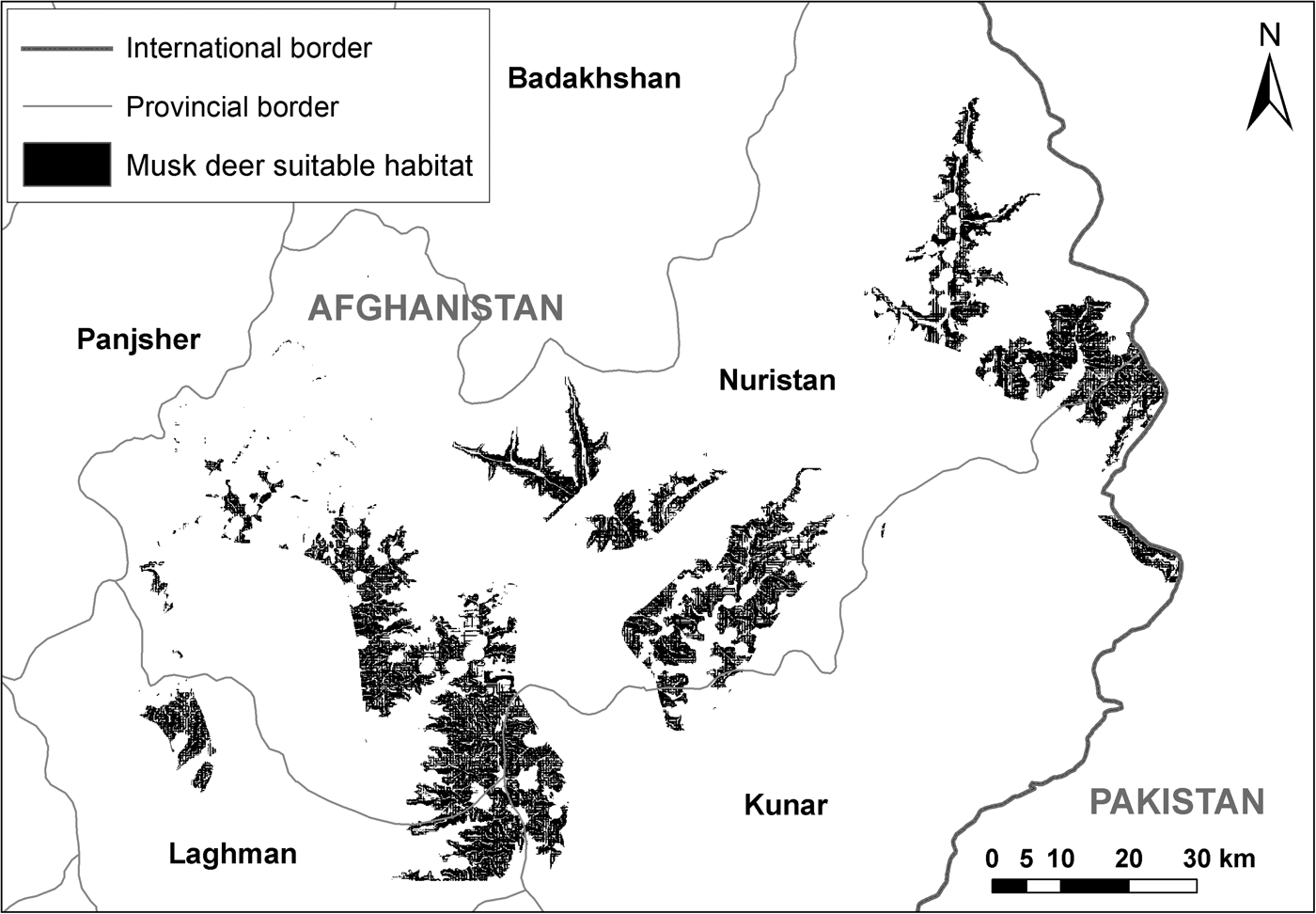
Locations of suitable habitat for musk deer in Afghanistan, based on environmental requirements and preferred habitat of the species as observed in central Nuristan, Pakistan and India, and of the closely related Himalayan musk deer Moschus leucogaster in Nepal.
Summer habitat of musk deer Moschus cupreus in Nuristan, with rock outcrops, alpine meadows, scattered currant bushes, dense rhododendron, and juniper scrubs on steep slopes (≥ 20°), above the tree line (> 3000 m).

On 4 July 2009 in a household near Waygal the team photographed a dead adult female musk deer that had been hunted the previous day in the Kashtoun mountain range (Plate 2). This was the first time the species was photographed in Afghanistan. The hairs collected from this specimen were used as a standard for manual microscopy comparisons.
Carcass of an adult female musk deer hunted in the Kashtoun mountain range (Fig. 1) on 3 July 2009.

Our geographical model predicts that suitable habitat for musk deer in Afghanistan covers c. 1,300 km2 in the contiguous provinces of Nuristan (75.5%), Kunar (14.4%) and Laghman (10.1%). The largest patch of continuous suitable habitat is 522 km2, or almost 40% of the total area of suitable habitat, and overlaps western Nuristan, east Laghman and west Kunar (Fig. 2). In terms of ecoregions, the Hindu Kush alpine meadow ecoregion is the most represented (43.5%), followed by East Afghan montane conifer forests (31%) and Northwestern Himalayan alpine shrub and meadows (25.5%). The land cover within the predicted habitat model is composed of 84.1% closed forest, 11.4% open forest and 4.5% rock outcrop. All fragments of suitable habitats have the three types of land cover except the easternmost areas along the international border with Pakistan, which have no rock outcrop cover.
Discussion
This wildlife survey in the eastern forests of Afghanistan after 3 decades of war indicates that the musk deer still persists there despite unregulated hunting, extensive deforestation, habitat degradation, and the absence of rule of law. To our knowledge our study provides the first documented record of the musk deer in Afghanistan since 1948 (Hassinger, Reference Hassinger1973), the first photograph of a wild specimen from Afghanistan, and the westernmost location of musk deer in Asia.
In central Nuristan we found that, in summer, musk deer inhabit remote alpine scrub on scattered rock outcrops, and the upper fringes of closed coniferous forests at c. 3,000–3,500 m. They invariably use steep slopes (≥ 20°), which makes them difficult to approach and presumably difficult to hunt. According to local inhabitants musk deer spend the winter season in the undergrowth of mixed coniferous forests (possibly as low as 2,000–2,500 m), where tree branches provide them with food as well as shelter from heavy snowfall. The altitudinal distribution of our musk deer sightings differs from that proposed previously (1,500–3,000 m; Habibi, Reference Habibi1977) but overlaps with results of surveys carried out more recently in Azad Jammu and Kashmir, Pakistan (2,270–3,860 m; Qureshi et al., Reference Qureshi, Awan, Khan, Dar and Dar2004). The pattern of seasonal movements across the habitat appears to be similar to that observed in Neelum Valley, Pakistan (Qureshi et al., Reference Qureshi, Awan, Khan, Dar and Dar2004).
Our landscape-scale habitat suitability model provides an estimate of the potential range of the musk deer in Afghanistan. Although relatively vast, the area of habitat potentially available to musk deer in Afghanistan is discontinuous, fragmented by steep valleys with human habitation and high mountain ranges, with areas of suitable habitat sometimes separated by > 20 km. The preferred summer habitat, on rock outcrops, covers only 60 km2, which suggests that the population of musk deer in Afghanistan is small. Increasing the upper threshold for altitude in the geographical model to 4,200 m, to match highest altitude records from Chitral, Pakistan (Roberts, Reference Roberts2005), increased the area of suitable habitat by only 80 km2, of which < 60% had a geographical continuity with the rest of the predicted suitable habitat. Similarly, decreasing the minimum slope to 15° added only 189 km2 of favourable habitat. Both modifications combined resulted in a relatively modest increase (< 20%) in the predicted extent of musk deer habitat in Afghanistan.
The accuracy of the land cover information used in our model may be questionable, given the significant deforestation that has taken place in the eastern forest complex of Afghanistan (UNEP, 2003). However, habitat information for locations where musk deer were observed matched the land cover information accurately (Fig. 1). More importantly, and contrary to the claims of UNEP (2003), a tentative assessment of forest loss and deforestation trends undertaken during 2007–2008 by the Wildlife Conservation Society, using recent satellite imagery, did not find evidence of large-scale deforestation of the conifer forests or signs of imminent ecological calamity across eastern forests (Delattre & Rahmani, Reference Delattre and Rahmani2009). These findings were confirmed by ground assessment and overflight transect surveys carried out in 2010 in Kunar, Laghman, Nuristan and Nangarhar provinces by the Natural Resources Counterinsurgency Cell of the U.S. Army (Bader et al., Reference Bader, Douglas, Fairchild, Kaczmarek and Hanna2010). These surveys did not find significant degradation of the upper-elevation coniferous forests used by musk deer, whereas the lower-elevation oak forest (< 2,000 m) was reported to have suffered significant deforestation locally (Bader et al., Reference Bader, Douglas, Fairchild, Kaczmarek and Hanna2010). Although these results are encouraging for the conservation of musk deer, more subtle forest degradation, as opposed to blanket removal of all standing trees, may be occurring in the upper coniferous forest zone and could have a significant impact on the fragmented habitat of the musk deer.
Unregulated hunting may be the most serious threat to musk deer in Afghanistan, as has been documented for Himalayan and Kashmir musk deer (Green, Reference Green1987; Khan et al., Reference Khan, Qureshi and Awan2006; Mishra et al., Reference Mishra, Madhusudan and Datta2006). During summer these species stay in relatively inaccessible high mountain areas and are hunted opportunistically when encountered. However, when heavy snowfall in winter drives the animals to more accessible, lower-elevation areas they become vulnerable to hunters, who come to central Nuristan from as far as Kunar province to hunt (J.M. Ali, pers. comm.). Besides being hunted for meat, which is considered a local delicacy, the musk deer is primarily hunted for its musk-secreting preputial gland, which is valued for its fixative and scent properties. According to local people, hunting for musk began in the area in the early 1970s and has increased substantially since then. Petocz & Larsson (Reference Petocz and Larsson1977) were informed that Moschus glands were sold in the Jalalabad Valley for USD 20–30. Nowadays traders reportedly pay up to USD 200–250 per gland (J.M. Ali, pers. comm.).
The future of the forest habitat of Afghanistan's musk deer depends on the extent of logging activities in eastern forests, which are currently controlled illegally by smuggling networks involving corrupt officials, insurgents and criminal elements operating across the border with Pakistan (Bader et al., Reference Bader, Douglas, Fairchild, Kaczmarek and Hanna2010). Although the deteriorating security conditions in Nuristan did not allow NGOs to remain in Nuristan after 2011, the Wildlife Conservation Society maintains contact with the local people it has trained and will pursue funding to continue ecosystem research and protection in Nuristan when the situation improves.
Acknowledgements
This study was made possible by the generous support of the American people through the United States Agency for International Development (USAID). The contents of the article are the responsibility of the Wildlife Conservation Society (WCS) and do not necessarily reflect the views of USAID or the United States Government. Surveys would not have been possible without the support of successive WCS country directors during 2006–2009: Alex Dehgan, Peter Smallwood and Dave Lawson. We thank the first WCS team in Nuristan for the questionnaire survey results. We thank Rohullah Sanger for editing the figures.
Biographical sketches
Stephane Ostrowski provides technical support in eco-health, science and monitoring to conservation projects in Afghanistan, China, Iran, Mongolia, Pakistan, Russia and Tajikistan. Haqiq Rahmani was the Afghanistan geographical information system manager for the Wildlife Conservation Society during 2006–2014 and is now pursuing MSc studies in geographical information systems. Jan Mohammad Ali and Rita Ali improve the livelihoods of their community in central Nuristan through education and enhanced management of natural resources. Peter Zahler designs and supervises conservation programmes across Asia.



