





Introduction
Despite many species extinctions in the last decades, tropical regions still host incredible species diversity (Brown, Reference Brown2014), with a high number of cryptic species and intricate species interactions (Nadler and Ponce De León, Reference Nadler and Ponce De León2011; Condon et al., Reference Condon, Scheffer, Lewis, Wharton, Adams and Forbes2014). Describing the biodiversity of interactions is not a trivial task, as it generally depends on different types of resources, including methodological approaches, financial resources, and specialists’ expertise. For certain groups, such as endoparasites, the task becomes even more complex. These organisms are often overlooked due to their inconspicuous nature, as many reside within other organisms, rendering them difficult to detect and study. Yet, these organisms are recognized as ‘small players with crucial roles’ (Marcogliese, Reference Marcogliese2004), influencing evolutionary trajectories and ecosystem services (Wood and Johnson, Reference Wood and Johnson2015). Therefore, incorporating parasites and their interactions with host species into ecological studies is essential for a comprehensive understanding of how natural systems function (Brooks et al., Reference Brooks, Hoberg, Boeger, Gardner, Galbreath, Herczeg, Mejía-Madrid, Rácz and Dursahinhan2014; Speer et al., Reference Speer, Teixeira, Brown, Perkins, Dittmar, Ingala, Wultsch, Krampis, Dick, Galen, Simmons and Clare2022).
Parasites are good indicators of healthy environments, and information on their diversity enables the identification of environmental changes (Koprivnikar et al., Reference Koprivnikar, Marcogliese, Rohr, Orlofske, Raffel and Johnson2012; Wylezich et al., Reference Wylezich, Belka, Hanke, Beer, Blome and Höper2019). Additionally, parasites are important in causing diseases and controlling host populations (Wood and Johnson, Reference Wood and Johnson2015). Emergent diseases caused by introduced pathogens and parasites threaten biodiversity, especially in endangered species (Wake and Vredenburg, Reference Wake and Vredenburg2008; Waddle et al., Reference Waddle, Skerratt, Kaiser, Miller, Flegg, Campbell, Gallagher, Dimovski and Lambreghts2024). Therefore, monitoring parasites is also an important proactive measure to detect early signs of disease outbreaks, understand host-parasite dynamics and mitigate potential impacts on biodiversity (Brooks et al., Reference Brooks, Hoberg, Boeger, Gardner, Galbreath, Herczeg, Mejía-Madrid, Rácz and Dursahinhan2014). Amphibians are particularly valuable models for studying species interactions due to their dual life cycle, which links aquatic and terrestrial ecosystems, and their central positions in food webs as predators and prey of various metazoan groups (Dudczak et al., Reference Dudczak, De La Torre, Euclydes and Campião2022). Despite their ecological importance, neotropical amphibians remain underrepresented in global studies, particularly in host–parasite interactions (Herczeg et al., Reference Herczeg, Ujszegi, Kásler, Holly and Hettyey2021; Martins et al., Reference Martins, Poulin and Gonçalves‐Souza2021).
Traditional methods of studying endoparasites often rely on invasive or lethal sampling techniques (Aivelo and Medlar, Reference Aivelo and Medlar2018). However, these approaches are not feasible for threatened hosts, such as many amphibian species, for which population stability is a concern (Gardner, Reference Gardner2001; Anunciação et al., Reference Anunciação, Valencia-Zuleta, Signorelli, Martins, Bastos, Bataus and Guidorizzi2024). Consequently, there is a pressing need to develop accurate, non-invasive methods for endoparasite assessment (Budischak et al., Reference Budischak, Hoberg, Abrams, Jolles and Ezenwa2015). Advances in molecular tools have increased our knowledge of parasite species detection, showing an important complementary power concerning the information produced using traditional methods (Clare, Reference Clare2014; Wirta et al., Reference Wirta, Hebert, Kaartinen, Prosser, Várkonyi and Roslin2014; Scholz, Reference Scholz2024).
DNA metabarcoding uses high-throughput sequencing of environmental samples (eDNA) to identify species by amplifying standardized DNA regions with universal primers (Semenov, Reference Semenov2021). The resulting sequences are then compared against publicly available databases for taxonomic identification (Deiner et al., Reference Deiner, Bik, Mächler, Seymour, Lacoursière‐Roussel, Altermatt, Creer, Bista, Lodge, De Vere and Pfrender2017; Johnson Reference Johnson, Tetzlaff, Katz and Sperry2024). In this context, fecal DNA metabarcoding has emerged as a widely accepted non-invasive method for the accurate and efficient analysis of animal diet (Ando et al., Reference Ando, Mukai, Komura, Dewi, Ando and Isagi2020) and parasite diversity (Davey et al., Reference Davey, Kamenova, Fossoy, Solberg, Davidson, Mysterud and Rolandsen2023; Miller et al., Reference Miller, Rota and Welsh2024). This method has been successfully applied to investigate endoparasites of several vertebrate taxa (Miller et al., Reference Miller, Rota and Welsh2024), but studies on amphibians are scarce (Aivelo et al., Reference Aivelo, Harris, Cadle and Wright2018). Additionally, considering the importance of host feeding habits in acquiring parasites (Poulin, Reference Poulin2004; Gómez and Nichols, Reference Gómez and Nichols2013), assessing anurans’ dietary information may be a complementary tool for understanding their ecological interactions that may result in parasitism. In this study, we compare fecal metabarcoding with traditional invasive techniques to assess parasite and dietary diversity in anuran species from the Atlantic Forest. Our objectives include evaluating the strengths and limitations of each method, highlighting their ecological implications and contributing to the growing body of knowledge on amphibian ecological interactions.
Materials and methods
Study area and field collections
We collected anurans in 3 different conserved areas within the Atlantic Rainforest in the Paraná state, south of Brazil: Mananciais da Serra (25°29′29″S, 48°59′39″W), Parque Estadual do Pico Marumbi (25°26′42″S, 48°54′58″W) and Parque Estadual Floresta do Palmito (25°35′37″S, 48°33′39″W) in December 2021. Anurans were sampled at night using active visual and auditory searches. After capture, each anuran sample was placed in an individual thermic container at room temperature overnight. The next morning, we searched for and collected feces using sterile gloves that were changed between samples to avoid cross-contamination. The feces were stored in a 1.5 mL Eppendorf tube containing 100% ethanol and kept at −20 °C prior to DNA extraction. The anurans that did not defecate within 24 h were returned to the wild. After collecting feces, we euthanized the anurans using an overdose of lidocaine 4%, following the current Brazilian legislation (Federal Council of Biology – CFBIO, Resolution 308).
Diet analysis from stomach content survey
We mainly collected stomach contents, and when viable, we also collected diet items from the intestines. These items were kept in 70% ethanol and identified under a stereoscopic microscope up to the order or family level whenever possible. Morphological identification was used to compare our identification with the metabarcoding data of each individual.
Traditional parasite survey
We necropsied the anurans for helminth parasites and diet items in the intestinal tract and additionally examined the lungs since lungworms release their eggs through the feces and are common parasites in anurans (Campião et al., Reference Campião, Morais, Dias, Aguiar, Toledo, Tavares and Silva2014). All parasites were stored in 70% ethanol until further analysis. To identify the Nematoda individuals, we cleared them with Aman’s lactophenol on non-permanent slides and observed them under an optical microscope. Acanthocephalans were clarified using lactic acid and observed under a light microscope. Parasite identification and nomenclature followed Anderson et al. (Reference Anderson, Chabaud and Willmott2009) and Hodda (Reference Hodda2022) for the phylum Nematoda and Amin (Reference Amin1985) for Acanthocephala.
DNA extraction from fecal samples
We randomly separated approximately 150 mm3 of the fecal pellet using sterilized forceps, transferred it to a new 1.5 mL Eppendorf tube and froze it at −80 °C. Using a pestle, we macerated the frozen feces manually for 1–5 min and repeated the process until the feces were completely homogenized. Next, we mixed the macerated feces with 200 μL cetyltrimethylammonium bromide buffer and incubated it for 20 min at 65 °C. Then, we added 500 μL of chloroform, isoamyl alcohol (CIA), and centrifuged at 10°000 rpm for 10 min. The supernatant was removed, and the process was repeated and precipitated overnight. To remove the CIA reagent, we centrifuged the tubes for 10 min at 10,000 rpm, discarded the supernatant, washed the DNA with 500 μL of 70% cold ethanol and centrifuged again. The supernatant was discarded and air-dried, and the DNA was resuspended in ultrapure water.
Amplification of the 18S rRNA
Amplification of the 18S rRNA gene targeted the V8 and V9 regions. The primers used were SSU_V8F (5′-ATAACAGGTCTGTGATGCCCT-3′) and SSU_1510R (5′-CCTTCYGCAGGTTCACCTAC-3′), chosen for their specificity and efficiency in detecting metazoans, including Nematoda (Bradley et al., Reference Bradley, Pinto and Guest2016). PCR reactions included 1× reaction buffer with MgCl2, 0.2 mM of each dNTP (Thermo Fisher Scientific), 0.4 µM of each primer (Integrated DNA Technologies), 1.25 U of high-fidelity Taq DNA polymerase (Phusion, Thermo Fisher Scientific), 50 ng of extracted genomic DNA and ultrapure molecular-grade water (Sigma-Aldrich).
The thermocycling conditions were optimized to maximize specificity and yield as follows: initial denaturation at 98 °C for 3 min, followed by 35 cycles of denaturation at 98 °C for 10 s, annealing at 55–58 °C for 30 s and extension at 72 °C for 30 s, with a final extension at 72 °C for 7 min. Amplicons were purified using the AMPure XP Beads Kit (Beckman Coulter) to remove primers, free nucleotides and non-specific DNA fragments.
Library preparation and sequencing
Sequencing libraries were prepared using the Nextera XT DNA Library Prep Kit (Illumina), which included amplicon indexing. The libraries were quantified using a Qubit dsDNA HS Assay Kit (Thermo Fisher) and evaluated on a Bioanalyser 2100 (Agilent Technologies) for size and integrity. Sequencing was conducted on an Illumina MiSeq platform, generating paired-end reads (2 × 150 bp) and ensuring robust coverage for taxonomic analysis.
Bioinformatics and taxonomic classification
Raw sequence data were demultiplexed, quality-filtered using bcl2fastq (Illumina) and imported into QIIME2 2024.10 (Bolyen et al., Reference Bolyen, Rideout, Dillon, Bokulich, Abnet, Al-Ghalith, Alexander, EJ, Arumugam, Asnicar and Bai2019). The Cutadapt plugin (Martin, Reference Martin2011) removes adapter and primer sequences. Low-quality reads (Q < 20) were discarded, and amplicon sequence variants (ASVs) were inferred using DADA2 (Callahan et al., Reference Callahan, McMurdie, Rosen, Han, Johnson and Holmes2016), which also corrected sequencing errors and removed chimeras. For chimera removal, the parameter p-min-fold-parent over-abundance was set to 3.
Taxonomic classification of ASVs was performed using the Naive Bayes classifier implemented in QIIME2’s ‘feature-classifier classify-sklearn’ module (Bokulich et al., Reference Bokulich, Kaehler, Rideout, Dillon, Bolyen, Knight, Huttley and Caporaso2018) and trained using the version 138.2 of SILVA database (Yilmaz et al., Reference Yilmaz, Parfrey, Yarza, Gerken, Pruesse, Quast, Schweer, Peplies, Ludwig and Glöckner2014). Sequences of Nematoda were categorized into ‘parasites’, and Arthropoda as ‘diet’, based on whether the taxa were known as anuran parasites/prey. To enhance the taxonomic resolution for parasite taxa, sequences identified as Nematoda, Rotifera and Platyhelminthes were aligned with the NCBI nt database using BLAST (Srivathsan et al., Reference Srivathsan, Sha, Vogler and Meier2015). The fecal metabarcoding data were cross-validated using traditional morphological identifications.
Results
We collected anuran individuals of different species, families and localities (Table 1), gathering paired diet data from the stomach contents, endoparasites and feces for metabarcoding analysis. Through traditional morphological survey methods, we identified 3 insect taxa from anuran gastrointestinal diet contents and 12 taxa of metazoan endoparasites. Fecal metabarcoding detected a total of 576.443 quality sequences from all fecal samples, recovering bacteria, protozoa, fungi, plants and metazoan sequence taxa. The percentage of non-chimeric sequences was an average 35.5%, varying from 9.9% to 65.4% (Supplementary Table S1).
Species classification and localities of the collected anurans in protected areas of the Brazilian Atlantic Rainforest

Diet analysis from stomach content survey and traditional parasitological survey
Diet items were recovered from the stomachs of 7 anurans. The diet comprised arthropods, morphologically identified as Hymenoptera (Formicidae), Coleoptera and Lepidoptera insects.
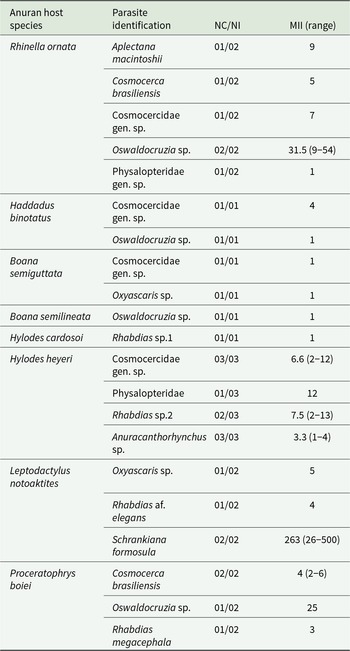
Using the traditional method, we morphologically recovered 10 nematode morphospecies and identified them up to species (5), genus (5) or family (2), and one Acanthocephala taxon was identified to genus (Table 2). Among the specimens identified generically, we observed 3 nematodes (Oswaldocruzia sp., Rhabdias sp.1 and Rhabdias sp.2) and 1 acanthocephalan (Anuracanthorhynchus sp.), which are potentially new species because their morphology did not match that of the described species. Moreover, morphological identification relies on specific characteristics that may not be observed in all specimens. For instance, the 6 specimens of Oxyascaris sp. that we found were all females, and thus, specific identification was not possible because it is based on male sexual morphological characters. Similarly, different genera of Cosmocercidae (such as Aplectana and Cosmocerca) are mainly distinguished by their reproductive organs and cuticular ornamentation surrounding papillae in the posterior part of males. Therefore, when only females were present in the sample, identification beyond family was not possible. Specimens of Physalopteridae were found in larval stages and therefore lacked adult morphological traits that allow better taxonomic resolution. One host, Scinax tymbamirim, did not have any parasite found in the morphological search.
Morphological survey of anuran parasites in the Brazilian Atlantic rainforest. For each anuran host species, we provide the proportion of infected hosts (NC/NI) and the Mean Intensity of Infection (MII) for each parasite species

NC/NI = number of collected/number of infected; MII, mean intensity of infection with range.
Diet analysis from feces metabarcoding
The feces of 10 anurans presented sequences of Arthropoda that could be assigned as diet, which represent 10.9% of all quality sequences, and were taxonomically classified as Insecta, Arachnida and Maxillopoda (Figure 1). Molecular sequencing of feces revealed the presence of a greater diversity of arthropods ingested by anurans than we observed in their stomachs. The taxonomic assignment provided by QIIME2 showed higher accuracy than the traditional survey and morphological identification. A larger proportion of diet sequences referred to the Arachnida class (42%), with the majority being Acari (36%), followed by Hexapoda (22%) (Figure 1). Most of the taxonomic identification of the sequences reached at least the subclass level, while other substantial proportions reached order (31.31%).
Fecal metabarcoding of anurans’ diet. (A) Total quality sequence abundance of arthropods; (B) relative abundance of arthropods across samples. Each bar corresponds to an anuran specimen, Boana semiguttata: Bs; Boana semilineata: Bsl; Haddadus binotatus: Hb; Hylodes cardosoi: Hc; Hylodes heyeri: Hh1, Hh2, Hh3; Leptodactylus notoaktites: Ln1, Ln2; Proceratophrys boiei: Pb1, Pb2; Rhinella ornata: Ro1, Ro2; St: Scinax tymbamirim.

Parasite survey from feces metabarcoding
Molecular analysis showed the presence of Nematoda for all, except 2 anuran specimens (Figure 2), including a specimen for which we did not detect any macroparasite in the morphological search. Moreover, most parasite taxa identified morphologically in the intestines of anurans were detected through fecal metabarcoding but were mostly identified up to the order level (Figure 2; Supplementary Table S2). The taxonomic classification of the Nematoda phylum recovered sequences from the classes Chromadorea (orders: Rhabditida and Monhysterida) and Enoplea (orders: Enoplida and Triplonchida). Only one nematode taxon was identified at the species level: the free-living nematode Prismatolaimus intermedius (Enoplea: Triplonchida), which was not observed in the morphological search. Fecal metabarcoding also recovered sequences from Platyhelminthes and Rotifera, but they matched free-living instead of parasite taxa.
Fecal metabarcoding of anurans’ parasites. (A) Total quality sequence abundance; (B) relative abundance of nematodes across samples. Each bar corresponds to an anuran specimen, Boana semiguttata: Bs; Boana semilineata: Bsl; Haddadus binotatus: Hb; Hylodes cardosoi: Hc; Hylodes heyeri: Hh1, Hh2, Hh3; Leptodactylus notoaktites: Ln1, Ln2; Proceratophrys boiei: Pb1, Pb2; Rhinella ornata: Ro1, Ro2; St: Scinax tymbamirim.

For the second step of sequence identification, we used BLAST searches of the metabarcode sequences of the Nematoda, Platyhelminthes and Rotifera taxa against the GenBank database and recovered a more specific classification. While the platform QIIME2 only identified parasites to the order level (Rhabditida), GenBank could match those sequences with Strongyloides sp., Oswaldocruzia sp. and Rhabdias sp. (Query Cover: >99% and per. ident: >97.8), and specimens of the last 2 genera were indeed present in the anuran intestines and lungs, respectively, according to our morphological search. Similarly, BLAST searches of the sequences identified as belonging to the class Chromadorea by QIIME2 against GenBank matched them with Cosmocercidae, Cosmocerca sp. and Aplectana sp. (Query Cover: 100%; per. ident: >99.2), which were also confirmed by our results of the morphological search (Table 2). We observed species of the genera Oxyascaris and Schrankiana, but neither QIIME2 nor GenBank BLAST searches matched the sequences of these taxa.
Comparing morphological vs metabarcoding for metazoan parasite detection and identification
Among the metazoans, we detected Nematoda, which were identified mostly up to the order level. In the first step of sequence identification, which is more comprehensive, we observed that only a part of the nematode sequences was composed of parasite taxa, while the others were identified as free-living, as well as Platyhelminthes and Rotifera (Supplementary Table S2). In the second step of sequence identification, we selected sequences assigned to Nematoda, Platyhelminthes and Rotifera and compared them against the GenBank database. The Nematoda sequences matched several parasite taxa, some unrelated to the surveyed hosts, while others included genera that we had also identified morphologically to the genus level.
A small number of sequences were identified as Platyhelminthes in the metabarcoding analysis (Supplementary Table S2), and we did not find any parasite taxa of Platyhelminthes in the intestines. Moreover, we found acanthocephalans parasitizing the individuals of Hylodes heyeri through morphological analysis, while the metabarcoding analysis recovered sequences corresponding to free-living rotifers, specifically Bdelloidea and Monogononta. Interestingly, the rotifer sequences were found exclusively in the same anurans where acanthocephalans were detected morphologically. This match suggests that the rotifer sequences recovered in the metabarcoding analysis could represent misidentified acanthocephalans, likely due to phylogenetic proximity (García-Varela and Nadler, Reference García-Varela and Nadler2006) and the sequencing of conserved genetic regions shared between these taxa.
Discussion
This study is the first to compare parasite and diet diversity in anurans using DNA fecal metabarcoding paired with traditional morphological methods. Metabarcoding revealed a greater diversity of organisms than was observed through morphological analysis. Fecal metabarcoding captured a higher diversity of arthropods that are likely dietary items, being more efficient than traditional invasive methods in detecting a wide spectrum of dietary diversity in anurans. However, it did not entirely align with stomach content findings. The method also proved effective for parasite identification; however, it still relies on expert input, as the lack of a robust genetic sequence database can lead to spurious matches (Clarke et al., Reference Clarke, Soubrier, Weyrich and Cooper2014). For example, in a host-parasitoid system, only 39.4% of parasitoid sequences could be identified to the species level, compared with 90% of invertebrate hosts, suggesting that parasite diversity may be missed or underestimated depending on how much genetic sampling has been done on that group (Šigut et al., Reference Šigut, Kostovčík, Šigutová, Hulcr, Drozd and Hrček2017).
Fecal metabarcoding identified taxa such as Nematoda, Platyhelminthes and Rotifera, often to the order level, while several arthropods were identified to the species level. The superior taxonomic resolution for dietary items compared to parasites reflects the extensive representation of arthropod sequences in GenBank. However, as discussed earlier, the limited availability of reference sequences for parasite taxa in GenBank remains a challenge. This contrast highlights the need for targeted efforts to expand molecular databases for underrepresented groups like Nematoda, Platyhelminthes and Acanthocephala (Scholz, Reference Scholz2024). Expanding reference databases for parasite taxa, especially in Neotropical regions, is critical to enhancing metabarcoding utility (Huggins et al., Reference Huggins, Michaels, Cruickshank, Preziosi and Else2017; Budischak et al., Reference Budischak, O’Neal, Jolles and Ezenwa2018).
A trade-off exists between accuracy and detectability in genetic analysis (Srivathsan et al., Reference Srivathsan, Sha, Vogler and Meier2015; Aivelo and Medlar, Reference Aivelo and Medlar2018). Specific molecular markers enhance taxonomic accuracy but limit the range of taxa detected, whereas universal markers like the 18S rRNA maximize detectability across diverse groups (Blasco-Costa et al., Reference Blasco-Costa, Cutmore, Miller and Nolan2016). In this study, the use of a broad-spectrum marker (Peham et al., Reference Peham, Steiner, Schlick‐Steiner and Arthofer2017) was crucial for detecting both known and potentially undescribed parasites, given the limited molecular data available for most anuran parasites (Huggins et al., Reference Huggins, Michaels, Cruickshank, Preziosi and Else2017; Budischak et al., Reference Budischak, O’Neal, Jolles and Ezenwa2018). This approach ensures that even when the target taxon is absent in databases, closely related species can be identified (Mande et al., Reference Mande, Mohammed and Ghosh2012). However, highly conserved sequences may limit taxonomic resolution (Dueholm et al., Reference Dueholm, Andersen, McIlroy, Kristensen, Yashiro, Karst, Albertsen and Nielsen2020), as demonstrated by BLAST analyses of Rhabditida sequences, which matched multiple genera and required careful interpretation to exclude irrelevant taxa. Metabarcoding provides an efficient overview of parasite diversity, as observed in studies on other taxa, such as wild rats (Tanaka et al., Reference Tanaka, Hino, Tsai, Palomares-Rius, Yoshida, Ogura, Hayashi, Maruyama and Kikuchi2014; Hino et al., Reference Hino, Maruyama and Kikuchi2016), wolverines (Watson et al., Reference Watson, Hailer, Lecomte, Kafle, Sharma, Jenkins, Awan, L’Hérault and Perkins2020) and primates (Aivelo and Medlar, Reference Aivelo and Medlar2018). However, its effectiveness depends on continued efforts to enhance reference libraries and develop targeted molecular markers (Blasco-Costa et al., Reference Blasco-Costa, Cutmore, Miller and Nolan2016). Moreover, using group-specific primers in follow-up analyses can refine taxonomic resolution for targeted groups, such as nematodes, and catch potentially spurious matches from genetics alone (Alberdi et al., Reference Alberdi, Aizpurua, Gilbert and Bohmann2018).
Arachnids were the most common dietary items in the fecal metabarcoding but were not observed in the morphological survey of stomach contents; however, the interpretation of abundance estimates from fecal metabarcoding may be taken cautiously (Stapleton et al., Reference Stapleton, Weinstein, Greenhalgh and Dearing2022). Moreover, mismatches between fecal metabarcoding and stomach contents may probably reflect temporal turnover, reflecting differences between recent predation events and longer-term dietary history. Anurans’ opportunistic predation habits likely contribute to these differences (Rodrigues and Santos-Costa, Reference Rodrigues and Santos-Costa2014). In addition, one limitation of cross-sectional diet metabarcoding is that it only represents a ‘snapshot in time’ of what an animal eats, making such studies limited in scope. However, repeated sampling throughout seasons and years, or combination with longer-term diet assessment methods such as stable isotopes, can give a longitudinal view of diet and begin to approximate the overall dietary niche of the species (e.g., Soininen et al., Reference Soininen, Ehrich, Lecomte, Yoccoz, Tarroux, Berteaux, Gauthier, Gielly, Brochmann, Gussarova and Ims2014; Oelbaum et al., Reference Oelbaum, Fenton, Simmons and Broders2019). Indeed, fecal metabarcoding has been increasingly and successfully used to describe vertebrate diets, with the identification of even rare items (Stapleton et al., Reference Stapleton, Weinstein, Greenhalgh and Dearing2022; Yoshimura et al., Reference Yoshimura, Hayakawa, Kikuch, Zhumabai, Qi, Sugimoto, Sharma and Kinoshita2024).
Anurans are preyed upon by a wide range of vertebrates and host a diverse community of trophically transmitted parasites (Koprivnikar et al., Reference Koprivnikar, Marcogliese, Rohr, Orlofske, Raffel and Johnson2012). These parasites are often encysted and, like those infecting non-intestinal organs (e.g., blood parasites such as microfilariae), are not detectable via fecal metabarcoding. Moreover, males and immature individuals of parasites are not detected by this method, and for females, the amount of DNA detected may be influenced by factors such as egg load. Therefore, quantitative assessment of parasite infection intensity is limited, as metabarcoding estimates of parasite abundance may not accurately reflect reality (Stapleton et al., Reference Stapleton, Weinstein, Greenhalgh and Dearing2022).
The small sample size is a methodological limitation of our study, although the consistent patterns observed across individuals and taxa underscore the robustness of our findings and their relevance to broader applications. The sample size also aligns with the ethical constraints, as our methodological approach included the evaluation of invasive methods on endemic species in protected areas. Additionally, fecal metabarcoding is susceptible to environmental contamination and can also account for accidental intake by the organisms studied. This probably happened in our study, since anurans are sloppy feeders and accidental ingestions may occur. Future studies should incorporate template controls, which can be filtered bioinformatically to better detect primer bias (Ficetola et al., Reference Ficetola, Taberlet and Coissac2016; Van der Loos and Nijland, Reference Van der Loos and Nijland2021; Sickel et al., Reference Sickel, Zizka, Scherges, Bourlat and Dieker2023).
Our results demonstrated the complementary nature of fecal metabarcoding and traditional endoparasite survey methods for metazoan parasite identification. Morphological analysis is essential for identifying novel or poorly represented taxa, such as the putative new species found in this study. Metabarcoding, in turn, is valuable for detecting a broad range of taxa – from bacteria and protozoans to metazoans – and is particularly useful for non-invasive assessments of rare or endangered host species. This combination of approaches can significantly improve biodiversity assessments. Considering both the advantages and disadvantages mentioned here, we believe fecal metabarcoding is suitable for exploratory studies aimed at surveying parasite and dietary diversity across host populations, especially in cases where traditional methods are infeasible due to ethical or logistical constraints.
The primary aim of this study was to evaluate the accuracy of detecting and identifying interactions between invertebrates and anurans using fecal metabarcoding compared to traditional morphological surveys. We found differences in the identification accuracy between the these approaches for both anuran parasites and diet. While initial taxonomic identification through metabarcoding typically resolved sequences to the order level, the use of database tools can provide more specific identifications. This study represents an important first step in the development of a non-invasive method for identifying parasitized anurans. By enabling the detection of parasite–host interactions without the need for lethal sampling, this approach opens new avenues for future research. It holds potential for monitoring infected hosts and exploring correlations between parasitism, host behaviour, reproduction, survival and conservation threats, particularly in vulnerable populations.
Supplementary material
The supplementary material for this article can be found at https://doi.org/10.1017/S0031182025100292.
Acknowledgements
We thank the Sanitation Company of Paraná (SANEPAR) for logistical support in fieldwork at Mananciais da Serra. We are also grateful to anonymous reviewers for their helpful suggestions, Walter Boeger and Marcio R. Pie for their scientific suggestions on the early ideas of this manuscript and Glauco Oliveira for his help with anuran collection and figure production.
Author contributions
A..D. contributed to research design and performance, data analysis and paper writing. R.E. contributed to data analysis and paper writing. E.R. contributed to data analysis and paper writing. H.F.M.O. contributed to paper writing. M.R.I. contributed to paper writing. K.M.C. contributed to research design, data analysis and paper writing.
Financial support
We thank the Brazilian Council for Scientific and Technological Development (CNPq), for the doctoral scholarship awarded to A.D. K.M.C. acknowledges the Council for Scientific and Technological Development (CNPq – proc. 306934/2022-1). This project was partially funded by the research support call 04/2018 of Fundação Araucária and CNPq 046/2020 JP in the call CP 20/2018 PPP.
Competing interests
None declared.
Ethical standards
Collection and observations of this study were conducted in accordance with Sistema de Autorização e Informação em Biodiversidade – Instituto Chico Mendes de Conservação da Biodiversidade – SISBIO (license numbers 62.552-1 and 80.378-1) and the Ethics Committee for Animal Use from the Biological Sciences Section of the Federal University of Parana (statement number 1167).



 Open access

