




Non-technical Summary
Bat fossils in Europe are mostly found in paleokarst, which represents an environment that was not suitable for different lineages. In this sense, despite their lesser potential for the preservation of bat fossils, fluviolacustrine (river- and lake-associated) deposits are particularly important. This was confirmed by the description of seven bat species— Miostrellus cf. Miostrellus noctuloides, Myotis cf. Myotis murinoides, ‘Otonycteris’ sp. indet., Miniopterus sp. indet., Vespertilionidae gen. indet. sp. indet. 1, Vespertilionidae gen. indet. sp. indet. 2, and Rhinolophus cf. Rhinolophus grivensis—retrieved from upper Miocene (~ 11.5−5.5 million years) fluviolacustrine deposits in Slovakia. The unusual presence of six distinct species in the locality of Krásno is likely the consequence of the relatively high frequency of bats in this Turolian fluviolacustrine deposit, allowing a more complete and more accurate picture of the Carpathian late Miocene bat faunas.
Introduction
Despite being the second largest mammal order in terms of modern specific diversity and being actively studied by the scientific community (Kruskop and Artyushin, Reference Kruskop and Artyushin2021), the fossil record of bats is so limited that few forms are identified compared to their expected palaeodiversity (Eiting and Gunnell, Reference Eiting and Gunnell2009). In most paleontological sites of Miocene age, bat remains are rare and consist of isolated dental elements, bringing few distinctive features and resulting in few, often cryptic species. As a consequence, our knowledge is largely based on material from karst deposits, in which bats are more frequent and better preserved (e.g., Zapfe, Reference Zapfe1950; Mein and Ginsburg, Reference Mein and Ginsburg2002; Ziegler, Reference Ziegler2003; Rosina et al., Reference Rosina, Kruskop and Semenov2019). This logically led to a bias in our representation of palaeodiversity (Sigé and Legendre, Reference Sigé and Legendre1983; Galán et al., Reference Galán, López-García, Cuenca-Bescós and Sevilla2024).
Regardless of their lesser potential for chiropteran preservation, fluviolacustrine deposits are of crucial importance to assess the regional diversity of bats because some taxa are restricted to these environments (Sigé and Legendre, Reference Sigé and Legendre1983). Combined with the data from karst deposits, they are likely to reveal changes in the structure of bat communities. As a contribution to this topic, we describe here the bat faunas from three upper Miocene fluviolacustrine deposits of Slovakia (Fig. 1): Borský Svätý Jur (MN9), Studienka A (MN9), and Krásno (MN11).
(1) Location of Slovakia within Europe. (2) Map of Slovakia showing the main geological structures and the late Miocene localities containing bat material (red stars). Modified after Cailleux et al. (Reference Cailleux, van den Hoek Ostende and Joniak2023).

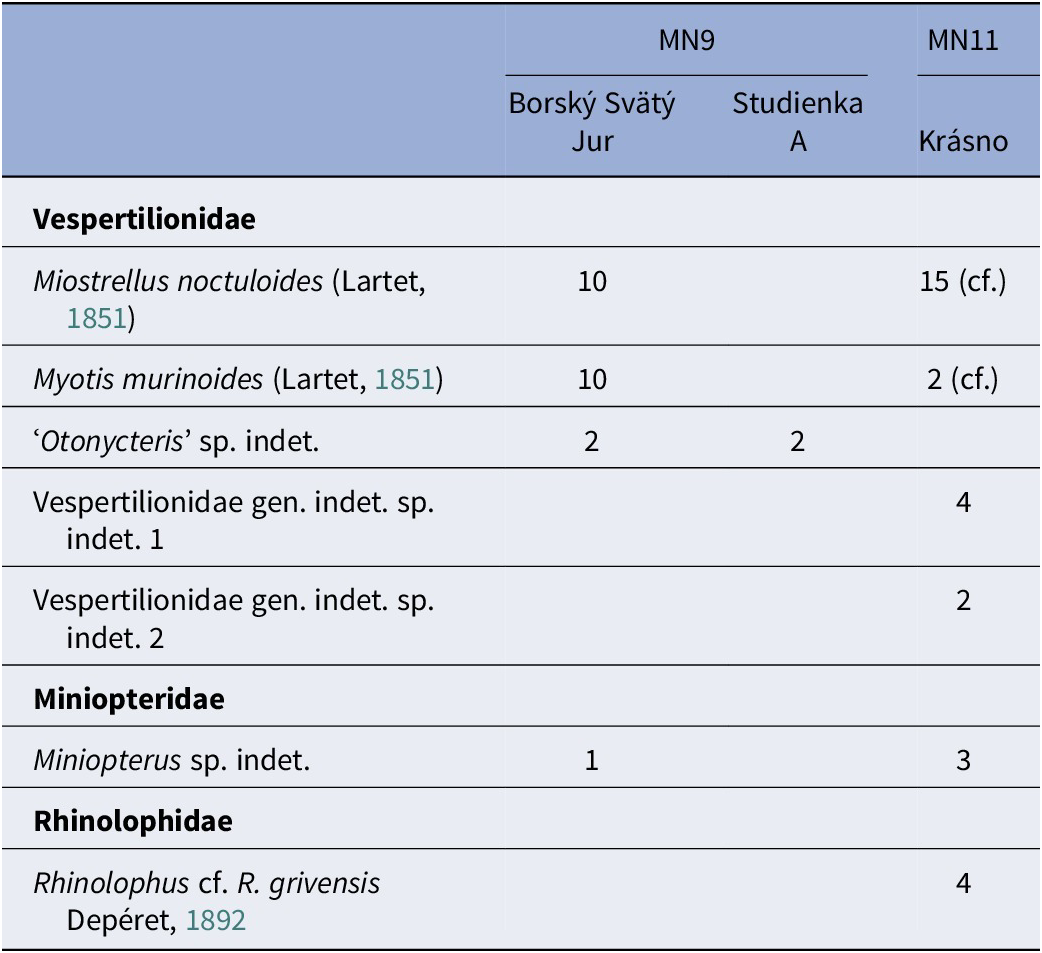
Composition of the Chiroptera from the late Miocene of Slovakia (number of identified specimens)
Material and methods
A relatively large collection of small mammals has recently been collected from several upper Miocene fluviolacustrine deposits from Slovakia. Both the rodent and the eulipotyphlan faunas are currently under study (Joniak, Reference Joniak2005, Reference Joniak2016; Pipík and Sabol, Reference Pipík and Sabol2005; Joniak and Šujan, Reference Joniak and Šujan2020; Cailleux et al., Reference Cailleux, van den Hoek Ostende and Joniak2023, Reference Cailleux, van den Hoek Ostende and Joniak2024a, Reference Cailleux, van den Hoek Ostende and Joniakb, Reference Cailleux, van den Hoek Ostende, Skandalos and Joniak2025). Only three localities delivered bat remains (Fig. 1; Table 1): the MN9 predeltaic deposits of Borský Svätý Jur (Vienna Basin; Ivanka Formation), the MN9 swamp deposits of Studienka A (Vienna Basin; Ivanka Formation), and the MN11 freshwater limestone deposits of Krásno (Danube Basin; Hlavina Member). The geological setting of these localities has been summarized by Cailleux et al. (Reference Cailleux, van den Hoek Ostende and Joniak2023).
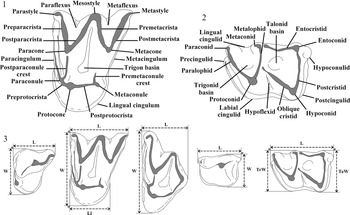
The dental terminology of Chiroptera is subject to great variation. The lack of stable terminology has led to difficulties in comparing taxonomic descriptions, notably for the hypocone/metaconule and the division of lophs. Numerous terminologies have been created and followed to describe Neogene European bats, e.g., Miller (Reference Miller1907), Van Valen (Reference Van Valen1966), Rachl (Reference Rachl1983), Menu (Reference Menu1985), and Sevilla (Reference Sevilla1988). Here, we follow Sevilla (Reference Sevilla1988) for most structures, because this work provided a relatively complete terminology well-suited for characterizing vespertilionoid-like morphology. However, we also follow the standardized terminology of Fracasso et al. (Reference Fracasso, de Oliveira Salles and Perini2011) to name the postparaconule crest (paraloph sensu Sevilla, Reference Sevilla1988), the premetaconule crest (metaloph sensu Sevilla, Reference Sevilla1988), and the metaconule (hypocone sensu Sevilla, Reference Sevilla1988), because these names better fit the classic terminology used for tribosphenic mammal molars.
The postparaconule crest is defined as the thin crest attached to the base of the paracone and usually connected to the posterior flank of the preprotocrista. The paraconule might or might not be distinct. The distinction of the premetaconule crest from the postprotocrista is harder to assess because the postprotocrista very rarely joins the metacingulum. Here, we define the postprotocrista as a high and relatively straight crest with a posterior or posterolabial orientation, starting from the posterior flank of the protocone. The premetaconule crest is defined as a short crest with a relatively lingual orientation, attached to the lingual flank of the metacone and connected labialy to the preprotocrista. As for the paraconule, the metaconule might or might not be distinct. The premetaconule crest is therefore considered differentiated when the postprotocrista is not directly joining the metacone (i.e., the loph consisting of two segments), resulting in a less-triangular trigon. The name of this loph is not formalized because the available terms (e.g., protoloph, metaloph) would result in excessive confusion with other dental terminologies. When these structures are differentiated, the rare additional crest that connects the metaconule complex to the metacingulum is referred to as the postmetaconule crest (based on Fracasso et al., Reference Fracasso, de Oliveira Salles and Perini2011).
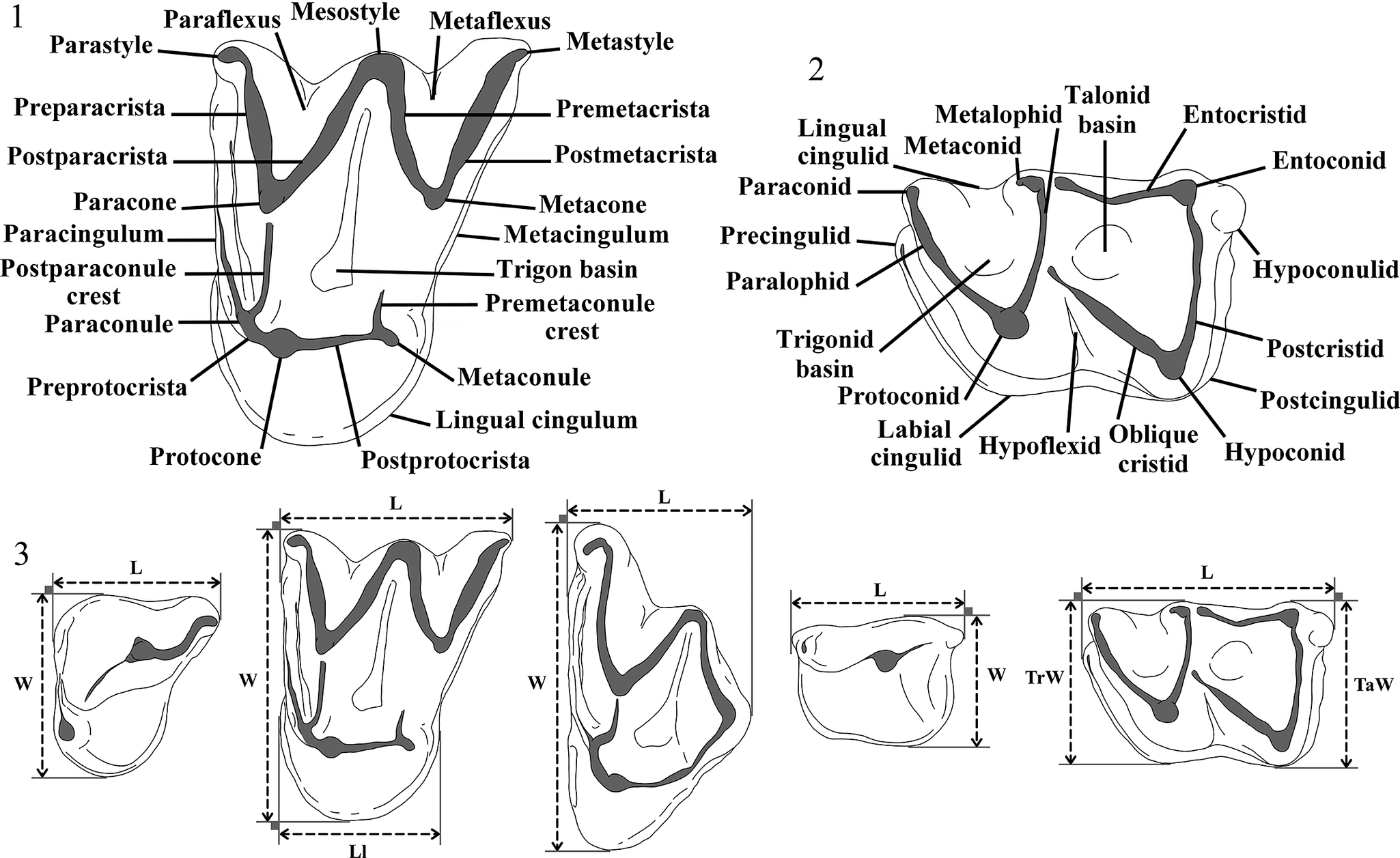
Our measurement protocol (Fig. 2) is based on the perpendicular method of Sigé (Reference Sigé1968), which is here considered more accurate and reproducible than the nonperpendicular method of Sevilla (Reference Sevilla1988). The reference line follows the labial flank of the upper dentition and the lingual flank of the lower dentition. As an exception, the reference line for the M3 follows the anterior flank of the teeth, as used by Rachl (Reference Rachl1983, fig. 6.a). The abbreviations are changed to fit the English language. The measurements, given in millimeters (mm), were obtained with a digital measuring microscope (Eakins 37MP) with a mechanical stage and digital measuring clocks (Mitutoyo 350-352-30). Identification numbers, laterality, and measurements are provided in Supplementary Data 1. Specimens in figures are represented in left orientation. Reversed specimens are indicated by an underlined number. Unless otherwise noted, scanning electron microscopy (SEM) pictures are made in occlusal view. Drawings were obtained with a graphic tablet (Wacom Intuos Pro) and the software Autodesk SketchBook (v. 8.7.1; https://www.sketchbook.com/).
Terminology used for the M2 (1) and m1 (2) of bats, and measurements protocol for (left to right) P4, M2, M3, p4, and m1 (3). L = labial length; L1 = lingual length; W = width; TaW = talonid width; TrW = trigonid width.
Abbreviations
C/c, canine; H, height; I/i, incisor; L, labial length; L1, lingual length; M/m, molar; N, number of specimens; P/p, premolar; TaW, talonid width; TrW, trigonid width; W, width. Localities: BJ, Borský Svätý Jur; KR, Krásno; ST, Studienka.
Repositories and institutional abbreviations
The studied material consists of 55 dentognathic elements (BJ214000-01, 07-09, 11-17, 21, 29-38; ST215000-01; KR128002-15, 18-21, 30-31, 40-41, 50-53, 60-63) housed at the Department of Geology and Paleontology of Comenius University, Bratislava. Other material mentioned in the present work are deposited in the following institutions: Muséum National d’Histoire Naturelle (MNHN), Paris, France; and Université Claude Bernard Lyon 1 (UCBL), Lyon, France.
Systematic paleontology
Order Chiroptera Blumenbach, Reference Blumenbach1779
Suborder Yangochiroptera Koopman, Reference Koopman, Anderson and Jones1984
Family Vespertilionidae Gray, Reference Gray1821
Subfamily Vespertilioninae Gray, Reference Gray1821
Tribe Vespertilioni Gray, Reference Gray1821
Genus Miostrellus Rachl, Reference Rachl1983
Type species
Miostrellus risgoviensis Rachl, Reference Rachl1983.
Diagnosis
See Rachl (Reference Rachl1983, p. 224).
Occurrence
Miostrellus occurs from the late early Miocene (Rosina and Rummel, Reference Rosina and Rummel2012, Reference Rosina and Rummel2017; Crespo et al., Reference Crespo, Sevilla, Montoya and Ruiz-Sanchez2020) and reaches its apparent maximal diversity during the middle Miocene (e.g., Baudelot, Reference Baudelot1972; Horáček, Reference Horáček2001; Mein and Ginsburg, Reference Mein and Ginsburg2002). Inclusion of Miostrellus noctuloides (Lartet, Reference Lartet1851) in the genus Miostrellus extends the temporal range of Miostrellus into the late Miocene (Mein, Reference Mein, Agustí, Rook and Andrews1999; Ziegler, Reference Ziegler2006; Rosina and Rummel, Reference Rosina and Rummel2012; this paper).
Miostrellus noctuloides (Lartet, Reference Lartet1851)
and Miostrellus cf. Miostrellus noctuloides (Lartet, Reference Lartet1851)
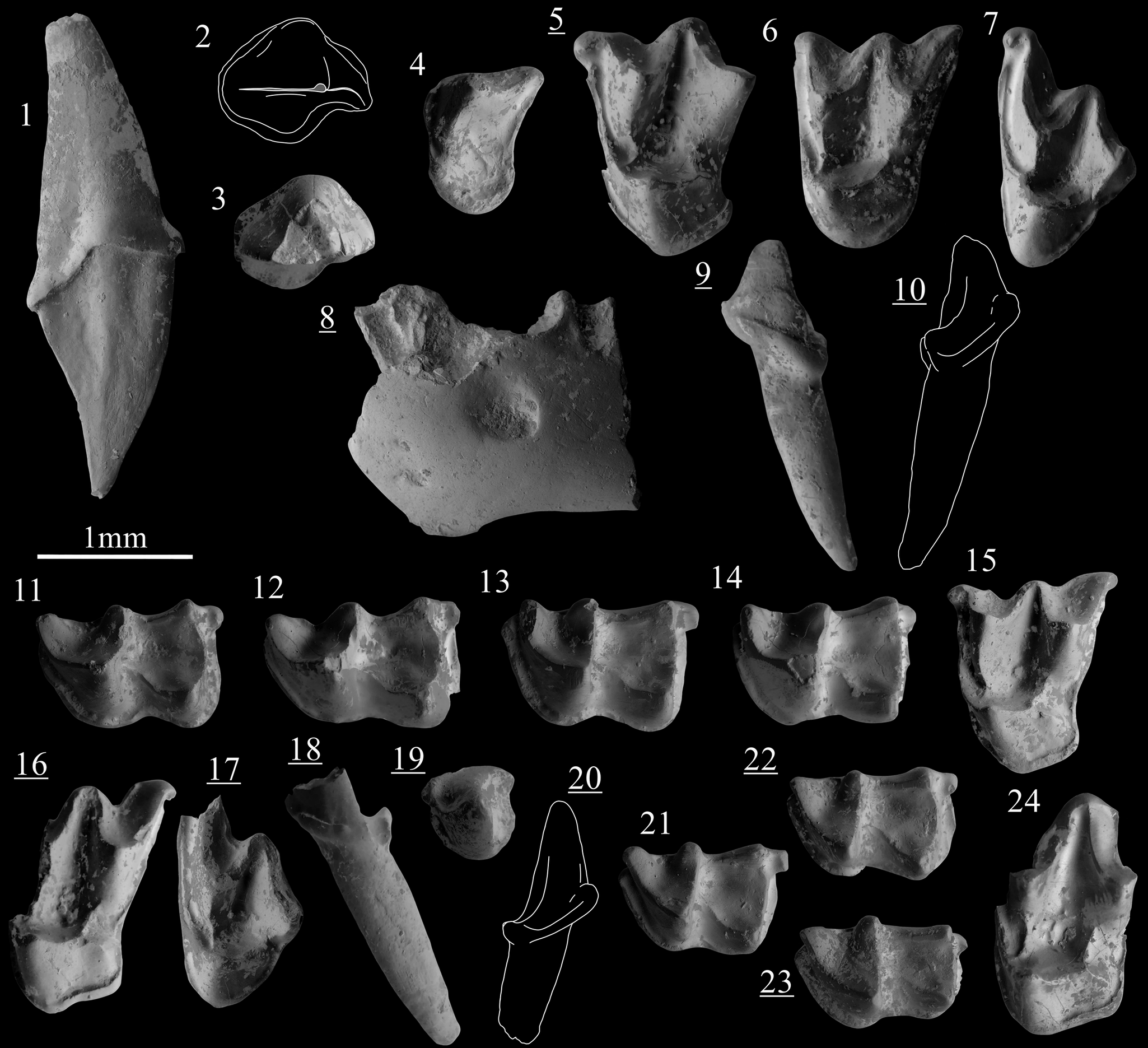
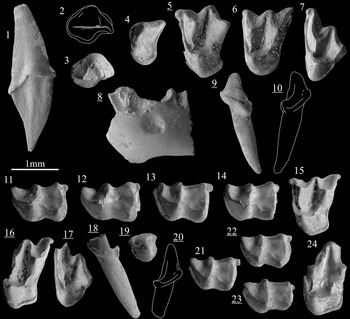
Scanning electron photomicrographs of Miostrellus cf. Miostrellus noctuloides (Lartet, Reference Lartet1851) from Borský Svätý Jur and Krásno (1–14) and Myotis cf. Myotis murinoides (Lartet, Reference Lartet1851) from Borský Svätý Jur (15–23) and Krásno (24). (1, 2) C, BJ214037, in lingual view (1) and with schematic drawing of the occlusal view (2); (3) C, KR128008; (4) P4, BJ214032; (5) broken M1, KR128002; (6) M2, BJ214030; (7) M3, BJ214031; (8) fragment of mandible, BJ214038, labial view; (9, 10) c, KR128009, in labial view (9) and with schematic drawing of the lingual view (10); (11) m1, BJ214033; (12) m1, KR128010; (13) m2, BJ214034; (14) m2, KR128012; (15) M1, BJ214007; (16) broken M2, BJ214009; (17) broken M3, BJ214011; (18) c, BJ214012, labial view; (19, 20) c, BJ214013, in occlusal view (19) and with schematic drawing of the lingual view (20); (21) m2, BJ214014; (22) m2, BJ214016; (23) m3, BJ214017; (24) broken M2, KR128040. Images with underlined numbers are reversed.
(1) Dimensions of the m1 (triangle), m2 (square), and m3 (circle) of Miostrellus aff./cf. Miostrellus noctuloides (Lartet, Reference Lartet1851) and Myotis cf. Myotis murinoides (Lartet, Reference Lartet1851) (based on Baudelot, Reference Baudelot1972; Sevilla, Reference Sevilla2002; Ziegler, Reference Ziegler2003); (2) Miostrellus noctuloides, m2, Borský Svätý Jur, BJ214035, in occlusal, labial, and lingual views. (3) Myotis cf. Myotis murinoides, m2, Borský Svätý Jur, BJ214014, in occlusal, labial, and lingual views. L = labial length; TaW = talonid width.

Type specimen
Neotype, MNHN Sa. 13.580, fragment of left mandible with p4–m3, Sansan, France (Baudelot, Reference Baudelot1972).
Diagnosis
See Baudelot (Reference Baudelot1972, p. 52).
Occurrence
MN4 to MN11 of western and central Europe (Baudelot, Reference Baudelot1972; Mein, Reference Mein, Agustí, Rook and Andrews1999; Mein and Ginsburg, Reference Mein and Ginsburg2002; Sevilla, Reference Sevilla2002; Ziegler, Reference Ziegler2006; Rosina and Rummel, Reference Rosina and Rummel2019).
Description
The upper canine displays an asymmetric occlusal outline, with a rounded anterior margin and a tapered posterior margin. In occlusal view, the anterolingual border is convex although the posterolingual border is concave (Fig. 3.2, 3.3). The crown is triangular in cross section. The anterior and posterior crests are slightly compressed. The labial crest is large. The posterior crest is sharp. There is a low anterolingual extension. The tooth is surrounded by a cingulum, except below the posterolingual flank of the labial crest.
The P4 is a small, quadrangular premolar; its main cusp is located at the anterolabial corner. The postparacrista is low and concave, ending in a more labial position than the paracone. A minute cusp is attached to the anterolingual corner, independent from the short, low postparaconule crest attached to the paracone. It is connected to a narrow anterior cingulum. The posterolingual basin is broad and shallow. Only a slight constriction of the lingual area is visible on the posterior flank.
The M1 is a broad element with a slight labiolingual compression (Fig. 3.5). The metacone and paracone are positioned close to the labial side and labial crests are overall short. The mesostyle is in a more labial position than the parastyle. The preparacrista and parastyle create a thick, but low, S-shaped crest. The protocone is relatively low and has a curved lingual flank, resulting in a rounded lingual margin. The preprotocrista joins the thick paracingulum. There is an incipient postparaconule crest and no distinct paraconule. The postprotocrista is short and leads to a poorly differentiated metaconule and a rather high premetaconule crest. The lingual cingulum is broad but weak below the protocone.
The M2 differs from the M1 by the stronger anteroposterior compression and the slightly longer labial crests, resulting in a straighter postmetacrista. In addition, the premetaconule crest is lower, resulting in a better differentiation of the metaconule.
The M3 is triangular (Fig. 3.7). The paracone is robust and the parastyle is bulky. They are connected by a blunt, curved preparacrista. The premetacrista is slightly longer than the postparacrista and is similar in shape. The metacone is as high as the protocone, to which it is connected by the postprotocrista and the premetaconule crest. Two unconnected cingula are found anterolingually and posterolingually.
A fragment of the mandible (BJ214038) displays several damaged alveoli of the incisors. The most posterior one (i3) is the best preserved. The largest alveolus is circular and attributed to the canine. A second circular alveole, significantly smaller, posterior to it is attributed to a small, one-rooted p2. The posteriormost alveole preserved in the fragment is an anteroposteriorly compressed alveole, which is shorter but as broad as the alveole of the p2. This is interpreted as the anterior alveole of a two-rooted p4. The mandibular foramen is situated below the lamina separating the canine and the p2 (Fig. 3.8).
The one-rooted c has a trapezoid outline and is relatively small; its height only reaches the height of the protoconid of m1. The main cuspid is in an anterior position. A relatively high, curved crest extends from its tip, running along the lingual margin and reaching the posterolingual corner of the tooth. A minute anterolingual cuspule is present and is connected to a thick, regular lingual cingulid. The labial cingulid is also thick and regular but does not join the minute cuspule, leaving a central anterior notch in occlusal view. The posterior cingulid is broad and the posterior margin is straight. The only available p4 (KR128007) is damaged. The outline is subrectangular with an apparently continuous cingulid. The main cuspid is in a slightly anterior position and connected by a thin crest to an anterior cuspule. A short posterolabial swelling is discernible on the main cuspid flank.
The trigonid of the m1 is relatively narrow and subequal in length to the talonid. The paraconid and the metaconid are low and slightly bent, whereas the protoconid is stouter. The paraconid is projected anteriorly. A thin anterolingual cingulid borders the entrance of the trigonid basin. The paralophid is curved and the trigonid basin is shallow. The talonid basin is enclosed by a moderately high entocristid. The entoconid is slightly bent lingually. The oblique cristid ends slightly labially to the center of the trigonid wall. The posterior flank displays the myotodont type (i.e., the postcristid connects the hypoconid to the entoconid), leading to an independent hypoconulid. The labial cingulid is thick and irregular (sensu Sevilla, Reference Sevilla1988, fig. 11), slightly dilated below the labial flank of the protoconid, and continuous from below the paraconid to near the hypoconulid.
The m2 is distinguishable from the m1 by its less anteroposteriorly compressed trigonid, its metaconid in a less central position, and its less projected paraconid, resulting in a narrower trigonid basin (Fig. 3.11, 3.12 vs. Figs. 3.13, 3.14, 4.2).
The relatively small m3 has an anteroposteriorly compressed trigonid with a slightly curved paralophid. The rectangular talonid is slightly reduced. The entoconid is pointed and laterally compressed; it preserves a somewhat subtriangular outline in cross section. The entocristid is relatively high. The hypoconid is slightly lower than the entoconid and has a broader subtriangular outline. A small hypoconulid is present. The oblique cristid is irregular. The labial cingulum is thick and is strongly irregular below the hypoflexid.
Material
Borský Svätý Jur (Miostrellus noctuloides): one C (BJ214037: L = 1.02, W = 0.85, H = 1.79), one P4 (BJ214032: L = 0.78, W = 0.90), one broken M1 (BJ214029), one M2 (BJ214030: L = 1.11, Ll = 0.77, W = 1.40), one M3 (BJ214031: L = 0.87, W = 1.54), one m1 (BJ214033: L = 1.19, TrW = 0.74, TaW = 0.76), two m2 (BJ214034: L = 1.24, TrW = 0.75, TaW = 0.79; BJ214035: L = 1.24, TrW = 0.77, TaW = 0.80), one m3 (BJ214036: L = 1.07, TrW = 0.63, TaW = 0.55), and one edentulous fragment of mandible (BJ214038).
Krásno (Miostrellus cf. Miostrellus noctuloides): one C (KR128008: L = 0.94, W = 0.81), two M1 (KR128002: Ll = 0.87, W = 1.36; KR128005), one M2 (KR128006: Ll = 0.77), two M3 (KR128003: W = 0.83; KR128004), one c (KR128009: L = 0.63, W = 0.67), one p4 (KR128007: L = 0.72), four m1 (KR128010: L = 1.27, TrW = 0.73, TaW = 0.79; KR128011: TrW = 0.76, TaW = 0.80; KR128014: L = 1.23, TaW = 0.78; KR128015), two m2 (KR128012: L = 1.23, TrW = 0.75, TaW = 0.79; KR128013: L = 1.30, TrW = 0.73, TaW = 0.79), and one fragment of m3 (KR128018).
Remarks
This small Miocene vespertilionid has: (1) angular upper molars with postparaconule crest, premetaconule crest, and metaconule, but no paraconule; (2) M3 with postparaconule crest; (3) m1-2 with curved paralophid, broad talonid, and myotodont postcristid; (4) only slightly reduced m3/M3. This combination of features is found in very few Miocene European bat materials and fits particularly well with Miostrellus noctuloides, originally described from Sansan (MN6; Lartet, Reference Lartet1851; Baudelot, Reference Baudelot1972). After direct comparisons, our elements show strong morphometric and morphological similarities with the material from Sansan and with several specimens from the upper Miocene of Austria (described by Ziegler, Reference Ziegler2006). It also agrees with the description of the material from Petersbuch 6 (Ziegler, Reference Ziegler2003) and Casetón 1A-2B (Sevilla, Reference Sevilla2002). The tentative attribution of a mandibular fragment to Miostrellus noctuloides is based on these comparisons (Baudelot, Reference Baudelot1972, figs. 18, 19; Ziegler, Reference Ziegler2003, fig. 6.1−6.4). These small elements share the reduced alveole corresponding to the p2 and the compressed anterior alveoli of the p4, implying two lower premolars.
Miostrellus noctuloides is variable in size within a locality (Baudelot, Reference Baudelot1972) and between localities (Fig. 4.1). The material from Petersbuch 6 (MN7/8; Ziegler, Reference Ziegler2003) most resembles the material from Sansan (MN6; Baudelot, Reference Baudelot1972). Miostrellus aff. Miostrellus noctuloides from Sandelzhausen (MN5; Ziegler, Reference Ziegler2000b) possesses a proportionally longer m1 and narrower lower molars (Sevilla, Reference Sevilla2002), motivating a separate mention. Similarly, there is little doubt that the large (Fig. 4.1) Miostrellus aff. Miostrellus noctuloides from Petersbuch 10 (MN7/8; Ziegler, Reference Ziegler2003) represents a different species. The specimens from Krásno (MN11) are significantly smaller than the one from Petersbuch 10 but are only partly overlapping the size variability of the material from Sansan. Because of this, the material from Krásno is referred to Miostrellus cf. Miostrellus noctuloides and likely represents a slightly more advanced form.
Miostrellus noctuloides has been referred to several genera. Originally described as a Vespertilio Linnaeus, Reference Linnaeus1758 by Lartet (Reference Lartet1851), it was transferred to Eptesicus Rafinesque, Reference Rafinesque1820, by Baudelot (Reference Baudelot1972), which has been widely followed (e.g., Rachl, Reference Rachl1983; Horáček, Reference Horáček2001; Sevilla, Reference Sevilla2002). Ziegler (Reference Ziegler2003) demonstrated that the dental formula of the species precludes attribution to Eptesicus (sensu lato), and he tentatively transferred the species into Paleptesicus Zapfe, Reference Zapfe1970. However, there is a strong morphological and metric gap between the type species, Paleptesicus priscus (Zapfe, Reference Zapfe1950), and Miostrellus noctuloides, which precludes any close relationship. Rosina and Rummel (Reference Rosina and Rummel2012) argued that Miostrellus noctuloides better fits in Miostrellus, based on the material described by Ziegler (Reference Ziegler2003) from Petersbuch 6 and 10.
We found very few differences between the type species of Miostrellus, Miostrellus risgoviensis Rachl, Reference Rachl1983, and Miostrellus noctuloides. Namely, the larger size of Miostrellus noctuloides (∼ 5−10%) and the differentiation of the premetaconule and the postparaconule crest on M1-2. It is worth noting that Rachl (Reference Rachl1983, p. 232) mentioned that the postprotocrista reaches the labial base of the metacone and then joins its tip. This curvature is also visible in Miostrellus cf. Miostrellus risgoviensis from Forsthart (MN4; Rosina and Rummel, Reference Rosina and Rummel2017, fig. 1.f). Notably, the presence of metaconule/hypocone would result in a firm identification of the premetaconule crest/metaloph, a term lacking in the terminology of Rachl (Reference Rachl1983, fig. 4). Also, material attributed to Miostrellus with a distinct postparaconule crest has already been reported (Rosina and Rummel, Reference Rosina and Rummel2017, fig. 1.e). Considering the limited evidence and the unstable taxonomy of these forms, we consider that Miostrellus noctuloides likely corresponds to a small Miostrellus species with a relatively high dental complexity.
Tribe Myotini Tate, Reference Tate1941
Genus Myotis Kaup, Reference Kaup1829
Type species
Vespertilio myotis Borkhausen, Reference Borkhausen1797.
Diagnosis
See Sevilla (Reference Sevilla1988, p. 155).
Occurrence
Myotis is the most species-rich genus of modern bats and is found worldwide. Its rich fossil record traces back to the Oligocene (Ziegler, Reference Ziegler2000b Reference Zieglera; Gunnell et al., Reference Gunnell, Smith and Smith2017).
Myotis murinoides (Lartet, Reference Lartet1851) and Myotis cf. Myotis murinoides (Lartet, Reference Lartet1851)
Type specimen
MNHN Sa. 13.657, neotype, fragment of right mandible with c–m2, Sansan, France (Baudelot, Reference Baudelot1972).
Diagnosis
See Baudelot (Reference Baudelot1972, p. 24).
Occurrence
MN5−MN11 of western and central Europe (Baudelot, Reference Baudelot1972; Mein, Reference Mein, Agustí, Rook and Andrews1999; Mein and Ginsburg, Reference Mein and Ginsburg2002; Ziegler, Reference Ziegler2006; Ménouret and Mein, Reference Ménouret and Mein2008; this work).
Description
The M1 is an angular, compact element. The metacone is higher and in a more lingual position than the paracone. The lingual flank of the metacone is rounded. The premetacrista is shorter than the postmetacrista. The metaflexus is wider than the paraflexus. The protocone is connected to the paracingulum by the preprotocrista. The paraconule is not distinct in our specimen (BJ214008). The postparaconule crest is low. The postprotocrista leads to a moderately high, irregular premetaconule crest joining the base of the metacone. The metaconule is crest-like. The lingual cingulum is divided below the protocone.
The M2 is slightly wider and more compressed anteroposteriorly than the M1 (Fig. 3.16). The labial crests are elongated. The postparaconule crest is weakly connected to a well-developed paraconule. The metaconule is crest-like, but its base is relatively well delimited, resulting in an angular labial outline. The premetaconule crest is rather high. The metacingulum is narrower than the paracingulum. The lingual cingulum is barely visible below the protocone.
The M3 is moderately reduced. The paracone is robust. The preparacrista is elongated and slightly curved. The premetacrista and the postparacrista are similar in shape. The metacone is as high as the protocone. The postprotocrista ends as a bulge and is weakly connected to the base of the metacone by a thin crest (premetaconule crest). The postparaconule crest is weakly connected to the preprotocrista. The latter continues anteriorly and joins the thick paracingulum. Narrower cingula are found anterolingually and posterolingually.
The lower canine is a gracile, one-rooted, ovoid element slightly anteroposteriorly compressed. The pointed cuspid is subtriangular in cross section. A minute cuspule is present in an anteriormost position. This cuspule is connected to the main cuspid by a thin central crest (Fig. 3.19). The cuspule is attached to a thin, regular lingual cingulid, but not to the narrower labial cingulid. The talon is broader on the lingual side, where a thin cristid leads to a bulge.
The m2 has a short and slightly narrower trigonid than the talonid (Figs. 3.22, 3.23, 4.3). The paralophid is almost straight. The paraconid and the metaconid are low. Additionally, the paraconid is anteriorly projected. A short anterolingual cingulid is present. The talonid basin is moderately enclosed by the entocristid. The entoconid is rounded in cross section. The oblique cristid is high, thick in its central part, and extends from the broad hypoconid to reach the center of the trigonid wall. The structure is myotodont. The hypoconulid is robust. A very thin crest connects the hypoconulid to the posterolingual base of the entoconid. The labial cingulid is thick and irregular below the labial flank of the protoconid and the hypoflexid. The m3 is only slightly smaller than the m2. The compressed anteroposteriorly trigonid has a gracile paraconid and metaconid. The paraconid is slightly projected forward. The talonid is moderately reduced. The entoconid is short and ovoid in the cross section. The entocristid is weak. The hypoconid is lower but broader than the entoconid. The oblique cristid is straight. A small hypoconulid is present. The labial cingulid is thick and slightly irregular.
Material
Borský Svätý Jur (Myotis murinoides): one M1 (BJ214007: L = 1.08, Ll = 0.69, W = 1.20), three M2 (BJ214008: Ll = 0.71; BJ214009: Ll = 0.72; BJ201410), one M3 (BJ214012: L = 0.77), two c (BJ214012: L = 0.70, W = 0.62; BJ214013: L = 0.66, W = 0.63), one m1/2 (BJ214015: TaW = 0.72), two m2 (BJ214014: L = 1.14, TrW = 0.69, TaW = 0.74; BJ214016: L = 1.10, TrW = 0.62, TaW = 0.69), and one m3 (BJ214017: L = 1.06, TrW = 0.61, TaW = 0.56).
Krásno (Myotis cf. Myotis murinoides): one M2 (KR128040: Ll = 0.84), and one M3 (KR128041).
Remarks
This small vespertilionid has myotodont molars, narrow upper molars with weak metaconules, and poorly reduced M3 and m3. The additional presence of a paraconule, postparaconule crest, and premetaconule crest on M2 indicates Myotis sensu lato (Sevilla, Reference Sevilla1988; Ziegler, Reference Ziegler2000a; Rosina and Semenov, Reference Rosina and Semenov2012). The metaconule on the M1-2 distinguishes our species from Myotis sanctialbani Viret, Reference Viret1951 (based on Baudelot, Reference Baudelot1972). The postparaconule crest and premetaconule crest are more robust than in the larger Myotis boyeri Mein, Reference Mein1964 from Lissieu. The angular paralophid on m2 makes our species distinct from the slightly larger Myotis reductus Ziegler, Reference Ziegler2003, from Petersbuch 6 (Ziegler, Reference Ziegler2003).
Our species is significantly smaller than most Neogene species (based on Ziegler, Reference Ziegler2000a; Rosina and Kruskop, Reference Rosina and Kruskop2011; Rosina and Semenov, Reference Rosina and Semenov2012; Horáček and Trávníčková, Reference Horáček and Trávníčková2019). Our material fits the dimensions of Myotis minor Ziegler, Reference Ziegler2000b, but this species does not have a hypoconid-entoconid connection (Ziegler, Reference Ziegler2000a), which is clearly present in one specimen (BJ214016) and barely visible in another (BJ214014). Myotis ziegleri Horáček, Reference Horáček2001 (replacing the original name Myotis elegans Baudelot, Reference Baudelot1972, preoccupied by Myotis elegans Hall, Reference Hall1962; see Storch, Reference Storch, Rossner and Heissig1999 and Horáček, Reference Horáček2001) is slightly smaller and the pictured M1 from Sansan (Baudelot, Reference Baudelot1972, pl. 2, fig. 7) displays a higher dental complexity.
The only Myotis species that fits in both size and morphology with our specimens is Myotis murinoides, which was originally described from Sansan (Baudelot, Reference Baudelot1972). This is additionally supported by direct comparisons with Myotis murinoides from La Grive Saint-Alban (listed by Mein and Ginsburg, Reference Mein and Ginsburg2002), from Lo Fournas 1993 (listed by Mein, Reference Mein, Agustí, Rook and Andrews1999) and with Myotis cf. Myotis murinoides from the upper Miocene of Austria (Ziegler, Reference Ziegler2006). Several lower Miocene assemblages attributed to Myotis aff. Myotis murinoides show particularly large upper canines (Ziegler, Reference Ziegler2000b; Rosina and Rummel, Reference Rosina and Rummel2017) making this species easily distinguishable from Myotis murinoides. No upper canines have been reported from the MN9 Austrian and Slovak localities, but Myotis aff. Myotis murinoides is not expected in the upper Miocene. Finally, the two broken specimens from Krásno are larger than the specimens from Borský Svätý Jur. Although they likely represent a single lineage, a clear attribution is uncertain considering the limited sample. Therefore, the specimens from Krásno are attributed to Myotis cf. Myotis murinoides.
The generic attribution of this species is unstable. It has been assigned to Myotis by several authors (Baudelot, Reference Baudelot1972; Ziegler, Reference Ziegler2000b; Sevilla, Reference Sevilla2002; Rosina and al., Reference Rosina, Prieto, Hír and Kordos2015; Rosina and Rummel, Reference Rosina and Rummel2017; Crespo et al., Reference Crespo, Sevilla, Montoya and Ruiz-Sanchez2020), but Horáček (Reference Horácek1986) argued for a possible assignment to Kerivoula Gray, Reference Gray1842, which was occasionally followed (Ziegler, Reference Ziegler2006; Ménouret and Mein, Reference Ménouret and Mein2008). Ziegler (Reference Ziegler2000a) also suggested an assignment to the subgenus Leuconoe Boie, Reference Boie1830, elevated to generic rank by Menu (Reference Menu1985, Reference Menu1987). The latter taxon was previously considered as a basal subgenus of Myotis (e.g., Godawa Stormark, Reference Godawa Stormark1998), but phylogenetic and ecological data provide convincing evidence that ‘Leuconoe’ is an ecomorph of Myotis found in small-sized and soft-body invertivorous species (see Ghazali et al., Reference Ghazali, Moratelli and Dzeverin2017). Consequently, Myotis murinoides is a Miocene example of this ecomorph and is classified here as Myotis.
Tribe Plecotini Gray, Reference Gray1866
Genus Otonycteris Peters, Reference Peters1859
Type species
Otonycteris hemprichii Peters, Reference Peters1859.
Diagnosis
See Gharaibeh and Qumsiyeh (Reference Gharaibeh and Qumsiyeh1995, p. 1).
Occurrence
The fossil record of Otonycteris is restricted to the late middle Miocene (Mein and Ginsburg, Reference Mein and Ginsburg2002) and early upper Miocene (Ménouret and Mein, Reference Ménouret and Mein2008; Rosina, Reference Rosina2015; this work) of Europe.
‘Otonycteris’ sp. indet.
Figures 5.1, 5.2, 6.3, 6.4
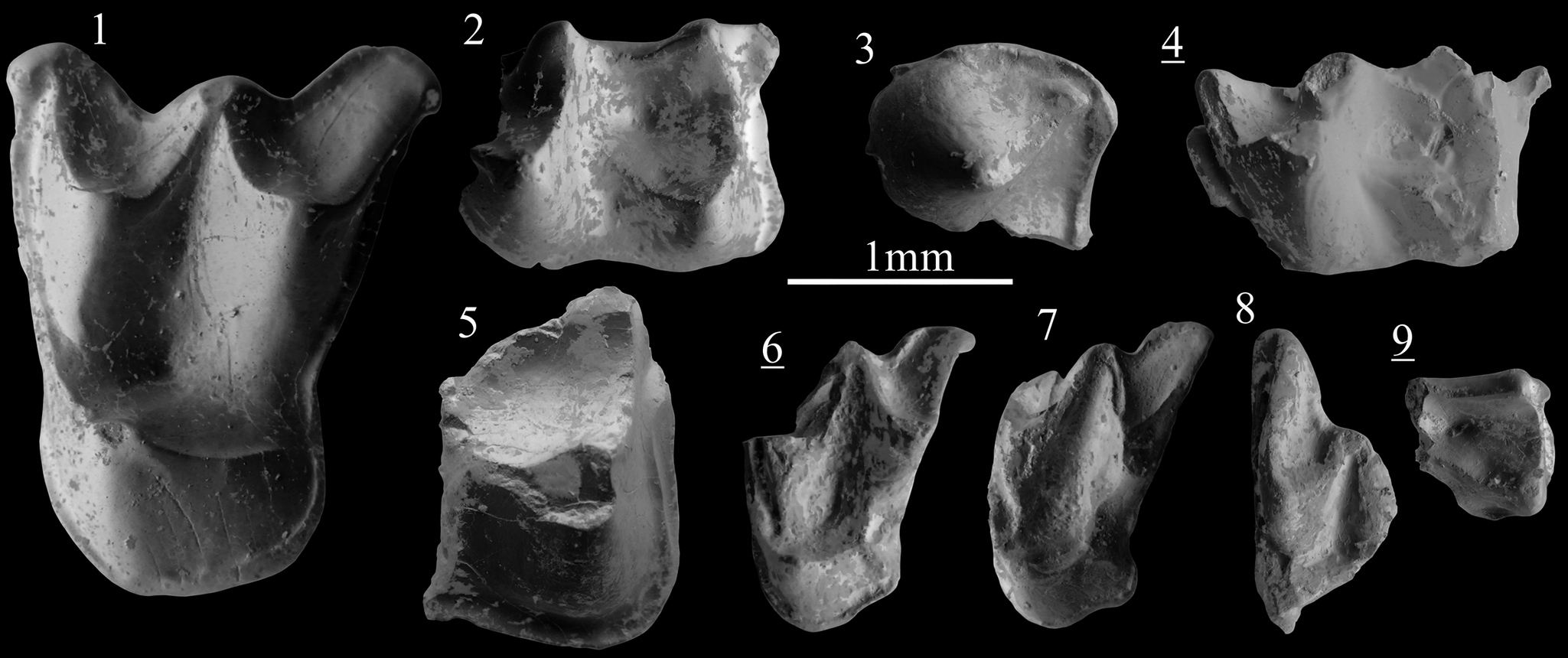
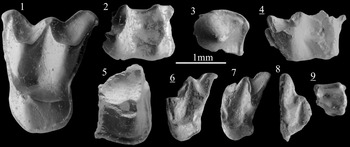
Scanning electron photomicrographs: (1, 2) ‘Otonycteris’ sp. indet. from Borský Svätý Jur: (1) M2, BJ214000; (2) broken m2, BJ214001; (3, 4) Vespertilionidae gen. indet. sp. indet 1 from Krásno: (3) broken P4, KR128050; (4) broken m1/2, KR128053; (5) Vespertilionidae gen. indet. sp. indet 2 from Krásno, broken m1/2, KR128031; (6–9) Miniopterus sp. indet. from Borský Svätý Jur and Krásno: (6) broken M1, KR128020; (7); broken M2, BJ214021; (8) broken M3, KR128021; (9) broken m3, KR128022. Images with underlined numbers are reversed.
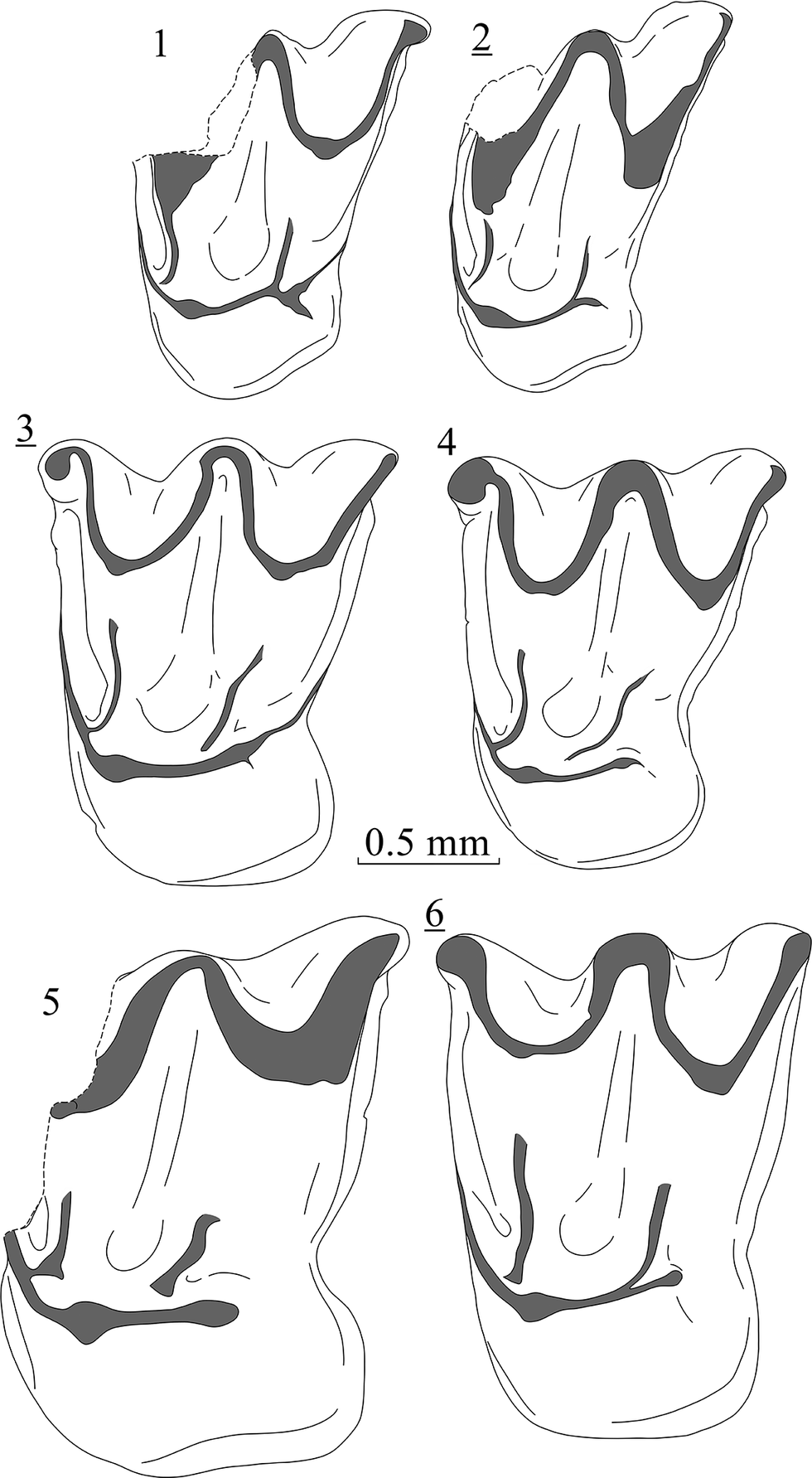
Comparative drawings of Recent and fossil of upper molars attributed to Otonycteris. (1) P4−M3, Otonycteris hemprichii Peters, Reference Peters1859, Morocco, Recent (Faculty of Sciences, Lyon, cast; unumbered); (2) M2, Otonycteris sp. indet., Soblay (MN10), France, UCBL-FSL 217897; (3–6) ‘Otonycteris’ sp. indet.: (3) broken M1, Studienka A (MN9), Slovakia; (4) M2, BJ214000, Borský Svätý Jur (MN9), Slovakia; (5) M1, La Grive Saint-Alban (MN7/8), France, UCBL-FSL 66152; (6) M2, La Grive Saint-Alban (MN7/8), France, UCBL-FSL 217890. Dotted lines represent broken parts of the specimens.

Description
The fragment of an upper canine bears a high, robust obovoid cuspid from which a thin crest descends posterolabially without reaching the posterior margin. The posterolingual part bears a broad talon. The other structures of the crown are not preserved. The anterior cingulum is narrower than the posterior cingulum.
The lingual fragment of M1 has an angular margin and a robust protocone. The preprotocrista is high and joins the paracingulum. There is no postparaconule crest. The postprotocrista is straight and there is no metaconule. A thin premetaconule crest turns labially and touches the base of the metacone. A continuous lingual cingulum is present; it is narrow below the protocone, but thick posteriorly.
The M2 is very simple (Fig. 5.1). The paracone and the postparacrista are slightly lower than the metacone and the premetacrista, respectively. The preparacrista joins the parastyle as a hook whereas the connection between the longer postmetacrista and the metastyle is direct. The metastyle is lower than the parastyle and the robust mesostyle. The paraflexus and the metaflexus are broad and bear distinct cingula. The protocone is low and stout. The preprotocrista joins the paracingulum. The postprotocrista ends freely, in a relatively labial position. There is no metaconule or paraconule. Additionally, there is neither a premetaconule crest nor a postparaconule crest, resulting in a largely open basin. The lingual flank is surrounded by a thick lingual cingulum, which is barely visible below the protocone.
The fragment of m1 (Fig. 5.2) displays a slightly buccolingually compressed trigonid and overall high cuspids. The protoconid is conical and anteriorly positioned. The pointed metaconid is only slightly projected lingually and has a reduced base. A part of the lingual cingulid is visible. The talonid is broader than long, with a robust hypoconid and a low subtriangular entoconid. The oblique cristid is straight and the entocristid high and continuous. The postcristid is slightly curved and displays the myotodont tooth type. The low hypoconulid has a broad base. From a labial view, the thick cingulum is W-shaped, because of it extending upward below the hypoflexid. There is a weak connection between the labial cingulid and the postcingulid.
Material
Borský Svätý Jur: one M2 (BJ214000: L = 2.12, Ll = 1.41, W = 2.69) and one damaged m1 (BJ214001: TrW = 1.03, TaW = 1.10).
Studienka A: one fragment of C (ST215000: L = ~ 2.18, H = ~ 3.23) and one fragment of M1 (ST215001: Ll = 1.53).
Remarks
These specimens have been grouped together based on their size and similar structures. The myotodont lower molar and the shape of the upper molar suggest that they belong to the Vespertilionidae family. However, the simple M2 with an open trigon basin and extremely low dental complexity precludes an attribution to most of them (e.g. Engesser, Reference Engesser1972; Sevilla, Reference Sevilla1988; Czaplewski and Morgan, Reference Czaplewski and Morgan2001; Rosina and Rummel, Reference Rosina and Rummel2017; Czaplewski et al., Reference Czaplewski, Morgan and Martin2018). The overall simplistic morphology of the upper molars fits morphotype B sensu Menu (Reference Menu1985). Of the taxa displaying this morphotype, the large vespertilionid Eptesicus sensu lato should be considered first, because this group is frequently recorded in the Miocene (e.g. Baudelot, Reference Baudelot1972; Ziegler, Reference Ziegler1993; Rosina and Sinitsa, Reference Rosina and Sinitsa2014; Czaplewski, Reference Czaplewski2017). However, the M2 are more robust and display a closed basin in European Miocene forms, as described by Ziegler (Reference Ziegler2003) in Eptesicus campanensis Baudelot, Reference Baudelot1970 (= Cnephaeus campanensis, based on Cláudio et al., Reference Cláudio, Novaes, Gardner, Nogueira, Wilson, Maldonado, Oliveira and Moratelli2023). In the Pleistocene species E. praeglacialis Kormos, Reference Kormos1930 (= Cnephaeus praeglacialis, based on Cláudio et al., Reference Cláudio, Novaes, Gardner, Nogueira, Wilson, Maldonado, Oliveira and Moratelli2023; e.g., Lopatin, Reference Lopatin2023) and E. serotinus Schreber, Reference Schreber1774 (= Cnephaeus serotinus, according to Cláudio et al., Reference Cláudio, Novaes, Gardner, Nogueira, Wilson, Maldonado, Oliveira and Moratelli2023; e.g., Sevilla, Reference Sevilla1988), the M2 has a more angular shape, the protocone has a more compact subtriangular base, and the postprotocrista is higher and sharper, ending in a swelling with a posterolingual orientation. In the Mio-Pliocene North American Eptesicus cf. E. fuscus Beauvois, Reference Beauvois1796, the trigon basin is open but the postprotocrista still fully joins the cingulum (Czaplewski, Reference Czaplewski2017). Other eptesiforms (sensu Menu, Reference Menu1985; e.g., Miostrellus, Paleptesicus) can be discarded for their different dental configuration, in addition to their smaller size. The last genus with a Miocene fossil record mentioned by Menu (Reference Menu1985) is Plecotus Geoffroy Saint-Hilaire, Reference Geoffroy Saint-Hilaire1818. The few known Miocene and Pliocene Plecotus spp. are significantly smaller than our specimens and do not exhibit the combination of M2 with a median constriction and a largely open trigon basin, and m1 with a myotodont postcristid (Topál, Reference Topál1989; Ziegler, Reference Ziegler2003; Rosina and Rummel, Reference Rosina and Rummel2012; Rosina et al., Reference Rosina, Kruskop and Semenov2019). Hanakia Horáček, Reference Horáček2001 should also be considered to some degree. The youngest Hanakia species, the middle Miocene Hanakia antiquus Gaillard, Reference Gaillard1899, has distinct postparaconule and premetaconule crest (Baudelot, Reference Baudelot1972). Our M2 is surprisingly similar to that of the lower Miocene Hanakia agadjaniani Rosina and Rummel, Reference Rosina and Rummel2012, but this taxon is smaller and has a very distinct metaflexus on M1-2, as well as an open trigon basin on M1 (Rosina and Rummel, Reference Rosina and Rummel2019, fig. 3C).
A few large-sized plecotine taxa from the upper Miocene of Europe are of special interest: Samonycteris Revilliod, Reference Revilliod1922, Otonycteris, and related forms. The former genus is known by a skull in which the mandibles are in anatomical connection, making it impossible to observe the occlusal surface of the dentition (Horáček et al., Reference Horáček, Fejfar and Hulva2006; Costeur et al., Reference Costeur, Friesenhagen, Schulz, Müller and Wang2024). Material identified from Suchomasty 3 (MN9; Horáček, Reference Horáček2001) under the name aff. Samonycteris sp. indet. is known only by a fragment of mandible. A similar form is suspected in the bat assemblage of Masía del Barbo 2B (MN10, Spain), currently under study by the first author; however, no complete upper molars have been found from the locality. One available fragment of M2 (specimen 3101b) displays superficial similarities to our specimen, differing in its stronger anteroposterior compression and the shorter postprotocrista.
The lingual part of our M2 is less specialized than that of the Recent species Otonycteris hemprichii (Fig. 6.1). Additionally, the entoconid and entocristid of our m1 are not reduced (see Horáček et al., Reference Horáček, Fejfar and Hulva2006). The upper molars of the only described Neogene Otonycteris, O. rummeli Rosina, Reference Rosina2015, are unknown. The genus has been listed in the fauna from La Grive Saint-Alban (MN7/8; Mein and Ginsburg, Reference Mein and Ginsburg2002) and Soblay (MN10; Ménouret and Mein, Reference Ménouret and Mein2008) based on one upper molar from each site, but this material has never been described. Upon examining the specimens at the UCBL, we discovered a left M1 (UCBL-FSL 66152: L = 2.13, Ll = 1.68, W = 2.65) and a right M2 (UCBL-FSL 217890: L = 1.99, Ll = 1.45, W = 2.64) attributed to Otonycteris sp. indet. from La Grive Saint-Alban (Fig. 6.5, 6.6), as well as the right M2 (UCBL-FSL 217897: L = 2.25, Ll = 1.83, W = 3.16) listed from Soblay (Fig. 6.2). These specimens do not display the same degree of dental specialization observed in modern species. Based on the angular outline, the anterolingual position of the high protocone, and the closed trigon basin, we concur with Ménouret and Mein (Reference Ménouret and Mein2008) that the molar from Soblay best fits Otonycteris. The molars from La Grive Saint-Alban are similar in size to our specimens and display strong structural similarities. They show a combination of an M1 with a closed trigon basin, an angular lingual margin and a developed posterolingual cingulum, and an M2 with an open trigon basin and a lingually positioned mesostyle. The MN9 Slovak specimens are slightly more advanced than the upper molars from La Grive Saint-Alban due to the complete absence of the postprotoconule crest, and despite the M2 from Borský Svätý Jur, has a less angular lingual margin (Fig. 6.3, 6.4 vs. Fig. 6.5, 6.6). Therefore, despite the limited sample size and the limited published record, we think that the specimens from La Grive Saint-Alban, Borský Svätý Jur, and Studienka A are more closely related. Nevertheless, the state of the postprotoconule crest suggests that they belong to two different species. Considering the MN10 specimen from Soblay, in which the postprotocrista joins the base of the metacone as an extremely thin crest, it is possible that the complete closure of the trigon basin represents a late stage in the development of Otonycteris-like dentition. Because the specimens from La Grive Saint-Alban, Borský Svätý Jur, Studienka A, and Soblay are similar in size to, or slightly smaller than, the modern O. hemprichii (Fig. 6), they cannot correspond to the upper dentition of the larger Vallesian O. rummeli (see Rosina, Reference Rosina2015). We think that the ancestral structures of the specimens from La Grive Saint-Alban, Borský Svätý Jur, and Studienka A, notably the open trigon basin on M2, prevent a clear generic attribution. These three samples are therefore attributed to ‘Otonycteris’ sp. indet.
Vespertilionidae gen. indet. sp. indet. 1
Description
The fragment of P4 (Fig. 5.3) displays a conical protocone with a short, low postparacrista. This crest is weakly connected to a style at the posterolabial corner. There is no central constriction on the posterior side, but there is a small, shallow posterior basin. A cingulum surrounds the labial and posterior face.
The trigonid of the m1/2 (Fig. 5.4) is moderately compressed and narrower than the talonid. The paralophid is strongly curved and connects to a low paraconid. The metaconid is broader and higher than the paraconid. The trigonid basin is shallow. A thin, narrow lingual cingulid is present. The talonid is broad, with a robust hypoconid and oblique cristid. The entoconid is high and has a triangular outline in cross section. The entocristid is weak. The postcristid is thin and low. The structure is myotodont. The hypoconulid is very low. The end of the precingulid is marked and projected. The labial cingulid is poorly preserved; it is moderately connected to the postcingulid.
Material
Krásno: one fragment of P4 (KR128050) and three fragments of m1/2 (KR128051: TaW = 0.87; KR128053: L = 1.37, TrW = 0.80, TaW = 0.90; KR128052).
Remarks
These specimens correspond to a medium-sized vespertilionid with a myotodont structure and with dental dimensions larger than Miostrellus noctuloides and Myotis murinoides, but significantly smaller than ‘Otonycteris’ sp. indet. The circular cusp and straight labial flank of the P4 are ancestral features corresponding to the morphotype A ‘leuconoformes’ sensu Menu (Reference Menu1985, fig. 15). This, with the combination of lower molars with rounded paralophid, lingual cingulid, and myotodont type, fits with several Myotis-like vespertilionid genera, hampering any clear taxonomic verdict. Overall, strong similarities are found with several Austrian specimens from the upper Miocene lumped under the denomination cf. Myotis sp. indet. by Ziegler (Reference Ziegler2006) and with Myotis aff. Myotis boyeri from the fissure fillings of Kohfidisch (MN11; Bachmayer and Wilson, Reference Bachmayer and Wilson1978). This strongly suggests the presence of at least one, relatively rare, medium-sized species sharing the generalist features of Myotis in the early Turolian of the northwestern part of the Pannonian realm.
Vespertilionidae gen. indet. sp. indet. 2
Description
Only the posterolabial corner of the upper molar (M1/2) is preserved (Fig. 5.5). The metacone is stout, the premetacrista is low, and the postmetacrista is blunt and only slightly curved. The mesostyle is lower than the metastyle. The metaflexus is broad and is delimited by a strong cingulum. The metacingulum is narrower.
The fragment of a high-crowned lower molar talonid displays a massive, subtriangular hypoconid and a thin but continuous postcristid (myotodont type). The labial cingulid is thick and extends below the hypoflexid. It is strongly connected to the thinner postcingulid.
Material
Krásno: One fragment of M1/2 (KR128030) and one fragment of m1/2 (KR128031: TaW > 1.19).
Remarks
These two fragments are lumped together because they both belong to a large vespertilionid, proportionally slightly larger than ‘Otonycteris’ sp. indet. from Borský Svätý Jur and Studienka A. The material from Krásno is also distinct from ‘Otonycteris’ sp. indet. by its lower mesostyle on the M1/2, its more massive and higher talonid, and by the thicker cingulids of the m1/2 (Fig. 5.2 vs. Fig. 5.5).
Family Miniopteridae Dobson, Reference Dobson1875
Genus Miniopterus Bonaparte, Reference Bonaparte1837
Type species
Miniopterus fossilis Zafpe, Reference Zapfe1950.
Diagnosis
See Zapfe (Reference Zapfe1950, p. 60).
Occurrence
Miniopterus is a Recent genus that is punctually identified in the latest Oligocene (Ziegler, Reference Ziegler2000a), Miocene (e.g. Zapfe, Reference Zapfe1950; Mein, Reference Mein, Agustí, Rook and Andrews1999; Ziegler, Reference Ziegler2003), Pliocene (e.g. Wołoszyn, Reference Wołoszyn1987; Popov, Reference Popov2004; Mansino et al., Reference Mansino, Crespo, Lázaro, Ruiz-Sánchez, Abella and Montoya2016), and Pleistocene (Sevilla, Reference Sevilla1988) assemblages of Europe.
Miniopterus sp. indet.
Figures 5.6–5.9, 7.1, 7.2
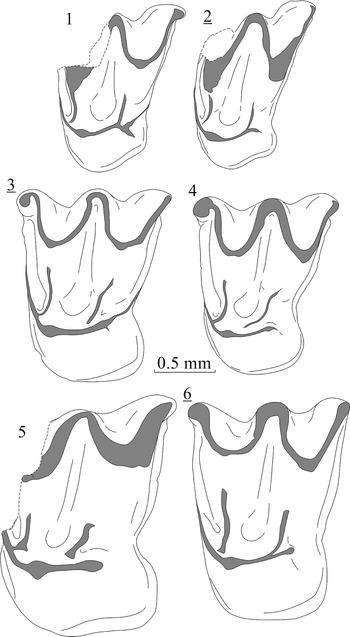
Comparative drawings of upper molars of: (1, 2) Miniopterus sp. indet.: (1) broken M1, Krásno (MN11), Slovakia, KR128020; (2) broken M2, Borský Svätý Jur (MN9), Slovakia, BJ214021; (3, 4) Miniopterus fossilis (Zafpe, Reference Zapfe1950): (3) M1, La Grive Saint-Alban (MN7/8), France, UCBL-FSL 217893; (4) M2, La Grive Saint-Alban (MN7/8), France, UCBL-FSL 217894; (5, 6) Miniopterus zapfei Mein and Ginsburg, Reference Mein and Ginsburg2002: (5) broken M1, La Grive Saint-Alban (MN7/8), France, UCBL-FSL 217895; (6) M2, La Grive Saint-Alban (MN7/8), France, UCBL-FSL 217896. Dotted lines represent broken parts of the specimens.
Description
The M1 is an angular element with high crests (Figs. 5.6, 7.1). The metacone and paracone are compressed. The postmetacrista is straight and connected to an anteroposteriorly oriented blade-like metastyle. The protocone is low. The preprotocrista and the postprotocrista are robust. In addition, three crests begin at the posterior end of the postprotocrista (Figs. 5.6, 7.1): a moderately high premetaconule crest that reaches the anterolingual base of the metacone; a postmetaconule crest that joins the metacingulum; and a short, crest-like metaconule ending freely. The lingual cingulum is weak below the protocone.
The M2 is slightly more stretched than the M1 and displays more elongated labial crests and a less-rounded lingual margin (Figs. 5.7, 7.2). Additionally, there is no postmetaconule crest and the metaconule is not distinct from the posterolingual swelling.
The damaged M3 is moderately reduced (Fig. 5.8). It displays an elongated preparacrista and low parastyle. The postparacrista and premetacrista are also low. A weak postparaconule crest is present.
The broken m3 displays an elongated talonid. The hypoconid has a subtriangular outline and is lower than the slightly reduced entoconid. The straight entocristid is higher than the oblique cristid. The postcristid runs behind the entoconid area before splitting into two branches: one joins the posterolabial flank of the entoconid, whereas the other, thinner, branch joins the hypoconulid (Fig. 5.9). This corresponds to the morphotype b sensu Rachl (Reference Rachl1983, fig. 12) and fits the submyotodont type sensu Legendre (Reference Legendre1984, fig. 3). The partly preserved labial cingulid is not clearly connected to the postcingulid.
Material
Borský Svätý Jur: One damaged M2 (BJ214021: Ll = 0.61, W = 1.33).
Krásno: One damaged M1 (KR128020: Ll = 0.62, W = 1.31), one fragment of M3 (KR128021), and one talonid of m3 (KR128022: TaW = 0.60).
Remarks
The dental complexity of the upper molars, particularly the M1, is inconsistent with that of members of the Vespertilionidae family. Pipistrellus Kaup, Reference Kaup1829 should be considered to some degree, but in this genus, the M1 and M3 are less anteroposteriorly compressed, the M1-2 have a more distinct, conical metaconule, and the M2 has no talon. Despite their relatively high dental complexity, the absence of a well-differentiated metaconule and the underdeveloped talon, coupled with the specimens’ minute size, preclude a classification within the Molossidae Gill, Reference Gill1872. This is also in line with the talonid on m3, which is more reduced in the latter family (e.g., Rosina et al., Reference Rosina, Kruskop and Pickford2022). The shape of the metaconule and the weak talon on M1-2 define Miniopterus, the only genus in the family Miniopteridae. Five Miniopterus spp. are known in the fossil record: Miniopterus fossilis Zapfe, Reference Zapfe1950 (MN6−MN14; Mein, Reference Mein, Agustí, Rook and Andrews1999; Mein and Ginsburg, Reference Mein and Ginsburg2002; Mansino et al., Reference Mansino, Crespo, Lázaro, Ruiz-Sánchez, Abella and Montoya2016), Miniopterus zapfei Mein and Ginsburg, Reference Mein and Ginsburg2002 (MN7/8), Miniopterus rummeli Ziegler, Reference Ziegler2003 (MN7/8), Miniopterus approximatus Wołoszyn, Reference Wołoszyn1987 (MN14−MN15; Popov, Reference Popov2004), and Miniopterus horaceki Gunnell, Eiting, and Geraads, Reference Gunnell, Eiting and Geraads2011 (MN16−MN17). To these, we can add the occurrence of Miniopterus cf. Miniopterus fossilis from the upper Oligocene of Herrlingen 9 (Ziegler, Reference Ziegler2000a). Considering the limited material (four lower molars) and the large temporal gap, we believe this specimen is best classified as Miniopterus sp. indet.
The dimensions of MN7/8 Miniopterus zapfei (La Grive Saint-Alban, France) and MN7/8 Miniopterus rummeli (Petersbuch 6, Germany) match perfectly, so much so that the holotype of Miniopterus zapfei, a mandible with p4−m2, is distinct from the mean lengh dimension of Miniopterus rummeli from the Petersbuch fissures by only a few hundredths of a millimeter. The main morphological difference between Miniopterus zapfei and modern forms is the continuous cingulum on P4 (according to Mein and Ginsburg, Reference Mein and Ginsburg2002), a character also found in Miniopterus rummeli. The latter species is partly defined by its “not crowded lower premolars” (Ziegler, Reference Ziegler2003, p. 485), which is likely in comparison to the type species Miniopterus fossilis. Similarly, the p4 of Miniopterus zapfei is slightly slender (“un peu plus grêle”; Mein and Ginsburg, Reference Mein and Ginsburg2002, p. 24) than that of Miniopterus fossilis. We discovered additional material of Miniopterus zapfei from La Grive Saint-Alban (UCBL) and found no morphological differences between the upper dental elements of Miniopterus zapfei (Fig. 7.5, 7.6) and the figured elements of Miniopterus rummeli (Ziegler, Reference Ziegler2003). Although the original diagnosis of Miniopterus zapfei clearly indicates that Mein and Ginsburg (Reference Mein and Ginsburg2002) were unaware of the existence of Miniopterus approximatus, it is clear that Ziegler (Reference Ziegler2003) was also unaware of the existence of Miniopterus zapfei. Consequently, Miniopterus rummeli should be considered as a junior synonym of Miniopterus zapfei.
Our material shows strong morphological similarities with Miniopterus fossilis. Originally identified from Devínska Nová Vés–Štokeravská vápenka (MN6; Zapfe, Reference Zapfe1950), this species is best known for its lower dental elements (Mein and Ginsburg, Reference Mein and Ginsburg2002; Ziegler, Reference Ziegler2003). Additional material attributed to Miniopterus fossilis was discovered from La Grive Saint-Alban (MN7/8), displaying the same combination of characters as in our material (Fig. 7.3, 7.4): M1-2 with postparaconule and premetaconule crests, and a metaconule swelling; M2 with a more irregular lingual margin; and the postmetaconule crest sometimes joining the metacingulum on M1. The latter character is observed in UCBL-FSL 217893 (Fig. 7.3), but not in the second M1 found from La Grive Saint-Alban (UCBL-FSL 217892). Finally, the holotype of Miniopterus fossilis also includes a submyotodont m3 (Zapfe, Reference Zapfe1950, fig. 9). Despite these structural similarities, our material is much smaller than the specimen discovered from La Grive Saint-Alban. In addition, our M1-2 are more anteroposteriorly compressed, notably the posterolingual part (Fig. 7.1, 7.2 vs. Fig. 7.3, 7.4), so that there is no possible confusion between the two taxa. Consequently, our material is tentatively attributed to Miniopterus sp. indet. and likely represents an unknown species.
Suborder Yinpterochiroptera Springer et al., Reference Springer, Teeling, Madsen, Stanhope and de Jong2001
Family Rhinolophidae Gray, Reference Gray1825
Genus Rhinolophus Lacépède, Reference Lacépède1799
Type species
Vespertilio ferrumequinum Schreber, Reference Schreber1774.
Diagnosis
See Sevilla (Reference Sevilla1988, p. 136).
Occurrence
Rhinolophus is a frequent component of Neogene bat assemblages from Europe. It is known from the latest Eocene (Sigé and Legendre, Reference Sigé and Legendre1983), which is in line with the molecular analysis of Stoffberg et al. (Reference Stoffberg, Jacobs, Mackie and Matthee2010). Rhinolophus is presently identified worldwide and is currently the second most species-rich bat genus (Guillén-Servent et al., Reference Guillén-Servent, Francis, Ricklefs, Csorba, Ujhelyi and Thomas2003).
Rhinolophus cf. R. grivensis Depéret, Reference Depéret1892
Scanning electron photomicrographs of Rhinolophus cf. R. grivensis from Krásno: (1) broken M1, KR128050; (2) broken M3, KR128060; (3, 4) m3, KR128061, in occlusal view (3) and with schematic drawing of the labial view (4).

Holotype
Right mandible with p4–m3, UCBL Lgr. 320, La Grive Saint-Alban, France (Viret, Reference Viret1951).
Diagnosis
See Viret (Reference Viret1951, p. 22).
Occurrence
MN5−MN13 of Europe (e.g., Mein, Reference Mein1964, Reference Mein, Agustí, Rook and Andrews1999; Sesé, Reference Sesé1986; Ziegler, Reference Ziegler2003, Reference Ziegler2006). Suspected in MN4 locality of Oberdorf 4, Germany (Ziegler, Reference Ziegler1998).
Description
Only the anterolabial part of the M1 is preserved (Fig. 8.1). The paracone is low and subtriangular. The postparacrista is slightly longer than the preparacrista, but both are overall short. The parastyle is blade-like and perpendicular to the postparacrista. The paraflexus is broad and shallow. The basin is enlarged. A paracingulum is present and thicker slightly lingual to the parastyle. The fragment of M3 (Fig. 8.2) is relatively wide. The protocone is a weak cusp located at the most lingual margin of the tooth. The preprotocrista is slightly lower than the postprotocrista and is strongly connected to the paracingulum. The postprotocrista is in contact with the posterolingual base of the metacone. The middle section of the postprotocrista is slightly elevated (paraconule?). The lingual cingulum is thin and discontinuous.
The p2 is a small element with a conical cuspid in an anterolabial position. A small anterior cuspule is attached to its base. A broad cingulid surrounds the anterior, lingual, and posterior flanks of the tooth, but is absent on the labial side. The cingulid is thicker at the posterolabial corner and bears a minute cuspid.
The m3 is an elongated tooth with a compressed trigonid. The width of the trigonid and the talonid are equivalent. The paraconid is a conical cuspid connected to a subtriangular paracone by a bipartitioned paralophid. The metaconid is straight, conical, and situated more lingually than the paraconid. It is slightly higher than the paracone. There is no lingual cingulid. The base of the metaconid is connected to the entoconid by a high, slightly S-shaped entocristid. The hypoconid is ovoid in cross section. The oblique cristid is low and irregular, ending just below the central section of the trigonid wall. The talonid is clearly nyctalodont and the hypoconulid is tiny. The labial cingulid is thin and extremely regular. It is weakly connected to the postcingulid.
Material
Krásno: one fragment of M1 (KR128060), one fragment of M3 (KR128061), one p2 (KR128062: L = 0.62, W = 0.63), and one m3 (KR128063: L = 1.38, TrW = 0.79, TaW = 0.78).
Remarks
The characteristic molar configuration of Rhinolophidae and Hipposideridae is recognized here. Hipposiderids are very rarely identified in the upper Miocene of Europe, and there is no record from central Europe (Ziegler, Reference Ziegler2006). Additionally, our material has a broader basin and a shorter labial crest on the upper molars than Asellia cf. A. mariatheresae Mein, Reference Mein1958, from Lo Fournas 1993 (listed by Mein, Reference Mein, Agustí, Rook and Andrews1999) and does not show any clear morphometrical similarities with Miocene Hipposideros Gray, Reference Gray1831 (based on Legendre, Reference Legendre1982; Ziegler, Reference Ziegler2003). Consequently, our candidates are restricted to the rhinolophid genus Rhinolophus. Our specimens are very small and most Rhinolophus spp. can be confidently eliminated (based on Zapfe, Reference Zapfe1950; Kretzoi, Reference Kretzoi1951; Topál, Reference Topál1979; Sesé, Reference Sesé1986; Sevilla, Reference Sevilla1988; Ziegler, Reference Ziegler2003, Reference Ziegler2006; Popov, Reference Popov2004; Crespo et al., Reference Crespo, Sevilla, Mansino, Montoya and Ruiz-Sánchez2018). The length of our m3 is proportionally narrower and falls outside the length variability of the small R. variabilis Topál, Reference Topál1975. It is found within the morphometric variability of R. grivensis (based on Rachl, Reference Rachl1983; Ziegler, Reference Ziegler2003, Reference Ziegler2006). No differences have been found after direct comparison with the material from La Grive Saint-Alban (Mein, Reference Mein1964) and Devínska Nová Vés−Štokeravská vápenka (originally described as R. similis Zapfe, Reference Zapfe1950; synonymized by Zapfe, Reference Zapfe1952). In our m3, the talonid is similar in width to the trigonid. This is common to most assemblages attributed to R. grivensis, with the exception of the material described from Lissieu, originally attributed to R. grivensis lissiensis Mein, Reference Mein1964 (MN13; Mein, Reference Mein1964; see Topál, Reference Topál1974, and Ziegler, Reference Ziegler2003).
Discussion
Palaeodiversity and faunal similarities
The fluviolacustrine faunas from Borský Svätý Jur, Studienka A, and Krásno greatly increase our knowledge of Carpathian Miocene bats, previously known in Slovakia by the MN6 karst material from Devínska Nová Vés–Štokeravská vápenka (Zapfe, Reference Zapfe1950). Seven taxa are firmly identified in the upper Miocene of Slovakia, with a maximal diversity of six taxa at the MN11 locality of Krásno (Table 1). Such high diversity in a Eurasian upper Miocene fluviolacustrine deposit is unusual; such diversity is more typical of karst (Bachmayer and Wilson, Reference Bachmayer and Wilson1978; Kostakis and Masini, Reference Kostakis and Masini1989; Rosina and Semenov, Reference Rosina and Semenov2012; Rosina et al., Reference Rosina, Kruskop and Semenov2019) and lignite (Zhuding et al., Reference Zhuding, Defen, Guoqin and Yufen1985; Mein, Reference Mein, Agustí, Rook and Andrews1999; Ménouret and Mein, Reference Ménouret and Mein2008) deposits. The diversity at Krásno is only slightly higher than the one recorded in the fluviolacustrine deposit of Venta del Moro (MN13; Crespo et al., Reference Crespo, Sevilla, Mansino, Montoya and Ruiz-Sánchez2018) and in a few older Miocene deposits (e.g., Sansan; Baudelot, Reference Baudelot1972). The overall low abundance of bats is likely a consequence of their poor preservation in fluviolacustrine contexts (Sigé and Legendre, Reference Sigé and Legendre1983) and the still rare comprehensive studies of Neogene bat assemblages.
The co-occurrence of Miostrellus cf. Miostrellus noctuloides and Myotis cf. Myotis murinoides is attested at Sansan (MN6; Baudelot, Reference Baudelot1972), La Grive Saint-Alban (MN7/8; Mein and Ginsburg, Reference Mein and Ginsburg2002), and Lo Fournas 1993 (MN10; Mein, Reference Mein, Agustí, Rook and Andrews1999). Overall, these two genera are frequent in the late middle Miocene and early upper Miocene of Spain, France, and Austria (e.g., Bachmayer and Wilson, Reference Bachmayer and Wilson1978; Mein, Reference Mein, Agustí, Rook and Andrews1999; Sevilla, Reference Sevilla2002; Ziegler, Reference Ziegler2006; Ménouret and Mein, Reference Ménouret and Mein2008). Myotis includes > 100 species and its range of habitats is wide. Miostrellus is mainly recorded in fluvial contexts (e.g., Baudelot, Reference Baudelot1972; Horáček, Reference Horáček2001; Ziegler, Reference Ziegler2006; Rosina and Rummel, Reference Rosina and Rummel2017). Considering the similar size (Fig. 4.1) and ecomorphology of Miostrellus noctuloides and small Myotis spp., the frequent association of these two groups supports different ecological or microhabitat preferences. This is in line with the dietary specialization observed in Recent small invertivorous bat communities to reduce competition, as shown by Rakotoarivelo et al. (Reference Rakotoarivelo, Ranaivoson, Ramilijaona, Kofoky, Racey and Jenkins2007), as in the case of Myotis and Miniopterus. The presence of the same three species in Borský Svätý Jur (MN9) and Krásno (MN11) could imply a relative environmental stability. However, this is inconsistent with the environmental reconstructions of the region during the earliest Turolian (Joniak and Šujan, Reference Joniak and Šujan2020; Cailleux, Reference Cailleux2024). Instead, this supports a high level of environmental tolerance, which might have played a part in the apparent morphological stability and broad biostratigraphic range of Miostrellus cf. Miostrellus noctuloides (MN4−MN11) and Myotis cf. Myotis murinoides (MN5−MN11), alongside Miniopterus fossilis (MN6−MN14).
Modern Otonycteris are ground-gleaning species with a specialized, hard-bodied invertivorous diet (Horácek, Reference Horácek1991; Rosina, Reference Rosina2015). Given the more ancestral upper dentition of ‘Otonycteris’ spp., the earliest representatives of the genus likely had a wider prey range. The same applies to their paleoecological significance, because modern Otonycteris spp. prefer dry environments, e.g., steppes and deserts (Horácek, Reference Horácek1991). Based on actualism, Rosina (Reference Rosina2015, p. 10) “propose[d] a more arid climate in Europe in the Upper Miocene compared to the Quaternary.” However, an early preference for an arid climate is inconsistent with the humid environments reconstructed from La Grive Saint-Alban (Hugueney et al., Reference Hugueney, Mein and Maridet2012), Soblay (Ménouret and Mein, Reference Ménouret and Mein2008), Borský Svätý Jur, and Studienka A (Cailleux, Reference Cailleux2024). The facies of Studienka A (MN9) are typical of a swamp/marsh system and Soblay (MN10) is a lignitic deposit that delivered pollen predominantly associated with warm to subtropical conditions. In addition, the Gritsev assemblage (MN9), which contained O. rummeli, is notable for its exceptional abundance of insectivores, which is even greater than that of rodents (as indicated by Rosina et al., Reference Rosina, Kruskop and Semenov2019). This indicates particularly humid conditions. Therefore, the Miocene representative of the genus in Europe had a different ecology than the modern species. It is also plausible that the specific environments now occupied by Otonycteris amplified the adaptation toward hard-bodied invertivory, because it is well documented that the invertebrate biomass in arid areas is dominated by hard-bodied invertebrates (e.g. Coleoptera; Tigar, Reference Tigar1998). This late ecological specialization could account for the extirpation of Otonycteris before the drier Turolian Period in Europe and suggests a relative gap between Miocene European forms and modern African and Asian species.
The taphocoenosis of Krásno
Predation is a common cause for the accumulation of small mammals in paleontological assemblages (Andrews, Reference Andrews1990; Fernández-Jalvo and Andrews, Reference Fernández-Jalvo and Andrews2016; Terry et al., Reference Terry, Laney and Hay-Roe2018). The high degree of breakage and the presence of moderate to heavy digestion marks (sensu Fernández-Jalvo et al., Reference Fernández-Jalvo, Andrews, Denys, Sesé, Stoetzel, Marin-Monfort and Pesquero2016) in the accompanying fauna imply nocturnal raptors as the main accumulating agent. Within the rich taphocoenosis of Krásno (∼ 1,690 specimens), bats represent 1.78% of the small mammal remains and ~ 3% of the minimum number of mammal individuals. These data are only slightly higher than the mean modern composition of pellets in forested environments and wetlands (based on Kowalski, Reference Kowalski1995; Escarlate-Tavares and Pessôa, Reference Escarlate-Tavares and Pessôa2005; Rosina and Shokhrin, Reference Rosina and Shokhrin2011; Sieradzki and Mikkola, Reference Sieradzki, Mikkola and Mikkola2020). Bats represent 1.40% of the small mammal remains from Borský Svatý Jur (∼ 1,640 specimens) and 0.25% of the small mammal remains from Studienka A (∼ 810 specimens).
Traditionally, the presence of Rhinolophidae suggests karst in the vicinity of the locality (Sigé and Legendre, Reference Sigé and Legendre1983; Sevilla, Reference Sevilla1990; Sevilla and Chaline, Reference Sevilla and Chaline2011). In addition, Miocene records of Miniopterus ae so far restricted to karstic assemblages (Zapfe, Reference Zapfe1950; Wołoszyn, Reference Wołoszyn1987; Mein, Reference Mein, Agustí, Rook and Andrews1999; Mein and Ginsburg, Reference Mein and Ginsburg2002; Ziegler, Reference Ziegler2003; Popov, Reference Popov2004; Mansino et al., Reference Mansino, Crespo, Lázaro, Ruiz-Sánchez, Abella and Montoya2016). Despite the geographic position of Krásno at the southern margin of the Rišňovce depression and near the Tribeč mountains (Sabol et al., Reference Sabol, Joniak, Bilgin, Bonilla-Salomón, Cailleux, Čerňanský, Malíková, Šedivá and Tóth2021), the uplift of the relief surrounding the locality occurred relatively late (Šujan et al., Reference Šujan, Rybár, Kováč, Bielik, Majcin, Minár, Plašienka, Nováková and Kotulová2021). It is likely that the still-low topographic elevation had a minor effect on local biodiversity. However, it is worth noting that the Hlavina Member, in the surroundings of Krásno, is in contact with Triassic basement, which includes limestones and dolomite layers (Ivanička et al., Reference Ivanička, Polák, Hók, Határ and Greguš1998) that cropped out during the Turolian and probably added crevices to the near landscape.
Horseshoe bats are cave dwellers that forage in dense forests and shrublands near water sources (Sevilla, Reference Sevilla1990; Bontadina, Reference Bontadina2002; Lee et al., Reference Lee, Kuo, Chu, Lin, Chang and Chen2012). Similarly, Miniopterus roost in caves, but their hunting areas include lake shores, forests, and riverine habitats (Weyeneth et al., Reference Weyeneth, Goodman, Stanley and Ruedi2008). These two groups might therefore have been sporadically preyed upon in the area of Krásno and transported by water. Water transportation would provide a secondary explanation for the low preservation of small mammal material (see Fernández-Jalvo and Andrews, Reference Fernández-Jalvo and Andrews2016). In the case of accumulation by opportunistic birds of prey, rhinolophids are underrepresented in pellets, which is interpreted as related to better escape skills than in vespertilionids (Krzanowski, Reference Krzanowski1973; Sevilla and Chaline, Reference Sevilla and Chaline2011) or to ecological separation (Ruprecht, Reference Ruprecht1979). This provides a suitable explanation for their apparent presence in few fluviolacustrine localities (e.g., Mein, Reference Mein, Agustí, Rook and Andrews1999; Crespo et al., Reference Crespo, Sevilla, Mansino, Montoya and Ruiz-Sánchez2018). Because these deposits usually display a low abundance of bats compared to other small mammals, rhinolophids are even more rarely recorded.
The genus Rhinolophus is usually represented by two species in the Miocene faunas of Europe: R. cf. R. grivensis and R. cf. R. delphinensis Gaillard, Reference Gaillard1899, in Petersbuch 6, 10, 18, 31, 35, and 48 (Ziegler, Reference Ziegler2003), Escobosa de Calatañazor (Sesé, Reference Sesé1986), La Grive Saint-Alban (Mein and Ginsburg, Reference Mein and Ginsburg2002), Richardhof-Golfplatz A/2 (Ziegler, Reference Ziegler2006), and Kohfidisch (Bachmayer and Wilson, Reference Bachmayer and Wilson1978) or R. grivensis lissiensis and R. csakvarensis Kretzoi, Reference Kretzoi1951, in Lissieu (Mein, Reference Mein, Agustí, Rook and Andrews1999). A similar duo is recorded in the lower Miocene of Petersbuch 28 and 62 (Rosina and Rummel, Reference Rosina and Rummel2012) and Wintershof-West (Ziegler, Reference Ziegler1993) with R. aff. R. lemanensis Revilliod, Reference Revilliod1920, and the smaller R. dehmi Ziegler, Reference Ziegler1993, in the lower Miocene of Buñol (van der Made et al., Reference van der Made, Belinchón and Montoya1998) with R. lemanensis and Rhinolophus sp. indet., and in the middle Miocene of Devínska Nová Vés–Štokeravská vápenka (Zapfe, Reference Zapfe1950) with R. delphinensis and R. similis. Two Rhinolophus spp. also were recorded from the upper Miocene of Brisighella (Kostakis and Masini, Reference Kostakis and Masini1989). Exceptionally, four Rhinolophus spp. have been recorded in the lower Miocene of Erkertshofen 1 and 2 and Petersbuch 2 (Rosina and Rummel, Reference Rosina and Rummel2019). The presence of a single small species of Rhinolophus at Krásno (Table 1) is likely a consequence of still-limited material. This illustrates the limits of the study of bats in fluviolacustrine settings. At the same time, the presence of several species with broad biostratigraphic ranges in our material highlights the very blurry, patchy record of bat taxa, a record that fluviolacustrine deposits can help unravel.
Acknowledgments
We would like to thank V.D. Crespo and two anonymous reviewers, editor J. Calede, and managing editor J. Kastigar for their valuable comments. The quality of the present work would have been far lower without their constructive, in-depth feedback. Additionally, we express our gratitude to U.B. Göhlich (Naturhistorisches Museum Wien, Vienna) and E. Robert (UCBL, Lyon) for their support during our stay in the paleontological collections of Vienna and Lyon. We are also very grateful to V. Rosina (Russian Academy of Sciences, Moscow) for providing bibliographic resources. This research was supported by the grants UK/27/2022, UK/221/2023, and UK/1068/2024 from Comenius University, the Scientific Grant Agency of the Ministry of Education, Science, Research, and Sport of the Slovak Republic, and Slovak Academy of Sciences (VEGA) under the contract VEGA 1/0533/21, the Slovak Research and Development Agency (projects APVV-20-0120 and APVV-20-0079) and the Austrian Science Funds (FWF) under the project P-15724-N06.
Competing interests
The authors declare none.
Data availability statement
Data available from the Dryad Digital Repository: http://doi.org/10.5061/dryad.6m905qg8g.






 Open access

