




Introduction
It is often said, in many colloquial variations, that the only certainties in life are death and taxes. If monumental depictions are to be believed, then death (via the war machine) and taxes (along with the extraction of other resources) appear to be mainly what the Assyrian Empire (c. 1350–600 BC) dealt in. Efforts by scholars to characterise the impact of such violence and exploitation have led to mixed results. Some emphasise a perceived depletion of resources (in both materials and labour) as the Assyrian Empire's characteristic cruelty and obsession with short-term gain came at the expense of long-term stability (Faust Reference Faust2011). Others refer to a pax Assyriaca of the eighth and seventh centuries BC, arguing that the empire was concerned with sustaining local economies and peace in conquered provinces while also supplying the heartland with labour and resources (Fales Reference Fales, Cohen and Westbrook2008), emphasising an Assyrian concern with the longevity of the empire. Others strive to make sense of both paradigms, arguing that Assyria's cruelty in war and concern with establishing long-lasting systems to sustain the needs of the empire were not mutually exclusive enterprises—what Lawson Younger (Reference Lawson Younger2015: 191) terms his “carrot and stick” model of Assyrian treatment.
While the material remains, such as architecture and artefacts, recovered in domestic contexts can reveal much about how the imperial lower classes lived, the evidence from mortuary contexts can serve as a contained indicator of imperial impacts and resource extraction (Quinn & Beck Reference Quinn and Beck2016). Mortuary culture is historically conservative; it is one of the most enduring forms of traditional practice and tends to change little in the face of external factors (Parker-Pearson Reference Parker-Pearson1999; Brandt et al. Reference Brandt, Prusac and Roland2015). Yet when mortuary data are assessed over the longue durée, it is possible to identify shifts in the practice among certain groups which could indicate external factors strong enough to impact those traditions around death so resistant to change. Here, I argue that by examining the relative wealth of graves from the Assyrian Empire across time (seven centuries of hegemony) and space (imperial core and centrally located provinces), we can trace the impact of the empire's resource-extraction practices on the wealth and development of the lower classes.
Background
Resource extraction formed the core of Assyrian imperial concerns; perpetual expansion and maintenance of the empire fostered an ever-increasing reliance on both resources for sustenance (agriculture and pastoralism) and resources for exchange (precious goods and specialised services). In other comparable empires, mechanisms of extraction broadly led to an intensification in extraction via labour, land-use and wealth. In the Inca Empire of South America, for example, such strategies included taxation through corvée (forced) labour, the storage of agricultural surplus, control over craft production and a new emphasis on the tribute of humans as well as food and material goods to the central government and religious institutions (La Lone Reference La Lone and Brumfiel1994).
The Assyrian Empire exerted its power through similar means. Multiple, flexible strategies were carried over from the second millennium, even when the empire reached its largest extent (Düring Reference Düring2020). Exacting tribute was often the first step in administration; within the land of Aššur (from Egypt to Iran at its furthest extent), provincial governors oversaw collecting the taxes of their region, which came in the form of foodstuffs, such as grain and livestock (Figure 1). Postgate (Reference Postgate1992) put forward the ‘land of Aššur’ and the ‘yoke of Aššur’ as two forms of Assyrian governance, which resulted in the collection of ‘gifts’ (de facto taxes) from the ‘land of Aššur’—including the regions discussed in this study—and tribute from the ‘yoke of Aššur’, which were areas under Assyrian hegemony located further afield. Increasing standardisation of weights and measures in the eighth century BC, along with growing centralised administration, emphasises a concern with control and ‘legibility’ of these collection structures, which Scott (Reference Scott1998) argued is key for top-down extraction. The empire used this extraction of wealth as a means of both subjugation and sustenance (Postgate Reference Postgate1974, Reference Postgate1992). The degree to which certain communities were impacted by imperial taxation and extraction, however, remains largely speculative.
A comparison of regions of the Assyrian Empire expected to pay tribute and regions expected to provide ‘gifts’ to the imperial core (figure by author; provincial borders after Oded Reference Oded1979 fig. 1).

Method
To investigate questions of imperial impact over time, 1184 graves from nine sites in the Assyrian core and provinces were included in this study (Figure 2). As in any research involving excavation records from multiple sites, project datasets differ in terms of methodology, records and publication quality. This is especially true of mortuary data, where often only basic attributes were recorded from graves and their contents, especially in excavations during the early twentieth century. To mitigate discrepancies, graves were not considered in this study if they failed to record any of the following categories: 1) type of grave; 2) location and positioning of grave; 3) number of individuals interred; 4) number and types of grave goods. While biological sex was rarely recorded for the skeletons (only 49 individuals), estimated age (at the levels of infant, child and adult) usually was. The recording or grave characteristics for this study generally followed the guidelines laid out by O'Shea (Reference O'Shea1984). Graves were divided among three general periods: Late Bronze Age (c. 1450–1200 BC); Transitional (c. 1200–900 BC); and Iron Age (c. 900–600 BC). See online supplementary material (OSM) Table S1 for examples.
A map of northern Mesopotamia showing the locations of the sites discussed in this article (figure by author; basemap courtesy of ESRI).

The graves included in this study were excavated at nine sites in northern Syria and Iraq: Qalat Sher'qat (Aššur); Tell Billa (Šibaniba); Tell Halaf (Guzana); Tell Mohammed Diyab; Tell Ta'ban (Tabetu); Tell Fekheriye (Šikani?); Tell al-Hamidiya (Taite); Tell Sabi Abyad; and Tell Barri (Kaḫat) (Table 1). These sites met several common criteria: they were under Assyrian hegemony for at least part of the Late Bronze Age and Iron Age; yielded at least five graves from non-elite/non-royal contexts; and graves excavated from the site were either published (Aššur, Tell al-Hamidiya, Tell Sabi Abyad, Tell Mohammed Diyab, Tell Halaf, Tell Ta'ban and Tell Barri) or accessible (Tell Billa and Tell Fekheriye). Most sites included in this study were urban centres, with the exception of Sabi Abyad which was a fortified agricultural estate. Some excavations, such as those at Aššur, Tell Billa, Tell Barri and Tell Ta'ban, concentrated on domestic and ‘public’ areas (temples, palaces, open squares and platforms) alike, others favoured one or the other. In total, 67 per cent of the graves from domestic contexts and just seven per cent came from contexts reliably identified as ‘public’ or ‘state’, reflecting the focus of this study on non-elite graves and the Assyrian practice of burial under homes (Figure 3). Twenty-six per cent of graves were excavated from contexts without a reliable ‘type’ (in many cases, not enough area was exposed to identify occupation patterns). At each site, it was possible to date graves to within the three periods, verified by associated ceramic chronologies from relevant strata. Overall, this sample represents the non-royal society of the Assyrian Empire over a geographically and politically broad range, enabling us to draw conclusions based on mortuary wealth without relying on graves from only one site or context.
Summary of eras and graves for sites discussed in this article.

The relative proportion of graves included in this study that are from domestic, ‘public’ or other contexts in the Assyrian provinces and imperial core (figure by author).

The wealth–value index
Inherent value attached to objects is a problematic concept of grave-good interpretation. Simplistic assignments of certain items as ‘high status’ ignore very real aspects of the human equation, such as access to material, production effort and craftsmanship. While similarities between assemblages show formal, structured behaviours, variation in such assemblages can indicate individual agency (Richards & Thomas Reference Richards, Thomas, Bradley and Gardiner1984). Grave goods in ancient Mesopotamia were gifts to the deceased, serving in an economy of exchange—properly providing for the dead in the afterlife to maintain their favour and protection (Creamer Reference Creamer2020). In some cases, in reaccessible graves (vaulted tombs and the like) the economy for grave goods may have continued after deposition to serve future occupants—therefore maintaining their value (Linn Reference Linn2018: 111). Understanding value in this dynamic, multi-layered way is key to constructing frameworks of mortuary assemblage wealth in ways that can be compared.
When working with mortuary datasets, several well-known issues arise. Mortuary ritual is a stage of performance; ostentatious displays of wealth are the norm in many instances (Brandt et al. Reference Brandt, Prusac and Roland2015). Added layers of tradition, such as variations in ritual and practice across ethnic groups, further obscures an ‘absolute’ value for grave assemblages. Without such knowledge, it is impossible to assess completely the wealth expended on the entire mortuary deposition process. While specific groups of graves were supplied in varying ways (an increase in animal remains, for example, in north-eastern Syria, which might indicate particular rituals for certain groups), an emphasis on providing adornment items and other objects of wealth persists throughout all regions, grave types and periods under consideration. (For a discussion of the varying ethnic identities present in the region during these periods, see Novák Reference Novák, Bonatz and Martin2013.) Even between varying mortuary practices—such as cremation, associated with Aramaean ethnic practices by some scholars (Sauvage Reference Sauvage2005; Tenu Reference Tenu2009)—grave assemblages are comparable in number and value of objects with other contemporary practices (Creamer Reference Creamer2021). In this dataset, assemblages accompanying males and females included similar sets of objects, with no distinct differences in richness. Infants had (on average) fewer objects than other age groups, but the ratio of infants, children and adults was comparable between the core and provinces in all periods, therefore the overall results comparing changes in the mortuary wealth of the general population were unaffected (see Table 2). Considering the belief in the need to supply the dead with sustenance and comfort in the afterlife, which was maintained for millennia in ancient Mesopotamia (Creamer Reference Creamer2020), we can assume that the inclusion of grave goods was a priority in the periods under discussion.
Average wealth values of different age groups.

This study sets out to examine mortuary wealth with the intent to compare such assemblages across periods, not to reconstruct the absolute wealth of individuals or families. Taking the number, type, quality and material of the goods within each grave into account, each grave was assigned a number between 0 and 10 to designate a general ‘wealth’ value (Figure 4; Tables 3 & S2). This scale allowed for recording important distinctions noted between grave assemblages that may have been too slight to have otherwise been recorded if using a less-stepped system. Specifically, the difference between no objects, one object (usually a single vessel) and three objects (usually two vessels, specifically a jar and a bowl, and some type of personal adornment such as a ring or bracelet) would have been subsumed into a single ranking if using a system with fewer values. However, the practical distinctions between these groups are important, considering they reveal a differing set of priorities (different food and drink offerings, a concern with personal display etc.) while not necessarily exhibiting a large difference in resources.
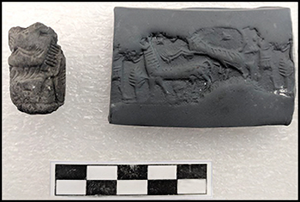
Examples of objects from graves at Tell Billa (objects from the Penn Museum collections); a) various stone and paste beads 33-4-184; b) ceramic lamp 33-4-7; c) ceramic jar 33-4-155; d) seal 33-4-25; e) bronze bracelet 33-4-113; f) iron fibula 32-20-276 (photographs by author).

Example assemblages related to wealth–value index (see Table S2 for more examples).

Although largely subjective, simplifying the vastly varying grave assemblages in this manner allows for a general comparison of the wealth of each grave. The process involved totalling all goods included in each grave, identifying the quantity of certain ‘types’ (ceramic vessels and adornment items, for example) and noting the materials used (metals, especially gold and silver, were common enough to be useful in measuring differences but rare enough to still denote wealth differences). The steps were:
1. Total the number of artefacts and divide into relevant categories (see Table 4), assigning ‘base values’ from category numbers alone. Of these categories, rings, bracelets, pins and seals were initially considered higher value (though this had the potential to change in step 2).
2. Note particular sub-materials (gold/bronze/iron under bracelets or rings; glazed/plain ceramics) and increase value accordingly. Gold was known to be highly valued in Assyria, and the inclusion of a gold artefact increased the base value to 4, for example. A string of frit beads would be roughly equivalent to a bronze ring, but precious stone beads could be equivalent to gold objects. Higher numbers of precious materials could further raise the value.
3. Identify any unusual form or craftsmanship which may alter value (an intricately carved seal or pendant, for example, might increase the value of the assemblage by a whole point).
Number of graves containing certain types of objects.

To check for consistency, assigned wealth values of grave-good assemblages were regularly compared during the assignment process. Additionally, upon assigning all graves a wealth value, a blind test was conducted in which 100 assemblages were extracted from the database without their identifying information and again assigned a wealth value. Comparing these new wealth values to the original ones, 94 out of 100 examples correlated exactly, demonstrating that there was internal consistency in these assignments. Alongside wealth values, grave types were considered. It should come as no surprise that pit burials often contained poor furnishings, while vaulted brick tombs were typically the richest. Ratios of grave types are presented in tandem to account for this variation in labour and resources devoted to encasing the dead. In cases where tombs held more than one instance of burial (such as internal sarcophagi or distinct walled areas), these were considered as separate graves with their own mortuary assemblages.
There are several drawbacks to employing this system. First, while based on a combination of qualitative and quantitative characteristics of assemblages, the ranking system itself is not proportional. This is by design; mortuary wealth varies so dramatically in Assyrian contexts (from many graves with no objects to several with more than 100, including many of precious materials) that ranking grave assemblages proportionally would, for example, effectively erase any distinction between graves of rank 1 and rank 3. The consequences of being exponentially ranked instead of proportionally mainly revolve around difficulties in employing typical statistical tests for comparison, such as the popular Gini coefficients and others like Atkinson's inequality measure and the Theil index (Peterson & Drennan Reference Peterson, Drennan, Kohler and Smith2018; Fochesato et al. Reference Fochesato, Bogaard and Bowles2019). However, Gini tests on mortuary assemblages in other regions have reflected on difficulties in synthesising values between assemblages (Windler et al. Reference Windler, Thiele and Miller2013). Additionally, Gini coefficients are most useful when analysing a complete set of contained data. Others have attempted to use grave sizes (Yu et al. Reference Yu, Chen and Fang2019), yet this approach would present little in the way of variance with Mesopotamian graves.
While the 1184 graves in this study form a huge subset of Assyrian mortuary culture, we reach a stumbling block when encountering meaningful comparisons with royal graves—the majority of which were looted or desecrated, and therefore have an indeterminable wealth value. Non-elite graves were occasionally the subject of looting as well, though much less often and restricted to reaccessible tombs. All instances of looted mortuary contexts recorded by the excavators (38/1184) were removed from consideration in this study. Restrictions on mortuary practices between classes, such as sumptuary laws, could also affect the assessment. However, no textual or archaeological evidence for Assyrian sumptuary laws restricting burial/funerary practices exists (the one example of such a law deals with which classes of women were allowed to ‘veil’ (Jastrow Reference Jastrow1921)) and we may therefore proceed with caution.
Without including graves from the highest ranks of society, it is impossible to comprehensively calculate for absolute indices of inequality within the dataset. Instead, the most meaningful results are produced from comparison between periods: assessing the overall trends in mortuary wealth between graves from comparable socioeconomic groups. The benefits of approaching this dataset via wealth values outweigh the drawbacks because, mainly, they: a) produce a simplified metric to assess general grave content wealth; b) encourage reproducibility of results and application of the system to other mortuary datasets; c) use an adjustable system to account for different emic views of value.
Results
The Assyrian core
The Assyrian centre of Aššur was located on the west bank of the Tigris River, serving as the focus of imperial culture. Though it lost its original status as imperial capital in the ninth century BC, the cultural and religious importance of Aššur continued unmatched in the Assyrian psyche, and it remained an important city until the fall of the empire in 612 BC. During excavations carried out in the early twentieth century, 968 graves from the Late Bronze Age to the Iron Age were uncovered and recorded, forming the largest set of mortuary material from any Assyrian site (Haller Reference Haller1954; Pedde Reference Pedde2015). Of these, 934 showed no evidence of looting or postmortem disturbance and were included in this study. As is typical of Mesopotamia, graves were often found under houses (68% of graves were from domestic contexts; Miglus Reference Miglus1996; Hauser Reference Hauser2012), others came from public areas or contexts with unknown use. Vaulted tombs were built to be reaccessed, allowing for both the postmortem care of the deceased and the subsequent addition of bodies, while others were placed in standard graves of various types.
Overall, the graves from Aššur reveal an average general wealth value of 2.3, with 209 graves of 934 (22.4%) containing no objects (and therefore, a wealth value of 0). The next most popular wealth value was 1 (175)—usually consisting of one or two ceramic vessels and possibly a string of beads (Table 4). Graves with a wealth value of 1, 2 and 3 are present in almost equal numbers. Ceramics are the most common grave goods, while beads and metal rings (bronze or copper) are also popular. Graves with a wealth value of 4 are also common (116 out of 934) and from here the frequency of corresponding graves decreases as wealth values increase: 56 graves have a wealth value of 5, 26 have a value of 6, 21 have a value of 7, 10 have a value of 8, seven have a value of 9, and only one example (Tomb 45 from the Late Bronze Age; Feldman Reference Feldman2006) has a wealth value of 10—the richest grave within the scope of this research.
In the Late Bronze Age, 33 of 225 graves (15%) contained gold objects, while 18 contained silver (8%). In the Iron Age, 60 of 709 (9%) graves contained gold while 90 (13%) contained silver. This increase in silver grave goods from the Late Bronze Age to the Iron Age is notable. One possibility is that this new use of silver was due to a new availability of the material once the Assyrian Empire conquered silver-mining regions. Objects typically made from copper, bronze or gold (for example, rings) were increasingly made from silver: likely reflecting a shift in day-to-day objects/jewellery as well as in burial practices.
Plotting wealth values against the number of graves (Figure 5) reveals differences between the mortuary assemblages of the three phases at Aššur. The Late Bronze Age seems fairly egalitarian, with a two-hump model emerging around values 0 and 3. In the Transition phase a sharper decrease is noted between values 3 and 4, and 4 and 5, which is carried further in the Iron Age—showing a higher number of lower value burials in the Iron Age and a sharper disparity in wealth between these and the richest graves. The Transition phase shows a gradual upwards trend from the Late Bronze Age in wealth and the number of objects, but also points to a growing wealth disparity which is strengthened further in the Iron Age. Notably, 46 per cent of Late Bronze Age graves have a wealth value between 0 and 2, compared to 60 per cent of Iron Age graves. This shows a significant change between the two periods and signals one of two possibilities: a growing wealth disparity between classes or shifting mortuary practices placing less emphasis on grave goods.
Wealth values of graves and distribution of grave types at Aššur. Note the sharp decline of richer graves in the Iron Age (IA), as opposed to the more equal distributions of the Late Bronze Age (LBA) and Transition period (figure by author).

The Assyrian provinces
To further explore this trend, it is necessary to expand beyond the imperial heartland. Inhabited in both the Late Bronze Age and Iron Age, the Assyrian holdings in north-eastern Syria (within the Upper Khabur and Balikh river valleys) and their lands adjacent to the imperial core in northern Iraq, show a gradual adoption of more ‘Assyrian’ grave characteristics, showcasing the effects of imperial Assyrian hegemony (Creamer Reference Creamer2021). North-eastern Syria was first conquered and ruled by the Assyrians in the thirteenth century BC; the nature of Assyrian control was flexible but waned in the aftermath of the Late Bronze Age Collapse (Machinist Reference Machinist1982; Miller Reference Miller2009). Textual evidence from Tell Bderi and Tell Ta'ban reveals that Assyrians were still present in some capacity within this area after the collapse, mentioning the local governor Aššur-ketti-lešer c. 1100 BC (Ohnuma & Numoto Reference Ohnuma and Numoto2001). By the end of the tenth century, Iron Age rulers began to re-establish themselves in the Khabur, successfully campaigning against polities to the west (Kühne Reference Kühne and Liverani1995; Parpola Reference Parpola, Denver and Gitin2003). Enemy territories in this area were first reduced to tributary status, supervised by Assyrian control points located at main settlements, before becoming provinces (Postgate Reference Postgate1992; Llop Reference Llop2011).
Of the 216 graves from provincial sites, four were potentially looted in antiquity and were removed from the study. There is a clear shift in mortuary wealth between the Late Bronze Age and Iron Age (Figure 6). In the provinces, several trends in grave goods become evident. Late Bronze Age graves ranged from 0–9 in wealth, with some graves containing over 50 objects. The average wealth value of this period was 2.4. Iron Age assemblages are markedly poor by comparison; the richest grave from this period ranks at 6, and the average wealth value among Iron Age graves was 1.7. Twenty per cent of graves contained no objects at all, and no gold objects were found in Iron Age mortuary contexts. Instead, the single highest-value piece from this period was a silver pendant, found at Tell al-Hamidiya in Grave G4 (Wäfler Reference Wäfler2004: 83). In contrast, 12 Late Bronze Age graves contained gold objects. Furthermore, all vaulted tombs from this dataset (the grave type requiring the most resources and labour) were from the Late Bronze Age—showcasing the wealth of some families. Localised wealth is also absent in the Iron Age.
Wealth values of graves and distribution of grave types in provincial contexts. LBA: Late Bronze Age; IA: Iron Age (figure by author).

Discussion
From the mortuary evidence presented here, we encounter a seemingly ubiquitous model of unequal wealth distribution, present both in the Assyrian imperial core and in the provinces. With historical evidence for growing bureaucracy in the Iron Age and sequential administrative reforms put into place by the Sargonid dynasty during that period, this appears to go hand-in-hand with increasing power within the Assyrian royal family (Zaia Reference Zaia2018). Galil (Reference Galil2007: 288) argues for a widening gap between the classes of Aššur in the seventh century specifically, citing smaller family sizes of the lower strata (average of three people) while higher-status families remained large (average of five or six). To what extent does a shifting wealth distribution in mortuary contexts reflect this potential widening divide between classes? What was the cause for this decrease in wealth in mortuary contexts?
There are no easy answers to these questions, as the relationship between mortuary rituals and the means of the living is not a straightforward one. In the Late Bronze Age, it is evident that higher-status families—at Aššur and elsewhere—prepared richer, more elaborate graves, including evidence for feasting and postmortem care, seemingly regardless of ethnic identity or familial group (Feldman Reference Feldman2006; MacDougal Reference MacDougal2014). The deceased in northern Mesopotamia were buried with as elaborate furnishings as possible. This tradition holds true across many of the ethnic groups known from contemporary records (Creamer Reference Creamer2021), therefore a significant absence of wealth in mortuary culture cannot be explained away by differing mortuary practices between groups. The wealth of graves seems dependent upon the resources to which the living community had access, thereby confirming mortuary wealth as a tentative reflection of living wealth. The expansion of the lower class and the decrease of overall wealth, then, may have been a result of intensive resource extraction from provinces.
It is important to consider that this disparity, rather than being due to a single factor, is instead likely a combination of many. Increased numbers of resettled deportees in the Khabur and heartland, while provided with land and resources to an extent, essentially had to ‘start over’ in their new environment, where much of their production would be seized by the crown as tax. While leaving enough for the families to survive on, this gave little opportunity for deported communities to build up wealth. Increased demands by the crown for corvée labour and increased taxes weakened the lower classes over time while strengthening the upper classes, culminating in the stark divide seen in the mortuary wealth of the Iron Age. Finally, an increased dependence upon imported labour may have diminished the importance (and demand) of local craftsmen and tradesmen, as illustrated in Radner's (Reference Radner and Frahm2017: 221–23) exploration of a well-to-do Assyrian scribal family, left in the lurch with debt accrued and no job prospects. Even workers in once-secure ‘middle-class’ positions found their livelihoods drying up as the empire expanded its reach. While it is questionable whether the ‘rich got richer’ in this case, it is apparent that the poor did indeed get poorer. Historical documents considered in tandem with this evidence could connect an influx of deportees and other foreign workers into the heartland to provide labour and resources to the crown with an expanding lower class, while the upper class remained static.
Conclusions
The evidence presented here points to a growing wealth disparity in mortuary contexts within heartland and core provinces of the Assyrian Empire. This mortuary wealth seems to reflect the situation in living communities, showing a widening gap between the lower and upper classes in the Iron Age where Assyrian subjects were significantly poorer than they were in the Late Bronze Age. Parallel evidence from inequality studies conducted using other metrics, such as household sizes, generally find a similar increase in inequality between the Late Bronze Age and Iron Age (Stone Reference Stone, Kohler and Smith2018; Basri & Lawrence Reference Basri and Lawrence2020; Squitieri & Altaweel Reference Squitieri and Altaweel2022). Comparing the wealth in mortuary contexts between the two periods has shown that not only was less wealth available to non-elites in the Iron Age, but also that this was true for inhabitants both in the capital and in provincial centres, meaning that strategies of extraction were not limited to those beyond the Assyrian core. Instead, imperial governance brought with it an ever-expanding practice of extraction from its subjects.
Overall, this study has shown the utility of a system focused on the mortuary wealth of the deceased, emphasising exponential scaling based on assigning simple numerical values to assemblages. The wealth–value index is replicable, but exact scaling must be fitted over a dataset using its own grave-good assemblages as the referential range. The scale itself can be changed, and the ranking exemplified in this study (with example assemblages and blind re-ranking) allows for internal consistency. Furthermore, there needs to be some assurance that grave goods are not exclusively tied to ethnic or group markers—a difficult task without accompanying textual sources. The ability to simplify large, complex datasets is critical to fostering comparison between temporally and geographically distinct mortuary contexts. Such comparisons allow for broader conclusions on wealth consistency, resource access and extraction practices under state and empire that otherwise, in many cases, remain inaccessible.
Acknowledgements
I would like to thank the Penn Museum and the Vorderasiatisches Museum for access to the materials from the Tell Billa and Aššur graves, respectively. Additional thanks are owed to the Penn Museum Archives, where I was able to reconstruct much of Tell Billa's excavations. I am indebted to Dominik Bonatz for allowing me to research the graves discovered at Tell Fekheriye, and Peter Bartl and Friedhelm Pedde for their advice during my time in Berlin.
Funding statement
This project was supported by a Fulbright Research Fellowship to Germany and funding from the University of Pennsylvania's Price Lab for Digital Humanities.
Supplementary material
To view supplementary material for this article, please visit https://doi.org/10.15184/aqy.2024.81.


 Open access

